Content Marketing for Plastic Surgeons: A Strategy Built for the 8-Month Patient

If you've been publishing blog posts for a year and your consultation volume hasn't moved, the problem probably isn't that you're not publishing enough. It's that your content was built for the wrong patient.
If you're the person responsible for marketing at a plastic surgery practice, whether you're the surgeon, the practice manager, or the marketing coordinator who got handed a blog login and a "we need more content" directive, you already know this feeling. You've published the procedure explainers. You've written the recovery guides. You've got a blog with thirty posts that gets decent traffic and produces almost no bookings you can point to. Leadership wants results. Paid search costs are climbing. And you're trying to figure out whether the content program is broken or whether you just need more time.
Most plastic surgery content is written as if patients decide in a weekend. A few Google searches, a before-and-after gallery, a call. That's the urgent care model: need arises, patient acts. Plastic surgery doesn't work that way.
In the practices we work with, rhinoplasty patients commonly research for 8 to 18 months before booking a consultation. They start with curiosity ("could I fix this?"), move through months of passive research, then active comparison, then the emotionally charged process of finding a surgeon they trust with their face. That journey touches dozens of pieces of content across multiple platforms, and most of it happens before they ever fill out a form.
Content marketing for plastic surgeons only works when it's designed around that journey, not around a channel list, a posting schedule, or a keyword spreadsheet. This guide covers both the architecture and the operations: which content serves each research stage, how procedure pages and blog clusters fit together, how to produce it without burning surgeon time, how to measure a program whose results arrive months late, and how the same work earns citations in AI search. The frameworks draw on what we see auditing practice content programs and on two Brown Bear studies of what actually ranks, one of the #1 procedure pages in 101 cities and one of the pages ranking for 50 procedures' before-and-after searches. By the end you'll have a stage map for the content you already have, a cluster plan for one procedure, and an attribution setup that makes the budget defensible. Start with why this niche plays by different rules than almost any other content category.
Key Takeaways
Rhinoplasty patients commonly research for 8 to 18 months before booking
Content built for a weekend decision cycle misses nearly the entire patient journey, and most practice blogs are doing exactly that.
Most practices only publish decision-stage content
Patients move through five distinct research stages; skipping the curiosity, research, and shortlisting stages means missing most of the patients who are still deciding.
Fix the procedure page before the blog
In competitive metros, the #1 procedure pages in our 101-city study run 2,000 to 2,500 words in a recognizable section order. A 300-word hub wastes every post that links to it.
A complete topic cluster requires 15 to 20 supporting posts per procedure
Thin hub pages without surrounding content structure generate impressions without conversions.
Expect 25 to 40% of consults influenced by content by month 12
Content marketing compounds over time: patient attribution shows up in the second half of year one, not month two.
Why Content Marketing Hits Differently in Plastic Surgery
Most industries publish content to capture demand. Plastic surgery content has to create the conditions for a decision that most patients weren't fully sure they wanted to make.
That distinction changes what you write, how you write it, and what success looks like. A patient in month two of their research doesn't need a call to action. They need a surgeon who sounds like they understand what the patient is going through: the hesitation, the self-consciousness, the worry about outcomes, the uncertainty about whether this is something "people like them" do. The content that wins their trust at that stage is invisible in your analytics but decisive in their eventual choice.
Google recognizes this complexity in how it evaluates plastic surgery content. Its Search Quality Rater Guidelines treat health topics as YMYL (Your Money or Your Life) and hold those pages to very high quality standards, and a procedure that permanently changes someone's body sits squarely in that territory, even though the guidelines never name cosmetic surgery specifically. Generic blog posts written to cover a keyword don't just underperform in plastic surgery. They actively work against you, signaling to Google that your site isn't a credible medical resource.
Plastic surgery also operates in luxury purchase psychology. Patients are not buying out of necessity. They're investing in a permanent change to how they look and feel. The cognitive weight of that decision is closer to buying a house than booking a dental cleaning. Content that ignores that weight, skipping straight to features and benefits, never connects with the patient who's actually ready to book.
For marketing managers trying to show ROI on a content program, this is actually good news: the measurement problem isn't that content doesn't work. It's that content works on a timeline that doesn't fit inside a monthly report. The rest of this guide is about building a program that accounts for that timeline from the start, so you can defend the investment and see where it's working before leadership loses patience.
The Research Cycle: 5 Stages Your Content Needs to Serve
Before you write a single word, you need a map of where your patients actually are when they'll encounter it. The research cycle for plastic surgery patients moves through five recognizable stages, each with a different content need.
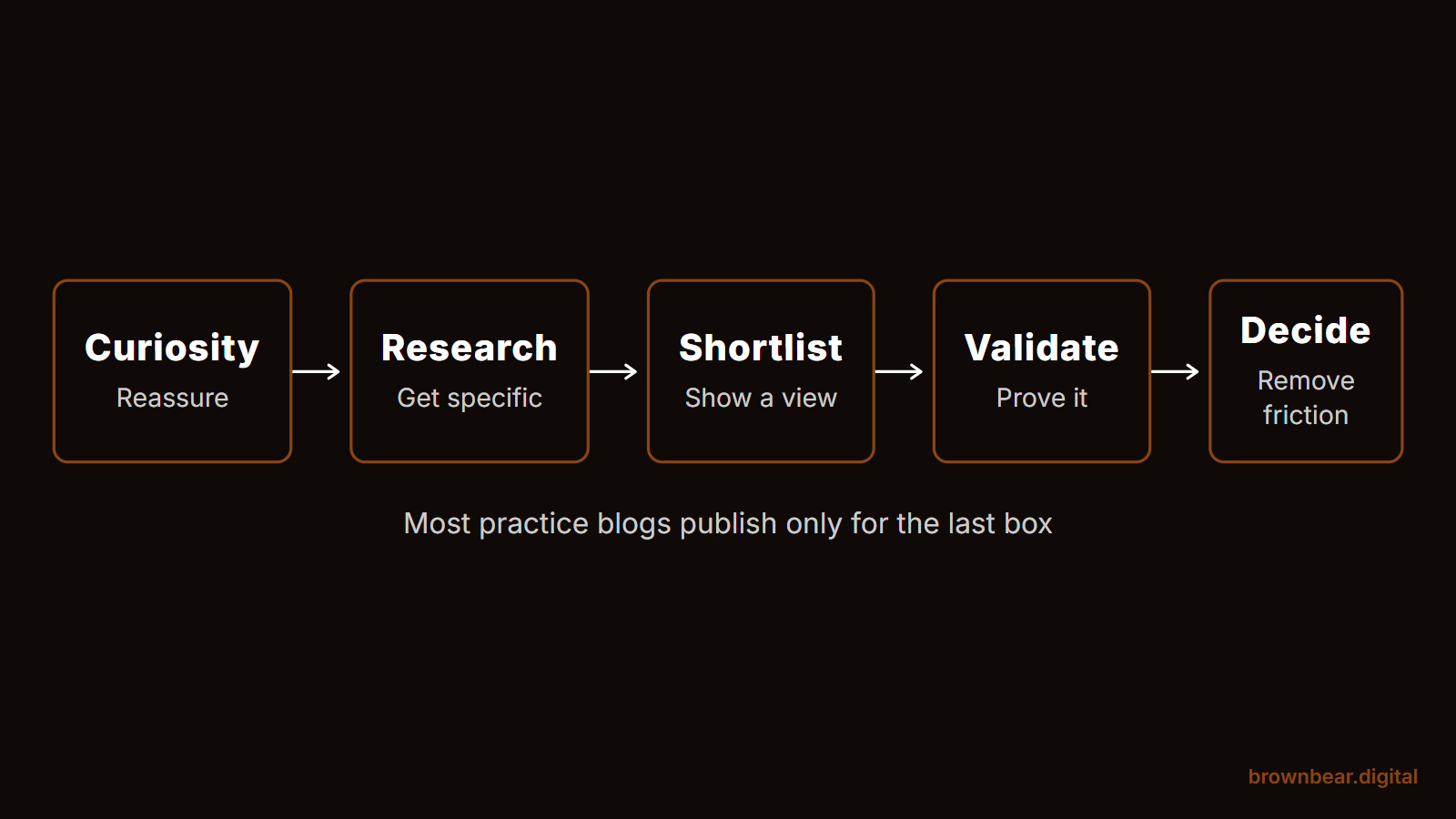
This map is about content. For the platform side of the same journey, from the first Google search through Reddit, YouTube, RealSelf, and the map pack, see the platform-by-platform patient research journey.
1. Curiosity
The patient is wondering. They've had a thought, usually triggered by a photo, a comment, a moment in the mirror, but they haven't committed to thinking of themselves as a potential patient yet. They're asking questions that don't even sound like plastic surgery questions: "Is it normal to not like your nose?" "Are mommy makeovers worth it?" "What's the difference between a board-certified plastic surgeon and a cosmetic surgeon?"
Content for this stage is educational, non-promotional, and genuinely reassuring. It doesn't push consultation. It earns the patient's permission to keep reading.
2. Research
The patient now knows what procedure they're interested in. They're in deep-read mode: recovery timelines, realistic outcomes, risk profiles, procedure variations. This is where most practices have content, but rarely enough of it, and rarely good enough.
The gap in most plastic surgery blogs is specificity. Patients in research mode don't want a paragraph on "rhinoplasty recovery." They want to know exactly what week three looks like, what the swelling pattern means, whether they can go back to the gym at six weeks, what a revision rate tells them about a surgeon. The practices whose content wins at this stage have gone specific in a way that requires real clinical knowledge.
Consider the difference between these two versions of the same recovery guidance. Version one: "Rhinoplasty recovery typically takes two to four weeks, during which you should rest and follow your surgeon's instructions." Version two: "Over the first two to three days, most patients are surprised by how far the bruising spreads around the eyes. This is normal, and it is at its worst early before it fades over the next one to three weeks. The swelling that makes you look puffy rather than post-surgical usually subsides enough to be socially presentable by day ten to fourteen, though your nose will look and feel bigger than its final shape for four to six weeks. The tip of your nose may feel stiff and slightly numb for several months. This is part of healing, not a sign of a problem." The first version could have been written by anyone. The second could only have been written by someone who has actually observed patients through rhinoplasty recovery. That's the difference patients in the research stage are paying attention to, even if they can't articulate it explicitly.
3. Shortlisting
The patient is comparing surgeons. They're reading about multiple practices, paying attention to credentials, reviewing galleries, and starting to form instinctive reactions to different voices. Your content at this stage needs to express a perspective: a point of view on how you approach a procedure, what you prioritize, what you refuse to compromise on.
This is not the stage for generic credential pages. It's the stage where surgeon-voice content, opinion pieces, philosophy essays, and detailed case walk-throughs do more work than any promotional copy could.
An example of what this looks like in practice: a surgeon who publishes a post titled "Why I Don't Perform Rhinoplasty on Patients Under 21" and explains their reasoning, including nasal structure maturity, psychological readiness, and the specific patterns they've observed in outcomes, is doing something no agency-written content can replicate. A patient who reads that post either agrees with the philosophy and feels immediately aligned, or disagrees and self-selects out. Either result is good. The surgeon who has no opinion expressed anywhere in their content gets neither reaction. Just passive scrolling.
4. Validation
The patient has a shortlist of two or three surgeons and is looking for confirmation. They're reading reviews, watching consultation videos, looking at the depth of the before-and-after gallery. They're asking: "Can I trust this person with this outcome?"
Patient stories structured around the emotional journey, not just the physical result, serve this stage. So do first-person posts about what the recovery actually felt like, or content that addresses complications and revision rates directly. Transparency at this stage is not a risk. It's what closes the gap.
5. Decision
The patient is ready. The decision is made emotionally; they're just looking for the rational permission to act. Clean procedure landing pages, pricing transparency (or a framework for discussing it), and a frictionless consultation booking process are what this stage needs from content.
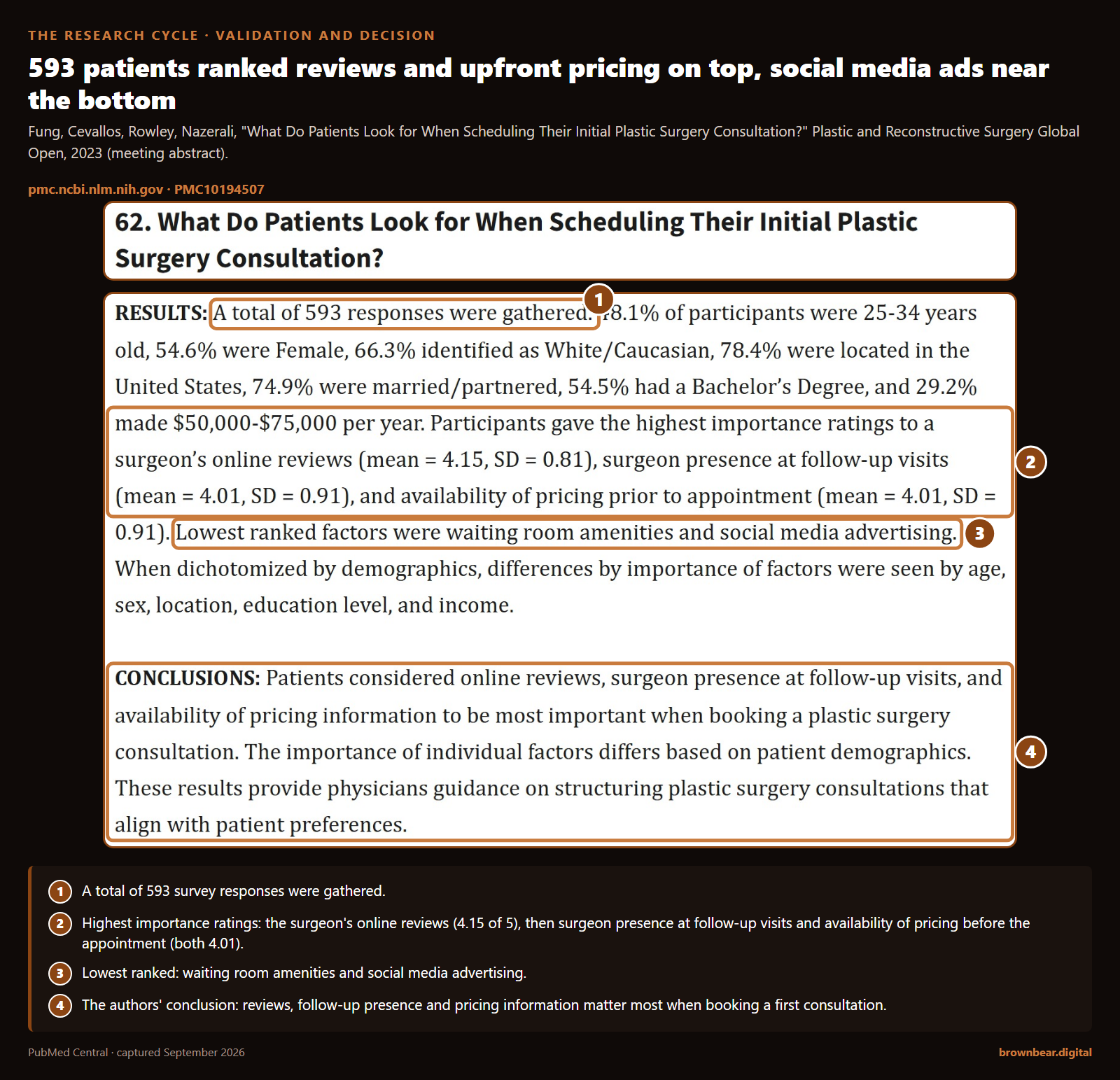
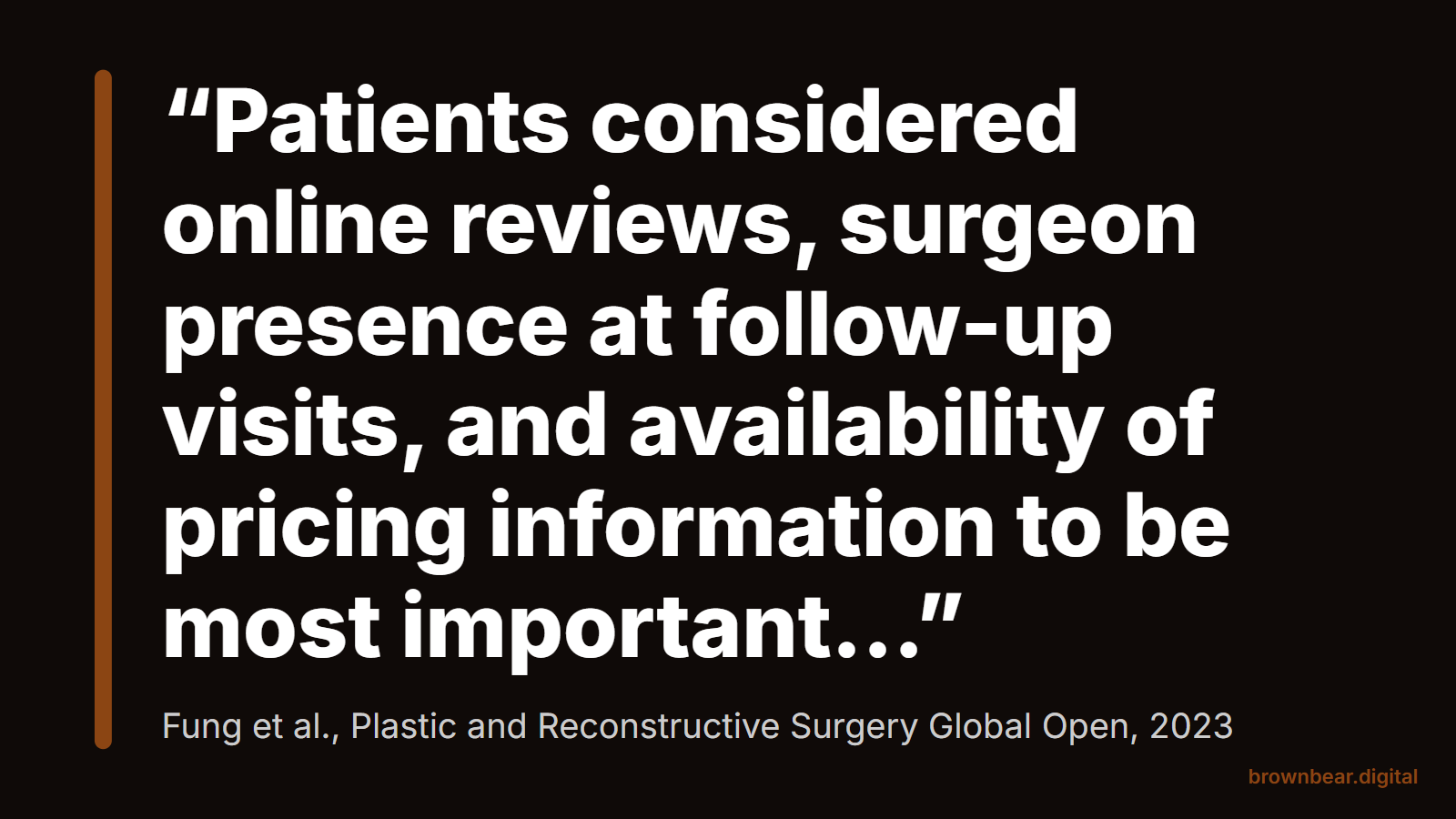
Pricing is the piece most practices resist, and it is the one patients weigh heavily. In a 593-person survey of what patients look for when scheduling a first plastic surgery consultation, published in Plastic and Reconstructive Surgery Global Open in 2023, the availability of pricing before the appointment ranked among the three most important factors, alongside the surgeon's online reviews, while social media advertising ranked among the least important.
Most plastic surgery content is decision-stage content, written to close a patient who's already decided. A complete content program serves all five stages.
If you're a surgeon who manages your own marketing, curiosity and research content is where your clinical knowledge gives you an unfair advantage over any agency writing generic procedure recaps. Nobody knows what surprises your patients at day seven post-op, or what question comes up in every consultation before a patient feels ready to book, except you. That material is the difference between commodity content and content that builds a practice.
Before you plan anything new, find out which of these stages your current library actually covers. Paste your post titles into the Stage Map and it sorts each one into the stage it most likely serves, lets you correct any call, and names the stages you have left empty.
Procedure Pages vs. Blog Posts: Getting the Architecture Right First
Before you plan a single piece of content, you need to understand a distinction that most practices get wrong: procedure pages and blog posts are not interchangeable. They serve different functions, rank for different types of queries, and need to be structured differently.
A procedure page answers the question: what is this procedure, do you offer it, and what does it involve? It targets high-commercial-intent keywords ("rhinoplasty surgeon Dallas," "breast augmentation cost"), and it lives permanently on your site as a service page. It should be detailed, authoritative, and built for a patient who has already decided they want this procedure and is evaluating you specifically. Every procedure you offer needs its own page. Every significant variation, mini facelift vs. full facelift, silicone vs. saline implants, open vs. closed rhinoplasty, may need its own page too. For a procedure-level view of how these pages fit into a full campaign, see our guides to marketing rhinoplasty online and marketing breast augmentation online.
A blog post answers a question the patient has at an earlier stage: "What does rhinoplasty recovery feel like?" "How do I choose between rhinoplasty and a non-surgical nose job?" "Am I a good candidate for a tummy tuck?" These target informational queries, the kind patients type in months 2 through 12 of their research cycle. Blog content doesn't convert directly. It captures patients early, builds the relationship, and feeds them back to your procedure pages and consultation form over time.
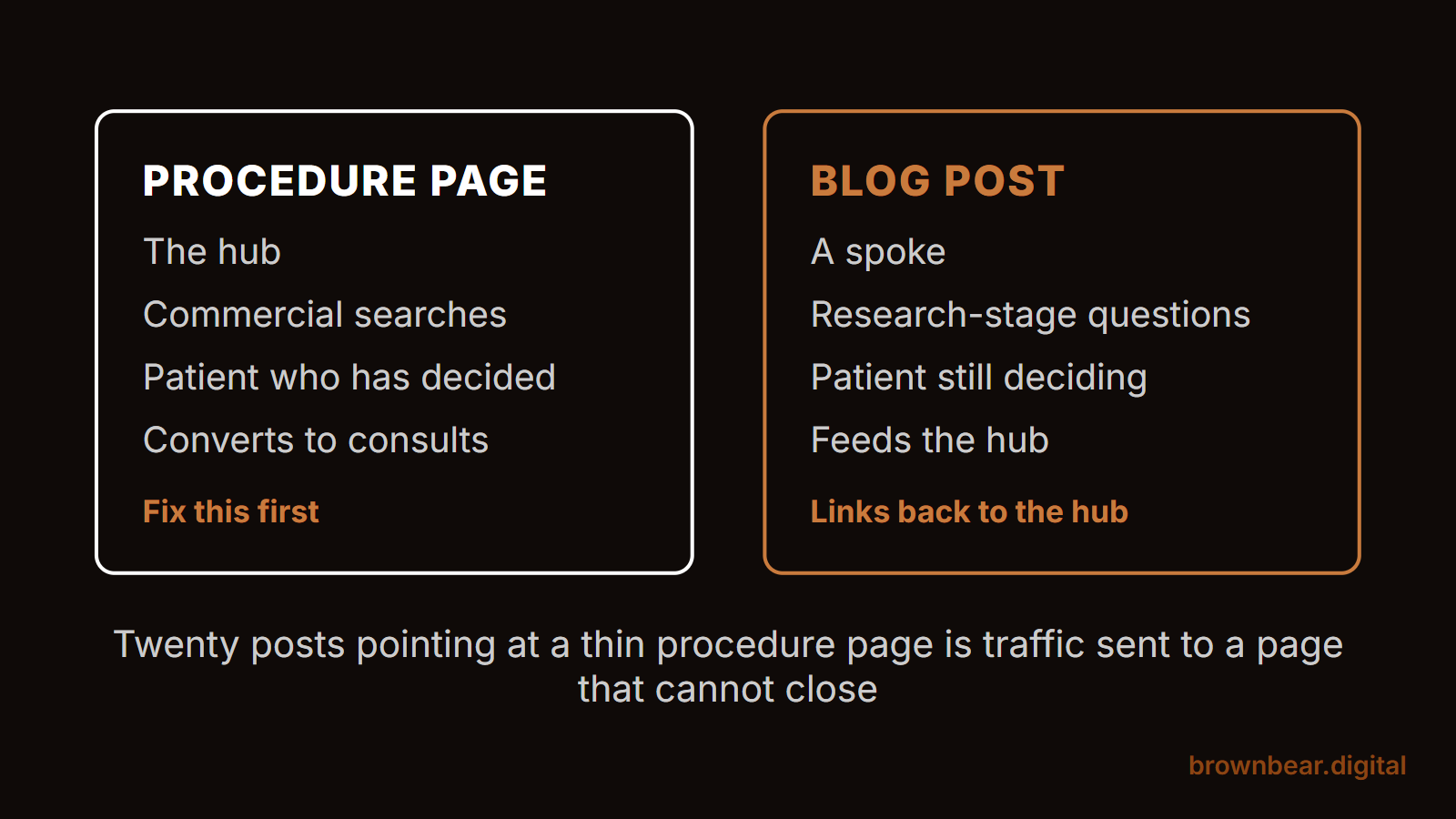
The two types work together in a specific way. Your procedure page on rhinoplasty is the hub. Your blog posts on rhinoplasty recovery, rhinoplasty for men, ethnic rhinoplasty considerations, and choosing a revision rhinoplasty surgeon are the spokes. Every spoke links back to the hub. The hub links to the most relevant spokes. This architecture (a topic cluster) tells Google that your site covers rhinoplasty with genuine depth, not just a single page's worth of content.
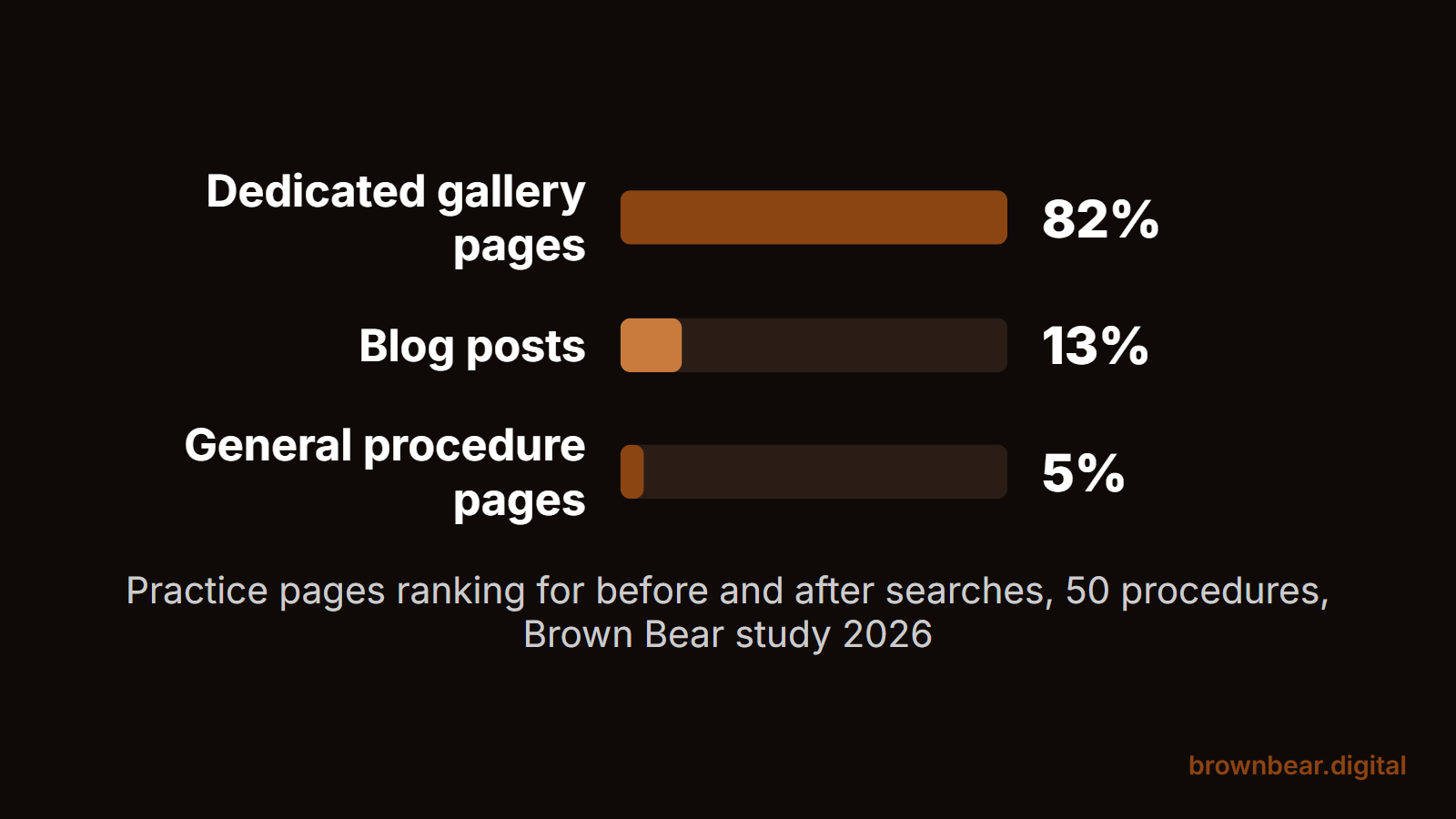
There is a third asset type this hub-and-spoke picture usually leaves out, and the data says it belongs in the plan. Our 50-procedure before-and-after gallery study found that photo queries go almost entirely to dedicated gallery URLs, 82% of the ranking practice pages, while general procedure pages take only 5%. The second route is the one a content program should care about: 13% of the pages ranking for those queries are blog posts, and the practice with the widest national footprint in the study ranks on six separate procedure keywords mostly through patient transformation write-ups. Those posts carry what a photo grid cannot, publishing real dollar figures at 17% against the gallery cohort's 5% and FAQ content at 62% against 42%. Written properly, a transformation post is a spoke that ranks on its own.
If you're publishing blog posts without procedure pages that are detailed and well-optimized, you're building spokes without a hub. The blog content will underperform because Google has no anchor to cluster it around.
One of the most common situations we see when auditing plastic surgery content programs: a practice has twenty blog posts about rhinoplasty and a procedure page that's 300 words of generic copy. All the blog effort is pointing to a page that can't convert. Getting the procedure pages right before scaling blog output is the correction that produces the fastest visible improvement, and it's the first thing worth auditing if your content isn't producing results. Our 101-city study of #1-ranking procedure pages shows what that 300-word page has to become: in competitive metros the winners cluster at 2,000 to 2,500 words and run a recognizable section order, explainer, options, candidacy, recovery, gallery, meet the surgeon, cost and financing, an FAQ of roughly eight questions, then the consultation CTA.
What to Actually Write: Content That Serves the Whole Cycle
Top-of-funnel content (the curiosity and research stages)
educates without pushing. These posts should be 1,200 to 2,000 words, specific enough that they couldn't have been written by someone without real clinical experience behind them. Examples:
- "What's the difference between a tummy tuck and a mini tummy tuck." A genuine comparison with specific candidacy criteria, not a promotional pitch for either option.
- "How long does rhinoplasty swelling last." A week-by-week timeline with the specific milestones patients care about (when you can go back to work, when photos look like your final result).
- "What to eat during facelift recovery." Practical, actionable, and useful enough to be shared.
- "Am I a good candidate for a mommy makeover." A candid post about what actually makes someone ready versus not ready, physically and psychologically.
Middle-of-funnel content (the research and shortlisting stages)
builds comparison confidence and positions you as the guide rather than just another option. Examples:
- "How to evaluate a plastic surgeon's rhinoplasty portfolio." This tells patients what to actually look for (starting anatomy that's similar to theirs, consistency of results across patients, natural-looking outcomes rather than a single aesthetic), which subtly demonstrates what your own portfolio has.
- "What board certification actually tells you, and what it doesn't." A transparent post that explains the difference between board-certified plastic surgeons and cosmetic surgeons without being sycophantic about your own credentials.
- "The most common reasons patients seek revision rhinoplasty." Written with real clinical candor, this post attracts patients who are already skeptical of the process and builds disproportionate trust.
Bottom-of-funnel content (the validation and decision stages)
removes final objections and confirms trust. Examples:
- Patient stories structured around the emotional arc: the hesitation, the decision, the recovery experience, and what changed, not just the before-and-after photos
- Surgeon philosophy pieces: "What I look for before agreeing to perform a rhinoplasty" or "Why I turn down certain procedures," posts that demonstrate judgment, not just capability
- "What happens at our consultation." A transparent, step-by-step walkthrough of exactly what the patient will experience, which dramatically reduces the anxiety that prevents patients from booking in the first place.
- Posts about complications: "What we do when a patient isn't happy with their result." This is the most counterintuitive content for most practices to publish, and often the highest-trust piece on the entire site.
The Commodity Content Trap
There is a specific failure pattern in plastic surgery content marketing, and if your blog isn't converting, you're probably in it.
The pattern: a practice publishes a rhinoplasty article that defines rhinoplasty, lists the types, describes a generic recovery, and ends with "contact us for a consultation." Then they publish the same structure for breast augmentation, liposuction, and blepharoplasty. The articles generate some traffic and produce almost no consultations.
This is commodity content. It contains no information that a patient couldn't have found in sixty seconds on any of the other fifty plastic surgery sites covering the same topic. Google has been explicit about this since its first helpful content update in August 2022, which targeted content made mainly to rank rather than to help, and in March 2024 it folded that system into its core ranking systems, so thin, repetitive pages are now weighed on every core update. It is also the first of the AI SEO mistakes medical clinics are making right now: publishing at volume with no angle and nothing only your clinic could say.
The test for information gain is simple: read your draft, then ask whether a patient who has spent three months researching this procedure would learn anything from it that they don't already know. If the answer is no, the post isn't ready.
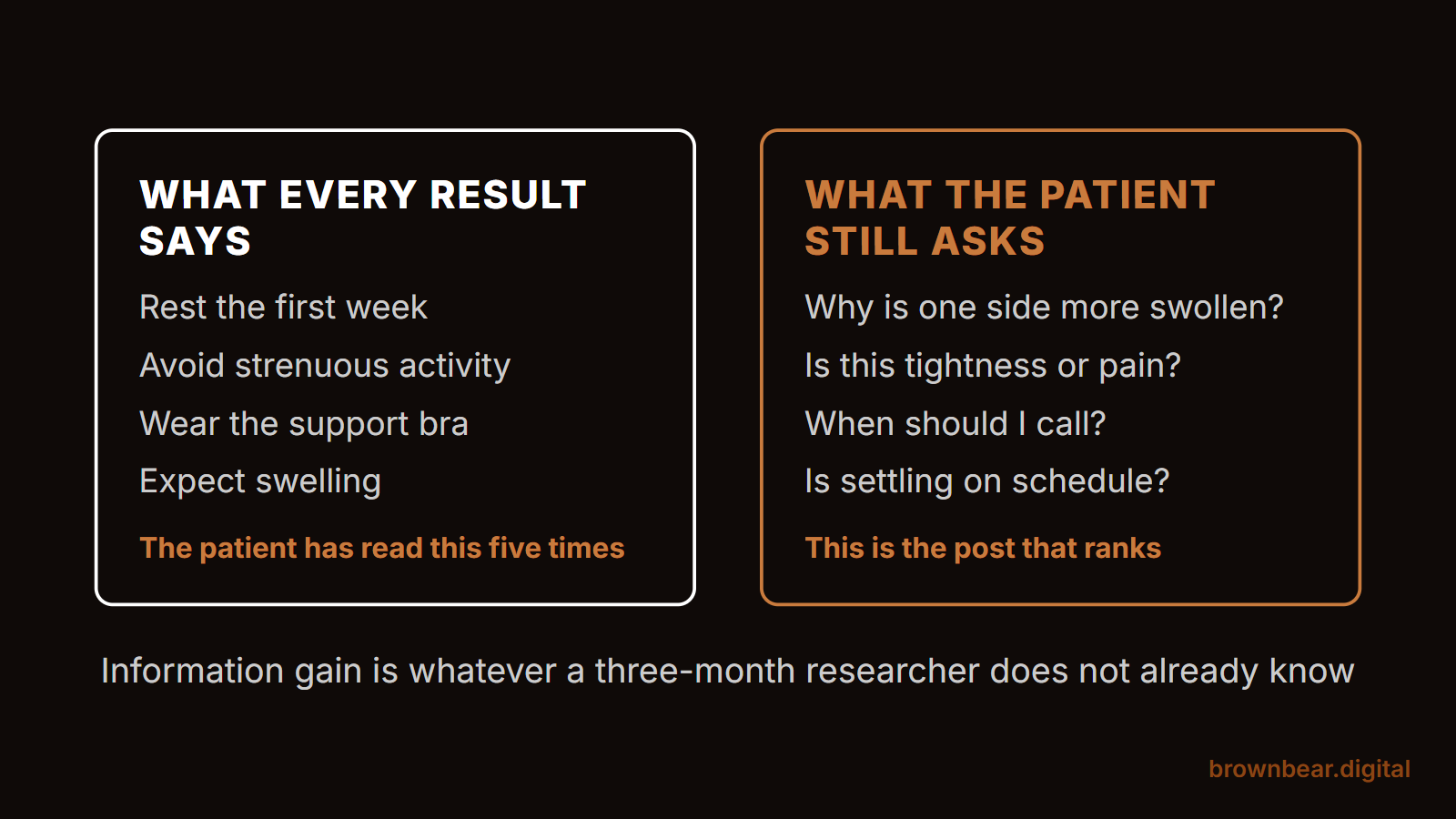
Here's a real example of the gap. Search "breast augmentation recovery" and read the top five results. You will find, repeated across nearly all of them: rest for the first week, avoid strenuous activity for four to six weeks, sleep on your back, wear your surgical bra, expect swelling and tightness. Every single patient researching this procedure has already read those instructions. A post that publishes them again is invisible. Now consider a post that covers what to do when the swelling is asymmetric in week two (often temporary, and here's why), how tightness feels different from incisional pain and when to call versus wait, and what "dropping and fluffing" actually looks like in terms of timeline and how to know it's progressing normally. That post is serving a patient who has read everything else and still has unanswered questions.
You can run this test on your own drafts. Paste a paragraph below, or load the two recovery-guidance versions from earlier in this piece and watch them score:
Interactive litmus test
The Commodity Content Detector
Paste a paragraph or section from your draft. A transparent heuristic — not an AI — counts hedge language against specificity anchors (day and week references, percentages, named milestones) and scores the information-gain density. Or load the two recovery-guidance examples from this article and watch the gap. Your text stays in your browser; nothing is sent anywhere.
Hedge language found:
For informational purposes only; this is a simple pattern-matching heuristic, not an assessment of clinical accuracy or a guarantee of rankings, and not professional advice. Your text stays in this browser and is never transmitted.
Non-commodity plastic surgery content is built on three specific inputs:
- Real clinical perspective. Not "recovery takes two to four weeks," but what you actually observe in your patients at days three, seven, and fourteen: the specific things that surprise them, what they should prepare for, what most surgeons don't mention. The content that requires genuine clinical experience to write is the content competitors can't easily replicate.
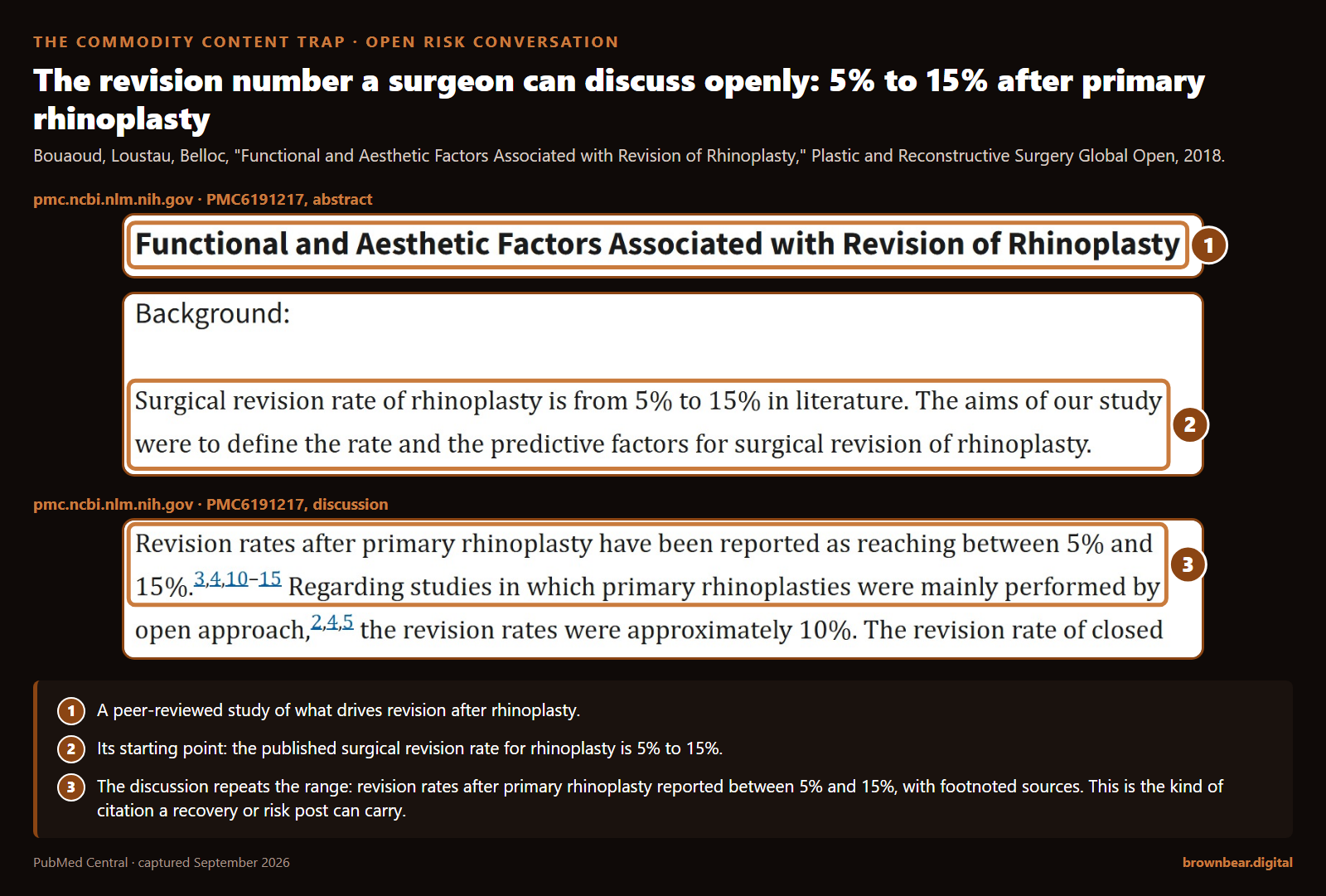
- Open risk conversation. Patients in research mode are actively looking for surgeons who will talk openly about complications. A post that addresses revision rates, realistic outcome variability, and what to do if you're unhappy with your result builds more trust than one that only shows success stories. Published revision rates after primary rhinoplasty run roughly 5 to 15%, the range cited in a 2018 study of the factors behind rhinoplasty revision. A surgeon willing to discuss that openly, and explain what drives revisions, is demonstrating exactly the kind of transparency that attracts patients who are doing serious research.
- A stated point of view. On technique. On candidacy. On what makes someone a good candidate versus a bad one. On the procedures you believe are overperformed in your market. Surgeons with genuine opinions about their craft attract patients who are specifically looking for that surgeon, not just any surgeon, and those patients are dramatically more likely to book and proceed.
YMYL and What It Means for How You Write
Every piece of content you publish about plastic surgery will be evaluated against Google's E-E-A-T framework: Experience, Expertise, Authoritativeness, and Trustworthiness. Because health content falls under YMYL, the bar is higher than for most content categories. We cover why this niche faces the higher bar, and what gets suppressed when you miss it, in the YMYL standard in plastic surgery and AI search.
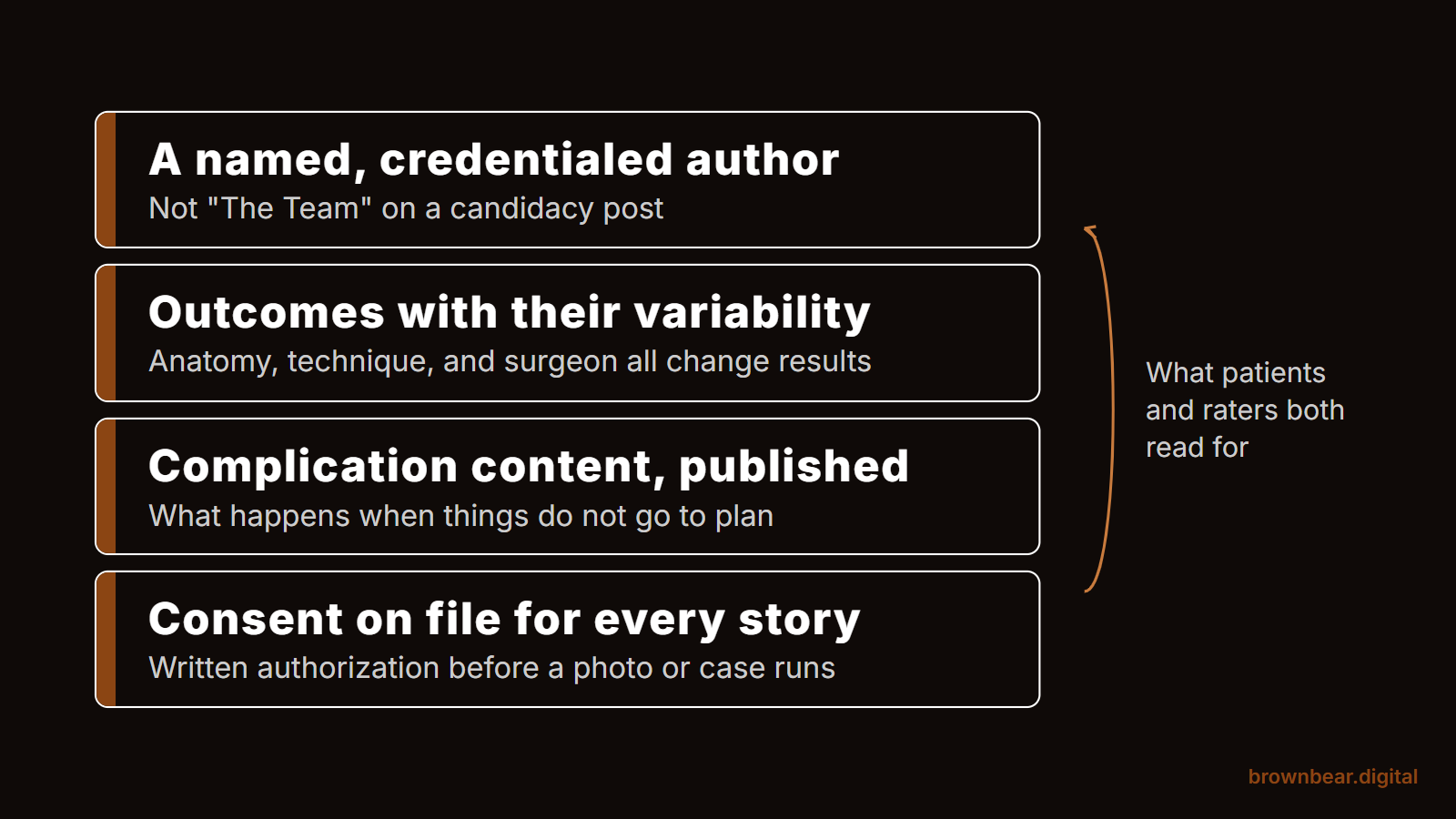
Every clinical blog post should have a named author with verifiable credentials.
"The Team" is not sufficient for a post advising patients on rhinoplasty candidacy. A board-certified plastic surgeon's name, their qualifications, and a link to their bio is what gives that post E-E-A-T credibility.
Claims about outcomes need to state their variability.
Posts that imply all patients achieve a certain result, without acknowledging that outcomes vary by anatomy, technique, and surgeon skill, read as promotional rather than educational, and Google treats them that way.
Risk and complication content is not a liability.
It's a trust signal. Practices that publish open, detailed content about what happens when things don't go as planned are more credible under E-E-A-T than practices that only publish success narratives.
HIPAA compliance governs patient stories.
Before-and-after photos and patient case studies require explicit written authorization specifying where and how the content will be used. This isn't just a legal requirement. The way you handle patient consent in your content is itself a trust signal to prospective patients reading it.
Topic Clusters: The Architecture That Compounds
A single blog post on rhinoplasty will rank for a small number of keywords and plateau. A topic cluster, built around a central pillar page and supported by fifteen to twenty posts that each address a specific patient question, compounds over time in a way that standalone posts never do.
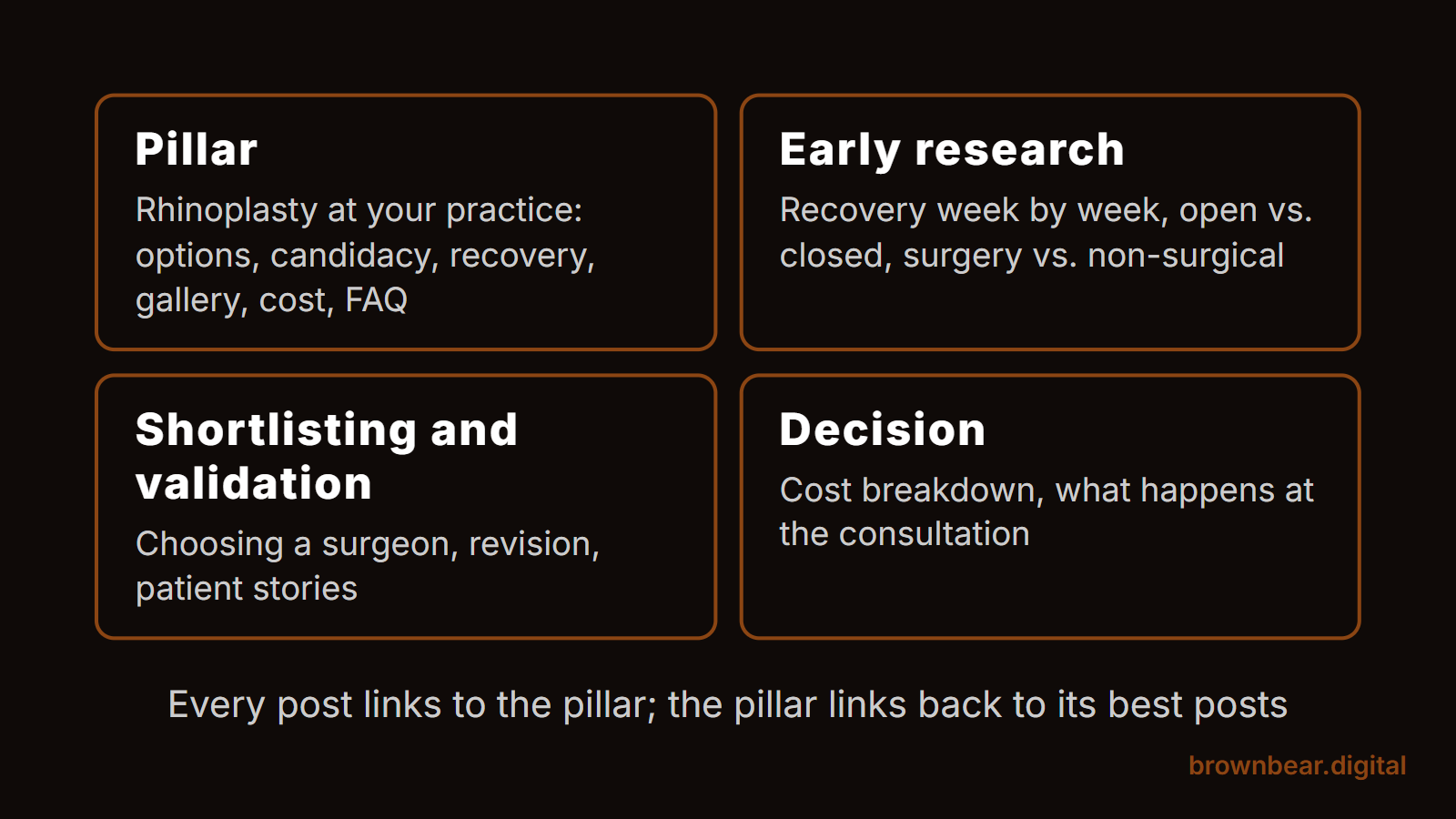
Pillar page:
Rhinoplasty at [Practice Name]. Comprehensive, covering the procedure, types, candidacy, recovery, surgeon credentials, gallery, and consultation CTA.
Supporting posts:
the ten below are the core; the rest come from the questions your own consultations keep raising.
- Rhinoplasty recovery week by week
- Rhinoplasty for men
- Ethnic rhinoplasty considerations
- Open vs. closed rhinoplasty
- Rhinoplasty and septoplasty: what's the difference
- How to choose a rhinoplasty surgeon
- Revision rhinoplasty: why patients seek it and what to know
- What to expect at your rhinoplasty consultation
- Rhinoplasty cost breakdown
- Non-surgical rhinoplasty vs. surgery: a side-by-side comparison
Most practices should build one cluster at a time, starting with their highest-revenue procedure. Trying to build clusters for eight procedures simultaneously produces thin content across the board. One complete cluster for your priority procedure, then the next. That's the sequence that compounds.
A cluster is "complete" when the pillar page ranks in the top five for the primary commercial query ("rhinoplasty [city]"), the supporting posts together cover every major informational question a patient would ask from the curiosity stage through validation, and every post has a clear internal link path back to the pillar page and forward to the consultation form. At that point, the cluster is a self-contained patient acquisition system for that procedure, and you move to building the next one.
To see how far your priority procedure is from that line, name it below and tick what already exists. The checker scores the cluster, shows which research stages it leaves uncovered, and orders the next three pieces to build.
Content Strategy in Practice: How to Execute Without Spreading Thin
Having the right architecture is half the job. The other half is a production system that keeps the content coming without requiring a surgeon to spend their weekends writing blog posts. (This production layer is what our content marketing service runs for practices: content built to rank and get cited, on a schedule that doesn't depend on the surgeon's free time.)
Quarterly Planning Over Monthly Scrambling
The practices that sustain a content program plan in ninety-day blocks, not month to month. Each quarter maps to one primary objective: Q1 might be building the rhinoplasty cluster, Q2 might be launching the breast augmentation cluster and starting the video library, Q3 might be deepening mid-funnel content across both clusters. Planning at the quarterly level means the month-to-month execution has direction. Planning month to month produces a blog that wanders.
Within each quarter, assign every piece to a research-cycle stage before it gets written. If you look at your planned content for the quarter and 80 percent of it is decision-stage material (procedure descriptions, consultation CTAs), you have a pipeline problem, not a content program.
The Production Workflow That Actually Ships
One of the most common bottlenecks in plastic surgery content programs: the surgeon is the only person who can sign off on clinical claims, and the surgeon has no time. Content sits in draft for three weeks waiting for review, the marketing manager gets frustrated, the schedule slips, and eventually the program stalls. If this sounds familiar, the fix isn't pushing harder on the surgeon. It's restructuring the review step so it takes ten minutes instead of an hour.
Content dies in the gap between "someone should write this" and "this is published." The practices with consistent output have closed that gap with a repeatable workflow:
- Brief first, write second. Every post starts with a one-page brief: target stage, target persona, the specific question it answers, the information gain element (what does this contain that no competitor covers), and the internal link destinations. A post written without a brief tends to be generic.
- Clinical review as a non-negotiable, but streamlined, step. Any post making clinical claims needs a surgeon sign-off before it publishes. The way to make this sustainable: deliver a brief annotated draft where the only things flagged for the surgeon's attention are the specific clinical claims that need verification. A surgeon can review a ten-point list of flagged claims in fifteen minutes. A surgeon cannot review a 1,800-word article in fifteen minutes. The format of the review request determines whether it actually happens.
- Publish with a distribution plan. Every post should have at least two distribution touchpoints the day it goes live: an email to your patient list segment (new posts relevant to procedures they've inquired about), and a social post that pulls a specific insight from the article rather than just linking to it. Content that gets published and left alone can take many months to build organic traction. Content that gets distributed builds an audience in parallel.
Which review format works depends on how much of the surgeon you can actually get. If your surgeon will give you ten minutes a week, send the flagged-claims list and nothing else, and hold a standing slot so it never waits in an inbox. If even that is unrealistic, reverse the order: record a twenty-minute monthly conversation in which the surgeon talks through the questions patients asked that month, draft every post from the transcript, and send back only the claims that changed in drafting. Picture a practice manager whose drafts each sat for three weeks. After moving to the recorded monthly call, the surgeon's voice is in the post before a word is written, and review shrinks to confirming a handful of numbers.
Repurposing: One Post, Five Touchpoints
A well-researched blog post contains far more value than one URL. The practices that get the most out of their content investment run a repurposing workflow on every major piece:
- The pillar post becomes the source material for three to five short social posts, each pulling a specific insight, statistic, or contrarian take from the full piece.
- A key section becomes the script for a two-minute educational video: the surgeon explains the same point on camera that the post makes in text.
- The FAQs embedded in the post become material for your Google Business Profile's service descriptions and posts. Google has wound down the old Business Profile Q&A, discontinuing its Q&A API in November 2025, so seeding questions there is no longer the play; what replaced Google Business Profile Q&A is where that effort goes now.
- The post's core argument becomes a paragraph in the next patient email newsletter, linking back to the full piece for readers who want to go deeper. Before it goes out, check it against the consent rules in our guide to plastic surgery email marketing.
This is not spamming the same content across platforms. It's recognizing that different patients encounter your practice in different places during their 8-to-18-month research cycle, and each touchpoint is a chance to be the practice they remember when they're ready to book.
Competitive Refresh: When to Update vs. When to Write New
A content program isn't just a publishing machine. It's a maintenance operation. Plastic surgery content decays, not because the procedure changes, but because the competitive landscape does. A post that ranked in position three for "rhinoplasty recovery timeline" eighteen months ago may now be on page two because three competitors published deeper versions.
A quarterly content audit should flag posts that have dropped in rankings or traffic, identify whether the drop is due to competitive content or a shift in search intent, and prioritize refreshes over new posts when a refresh is faster and the post already has some authority. Refreshing a post that already ranks, adding information gain, updating statistics, deepening the clinical specificity, almost always moves the needle faster than publishing a new post starting from zero.
Video, Before/After, and Patient Stories: Where They Fit
Before-and-after content
serves the research, shortlisting, and validation stages. Patients in research mode want realistic results for their specific anatomy and concerns, not aspirational photography. Galleries organized by starting point, procedure variation, and timeframe since surgery are far more useful and more trusted than galleries organized by how dramatic the transformation looks. The case documentation that makes that work is covered in our guide to building a before-and-after gallery patients trust.
Video content
serves the curiosity, research, and shortlisting stages. Short educational videos that explain a procedure plainly, without clinical jargon and without the tone of a promotional spot, build the kind of familiarity that makes a patient feel they already know a surgeon before the consultation. They don't need production value. They need authenticity and relevance. Embed them with care: in our homepage speed study, a YouTube embed added a median 995 KB of downloads and 764 milliseconds of processing on Google's fast test machine before anyone pressed play, so a click-to-play poster keeps the video without the wait. For the placement side, see where video belongs on your practice website.
Patient stories
serve the shortlisting, validation, and decision stages. The most effective ones are structured around the patient's emotional arc: the hesitation, the research process, what made them choose this practice, what the experience was like, and what the outcome has meant for them. Outcome photos are part of the story, not the whole story.
None of these replace a content strategy. They amplify it. A patient who found you through a blog post, spent three months reading your rhinoplasty cluster, watched two of your surgeon videos, and then found a patient story from someone with similar anatomy is a fundamentally different consultation than one who clicked an ad and filled out a form.
KPIs: What to Measure and When to Worry
Most plastic surgery practices measure content the wrong way: traffic in, consultations out, month over month. That model fails because it ignores the research cycle. A patient who reads your rhinoplasty cluster in February and books in August doesn't show up as a content win in February's report. They show up as a mystery booking eight months later.
A useful KPI framework for plastic surgery content is organized in four layers, each measuring a different phase of the patient journey from first content encounter to booked consultation. (For the practice-wide measurement picture beyond content, see plastic surgery KPIs: what to actually measure.) The benchmarks below are the planning targets we use with practices, not industry standards; your own baseline, measured the same way every quarter, matters more than any number here.
1. Visibility KPIs
These measure whether your content is actually being found. They're leading indicators: they move before consultations do.
- Organic sessions to blog content. Track month-over-month and quarter-over-quarter, segmented by cluster. A rhinoplasty cluster that's gaining sessions consistently is building authority. One that's flat or declining needs a refresh audit. Benchmark: 15 to 25% quarter-over-quarter growth in months 3 to 9 of a new cluster build.
- Keyword rankings for target informational queries. For each major blog post, track its ranking for the primary question it was written to answer. Rankings in positions 4 to 15 are in striking distance, and a refresh often moves them into the top three. Rankings below 20 need a more fundamental rewrite.
- AI Overview and featured snippet appearances. AI Overviews now sit on most plastic surgery searches: in our 50-procedure before-and-after study, 48 of the 50 procedure searches showed one. Track whether your content is being cited in those overviews for your target questions. A post can rank #4 and still be cited in an AI Overview if it provides the clearest answer to the specific question.
2. Engagement KPIs
These measure whether patients are actually reading and responding to the content, not just landing on it and leaving.
- Average engagement time by funnel stage. Top-of-funnel posts should see 2 to 3 minutes average. Mid-funnel posts should see 4 to 6 minutes. If a mid-funnel post is getting under two minutes, it's either not matching search intent or it's losing readers in the opening paragraphs.
- Scroll depth. A post that gets read to 30% and abandoned isn't a content win. It's a bounce with extra steps. Target 60%+ scroll depth on mid- and bottom-funnel content.
- Return visitor rate on blog content. A return rate below 15% on your top blog posts suggests you're attracting patients who aren't your target personas, or the content isn't compelling enough to bring them back.
- Blog-to-procedure-page click rate. Benchmark: 8 to 15% on well-optimized mid-funnel posts. Below 5% usually means the internal CTA is absent, weak, or mismatched to where the reader is in their research.
3. Pipeline KPIs
These measure whether content is producing consultation requests, the primary commercial output of the program.
- Organic search as a consultation source. Track what percentage of new consultation requests list organic search or a specific blog post as their source. This requires a well-designed intake form, not just GA4 data. Most GA4 attribution models undercount content influence because of the long research cycle and multi-session paths. GA4 looks back at most 90 days when it credits a key event, and much of a surgical patient's research happens before that window opens. Ask patients directly.
- AI assistant referrals as their own source. Add "an AI assistant like ChatGPT" to that intake question, and split ChatGPT, Perplexity, and Gemini referrals into their own analytics segment instead of leaving them in "referral." Across our client analytics, visitors referred by AI assistants convert to consultations at a higher rate than our other channels, which is why they earn their own line. The method for tracking AI referrals and brand mentions is its own guide.
- Content-influenced consultation rate. Of patients who booked a consultation, what percentage consumed at least two pieces of blog content before booking? Benchmark: 30 to 50% in a mature content program (12+ months running).
- Procedure page consultation rate. A procedure page converting at under 2% on qualified traffic needs a copy and UX review before you send it more blog traffic.
4. Revenue KPIs
These are the long-cycle metrics that prove content's ROI, tracked quarterly and annually, not month to month.
- Content-attributed consultation value. Multiply content-influenced consultations by your average consultation-to-procedure conversion rate and average procedure value. Track over rolling 12-month windows, not monthly, because of the research cycle lag.
- Cost per content-attributed consultation. In mature plastic surgery content programs, the cost per content-attributed consultation typically runs 40 to 70% below the equivalent Google Ads figure, but this ratio only becomes visible after month nine or ten of consistent publishing. Compare consults, not leads: a cost per lead flatters every channel equally.
- Content program ROI. A 3:1 ROI in year one is a realistic target for a practice that builds two complete topic clusters. A 6:1 to 10:1 ROI in year two and beyond, as clusters compound without proportional additional investment, is what makes content the most defensible marketing channel in plastic surgery.
Where to Start: Four Steps to Get a Real Program Running
If you've read this far and recognize your own content program in the gaps, the blog that isn't converting, the procedure pages that are too thin, the attribution data that doesn't exist, here's the sequence that produces the fastest path from where you are to a program that's actually working.
- Audit your procedure pages before publishing another blog post. Open your top two revenue procedures and read the procedure pages the way a patient would. Are they 300 words of generic copy, or are they genuinely detailed, credentialed, and built to convert a patient who has already decided they want this procedure? If they're thin, fix them first. Every blog post you publish before fixing the hub is traffic you're sending to a page that can't close.
- Map what you already have to the research cycle. Pull your existing blog posts and assign each one a research-cycle stage from curiosity to decision. The Stage Map earlier in this guide does the first pass for you. Most practices find they have a cluster of decision-stage posts (procedure overviews, consultation CTAs) and almost nothing in the curiosity, research, and shortlisting range. That map tells you exactly where to write next: fill the stages that are empty, starting with the highest-volume informational queries your patients are searching during their research phase.
- Add intake form attribution before you build anything else. Add two fields to your consultation intake form: "How did you find us?" and "Did you read anything on our website before reaching out?" These two fields will, over the next 6 to 12 months, give you the clearest data you have on what content is actually driving patients. Without them, content ROI is invisible. With them, it's concrete.
- Pick one procedure, build the cluster completely, then move to the next. Rhinoplasty if it's your highest-revenue procedure. Breast augmentation if that's where your patient volume is. Build the pillar page and the first ten to fifteen supporting posts, covering every question a patient asks from curiosity through validation. Make it the most complete resource on that procedure in your market. Depth in one procedure beats thin coverage across many, every time.
Where you enter this sequence depends on what already exists. If you already have thirty or more posts, write nothing new until the stage map is done: libraries that size usually need refreshes and internal links far more than new posts, and fixing them pays off faster. If you are starting from an empty blog, skip the mapping step and go straight to the pillar page for your highest-revenue procedure, then write its cluster in stage order, earliest stage first.
The immediate result of working through these four steps: you'll stop wondering whether your content program is working, because you'll have the architecture and the attribution data to actually know. That clarity, having a specific, measurable system instead of a blog that publishes randomly, is itself a meaningful outcome for anyone who's been defending a content budget without being able to show what it produces.
Branded Content and GEO: Getting Found Before Google Gets Involved
The search landscape that plastic surgery patients use in 2026 is not the one from 2022. When a prospective rhinoplasty patient opens ChatGPT or Perplexity and types "what should I know before getting a rhinoplasty," they don't get ten blue links. They get a synthesized answer drawn from content those systems consider authoritative, and your practice is either in that answer or it isn't.
Generative Engine Optimization (GEO) is the discipline of making your content and your brand the thing AI systems cite when patients ask the questions your practice should own. It operates on a different logic than traditional SEO, and it splits into two distinct tracks: what you control on your own site, and what exists about you across the broader web. The full GEO and AEO playbook for plastic surgeons covers both tracks end to end.
On-Site GEO: Structuring Content So AI Systems Can Use It
AI language models and search systems are good at extracting well-structured factual claims from authoritative sources. They struggle with content that hedges constantly, buries its point, or reads like it was written to avoid saying anything specific. The writing patterns that produce commodity content are precisely the writing patterns that get ignored by AI systems.
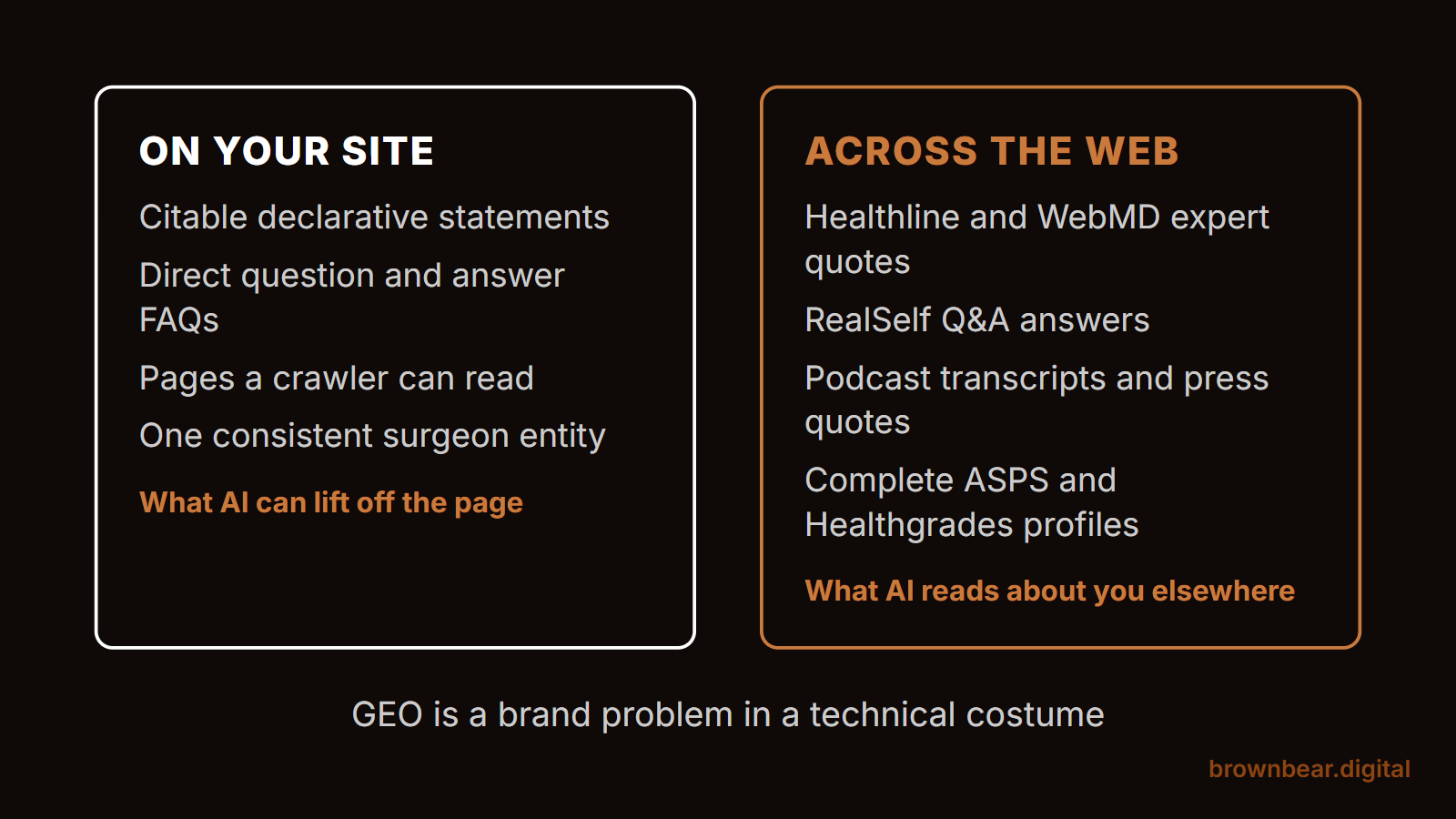
Write in citable declarative statements.
The sentence "rhinoplasty recovery typically involves significant swelling for the first two weeks, with most patients returning to desk work within one to two weeks" is citable. The sentence "rhinoplasty recovery can vary significantly depending on many factors and individual circumstances" is not. Write every key claim as if you're trying to be quoted.
Structure FAQ sections with direct question-and-answer format.
The most reliably surfaced plastic surgery content in AI Overviews has an explicit Q&A structure: a question stated as a patient would actually ask it, followed immediately by a direct answer, followed by supporting detail. A rhinoplasty FAQ that asks "How long does rhinoplasty swelling last?" and answers "Most of the visible swelling resolves within four to six weeks, though subtle refinement continues for up to a year" will be cited more reliably than a paragraph that discusses swelling in general terms.
Treat schema markup as hygiene, not the lever.
Schema.org markup for MedicalProcedure, MedicalBusiness, Physician, FAQPage, and Review entities tells machines what your site is about, who the surgeon is, and what procedures you perform, and it is worth getting right. It is not what wins the citation. In our 101-city procedure page study, six #1 pages carried no schema at all and others ranked with broken markup. The bigger levers are crawlability and structure: pages an AI crawler can read without executing heavy JavaScript, and answers it can lift off the page cleanly. On client sites we routinely strip large amounts of JavaScript for exactly this reason. The page-level method is in our guide to content optimization for AI search.
Build surgeon entity consistency.
AI systems construct an understanding of who a surgeon is by synthesizing information from multiple sources: your website bio, your ASPS profile, your Google Business Profile, your LinkedIn, any articles where you've been quoted. If your name appears differently across those sources, the entity is fragmented, and AI systems have lower confidence in attributing claims to you. Use your full credential string consistently across every indexed platform where you have a presence.
Off-Site GEO: Building the Brand Footprint AI Systems Draw From
Traditional SEO cared primarily about links. GEO cares about mentions, citations, and associations, whether they carry a hyperlink or not. AI language models are trained on the corpus of text that exists about your practice across the web. The more that corpus associates your practice name with specific procedures, outcomes, and credibility signals, the more likely AI systems are to surface you when patients ask relevant questions. When we run AI-visibility audits for practices, the finding that surprises owners most is how much third-party sites, reviews, directories, and press shape what AI says about them, and how little they show up next to competitors.
Get published on platforms AI systems trust.
Healthline, WebMD, RealSelf, Byrdie, Vogue, and industry-specific media like Plastic Surgery Practice magazine are widely read, widely cited sources of exactly the kind AI answers draw on. A single article on Healthline where a surgeon is quoted as an expert on rhinoplasty recovery can do more for GEO than fifty generic blog posts on a low-authority practice site.
RealSelf is a GEO asset, not just a review platform.
RealSelf's Q&A pages are the kind of source AI answers draw on for plastic surgery questions. Surgeons who answer questions on RealSelf with specific, attributed clinical answers are building a GEO footprint in exactly the format AI systems prefer: an expert name, a credential, a direct answer to a specific patient question. A surgeon with 200 detailed RealSelf answers has a meaningful GEO advantage over one who treats the platform as a passive review aggregator. If the term itself is new to you, this is what generative engine optimization actually is.
Digital PR for GEO, not just backlinks.
Being quoted in a news article, a consumer health feature, or a trend piece in a national publication creates an indexed citation that associates your practice with authority on a specific topic. Even a brand mention without a hyperlink contributes to the AI training signal. When a reporter covering "the rise of natural-looking rhinoplasty" quotes your surgeon and that article is published on a high-authority domain, AI systems processing that article add a data point connecting your surgeon's name to rhinoplasty expertise. Enough of those data points and your practice becomes the answer AI systems produce when patients ask who to trust.
Podcast appearances and transcribed interviews.
Podcast transcripts can be indexed by Google and read by AI systems. A thirty-minute conversation where a surgeon explains their philosophy on rhinoplasty, covering candidacy, technique, realistic outcomes, and the emotional dimension of the decision, produces a rich document full of citable claims attributed to a named, credentialed expert.
Professional directory completeness.
ASPS, ABPS, Castle Connolly, US News Health, and Healthgrades are all authoritative sources that AI systems draw from when constructing profiles of surgeons. An incomplete ASPS profile or a Healthgrades listing with no bio undermines the entity signal. Treat every major professional directory entry as a GEO asset, not an administrative task.
The Connection Between Brand and GEO
For agencies managing plastic surgery clients: GEO is the argument that makes content investment defensible to a skeptical surgeon. A client who doesn't fully believe in SEO will often respond to the GEO framing, because the question "do you want to be the practice ChatGPT recommends when a patient asks who to trust for rhinoplasty in your city?" is one most surgeons immediately understand the value of. It's also a question that can't be answered with a paid ad.
GEO is ultimately a brand problem wearing a technical costume. The practices that will dominate AI-generated search results over the next three to five years are not the ones who optimize their schema markup most precisely. They're the ones whose names appear most frequently, in the most credible contexts, across the widest range of authoritative sources, answering patient questions with specificity, candor, and genuine clinical knowledge.
That is exactly what a well-executed content program produces. Every blog post published on your site that gets cited in an AI Overview is a GEO win. Every RealSelf answer, every media quote, every podcast transcript is a GEO win. The practices that treat their content program as brand-building, not just SEO, are the ones building a GEO moat that paid advertising cannot buy.
What a 12-Month Content Program Actually Looks Like
Most plastic surgery practices underestimate what a real content program requires in the first year and overestimate what it will produce in the first three months.
Here's a realistic month-by-month frame for a practice with two priority procedures (rhinoplasty and breast augmentation) and a content investment of four to six hours of surgeon time per month for clinical review and perspective input:
Months 1 to 3 (Infrastructure):
Procedure page rewrites for rhinoplasty and breast augmentation, built to cluster-anchor quality, with schema markup, surgeon attribution, and internal link structure in place. Four to six blog posts per procedure, covering the highest-volume informational queries for each. Set up intake form attribution tracking. Zero new consultations directly attributed to content yet. This is normal.
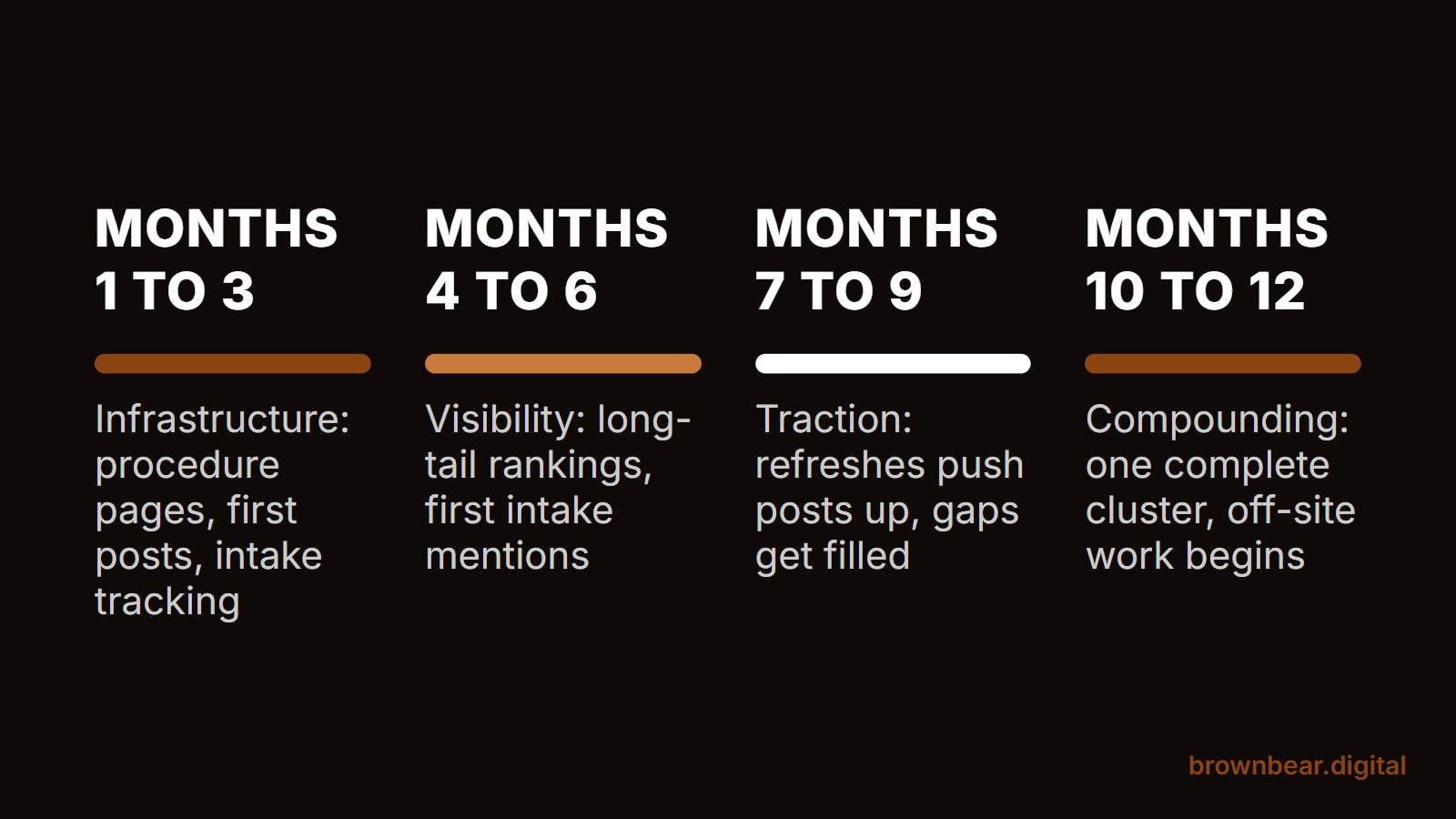
Months 4 to 6 (Visibility):
Informational posts begin ranking for long-tail queries. Organic sessions to the blog start climbing. Return visitor rates start to appear in analytics. The first content-influenced consultations begin appearing in intake form responses, patients mentioning they read a specific post before reaching out. One patient story published per procedure with proper consent. First GEO win: one or two blog posts cited in a Google AI Overview for a relevant query.
Months 7 to 9 (Traction):
Mid-funnel posts for both procedures are ranking in positions 4 to 15 for target queries and being pushed into the top three through refreshes. Blog-to-procedure-page click rate measurable and improving. Content-influenced consultation rate reaches 20 to 30% of new bookings. Cluster completeness review: identify the remaining informational gaps and prioritize the next wave of posts to fill them.
Months 10 to 12 (Compounding):
First complete cluster (rhinoplasty) producing consistent, measurable consultation attribution. Paid search comparison becomes favorable: the cost per content-attributed consultation is visibly lower. Off-site GEO program launches: one media outreach pitch per month, RealSelf Q&A activity, professional directory audit. Year-one ROI calculation produces a defensible number to take into budget planning for year two.
A realistic first-year outcome: meaningful organic visibility for long-tail and mid-funnel queries, growing return visit rates, content-influenced consultation rate of 25 to 40%, and the foundation of a GEO brand footprint that didn't exist before. Not a doubling of consult volume. The content program that doubles consult volume in year one either started from a very low base or benefited from exceptional timing, and either way, it's the exception, not the expectation.
The practices that see compounding returns from content are the ones that treat the first year as infrastructure. They build the clusters, establish the voice, create the attribution tracking, and invest in the off-site GEO footprint that feeds AI-generated search results. Then they watch as year two and year three produce disproportionate returns on the same foundation. That is the pattern in our facelift content marketing case study, where one middle-of-funnel content hub took a deep plane facelift surgeon from 16 to 168 AI Overview citations.
What this looks like in practice, for a marketing manager who's been through it: the moment the content program starts working isn't a spike in a dashboard. It's the consultation intake form starting to show patient after patient who mention a specific blog post, or say they found the practice through a search six months ago and have been reading ever since. It's a surgeon asking why the quality of consultations feels different: patients who come in more prepared, more decided, asking better questions. It's a cost-per-consultation number that starts diverging meaningfully from what paid search costs. That's the long-term outcome of building this correctly: a practice that owns its patient acquisition at a channel level where no competitor can simply outspend you.
Patients are already out there, six months into a research cycle, reading something. The only question is whether it's yours.
References
-
American Society of Plastic Surgeons. (2024). Plastic Surgery Statistics Report. American Society of Plastic Surgeons. https://www.plasticsurgery.org/plastic-surgery-statistics
-
Brown Bear Digital. (2025). Rhinoplasty patient research cycle and content attribution data, 2021 to 2025. Internal research.
-
Google LLC. (2025). Search Quality Rater Guidelines. https://static.googleusercontent.com/media/guidelines.raterhub.com/en//searchqualityevaluatorguidelines.pdf
-
RealSelf. (2025). About RealSelf. RealSelf. https://www.realself.com/company
-
U.S. Department of Health and Human Services. (2025). Health Information Privacy (HIPAA). HHS. https://www.hhs.gov/hipaa/index.html
-
Fung, E., Cevallos, P. C., Rowley, M. A., & Nazerali, R. S. (2023). What do patients look for when scheduling their initial plastic surgery consultation? Plastic and Reconstructive Surgery Global Open. https://pmc.ncbi.nlm.nih.gov/articles/PMC10194507/
-
Bouaoud, J., Loustau, M., & Belloc, J. B. (2018). Functional and aesthetic factors associated with revision of rhinoplasty. Plastic and Reconstructive Surgery Global Open. https://pmc.ncbi.nlm.nih.gov/articles/PMC6191217/
Build Your Content Program With Brown Bear
A content program that compounds is an architecture decision first and a writing job second: the right procedure pages, one complete cluster at a time, and attribution that shows the budget working. That is the work Brown Bear does for plastic surgery and other medical practices, with the surgeon's review time kept to minutes, not weekends. If you want to see where your library stands, start with our content marketing services for medical practices.
Written By
Founder, Brown Bear Digital
Bryan has 15 years of experience across SEO, paid search, and AI search strategy. He founded Brown Bear to give businesses direct access to senior-level search expertise without the agency overhead.
Learn More About BryanGet Found on Google.
Get Cited by AI.
Tell us about your site. We'll send back a proposal for SEO and AI search.