How AI Search Is Changing the Way Patients Research Conditions and Choose Providers

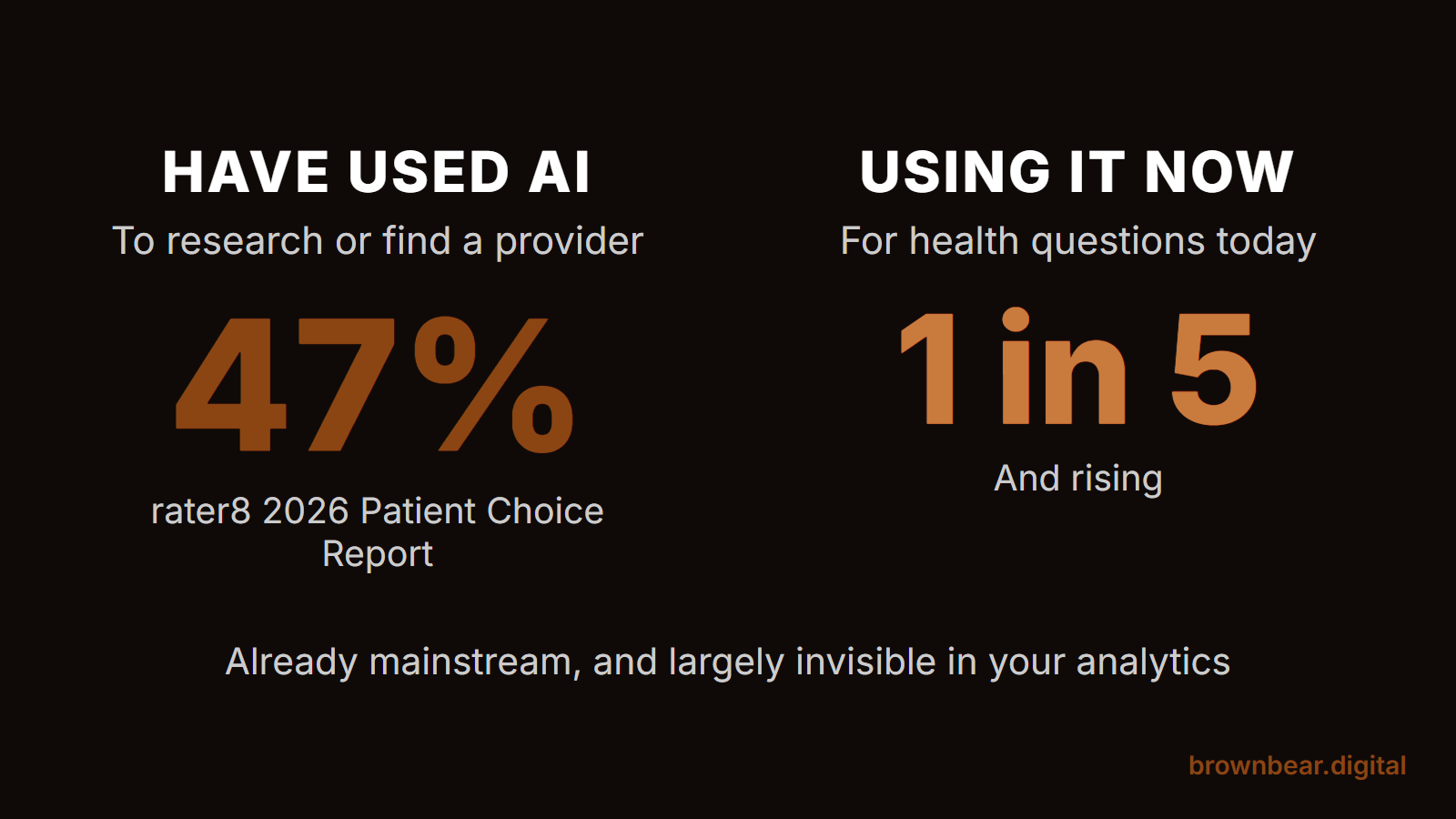
A patient who googled "knee pain going up stairs" five years ago got ten blue links and clicked two or three of them. Today she gets a finished answer: likely causes, warning signs, and often a short list of nearby specialists, before she ever reaches a website. In rater8's 2026 Patient Choice Report, 47% of patients said they have already used AI to research or find a healthcare provider.
This is Brown Bear's plain-language guide to what that shift means for your practice: how AI search is changing the way patients research health conditions and choose providers, and what to do about it while most practices are still optimizing for a results page fewer patients scroll.
When we say AI search, we mean both the AI answers layered on top of Google and the chat tools patients use directly, like ChatGPT, Gemini, and Perplexity. And we mean both halves of the patient journey: researching a condition ("what is this pain?") and choosing a provider ("who near me should treat it?"). If your patients are anywhere on that path, this covers it.
If you run your own practice and new-patient calls have dipped while your rankings look fine, this is likely part of why. If you manage marketing for a multi-location group, you are about to inherit a channel nobody formally assigned you. And if you are the office manager who owns the listings and the review responses, you have more influence over what AI says about your practice than anyone else in the building.
By the end, you will know how patients actually use these tools (with real examples), what the adoption numbers say and where they are soft, where AI pulls its answers about your practice from, and a 15 minute self-audit you can run today. The longer-term payoff is bigger: practices that show up inside AI answers now are building an advantage that gets harder to challenge every quarter.
We have grouped it into four parts: how patient behavior changed, what the numbers really say, where AI gets its answers, and what to do about it. So let's start where every patient starts: the moment a symptom meets a search box.
Key Takeaways
The patient journey now starts inside an AI answer
Patients get a finished answer and a provider shortlist before they ever reach a website. Your content is no longer just a destination. It is source material AI reads, judges, and quotes, and the practices that get quoted win the decision upstream of the click.
47% of patients have already used AI to find a provider
That is rater8's 2026 Patient Choice Report figure, and usage climbs every quarter. Yet only 46% consider AI health information reliable, so patients arrive half-convinced, and the practice with accurate information everywhere AI looks becomes the confirming source.
Nearly half of AI-using patients never tell their provider
About 48% never mention what the chatbot told them, so patients walk in with formed hypotheses your team never hears. Add one intake question about prior AI research and write condition content that answers those expectations head-on.
Run the 15 minute AI visibility audit this week
Ask ChatGPT, Google, and Perplexity the questions your patients ask, fact-check every claim about your practice, and trace errors to their source. Wrong data usually comes from one stale high-authority listing, so correct the origin, not the symptom.
Patients Now Start with an Answer, Not a Search
The core change is simple: patients used to start their research with a list of links, and now they start with a finished answer. Google's AI Overviews summarize the condition at the top of the page. Chat tools go further and carry a conversation. The comparison step, where a patient opened four practice websites in four tabs and your site could win their attention, is quietly disappearing.
Picture a 54-year-old with knee pain that flares on stairs. She asks her phone what it could be. The AI names the likely culprits, tells her what would make it urgent, and suggests the kind of specialist who treats it. She asks two follow-up questions in plain English. In under five minutes she has a working theory and a shortlist, and she has not visited a single website. That is the new first mile of patient acquisition, and it happens entirely inside the answer.
This does not mean your website stopped mattering. It means its job changed. Your content is no longer just a destination patients land on; it is source material AI reads, judges, and quotes. The practices that get quoted are in the conversation. The ones that don't are invisible at the exact moment the patient decides what to do next.
What Patients Actually Ask AI
Patients don't type keywords into AI tools; they describe their lives. The two-word search ("knee pain") becomes a paragraph with context: symptoms, how long, what they've tried, insurance, and what they're afraid of. That context changes what a "ranking" even is, because the AI is matching answers to situations, not words.
Spend an hour in patient communities and the pattern is unmistakable. People describe running every lab result and symptom through ChatGPT before deciding whether to book. Some paste in symptom lists 40 items long. One recurring sentiment captures the behavior better than any survey: people run everything through AI first "just to see what it might say," and then look for a human to confirm it. The AI is not replacing the visit. It is deciding which visit happens.
The questions cluster into four types your content should be able to answer:
- Symptom triage: "Is a mole that changed color worth seeing someone about, or can I wait?"
- Condition explanation: "Explain what a torn meniscus feels like versus arthritis."
- Specialty routing: "What kind of doctor treats recurring heel pain?"
- Provider selection: "Who is a good pediatric ENT near me who takes my insurance?"
The third type deserves special attention. Even physicians admit the general public struggles to know which symptoms point to which specialty. AI has become the router. If your site clearly explains which conditions you treat and who should come see you, you are feeding the router. If it only says "comprehensive care for the whole family," you are giving it nothing to work with.
How Many Patients Are Really Doing This?
The short answer: roughly one in five patients uses AI chatbots for health questions today, nearly half have used AI in some form to research or find a provider, and the number is climbing every quarter. In rater8's 2026 Patient Choice Report, 47% of patients said they had used AI to research or find a healthcare provider, and 84% still check online reviews before an appointment. Phreesia's patient survey puts regular AI chatbot use for health questions at 21%, up from 18% just four months earlier, with usage getting deeper as well as broader.
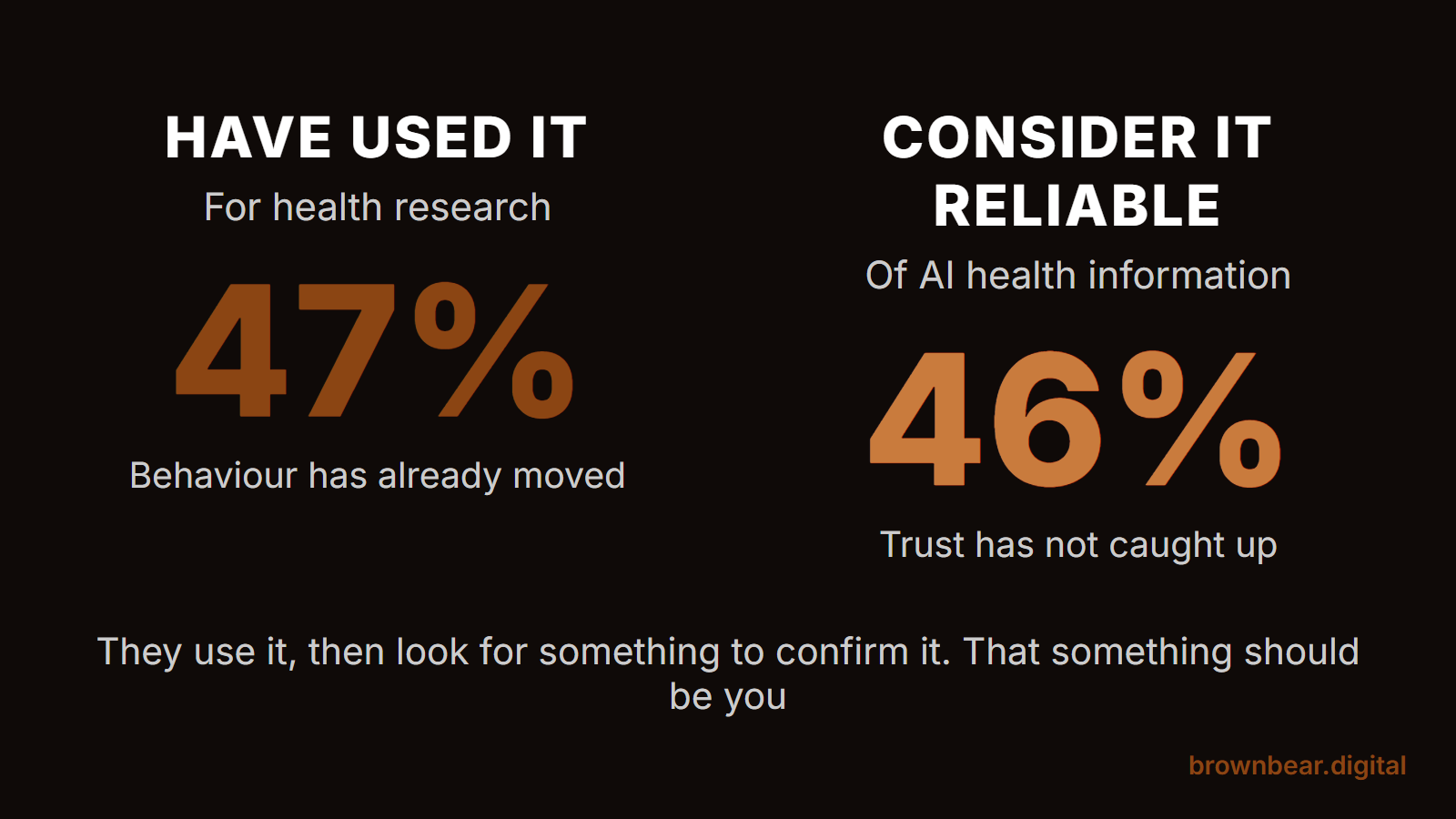
Two softer numbers matter just as much. Only 46% of patients consider AI health information accurate or reliable. And roughly two-thirds of patients who used AI to look up providers have run into incorrect practice information: wrong addresses, outdated phone numbers, providers who left years ago.
Read those together and the story is not "patients trust AI now." It is "patients use AI constantly and trust it partially." That gap is your opportunity. A patient arrives half-convinced and looking for confirmation. The practice whose information is accurate everywhere AI looks, and whose content addresses what the patient already read, becomes the confirming source. If you own a practice and have watched new-patient calls soften while your search rankings held steady, this is the mechanism: the decision is being made upstream of the click.
There is also a measurement answer for the skeptics.
"When a client is skeptical about AI search, we show them the referral traffic coming from the LLMs. Those visitors convert at a higher rate, whether that is booking a consultation or filling out a form. They are more engaged than almost any other channel, and that conversion rate is the core KPI we use to show clients this is working."
Bryan Passanisi
, founder of Brown Bear
Fewer clicks, better clicks: the patient who lands on your site after an AI conversation arrives pre-qualified by it.
From "What Is This?" to "Who Should I See?"
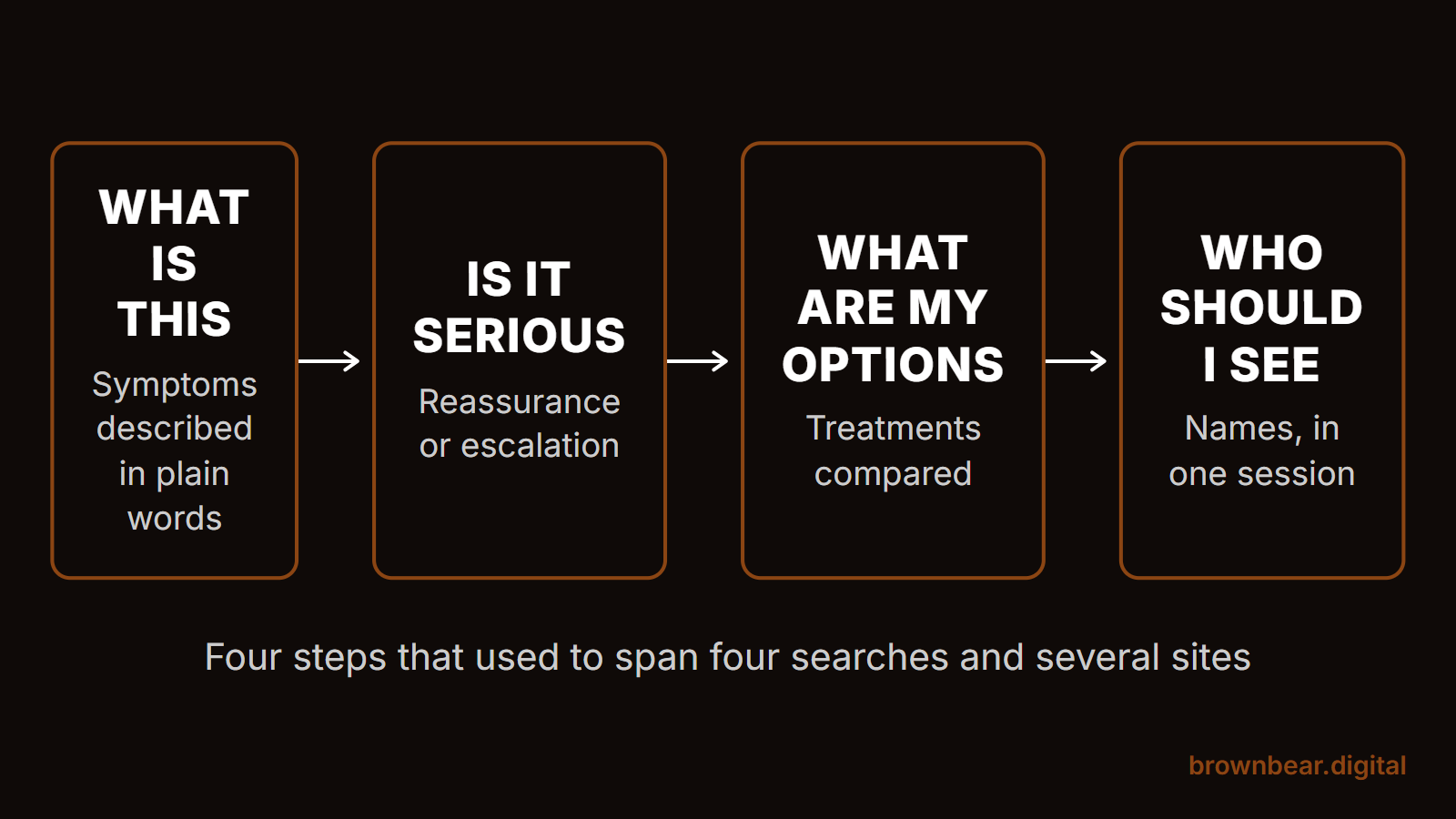
Here is the strategic shift most practices miss: condition research and provider selection used to be two separate searches, often days apart. In an AI conversation they are one continuous thread. The same chat that explains the condition gets the follow-up "so who should I see for this near me?" Your condition content and your provider marketing are now the same channel.
Say a father is up late with a 6-year-old whose third ear infection this season just broke through antibiotics. He asks an AI what recurring ear infections mean, gets an explanation of tubes and adenoids, and types one more line: "best pediatric ENT near Sacramento who takes Aetna." The research phase and the selection phase were ninety seconds apart, in the same window. Whatever sources the AI trusted for the explanation, it leans on again for the recommendation.
That is why publishing genuinely helpful condition content is no longer a branding exercise. It is also why you should pick your battles, because the AI answer layer is splitting into territories.
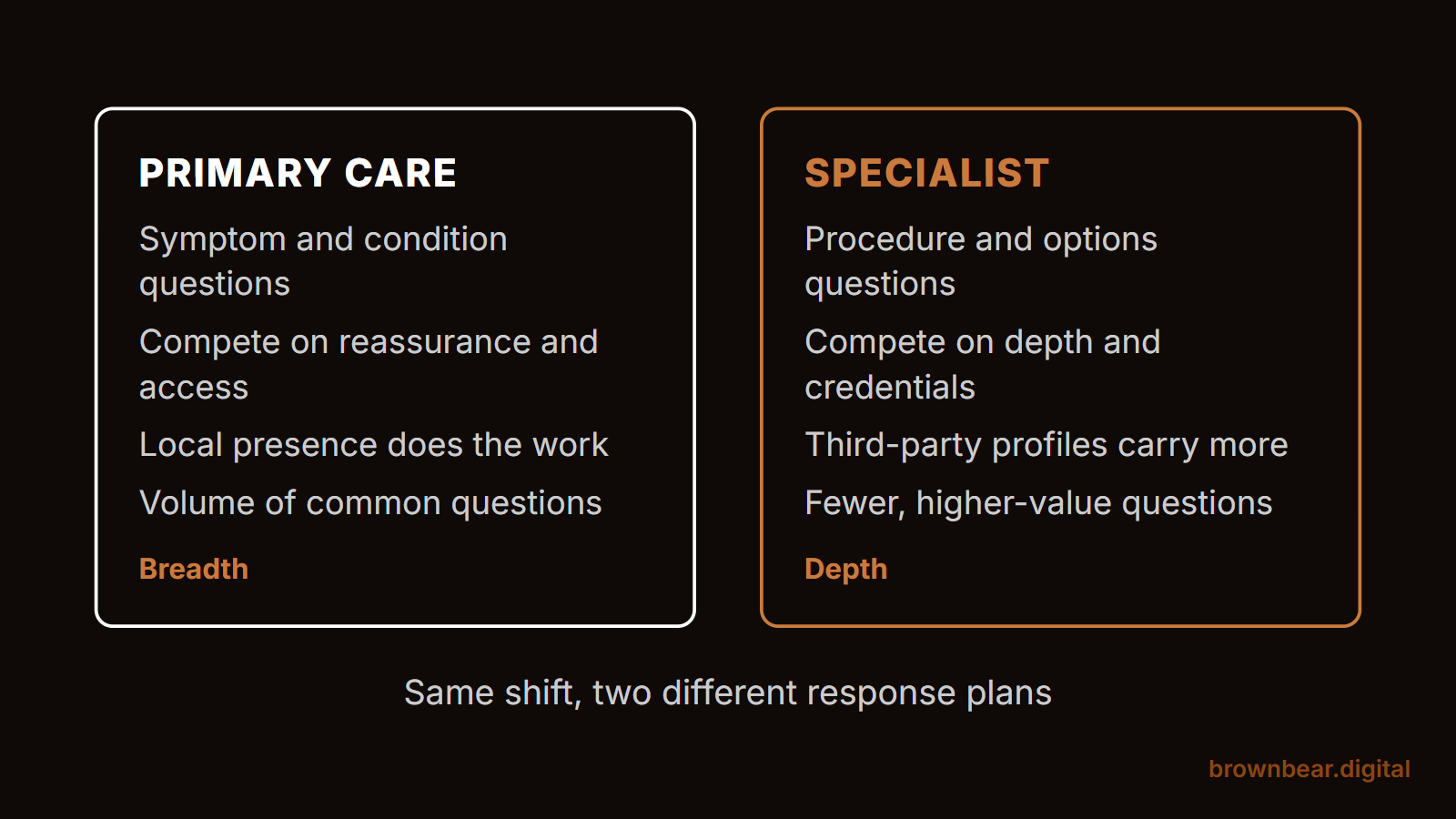
"For head terms like 'what is breast augmentation,' the big authority sites are taking over the AI answers: Mayo Clinic, the American Society of Plastic Surgeons. But the more local and focused queries, cost questions especially, still open the door for practices. And for procedure searches like 'rhinoplasty' or 'breast augmentation near me,' surgeons show up very high in AI Overviews, because Google and the LLMs understand there is a local intent behind the search."
Bryan Passanisi
, founder of Brown Bear
The playbook writes itself from that split. Don't spend your budget trying to outrank Mayo Clinic for the definition. Own the questions where AI still reaches for a practice: what it costs, who is a candidate, what recovery looks like, and every procedure-plus-location variation. Marketing managers, this is the reframe to bring to your next planning meeting: every condition page is now a provider-selection asset, and the practical, local layer of the topic is where it pays out. (If you run an aesthetic practice specifically, how AI search is changing how patients find plastic surgeons goes deeper on that niche.)
The Silent AI Patient Problem
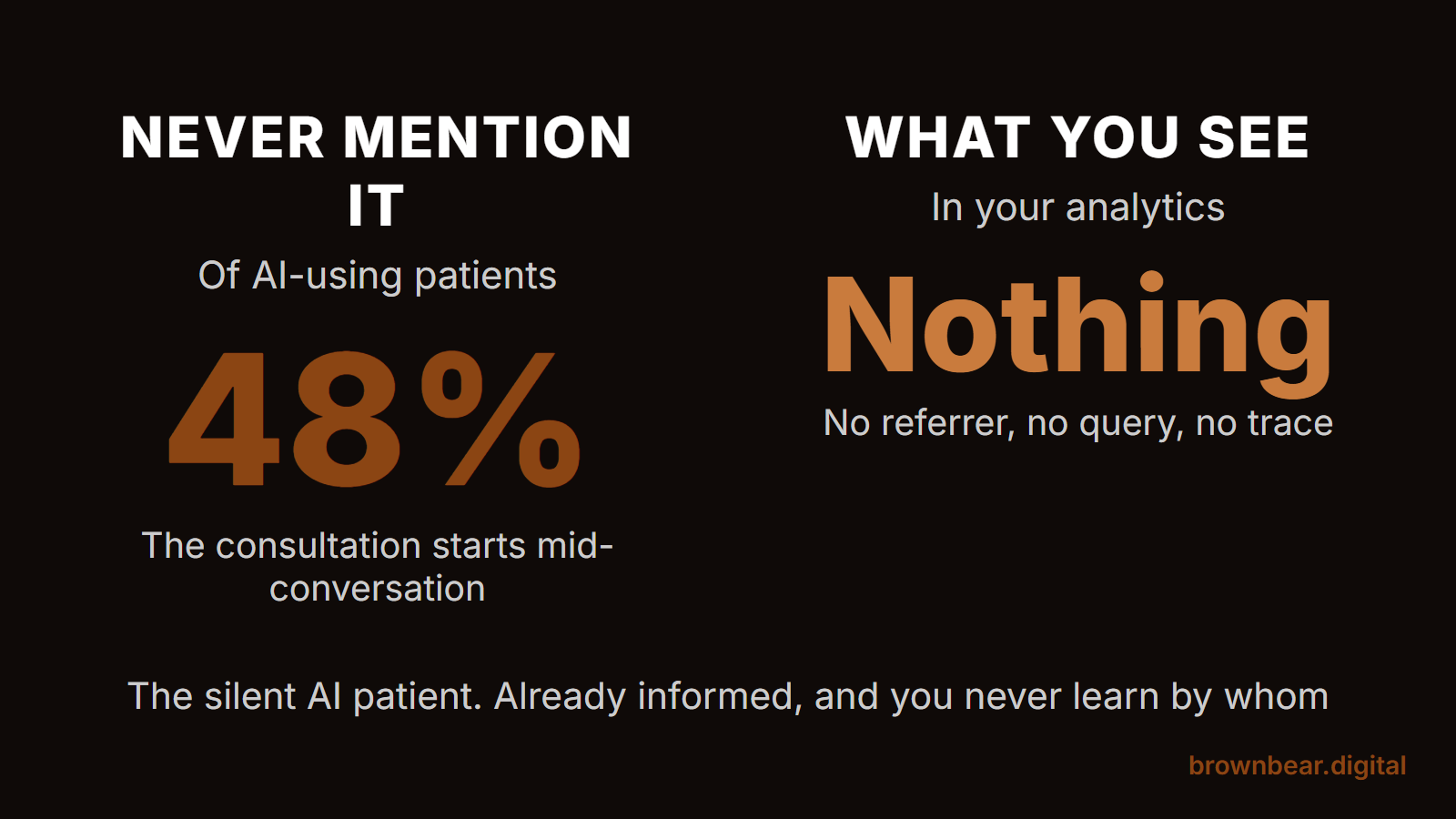
Nearly half of patients who consult AI about their health never mention it to their provider. In Phreesia's survey data, about 48% of AI-using patients never discuss what the chatbot told them, which means patients are arriving with formed hypotheses your team never hears.
Picture a first visit at a rheumatology practice. The patient spent three weeks asking an AI about her joint pain and fatigue and walked in privately expecting a lupus workup. The physician, hearing only the symptoms, starts down a different path. Nobody is wrong, but the visit now runs on two scripts. She leaves feeling unheard, and the review she writes says exactly that. The AI conversation shaped the encounter, and no one in the practice knew it existed.
The fix has two halves, and both are cheap:
- Add one intake question: "Have you already read or asked anything about your symptoms online or with an AI tool?" It surfaces the hidden script, and patients are relieved to be asked.
- Write your condition content to meet AI-formed expectations head-on: "If you've read that X, here's what that means in practice." You are no longer introducing the topic. You are the second opinion on the AI's first draft.
Where AI Gets Its Answers About Your Practice
When an AI tool answers "who is a good dermatologist near me," it assembles that answer from five source systems, and the assembly is only as good as the weakest one:
- Your website: service pages, condition content, provider bios. The AI reads structure: clear headings, direct answers, named providers and conditions. It also has to be technically readable, and heavy JavaScript is a real barrier, because LLM crawlers do a poor job rendering it.
- Your Google Business Profile and listings: address, hours, phone, insurance. Inconsistency across listings reads as unreliability, and AI tools fill gaps with whatever they find, current or not. Our guide to local SEO and Google Business Profile configuration covers the high-leverage setup.
- Reviews: Google, Healthgrades, Vitals. AI summarizes sentiment and quotes highlights; 84% of patients still verify with reviews after the AI answer.
- Structured data: schema markup that tells machines "this is a physician, this specialty, this location." Worth keeping clean and specific, but not the lever it is often sold as (more on that below).
- Third-party mentions: directories, local press, hospital affiliations. These are the corroborating witnesses AI uses to decide you are real and established.
So what does auditing these systems actually turn up? Less outright fiction than you might expect.
"The information is rarely wrong per se. What we find is that the procedures a surgeon most wants to be known for are buried, or not nearly as prominent as they want them to be. The LLMs see a generalist when the practice wants to be seen as the rhinoplasty specialist, and our job is to make that emphasis unmistakable. The most common actual error is an odd variation of the practice's name, address, or phone number, and that is usually easy to correct at the local level."
Bryan Passanisi
, founder of Brown Bear
He is also blunt about the tactic everyone asks him about first:
"Schema is a bit overhyped for AI search. It is still a best practice, and most practices' schema could use more love and specificity, but it is not going to be your silver bullet. What actually moves the needle is a site that is crawlable and content that is structured so LLMs and Google can read it easily. The amount of JavaScript we strip off client sites is massive, because we know LLMs do not do a good job crawling it. There are bigger hurdles to tackle than schema."
Bryan Passanisi
, founder of Brown Bear
Remember the two-thirds of patients who hit wrong provider information in AI answers. That error rate is not the AI inventing things so much as it faithfully repeating stale or muddled data from source systems nobody has audited. If you are the office manager who owns the listings, this list is your new job description, and you have more leverage over AI answers than any ad budget in the building.
The 15 Minute AI Visibility Audit
You can see exactly what AI tells patients about your practice today, for free, in about 15 minutes. Here is the audit we recommend running quarterly:
- Ask three tools the questions your patients ask. Open ChatGPT, Google (for the AI Overview), and Perplexity. Run three queries: a condition you treat ("what does a torn rotator cuff feel like"), a selection query ("best orthopedic practice near [your city]"), and your own name ("[practice name] reviews").
- Fact-check every claim about you. Address, phone, hours, insurance accepted, providers on staff. Note every error and where the tool says it got the information.
- Check the citations. Which sites does each tool lean on for the condition answer and the recommendation? Are you in any of them? Those source lists are your target map.
- Fix the highest-authority source first. Wrong data usually traces to one stale listing that everything else copies. Correct the origin, not just the symptom.
Say the practice manager at a three-location physical therapy group runs this next Tuesday. ChatGPT recommends the group but lists the location that closed two years ago. Perplexity cites a Healthgrades profile showing a therapist who left in 2024. The Google AI Overview for "PT for frozen shoulder" quotes a competitor's blog because the group's own shoulder page is a 90-word stub. Fifteen minutes, three findings, and a to-do list that will do more for new-patient volume this quarter than any keyword tweak. That is the point of the audit: it converts an invisible problem into a fixable list. When you are ready to go beyond the quarterly check, the full GEO and AEO playbook turns this audit into an ongoing program.
What to Do Now, by Practice Type
The playbook forks depending on how your practice is built. Find your branch:
If you are a solo or small private practice:
your leverage is accuracy and reviews, not volume. Get your Google Business Profile and top three listings perfectly consistent, respond to every review (AI reads the responses too), and build one genuinely deep condition page for the problem you most want to be found for. One excellent page beats ten stubs, because AI quotes depth.
If you are a multi-location group:
your risk is inconsistency at scale. One location's stale address contaminates AI answers for the whole brand. Centralize listings management, give every location its own complete page with schema markup, and standardize how provider bios name specialties and conditions. Your marketing manager should own the quarterly AI audit across all locations.
If you are a referral-heavy specialist:
your patients arrive via the routing question ("what kind of doctor treats this?"). Invest in condition-explanation content that answers the triage and routing questions plainly, because you win when the AI explains the condition using your page and then gets asked "who near me treats it." Your referral sources are also asking AI; being the cited explainer reinforces both channels.
Whichever branch is yours, this week's moves are the same:
- Run the 15 minute audit above and log every error.
- Fix your highest-authority stale listing at the source.
- Add the AI question to your intake form.
- Pick the one condition page that feeds your best service line and make it the clear, direct, deeply useful answer AI wants to quote.
Do that and you are ahead of most practices in your market. Keep doing it quarterly and you become the answer patients see first, which is the closest thing to a moat that exists in AI search. And the window matters, because this is still early adoption.
"As more people get comfortable using LLMs to find the right practice for a procedure, this is only going to grow."
Bryan Passanisi
, founder of Brown Bear
The practices building their AI visibility now are compounding into that growth instead of chasing it.
Get Ahead of AI Search with Brown Bear
AI search rewards practices that treat visibility as an ongoing discipline, and that is exactly the work we do. Brown Bear audits how AI tools see your practice, fixes the source systems those answers are built from, and creates the condition content that gets your practice quoted at the moment patients decide. If you want the full version of the audit you just read about, run against every tool and every location you have, talk to Brown Bear about AI search optimization and we will show you what patients are being told about you right now.
Written By
Founder, Brown Bear Digital
Bryan has 15 years of experience across SEO, paid search, and AI search strategy. He founded Brown Bear to give businesses direct access to senior-level search expertise without the agency overhead.
Learn More About BryanGet Found on Google.
Get Cited by AI.
Tell us about your site. We'll send back a proposal for SEO and AI search.