The YMYL Standard in Plastic Surgery: Why Medical Practices Face a Higher Bar in AI Search

Every YMYL guide on the open web tells you roughly the same thing. YMYL stands for "Your Money or Your Life." Google's quality raters hold YMYL content to a higher standard. The relevant framework is E-E-A-T. Author bios matter. Citations matter. The Medic update changed everything.
It's all true and it's all generic, and that's the problem. The piece you're reading exists because every other YMYL guide is written by SEO professionals about SEO theory, applied to no particular industry, defended with no particular evidence. The audience that actually has to do something with YMYL (agencies and in-house marketers responsible for medical practices, financial services, and legal firms) is left to translate generic advice into a vertical where the stakes are concrete and the standards are specific.
This piece picks one vertical and works through it. Plastic surgery is one of the highest-stakes YMYL niches that exists: elective, expensive, body-altering, irreversible, frequently driven by emotional motivation, and now mediated by AI search systems that increasingly stand between the patient and the surgeon. Every YMYL principle applies here in concentrated form. If you're an agency working on a plastic surgery practice, an in-house marketer for a multi-surgeon group, or another agency reading this for the methodology: this is what the YMYL standard actually looks like inside one practice.
Key Takeaways
Plastic surgery is clear YMYL, near the top of the gradient
Google's rater guidelines treat YMYL as a spectrum, and pages on clear YMYL topics get the most scrutiny. An irreversible, expensive, emotionally loaded surgical decision sits squarely in that zone. Generic YMYL advice is necessary but nowhere near sufficient at that altitude.
The Medic update hit health sites hardest
In Search Engine Roundtable's survey of more than 300 sites hit by the August 2018 core update, over 42% were health or medical sites, which is how it got its name. Google has run thirteen more core updates between March 2023 and May 2026, and each one retests the same standard.
AI Overviews skip what ranking used to demote
Where traditional ranking pushes a weak page down to position 8, an AI Overview simply cites someone else. The fix is architectural: verifiable surgeon identity, sourced claims, structured data, and visibly maintained content.
Cite the source or name the surgeon
Attributing claims to unnamed studies or experts is a downgrade signal on medical content. Every recovery timeline, statistic, and outcome claim should link to a peer-reviewed source or be explicitly flagged as the surgeon's own clinical observation.
Patient stories are an asset, not a risk
Google's guidelines give first-hand experience on YMYL topics high E-E-A-T when it is safe and consistent with expert consensus, while advice on candidacy, safety, and medication must come from experts. Most practices get this split backwards.
What YMYL Is, Briefly
YMYL comes from Google's Search Quality Rater Guidelines, the document Google's human raters use to evaluate whether the algorithm is returning good results. Google first published its rater guidelines in 2013, and the current edition is dated September 11, 2025. It defines YMYL topics as those that "could significantly impact the health, financial stability, or safety of people, or the welfare or well-being of society." Health is the canonical example, alongside financial advice and legal information.
YMYL is not a ranking factor, and in Google's own words, "Search raters have no control over how pages rank." But Google also says its systems "give even more weight to content that aligns with strong E-E-A-T" for topics that could significantly impact health, financial stability, or safety. That means YMYL effectively raises the bar for what counts as good content. A piece that would pass scrutiny in a non-YMYL niche can fail in a YMYL one. That gap is where most plastic surgery content lives.
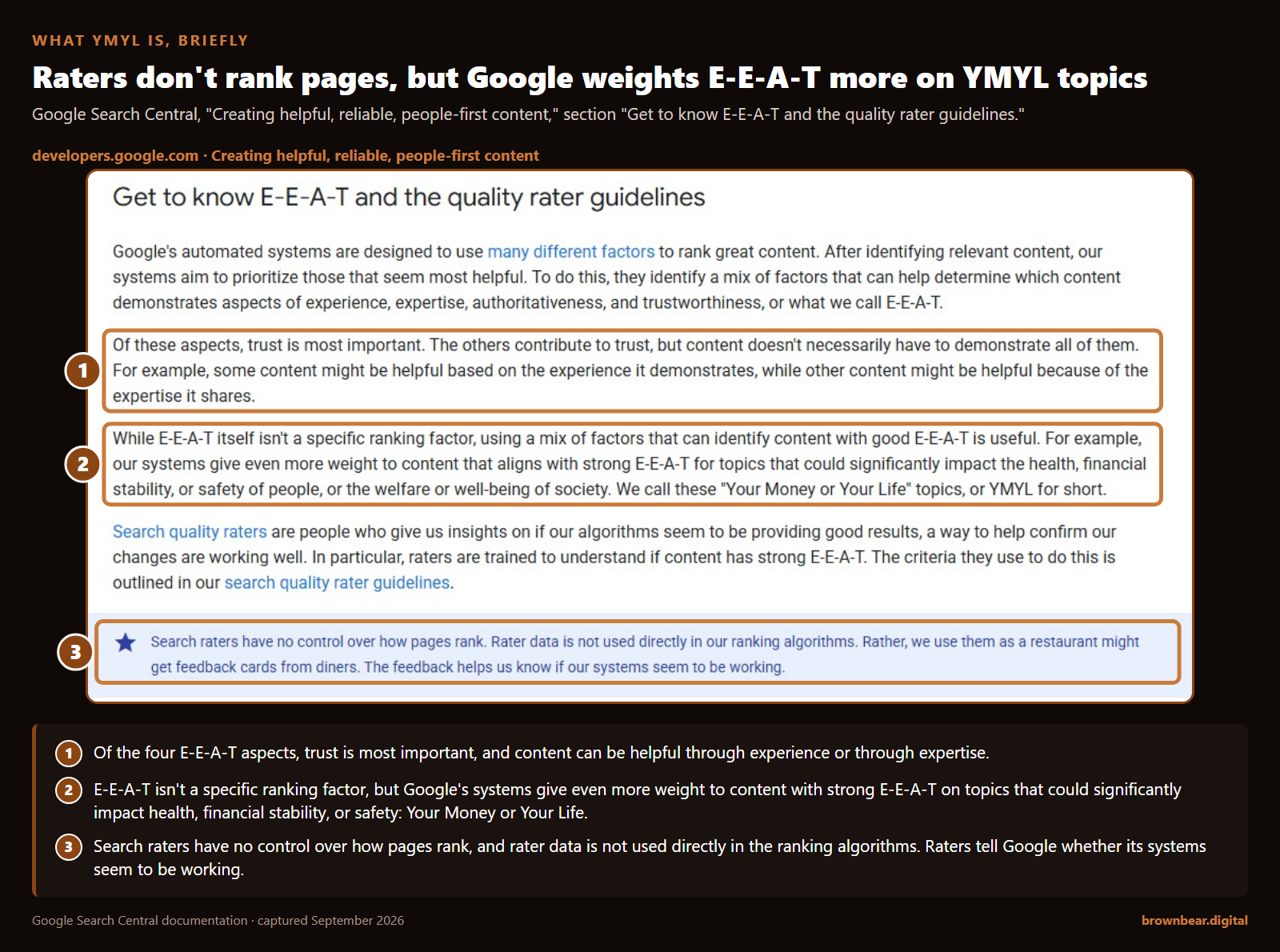
The Medic update of August 2018 is the historical reference point: health and medical sites saw dramatic ranking volatility, and the pattern has repeated with most core updates since. Google has shipped three more core updates since June 2025, in December 2025, March 2026, and May 2026, so the standard is being retested several times a year.
That's the foundation, and our YMYL SEO pillar covers it in full, including link risk and recovery. Now the plastic surgery specifics.
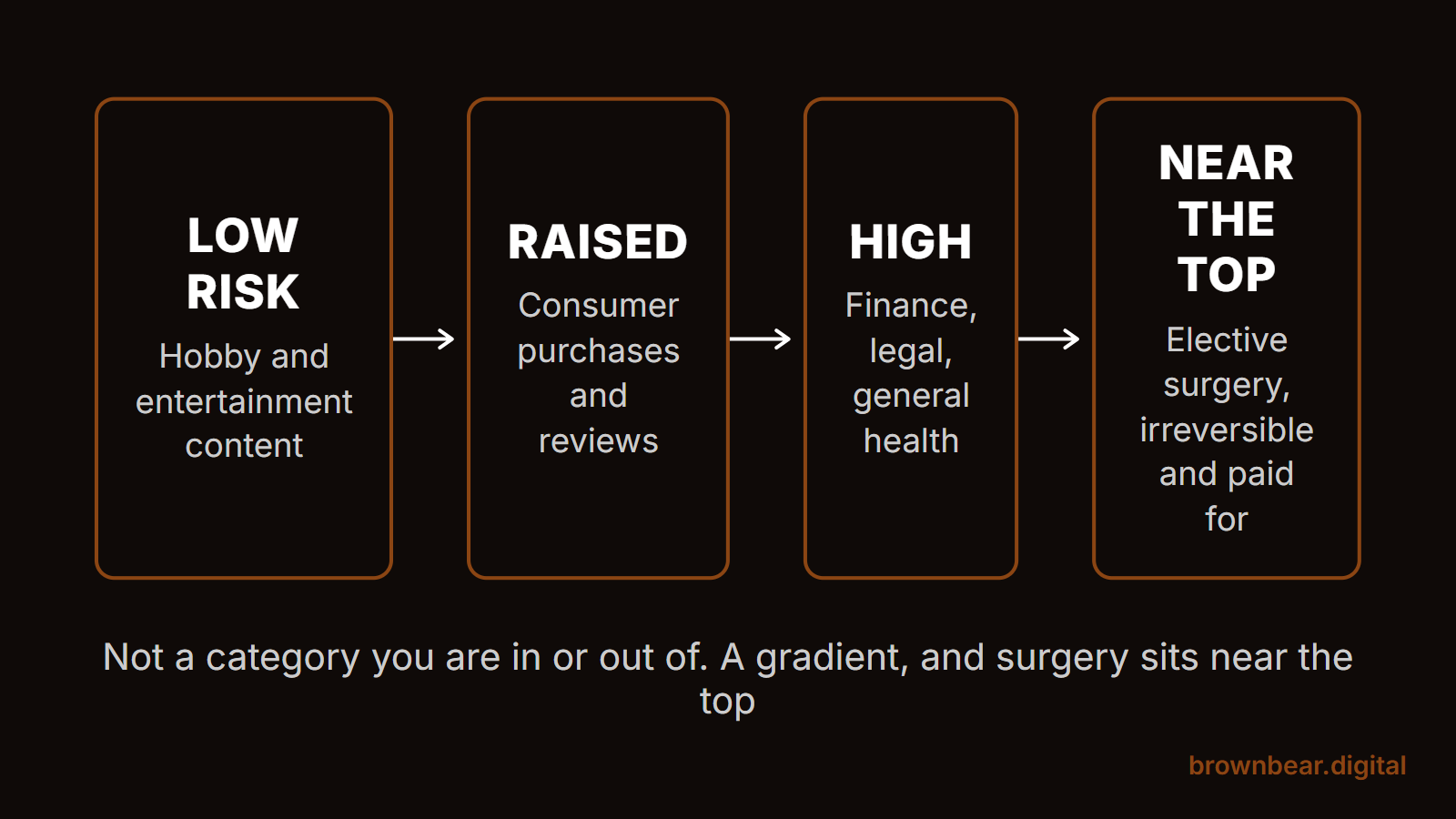
YMYL Is a Risk Gradient, Not a Binary, and Surgery Sits Near the Top
Most YMYL guides present the topic as a binary: either your content is YMYL or it isn't. That's not how Google's quality raters actually evaluate it. The guidelines say it directly: "Because YMYL assessment is a spectrum, it may be helpful to think of topics as clear YMYL, definitely not YMYL or something in between." Pages on clear YMYL topics, the same passage continues, "require the most scrutiny for Page Quality rating."
Plastic surgery sits near the top of that gradient because:
- The information directly informs an irreversible bodily decision
- The financial stakes typically run from several thousand dollars to tens of thousands per procedure
- The patient's emotional state at decision time is often heightened (post-divorce, post-weight-loss, post-injury, pre-wedding)
- A poorly-vetted surgeon can cause real, permanent harm
- The information landscape is full of bad actors: unaccredited "surgeons," medical tourism mills, social media practitioners with no training in the procedures they sell
For a financial-advice site, the risk is "the reader makes a poor investment." For a plastic surgery site, the risk includes "the reader is permanently scarred by an unqualified surgeon they trusted because of misleading content." The guidelines never name plastic surgery, but they file anything that "could harm mental, physical, and emotional health" under YMYL Health or Safety, and their own YMYL examples include when to go to the emergency room and the treatment options for liver cancer. An elective operation that is expensive and hard to undo meets the same test.
The practical consequence: plastic surgery content is held to the clear YMYL standard, the top of the scale. Generic YMYL advice ("have an author bio, cite your sources, keep content updated") is necessary but not sufficient. The standard has to be applied with the specificity that the topic demands.
The E-E-A-T Stack Inside One Plastic Surgery Practice
Every YMYL guide explains E-E-A-T as four pillars: Experience, Expertise, Authoritativeness, Trust. None of them show you what each pillar actually looks like inside a specific working practice. (For the full framework, including the on-site vs off-site authority split, see E-E-A-T for plastic surgeons.) Here's a single hypothetical practice, call it a two-surgeon aesthetic and reconstructive group, and what each pillar requires.
Experience
For a plastic surgery practice, Experience answers: has the surgeon actually done the procedure being described?
The signals that demonstrate it:
- Original before-and-after galleries of patients the surgeon has personally operated on, photographed in their office, with metadata tying images to the procedure and surgeon. Stock images and licensed gallery photos signal the absence of experience.
- Surgeon-authored procedure commentary: short notes on technique selection, why this approach for this patient, what made the case interesting. AI engines parse this as first-person experience.
- Real consultation video of the surgeon explaining a procedure they perform regularly. A transcript turns the video into text a search engine or AI system can read, and appearing on camera is itself evidence the surgeon exists.
- Named patient stories: first name, age range, motivation, outcome. These are far stronger than anonymous testimonials. Properly consented and HIPAA-compliant, they are the most powerful experience signal a practice can publish.
A practice that has all four for every major procedure they perform is publishing at the Experience standard YMYL requires. Most practices have one or two, executed inconsistently. Our gallery rebuild case study shows what treating the gallery as documentation is worth: top-3 gallery rankings up 4x and 19 new AI Overview citations for one practice.
Expertise
Expertise answers: is the person making this claim qualified to make it?
The signals:
- Board certification by the American Board of Plastic Surgery (ABPS), the only board recognized by the American Board of Medical Specialties for plastic surgery. Listed on the surgeon bio, present in the surgeon's IndividualPhysician markup, ideally cross-linkable to the ABPS verification page.
- Fellowship training in the procedure being discussed (e.g., aesthetic fellowship, hand fellowship, craniofacial fellowship). Specificity matters: "completed fellowship in aesthetic plastic surgery" is stronger than "completed advanced training."
- Active hospital privileges. A surgeon with admitting privileges at an accredited hospital is a different signal from one operating exclusively out of a non-accredited surgical suite.
- Peer recognition: committee positions in the American Society of Plastic Surgeons (ASPS), Aesthetic Society membership, journal editorial roles, conference faculty positions.
- Procedure pages with technical depth that demonstrate the surgeon understands the procedure: open vs. closed rhinoplasty technique selection, structural grafting decisions, considerations for revision cases. This is where Expertise becomes legible to AI engines that parse the content.
The failure pattern here: a practice lists the credentials in a sidebar paragraph and assumes the work is done. Expertise has to be structured to be verified: encoded in schema, linked to verification sources, and reflected in the actual depth of the content the surgeon authors.
Authoritativeness
Authoritativeness is what other credible sources say about this surgeon. It's the hardest pillar to manufacture.
The signals:
- Press citations in trusted publications. Local news is a baseline; national medical media (Health, Allure, Vogue's surgeon profiles, ASPS press) is stronger; peer-reviewed journal authorship is strongest.
- Speaking and teaching: invited talks at ASPS, Aesthetic Society, hospital grand rounds, residency teaching positions. Each adds verifiable authority.
- Backlinks from credible third-party medical sources: ABPS profile, ASPS profile, hospital affiliation pages, RealSelf verified profiles, peer-referenced commentary. AI engines verify backlink quality at the source level.
- An internal authority graph: a robust blog with original surgeon-authored commentary, internally cross-linked, that creates a topical authority signal across the site.
A practice with five years of original surgeon-authored content covering decision-making across procedures, with two or three press mentions and an active speaking calendar, has a different authoritativeness profile from a practice with the same credentials but no published commentary.
Trustworthiness
Trust is the foundational pillar. Google's rater guidelines call it "the most important member of the E-E-A-T family because untrustworthy pages have low E-E-A-T no matter how Experienced, Expert, or Authoritative they may seem."
For plastic surgery, Trust shows up in places most websites treat as compliance overhead:
- HIPAA-compliant handling of patient photos and stories: clearly explained, with a visible consent process. A practice that is sloppy with patient privacy signals untrustworthiness in the most fundamental way YMYL evaluators care about. Our guide to HIPAA compliance and medical SEO covers the marketing authorization that consent process has to include.
- Sourced medical claims: recovery times, statistics, technique outcomes should link to peer-reviewed sources where possible, or be flagged as the surgeon's own clinical observation. Unsourced medical claims are a downgrade signal.
- Outcomes transparency: including realistic ranges, not just optimal cases. Including the conditions under which the surgeon would decline to perform a procedure. This reads as trustworthy because it is.
- Verifiable identity: real address, real phone, real surgeon photos, encoded in MedicalBusiness schema. Practices that obscure their physical location or use stock photos for surgeons give raters, and AI systems, nothing to verify.
- Last-updated date patterns: visible date stamps on medical content showing the practice maintains accuracy.
A practice scoring strong on Trust has all five elements engineered into the website architecture. A practice that has them implemented as afterthoughts has the appearance of trust without the substance, and YMYL evaluation systems can increasingly tell the difference.
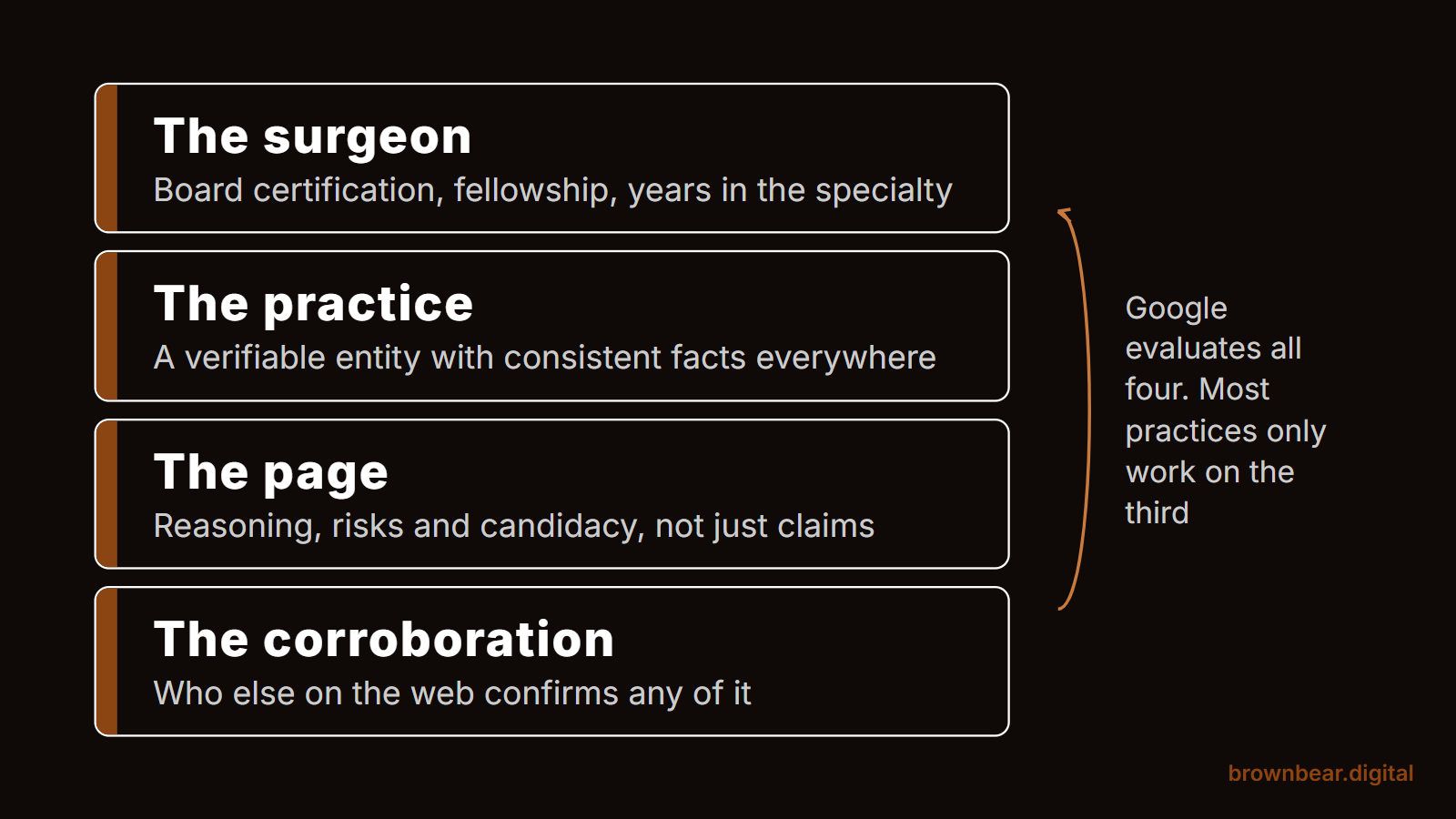
Where Patient Experience Counts, and Where Only the Surgeon Can Speak
Google's rater guidelines split YMYL content into two kinds, and plastic surgery sites routinely get the split backwards. First-hand experience on a clear YMYL topic "may be considered to have high E-E-A-T as long as the content is trustworthy, safe, and consistent with well-established expert consensus." But "some types of YMYL information and advice must come from experts." Knowing which of your pages sits on which side of that line is most of the YMYL standard in practice.
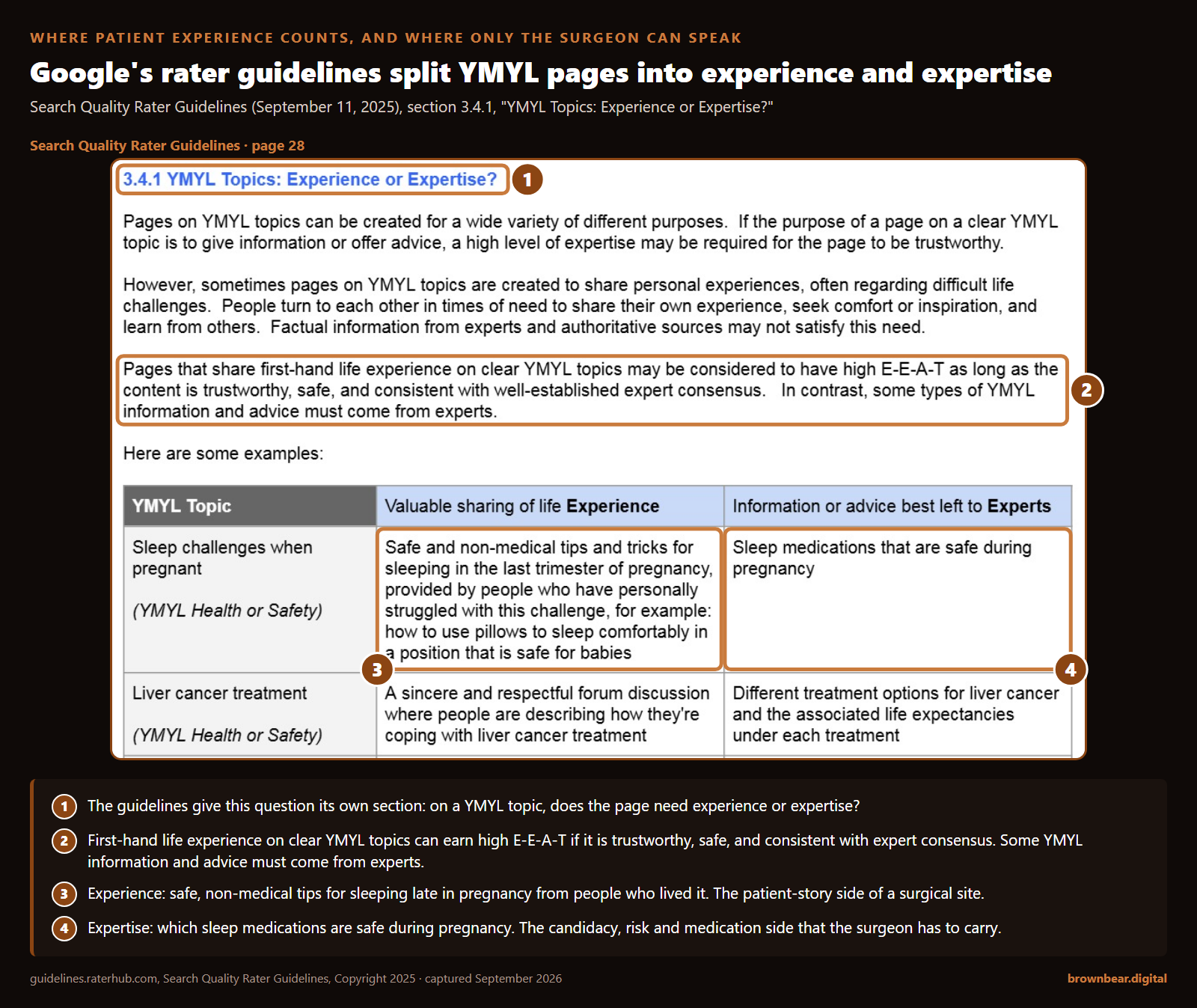
The guidelines' own examples map almost one to one onto a surgical practice. Safe, non-medical tips for sleeping comfortably late in pregnancy, from people who lived it, count as valuable experience. Which sleep medications are safe during pregnancy is advice best left to experts. Swap in your own content and the line is easy to see:
- Patient experience can carry it: what recovery felt like week by week, how she chose between two surgeons, what she wished she had asked at the consultation.
- The surgeon has to carry it: candidacy, risks and complication rates, which medications are safe after surgery, when swelling or pain means calling the office, how long results last.
- Both, visibly separated: a before-and-after case with the patient's own words, where her story is experience and any claim about what the procedure achieves belongs to the surgeon.
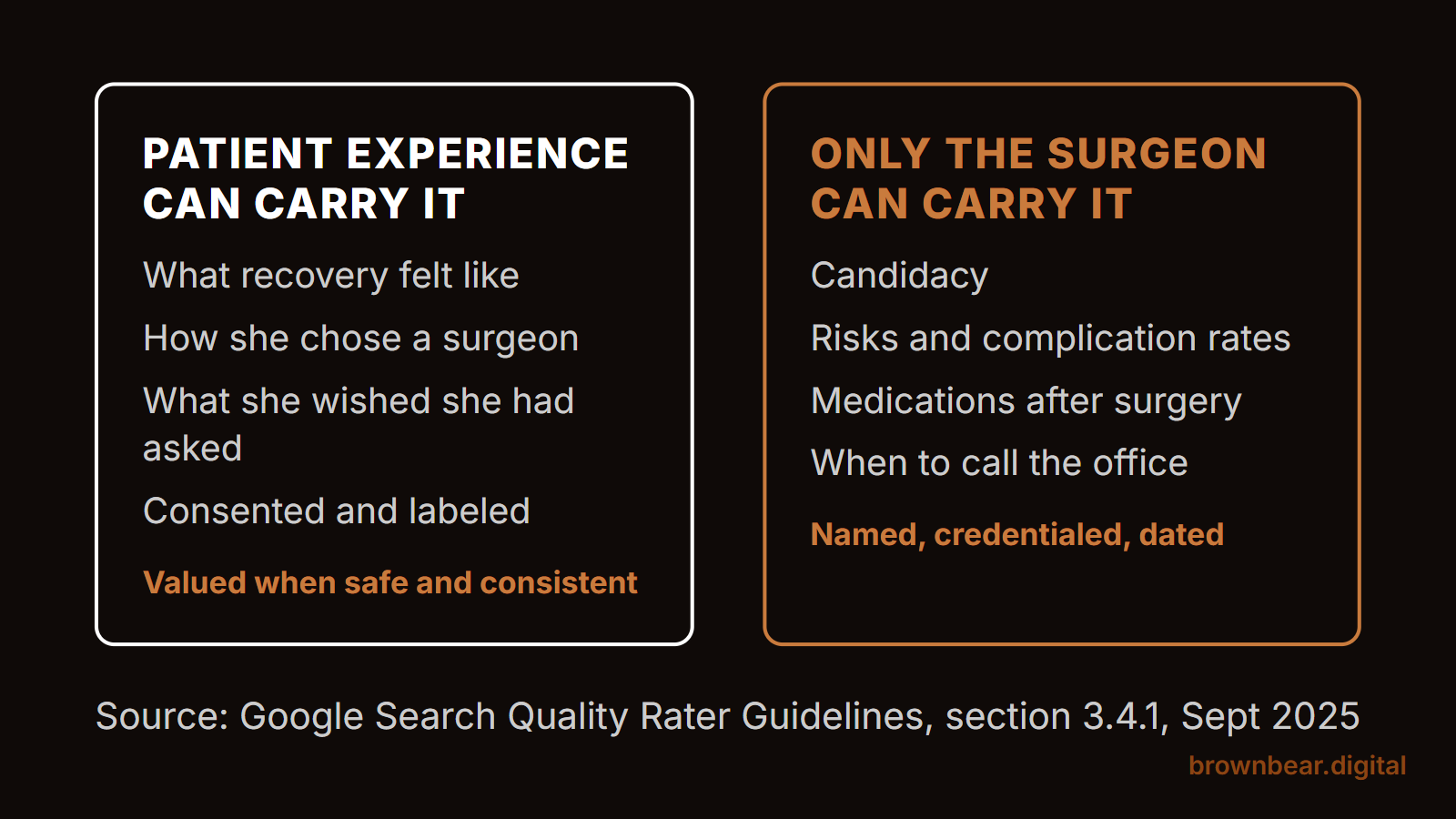
Most practices invert this. They keep patient voices off the site because YMYL sounds like a reason for caution, then publish unsigned procedure pages full of clinical advice. The guidelines reward the opposite: consented, labeled patient experience, and clinical content with a named surgeon on it.
Picture a two-surgeon practice in Denver whose recovery blog is written by its patient coordinator. One post mixes a patient's diary of her first week after a tummy tuck with a line like "most patients can drive after five days." The diary is exactly the experience content the guidelines value. The driving line is a clinical claim with no surgeon's name on it. Split the post: the diary stays as her story, the driving guidance moves to a surgeon-signed aftercare page, and each half now clears its own bar.
Where to start depends on what your site already has. If it has no patient stories yet, start there: they are the cheapest experience signal you can add, and the only one a competitor cannot copy. If it already has plenty, audit the other side first, because an unsigned candidacy or aftercare page is the bigger YMYL liability. Sort ten common pieces of practice content below and see where the line falls.
Google's rater guidelines draw a line through YMYL content: some of it is best told by people who lived it, and some of it must come from experts. Sort ten real pieces of plastic surgery content and see where the line falls.
Built by Brown Bear Digital · based on Google's Search Quality Rater Guidelines, Sept 2025
How AI Overviews Treat Plastic Surgery Content, and What Gets Left Out
AI Overviews (the Google-generated summaries that appear at the top of many search results) make the YMYL bar more visible than traditional ranking does. Where ranking pushes a low-E-E-A-T page down to position 8, AI Overviews simply don't cite it.
In this vertical they are also hard to avoid. In our 50-procedure gallery study, an AI Overview appeared on 48 of the 50 before-and-after searches we measured.
For plastic surgery queries, these are the patterns we see most often when we check which pages get cited.
What gets cited:
- ASPS, ABPS, Mayo Clinic, Cleveland Clinic, NIH, peer-reviewed journals
- Plastic surgery practice websites where the surgeon's credentials can be verified in structured data
- Procedure pages that answer the question directly in the first 1 to 2 paragraphs
- Pages that link to medical sources for factual claims
- Pages with a visible "Last updated" date that shows the content is maintained
What gets suppressed:
- Unverifiable surgeon identity: practices where the surgeon can't be cross-referenced against ABPS or ASPS
- Pages that bury the answer behind marketing copy
- Pages making unsourced medical claims
- Aggregator and lead-gen sites with no demonstrable expertise
- Sites with stock photography for "surgeons" or generic medical imagery
- Pages that have gone stale on a topic where consensus has shifted
The split we see is by query type. Institutions like Mayo Clinic and the American Society of Plastic Surgeons are taking the head-term answers, the "what is breast augmentation" questions, while procedure-plus-location and cost queries still open the door for a practice, because Google reads local intent into them. That is where a practice's trust architecture pays off first.
Even the YMYL question itself shows how low the evidence bar sits today. When we searched "ymyl plastic surgery" on September 28, 2026, the AI Overview that rendered cited agency blog posts, not a medical society, a certifying board, or Google's own guidelines. The AI layer is summarizing the same generic advice this piece argues against, which leaves room for any practice or agency that publishes the specific version.
The practical implication is significant. A plastic surgery practice that is invisible in AI Overviews for procedure queries in their geographic market is, increasingly, invisible to a meaningful share of patients researching that procedure. The fix is not aesthetic: it's architectural. Verifiable identity, sourced claims, structured data, recency. Our complete guide to AI search for plastic surgeons walks through how to build each of those signals. Once the trust layer is in place, our breakdown of AI Overview visibility covers the mechanics of getting cited.
Author Bios That AI Engines Verify: The Medical Version
The generic YMYL advice on author bios ("include an author on every blog post and link to a bio page that demonstrates their expertise") is correct as far as it goes. For plastic surgery, the standard is higher and more specific. The bio page itself has to hold up too: plastic surgeon about page best practices covers how to build the page these bios link to.
A medical author bio that AI engines verify cleanly:
- Name and credentials in the H1: "Jane Smith, MD, FACS, Board-Certified Plastic Surgeon"
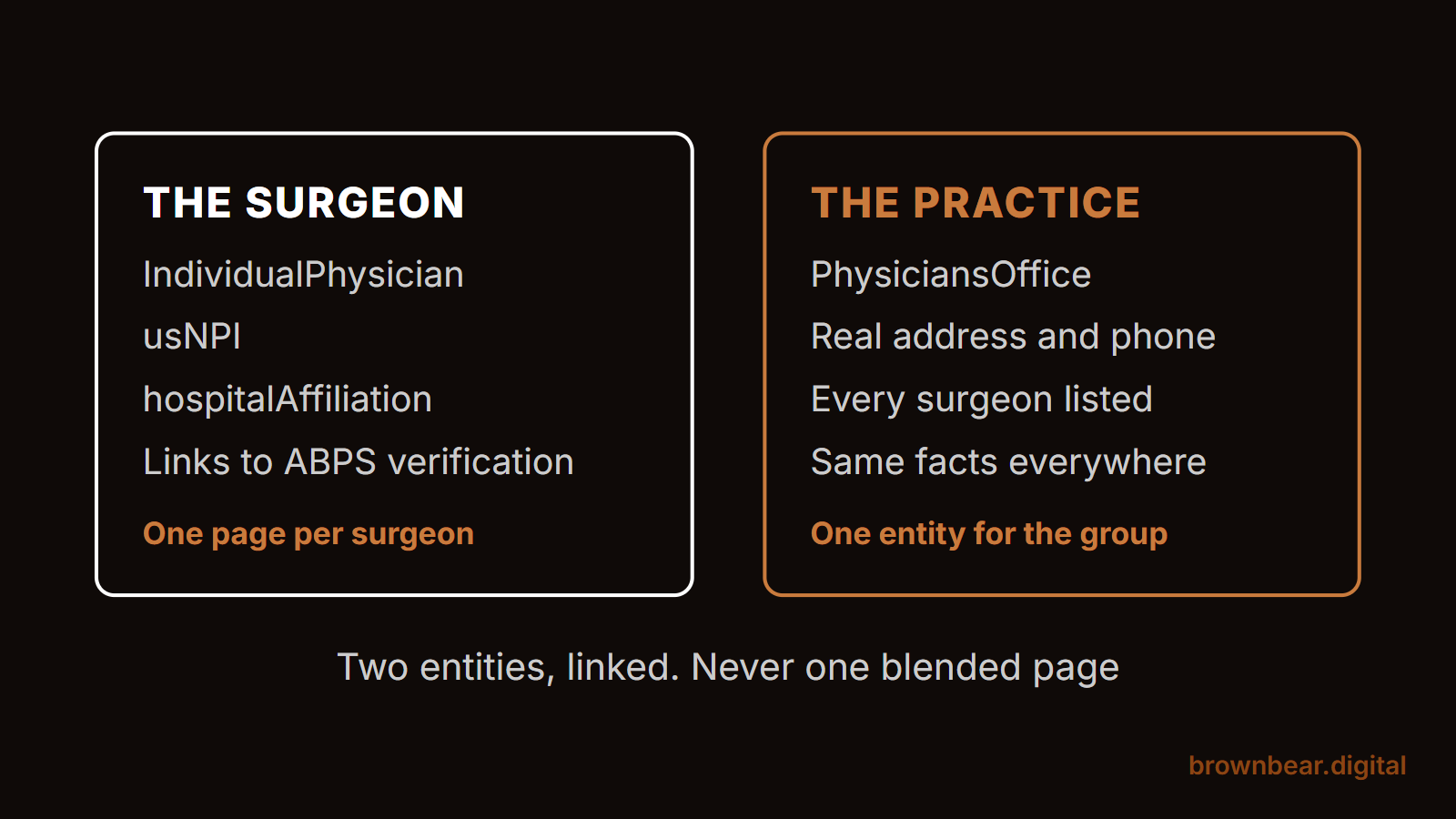
- NPI number visible, and carried in the usNPI property of IndividualPhysician markup, the schema.org type built for one practitioner rather than a practice
- ABPS certification displayed and linked to the ABPS verification source
- Medical school, residency, fellowship with full institution names, which give anyone checking, human or machine, something concrete to verify
- Hospital affiliations and academic appointments, linked to the institutions and marked up with hospitalAffiliation
- Memberships: ASPS, Aesthetic Society, AMA, state medical society, each linked
- Press, publications, and speaking: actual verifiable links, not generic claims of being "featured in major publications"
- Real photos: multiple, ideally including operating context, ideally with visible clinical environment
- First-person philosophy section: 200 to 400 words from the surgeon in their voice on their approach to care
The bio should live at a clean canonical URL (/about/dr-smith or /surgeons/jane-smith), be cross-linked from every procedure page the surgeon performs, and be the canonical source for that surgeon's identity across the site.
How you build this depends on the practice's shape. If you are a solo surgeon, the bio and the practice are nearly the same entity: one IndividualPhysician page, the practice marked up as a PhysiciansOffice, and every procedure page pointing to you. If you run marketing in-house for a multi-surgeon group, each surgeon needs a separate bio, and each procedure page should name the surgeon who actually performs it rather than the group. Where nurse injectors or aestheticians write content, give them their own credentialed bios, and never let their pages borrow a surgeon's credentials.
Say a three-surgeon group publishes every blog post under the practice name. Anyone looking for who is qualified to make the claims finds a logo. Re-attributing twenty procedure posts to the surgeons who perform those procedures, each linking to a complete bio, turns twenty anonymous pages into twenty pieces of evidence for three named experts.
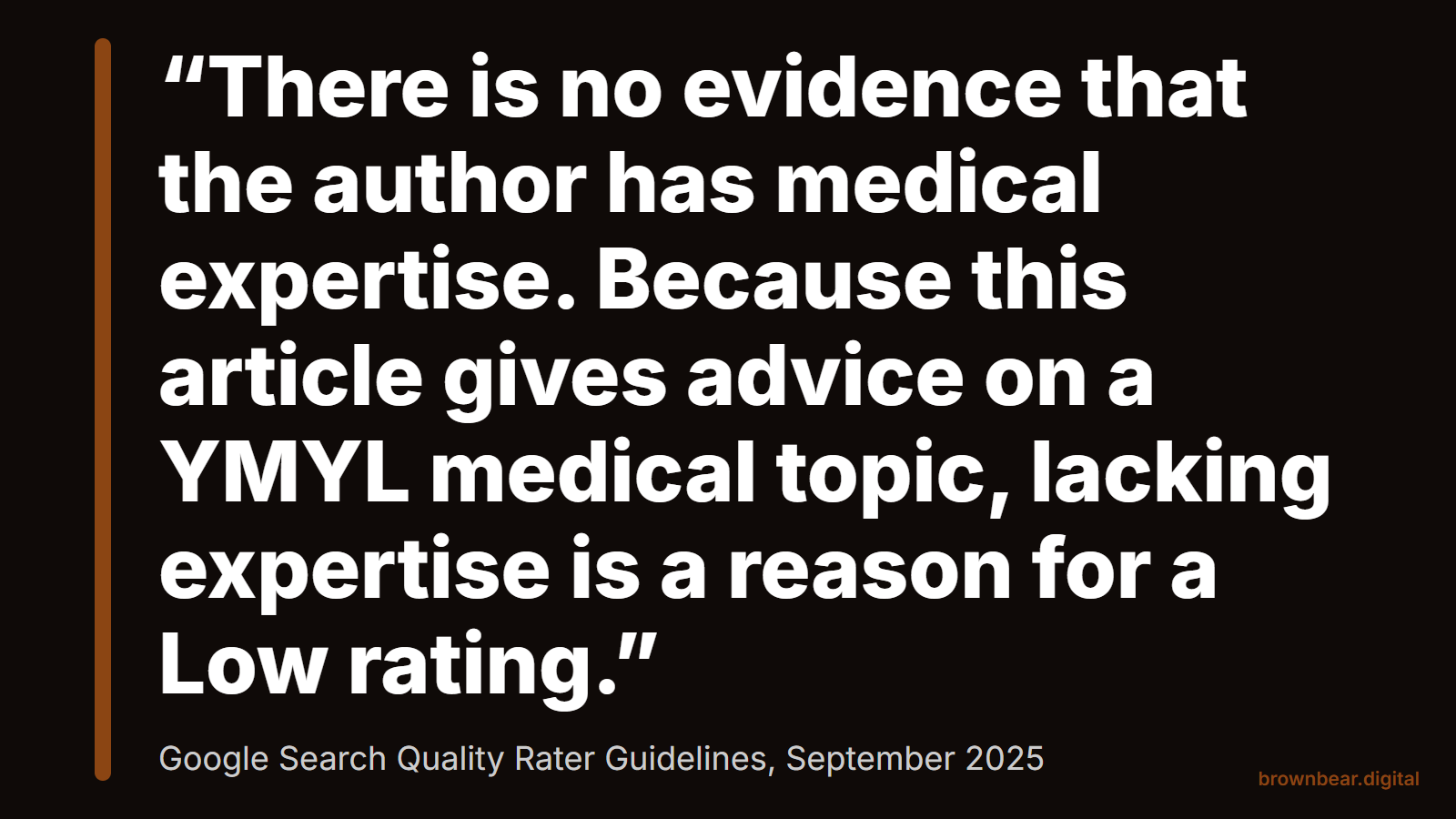
A bio fixes attribution, not quality. A struggling site does not recover because author boxes appeared, and in our client work, schema is worth getting right but is not a silver bullet: crawlable, clearly structured content moves AI visibility more than markup does.
The cost of this bio architecture is not trivial. It requires real surgeon time and real verification work. The cost of not having it, in a YMYL niche, is higher.
Citation Hygiene for Plastic Surgery Content
Generic YMYL guides recommend "cite your sources." For medical content, the standard is more specific. Citations on a plastic surgery website should follow these rules.
Source hierarchy (in descending order of weight):
- Peer-reviewed journals such as Plastic and Reconstructive Surgery and Aesthetic Surgery Journal
- Major medical institutions (Mayo Clinic, Cleveland Clinic, Johns Hopkins)
- Professional society publications (ASPS, ABPS, Aesthetic Society)
- Government health resources (NIH, FDA, CDC)
- The surgeon's own clinical observation, explicitly flagged as such
What to cite:
- Recovery timelines, statistics, complication rates
- Procedure outcome ranges
- Technique-specific claims
- Historical context for procedures (when techniques were developed, by whom)
- Comparative claims between procedures
What does not need citation but does need authorship clarity:
- The surgeon's stated philosophy
- Practice-specific information
- Patient story content (with consent)
Avoiding citation through vague language ("studies have shown," "experts agree") gives a rater nothing to check, on pages the guidelines hold to "very high Page Quality rating standards." Either cite the specific source, or attribute the observation to the surgeon directly. The trust gain from explicit attribution outweighs any aesthetic cost in the writing.
Say a rhinoplasty page reads: "Most patients are back at work in a week, and studies show swelling is gone by three months." Both halves fail, and they need different fixes. If the first half is the surgeon's real experience, attribute it: "In Dr. Lee's practice, most patients return to desk work after about a week." The second half needs the specific study it supposedly came from, or it comes out. Paste your own procedure copy into the scanner below to find the phrases that need one fix or the other.
Paste a procedure page, a blog post, or a recovery guide. The scanner marks every number that needs a source, every "studies show" that needs a name, and every absolute a surgeon would never say in a consultation, then tells you which fix each one needs.
Built by Brown Bear Digital · nothing you paste leaves this page
Disclosure: A pattern check for informational purposes. It catches common phrasings, not every unsupported claim, and it cannot tell whether a cited figure is correct. Medical accuracy is the surgeon's call. Nothing you paste is stored or transmitted.
The Medic Update, Every Core Update Since, and What Got Hit
The August 2018 update is the canonical reference point in YMYL discussions, and the evidence behind its nickname is more specific than most retellings suggest. It began on August 1, 2018. A week later, Search Engine Roundtable published a survey of more than 300 affected sites and found that over 42% were health or medical sites, a concentration its author said he had never seen in one niche. That is where the name "Medic" came from, even though Google described it as a broad core update rather than a medical one.
What happened next matters more than the name, because Google keeps retesting. Its own Search Status Dashboard lists thirteen core updates between March 2023 and May 2026: March, August, October, and November 2023; March, August, November, and December 2024; March, June, and December 2025; and March and May 2026. Each is a broad reassessment, and health content gets reassessed along with everything else. That cadence is also why YMYL results take patience: we cover how long YMYL SEO actually takes and what controls the clock.
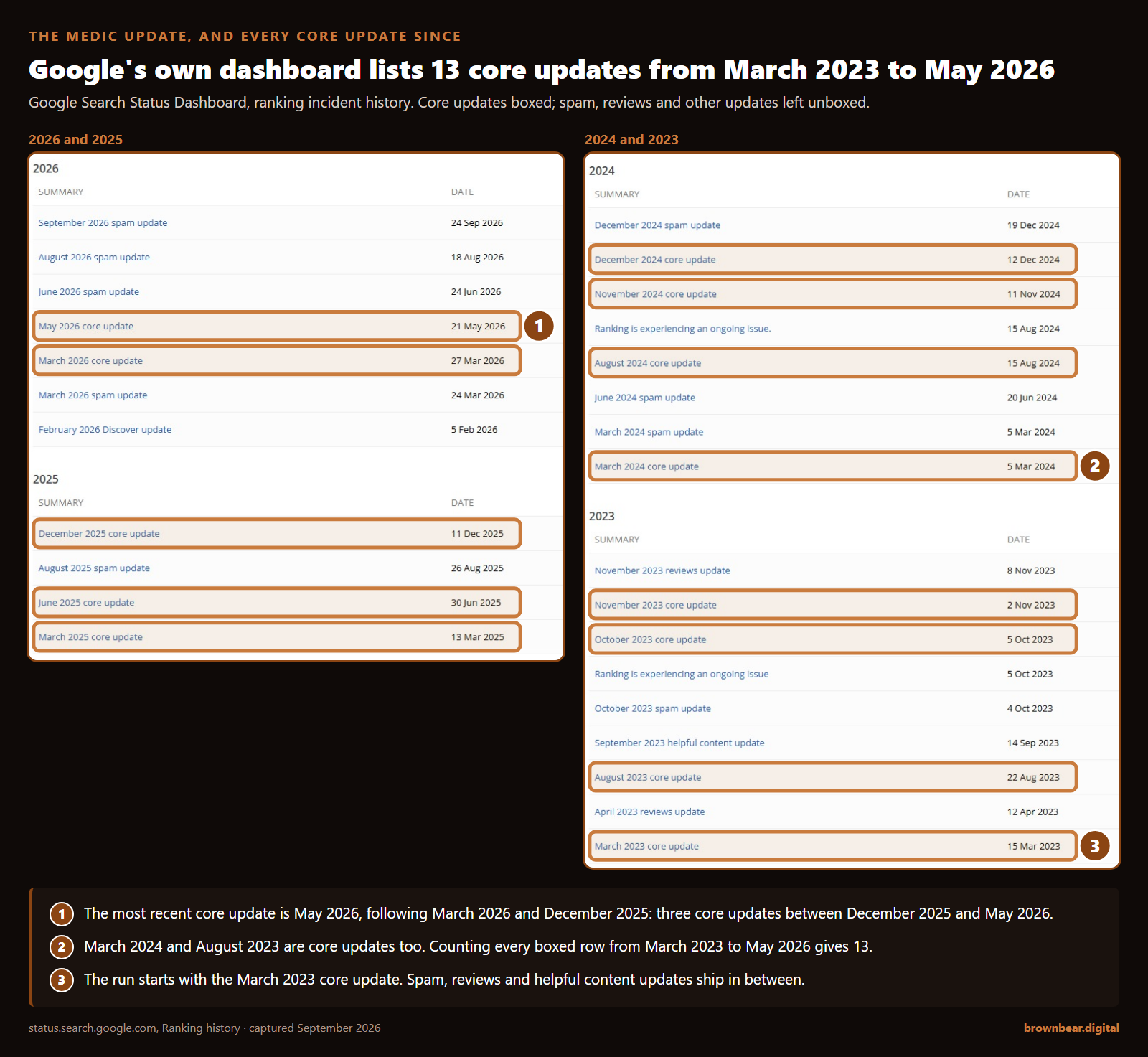
Our reading of that history: the YMYL standard is not a fixed bar, it ratchets. Content that passed in 2020 is exposed now, and content written to today's floor will be exposed at a future update. Practices that build to the current ceiling, not the current floor, are the ones that ride out core updates.
What to do with that depends on where you stand. If your traffic dropped during a core update, resist rewriting everything at once. Compare the pages that fell against the pages that held, and look for the trust gap between them: unsigned clinical claims, missing surgeon attribution, stale procedure pages. If your traffic held, treat that as time bought rather than a pass, and close the same gaps before the next update tests them.
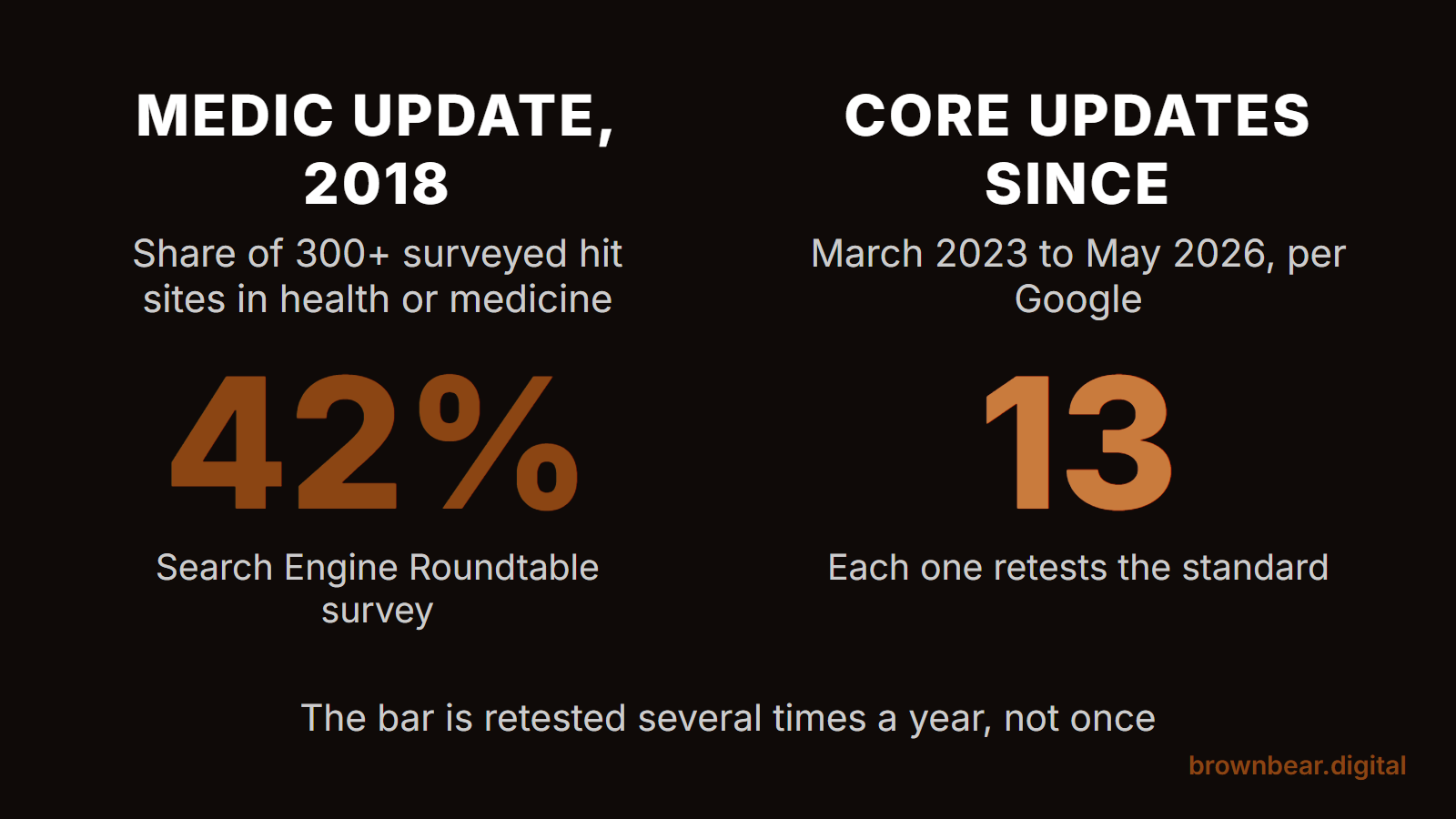
Why Generic YMYL Advice Fails for Elective Surgery Practices
Most YMYL guidance is written for journalism, financial services, or general health publishing. Elective surgery practices have a fundamentally different content situation.
The content is produced by the practice that benefits from it.
A peer-reviewed journal has institutional separation between authors and commercial outcomes; a plastic surgery practice does not. YMYL standards have to be applied with awareness that the surgeon-author is the commercial entity. Disclosure, transparency about outcomes, and explicit acknowledgment of when the surgeon is recommending their own service vs. providing neutral information: these matter more than they do in publisher contexts.
The audience is at peak emotional sensitivity.
A patient researching a major procedure is rarely in a calm, deliberative state. Content that pretends otherwise reads as off-key. The YMYL standard for plastic surgery requires acknowledging the emotional context (anxiety, decision pressure, recovery fears) without exploiting it.
The geography is concrete.
Most YMYL content is national or international in scope. Plastic surgery practices serve a defined geographic market. The trust signals that matter include local ones: hospital affiliations, local press, named local patients, specific city-level expertise. Generic YMYL advice misses this entirely.
The decision is irreversible.
A bad investment can sometimes be corrected. A poorly performed procedure cannot. The YMYL standard for plastic surgery has to reflect the irreversibility of the underlying decision in the level of caution, completeness, and verifiable expertise required of the content.
A practice working with an SEO agency that hasn't internalized these distinctions will produce technically YMYL-compliant content that still feels generic, and AI engines and Google's quality systems will correctly identify it as such.
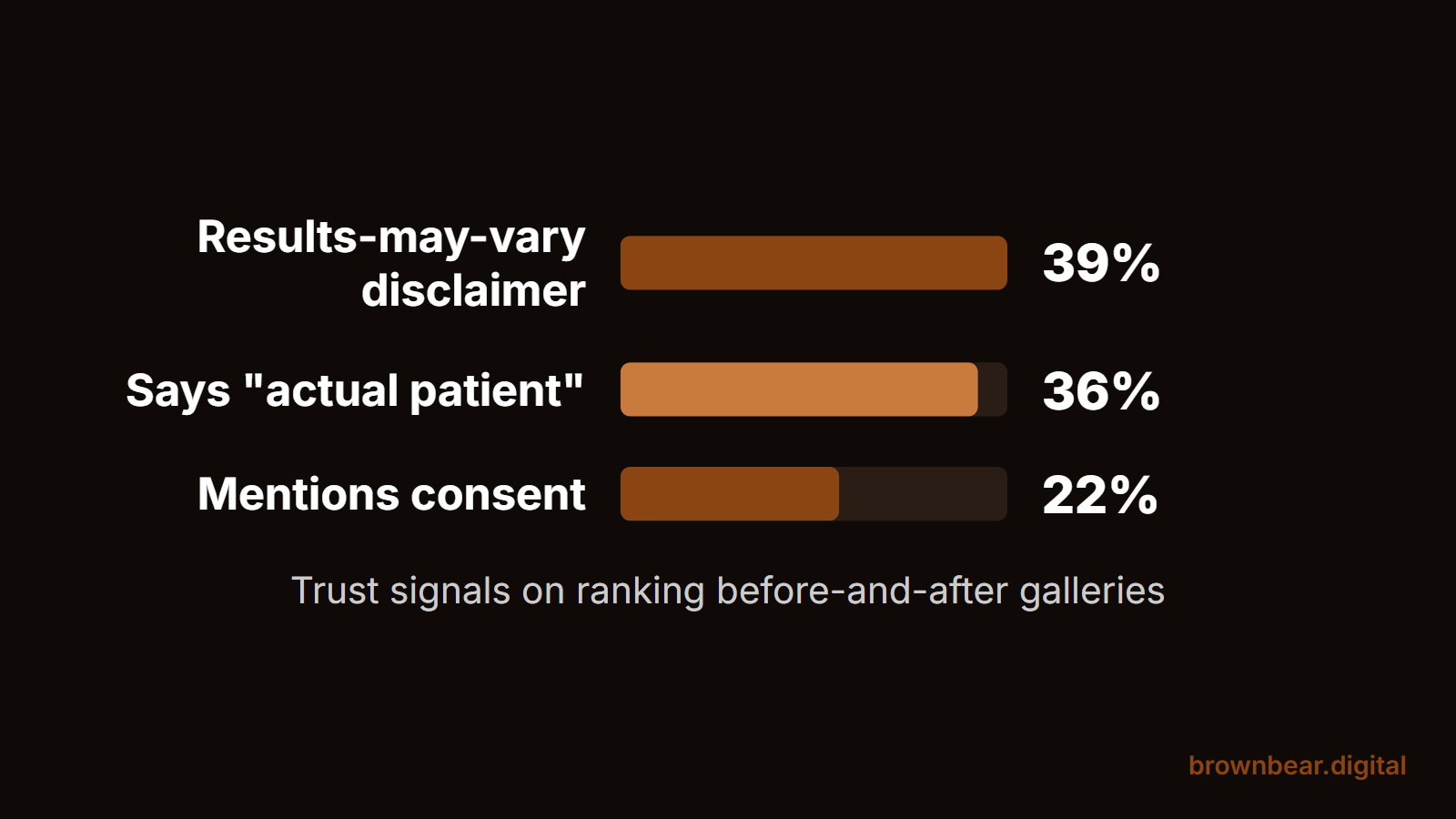
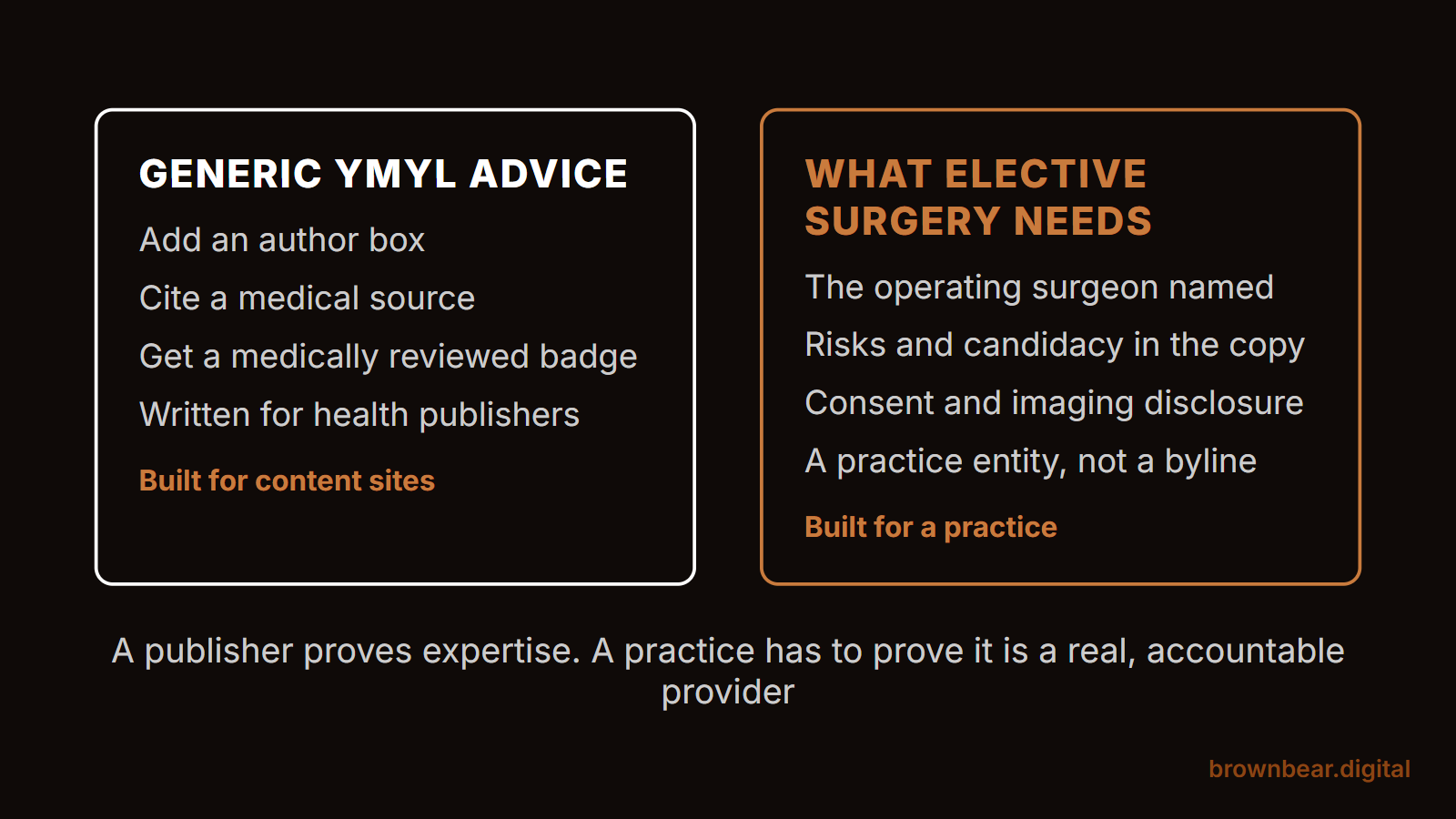
Here is the encouraging half of that picture. When we measured the pages currently winning these searches, most of them do not clear the bar either. Our 101-city procedure page study found risks and safety covered at the heading level on 6% of #1-ranking pages, and a complete surgeon entity, meaning Person schema linked out to external profiles, on exactly one page in 101. Our 50-procedure gallery study found a results-may-vary disclaimer on 39% of ranking galleries, an "actual patient" label on 36%, and any mention of consent on 22%. The YMYL standard is demanding and the current winners are largely ignoring it, which makes the checklist below a competitive weapon rather than a compliance chore.
A YMYL Audit Checklist for a Plastic Surgery Website
Before publishing or claiming YMYL compliance, a plastic surgery website should pass:
Authorship and identity
- Every medical claim has a named, credentialed author
- Each surgeon has a complete bio at a canonical URL with NPI, ABPS cert, full training history
- IndividualPhysician markup, with usNPI and hospitalAffiliation, is present and accurate on every surgeon bio
- Surgeon bios are cross-linked from every procedure page they perform
- No stock photos used for surgeons, staff, or "patients" anywhere on the site
- Patient experience content and clinical content are labeled so a reader can tell which voice is speaking
Content quality
- Every procedure page has MedicalProcedure schema
- Every medical claim is sourced (peer-reviewed, institutional, or explicitly attributed to the surgeon's clinical experience)
- FAQs use FAQPage schema
- Recovery timelines, statistics, and outcomes are sourced or flagged as practice observations
- "Last updated" date is visible on every medical page
Trust signals
- HIPAA-compliant patient photo and story practices, transparently described
- Real practice address, phone, and MedicalBusiness schema
- Outcomes presented with realistic ranges, not just optimal cases
- Conditions under which the surgeon would decline a procedure are stated somewhere
- Press, publications, and speaking are linked, not just claimed
Technical
- Core Web Vitals pass for all medical content pages
- Mobile-first responsive across all procedure and bio pages
- Internal links create a coherent topical authority graph
Recency
- Procedure pages reviewed and updated within the last 12 months
- Outdated technique discussions removed or updated
- New procedures the practice performs are added with full documentation
A practice or agency that can pass this checklist is operating at the YMYL standard the plastic surgery vertical actually requires. A practice that can't is operating at the YMYL standard generic guides describe, which in 2026 is no longer enough.
If you can only do four things this quarter, do them in this order:
- Put a named, credentialed surgeon on every procedure and aftercare page, linked to a complete bio.
- Run your ten highest-traffic procedure pages through the claim scanner above and fix every vague attribution.
- Add consented patient experience content where it belongs: recovery diaries, consultation stories, decision stories.
- Date-stamp every medical page and set a review cycle, so the date means something.
Trust as a Competitive Moat
The strategic implication of all of this is the same conclusion every careful YMYL guide eventually reaches: trust is hard to manufacture, slow to compound, and impossible to fake at scale. Practices that have built genuine E-E-A-T architecture into their website, content, and identity have a moat that gets wider with every algorithm update and every advance in AI Overview citation logic.
Generic content competes on volume. YMYL-grade content compounds on credibility.
For plastic surgery practices, this is not a marketing observation. It's a competitive one. The practices that will dominate AI search and traditional search over the next five years are the ones whose websites are legible, verifiable, and substantively trustworthy at a level competitors can't match by hiring a different agency or buying a redesign. The ones that aren't there yet will not get there by following generic YMYL advice. They'll get there by treating their YMYL architecture as the central asset of their digital presence, and the design layer above it as the vehicle, not the destination.
That's the standard. Inside one vertical, applied to the practices that have to work with it, that's what YMYL actually means.
References
-
American Board of Medical Specialties. (2025). ABMS Member Boards. American Board of Medical Specialties. https://www.abms.org/member-boards/
-
American Board of Plastic Surgery. (2026). Is Your Surgeon Certified? American Board of Plastic Surgery. https://www.abplasticsurgery.org/public/verify-certification/VerifyCert?section=SurgeonSearch
-
American Society of Plastic Surgeons. (2025). Find a Plastic Surgeon. American Society of Plastic Surgeons. https://www.plasticsurgery.org/find-a-surgeon
-
The Aesthetic Society. (2025). About the Aesthetic Society. The Aesthetic Society. https://www.theaestheticsociety.org/about
-
Google LLC. (2025, September 11). Search Quality Rater Guidelines. Google. https://static.googleusercontent.com/media/guidelines.raterhub.com/en//searchqualityevaluatorguidelines.pdf
-
Google LLC. (2026). Creating helpful, reliable, people-first content. Google Search Central. https://developers.google.com/search/docs/fundamentals/creating-helpful-content
-
Google LLC. (2026). Google Search Status Dashboard: Ranking updates. Google. https://status.search.google.com/products/rGHU1u87FJnkP6W2GwMi/history
-
Schema.org. (2025). IndividualPhysician. Schema.org. https://schema.org/IndividualPhysician
-
Schwartz, B. (2018, August 8). Google Medic Update: Google's Core Search Update Had Big Impact On Health/Medical Sites. Search Engine Roundtable. https://www.seroundtable.com/google-medic-update-26177.html
-
U.S. Department of Health and Human Services. (2025). Health Information Privacy (HIPAA). HHS. https://www.hhs.gov/hipaa/index.html
Work with Brown Bear on YMYL-Grade Plastic Surgery SEO
Most agencies describe E-E-A-T as a checklist. Brown Bear Digital builds the credibility architecture behind it: surgeon bio systems, medical authorship, citation discipline, and the on-site trust signals that determine whether your content gets surfaced in AI Overviews or buried below practices that took the standard seriously. Our plastic surgery SEO services, content marketing, and AI search optimization are built around what YMYL actually requires in 2026, as part of our broader plastic surgery marketing work. Reach out and we'll assess where your site currently stands against the standard.
Written By
Founder, Brown Bear Digital
Bryan has 15 years of experience across SEO, paid search, and AI search strategy. He founded Brown Bear to give businesses direct access to senior-level search expertise without the agency overhead.
Learn More About BryanGet Found on Google.
Get Cited by AI.
Tell us about your site. We'll send back a proposal for SEO and AI search.