Plastic Surgery Reviews: Generation, Response, and SEO Impact

Reviews are the most frequently misunderstood asset in plastic surgery marketing. Practices treat them as either a passive byproduct of doing good work, or as a marketing asset to be inflated through volume campaigns. Both approaches leave significant ranking and conversion value on the table, and both occasionally cross into HIPAA, FTC, or state medical-advertising violations that the practice doesn't realize it's committing.
This piece covers the parts most surgeons and practice managers actually need: how reviews drive ranking and conversion, where to focus across the platforms that matter, how to generate them on a steady cadence, how to respond without violating HIPAA, and how to handle negative reviews without making them worse.
Key Takeaways
Reviews are a system, not a byproduct
Steady velocity, the right platform priority, and compliant responses drive both map-pack rankings and consultation conversion. Treating reviews as something that just happens leaves ranking value on the table and invites HIPAA and FTC exposure.
A working system produces 8 to 25 Google reviews a month
Every consult patient gets a personal request 24 to 72 hours after the visit, and surgical patients get theirs at weeks 4 to 6 post-op when they're past early recovery. The request comes from a named coordinator, never with an incentive attached.
Never confirm patient status in a review response
Thanking a patient by name for their rhinoplasty is a HIPAA violation, and so is saying you have no record of them. Keep responses warm and brief, and move every resolution to a private phone call.
Google first, RealSelf second, everything else maintenance
Google reviews feed the map pack and knowledge panel, and RealSelf carries the detailed procedure-specific reviews surgical patients actually read. Equal-effort campaigns across six platforms waste attention.
What Reviews Actually Do for the Practice
Two distinct functions, often conflated.
Search ranking.
Review count, recency, response rate, and review-text relevance all feed local search ranking, particularly the map pack. They also feed broader brand-search signals; a practice with strong, current reviews will outrank a practice with stale reviews on direct-name searches and "plastic surgeon [city]" searches.
Consultation conversion.
Patients researching plastic surgery read reviews before they fill out a form. The number, recency, and content of reviews directly affect how many qualified visitors become consults. A practice with 80 well-written, recent reviews converts at materially higher rates than a practice with 12 reviews from 2021, even when the websites are otherwise comparable.
These two functions interact, but they are not the same. A campaign that drives review count without quality or recency improves rankings slightly and conversion not at all.
Platform Priority: RealSelf vs. Google vs. Yelp
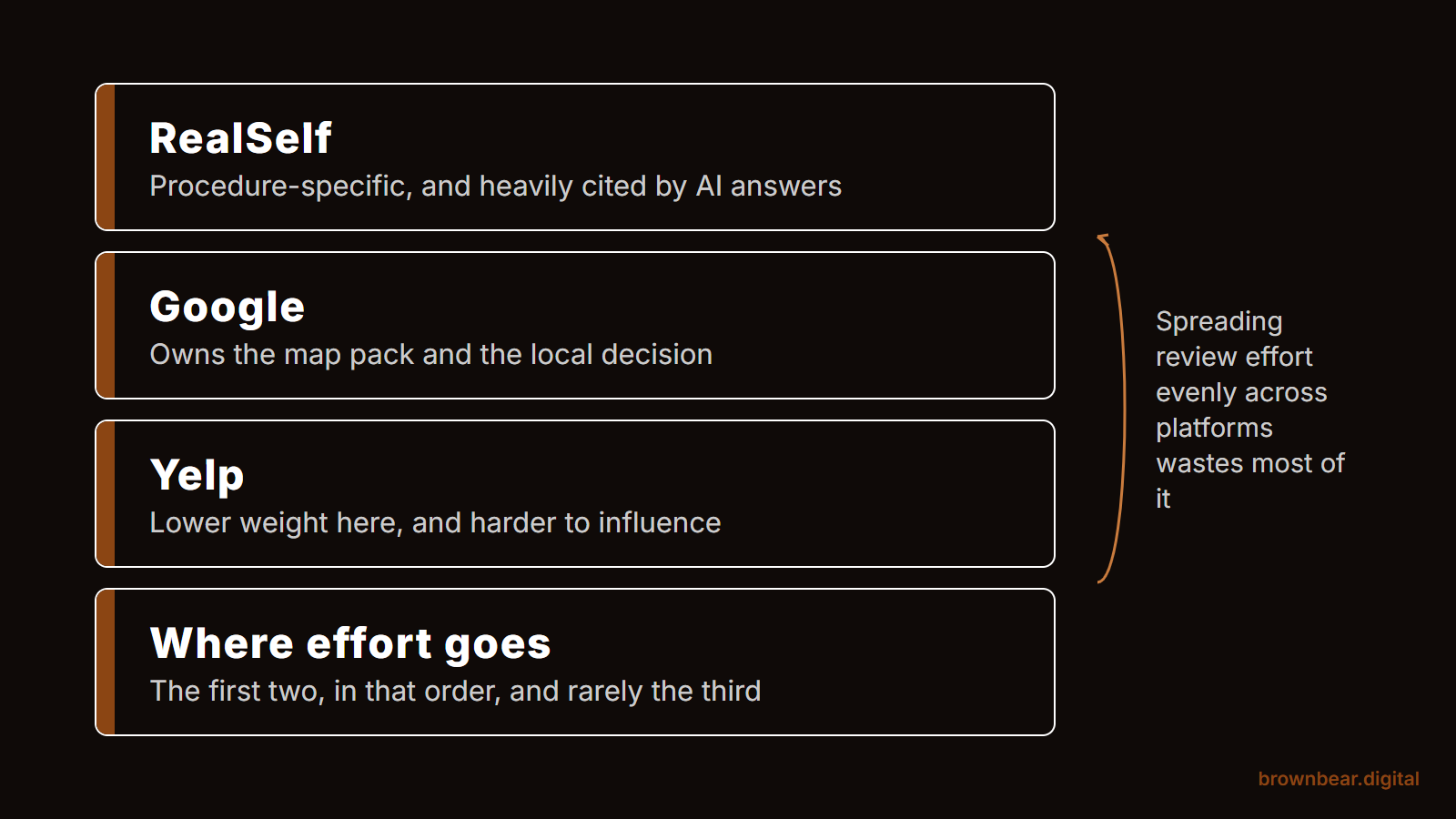
Most agencies treat all review platforms as equivalent. They are not. For plastic surgery specifically, the priority order is:
Google reviews.
First priority. Google reviews feed the GBP, which feeds the map pack and the knowledge panel on brand searches. Patients see them first when they search the practice name. Volume and velocity here matter most.
RealSelf.
Second priority for surgeons doing meaningful cosmetic surgery volume. RealSelf has procedure-specific search behavior, where patients researching rhinoplasty browse rhinoplasty surgeons directly on the platform. The Q&A section, the "Worth It" rating, and the surgeon's own answer activity all matter. RealSelf is also the platform where patients post the most detailed, photo-rich, procedure-specific reviews; those reviews show up in Google search results for the surgeon's name and procedure terms.
Yelp.
Third priority, with caveats. Yelp's filtering algorithm hides legitimate reviews and promotes others in ways that frustrate practitioners. Yelp matters because patients still check it, particularly in California and the Northeast. It is rarely worth aggressively pursuing volume on Yelp; it is worth maintaining a presence and responding to reviews that get through the filter.
Healthgrades, Vitals, RateMDs.
Lower priority for plastic surgery specifically. These platforms over-index on traditional healthcare specialties; plastic surgery patients tend to research elsewhere first. Maintain accurate profiles; don't pour generation effort here.
Facebook reviews.
Tertiary. Some patients use them. Most don't.
The practice that drives most of its review-generation effort to Google and RealSelf, with maintenance posture on the rest, is allocating correctly. The practice that runs equal-effort campaigns across six platforms is wasting attention.
Review Generation: The System That Works
The system that produces sustainable, high-quality review velocity is not complicated.
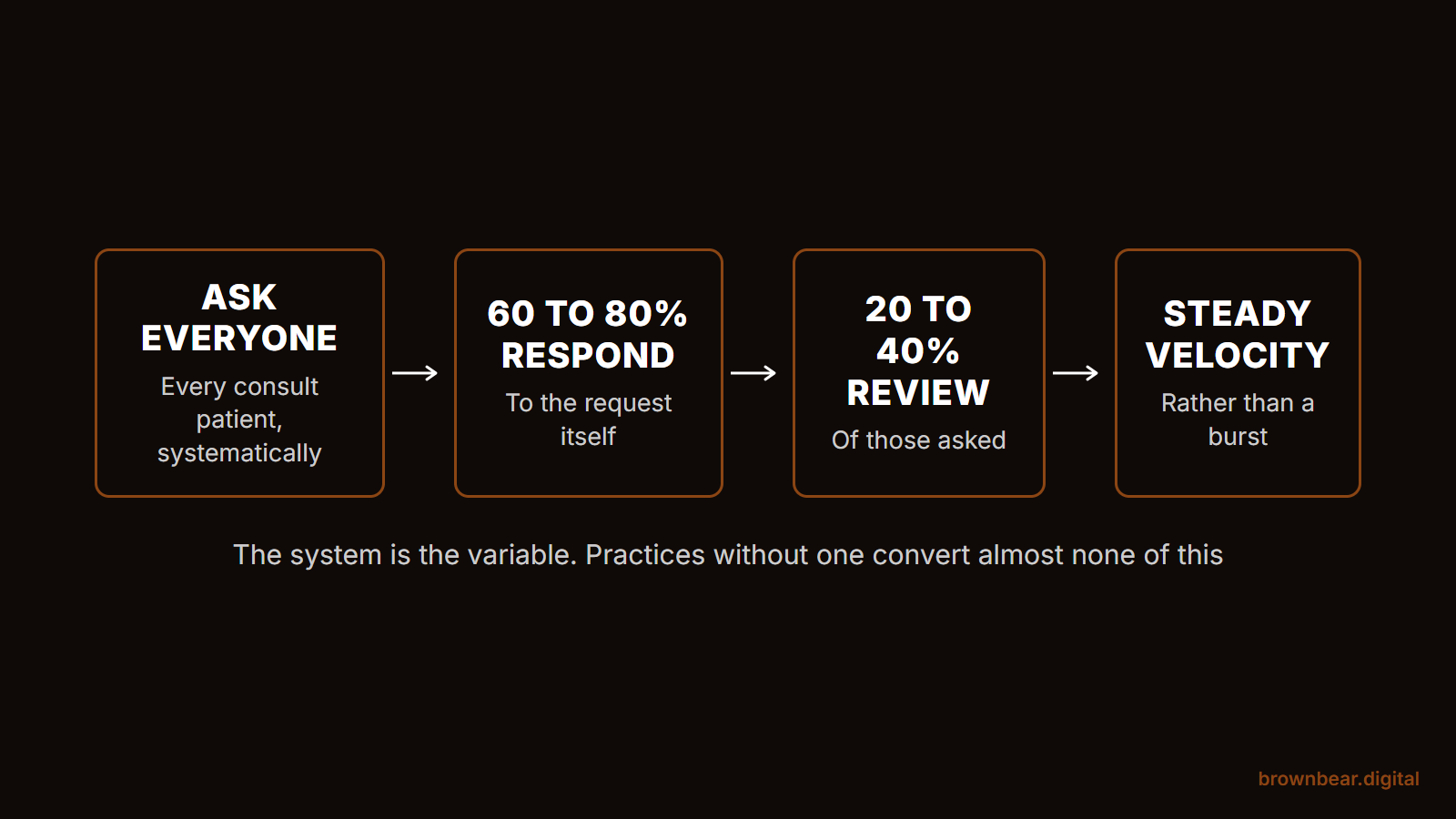
Every consult patient gets a review request 24 to 72 hours after the visit.
SMS first, email second. The message names the surgeon and links directly to the GBP review form (and optionally a RealSelf option for surgical patients).
Every surgical patient gets a review request at the appropriate clinical milestone.
Generally 4 to 6 weeks post-op for breast, body, and face procedures, when the patient is past the difficult early recovery and beginning to enjoy results. Sooner for non-surgical. The timing matters enormously: a request at week one produces an unhappy review; a request at week six produces a real one.
The request is from a person, not a brand.
"Hi [name], it's [coordinator] from Dr. [surgeon]'s office. We hope you're feeling great. If you're willing, we'd love a Google review, it really helps other patients find us. [link]" outperforms automated brand messages by a wide margin.
There is no incentive offered.
No discount, no gift card, no entry into a drawing. Offering compensation for reviews violates Google's terms, FTC guidance, and the medical-advertising rules in most states. This is non-negotiable.
Negative responses route to private feedback first.
The patient who indicates dissatisfaction is offered a direct call from the practice manager before any public review is requested. This is not "review filtering" (which is a different and prohibited practice). It's appropriate service recovery. The patient is never blocked from leaving a public review if they choose to.
A healthy plastic surgery practice on this system generates 8 to 25 new Google reviews per month, with 60 to 80% of consult patients responding to the request and 20 to 40% leaving a review. Those numbers vary by practice culture and consult volume; the trend matters more than the absolute number.
Responding to Reviews Without Violating HIPAA
This is where most practices and many agencies create legal exposure they don't recognize.
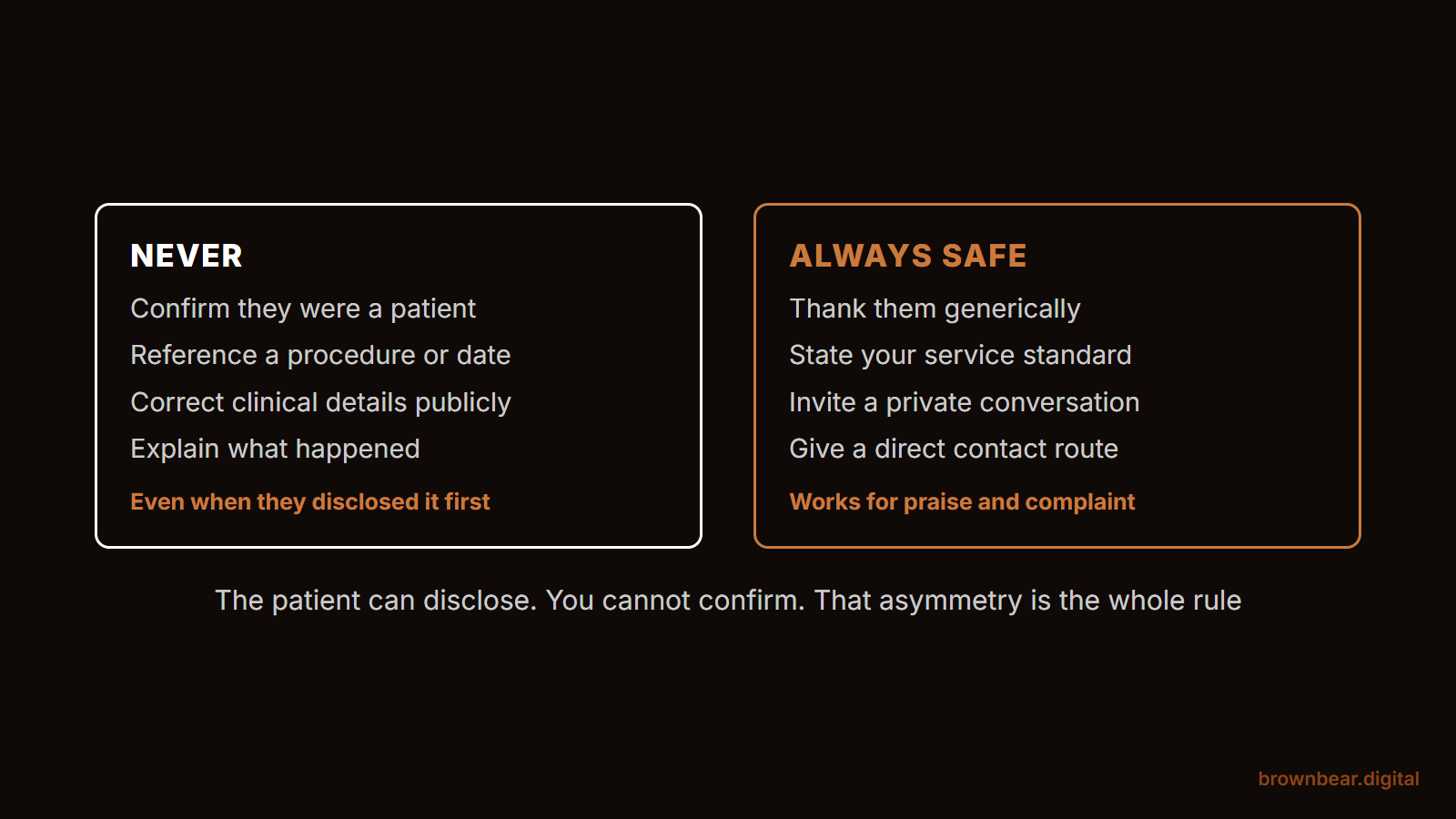
The HIPAA reality: a patient writing a review online has not authorized the practice to confirm or deny their patient status, identify them, or discuss their treatment. Even if the patient has named themselves, the practice cannot reciprocate without explicit, documented authorization.
Common HIPAA violations in review responses:
- "Thank you for trusting us with your rhinoplasty, [Name]. We're so glad your recovery is going well." (Confirms patient status, identifies the patient, confirms procedure.)
- "We're sorry your experience didn't meet expectations. Your tummy tuck was a complex case and we did our best." (Discloses procedure and treatment context.)
- "We don't have a record of this patient." (Discloses patient status by negation.)
The compliant response template, for positive reviews:
"Thank you so much for the kind words! Reviews like this mean a great deal to our team. We appreciate you taking the time."
The compliant response template, for negative reviews:
"Thank you for the feedback. Without confirming any patient relationship, we'd welcome the chance to speak directly so we can understand and address your concerns. Please call our practice manager at [number]."
The compliant response template, for unfair or false reviews:
"Thank you for sharing your perspective. Without confirming any patient relationship, we want to note that this account differs significantly from our records. We invite you to call us at [number] to discuss directly."
The pattern is consistent: warm, brief, never confirms patient status, always offers a private channel for resolution.
Negative Review Handling
Three rules that hold up.
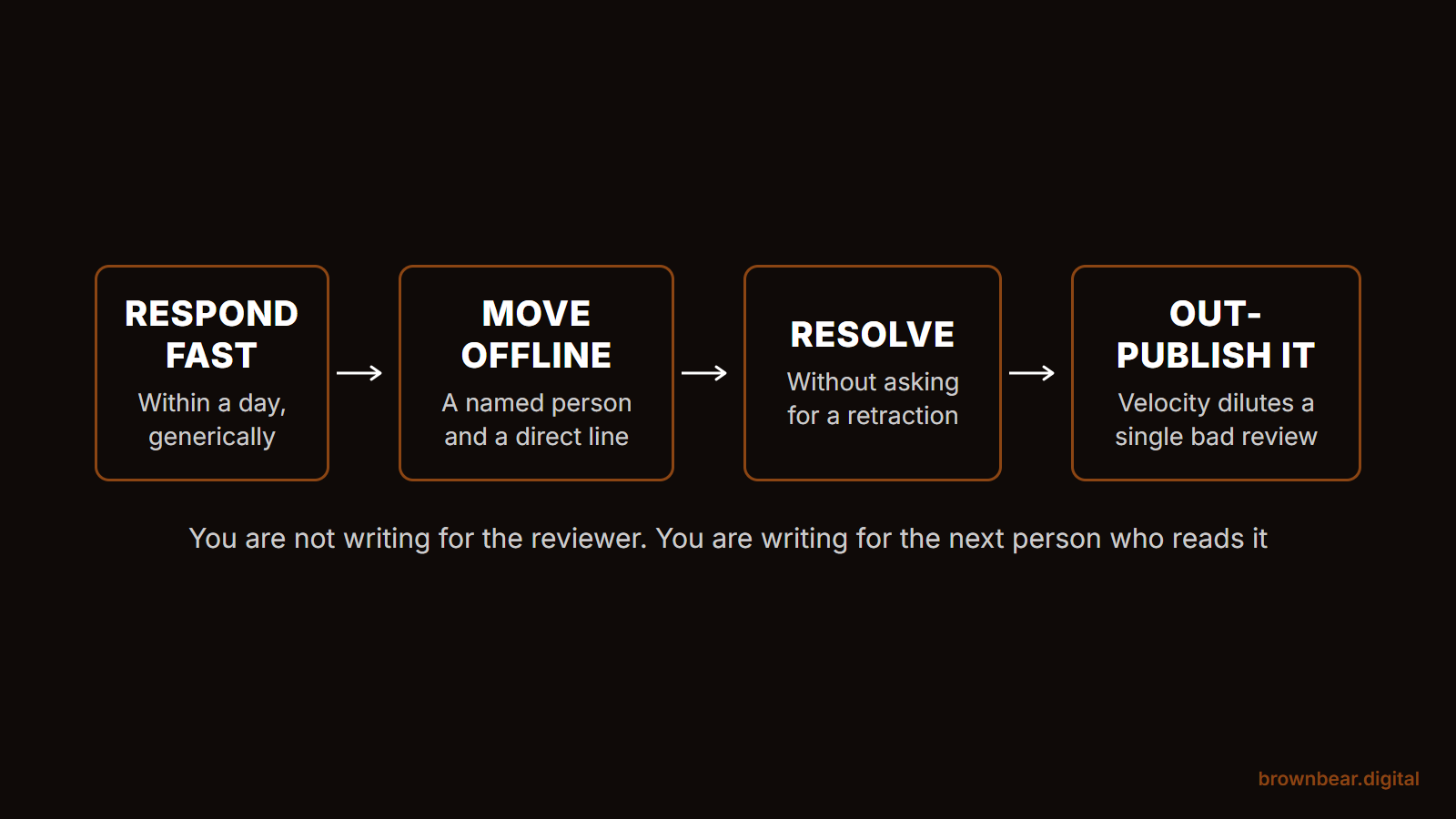
Respond within 48 hours.
Slower responses look indifferent. Faster responses look defensive.
Never argue.
Even when the review is unfair, false, or written by a competitor, public arguments make the practice look worse than the original review did. The audience for the response is not the reviewer; it is the next patient reading.
Move it offline.
Every negative review response should include a phone number and an invitation to call. Some patients accept the invitation and the situation resolves. Most don't. The patients reading the responses see a practice that is willing to engage privately, which is what they're actually evaluating.
For genuinely defamatory or fake reviews, the path is platform escalation: Google's review removal process, RealSelf's reporting tools, Yelp's content guidelines. The success rate is low but not zero. Documented cases of fake reviews from named individuals, or reviews that violate platform-specific content policies, can be removed.
What does not work: paying reputation management firms to bury reviews with fake positive ones, suing patients for negative reviews (which produces a Streisand-effect cascade and is increasingly disallowed by anti-SLAPP statutes), or attempting to incentivize the patient to remove the review.
What Reviews Should Look Like (Without Scripting Them)
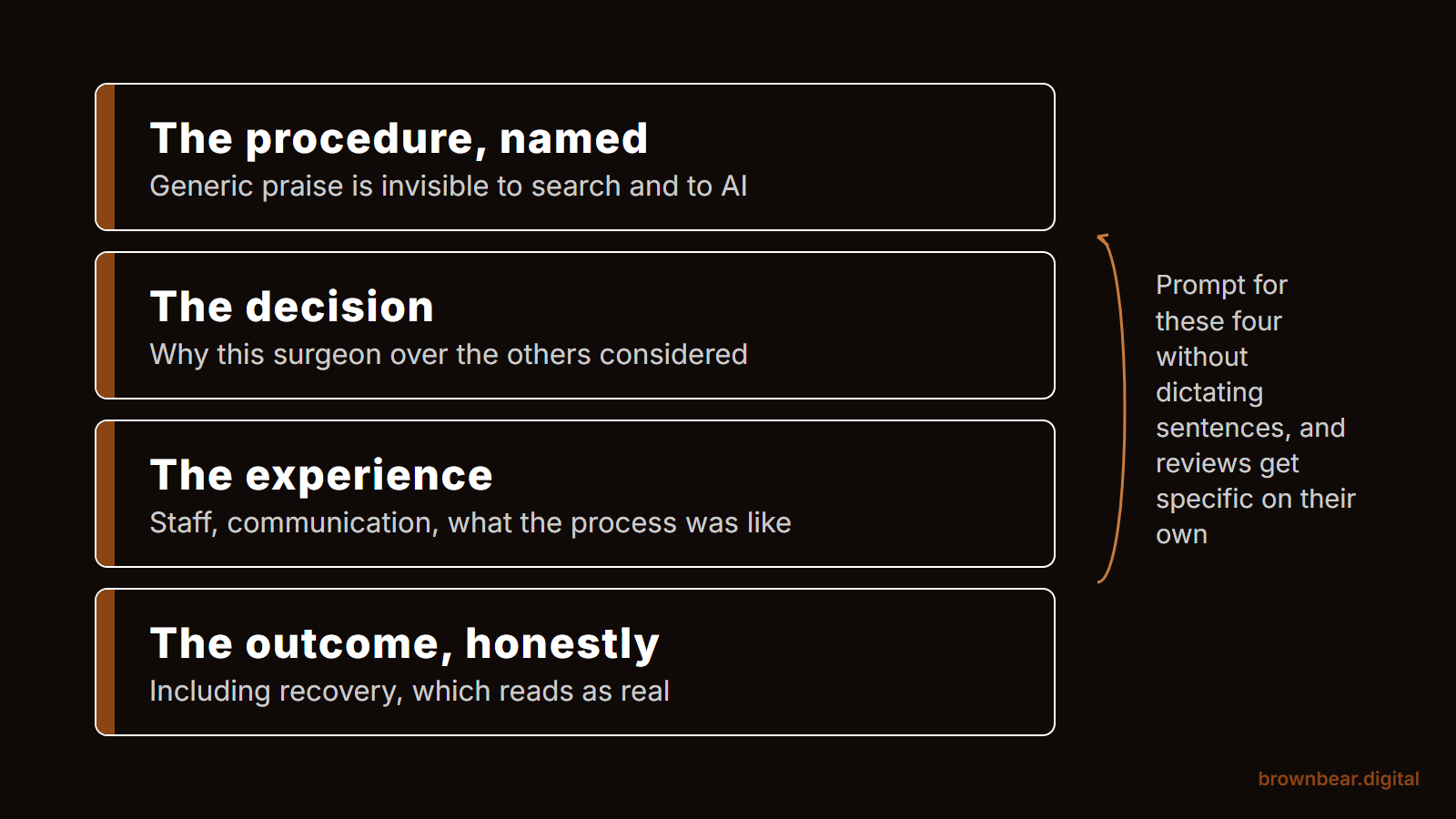
Scripted reviews are detectable, both by the platforms and by patients. Reviews that all sound the same get filtered, and patients reading them register the artificiality even when they can't articulate it.
Real reviews vary in length, tone, specificity, and grammar. They mention specific moments: the consultation, a particular nurse, a recovery experience, a result. They sometimes include mild criticism alongside praise. They are written by humans with their own voice.
The practice should request reviews; it should not draft them. The most useful prompt language in a review request is something like: "If you're willing, we'd love to hear about your experience, what stood out, how the consultation went, whatever feels real to you." That produces useful, specific, ranking-relevant content. "Please mention Dr. Smith and your facelift in your review" produces filtered reviews and patients who feel manipulated.
Within the request, you can mention that procedure-specific reviews help other patients find the practice. That's true and ethically clean. You cannot dictate the content.
Tying Reviews Back to Local SEO and the Website
The reviews that drive the most ranking value are the ones that mention specific procedures, specific surgeons, and specific locations in their natural text. Those reviews feed local relevance for those exact queries.
The reviews that drive the most conversion value are the ones that appear on the practice's own website in addition to the platform. A reviews schema markup on the homepage and procedure pages, surfacing recent Google reviews with author names and dates, materially increases conversion. The reviews are also indexable, which feeds search.
The reviews that show up in Google's knowledge panel on a brand search are the ones that have been responded to. Response rate is a quality signal, and the responded reviews appear preferentially.
What to Do Next
- Audit your review velocity over the last 12 months. If it's not steady, the request system isn't working.
- Read your last 30 review responses. Score them against the HIPAA-compliant templates above. If any of them confirm patient status, fix that this week.
- Set the platform priority correctly. Google first, RealSelf for surgical practices, everything else maintenance.
- Build the post-op review request into the surgical workflow. Week 4 to 6, by SMS, from the coordinator's name, no incentive.
A plastic surgery practice with 80 to 200+ recent, well-written, varied reviews on Google, plus an active RealSelf presence, plus a clean response history is winning the comparison battle on every brand search and every map-pack query. That position took 12 to 24 months of disciplined work to build. It does not erode quickly. And it cannot be replicated by a competitor with budget alone.
References
-
Federal Trade Commission. (2023). FTC's Endorsement Guides: What People Are Asking. FTC. https://www.ftc.gov/business-guidance/resources/ftcs-endorsement-guides-what-people-are-asking
-
Google LLC. (2025). Contribute reviews on Google Maps. Google Maps Help. https://support.google.com/maps/answer/6230175
-
RealSelf. (2025). About RealSelf. RealSelf. https://www.realself.com/about
-
U.S. Department of Health and Human Services. (2025). Health Information Privacy (HIPAA). HHS. https://www.hhs.gov/hipaa/index.html
Related reading: Plastic Surgery Local SEO · About page best practices · How Plastic Surgery Practices Fill Their Consultation Calendar
Work with Brown Bear on Your Practice's Review Strategy
A review profile that drives ranking and conversion doesn't build itself. It's the result of a systematic post-op workflow, HIPAA-compliant response practices, and a platform strategy focused on the channels that actually matter. Brown Bear Digital builds and manages review generation systems for plastic surgery practices, integrated directly into the local SEO and on-site content strategy that turns review authority into map-pack rankings and qualified consultations. If your review velocity has stalled or your response approach is inconsistent, reach out and we'll walk you through what a working system looks like.
Written By
Founder, Brown Bear Digital
Bryan has 15 years of experience across SEO, paid search, and AI search strategy. He founded Brown Bear to give businesses direct access to senior-level search expertise without the agency overhead.
Learn More About BryanReady to Turn Search
Into Revenue?
No pitch decks. Just a real conversation.