Plastic Surgery Local SEO & Google Business Profile

Local search for plastic surgery is not the same category as local search for dentistry, urgent care, or any other medical specialty. The platforms, the ranking signals, and the patient behavior are different. Treating them the same is why most practices are partially visible at best.
Brown Bear is an SEO and AI search agency that works exclusively with plastic surgery practices. The configuration gaps we see most consistently: a GBP set up at launch and never revisited, location pages with thin content, and no active review-generation workflow to match the patient's research pace.
This piece covers both why plastic surgery local search operates differently from the rest of medicine and the specific configuration work that determines where you appear when patients search for surgeons in your market.
If you're ranking for procedure terms but not showing up in the map pack for "plastic surgeon [city]," this explains why and what to do about it. Maybe you know your GBP exists but haven't looked at it in months. Or your local presence feels inconsistent across locations and you're not sure what's driving the gap.
By the end of this, you'll have a clear view of what a fully configured plastic surgery local presence looks like across every layer that affects map pack and local organic rankings. The longer goal is a local search footprint that consistently puts your practice in front of patients when they're actively comparing surgeons in your market.
We'll walk through what makes plastic surgery local search structurally different, how to configure your GBP for this patient type, what location pages and citation consistency do for local authority, why review velocity matters more than review count once you pass a baseline, and the map pack factors specific to medical YMYL.
So, let's start with what's actually different about plastic surgery local search, because that distinction determines which tactics apply and which ones don't.
Key Takeaways
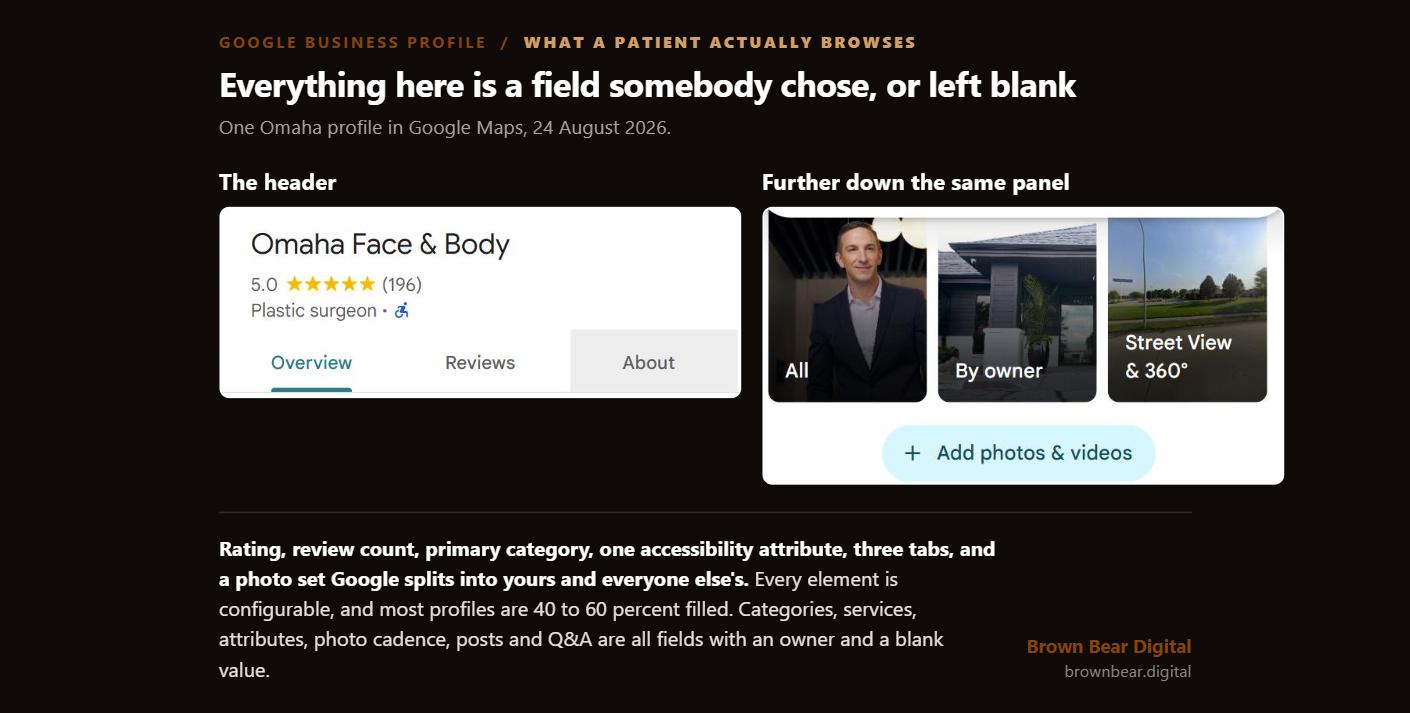
Your GBP is a second website, not a directory listing
Plastic surgery patients evaluate three to seven practices in detail before booking, comparing photos, reviews, credentials, and Q&A across all of them. A profile set up at launch and never revisited loses that comparison by default.
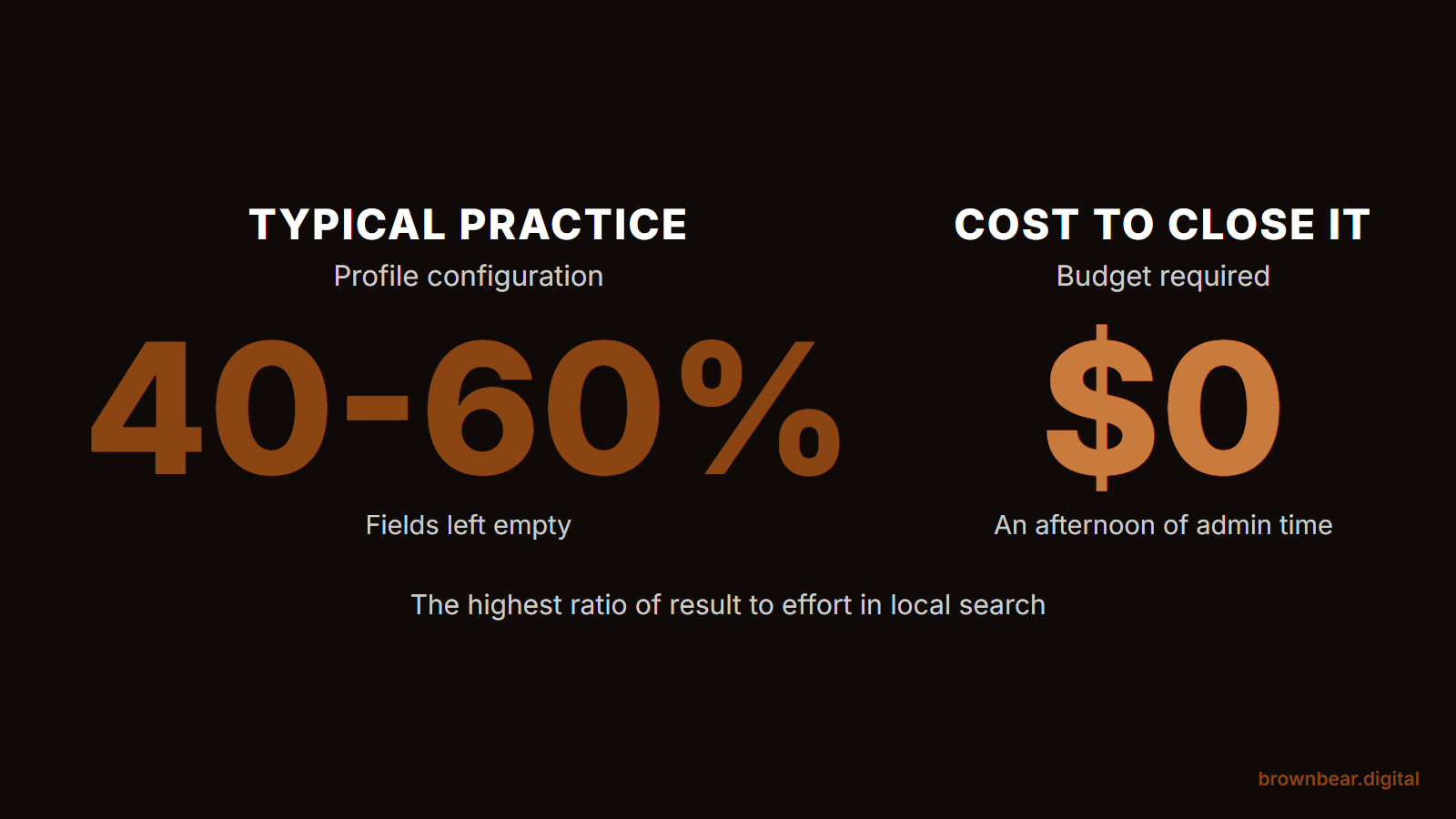
Most practices are only 40 to 60% configured on Google
Categories, services, attributes, photo cadence, posts, and Q&A each carry ranking and conversion weight, and most plastic surgery profiles leave nearly half of it on the table. The fixes are concrete and unglamorous.
Review velocity beats review count past a baseline
A practice with 600 reviews from two years ago and none in the last 90 days signals decline; 80 reviews with steady velocity signals activity. A consistent request workflow sustainably generates 8 to 25 new reviews per month.
Fix the 30 directories that matter, not 500
NAP inconsistencies, whether an old phone number or a different suite number, actively suppress local rankings. Audit the top 30 high-quality directories annually and skip the scrap-directory submission services.
What's Different About Plastic Surgery Local Search
Three structural realities you have to design around.
The map pack is heavily YMYL-evaluated.
Map-pack rankings are not just about proximity, prominence, and relevance (the standard local SEO factors). For medical queries, the systems also weight credentialing signals, review sentiment quality, and category-specific E-E-A-T markers. A plastic surgery profile that is technically optimized but missing board-certification signaling will lose to a less-optimized profile that has them.
Patients research surgeons in clusters, not individually.
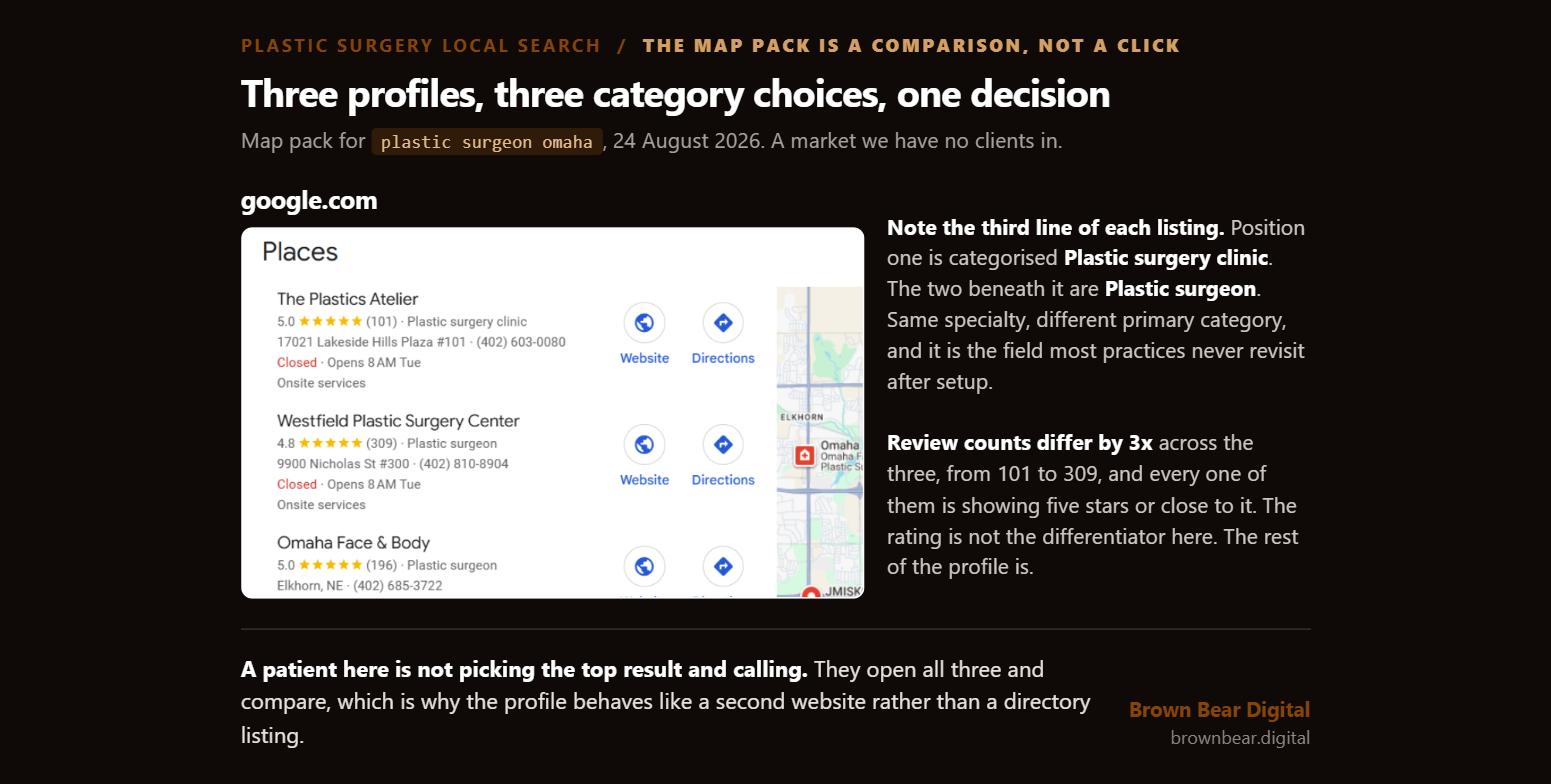
Unlike a "plumber near me" search where the patient picks the top result and calls, a "plastic surgeon near me" search produces three to seven detailed evaluations. The patient compares before-and-after galleries, reviews, credentials, and pricing across all of them before booking. This means the GBP is a second website, not a directory listing. Photos, posts, Q&As, reviews, and attribute completeness do real work in the comparison.
Review velocity matters more than review count past a certain threshold.
A practice with 600 reviews from two years ago and zero in the last 90 days is signaling decline. A practice with 80 reviews and steady velocity is signaling activity. The systems weight recency.
Google Business Profile: The High-Leverage Configuration
The GBP is the single highest-leverage local SEO asset for a plastic surgery practice. Most are 40 to 60% configured. The fixes are concrete.
Categories
Primary category: Plastic Surgery Clinic.
Not "Surgeon," not "Doctor," not "Cosmetic Clinic." The specific category exists; use it.
Secondary categories:
Add the procedure-specific or modality-specific categories that genuinely apply: Medical Spa, Skin Care Clinic, Hair Removal Service, Cosmetic Surgeon, Aesthetic Medicine. Don't load up on irrelevant categories; the algorithm reads category mismatch as spam signal.
Services
Every procedure you actually perform should be listed as a service, with a description. This is not a place to keyword-stuff. It's a place to be precise. "Rhinoplasty" and "Ethnic Rhinoplasty" can both be services, with different descriptions, if you do both. "Revision Rhinoplasty" can be a third service if it's a meaningful part of your practice.
The service descriptions are searchable internally to Google's local index. They influence what the profile shows up for. Treat them as 250-word mini-pages with relevant terminology, not as filler.
Attributes
The attribute selection is unglamorous and high-leverage. Attributes Google currently surfaces for medical practices that affect both ranking and patient decision-making:
- "Online care available" or "Virtual consultations" if you offer them
- "Wheelchair accessible entrance" / "Wheelchair accessible parking lot"
- "LGBTQ+ friendly"
- "Identifies as women-owned" or "Identifies as Black-owned" if accurate
- "By appointment only" if accurate
- Languages spoken, particularly important for practices serving diverse patient populations
Patients filter on these attributes. Profiles that have them populated appear in filtered results that profiles without them do not.
Photos
Photo strategy on a plastic surgery GBP is constrained by HIPAA and consent realities, which makes most generic GBP advice unworkable. What does work:
- Office and exterior photos. The building, signage, waiting room, consultation rooms, OR (if appropriate). Patients use these to recognize the practice.
- Surgeon and team photos. Faces in scrubs and street clothes. Approachable, professional, recognizable.
- Equipment and technology. Specific lasers, imaging systems, Vectra 3D, etc. Patients searching for specific technology find practices via GBP photos.
- Before-and-after photos. Only with documented consent for GBP use specifically. GBP photo consent is not the same as website gallery consent.
What doesn't work: stock images, purely decorative photos, AI-generated photos. The algorithm and patients both detect these, and both penalize them.
Photos should be added on a regular cadence, weekly to bi-weekly. A profile that hasn't added a photo in eight months reads as inactive.
Posts
GBP posts are an underused conversion lever. Two posts a week, alternating between procedure highlights, surgeon updates, before-and-after spotlights (with consent), and educational content. Each post should have a clear CTA: "Book a consult," "Learn more about [procedure]," "Schedule a call."
Post performance is visible in GBP insights. The posts that generate clicks and direction requests are the ones that sound like a person, not a press release.
Reviews
Review management is its own discipline, but two GBP-specific points:
- Respond to every review, positive and negative, within 48 hours. Response rate and recency are visible to patients and signal an active practice.
- Encourage patients to mention specific procedures in their reviews ("My rhinoplasty experience…") because procedure terms in review text feed local relevance for those procedure queries. Do not script the reviews, but do invite procedure-specific feedback in the review request.
Q&A
Patients use Q&A as a research tool. Most plastic surgery practices have inactive Q&A sections that competitors and curious patients have populated with low-quality questions. The fix:
- Pre-populate with 10 to 15 high-quality questions and answers, posted from the practice's account. Cover pricing range expectations, consultation process, financing, common procedures, board certification.
- Monitor the Q&A weekly. Answer real patient questions within 24 hours.
Location Pages on the Website
For multi-location practices, location pages are where most local SEO programs go off the rails. The default agency approach, a 400-word page per location with the same boilerplate paragraph and a different city name, does not rank and does not convert.
A real location page covers:
- The specific surgeon(s) at that location, with full credentialing and a portrait
- The specific procedures offered there (some locations only do certain procedures)
- The clinic specifics: hours, parking, accessibility, languages spoken
- Real photos of that specific location, not corporate stock
- Reviews tied to that location
- A directions section with embedded map and step-by-step from major nearby landmarks
- FAQs specific to that location's patient population
- Schema markup for the specific location, with proper geo coordinates and area-served data
For single-location practices, the location signal lives on the main contact and home pages. NAP consistency, embedded map, clear address, and parking/access information all matter.
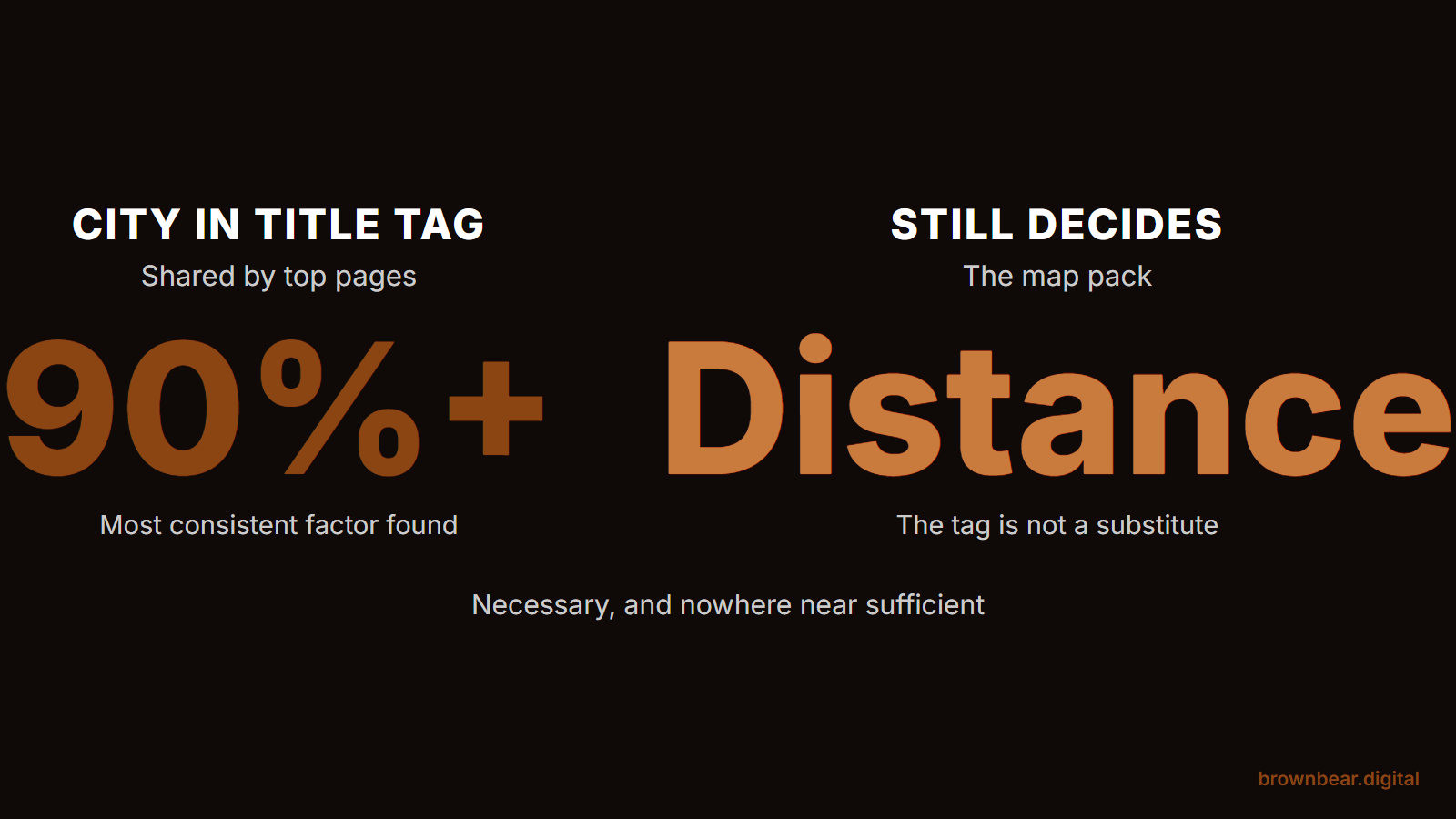
That homepage carries more weight than most practices realize. In our 101-city study of the organic #1 result for a major procedure search, 52% of the winning pages were the practice homepage rather than a procedure page, and the city in the title tag was the single factor nearly all of them shared, at 90% or higher. The map pack sat outside that study's scope, but the two surfaces reward the same thing: a practice whose location is stated consistently everywhere Google can read it.
NAP Consistency and Citations
Name, Address, Phone consistency across the web is local SEO infrastructure. Inconsistencies, such as a different suite number on Yelp, an old phone number in an industry directory, or a previous practice name still circulating, actively suppress rankings.
Audit the top 30 directories.
Not 200. The high-quality ones are Yelp, Healthgrades, Vitals, ZocDoc, RealSelf, the ASPS surgeon directory, WebMD, Sharecare, U.S. News Health, the Better Business Bureau, the local chamber of commerce, and the major map services. These are the ones that matter for plastic surgery.
Fix inconsistencies manually or via a single trusted aggregator
(Yext or BrightLocal). Avoid the "submit to 500 directories" services; many of those targets are scrap directories that haven't influenced rankings in years. The same consistency work is now the entity work that comes first for AI visibility too.
Audit annually.
Practices change phone numbers, add suite numbers, and rebrand. The citations drift.
Review Velocity
Review velocity is a ranking and conversion factor. The target is steady, organic-feeling growth, not bulk outreach campaigns.
The system that works:
- Every consult patient gets a review request 24 to 72 hours post-visit, by text or email, with a one-tap link to the GBP review form
- Every post-op patient gets a review request at the appropriate clinical milestone (typically 4 to 8 weeks for surgical procedures, sooner for non-surgical)
- The request never offers an incentive (which violates platform terms and, in some states, medical advertising regulations)
- Negative reviews route through a private feedback channel first, but the practice does not block negative reviews on the public profile
A typical healthy plastic surgery practice on this system generates 8 to 25 new reviews per month, sustainably.
Map-Pack Ranking Factors Specific to Medical YMYL
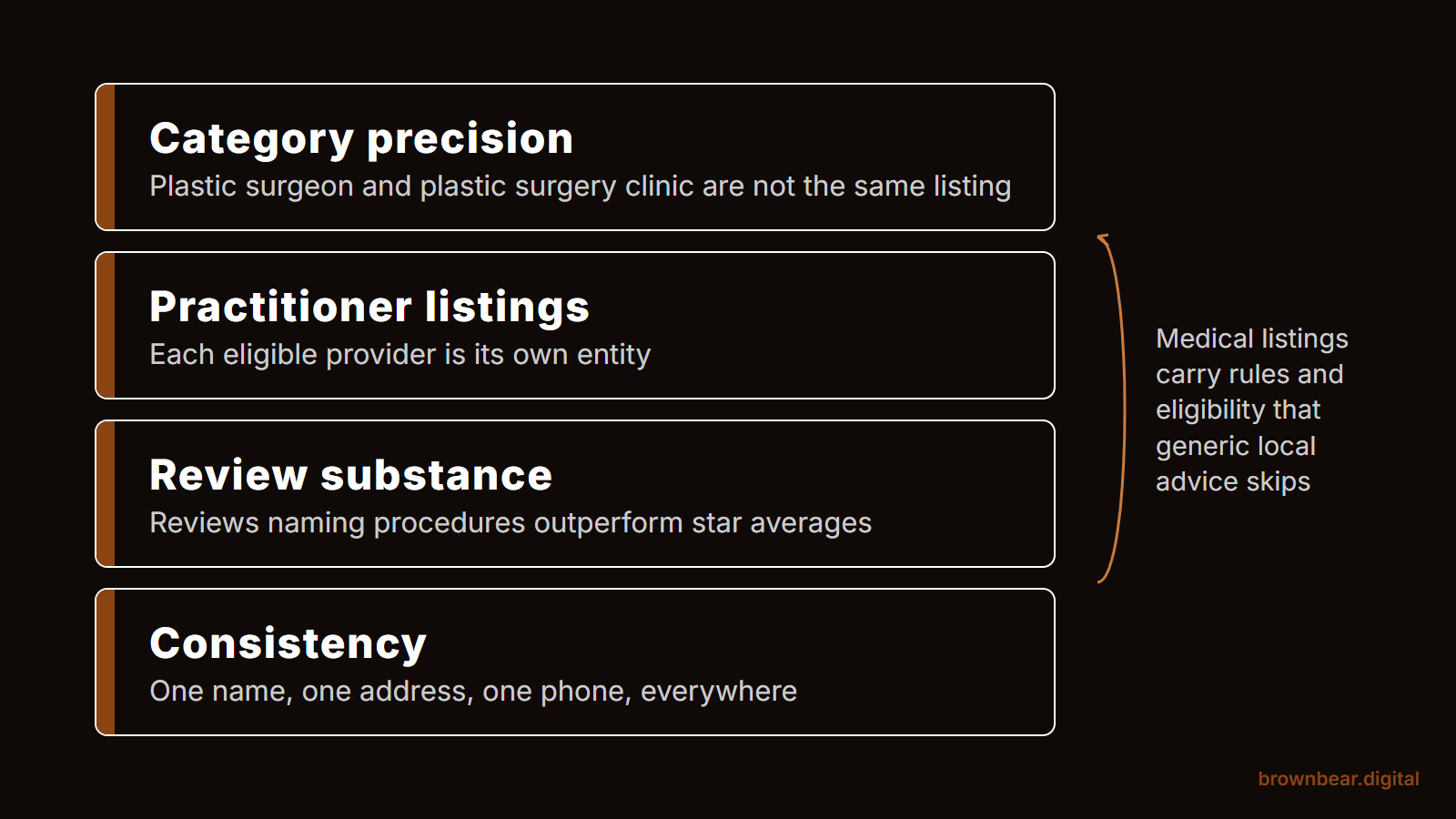
Across the standard local ranking factors of proximity, prominence, and relevance, three carry disproportionate weight for plastic surgery.
Credentialing visibility.
Board certification displayed in the GBP description, on the linked website's homepage, and on every linked location page. The systems read these signals.
Review sentiment for medical-specific concerns.
Reviews that mention safety, recovery, results, and bedside manner positively contribute more than generic positive reviews. Reviews that mention complications, mismanagement, or surgical errors do meaningful damage even when balanced by positive volume.
Linked website E-E-A-T health.
The GBP-linked website's E-E-A-T signals feed back to the GBP. A profile linked to a website that lacks medical authorship and review will underperform a profile linked to a website with strong E-E-A-T, all else equal.
What to Do Next
- Audit your GBP this week. Categories, services, attributes, photos in the last 30 days, posts in the last 30 days, Q&A health, review response rate. Score each.
- Pull a NAP report on the 30 directories that matter. Fix the obvious mismatches.
- Set up the review-request workflow if you don't have one. Even a basic SMS-based system meaningfully changes velocity.
- For multi-location practices, audit the location pages. If they're boilerplate, that's the highest-leverage rebuild on the site.
Local SEO for plastic surgery is not optional and is not a generic discipline. The practices that treat their GBP and local presence as a second website, actively maintained, regularly updated, credentialed and reviewed, are the ones that show up in the map pack when "plastic surgeon near me" gets searched 22,000 times a month.
References
-
American Society of Plastic Surgeons. (2025). Find a Plastic Surgeon. American Society of Plastic Surgeons. https://www.plasticsurgery.org/find-a-surgeon
-
Brown Bear Digital. (2025). Plastic surgery local search keyword volume data. SEMrush US database, April 2025. Internal research.
-
Federal Trade Commission. (2023). FTC's Endorsement Guides: What People Are Asking. FTC. https://www.ftc.gov/business-guidance/resources/ftcs-endorsement-guides-what-people-are-asking
-
Google LLC. (2025). Google Business Profile Help. Google. https://support.google.com/business/
-
U.S. Department of Health and Human Services. (2025). Health Information Privacy (HIPAA). HHS. https://www.hhs.gov/hipaa/index.html
Related reading: Plastic Surgery Reviews: Generation, Response, and SEO Impact · How Plastic Surgery Practices Fill Their Consultation Calendar · Plastic Surgery SEO Services: A Buyer's Guide
Work with Brown Bear on Your Plastic Surgery Local Presence
The map pack for "plastic surgeon near me" is one of the most valuable pieces of real estate in local search, and most practices are working from a playbook written for restaurants and plumbers, not YMYL medical providers. Brown Bear Digital handles local SEO specifically for plastic surgery practices: GBP optimization, citation health, review velocity, and the on-site content and E-E-A-T signals that feed local authority. If your practice isn't showing up where your patients are searching, reach out and we'll show you exactly where the gaps are.
Written By
Founder, Brown Bear Digital
Bryan has 15 years of experience across SEO, paid search, and AI search strategy. He founded Brown Bear to give businesses direct access to senior-level search expertise without the agency overhead.
Learn More About BryanReady to Turn Search
Into Revenue?
No pitch decks. Just a real conversation.