Why Plastic Surgery SEO Is Different From Every Other Medical Niche

Plastic surgery is the only medical niche where patients behave like luxury consumers. Understanding that distinction is the difference between an SEO strategy that fills your consultation calendar and one that generates traffic that never converts.
Bryan Passanisi is the founder of Brown Bear, an SEO and AI search agency that works exclusively with plastic surgery practices.
This piece covers both why the standard medical SEO playbook fails for cosmetic practices and what a plastic surgery-specific approach actually looks like, from keyword strategy through content architecture to conversion mechanics.
If you've hired an SEO agency that treats your rhinoplasty practice the same way it treats a dentist or an urgent care clinic, you've already felt the gap between their reporting and your actual consult volume. Maybe you're evaluating a new proposal and something about it feels generic, but you can't put your finger on what's wrong. Or you're a surgeon who ranks reasonably well but still isn't seeing the consultation volume your traffic numbers should be producing.
By the end of this, you'll understand the structural reasons why plastic surgery SEO requires its own approach, and you'll have a clear framework for evaluating whether your current strategy is actually built for your patient type. Longer term, the goal is a search presence that meets cosmetic patients where they are in their research, not where a generic medical SEO template assumes them to be.
We'll cover how plastic surgery patients actually search and why that behavior looks nothing like standard medical search, where generic SEO strategies break down in this niche, the three search patterns that drive most qualified cosmetic traffic, and what a content and technical approach built specifically for this patient type looks like.
So, let's start with the patient, because the search behavior is where every strategic difference originates.
Key Takeaways
Plastic surgery patients shop like luxury consumers, not patients
They self-refer, pay out of pocket, and research for weeks or months before contacting anyone. Standard medical SEO optimizes for a referral-driven, insurance-covered urgency that cosmetic patients never exhibit.
Your real catchment area is a one to three hour drive
Cosmetic patients will travel one to three hours for the right surgeon, so local SEO tuned for nearest-provider proximity leaves most of your actual market unclaimed.
Most strategies chase only one of three search patterns
Qualified traffic splits across candidacy research, surgeon comparison, and late-stage due diligence searches. Optimizing only the comparison stage forfeits both the largest patient pool and the highest-converting one.
Procedure pages should read like product pages
Lead with aesthetic goals, transparent pricing, and financing instead of clinical definitions, because that is the information a patient making a major discretionary purchase actually uses to decide.
How Plastic Surgery Patients Actually Search (It's Not Medical Search)
The fundamental difference starts with how patients arrive at your practice. In most medical specialties, patients follow a referral pathway: symptom → primary care → specialist referral → appointment. The search behavior is problem-focused and urgent.
Plastic surgery flips this model completely.
Patients self-diagnose and self-refer.
A potential rhinoplasty patient doesn't get referred by another doctor. She decides she wants the procedure, researches it herself, and then chooses a surgeon. The search behavior is solution-focused and deliberate.
The purchase psychology is discretionary, not necessary.
Unlike most medical care, plastic surgery is a want, not a need. Patients approach it the way they approach other significant discretionary purchases: cars, jewelry, home renovations. They research extensively, comparison shop, and make decisions based on perceived value as well as clinical considerations.
Payment is out-of-pocket, which changes everything.
When insurance doesn't cover the procedure, patients research pricing, financing options, and value propositions the way they would for any major purchase. The economic dynamics are completely different from those of insurance-covered medical care.
The social component is private.
Unlike other medical procedures, many plastic surgery patients prefer discretion. This affects review generation, referral patterns, and how social proof works. Patients might research heavily on forums and social media but won't necessarily post about their experience publicly.
The timeline is extended and deliberate.
While emergency medical searches occur in moments and routine medical searches take days, plastic surgery research often spans weeks or months. Patients bookmark websites, return multiple times, and often research multiple procedures before deciding.
This creates a search journey that looks more like shopping for luxury goods than seeking medical care.
Why Standard Medical SEO Fails for Cosmetic Surgery
Most medical SEO strategies assume an insurance-covered, referral-driven, problem-solving patient journey. When applied to plastic surgery, these strategies optimize for the wrong behavior entirely.
The keyword strategy misses the mark.
Medical SEO typically targets symptom-based keywords ("back pain treatment") and location-based service terms ("dermatologist Atlanta"). Plastic surgery patients search differently. They use procedure names ("rhinoplasty"), qualitative terms ("natural breast augmentation"), surgeon evaluation queries ("best plastic surgeon reviews"), and comparison searches ("tummy tuck vs liposuction").
The content strategy assumes medical urgency.
Standard medical content focuses on conditions, symptoms, treatments, and insurance coverage. Plastic surgery content needs to address aesthetics, outcomes, recovery experiences, cost considerations, and surgeon selection criteria. The information hierarchy is completely different.
The conversion strategy targets insurance validation, not purchase decision.
Medical sites typically optimize for "insurance accepted" and "book appointment" conversions. Plastic surgery sites need to optimize for consultation requests, before-and-after gallery engagement, financing information requests, and procedure-specific landing page conversions.
The local SEO approach misunderstands the catchment area.
Medical practices typically serve their immediate geographic area, where patients want the closest qualified provider their insurance covers. Plastic surgery patients will travel for the right surgeon. The geographic optimization needs to account for patients willing to drive one to three hours for a procedure, which changes how you approach local content and citation building.
The authority signals focus on medical credentials, not aesthetic expertise.
E-E-A-T for medical sites emphasizes board certifications, hospital affiliations, and clinical publications. While these matter for plastic surgery, patients also care about aesthetic eye, artistic consistency, and procedure-specific expertise. The authority-building content mix is different.
The review strategy ignores preferences for discretion.
Medical practices can typically ask all patients for public reviews. Plastic surgery practices need more nuanced approaches since many patients prefer privacy. The review generation and reputation management approach requires different tactics.
These failures rarely announce themselves in a proposal. They hide in reasonable-sounding lines. See if you can catch them:
Interactive challenge
Spot the Generic Playbook
Six lines pulled from the kind of SEO proposals plastic surgery practices actually receive. Which ones understand cosmetic patients, and which are the medical template with your specialty pasted in? Your answers stay in your browser; nothing is sent anywhere.
For informational purposes only; proposal lines are composites for illustration, not quotes from real agencies, and this is not professional advice. Your answers stay in this browser and are never transmitted.
The Three Search Patterns That Define Plastic Surgery SEO
Understanding plastic surgery SEO means understanding the three distinct search patterns that drive most qualified traffic to cosmetic practices.
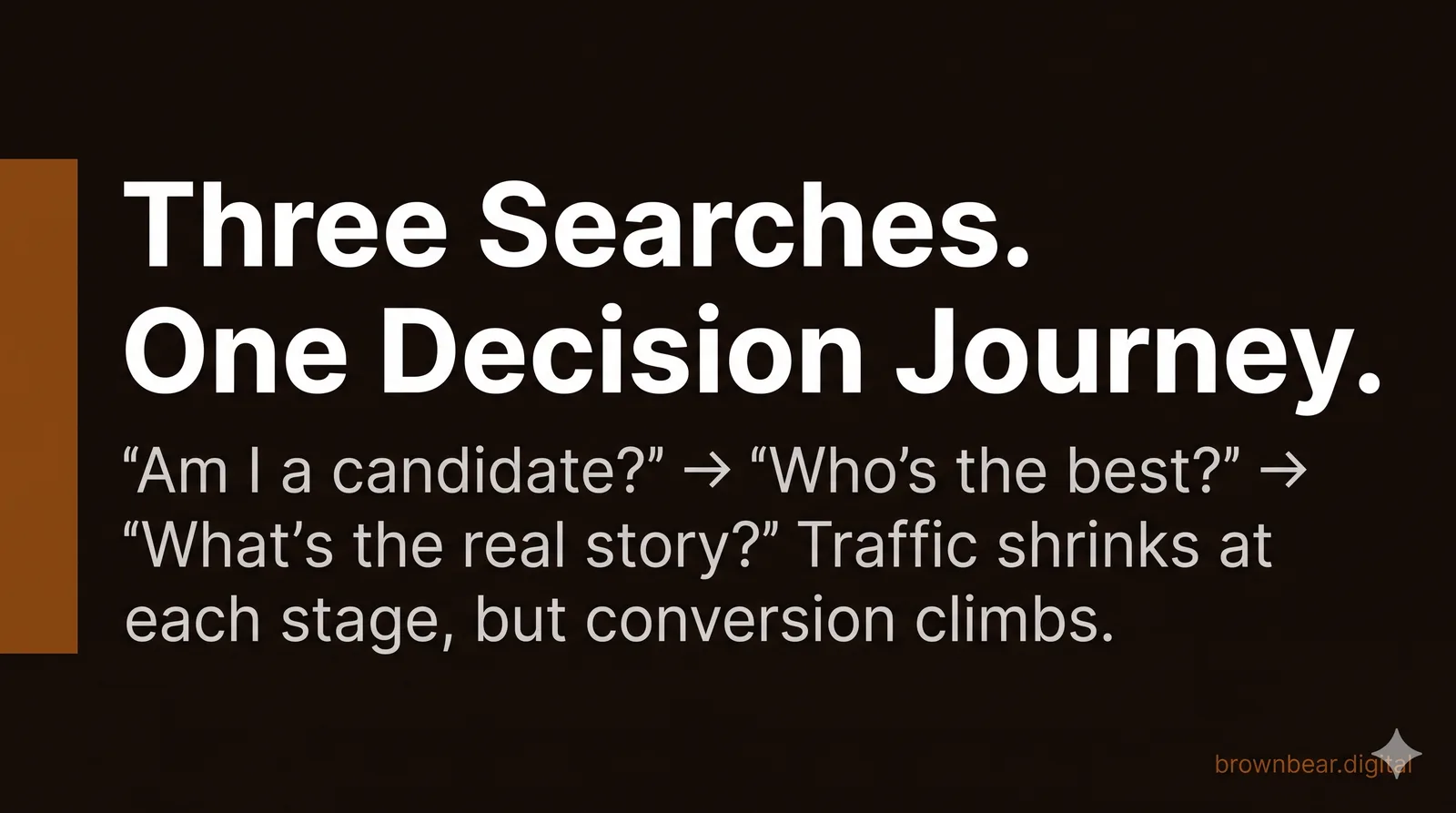
1. "Am I a candidate?" searches.
These are early-stage research queries where patients are exploring whether a procedure is right for them. Search terms include "good candidate for breast augmentation," "rhinoplasty before and after ethnic," "tummy tuck after pregnancy," and "facelift age recommendations."
This traffic converts slowly but represents the largest pool of potential patients. Content targeting these searches should feel consultative rather than promotional. Patients want to understand candidacy criteria, see relevant before-and-after examples, and get a sense of what their outcome might look like.
2. "Who's the best?" comparison searches.
These are mid-stage evaluation queries in which patients compare surgeons and practices. Search terms include "best rhinoplasty surgeon [city]," "plastic surgeon reviews," "[surgeon name] before and after," and "plastic surgery consultation questions."
This traffic converts at higher rates because patients have decided on the procedure and are now choosing a provider. Content targeting these searches should establish credibility, showcase outcomes, and differentiate your approach from competitors. Patients want to understand why they should choose you specifically.
3. "What's the real story?" due diligence searches.
These are late-stage validation queries where patients are verifying their choice before booking. Search terms include "[surgeon name] reviews," "plastic surgery complications," "[procedure] recovery timeline," and "questions to ask plastic surgeon."
This traffic converts at the highest rates but represents the smallest volume. Content targeting these searches should provide transparent, detailed information that builds confidence in the decision. Patients want honest discussion of risks, realistic recovery expectations, and clear next steps.
Most plastic surgery SEO strategies focus entirely on comparison searches and ignore the candidacy and due diligence patterns. The practices that optimize for all three search patterns capture a much larger share of their potential patient base.
Content Strategy for the Luxury Medical Mindset
Plastic surgery content needs to bridge medical expertise with luxury service positioning. The content must feel both clinically authoritative and aesthetically sophisticated.
Procedure pages should read like product pages, not medical encyclopedia entries.
Instead of starting with clinical definitions, start with aesthetic goals and patient concerns. Use section headers like "What breast augmentation achieves" rather than "Breast augmentation overview." Include pricing information, financing options, and clear calls to action for consultations.
Before-and-after galleries are conversion tools and portfolio showcases.
Organize galleries by patient characteristics (age, body type, aesthetic goals) rather than procedure type alone. Include context about why specific approaches were chosen and how results align with patient goals. Make galleries easy to navigate and compare.
The "about the surgeon" content should emphasize aesthetic philosophy alongside clinical credentials.
While board certifications and training matter, patients also want to understand your aesthetic approach, your philosophy on natural-looking results, and your patient care style. Include personal elements that help patients feel confident in their choice.
Recovery and timeline content should feel supportive, not clinical.
Patients want detailed, realistic expectations about recovery. Use timelines, day-by-day recovery guides, and practical advice about returning to normal activities. Address common concerns about pain, bruising, and when results become visible.
Cost and financing information should be transparent without creating sticker shock.
Include pricing ranges, payment options, and insurance considerations where relevant. Address the investment aspect of the procedure and the value provided. Many patients research costs extensively before calling.
Patient testimonials and reviews should feel genuine and specific.
Generic "great experience" reviews carry less weight than specific stories about results, recovery experiences, and why patients chose your practice. Include video testimonials when possible, and ensure reviews address the concerns most patients have about your specialty procedures.
Technical SEO Adjustments for Discretionary Procedures
The technical foundation of plastic surgery SEO requires adjustments that account for the unique patient journey and search behavior.

Schema markup should emphasize procedures, outcomes, and surgeon qualifications.
Use medical procedure schema, surgeon schema, and review schema. Include pricing information in structured data where appropriate. Mark up before-and-after galleries and patient testimonials to help search engines understand your expertise.
Site architecture should mirror the patient decision process.
Organize content around the patient journey: procedure exploration pages, surgeon information, before-and-after galleries, patient resources, and consultation scheduling. Make it easy for patients to find information at any stage of their research.
Internal linking should connect related procedures and decision points.
Link between related procedures (breast augmentation and breast lift), connect procedure pages to relevant before-and-after galleries, and link to surgeon qualifications from procedure pages. Help patients navigate their research efficiently.
Local SEO should account for extended geographic reach.
Optimize for broader geographic terms beyond your immediate city. Include content about traveling for surgery, accommodation recommendations, and follow-up care for out-of-town patients. Many practices serve patients who drive one to three hours for procedures.
Image optimization needs special attention.
Before-and-after photos are crucial conversion elements but need careful optimization. Use descriptive file names, alt text, and image titles. Ensure photos load quickly and display properly on mobile devices. Consider using galleries that allow easy comparison between images.
Mobile optimization is critical for research behavior.
Many patients do extensive research on mobile devices, often in private moments. Ensure the mobile experience makes it easy to browse galleries, read testimonials, and contact the practice. The mobile experience should feel sophisticated and professional.
What Carries Over From Medical SEO (Applied Differently)
While plastic surgery SEO requires its own approach, some elements of medical SEO remain relevant when applied through the lens of aesthetic medicine.
E-E-A-T principles still matter but the evidence mix is different.
Experience, Expertise, Authoritativeness, and Trustworthiness remain crucial for YMYL content in healthcare. However, the evidence mix includes aesthetic outcomes alongside clinical credentials. Before-and-after galleries, artistic consistency, and patient satisfaction become part of the authority equation.
Local presence and citations remain important but serve a different purpose.
NAP consistency, Google Business Profile optimization, and local directory presence still matter. However, the goal shifts from "nearest provider" optimization to "preferred provider in region" optimization. The geographic scope is broader and the quality signals are more important than proximity signals.
Page speed and technical performance are non-negotiable.
Fast-loading pages remain crucial for both SEO and user experience. However, plastic surgery sites often include more images, galleries, and visual content, making performance optimization more challenging and more critical.
Content quality and depth still drive rankings.
Comprehensive, well-researched content continues to outperform thin content. However, the definition of "quality" includes aesthetic considerations alongside medical accuracy. Content must be both clinically sound and aesthetically appealing.
Review signals continue to influence rankings and conversions.
Positive reviews remain important for both search visibility and patient confidence. However, the review-generation strategy must account for patients' privacy preferences and the discretionary nature of the procedures.
Social signals play a role but privacy considerations matter.
Social media presence and engagement can support SEO efforts. However, patient privacy requirements and the personal nature of the procedures require different social media strategies than other medical specialties.
Auditing Your Current Approach
Most plastic surgery practices unknowingly use generic medical SEO strategies that miss their actual patient behavior. Here's how to evaluate whether your current approach aligns with how your patients actually search and decide.
Keyword targeting audit.
Review your current target keywords. Are you optimizing for medical condition terms or procedure terms? Do your keywords match how patients actually search when researching cosmetic surgery? Are you targeting early-stage research terms, comparison terms, and validation terms, or just conversion terms?
Content positioning audit.
Read your current website content from a potential patient's perspective. Does it feel medical or aesthetic? Does it address patients' concerns when considering elective procedures? Does it help patients visualize their potential outcomes and understand your aesthetic approach?
Conversion path audit.
Track how patients currently move through your site. Are they finding the information they need to build confidence in their decision? Are your calls to action appropriate for the extended research timeline? Do you provide enough information to move patients from research to consultation?
Competitor comparison audit.
Compare your approach to other plastic surgeons in your market and to luxury service providers outside your industry. Does your online presence feel consistent with the investment level patients are making? Does your positioning differentiate you from other practices?
Geographic reach audit.
Analyze where your current patients travel from. Are you optimizing for the right geographic area? Do you provide enough information for patients who might drive one to three hours for your services?
Technical performance audit.
Test your site speed, mobile experience, and image loading. Given the visual nature of plastic surgery research, does your site perform well across all devices? Do your galleries and visual content enhance or hurt the user experience?
Rather than holding all six audits in your head, run them here:
Interactive audit
Is Your SEO Built for Plastic Surgery?
Twelve questions across the six audit dimensions. Answer honestly for your current strategy — whether you run it in-house or through an agency. Your answers stay in your browser; nothing is sent anywhere.
Keyword targeting
Do your target keywords center on procedure and evaluation terms (“rhinoplasty,” “best rhinoplasty surgeon”) rather than symptom or condition terms?
Are you targeting all three stages — candidacy research, surgeon comparison, and late-stage validation queries — not just “best surgeon [city]”?
Content positioning
Do your procedure pages lead with aesthetic goals and outcomes rather than clinical definitions?
Does your content address cost, financing, and recovery in the depth a patient making a five-figure discretionary purchase expects?
Conversion path
Are your calls to action built for a weeks-long research timeline (gallery browsing, financing info, consult requests) rather than a single “book now”?
Can a returning visitor pick up their research where they left off — clear paths between procedures, galleries, and surgeon credentials?
Competitive positioning
Does your online presence feel consistent with the investment level patients are making — closer to a luxury brand than an urgent care clinic?
Does your content express a distinct aesthetic philosophy that separates you from the other surgeons in your market?
Geographic reach
Do you know how far your actual patients travel, and does your SEO target that full radius rather than just your city?
Do you have content for out-of-town patients — travel logistics, accommodations, follow-up care?
Technical performance
Do your before-and-after galleries load fast and browse easily on a phone?
Is your schema markup built around procedures, surgeon credentials, and reviews — not just a generic medical business profile?
For informational purposes only; the score reflects your answers, not a guarantee of search performance, and is not professional advice. Your answers stay in this browser and are never transmitted.
Once you've identified the gaps in your current approach, the next decision is finding an agency equipped to close them. Our guide to hiring an SEO agency for a medical practice covers what to ask and what the answers reveal about whether an agency has genuine YMYL experience or is working from a generic healthcare playbook.
The Competitive Advantage of Authentic Positioning
Plastic surgery practices that understand their patients' actual behavior have a significant competitive advantage over those that use generic medical SEO strategies.
When you optimize for luxury-service purchase behavior rather than medical-necessity search behavior, you attract patients who are better qualified, more committed to moving forward, and more willing to invest in the outcomes they want.
When your content feels consultative rather than clinical, you build confidence and trust with patients who are making a significant personal and financial decision.
When your SEO strategy accounts for the extended research timeline and the psychology of discretionary purchases, you stay visible throughout the longer decision-making process that plastic surgery patients follow.
The practices that get this right, the ones that understand they're marketing to consumers rather than patients, consistently outperform practices that treat plastic surgery SEO as a medical marketing problem.
Brown Bear Digital works with plastic surgery practices and aesthetic medical groups on exactly this kind of positioning-driven SEO. We understand that cosmetic surgery sits at the intersection of medical care and luxury service, and we optimize for the search behavior that actually drives qualified consultations.
The next patient who calls your practice may have been researching for weeks, comparing multiple surgeons, and evaluating her decision like any other major investment. Where she found you, and how confident she felt in that choice, depends on whether your SEO strategy matches how she actually made her decision.
References
-
American Board of Plastic Surgery. (2025). Find a Board-Certified Plastic Surgeon. American Board of Plastic Surgery. https://www.abplasticsurgery.org/find-a-surgeon/
-
American Society of Plastic Surgeons. (2024). Plastic Surgery Statistics Report. American Society of Plastic Surgeons. https://www.plasticsurgery.org/news/plastic-surgery-statistics
-
Google LLC. (2025). Search Quality Rater Guidelines. Google Search Central. https://developers.google.com/search/docs/fundamentals/creating-helpful-content
Related reading: How AI Search Is Changing How Patients Find Plastic Surgeons · Plastic Surgery SEO Services: A Buyer's Guide · The YMYL Standard in Plastic Surgery
Work with Brown Bear on Plastic Surgery SEO
Generic medical SEO applied to plastic surgery is the exact problem this piece describes, and it's what Brown Bear Digital was built to fix. We don't run the same playbook across healthcare verticals. We build SEO strategies specific to the luxury purchase psychology, extended research timelines, and discretionary patient behavior that define cosmetic surgery. Our plastic surgery SEO services and content marketing cover the full picture, from keyword strategy to local authority and AI search visibility, as part of our broader plastic surgery marketing work. Reach out for a consultation and we'll show you exactly where your current approach is leaving consultations behind.
Written By
Founder, Brown Bear Digital
Bryan has 15 years of experience across SEO, paid search, and AI search strategy. He founded Brown Bear to give businesses direct access to senior-level search expertise without the agency overhead.
Learn More About BryanReady to Turn Search
Into Revenue?
No pitch decks. Just a real conversation.