How AI Search Is Changing How Patients Find Plastic Surgeons (And What To Do About It)
A patient considering rhinoplasty in 2020 typed "best rhinoplasty surgeon Los Angeles" into Google, scrolled through the local pack, opened five tabs, and worked her way down the list.
A patient considering the same procedure today might never see a Google search result page at all. She asks ChatGPT which surgeons in LA are known for natural-looking results. She follows up by asking what to look for in before-and-afters. She cross-checks the two surgeons it names against r/PlasticSurgery threads. By the time she lands on a practice website, she has already chosen who she's calling.
This shift is happening right now. It's reshaping how plastic surgery practices get found, and most of the agencies your competitors are paying haven't caught up. Google Ads, local SEO, and Instagram before-and-afters are still necessary, but they are no longer sufficient on their own.
This piece covers what's actually changing, why it matters more in plastic surgery than in almost any other niche, and what your practice should be doing about it in the next 90 days.
Key Takeaways
Patients now shortlist surgeons in a layer above your website
Prospective patients ask ChatGPT and Perplexity which surgeons to trust, cross-check Reddit, and arrive at your site already decided. If your practice is not present in that discovery layer, you never make the shortlist.
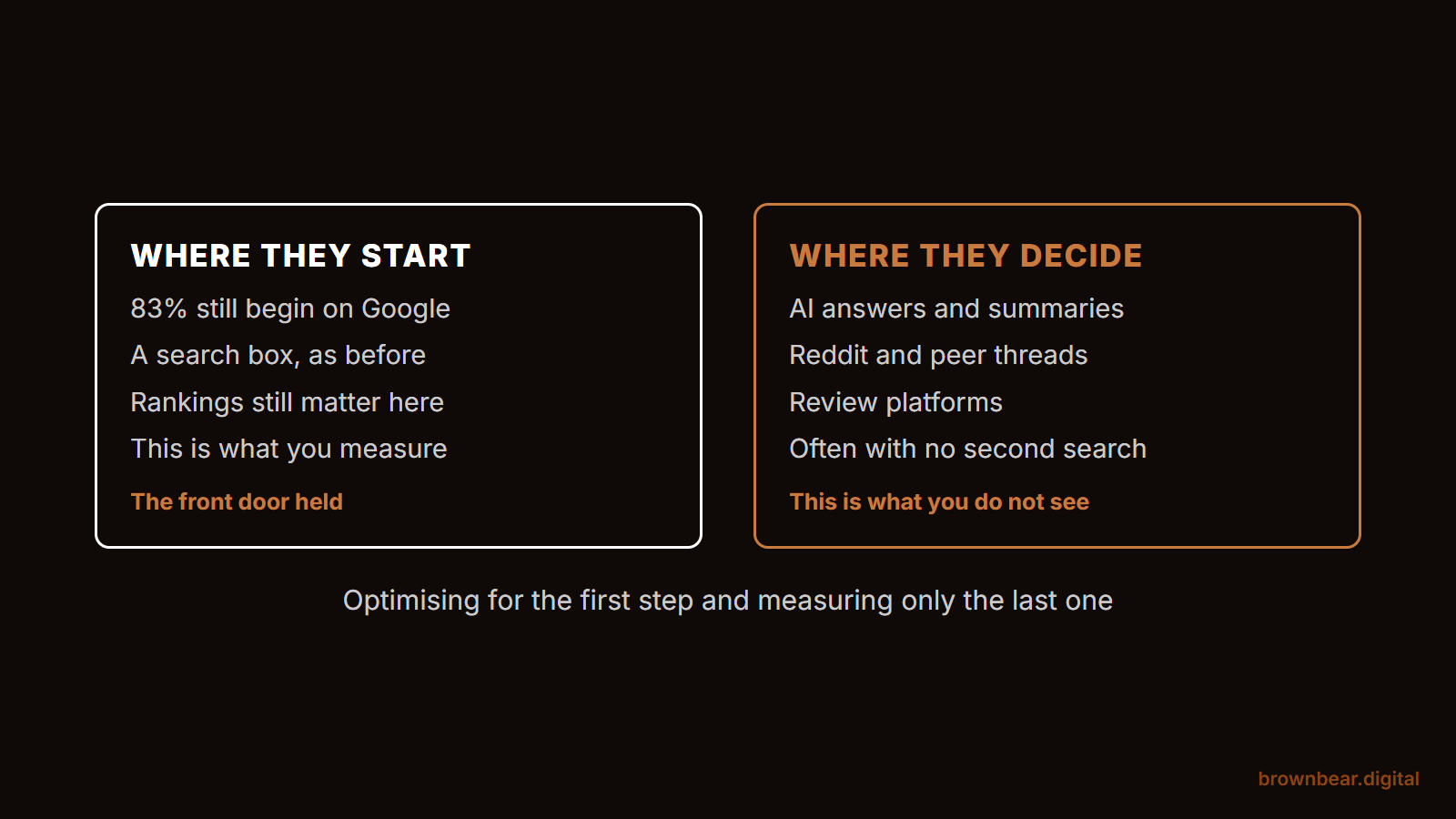
83 percent of patients still start on Google, but decide elsewhere
Patients spend three to four weeks researching providers, and around 83 percent start on Google, yet those numbers no longer capture where the decision happens. AI assistants now synthesize your reviews, publications, and Reddit threads into the answer.
AI engines reward third-party signals your marketing has ignored
Entity strength, citation density, review language, and Reddit presence drive AI recommendations. A single feature in a respected outlet moves your AI visibility more than 50 owned blog posts, nearly the opposite of the last decade's playbook.
Baseline your AI visibility before you change anything
Spend days 1 to 30 asking the four major AI assistants what they say about your specialty in your geography and documenting it. Practices doing disciplined GEO work typically see their first AI Overview citations within two quarters.
The Patient Who Never Lands on Your Website
The data on plastic surgery patient research is consistent and somewhat alarming. Patients spend three to four weeks researching providers before they make a single call. Around 83 percent start that research on Google. About 82 percent check online reviews before booking a consultation. Numbers like these have been quoted in industry reports for years.
What those numbers no longer capture is where the decision actually happens.
In our client data, we're seeing a steady drop in the share of consultation requests that come from a clear "researched on our site, then called" path. The path is fragmenting. People arrive at consultation already informed about specific techniques, already convinced of a particular surgeon's strengths, and already skeptical of two or three alternatives. They didn't get there from your website. They got there from a conversation with an AI assistant that synthesized your reviews, your before-and-afters, your peer-reviewed publications, and a Reddit thread you've never read.
The implication for your marketing is direct. The patient now makes the shortlist decision in a layer that sits above your website, before your site is ever loaded. If you're not present in that layer, you don't make the shortlist, and you don't get the call.
What AI Search Actually Is (And What Most Agencies Get Wrong)
There's a lot of confusion about what "AI search" means. It's not one thing. It's three overlapping shifts, and they don't all behave the same way.
Google AI Overviews
These are the AI-generated answer boxes that now appear at the top of many Google search results. For plastic surgery queries, AI Overviews show up most often on procedure-comparison and "how to choose" searches, exactly the searches a patient runs in their first two weeks of research. The Overview cites a small set of sources, often three to seven, and many users read it without scrolling further.
Standalone AI search engines
ChatGPT, Claude, Gemini, and Perplexity are now used for the same kind of research that patients used to do on Google. Perplexity, in particular markets, presents itself as an "answer engine" and shows the sources it pulled from. ChatGPT increasingly pulls live web results into its answers. The behavior is less "search and click" and more "ask and decide."
LLM-powered features inside other tools
Apple Intelligence, Microsoft Copilot, Meta AI inside WhatsApp, and similar features are quietly pulling answers from underlying language models for everyday questions. A patient asking Siri about rhinoplasty recovery in 2027 will get a synthesized answer, not a list of links.
What most agencies miss:
these aren't new "channels" you can run ads on. They're a new discovery layer that sits between the patient and every website that used to compete in search results. You don't optimize for them by buying placements. You optimize for them by becoming the source they cite.
That's a different game than SEO, and the agencies still selling "10 plastic surgery marketing strategies" with one bullet on AI haven't changed how they actually do the work.
How AI Engines Decide Which Surgeons to Recommend
This is where the practical work begins. AI engines aren't ranking surgeons the way Google ranks pages. They're synthesizing recommendations from a basket of signals, and the weights are different.
Five signal types matter most for medical and cosmetic queries:
-
Entity strength.
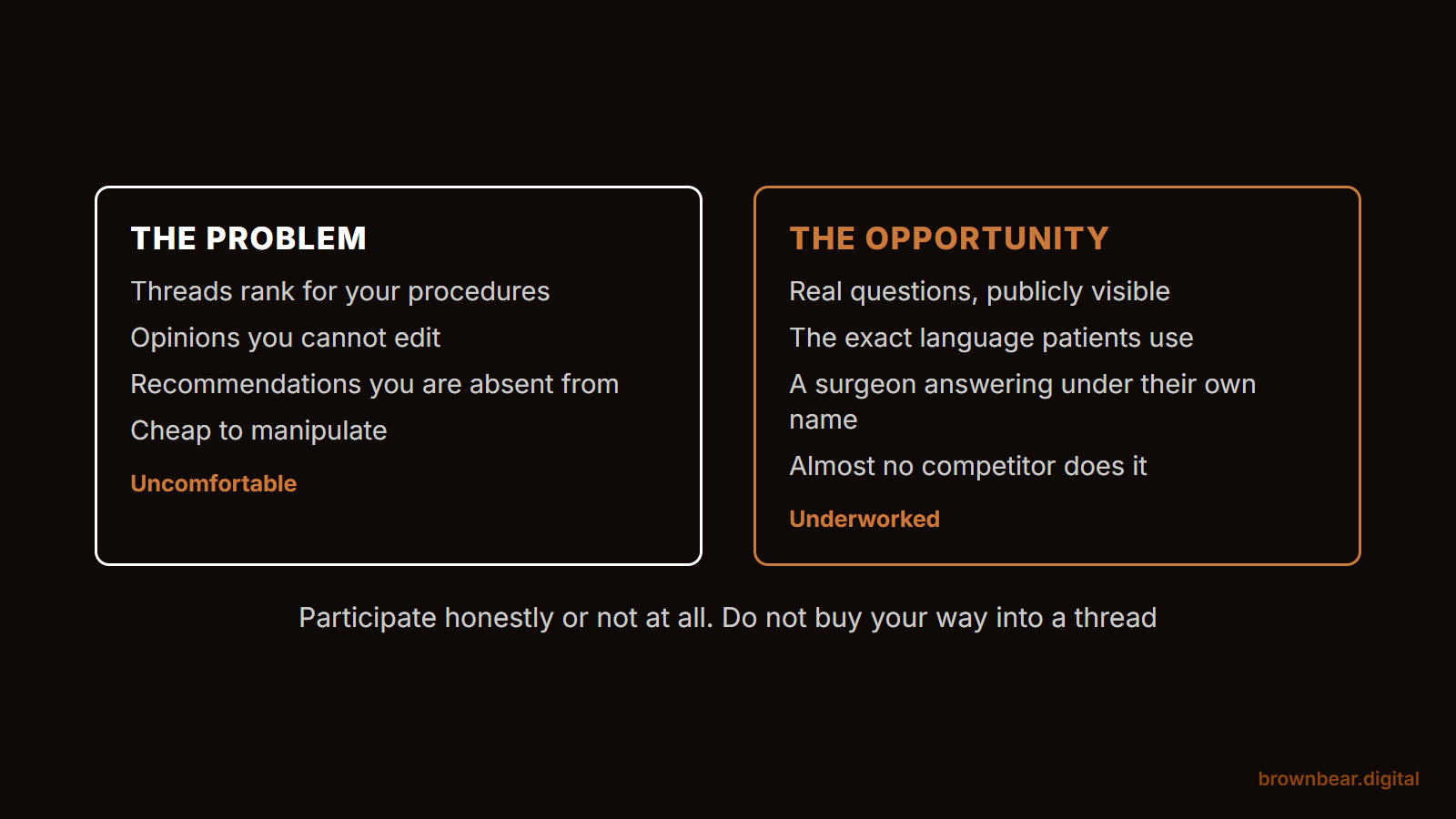
AI engines build a model of who you are as a recognized entity: a practitioner, a practice, a brand. Google's Knowledge Graph, your peer-reviewed publications, your American Society of Plastic Surgeons listing, your hospital affiliations, your residency, your fellowship all feed into the entity profile. Surgeons with strong, consistent entity signals across multiple authoritative sources get surfaced more often. Surgeons with thin or inconsistent profiles get skipped.
-
Citation density and source diversity.
AI engines weigh sources differently. A claim that appears in a peer-reviewed journal, a major news outlet, a board certification database, and your own website carries far more weight than a claim that only appears on your own site. What matters is whether your name shows up in places the AI considers credible, not how many times it shows up on your own domain.
-
Review semantics.
AI engines don't just count star ratings. They read the language of reviews. Reviews that consistently use specific phrases, such as "natural-looking results," "transparent about recovery," and "didn't push extra procedures," train the model to associate those qualities with your name. A practice with 200 four-star reviews that all say "great experience" is less searchable in the AI layer than a practice with 80 reviews that use specific, descriptive language.
-
Third-party content presence.
This is the one most surgeons underestimate. When an AI assistant generates a list of recommended surgeons, it leans heavily on third-party content: Reddit threads, RealSelf doctor pages, news features, podcast appearances, and publication interviews. Surgeons who exist only on their own websites tend to get under-cited compared to surgeons who appear across the broader web.
The shorthand: AI engines reward distributed, third-party-validated signals. They under-reward closed, owned-channel-only signals. This is almost the opposite of what most plastic surgery marketing has optimized for over the last decade.
The Reddit Problem (And Why It's Actually an Opportunity)
If you've never spent time on r/PlasticSurgery, you should. It's one of the largest active communities in the niche, and it's where a substantial fraction of your prospective patients are getting their real opinions on you.
This matters more than it used to because LLMs cite Reddit heavily. Reddit licensed its data to Google and OpenAI. When an AI engine is generating a recommendation about plastic surgeons, it is, provably, frequently pulling threads from r/PlasticSurgery, r/PlasticSurgeryRecovery, r/Rhinoplasty, and the procedure-specific subreddits to support its answers.
The implication is direct. A surgeon with 12 detailed, positive threads on Reddit, each with hundreds of upvotes, is structurally more visible in the AI layer than a surgeon with twice as many Google reviews and no Reddit footprint at all.
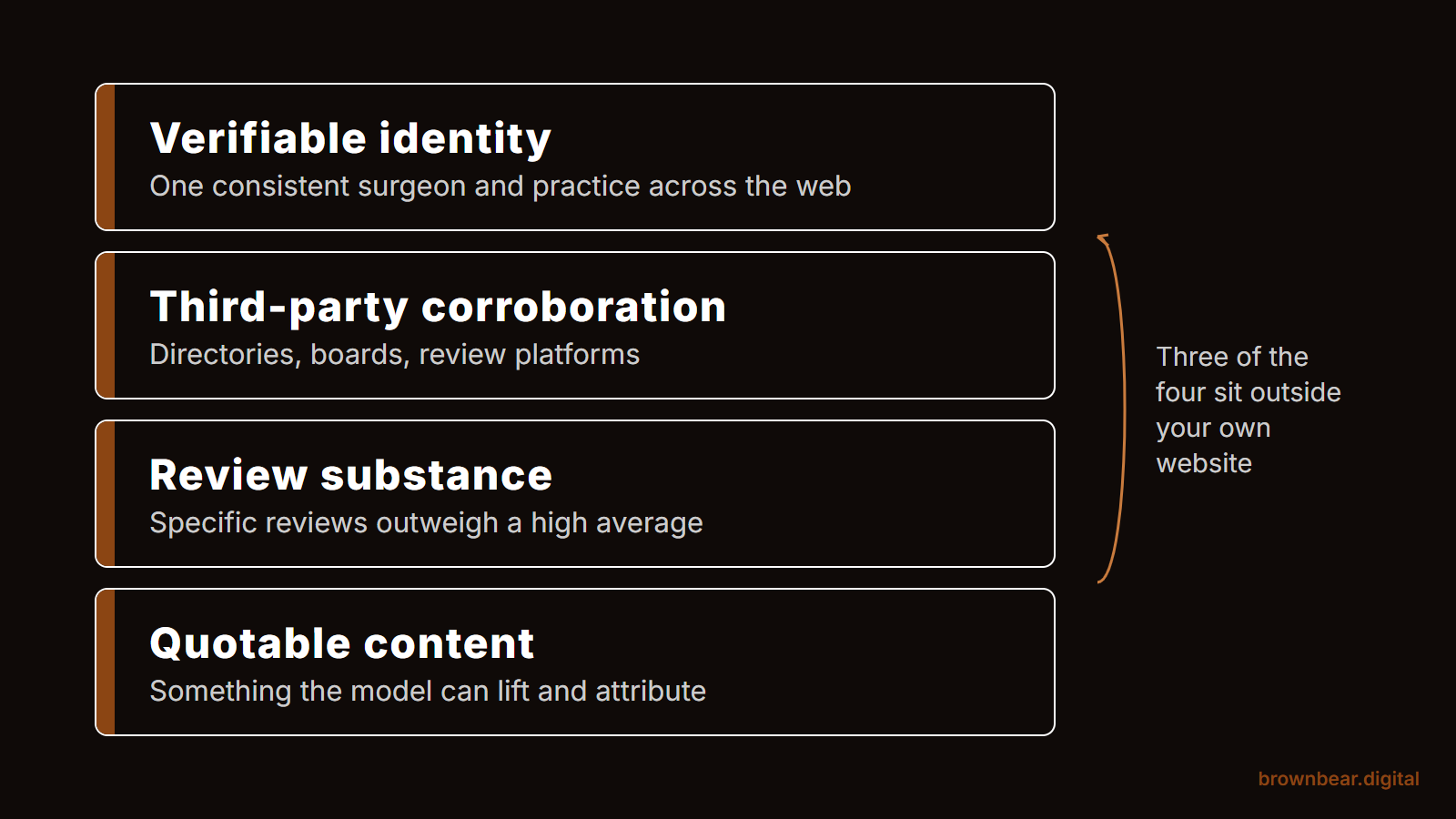
This creates an obvious problem and a less obvious opportunity. The problem: you can't fake a Reddit presence. The community polices astroturfing harshly, and a flagged account can damage you faster than no presence at all.
Surgeons who do AMAs, who answer questions in their specialty subreddit under their real identity, who let patients post unprompted reviews and engage with thoughtful follow-ups build the kind of organic Reddit footprint that AI engines treat as authoritative. We've watched practices move from invisible in AI answers to consistently cited within three to six months once a real Reddit strategy is in place.
This is uncomfortable work. It's also one of the highest-impact things a plastic surgery practice can do for AI visibility right now.
What Still Matters From the Old Playbook
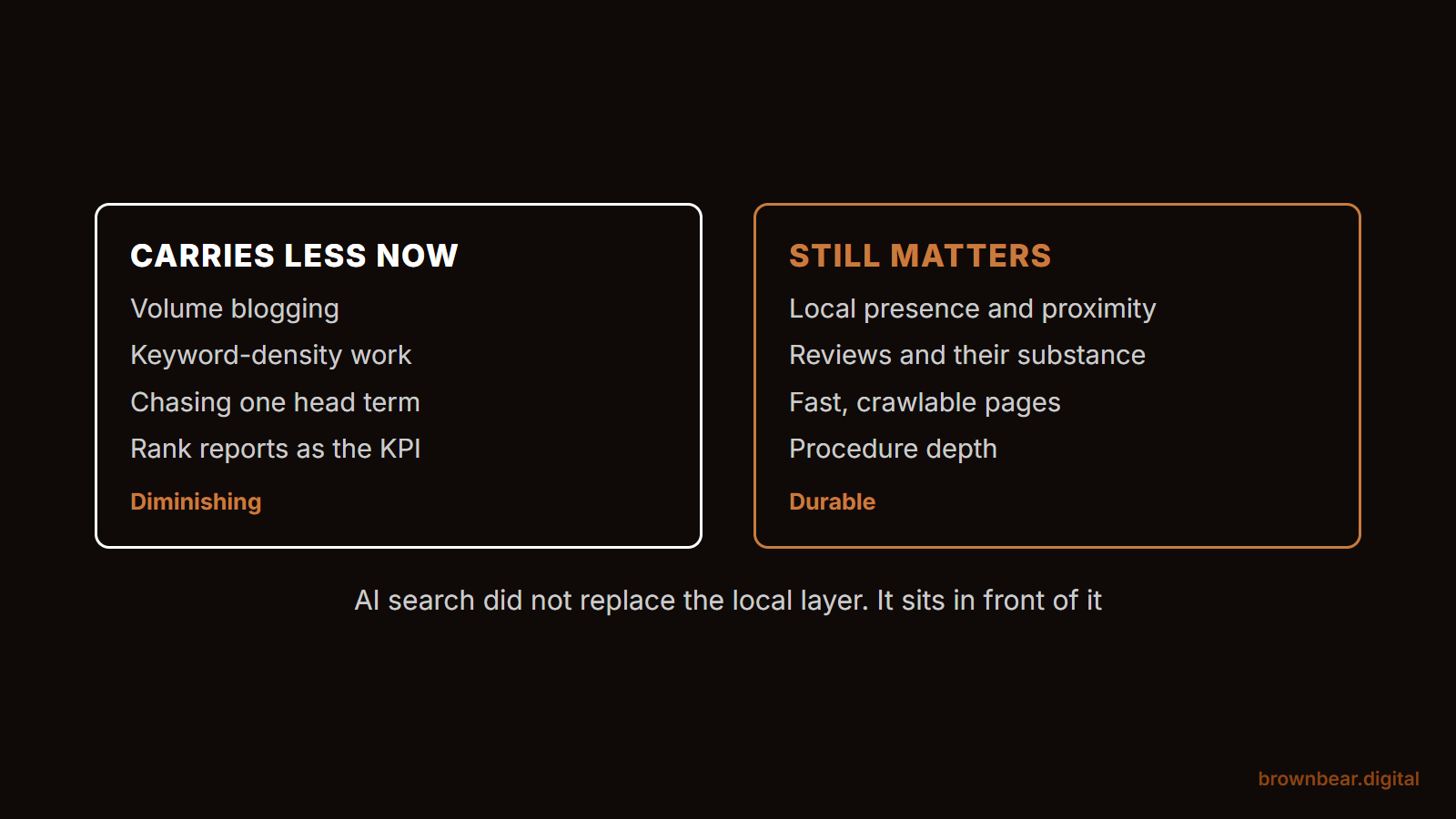
Before going further, the necessary caveat. None of what's coming next means traditional digital marketing is dead. It means the foundation is now table stakes, and the differentiator has moved up a layer.
What still matters and isn't going away:
A fast, well-structured website remains the foundation.
AI engines crawl it, summarize it, and reference it. If your site is slow, broken on mobile, or thin on procedure-specific content, every other signal you build is weaker.
Local SEO still drives a meaningful share of bottom-of-funnel queries.
"Plastic surgeon near me" still pulls a Google local pack. Patients still call from that pack. Don't abandon Google Business Profile work.
PPC still works for high-intent procedure searches.
The CPC is brutal, at $20 to $30 per click on competitive procedures, but the conversion math holds for many practices. Just don't mistake PPC volume for marketing strategy.
Reviews still drive trust.
They drive AI signal too, as discussed above. Practices with active review pipelines stay competitive. Practices without them fall behind on multiple fronts simultaneously.
The point isn't to stop doing this work.
It's to recognize that doing only this work is now a holding pattern rather than a growth strategy.
The GEO Playbook for Plastic Surgery Practices
Generative Engine Optimization (GEO) is the term for what most practices need to add to their existing marketing. It's the practical work of making your practice findable, citable, and recommendable inside AI-generated answers.
Here's what we've found actually moves the needle for plastic surgery clients:
Build the entity profile deliberately.
Make sure your name, credentials, hospital affiliations, and specialties appear consistently across all authoritative sources. Wikipedia (where appropriate), American Board of Plastic Surgery directory, ASPS, ASAPS, your hospital's physician page, your university's faculty page, your Google Business Profile, and your LinkedIn. Inconsistencies in this layer, whether different middle initials, different specialty descriptions, or mismatched practice names, confuse the entity model and weaken your AI presence.
Publish content AI engines can structurally use.
This isn't about word count or keyword density. It's about format. AI engines preferentially cite content that's structured for extraction: clear question-and-answer sections, definitive statements with supporting reasoning, comparisons with named criteria, and procedure information that includes specific data points (recovery timelines, technique distinctions, candidacy criteria). Most plastic surgery blog content reads like marketing copy. Content that gets cited reads like reference material.
Earn citations from authoritative third-party sources.
A single feature in a respected outlet, whether Allure, New Beauty, or RealSelf editorial, moves your AI visibility more than 50 owned blog posts. So does a peer-reviewed publication, a podcast appearance with a notable host, a media quote in coverage of an industry trend. The work that matters is harder, slower, and worth more.
Use proper schema markup.
This is technical SEO that has new urgency. The medical practice schema, physician schema, FAQ schema, and procedure-specific schema all provide AI engines with structured data they can rely on. Most plastic surgery sites have either no schema or a generic local-business schema. Practices with full medical and physician schema get cited noticeably more often in AI answers about their specialties.
Create reference-worthy original content.
Original outcomes data, named techniques, opinion pieces with a clear stance, in-depth procedure decision guides written from clinical experience: this is what AI engines treat as primary source material. Most plastic surgery content is derivative, variations on the same procedure overviews that everyone else publishes. Original content is genuinely scarce, which is exactly why it gets cited.
Build an authentic Reddit and forum strategy.
Identify the subreddits where your specialty is discussed. Engage under your real name and credentials. Do AMAs. Answer technical questions where you have a defensible point of view. Don't astroturf. Don't pay for reviews. Don't post your own marketing in community threads. Let your patients post about you organically and respond as yourself when they do.
Track AI visibility alongside search rankings.
Run quarterly checks: ask ChatGPT, Claude, Gemini, and Perplexity questions a prospective patient would ask. "Who are the top rhinoplasty surgeons in [your city]?" "What should I look for in a breast augmentation surgeon?" "Compare [your specialty] surgeons in [your area]." If your name doesn't come up, that's the gap to close. Watch how the answers change month over month as you build out the work above.
What to Do in the Next 90 Days
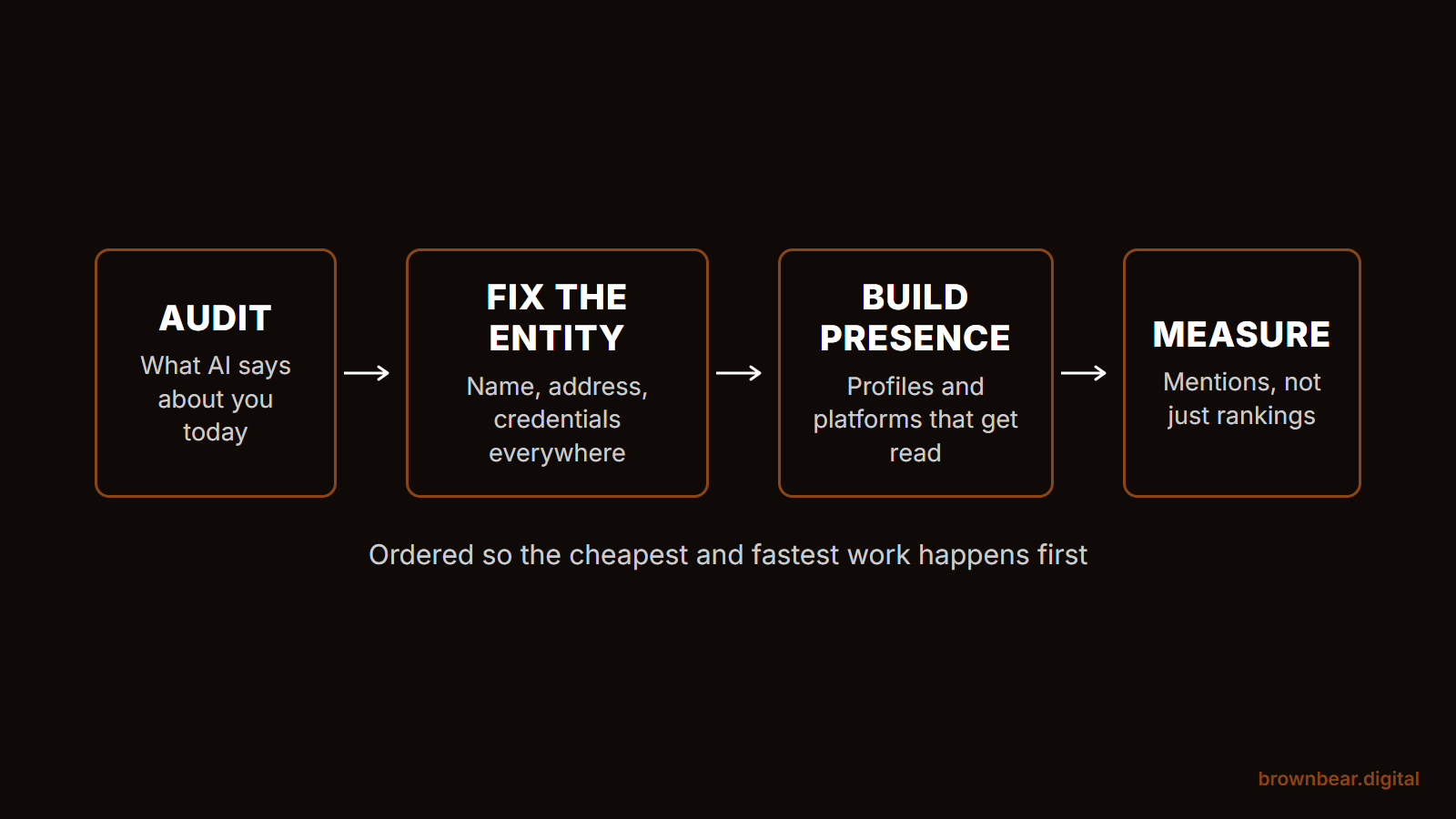
If this is the first time you're thinking about AI search seriously, the temptation is to do everything at once. Don't. Sequence matters.
Days 1 to 30: Audit and baseline.
Run AI visibility checks. Ask the four major AI assistants about your specialty in your geography and document what they say. Note who they recommend, what sources they cite, and whether your practice appears at all. This is your starting point.
Audit your entity profile. Check that your name, credentials, and practice details are consistent across ABPS, ASPS, your hospital, your university affiliations, Google Business Profile, and LinkedIn. Flag every inconsistency.
Review your existing content for AI-readability. Identify blog posts that read like marketing copy and could be rewritten as reference material. Identify procedure pages that lack structured data, specific claims, or original perspective.
Days 31 to 60: Foundation work.
Implement medical and physician schema across your site. This is technical work, and most practices need a developer or an SEO partner, but it's high-impact and one-time.
Resolve the entity inconsistencies you flagged. This often means contacting external directories directly. It's tedious. It works.
Begin a Reddit and forum strategy. Pick one or two subreddits relevant to your specialty. Read for two weeks before posting. Then engage genuinely as yourself.
Days 61 to 90: Content and citations.
Publish two or three pieces of genuinely original content. Outcomes data from your own practice. A definitive opinion on a contested technique. A patient decision guide written from real clinical experience, not from competitor research. These pieces are your citation bait.
Re-run your AI visibility checks at day 90. Compare to your day 1 baseline. The shift, even at this early stage, is usually visible: practices we work with typically see their first AI Overview citations within the first two quarters of disciplined GEO work.
The Next Decade of Patient Acquisition
Plastic surgery is one of the highest-stakes consumer decisions a person makes. It's expensive, it's irreversible, and it's emotional. Patients have always done deep research before choosing a surgeon. What's changing is where that research happens and which sources shape it. And the shift extends well beyond aesthetics: our companion piece on how patients use AI to research conditions and choose providers covers the healthcare-wide behavior, including the silent AI patient problem and a 15 minute self-audit.
The agencies still building plastic surgery marketing strategies around Google rankings, Instagram engagement, and Facebook ads aren't wrong. They're incomplete. The discovery layer has moved, and the practices that recognize it now will spend the next 5 years compounding an advantage that becomes very difficult to catch up to once it's established.
The work isn't dramatic. It's entity hygiene, structured content, real third-party authority, and engagement in places most practices have never engaged. Done consistently, it's the difference between being the surgeon AI engines recommend and the surgeon they don't mention.
Brown Bear works with plastic surgery practices and aesthetic medical groups on exactly this kind of work: search, GEO, paid, and the connective tissue between them. If you want to know what AI engines say about your practice today, and what to do about the gap, that's the conversation worth having now.
The next patient who calls your office may have decided to call before she ever loaded your website. Where she made that decision is where your marketing needs to live.
References
-
American Society of Plastic Surgeons. (2024). Plastic Surgery Statistics Report. American Society of Plastic Surgeons. https://www.plasticsurgery.org/news/plastic-surgery-statistics
-
Google LLC. (2025). About AI Overviews in Search. Google Search Help. https://support.google.com/websearch/answer/14901683
-
Reddit Inc. (2024). Reddit Data API Terms. Reddit. https://www.redditinc.com/policies/data-api-terms
-
RealSelf. (2025). About RealSelf. RealSelf. https://www.realself.com/about
-
Schema.org. (2025). MedicalBusiness. Schema.org. https://schema.org/MedicalBusiness
Related reading: Why Plastic Surgery SEO Is Different From Every Other Medical Niche · The YMYL Standard in Plastic Surgery · Plastic Surgery SEO Services: A Buyer's Guide
Ready for Brown Bear to Fix Your AI Search Visibility?
AI search isn't a future problem. It's the layer where your next patients are making decisions right now, and most plastic surgery practices aren't showing up in it. Brown Bear Digital works with plastic surgery practices and aesthetic medical groups on the entity building, GEO strategies, and structured content that get practices cited in ChatGPT, Perplexity, and Google AI Overviews, not just ranked in traditional search. Our AI search optimization, plastic surgery SEO, and content marketing are how we approach this, alongside our broader plastic surgery marketing work. Get in touch for a consultation and we'll run an AI visibility audit on your practice from the ground up.
Written By
Founder, Brown Bear Digital
Bryan has 15 years of experience across SEO, paid search, and AI search strategy. He founded Brown Bear to give businesses direct access to senior-level search expertise without the agency overhead.
Learn More About BryanReady to Turn Search
Into Revenue?
No pitch decks. Just a real conversation.