Plastic Surgery SEO Services: A Buyer's Guide

The difference between a plastic surgery SEO engagement that fills your consultation calendar and one that produces reports you can't connect to revenue usually comes down to whether the agency actually understands what it's selling.
Bryan Passanisi is the founder of Brown Bear, an SEO and AI search agency that works exclusively with plastic surgery practices.
This piece covers both what genuine plastic surgery SEO work looks like at the service level and how to identify what's filler, from technical scope through content production to YMYL compliance requirements most generalist agencies skip entirely.
If you're reviewing a proposal and struggling to distinguish real deliverables from inflated line items, you're not alone. Maybe you've already signed with an agency and six months in you're not sure what you're actually getting for the retainer. Or you've been burned before by a generalist shop that treated your rhinoplasty practice like a plumbing company and want to know what to ask for this time.
By the end of this, you'll have a clear breakdown of what should appear in a real plastic surgery SEO scope, what to push back on, and what the honest benchmarks are for pricing and reporting. Longer term, this gives you a framework for evaluating any SEO partner, not just the ones you're looking at right now.
We'll cover why plastic surgery SEO is its own category and not just "medical SEO with local optimization," what's actually in a real engagement across technical, content, local, and off-page work, what YMYL compliance adds to the scope that generalist agencies routinely miss, and what reporting and pricing should actually look like.
So, let's start with what makes plastic surgery SEO different from the rest of medicine, because that distinction explains everything else in the scope.
Key Takeaways
Plastic surgery SEO is classified as YMYL, and that changes everything
Pages without clear authorship, medical credentials, and documented review fail to rank regardless of technical SEO quality.
Budget $3,000 to $6,500/month for a single-surgeon practice
Multi-location practices typically invest $8,000 to $20,000+ depending on content velocity and competitive geography.
Generalist agencies actively damage plastic surgery sites
Black-hat tactics and anonymous content writing leave lasting domain authority damage in YMYL verticals, with effects that recover far more slowly than in non-medical categories.
The right metric is cost per consult from organic, tracked by procedure
Total traffic and keyword rankings are vanity metrics. What matters is how many booked consultations organic search is producing and at what cost.
Why Plastic Surgery SEO Is Not Generic SEO
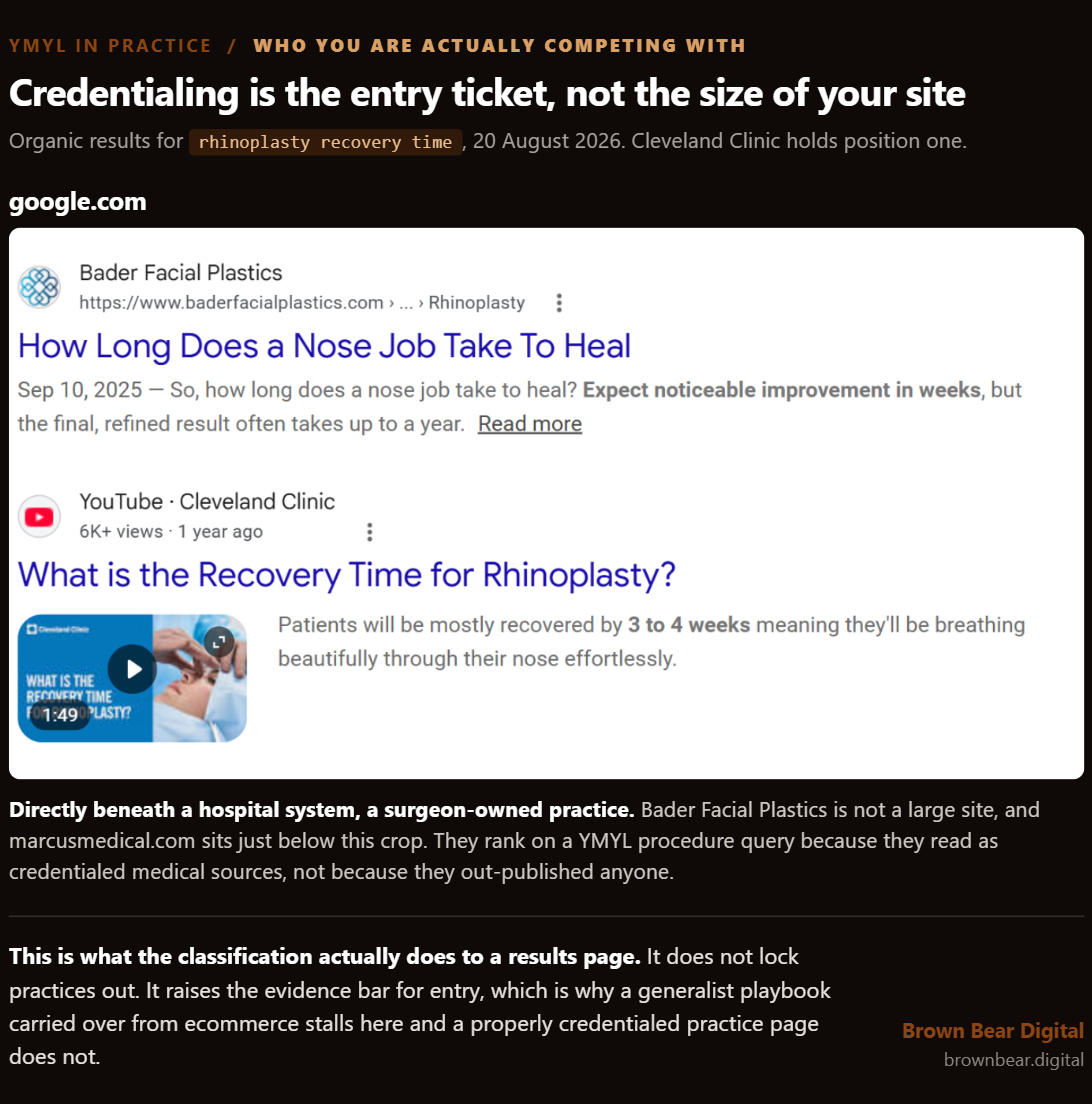
Plastic surgery is classified by Google as a Your Money or Your Life topic. That single classification changes the rules in three concrete ways.
E-E-A-T (Experience, Expertise, Authoritativeness, Trust) is not a soft factor: it's the gating factor.
Pages that don't display clear authorship, medical review, and credentialing struggle to rank, regardless of how well-optimized the content is otherwise. A 2,000-word rhinoplasty page written by an anonymous content writer will lose to a 1,200-word page written or reviewed by a board-certified surgeon, every time.
Quality rater scrutiny is heavier.
Human quality raters and the systems they train evaluate plastic surgery sites against the medical YMYL guidelines, which require trustworthy authors, accurate information, complication disclosure, and citation. Sites that don't meet that bar have lower ceilings, even when the technical SEO is clean.
Manual penalties for shady tactics are more severe and recover more slowly.
Link buying, doorway pages, expired domain stuffing, AI-spam content: every black-hat tactic that sometimes works in less sensitive verticals will shorten the life of a plastic surgery practice's domain authority, often permanently.
A generalist SEO agency carrying over its standard playbook from e-commerce or local services into plastic surgery is not just inefficient. It's dangerous. The mistakes leave marks.
What's Actually In a Real SEO Engagement
A plastic surgery SEO scope, broken into the four categories that should appear in any proposal.
Technical SEO
What it covers:
Site architecture, crawlability, indexation, page speed, Core Web Vitals, schema markup, mobile usability, HTTPS, sitemap and robots configuration, redirect health, hreflang for multi-language sites.
What's worth paying for:
A real technical audit at the start of the engagement, with prioritized fixes implemented. Schema markup specific to medical practices: Physician, MedicalOrganization, MedicalProcedure, Review, FAQPage. Quarterly technical health reviews to catch regressions.
What's filler:
"Technical SEO maintenance" billed monthly with no specific deliverables. If you're paying for ongoing technical SEO, the agency should be able to show you what they did this month and what changed as a result.
On-Page Content SEO
What it covers:
Procedure pages, surgeon and team pages, location pages, blog/educational content, FAQ pages, internal linking architecture.
What's worth paying for:
Real content production with medical review. A procedure page should be researched against current ASPS guidance, drafted by a writer who understands the procedure, reviewed by the surgeon or another board-certified physician, and published with clear authorship. The content brief should be specific to the practice, not generic.
What's filler:
Generic blog posts on "five things to know before rhinoplasty" written by a freelancer with no medical background, no review, and no differentiation from the same article on fifty other sites. AI-spun content disguised as original. "Content calendars" that produce volume without ranking improvement or consult attribution.
A useful test: ask the agency to send you the last six pieces they published for an existing plastic surgery client. Read them. If they sound like they could have been published on any plastic surgery site in the country, they probably were, and they aren't ranking.
The opposite of filler is content built on something nobody else has. Our 101-city procedure page study and our 50-procedure before-and-after gallery study exist for that reason: original research earns the citations, links, and AI mentions that a rewritten listicle never will. It is a fair question to put to any agency you are evaluating. What have you published for a client that a competitor could not have written?
Local SEO
What it covers:
Google Business Profile optimization and management, location pages, local citations and directory consistency, review velocity and management, local link building, geo-targeted content.
What's worth paying for:
Active GBP management: weekly posts, photo additions, Q&A monitoring, review responses, attribute updates. NAP audit and cleanup across the major directories at engagement start. A real review-generation system tied into the consult and post-op workflow.
What's filler:
"GBP optimization" charged as a setup fee with no ongoing management. Citation submissions to 200+ directories, most of which are scrap directories that haven't influenced rankings since 2014.
Off-Page SEO
What it covers:
Backlink acquisition, digital PR, partnership development, brand mention monitoring, removal of toxic links, link reclamation.
What's worth paying for:
Slow, deliberate, editorial link acquisition. Guest contributions on real publications. Local sponsorships and partnerships that produce legitimate links. Help-a-Reporter-Out-style citation work where the surgeon is quoted by name as a source. Removal of any toxic legacy links a previous agency built.
What's filler:
Bulk guest post packages on private blog networks. Forum profile signatures. Comment links. Web 2.0 properties. "Link building" with no specific publications or partnerships named in advance.
An honest plastic surgery SEO engagement might produce 3 to 8 high-quality links per quarter. An agency promising 30+ links per month is selling something that will eventually trigger a manual review or an algorithmic devaluation.
What YMYL Adds to the Scope That Generalist Agencies Skip
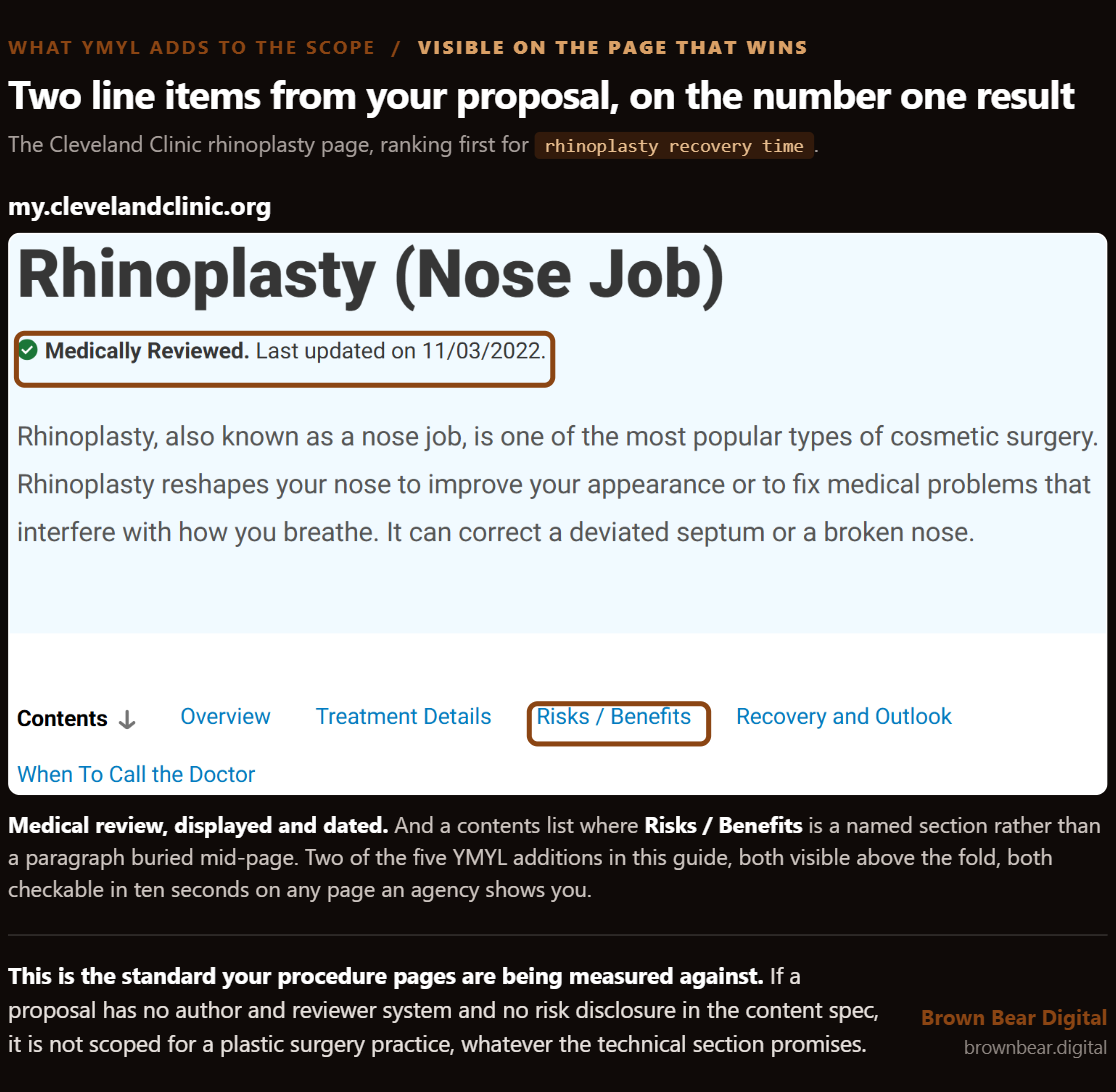
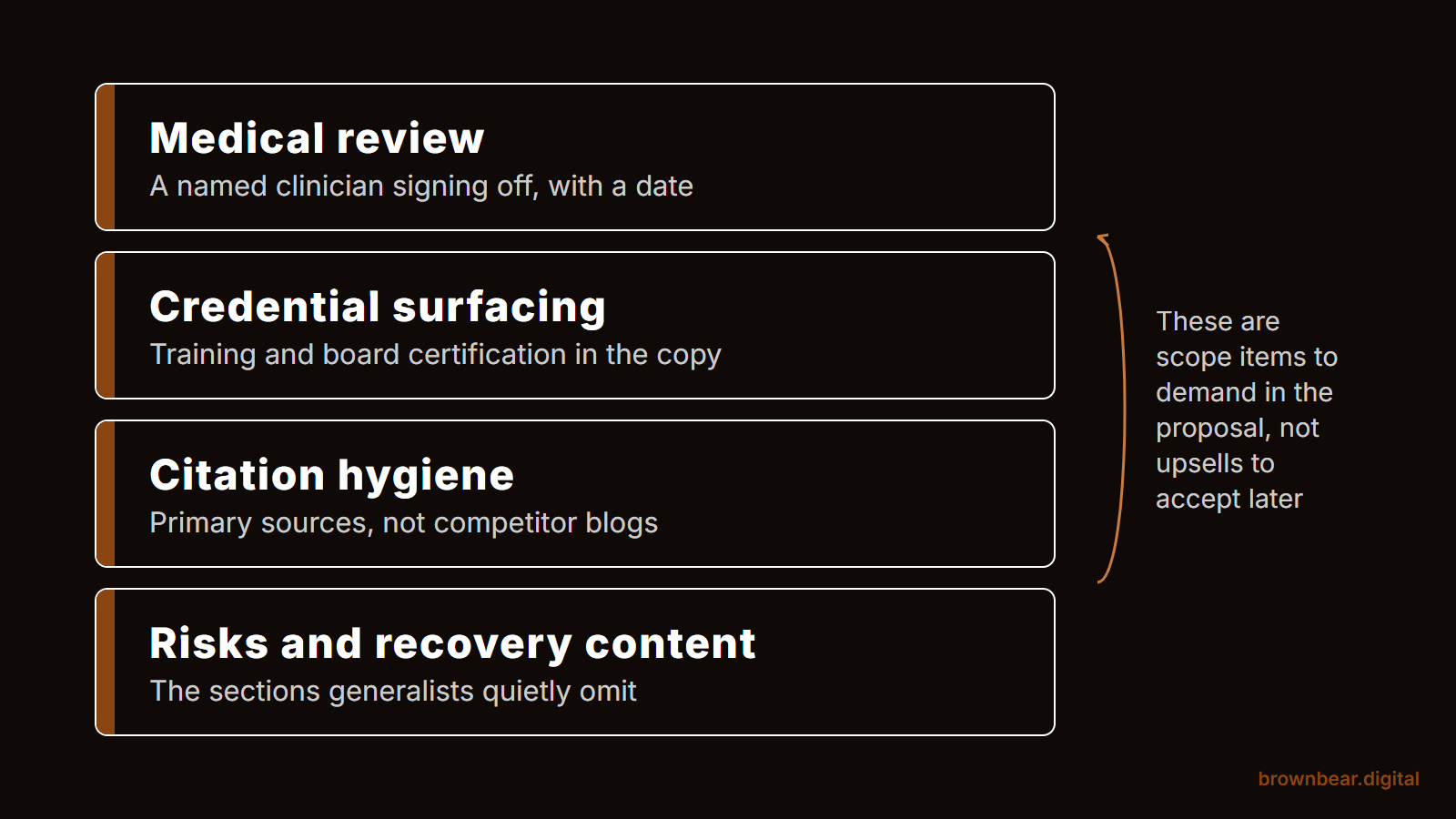
Five additions that should appear in a real plastic surgery SEO proposal.
Author and reviewer system.
Every procedure page and educational article needs identified authorship and medical review, displayed on-page, with a link to the surgeon or reviewer's bio. The bio needs to credential the surgeon: board certification, hospital privileges, fellowship, society memberships, publications.
Citation discipline.
Statistics, recovery timelines, complication rates, and outcome data should cite ASPS, peer-reviewed sources, or the surgeon's own series with a clear data note. Uncited numbers attract scrutiny.
Risk and complication disclosure.
Pages that omit risks underperform pages that disclose them honestly. The disclosure also reduces medical-legal exposure.
Photo consent and HIPAA-aware galleries.
Before-and-after photos require documented consent. The handling of those photos in galleries, meaning image weight, alt text, and schema, has SEO implications that generalists routinely miss.
Tracking and tagging within HIPAA constraints.
Configuring Google Analytics, ad pixels, call tracking, and CRM integrations in a way that doesn't transmit PHI. This is a non-trivial technical project that most agencies simply ignore.
Reporting That Actually Tells You Something
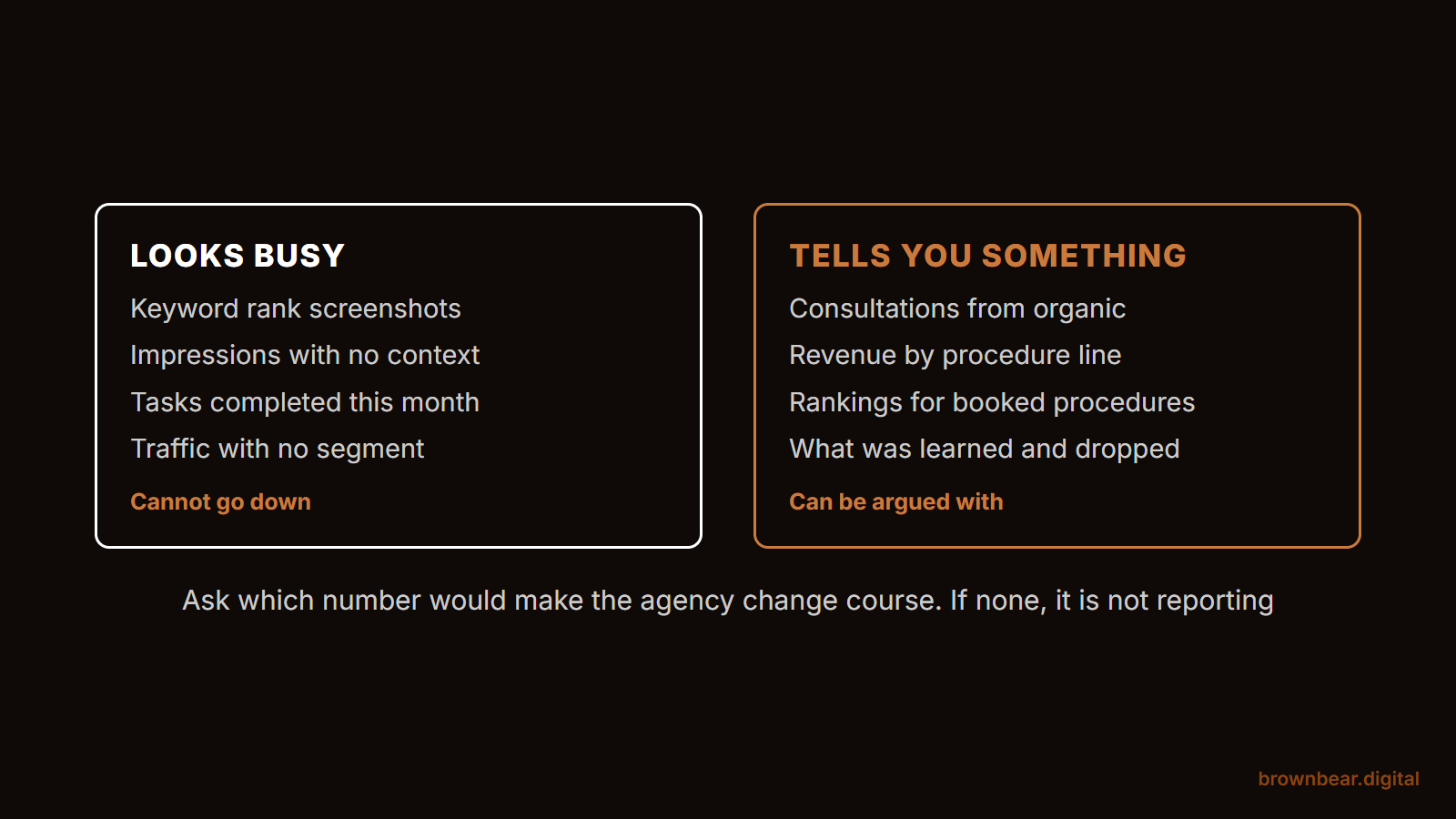
The standard SEO report of keyword rankings, organic traffic, and page-level performance is necessary but not sufficient. A real plastic surgery SEO report should also show:
- Source-of-consult breakdown. How many consults this month came from organic search, from which procedures, from which pages.
- Cost per consult from organic. SEO investment divided by attributed consults. Should improve materially over a 12-month engagement; if it doesn't, the engagement isn't working.
- Procedure-level performance. Some procedures will outperform others. Reporting that aggregates everything into one "organic" bucket hides the truth.
- Content production output and outcomes. What was published, what's ranking, what's converting.
If the SEO report you receive doesn't include these, ask why. The answer will tell you a lot about whether the agency is set up to do real plastic surgery SEO or is repurposing a template from an e-commerce client.
Pricing Benchmarks for SEO Specifically
Plastic surgery SEO standalone (no PPC, no general marketing):
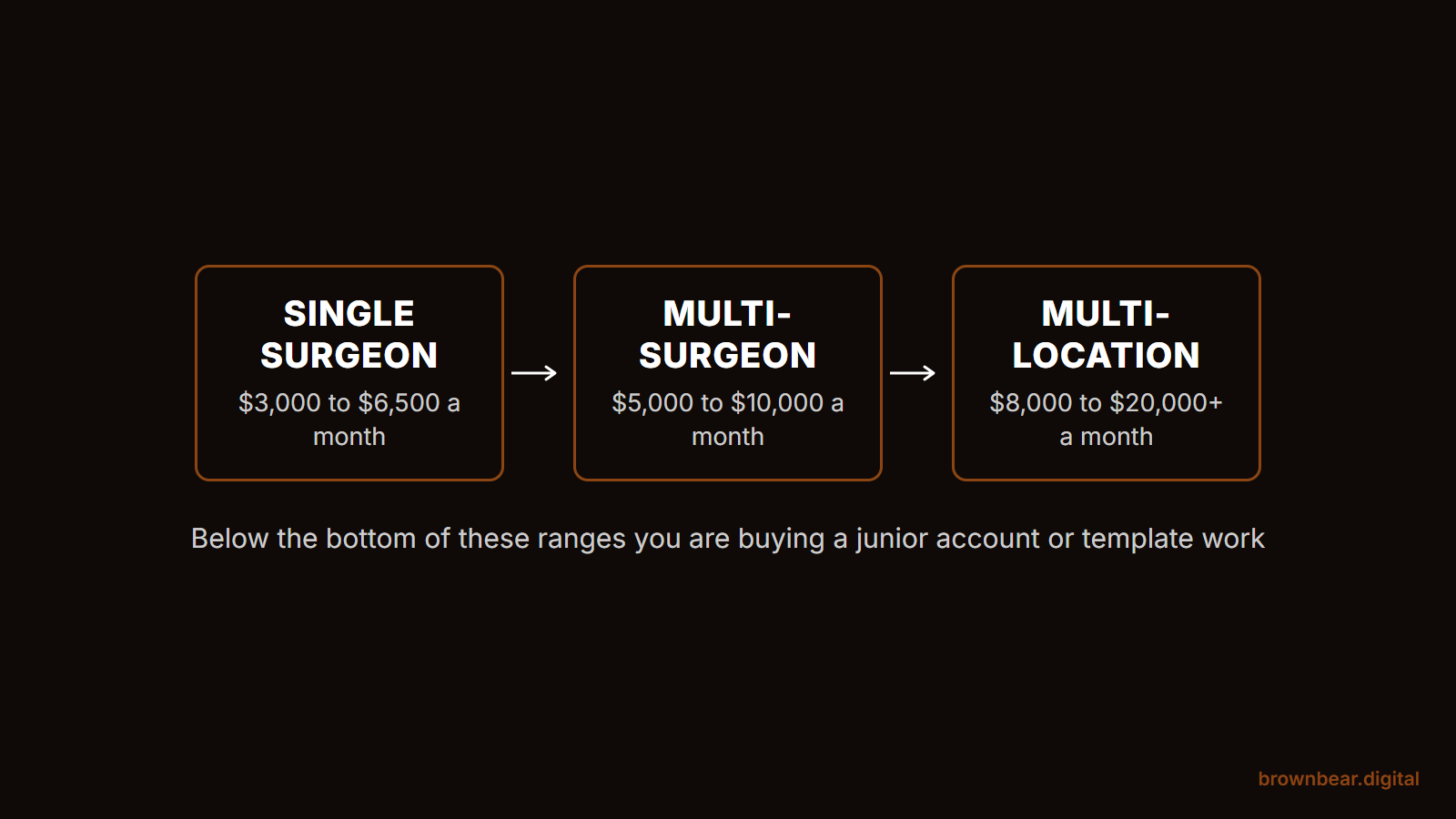
- Single-surgeon practice, ongoing SEO: $3,000 to $6,500/month
- Multi-surgeon, single location: $5,000 to $10,000/month
- Multi-location: $8,000 to $20,000+/month, scaling with locations and content velocity
Below the bottom of these ranges, you're buying a junior account or template work. The price difference between mid-range and high-range is usually due to content production capacity (how many real, medically reviewed pages per month) and senior strategic involvement.
What to Do Next
- Audit what you currently have. Pull a list of your top 20 ranking pages. Read them. If they don't show authorship, medical review, or specific surgical perspective, that's your opportunity.
- Demand procedure-level data. Any agency you're evaluating should be able to discuss SEO outcomes by procedure, not just by traffic.
- Run the writing test. Ask for the last six pieces they published for a plastic surgery client. Differentiation is visible in two minutes of reading.
- Look at the contract for ownership and reporting clauses. Domain, GA account, GSC access, and content: the practice owns, the agency administers.
- Run the agency through a hiring framework. Knowing what to look for in a proposal is different from knowing what to ask in a pitch meeting. Our guide to hiring an SEO agency for a medical practice walks through the five questions that reveal whether an agency has genuine YMYL experience or is applying a general healthcare template.
A real plastic surgery SEO engagement compounds. Twelve months in, the practice should have 40 to 80+ pages of medically reviewed, well-cited, well-linked content; a healthy GBP; rising rankings on the procedures that actually drive revenue; and a measurable, declining cost per consult from organic.
If you're twelve months into an SEO engagement and you don't have that, the engagement isn't working, regardless of what the rankings report shows.
References
-
American Society of Plastic Surgeons. (2024). Plastic Surgery Statistics Report. American Society of Plastic Surgeons. https://www.plasticsurgery.org/news/plastic-surgery-statistics
-
Google LLC. (2025). Search Quality Rater Guidelines. Google Search Central. https://developers.google.com/search/docs/fundamentals/creating-helpful-content
-
Schema.org. (2025). MedicalProcedure. Schema.org. https://schema.org/MedicalProcedure
-
U.S. Department of Health and Human Services. (2025). Health Information Privacy (HIPAA). HHS. https://www.hhs.gov/hipaa/index.html
Related reading: Why Plastic Surgery SEO Is Different · How to Evaluate a Plastic Surgery Marketing Agency · The YMYL Standard in Plastic Surgery
What a Real Plastic Surgery SEO Engagement Looks Like
You've just read what separates a real plastic surgery SEO engagement from generic medical SEO filler. Brown Bear Digital is the answer to most of the questions this guide raises: medically reviewed content, procedure-level reporting, full ownership of your domain and analytics, and a strategy built specifically for a YMYL category with luxury-purchase dynamics. Our plastic surgery SEO services and content marketing represent that full stack, as part of our broader plastic surgery marketing work. Reach out and we'll walk you through exactly how we'd approach your practice.
Written By
Founder, Brown Bear Digital
Bryan has 15 years of experience across SEO, paid search, and AI search strategy. He founded Brown Bear to give businesses direct access to senior-level search expertise without the agency overhead.
Learn More About BryanReady to Turn Search
Into Revenue?
No pitch decks. Just a real conversation.