How Long Does Medical, Legal, or Financial SEO Take? What to Know About YMYL SEO Timelines

If you run a medical practice, law firm, or financial advisory firm and you've been told SEO takes "six months," you've been given half an answer. The timeline is real, but the reason behind it is almost never explained properly, and the factors that actually control it are almost never the ones most agencies lead with.
Your vertical, whether that's medical, legal, or financial, sets the competitive environment. But your specific SEO timeline is determined by what's happening on your website right now, the quality of the strategy being applied to it, and how fast recommendations are actually going live.
Here's a breakdown of what really drives YMYL SEO timelines, what to expect at each stage, and why two practices in completely different industries can end up on almost identical schedules.
Key Takeaways
Your vertical sets the scrutiny, your site sets the clock
Medical, legal, and financial practices are told SEO takes six months, but the vertical only sets the competitive environment. Your site's technical health, content authorship, backlink profile, and implementation speed determine the actual timeline.
Real traction lands between 4 and 6 months
Most YMYL sites with solid fundamentals and consistent execution see meaningful movement in months 4 to 6, with technical fixes handled in the first 60 to 90 days. Sites carrying technical debt or slow implementation wait considerably longer.
The execution gap is the hidden timeline killer
Compliance reviews, committee approvals, and stretched dev teams routinely leave recommendations unimplemented for months, and every month in the queue is ranking progress that never happens. Build the approval pathway before the engagement starts, not after the first audit lands.
Run links and content in parallel from day one
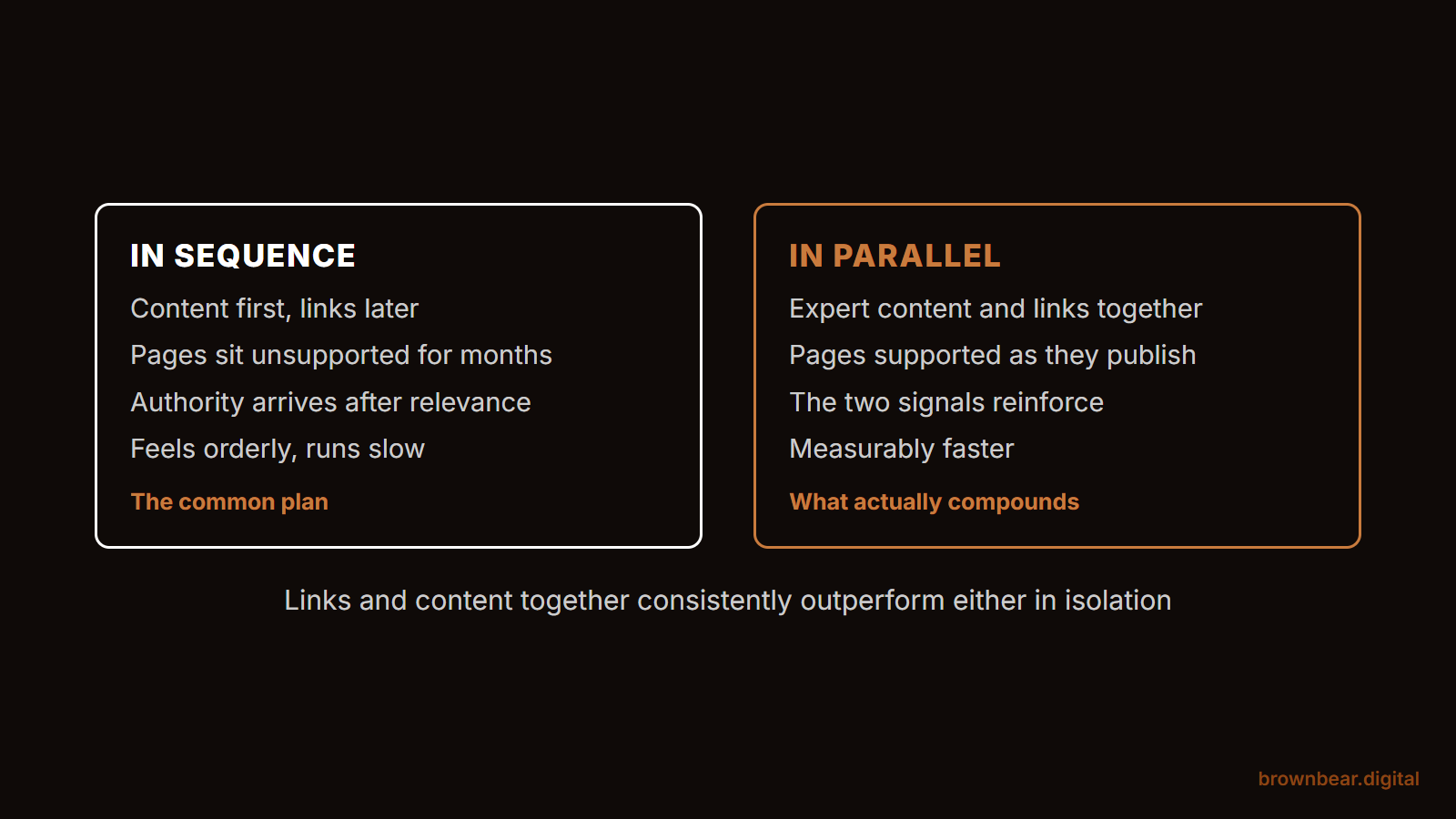
Expert content and active link acquisition running together compound measurably faster than either alone. Sequencing them, content first and links later, is one of the most consistent ways YMYL timelines get extended unnecessarily.
What Is YMYL SEO and Why Google Treats It Differently
YMYL stands for "Your Money or Your Life."
It's how Google internally classifies content that could meaningfully affect a reader's health, legal standing, financial stability, or personal safety. If you're a cardiologist, an estate planning attorney, or a certified financial planner, your website is YMYL. (For a deep dive on how this standard plays out in one high-scrutiny niche, see the YMYL standard in plastic surgery and AI search.)
The verticals Google scrutinizes most include:
- Medical and healthcare: clinical content, provider profiles, treatment information
- Legal: rights, case outcomes, attorney credentials
- Financial: investment guidance, tax strategy, financial planning
- Mental health: therapy, crisis resources, diagnosis-adjacent content
- Pharmaceutical and supplement: dosage, drug interactions, efficacy claims
What these sectors share: a mistake in the content doesn't just hurt your rankings. It could harm the person reading it. Google takes that seriously. Its quality raters are explicitly trained to flag YMYL content that lacks verifiable expertise, clear authorship, and demonstrated trustworthiness.
How E-E-A-T Acts as a Ranking Gate for YMYL Sites
E-E-A-T stands for Experience, Expertise, Authoritativeness, and Trustworthiness.
It's Google's quality framework for evaluating content, and for YMYL sites the threshold is significantly higher than for general industries.
A blog post about weekend hiking trails can rank without a named author. A blog post about managing Type 2 diabetes cannot, not at any meaningful scale. Google needs to see:
- Experience: content written by or closely attributed to someone with real-world involvement in the topic
- Expertise: demonstrable credentials, meaning degrees, licenses, professional history
- Authoritativeness: third-party recognition through citations, backlinks, and professional mentions
- Trustworthiness: accurate, regularly updated content with transparent authorship and no misleading claims
This isn't limited to your blog. Your author bio pages, practitioner profiles, about page, and review signals all feed into how Google evaluates your site's overall E-E-A-T posture. For most YMYL sites we audit, this layer is the most underdeveloped, and the one with the most immediate upside when addressed properly.
The Honest Answer: It's Not Really About the Vertical
Here's what most agency content on this topic won't say directly: whether you're a dermatologist, a divorce attorney, or a wealth management firm doesn't determine how long your SEO takes.
One of the most common situations we encounter with new YMYL clients: they've been with another agency for eight months, they're in a moderately competitive market, and they've seen almost no meaningful movement. When we audit the site, the issue is almost never the industry. It's that technical problems were never resolved, content is thin and lacks credible authorship, and the previous agency's recommendations have been sitting half-implemented because the internal team doesn't have bandwidth to push them through.
The vertical sets the degree of scrutiny Google applies and how competitive the market is. Your site's current condition and how fast it's improving set your actual timeline.
A brand-new medical practice website with no backlinks, unresolved crawl errors, and no named authors will take longer to rank than a five-year-old financial advisory firm's site with a clean technical foundation, a library of well-attributed content, and a recognized brand presence, even if the financial advisor is in a denser market. The vertical is context. Your site is the variable.
What's Actually Happening on Your Site Right Now
Before any timeline estimate is meaningful, there needs to be an honest assessment of where the site stands today. Three areas determine your baseline more than any other.
Technical Foundation
Google has to be able to crawl, index, and understand your site before it can rank it. For YMYL sites, unresolved technical issues create a ceiling that no amount of content or link building can break through.
The most common technical problems that extend YMYL SEO timelines:
- Pages blocked from indexing by misconfigured robots.txt files or incorrectly applied noindex tags on core service pages
- Slow Core Web Vitals, particularly Largest Contentful Paint and Cumulative Layout Shift
- Duplicate content from parameter-based URLs or staging environments that haven't been properly excluded
- Missing or incorrect schema markup, especially critical for healthcare (MedicalBusiness, Physician, FAQPage) and legal (LegalService, Attorney)
- HTTP-to-HTTPS migration issues leaving redirect chains or mixed content warnings
Technical fixes create the floor. Without them, everything else is competing with a structural handicap.
Content: Depth, Accuracy, Authorship, and Topical Coverage
For YMYL sites, thin content is not just a missed opportunity. It's an active liability. Google's quality raters are trained to down-rate YMYL pages with insufficient depth, no clear author expertise, or content that could be misunderstood by someone making a real health, legal, or financial decision.
Strong YMYL content looks like service pages that go beyond a brief description and actually answer what the patient, client, or investor needs to know before making a decision; blog and educational content written by or closely attributed to a credentialed professional with a linked author bio; topical depth that signals genuine authority across the subject area; and regular updates, which matter especially in medical and legal content where guidelines and best practices change frequently.
"The most consistent issue is content quality. A lot of the copy on these sites is thin, undescriptive, and written without any real consideration for how the audience is actually searching. Pages that should be transactional read like informational pieces, and vice versa. There's usually a lack of basic keyword inclusion, poor structure, and almost no content strategy around the broader consumer search journey: the pages that would connect with someone in the early stages of research, not just the moment they're ready to book or call."
Bryan Passanisi, Founder, Brown Bear Digital
Broad, shallow, or clearly unattributed content is one of the most consistent reasons YMYL sites plateau after early traction, even when other factors are strong.
Backlinks: Authority, Relevance, and the Trust Gap
Links remain among the most powerful ranking signals, and for YMYL sites they carry additional weight. They serve as a proxy for real-world professional authority. A link from the American Bar Association or a regional medical journal signals something qualitatively different than a link from a general health blog.
A new YMYL site with no backlinks is asking Google to take its word for its expertise. Building a backlink profile that signals genuine authority through digital PR, professional association memberships, local media coverage, educational institutions, and verified niche directories is not optional in competitive YMYL markets. It's the mechanism through which external validation reinforces your on-site E-E-A-T signals.
Links and content together consistently outperform either in isolation.
When expert-level content and active link acquisition run at the same time, not content first and then links later, the compounding effect is measurable and faster.
Your Starting Point Changes the Clock
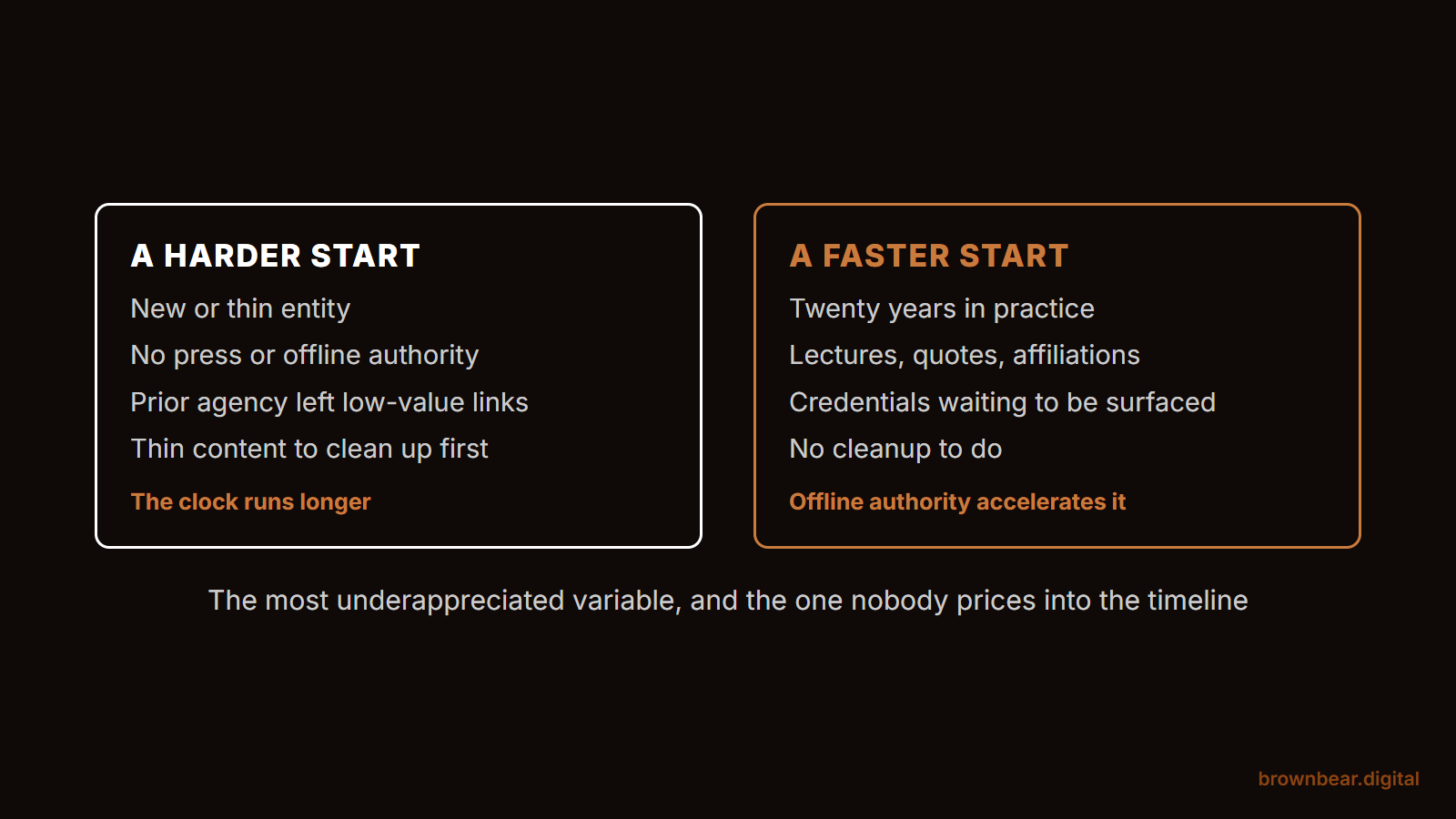
Two YMYL sites receiving the exact same SEO strategy can produce very different results on very different timelines. The most underappreciated reason is where each site is starting from.
Brand Signals and Offline Authority
Google increasingly uses brand signals, including searches for your name, co-citations, press coverage, and local business data, as corroboration for the expertise signals on your site. A physician who has practiced for 20 years, lectures at a medical school, and has been quoted in regional media has an offline authority that, when properly surfaced online, accelerates YMYL SEO in ways that are genuinely difficult to replicate quickly with a new entity.
For attorneys, financial advisors, and healthcare providers: your credentials, board certifications, professional affiliations, and published work are not just resume line items. They are SEO signals waiting to be properly connected to your digital presence. That connection work is the core of E-E-A-T for plastic surgeons, and the same principles apply across every YMYL vertical.
Existing SEO Work: Done Well or Done Wrong
A site that has had previous SEO work, in-house or through another agency, can be starting from a stronger position, a neutral one, or a significantly worse one depending on what was actually done.
"We pull Google Search Console data and pair it against the client's actual lead volume over the same period. That combination tells us quickly whether there was any real business impact, not just traffic movement. We also use additional tools to map which keywords gained traction since the previous agency started work. The majority of the time, what we find is low-value links and thin content. These aren't things most business owners or marketing managers would know to flag. They look fine on the surface, but they're not moving the needle commercially."
Bryan Passanisi, Founder, Brown Bear Digital
Solid prior work is a genuine head start. But inherited low-quality link profiles, keyword-stuffed content, technical shortcuts, or strategies that generated short-term rankings at the cost of long-term trust need to be identified and addressed before new work can compound effectively. When we audit sites with prior SEO history, the ones that take longest to show new results are almost always the ones where past work created liabilities that have to be cleared before gains can stick.
Variables That Compress or Extend Your Timeline
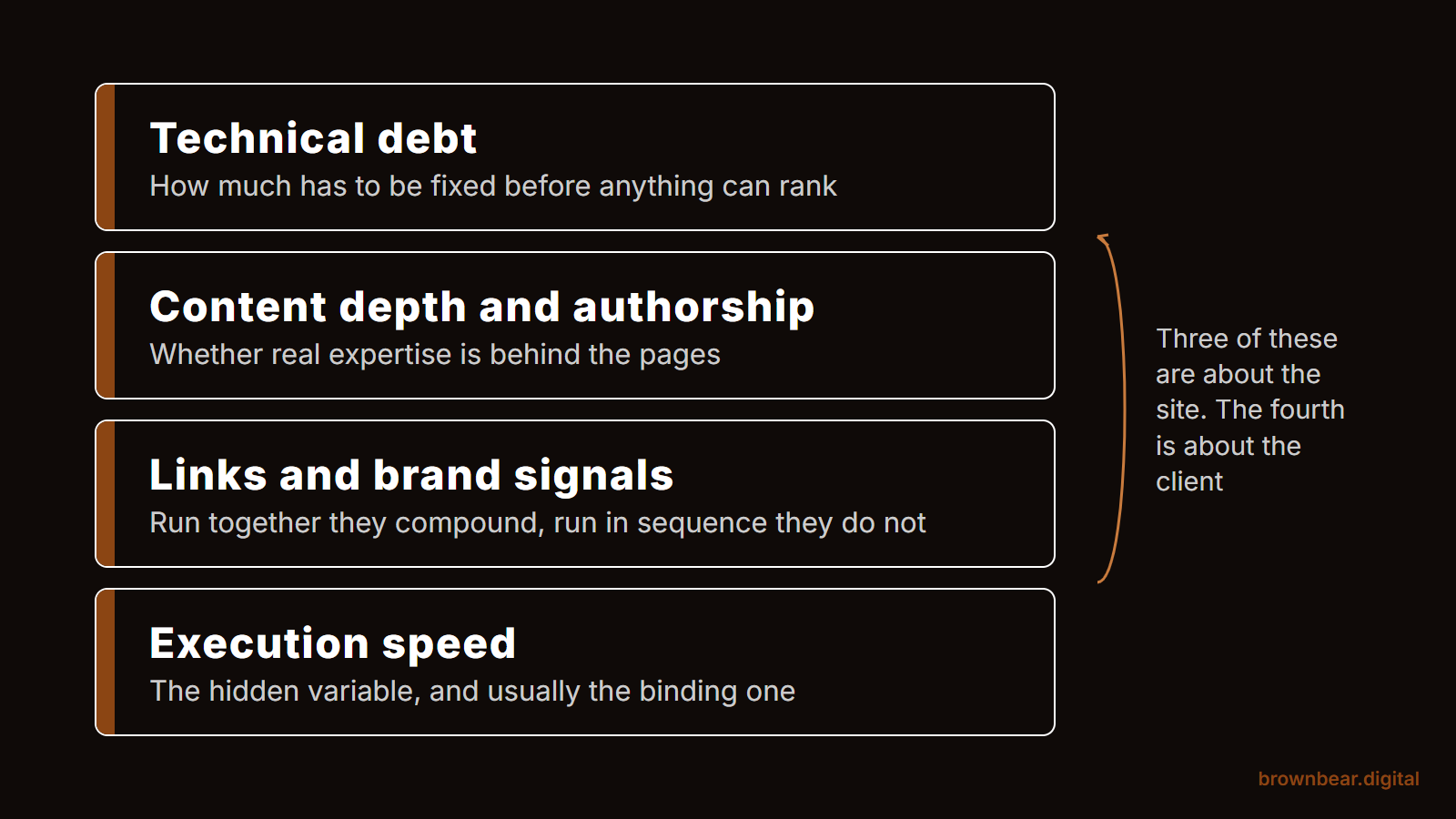
Even from a strong baseline, four variables have the most direct and measurable impact on how quickly results arrive.
Quality of SEO Recommendations
The quality of the underlying strategy matters more than most practices consider when evaluating agencies.
A technically correct but strategically shallow set of recommendations, such as "publish more content," "get more backlinks," or "improve your page speed," produces slow or no results even when executed flawlessly. The recommendations need to be specific, prioritized by actual impact, and grounded in what's genuinely limiting your rankings today.
For YMYL sites, this means understanding Google's quality guidelines in depth, knowing how to audit and strengthen E-E-A-T signals specifically, and producing a content approach that is genuinely differentiated from what every competing practice already has on their site.
Execution Speed: How Fast Changes Actually Go Live
This is where most YMYL practices lose the most time. It's also the variable that almost no agency ever discusses openly with clients before an engagement starts.
A strategy can be completely sound and still produce no results for months if recommendations aren't being implemented. For medical, legal, and financial firms, implementation delays are especially common because of compliance and review requirements that don't exist in most other industries. Content needs legal or regulatory sign-off before it goes live. Website changes go through IT teams or third-party developers. New service pages require physician approval or partner sign-off. These are legitimate constraints, but they compound directly against your SEO timeline.
Every month a recommendation sits in a queue is a month of potential ranking progress that doesn't happen. Understanding your own execution capacity before beginning an SEO engagement isn't optional. It's part of setting a timeline that's actually realistic for your organization.
Local vs. National Competition
A family medicine practice in a mid-size regional market competing for local patients faces a different challenge than a medical malpractice law firm targeting national search volume. Local SEO campaigns, where Google Business Profile optimization, citation consistency, and proximity signals do significant work, can show meaningful movement faster than national campaigns where you're competing against established domains with years of content and link equity behind them.
Local isn't always easier: a densely competitive market like New York or Los Angeles can be harder than a national campaign for a narrow specialty. But the mechanisms are different, and local SEO traction typically comes faster than broad national keyword targets.
Keyword and Topic Difficulty in Regulated Industries
Some YMYL keywords are significantly harder to move than others, not because of your site's shortcomings, but because the competitive landscape is entrenched. "Personal injury attorney [major city]" and "cardiologist near me" are not the same challenge as "telehealth mental health therapy for adolescents" or "fee-only financial planner for physicians."
A well-executed YMYL SEO strategy prioritizes achievable targets that build topical authority first,
then uses that authority as leverage to compete for higher-difficulty terms over time. Trying to rank for the hardest terms immediately, before the site has built the trust architecture to compete, is one of the most consistent ways timelines get extended unnecessarily.
The Execution Gap: The Hidden Reason Most YMYL Practices Wait Longer
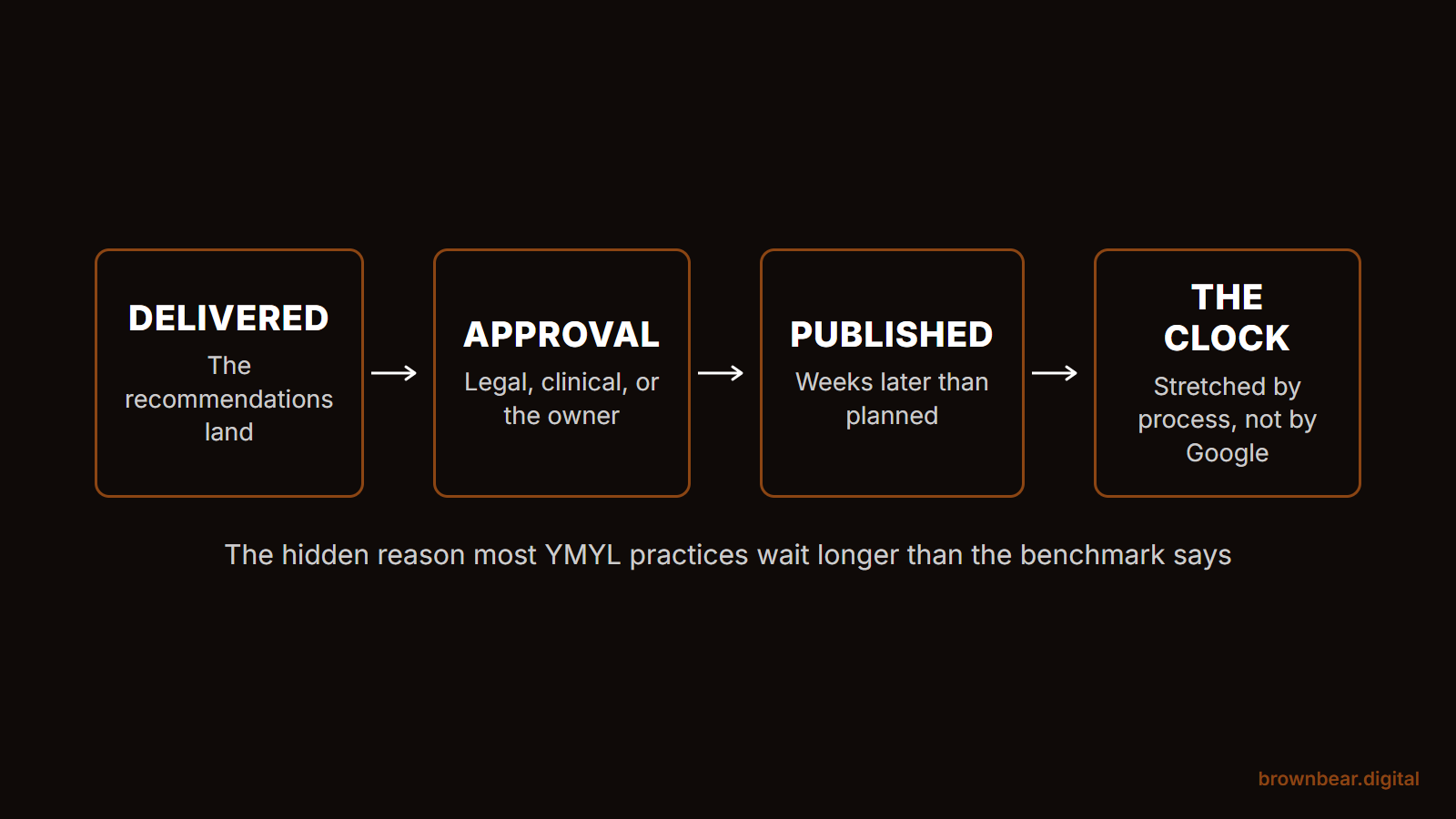
One of the most consistent patterns we see across YMYL SEO engagements is the gap between when a recommendation is made and when it is actually implemented. This gap, driven by compliance review cycles, committee approvals, slow content production workflows, or stretched web development resources, is often the single largest factor in delayed results. And it's almost never included in the timeline conversation at the start of an engagement.
An audit delivered in January that isn't fully implemented until May has cost four months of compounding potential. Content recommendations that require physician or compliance review but sit in inboxes for six weeks while the team manages other priorities don't produce results on any schedule. Execution capacity is one of the most revealing things to probe when hiring an SEO agency for a medical practice, because the agency's workflow is half of your timeline.
"We always have our team handle quick internal reviews to keep things moving. But for compliance-sensitive content, which is most of what we produce for YMYL clients, we work with specialist agents who assist with content reviews for regulatory accuracy. That significantly reduces the burden on the client's internal team and keeps the production cycle from stalling at the approval stage. It's one of the things that most directly impacts timeline, so we build the review process into the workflow from day one rather than treating it as an afterthought."
Bryan Passanisi, Founder, Brown Bear Digital
The YMYL practices that consistently see the fastest results aren't always the ones with the biggest budgets. They're the ones that built an execution process before the SEO work started: a dedicated internal point of contact, a content approval pathway with a defined turnaround, and a web team, internal or external, that can implement technical changes within a reasonable window.
Speed of implementation is not a soft factor.
It is one of the most quantifiable variables separating practices that see strong results at month five from those still waiting at month eleven.
So When Can You Expect Real Traction?
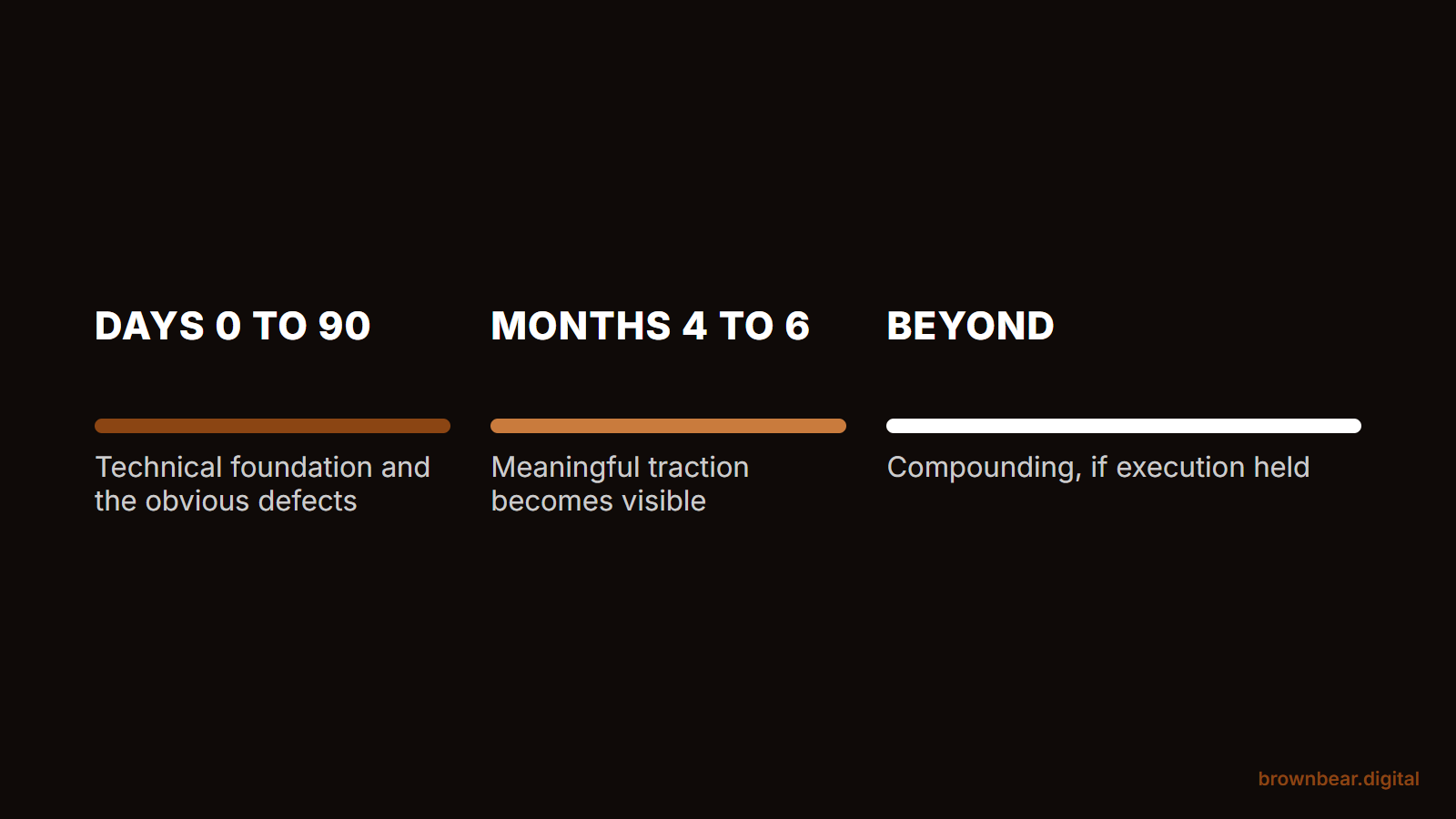
With all of those variables in play, here's the honest general answer: most YMYL sites with solid fundamentals and consistent execution start to see meaningful SEO traction between 4 and 6 months.
That window assumes:
- Technical issues are being addressed in the first 60 to 90 days
- Content production is underway with proper E-E-A-T attribution from the start
- Link building is running concurrently with content, not after it's "finished"
- Recommendations are being implemented within weeks, not months
| Phase | Timeline | What You Should See |
|---|---|---|
| Foundation | Months 1 to 3 | Technical fixes live, indexing improving, early impressions growing in Search Console |
| Traction | Months 4 to 6 | Long-tail rankings appearing, organic traffic beginning to move, GBP visibility improving for local campaigns |
| Compounding | Months 7 to 12 | Primary keyword movement, qualified traffic arriving, measurable lead attribution starting |
| Authority | Month 12+ | Competitive terms ranking, branded search growing, content earning links without active outreach |
"Healthy progress at four months looks like movement in priority keyword rankings, a measurable improvement in impressions, and early lead attribution tied to organic. But more importantly, that's the point where we start hitting velocity, where our system becomes more fluid and genuinely ingrained into the client's workflow. The collaboration becomes less about onboarding and more about momentum. That shift is one of the clearest signals that the engagement is on the right track."
Bryan Passanisi, Founder, Brown Bear Digital
The 4 to 6 month window is the realistic baseline for a site that is genuinely executing, not a guarantee. Sites with unresolved technical debt, slow implementation, or a weak backlink profile will take longer. Sites with a strong brand foundation, solid existing content, and an internal process that can move quickly will often see movement earlier.
The most reliable accelerant is links and content working in parallel.
When expert-level content and active link acquisition run together from the beginning, not sequentially, the trust signals compound in a way Google responds to measurably faster than when either runs alone.
How to Move Faster Without Taking Shortcuts
There are no shortcuts in YMYL SEO that don't eventually become liabilities. Link schemes, AI-generated content published without expert review, keyword stuffing, and thin doorway pages will produce short-term movement and longer-term penalties. What does compress the timeline is disciplined execution by a team that works YMYL niches daily, which is exactly how our SEO services are structured. YMYL penalty recovery is among the hardest in SEO precisely because Google's scrutiny of these industries is highest and its algorithm updates target them most directly.
"Faster results come from better balance: more links and content running in parallel without sacrificing quality. We can scale with a client's budget, but we're deliberate about how we use it. And scaling doesn't always mean producing more long-form content. Sometimes the higher-leverage move is improving the quality and reach of what already exists, or introducing video and branded experiences that extend the site's authority in ways that written content alone can't. We're protective of how that investment gets deployed."
Bryan Passanisi, Founder, Brown Bear Digital
What actually compresses a YMYL SEO timeline without creating downstream risk:
- Prioritize technical fixes in the first 90 days. Crawlability and proper indexing are table stakes: nothing else compounds until the foundation is solid.
- Attach real credentials to every piece of content. Named authors with linked bios, "reviewed by" lines, and visible professional credentials are direct E-E-A-T signals, not cosmetic additions.
- Build the content architecture before individual pieces. A topically organized site structure that signals genuine expertise across a subject area outperforms a collection of unrelated articles, even when the individual articles are well-written.
- Pursue relevant links proactively and from day one. Passive link acquisition does not build YMYL authority at meaningful speed. Active digital PR, professional association involvement, local media relationships, and credible directory listings do.
- Build your execution process before the engagement starts. Map out who approves content, who implements technical changes, and how quickly decisions get made, all before the first audit deliverable lands in your inbox.
Set the Right Expectations. Then Beat Them.
If you're a medical practice, law firm, or financial advisory firm asking how long SEO will take, the most honest answer is: it depends on where your site is today, how specific and well-prioritized your strategy is, and how fast your team can actually move.
The vertical you're in shapes the degree of scrutiny and the competitiveness of the market. Your site's technical health, content quality, backlink profile, brand authority, and implementation speed determine your actual timeline.
Get those factors right, with links and content running in parallel from the start, and 4 to 6 months is a realistic window to see meaningful traction. Leave any of them unaddressed and the timeline extends, regardless of what's being promised.
If you want to know exactly where your YMYL site stands on each of these factors, that's where our audit process starts: an honest assessment of what's working, what's holding you back, and what a realistic timeline actually looks like for your specific situation.
Written By
Founder, Brown Bear Digital
Bryan has 15 years of experience across SEO, paid search, and AI search strategy. He founded Brown Bear to give businesses direct access to senior-level search expertise without the agency overhead.
Learn More About BryanGet Found on Google.
Get Cited by AI.
Tell us about your site. We'll send back a proposal for SEO and AI search.