E-E-A-T for Plastic Surgeons: What Google Is Actually Measuring (And Where Most Practices Are Coming Up Short)

Most plastic surgery practices are optimizing for E-E-A-T in the wrong direction. They're focused on what their website says about them. Google is focused on what the rest of the web can confirm.
Bryan Passanisi is the founder of Brown Bear, an SEO and AI search agency that works exclusively with plastic surgery practices.
This piece covers both what E-E-A-T actually evaluates in a YMYL category like plastic surgery and the practical difference between on-site credentialing and off-site authority building, including the off-site signals most agencies never explain.
If your credentials are strong but a competitor with a lighter CV keeps outranking you, the gap is almost certainly not on your website. Maybe you've been told your E-E-A-T needs work and the advice you got was a list of credential placement tweaks, and nothing changed. Or you're a newer surgeon trying to figure out how to compete for authority against practices that have been around for decades.
By the end of this, you'll have a clear framework for auditing your own authority profile and a specific understanding of where the gaps actually are. Longer term, what this builds toward is an authority presence that works across both traditional search and AI-generated recommendations, the two places your future patients are already looking.
We'll cover what E-E-A-T actually evaluates and why plastic surgery faces the highest scrutiny, the critical difference between on-site credentialing and off-site authority building, how AI search changed the E-E-A-T calculus in 2026, and a self-audit framework with a prioritized action plan you can start this week.
So, let's start with what E-E-A-T is actually measuring, because the mechanism is different from how most explanations present it.
Key Takeaways
Google trusts what the web confirms, not what you claim
Most practices optimize E-E-A-T in the wrong direction, polishing what their website says while Google cross-references those claims against journals, directories, press, and patient platforms. The authority gap is almost never on your site.
Ten RealSelf answers a quarter compounds real authority
After the on-site foundation is solid, patient platforms are the fastest way to build indexed off-site authority. A consistent 10 or more well-written RealSelf answers per quarter maintains Top Doctor status and feeds the sources AI tools pull from.
Fix the on-site foundation before chasing off-site signals
A verifiable surgeon bio, procedure page authorship, citation discipline, risk disclosure, and schema markup take a few weeks of finite work, and off-site signals pointing at a weak on-site profile underperform.
Audit yourself by searching without your own website
Google your name plus your specialty and skip your own domain. If the first two pages are just your site, socials, and directory listings, your off-site authority is thin, and that gap is what competitors with lighter CVs are exploiting.
What E-E-A-T Actually Evaluates, and Why Plastic Surgery Is Under the Microscope
E-E-A-T stands for Experience, Expertise, Authoritativeness, and Trustworthiness. Google applies these criteria to every piece of content it indexes, but it applies them differently depending on what's at stake for the person searching. Plastic surgery is classified as a Your Money or Your Life topic: a category where a wrong answer could cause real harm. That classification puts cosmetic practices under the same level of algorithmic scrutiny as financial advisors and pharmaceutical companies.
What most explanations of E-E-A-T get wrong is the mechanism. Google is not reading your credentials page and deciding whether to trust you. It is cross-referencing what your website claims against what the rest of the web says about you. A surgeon whose credentials are displayed prominently on their homepage but who has no presence anywhere else on the web has a very different authority profile than a surgeon whose name appears in journal citations, media interviews, conference speaker listings, and professional society records.
The practical implication: E-E-A-T is not a checklist you complete once. It is a reputation that builds, or doesn't, over time, across every corner of the web your name touches.
The Two Types of Authority Most Practices Get Backwards
The most common reaction when we bring up E-E-A-T with a new plastic surgery client is underestimation. Surgeons tend to assume it is primarily a website question, and that if their site is in good shape, their E-E-A-T is in good shape. What they don't initially see is how many levers actually exist, and how many of those levers live entirely off their website.
There are two distinct categories of authority signal, and most plastic surgery practices invest almost entirely in the wrong one.
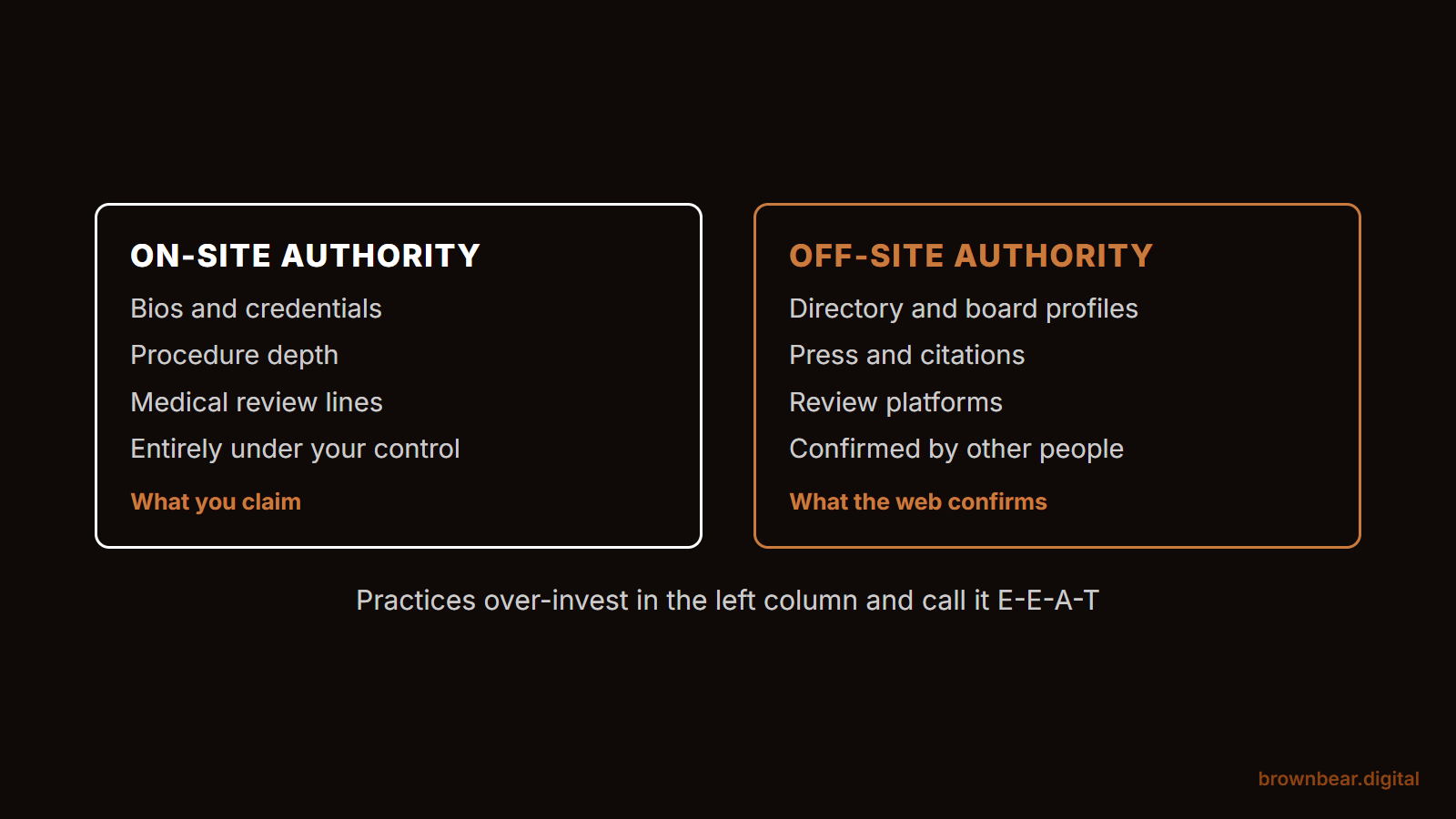
On-site authority is what you say about yourself: the credentials on your bio page, the surgeon attribution on your procedure content, the medical review disclosures, the schema markup telling Google your specialty and location. This is necessary. It is also the minimum, and it is where almost all practices stop.
Off-site authority is what the rest of the web says about you: citations in medical publications, quotes in press coverage, links from professional societies, answers on patient platforms, speaking credits at conferences. This is what Google actually uses to verify your on-site claims.
The distinction matters because Google's systems are built to resist manipulation. Any practice can write "board-certified plastic surgeon with 20 years of experience" on their website. Very few practices have that claim corroborated by an independent source. The ones that do are the ones Google ranks with confidence.
Think of it this way: listing a credential on your website is making a claim. Having that credential reflected on the American Board of Plastic Surgery's verification site, mentioned in a regional news interview, referenced in a patient's RealSelf review, and linked from your hospital's physician directory is having that claim confirmed. Google's systems are built to find the confirmation, not just the claim.
On-Site Authority: Getting the Foundation Right
On-site authority work is the foundation. It needs to be done correctly before off-site signals can reinforce it. Most practices have gaps here that undermine the authority they've already built, and the gaps are often more basic than they expect.
Surgeon bio pages.
The bio page is the highest-leverage on-site authority asset most practices underuse. It should function as a verifiable professional record, not a marketing paragraph. In practice, a surprising number of plastic surgery bio pages are missing the fundamentals entirely: board certification by the American Board of Plastic Surgery, Fellow of the American College of Surgeons (FACS) status, membership in the American Society of Plastic Surgeons or The Aesthetic Society, fellowship training with the program named, academic appointments, and hospital affiliations. These are not optional additions. They are the verifiable data points Google is looking for, and they are frequently absent. Each one is something Google can cross-reference against an independent source. Each missing one is a gap in your verifiable record.
Procedure page authorship.
Every procedure page and educational article should carry clear authorship, the surgeon's name linked to their bio (see plastic surgeon about page best practices for what that bio needs to contain), and for clinical claims, a medical review notation. A page that says "written by Dr. [Name], reviewed by [Name], MD" and links to a credentialed bio is treated differently by Google's quality systems than an anonymous page, even if the content is identical. This is one of the lowest-cost, highest-impact E-E-A-T changes a practice can make.
Citation discipline.
Any statistic, clinical claim, complication rate, or outcome figure on your site should cite a source: ASPS guidelines, a peer-reviewed study, or the surgeon's own case series with a clear data note. Uncited claims do not fail by themselves, but cited claims actively build trust signals. Pages that cite credible external sources also tend to earn more inbound links over time. These on-page signals work alongside the visual and structural trust signals in plastic surgery website design; the two compound.
Risk and complication disclosure.
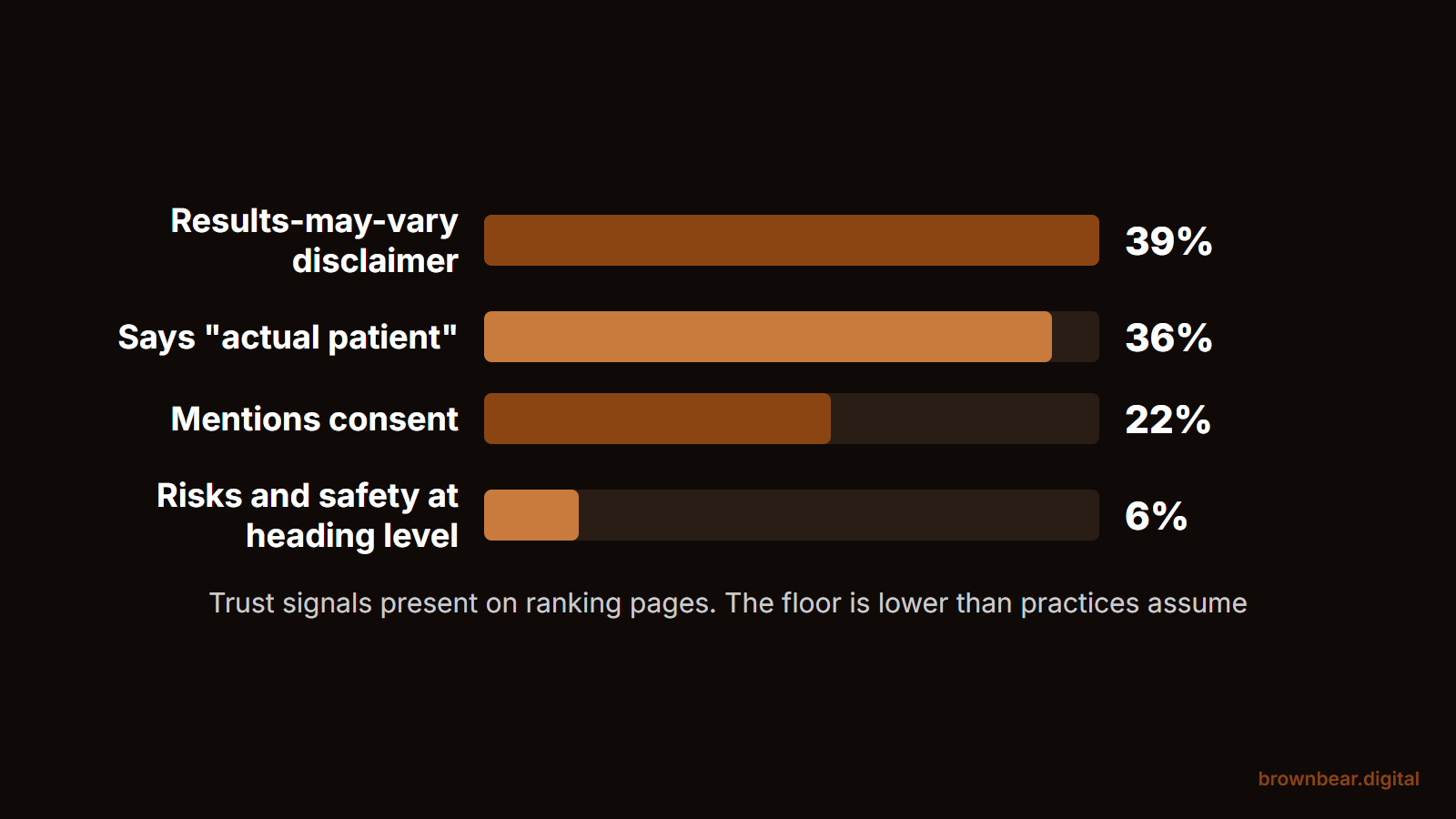
Pages that include honest complication disclosure consistently outperform pages that omit it, in plastic surgery specifically. Google's quality raters are instructed to flag medical pages that present procedures as uniformly safe. A rhinoplasty page that addresses revision rates, swelling timelines, and anesthesia risks signals to both patients and Google that the author understands the full clinical picture. It is also rare enough at the top of the SERP to work as a differentiator. In our 101-city study of #1-ranking procedure pages, just 6% covered risks and safety at the heading level. The same thinness shows up on galleries: our 50-procedure gallery study found only 39% of ranking pages carrying a results-may-vary disclaimer, 36% saying "actual patient" anywhere, and 22% mentioning consent. For a YMYL category under this much scrutiny, that is a low bar to clear.
Schema markup.
Physician schema, MedicalOrganization schema, and MedicalProcedure schema tell Google's crawlers precisely who you are, what you do, and where you're located, in machine-readable terms it can act on immediately. Most practices have basic LocalBusiness schema and nothing more. The procedure-level and physician-level markup is where the differentiation is, and the city study quantifies how empty that lane still is: 94% of the winning pages carry some JSON-LD, but only 17% use MedicalProcedure, only 2 of the 101 use the precise PlasticSurgery business type, and of the 33 surgeon Person entities found across those pages, exactly one links out to external profiles with sameAs. Nobody at the top of that SERP is building the surgeon's entity graph.
Off-Site Authority: Where the Real Gap Is
The frustration we hear most from surgeons who feel like they've done everything right is a version of the same thing: the content is there, the rankings are improving, but the authority isn't growing. Almost always, the issue is that their SEO program has been operating through a single lens, on-site optimization, without the off-site work that builds brand credibility beyond their own domain. It is the first gap to probe when choosing a plastic surgery SEO company: ask how the off-site work gets done, not just what the on-page checklist covers. The agencies serving these practices are often producing commodity content that drives some traffic but does nothing to distinguish the surgeon as a recognized expert in their field.
Real authority in 2026, especially with where AI search is heading, requires looking at search through multiple lenses simultaneously. Third-party review sites, interviews, thought leadership, speaking engagements, the accumulated record of a surgeon who is genuinely present in their professional community. The real-world signals count now in ways they didn't three years ago.
Off-site authority is built through every instance of your name, credentials, and work appearing on a source other than your own website. The sources Google weights most heavily are the ones it already trusts: medical journals and publications, established media outlets, professional society websites, accredited hospitals, and high-authority patient platforms. Reviews are the most controllable of these signals, and plastic surgery review generation and response covers how to build them systematically.
Medical publications and citations.
A surgeon whose work appears in peer-reviewed literature, even a single case series or technique note, has a verifiable publication record that Google's systems can find and cross-reference against their on-site credentials. This is the highest-authority signal available to a surgeon and the hardest to fake. For surgeons who are not active researchers, contributing a perspective piece to a professional newsletter or being quoted as a subject-matter expert in a medical publication carries a meaningful fraction of the same authority value.
Media coverage.
Being quoted by name as a plastic surgery expert in a regional newspaper, a national health publication, or a broadcast segment is one of the clearest off-site authority signals available. The quote itself matters less than the publication and the fact that it identifies you by name, credential, and specialty. Practices that have a deliberate media strategy, even a modest one pitching local journalists on cosmetic surgery topics before seasonal peaks, accumulate these citations over time.
Conference presentations and speaking engagements.
A surgeon who has presented at ASPS, The Aesthetic Meeting, or any regional plastic surgery conference has a publicly verifiable record of peer recognition. The key is making that record findable: speaker bios on conference sites, announcements on your own site, LinkedIn posts with links to the agenda. Google indexes all of it.
Third-party review platforms.
Healthgrades, Vitals, RealSelf, and Zocdoc are all indexed by Google and pulled from by AI search tools. A complete, active, well-reviewed presence across these platforms is an off-site authority signal, not just a reputation management exercise. Each platform where your name appears alongside verified patient reviews adds another independent corroboration of your credibility.
RealSelf Q&A activity.
Every answer a surgeon posts on RealSelf is indexed by Google. A well-written, specific answer to a patient's question about recovery from rhinoplasty can rank independently in Google search, with the surgeon's name and credentials attached to it. From an AI search perspective, RealSelf is one of the core profile platforms that tools like ChatGPT and Perplexity pull from when answering questions about local providers and procedures. It appears consistently in AI-generated responses across a wide range of plastic surgery prompts. A surgeon who has optimized their profile and maintains active Q&A engagement has a materially different AI search presence than one who claimed their profile and stopped there.
Professional society directories and committee positions.
ASPS, The Aesthetic Society, and specialty boards all maintain searchable member directories. If your name appears there with your current status and specialty, Google can verify your credentials independently of what your website says. Committee and leadership positions go further: they signal peer recognition, not just membership.
The pattern we see consistently across the practices we work with: surgeons with strong organic search authority are almost always surgeons who are genuinely active in their professional community, speaking, contributing, publishing, engaging. That activity creates an off-site authority profile that is nearly impossible to manufacture quickly, which is precisely why Google trusts it.
E-E-A-T and AI Search in 2026
The E-E-A-T framework was built for traditional search. In 2026, it matters at least as much for AI-generated responses, and the mechanism is slightly different.
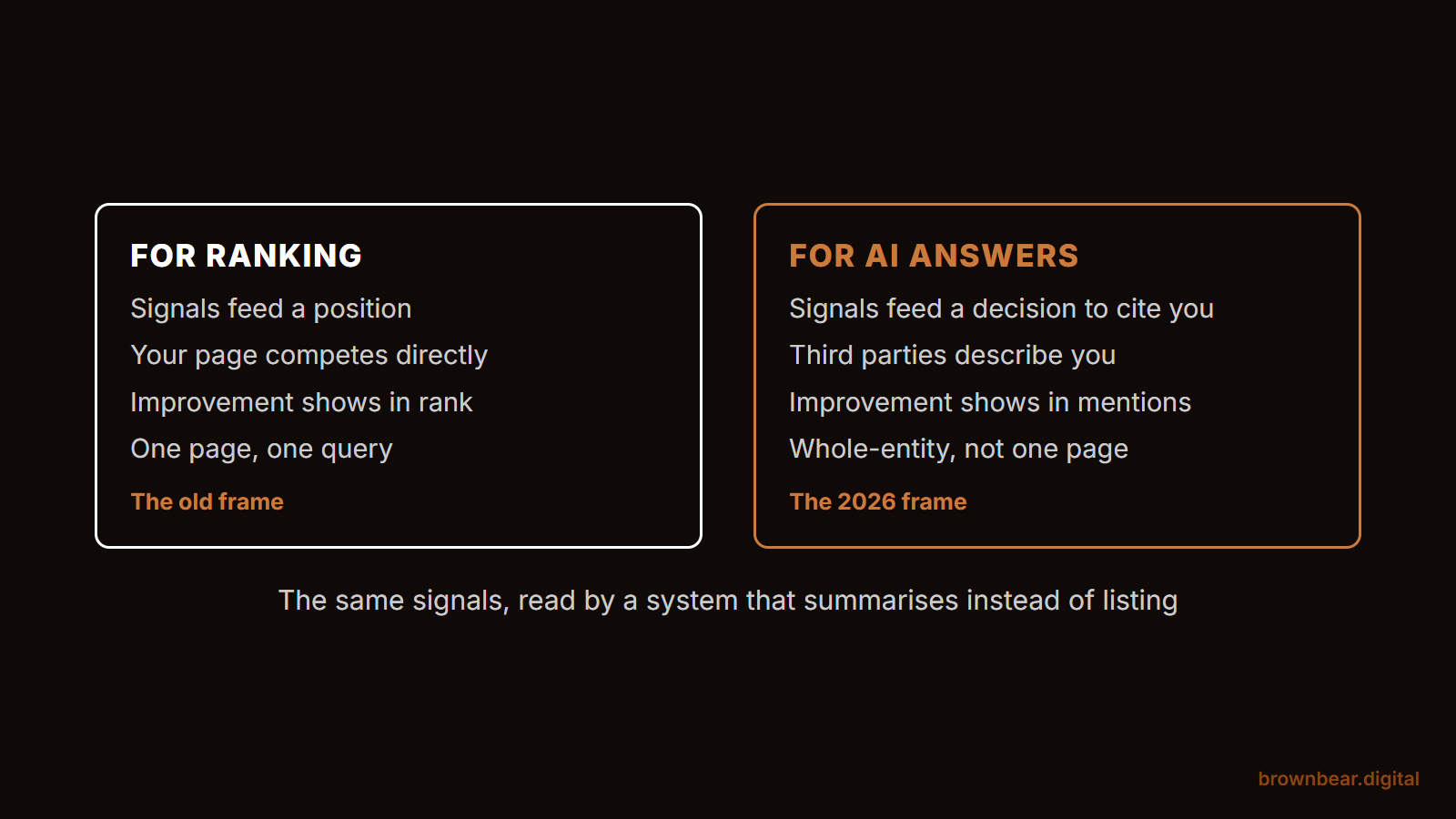
Google's AI Overviews and conversational AI tools like ChatGPT and Perplexity do not evaluate authority by reading a single page. They synthesize across everything they have indexed: your website, your RealSelf profile, media mentions of your name, your professional society listing, your published work. A surgeon who appears as a credible, consistent, verified expert across multiple independent sources is far more likely to be cited in an AI-generated response than one who has a polished website and nothing else.
This creates a compounding dynamic. Every off-site authority signal you build does double work: it improves your traditional search rankings and it increases your presence in the corpus that AI systems draw from when answering patient questions about procedures and surgeons in your market. It also determines how AI describes you when it does name you, which is its own discipline: see how to improve brand visibility in AI search engines. And because plastic surgery sits near the top of the YMYL risk gradient, the scrutiny is harsher here than almost anywhere: the YMYL standard in plastic surgery explains why.
The practical implication is that authority building is no longer optional for any practice with a serious organic search strategy. The bar for appearing in AI-generated recommendations is genuinely higher than the bar for ranking in the traditional map pack, and it rewards exactly the kind of real, verifiable professional activity that E-E-A-T has always favored. For the broader picture of how practices earn those recommendations, see our AI search guide for plastic surgeons.
The Authority Audit: Where Most Practices Stand Today
Before investing in any new authority-building activity, it is worth understanding where you actually stand. Most practices are surprised by what this exercise reveals, and the bigger surprise is usually not their own profile but their competitors'.
On-site audit.
Read your surgeon bio as a skeptic. Does it name your medical school and residency program? Does it list your board certification by the American Board of Plastic Surgery, your FACS status, and your professional society memberships? Do your procedure pages carry attribution and medical review? Do your clinical claims cite sources? Is risk disclosure present on every procedure page? If the answer to any of these is no, you have on-site gaps that undermine the authority you have already built elsewhere.
Off-site audit.
Search your name plus your specialty in Google, without navigating to your own website. What appears on the first two pages of results? If the answer is mostly your own website, your social profiles, and your directory listings, your off-site authority is thin. Now search your name plus the word "quoted" or your name plus "MD" plus a procedure you perform. Does anything appear that was written by someone else, on a site other than your own? If not, you have very little off-site authority in the record Google can access.
Competitor check.
When we run authority audits with new clients, we almost always Google their primary competitors alongside them. What typically emerges is that the practices outranking them are investing in search from a branding angle: ranking for core procedure terms, maintaining active off-site platform presence, and in some cases running integrated SEO and paid search programs simultaneously. Surgeons who assumed their competitors were doing basic SEO often discover they are doing significantly more, and doing it more holistically.
Citation check.
Go to Google Scholar and search your name. Has anything you have written, presented, or contributed to been indexed? Even a single indexed contribution creates a verifiable scholarly record. For surgeons who have never published or presented, this field will be empty, which is worth knowing, because it is one of the most significant gaps in the authority profiles of otherwise credentialed surgeons.
Platform completeness check.
Check your profiles on RealSelf, Healthgrades, Vitals, and Zocdoc. Are they complete? Is your Q&A engagement active? Are reviews current? These platforms are part of your off-site authority profile, and incomplete or inactive profiles are gaps Google can see.
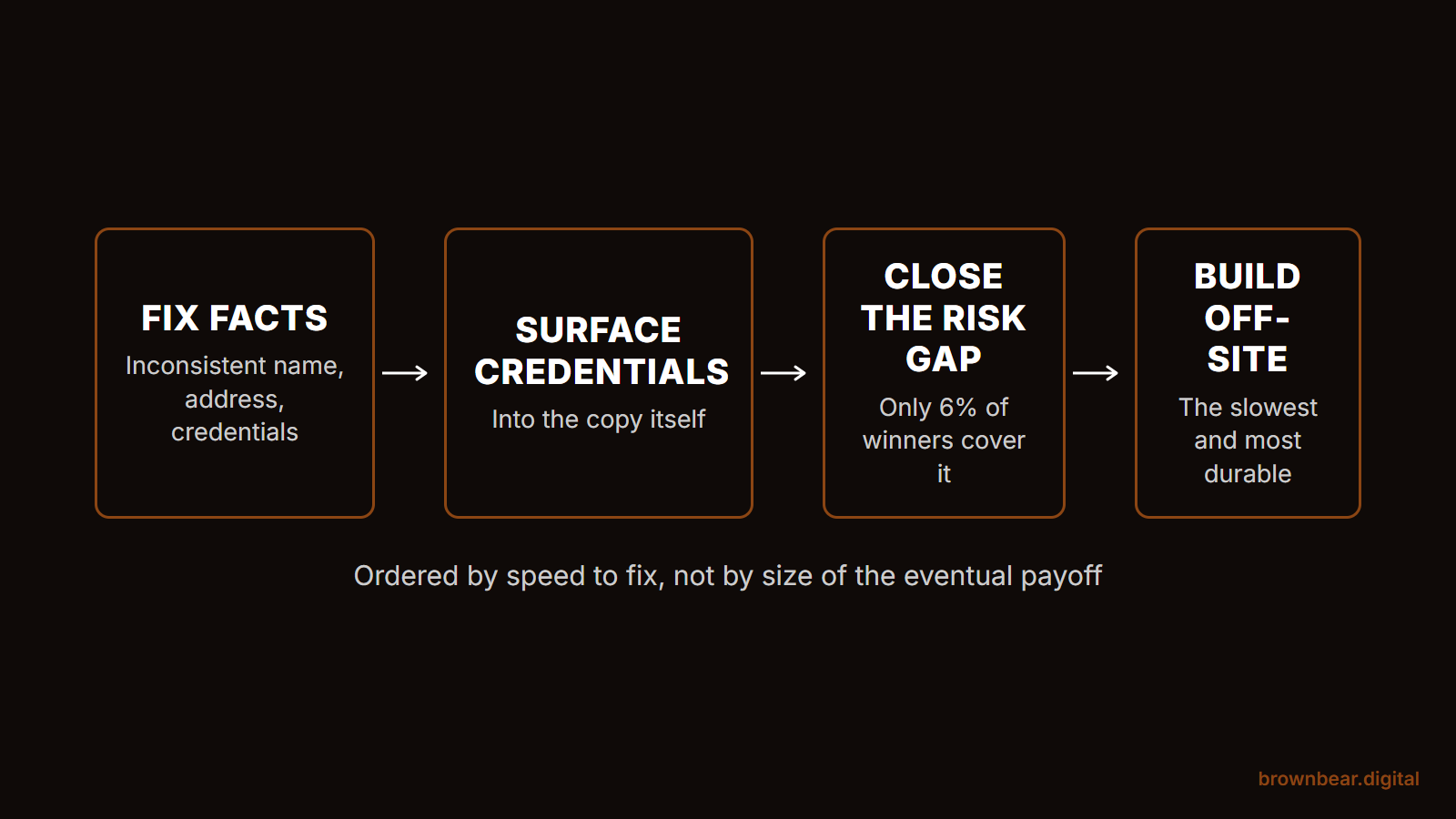
What to Prioritize and In What Order
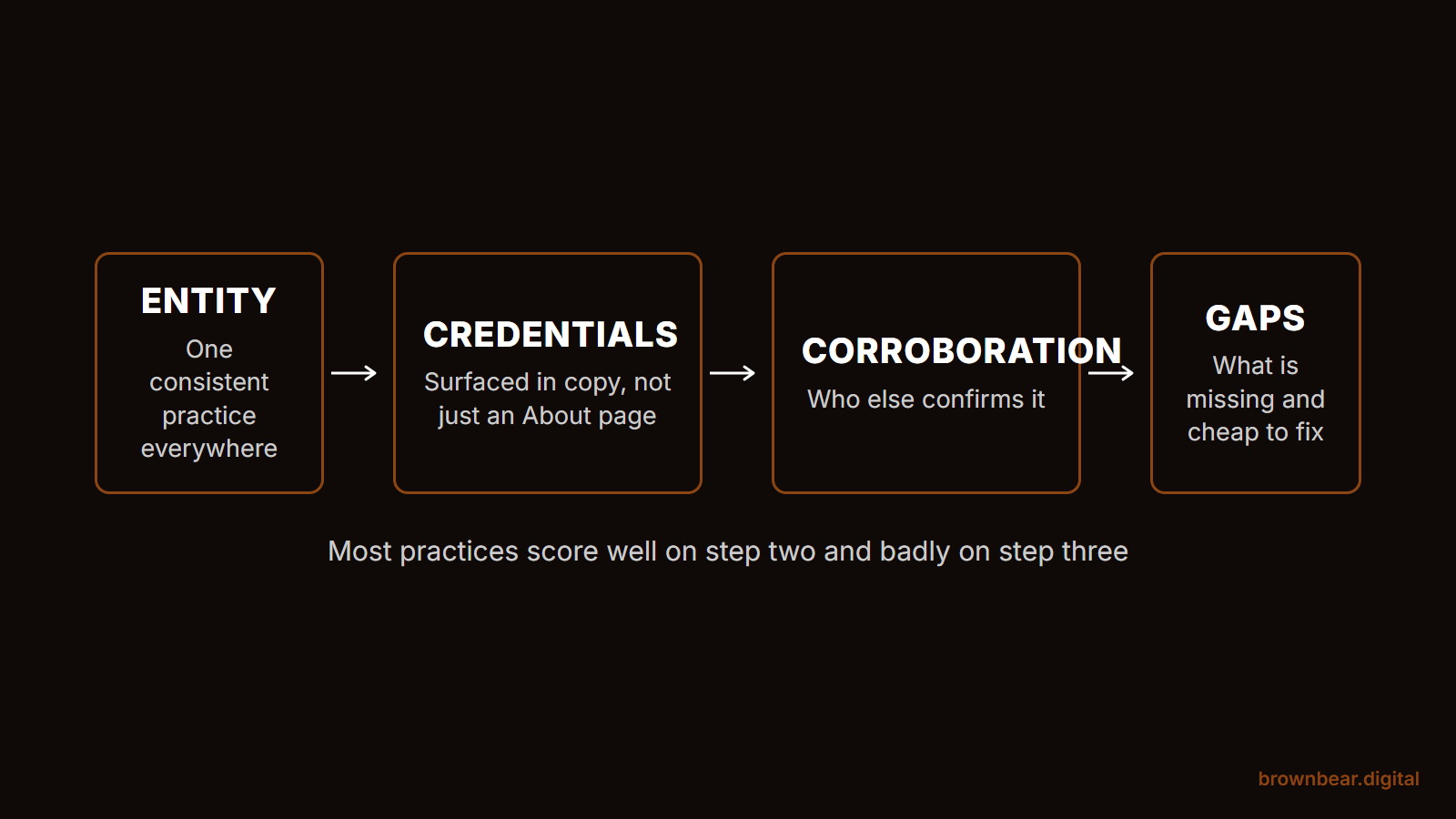
Authority building is a multi-year project. Prioritizing it correctly avoids spending effort on signals that take years to move before the foundational work is done. This sequencing is the backbone of our SEO services for surgical practices.
First: get the on-site foundation right.
Surgeon bio with full verifiable credentials, procedure page attribution, citation discipline, risk disclosure, schema markup. This work is finite, takes a few weeks, and is the prerequisite for everything else. Off-site signals pointing to a weak on-site profile underperform off-site signals pointing to a strong one.
Second: activate the Q&A and review platforms.
RealSelf, Healthgrades, Vitals, and similar patient platforms are the fastest way to build indexed off-site authority after your on-site foundation is solid. A consistent schedule of well-written answers, 10 or more per quarter on RealSelf to maintain Top Doctor status, combined with a systematic review generation workflow, builds a durable off-site record that compounds over time.
Third: pursue media and speaking opportunities.
This is slower and harder to control, but it carries the highest authority value per instance. Local health journalists are often looking for physician sources. ASPS and regional society meetings accept abstract submissions from members. A systematic, low-pressure approach to these opportunities over 12 to 18 months produces a meaningful citation record.
Fourth: build toward publication.
For surgeons with academic inclinations, contributing to the published record, even a single technique note or case study, creates a citation profile that no amount of website optimization can replicate. This is a long-term play, but it is the ceiling of surgeon authority in Google's framework.
Timeline reality: on-site changes can affect rankings within weeks. Q&A and review platform activity compounds over months. Media mentions and speaking credits build over one to two years. Publication records are a multi-year investment. Practices that start all four tracks simultaneously, even modestly, build authority profiles that become genuinely difficult for competitors to close.
Authority Is Not What You Say. It Is What the Web Confirms.
The practices that rank consistently at the top of plastic surgery search results in competitive markets are almost never the ones with the best credential pages. They are the ones whose authority is corroborated: by platforms, by publications, by professional societies, by media, by the accumulated record of a surgeon who is genuinely engaged in their field.
Getting there requires both dimensions: the on-site foundation that makes your credentials readable and verifiable, and the off-site activity that gives Google something to cross-reference those credentials against. Most practices have done some of the former and almost none of the latter. That gap is where the authority advantage actually lives.
If you want to understand where your practice's authority profile stands today and what the highest-leverage moves are for your specific market, that is the kind of work we do at Brown Bear.
Written By
Founder, Brown Bear Digital
Bryan has 15 years of experience across SEO, paid search, and AI search strategy. He founded Brown Bear to give businesses direct access to senior-level search expertise without the agency overhead.
Learn More About BryanGet Found on Google.
Get Cited by AI.
Tell us about your site. We'll send back a proposal for SEO and AI search.