AI Search for Plastic Surgeons: The GEO and AEO Playbook for Getting Recommended by ChatGPT, Perplexity, and Google
A surgeon showed us his phone last spring, half annoyed and half rattled. He had typed "best rhinoplasty surgeon near me" into ChatGPT the way a patient would, and it named three practices in his city. His was not one of them. He had ranked on the first page of Google for that search for years. He had paid an agency the whole time. And the tool his patients were now using to make a shortlist had simply left him off it, as if the practice did not exist.
That gap is the reason this guide exists. The front door to a plastic surgery practice used to be a Google search and a map pack. For a growing share of patients it is now a conversation with an AI, and the AI hands them a short list of names before they click anything at all. If your practice is not one of those names, you are invisible at the exact moment a nervous patient is deciding who feels safe enough to cut them open. We run these campaigns for aesthetic and surgical practices, and we have watched this shift move from a curiosity to a real source of lost consults in about eighteen months.
The reassuring part is that AI search is not magic, and it is not random. Engines like ChatGPT, Perplexity, and Google's AI Overviews assemble their answers from sources they have learned to trust, and those sources follow patterns you can influence. A 2026 analysis of medical aesthetics found that the top fifteen brands captured roughly 62% of all AI citation share, which sounds bleak until you realize the flip side: visibility is concentrated because most practices are doing nothing deliberate about it. The lane is wide open for the ones who move first.
Whether you are the surgeon squeezing this in between cases or the office manager who got handed "the marketing," this piece covers both halves of the problem. It explains how these engines actually decide who to name, and it gives you concrete things to check and fix, starting with a self-audit you can run in ten minutes without spending a dollar.
Maybe you have already sensed this happening. A new patient mentioned they "asked ChatGPT" during a consult, and it stuck with you. Maybe you have paid for SEO for years and cannot understand why you show up in Google but nowhere in AI answers. Or maybe you are opening in a saturated metro where every search already belongs to someone else, and you are looking for the opening nobody else has taken yet. Any of those is the right reason to keep reading.
By the end, you will understand what patients are actually asking AI before they book, which signals decide whether your name comes up, and exactly where your time and money should go first. Longer term, you will know how to make your practice the obvious recommendation for the procedures you most want to perform, so the AI does your first round of selling for you instead of quietly handing it to a competitor.
We will start with the reframe that makes everything else make sense: AI search is not replacing your local visibility, it is sitting on top of it, and understanding that relationship changes every decision that follows. So, let's start there.
Key Takeaways
AI search sits on top of your local foundation
It is not a rival channel to build from scratch. Engines assemble their shortlists from the same raw materials that drive local search, meaning reviews, directories, your website, and third-party mentions, so the local work is the fuel and GEO is the second story built on it.
AI recommendations are roughly 30 times more selective
A 2026 local visibility analysis found AI answers about 30 times more selective than a standard Google search, with ChatGPT recommending on the order of 1% of locations and favoring practices averaging 4.3 stars. Appearing in the map pack is no longer enough on its own.
Third-party authority outweighs anything on your own site
Engines trust what credible outside sources say about you far more than what you say about yourself, and for surgeons the single most important source is RealSelf. If you do one thing after reading, run a full audit of your RealSelf presence.
Run the free four-prompt self-audit before spending anything
The shortlist test, the name test, the source test, and the procedure test take about ten minutes across ChatGPT, Perplexity, and Google. They tell you whether AI can see your practice at all and hand you a prioritized fix list without a sales call.
AI Search Is the New Front Door, Not a Replacement for Local
The first mistake practices make is treating AI search as either a gimmick to ignore or a brand new channel to chase from scratch. It is neither. Think of it as a layer that now sits on top of everything patients already did.
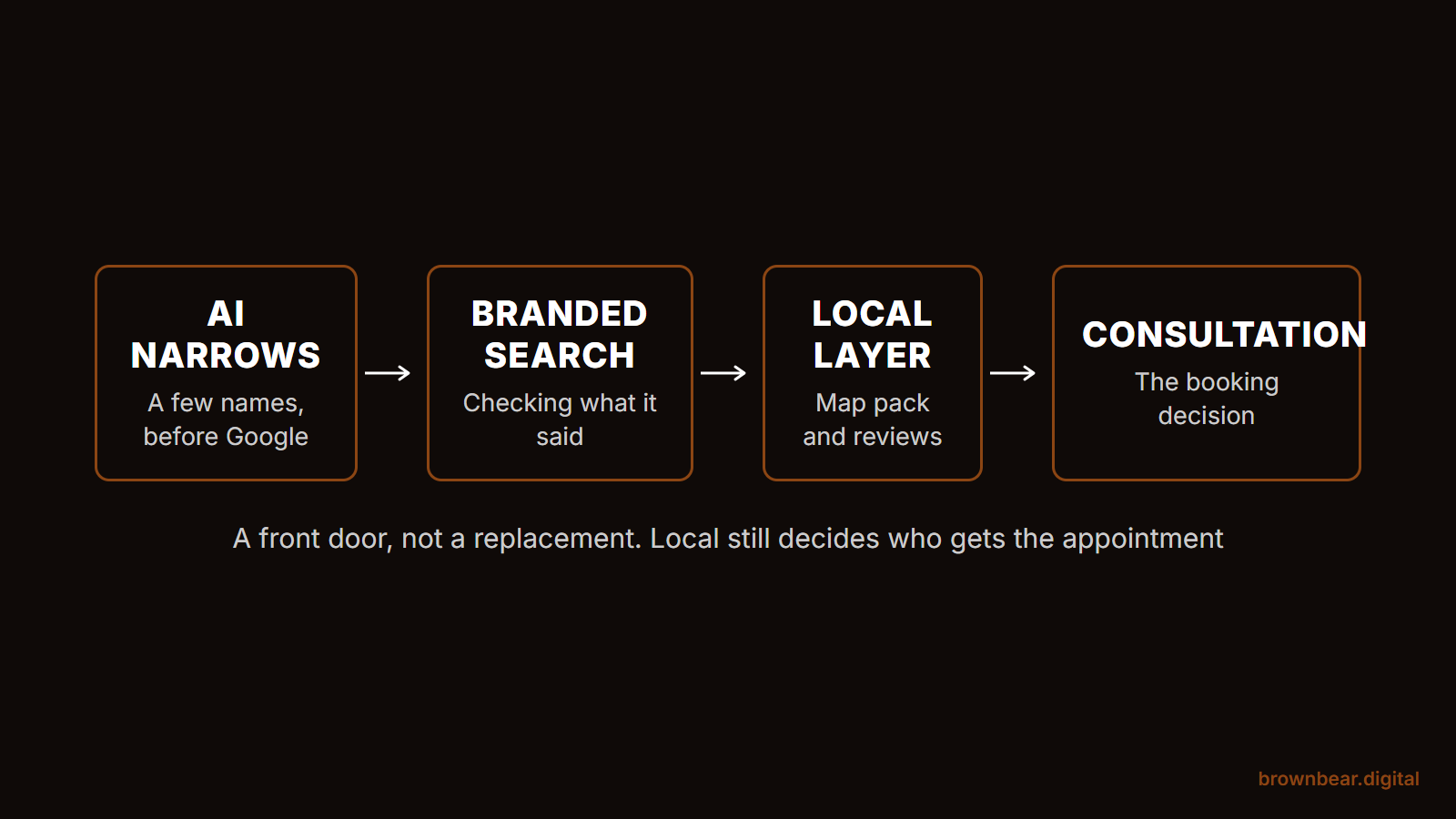
A patient still ends up choosing a surgeon close to home, still reads reviews, still studies before-and-after galleries, still checks board certification. What has changed is the very first step. Instead of opening Google and scanning ten blue links, more of them open ChatGPT or Perplexity and ask a direct question, and the engine answers with a curated short list and a summary of why. That short list is built from the same raw materials that drive local search: your reviews, your directory profiles, your website, and what the rest of the web says about you. If those materials are strong, the AI tends to include you. If they are thin, it skips you and you never even know the conversation happened.
The reach of that layer is easy to underestimate. When we pulled the live SERP for "[procedure] before and after" across 50 aesthetic procedures, 48 of the 50 keywords returned an AI Overview and People Also Ask appeared on all 50. Even the search where a patient explicitly wants to look at photographs now opens with a generated answer.
This is why the honest framing is not "GEO versus SEO," even though "geo vs seo" is one of the most searched comparisons in the space. The two are not rivals. Your local search foundation is the fuel AI engines burn to generate their answers. A practice that has already done the work of winning the local map pack is far more likely to surface in AI results, because the signals overlap heavily. If you have not built that foundation yet, our local SEO playbook for plastic surgeons is the place to start, because it is the ground floor of everything below. AI search is the second story you build on top of it.
There is a second reason to take this seriously, and it shows up in the traffic itself. The patients who arrive from an AI tend to be further along and readier to act than almost any other source.
"Once we could isolate LLM referral traffic as its own segment, one pattern stood out fast: visitors coming from an AI are far more likely to take action. The model already did the research for them, so by the time they reach the site they are not window shopping. They have narrowed their options and they are ready to talk to a surgeon."
Bryan Passanisi
, founder of Brown Bear
The practical takeaway: do not abandon what works to chase what is new. Reinforce the foundation, then add the specific moves that make AI engines trust and cite you. The rest of this guide is those specific moves.
What Patients Actually Ask AI Before They Book
Before you can influence the answer, you have to understand the question. And the questions patients type into AI are different from the keywords they type into Google.
A Google search is usually a fragment: "tummy tuck near me," "rhinoplasty cost." An AI prompt is a full sentence, often a nervous one, and it carries the decision the patient is actually trying to make. Patients are already turning to these tools for surgical information in large numbers, a shift documented in the peer-reviewed literature on ChatGPT in plastic and reconstructive surgery. Based on the queries we see and the way these engines get used, the prompts cluster into a few recognizable shapes:
- The shortlist request. "Who are the best board certified plastic surgeons for a mommy makeover in Charlotte?" The patient wants names, and the AI will give three to five.
- The reassurance check. "Is Dr. Smith a good rhinoplasty surgeon?" The patient already has a name and is asking the AI to confirm or warn them.
- The comparison. "How do I choose between two plastic surgeons who both have good reviews?" This is a real, high-frequency question, and most practice content ignores it completely.
- The education-then-provider path. "What is recovery like for a deep plane facelift, and who specializes in it near me?" The patient learns, then asks for a provider in the same breath.
Here is what matters about all four. The AI does not invent its answer. It assembles it from sources it can find and trust, then names the practices that show up consistently across those sources with strong signals attached. If a patient asks who the best surgeon is for a procedure and your practice has a thin RealSelf profile, few recent reviews, and no clear page about that procedure, you are not in the running, no matter how skilled you are in the operating room.
If you want the deeper version of this decision journey, we mapped how AI is reshaping it in detail in how AI search is changing how patients find plastic surgeons. For now, hold onto one idea: your job is to be the answer to these questions, in the sources the AI reads, before the patient ever reaches your website.
How AI Engines Decide Which Surgeon to Name
AI search feels like a black box, but it is far more predictable than it looks. Every major engine is doing a version of the same thing: pulling from sources it trusts, weighing signals of credibility, and synthesizing a confident answer. The selectivity is the part that surprises people. One 2026 local visibility analysis found that AI recommendations are roughly 30 times more selective than a standard Google search, which is why appearing in the map pack is no longer enough on its own.
The engines are not identical, though, and the differences matter for where you invest.
"When a practice ranks well on Google but goes quiet in AI results, the first place we look is off-site. We audit where they are mentioned across the web and what is feeding the models on those procedures. A lot of the time it traces back to third-party aggregators like RealSelf and Yelp. A surgeon can rank fine on Google and still be invisible in an AI answer, because they are thin or inactive on the exact sources the models lean on."
Bryan Passanisi
, founder of Brown Bear
ChatGPT, Perplexity, Google AI Overviews, and Gemini pull differently
ChatGPT
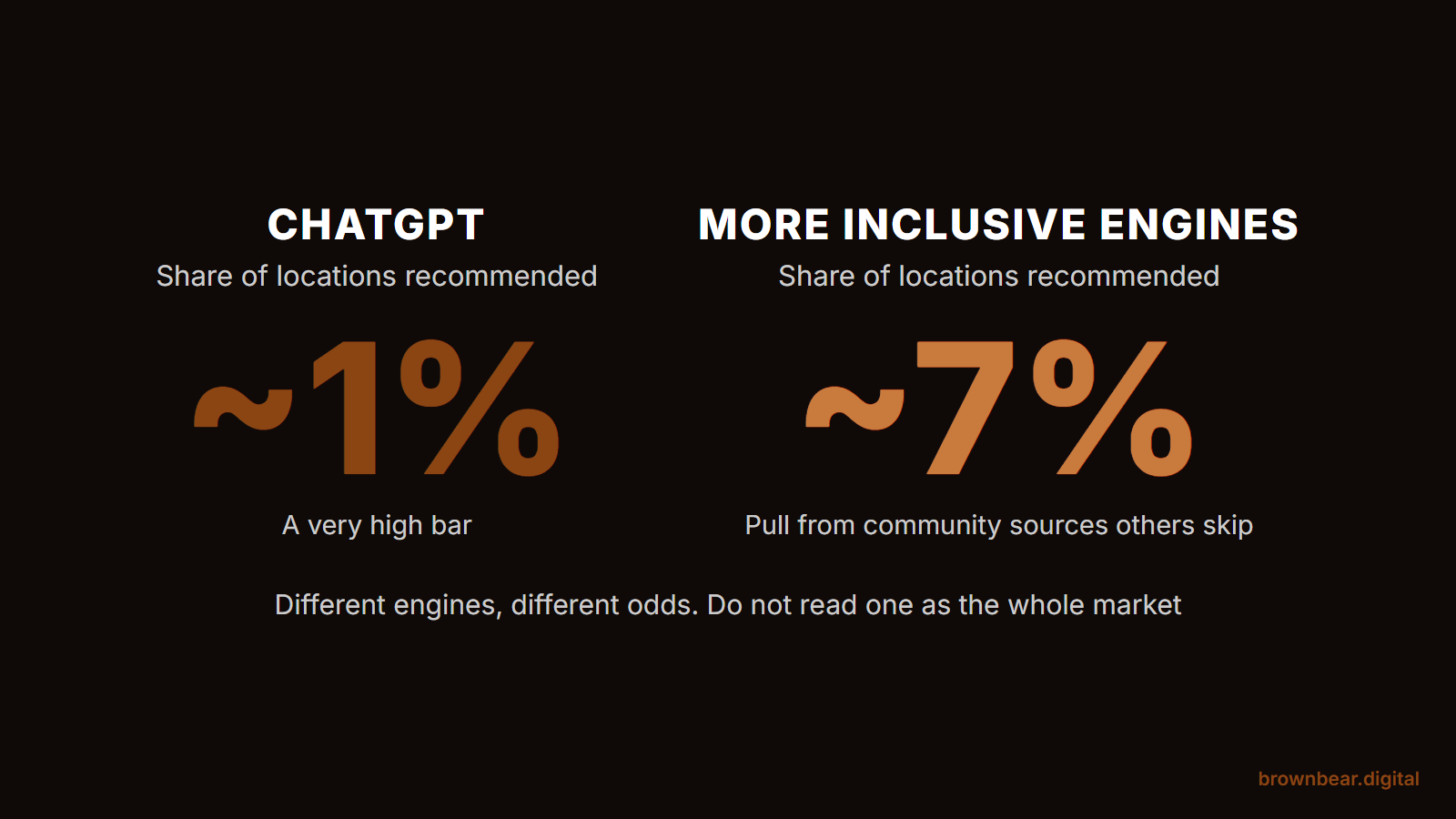
leans heavily on long-form editorial and provider-authored content, and it is closely tied to Bing's index. One widely cited study found that 87% of ChatGPT citations align with Bing's top results, which means your Bing visibility, long ignored by most practices, suddenly matters. It recommends a very small slice of businesses, on the order of 1% of locations for a given query, so the bar is high.
Perplexity
casts the widest net. It surfaces niche specialty outlets and community sources that the others skip, and it recommends a larger share of businesses, closer to 7% of locations. Reddit shows up in nearly half of top Perplexity citations, which tells you where its trust comes from.
Google AI Overviews
blend traditional SEO signals with generative summarization. This is the friendliest engine for a practice that has already invested in classic SEO, because your existing rankings still carry weight.
Gemini
is the most generous with recommendations, naming a larger set of businesses, and it tends to reward accurate, complete business profile data.
The strategic point is not to game any single engine. It is to build the underlying signals of credibility that all of them look for, because a practice that earns trust broadly shows up across the board rather than in one place. That is exactly what the medical aesthetics visibility index found: the brands that led did so across all four engines at once, not just one.
GEO and AEO, Defined Without the Jargon
Two acronyms dominate this conversation, and they get used loosely, so here is the plain-language version. If you want the fuller treatment, we have a whole piece on what GEO is.
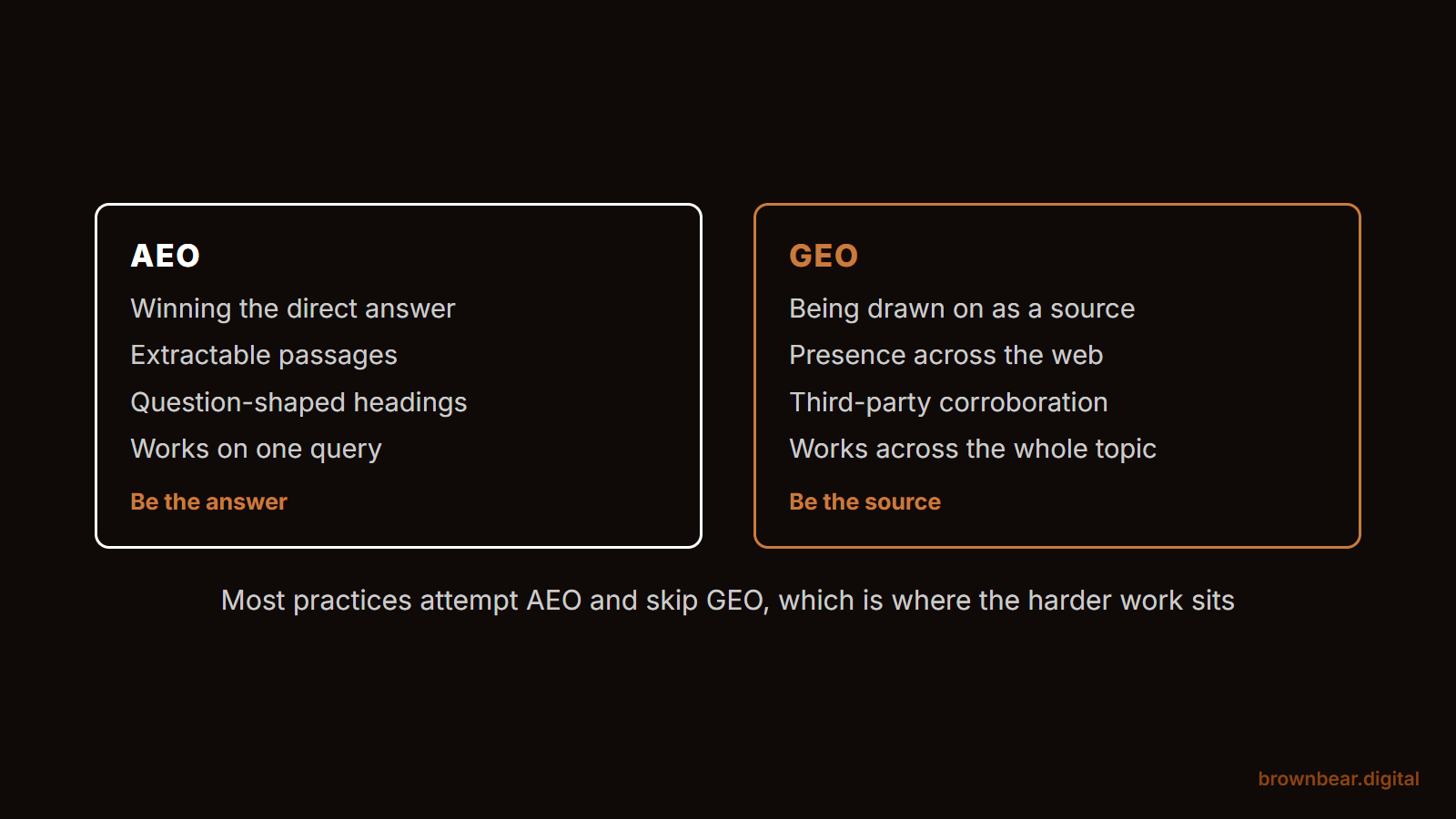
GEO, or Generative Engine Optimization, is the practice of making your business visible and recommended inside AI-generated answers.
It is the broad discipline: everything you do so that ChatGPT, Perplexity, Gemini, and Google's AI name your practice when a patient asks.
AEO, or Answer Engine Optimization, is the narrower craft of structuring your content so an engine can lift a clean, direct answer from it.
It asks a simple question: when a patient asks AI something, is your content formatted so the engine can quote it easily? That means clear answer blocks near your headings, real FAQ sections that match how patients actually ask, and pages that resolve a question in a sentence or two before elaborating.
The relationship is straightforward, though the industry argues about it constantly and we have written up GEO vs AEO separately. AEO is one of the tools inside the larger GEO toolbox. You do AEO on your own pages so they are quotable, and you do the broader GEO work, reviews, directories, third-party authority, so the engines trust you enough to quote you in the first place. A page can be perfectly structured and still never get cited, because the practice behind it has not earned the credibility. Both halves have to be true.
The Five Signals That Make a Practice Recommendable
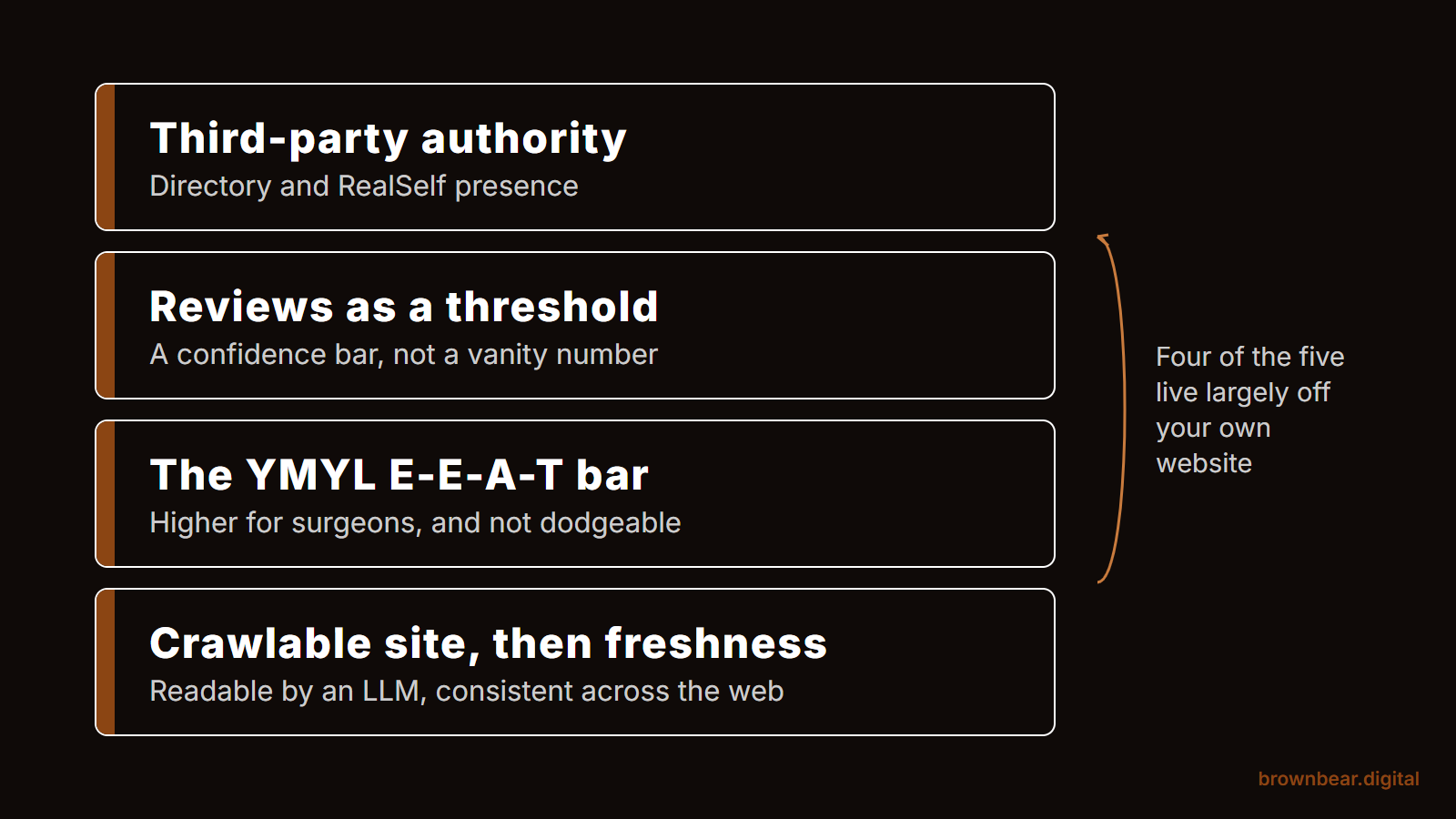
If GEO is the goal, these are the levers. Across every engine and every study, the same five signals decide whether a practice gets named. They are listed roughly in order of impact for a medical practice, which is not the same order a generic GEO guide would give you, because plastic surgery carries a trust burden that most industries do not.
1. Third-party authority, especially your directory and RealSelf presence
AI engines trust what other credible sources say about you far more than what you say about yourself. Listings and directory profiles account for a large share of all AI citations, and for plastic surgeons the single most important one is RealSelf, the aggregator these engines lean on for aesthetic providers.
Most practices claim their RealSelf profile once and forget it. That is a mistake in the AI era, because a complete, active, well-reviewed RealSelf profile is often the exact source an engine pulls from when a patient asks for a recommendation. We break down why in your RealSelf profile is what AI uses to decide which surgeon to recommend, and the underlying platform strategy in how RealSelf actually works for plastic surgeons. If you do one thing after reading this guide, make it a full audit of your RealSelf presence.
2. Reviews as a confidence threshold, not a vanity number
Reviews are not just social proof anymore. AI engines use them as a gate. The same visibility analysis found that locations recommended by ChatGPT averaged 4.3 stars, while practices sitting near 3.4 stars with low response rates were effectively invisible in AI recommendations. Volume and recency matter too. Patient behavior research from the American Society of Plastic Surgeons shows patients read up to ten reviews before choosing a surgeon and look for a recent, consistent track record, and the engines have learned the same preference.
The practical bar: aim for a strong average above 4.3, a steady stream of recent reviews rather than a stale batch, and a real habit of responding. A profile that has not seen a new review in eight months signals a dormant practice to both patients and the AI reading on their behalf.
3. E-E-A-T and the higher YMYL bar surgeons cannot dodge
Plastic surgery is "Your Money or Your Life" content in Google's eyes, which means the credibility bar is deliberately higher than it is for a restaurant or a plumber. AI engines inherit that standard. They favor content with real author credentials, clinical transparency, and outside confirmation of expertise. In fact, the aesthetics index put it bluntly: earned authority beats spent authority in the AI answer layer, meaning peer-reviewed citations and credentialed bylines outperform paid social and influencer spend.
"Because this is a health and safety decision, not a routine purchase, the models lean harder on credibility signals before they will surface a name. The best way to clear that bar is to be more present on third-party sites, not just your own. Think of it as a small, ongoing PR effort: show what you are known for, share the credentials and the notable cases, tell the stories that explain your expertise. Human reviews, video reviews, and before-and-after photos add another layer, and they can actually shape the sentiment of the AI result itself."
Bryan Passanisi
, founder of Brown Bear
This is where most practices come up short, because they optimize what their website claims instead of what the rest of the web can confirm. We go deep on this in E-E-A-T for plastic surgeons and on the specific medical standard in the YMYL standard in plastic surgery. The short version: make sure a real, credentialed surgeon is visibly attached to your content, and make sure independent sources corroborate the expertise you claim.
4. A site LLMs can crawl, read, and understand
None of the signals above matter if an AI cannot actually reach and make sense of your website in the first place. This is the foundation the rest sits on. Engines do not read your site the way a human does. A crawler first has to be able to access your pages, and then the model has to be able to parse the structure it finds and understand the content inside it. If your site was built by a legacy SEO agency, there is a real chance it is hard for large language models to read, not because the content is bad but because the site is not findable or structured in a way a machine can follow.
Two things have to be true. First, the site has to be crawlable and accessible, with content that renders in a way machines can retrieve rather than getting buried behind scripts or blocked resources. Second, the content has to be structured so an engine understands what it is looking at, which is where schema markup comes in: code that labels your practice, your location, your procedures, your reviews, and your providers in a format engines understand. Google's own structured data documentation lays out the accepted formats, and the ones that matter most for a practice are MedicalBusiness or LocalBusiness with accurate name, address, phone, hours, geo-coordinates, services, and aggregate rating, plus Physician markup for your surgeons and FAQ markup on your procedure pages. Get this layer wrong and everything above it goes unseen.
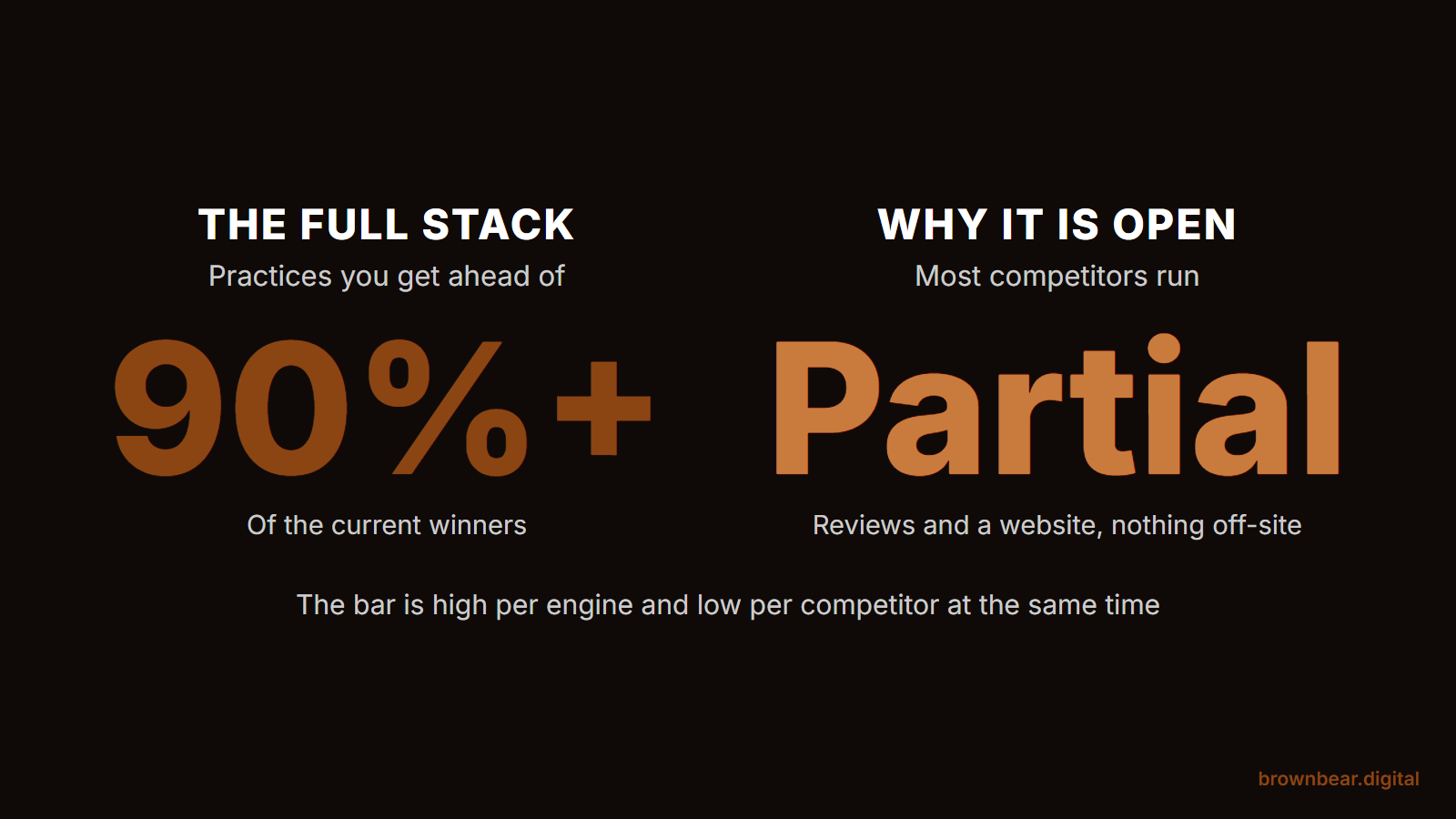
The bar here is lower than it sounds, because the pages currently beating you have not cleared it either. In our 101-city study of #1-ranking procedure pages, 94% carried some JSON-LD, but only 17% used MedicalProcedure, only 31% marked up their FAQ content, and exactly one page in 101 linked its surgeon's Person schema out to external profiles. Building the full stack described above puts a practice ahead of more than 90% of the current winners.
5. Freshness and consistency across the web
Stale content gets skipped. One analysis found that content updated within the last 30 days earned 3.2 times more AI citations than older material. Consistency matters just as much: your name, address, and phone number should match exactly everywhere they appear, because a single mismatched listing chips away at the confidence an engine has in your data.
This does not mean rewriting your site weekly. It means keeping procedure pages current, refreshing your directory profiles, adding reviews steadily, and never letting a location detail drift out of sync.
How to Check Whether AI Can Even See Your Practice Today
Here is the part no agency selling you a tool will give you for free: a self-audit you can run this afternoon. Before you spend anything, find out where you actually stand. Open ChatGPT, Perplexity, and Google, and run these checks as if you were a patient.
- The shortlist test. Ask each engine, "Who are the best board certified plastic surgeons for [your top procedure] in [your city]?" Note whether your practice appears, where, and how you are described. Do this in a logged-out or private window so your own history does not skew the answer.
- The name test. Ask, "Tell me about [your practice name] in [your city]." See whether the engine knows you exist, and whether the details it recites are accurate. Wrong hours or a wrong specialty is a data problem you can fix.
- The source test. In Perplexity, which shows its sources, look at which pages it cites when it answers a question in your specialty. Those citations are a map of who the engine trusts. If RealSelf, a directory, or a competitor keeps appearing and you do not, you know where the gap is.
- The procedure test. Ask a detailed education-then-provider question like "What is recovery like for a deep plane facelift, and who does it well near me?" This reveals whether your procedure pages are strong enough to pull you into the answer.
Write down what you find. If you appear consistently with accurate details, you are ahead of most practices. If you are absent or described wrong, you now have a specific, prioritized list of what to fix, and you got it without a sales call.
This manual check is the free version, and it is enough to get started. If you want to go further, there are a series of tools built to track these prompts for you on an ongoing basis, so you can gauge your visibility, the sentiment of how you are described, and your citation share across engines over time rather than checking by hand. We cover how to put those to work in the measurement section below.
The Mistakes That Keep Practices Invisible
Most practices that are missing from AI results are not making one big error. They are making several small ones that compound. The most common pattern we see is a practice that invested in classic SEO years ago, watched it work, and assumed the same setup would carry them into the AI era. It does not, because the infrastructure that makes a site readable to a human is not the same infrastructure that makes it parseable by a machine.
The other frequent trap is treating AI visibility as a content problem when it is often a credibility and structure problem. Publishing more blog posts does little if your RealSelf profile is dormant, your reviews are stale, and your site has no structured data. We catalogued the full set of these errors in the AI SEO mistakes medical clinics are making right now, and the throughline is always the same: the practices getting left behind are optimizing the wrong layer.
There is a deeper misunderstanding underneath all of it, too, and it is worth being honest about.
"The biggest thing practices get wrong is assuming anyone has this fully figured out. We have a solid working understanding of how LLMs pull and cite sources, but the model companies have not handed us a playbook. OpenAI and Anthropic have not released strong guidance the way Google has spent years talking openly with SEOs. So any practice that hears a guarantee about AI rankings should be skeptical. The honest version is that we test, measure, and adjust as the space matures."
Bryan Passanisi
, founder of Brown Bear
Worth naming directly, because it stings and it is true: if you paid for SEO for years and you are nowhere in ChatGPT, that is not proof the work was wasted. It is proof the work stopped one layer short of where patients now start.
How to Measure AI Visibility Over Time
A self-audit tells you where you stand today. To manage this like the real marketing channel it has become, you need to track it over time, the way you already track rankings and calls.
At the simplest level, repeat the four self-audit prompts on a schedule, monthly at first, and log whether you appear and how you are described. That costs nothing and catches big shifts. Beyond that, a category of AI visibility and brand-monitoring tools has emerged that does this at scale. The better ones let you track a set of patient prompts on an ongoing basis and watch three things move over time: your visibility, meaning whether you appear at all; the sentiment of how you are described when you do; and your citation share, meaning which sources the engines are pulling you from. Search interest in these tools, from brand mention trackers to AI search analytics platforms, has climbed sharply, which tells you the market is professionalizing fast.
The metric that matters most is not a vanity mention count. It is share of recommendation: when a patient asks AI for a surgeon in your area for the procedures you care about, how often are you on the list, and where. Tie that back to consults booked and you have turned a fuzzy new channel into something you can actually manage. For the fuller measurement picture, our guide to the plastic surgery KPIs worth actually measuring puts AI visibility in context with the numbers that pay the bills.
When to Fix This Yourself and When to Bring in Help
A fair amount of this is genuinely DIY, and you should do the free parts yourself before you pay anyone. Your front desk or office manager can claim and complete your RealSelf and Google profiles, build a steady review habit, keep your business details consistent everywhere, and run the monthly self-audit. Those moves alone put you ahead of most of your local competition, because most practices are doing none of them deliberately.
The line to bring in help is usually one of three things. First, structured data and technical implementation, which requires touching code and is easy to get wrong in a way that quietly costs you. Second, the E-E-A-T and authority work, which means earning credible third-party coverage and is slow, relationship-driven, and hard to fake. Third, the point where you simply do not have the hours, and the opportunity cost of a surgeon doing marketing between cases is far higher than the cost of a good partner.
If you do evaluate an agency, hold them to a real standard. Ask them to show you their own AI visibility, ask specifically how they approach GEO and structured data for medical practices, and be wary of anyone who promises AI rankings the way old agencies promised the number-one Google spot. We wrote a full vetting framework in how to evaluate a plastic surgery marketing agency, our guide to cosmetic surgery SEO services separates real deliverables from filler on the classic search side, and the same principle applies here that applies to all of it: a good partner shows you the mechanism, not just the promise.
Work With Brown Bear on AI Search for Your Practice
Getting recommended by AI is not a single fix. It is the compounding result of a strong local foundation, an active and credible third-party presence, reviews that clear the confidence bar, structured data engines can read, and content that earns citations instead of just filling a blog. That is exactly the work we do as a Bay Area plastic surgery marketing agency for aesthetic and surgical practices, in the order that actually moves the needle rather than the order that is easiest to sell.
If you want to know where your practice stands in AI search today and what it would take to become the name patients get handed, take a look at how we approach AI search for plastic surgery practices. We will show you the mechanism, not just a promise, starting with the same kind of audit this guide walked you through.
Frequently Asked Questions
What is GEO for plastic surgeons?
GEO, or Generative Engine Optimization, is the practice of making a plastic surgery practice visible and recommended inside AI-generated answers from tools like ChatGPT, Perplexity, Gemini, and Google's AI Overviews. It combines a strong local search foundation with active directory and RealSelf profiles, strong recent reviews, credible third-party authority, and structured data so AI engines trust and cite the practice when a patient asks for a recommendation.
How is AEO different from GEO?
AEO, or Answer Engine Optimization, is the narrower craft of structuring your content so an AI engine can lift a clean, direct answer from it, using answer blocks, real FAQs, and clear headings. GEO is the broader discipline of earning the credibility and visibility that get you cited at all. AEO makes your pages quotable; GEO makes the engines want to quote you.
Why does my practice rank on Google but not in ChatGPT?
Because AI engines are far more selective than Google and rely on different signals. Ranking well in classic search is necessary but not sufficient. ChatGPT in particular leans on Bing's index and on third-party sources like directories and reviews, so a practice with strong Google rankings but a thin RealSelf profile, stale reviews, or no structured data will often be left out of AI answers.
How do I check if AI recommends my practice?
Run four prompts in a private browser window across ChatGPT, Perplexity, and Google: a shortlist request for your top procedure in your city, a direct question about your practice name, a source check in Perplexity to see who it cites, and an education-then-provider question about a specific procedure. Whether you appear, and how accurately, tells you exactly where to focus.
How long does it take to show up in AI search?
Expect 60 to 90 days in most cases, but the honest answer is that it depends on two things: when the work actually gets implemented, and how good that work is. Fixing the fundamentals starts the clock, which means completing directory and RealSelf profiles, making the site crawlable and adding structured data, refreshing reviews, and keeping business details consistent. Building the deeper third-party authority that drives consistent recommendations takes longer, because credibility is earned rather than switched on. Quality matters more than volume here. We have seen practices come to us after paying an agency that did a lot of work and still had nothing to show for it, because the work was low quality and the measurement was too poor to know what was moving and what was not.
Written By
Founder, Brown Bear Digital
Bryan has 15 years of experience across SEO, paid search, and AI search strategy. He founded Brown Bear to give businesses direct access to senior-level search expertise without the agency overhead.
Learn More About BryanGet Found on Google.
Get Cited by AI.
Tell us about your site. We'll send back a proposal for SEO and AI search.