What Ranks for Before-and-After Searches? A 50-Procedure Gallery Study
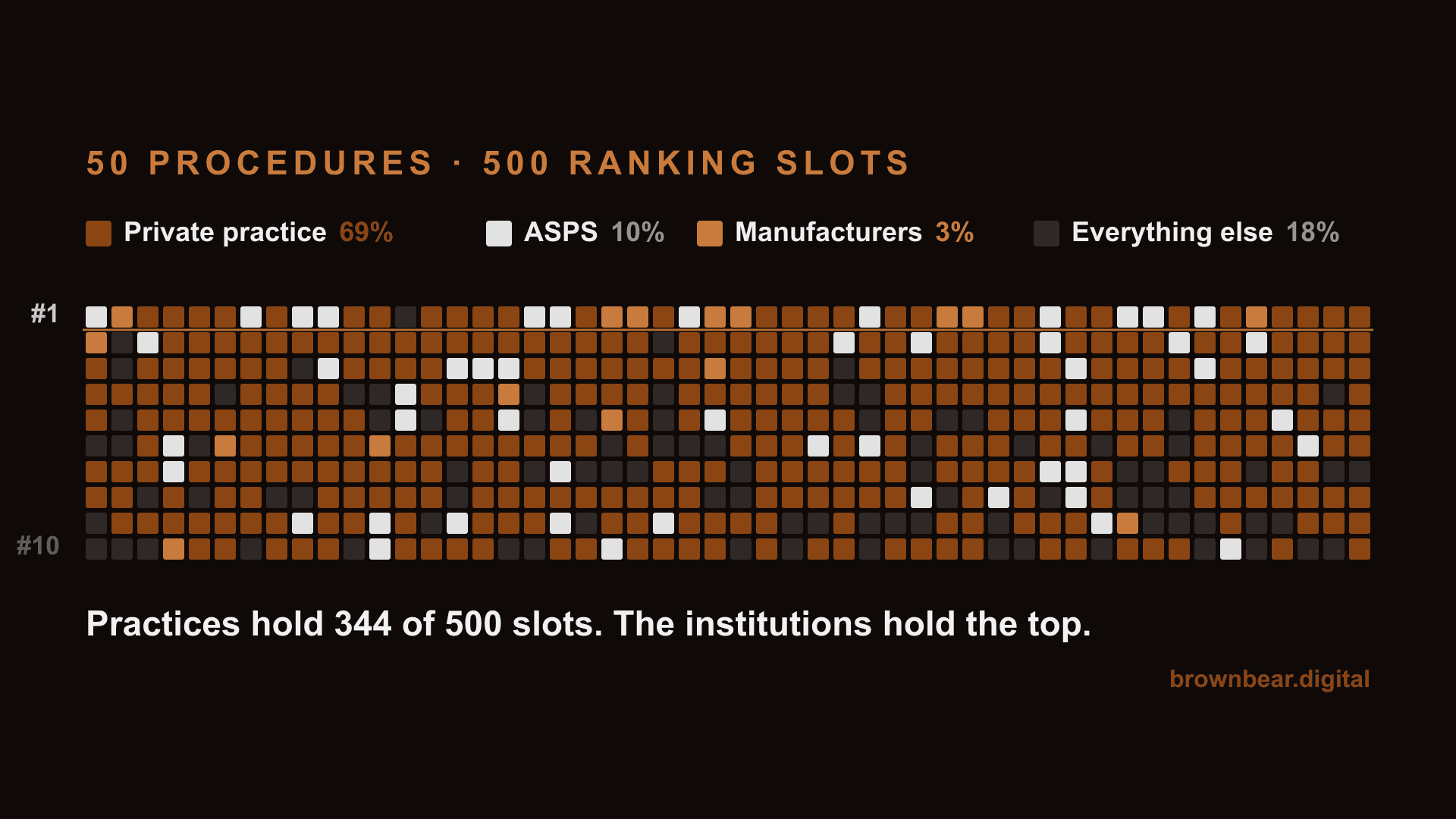
Our 101-city procedure page study found that a before-and-after gallery is effectively mandatory on winning procedure pages, present on 93% of them. That raised the obvious next question: what wins when the gallery itself is the search? So we took the query "[procedure] before and after" across 50 aesthetic procedures, from breast augmentation to Morpheus8, pulled the top 10 organic results for each, and dissected every page we could capture: 500 ranking slots, 428 unique pages, 418 parsed layer by layer.
The first thing the data does is kill an assumption. There is no meaningful local version of this SERP: localized photo queries like "breast augmentation before and after Miami" have no measurable search volume. Patients search procedure pages by city and galleries nationally, which means your gallery page is not competing against the practice across town. It is competing against every practice in the country, plus the American Society of Plastic Surgeons, plus the manufacturer of the device you are photographing.
Read this first, because it frames everything below.
Like the city study, this measures on-page factors only: the content, structure, markup, and media on the ranking pages themselves. It does not capture backlinks, brand mentions, reviews, or entity strength, and the presence of plasticsurgery.org at #1 on twelve surgical SERPs is a loud reminder that authority does the heavy lifting. Treat what follows as the foundation layer: the anatomy shared by the practices that beat those institutions, and the open gaps that make beating them realistic.
Key Takeaways
Photo intent is a national SERP with an institutional layer
ASPS's gallery takes #1 on 12 of 28 surgical terms and manufacturer sites take #1 on 8 of 22 non-surgical terms. But private practices still hold 69% of all 500 slots and 58% of #1 positions. Individual galleries beat the institutions every day.
The ranking asset is a dedicated per-procedure gallery page
82% of ranking practice results are dedicated gallery pages, and #1 galleries show more and say less: a median of 51 images against roughly 900 words. Blog posts are the secondary route at 13%; procedure pages almost never rank for photo intent.
The differentiation lanes are wide open
Only 35% number their cases, 8% publish real prices, 5% mark up FAQs, 4% use gallery schema, and 1% use video schema. Just 27% of image alt texts name the procedure, on a SERP where 32 of 50 keywords show an image pack and 48 show an AI Overview.
How We Ran the Study: 50 Procedures, 500 Ranking Slots, Full-Page Captures
We built a roster of 50 aesthetic procedures with verified US search demand for the query "[procedure] before and after": 28 surgical (six breast, eleven body, eleven face) and 22 non-surgical (injectables, devices, skin treatments, hair restoration). Monthly search volumes run from 720 for gynecomastia surgery to 33,100 for microneedling, with heavyweights like sculptra (22,200), breast lift and botox (14,800 each), and bbl and labiaplasty (12,100 each). For each keyword we pulled the live top 10 US organic results through SEMrush, recorded the SERP features present on each keyword, then captured every unique non-social URL in full HTML and parsed it programmatically: titles, headings, word counts, image inventories and alt text, case-level metadata, gallery UI code, disclaimers, schema graphs, and conversion elements.
That composition is a different world from the city study, where private practices took 100 of 101 local #1s. Nationally, three ownership blocs split the map along clean lines. The American Society of Plastic Surgeons' photo gallery appears on 29 of the 50 SERPs and takes #1 on twelve, all of them surgical: breast augmentation, breast lift, breast reduction, gynecomastia, tummy tuck, liposuction, arm lift, thigh lift, body lift, rhinoplasty, facelift, and chin implant. Manufacturer sites take #1 on eight, all of them non-surgical: botoxcosmetic.com, Restylane for cheek filler, Kybella, Sculptra, CoolSculpting, Ultherapy, HydraFacial, and a microneedling device brand. Private practices win the remaining 29 #1s and 344 of the 500 total slots.
Two absences matter as much as the winners. Directories are nearly extinct here: RealSelf holds just 4 of 500 slots, all at positions 9 and 10, none on surgical terms. And social platforms, meaning Reddit, Instagram, YouTube, TikTok, and Pinterest, hold 48 slots across 28 keywords but never once take #1, with 44 of those 48 slots sitting at positions 4 through 10. Social crowds the bottom half of non-surgical SERPs with 39 of its slots and barely touches surgical ones with 9. If you have been weighing your own gallery against a RealSelf profile, this SERP has already voted.
The Most Feature-Saturated SERP in Aesthetics
Before a single organic ranking is won, the photo-intent SERP is carpeted with features competing for the same click.
People Also Ask appears on all 50 keywords and an AI Overview on 48 of 50. The only holdouts are breast augmentation and otoplasty. Image features hit 40 of 50 as inline thumbnails and 32 of 50 as a full image pack, video features 47, and a Discussions and Forums block surfaces Reddit threads on half the SERPs. This is the context for every finding below: a gallery page is not just ranking against other pages, it is feeding, or failing to feed, the image, video, and AI features that dominate the visible screen.
The Ranking Asset Is a Dedicated Gallery Page, but There Is a Second Route
Of the 330 practice pages in the study, 82% are dedicated before-and-after gallery pages, 13% are blog posts, and only 5% are general procedure pages. At #1 the split sharpens: 93% of practice #1s are dedicated galleries. Google has decided what this query deserves, and it is the gallery URL, not the procedure page with a gallery section.
The blog cohort is small, and it wins differently on purpose. Ranking blog posts run a median of 2,065 words against the gallery cohort's 1,145, mention cost at 55% versus 31%, publish real dollar figures at 17% versus 5%, and carry FAQ content at 62% versus 42%. The model operator is Houston's Dr. Sukkar, whose site ranks top-10 nationally on six of our 50 keywords, five of them via blog posts with titles like "Tummy Tuck Before and After: Houston Patient Transformations." A Baltimore practice does the same on five keywords with bare gallery URLs, including the #1 position for neck lift. National photo rankings are not a megapractice monopoly; they are a repeatable page template.
The Anatomy of a Ranking Gallery
The 330 practice pages converge on a recognizable build.
It is the build our guide to before-and-after gallery best practices describes, and the data now puts numbers on every element of it. The title formula is "[Procedure] Before and After Photos | [Practice]": 85% carry "before and after," 74% a photos/gallery/results word, 79% the procedure name, at a median 64 characters. Structure is disciplined where it counts: 90% run a single H1, 71% with the procedure in it. Below that it is deliberately thin. Unlike procedure pages with their twelve-section builds, galleries carry few H2s beyond a consultation CTA and a results heading. The photos are the outline.
The media load: a median of 34 images per page, with the middle half running 17 to 58 and the biggest build at 1,440. Alt text coverage is high at a median 93%, but only 27% of alt texts name the procedure and 38% say "before" or "after" at all. The images are labeled; they are not optimized. On a SERP where 32 of 50 keywords show an image pack, that is the cheapest visibility leak in this study.
And the copy is not optional. The median ranking gallery carries 1,273 words, with the middle half between 724 and 2,101. Word count is clearly not the ranking factor by itself: a 180-word gynecomastia page ranks #10 and a 17,745-word lip lift gallery ranks #2. But an empty photo grid with a heading is not what wins either.
#1 pages show more and say less
Practice #1s run a median of 51 images against the field's 34, but only 892 words against 1,273. They are also more interactive: 47% offer gallery filtering against 37% of the field. At the top of this SERP, the photos do the arguing.
The engineering is table stakes, the platform is not
87% run a lightbox or slider script, 40% paginate or lazy-load cases, and 37% offer filtering. But specialized gallery platforms are rare, with TouchMD on 10 pages, NextGEN on 10, and BRAG book on 5, while roughly 46% of the cohort is ordinary WordPress. Nobody needs proprietary software to rank.
The conversion spine survives from the city study
92% carry a click-to-call link, 70% a contact form, 67% financing content, and 77% put video somewhere on the page. A gallery is a landing page, and the winners treat it like one.
Case Documentation: The Open Differentiation Lane
Here is where the field spreads out. A before-and-after gallery can be an anonymous photo grid, or it can be a documented case archive. The ranking pages sit on a clear ladder, and most of them stop at the bottom rungs.
35% of ranking galleries number their cases, labeling them "Case 47" or "Patient 12," and when they do, the median page documents 17 of them. 31% publish patient ages, 15% state the post-op interval on at least one photo, and just 5% publish technique specifics like implant volumes. The pages that climb the whole ladder are the category standouts: a Kansas City practice ranks nationally for breast augmentation with 150 numbered cases, 297 implant-size callouts, and 1,440 images; a San Antonio gallery labels 180 cases; a facelift surgeon documents 170. These are not thin pages that happen to rank. They are the deepest procedure-specific photo archives on the internet, and Google treats them accordingly.
The same documentation logic extends to trust language, and the numbers are lower than a YMYL SERP should tolerate: only 39% carry a results-may-vary disclaimer, 36% say "actual patient" anywhere, and 22% mention consent. Age gates protect 8% of galleries, concentrated in breast and body procedures, and gated galleries still rank as high as #1. Patient privacy is not a rankings tax.
Schema on Galleries: Boilerplate, Not Intent
94% of ranking practice pages carry JSON-LD, and almost none of it has anything to do with the gallery.
What is there is the automatic layer: breadcrumbs at 69%, a local business entity at 64%, and ImageObject at 53%, mostly emitted by SEO plugins for the page's featured image rather than per case. What is missing is every markup type a photo archive actually calls for. FAQPage sits at 5% while 44% of pages carry FAQ content. ImageGallery or MediaGallery markup appears on 4% of pages. VideoObject on 1%, while 77% of pages have video. The sharpest detail in the whole schema dataset: RealSelf marks up its photo hubs with MediaGallery schema. The aggregator does what the practices don't.
The Standout Pages That Break the Template
One gallery URL can rank across multiple procedures
The blog-post gallery is a real strategy
International galleries rank in the US
17 slots across 14 keywords belong to Australian, UK, Canadian, Dutch, Turkish, and Thai clinics. Authority and archive depth beat locale on a national photo SERP, and it cuts both ways: your gallery can be outranked by a Sydney surgeon's.
Manufacturers own the treatments they invented
Every branded non-surgical procedure, from Botox and Kybella to Sculptra, CoolSculpting, Ultherapy, and HydraFacial, hands #1 to the brand's own results page. On those terms the realistic practice target is the top practice slot, positions 2 through 4, not #1.
The reverse lesson: gates and thin pages still rank
Age-gated galleries rank as high as #1 and #2 on breast and body terms, and sub-300-word pages hold positions 8 to 10 across the study. The floor is lower than most SEO advice admits, which is exactly why the documented-archive ceiling is so beatable.
Six On-Page Gaps Where the Current Top 10 Is Beatable
The same pattern as the city study: everyone runs the template, almost nobody runs the whole playbook. Each gap below is also precisely the specific, citable content that AI search engines reward.
Procedure keywords in image alt text
93% of images have alt text, but only 27% of alt texts name the procedure, on a SERP with 32 image packs and 48 AI Overviews reading them.
Numbered, documented cases
The single biggest visible difference between a photo grid and a case archive, and two-thirds of ranking pages skip it.
Post-op intervals on photos
Real dollar pricing
The gallery is where patients decide they want the result; 92% of pages make them leave to find out what it costs.
FAQ schema on FAQ content
44% wrote the questions. One in twenty marked them up.
Gallery and video schema
ImageGallery markup on 4% of pages, VideoObject on 1%. The markup types built for exactly this page are the least used on it.
The Gallery Playbook
Everything above compresses into four moves.
Move 1: give every major procedure its own gallery URL.
Not one lumped before-and-after page, but a dedicated page per procedure at /before-after/[procedure]/ or /gallery/[procedure]/, with the "[Procedure] Before and After Photos | [Practice]" title, a single procedure H1, 30 to 60 images, and 900 to 1,300 words of case-anchored copy. This is the URL Google has decided this query deserves, and it doubles as the gallery your procedure page links to.
Move 2: document, don't just display.
Number the cases. Publish age, technique or spec, and post-op interval per case. Write alt text like a chart note: procedure, view, interval. Add the FAQ block and answer cost directly, with real figures if you can defend them. The 35% who number cases hold the high ground; the 5% who go deep own it.
Move 3: take the schema lane nobody is in.
ImageGallery on the page, ImageObject per case photo, FAQPage on the questions, VideoObject on the videos, all tied into the same local entity graph as the rest of the site. On this SERP that stack beats 95% of the current top 10, and it is the layer AI features parse directly.
Move 4: treat the gallery as a trust document.
Actual-patient labels, a results-vary disclaimer, a consent statement, and privacy gating where the procedure calls for it. The data shows gates cost nothing. And if you want proof the whole playbook moves rankings, our gallery UX case study documents one practice's rebuild along these lines: top-3 gallery rankings up 4x and 19 new AI Overview citations. This is YMYL surface area reviewed by patients and, increasingly, by AI systems evaluating whether to cite you. Most of the current winners leave at least one of these off; a complete trust layer is a differentiator that costs an afternoon.
The takeaway for practices: the before-and-after SERP is national, institutional at the top, and shallow underneath. ASPS and the manufacturers win on authority with galleries that are broad but generic. The practices that beat them do it with depth: documented cases, real pricing, real markup, and a page engineered as carefully as the surgery it showcases. Your gallery is already your most-viewed sales asset. This is what it takes to make it a search asset too.
Here's How Brown Bear Digital Can Help
This study is the teardown we run on individual galleries. We will score your before-and-after pages against the national winners for your procedures, covering archive depth, case documentation, image optimization, schema, and the trust layer, plus where your gallery should feed your procedure pages and local SERPs. You get a prioritized fix list, not a pitch deck.
Get Your Gallery TeardownWritten By
Founder, Brown Bear Digital
Bryan has 15 years of experience across SEO, paid search, and AI search strategy. He founded Brown Bear to give businesses direct access to senior-level search expertise without the agency overhead.
Learn More About BryanGet Found on Google.
Get Cited by AI.
Tell us about your site. We'll send back a proposal for SEO and AI search.