Can You Optimize Content for AI Search?

This is Brown Bear's plain-language answer to the question we get on almost every discovery call now: can you actually do anything to make AI search engines pick your content, or is everyone just guessing?
I'm Bryan Passanisi. I run Brown Bear, a digital marketing agency, and most of my week is spent inside AI visibility audits for medical and plastic surgery practices, ecommerce brands, and service businesses trying to work out why ChatGPT keeps recommending a competitor. I have opinions about this, and I have receipts. I also have a fairly unpopular position on where most agencies are spending their clients' money.
When I say "content" here, I mean all of it: the marketing and product page copy that has to sell something, the blog and long-form library that has to teach something, and the video and imagery most people never think of as optimizable at all. And when I say "AI search," I mean both Google's AI Overviews and AI Mode, which sit on top of the search index you already compete in, and the standalone assistants like ChatGPT, Perplexity, Claude, and Gemini, which retrieve differently and cite differently.
If you're a practice owner who has just been pitched a five-figure GEO retainer, you're trying to work out whether this is a real discipline or a rebrand. If you're the in-house marketing lead who got forwarded a screenshot of an AI assistant recommending three competitors and not you, you need to know what to actually change by Monday. And if you're the SEO on the team defending fundamentals to a boss who read one confident LinkedIn post, you need the data on your side.
By the end of this you'll have a working model for where AI visibility is actually won, a per-format playbook for copy, long-form, video, and imagery, a clear list of the tactics the evidence supports and the ones it does not, and a way to tell whether any of it moved. That's the immediate payoff. The longer one is that you stop paying for motion and start paying for the two or three things that compound.
To keep a genuinely large topic manageable, I've broken it into four parts: what the research actually says, the three-gate model for where visibility is won or lost, the format-by-format playbook, and the brand and authorship layer that decides most of it. So let's start with the question underneath the question: is any of this optimizable at all?
Key Takeaways
Yes, but proportion is everything
Formatting copy so a model can quote it is real, measurable work, and it is the smallest of the three levers. Whether the machine can retrieve your page at all, and whether your brand has earned any third-party credibility, decide far more of the outcome.
AI crawlers read raw HTML only
None of the major AI crawlers execute JavaScript. If your copy arrives client-side after load, ChatGPT, Claude, and Perplexity see something close to an empty page, no matter how good the writing is.
Mentions beat backlinks roughly three to one
Branded web mentions correlate with AI visibility at about 0.66 versus 0.22 for backlinks. The trust gate is won on third-party surfaces: reviews, press, forums, and video, not just on your own pages.
The Short Answer, and the Part Most Guides Leave Out
Yes, you can optimize content for AI search. But the part that gets left out is proportion. Formatting and structuring your copy so a model can lift a clean answer out of it is real, measurable work, and it is the smallest of the three things that determine whether you get cited. The two larger factors are whether the machine can retrieve your page at all, and whether it has any reason to treat your brand as a credible source. Most published advice spends the overwhelming majority of its word count on the smallest lever.
This is why the industry appears to be at war with itself. One camp points at Google's own documentation on AI features in Search, which states plainly that "there are no additional requirements to appear in AI Overviews or AI Mode, nor other special optimizations necessary," and that you don't need new machine-readable files or special schema. The other camp points at large-scale citation analyses showing that how a page is written and structured measurably changes its odds of being the source an AI answer quotes. Both are right. They are describing different gates.
Google is telling you that the entry ticket is the same one it always was: get indexed, be useful, be accessible. The citation data is telling you that once you are through that door, presentation changes your odds of being the source that gets quoted. Neither claim cancels the other, and confusing the two is how businesses end up buying a new discipline when they needed a technical fix.
What the Research Actually Shows About Optimizing for AI Search
There is real evidence that content-level changes move AI visibility, and it is worth knowing precisely what it measured. One of the largest public analyses of AI citation behavior yet published, reported by Search Engine Land in early 2026, analyzed 1.2 million AI answers and 18,012 verified citations, drawn from a corpus of 3 million ChatGPT responses and 30 million citations. What gets quoted is not random, and it is not mostly about who you are. Citations concentrate hard at the top of the page, with 44.2 percent drawn from the first 30 percent of the content. Cited passages were nearly twice as likely to open with a clear definition, twice as likely to be tied to a question, with 78.4 percent of those question-linked citations coming from headings, and far denser in named entities, averaging 20.6 percent proper nouns against a typical 5 to 8 percent.
Read that carefully, because findings like these are the most over-interpreted in this field. The study did not show that a new discipline replaced SEO. It showed that models quote writing that answers immediately, defines its terms, and names real people, products, and sources instead of gesturing at them. That is not a new playbook. That is what good editorial has always been, now with a measurable payoff.
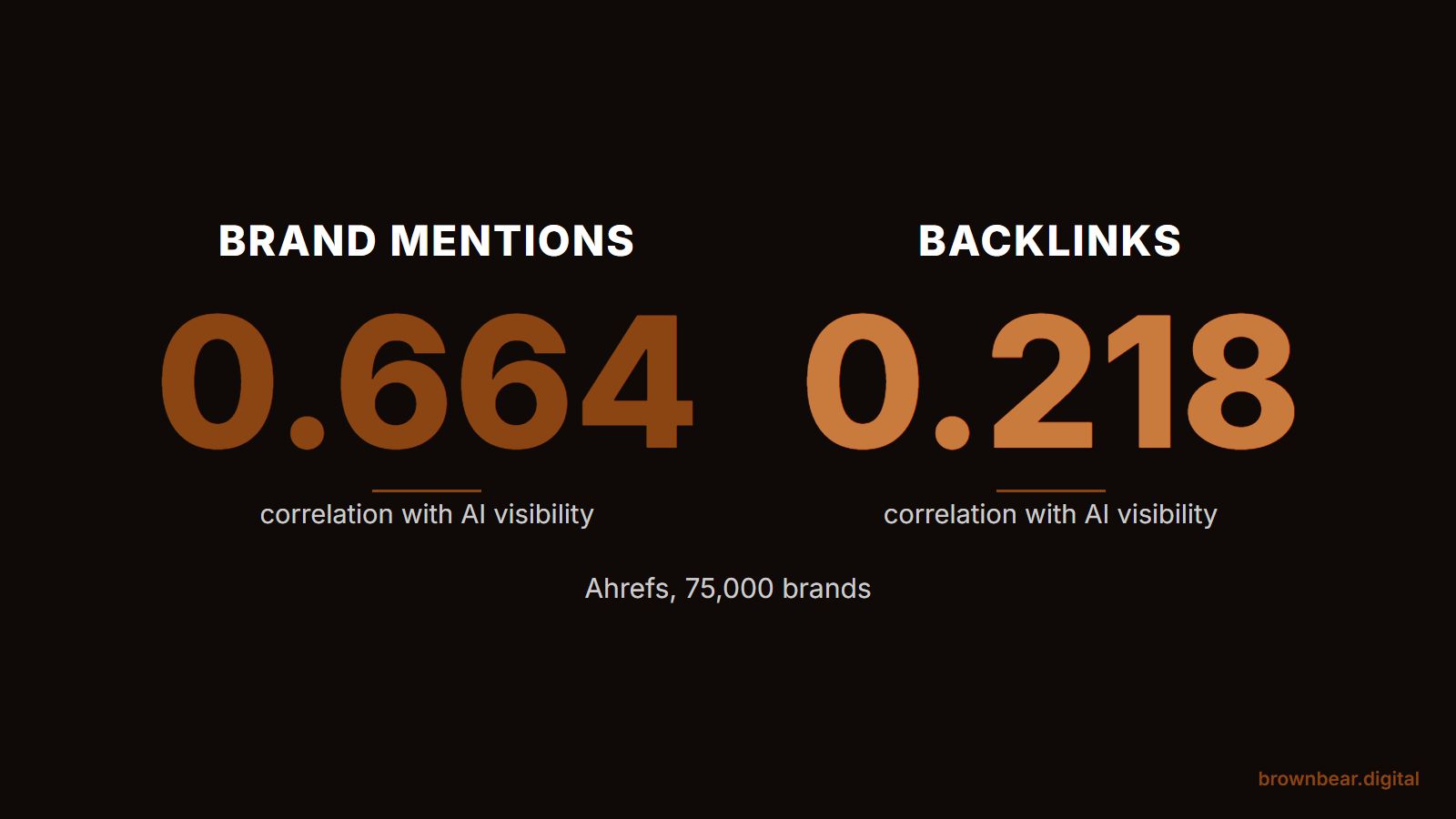
The correlational data points the same direction, harder. Ahrefs studied 75,000 brands and found that branded web mentions correlated with AI Overview visibility at roughly 0.664, while backlinks came in at about 0.218, a gap of roughly three to one. And Semrush's comparison study found that the overlap between search performance and AI citation is far stronger at the domain level than at the URL level: Perplexity matched Google's top 10 on 91 percent of domains but only 82 percent of individual URLs. Breadth of quality coverage across your site predicts citation better than any single optimized page does.
One important counterweight: the relationship between organic rank and AI citation is loosening fast. Ahrefs reported in early 2026 that only about 37.9 percent of URLs cited in AI Overviews appeared in the top 10 organic results, down from roughly three quarters just six months earlier, with the remainder split almost evenly between positions 11 to 100 at 31.2 percent and beyond position 100 at 31.0 percent. The effect is even more pronounced off Google: Semrush found that nearly 90 percent of the pages ChatGPT cites rank at position 21 or below for the related query. Ranking first is no longer a guarantee of citation, and not ranking is no longer a guarantee of exclusion. What has not loosened is the requirement to be retrievable and credible in the first place.
So the fair summary of the research is this: content optimization for AI search is real, its effect size is meaningful but bounded, and every tactic that clearly works is a tactic a good editor would have recommended anyway.
The Three Gates Every AI Answer Passes Through
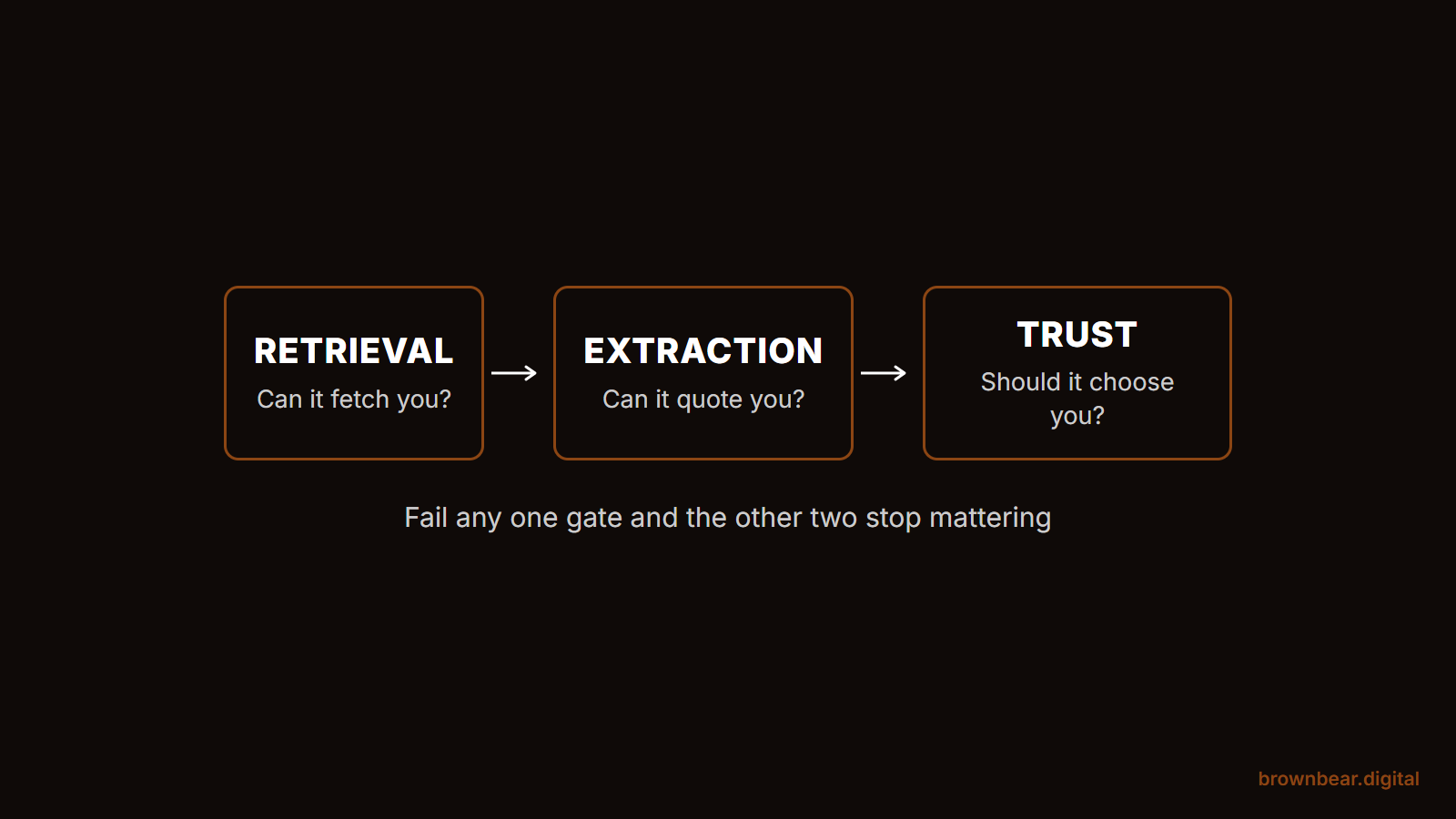
Here is the model I use in every audit, and it is the thing I'd want you to take away even if you read nothing else. Before your content can appear in an AI answer, it has to pass three gates in order. Fail an earlier gate and nothing you do at a later one matters.
Gate One is Retrieval.
Can the system physically fetch and read your content? This is crawling, rendering, indexing, and access. It is binary. You either pass or you are invisible.
Gate Two is Extraction.
Once the system has your text, can it lift a clean, self-contained answer out of it? This is structure, directness, headings, and evidence. This is the gate almost every published guide is talking about.
Gate Three is Trust.
Given several pages that pass gates one and two, does the system have a reason to choose yours? This is brand reputation, third-party corroboration, author credibility, and consensus across the web.
The reason this ordering matters so much in practice is that the gates are wildly unequal in both cost and payoff. Gate One is usually cheap to fix and catastrophic to fail. Gate Two is cheap to fix and offers modest, reliable gains. Gate Three is expensive and slow, and it is the one that actually decides competitive outcomes between two well-built pages.
The diagnostic question is always: which gate is my bottleneck? A business that has failed Gate One does not have a content problem, and buying content will not help. A business that passes all three gates and still is not cited usually has a Gate Three problem, and buying more content will not help there either.
The Three Gates Scorecard
Fourteen questions, one answer that matters: which gate is your bottleneck? Score each gate honestly and this names the one to work on first. A high score at a later gate cannot compensate for a failure at an earlier one.
Gate One · Retrieval
0 of 5 answered
Can the machine physically fetch and read your content?
1. Load a key page, hit view-source, and search for a sentence of your own body copy. Is it there?
2. How does your site deliver its main content?
3. Are key answers (FAQs, specs, pricing) hidden inside tabs, accordions, or “read more” toggles?
4. Broken internal links, dead sitemap entries, and 404s — how clean is your site?
5. Are you blocking AI user agents in robots.txt, at the CDN, or via aggressive bot filtering?
Gate Two · Extraction
0 of 5 answered
Can it lift a clean, self-contained answer off the page?
6. Does the direct answer sit in the first two sentences under each heading?
7. Are your headings phrased as the question readers ask, or as category labels?
8. Is comparative information in tables and sequential information in lists?
9. Do key passages stand alone, or lean on “as mentioned above” and pronouns?
10. Do your key sections carry a real statistic, a named source, or a quoted expert?
Gate Three · Trust
0 of 4 answered
Does the system have independent reason to choose you?
11. Has third-party press, a trade publication, or an independent site mentioned your brand in the past year?
12. How does your review profile volume compare with your top competitors?
13. Do your named authors have a footprint beyond your site — quoted, interviewed, or credited elsewhere?
14. Do you appear in the roundups, listicles, and comparison posts that already rank for your category?
Your bottleneck gate
Answer all 14 questions above and this panel will name the gate to work on first. 0 of 14 answered.
Self-diagnostic for informational purposes only; scores are illustrative and results are not a guarantee of AI search visibility. Not professional advice. Your answers stay in your browser — nothing is transmitted or stored.
Gate One: Can the Machine Actually Get Your Content
This is the battle, and it is the one almost nobody is fighting. If an AI crawler cannot read your content, everything downstream is theatre.
The single most important technical fact in AI search right now is that AI crawlers generally do not execute JavaScript. Vercel's analysis with MERJ, published in December 2024 and still holding in independent checks through 2026, examined crawler behavior across the major bots and found that none of the major AI crawlers render JavaScript. They fetch JavaScript files sometimes, ChatGPT's crawler in about 11.5 percent of requests and Claude's in about 23.8 percent, but they do not execute them. They read the raw HTML the server returns and nothing else. Google's Gemini is the meaningful exception, because it inherits Googlebot's rendering infrastructure.
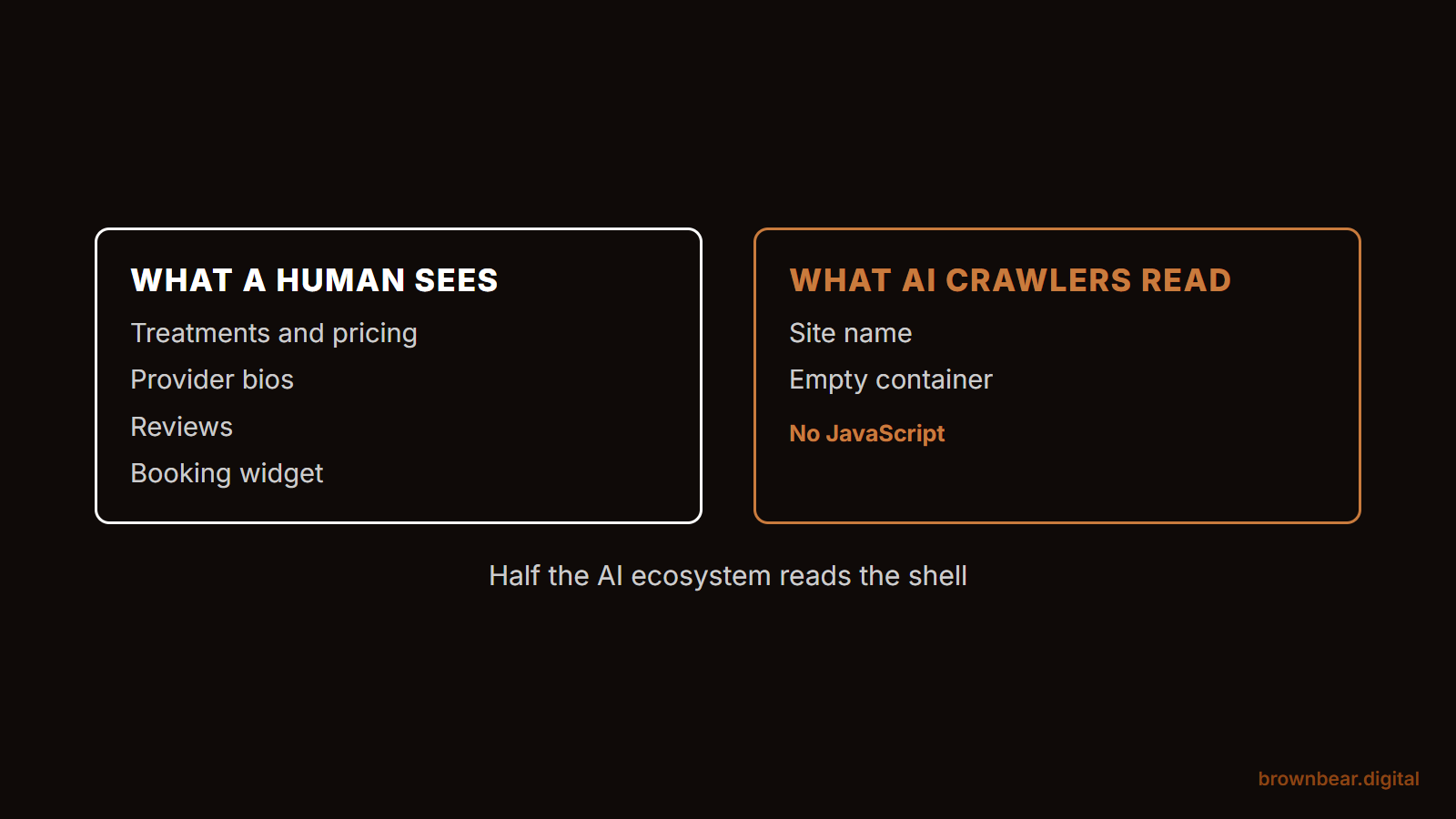
Translate that into consequences. If your product descriptions, your FAQ answers, your reviews, or your specifications are injected into the page by client-side JavaScript after load, then to ChatGPT, Claude, and Perplexity your page is close to empty. Not badly optimized. Empty. You can write the best answer on the internet and it will sit inside a container those systems never see.
What an AI Crawler Actually Sees
Set up the page the way your site is built, then compare what each crawler can read. Googlebot and Gemini render JavaScript. GPTBot, ClaudeBot, and PerplexityBot read the raw HTML your server returns — and nothing else.
Googlebot
Executes JavaScript
GPTBot · ClaudeBot · PerplexityBot
Raw HTML only — no JS execution
Gemini
Inherits Googlebot rendering
Simplified illustration of the Vercel/MERJ crawler analysis (December 2024) cited in this article: major AI crawlers fetch but do not execute JavaScript, while Gemini inherits Googlebot's rendering. Actual crawler behavior varies and changes over time; this is not a rendering test of your site. Not professional advice. Your selections stay in your browser — nothing is transmitted or stored.
Picture a med spa that relaunched on a modern JavaScript framework. The site looks superb, ranks acceptably because Googlebot renders it, and the treatment pages carry genuinely good copy about what each procedure involves and who it suits. Then the owner asks an assistant to compare local providers and the practice is simply absent. Nothing is broken in any way a normal person would notice. The server returns a page shell, the copy arrives a half second later via JavaScript, and half the AI ecosystem reads the shell. Stripping large amounts of JavaScript off client sites and getting the content into the server-rendered HTML is one of the highest-yield things we do, and it is invisible work that never makes it into a marketing deck.
The same analysis found another quiet waste: roughly a third of ChatGPT's and Claude's crawler fetches landed on 404 pages. That is a third of your crawl attention spent on nothing. Stale internal links, dead sitemap entries, and old redirects are not just hygiene issues anymore. They are budget you are handing away.
Beyond rendering, Gate One includes the things that hide content in plain sight. Answers buried inside tabs, accordions, or "read more" toggles may not be in the initial HTML at all. Microsoft's own guidance makes the same point from the Bing side, warning against hiding important answers in expandable menus because AI systems may not render that content. Content locked behind interstitials, aggressive bot filtering at the CDN or firewall layer, and robots directives that block AI user agents all belong here too. Blocking an AI crawler is a legitimate business decision. It is not a legitimate accident.
Here is where your path forks.
If your site is server-rendered or statically generated, your main content appears in view-source, and you already hold top 10 positions for your core terms, Gate One is probably not your bottleneck. Skip ahead and spend your effort on gates two and three. But if your site is a client-rendered single-page application, or if you can load a key page, view its source, and not find your own body copy in it, then stop. Do not commission a content program. Fix rendering first, because every dollar spent on copy before that is spent on text half the market cannot read.
Gate Two: Can It Lift a Clean Answer Off the Page
Assuming the machine can read your page, the next question is whether it can extract a self-contained answer without having to understand your whole document. This is the gate that content optimization genuinely owns, and the tactics here are well evidenced and cheap.
The core mental shift is that these systems do not read your page the way a person does. Microsoft's guidance on AI search inclusion describes it as parsing: the system breaks content into smaller usable pieces rather than consuming it top to bottom. Your page is not competing as a page. Its individual passages are competing as passages. That single reframe changes how you write.
What follows from it, concretely:
- Answer the heading's question in the first two sentences under it. Not after the context, not after the caveats. First. Context and nuance go after, where they add value without blocking extraction.
- Write headings as the question, not the category. "How Much Does a Rhinoplasty Cost in the Bay Area" is extractable. "Investment" is not.
- Make passages self-contained. A paragraph that begins "As mentioned above" cannot be lifted. Repeat the subject rather than pronouns when a passage carries a key answer.
- Use tables for anything comparative and lists for anything sequential. Structured formats survive extraction intact.
- Define terms in a clean declarative sentence. "A revision rhinoplasty is a second surgery to correct the result of a previous one." That sentence shape gets quoted constantly.
- Add the evidence the citation data rewards: a clear definition in the first sentence under the heading, real named entities instead of vague gestures, and a genuine statistic with its source. Cited passages in the Search Engine Land study were nearly twice as likely to open with a definition and carried roughly three times the typical density of proper nouns. Say you run marketing for a dental group and your implant page opens with three paragraphs about the practice's philosophy before it says what an implant costs. A reader tolerates that. An extraction system reaches the heading, finds no answer near it, and moves to a competitor page that leads with a number and a range. You did not lose on quality. You lost on placement. Moving one sentence to the top of that section is a ten-minute edit with a better expected return than a new blog post.
What Gate Two will not do is manufacture authority. Structure makes you quotable. It does not make you worth quoting.
Gate Three: Does It Have a Reason to Trust You
When several pages clear the first two gates, the deciding factor is whether the system has independent reason to treat your brand as a legitimate source. This is the gate that content alone cannot buy, and it is where most AI visibility is actually won.
The Ahrefs correlation is the cleanest evidence available: branded web mentions tracked AI visibility roughly three times more strongly than backlinks did. A follow-up extending the work to ChatGPT and Google AI Mode found the pattern held, with YouTube brand mentions emerging at 0.737 as the single strongest individual signal measured. These are correlations, not proof of mechanism, and they deserve to be held loosely. But they line up with what we see inside audits, which is that third-party surfaces move AI visibility more than on-site work does.
What surprises owners most in an AI visibility audit is rarely that the model said something wrong about them. It is how little they appear compared with their competition, and how much of what does appear traces back to sites they do not control: reviews, directories, press, roundups, and forum threads. The other recurring finding is subtler. The information about the business is usually accurate but badly weighted. The procedures a surgeon most wants to be known for are buried three levels deep, so the model has learned a generalist where the practice sees a specialist. That is not a factual error you can file a correction for. It is an emphasis problem, and it is fixed by changing what the wider web says about you, not by rewriting one page.
Consensus matters here in a way it does not in classic SEO. These systems compare what your page claims against what everything else says. Picture two competing clinics with equally good, equally well-structured pages on the same procedure. One has been quoted in two trade publications, has a well-populated review profile, and appears in three independent roundups. The other has a better website. The first one gets cited, because the model can corroborate it and cannot corroborate the second. If your page says one thing and the rest of the web says another, the model does not split the difference. It deprioritizes you.
This is the second place your path forks.
If you are an established brand with existing press coverage, review volume, and category recognition, your leverage is in gates one and two, because you already clear gate three and structural work will convert that standing into citations. If you are relatively unknown in your category, the reverse is true, and no amount of content optimization will fix it. Your quarter is better spent on digital PR, review generation, getting into the roundups and comparison lists that already rank, and building the kind of coverage that gives a model something to corroborate.
Optimizing Marketing and Product Page Copy
Commercial pages are the hardest case, because the things that make a page convert are frequently the things that make it hard to extract. Benefit-led headlines, deliberate ambiguity around pricing, and emotional copy all work on humans and fail on machines.
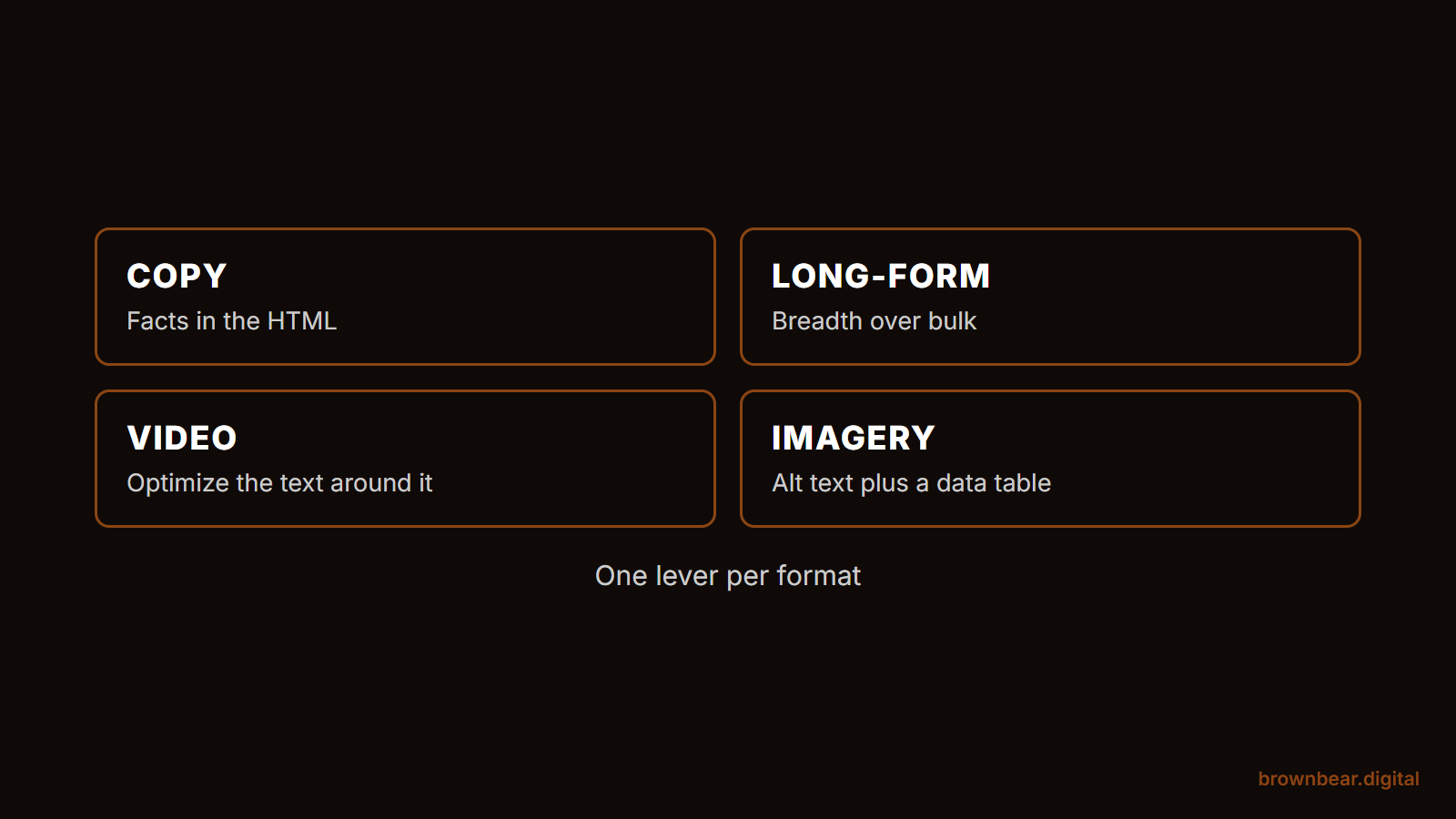
The resolution is not to turn your product page into a spec sheet. It is to make sure the page contains, somewhere in clean crawlable HTML, the factual answers a buyer would ask before purchasing. Price or price range. What it includes. Who it is for and who it is not for. Dimensions, materials, timelines, eligibility. Compatibility and limitations. These can live below the fold in an expanded details section as long as they are in the server-rendered HTML and not behind a tab that loads on click.
There is a second, harder truth about commercial pages. AI systems frequently cite the source that resolves a buyer's uncertainty rather than the page where the transaction happens. An analysis of 23,387 citations across 240 branded prompts and five AI platforms found that 57 percent of branded-query citations went to reviews, listicles, forums, social posts, and case studies, while product and commercial pages captured just 12 percent. One 2026 analysis also reported roughly three times the citation probability for domains with major review-platform profiles, though it disclosed no dataset, so treat that one as directional.
Imagine an ecommerce brand selling a mid-priced kitchen appliance. Its product page is beautiful, converts well, and is the highest-value page on the site. Ask an assistant which appliance in that category to buy and the answer cites two review roundups and a forum thread, none of which the brand owns. The product page was never going to win that query, because the query is about trust and the product page is the least trustworthy source on the subject by construction. The brand's real lever is being present and well-reviewed in the sources that do get cited.
So for commercial pages the practical program is: put the facts in the HTML, keep the persuasion, and accept that your product page is one input among many rather than the whole game.
Optimizing Blog Posts and Long Form Content
Long-form is where content optimization has the most room to work, and where the SEO fundamentals map onto AI search most directly.
Comprehensiveness matters, but not in the way "write 3,000 words" implies. What the domain-level correlation in the Semrush work suggests is that breadth of quality coverage across a topic predicts citation better than depth on any single page. Ten genuinely useful pages covering the real sub-questions of your category beat one enormous pillar page. Practically, that means building topical clusters where each page owns a specific question and answers it directly, rather than one monster guide that answers everything shallowly.
Linkability still matters, and it matters for a reason people often get backwards. Links look like a weak direct signal at best, correlating with AI visibility at roughly 0.22 to 0.33 against 0.66 to 0.74 for brand mentions. What earning links does is produce the surrounding coverage, the mentions, and the corroboration that gate three runs on. A genuinely linkable asset, original data, a useful tool, a contrarian and well-argued position, generates the third-party citations that make you a credible source. That is the actual mechanism, and it is why "just write more posts" underperforms.
Freshness carries real weight, more than it did in classic SEO. A March 2026 analysis of 118,000 AI answers found Perplexity cited content updated within the last 30 days 82 percent of the time, against 37 percent for content more than six months old. That is a single agency study without independent replication, so hold the exact numbers loosely, but the direction is corroborated widely. If you have a decaying library, updating your strongest twenty pages with current figures and current dates is often worth more than publishing twenty new ones.
I will push back on one piece of received wisdom while I'm here. The claim that blog content is dead because assistants answer everything is wrong, and it is expensive to believe. Long-form still earns the links and mentions that gate three depends on, and it still catches readers at the middle of an AI-mediated journey, particularly around cost and comparison questions. What I do tell clients is that every piece needs a defensible reason to exist. Content produced to hit a quota was always waste. It is just faster to detect now.
Optimizing Video for AI Search
Video is the most underrated surface in AI search, and the data on it is unusually strong. BrightEdge measured YouTube as the single most-cited domain in Google AI Overviews in an October 2025 study, at a 29.5 percent citation share. A March 2026 analysis of 30 million AI-cited sources found YouTube the second most-cited domain across AI search engines, behind only Reddit. Pair that with the Ahrefs follow-up finding that YouTube brand mentions were the strongest single correlate of AI visibility it measured, and video stops looking like a brand-awareness line item.
The mechanism is text. These systems are not watching your video. They are reading its title, description, chapters, transcript, and the page it sits on. So optimizing video for AI search is mostly optimizing the text around video.
That means: write titles as the question the video answers rather than as a clever label. Add real chapters, because chapters give the system labeled segments it can match against a specific sub-question. Publish a full transcript, ideally on your own site alongside the embed, so the substance exists as crawlable text on a domain you control. Write a description that summarizes the actual answer rather than promoting the channel. And embed the video on a relevant page with surrounding copy that states what it covers.
Say a surgeon films a genuinely excellent twelve-minute walkthrough of what a consultation involves. It is posted with a title like "Consultation Walkthrough," no chapters, an auto-generated transcript nobody checked, and a two-line description. The content is better than anything ranking. It is also close to invisible, because there is no text anywhere connecting it to the question a patient actually asks. Retitling it around that question, adding six chapters, and publishing a cleaned transcript on the practice site is an afternoon of work on an asset that already exists.
Optimizing Images for AI Search
Images are the weakest lever of the four formats, but they are not nothing, and there is one finding worth knowing. In the Vercel crawler analysis, image files made up around 35 percent of Anthropic's crawler fetches, the largest share of its requests, while OpenAI's crawler concentrated on HTML. Crawler priorities differ meaningfully by platform.
Still, the operating rule is that visual content without supporting text is effectively invisible to retrieval. What gets read is the alt text, the filename, the caption, and the copy immediately surrounding the image. So the optimization is unglamorous: write alt text that describes what the image actually shows rather than stuffing a keyword, name files descriptively, caption anything that carries information, and make sure any data displayed in a chart or infographic also exists as text or a table on the page.
That last one is the common expensive mistake. A well-designed infographic that contains your best original data, published only as a flat image, is data the retrieval layer cannot use and cannot cite you for. The chart is for the human. The table underneath it is for everything else.
Where Authorship and Expertise Actually Move the Needle
This is the question I get asked most by people who have read about E-E-A-T, and the answer has two halves that point in opposite directions.
The first half: there is no markup that makes Google or an assistant recognize your author as an expert. Google stopped showing authorship in search results back in 2014, and its current AI features documentation is explicit that no special schema is required. Adding author schema to a page does not create authority. It describes a claim about authority that nothing verifies.
The second half: authorship absolutely matters, just through a different channel. What actually works is when a named person exists as an entity across the web, quoted in publications, speaking at events, credited on research, active on platforms, with a consistent name and consistent credentials everywhere they appear. Then the model has corroborated evidence that this person is a recognized voice on the subject, and content attributed to them inherits that. The signal lives off your site. Your page's byline is the pointer, not the proof.
This is the same logic as gate three, applied to a person instead of a company, and it produces a genuinely useful strategic instruction: do not invest in author schema, invest in making your author findable and quoted elsewhere. A byline with no external footprint is decoration. A byline attached to someone with a real public record is one of the strongest trust signals available to a small business, because it is very hard to fake and very easy for a model to corroborate.
The practical version for most businesses is to pick one or two real people, put their names on the work, give them consistent bios, and then spend the effort on getting those people quoted, interviewed, and cited somewhere other than your own website.
What Does Not Work, According to the Data
The counterpart to knowing what works is knowing what to stop paying for.
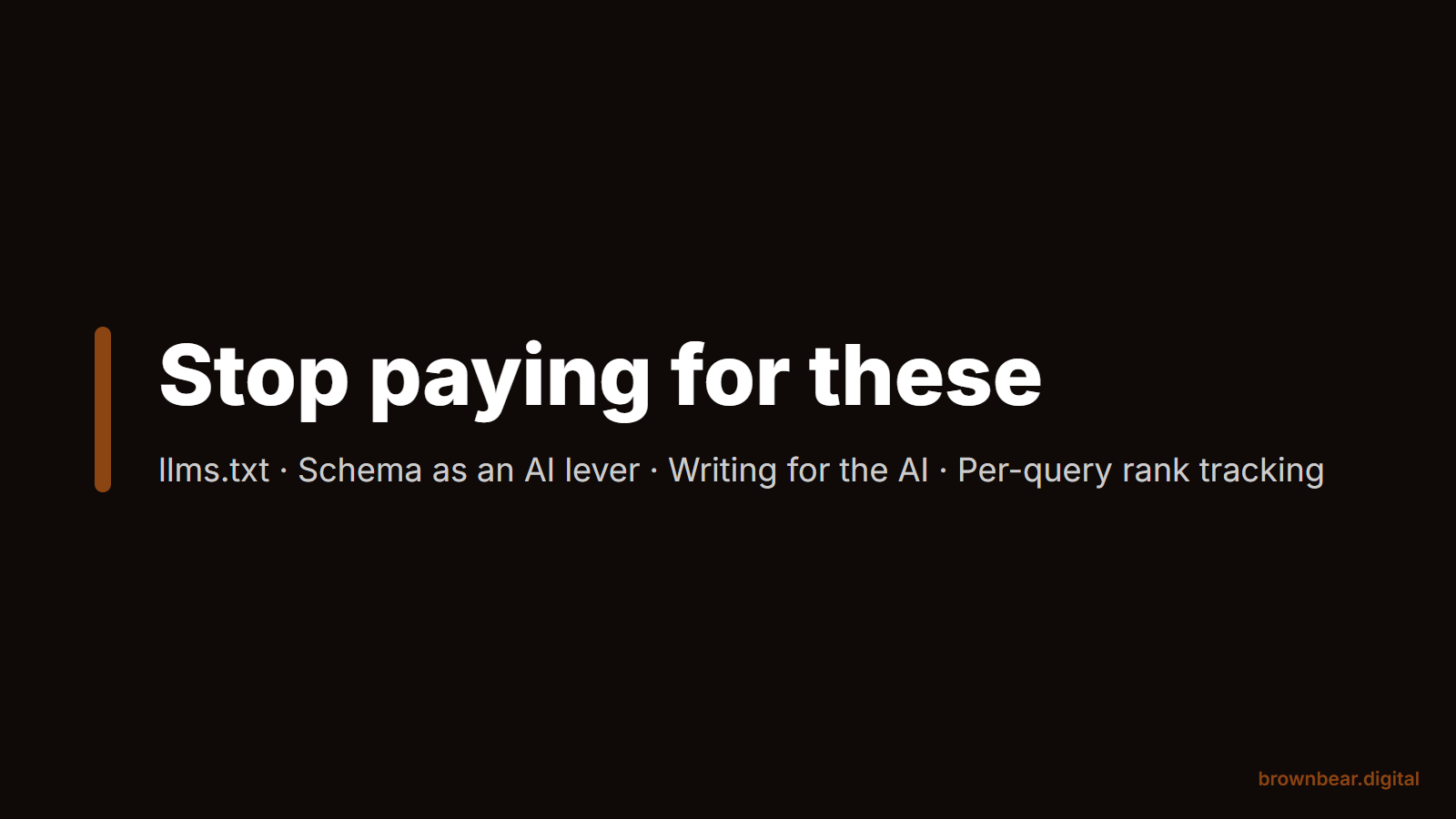
llms.txt has no observed effect.
Google's John Mueller has said the Search team neither uses nor endorses it and compared it to the old keywords meta tag, a self-declared signal that was trivially gamed. Ahrefs analyzed 137,000 sites and found that among those publishing an llms.txt file, 97 percent of the files received zero requests of any kind in May 2026. Not from AI crawlers. Not from anything. It costs almost nothing to add, which is precisely why it gets sold as a deliverable.
Schema is a best practice, not a lever.
This is my least popular position and I'll keep holding it. Structured data is worth maintaining and it helps with rich results in classic search. It is not a meaningful AI visibility driver, and Google's documentation says outright that no special schema is needed for AI features. When an agency's AI search proposal is mostly schema work, that is a proposal built from what is easy to bill, not from what moves.
Writing "for the AI" degrades content.
Stuffing question phrases, padding with FAQ blocks nobody asked, and flattening prose into machine-shaped fragments produces content that is worse for humans and no better for retrieval. The citation data rewarded plain answers, clear definitions, and real named entities, not stripped-out voice.
Query-level visibility tracking is unreliable.
Rand Fishkin's 2026 research concluded that AI brand visibility tracking is inherently unreliable at the level of individual queries, because these systems are non-deterministic and vary from session to session. With 600 volunteers running the same prompts, he found under a 1-in-100 chance of getting the same brand list twice. Tools that report you at "position 3 in ChatGPT" for a prompt are selling a precision that does not exist. Directional share of voice across many prompts is defensible. A ranked position for one prompt is not.
The pattern across all four is the same. The tactics that fail are the ones that are cheap to perform, easy to invoice, and require no change to what your business actually is.
How to Tell Whether Any of This Is Working
Given that query-level tracking is unreliable, you need measures that survive the noise.
The most useful one we report to clients is referral behavior. In our own client accounts, traffic arriving from LLM sources converts at a higher rate and engages more deeply than most other channels, and published industry data points the same way, with Adobe reporting roughly 42 percent higher engagement from AI referrals. The reason is that the journey compresses: a prospect works through several questions inside one assistant session and arrives having already done the comparison a website would normally have to do for them. Volume is still small for most businesses. Quality is not, and the volume grows.
Alongside that, track three things over quarters rather than weeks: your share of mentions across a fixed set of representative prompts run repeatedly, the volume and quality of third-party mentions and reviews you are earning, and your branded search volume, which correlated with AI visibility at 0.392 in the Ahrefs work and is far easier to measure reliably than anything happening inside the assistants themselves.
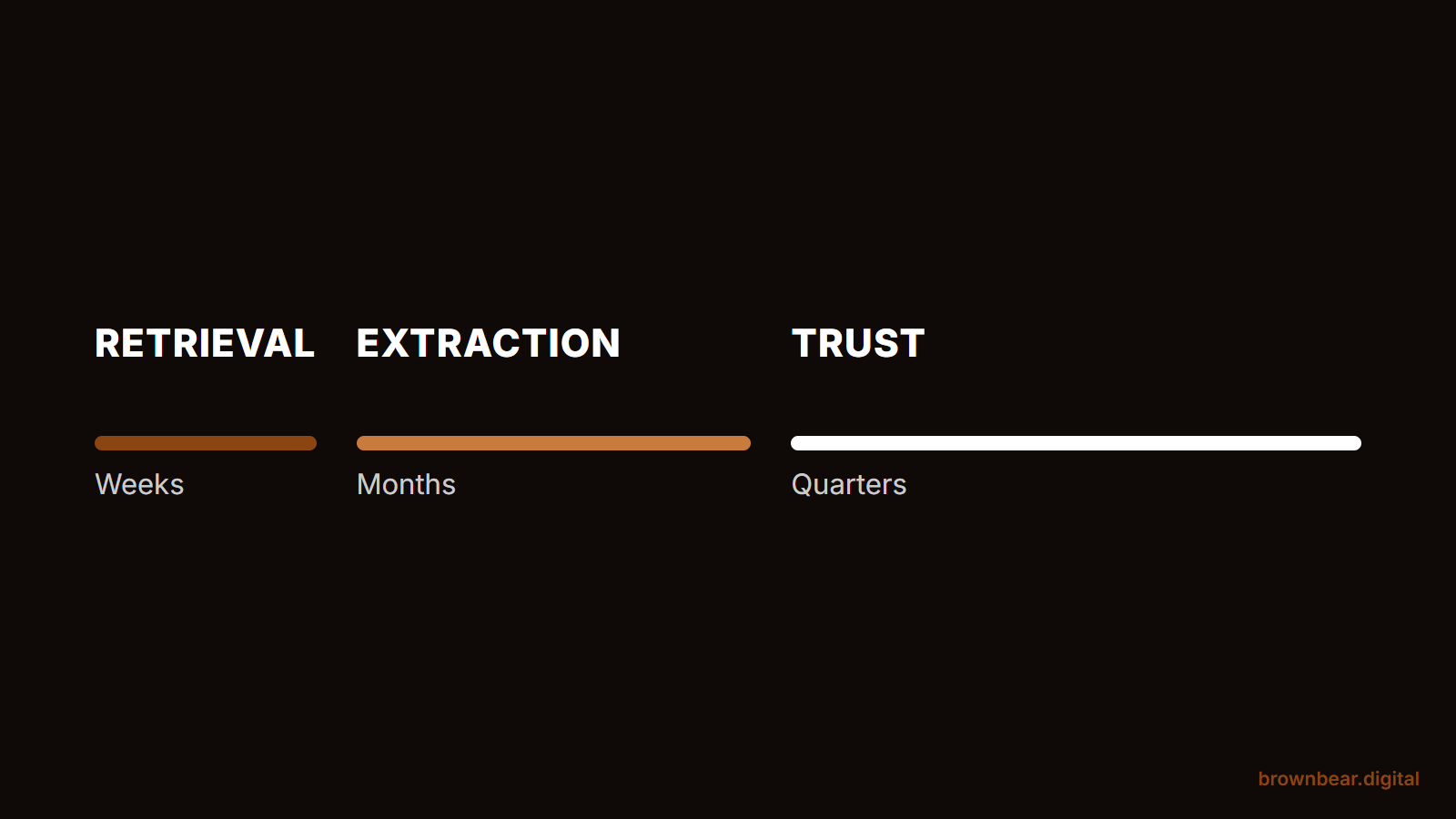
Set expectations accordingly. Gate One fixes can show up within weeks, because they change what is retrievable. Gate Two fixes show up in months. Gate Three moves over quarters and years, which is exactly why it is the defensible one.
What to Do First If You Only Have One Quarter
If you have limited budget and attention, do these in this order and stop when you run out of quarter.
- Run the view-source test on your five most important pages. Load each page, view source, and search for a sentence of your own body copy. If it is not there, your bottleneck is rendering and nothing else matters until it is fixed. Get the main content server-rendered.
- Audit for hidden and broken content. Pull answers out of tabs and accordions into the base HTML, fix the internal links and sitemap entries producing 404s, and confirm you are not blocking AI user agents at the CDN or in robots.txt unless you mean to.
- Rewrite the openings of your twenty highest-value sections. Put the direct answer in the first two sentences under each heading, turn category headings into question headings, and add one real statistic or named source per section.
- Start the third-party program. Pick three review platforms or publications that already rank for your category terms, and get present and well-reviewed on them. This is the slowest item and the one that compounds, so start it in the same quarter even though it pays out later. Notice that only one of those four is content optimization in the sense people usually mean.
Working With Brown Bear on AI Search Visibility
The businesses winning in AI search are not the ones who found a trick. They are the ones whose content is retrievable, whose answers are clean, and whose reputation gives a model something to corroborate. That is unglamorous, it is durable, and it is very hard for a competitor to copy quickly, which is the whole point. Brown Bear runs AI visibility audits that identify which of the three gates is actually costing you, and we would rather tell you it is a rendering problem than sell you a content program you do not need. If you want to know where you stand, you can talk to us about an AI search visibility audit.
Written By
Founder, Brown Bear Digital
Bryan has 15 years of experience across SEO, paid search, and AI search strategy. He founded Brown Bear to give businesses direct access to senior-level search expertise without the agency overhead.
Learn More About BryanGet Found on Google.
Get Cited by AI.
Tell us about your site. We'll send back a proposal for SEO and AI search.