Why Your Medical Practice Isn't Showing Up in AI Search (And What Actually Moves It)

Your best competitor used to be the practice with the biggest ad budget. Now it might be whichever practice ChatGPT happens to name first. This is Brown Bear's plain-language guide to why your medical practice isn't showing up in AI search results, and what actually changes that.
We run AI search programs for client practices, which means we watch the referral data, not the hype. We've seen the moment a practice starts appearing in AI answers show up in its new-patient numbers. This guide also draws on the largest public test to date, a 2026 study published by the Medical Group Management Association, which ran about 4,950 patient-style queries and found that not one of the 200 independent practices sampled was named by ChatGPT.
When we say AI search, we mean both the AI answers layered into Google and the standalone assistants patients use directly: ChatGPT, Perplexity, Gemini, Copilot. Whether a patient asks Google "best dermatologist near me" and reads the AI summary, or asks ChatGPT to recommend someone for their mole check, the same visibility problem decides whether you exist in the answer.
If you run a one-or-two-provider practice and suspect the internet has started recommending everyone but you, this is for you. If you manage marketing across several locations and your agency's "AI SEO" line item has no numbers attached to it, this is very much for you. And if you're the physician who got handed the website because nobody else wanted it, you'll leave with a plan that fits inside a real week.
By the end, you'll know exactly why practices disappear from AI answers, how to test your own visibility tonight in about 15 minutes, which fixes actually move the needle (and which popular one is overweighted), and how to count the patients AI sends you, so you never have to take anyone's word for it, including ours.
We've grouped the work into four parts: what changed in how patients search, why you're invisible, the fixes in priority order, and the measurement layer almost nobody talks about. Let's start with the part you can verify yourself: what patients are actually doing.
Key Takeaways
AI invisibility is a room you were never in
AI recommendation is not a ranking you slipped down. Assistants assemble answers from sources they can verify, such as profiles, directories, reviews, and quotable content, and independent practices lose on presence in those sources, not on quality.
Zero of 200 independent practices got named
A 2026 MGMA-published study ran about 4,950 patient-style queries and found not one of the 200 independent practices sampled was named by ChatGPT, while hospital-affiliated providers dominated the answer pool.
Run the five-prompt visibility test tonight
Fifteen minutes in ChatGPT with five prompts tells you whether you have a visibility problem, an entity problem, or a correction problem, and that diagnosis sets the order of everything you fix next.
Schema is hygiene, not a lever
Implement the basic markup in an afternoon, then stop. Content depth and entity consistency do the visible work, and an agency package built mostly on schema line items tells you what you need to know.
Patients already ask AI for doctors. Here's what that looks like.
Patients have moved faster than practices on this. In KFF's 2024 polling, 17 percent of adults were already using AI chatbots at least once a month for health information and advice, including a quarter of adults under 30. By early 2026, KFF's tracking poll found one in three adults had turned to an AI chatbot for health information in the past year. The two polls ask different questions, so don't read them as one curve, but they point the same direction: this is now normal patient behavior.
The searches themselves have changed shape. Nobody types "dermatologist 90210" into ChatGPT. They ask, "My mole changed color and I'm worried. Who should I see near Pasadena, and what should I expect at the appointment?" The AI answers the medical question and, increasingly, names providers in the same breath. Whoever gets named inherits the trust of the whole answer.
Say you're a two-physician dermatology practice in Pasadena. A patient down the street asks ChatGPT that exact question tonight. Picture the answer: a short explanation of when mole changes warrant urgency, then three named options, a university health system 20 minutes away, a national chain's local office, and a competitor with a thin website but a Wikipedia-cited hospital affiliation. You're not in the answer. Not because you're worse. Because the AI has no machine-readable reason to know you're relevant.
That's the pattern to internalize: AI recommendation is not a ranking you slipped down. It's a room you were never in. We've mapped the patient side of this shift in more depth in how AI search is changing patient health research.
The real reasons your practice is invisible to AI
Most explanations you'll read stop at "you need AI optimization." Here's the actual mechanism, because you can't fix what you can't see.
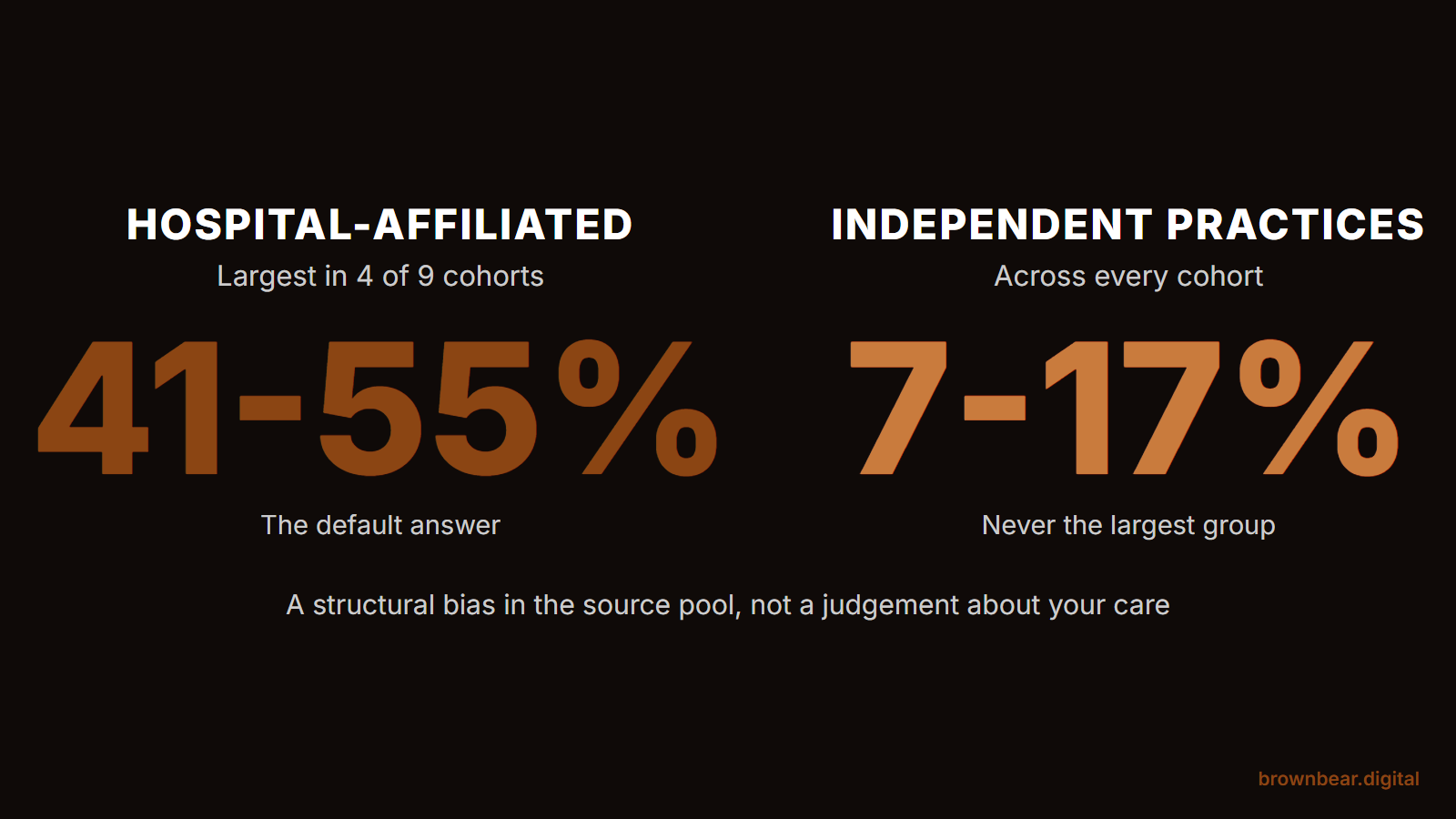
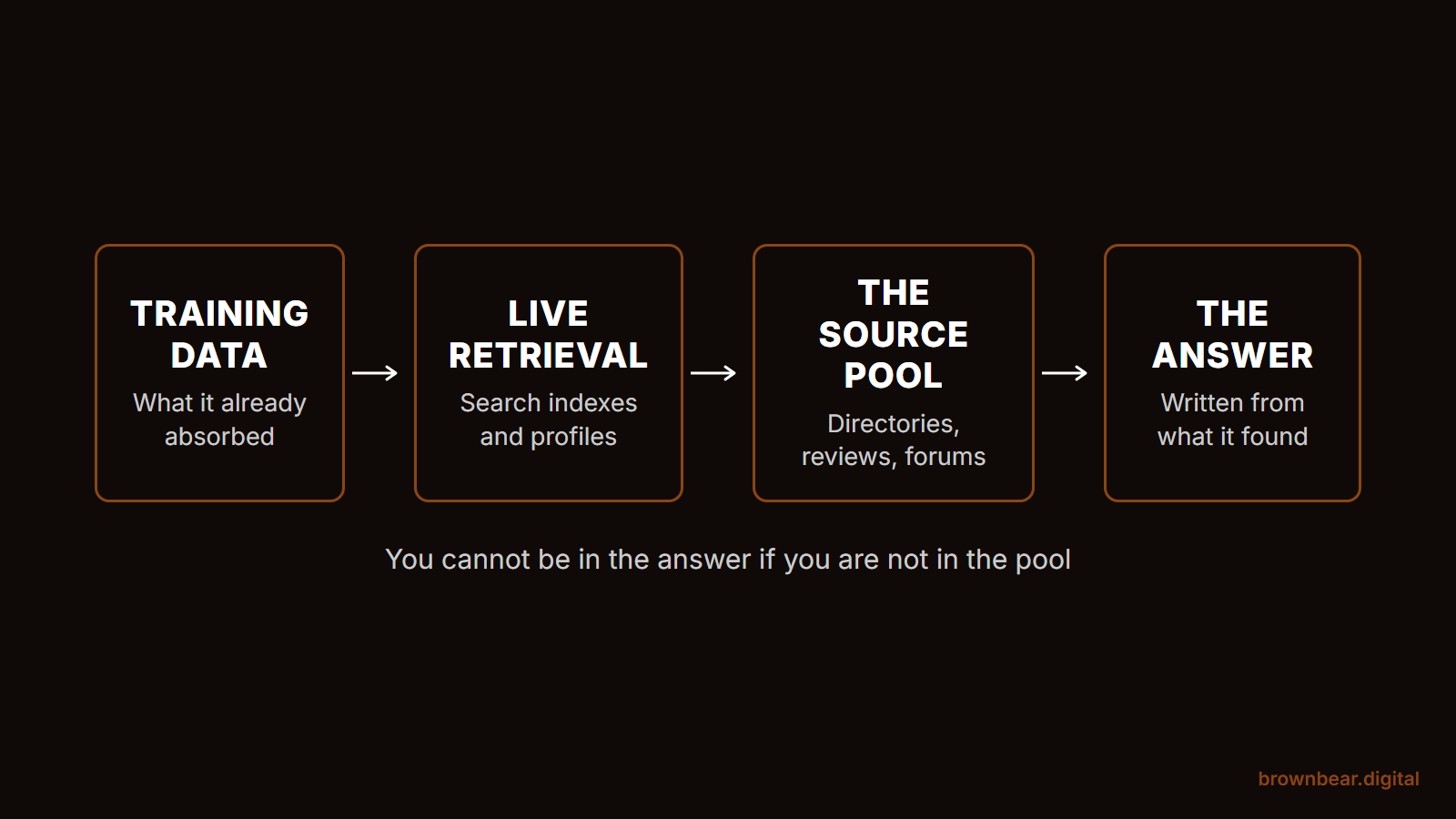
AI assistants build answers from a source pool: their training data plus whatever they retrieve live, mostly search indexes, business profiles, directories, review platforms, news, and forum discussions. The MGMA-published research analyzed roughly 35,000 additional queries across nine patterns and found hospital-affiliated providers were the largest share in four of the nine cohorts, at 41 to 55 percent, while independent practice organizations sat at 7 to 17 percent across every cohort and were never the largest. Independent practices lose not on quality but on presence in the sources AI reads.
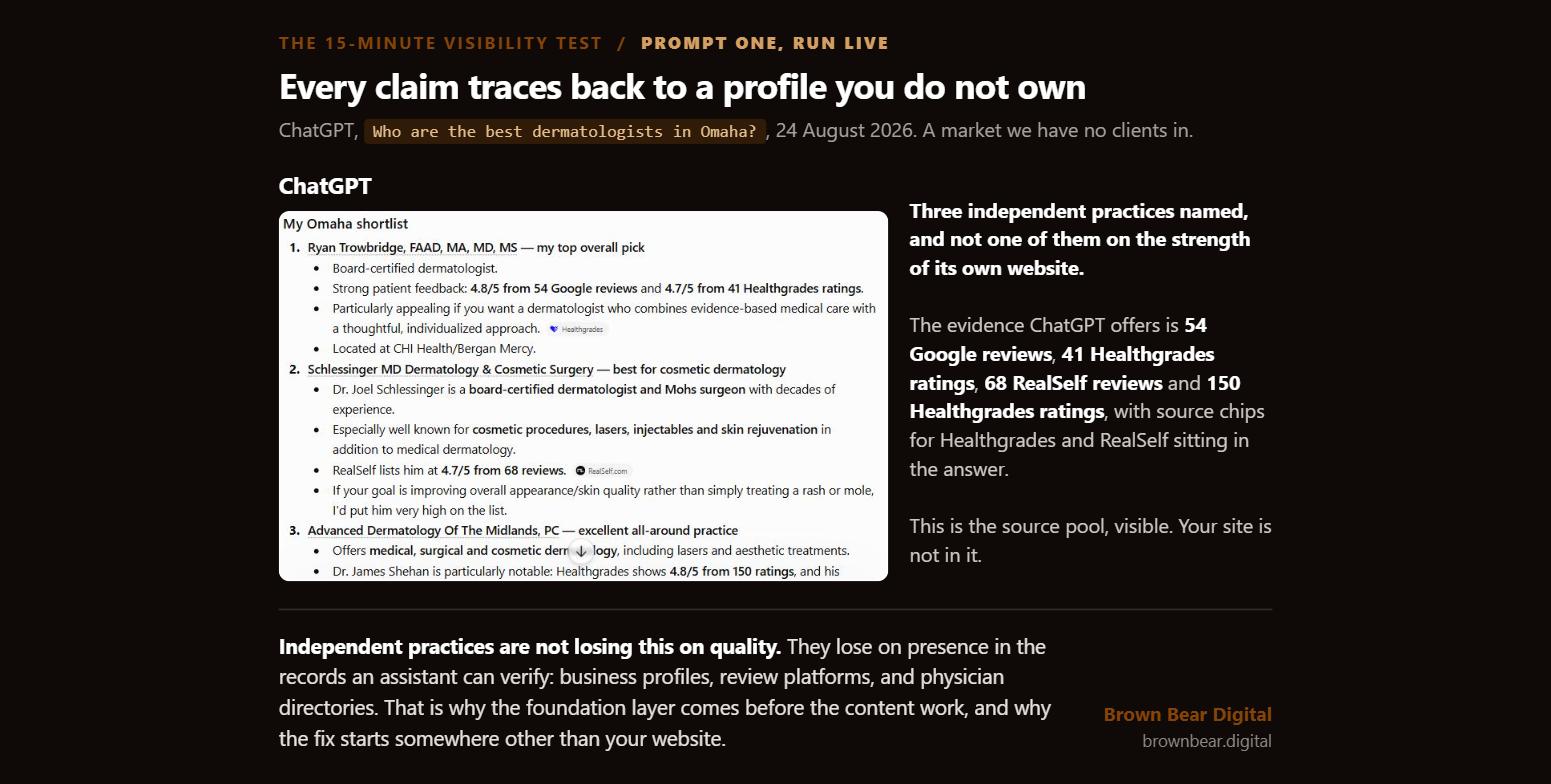
Three specific gaps do most of the damage.
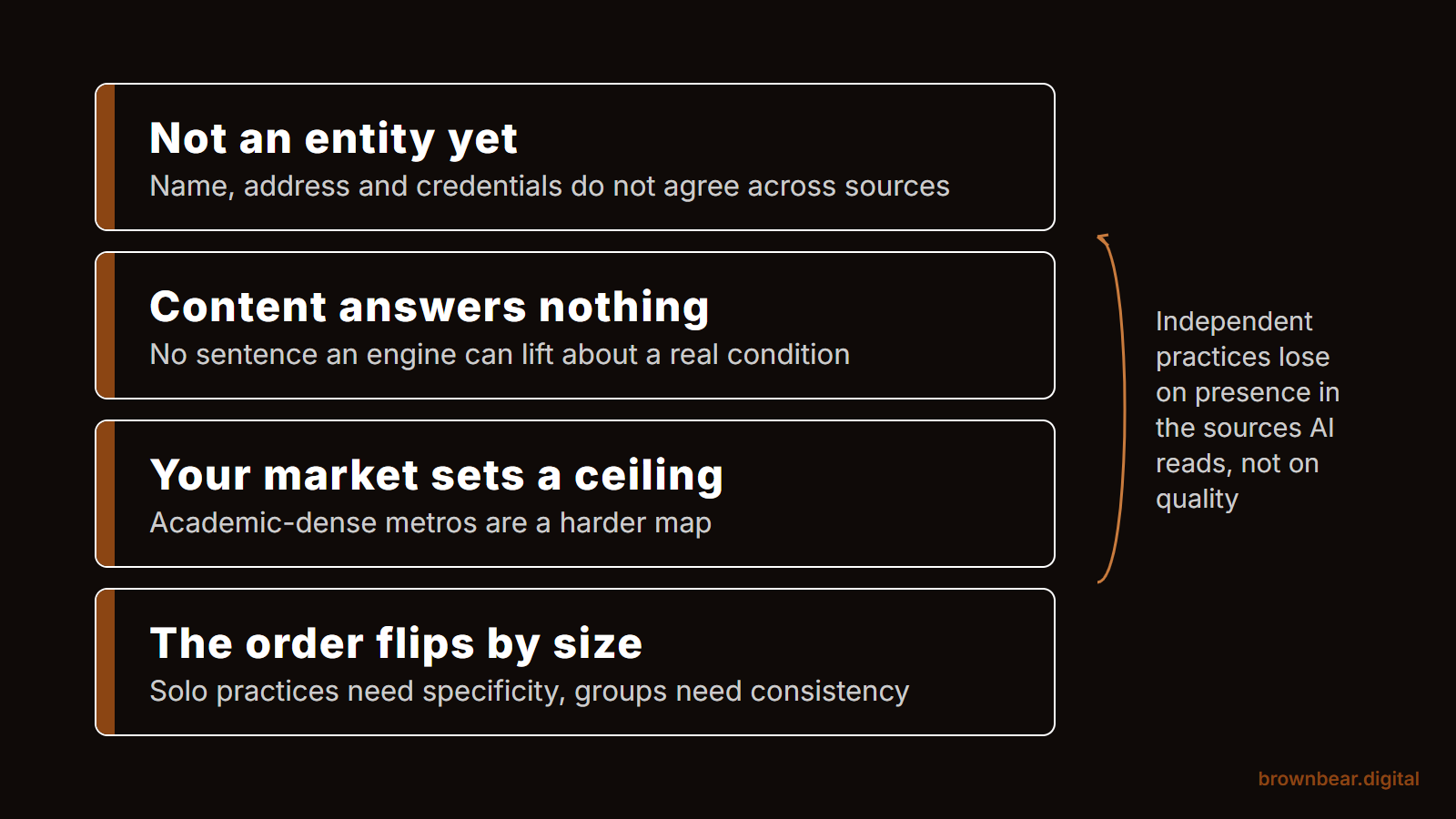
You're not an entity yet.
If your practice doesn't exist as a consistent, verifiable "thing" across your site, your Google Business Profile, NPI registry data, and major directories, AI models can't confidently connect your name to your specialty and city. So they default to hospitals and chains they can verify.
Your content answers nothing.
Pages that say "comprehensive, compassionate care" give an AI no sentence it can lift into an answer about a specific condition, procedure, or situation.
Your market sets your ceiling.
The same analysis found independent-practice mention shares of 23 percent in Charlotte versus 7 percent in Boston, with the thinnest shares in metros dense with academic medical centers. A solo practice in a big academic-medicine city is playing a harder map than one in a mid-size market, and your expectations should be set accordingly.
If you're a solo or two-provider practice, your leverage is specificity: being the clearly documented answer for particular conditions in your particular area. If you're a multi-location group, your problem is usually consistency instead: three slightly different practice names across locations reads, to a machine, like three unverifiable practices instead of one credible group. The fix list is the same; the order flips. Most of the damage we see comes from a handful of repeatable errors; we cataloged the AI SEO mistakes medical clinics make if you want to check yourself against them.
Run this 15-minute AI visibility test tonight
Before you spend a dollar on this, find out where you actually stand. You don't need an API or a consultant. You need five prompts and 15 minutes.
Open ChatGPT (and ideally Perplexity too, since it cites sources), and run these five, filling in your specialty and city:
- "Who are the best [specialty] doctors in [city]?"
- "I have [common condition you treat]. Recommend a doctor near [city/neighborhood]."
- "What should I know about [signature procedure you offer], and who does it well near [city]?"
- "Tell me about [your practice name]. Is it reputable?"
- "What are patients saying about [your practice name]?"
Then read the results like this. If prompts 1 to 3 never name you, you have a visibility problem: AI can't connect you to your specialty and market. If prompt 4 comes back thin or confused ("I don't have much information about this practice"), you have an entity problem: fix your foundation layer first. If prompt 4 or 5 states things that are wrong (old address, wrong insurance, a physician who left), you have a correction problem, and the section below just became your priority. And if you show up in some prompts but not others, note which patient situations you're missing; those are your next content pages.
One honest caveat: AI answers vary by session, phrasing, and even time of day. Run each prompt twice. You're reading a pattern, not a scoreboard.
Run your AI visibility test
Answer five quick questions and we’ll generate your five personalized test prompts. Run them in ChatGPT or Perplexity, come back, and log what happened — you’ll get your diagnosis and exactly where to start.
Fill in all five fields to generate your prompts.
Log a result for all five prompts first.
Built by Brown Bear Digital · nothing you type leaves this page
Disclosure: This tool is for general informational purposes and applies the framework described in this article. AI search results vary by platform, location, and time — your results are a snapshot, not a guarantee of visibility, rankings, or patient volume, and this is not medical, legal, or professional advice. Nothing you enter is stored or transmitted; it stays in your browser.
The foundation layer: your profiles, reviews, and the sources AI reads
Every AI answer about local healthcare is assembled from sources you can influence. The foundation work is making those sources say the same, complete, current thing about you.
Your Google Business Profile is still the heaviest single input for location-based queries, because AI engines lean on the same local data Google's map results use. Complete every field, keep hours and insurance current, and post updates; a profile that's 80 percent done reads as 80 percent trustworthy. Our Google Business Profile guide walks through the exact fields that matter most. Then the directories AI actually reads: your NPI registry record (the government's provider database, which seeds many downstream directories), Healthgrades, Vitals, WebMD, and your state medical board listing. The test is boring but strict: same practice name, same address format, same phone number, everywhere.
Reviews matter here too, but differently than you think. AI models don't just count stars; they read review text as evidence of what you're good at. A practice with 40 reviews that repeatedly mention "explained my knee replacement options clearly" builds a machine-readable association between the practice and knee replacement. Ask happy patients to mention their procedure when they review. That's not gaming anything; it's helping the record reflect what you actually do.
Picture a three-location orthopedic group where location two is listed as "Summit Ortho," location one as "Summit Orthopedics," and the NPI record still shows the founding physician's solo entity from 2011. A human sees a growing practice. A machine sees noise it can't verify, and quietly leaves all three locations out of the answer. Two hours of cleanup is worth more than any amount of new content in that situation.
Write pages AI can actually quote
Here's the test for every page on your site: does it contain a sentence an AI could lift, verbatim, into an answer to a real patient question? Most practice websites fail it on every page.
Compare these two passages.
Before: "Our board-certified physicians provide comprehensive, patient-centered dermatologic care using state-of-the-art technology." There is no question to which that is the answer.
After: "We see most new mole-check patients within five business days. If a mole has changed color or shape, we recommend being seen within two weeks; changes like these don't usually mean melanoma, but timing matters when they do." That's three quotable answers in two sentences: how fast, how urgent, and why.
Structure the site so each major condition and procedure you want to be recommended for has its own page, written in the shapes AI extracts most reliably: a direct answer near the heading, then the nuance. An FAQ section where the questions mirror how patients actually phrase things ("How much does a skin check cost without insurance?") is one of the highest-leverage additions a practice site can make, and it's also simply useful to humans, which is the point. Medical content also carries a higher bar for accuracy signals; here's the YMYL standard AI search applies to medical content.
One thing we tell clients that surprises them: your bio pages matter more than your homepage. When AI answers "tell me about Dr. Chen," it's assembling from her bio, her NPI data, and her reviews. A bio that explains who she treats best and how she practices gives the machine a reason to recommend her over a name it can merely verify.
The schema question: what markup does (and doesn't) do
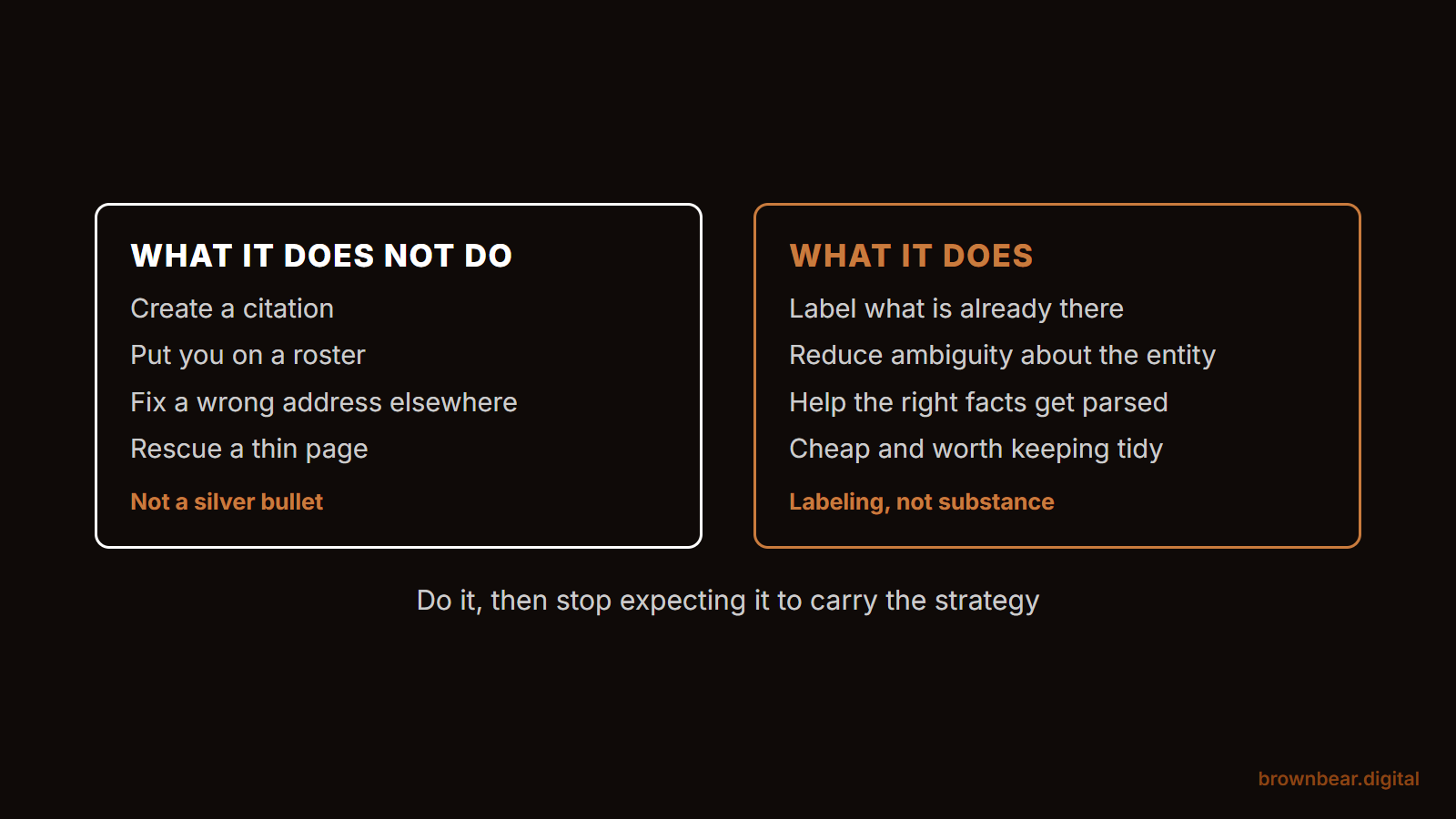
Every article on this topic tells you to add schema markup, the structured data code that labels your pages for machines. It's on every checklist, usually near the top. We're going to be the ones to tell you it's overweighted.
Here's our position, from watching client practices: schema is hygiene, not a lever. In the practices we've moved into AI answers, content depth and entity consistency did the visible work; schema changes alone never produced a jump we could attribute to them. The MGMA research points the same direction: about two thirds of the practices that did get cited by AI lacked the on-site technical features being tested, which is hard to square with markup being a primary driver.
The reasoning is straightforward. Schema helps machines parse what a page says. It cannot make the page say anything worth quoting. A MedicalOrganization tag on a homepage full of "comprehensive care" language is a neatly labeled empty box.
So yes, implement the basics once: MedicalOrganization or Physician markup, LocalBusiness data, FAQ markup where you have real FAQs. It's an afternoon of work and it removes ambiguity. Then stop. Every additional hour someone wants to bill you for markup is an hour that should have gone into a condition page, a physician bio, or your review base. If an agency's AI package is mostly schema line items, that tells you what you need to know.
When AI gets your practice wrong
Invisibility isn't the worst case. The worst case is an AI confidently telling patients your old address, an insurance plan you dropped, or that a physician who left two years ago still practices with you. Patients act on these answers without ever reaching your website to be corrected.
AI gets practices wrong for a mundane reason: it's assembling from stale or conflicting sources. The old address lives on in a directory you forgot exists; the departed physician is still on three profile sites; an outdated insurance list survives on a page you meant to delete. The model isn't inventing; it's faithfully repeating the worst version of your records.
The correction playbook, in order:
- Run prompts 4 and 5 from the visibility test and write down every factual error.
- Trace each one to its likely source. Search the wrong fact in quotes on Google; the sources repeating it will surface.
- Fix the record at the source: update or close stale directory listings, refresh departed-provider profiles, and put the correct facts prominently on your own site, because your site is the tiebreaker when sources conflict.
- Re-test monthly. The assistants that retrieve live data (Perplexity, Copilot, AI answers in Google) usually reflect fixes within their normal crawl cycle, days to weeks. Answers generated purely from training data can lag until the next model update, which is annoying but temporary.
If you're multi-location, assign this to one named person per quarter. Distributed ownership is how the wrong address survived this long in the first place.
How to know if AI is actually sending you patients
Here's the question nobody else in this space will help you answer: is any of this working? Every agency selling "AI optimization" reports activity. Almost none report outcomes. So build what we call the AI Referral Ledger, a simple two-source count of patients AI actually sends you. It takes an hour to set up.
1. The GA4 report that catches AI clicks
GA4 now groups the big assistants (ChatGPT, Gemini, Copilot) into a native AI Assistant channel, while others, including Perplexity, still show up as referral traffic from domains like perplexity.ai. Build one report that watches both: the AI Assistant channel plus referral sources such as chatgpt.com and perplexity.ai. Two caveats worth knowing: a large share of AI-app visits arrive with no referrer and land in direct, and clicks from Google's AI Overviews count as regular google organic traffic. Your ledger undercounts by design; the trend is what you're watching. Early industry analyses repeatedly find this traffic converts well above general search. Semrush's 2025 study measured the average AI search visitor at 4.4 times the value of a traditional organic visit, which matches what we see in client accounts: a patient who arrives from an AI recommendation arrives largely pre-sold.
2. The intake question that catches everyone else
At the front desk, add one answer choice to the "how did you hear about us" question, whether it's asked by a human or an intake form: "An AI assistant (ChatGPT, etc.)." This catches the majority of AI-referred patients your analytics never sees, the ones who got your name from an answer, then called directly or searched your name. In our client practices, this intake line regularly captures two to three times more AI-referred patients than the referral traffic shows, and it's the number that convinced several skeptical physicians that this channel is real.
The ledger is one row per month: AI referral sessions, AI-attributed new patients from intake, and consults booked. Three columns, and suddenly you're the only practice in your market that knows its AI channel's actual yield. If you hire help with any of this, the ledger is also your accountability tool: show me the trend, not the checklist. The same principle drives which marketing KPIs a practice should actually measure.
Your next 30 days, in order
You don't need to do everything. You need to do these, in this order.
- Tonight (15 minutes): run the five-prompt visibility test. Write down what's missing and what's wrong.
- Week 1 (2 to 3 hours): fix the record. Google Business Profile complete and current, NPI data correct, name/address/phone identical across Healthgrades, Vitals, WebMD, and your state board listing. Correct every factual error the test surfaced.
- Weeks 2 to 3 (a few hours per page): build or rewrite your top three condition/procedure pages and your physician bios so each contains direct, quotable answers to real patient questions. Add the FAQ section. Do the basic schema pass in the same sitting, then move on.
- Week 4 (1 hour): set up the AI Referral Ledger: the GA4 report and the new intake answer choice. Put a monthly 20-minute review on the calendar to re-run the test and read the ledger.
Set expectations by your market: in a hospital-dense metro, weeks 2 and 3 are where you'll live for a while, and progress means being named for specific conditions before you're named for "best in city." In smaller markets, practices doing this work are often the first mover, and the results show up faster than anyone expects. Specialty matters as much as market: our plastic surgery clients compete in one of the most institution-dominated answer pools, and the same playbook still moves them.
Your next 30 days, in order
Pick your start date and the plan maps itself to your calendar. Check tasks off as you go — your progress is saved on this device.
Built by Brown Bear Digital · from the playbook above
Disclosure: This planner is for general informational purposes — it organizes the steps described in this article and is not a guarantee of AI search visibility or specific business results, nor medical, legal, or professional advice. Your progress is saved only in this browser; nothing is transmitted.
Get Found in AI Search with Brown Bear
Brown Bear runs AI search visibility programs for medical practices: the entity cleanup, the quotable content, the correction work, and the measurement, so you see the same referral data we do. If you'd rather hand this list to someone who has run it before, bring your five-prompt test results. It's the first thing we'll ask for anyway.
Written By
Founder, Brown Bear Digital
Bryan has 15 years of experience across SEO, paid search, and AI search strategy. He founded Brown Bear to give businesses direct access to senior-level search expertise without the agency overhead.
Learn More About BryanGet Found on Google.
Get Cited by AI.
Tell us about your site. We'll send back a proposal for SEO and AI search.