The 8 AI SEO Mistakes Medical Clinics Are Making Right Now

You adopted AI for SEO because it made sense. Content at scale, keyword research in seconds, meta descriptions optimized before your morning coffee. The tools promised efficiency, the demos looked convincing, and the workflow came together quickly. So you built the content calendar, set the publishing schedule, and started producing.
That was six months ago. Or twelve. The pages are indexed, the brand mentions are accumulating, the reports look active. But the ranking movement you expected hasn't come. Organic inquiries haven't shifted. And somewhere between the content calendar and the quarterly review, a quiet doubt crept in: is this actually working?
If you're a marketing manager, practice manager, or clinic owner running an AI SEO program that isn't delivering, the answer is almost never "we need more content." It's almost always one of the following eight problems, working individually or in combination, that explains why the effort isn't translating.
This isn't a guide to AI SEO. It's a diagnostic for the version of AI SEO that most medical clinics are currently running. Google is getting better, not worse, at identifying it.
Key Takeaways
Your AI SEO program is failing on strategy, not on AI
Clinics that adopted AI as a substitute for strategy, instead of a tool inside one, produce commodity content Google is actively learning to deprioritize. Eight specific, diagnosable problems explain why the rankings never moved.
Clinically anonymous content loses 30 to 50 percent of visibility
Practices in competitive markets have lost between 30 and 50 percent of organic visibility after core updates because their content was well-structured but carried no named author, practitioner credential, or clinical voice.
Two strong articles beat twelve thin ones in healthcare
Google scrutinizes YMYL content more carefully, and volume without expertise triggers a sitewide quality signal that drags down every page. Cut the publishing cadence and raise the standard for what earns a spot in the calendar.
A surge in brand mentions is a red flag, not a win
Google evaluates the authority and topical relevance of the sites your mentions come from, not the count. Forty placements on irrelevant sites build the appearance of SEO activity, while a few healthcare-relevant mentions build actual equity.
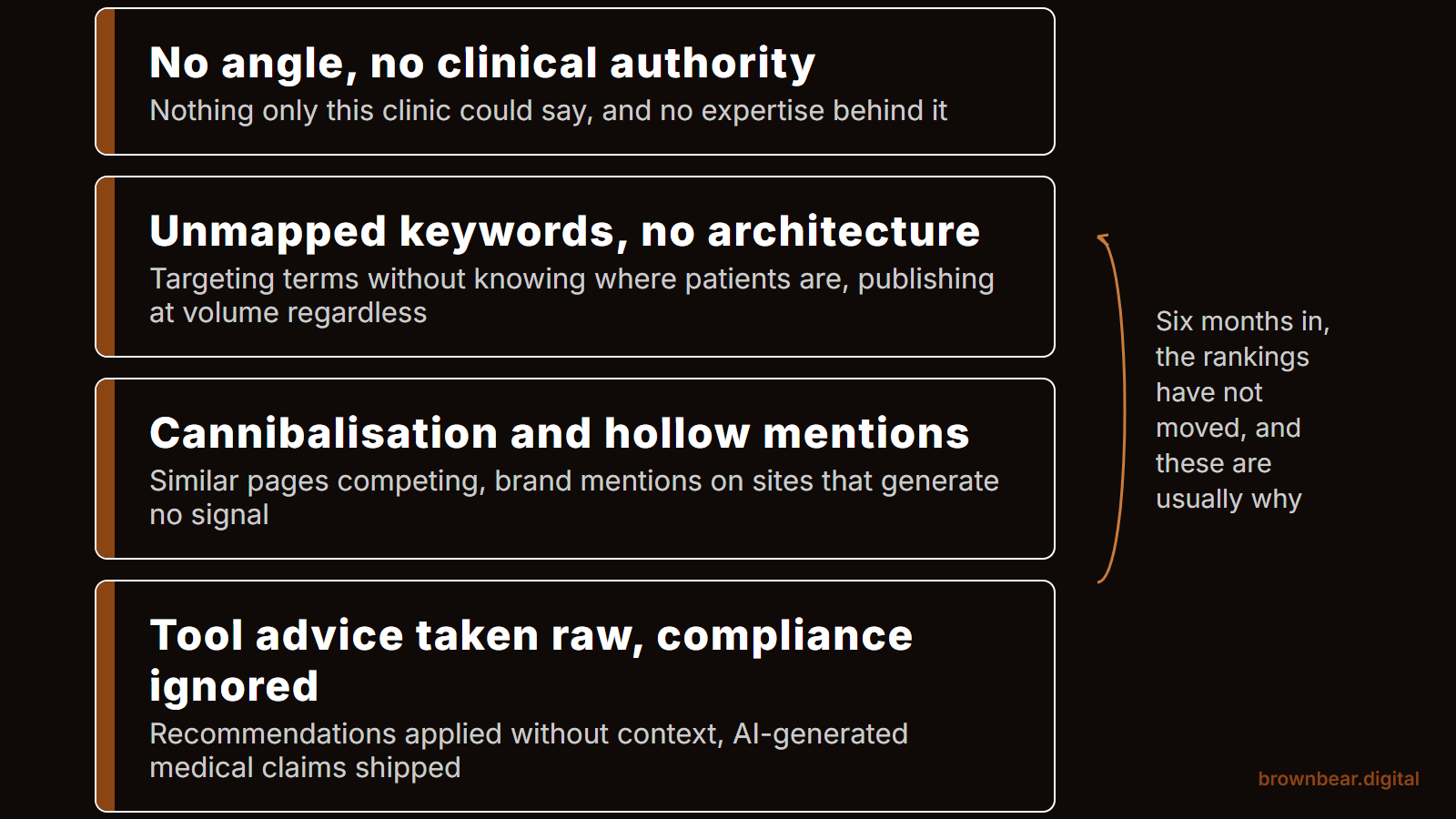
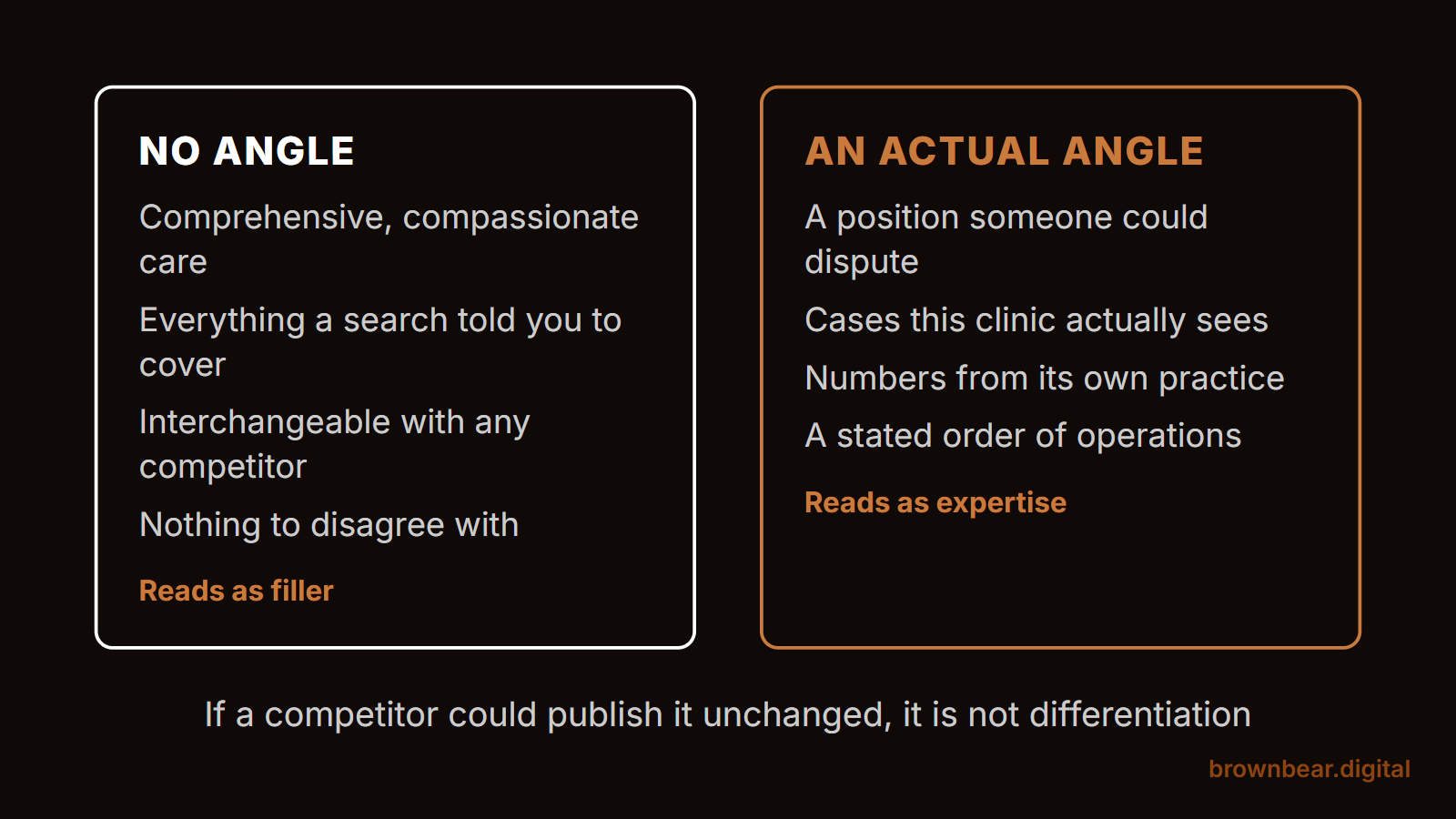
1. Your Content Has No Angle, No Point of View, and Nothing Only Your Clinic Could Say
This is the foundational problem, and almost every other mistake on this list flows from it.
When you run a topic through an AI content tool, the output looks good. Clean grammar, proper heading structure, keyword-relevant copy. It reads like SEO content. The problem is that it reads exactly like the SEO content already ranking for that term, and exactly like the content every other clinic using the same tools and the same prompts is publishing.
Google has been moving for several update cycles toward rewarding information gain: content that surfaces something the reader couldn't have found in the first three results. AI-generated content synthesizes what already exists. It doesn't add to the conversation. It repackages it. Content with a real angle takes strategy and production discipline, which is exactly what our content marketing service exists to supply.
For medical clinics, this is acute. A dermatology practice writing about what causes hyperpigmentation using an AI tool gets the same article any dermatology practice would get. No clinical perspective from the practitioners who treat it daily. No specific patient outcomes from the treatments actually offered. No angle that comes from having performed the procedure on a real patient population in a real geography.
"Commodity content follows the same formulaic structure you see repeated across every page on the first SERP. It answers 'what is X,' 'how does X work,' and 'the benefits of X' without adding any real perspective, clinical nuance, or relevance to the individual patient. These are questions any AI tool can answer without experience, and that's exactly the problem. Ten other clinics have already answered them the same way. There's no detail that speaks to the patient's actual pain points, no angle that distinguishes one practice from another, and nothing that could only have come from someone who has genuinely treated patients."
Bryan Passanisi, Founder, Brown Bear Digital
The content is not wrong. It just offers nothing new. And content that offers nothing new is, by definition, commodity content.
Google has signaled clearly that commodity content will be increasingly deprioritized. For clinics in competitive markets like plastic surgery, dental implants, or aesthetic medicine, deprioritized means buried.
What this looks like in practice
Your PRP microneedling page covers what it is, how it works, and what to expect. So do the seven pages outranking you. None of them, including yours, say anything about why your protocol differs, what your patient selection criteria are, or what outcomes your specific patient population sees.
What to do instead
Every piece of content needs one thing only your clinic could have written: a clinical stance, a real patient outcome pattern, a specific treatment decision. That's the signal Google is looking for, and it's the signal no AI tool can manufacture for you.
2. AI Cannot Generate the Clinical Authority Google Requires for Medical Content
Healthcare content sits in what Google classifies as YMYL territory: Your Money or Your Life. That classification triggers a significantly higher scrutiny threshold for E-E-A-T signals: Experience, Expertise, Authoritativeness, and Trustworthiness.
What this means in practice: a page about botox for jaw slimming on a med spa website needs to demonstrate that a qualified clinician with relevant credentials was involved in its creation, that the information reflects genuine clinical experience, and that the practice has verifiable authority in the field. AI can produce the words. It cannot produce the credentials, the clinical history, or the practitioner voice that makes those signals credible. We break down exactly what Google is measuring in E-E-A-T for plastic surgeons, and the framework applies to every clinical niche.
Clinics that have scaled AI content without addressing the E-E-A-T layer are building on unstable ground. The content may rank temporarily. After the next core update, pages that lack clear author attribution, practitioner involvement, and demonstrated clinical experience are consistently the ones that fall. And there will be a next core update.
Practices in competitive markets have lost between 30 and 50 percent of organic visibility after core updates specifically because their content was well-structured but clinically anonymous. No named author. No practitioner credential. No signal that a qualified professional contributed to the piece.
If you've inherited the SEO program at your clinic and suspect the content published before you arrived may not meet this standard, this is the first place to audit.
What this looks like in practice
Your service pages and blog content were written by an AI tool, reviewed by your marketing manager, and published without a named clinical author or credential attribution. The information is accurate, but there is no proof of expertise attached to it.
What to do instead
Every piece of clinical content needs a named practitioner attribution, a short credential marker, and a real clinical voice woven into the copy. That voice can be captured in a single thirty-minute interview with your lead clinician and used to inform dozens of pieces. AI writes the structure. The clinician provides the authority.
3. You're Targeting Keywords Without Mapping Where Your Patients Actually Are
AI keyword tools are good at identifying what patients search for. They are not good at identifying why, or what stage of a decision that search represents.
A patient searching "what is a Brazilian butt lift" is in early research mode. They want to understand the procedure. A patient searching "BBL surgeon near me" has completed their research and is ready to book a consultation. Targeting both with the same type of content, or targeting the high-volume informational keyword without a conversion-focused commercial landing page behind it, breaks the patient acquisition funnel at a critical seam.
Most AI-assisted clinic SEO builds content around keyword volume without segmenting by intent. The result is heavy investment at the top of the funnel: educational content that attracts traffic but doesn't convert, and consistent gaps at the bottom, where patients who are ready to book have no clear path to a consultation.
For the practice manager who checks organic traffic monthly and sees steady sessions but flat inquiry volume, intent mismatch is often the culprit. The content is pulling in the wrong stage of patient.
What this looks like in practice
You have twelve blog posts about laser skin treatments covering what they are, how they work, and what conditions they address. You have one thin service page for your laser offerings. The blog posts rank for informational terms. The service page doesn't rank competitively because it lacks depth. Patients ready to book cannot find you.
What to do instead
Audit your existing content by intent stage, not just by topic. For every high-volume informational keyword you are targeting, identify the commercial-intent equivalent and build a conversion-focused page around it. Treat informational content as a funnel that feeds those pages, not the destination itself.
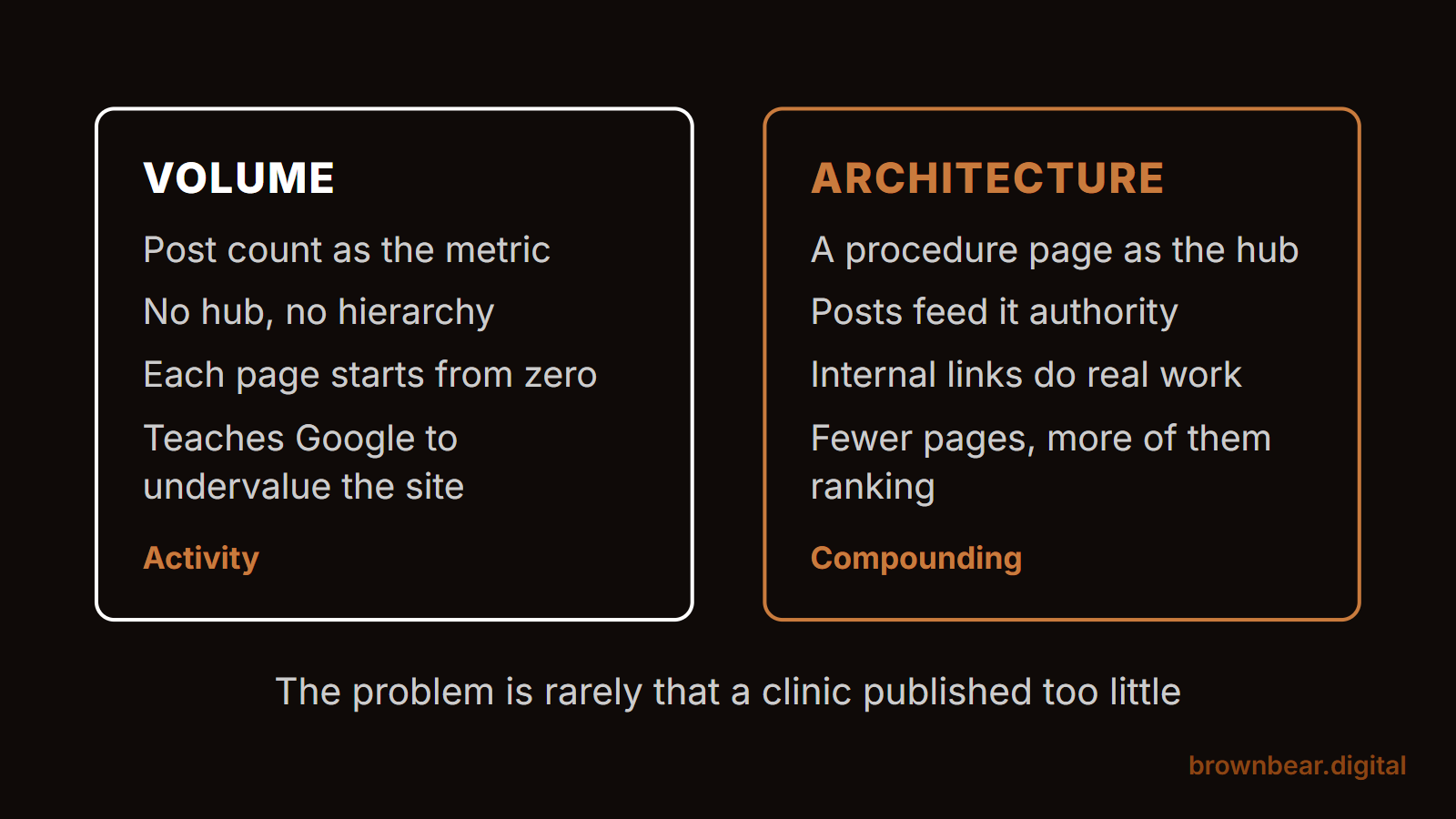
4. Publishing at Volume Without a Content Architecture Is Training Google to Undervalue Your Site
AI makes it fast to publish. That speed creates a specific kind of problem. Volume without architecture is the opposite of the cluster-based approach we lay out in content marketing for plastic surgeons, where every piece has a defined job inside a structure.
When a clinic uses AI to produce eight to twelve articles a month, the content calendar fills up and the output feels like momentum. But Google's Helpful Content Update changed the calculus on content velocity. Sites that publish large volumes of content that doesn't demonstrate genuine expertise, doesn't fully satisfy the reader's actual question, or duplicates what already exists in better-constructed pieces receive a sitewide quality signal that affects every page, not just the thin ones.
For medical clinics publishing in YMYL categories, the threshold is lower than it is for other industries. Google scrutinizes health content more carefully. A dental clinic publishing twenty-four AI-generated articles a year with no clinical depth, no author attribution, and no differentiated perspective is accumulating a sitewide quality liability that will surface in the next core update.
What this looks like in practice
You are publishing consistently, articles are getting indexed, but organic growth is flat. Pages that were performing adequately are starting to slip. The issue isn't the individual pages in isolation. It's the signal the site is sending as a whole.
What to do instead
Volume is not a strategy. Two well-constructed, experience-backed articles a month will outperform twelve thin ones over any meaningful time horizon in the healthcare vertical. Cut the publishing cadence and raise the standard for what earns a spot in the calendar.
5. Publishing Multiple Similar Pages Is Cannibalizing the Rankings You Are Trying to Build
This is the structural consequence of publishing at volume without a content architecture, and it compounds quietly over time.
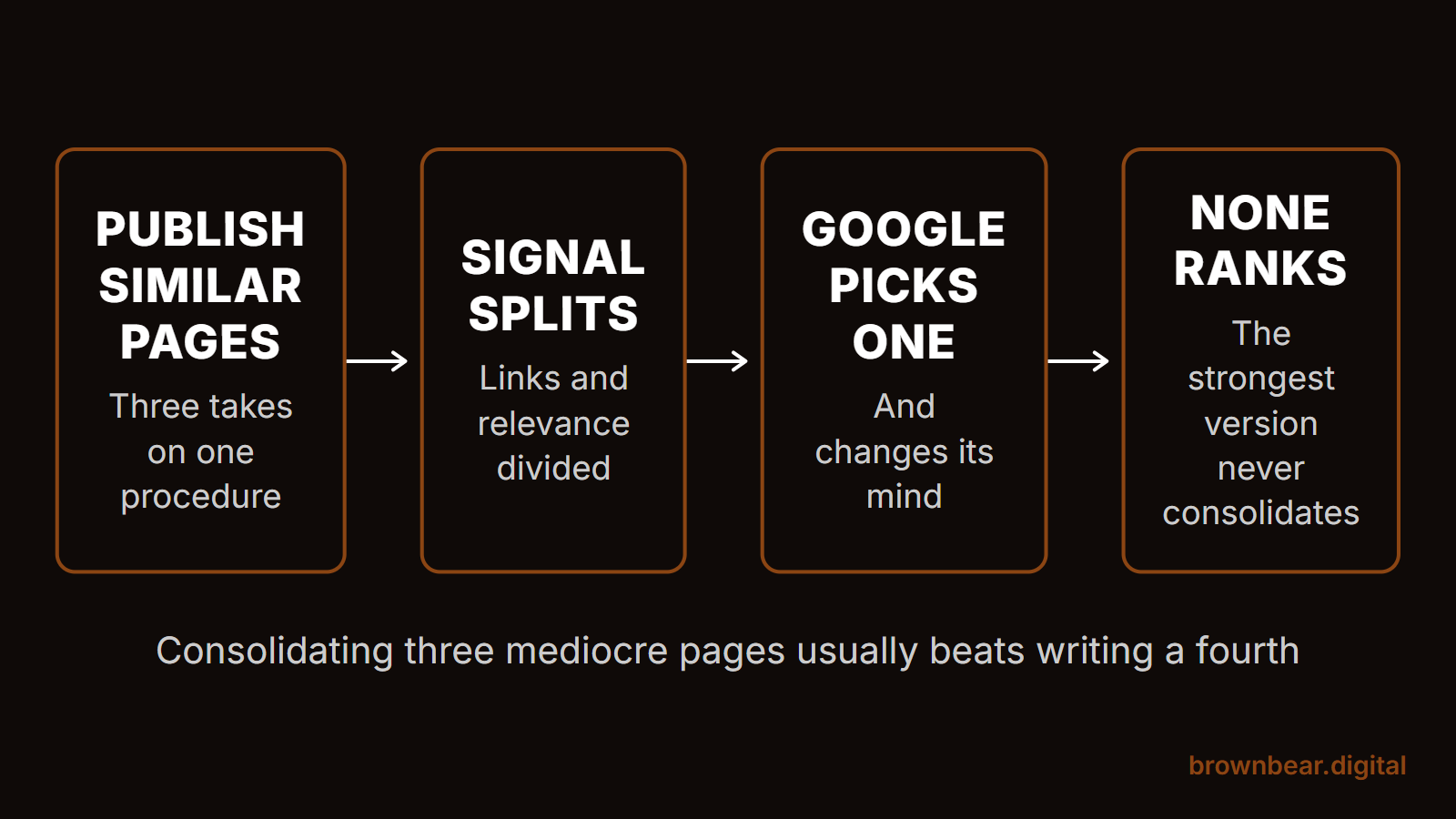
When a clinic publishes separate pages for "how much does botox cost," "botox pricing guide," "what affects the cost of botox," and "is botox worth the price" without a clear hierarchical structure connecting them, Google faces an ambiguous choice: which page best answers the query? When no clear answer emerges, none of the pages rank as well as a single authoritative resource would have.
This is topical cannibalization. The pages compete against each other for the same ranking signal, authority dilutes across all of them, and every page performs below its potential.
In competitive markets like plastic surgery, aesthetic medicine, and dental implants, where you are already contending with established practices that have significant domain authority, splitting your own authority across near-duplicate pages is a compounding disadvantage you cannot afford.
What this looks like in practice
You search for a procedure your clinic offers and three or four of your own pages appear in the results at positions seven, nine, eleven, and fourteen, when one authoritative page should be sitting at three or four.
What to do instead
Audit your existing content for cannibalization before publishing anything new. Where multiple pages overlap on keyword target, consolidate them into a single comprehensive resource and redirect the others. Build a content hub strategy where one pillar page anchors each core topic and supporting content links into it with clear hierarchy.
6. Scaling Brand Mentions on Sites That Generate No Real Signal Is Not Link Building
Brand mentions and backlinks are legitimate SEO signals. The logic is straightforward: credible sources referencing your clinic increase the authority Google attributes to you. The problem is in how clinics have interpreted "more."
AI-assisted outreach tools have made it easy to generate brand mentions at scale. Guest posts, directory submissions, sponsored content placements: all publishable quickly and cheaply. The volume looks substantive in a monthly report. What it does not do is transfer meaningful authority to your domain.
"What we see consistently is that the goal becomes the number, not the quality or relevancy of the placements. A clinic goes from zero brand mentions to forty-plus in a single month. That kind of surge is a red flag, not a win. Google isn't counting mentions. It's evaluating the authority and topical relevance of the sites those mentions come from. When we audit a program built around volume, the placements are almost always on sites with no connection to healthcare, no real traffic, and no audience that would ever become a patient."
Bryan Passanisi, Founder, Brown Bear Digital
A dermatology clinic with forty brand mentions on general lifestyle blogs, random news aggregators, and content sites that exist primarily as link placement vehicles has not built SEO equity. It has built the appearance of SEO activity. A few high-quality, topically relevant mentions from authoritative sources in the healthcare space are worth more than hundreds of low-quality placements on sites your prospective patients will never encounter. In some cases, a pattern of low-quality link acquisition triggers a manual review.
What this looks like in practice
Your monthly SEO report shows thirty-five new brand mentions. When you examine the actual sites, they are a mix of general health directories, regional lifestyle blogs with minimal traffic, and content networks built primarily for link placement. None of them are publications your prospective patients actually read.
What to do instead
Evaluate every potential placement against three criteria in this order: topical relevance to healthcare or your specific specialty, actual organic traffic to the site, and domain authority. A single mention in a publication your target patient demographic reads is worth more than fifty placements they will never see. Drop volume as a success metric for brand mentions entirely.
7. Taking AI Tool Optimization Recommendations at Face Value Without Applying Context
AI-powered SEO platforms have become standard in clinic marketing stacks. Tools that generate meta title recommendations, flag internal linking gaps, audit schema markup, and score page optimization are useful, and the recommendations they surface are often correct in principle. They are frequently wrong in execution context. (Understanding how AI engines actually decide which practices to recommend is the context most tool recommendations are missing.)
"The most common issue we see is meta titles and descriptions generated without any context about the keyword target or the intent of the page. The output is technically a meta title, but it's the wrong one: too long, too short, or written to describe the page rather than answer what the searching patient actually wants. Schema is the other consistent problem. We see a lot of basic markup that's incomplete, or schema types applied to pages they don't fit. The tool generates something that passes a validation check, but it's not giving Google what it needs to understand the clinical context of the page."
Bryan Passanisi, Founder, Brown Bear Digital
This happens because AI SEO tools are trained on broad patterns across large datasets. They identify what correlates with ranking success in aggregate, not what is appropriate for a specific page, site history, or practice type. A rhinoplasty service page with a legacy URL structure from a CMS migration needs a different approach than a new page built from scratch. A med spa with an established internal linking hierarchy needs recommendations evaluated against that structure, not applied over it. The tool is surfacing a pattern observed across thousands of sites. You have to determine whether that pattern applies to your specific situation.
What this looks like in practice
You run an AI SEO audit, implement the top twenty recommendations in a single sprint, and organic performance drops the following month. The recommendations were technically defensible in isolation. Applied to your site's specific architecture, they created problems that took months to untangle.
What to do instead
Treat every AI SEO tool recommendation as a hypothesis that requires validation, not an instruction that requires implementation. Prioritize by risk level, implement in small batches, and monitor between each. Do not implement bulk recommendations without a qualified SEO practitioner reviewing them against your site's specific context first.
8. AI-Generated Medical Content Is Creating Compliance Exposure Most Clinics Haven't Considered
This is the problem most clinic marketing managers have not thought about yet, and the one with the broadest potential consequences.
AI content tools have no awareness of FTC advertising guidelines. They do not know your state medical board's rules on before-and-after photo use, outcome language, or comparative advertising claims. They do not understand where the line sits between educational health content and regulated medical advice in your jurisdiction. And when you are publishing content at volume, the probability of a compliance breach scales with every piece you publish.
Plastic surgery and aesthetic medicine practices face specific exposure here. FTC guidelines on before-and-after imagery require clear disclosure, contextual framing, and in many interpretations prior written patient consent. Language like "eliminate," "permanently remove," or guaranteed outcome framing embedded in AI-generated content crosses into claim territory that state medical boards actively regulate. Dental practices face parallel exposure around treatment outcome language and fee advertising rules that vary significantly by state.
What many clinics don't realise is that the compliance gap often starts before the content itself.
"The most consistent compliance issues we see are not in the copy itself. They're in how AI-developed clinic websites are built. Accessibility elements are missed at the build stage: alt text on images, proper heading hierarchy, color contrast, form labels. These aren't just legal requirements under ADA guidelines. They're quality signals. A site that fails basic accessibility standards sends a sitewide technical quality signal to Google that compounds every content problem on top of it. For medical practices, it's a legal exposure and an SEO liability at the same time."
Bryan Passanisi, Founder, Brown Bear Digital
Content-level compliance deserves equal attention. Outcome guarantees, unqualified superlatives, and before-and-after claims without proper disclosure should not survive the editorial process at any well-run clinic.
What this looks like in practice
Your AI-generated content for a laser resurfacing service uses phrases like "proven to eliminate fine lines" and "guaranteed results in three treatments." These are FTC flag risks for outcome language and precisely the kind of unsubstantiated claim Google's quality raters are trained to identify as low-quality health content. Meanwhile, the AI-built website behind that content is missing alt text on half its images and has form fields without accessible labels.
What to do instead
AI-generated content for medical services requires a compliance review before publication, not just a clinical one. Build a checklist of prohibited language specific to your practice type and jurisdiction and run every piece through it before it goes live. Pair that with a technical accessibility audit of the site itself. The two issues travel together more often than not.
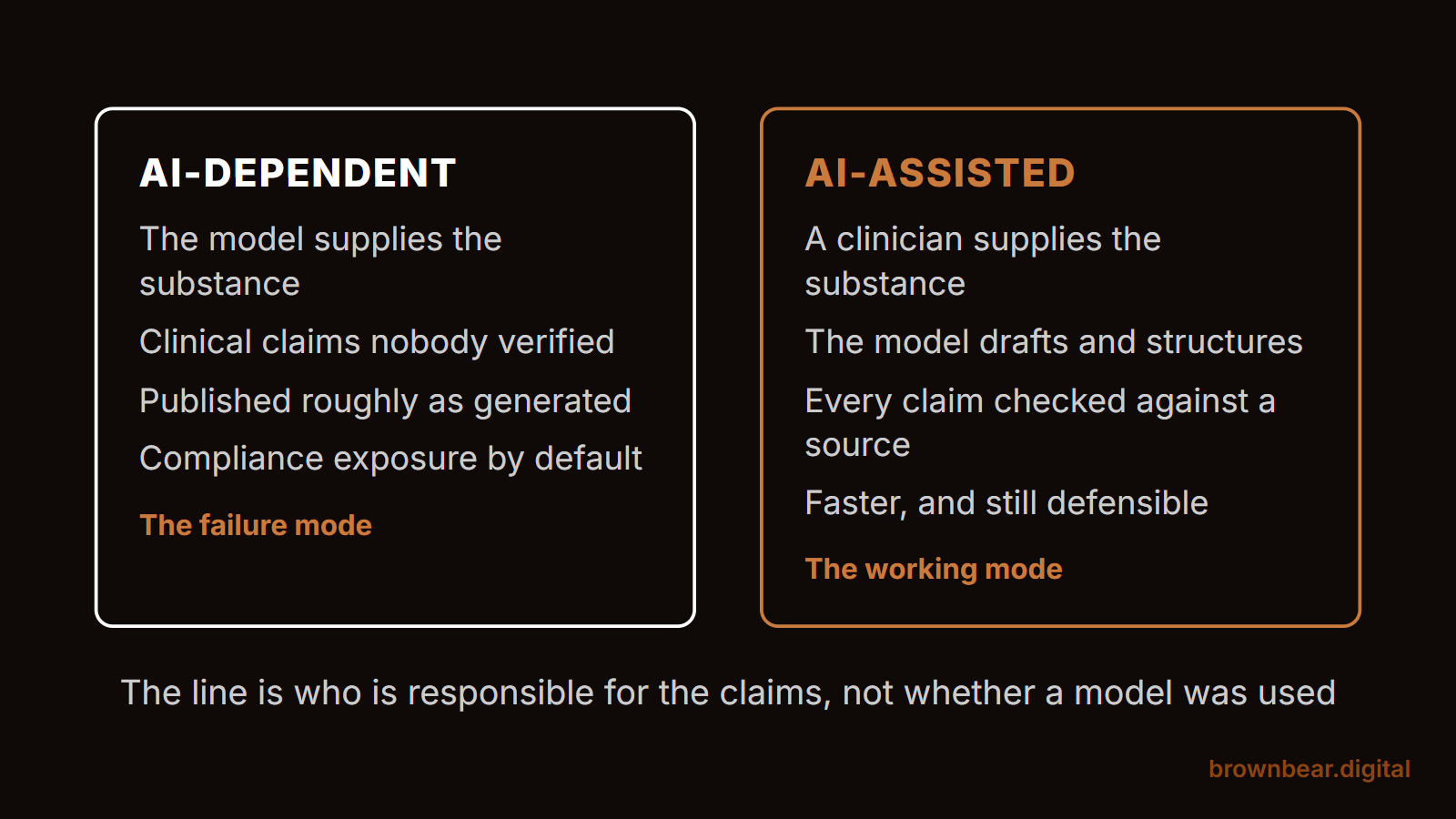
The Gap Between AI-Assisted and AI-Dependent
The clinics struggling with AI SEO right now are not failing because they adopted AI. They are struggling because they adopted AI as a substitute for strategy rather than a tool within one.
AI can accelerate clinic SEO when used to execute a well-developed framework: the right content architecture, clinical authority genuinely embedded, patient intent mapped across the funnel, compliance-aware review processes, and quality-controlled distribution through sources that actually matter. Used without that framework, it produces content that looks like SEO, creates the feeling of progress, and quietly accumulates the signals that lead to algorithmic suppression, ranking penalties, and in the worst cases, regulatory exposure.
Most of your direct competitors are making these same mistakes. The clinic that addresses them first, and builds the strategic foundation that AI tools require to perform, has a real and closing window.
Brown Bear works with dental practices, med spas, dermatology clinics, plastic surgery groups, physical therapy practices, and chiropractors on SEO built on clinical authority, strategic content architecture, and a clear understanding of how patients find and choose medical providers. If this piece resonated, reach out to talk through where your current SEO program stands and what it would take to move it forward.
Written By
Founder, Brown Bear Digital
Bryan has 15 years of experience across SEO, paid search, and AI search strategy. He founded Brown Bear to give businesses direct access to senior-level search expertise without the agency overhead.
Learn More About BryanGet Found on Google.
Get Cited by AI.
Tell us about your site. We'll send back a proposal for SEO and AI search.