How to Track Brand Mentions in AI Search: Tools, a Free System, and What to Do Next
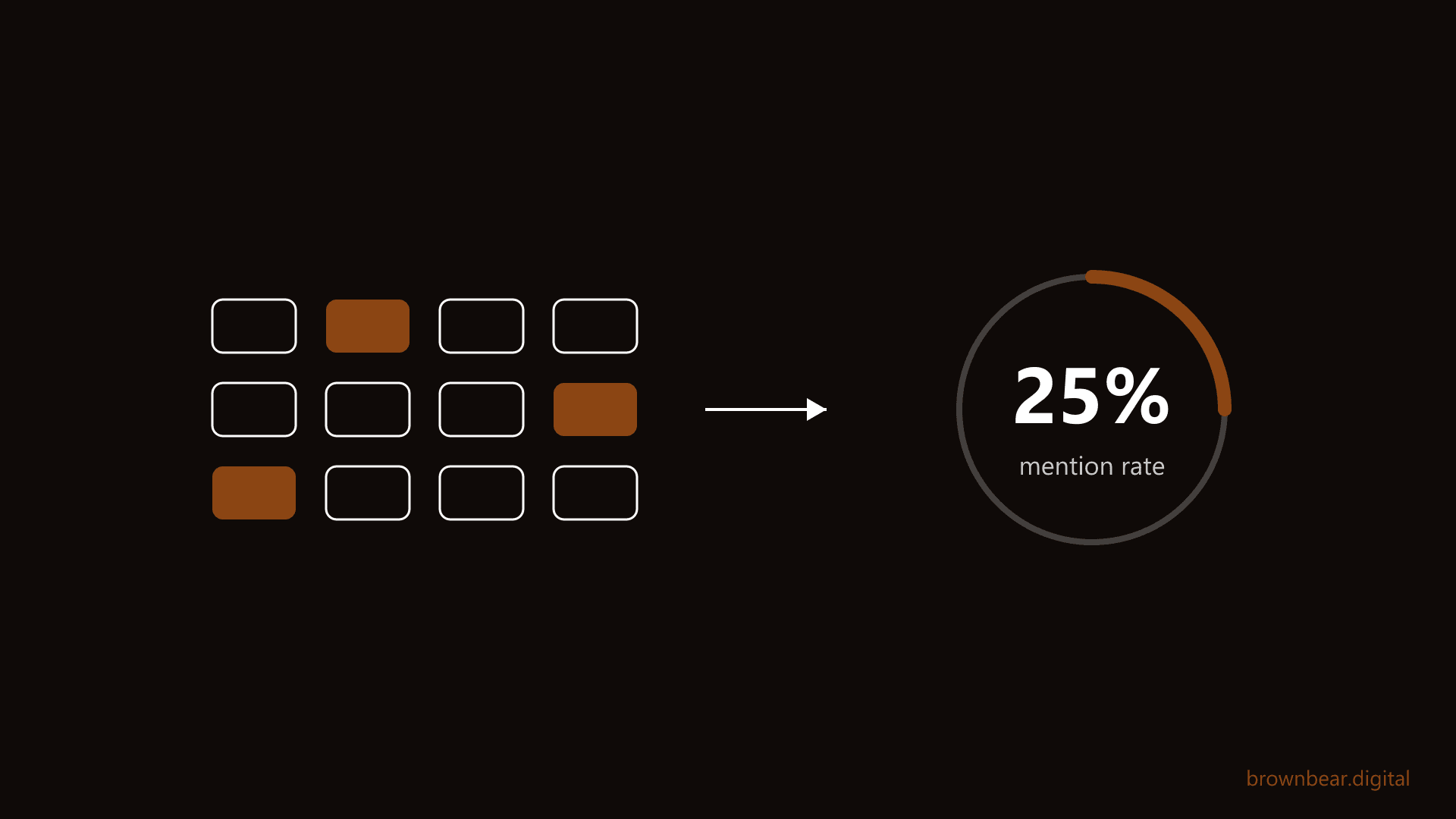
Your customers are already asking ChatGPT who to buy from, and most brands have no idea what it says back. This is a working guide to tracking brand mentions in AI search: what can actually be measured, which tools are worth paying for at each budget, and the free system we use to baseline a brand's AI visibility before any money gets spent.
At Brown Bear, we run AI visibility programs for clients ranging from medical practices to service businesses, and the methods in this guide are the ones those programs start with. We do not sell tracking software, which matters here more than usual: nearly every guide ranking for this topic is written by a vendor whose answer to "how do I track this?" is its own product.
When we say AI search, we mean both the chat assistants, like ChatGPT, Perplexity, Gemini, Claude, and Copilot, and the AI layers inside Google itself, AI Overviews and AI Mode. Tracking works differently across them, and this guide covers both kinds.
If you're a marketing lead whose CEO just asked "do we show up in ChatGPT?", this will give you an actual number to bring back. If you own a practice or a local business and a new customer just told you an AI recommended you, this shows you how often that's happening and what the AI says when it does. And if you're the in-house SEO trying to pick a tracking tool without burning budget on the wrong tier, the comparison below is the one we wish vendors published.
By the end, you'll have three things: a straight answer on what can and can't be tracked, a tool shortlist matched to your situation, and a free tracking log you can start using today. We've grouped the guide into four parts: what's possible, the tools, the free manual system, and what to do with what you find.
Let's start with the question behind every other question here: can you actually track this at all?
Key Takeaways
You can track AI mentions, but only by sampling
There is no rank to check and no search console for chats. Run buyer-style prompts across the engines on a schedule and record who gets named: mention rate and share of voice are the numbers that matter.
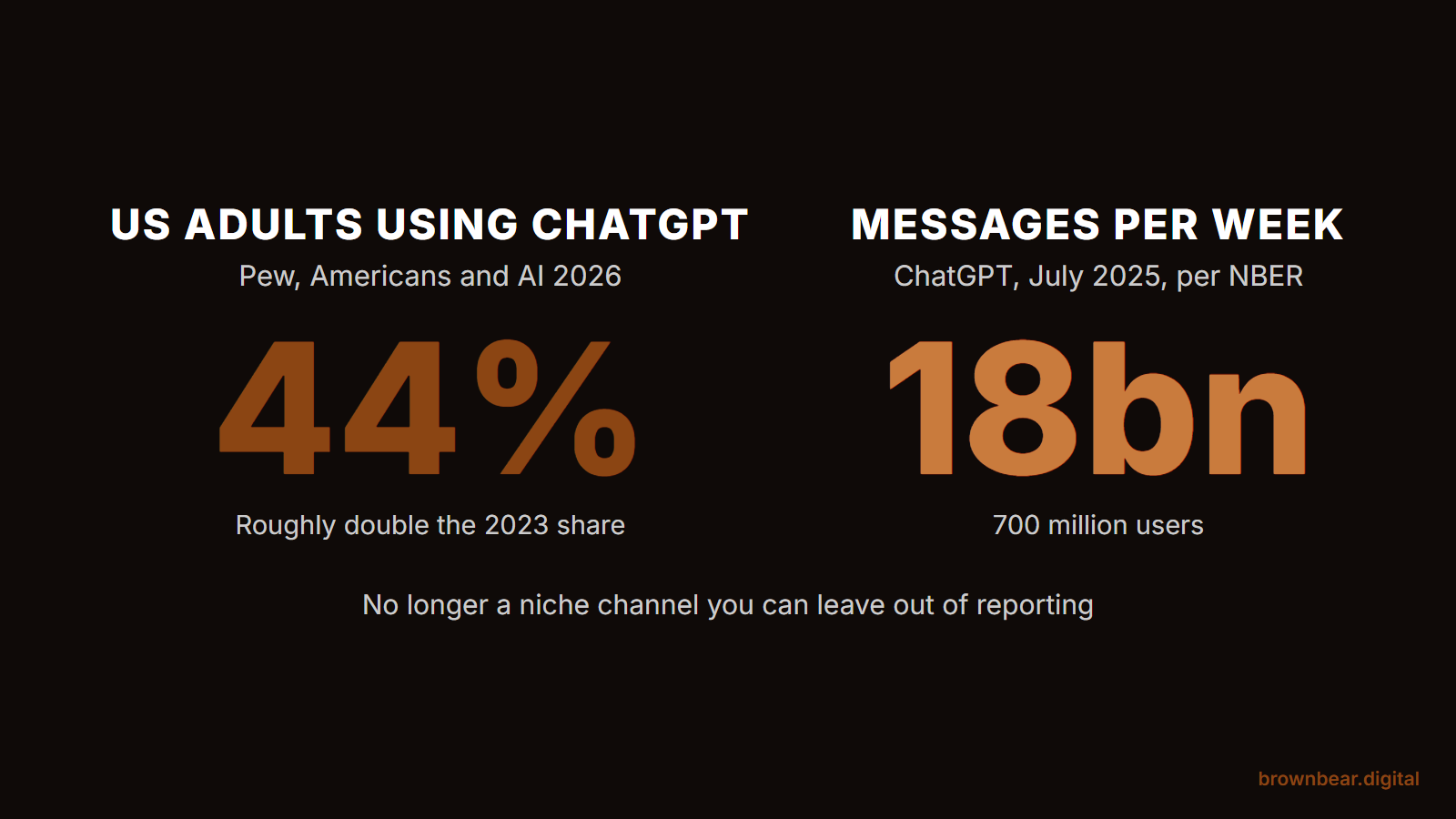
44% of U.S. adults now use ChatGPT
That is roughly double the share in 2023, per Pew Research Center. If your brand is not in those answers, a competitor is, and ranking number one on Google does not mean ChatGPT knows you exist.
Start free with the 12-Prompt Baseline
Twelve buyer-style prompts, three engines, run weekly for four weeks, at about 30 minutes a week and zero dollars, tells you whether you have an AI visibility problem worth funding before you buy any tool.
Fix the sources, not the chatbot
Wrong or thin descriptions trace back to the pages AI keeps citing. Correct the directories, reviews, and comparison pages feeding the answers, and the description follows the sources within weeks.
Can You Actually Track Brand Mentions in AI Search?
Yes. You can track brand mentions in AI search by sampling: running the buyer-style questions your customers ask, across the AI engines they use, on a schedule, and recording whether your brand shows up in the answers. Over enough runs, that produces a mention rate you can benchmark and improve. Every serious tool and every manual system works this way.
The caveat is what you cannot do. There is no rank to check and no search console for chats. Conversations with ChatGPT are private, so no tool can see what the AI told someone else yesterday. What tracking gives you is a statistical picture built from your own sampled runs, not a log of real user sessions. That's still enough to know where you stand, and it's far better than the current default at most companies, which is finding out from a customer.
The audience is no longer niche: 44% of U.S. adults now use ChatGPT, roughly double the share in 2023, according to Pew Research Center's Americans and AI 2026 survey. If your brand isn't in those answers, a competitor is.
Why Tracking AI Mentions Is Nothing Like Rank Tracking
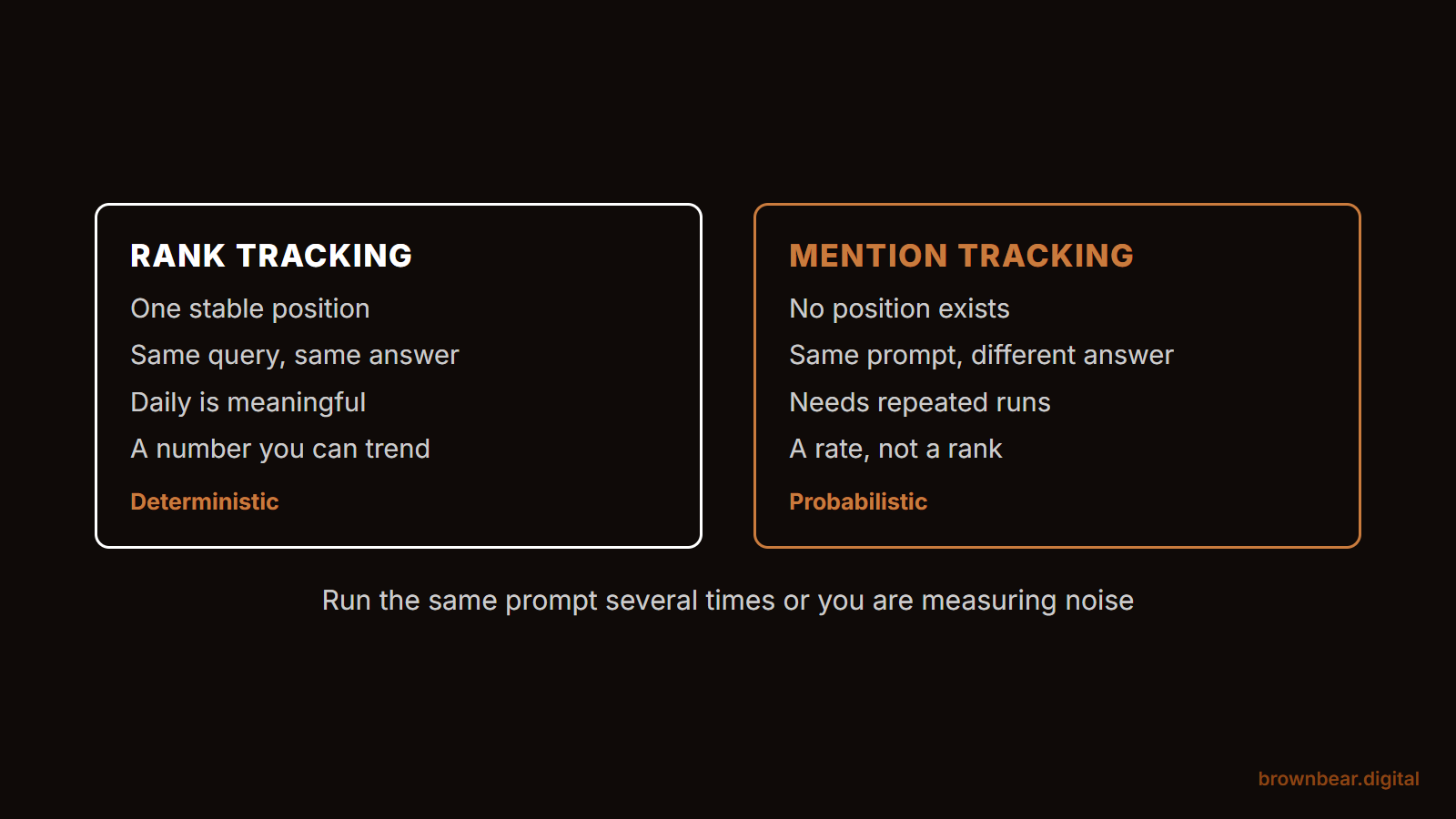
Rank tracking measures your position in a fixed list of links. AI mention tracking measures whether an assistant names you inside a synthesized answer, and that answer changes between runs. Ask the same question twice and you'll often get different brands, in a different order, described differently. So the unit of measurement changes: not "position 3," but "mentioned in 6 of 10 runs."
Picture a med spa director who asks ChatGPT for the best med spa in Scottsdale ten times across a week. Her spa appears in four of the ten answers, each time described a little differently. A rank tracker has no way to represent that. Her real number is a 40 percent mention rate, and the job of a tracking program is moving it toward 70.
The engines also behave differently from each other. Perplexity lists its sources with each answer, which makes it the easiest place to see what's feeding the machine. Google's AI Overviews are tied to its live index and link out. ChatGPT blends model knowledge with web browsing, and answers pulled through its API often differ from the consumer app, because the API leans on the static model while the app can pull from the live web. A tracking system has to sample each engine separately rather than treating "AI" as one channel.
The scale explains why this deserves a line in your reporting: by July 2025, ChatGPT alone was handling 18 billion messages a week from 700 million users, about 10% of the world's adults, per the NBER working paper How People Use ChatGPT. The buying journey compresses inside those chats, a shift we've broken down in how AI search is changing the way people research and choose providers.
One more thing rank tracking never prepared you for: you can rank number one on Google and still be invisible in ChatGPT. AI engines lean on a different graph of sources, weighted toward third-party coverage. In our audits, that's the finding that surprises owners most: how much review sites, directories, and press drive AI visibility and sentiment compared with the brand's own site.
The Best AI Brand Monitoring Tools, From 29 Dollars to Enterprise
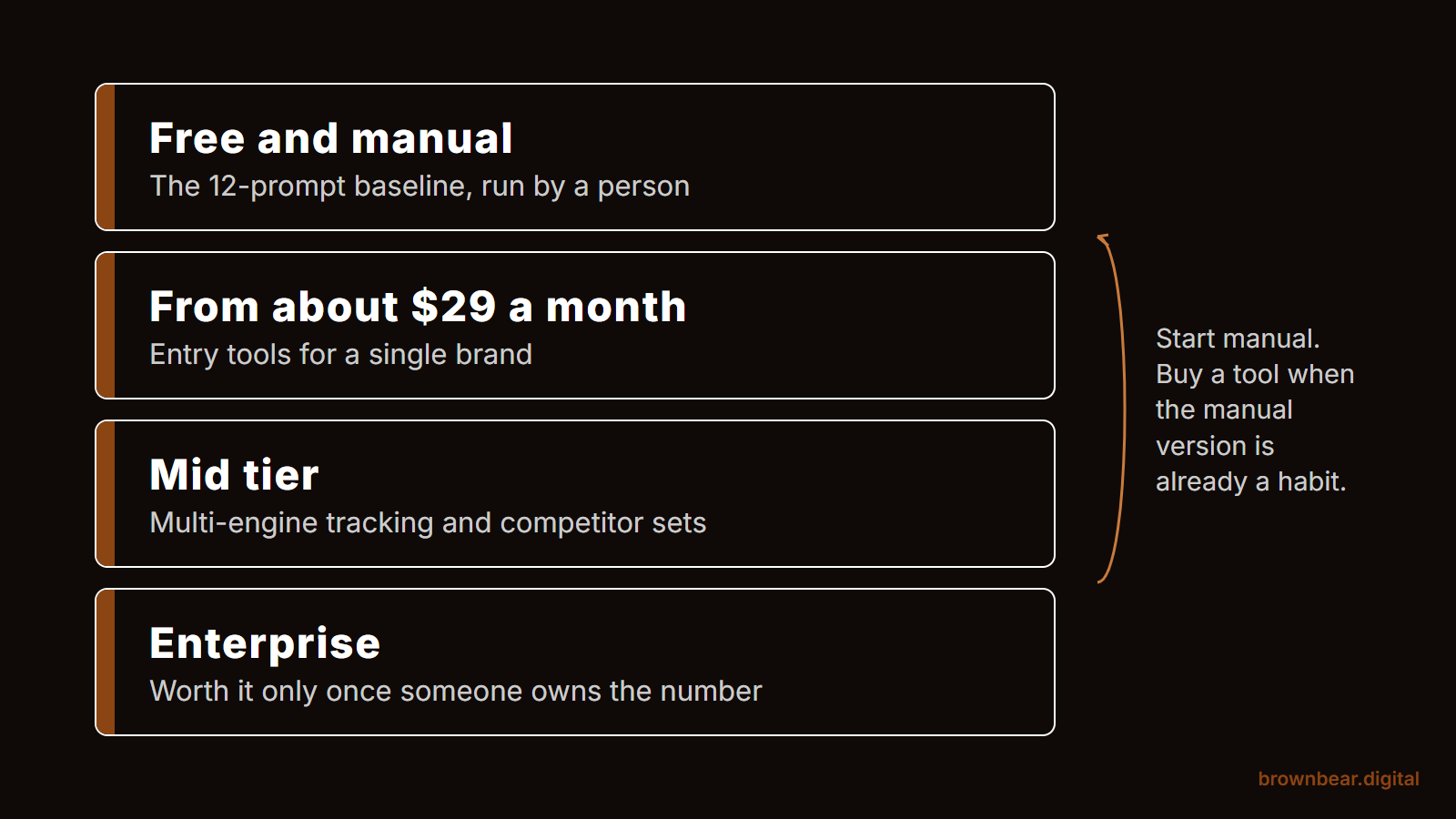
Five tools cover most budgets and team sizes. None of them is ours; we don't sell software, and this is the comparison we run when scoping client programs. Prices were verified against each vendor's pricing page in July 2026, and note that several vendors advertise the annual-billing rate, so the monthly-billing price can run higher.
| Tool | Starts at | Tracks at entry tier | Best fit |
|---|---|---|---|
| Otterly.AI | $29/mo Lite, 15 prompts | ChatGPT, AI Overviews, Perplexity, Copilot | First paid tool for local and small brands |
| Peec AI | $95/mo Starter, 50 prompts | Your pick of 3 engines | Mid-size teams tracking competitors daily |
| Semrush AI Visibility | $99/mo per domain, billed annually, 25 prompts | ChatGPT, AI Overviews, AI Mode, Gemini, Perplexity | Teams already inside Semrush |
| Profound | $99/mo Starter, yearly billing, 50 prompts, ChatGPT only | ChatGPT at entry; 3 engines on the $399 Growth tier | Brands that want citation and agent analytics depth |
| Ahrefs Brand Radar | $398/mo selected platforms, $699/mo all | AI Overviews, ChatGPT, Perplexity, Copilot, Gemini, Grok | Enterprise share-of-voice across a whole market |
A few working notes from using these. Otterly's 15-prompt cap sounds small until you remember a disciplined prompt set for a single-location business is about a dozen prompts; it's genuinely enough to start. Peec's entry tier makes you choose 3 engines, which is a real constraint if your audience splits between Google's AI results and ChatGPT. Profound's entry tier is ChatGPT-only, and the jump to 3 engines costs 4x, so price the tier you'll actually need, not the teaser. Brand Radar is the only one built on a market-wide prompt database rather than just your own tracked prompts, which is why it costs what it costs.
Which one is yours comes down to two deciding factors: budget and how much of your customer journey already runs through AI. If you're a local business under $100 a month, start with Otterly Lite or the free manual system below; your prompt set is small and the extra engines matter less than consistency. If you already pay for Semrush, the AI Visibility add-on wins on integration alone. And if AI answers are already sending you measurable leads, that's the signal to fund Profound Growth or Brand Radar, where the deciding factor is whether you need market-level prompt data or just depth on your own prompts. Where that budget comes from is its own decision; we've laid out our approach in adapting your SEO budget for AI search.
How to Track Brand Mentions in AI Search Without Paying for a Tool
You can see if AI mentions your brand for free: pick 8 to 12 questions a real buyer would ask, run them weekly in ChatGPT, Perplexity, and Google, and log whether you, a competitor, or nobody gets named. That's the entire method. A spreadsheet with five columns does it: date, prompt, engine, who got mentioned, and how you were described.
The tool vendors ranking for this topic call manual checking "the slow way," and of course they do; it competes with what they sell. Our position is different. For a local business or a first baseline, a disciplined manual system is not a compromise, it's the right first move. It costs nothing, it forces you to learn what your buyers actually ask, and four weeks of logged runs will tell you whether you have an AI visibility problem worth funding. What makes manual data useless is doing it once, screenshotting one good answer, and calling it a day. Consistency is the whole game.
The hardest part is writing prompts like a buyer instead of like a marketer. Nobody types your tagline into ChatGPT. Use the builder below to generate a starter set for your business, then edit it down to the 12 your customers would genuinely ask.
Free Tool
AI Buyer Prompt Set Builder
Answer four questions and get a ready-to-track set of buyer-style prompts, the same starting point we use in client AI visibility audits.
Add your brand name and what you offer first.
For informational purposes: generated prompts are starting points, not a guarantee of AI visibility results. Nothing you type here is transmitted or stored; it stays in your browser and clears when you leave the page.
The 12-Prompt Baseline: Our Step-by-Step Tracking System
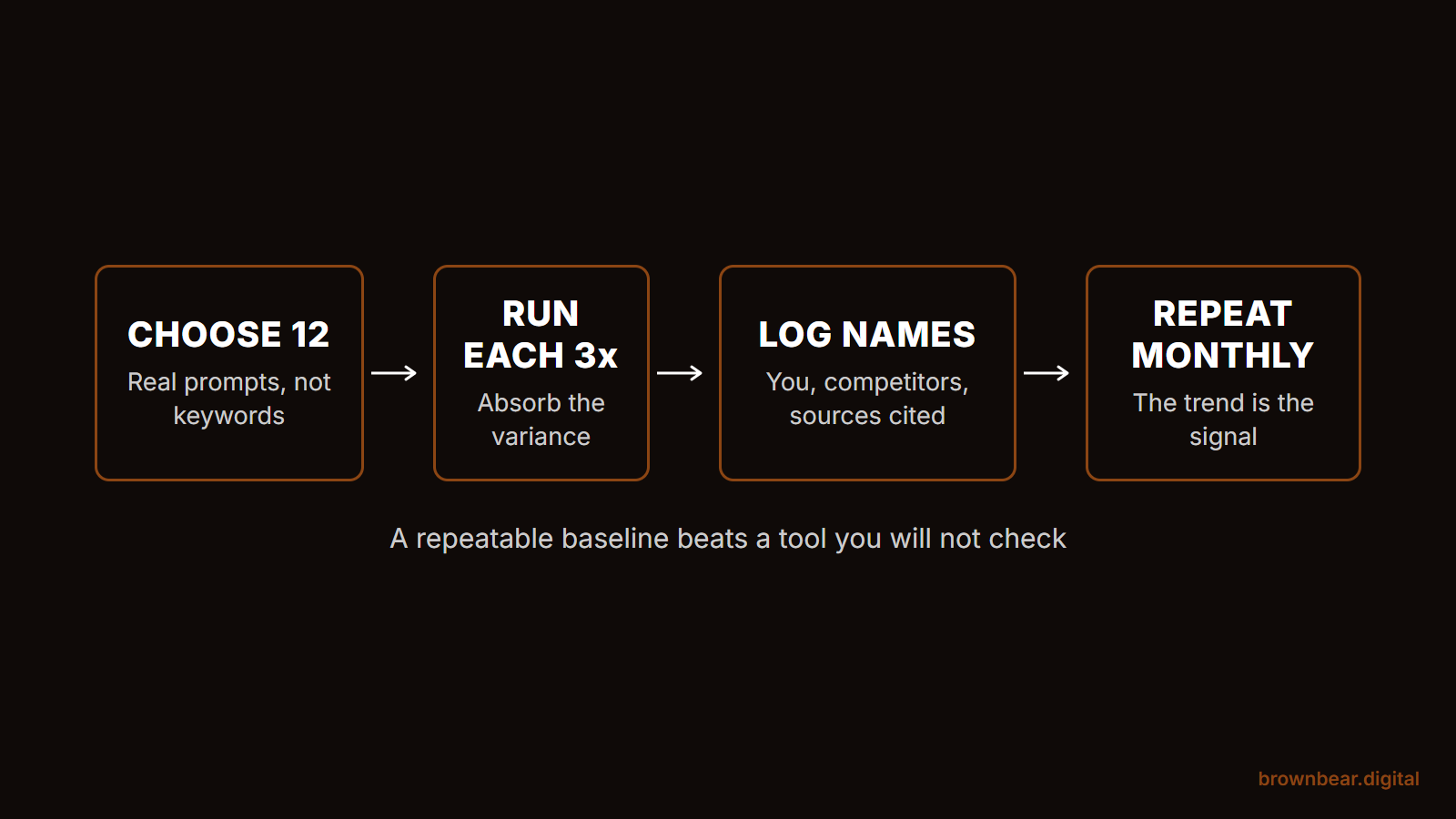
This is the system we run at the start of client engagements, and it works the same whether you log results in a spreadsheet or a paid tool. We call it the 12-Prompt Baseline. It takes about 30 minutes a week.
- Build your prompt set. 12 prompts across four intents: discovery, comparison, validation, and cost. The builder above produces this split for you.
- Pick your engines. ChatGPT, Perplexity, and Google's AI results are the minimum three. Add Gemini or Copilot if your audience skews Android or Microsoft-workplace.
- Run the set on a schedule. Weekly, same day, logged out where possible. Expect different answers run to run; that variance is why you sample instead of spot-check.
- Log every run. Who got mentioned, in what order, described how. Use the tracking log below; it saves in your browser and exports CSV.
- Compute two numbers. Mention rate is the share of runs where you appear. Share of voice is your mentions divided by yours plus your competitors'. These are the numbers for the leadership slide.
- Capture what the answers cite. Especially in Perplexity and AI Overviews. The sites AI keeps citing in your category are your target list for the fix-it work later.
- Tie it to revenue in GA4. Build a segment for sessions whose source contains chatgpt.com, perplexity.ai, gemini.google.com, or copilot.microsoft.com, and watch its conversion rate next to your other channels. Across our clients, LLM referral traffic converts at a higher rate than any other channel we track, which is exactly the number that turns a skeptical CFO into a sponsor.
Say you're the founder of a payroll software startup. Twelve prompts, three engines, four weeks: 144 logged runs. Your mention rate comes back at 8 percent while your biggest competitor sits at 31, and the citation log shows the same two comparison blogs and a G2 page feeding most answers that exclude you. In one month, for zero dollars, you've turned "do we show up in AI?" into a target list of three pages to win.
Free Tool
AI Mention Tracking Log
Log each prompt you run in ChatGPT, Perplexity, Gemini, or Google's AI results. The log computes your mention rate and share of voice as you go, and saves in your browser between visits.
Type the prompt you ran first.
| Date | Prompt | Engine | Result | Sentiment |
|---|
No runs logged yet. Run a prompt in an AI engine, then record what happened.
For informational purposes: this log reflects only the runs you record and is not a guarantee of AI visibility performance. Your entries are stored only in this browser via localStorage; nothing is transmitted to any server.
The Metrics That Matter and the Ones That Just Look Good
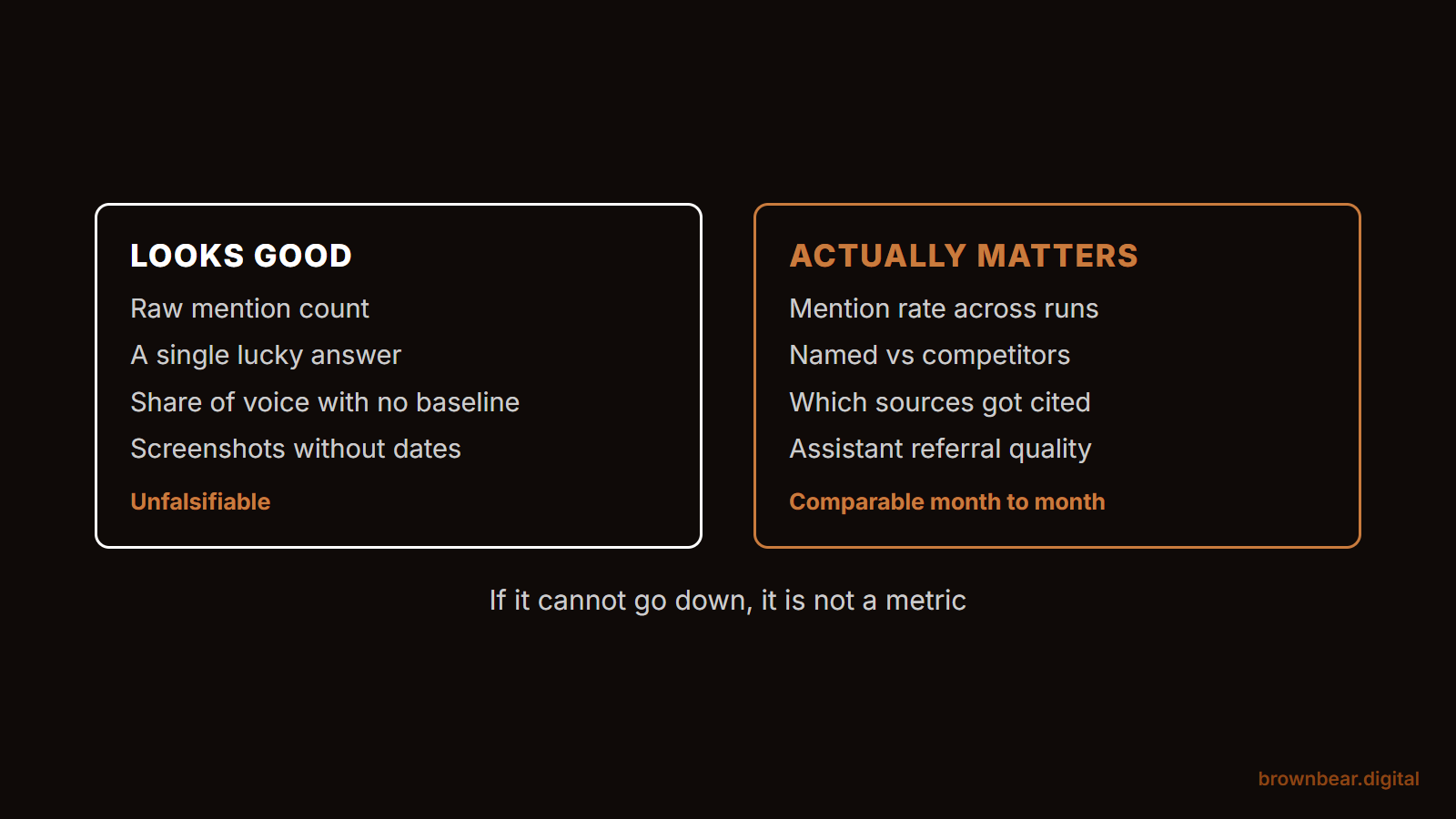
Four metrics carry a tracking program, in this order. Mention rate tells you whether you exist in the answers. Share of voice tells you whether you're winning them. Citation sources tell you where to act, since they name the pages doing the recommending. And accuracy tells you whether what the AI says about you is right, current, and emphasizing what you want to be known for.
Two others deserve skepticism. Position-in-answer is a weak proxy; answers reorder run to run, and being named at all matters far more than being named first. And the screenshot of one great ChatGPT answer is the new vanity metric: unfalsifiable, unrepeatable, and gone on the next run. If a number can't survive being sampled twice, don't put it on a slide.
If you're the in-house SEO making the budget case, bring exactly two charts to the meeting: share of voice against your top competitor over time, and the GA4 LLM referral segment's conversion rate next to organic. The first proves the gap, the second proves the money.
You Found Your Mentions. Now What?
Tracking is diagnosis. What you do next depends on which of three situations the data shows, and the answer genuinely forks here.
If you're not mentioned anywhere, the work is foundational. AI engines can't recommend a brand they can't read or find corroborated elsewhere. That means a crawlable site with cleanly structured content, and a presence on the third-party sites your category's answers keep citing: reviews, directories, press. A word on schema markup, since every vendor pitch leans on it: we consider it worth doing and overhyped. The bigger levers in our experience are crawlability and easily structured content; LLMs handle JavaScript poorly, and we strip large amounts of it off client sites for exactly this reason. That work sits inside a technical SEO foundation, and the content side is covered in our GEO and AEO playbook.
If you're mentioned but described wrong, the work is correction, and it's usually smaller than owners fear. In our AI visibility audits, flat-out false information is rare. The two patterns we actually find: the AI describes a specialist as a generalist, burying the services the brand most wants to be known for, and small factual drift like odd variations of a name, address, or phone number pulled from stale listings. Both trace back to sources, so the fix is updating the pages the answers cite, not arguing with a chatbot. We've written up that process in getting your brand named and described correctly in AI answers.
Say you run a three-location dental group, and the log shows Perplexity calling your flagship implant studio "a general dentist office" while citing a directory listing with a phone number you retired two years ago. The fix isn't new content. It's correcting four directory profiles and getting your implant work onto the pages Perplexity already trusts. Six weeks later the description follows the sources.
If you're mentioned and described accurately, protect it: drop to a monthly cadence, keep feeding the citation sources fresh material, and start expanding the prompt set into the next service line or market you want AI to associate with you.
Whichever situation you're in, the next step is the same size: 1. Run the 12-Prompt Baseline for four weeks. 2. Sort your result into one of the three situations above. 3. Fix the two highest-leverage citation sources before touching anything else. 4. Re-run the same prompt set and confirm the needle moved.
Questions We Hear About AI Mention Tracking
What counts as a brand mention in AI search?
Any time an AI-generated answer names your brand, whether as a recommendation, a comparison, or a citation of your site. Mentions and citations differ: a mention names you in the answer text, while a citation links your page as a source. Track both; mentions drive customers, citations reveal what the AI trusts.
How often should you check?
Weekly while you're establishing a baseline or fixing a problem, monthly once your mention rate is stable and accurate. One-off checks are noise; the variance between runs is too high for a single sample to mean anything.
Which AI engine matters most?
The one your buyers use, which you can see in your GA4 referral data rather than guess. ChatGPT has the largest user base, and Google's AI Overviews reach the most searchers by default, so those two plus Perplexity make the standard starting three.
Can you make AI mention your brand more often?
Yes. That's the discipline now called GEO, generative engine optimization: making your site easy for AI systems to read and building your presence on the sources they cite. Tracking tells you where you stand; GEO moves the number.
Get Your AI Visibility Baseline from Brown Bear
You now have the full system: what's trackable, the tools worth paying for, and a free baseline you can start this week. If you'd rather have the answer than the homework, this is what we do. Brown Bear runs the baseline, the fix-it work, and the reporting as one AI search optimization program, and we'll show you the mention rate and the referral conversions on the same slide. Ask us what your brand's baseline looks like.
Written By
Founder, Brown Bear Digital
Bryan has 15 years of experience across SEO, paid search, and AI search strategy. He founded Brown Bear to give businesses direct access to senior-level search expertise without the agency overhead.
Learn More About BryanGet Found on Google.
Get Cited by AI.
Tell us about your site. We'll send back a proposal for SEO and AI search.