How to Adapt Your SEO Budget for AI Search Optimization

This is a working plan for adapting an SEO budget to AI search, written from the budget spreadsheets I actually manage. I'm Bryan Passanisi, founder of Brown Bear Digital, a search agency in the San Francisco Bay Area, and rebalancing client budgets for AI visibility has been the biggest part of my job for the past two years.
One finding shapes everything in this guide. When we run AI-visibility audits for new clients, the information AI gives about them is rarely wrong. The real surprise is how little they show up at all, and how much of what ChatGPT or Google's AI Overviews say about their category comes from other people's websites: review sites, directories, press coverage, YouTube. Once you watch that pattern repeat across accounts, you stop asking "how do I optimize my site for AI" and start asking "where does my budget actually need to go."
When I say adapting your SEO budget, I mean both rebalancing the spend you already have and adding line items most SEO budgets have never carried: placements on third-party sites, video, AI visibility tracking tools, a higher creative bar, and primary research. What I don't mean is a second, separate AI budget. Every dollar in this plan comes out of the search budget you already have.
If you're the marketing lead who has to defend next year's search line to a CFO, this gives you the line items and the reasoning behind each one. If you're a founder spending $2,000 to $5,000 a month on SEO and wondering whether any of it still matters, it shows you what to keep and what to trade. And if you're on the agency side re-scoping retainers, you'll recognize the same conversations I'm having with my own clients right now. If you run a plastic surgery practice, our breakdown of what plastic surgery SEO should cost prices each service line.
Key Takeaways
Same budget, new line items
Redirect 15 to 30 percent of your existing SEO budget; don't create a separate AI program that pays twice for overlapping work.
Third-party sites decide AI answers
Review sites, directories, and roundups shape what AI says about your category. Budget placements, affiliate, and PR to be present there.
Video punches above its cost
YouTube is one of the most cited domains in AI search. An iPhone and a good editor are enough.
Track it or fly blind
AI visibility tools like Peec AI, Scrunch, Profound, or your existing Semrush and Ahrefs plans show where you appear and which sources to target next.
Proprietary data gets cited
One survey a year produces the named stats AI answers quote, and it feeds every other line item.
By the end, you'll have five specific line items, a way to size them against your current budget, a short list of things to cut to pay for them, and the metrics that tell you whether the shift worked. The plan comes in three parts: the five line items, what to cut to fund them, and how to size and measure the whole thing. Let's start with the short version, because the core move is simpler than most of what's been written about it.
The Short Answer: Same Budget, New Line Items
To adapt an SEO budget for AI search optimization, keep the total roughly the same and redirect 15 to 30 percent of it toward the things AI search actually rewards: presence on the third-party sites that rank for your queries, video, AI visibility tracking tools, a higher bar for content quality and creative, and primary research. Fund the shift by cutting commodity content production and over-scoped technical projects, not by cutting fundamentals.
Most of what's been published on this topic agrees on the percentage range and stops there. I think the percentage is the least interesting decision you'll make. Two companies can both "move 20 percent to AI search" and get completely different results, because the money went to completely different things. The composition of the AI slice matters more than its size, and the composition is where most budgets go wrong.
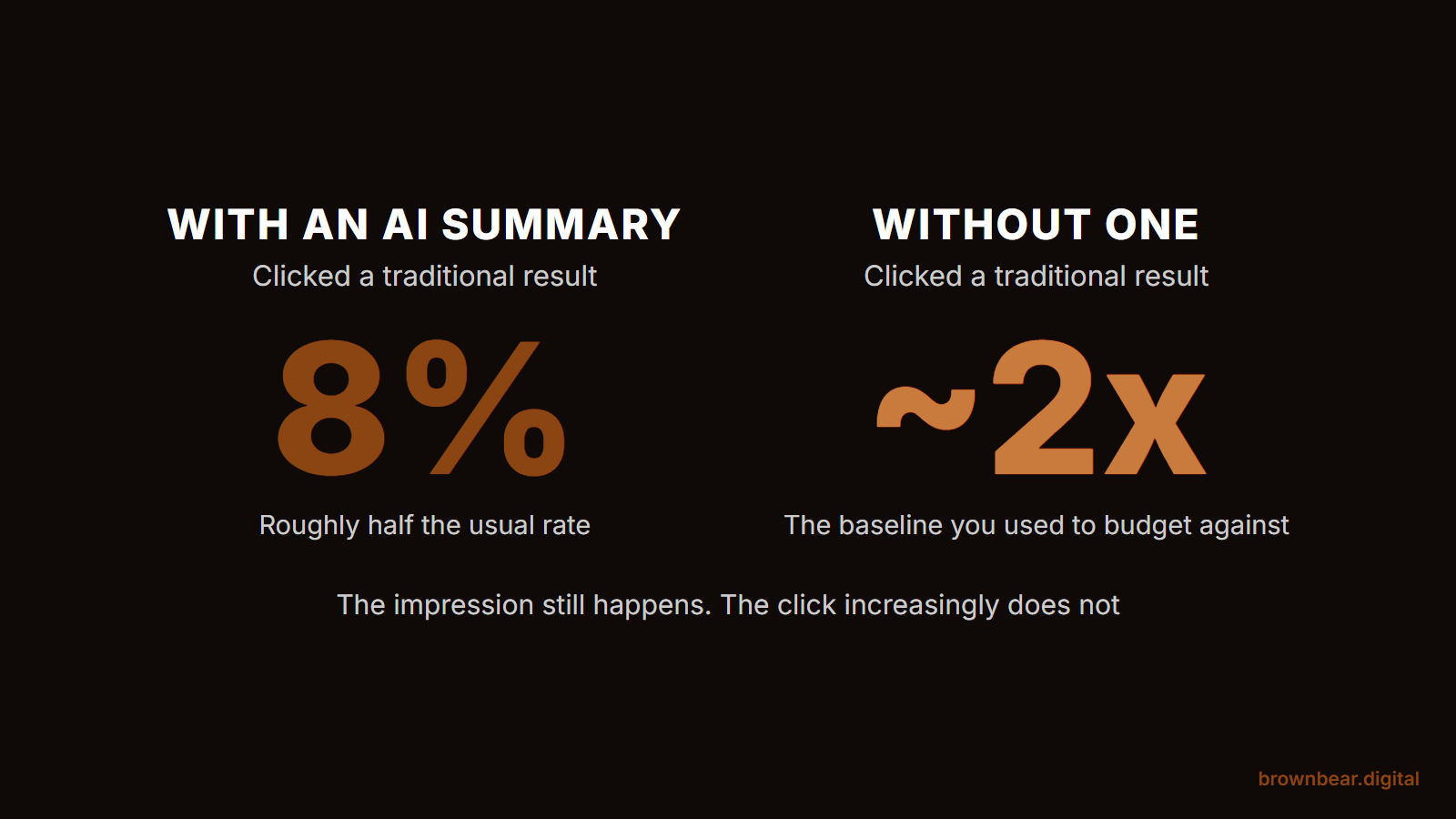
There's a reason the urgency is real, though. Pew Research Center found that when Google shows an AI summary, users click a traditional result on only about 8 percent of visits, roughly half the rate of pages without one. The clicks you built your old budget around are thinning out. The visibility is still there to win. It just lives in more places than your website now.
Why This Comes Out of Your Existing SEO Budget
I want to push back on the idea that AI search optimization deserves a new, separate budget, because most of the work overlaps with SEO you should already be doing. A crawlable site, authoritative content, clean entity signals, real links: that's what an ongoing SEO program should already be producing, and it's most of what earns AI citations too. At the smaller end, we have ordered the same work by cost in GEO on a small budget. If an agency pitches you a standalone "GEO program," a lot of what's inside that program is your SEO deliverables with a new label. We've written a full GEO and AEO playbook for one of our client niches, and the overlap with plain SEO is visible on every page of it. Paying twice for the same work is the fastest way to waste this moment.
The tension is that some of what AI search rewards is genuinely new, and classic SEO budgets never carried a line for it. Nobody budgeted for affiliate placements or YouTube production inside an SEO retainer in 2022. Those line items need money, and the money has to come from somewhere. Treating this as a reallocation inside your historical budget forces the discipline that a new budget lets you skip: you have to decide what the new work is worth more than.
If your traffic is down while your rankings look stable, you've already felt why this conversation changed. Nothing broke. The results page just started answering questions before anyone clicks. Your budget should follow where the answers come from.
1. Placements on the Third-Party Sites That Already Rank for Your Queries
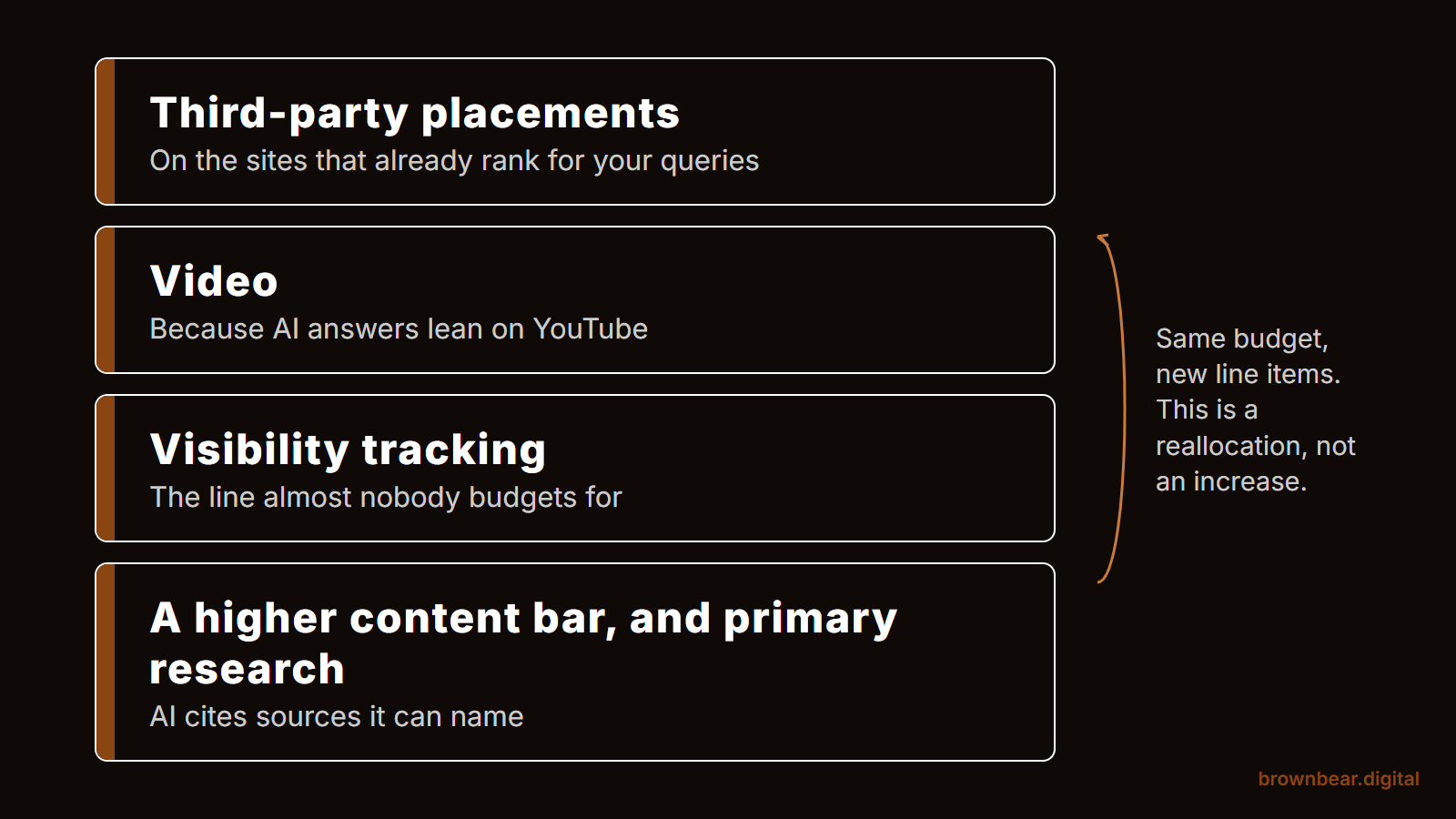
Pull the full set of queries you care about and look at who actually ranks for them, then ask an AI assistant those same questions and note who gets cited. For most commercial categories, the answer is not brands. It's review roundups, directories, comparison sites, and press. Your first new line item is budget to be present on those third-party sites: paid placements, affiliate program commissions, sponsorships, or a real PR push, depending on what the sites accept.
This is the line item that surprises business owners most in our audits. They expect to hear their website needs work. What we show them instead is that the sites shaping AI's answer about their category belong to other people, and their brand is absent from nearly all of them. In one of our client niches, a single third-party profile is often what AI uses to decide which provider to recommend. The data backs the pattern up: study after study of buying-intent questions finds the most cited source categories are third-party, from recommendation media to review platforms, with brand-owned sites sitting far down the list. Absence from those sources is absence from the answer.
Which lever you pull depends on who ranks. If the pages ranking for your queries are editorial review sites and listicles, the move is an affiliate program or direct outreach for inclusion, and the budget looks like commissions and placement fees. If they're directories and marketplaces, the move is paid listings and fully built-out profiles, and the budget looks like subscription fees. Same line item, different mechanics, and your query set tells you which one is yours.
Say you run a plastic surgery practice. Ask ChatGPT who does the best rhinoplasty in your metro and the answer is stitched together from RealSelf profiles, a couple of best-surgeons-in-your-city roundups, and a directory or two. If your practice is absent from those sources, you are not in the answer, no matter how strong your own site is. A $1,500 monthly placements line that gets your profiles fully built out and your name into two of those roundups does more for your AI visibility than another $1,500 of on-site tweaks.
One mental adjustment helps here: yes, this is paid money living inside an SEO budget. That's fine. The wall between earned and paid visibility was a reporting convenience, and AI search does not respect it.
The AI Answer Simulator
Northgate Plastic Surgery is a fictional practice. Toggle each budget line item and watch what the AI answer does with it.
"Who's a good rhinoplasty surgeon in the Northgate area?"
A simplified illustration of how answer engines assemble citations, based on this article's framework. Northgate Plastic Surgery, RateMySurgeon, and every citation shown are fictional. This illustrates citation mechanics only; it is not medical advice or a provider recommendation. Real AI answers vary by engine and query. Nothing you click is transmitted or stored.
2. Video, Because AI Answers Lean on YouTube
The second line item is a steady stream of modest videos, because AI results pull dramatically from YouTube. Google's AI experiences surface video directly, and in one analysis of 30 million AI search citations, YouTube was the second most cited domain on the web, behind only Reddit. The pull is strongest in Google's AI surfaces and for comparison and "is it worth it" questions. If your category gets asked about out loud, video is now part of search visibility, not a separate channel you'll get to eventually.
The budget required is smaller than most people assume. You do not need studio production. An iPhone, decent audio, and a good editor will carry you. What matters is that each video answers a real query directly, with a title that matches how people ask it. I'd rather see a client publish two plain videos a month answering exact questions than one polished brand film a quarter.
This is how most of our own clients do it: they shoot on an iPhone and work with an editor they found online or hired locally. Production quality still matters for how viewers read you, since polish feeds trust in the brand, but the substance of the video carries most of the AI and search value. The one step we don't skip is the edit itself. Our editors layer on text overlays and the rest of the YouTube best practices before anything goes live.
Picture a personal injury attorney who films answers between depositions: what a claim in her state is actually worth, how long a case really takes, when settling beats filing. Twelve short videos over six months, shot on a phone and cleaned up by an editor at a few hundred dollars per video. Those videos start surfacing when assistants answer settlement questions in her state, and the consult calls that mention them come in already half-sold. The budget was an editor and a Saturday a month, not a production company.
3. AI Visibility Tracking Tools Almost Nobody Budgets For
The third line item is the one most people haven't considered at all: tracking tools built to show where you appear in AI answers. Dedicated platforms like Peec AI, Scrunch, and Profound track how often models mention you, what they say, and which sources they cite when they say it. Semrush has shipped its AI Visibility Toolkit and Ahrefs has Brand Radar, so the tools you already pay for may include a version of this.
Without a tracker, you're flying blind on the exact question your CEO is going to ask: "Do we show up in ChatGPT?" With one, you get a baseline, a trend line, and something more valuable than either: the list of sources AI cites in your category. That citation list is the targeting data for the third-party placements above. The tools pay for themselves the first time they tell you which review site to go get placed on.
This should be a standing monthly line, not a one-off audit. Coverage moves as models update and as competitors start doing this work. Starter tiers now begin around $100 a month, a fuller multi-engine setup runs a few hundred, and either way, treat the reports the way you treated rank tracking for the last decade.
Here's how this looks in our own shop. We currently run tracking through our Semrush account, which gives us solid reads on prompt coverage and on the sentiment attached to specific results, and we're evaluating a move to one of the dedicated platforms as the work grows. The bigger change has been in reporting: AI search now gets its own category in every monthly report, with visibility, citations, sentiment, and average position within prompts tracked side by side, so nothing coming out of the AI platforms goes unwatched.
4. A Content Bar That Standard SEO Budgets Don't Clear
The fourth line item raises your cost per piece instead of your piece count. AI search is more selective about sources than the ten blue links ever were, and content that reads like everyone else's doesn't get cited, it gets averaged into the answer anonymously. Budget for original imagery, custom diagrams, and real design on the pages you want cited. Stock photos and text walls read as commodity to both people and models. That's the bar our content marketing work is built to clear.
I hear "blog content is dead because of LLMs" in client meetings, and I disagree with it. Long-form content still earns links and still shows up at the moments in an AI-mediated journey when someone wants depth. What's dead is content without a reason to exist. The caveat I give every client: demand the rationale behind every piece before it's written. If the answer is "to publish something this month," cut it and put the money here instead.
The right spend depends on where your expertise lives. If you're a money-or-life brand in health, finance, or legal, your experts are usually already in-house or close by: practitioners, licensed professionals, compliance people. Your budget goes to extracting and packaging what they know, getting their names and credentials onto the pages, and paying for their review time. If your expertise is not in-house, budget for outside consulting review instead: a credentialed expert who reviews and signs the content. The deciding factor is whether the expert is already on payroll, and for most YMYL brands they are, which makes this cheaper than it sounds. Content in these categories is already held to a visibly higher standard in AI search, and the expert names are how you clear it.
5. Primary Research, Because AI Cites Sources It Can Name
The fifth line item is primary research: surveys of your own customers, or a commissioned survey panel if you need reach beyond your list. Unique, proprietary data is the single most citable asset you can own, because AI engines and Google both reward information that exists nowhere else. A named stat with your brand on it gets quoted, linked, and pulled into answers in a way generic advice never will be.
Research also buys you freshness. A survey dated this year signals current information in a way an undated evergreen post can't, and answer engines visibly prefer recent sources for questions where the ground is moving.
Say you run a plastic surgery practice and survey 400 past patients about how they researched their procedure: which sources they trusted, how many consultations they booked, what almost stopped them. That one project produces a dozen citable stats, an original report, charts your team reuses for a year, and the kind of "according to" line that shows up in AI answers about choosing a surgeon. A project like that can run $5,000 to $15,000, done once a year, and it feeds every other line item on this list: the report earns third-party pickup, the stats go in videos, and the tracking tools show you the citations landing.
What to Cut So the Total Stays Flat
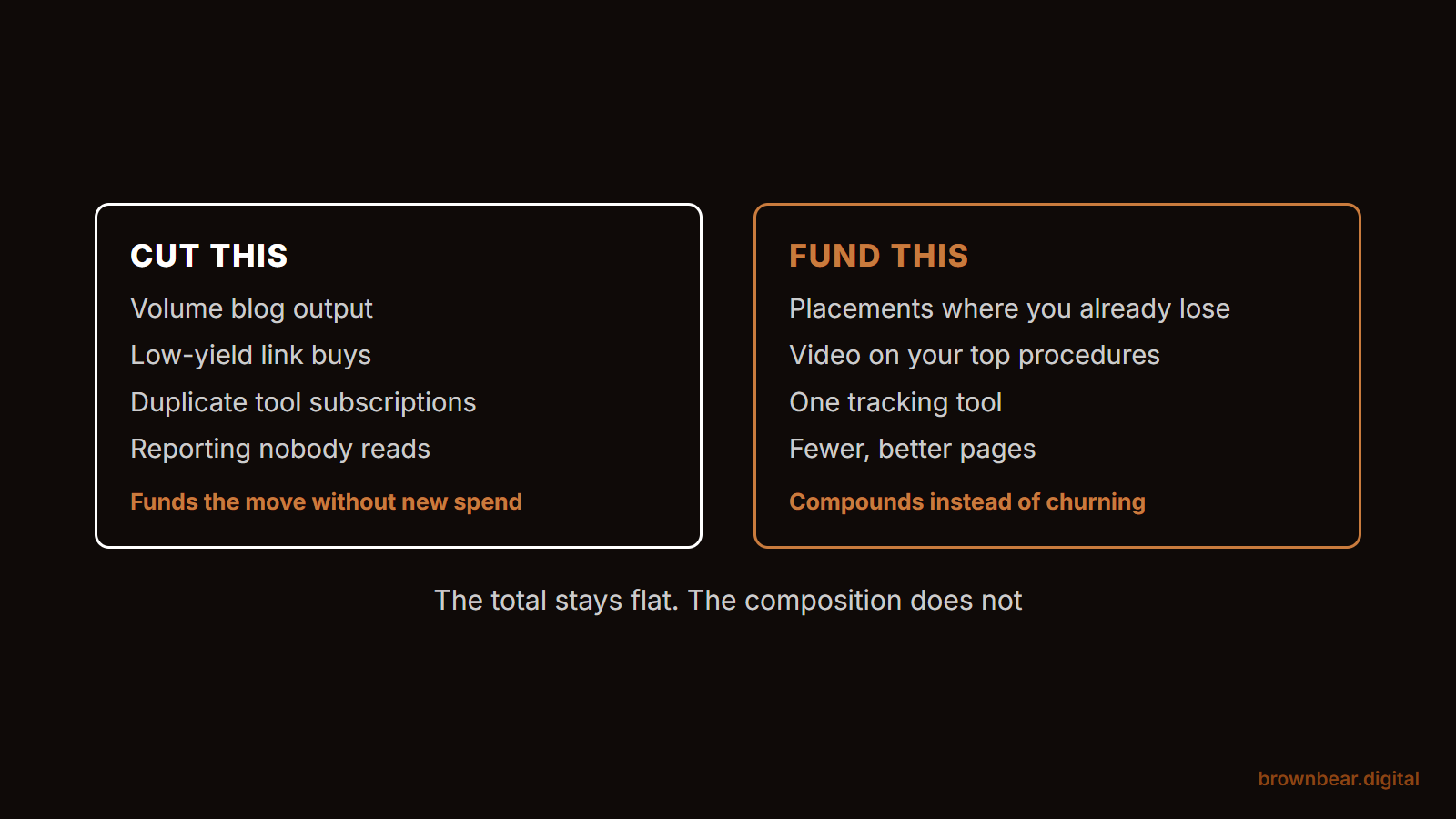
Every dollar above has to come from somewhere. Three cuts fund most of this plan.
First, commodity content volume. The four-posts-a-month retainer producing keyword-shaped articles nobody cites is usually the largest recoverable line in the budget. Cut the count, keep the content bar set out above.
Second, over-scoped technical and schema projects. This is a stance I'll defend: schema is overhyped as an AI search lever. It's still a best practice and worth keeping tidy, but it is not the silver bullet it's being sold as this year. Google's own guidance on AI features says there are no additional schema requirements for appearing in them. The bigger technical levers are crawlability and content structured simply enough for a model to parse: the major LLM crawlers don't execute JavaScript at all, and we've stripped enormous amounts of JS off client sites for exactly that reason. Fund a crawlability cleanup once, then stop paying monthly for schema tinkering.
That's not theory. It's the line we've adjusted most recently across our own accounts. Once the initial cleanup was done, with the site crawlable, page speed at best practice, and the JavaScript load cut dramatically, we took the recurring technical hours and moved them into content and links.
Third, the long tail of your rank tracking and link budget. Tracking two thousand keywords when two hundred drive revenue, and buying directory links nobody will ever cite, are both legacy spends. The rank-tracking money moves to AI visibility tracking. The low-value link money moves to third-party placements, where placement actually changes what AI says.
How the Split Changes With Your Budget
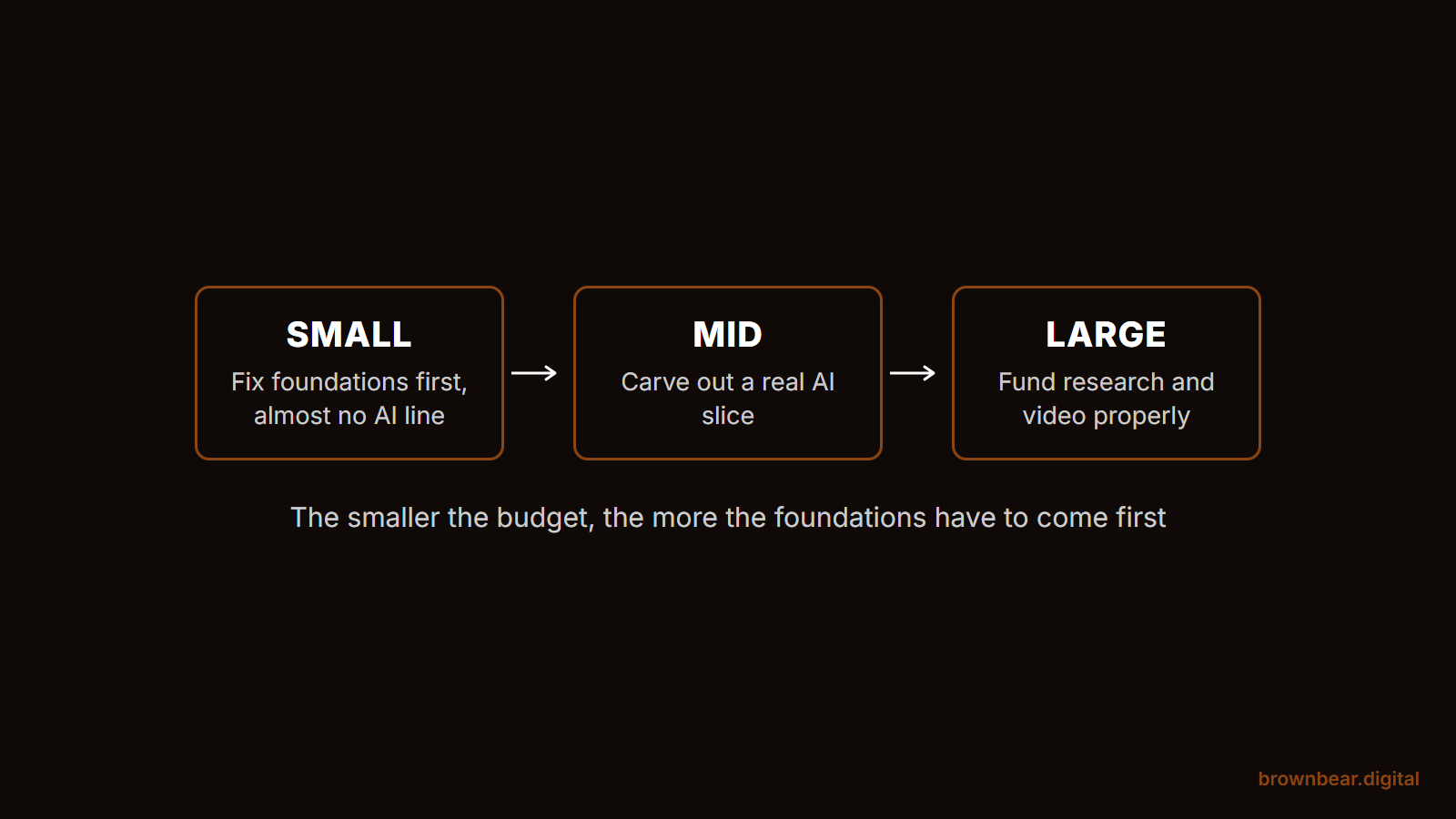
The five line items flex with budget size, and the right move at $2,000 a month is genuinely different from the right move at $20,000.
If you're under about $2,500 a month, don't try to fund all five lines. Check whether your existing Semrush or Ahrefs plan includes AI tracking before buying a dedicated tool, then pick one growth bet based on your category: video if your customers ask questions out loud, third-party placements if review sites own your queries. One bet, funded properly, beats five underfunded ones.
Between roughly $2,500 and $10,000 a month, run all five lines thin: a dedicated tracker, a monthly video pair, one or two placement targets, a higher bar on fewer pieces, and save the survey for a once-a-year push. Above $10,000, lead with research and placements, because at that level you're not fighting for presence, you're fighting to be the named source the answers are built from.
As a starting grid before you adjust for your category:
| Monthly budget | Fundamentals | Third-party | Video | Tracking | Content bar | Research |
|---|---|---|---|---|---|---|
| $2,000 | ~75% | one bet: ~15% | or here | free tiers | ~10% | skip year one |
| $5,000 | ~70% | ~10% | ~8% | ~4% | ~8% | annual pool |
| $20,000 | ~65% | ~12% | ~8% | ~3% | ~7% | ~5% |
These are starting points, not prescriptions. The AI Search Budget Rebalancer below turns your actual number into a dollar split you can take into a budget meeting.
The AI Search Budget Rebalancer
Enter your current monthly SEO budget. Get the dollar split across the five line items from this article.
For planning purposes only; results are a starting framework, not a guarantee of outcomes, and not professional financial advice. Everything you enter stays in your browser. Nothing is transmitted or stored.
The Numbers That Tell You It's Working
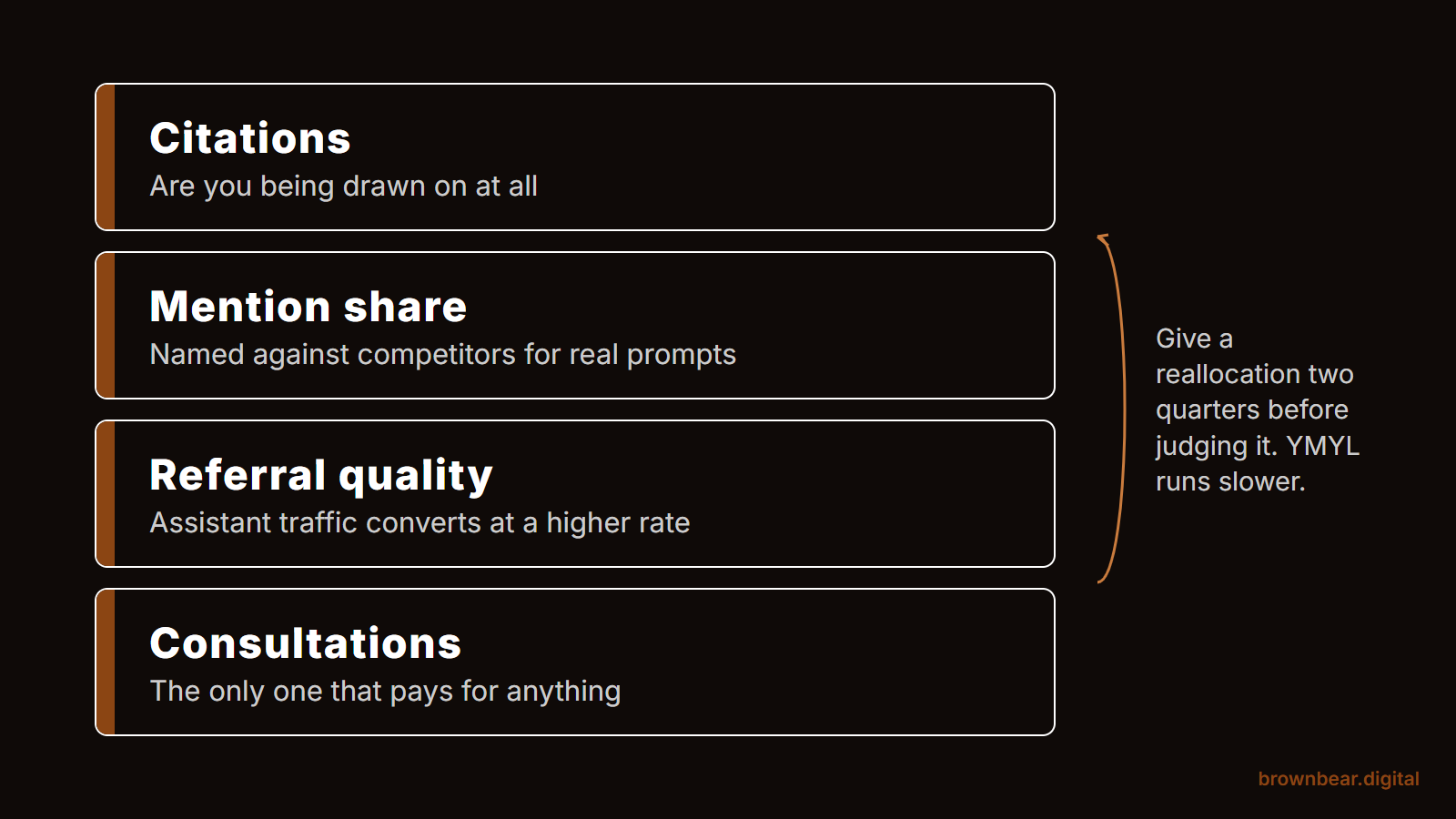
The KPI I show skeptical clients first is LLM referral quality. Across our client analytics, traffic that arrives from ChatGPT, Perplexity, and other assistants converts at a higher rate than almost any other channel, mainly because the search journey compresses: the LLM walks a user toward a choice in a fraction of the time, with far more information in hand, than the traditional journey ever allowed. When we compare these referrals against organic search, they hit the page's main conversion event faster and at a higher rate. We're still pressure-testing that data before we publish hard numbers, but what we're seeing holds up, and it matches what the rest of the industry is reporting. The volume is still small. The intent is not. And adoption only moves one direction from here.
Alongside that, track four things: your mention and citation rate in the AI tracking tool, presence on the third-party sites you targeted, whether your videos surface for the queries they answer, and branded search volume, which rises as AI answers put your name in front of people who then go look you up.
Here's the order of operations I'd run:
- Baseline your AI visibility this month with one tracking tool, even a free tier, so every later change is measurable.
- Map the third-party sites ranking and cited for your top 20 queries, and price what presence on the top three costs.
- Ship your first two videos answering the two questions your sales team hears most.
- Put a date on one research project for the next two quarters, sized to your list.
Give the reallocation two quarters before you judge it. Citations move faster than rankings ever did, but they still don't move in a week.
Questions That Keep Coming Up About AI Search Budgets
How much of my SEO budget should go to AI search optimization?
Between 15 and 30 percent for most companies, weighted toward the higher end if AI answers already dominate your queries. But decide the composition first and let the percentage fall out of it, not the reverse.
Do I need a separate budget for GEO?
No. The overlap with SEO fundamentals is too large, and a separate budget usually means paying twice for the same deliverables. Reallocate inside the budget you have.
Are AI visibility tracking tools actually worth it?
Yes, for one reason above the dashboards: they show you which sources AI cites in your category, which is the targeting data for your placement and PR spend. Check whether the Semrush or Ahrefs plans you already pay for include it before adding a dedicated tool.
How fast will I see results?
Practitioners commonly report first movement in citations and mentions within four to eight weeks of the content and placement work landing, with more meaningful gains in the 60 to 90 day window. That's agency experience rather than a controlled study, so give the full reallocation two quarters before judging it. YMYL categories typically run slower; we've broken down how long medical, legal, and financial SEO takes if that's your world.
Plan Your AI Search Budget with Brown Bear Digital
Everything above is the framework we use when a client hands us a search budget and asks what it should look like now. Brown Bear Digital builds and runs these reallocations: the audits that show where you stand in AI answers, the placement and content work that changes it, and the reporting that proves it to whoever signs the budget. If you want a second set of eyes on your split before you commit it, talk to us about your AI search budget and we'll walk through your numbers together.
Written By
Founder, Brown Bear Digital
Bryan has 15 years of experience across SEO, paid search, and AI search strategy. He founded Brown Bear to give businesses direct access to senior-level search expertise without the agency overhead.
Learn More About BryanGet Found on Google.
Get Cited by AI.
Tell us about your site. We'll send back a proposal for SEO and AI search.