Your RealSelf Profile Is What AI Uses to Decide Which Plastic Surgeon to Recommend
Being found by the right patient at the right moment used to mean ranking on page one of Google. That's still important. But there's a second channel building above it: one that routes high-intent, procedure-ready patients directly to the surgeons AI search engines have decided to trust. Getting into that channel requires understanding what AI actually looks for, and why most plastic surgery practices are leaving the most valuable spot on that list empty.
The team at Brown Bear Digital works with plastic surgery practices navigating exactly this shift. What we've seen over the past two years is a clear pattern: the practices winning new consultations from AI-referred patients aren't necessarily the ones with the best websites or the highest Instagram follower counts. They're the ones who built a credible, complete presence on the one platform AI engines consistently cite for aesthetic procedures.
This applies whether you're a solo surgeon trying to capture more rhinoplasty consultations or a practice manager evaluating where to focus your marketing budget as traditional search traffic plateaus. The answer, more than most people expect, starts with RealSelf.
If you've spent the last few years investing in your website, Google Ads, and before-and-after content on Instagram but haven't touched your RealSelf profile since you first created it, this article explains what that's costing you in the AI search era. Maybe you've always thought of RealSelf as a patient research tool, not a marketing channel. That assumption is exactly what's giving competitors a compounding advantage right now. For the practice watching its organic leads flatten while a competitor keeps showing up in ChatGPT answers, this is where the explanation starts.
By the time you finish reading, you'll understand precisely why RealSelf is the platform AI search engines rely on most when a patient asks who to see for a cosmetic procedure, and what a profile that actually appears in those answers looks like. Long term, this is the foundation of a consultation pipeline that doesn't require paid media to stay full.
We'll cover how AI search engines build their surgeon recommendations, why RealSelf occupies a structurally different position than Yelp, Google Reviews, or Healthgrades, the specific content types AI engines cite, what a ready profile includes, and what happens to practices that leave theirs thin.
So, let's start with how AI actually picks a surgeon, because the mechanics are more specific than most practices realize.
Key Takeaways
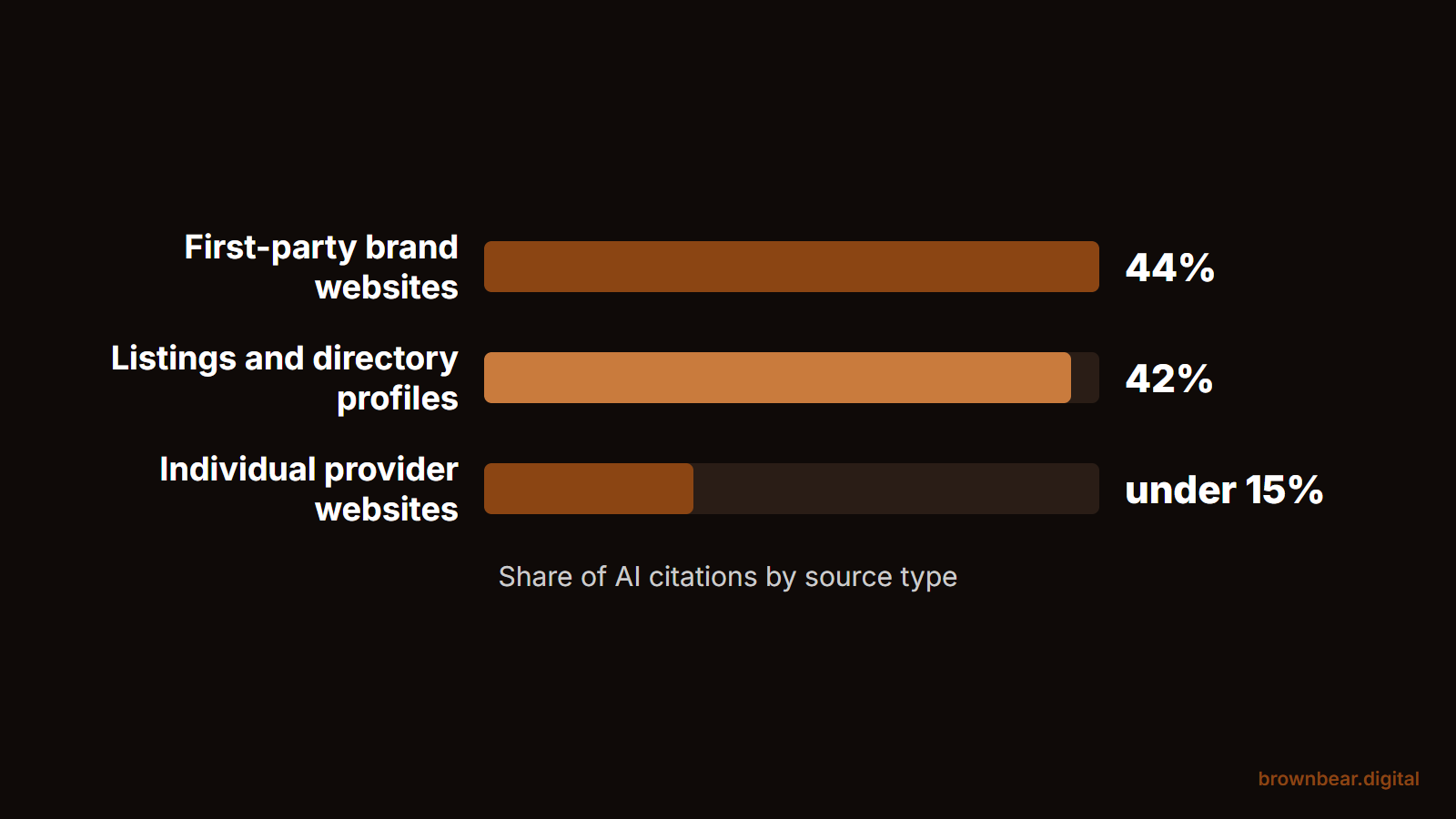
Listing profiles account for 42% of AI citations
Nearly matching the 44% share held by brand websites. Directories are now a primary AI source, not a secondary one.
In specialty healthcare, aggregators capture 70 to 85% of AI citations
Individual provider websites receive under 15%. The gap is structural. It won't be closed by a better website.
RealSelf is the only aesthetic platform that verifies physician medical licenses
That credential check is the trust anchor AI engines rely on before recommending a surgeon by name.
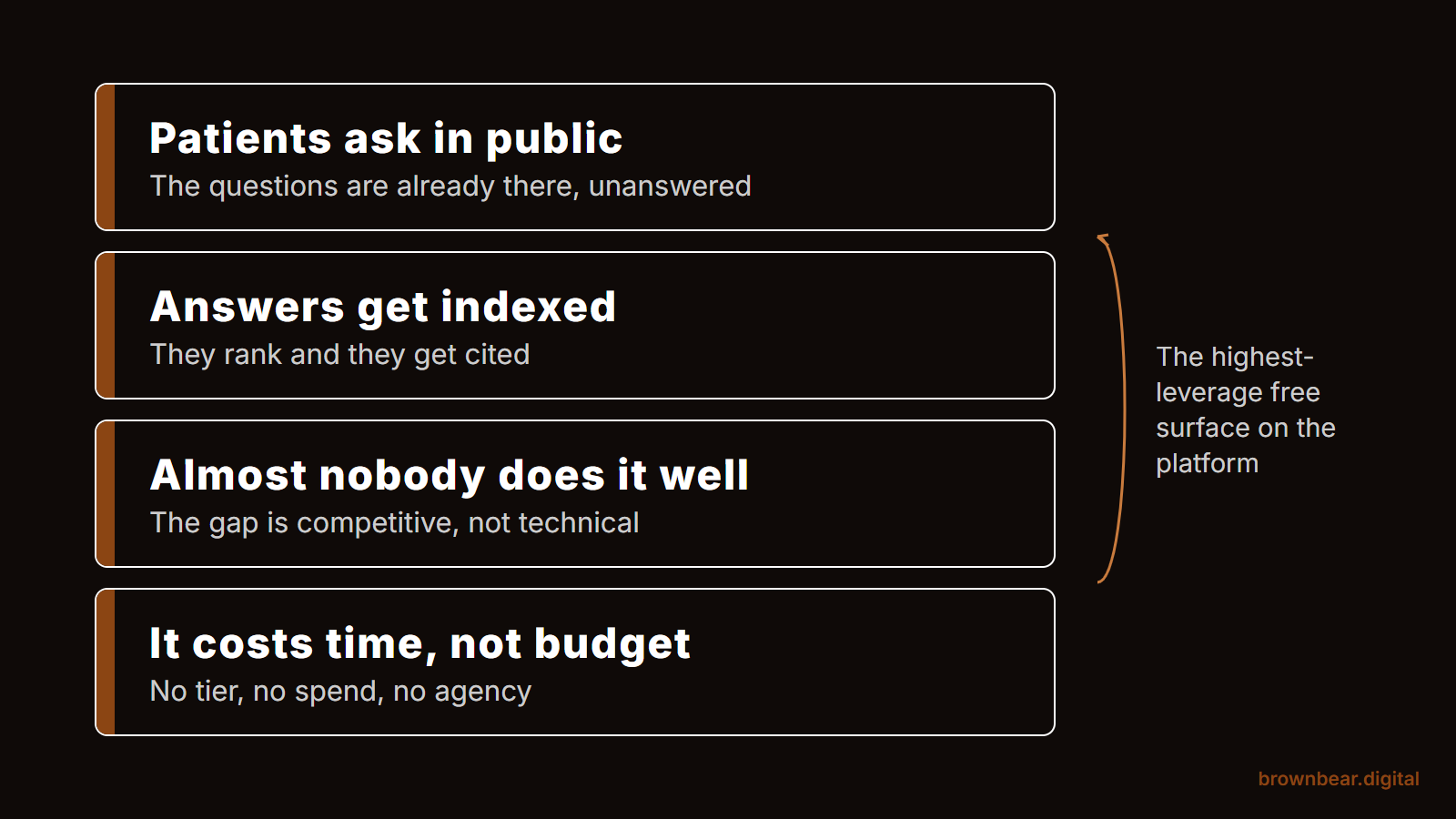
The Q&A section is plastic surgery's most underused marketing asset
Surgeon-authored answers earn a 2.1x citation boost, yet most profiles leave all 50+ citation opportunities empty.
How AI Search Engines Actually Pick a Surgeon
When a patient types "best rhinoplasty surgeon in [city]" into ChatGPT or Perplexity, the AI doesn't return a list of search results. It synthesizes an answer from sources it has already indexed as structured, verified, and credible. That's a fundamentally different process than a traditional Google search, and it favors a different set of inputs. We break down that selection process end to end in our AI search playbook for plastic surgeons.
AI search engines build what's called an authority map. They draw from platforms where a doctor's credentials are verified, where content is organized by specific procedure, and where patient outcomes are documented over time. A polished practice website doesn't move that map on its own. What does is consistent, credible presence across the platforms AI has learned to treat as authoritative sources for the topic. (For the full picture of this behavioral shift, see how AI search is changing how patients find plastic surgeons.)
The data behind this is more concrete than most practices expect. According to Yext, which analyzed 6.8 million citations across ChatGPT, Gemini, and Perplexity, listing and directory-style profiles account for 42% of all AI citations, nearly matching the 44% share held by first-party brand websites. A patient researching surgeons is, statistically, as likely to encounter your practice through a directory profile as through your own site.
In healthcare specifically, the imbalance sharpens further. According to upGrowth's research on AI citation patterns in medical queries, in markets where specialty aggregator platforms dominate, those aggregators capture 70 to 85% of AI citations while individual provider websites account for under 15%. The practices showing up in AI-generated surgeon recommendations aren't winning on website quality. They're winning on structured presence in the platforms AI has learned to trust.
Google AI Overviews now appear in an estimated 67% of healthcare-related search queries. Perplexity and ChatGPT have grown from novelty tools into primary research channels for a meaningful share of patients. When these systems generate a surgeon recommendation, they draw from a narrow set of trusted sources. For plastic surgery, that set is short, and RealSelf occupies a prominent position at the top of it.
Why RealSelf Stands Above Every Other Review Platform for AI Visibility
Not all review platforms look the same to an AI engine. The difference is structural, and it matters considerably.
According to the AI Platform Citation Source Index 2026, synthesized from more than 680 million citations tracked across ChatGPT, Google AI Overviews, and Perplexity, Commerce and Review is one of six functional categories that AI systems consistently draw from. Yelp, G2, TripAdvisor, and Trustpilot all rank in the global top 50 most-cited domains in that category, confirming that review aggregators are a recognized and recurring citation source across all major AI engines. For aesthetic medicine, RealSelf occupies that same tier. It is the niche-dominant platform AI engines have learned to treat as authoritative for cosmetic procedures, the equivalent of what TripAdvisor is to travel or G2 is to B2B software.
The reason comes down to credential verification. RealSelf verifies the medical license of every physician on the platform. That single layer sets it apart from Yelp, Google Reviews, or Healthgrades, where the barrier to listing is far lower. For an AI system trying to identify credible, board-certified plastic surgeons in a specific geography, RealSelf's verification signal is exactly the kind of trust anchor it needs to recommend a name with confidence.
But verified credentials alone aren't what drive AI citations. The content structure is the real differentiator. RealSelf organizes everything around procedures, not practices. A patient researching abdominoplasty finds abdominoplasty-specific reviews, abdominoplasty Q&A from board-certified surgeons, abdominoplasty before-and-afters, and abdominoplasty outcome ratings. That's procedure-level structured data. AI search engines are built to extract exactly that kind of layered, categorized information and match it to specific patient queries.
With more than 10 million consumers visiting the platform each month, RealSelf has built a scale of verified, procedure-specific content that no other platform in the aesthetic space has matched. Academic researchers regularly use RealSelf data as a primary source for patient satisfaction analysis, a pattern that signals how well the platform's content structure maps to what credible sources look like to AI systems.
The consistency signal also matters. When your information appears identically on RealSelf, your Google Business Profile, Healthgrades, and Vitals, AI systems read that alignment as a trust confirmation. But of those platforms, RealSelf is the one that carries procedure-specific and outcome-specific weight. The others confirm you exist. RealSelf tells AI what you're actually qualified to do.
The Q&A Content Gap Most Surgeons Leave Open
Here's where most plastic surgeons are leaving the most AI visibility on the table: the Q&A section.
RealSelf's Q&A format allows patients to ask specific procedure, candidacy, and recovery questions, and board-certified surgeons to answer them publicly. Those answers are indexed, structured, and tagged by procedure, location, and credentials. They are precisely the kind of content AI search engines extract when assembling answers to patient queries.
When a patient asks ChatGPT a specific question about rhinoplasty recovery time, the AI doesn't generate the answer from general knowledge alone. It pulls from sourced, credentialed, publicly indexed content. Surgeon-authored answers on RealSelf are exactly what AI systems prefer to cite: specific, verifiable, procedure-matched, and attached to a professional with confirmed credentials.
Data from a citation pattern study analyzing 1,000 Google AI Overviews confirms the mechanism: pages with named-source citations embedded in their content receive a 2.1x citation lift compared to pages without them. Surgeon-authored Q&As on RealSelf are structurally identical to that winning format: a named, credentialed source answering a specific question in structured text, sitting on a domain AI engines already trust.
A surgeon with 50 thoughtful Q&A answers on RealSelf has created 50 citation opportunities that a surgeon with zero answers doesn't have.
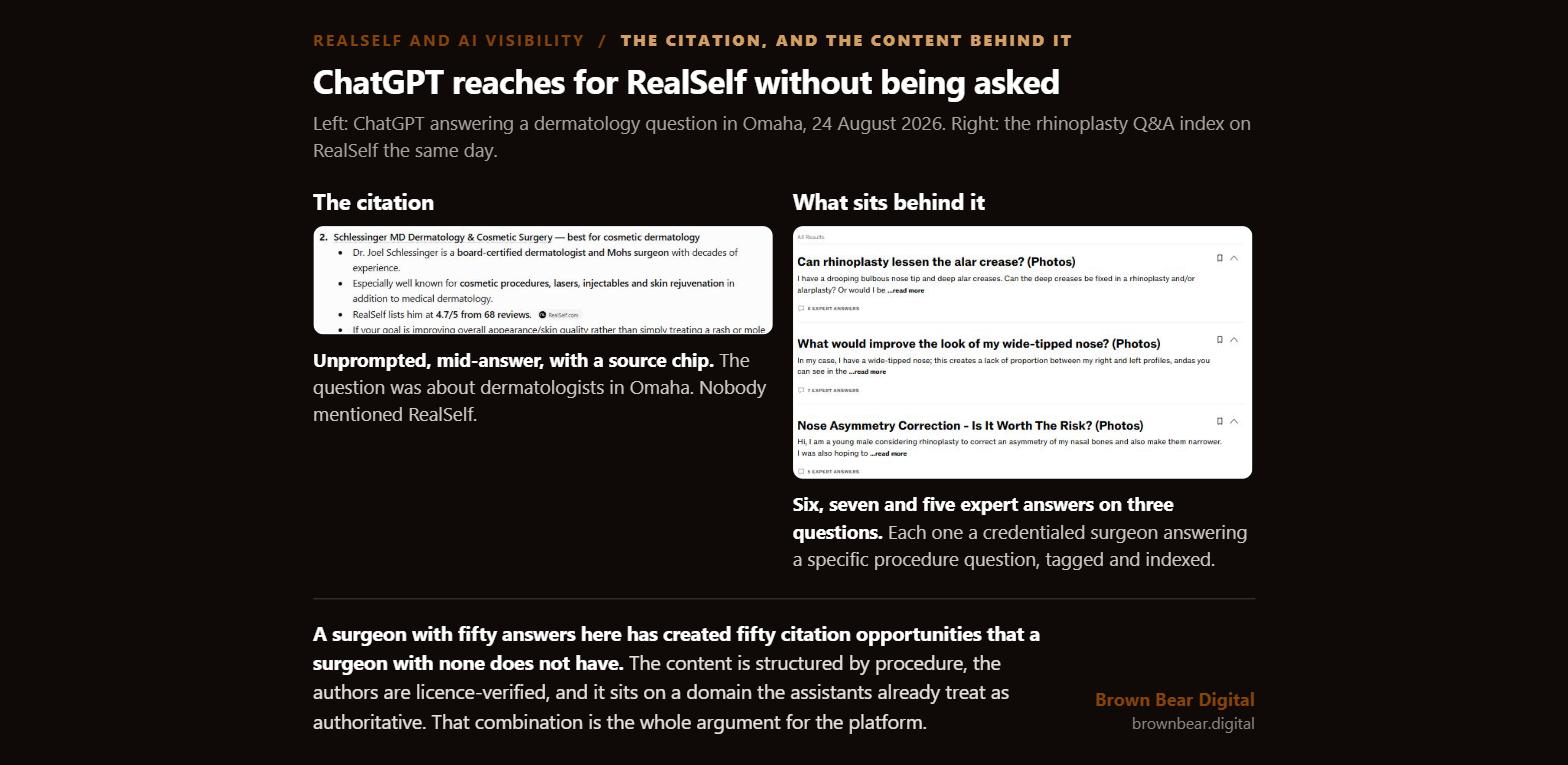 This is the gap most practices leave completely open. Instagram posts don't feed this. Website FAQs, unless marked up with structured data and hosted on a high-authority domain, carry a fraction of the weight. The Q&A you write on RealSelf sits on a domain AI engines already trust, tagged with your specialty credentials, attached to the exact procedures you want to be recommended for.
Research published by the National Institutes of Health on cosmetic surgery patient reviews found that the quality and quantity of physician engagement with patient questions directly influences perceived professional credibility. That credibility is the same signal AI search engines read when building their recommendations.
How the "Worth It" Rating Becomes an AI Trust Signal
RealSelf's "Worth It" rating doesn't exist anywhere else in the aesthetic space. It's a procedure-level outcome metric: real patients rating whether a specific treatment was worth the cost, recovery, and risk. It aggregates across verified patient journeys, procedure by procedure.
For an AI search engine building a recommendation, this is outcome data, not a generic star rating. Procedure-specific outcome percentages tied to verified board-certified providers are precisely the kind of structured signal AI systems weight when deciding which surgeons to include in an answer.
A rhinoplasty patient asking Perplexity for a surgeon recommendation is fundamentally asking: who produces the best outcomes for this specific procedure? The "Worth It" data is the closest thing to a structured, verifiable answer AI can pull from any platform in the aesthetic space. Surgeons with strong Worth It ratings attached to their RealSelf profiles have a measurable advantage in how AI engines score their authority for specific procedures.
The American Society of Plastic Surgeons sets the board certification and safety standards patients should look for when choosing a surgeon. RealSelf's Worth It system works alongside those credentials. It's not a substitute for certification: it's the patient-verified outcome layer that AI systems weight on top of it when deciding who to recommend from a list of equally credentialed surgeons.
What Your RealSelf Profile Needs to Be AI-Ready
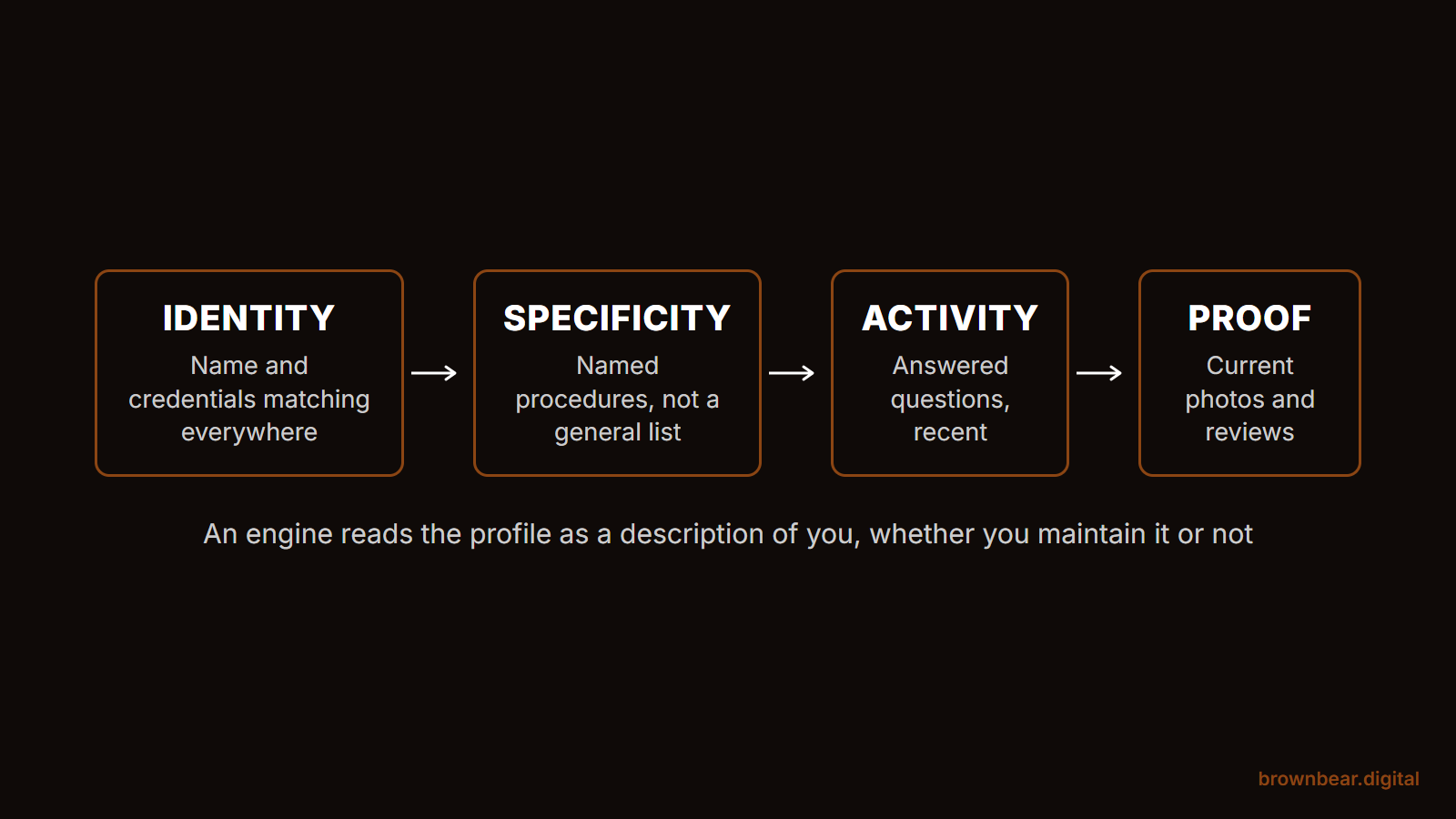
An incomplete or outdated RealSelf profile is, from an AI engine's perspective, an incomplete or outdated citation source. It either contributes to your authority map or it doesn't. (This piece covers the AI side; for how the platform itself works, including Worth It ratings, recognition tiers, and the Q&A system, see our full RealSelf SEO strategy for plastic surgeons.)
Here's what an AI-ready profile includes:
- Complete credentials. Board certification, specialty designation, hospital affiliations, and years of experience. These aren't profile formalities: they're the structured fields AI engines use to verify you're the kind of provider patients are looking for.
- Procedures mapped to your actual focus areas. If rhinoplasty is your primary work but your profile lists fifteen undifferentiated procedures, the AI signal is diluted. Prioritize your core procedures and let RealSelf's categorization structure amplify your relevance.
- Active Q&A engagement. Answer questions in your specialty procedures on a consistent schedule. The goal isn't volume for its own sake: it's building the indexed content footprint that AI systems pull from when a patient asks something you've already answered.
- Accurately labeled before-and-after photos. Every photo should carry a correct procedure tag. Mislabeled or uncategorized photos are invisible to the structured data layer AI reads.
- Recent patient reviews. AI systems read recency as a freshness signal. A profile with 90 reviews from three years ago and nothing recent sends a weaker authority signal than one actively receiving new patient feedback.
- Consistent contact information. Your name, address, and phone number on RealSelf must exactly match your Google Business Profile, your website, and every other platform where you're listed. Discrepancies fragment the authority map AI uses to confirm you're a real, established practice.
What Happens When a Patient Asks AI and You're Not There
Here's the question most practices haven't asked directly: what does ChatGPT say right now when a patient asks who to see for your primary procedure in your market?
The answer isn't neutral. When AI can't find enough structured, credentialed information about a surgeon to include them in a recommendation, it recommends someone else. There's no "this surgeon also exists but has less data" footnote. The patient gets a shortlist. If you're not on it, you're not in the decision.
According to upGrowth's research on healthcare AI citations, individual provider websites account for under 15% of responses in markets where aggregator platforms are present. That 85% flowing to aggregators isn't spread evenly across dozens of platforms either. Data from an arXiv study analyzing 615 ChatGPT health citations found that the top organizations in any given niche account for over half of all citations, with the remainder split across hundreds of sources. For aesthetic medicine, the niche-dominant aggregator is RealSelf. Practices that don't appear there don't surface in the recommendation layer, regardless of how strong their website or social media presence is.
The American Board of Plastic Surgery defines who qualifies as a board-certified plastic surgeon. AI engines reference platforms that reflect those standards, and RealSelf is the one that maps board certification directly to procedure-level performance data. Practices that aren't present on that platform simply don't appear in the answers patients are getting.
The gap compounds. Surgeons AI recommends collect more reviews, answer more questions, and build more indexed content. Their authority map deepens every month. Surgeons AI doesn't recommend fall further behind with each month they don't close the gap.
[Placeholder: Brown Bear has seen plastic surgery clients achieve a measurable lift in AI-referred consultation requests within [X] months of a full RealSelf profile optimization. Include specific client result here when available.]
Patients are already using AI to shortlist surgeons. That pipeline is live. The practices that started optimizing for it a year ago are compounding the advantage now.
Brown Bear Digital Helps Plastic Surgeons Win in AI Search
AI search visibility for plastic surgery practices starts with getting the right platform right, and RealSelf is where the foundation gets built. Brown Bear Digital works with aesthetic practices through our AI search optimization service to audit their current AI search footprint, optimize their RealSelf profiles, and build the cross-platform consistency that AI engines use to confirm authority. If you want to know where your practice stands in AI-generated surgeon recommendations right now, reach out to the Brown Bear Digital team to start the conversation.
Written By
Founder, Brown Bear Digital
Bryan has 15 years of experience across SEO, paid search, and AI search strategy. He founded Brown Bear to give businesses direct access to senior-level search expertise without the agency overhead.
Learn More About BryanReady to Turn Search
Into Revenue?
No pitch decks. Just a real conversation.