RealSelf for Plastic Surgeons: How the Platform Actually Works (And the SEO Strategy Most Practices Miss)

Understanding which platforms your patients use to research surgeons, and how those platforms decide what to show them, is the difference between a digital presence that compounds and one that just costs money.
Bryan Passanisi is the founder of Brown Bear, an SEO and digital marketing agency that works exclusively with plastic surgery practices.
Tom Seery, co-founder of RealSelf, built the platform on a principle he's stated plainly: visibility is based entirely on patient input, not surgeon spending. Understanding what that means in practice is the starting point for using the platform strategically.
This piece covers both the mechanics of how RealSelf works at the platform level, including the algorithm, Q&A system, and recognition tiers, and what to do with that knowledge at the practice level, including a paid tier capability most agencies don't explain.
If you claimed your RealSelf profile a year or two ago, got a few reviews, and moved on, this covers what comes next. If you're the person responsible for the practice's marketing decisions and someone has suggested upgrading to the paid tier without clearly explaining what it does for your organic rankings, this will fill that gap. Maybe you've watched a competitor appear above you in RealSelf's local results and wondered whether the platform is simply pay-to-play. It's more nuanced than that, and more actionable. RealSelf is one channel inside a wider online marketing plan for a plastic surgery practice, and it works best when the rest of that plan is in place.
By the end of this, you'll have a clear picture of how RealSelf actually surfaces surgeon profiles, where the real SEO leverage lives, and how the platform fits into a broader digital authority strategy for your practice. Longer term, what's possible is a presence that shows up across Google, RealSelf, and AI-generated search responses, covering the full research path your patients are already on.
We'll walk through how the platform surfaces profiles and what signals it weights, the Q&A strategy most practices leave completely untouched, the recognition tier requirements and what achieving them does for local visibility, the paid tier's link-building mechanics, and how to sequence all of it into a coherent strategy.
So, let's start with what RealSelf actually is, because how most practices think about the platform is the main reason most practices aren't getting value from it.
Key Takeaways
RealSelf is a decision engine, not a review site
Patients use it months before choosing a surgeon, and visibility runs on patient-input signals you control, meaning reviews, photos, and Q&A activity, not on how much you spend.
Top Doctor status takes 10 answers every 90 days
That is roughly four Q&A answers a month, and it places you in the top 10% of the platform with preferential ranking in local searches. In competitive markets it is effectively table stakes.
The paid tier is really a link-building asset
Paid membership lets you place contextual backlinks from RealSelf's high-authority domain directly to your procedure pages, the same signal practices fund outreach campaigns to earn. Build the pages first, then the links.
Keep your Worth It ratio above the 70% line
Below roughly 70%, researching patients do the mental math and come up uncertain. A consistent review pipeline timed 4 to 8 weeks post-op, when satisfaction peaks, moves both volume and ratio in your favor.
What RealSelf Actually Is (And Why Surgeons Keep Underestimating It)
RealSelf is not a review site. That distinction matters, because it changes how you think about what the platform can do for your practice.
A review site is somewhere patients go after a decision to share their experience. RealSelf is where patients go before the decision, often months before, to research procedures, compare outcomes, read clinical answers to specific questions, and build a short list of surgeons they're willing to contact. It's a decision engine, and the patients on it are among the most motivated, most-researched prospects in aesthetic medicine.
From a search engine perspective, RealSelf is a high-authority domain. Its pages consistently rank for competitive procedure terms, sometimes above the websites of well-established practices. If you've ever searched your city plus a procedure name and watched a RealSelf listing appear above your homepage, that's RealSelf's domain authority at work. The question is whether your profile is the one patients find when that happens, and whether it's doing enough to convert their interest into a consultation request.
Why RealSelf Matters More in 2026 Than It Did Two Years Ago
The platform's value has compounded over the past 18 months because of AI search, and most practices haven't caught up to what that means.
Google's AI Overviews pull from high-authority, patient-facing sources when generating answers to health and procedure queries. When someone asks Google "what should I look for in a rhinoplasty surgeon," the AI-generated response increasingly draws from structured, expert-verified content: procedure guides, verified patient reviews, doctor Q&A answers. RealSelf produces that kind of content at scale, and Google trusts it. That question also sits at the center of marketing rhinoplasty online, where the research window runs longer than for almost any other procedure.
The same dynamic applies in conversational AI tools. ChatGPT, Perplexity, and similar platforms regularly surface RealSelf results when answering questions about local providers or specific procedures. A surgeon with an active, complete, well-reviewed profile is far more likely to appear in those citations than one with a sparse or inactive presence. We go deep on that mechanism in how your RealSelf profile shapes which surgeons AI recommends.
What this means in practice: every Q&A answer you post on RealSelf, every review you generate, every photo you upload now has three potential surfaces. It can appear in RealSelf's own internal search. It can rank in Google for a long-tail query. It can be cited in an AI-generated answer. The time investment compounds in a way that a paid ad placement or a one-time website optimization never does.
How RealSelf Surfaces Surgeon Profiles
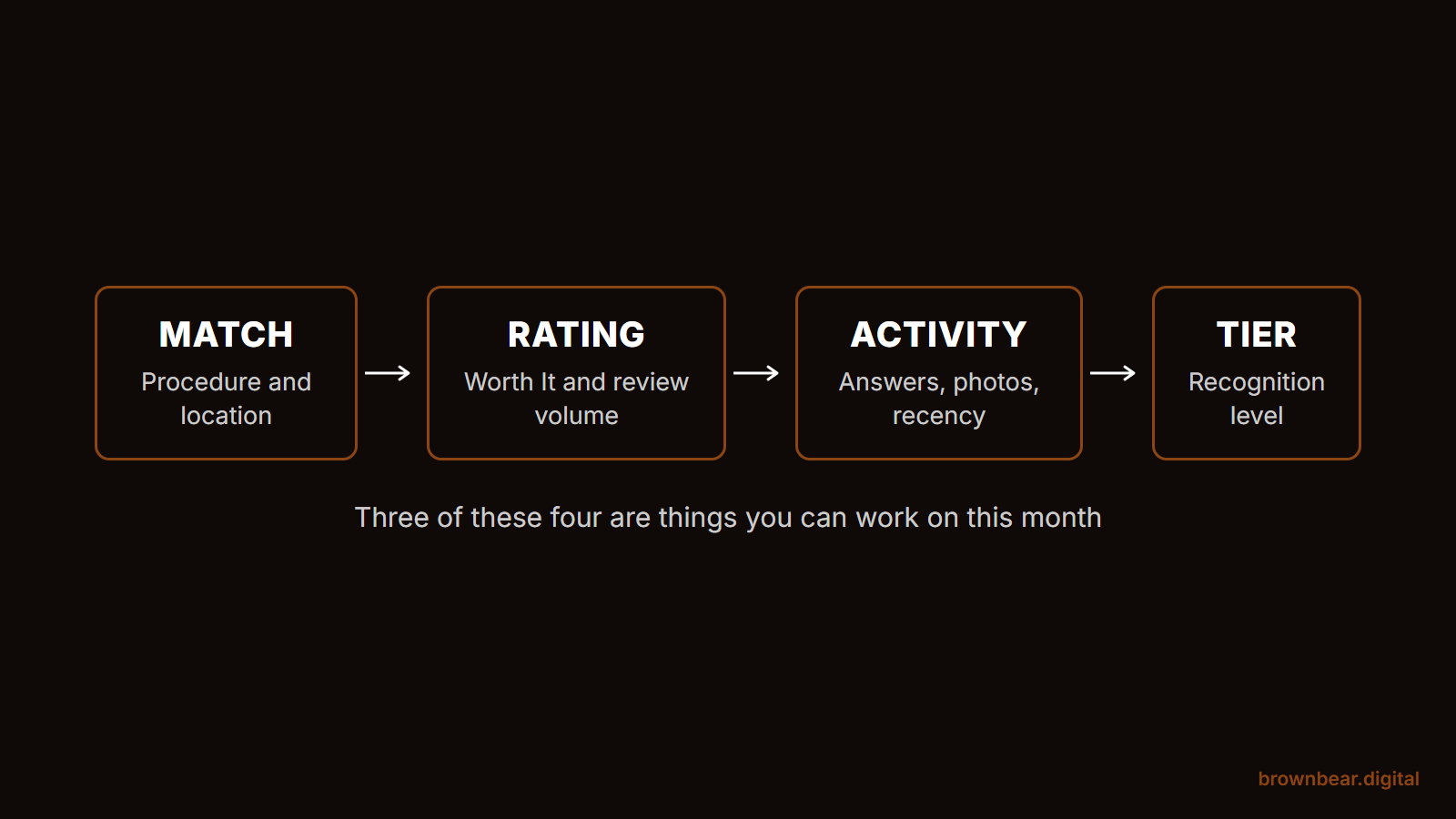
Within the platform, profiles don't appear in equal positions. RealSelf uses engagement signals to determine which doctors show up prominently in local directory searches, and most of those signals are within your control.
The three primary levers are patient reviews (quantity, recency, and rating), before-and-after photos (volume and breadth across the procedures you want to be found for), and Q&A engagement (how often and how well you answer patient questions on the platform).
The minimum configuration threshold that matters is Verified status. To earn it, you need a 4.0-star rating or higher. A verified badge signals to both the platform algorithm and to patients reviewing your listing that you're a committed, responsive practitioner. Without it, your profile competes at a disadvantage in local search results.
Geographic targeting also factors in. When a patient searches for surgeons in a specific metro area, RealSelf weights results based on proximity and procedure relevance. One of the fastest ways to increase your surface area in those results: claim every procedure you actually perform. If you don't claim blepharoplasty, you won't appear when someone in your city searches for an eyelid surgeon. The categories are free to claim, and most surgeons leave several unchecked.
The Worth It Rating: What It Measures and What You Can Control
The Worth It rating is simpler than it looks. Patients rate a procedure as "Worth It," "Not Worth It," or "Not Sure." The percentage displayed on your profile is the ratio of Worth It responses to the combined total of Worth It and Not Worth It responses. "Not Sure" votes don't count toward the calculation.
You cannot remove reviews from RealSelf. The company is explicit about this, and there is no workaround. What you can control is the volume: a consistent, systematic approach to generating new positive reviews improves your percentage over time and shifts the ratio in your favor.
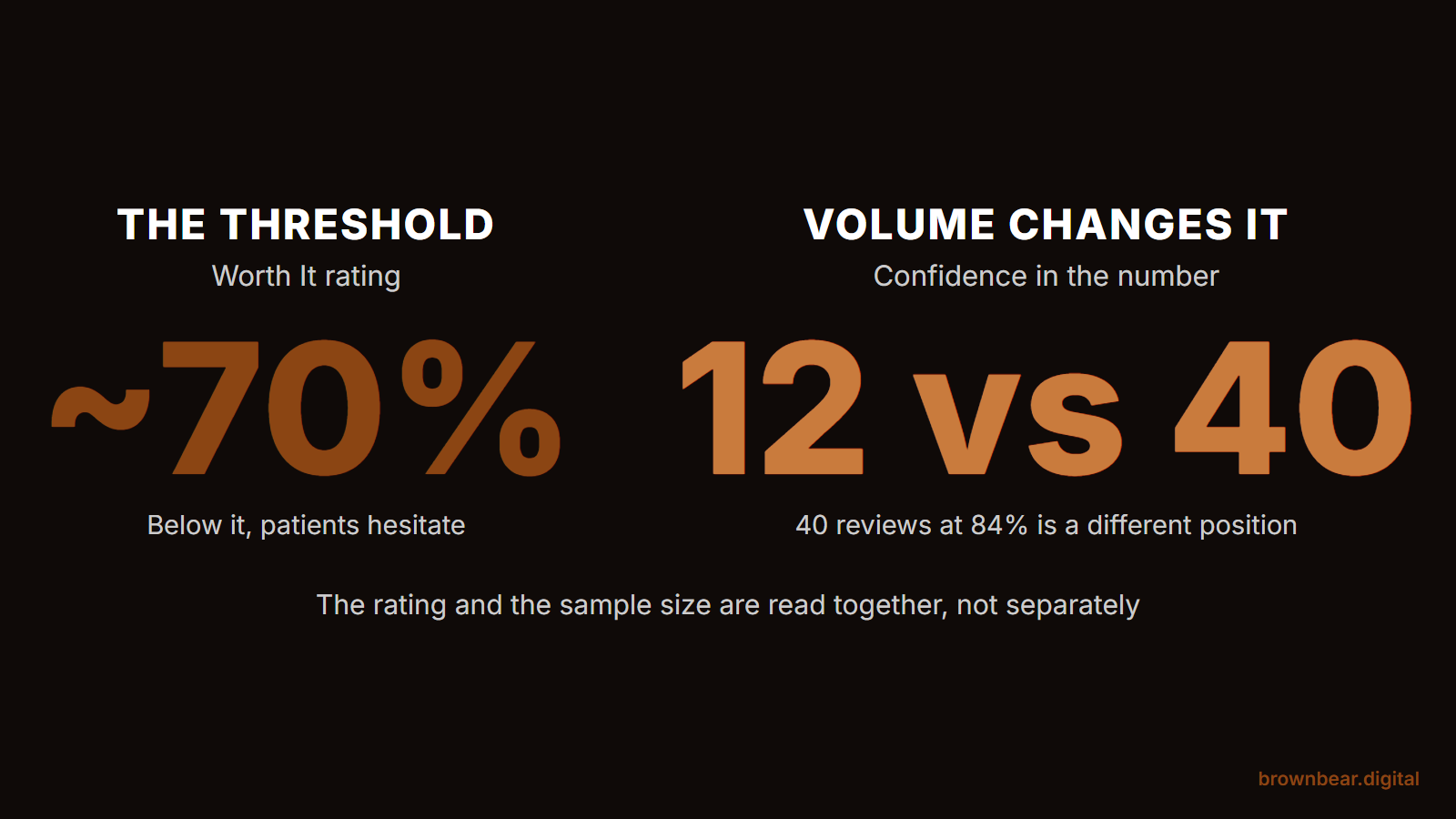
The threshold that matters in practice is around 70%. If you fall below it, patients who find your profile during their research phase are doing mental math and coming up uncertain. A surgeon with 12 reviews at 68% is in a materially different competitive position than one with 40 reviews at 84%, even if their clinical outcomes are comparable. Volume and ratio work together.
The most effective approach is building the review ask into your post-procedure workflow at the right moment: typically 4 to 8 weeks post-op, when satisfaction is high and results are visible. The ask should be frictionless, a direct link to your RealSelf profile rather than a vague request to "leave a review somewhere." Automated follow-up sequences through your practice management system make this consistent without requiring manual staff effort each time. For a deeper look at how to build that system, the review generation playbook for plastic surgeons covers the full workflow.
The Q&A Strategy: The Highest-Leverage Free Activity on the Platform
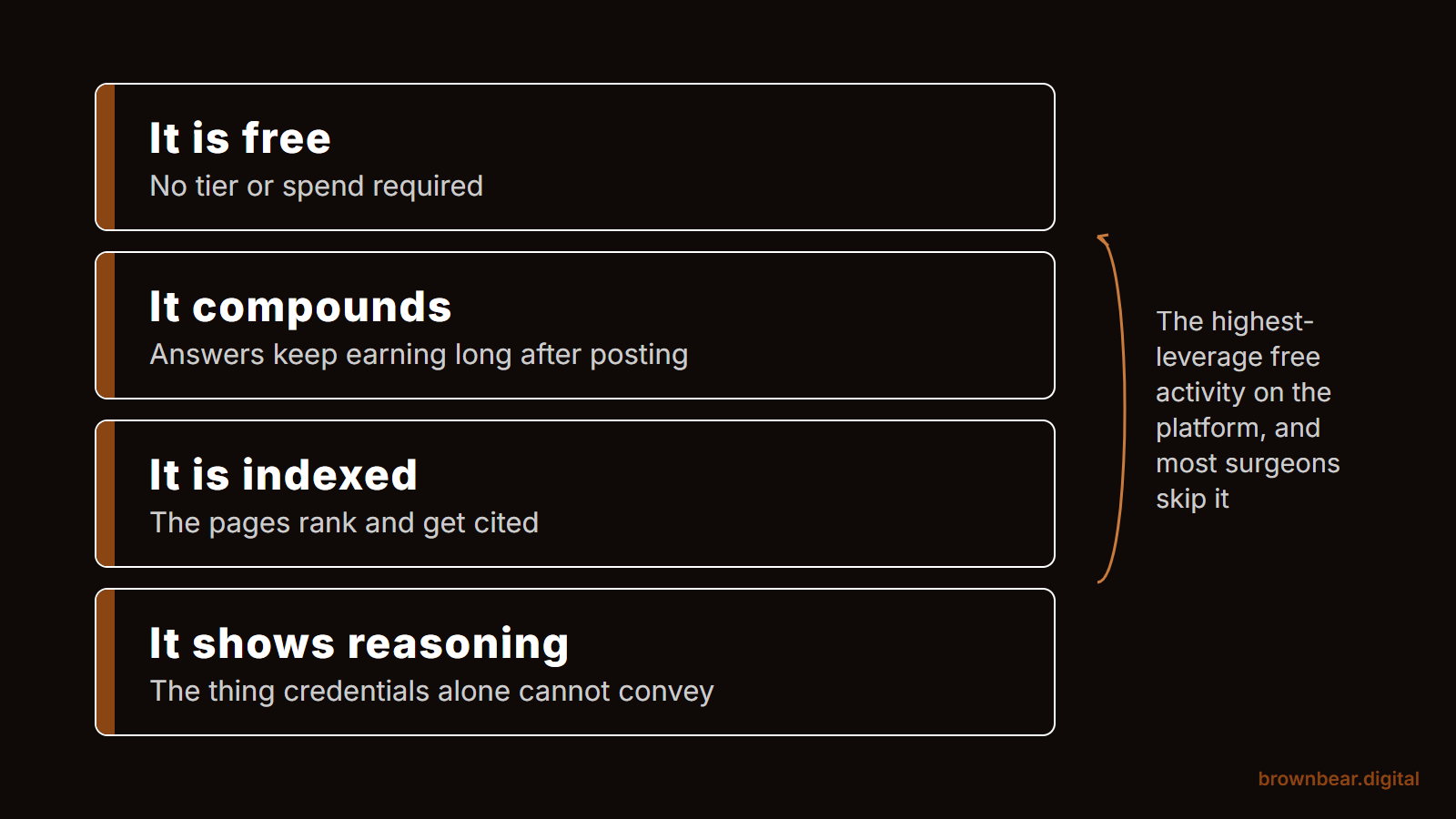
If there is one thing most practices could do today that would meaningfully improve their RealSelf visibility, it's answering patient questions consistently. Almost nobody does it well.
Patients post questions about procedures, recovery, risks, pricing, and surgeon selection every day. Doctors can answer those questions publicly, and those answers stay on the platform permanently. When you answer a question, two things happen. Your activity is logged as an engagement signal by RealSelf's algorithm, which directly increases your profile's visibility in local directory searches. And if your answer is specific and thorough, it can also rank in Google independently for the long-tail query the patient originally typed.
A generic answer like "recovery varies by patient, please consult a board-certified surgeon" generates no helpful votes, no engagement, and no ranking benefit. A specific, clinically-grounded response to a real patient concern is an asset. It gets upvoted by other patients researching the same question. It surfaces in search results with your name attached. It builds familiarity with patients who are still weeks away from contacting anyone.
Maintaining Top Doctor status requires answering at least 10 questions every 90 days. That's roughly four answers per month. At 30 minutes per session, one focused session every two weeks is enough to stay current. The key is answering questions where you have something genuinely specific to say, not filling a quota with boilerplate that no one finds useful.
RealSelf Recognition Tiers: What Each Level Actually Requires
RealSelf has four recognition tiers for physicians. Understanding what each one requires, and what it does for your visibility, matters for deciding how much to invest in the platform.
| Tier | Requirements | Visibility Benefit |
|---|---|---|
| Participating Member | 1 or more answered questions | Profile badge |
| Distinguished Member | 50 or more answered questions | Elevated directory position |
| Top Doctor | 10 answers per 90 days, 3+ patient reviews with above-average ratings, positive helpful vote ratio | Top 10% of platform; preferential ranking in local searches |
| RealSelf 500 | 75+ total answers, 10 per 90 days, high helpful vote ratio | Top 5% nationally; annual recognition |
The badge matters less than what the algorithm does with it. Top Doctor status places you in the top 10% of the RealSelf physician community and triggers preferential treatment in local search results within the platform. In highly competitive markets like Los Angeles, Miami, New York, and Dallas, Top Doctor is effectively table stakes for meaningful directory visibility. In smaller markets, achieving it puts you in a category with little to no local competition.
The path to Top Doctor is manageable if you treat it as a system rather than an occasional activity. Ten quality answers every 90 days, a consistent review pipeline, and an above-average rating are the requirements. For a surgeon who builds this into their workflow, it becomes a low-overhead competitive advantage that compounds over time.
The Paid Tier: The Link-Building Asset Nobody Talks About
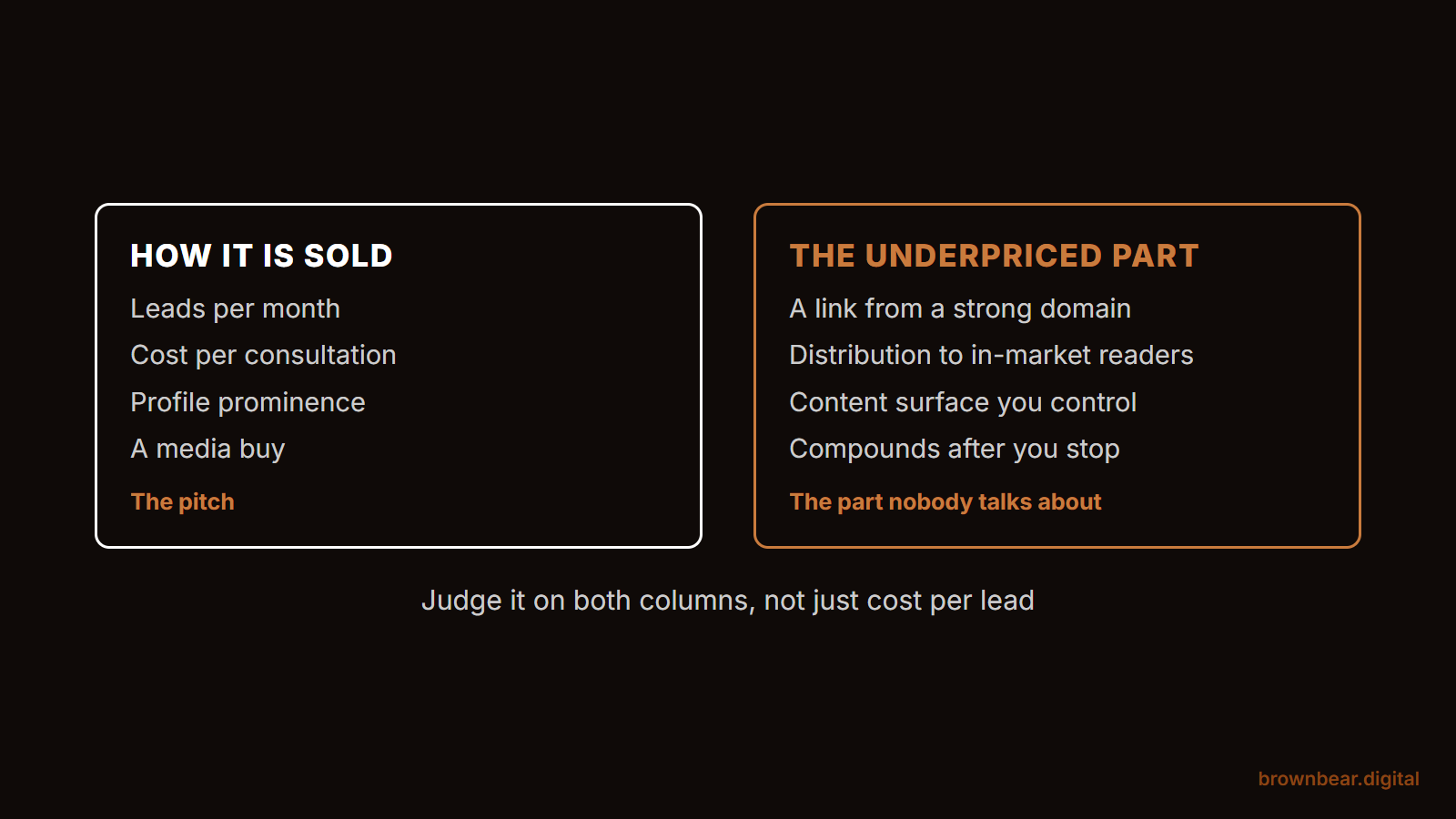
Most agencies describe RealSelf's paid membership in terms of "enhanced visibility" and "featured placement in local searches." Those benefits are real. But they're not the most strategically significant thing the paid tier unlocks.
The paid tier gives you the ability to customize your profile with direct links to specific pages on your own website.
This means you can link from your RealSelf rhinoplasty content directly to your practice's /rhinoplasty page. From your breast augmentation profile section to your /breast-augmentation page. From your surgeon bio to your homepage. Each of those is a contextual backlink from a high-authority domain, pointing to a specific page you want to rank in Google.
We've seen this play out with a practice we work with. After upgrading to the paid tier, they used the profile customization to build out a fully optimized bio with procedure-specific links throughout. The result was a meaningful improvement in organic rankings for those procedure pages, not just within RealSelf but in Google. The reason is straightforward: when a high-authority domain links to your /rhinoplasty page with rhinoplasty-related anchor text, Google treats that as a credibility signal for that page. Contextual backlinks from trusted domains are among the most reliable ranking inputs in local SEO, and RealSelf is one of the few platforms in the plastic surgery space that makes this possible.
Most practices spend significant budget on link-building campaigns, paying for guest posts, directory submissions, and outreach programs to earn exactly this kind of signal. The RealSelf paid tier delivers a comparable benefit, attached to a platform that is directly in the patient research path for your specialty.
The honest qualification: the paid tier's featured directory placement is most impactful in competitive markets where multiple strong profiles are competing for the same local searches. In markets where organic Top Doctor status already puts you at the front of results, the placement benefit is smaller. But the link equity benefit applies regardless of market. If you have well-built procedure pages that you want Google to see as authoritative, the paid tier is worth evaluating against the cost of what you'd otherwise spend to earn those same backlinks through an outreach campaign.
One thing to confirm before upgrading: make sure your procedure pages are worth linking to. Optimized, substantive, properly structured pages. A high-authority backlink pointing to a thin page won't move the needle. Build the pages first, then build the links.
Whether that adds up to an upgrade for your practice depends on your market, your tier status, and those pages. Run your situation through the framework:
Interactive decision check
Is the Paid Tier Worth It for Your Practice?
Five questions, then a verdict in RealSelf’s own format: Worth It, Not Worth It Yet, or Not Sure — with the reasoning. Your answers stay in your browser; nothing is sent anywhere.
1. How competitive is your market on RealSelf?
2. How would you honestly rate the procedure pages on your own website?
3. Are your free fundamentals done — complete profile, Verified status, every procedure claimed, NAP matching your Google Business Profile?
4. Where are you in the recognition tiers?
5. Are you currently paying for link building in any form — outreach, guest posts, directory campaigns?
For informational purposes only; the verdict reflects your answers against the framework in this article, not a guarantee of results, and is not professional or financial advice. Brown Bear is not affiliated with RealSelf. Your answers stay in this browser and are never transmitted.
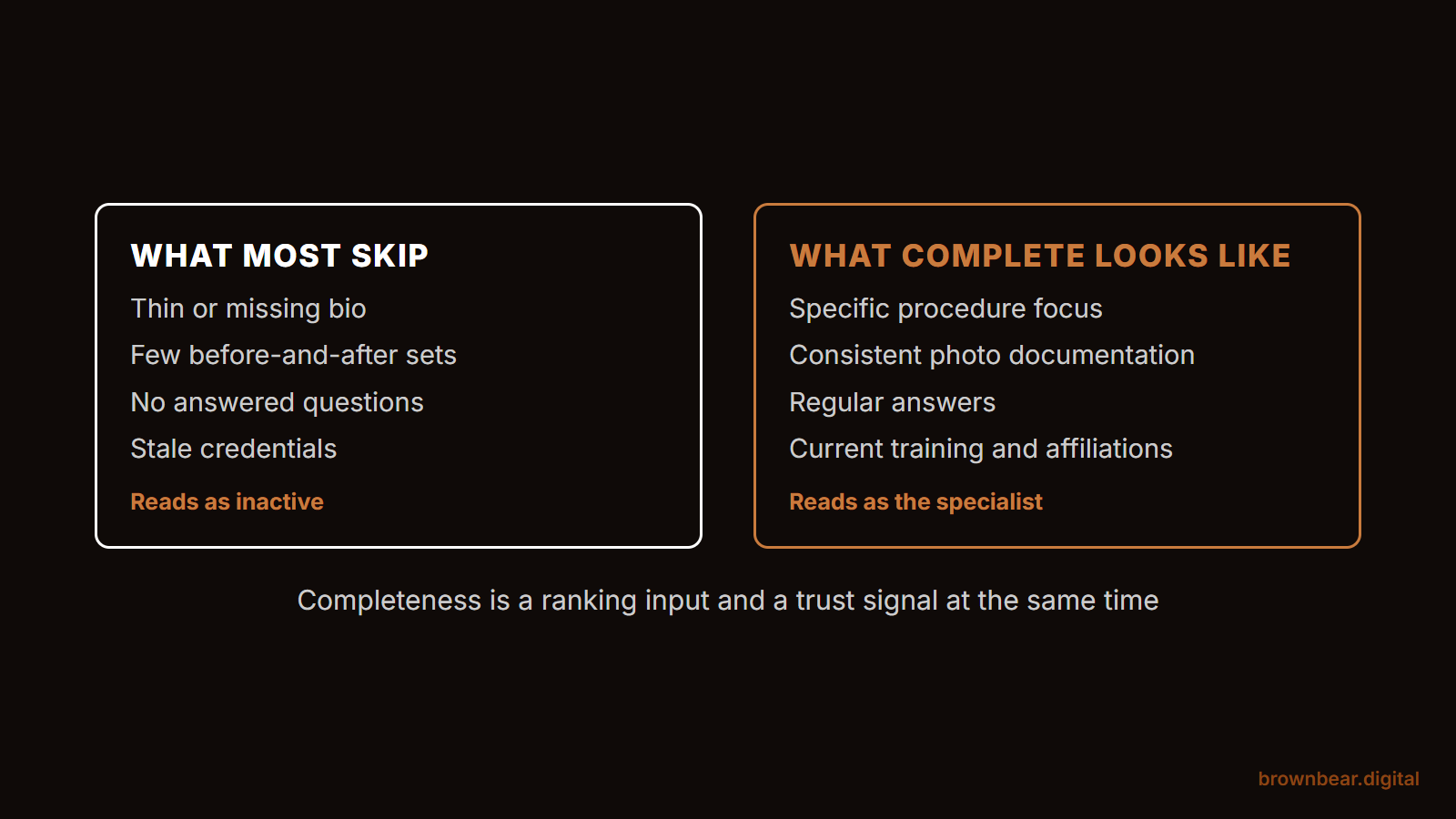
Profile Optimization: The Basics Most Surgeons Skip
Before any of the above strategies can deliver results, the fundamentals need to be right. These are the elements most surgeons either leave incomplete or fill in for the wrong audience.
Your bio.
Write it for a patient evaluating whether to contact you, not for a medical board reviewing your credentials. Your training, certifications, and procedural volume all matter, but they belong in the middle of the bio, not the opening sentence. A patient's first question when reading your profile is whether you're the right surgeon for them. Answer that first.
Procedure specialties.
Claim every procedure you perform. RealSelf uses these categories to match your profile to relevant local searches. If you do body contouring but haven't claimed liposuction as a specialty, you're invisible in those searches.
Before-and-after photos.
Volume matters, and so does representation. Patients are looking for results that look like them. A gallery that only shows ideal candidates in a narrow demographic range leaves a significant portion of your prospective patient pool unable to see themselves in your work. Variety across ages, body types, and starting points builds broader relevance.
NAP consistency.
Your name, address, and phone number on RealSelf need to be character-for-character identical to your Google Business Profile. "Suite 200" and "Ste. 200" are different strings, and inconsistencies like that weaken the local SEO signals both platforms send to Google on your behalf.
Response time.
Verified status on RealSelf requires committing to respond to patient inquiries within two business days. That commitment is displayed on your profile. Patients in research mode notice it, and RealSelf's algorithm factors responsiveness into how your profile performs in search results.
How RealSelf Fits Into Your Broader SEO Strategy
RealSelf works best as one component in a coordinated authority network, not as a standalone investment. Coordinating that network is the core of our SEO services for aesthetic practices.
The three platforms that matter most for plastic surgeons are Google Business Profile, RealSelf, and Healthgrades. Each reaches a different patient at a different stage of their research, and each sends different trust signals to Google. A surgeon who is active and well-reviewed across all three is building a consistent authority signal that individual website optimization alone cannot replicate.
The website those profiles send patients to still has to load. A patient who taps through from a RealSelf profile is often a first-time visitor on a phone, and in our page speed research on 150 practice homepages only 31 showed their main content within Google's 2.5-second line on a real browser slowed to a mid-range phone.
It is worth being precise about where the platform competes with your own site and where it does not. Our 101-city study of procedure page rankings found that 100 of the 101 #1 positions for a major procedure search belong to individual practice and surgeon sites. Directories including RealSelf show up at positions 2 and 3 in a handful of markets and never once at the top. The picture is similar on national photo queries: in our 50-procedure gallery study, RealSelf held 4 of 500 ranking slots, all at positions 9 and 10, none of them on a surgical term. Read that as good news rather than a reason to skip the platform. RealSelf is a research and authority layer feeding the entity Google ranks, not a rival for the searches that book consultations.
From an E-E-A-T perspective, the framework Google uses to assess whether a medical source is trustworthy, RealSelf activity contributes directly. Consistent patient reviews, quality Q&A answers, and a verified, complete profile all demonstrate that you are a practicing clinician with real patient outcomes. In a YMYL category like plastic surgery, those signals carry weight well beyond your own website.
The practical sequencing for a practice building this out: get the fundamentals right first (complete profile, NAP consistency, Verified status, all procedure specialties claimed), then activate Q&A as an ongoing channel, then evaluate the paid tier based on your market and the quality of your procedure pages. The fundamentals take a few hours to set up correctly. Q&A takes a few hours per month to maintain. The paid tier is a strategic decision that depends on your market competitiveness and your existing SEO program.
What Separates the Practices Getting Results From the Ones That Aren't
The practices getting the most from RealSelf in 2026 are not the ones with the largest budgets or the most reviews. They're the ones who understand what the platform actually does: surfaces profiles in patient research, ranks in Google, appears in AI-generated answers, and, through the paid tier, sends direct link equity to specific procedure pages.
Most of that is available through a system, not a spending increase. The Q&A strategy, the review pipeline, the procedure category claims, and the profile fundamentals are all free. The paid tier adds link-building value that pays for itself if your SEO program is already pointed in the right direction.
If you want to understand how RealSelf fits into a full SEO strategy for your practice, that's a conversation we're built to have.
Written By
Founder, Brown Bear Digital
Bryan has 15 years of experience across SEO, paid search, and AI search strategy. He founded Brown Bear to give businesses direct access to senior-level search expertise without the agency overhead.
Learn More About BryanGet Found on Google.
Get Cited by AI.
Tell us about your site. We'll send back a proposal for SEO and AI search.