How to Improve Brand Visibility in AI Search Engines: A Plastic Surgeon's Guide to Being Named and Described Correctly

A surgeon we work with ran a simple test last spring. He asked ChatGPT who the best facelift surgeons in his city were, expecting to see his own name near the top. It named three practices. His was not one of them, and the one it praised most warmly was an ENT with a one-year cosmetic fellowship. He had five years of plastic surgery residency, a fellowship on top of that, and two decades of facelifts behind him. To the AI, none of that existed.
That is a brand visibility problem, and it is a different animal from a ranking problem. Ranking asks whether you show up on a page. Brand visibility in AI search asks two harder questions: does the engine name your practice when a patient describes what they want, and when it does, does it describe you accurately? A practice can lose on both counts at once, and never see the conversation that cost it the consult.
We run AI search campaigns for aesthetic and surgical practices, and this specific failure, getting left out or getting misdescribed, is one of the most common and most fixable problems we see. If you want the full picture of how AI engines assemble their recommendations, our GEO and AEO playbook for plastic surgeons is the foundation. This piece goes narrower, into the brand layer specifically: how to make sure AI knows who you are, gets your credentials right, and reaches for your name first.
Whether you are the surgeon who just failed that test yourself or the office manager trying to understand why a lighter-credentialed competitor keeps getting the nod, this covers both the mechanism and the fix. So let's start with what brand visibility actually means once a machine is the one doing the describing.
Key Takeaways
Being named is only half of AI brand visibility
An AI answer is a pre-digested interpretation the patient receives before ever reaching your site. Inclusion gets you on the shortlist; accuracy decides whether the engine describes your specialty and credentials the way you would, and both can fail at once without you ever seeing it.
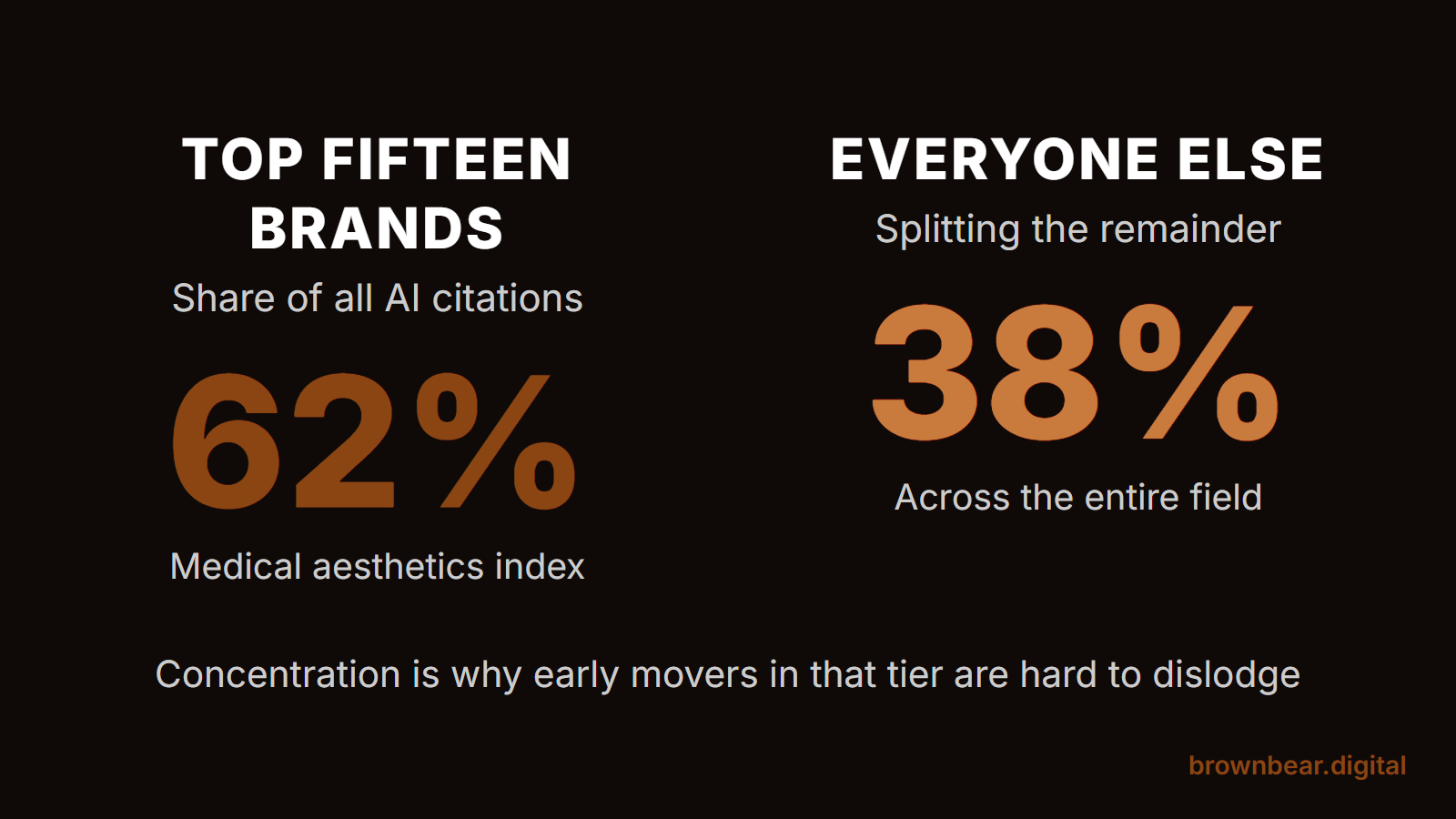
Fifteen brands hold roughly 62% of AI citation share
The first AI visibility index for medical aesthetics found the top fifteen brands capturing about 62% of all citations. Visibility is concentrated because most practices are doing nothing deliberate about it, which leaves the lane open for the ones who move.
AI credential bias quietly rewrites who you are
Engines frequently favor narrower titles like facial plastic surgeon over board-certified plastic surgeons with five to six years of residency, because they pattern-match on labels rather than training. Publish consistent credential language that mirrors the American Board of Plastic Surgery's definitions and correct the citing sources directly.
Recent procedure-specific reviews teach AI your specialty
Recency, specificity, and responsiveness decide how the engine summarizes you. A steady stream of detailed, procedure-level reviews on Google, RealSelf, and Yelp moves you from generic praise to being named for the exact searches that drive consults.
What "Brand Visibility in AI Search" Actually Means
Brand visibility in AI search is how often, and how accurately, an engine names your practice inside its answer when a patient asks for a recommendation. It has two parts, and both matter. The first is inclusion: are you one of the names the model says out loud. The second is accuracy: does it describe your specialty, your credentials, and your reputation correctly when it does.
This is where AI search departs from classic SEO. A Google result is a link the patient clicks and interprets for themselves. An AI answer is an interpretation the patient receives pre-digested. The engine has already decided who you are and how to summarize you, in one confident paragraph, before the patient ever reaches your site. If that summary is thin, wrong, or missing, you do not get a second chance to make the case. The machine already made it for you, or against you.
So improving brand visibility is not only about being mentioned more. It is about controlling the story the AI tells when it mentions you.
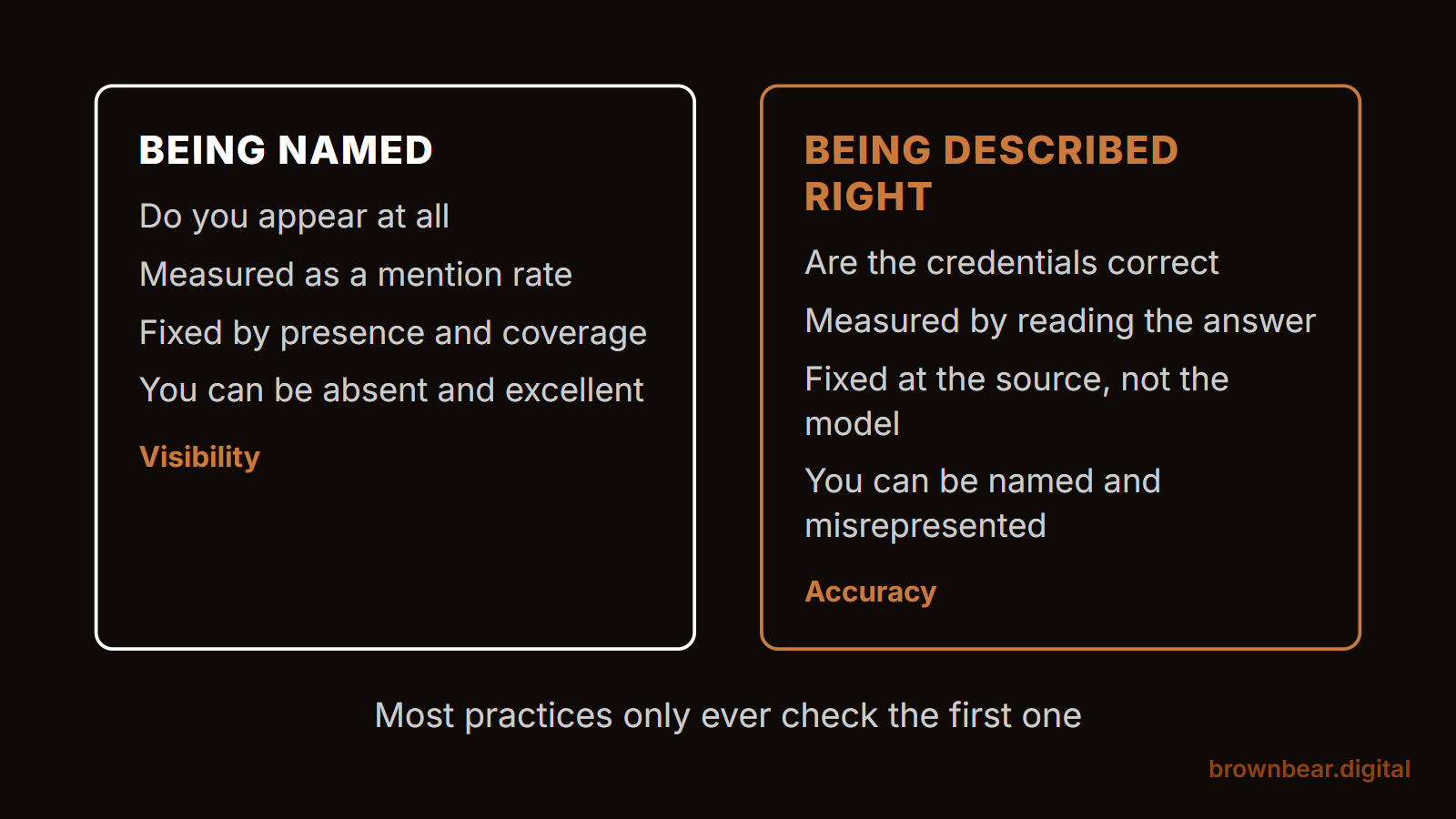
The Credential Bias That Quietly Rewrites Your Brand
Here is the part no generic "AI visibility" advice will warn you about, because you have to understand surgery to see it. AI engines carry a credential bias. When patients ask about facial procedures like facelifts and rhinoplasty, these models frequently favor "facial plastic surgeons," ENT physicians with a one-year cosmetic fellowship, over board-certified plastic surgeons, on the flawed logic that a narrower title signals deeper skill.
That logic is wrong, and it costs real practices real consultations. Board-certified plastic surgeons complete five to six years of residency with substantial facial training, and many add an aesthetic fellowship on top. The engine does not weigh that. It pattern-matches on labels, and it sometimes invents categories that do not exist, like a "general plastic surgeon" tier, then presents them as fact. This is a brand visibility failure in its purest form: the AI is not just skipping you, it is actively mischaracterizing what you are.
"Patients expect to see board certification right up front, and it's often how they separate one surgeon from another. What I wish more patients understood is that not all boards are equal. Any licensed doctor can call themselves a cosmetic surgeon, but a surgeon board certified through the American Board of Plastic Surgery has gone through years of specific surgical training to earn it. When an AI tool steers someone toward a provider based on a label instead of the training behind it, the patient usually doesn't even know a swap happened. When they catch it, they start second-guessing every recommendation the tool gave them."
Bryan Passanisi
, founder of Brown Bear
That last point is the one to sit with. When a patient realizes an AI steered them on a label rather than real training, the distrust does not stay contained to one provider. It spreads to every recommendation the tool gave. The credential bias is a shared problem for board-certified surgeons, which is exactly why correcting it is worth doing deliberately rather than hoping the model figures it out.
Correcting the Record When AI Gets Your Brand Wrong
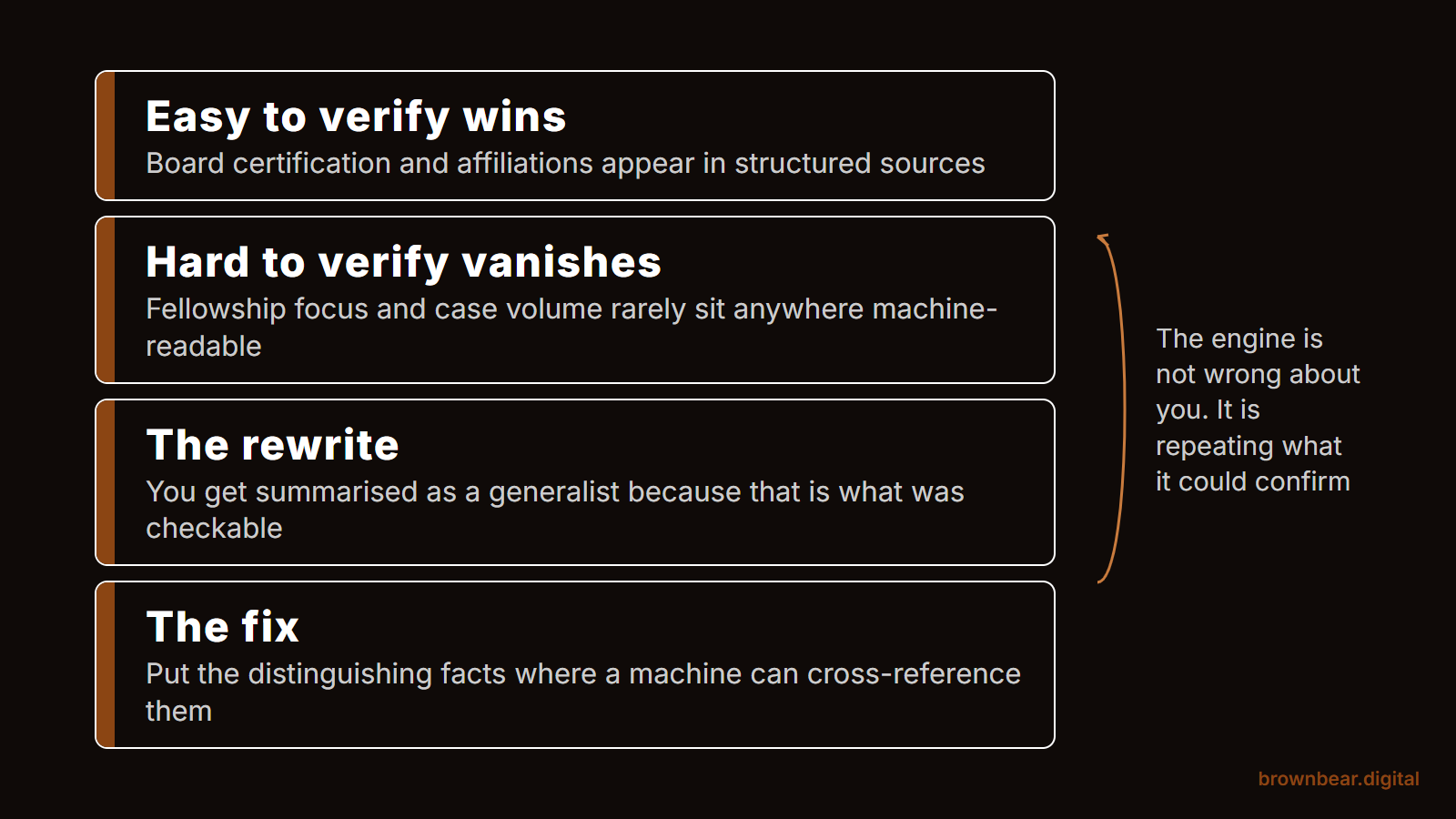
Before you chase new mentions, fix the record on the credentials you already hold. Publish clear, consistent language about your board certification everywhere a machine can read it: your site, your directory profiles, and any editorial features. State plainly what certification means and point to the authorities that define it. The American Society of Plastic Surgeons and the American Board of Plastic Surgery both maintain the definitions AI models should be learning from, and the closer your language mirrors theirs, the harder it is for an engine to get you wrong. This is the on-site half of the E-E-A-T work every plastic surgery practice needs, applied to the specific problem of a machine misreading your credentials.
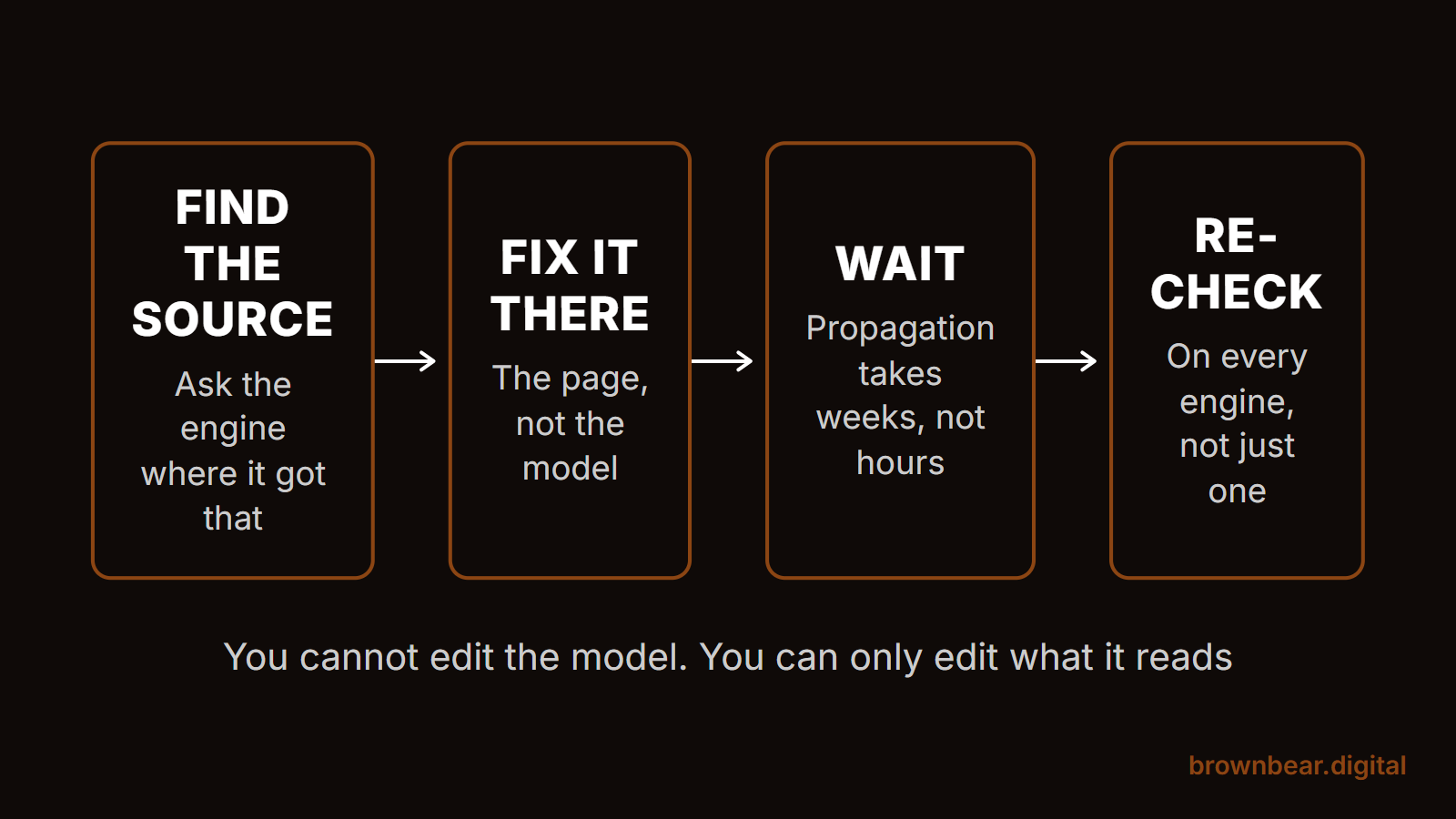
"The fix, when it's needed, is direct. Go straight to the sites citing the wrong information and ask them to update it, then make sure your own website states the correct credentials clearly and is easy to crawl. This is rare, credentials don't get misattributed often, but when they do, those two moves usually clear it up."
Bryan Passanisi
, founder of Brown Bear
Expect the answer box to follow its sources rather than lead them. Once the citing pages are corrected, the AI descriptions tend to update within a few crawl cycles, so plan on a couple of weeks rather than an overnight fix. You cannot rewrite the model directly, but you can flood it with accurate, corroborated signals until accurate becomes the path of least resistance.
Why Each AI Engine Sees Your Brand Differently
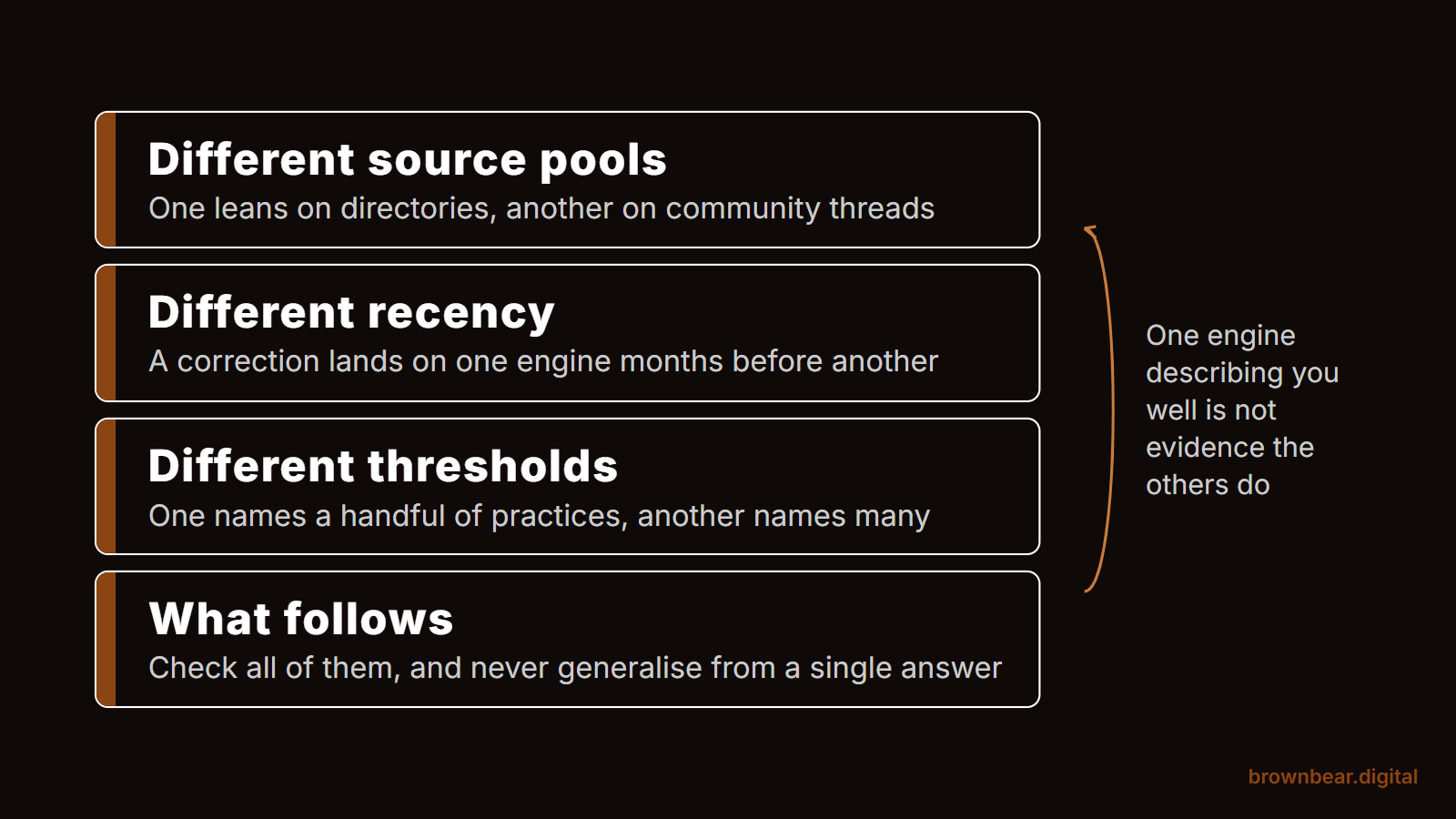
Treating "AI search" as one thing is the second mistake practices make. Each major engine builds its answers from a different kind of source, so the same brand can be visible in one and invisible in another. The first AI visibility index built for medical aesthetics made the split concrete, and it also found that the top fifteen brands captured roughly 62% of all AI citation share. That concentration sounds bleak until you see the flip side: visibility is concentrated because most practices are doing nothing deliberate about it.
| Engine | What it rewards for aesthetics | What that means for your brand |
|---|---|---|
| ChatGPT | Long-form, provider-authored editorial and deep practitioner features | Publish substantive, surgeon-bylined content and earn features that profile your providers by name |
| Claude | Clinical, methodologically transparent, peer-reviewed sources | Be precise and evidence-based; contribute to and cite credible clinical literature |
| Perplexity | The broadest range of publishers, including niche specialty outlets | Get placed in aesthetic and regional trade publications, not just the big names |
| Google AI Overviews | A blend of classic SEO signal and generative summarization | Your existing rankings still feed the answer box, so local search work compounds here |
The through line is a single idea from that index: earned authority beats spent authority in the AI answer box. The model does not know what you paid for. It knows who cited you. For the deeper mechanics of how each engine assembles its shortlist, the GEO and AEO playbook breaks it down engine by engine. The brand-level takeaway is simpler: a recommendation you buy is fragile, and a recommendation you earn through citations compounds.
Your Reviews and Directories Are How AI Learns Your Brand
Think of your reviews and directory profiles as the raw material an engine reads to describe you. Volume across several sites matters, because it teaches the model which procedures you are known for.
"Google pulls mostly from your Business Profile, but for plastic surgeons, RealSelf and Yelp carry real weight, since that's where you get detailed, procedure-level reviews. Photos or videos tied to a review are bonus points, because they add context the AI can pull from. When a practice moves from old, generic reviews to recent, procedure-specific ones, the AI stops calling them 'a great surgeon' and starts calling them 'known for rhinoplasty' or 'known for mommy makeovers.' That specificity is what gets you named for the searches that actually drive consults."
Bryan Passanisi
, founder of Brown Bear
Three qualities decide how much that material helps. Recency signals that your practice is active and relevant, so a wall of five-year-old praise reads as stale. Specificity gives the engine accurate language to summarize you with, because "a natural-looking deep plane facelift at three months" teaches the model more than "great experience." And responsiveness, replying to reviews good and bad, signals a practice that stands behind its work. We go deeper on the review engine in our guide to review generation and response for plastic surgeons, and on the platform specifics in the RealSelf profile strategy for AI search. If your listings contradict each other or your best reviews are old, you are handing the machine a blurry picture, and it will skip you even when your surgical results are excellent.
Building Brand Authority AI Will Actually Cite
The content that earns brand citations in aesthetics is provider-first, and it does not stop at your own domain. This is where most practices leave visibility on the table.
"The thing most owners underestimate is that you can't win AI citations from your website alone. Primary research, expert quotes, and a real presence on third-party platforms like YouTube and podcasts are what reliably earn citations. That off-site footprint is exactly what AI engines lean on when they decide who to name, which is why you want a real strategy instead of just polishing your homepage."
Bryan Passanisi
, founder of Brown Bear
So write procedure pages in your surgeon's voice, explaining candidacy, technique, and recovery with real specificity, and answer the exact questions patients ask AI in language a model can lift. Then extend past the site: pursue editorial features that profile your providers, get your surgeons on relevant podcasts and video, and publish or contribute to original data where you can. A third-party citation carries more weight than anything you publish about yourself, which is why this off-site authority is the same force that governs the YMYL standard AI search applies to plastic surgery. The stronger and better-attributed that footprint becomes, the more often the engine reaches for your name.
How to Measure Brand Visibility in AI Search
You measure brand visibility differently than rankings, and you give it a realistic runway. Track how often, and how accurately, each engine names your practice for your priority procedures and locations, and watch specifically whether it describes your credentials correctly, because fixing that is a win on its own. (A simple starting point is the 15 minute AI visibility audit from our guide to how patients research providers with AI.)
"Expect movement around the 90-day mark, but at 90 days the signal is visibility, not consults yet. Before the phone starts ringing, we look for the practice showing up in AI Overviews and in ChatGPT or Perplexity answers for target procedures, plus a lift in branded search and more Google Business Profile activity like profile views and direction requests. Those move first. Consults follow once that visibility compounds."
Bryan Passanisi
, founder of Brown Bear
The main variable is execution speed: the faster approved content goes live on-site, and the sooner off-site placements clear, the better the return. Meaningful consultation impact tends to build over the following six to nine months as authority compounds. This is not a switch you flip, it is a moat you build, which is exactly why the early movers in that 62% citation tier are so hard to dislodge. For the full set of metrics worth tracking, see the plastic surgery KPIs that actually matter.
Work With Brown Bear on Your AI Search Brand Visibility
Getting named by ChatGPT, Perplexity, and Google's AI, and described the way you would describe yourself, is not a one-time task. It is the compounding result of a clean credential record, strong recent reviews, structured data engines can read, and an off-site authority footprint that earns citations instead of buying them. That is the work we do for aesthetic and surgical practices, in the order that actually moves the needle.
If you want to know how AI search sees your brand today, and what it would take to become the name patients get handed, take a look at how we approach AI search for plastic surgery practices. We will show you the mechanism, not just a promise.
Frequently Asked Questions
What does brand visibility in AI search mean for a plastic surgeon?
It means how often an engine like ChatGPT, Perplexity, or Google's AI Overviews names your practice when a patient asks for a recommendation, and how accurately it describes your specialty and credentials when it does. Unlike a Google ranking, which the patient interprets themselves, an AI answer is a pre-digested summary, so being named and being described correctly are both part of the same visibility problem.
Why does AI recommend a facial plastic surgeon over a board-certified plastic surgeon?
Because AI engines pattern-match on titles and often assume a narrower label means deeper expertise, which is not how surgical training works. A board-certified plastic surgeon completes five to six years of residency with substantial facial training, frequently plus a fellowship. The fix is to publish clear, consistent credential language across your site and profiles that mirrors how the American Board of Plastic Surgery defines certification, so the engine has an accurate source to learn from.
How do I fix AI describing my credentials incorrectly?
Go directly to the third-party pages citing the wrong information and request a correction, then make sure your own website states your credentials clearly and is easy to crawl. Once the source pages are corrected, AI descriptions usually update within a few crawl cycles, so expect a couple of weeks rather than an instant change.
Which review sites matter most for AI brand visibility in plastic surgery?
Google Business Profile is the baseline, but RealSelf and Yelp carry real weight for surgical practices because they hold detailed, procedure-level reviews. Recent, specific reviews with photos or videos teach the engine which procedures you are known for, which is what moves you from "a great surgeon" to "known for rhinoplasty" in an AI answer.
How long does it take to improve brand visibility in AI search?
Expect visibility signals to move around the 90-day mark, meaning AI mentions, branded search, and Google Business Profile activity, with consultation impact building over the following six to nine months. Speed depends most on how quickly approved content gets published on-site and how soon off-site placements go live.
Written By
Founder, Brown Bear Digital
Bryan has 15 years of experience across SEO, paid search, and AI search strategy. He founded Brown Bear to give businesses direct access to senior-level search expertise without the agency overhead.
Learn More About BryanGet Found on Google.
Get Cited by AI.
Tell us about your site. We'll send back a proposal for SEO and AI search.