How to Improve Brand Visibility, Sentiment, and Citations in AI Search
This is Brown Bear's working guide to getting your brand named, described accurately, and cited as a source when AI answers questions in your category. It draws on what Bryan Passanisi, Brown Bear's founder, sees inside the AI visibility audits we run for clients, from medical practices to SaaS companies. The patterns repeat across industries, and most of them are fixable.
When we say AI search, we mean both Google's AI Overviews and the standalone assistants people now treat as search engines: ChatGPT, Perplexity, Claude, Gemini, and Copilot. The playbook below applies to both, because both are doing the same job. They read the open web, decide which brands to trust, and compress everything into one answer.
If you're the in-house marketer watching organic traffic flatten while leadership asks what the AI plan is, this gives you one. If you run a small or local business and a customer just told you ChatGPT recommended your competitor by name, this explains why. And if you're the SEO defending a budget line that suddenly has to cover "AI," this gives you the framework and the measurement method to back it.
Key Takeaways
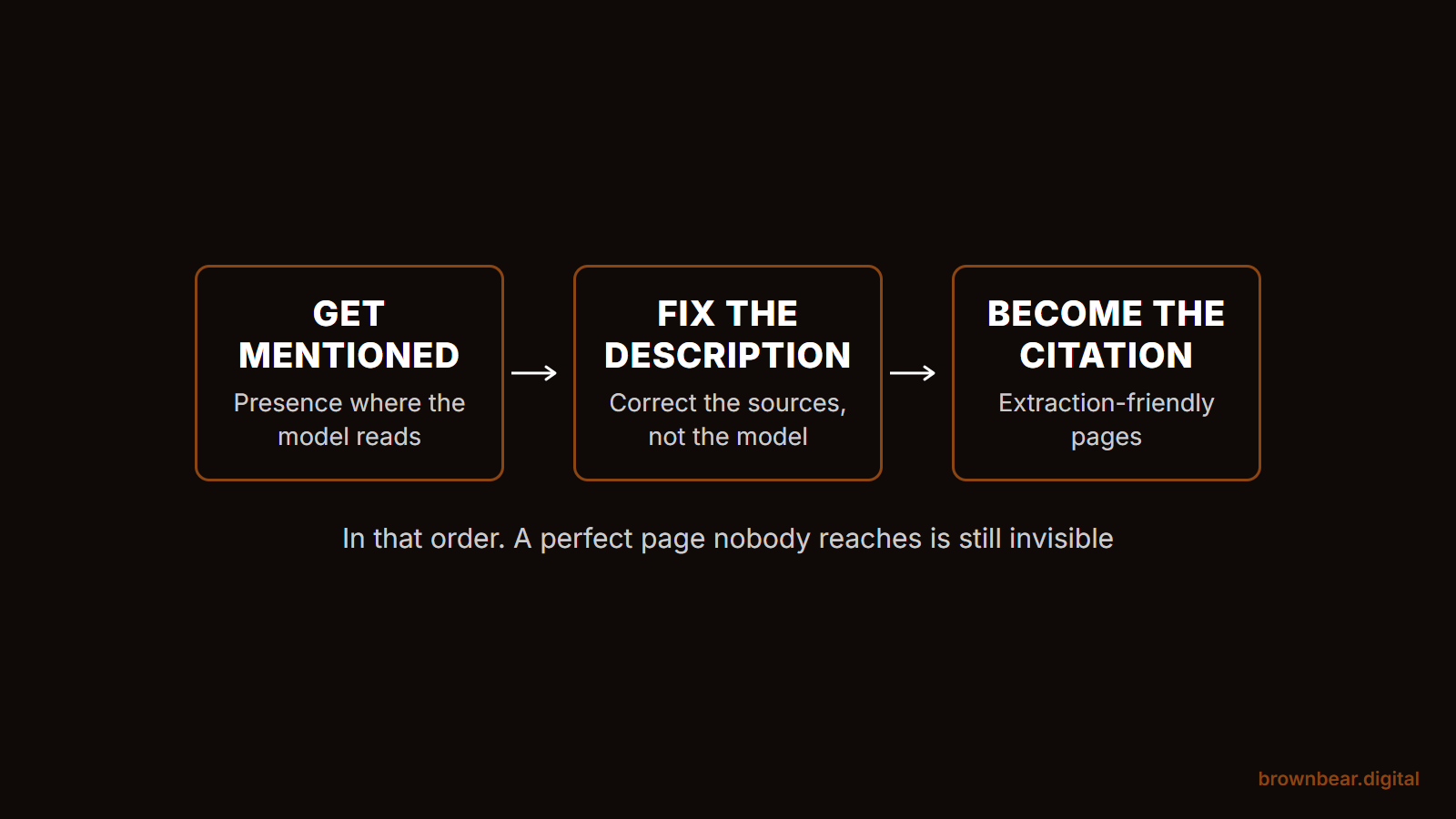
Three levers, not one
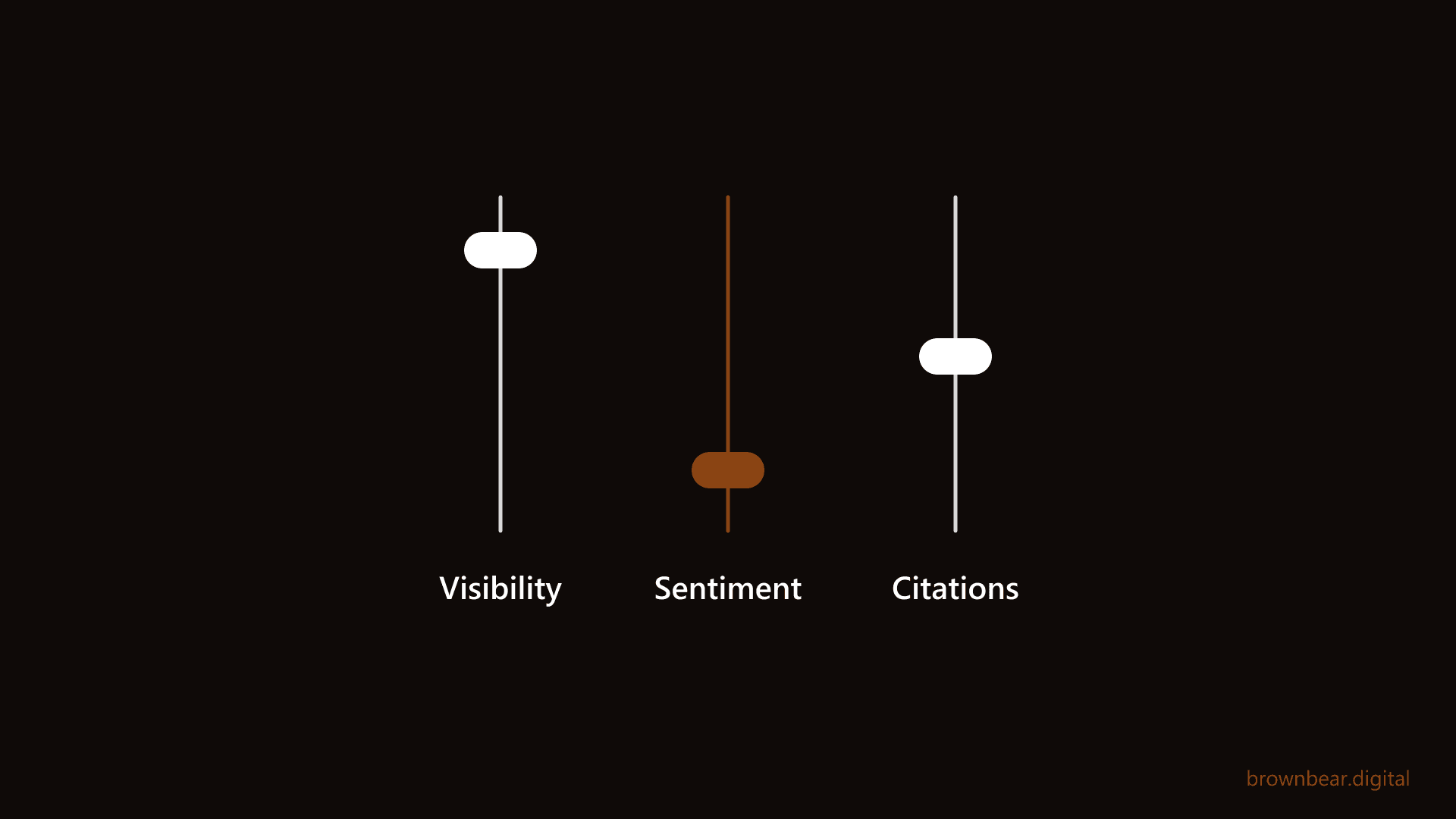
Visibility (does AI name you), sentiment (how AI describes you), and citations (does AI quote your pages) are controlled by different parts of your footprint and fail for different reasons. Fixing the wrong one wastes a quarter.
Mentions are earned off your website
AI engines decide which brands to name by reading the third-party sources they already trust. Entity consistency comes first: one canonical name, address, and phone number everywhere.
Sentiment is a compression of your public record
You can't argue with the summary, only change the inputs it summarizes. A stale review corpus keeps a stale description in every AI answer until newer inputs outweigh it.
Citations go to extraction-friendly pages
The major LLM crawlers execute no JavaScript at all. Answer-first structure in raw HTML moves this lever more than schema markup does.
You can measure all three for free
The 10-Prompt Self-Audit gives you a visibility, sentiment, and citation baseline in one afternoon, no tools required. The interactive tracker below runs it with you.
By the end, you'll know the three separate levers that control how AI treats your brand, which one is actually your problem, and a free method for measuring all three in an afternoon.
We've organized it into three parts: how AI engines choose brands, the three levers themselves, and how to measure progress without buying another tool. Let's start with the distinction most advice skips.
Visibility, Sentiment, and Citations Are Three Different Problems
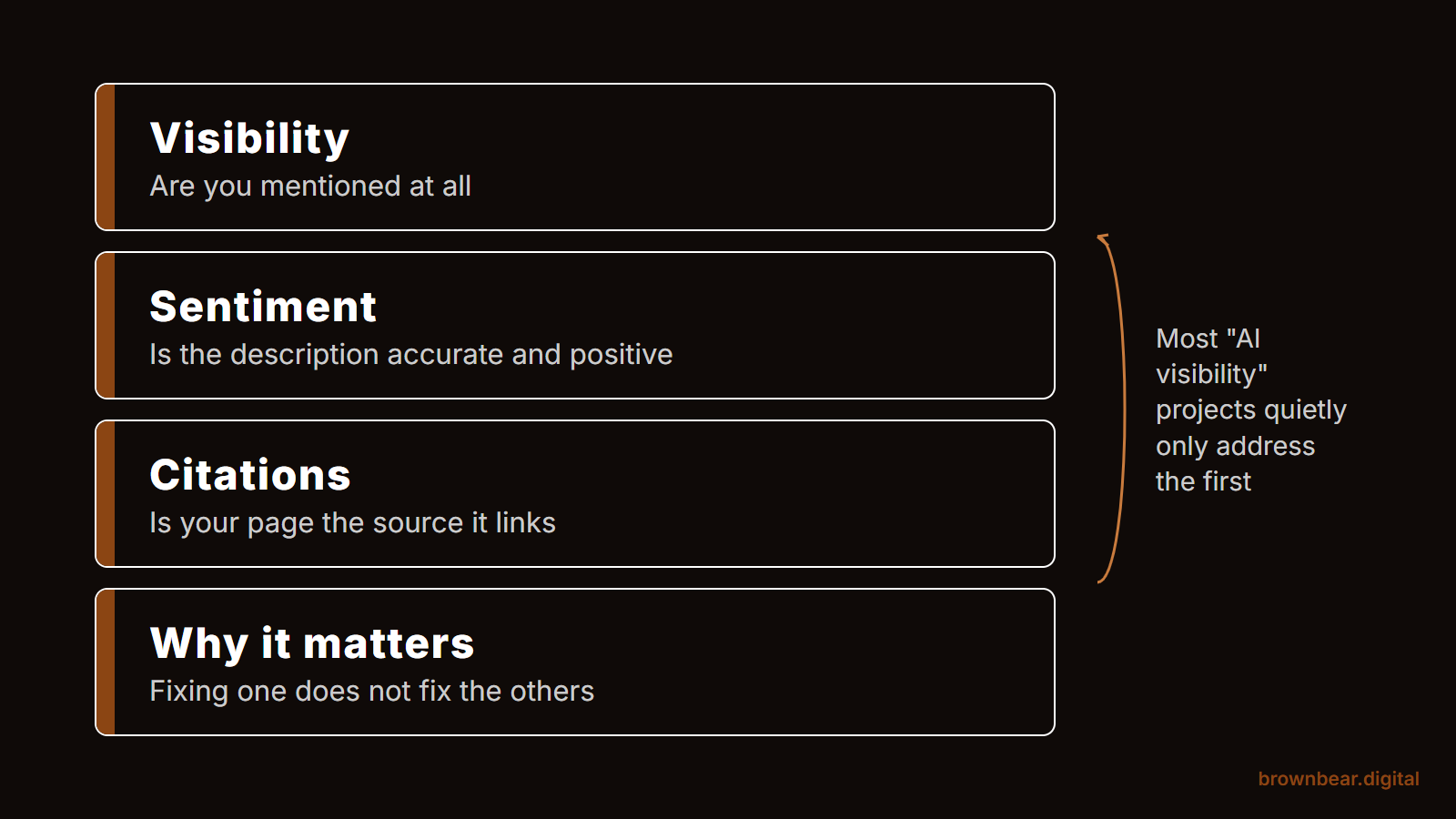
AI search performance breaks into three separate questions. Visibility: does the AI name your brand when someone asks for recommendations in your category? Sentiment: when it names you, does it describe you the way you'd want a salesperson to? Citations: when it lists sources, are your pages among them?
These get lumped together as "AI visibility," and that lumping is why so much effort goes nowhere. Each lever is controlled by a different part of your digital footprint, and each one fails for a different reason. A brand can be mentioned constantly but described as a budget option. A brand can have zero mentions but earn citations on one strong page. Fixing the wrong lever wastes a quarter.
The stakes are real and growing. Roughly 4 in 10 U.S. adults have now used ChatGPT, according to the Pew Research Center's February 2026 survey, and usage has more than doubled since 2023. Those users ask for recommendations the way they used to type queries, and they rarely see a list of ten blue links. They see one answer.
Which AI Search Lever Is Your Problem?
Six questions. Answer from what you actually see, not what you hope. Your weakest lever is where the next 90 days go.
1. When you ask an AI assistant for recommendations in your category, does your brand get named?
2. Is your business name, address, and phone number identical across every directory and profile?
3. When AI describes your business, is the description current and emphasizing what you want to be known for?
4. How recent is the bulk of your review corpus?
5. Do your key pages answer their main question directly in the first two sentences under a clear heading?
6. Do AI answers in your category ever cite your site as a source?
Answer all six questions first.
For informational purposes only; results reflect your self-reported answers and are not a guarantee of AI search performance. Not professional marketing advice. Your answers stay in your browser and are not transmitted or stored anywhere.
How AI Engines Decide Which Brands to Mention
AI engines pull from two places: what the model learned in training, and what it retrieves from live search at answer time. Training data rewards brands with a long, consistent public record. Live retrieval rewards brands that rank in the indexes the assistant queries. For ChatGPT, that's a blend of OpenAI's own index and third-party search providers, historically Bing, which is why Bing Webmaster Tools is worth an afternoon even though most teams have never once opened it.
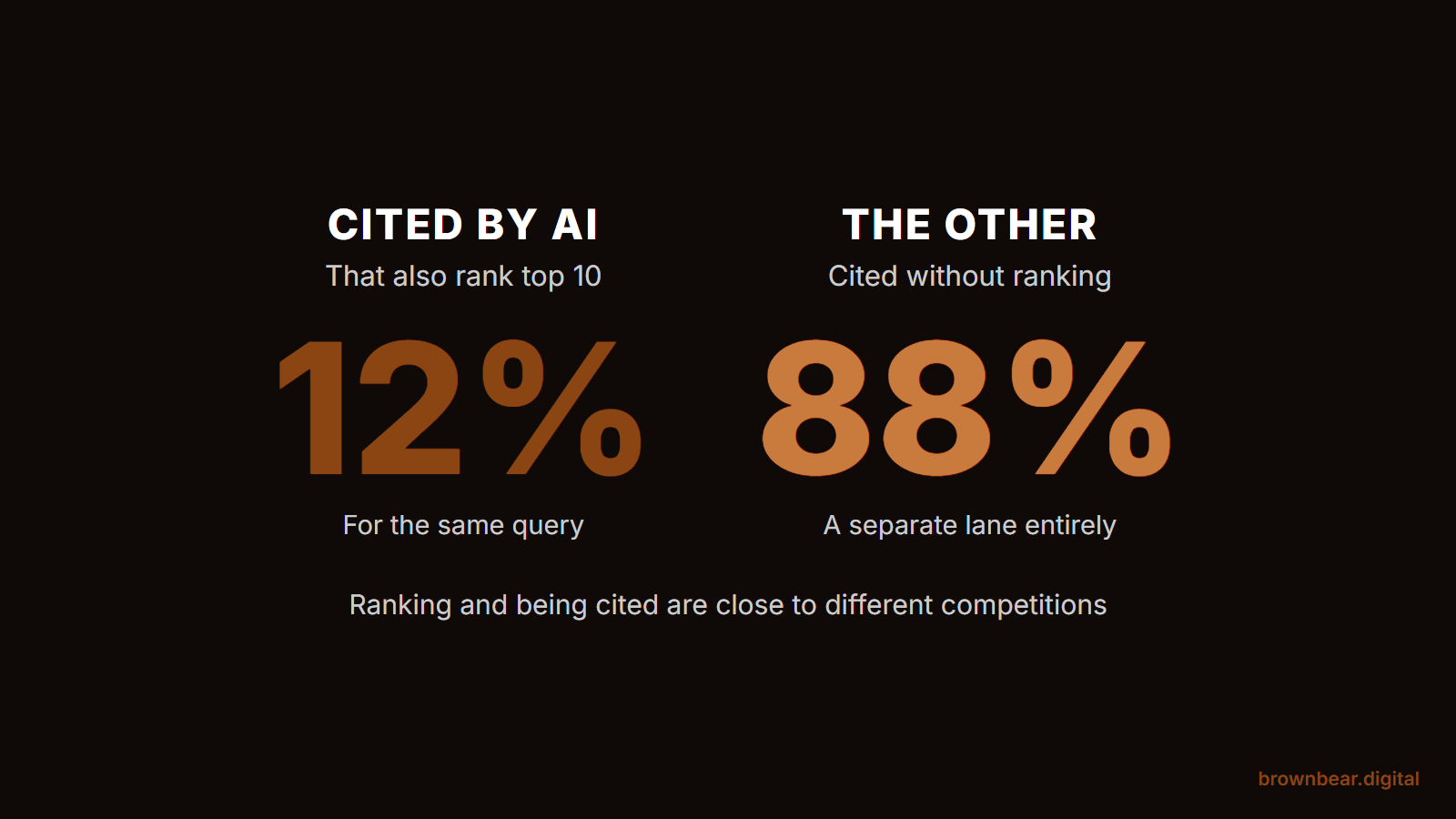
This is why the loudest argument in the industry, that AI optimization is just SEO with a new name, is half right. Rankings still feed the retrieval side, so your SEO foundation carries over. But the overlap is smaller than most people assume: Ahrefs found that only about 12% of the URLs AI assistants cite rank in Google's top 10 for the same query. And the training side of the equation doesn't care about your rankings at all. It cares about how often, and how consistently, credible third parties describe your brand. For the tactical, platform-by-platform version of these mechanics, our GEO and AEO playbook goes deeper.
That consistency point is worth sitting with. When an AI encounters your business as "Smith Dermatology," "Smith Derm & Aesthetics," and "Smith Dermatology Group" across three directories, it isn't sure those are the same entity, and unsure entities don't get recommended. In the audits we run, flat-out wrong information about a brand is rare. The far more common finding is odd variations of the business name, address, and phone number scattered across the web, and the fix is cheap.
1. Get Mentioned More Often
Visibility is earned off your website more than on it. AI engines decide which brands belong in an answer by reading the sources they already trust for your category: review platforms, directories, press, industry publications, and community discussion. If those sources rarely mention you, your own site can't argue you into the answer.
This is the finding that surprises business owners most in our audits: how much of their AI presence is controlled by third-party sites they've been ignoring. The brand that shows up in AI answers is usually the one with the widest, most consistent third-party footprint, not the one with the best homepage.
The second most common visibility problem is subtler. The AI knows the brand exists but has the emphasis wrong. A common pattern from our practice audits: a surgeon who wants to be known for rhinoplasty reads their AI profile and finds the procedures they've built their reputation on buried under generalist language, because the public record describes a generalist. The web says "full-service practice" everywhere, so the AI sees a generalist, and generalists don't get named for specialist queries. We cover the practice-specific version of this playbook in our plastic surgeon's guide to AI search visibility.
To move this lever:
- Fix your entity data first. One canonical business name, address, and phone number, enforced across every directory, profile, and listing you can log into.
- Claim and fill out the two or three platforms AI engines treat as authorities in your category. For local services that's Google Business Profile and the dominant review site. For B2B software it's G2 and Capterra. For medical it's the major provider directories.
- Earn third-party mentions that describe you the way you want to be described: local press, industry roundups, association listings, podcast appearances.
- Publish the specialization you want to be known for, on your site and in every bio and profile, in plain repeated language.
2. Fix How AI Describes You
Sentiment in AI answers is mostly a compression of your review corpus and press coverage. The model reads what hundreds of people wrote about you and summarizes the pattern. You can't argue with the summary. You can only change the inputs it summarizes.
Start by reading your own AI description without flinching. Ask three assistants what your brand is known for and what its weaknesses are. What comes back is a mirror of the public record: the age of your reviews, the complaints that repeat, the qualifiers journalists attach to your name.
Then work the inputs. If your circumstances are consumer or local, the review corpus is the lever: generating a steady stream of recent, detailed reviews and responding to the negative ones, because responses become part of the record too. If you're B2B, the lever is usually third-party coverage: analyst mentions, comparison articles, G2 review recency, and the case studies other sites publish about you. Same lever, different terrain.
Picture a B2B software company whose G2 profile peaked three years ago. The product has shipped two major versions since, but the review corpus still describes the old one, so every AI answer calls it "dated" and "better for small teams." Nothing about that sentence is a lie. It's just three years stale, and it will stay in every AI answer until newer reviews outweigh the old ones. A 90-day review push is the fix, not a press release.
One warning while you do this: buy nothing. Fake reviews, AI-generated reviews, and paying for reviews that have to be positive are now federal violations, not just platform policy issues. The FTC's rule banning fake reviews took effect in October 2024, and the agency can seek civil penalties from knowing violators. AI engines are also getting better at discounting review patterns that look manufactured, so the shortcut doesn't even work.
And if the AI is repeating something factually wrong about you, stale pricing, a closed location, a discontinued product, trace it to the source. The model read it somewhere. Correct the page it read, and the answer follows within a refresh cycle or two.
3. Become the Page AI Cites
Citations go to pages an AI can lift an answer from cleanly. That means a direct, complete answer near a clear heading, in text that exists in the HTML rather than rendered by JavaScript, on a page a crawler can reach. Structure and access decide citations more than authority does.
Here's the stance we'll defend: schema markup is overhyped for AI search. It's still worth maintaining as a best practice, but it isn't the lever. We strip enormous amounts of JavaScript off client sites, and that single change does more for AI citation than any schema deployment we've run. The reason is mechanical: Vercel's analysis of AI crawler traffic found that the major LLM crawlers, including GPTBot, ClaudeBot, and PerplexityBot, don't execute JavaScript at all. If your answers only exist after client-side rendering, to those crawlers your page reads as empty. It's one of the AI SEO mistakes we see medical clinics making most often.
The content side is about shape. Every section should lead with its answer: a two-sentence direct response an engine can quote, followed by whatever depth the topic needs. Question-shaped headings help. Tables and numbered steps help. What doesn't help is the classic blog structure where the answer arrives in paragraph nine after three paragraphs of throat-clearing.
Which path you take depends on what you already have. If you're sitting on a large content library, your fastest wins come from restructuring what already ranks: move the answers up, break walls of text under question headings, and cut the intro fluff. If you're starting from a thin site, don't backfill a generic library. Write the ten pages that directly answer the questions AI gets asked in your category, and make each one the cleanest source available.
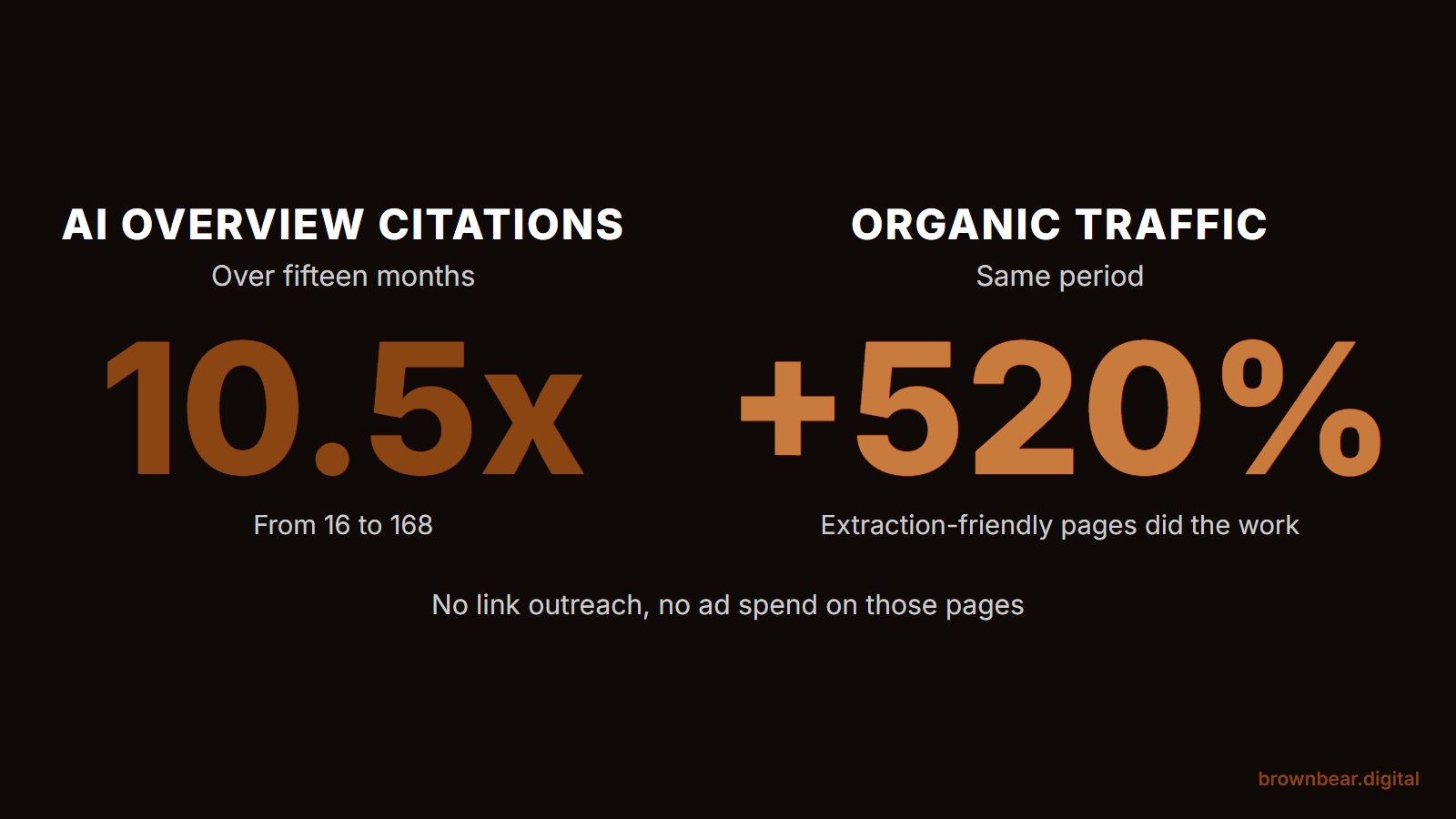
This lever moves faster than traditional SEO ever did. In one Brown Bear engagement, documented in our facelift marketing case study, a deep plane facelift surgeon went from 16 to 168 AI Overview citations, a 10.5x increase, alongside 520% organic traffic growth, with restructured, extraction-friendly pages doing most of that work.
To move this lever:
- Run your key pages through a text-only view of the page source. If the answers aren't in the raw HTML, fix rendering before touching content.
- Restructure your five most important pages answer-first: direct response in the first two sentences under each heading.
- Convert your strongest expertise into question-shaped pages that answer one query completely each.
- Keep schema where you have it, but spend the next sprint on crawlability and structure, not markup.
Can You Actually Measure Any of This
Yes, imperfectly, and without buying anything. AI answers vary by user, session, and day, so what you're measuring is a tendency, not a ranking. Measured monthly with a consistent method, tendencies are enough to show movement.
The method we use is the 10-Prompt Self-Audit. Write ten prompts a real customer would ask in your category: three recommendation asks such as "best rhinoplasty surgeon near Walnut Creek," three comparison asks naming you against a competitor, two direct asks about your brand, and two informational questions your site should be the answer to. Run all ten in ChatGPT, Perplexity, and Google's AI Overviews on the same day each month. For each response, log three things: were you named, how were you described in one phrase, and which domains got cited.
Score it simply. Visibility is the share of responses that name you. Sentiment is a three-bucket read of the descriptions: recommended, neutral, or qualified with a negative. Citation share is how many of the cited pages are yours. Thirty responses give you a stable enough baseline, and the whole exercise takes an afternoon.
Say you run a regional accounting firm and the first audit comes back: named in 4 of 30 responses, described as "a small local firm" where named, zero citations. That's not a report card, it's a diagnosis. Visibility is the weak lever, so directories and third-party mentions come before any content project, and next month's audit tells you whether it's working.
The 10-Prompt Self-Audit Tracker
Edit the ten prompts for your category, run each in an AI assistant, and log what came back. Your scores compute automatically and save in this browser so you can compare month over month.
Saved in this browser.
For informational purposes only; AI answers vary by user, session, and day, so treat scores as a monthly tendency, not a ranking. Not professional marketing advice. Everything you enter stays in this browser via localStorage; nothing is transmitted to Brown Bear or anyone else.
Two business metrics complete the picture. Watch AI referral traffic in your analytics, small but growing, and watch what it does after it lands. Across our client base, LLM referral visitors convert to consultations and form fills at a higher rate than any other channel we track, which is the number that turns an AI line item from experiment into budget. The journey compression behind that pattern shows up clearly in how AI search is changing the way patients research providers.
What This Looks Like for a Small or Local Business
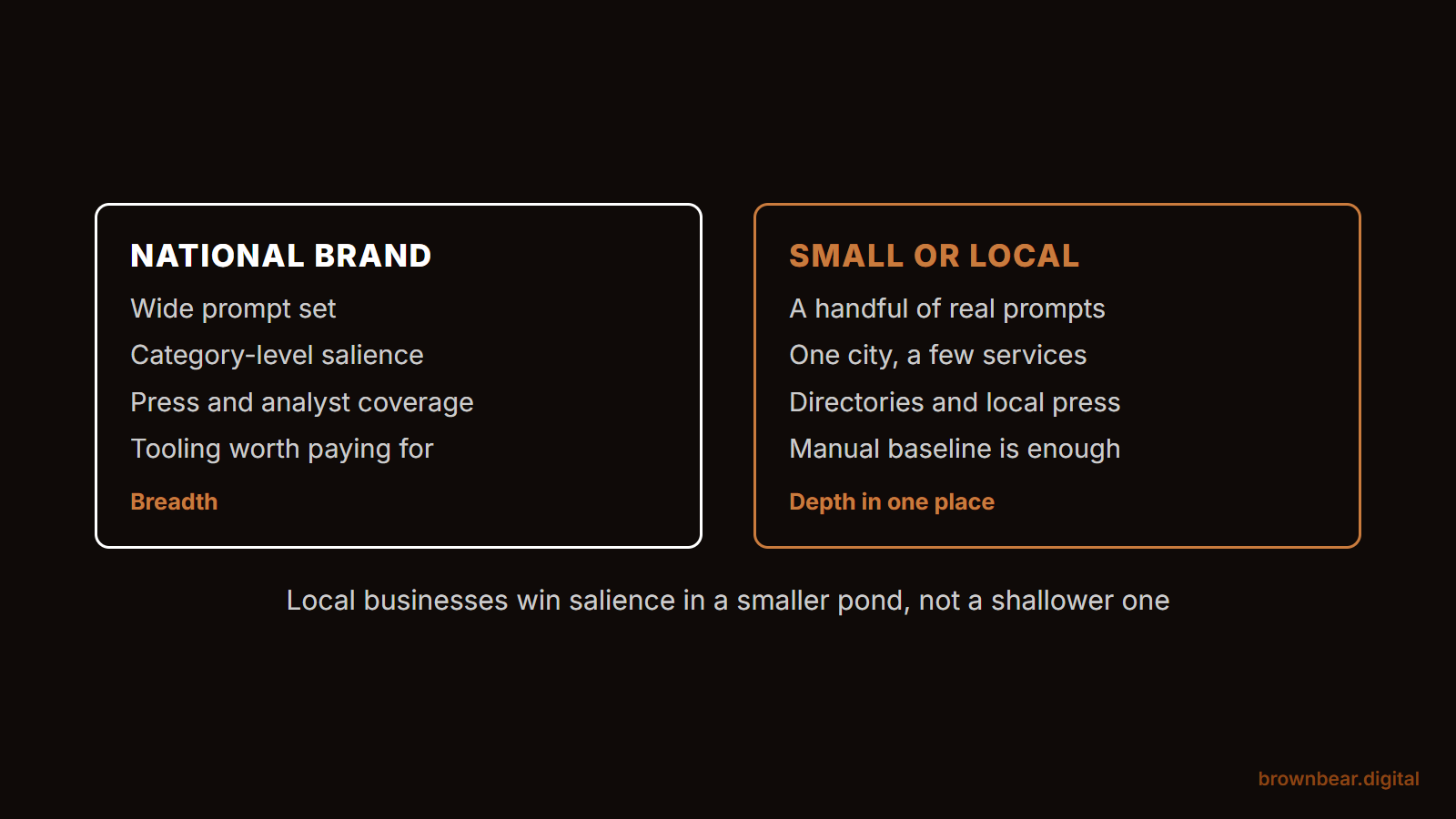
You don't need enterprise tooling to compete here, and in one important way the field tilts toward you. Head-term answers in most categories have been claimed by the big authority sites. Local and specific queries have not. When someone asks "best family dentist in Concord that takes Delta Dental," the AI can't answer with WebMD. It has to name actual businesses, and it names the ones with clean entity data and a strong recent review corpus.
For a local business the whole program compresses to four moves: one canonical name-address-phone everywhere, a Google Business Profile treated as a living page rather than a listing, a steady drumbeat of detailed recent reviews, and a handful of pages that answer the questions people actually ask an assistant, including the "near me" and "takes my insurance" versions. Run the 10-Prompt Self-Audit with local phrasing and most of your gaps will be visible in the first pass.
The long-term outcome is worth naming. Brands that fix these three levers now are writing the record future models train on. The ones that wait are letting competitors and stale reviews write it for them.
Where Brown Bear Fits in Your AI Search Strategy
Everything above is doable in-house, and the self-audit will tell you where to start. What Brown Bear adds is the pattern library: we've run this program across medical practices, SaaS companies, and professional services firms, and we know which lever moves first in each category and what it does to consultations and pipeline. If you'd rather compress the learning curve, our AI Search Optimization service starts with the same audit and hands you the plan either way.
Written By
Founder, Brown Bear Digital
Bryan has 15 years of experience across SEO, paid search, and AI search strategy. He founded Brown Bear to give businesses direct access to senior-level search expertise without the agency overhead.
Learn More About BryanGet Found on Google.
Get Cited by AI.
Tell us about your site. We'll send back a proposal for SEO and AI search.