Sentiment and Salience in AI Search: Why Brands That Sound Good Still Get Skipped
Ask ChatGPT what it thinks of your brand and you might get a glowing answer. Ask it who someone should hire, buy from, or trust in your category, and your brand might never come up. Those are two different problems, and almost everyone is only working on the first one.
This is a plain-language guide to the two forces that decide whether AI search sends you customers: sentiment, how AI systems talk about you, and salience, whether they reach for you at all when a real buying question gets asked. We have watched this play out in client dashboards at Brown Bear, where referral traffic from ChatGPT, Perplexity, and Google's AI answers has gone from a rounding error to a line item worth reporting. The pattern that keeps repeating: the brands winning those referrals are not always the best-reviewed ones. They are the ones the models associate with the problem being solved.
When we say AI search, we mean both the chat assistants people ask directly, like ChatGPT and Claude, and the AI answers layered onto traditional search, like Google's AI Overviews. The mechanics differ, but the salience question is the same in both: when a buyer describes their problem, does your name surface?
If you run a business and keep hearing that customers "found us through ChatGPT," you want to know how to make that happen on purpose. If you are the marketer defending an SEO budget while attribution shrinks, you need a way to explain what the budget buys now. And if you have built a brand people genuinely love but AI tools act like you do not exist, you are exactly who this piece is for.
By the end, you will know the difference between being liked and being reached for, which of the four positions on the Sentiment and Salience Grid your brand occupies, and the playbook for moving out of a bad one. We have organized it in three moves: what salience means in AI search and how models choose brands, how to diagnose and measure where you stand, and how to build salience and keep it from drifting. Let's start with the word itself, because it is older than the technology.
Key Takeaways
Sentiment and salience are different problems
Sentiment is how AI answers frame you when you appear. Salience is whether you appear at all when a buyer describes a problem you solve. Most brands only ever measure the first.
Models run association math, not quality checks
AI assistants surface the brands most consistently tied to the problem in third-party text. Mentions, consistency, and company kept matter more than anything on your own homepage.
Diagnose your position, then run its playbook
Every brand lands in one of four grid positions: Category Default, Quiet Favorite, Empty Mention, or Ghost. Each has a different fix, and the 15-prompt audit below tells you which one is yours.
What Brand Salience Means Now That AI Answers the Question
Brand salience is the probability that your brand comes to mind when a buyer hits a buying situation. It was never about whether people know you exist. It is about whether you show up in their head at the moment of need. The Ehrenberg-Bass Institute's research on brand salience established this decades ago: brands grow by being thought of in more buying situations, not by being loved more intensely by a few. Jenni Romaniuk and Byron Sharp's broader work calls the underlying asset mental availability.
AI search did not retire that idea. It industrialized it. The "coming to mind" used to happen inside a customer's memory. Now, for a growing share of purchases, it happens inside a language model. Someone types "my crawlspace smells musty, who should I call," and the model performs the recall step on the buyer's behalf. Salience in AI search is the probability that the model retrieves your brand at that moment.
That shift matters because you can influence a model's associations in ways you could never influence a stranger's memory. What you cannot do is influence them with the tactics most brands are still funding, which were built to win a ranking, not a recall.
Sentiment Is How AI Talks About You. Salience Is Whether It Reaches for You.
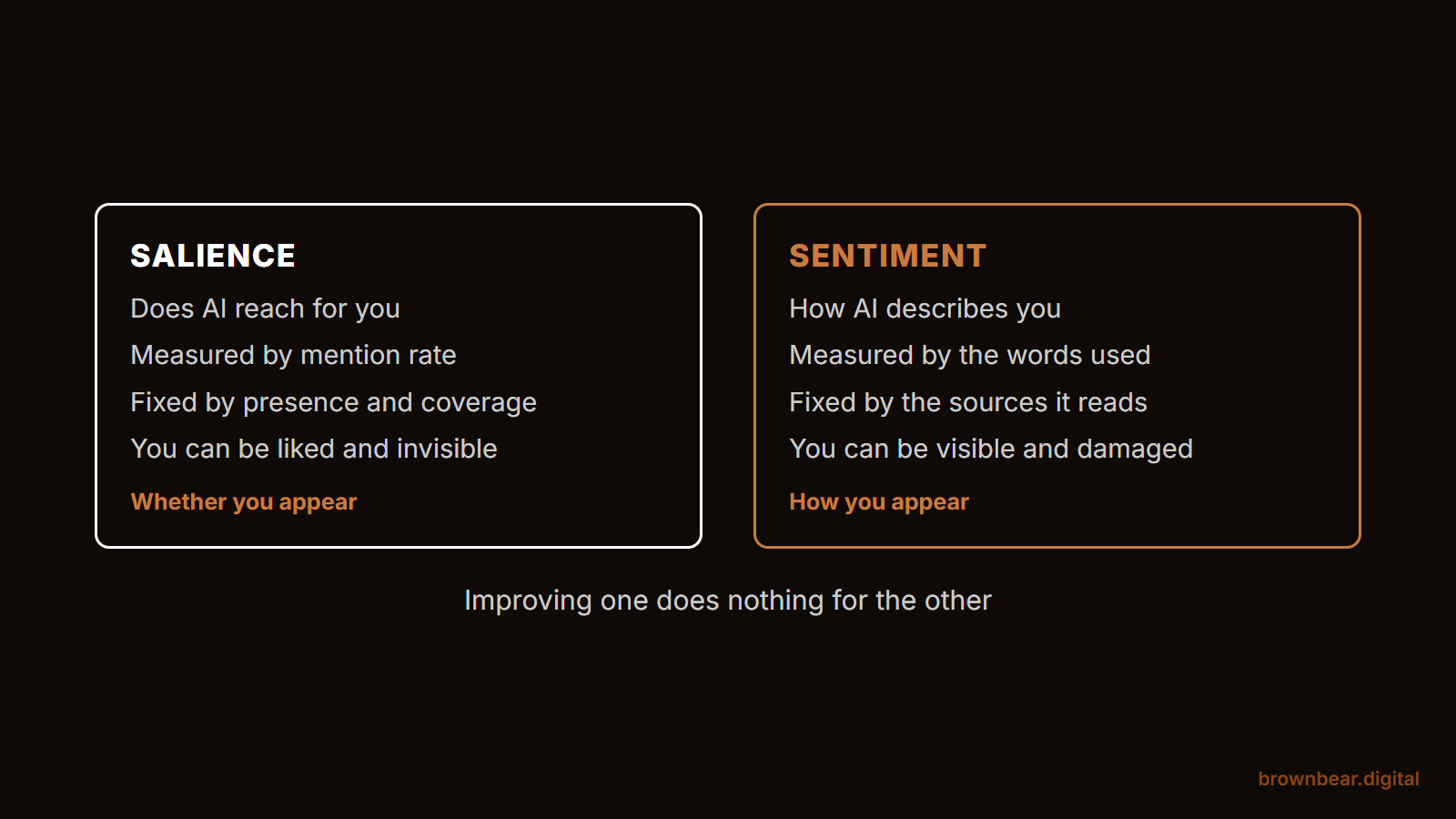
Here is the distinction this whole piece turns on. Sentiment is the tone and framing an AI system uses when your brand appears in an answer: praised, dismissed, hedged, or neutral. Salience is whether your brand appears at all when the prompt describes a problem you solve, without naming you. Sentiment is how the model talks about you. Salience is whether the model reaches for you.
Most AI visibility tracking treats sentiment as the headline metric, and it is worth tracking. Our guide to improving brand visibility, sentiment, and citations in AI search covers that measurement stack in depth. But sentiment only gets measured on answers where you already showed up. A brand can hold flawless sentiment and near-zero salience, and the dashboards will look reassuring while the referrals go to someone else.
Picture a boutique running-shoe store with a wall of five-star reviews. Ask an assistant directly, "is Fleet Street Runners any good," and the answer glows: knowledgeable staff, gait analysis, generous return policy. Now ask the question an actual buyer asks: "where should I get fitted for running shoes if I overpronate?" The answer lists two chains and a competitor across town. The store's sentiment is perfect. Its salience, for the exact problem it solves best, is zero. That gap is invisible until you go looking for it.
How AI Assistants Decide Which Brands to Surface
When a model assembles a recommendation, it is not evaluating quality. It is running association math. One widely shared Quora answer put it better than most industry decks: to recommend a business, an AI runs "a massive, mathematical popularity contest." The model draws on two pools: what it absorbed in training, and what it retrieves from live search results at answer time. In both pools, the currency is the same. How often, how consistently, and in what company does your brand appear next to the words that describe this problem?
The research that exists backs the frequency-and-association picture. Surfer's 2026 study of 922 prompts across 12 industries found a moderately strong correlation between how often a brand appeared in cited source pages and how strongly AI assistants recommended it, with brand blog posts the single most impactful content type. Ahrefs' study of mentions on highly linked pages adds a wrinkle worth knowing: those mentions correlate strongly with visibility in Google's AI Overviews, at 0.70, but barely at all with ChatGPT's, at 0.12. ChatGPT leans on breadth of mentions across sources rather than link authority. Different engines, same underlying rule: association strength wins.
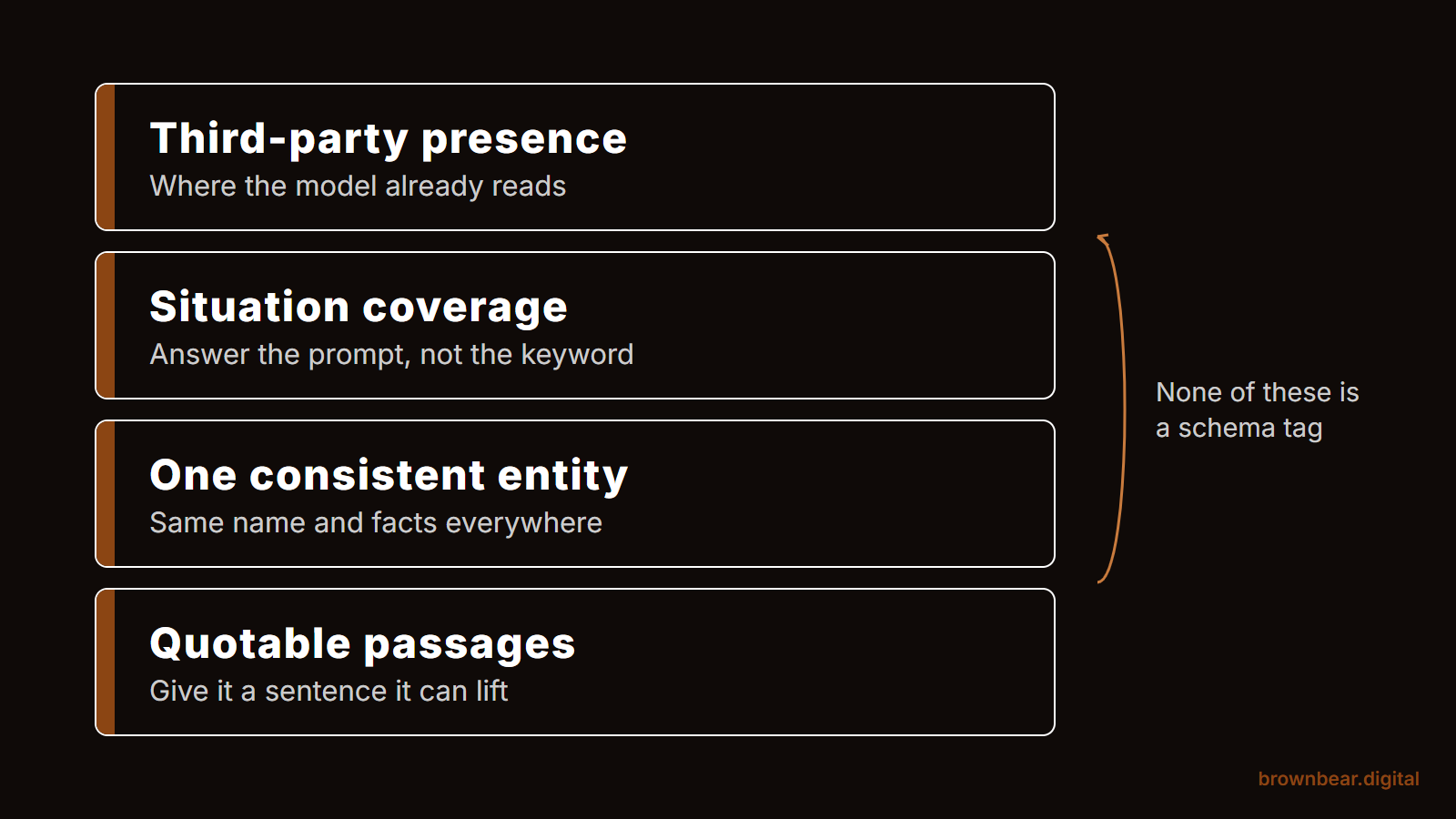
This is also why we tell clients that schema markup is overhyped as an AI visibility lever. Structured data is hygiene, and hygiene is worth doing. But in our client work, we have never seen markup move a brand into answers it was not already associated with. What moves brands is the mention footprint: reviews, community threads, directories, press, and content that repeatedly ties the brand name to the problem, in text other than its own website. As one r/SEO commenter observed after testing, ChatGPT "seems to care more about brand mentions and engagement than traditional SEO signals."
Watch a Recommendation Assemble
A simplified model of the association math described above. Pick a buying prompt, then move the sliders to change your brand's footprint and watch whether the answer reaches for you.
Simulated AI answer
Illustrative simulation for educational purposes only. The weights are simplified for teaching and do not represent any real AI system's algorithm; results are not a prediction or guarantee. Not professional advice. Slider input stays in your browser; nothing is transmitted or stored.
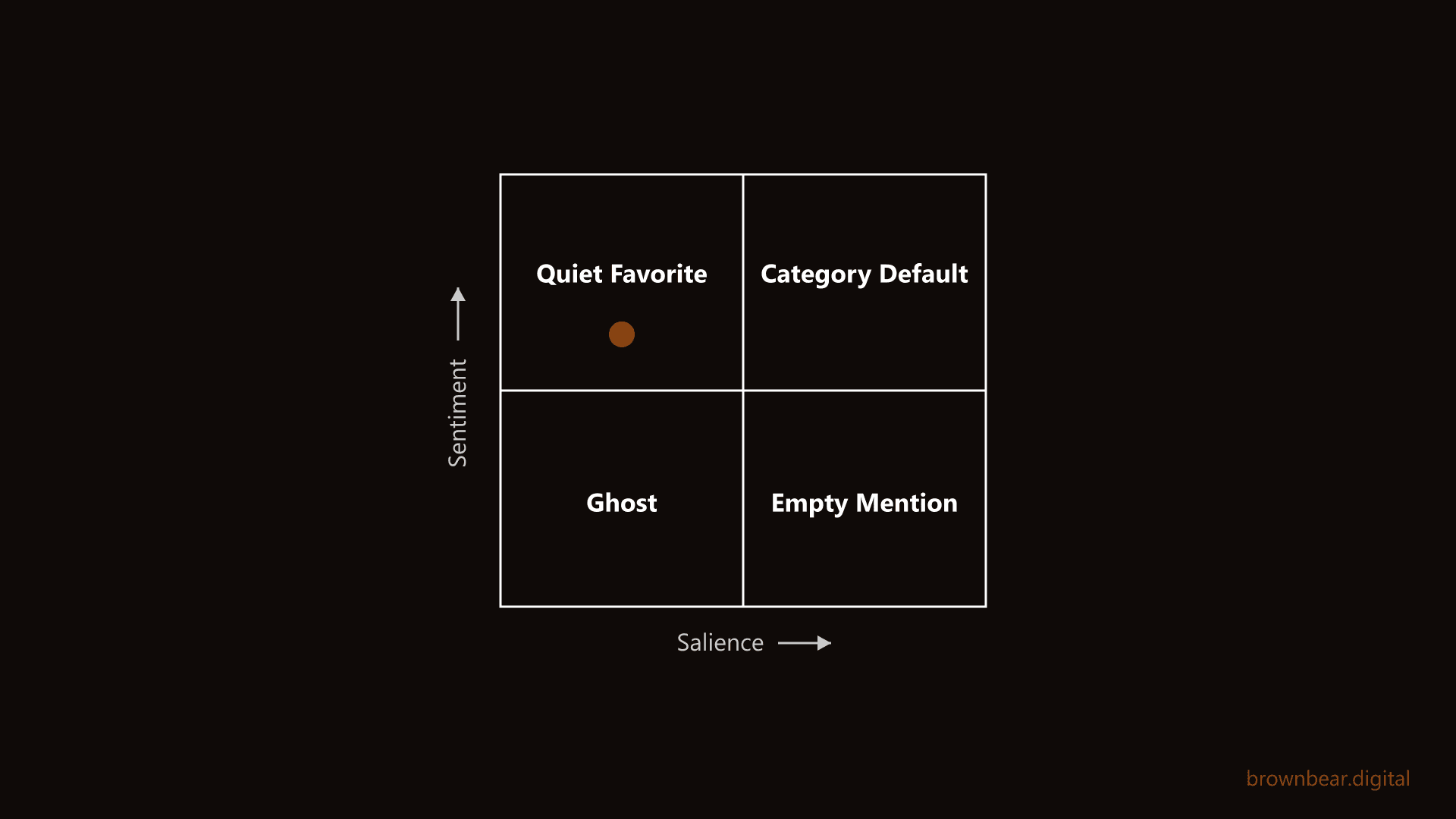
The Four Positions on the Sentiment and Salience Grid
Put the two forces on a grid and every brand lands in one of four positions. Sentiment runs on one axis: how AI answers frame you when you appear. Salience runs on the other: how often you appear unprompted for problem-shaped questions in your category. We use this with clients because it replaces a vague worry, "how do we do in AI," with a named position and a specific playbook.
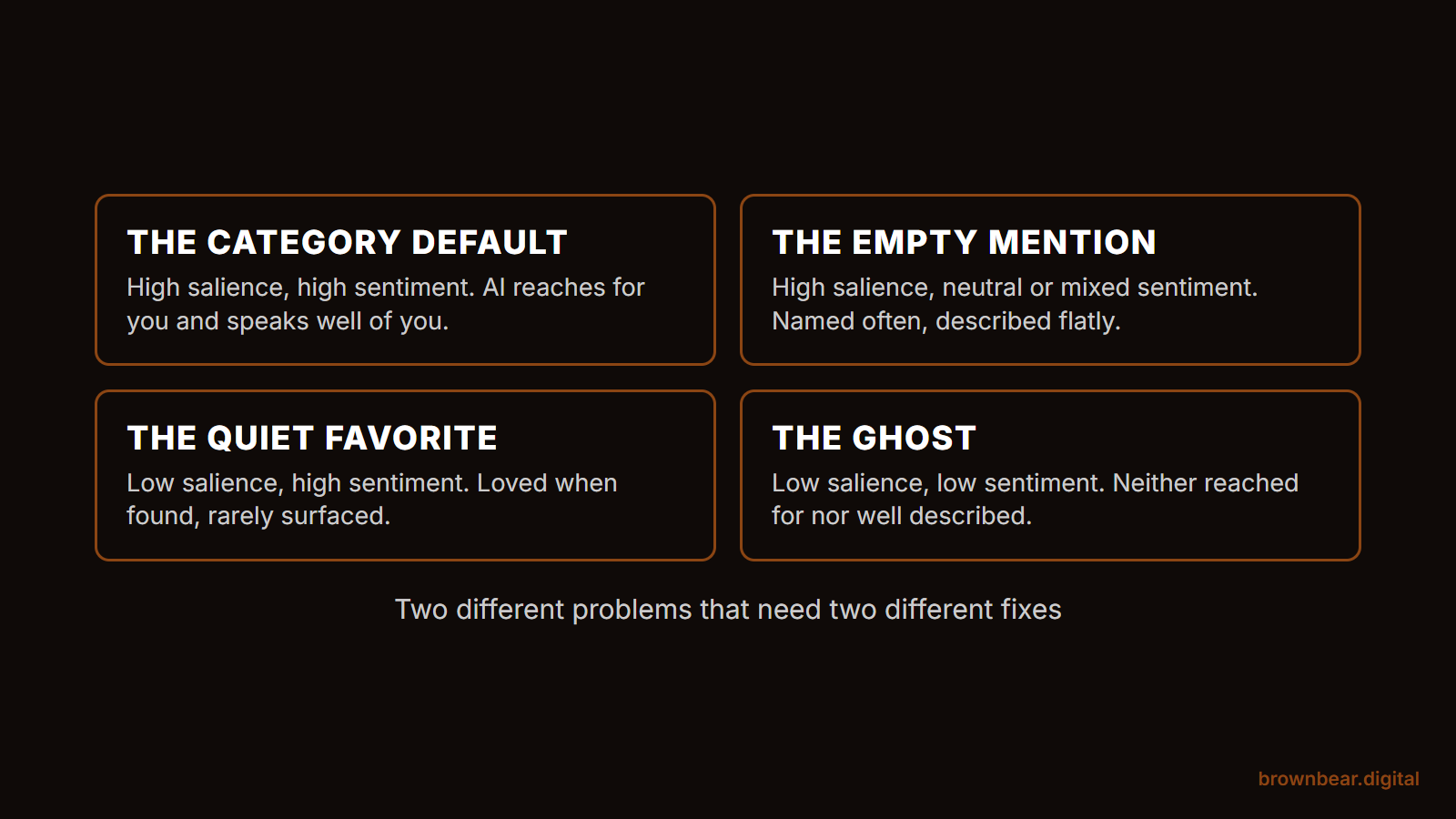
The Category Default. High salience, high sentiment.
The model reaches for you and says good things. Your job is defense: keep the mention footprint fresh, watch for drift, and do not let a rebrand or a quiet PR year erode associations you paid years to build.
The Quiet Favorite. Low salience, high sentiment.
Praised when named, absent when it counts. This is the most common position we find for genuinely good small brands, and the most fixable. The playbook is association building: get the brand named next to the problem in third-party text, community threads, and comparison content, because the praise is already banked.
The Empty Mention. High salience, neutral or mixed sentiment.
You show up, but flat: listed without conviction, or trailed by a caveat. Here the work is sentiment shaping: reviews, specific proof, and named outcomes that give the model something warmer than existence to repeat.
The Ghost. Low salience, low sentiment.
The model has nothing to say and no reason to say it. New brands start here. The playbook is presence before persuasion: establish the basic third-party footprint before spending anything on tone. We broke down the diagnostic version of this problem in why a medical practice is not showing up in AI search.
Say you run a regional accounting firm and test this. Named prompts come back warm, thanks to a decade of client goodwill. Problem prompts, "who should a restaurant owner in Ohio use for bookkeeping," never mention you. You are a Quiet Favorite. That diagnosis alone redirects the next two quarters of marketing: less brand-voice content on your own blog, more third-party presence where restaurant owners and models both look.
Where Does Your Brand Sit on the Sentiment–Salience Grid?
Run the prompts described in the measurement section, then answer these eight questions about what you saw. Your position and playbook appear below.
For informational purposes only; results reflect your own answers, not a measurement of any AI system, and are not a guarantee of marketing outcomes. Not professional advice. Your answers stay in your browser and are never transmitted or stored.
Category Entry Points Are Now Prompts
Marketing science has a name for the buying situations a brand needs to be recalled in: category entry points. For a mattress brand, the entry points were never "mattress." They were back pain, a partner who runs hot, a move, a divorce, a bad hotel night that made home feel worse. Brands earn recall by attaching themselves to those moments.
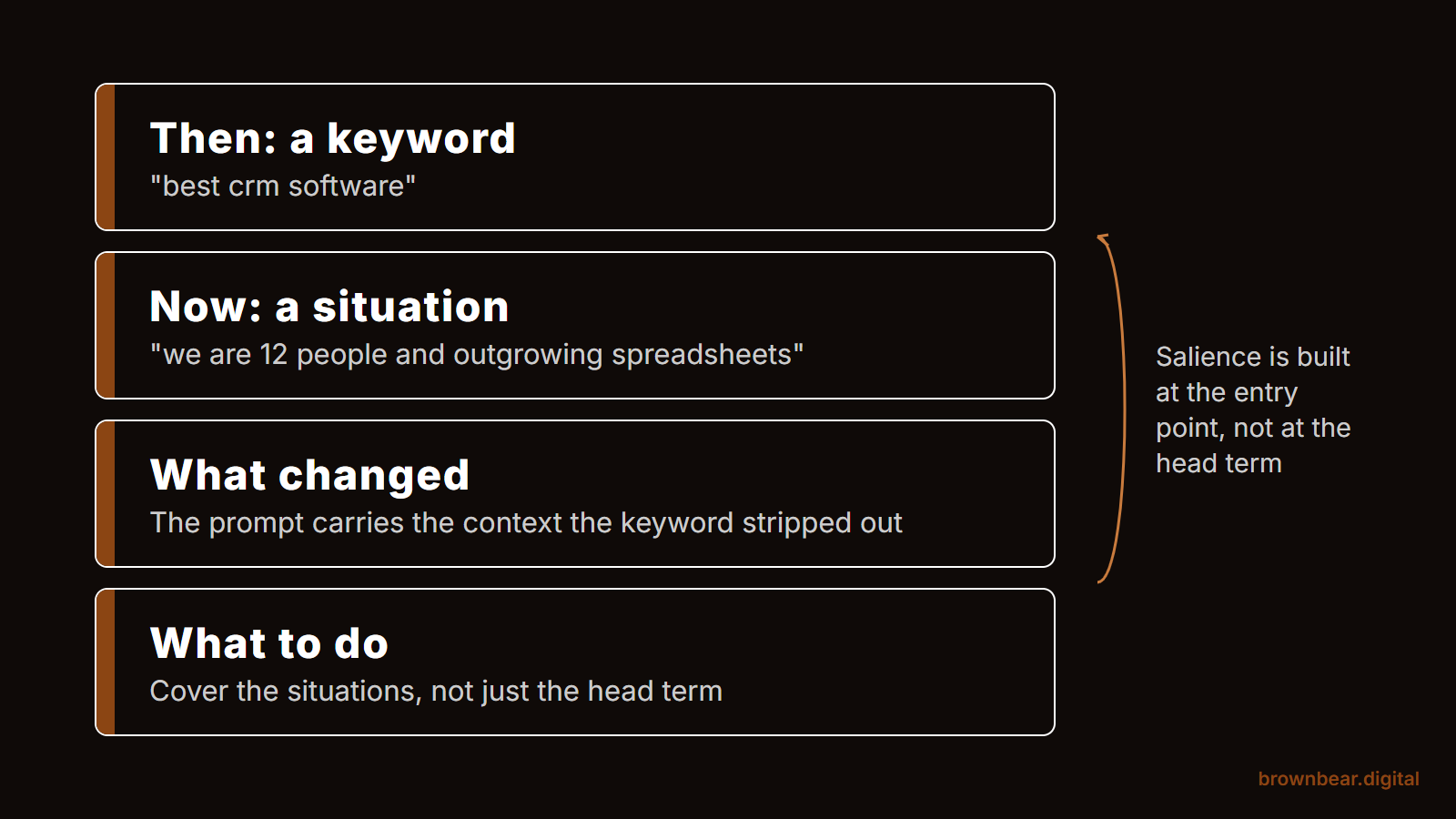
In AI search, category entry points stop being abstract and become literal strings of text. They are the prompts. "Best mattress" is one entry point with brutal competition. "I wake up sweating every night" is another, with far less. Every distinct way a buyer describes their problem to an assistant is an entry point you either occupy or forfeit.
This reframes what AI-era content is for. The question is no longer which keywords you rank for. It is which problem descriptions your brand co-occurs with, anywhere the model reads. We saw this firsthand with a plastic-surgery client: the practice's LLM referrals came overwhelmingly from problem-shaped and suitability-shaped questions, the kind patients had been typing into ChatGPT at midnight, not from anyone asking for the practice by name. The pages and mentions that tied the practice to those specific situations were doing the earning, a shift we documented in how AI search is changing how patients find their surgeon.
One more observation from our client dashboards, because it changes where you aim: Google's AI Overviews and the chat assistants are splitting territory. Overviews dominate quick informational lookups, while the longer, messier, more personal decision conversations happen in chat. Salience work has to cover both, because your buyers are in both.
How to Measure Your Brand's Salience in AI Search
You do not need an enterprise tool to get a usable read. You need a structured hour. Here is the method we run, which any team can copy.
- Write 15 prompts a real buyer would use. Five that name your brand directly, five that describe problems you solve without naming you, and five that ask for recommendations in your category with a qualifier that fits your actual customers: location, budget, situation.
- Run all 15 through at least two engines, one chat assistant and one AI-augmented search, in fresh sessions so earlier answers do not contaminate later ones.
- Score every answer on both axes. Salience: did you appear unprompted, and how high in the answer? Sentiment: when you appeared, was the framing positive, neutral, hedged, or negative? Note which competitors appear where you do not.
- Plot the result on the grid and date it. One test is a snapshot. The same 15 prompts re-run quarterly is a trendline, and the trendline is the metric.
The named-brand prompts measure sentiment. The problem-shaped prompts measure salience. Most brands only ever run the first kind, which is exactly why the salience gap stays invisible. Pair the audit with how to track brand mentions in AI search for the always-on monitoring layer between quarterly tests.
On reporting: we now treat LLM referrals as a first-class KPI for clients, sitting next to organic sessions rather than buried inside them. Those visitors arrive pre-sold by an answer that already framed the choice, and the close rates we see reflect it. If your analytics still lump ChatGPT and Perplexity referrals into "other," splitting them out is the single fastest way to make this work legible to whoever approves your budget.
Building Salience: What Actually Moves the Needle
The community consensus on this is blunter than most agency decks, and it is correct: AI does not care what you say about yourself on your homepage. It cares what everyone else says about you. Where you start, though, depends on what you already have.
If you are an established brand with years of reviews, press, and community mentions, your raw material already exists. The work is consistency and freshness: make sure your name, category, and specialty read identically across directories, profiles, and third-party listings, then keep new mentions flowing so the model's picture of you does not fossilize. Your biggest risk is not absence. It is drift, which the next section covers.
If you are a new brand, resist the instinct to blog your way in. A model cannot repeat consensus about you if no consensus exists. Build the third-party footprint first: the industry directories that AI answers demonstrably draw from, a presence in the communities where your buyers actually ask questions, local and trade press, and review volume. An SE Ranking analysis of 129,000 domains found that sites with heavy mention footprints on Quora and Reddit earned roughly four times the ChatGPT citations of sites with minimal ones. The finding is correlational, but the direction matches everything else we know. Your own content earns its keep later, once there is an entity for it to reinforce.
If you are a local business, weight the effort toward the surfaces assistants lean on for local answers: your Google Business Profile, review platforms, and location-specific directories. A national brand fighting for salience in a broad category needs press and comparison-content presence instead. Same principle, different terrain.
And in every case, keep investing in content marketing aimed at the problems themselves. The Surfer finding that blog posts are the most-cited content type is one of the few places where classic SEO advice and AI-era advice fully agree. The skeptics on r/SEO have a point when they say good SEO is still the foundation under all of this. What changed is the target: you are no longer writing to rank for a keyword. You are writing to own an entry point.
Brand Drift: When AI's Picture of You Falls Behind
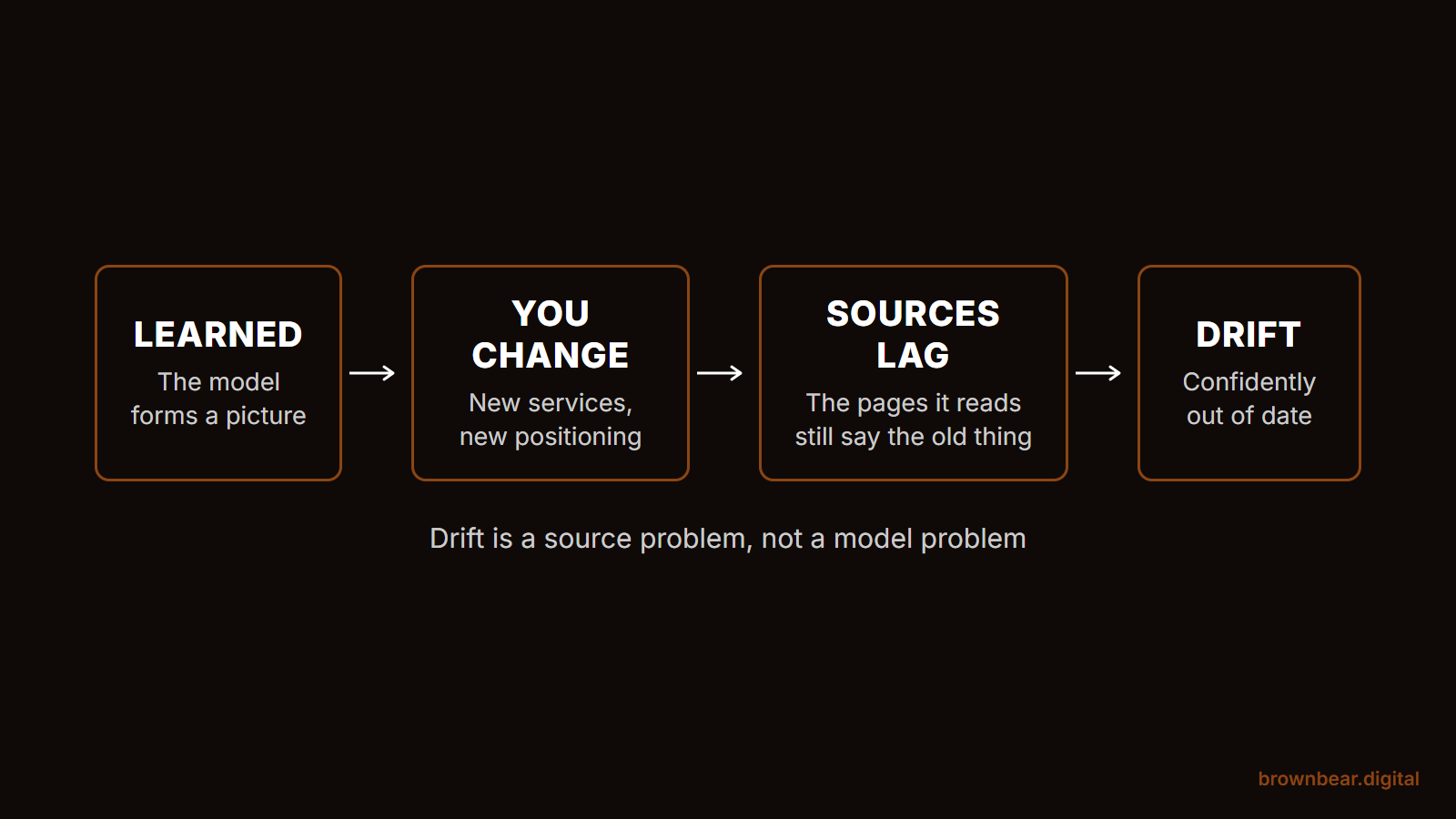
Brand drift is what happens when the model's picture of you lags who you are now. Training data has a cutoff. Retrieval favors well-established, heavily linked pages, which skew old. Reposition the company, launch a new service line, move upmarket, and AI answers can keep describing the previous version of you for a year or more.
Picture a design agency that spent 2024 rebranding from cheap logo work to full brand strategy. New site, new pricing, new clients. Two years later, assistants still introduce it as "an affordable option for startup logos," because ten directory listings and a hundred old forum mentions still outweigh one redesigned website. Nobody lied. The corpus is just stale.
Drift is why salience work is maintenance, not a project. The quarterly 15-prompt audit catches it early: sentiment that cools, descriptions that reach for outdated language, a competitor creeping into an entry point you used to own. The fix is always the same shape: refresh the third-party record, not just your own site, starting with the highest-authority pages that still describe the old you.
Where This Leaves Your SEO Budget
If the ground feels like it is moving, that is because it is. One of the more upvoted frustrations on r/SEO right now is professionals asking whether the discipline is "still the right thing" while attribution shrinks and AI answers absorb the clicks. The anxiety is rational. The conclusion usually drawn from it, cut the budget, is not.
Nothing in this piece replaces search fundamentals. Crawlable sites, real expertise, problem-shaped content: the models eat what search surfaces. And the audience on the other side keeps growing. Pew Research Center's 2026 survey of AI use found that 44 percent of U.S. adults have now used ChatGPT, more than double the share in 2023, with adults under 50 roughly twice as likely to use it as older adults. What changes is the scoreboard. Rankings measured whether you won a results page. Salience measures whether you won the answer. Budgets should follow the KPI; we wrote a full playbook on adapting your SEO budget for AI search. That means funding mention-earning work, community presence, and measurement that most SEO line items never included.
Here is where to start this quarter:
- Run the 15-prompt audit this week and plot your position on the Sentiment and Salience Grid.
- Split LLM referrals into their own analytics segment so the trendline exists before anyone asks for it.
- Pick your three most valuable category entry points and inventory who the models currently surface for each.
- Fund one association-building move per quarter: a directory cleanup, a community presence, a data piece worth citing, chosen by your grid position.
The immediate payoff is clarity: a named position instead of a vague worry, and a number you can put in front of whoever owns the budget. The longer payoff is the one that compounds. Buyers are steadily handing the recall step of purchasing to machines. The brands that teach those machines the right associations now will be the default answers later, and defaults are brutally hard to displace.
Build AI Search Salience with Brown Bear
Sentiment tells you how AI talks about your brand. Salience decides whether it brings you up at all, and that is the metric your next customers are already governed by. Brown Bear runs this exact diagnostic for clients, from the prompt audit through the association-building work that moves grid positions, with LLM referrals reported as the KPI. When you are ready to know which position your brand actually occupies, talk to us about AI search optimization.
Written By
Founder, Brown Bear Digital
Bryan has 15 years of experience across SEO, paid search, and AI search strategy. He founded Brown Bear to give businesses direct access to senior-level search expertise without the agency overhead.
Learn More About BryanReady to Turn Search
Into Revenue?
No pitch decks. Just a real conversation.