What Is YMYL SEO? Definition, Risks, and a Strategy That Holds Up
This is Brown Bear Digital's plain-language guide to YMYL SEO: what "Your Money or Your Life" actually means, why Google holds these topics to a stricter standard, and how to earn rankings that survive in the most scrutinized corner of search.
We work inside YMYL every day. Most of our clients are plastic surgeons and medical practices, and we also work as a search agency for dentists, which means every page we touch gets filtered through Google's highest quality bar before it ranks. This guide draws on that daily work and on the observations of Bryan Passanisi, our founder, who has spent the last several years tracking how Google and now AI search treat high-stakes content.
When we say YMYL, we mean both the obvious cases and the gray zone: the cardiology practice and the protein-powder review site, the estate-planning firm and the blog that tells parents which car seat to buy. If your content can change what someone does with their health, their money, or their safety, this guide covers you.
Maybe you run a practice and watched a competitor with thinner content outrank you for years. Maybe you manage content for a finance or health brand and every core update feels like a coin flip. Or maybe you own a niche site that lost half its traffic in one week and nobody can tell you why. All three of those situations have the same root cause, and it has a name.
By the end of this guide you will know what YMYL actually covers and where the gray zones sit, how to tell whether Google is treating your site as YMYL right now, which content and link building moves carry real risk, what to do when rankings drop, and the seven-step sequence we use to build YMYL visibility that lasts.
We have grouped it into five parts: the definition and where it came from, the classification question, the two risk zones of content and links, the recovery playbook, and the full strategy, including where AI search changes the rules. Let's start with the definition, because most of what goes wrong in YMYL SEO starts with a fuzzy one.
Key Takeaways
YMYL is a weighting, not a penalty
Google's systems give more weight to trust and E-E-A-T signals on topics that affect health, money, safety, or society. Nothing bad happens for publishing YMYL content; the bar for ranking it is just higher.
Link risk is asymmetric in YMYL
A good link helps you about as much as it helps anyone. A manipulative link pattern costs you more here than anywhere else, up to a manual action that removes the site from results.
Diagnose before you touch anything
Most YMYL recoveries start with the wrong move: rewriting content that was never the problem. Establish whether you face a manual action, an update re-score, or displacement, then fix in trust order.
What YMYL Actually Means in SEO
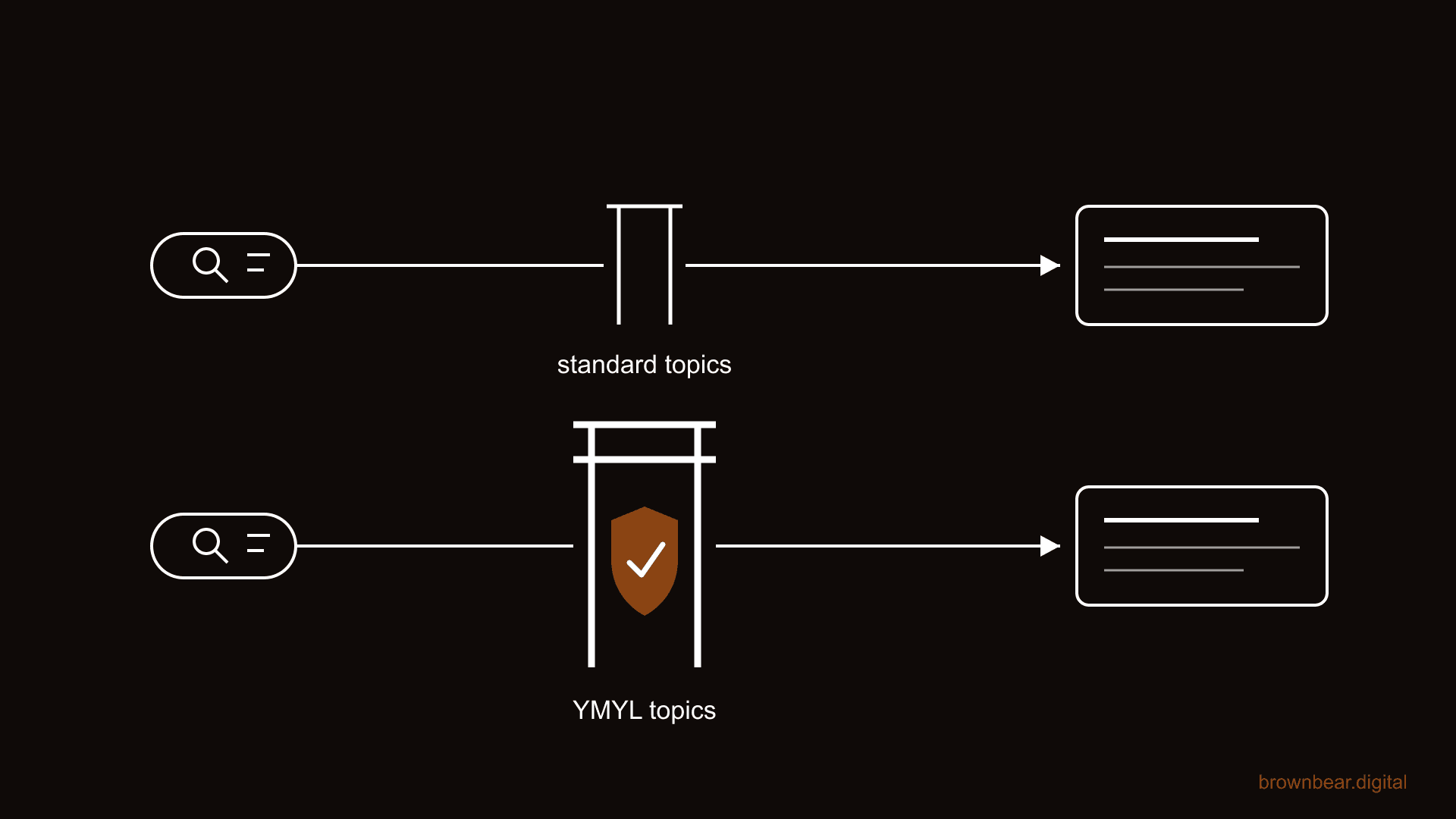
YMYL stands for "Your Money or Your Life." It is Google's label for topics where bad information can cause real harm: to a person's health, their financial stability, their safety, or the welfare of society. Pages on these topics are held to a higher quality standard than everything else in search.
That is not our paraphrase. Google's own documentation says its systems "give even more weight to content that aligns with strong E-E-A-T for topics that could significantly impact the health, financial stability, or safety of people, or the welfare or well-being of society," per Google's guidance on creating helpful content. That single sentence carries the four official harm categories: health, financial stability, safety, and societal welfare.
Two things in that sentence matter more than the acronym. First, YMYL is a weighting, not a penalty. Nothing bad happens to you for publishing YMYL content. What changes is how much proof Google demands before it ranks you. Second, the weight lands on E-E-A-T: experience, expertise, authoritativeness, and trust. Google is explicit that trust is the one that matters most; the other three exist to feed it.
So a working definition for practitioners: YMYL SEO is the discipline of ranking content on high-stakes topics, where trust signals carry more weight than anywhere else in search, and where the tactics that work fine on a recipe for banana bread can quietly cap or crater a page about blood pressure or retirement accounts.
Where YMYL Came From: Medic and Everything Since
The concept is older than the panic. Google's Search Quality Rater Guidelines have used the YMYL label for years to tell its human quality raters which pages deserve extra scrutiny. The turning point for SEOs was the broad core update of August 1, 2018, nicknamed the Medic update because health and wellness sites absorbed a wildly disproportionate share of the damage. Google never confirmed the health focus, but the industry data was lopsided enough that the nickname stuck: sites that had ranked for years lost half their visibility overnight, and the industry started reading the rater guidelines like scripture.
Since then the pattern has repeated with nearly every core update: YMYL niches swing harder, in both directions, than the rest of the web. The helpful content system that launched in August 2022 and became part of the core ranking systems in March 2024 raised the stakes again, because it brought sitewide signals into the scoring. In YMYL niches, a site-level trust problem now weighs on every URL on the domain.
Is YMYL a Ranking Factor? The Straight Answer
There is no YMYL score in Google's algorithm that you can optimize directly. There is a topic classification that changes how much weight trust and authority signals receive. Both halves of that sentence come from Google itself: the company states plainly that quality raters "have no control over how pages rank" and that rater data "is not used directly in our ranking algorithms," while the same documentation says its systems give even more E-E-A-T weight on YMYL topics. Those two statements are not a contradiction. The raters are the measuring stick; the systems are the mechanism.
You will find SEOs who dismiss the whole concept. A recent thread on r/SEO titled "Is YMYL a thing?" drew a top answer arguing that YMYL is much narrower than most people think, and that ranking in these niches "is not about chunkier backlinks." We think that answer is half right. The category is narrower than the scare posts claim: most lifestyle content never triggers it. But inside the category, the treatment is very real, and it is asymmetric. The cost of looking untrustworthy on a YMYL topic is far higher than the reward for looking slightly more trustworthy than the next site.
Our position, stated directly: treat YMYL as functionally real, because the treatment is real, whatever the internal mechanism is called. Optimize for the classification you can observe, not the label you cannot.
The YMYL Categories, From Clear Cases to Gray Zones
The clear cases are the ones Google names: medical and health information, financial advice and products, legal guidance, physical safety, news and civic information, and anything that takes payment or sensitive personal data. If your page tells someone what to do about a symptom, a loan, a lawsuit, or a ballot, it is YMYL, full stop.
The useful test for everything else comes from how Google's raters are told to think: ask what happens if the information is wrong. The Search Quality Rater Guidelines frame YMYL by the types of harm a topic could cause, and their own tier labels admit uncertainty: topics are sorted as clear YMYL, may be YMYL, or not or unlikely YMYL. That conditional tier is where most site owners get lost, so here are our working verdicts for the gray zones we get asked about most:
- Fitness and exercise: gray, leaning YMYL. "How to stretch your hips" is lifestyle content. "Training through chest pain" is a health page, whatever the site calls itself.
- Nutrition and recipes: the recipe itself is not YMYL. Claims about what a diet cures, prevents, or treats are.
- Supplements and nootropics: functionally YMYL. You are making ingestion recommendations. Expect health-grade scrutiny.
- Pet health: gray. Google's raters have historically treated veterinary advice more leniently than human medicine, but "can my dog take ibuprofen" is a safety question with a wrong answer that kills. Write it like it matters.
- Dating and relationships: mostly not YMYL, until it crosses into mental health, abuse, or financial entanglement.
- Parenting: gray. Sleep schedules are lifestyle. Car seats, feeding safety, and medication dosing are not.
- Home DIY: gray, decided by voltage and gas lines. A paint tutorial is a hobby page. A panel-wiring tutorial is a safety page.
Say you have run a fitness blog for six years, mixing workout plans with the occasional "best pre-workout" review. Nothing about your site changed, but a core update cut your traffic 40 percent, and the pages that fell hardest were the supplement reviews. That is what a partial YMYL classification looks like from the inside: Google did not judge your site as a whole, it judged your riskiest cluster, and that cluster failed a bar the rest of your content was never held to.
If raters themselves sometimes ask where the line sits, you should not expect certainty either. What you can do is locate your riskiest content cluster and treat that cluster to the standard of the category it brushes against.
How to Tell If Google Treats Your Site as YMYL
Google will never send you a notice that says "your site has been classified YMYL." You diagnose it from treatment symptoms, the same way you would diagnose any invisible classification. Four signals matter most:
1. Your volatility is synced to core updates.
Pull your traffic history and overlay Google's confirmed update dates. YMYL-treated sites move in steps that align with updates, not in gradual slopes.
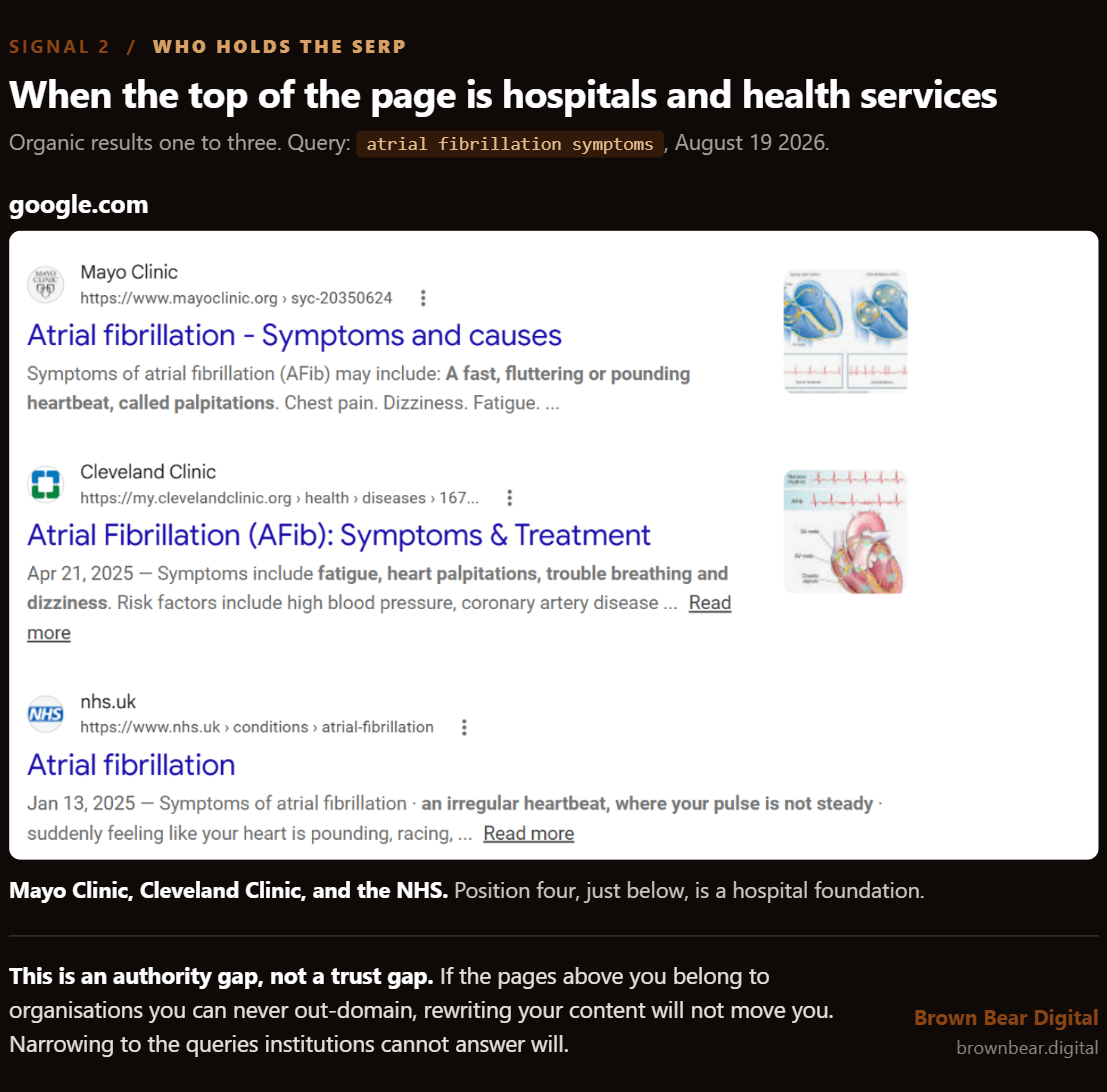
2. Institutions dominate your SERPs.
Search your ten most important queries and look at who ranks. When the results are hospitals, government agencies, banks, and national publishers, you are competing in a YMYL-weighted results page.
3. Your Bing rankings are dramatically better than your Google rankings.
The same content ranking 4th on Bing and 20th on Google is one of the most reliable field signals we know of. Bing's published guidelines carry no equivalent of Google's formal YMYL classification; its quality and credibility signals apply site-wide rather than being dialed up for money-or-life topics. A big spread suggests your content is competitive and your trust profile is what Google is discounting.
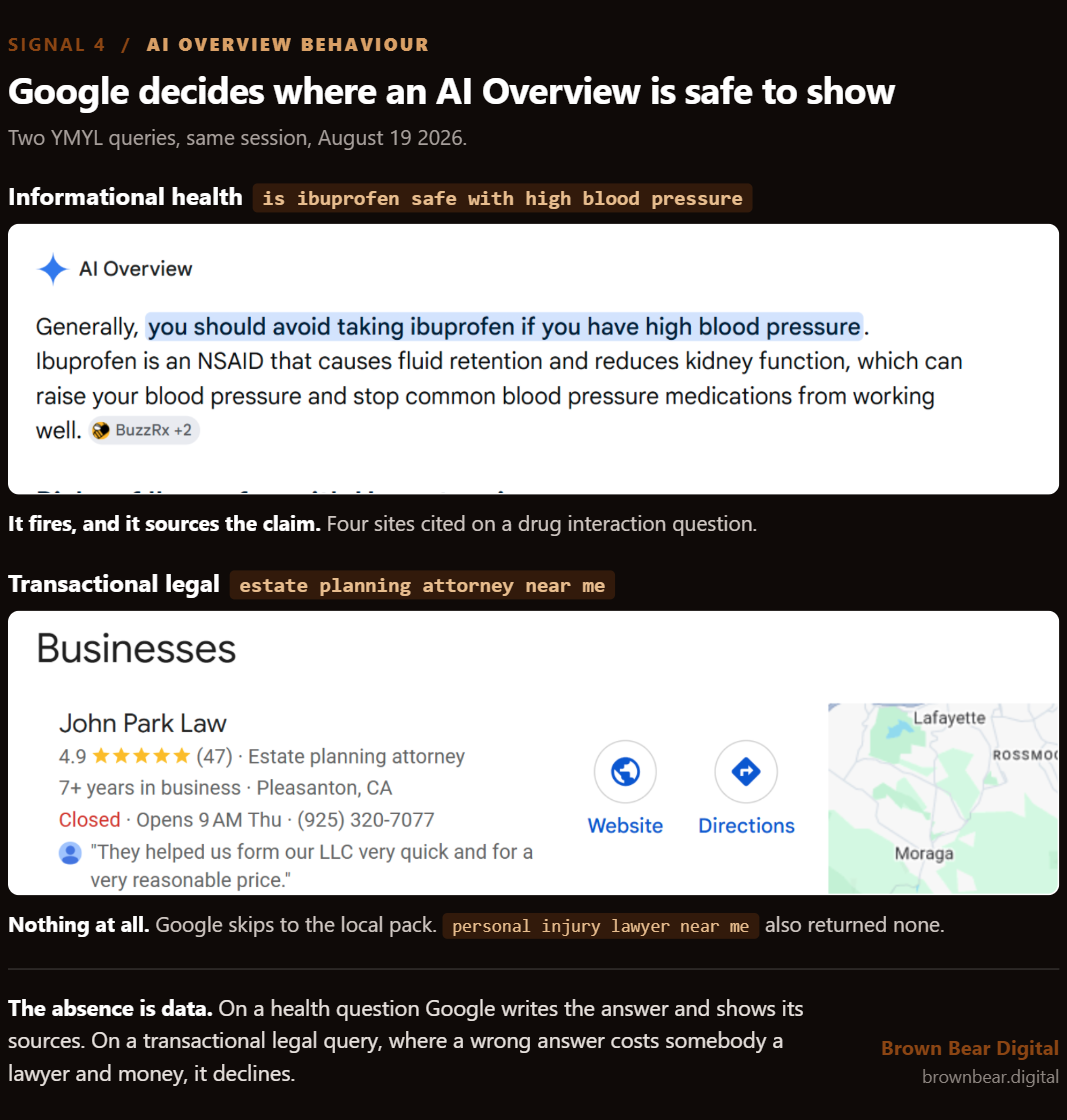
4. AI Overviews behave cautiously on your queries.
Google triggers AI Overviews unevenly across YMYL: industry studies put them at under 13 percent of transactional finance and legal queries while informational health queries see among the heaviest coverage in search, and when they do appear on high-stakes topics the citations skew toward established, trust-heavy domains rather than whoever happens to rank. If the AIO above you cites Mayo Clinic and the CFPB, you are watching the YMYL weighting operate in real time.
We call the structured version of this diagnosis the YMYL Exposure Test: five questions, scored, that tell you whether Google is treating your site as YMYL, partially YMYL, or standard. Would a wrong answer on your page cause real-world harm? Do institutions hold the top three results? Does your ranking volatility sync to update dates? Is there a Bing-to-Google spread of ten positions or more? Do AI Overviews on your queries cite only institutional sources? Three or more yes answers means you should run your site to the YMYL standard described in the rest of this guide, whether or not the label technically applies.
Five questions. Answer for the site, or for one content cluster, and find out whether Google is likely treating it to the YMYL standard.
Picture a two-partner dermatology practice whose "chemical peel aftercare" page ranks 5th on Bing and 22nd on Google. The in-house marketer has rewritten the page twice, and it is genuinely better than two of the pages above it. The Exposure Test says the content was never the problem: the page has no named author, the practice's entity footprint is a decade of inconsistent directory listings, and every competitor above it carries physician review lines. The rewrite fixed the thing that was already working.
If you run a practice or a firm, this diagnosis step is where we would start before spending a dollar on content or links. It changes everything downstream.
The Content Risks: Where YMYL Pieces Fail
Content risk in YMYL is a provenance problem before it is a quality problem. Google's question is not only "is this accurate" but "who says so, and why should anyone believe them." The failures we see most often, in rough order of damage:
- Authorless expertise. Medical and financial claims published under a brand logo or a ghost byline. On a YMYL topic, no visible author is a trust deficit, not a neutral default.
- AI-drafted content without expert review. The issue is not that AI touched the draft. It is that nobody accountable verified it. Raters are explicitly trained to hunt for the fingerprints.
- Stale facts on moving topics. Rates, laws, dosages, and guidelines change. A 2022 date on a tax page is a visible warning label.
- Absolutes where the truth is conditional. "This procedure is safe" reads as marketing. Calibrated claims with named conditions read as expertise.
- Missing provenance furniture. No about page, no contact path, no citation trail, no disclosure of how the site makes money. Individually small, collectively decisive.
Here is the encouraging part, from our own research. When we analyzed the number one ranking pages for breast augmentation searches across 101 US cities in Brown Bear's procedure page ranking factors study, only 6 percent of those winning pages covered risks and safety at the heading level, and exactly one page out of 101 built out a complete author entity for its surgeon. The YMYL bar is high, but in many niches the current winners barely clear it. The gap between "ranking" and "actually trustworthy" is your opening.
How you close the authorship gap depends on what you have to work with. If you have credentialed experts in-house, a practice owner or a licensed professional on staff, put them on the page: real byline, real credentials, and their reasoning in the copy, not just their headshot in the corner. If you have no credentialed author, build a reviewer loop instead: a licensed professional who reviews and signs the content for a fee, named on the page with their credentials. And if you are an affiliate or independent publisher with neither, your path is narrower but real: first-hand experience, rigorous citation of primary sources, and total transparency about who you are and how the site earns. What does not work in any of the three situations is pretending. A fabricated reviewer or padded credential is the one mistake in YMYL that is worse than no author at all.
For medical sites specifically, the compliance layer is its own risk zone; our guide to HIPAA compliance in medical SEO covers where marketing and regulation collide. And if you want the deeper treatment of how expertise signals actually show up in copy, we broke that down in our piece on E-E-A-T for plastic surgeons.
Your next steps on content, in order:
- Inventory every page that makes a health, money, legal, or safety claim.
- Assign each one a visible, credentialed author or reviewer.
- Add a dated citation to a primary source for every major claim.
- Set a refresh cadence for the pages where facts move, and show the last-reviewed date.
Link Building in YMYL Niches: Where the Real Risk Lives
Link building is where YMYL punishes ordinary SEO behavior hardest. The math is asymmetric: a good link helps you roughly as much as it would help anyone, but a manipulative link pattern costs you more here than anywhere else, because Google's tolerance for manipulation scales inversely with the harm a bad result can do. A tactic that earns a shrug in ecommerce can contribute to a site-level trust discount in health or finance, and in the worst case a manual action that removes you from results entirely.
What gets scrutinized in a YMYL backlink profile: the topical relevance of the sites linking to you, the pattern of your anchor text, whether payment or exchange sits behind the links, and the neighborhood problem, meaning what else the linking site links out to. A dofollow link from a general "wellness" blog that also links to essay mills and crypto casinos is not a neutral link. It is a signature.
The tactics that burn YMYL sites, specifically: paid guest posts on off-topic blogs, private blog networks, reciprocal exchange schemes at scale, and mass-produced "expert roundup" placements on domains that exist to sell placements. Every one of these works often enough elsewhere that agencies still sell them. In YMYL niches they are the most common root cause we find in the backlink profiles of sites that cannot figure out why nothing they publish ranks.
Before any link is pursued or accepted, grade it. We use a five-question screen we call the Link Risk Grader: Would this site link to us if we did not ask, pay, or trade? Is the linking page topically adjacent to ours? Would the anchor text look natural if a Google engineer read it out loud in a courtroom? Is there any payment, exchange, or network relationship behind it? Does the linking site link out to anything you would not put your own name next to? A link that fails two or more of those questions is a link a YMYL site should walk away from, whatever its domain rating says.
Grade one link prospect at a time: a guest post offer, a directory, a partner request. Five questions, one grade, and a clear call on whether a YMYL site should take it.
Say you run content for a small estate-planning firm and a "legal resources" blog offers a dofollow guest post slot for 200 dollars. The domain rating is a tempting 55. Run the screen: the link exists only because you paid, the blog publishes everything from casino reviews to CBD roundups, and the suggested anchor is "best estate planning attorney." That is a fail on three of five questions. The 200 dollars is not the cost of the link; it is the deposit on a future cleanup project.
What works instead is duller and slower: publishable first-party data that earns citations on its own, memberships and profiles with real professional bodies, local press and institutional relationships, and reclaiming unlinked mentions your brand already has. One genuinely earned link from a bar association, a hospital system, or a university outweighs a month of bought placements, and it is the only kind of link you never have to worry about later.
On disavowing: if you have a manual action for unnatural links, disavow aggressively as part of the reconsideration process, that is what the tool is for. If you have no manual action but a history of purchased links in a YMYL niche, we lean toward a targeted disavow of the worst clusters, a step further than Google's public "just ignore them" guidance, because the downside risk sits higher here. If your profile is merely mediocre, spend the hours earning better links instead; disavowing random low-quality links you never built is busywork.
When YMYL Rankings Drop: The Recovery Playbook
Diagnose before you touch anything. YMYL sites that lose visibility usually make their situation worse in the first month, because they start rewriting content that was never the problem. The triage comes first, and it forks three ways:
If Search Console shows a manual action, you have the rare clean case: fix exactly what the notice names, document the cleanup, and file reconsideration. If your drop lines up with a confirmed core update date, you were re-scored, not penalized: there is nothing to fix and resubmit, and recovery means raising the trust profile the update discounted, then waiting for a future update to re-score you. And if you see a slow bleed with no update correlation, look at competitors before you look at yourself: in YMYL niches the common cause is not that you got worse, it is that the SERP got institutionalized above you.
Then answer the question that a thirty-comment Reddit thread about a finance site ranking 4th on Bing and 20th on Google never resolved: is this a trust gap or an authority gap? They feel identical and have opposite fixes. Look at who replaced you. If the pages above you now belong to institutions you can never out-domain, that is an authority gap: your play is to narrow your topic focus to queries where institutions are weak, usually local, situational, and experience-based searches. If the pages above you belong to sites your own size, that is a trust gap: they carry authorship, citations, and entity signals you lack, and those are all buildable.
Imagine a supplements affiliate whose site went from 3,000 dollars a month to functionally zero across two update cycles. The instinct is to refresh all 400 reviews. The triage says otherwise: the SERPs for his head terms are now Healthline, examine.com, and national retailers, an authority gap he cannot close, while his long-tail comparison queries are held by sites his size that added medical reviewers last year, a trust gap he can. The recovery plan writes itself from that split: let the head terms go, rebuild the middle with reviewed, experience-based comparisons.
Set realistic expectations on time: YMYL recoveries run on update cycles, not sprint cycles, and typically take months longer than recoveries in ordinary niches. We published a full breakdown of how long YMYL SEO takes, including why the trust-rebuilding phase cannot be compressed. Two cautions from the field: passive recoveries happen, some sites bounce back a cycle later having changed nothing, but "wait and hope" is not a plan, it is a lottery ticket. And domain migration as a penalty escape almost never pays in YMYL: the trust problems travel with the content, and you restart entity history from zero. If you are migrating for legitimate reasons, run it against our website migration SEO checklist so the move itself does not add a second problem.
Your recovery sequence:
- Establish the drop type: manual action, update re-score, or competitive displacement.
- Classify the gap: authority or trust, by auditing who replaced you.
- Fix in trust order: authorship and review loops first, citations second, links last.
- Hold changes stable through the next confirmed update before judging results.
YMYL in AI Search: The New Gatekeeper
AI search applies the YMYL logic more aggressively than classic search ever did, and it splits the territory in a way most site owners have not noticed. Bryan's observation from our client work: the big institutions are taking over AI answers for head terms, while local, situational, and cost queries still open the door for practices and specialists, because the AI infers local intent and needs sources with first-hand specificity. If you compete head-on with Mayo Clinic for definitions, AI search is a losing table. If you own the queries where a searcher needs a price, a location, or a lived answer, the door is open wider than it looks.
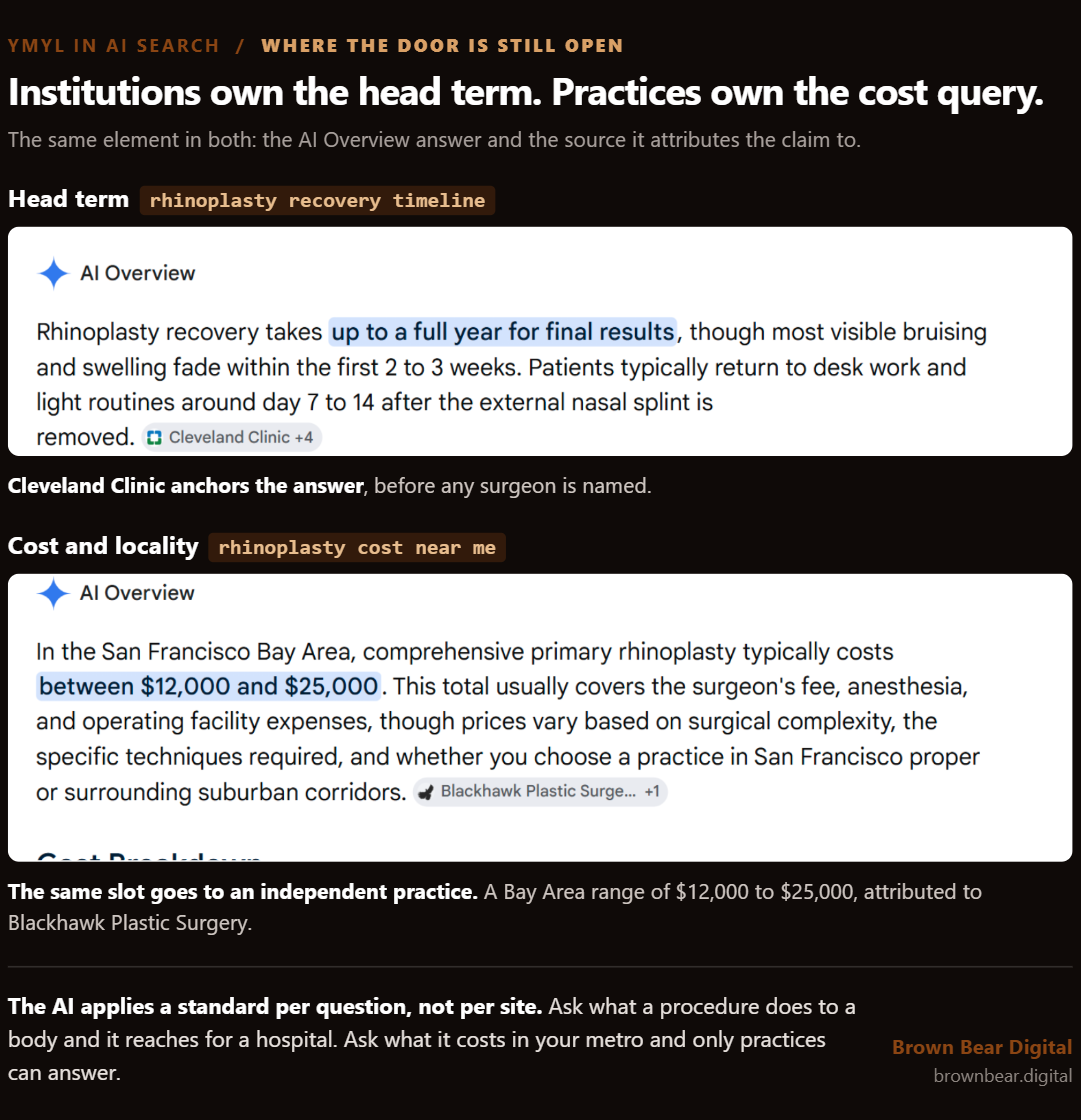
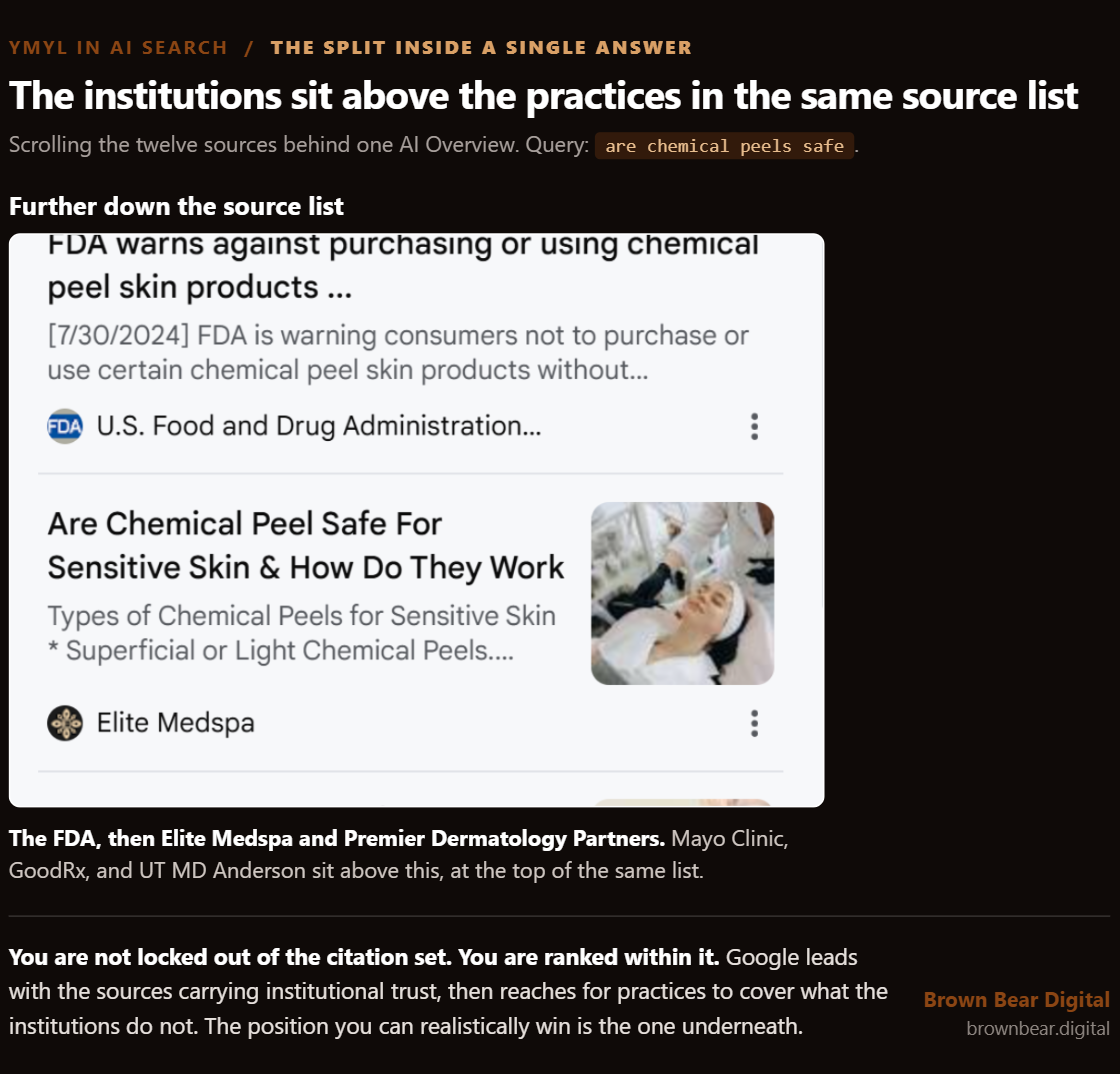
The split is not only between queries. It happens inside a single answer. Pull the full source list behind one AI Overview on a cosmetic health question and the institutions hold the top of the stack, with independent practices cited several positions further down the same list. You are not locked out of the citation set. You are ranked within it, and the position you can realistically win is the one underneath.
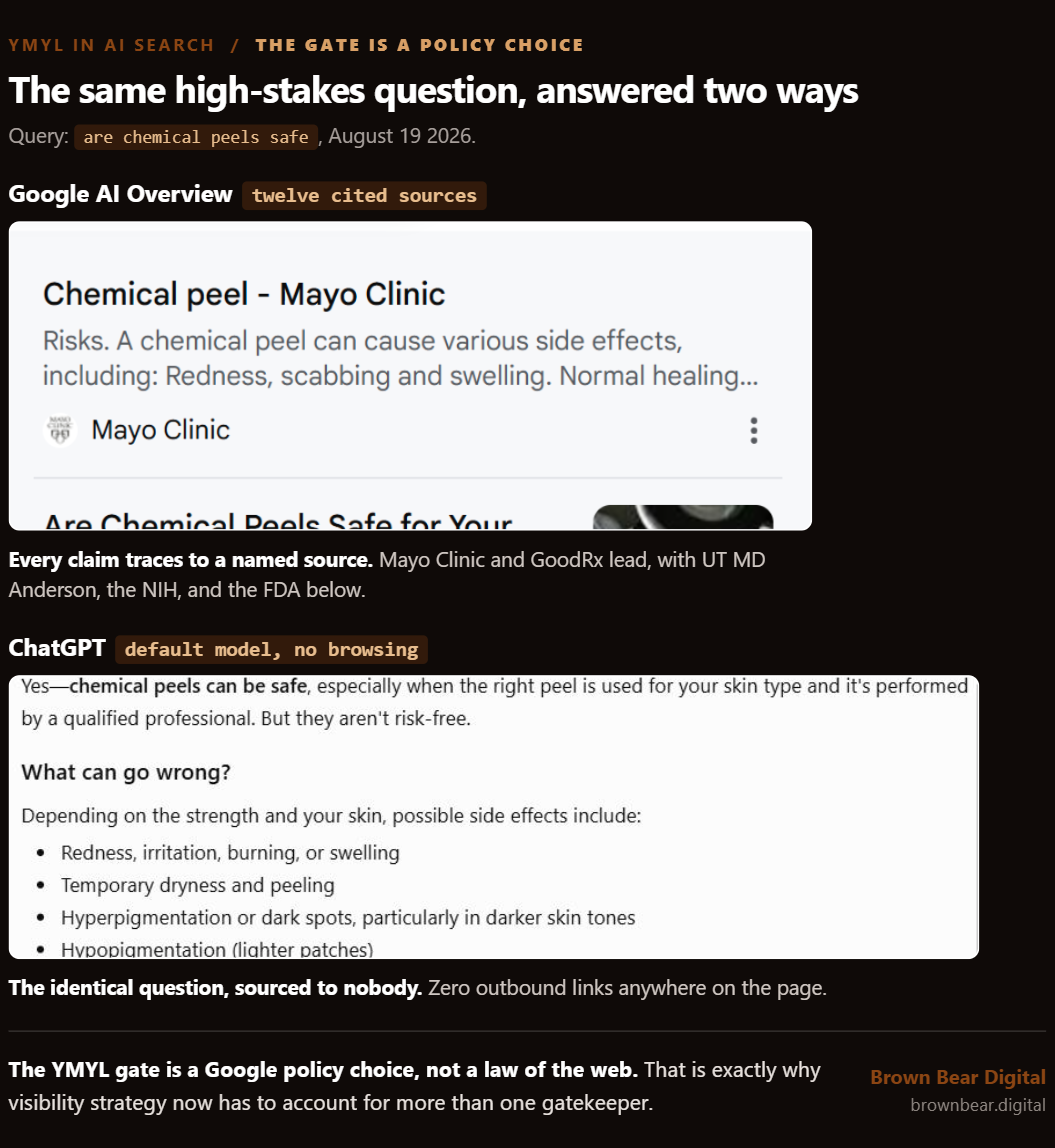
The strange twist is that different AI systems disagree about YMYL entirely. Google's AI surfaces inherit its institutional caution. Other systems demonstrably do not: SEO analyst Glenn Gabe documented a YMYL site with barely any Google visibility that had been cited in over 464,000 ChatGPT responses as of August 2026. We would not build a business on that gap, and we tell clients the same, but it proves the YMYL gate is a Google policy choice, not a law of the web, and visibility strategies now have to account for more than one gatekeeper.
Practically, YMYL in AI search comes down to the off-site footprint: what the review sites, directories, press, and communities say about you, because that is what the models read when they decide whether to cite you.
The YMYL SEO Strategy: Our Seven-Step Sequence
Everything above compresses into a sequence we run for YMYL clients. The order matters: trust infrastructure before content, content before links, links before AI visibility. Skipping ahead is how sites end up with great content nobody trusts enough to rank.
1. Run the exposure audit.
Apply the YMYL Exposure Test to every money-page cluster. Know which parts of your site carry the weighting before deciding where effort goes.
2. Build the trust infrastructure.
About page that names real humans, findable contact information, privacy and editorial policies, disclosure of how the site earns, and security basics. This is the least glamorous work in SEO and the most commonly skipped, which is exactly why it separates you.
3. Put accountable experts on every high-stakes page.
Authors or reviewers with verifiable credentials, real bios, and entity signals that connect them to the wider web. Remember the study finding: one page in 101 winners did this completely. The bar is on the floor.
4. Set content standards you can defend.
Primary-source citations, visible dates, calibrated claims, and a refresh cadence for every page where the facts move. Write reasoning, not just rules; it is the difference raters and readers both feel.
5. Build only links you could defend in a manual review.
Run every prospect through the Link Risk Grader. Put the outreach hours into data, professional bodies, and local institutions.
6. Build the AI search layer.
Audit your third-party footprint, fix the inconsistencies, grow the citations and sentiment that AI systems read, and stake out the situational queries institutions cannot own.
7. Measure like a skeptic.
Track rankings against update dates, AI Overview presence on your queries, and referral conversion by channel. In YMYL, the trend across update cycles is the scoreboard; week-to-week movement is noise.
Run the sequence and the immediate payoff is clarity: you will know within a month which gap you actually have and where the next quarter of effort goes. The longer payoff is the position every YMYL site actually wants: rankings that core updates confirm instead of threaten, because each re-score finds more evidence you deserve to be there.
Put Brown Bear Digital in Your Corner for YMYL SEO
YMYL SEO rewards the sites that treat trust as an asset to build instead of a box to check, and that is slow, judgment-heavy work. It is also the work we do all day, for practices and brands whose topics sit squarely in Google's most scrutinized category. If you want a partner who already knows this terrain, see how our SEO services approach high-stakes niches, or bring us your toughest page and we will tell you which gap you are actually fighting.
Written By
Founder, Brown Bear Digital
Bryan has 15 years of experience across SEO, paid search, and AI search strategy. He founded Brown Bear to give businesses direct access to senior-level search expertise without the agency overhead.
Learn More About BryanGet Found on Google.
Get Cited by AI.
Tell us about your site. We'll send back a proposal for SEO and AI search.