How HIPAA Compliance Impacts Medical SEO: The Rules, the Fines, and the Measurement Problem Nobody Names

This is Brown Bear's plain-language guide to how HIPAA compliance impacts medical SEO: what the law actually restricts, what it leaves alone, and how to grow a practice's search presence without becoming an enforcement story.
We run search programs for medical practices, which means we live on both sides of this question: the marketing side that wants every ranking signal working, and the data side where the compliance risk actually hides. For this guide we also read the enforcement record itself, every published federal action involving marketing, because the record tells a different story than the scare content does.
When we say medical SEO, we mean both the visible layer, your content, reviews, and Google Business Profile, and the plumbing underneath it, your analytics, pixels, and forms. HIPAA touches each of them differently, and the difference is the whole game.
If you run a one-or-two-provider practice and you've frozen your marketing because someone said the word "violation," this is for you. If you manage marketing across several locations and your agency swears everything is fine without showing you why, this is very much for you. And if you're the physician who got handed the website, you'll leave knowing exactly which three decisions matter.
By the end, you'll know whether HIPAA even governs your marketing, what your three real analytics options are, how to reply to any review without confirming a soul is a patient, and what your agency should never ask you for. We've grouped it into four parts: the rules, the tools, the enforcement record, and the response system. Start with the question almost nobody asks first: does HIPAA govern your marketing at all?
Key Takeaways
HIPAA limits your measurement, not your SEO
Everything that actually ranks a medical practice, meaning expert content, site structure, local signals, review volume, and E-E-A-T, is untouched by HIPAA. What the law restricts is pixels, retargeting, and detailed conversion tracking, and practices that accept that trade early outrank the ones that don't.
Third-party tracking runs on 98.6% of hospital sites
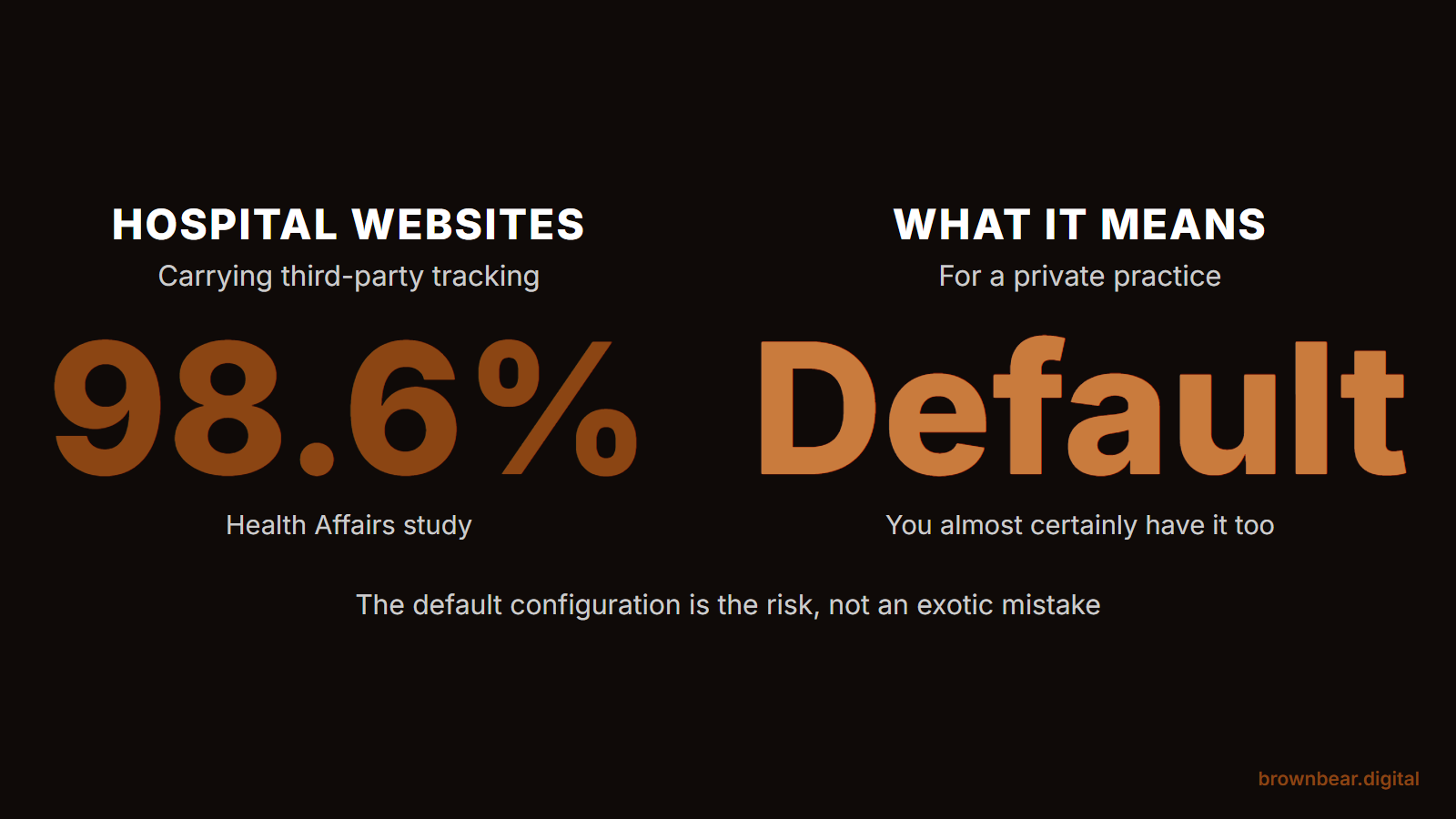
A Health Affairs study of 3,747 U.S. hospital websites found third-party tracking on 98.6% of them, and plaintiffs' firms scan for those pixels at scale. Your fine risk lives in the reply box; your lawsuit risk lives in the tag manager.
Every marketing fine on record is a review reply
Manasa Health Center, New Vision Dental, and Elite Dental all drew five-figure penalties for review responses that confirmed patient status. The safe system: thank the feedback, never the visit, and take specifics offline.
No BAA means GA4 and Meta pixels can't touch PHI
Google and Meta do not sign business associate agreements, so you have three real options: fence analytics off care pages, switch to a privacy-first tool, or run server-side tagging through a proxy you control.
Does HIPAA even govern your marketing?
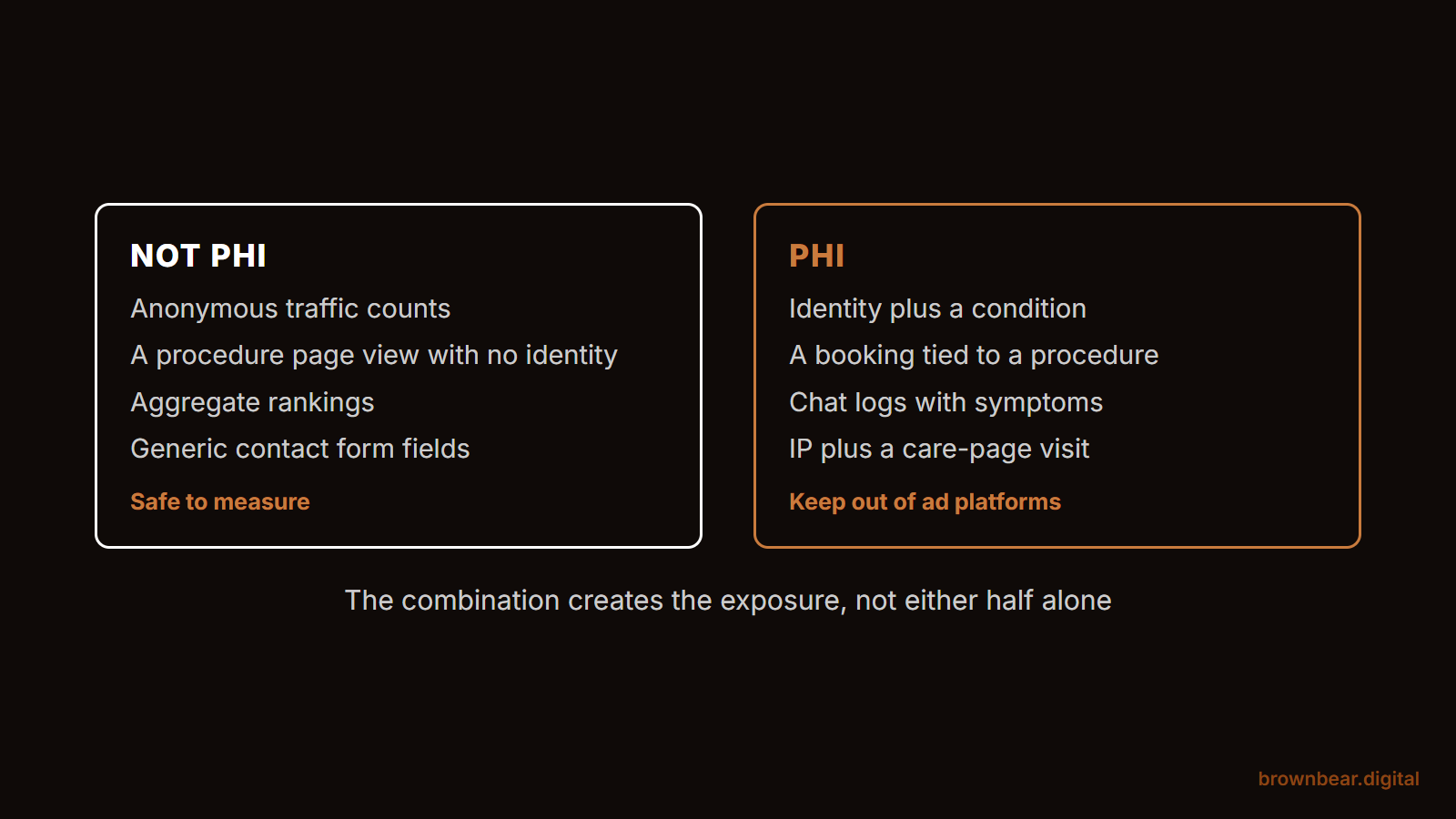
For almost every practice, yes, and the trigger is simpler than people think. If your practice transmits claims or eligibility checks electronically, and nearly every practice that takes insurance does, you are a covered entity, and HIPAA follows your patient data everywhere it goes, including into marketing tools.
The fork matters, though. If you're a cash-only concierge or aesthetics practice that never bills electronically, you may fall outside HIPAA's covered-entity definition entirely. That does not make you free: state health-privacy laws like Washington's My Health My Data Act and the FTC's health-data enforcement still apply, and both have teeth. But your risk map looks different, and so should your tooling decisions.
One rule to memorize either way: using patient information for marketing requires the patient's written authorization. That is the Privacy Rule's marketing provision, and a general consent-to-treatment form does not satisfy it. Most of the fines you'll read about below trace back to exactly this line.
What counts as PHI on a marketing website
Protected health information is any individually identifiable detail connected to someone's health or care. On a clinical system that's obvious. On a marketing site it hides in plain sight: a contact form with symptom checkboxes, a thank-you page URL that carries the condition in its query string, a call-tracking number that records the caller describing their diagnosis, and, above all, a review reply that confirms the reviewer was ever in your chairs.
Picture a dermatology practice that installs reputation software to answer reviews automatically. The canned reply thanks every reviewer "for choosing us for your recent visit." Helpful, polite, and each one is a public confirmation of patient status going out on autopilot. Nobody on staff wrote a word of it. Audit any tool that speaks for you before it speaks.
The GA4 and pixel problem: your three real options
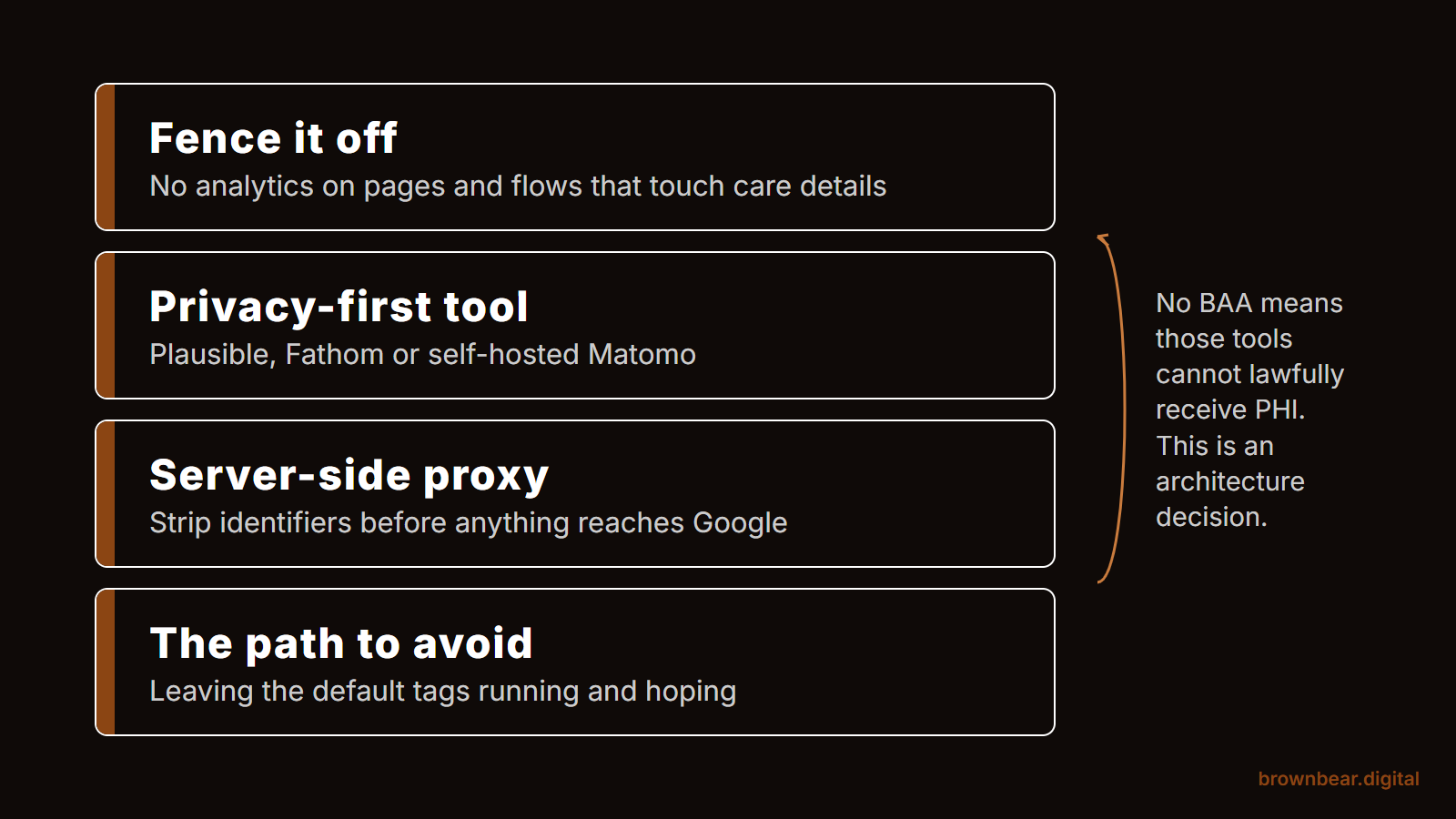
Here is the direct answer the vendor content dances around: Google states plainly that Google Analytics is not backed by a business associate agreement, and Meta does not sign BAAs for its pixel or ads products. No BAA means those tools cannot lawfully receive PHI from a covered entity, period. The question is not "is GA4 compliant." It's "what architecture keeps identifiable health signals out of it."
You have three real options, and the right one depends on your size and resources.
If you're a small practice with no developer, fence it or leave it: keep analytics entirely off pages and flows that touch care details, or switch to a privacy-first tool like Plausible, Fathom, or self-hosted Matomo. The enterprise "compliant analytics" platforms priced for hospital systems are real, and so is the sticker shock practice owners vent about in forums. The privacy-first tier costs less than your coffee budget. If you're a multi-location group with technical help, the third option opens: server-side tagging through a proxy you control, which strips identifiers before anything reaches Google's servers. That is the actual mechanism behind most "HIPAA-compliant GA" claims, and it's an architecture decision, not a checkbox.
Say you run a two-location dermatology group doing eight thousand sessions a month. The proxy route costs you a developer week and a small monthly server bill, and you keep your funnels. The privacy-first route costs an afternoon and loses ad-platform integration you shouldn't be using on health pages anyway. Either beats the third path we see constantly: leaving the default tags running and hoping. We catalogued that pattern and others in the AI SEO mistakes medical clinics make.
What the 2024 court ruling changed, and what it didn't
In December 2022, federal regulators published guidance treating a visitor's IP address combined with a visit to a condition page as protected information, which made ordinary web analytics look like a violation engine. Hospitals sued. On June 20, 2024, a federal court in Texas vacated that specific combination for unauthenticated public pages, and the government dropped its appeal that August. The rest of the government's position, described in HHS's online tracking guidance, still stands.
Translate that carefully, because both wrong readings are expensive. The ruling did not bless pixels. Anything behind a login, patient portals, scheduling flows, intake forms, remains fully in scope, and an anonymous browse of your "knee replacement" page is different from a form submission with a name attached. And the ruling only constrains one federal regulator: class-action lawyers and state privacy laws were untouched, and the class-action route is where the money is, as Advocate Aurora's twelve-million-dollar pixel settlement showed. Compliance by court ruling is a floor, not a strategy.
What HIPAA enforcement actually looks like for marketing
The scare content quotes statutory maximums in the millions. The actual marketing enforcement record is smaller, stranger, and far more useful, because almost all of it is one behavior: a practice replying to an online review with patient details. New Jersey's Manasa Health Center paid $30,000 in 2023. New Vision Dental paid $23,000 in 2022. A North Carolina dental practice drew a $50,000 civil penalty in 2022 after responding to a Google review. Elite Dental Associates paid $10,000 back in 2019 over Yelp replies. Five-figure fines, review boxes, every time.
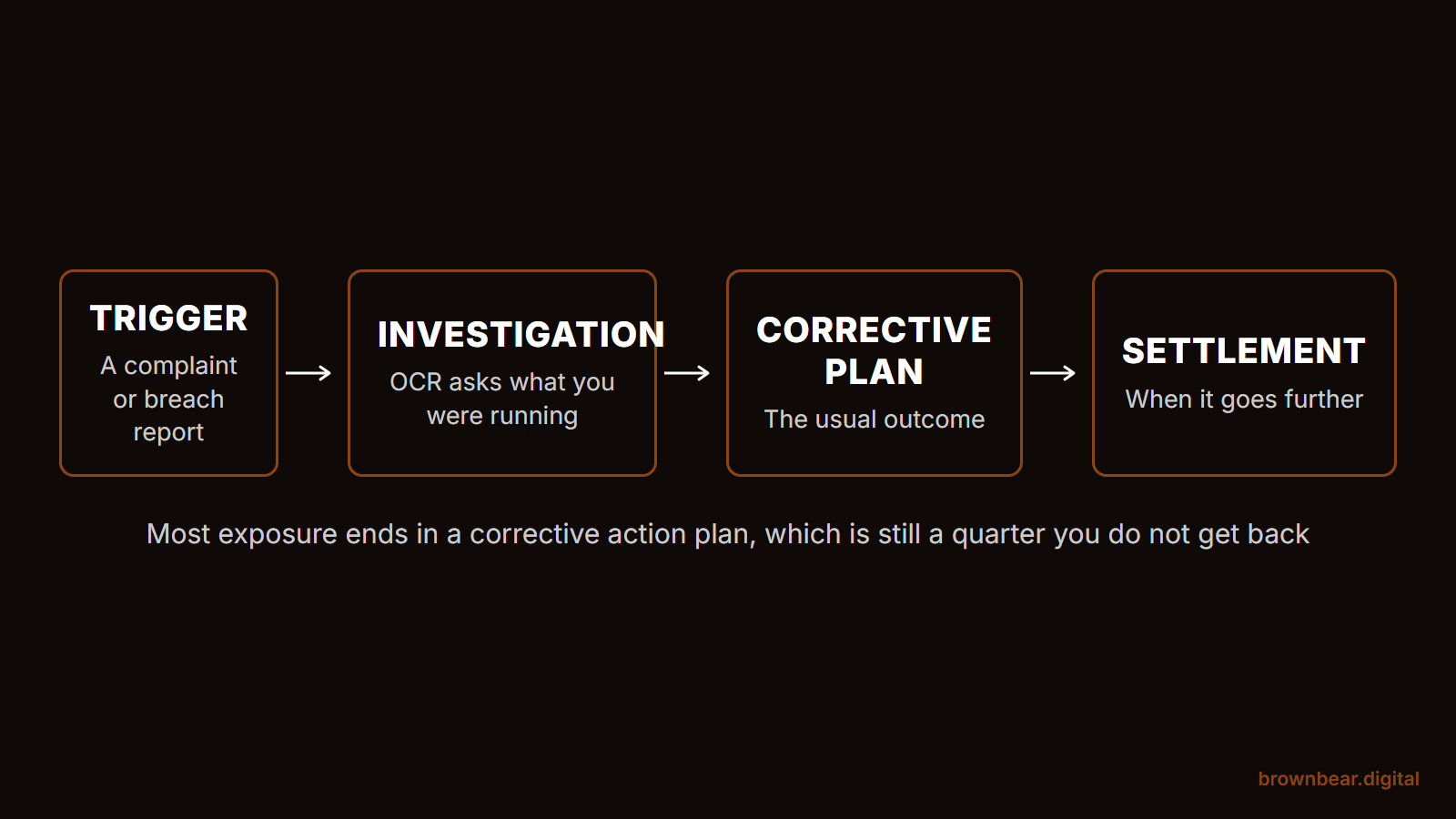
The tracking-pixel risk runs through a different courtroom. A Health Affairs study of 3,747 U.S. hospital websites found third-party tracking on 98.6% of them, per the study in Health Affairs, and plaintiffs' firms scan for those pixels at scale. For an independent practice the lesson is blunt: your fine risk lives in your reply box, your lawsuit risk lives in your tag manager, and the investigation itself costs real money before any penalty lands.
Reviews: your biggest local ranking signal is your riskiest reply box
Review volume and recency move local rankings, and reviews drive local rankings for medical practices more than almost anything else you control. Responding to reviews is also, as the enforcement record above shows, the single most-fined marketing act in healthcare. Both things are true, so you need a system, not vibes.
The practitioner consensus is unglamorous: only a generic reply that never confirms patient status is safe. Thank the feedback, never the visit. Take specifics offline. Never correct the story, even when it's wrong, and even when the reviewer described their own procedure in detail, because their disclosure does not release yours. The composer below turns that into copy-paste practice.
The Compliant Reply Composer
Pick the review you're facing and get a reply that protects the relationship without confirming anyone is a patient. Add your phone number and it's ready to paste.
Built by Brown Bear Digital · nothing you type leaves this page
Disclosure: These templates are general information based on the public OCR enforcement record and common practitioner guidance, not legal advice. Review-response policy should be confirmed with your compliance officer or healthcare attorney. Nothing you enter is stored or transmitted; it stays in your browser.
Testimonials, photos, and patient stories
Testimonials and before-and-after photos are conversion gold and E-E-A-T signal, and they are fully available to you, with one gate: a signed, specific marketing authorization. Not the treatment consent in your intake packet. A separate authorization that names the use. Get it before the story runs, store it where marketing can find it, and strip any identifying detail the authorization doesn't cover, including the incidental ones: a tattoo in a photo, a rare condition plus a small town.
Handled that way, patient proof is a durable advantage precisely because your more cautious competitors publish none of it. Our guide to before-and-after gallery best practices covers the consent and presentation mechanics.
What your marketing agency should never ask for
The sharpest HIPAA decision you'll make in marketing is what your agency can touch. An agency that only reads your rankings, your site content, and aggregated analytics never handles PHI and never needs a BAA. The moment an agency wants patient lists for "outreach and education," email audiences pulled from your EHR, or call recordings, it is asking to become a business associate, and if it doesn't volunteer a BAA in the same breath, walk.
Say you're the office manager at an eight-person practice and the new marketing consultant asks for a daily report of patients seen, to "personalize follow-up campaigns." That request has a compliance cost the consultant didn't price in, and in a practice that small, the data can't even be meaningfully de-identified. The forum threads where employees describe this exact pressure all end the same way: the person asking never had a plan for the data's obligations, only for its uses.
We wrote a full vetting playbook in how to hire an SEO agency for a medical practice. The one-line version: a good agency grows you on content, structure, and reviews, and treats your patient data as radioactive.
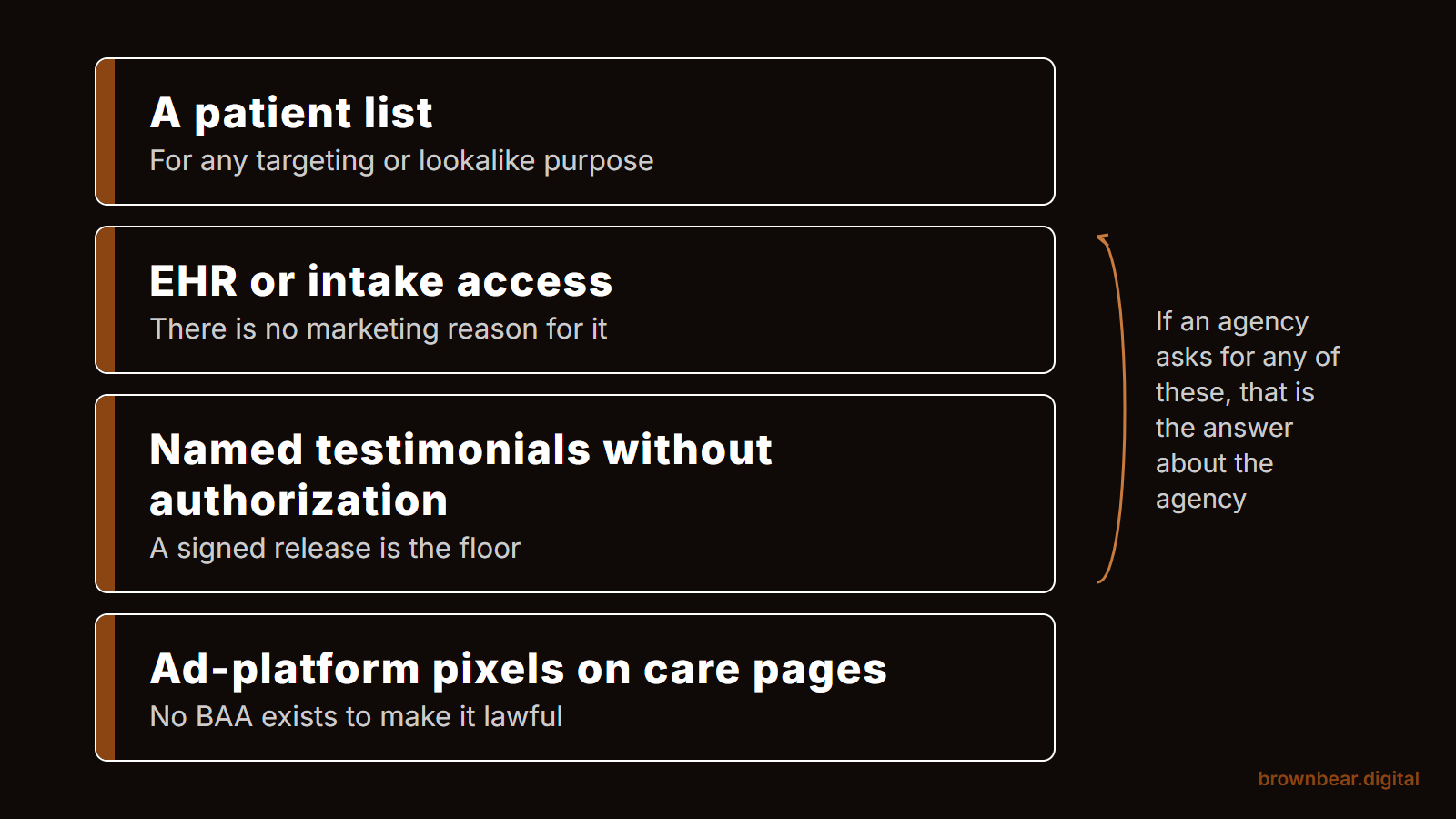
The compliant measurement stack: prove SEO works without touching PHI
Now the reframe this whole guide has been building toward. Read back through everything HIPAA restricted: pixels, retargeting audiences, patient-list campaigns, detailed conversion tracking. All measurement and remarketing. Now list what actually ranks a medical practice: expert content, clean site structure, local signals, review volume, E-E-A-T. Untouched, all of it. HIPAA doesn't limit your medical SEO. It limits your measurement, and practices that accept that trade early outrank the ones still trying to rebuild their old funnel dashboards inside a law that won't allow them.
So build the measurement layer from what's clean, in this order:
- Track rankings, organic sessions on non-care pages, and Google Business Profile actions: aggregate numbers, no identities.
- Add one answer choice to your intake form: "Found you online" with a follow-up for search or AI assistant. Consented, first-party, and yours. In our client practices, that intake question captures two to three times more search-and-AI-referred patients than analytics tools ever show, a gap we documented in how patients found you through AI search.
- Review a simple monthly ledger: sessions, intake attributions, consults booked. Twenty minutes.
- Judge every marketing dollar against that ledger, the way we argue in which marketing KPIs a practice should actually measure.
The near-term win is a marketing program you never have to hide from your compliance officer. The long-term win is bigger: while competitors pour budget into rented channels HIPAA keeps kneecapping, you compound the one channel the law leaves wide open.
Marketing Stack Risk Checker
Check everything currently running on your practice website or in your marketing. You'll get a per-tool verdict: whether a business associate agreement is even available, and what the fix is.
Built by Brown Bear Digital · nothing you select leaves this page
Disclosure: Vendor BAA availability changes and often depends on your plan tier; verdicts here are general information current as of mid-2026, not legal or compliance advice. Confirm every BAA in writing and review your stack with your compliance officer or healthcare attorney. Your selections are not stored or transmitted.
Grow Your Practice's Search Visibility Safely with Brown Bear
Brown Bear builds SEO programs for medical practices that treat compliance as an architecture decision: clean measurement, review systems that never confirm patient status, and content that earns rankings and AI citations on merit. If you'd rather hand this checklist to someone who has run it before, bring your review inbox and your tag manager. Those are the first two things we'll look at anyway.
Written By
Founder, Brown Bear Digital
Bryan has 15 years of experience across SEO, paid search, and AI search strategy. He founded Brown Bear to give businesses direct access to senior-level search expertise without the agency overhead.
Learn More About BryanGet Found on Google.
Get Cited by AI.
Tell us about your site. We'll send back a proposal for SEO and AI search.