Local SEO for Plastic Surgeons: The Playbook for Booking More Consults

A surgeon emailed us last year with a familiar story. He had paid an agency $4,000 a month for eighteen months. His website looked beautiful. His "domain authority" had climbed. And his consult calendar was still half empty. When we looked under the hood, the problem was obvious in about ten minutes: he ranked nowhere in the map pack, his Google Business Profile listed the wrong hours, and his three most profitable procedures did not have a real page anywhere on his site.
Getting found by patients in your own city is the difference between a practice that fills its calendar from search and one that keeps paying for the privilege of being invisible. That gap is what this guide closes. We have run these campaigns for aesthetic and surgical practices, and we have cleaned up after agencies that charged a fortune and delivered rankings for keywords no patient ever types. This is the playbook we wish every practice owner had before they signed their first marketing contract.
Here is the thing most "plastic surgery SEO" articles bury under technical jargon. For a plastic surgeon, SEO is local SEO. A patient in Charlotte is not comparing you to a surgeon in Seattle. They are deciding between you and the three other practices that show up on the map when they search "tummy tuck near me." Win that local race and the rest of SEO is a rounding error. Lose it and a beautiful website will not save you. This piece covers both the free fundamentals you can fix this week and the bigger money decisions, like whether to hire an agency at all.
If you are the surgeon doing this between cases, you want to know where your limited time actually pays off. If you are the office manager who got handed "the website," you want a clear order of operations, not a glossary. Maybe you have just opened in a saturated metro and every search already belongs to someone else. Or maybe you have been burned once already, paid a premium for rankings that never came, and you are rightly suspicious of the next pitch.
By the end, you will know exactly where your money should go first, which "best practices" are oversold, and how to tell a real local SEO partner from an expensive one. Longer term, you will understand how to own the local search market for the procedures you actually want to perform, so the calendar fills itself instead of emptying your ad budget.
We will start with the reframe that changes every decision after it, the way patients really find and choose a surgeon, then work down through your Google Business Profile, your reviews, your website, and finally the money questions: paid ads versus SEO, how to vet an agency, and what realistic results cost. So, let's start with why plastic surgery SEO is really local SEO.
Key Takeaways
For a plastic surgeon, SEO is local SEO
Patients choose between you and the three practices in the map pack, not a surgeon three states away. Win the local race on proximity, reviews, and Google Business Profile activity, and the rest of SEO is a rounding error.
Real results take three to six months, not thirty days
Map-pack movement typically shows within three to six months and steady consult flow builds over six to twelve, at $1,000 to $5,000 a month depending on your market. Anyone promising page-one results in 30 days is misleading you or chasing junk keywords.
Fix your Google Business Profile before touching the website
The profile is free, patients see it before your site, and it carries more map-pack weight than almost anything on your pages. Complete categories, fresh photos, weekly posts, and identical name, address, and phone everywhere beat a redesign.
Ask for reviews two to four weeks post-procedure
That window catches patients past the rough early recovery and genuinely happy with progress. Treat review generation as a front-desk system rather than a hope, and answer every review, because a thoughtful reply to a hard one persuades more than the five-star praise above it.
Why Plastic Surgery SEO Is Really Local SEO
Most SEO guides treat local search as one chapter near the back. For a plastic surgery practice, it is the whole spine. Cosmetic procedures are almost always bought close to home. Even patients who travel for a specific surgeon usually start by searching their own city first. That means the prize you are competing for is not a generic ranking. It is a spot in the local map pack, the little block of three practices Google shows with stars, distance, and a phone number.
This changes your entire priority list. On a national, non-local topic, links and content volume drive most of the result. In local medical search, Google leans heavily on three signals that have nothing to do with how many blog posts you publish: how close you are to the searcher, how strong and recent your reviews are, and how active and complete your Google Business Profile is. An SEO who works in this space put it bluntly in a forum thread: Google "puts more weight on proximity plus reviews plus GMB activity than traditional SEO signals" for medical keywords.
So before you spend a dollar on a fancy website redesign, understand the game you are actually playing. You are trying to become the obvious local choice for the specific procedures you want to perform, in the specific area you serve. Everything below is organized around that goal, in the order a real campaign should tackle it, and it is the same order we follow when we run SEO for plastic surgery practices.
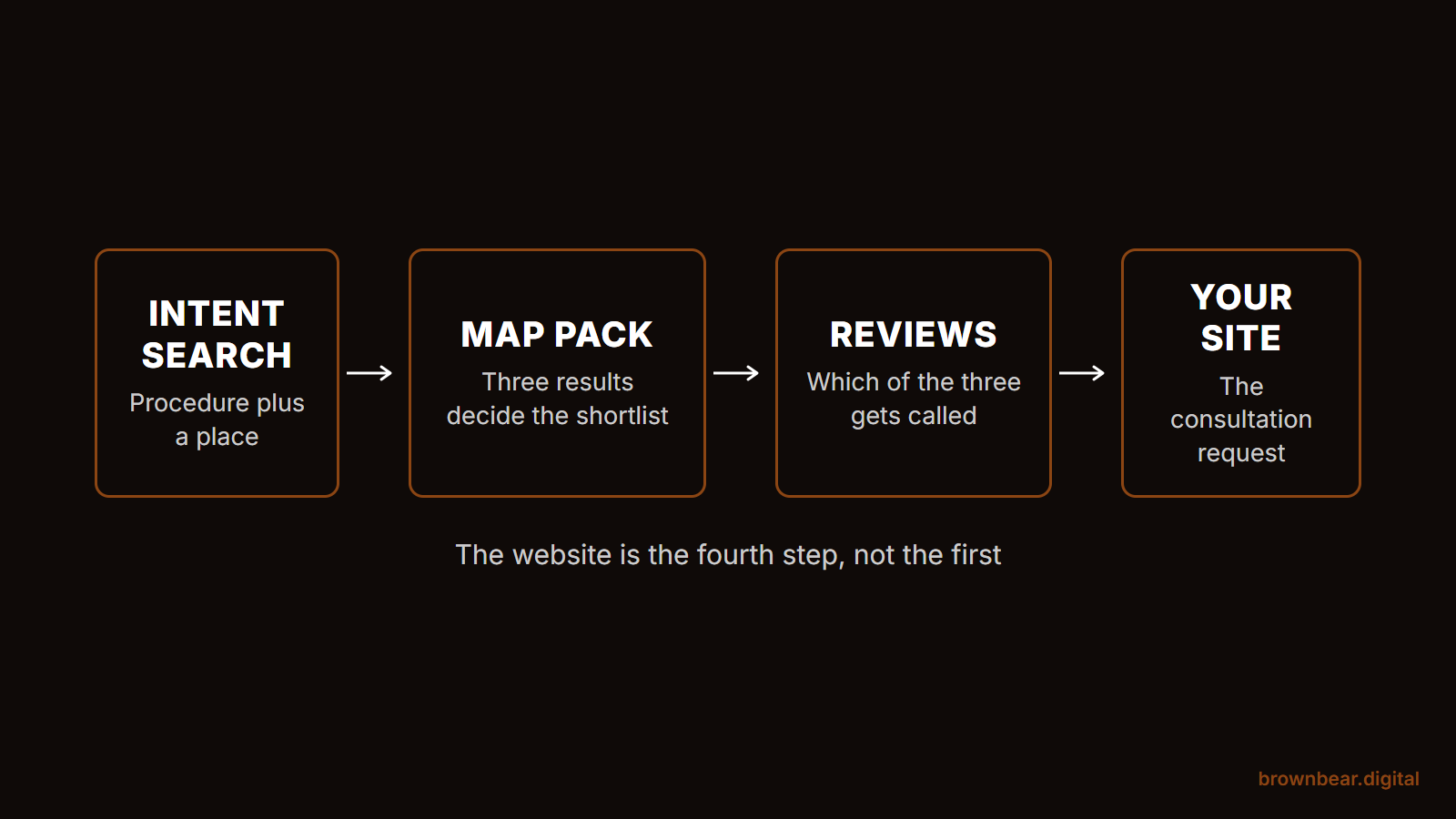
What Patients Actually Do Before They Book
It helps to picture the real path, because it is rarely a straight line. Someone has been thinking about a procedure for months, sometimes years. They finally open their phone and search something broad, like "rhinoplasty cost" or "mommy makeover near me." They are not ready to call. They are gathering courage and information. We mapped this decision journey in detail in our breakdown of how plastic surgery patients find their surgeon.
From there the pattern is remarkably consistent. They scan the map pack and click two or three practices. They read reviews, and not just the star rating. They read the actual words patients used, looking for someone who handled a case like theirs. They look at before-and-after galleries. They check whether the surgeon is board certified. Then, often weeks later, they come back and book a consult with the practice that felt the safest, not necessarily the cheapest or the closest.
Every step there is a place you can win or lose. A thin Google profile loses the first click. A page of generic five-star reviews with no detail loses the trust check. A missing or weak procedure page loses the patient who wanted to see that you actually specialize in what they need. Good plastic surgery SEO is just removing every reason a nervous patient might have to choose someone else.
Start With Your Google Business Profile, Not Your Website
If you do nothing else this month, fix your Google Business Profile. It is free, it is the single biggest lever in local medical search, and most practices treat it like an afterthought. Patients see it before they ever reach your website, and for map-pack rankings it carries more weight than almost anything on your site. If you are the office manager who just got handed "the website," start here rather than there: this is the highest-return hour you will spend all quarter. The sections below break down exactly what to optimize, roughly in priority order, and our deeper guide to local SEO and your Google Business Profile walks through each one screen by screen.
Get your name and categories right
Start with your business name. Use your real, consistent practice name, the same one on your signage and your website. It is tempting to stuff keywords into it, like "Dr. Smith Plastic Surgery | Best Rhinoplasty Boston," but that violates Google's guidelines and can get your profile suspended, which is a catastrophe to recover from. Keep it clean and let the other fields carry the keywords.
Categories are where the real ranking work happens. Set your primary category to the most accurate option, almost always "Plastic surgeon" or "Cosmetic surgeon," because the primary category is one of the strongest signals Google uses to decide which searches you appear for. Then add every procedure-relevant secondary category Google offers, such as "Medical spa," "Skin care clinic," or "Dermatologist" if those genuinely apply. Do not add categories you do not actually serve, but do not leave relevant ones empty either. Most practices under-use this field and quietly hand rankings to competitors who fill it out.
Load it with photos, and keep adding them
Photos do double duty here: they influence ranking through profile activity, and they are often what convinces a nervous patient to click. Aim to upload a generous set, not the bare minimum, and keep adding fresh ones over time rather than dumping a batch once and forgetting it. Cover the full range:
- Exterior shots so patients recognize your building and entrance from the street and parking lot.
- Interior shots of the waiting room, consultation rooms, and operating or treatment suites, because a clean, calming space reduces anxiety.
- Team photos of the surgeon and staff, which build the human trust that cosmetic patients care about deeply.
- Before-and-after work where you have documented patient consent, since this is frequently the single most persuasive content on the entire profile.
- Logo and cover image set deliberately, so the profile looks polished at a glance.
Name your image files descriptively before uploading, for example "breast-augmentation-before-after-austin.jpg" rather than "IMG_4821.jpg," and add accurate detail. It is a small signal, but in a close local race the small signals decide it.
Use video and Google Posts to stay active
Two underused features separate active profiles from dormant ones. First, video. Short clips work beautifully for this field: a 30-second practice tour, a surgeon introducing a procedure in plain language, or a patient testimonial shared with consent. Video signals an engaged profile and gives anxious patients a feel for the surgeon's manner before they ever call.
Second, Google Posts. These are short updates that appear right on your profile, and posting regularly, even once a week, tells Google the listing is actively managed, which is one of the activity signals that matters so much in medical search. Use posts for genuinely useful updates: a procedure spotlight, a seasonal note, a new credential, an event. Treat it like a small, steady habit rather than a campaign.
Answer questions, enable messaging, and fill every field
Turn on messaging and booking if your front desk can keep up with them, because a patient who can reach you in the moment they feel brave is a patient you do not lose to the next listing. Monitor the Questions and Answers section, where prospective patients post real questions, and answer them yourself before someone else answers them wrong. And fill out every remaining field: hours, including holiday hours, services with descriptions, the appointment link, attributes, and your service area. Profiles with complete information and fresh activity simply outrank half-finished ones.
Keep your name, address, and phone number identical everywhere
This sounds trivial. It is not. Google cross-checks your name, address, and phone number across the web to decide whether it trusts your location. If your suite number is written three different ways across Healthgrades, RealSelf, Vitals, Zocdoc, Yelp, and your own site, you are quietly diluting your own ranking. Pick one exact format and make it match everywhere. This is unglamorous work that delivers more than most "advanced" tactics.
Build a real review habit, and ask at the right moment
Reviews are not a vanity metric in this niche. They are a ranking factor and the deciding factor for a nervous patient. The practices that win treat review generation as a system, not a hope. The most effective window to ask is two to four weeks after a procedure, once the patient is past the rough early recovery and genuinely happy with their progress. A simple automated text or email at that point, sent by your front desk, can multiply your review volume within a few months. We lay out the full system in our guide to generating and responding to patient reviews.
One important guardrail: you cannot pay for, incentivize, or fabricate reviews, and you cannot selectively suppress the negative ones. The Federal Trade Commission has tightened its rules on fake and incentivized reviews, and healthcare practices are squarely in scope. The goal is more real reviews, asked for at the right time, with every review answered, especially the critical ones. A thoughtful reply to a hard review often persuades more than the five-star ones above it. You can read the FTC's current guidance on reviews and endorsements directly at the FTC's endorsement guidance.
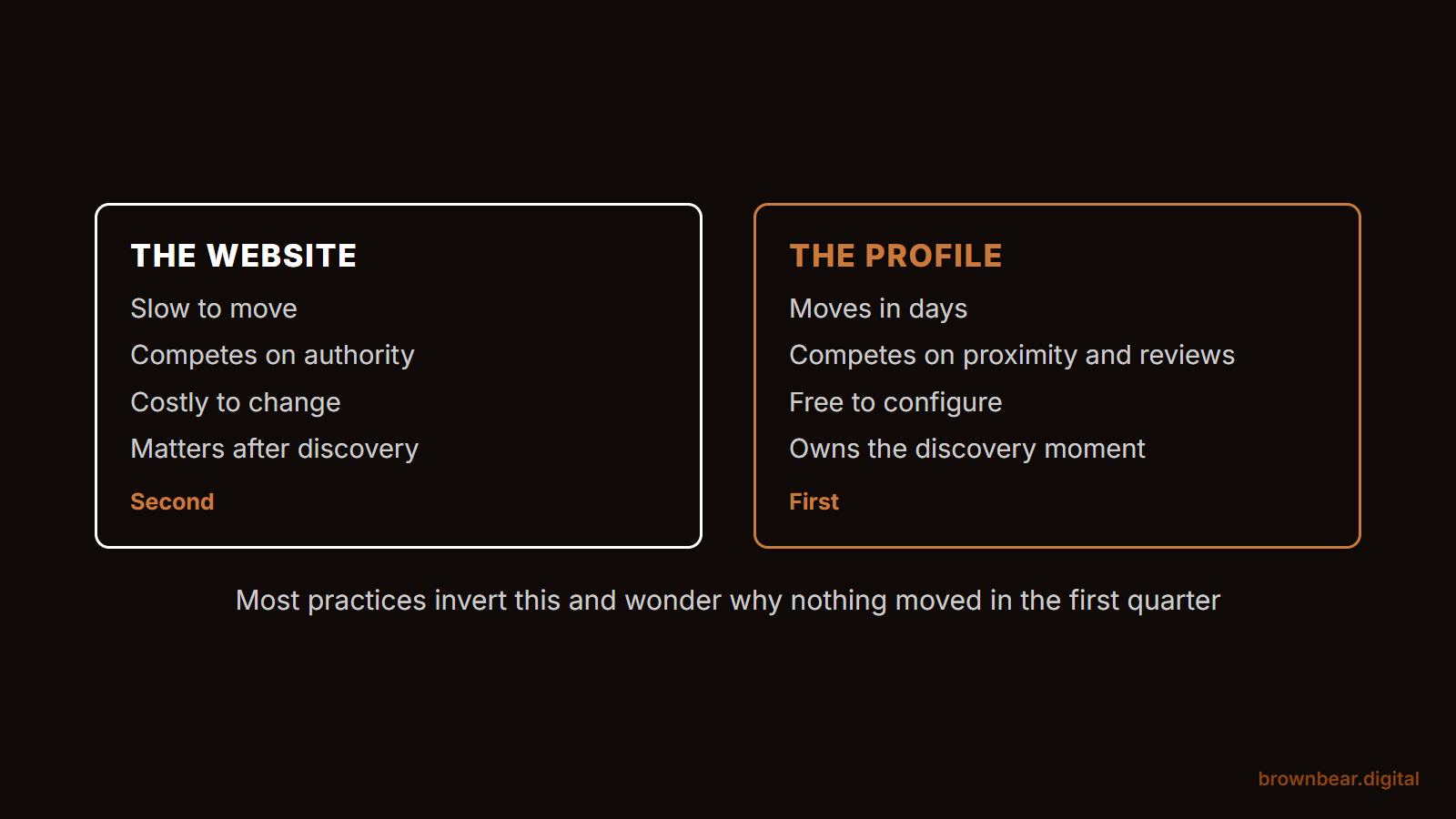
Why Reviews and Proximity Beat Backlinks in This Niche
Here is where we break with the standard agency pitch. Walk into most SEO sales conversations and you will hear a lot about backlinks, domain authority, and a string of three-letter metrics. In aesthetic and surgical local search, those metrics are wildly overrated as predictors of who actually ranks.
An agency owner described his aesthetics client this way in a candid forum thread: the DA, DR, and trust-flow numbers "don't even begin to tell the story." One competitor in his market had around 400 backlinks, most of them junk, and yet that competitor ranked beautifully and pulled in thousands of leads a month. The polished metrics said one thing. The map pack said another.
The lesson is not that links never matter. It is that for a local practice, proximity, review strength, and Google Business Profile activity usually move the needle faster and cheaper than a link-building campaign. If an agency leads with backlinks before they have even looked at your Google profile or your reviews, they are selling you the expensive thing, not the effective thing. We will come back to that when we talk about how to vet a partner.
Here is how the major local signals actually stack up for a plastic surgery practice, and what to do about each one.
| Signal | Weight in local medical search | What to do |
|---|---|---|
| Google Business Profile completeness and activity | Very high | Fill every field, post weekly, add fresh photos and video |
| Review volume, recency, and rating | Very high | Ask 2 to 4 weeks post-procedure; answer every review |
| Proximity to the searcher | High and fixed | Cannot change location; win on the signals you control |
| NAP consistency across directories | High | One exact format everywhere; clean up old listings |
| Procedure pages targeting "procedure plus location" | High | One strong page per core procedure |
| Backlinks | Low to medium, rises in big metros | Pursue quality links only once the basics are solid |
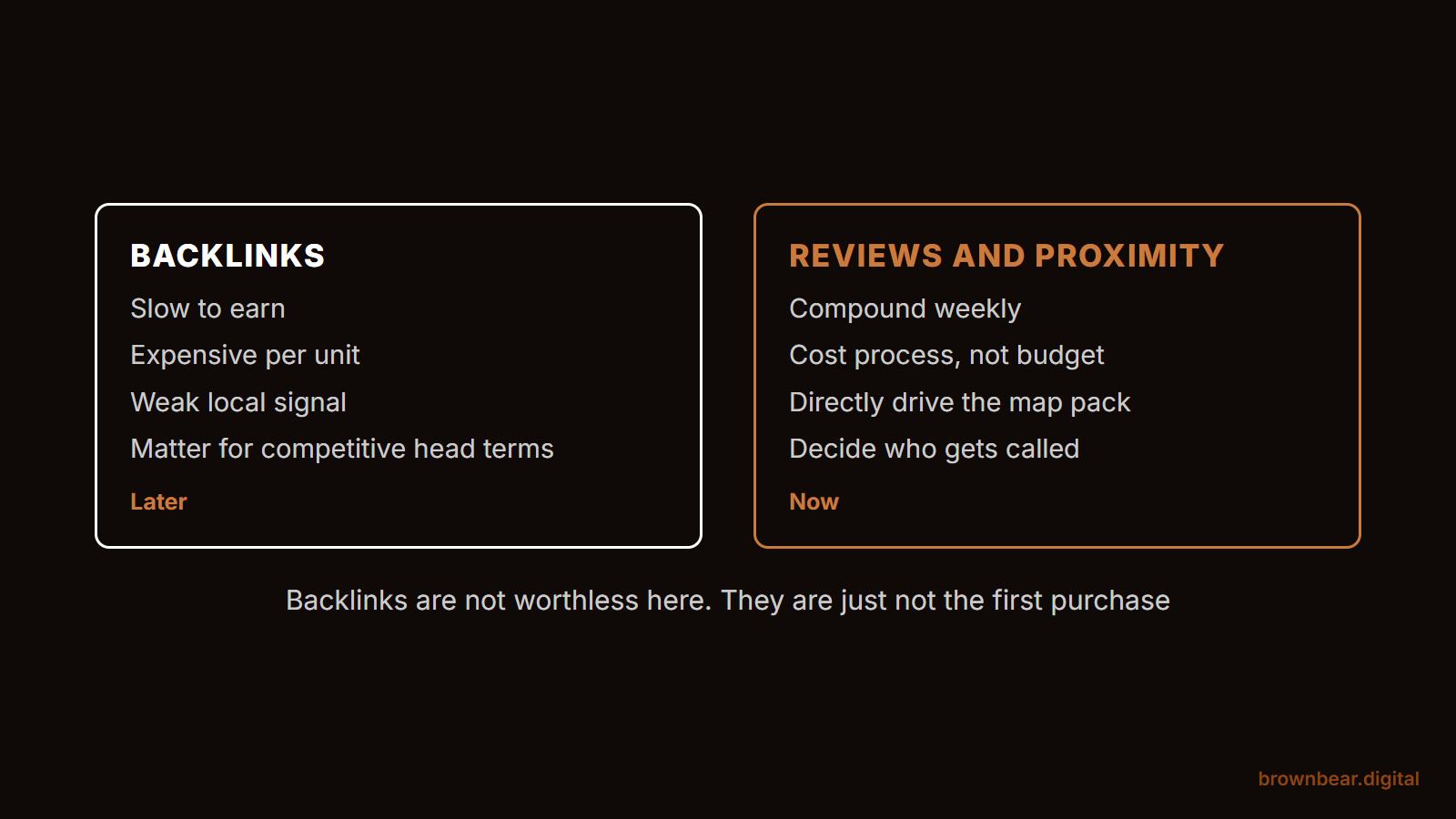
The Procedure Pages That Rank and Convert
When patients do reach your website, they are usually looking for one specific thing: the procedure they want. Yet the most common mistake we see is a practice with a gorgeous homepage and a single thin "Services" page that lumps twelve procedures into a few sentences each. That structure cannot rank, and it cannot convince.
Every core procedure you want to be known for deserves its own dedicated page, written to answer the real questions a patient has about that procedure. Target the way patients actually search, which is procedure plus location, like "breast augmentation in Austin." A strong procedure page covers what the procedure involves, who is a good candidate, what recovery looks like, realistic cost ranges, and your own before-and-after work. It should read like a calm, honest consultation, not a brochure.
We put numbers on that page in our 101-city study of what actually ranks for a major procedure search, and two findings should shape how you plan. First, the city belongs in the title tag. It appears on 90% or more of the winners and is the closest thing to a universal ranking factor in the dataset, while 65% of winning URLs carry no city name at all. Second, 52% of the #1 results are not procedure pages, they are the practice homepage, and most of those homepages never say the procedure in their title tag. In small and mid-size metros a tightly themed practice site can take the top spot with its homepage. In major metros the winners are overwhelmingly deep dedicated pages. Build both, because Google decides which URL to surface market by market. And treat the gallery as its own asset rather than a section on the page: it appears on 93% of the winners, and photo searches rank a separate URL entirely.
Show the surgeon, not just the practice
Google evaluates medical content through the lens of experience, expertise, authoritativeness, and trust, and patients do the same. Put the surgeon front and center. Name the operating physician, state board certification clearly, and link to a real bio that lists training and credentials. The American Board of Plastic Surgery certification and membership in bodies like the American Society of Plastic Surgeons are trust signals patients look for and search engines reward. A procedure page that reads as written or reviewed by the actual surgeon will outperform anonymous content every time.
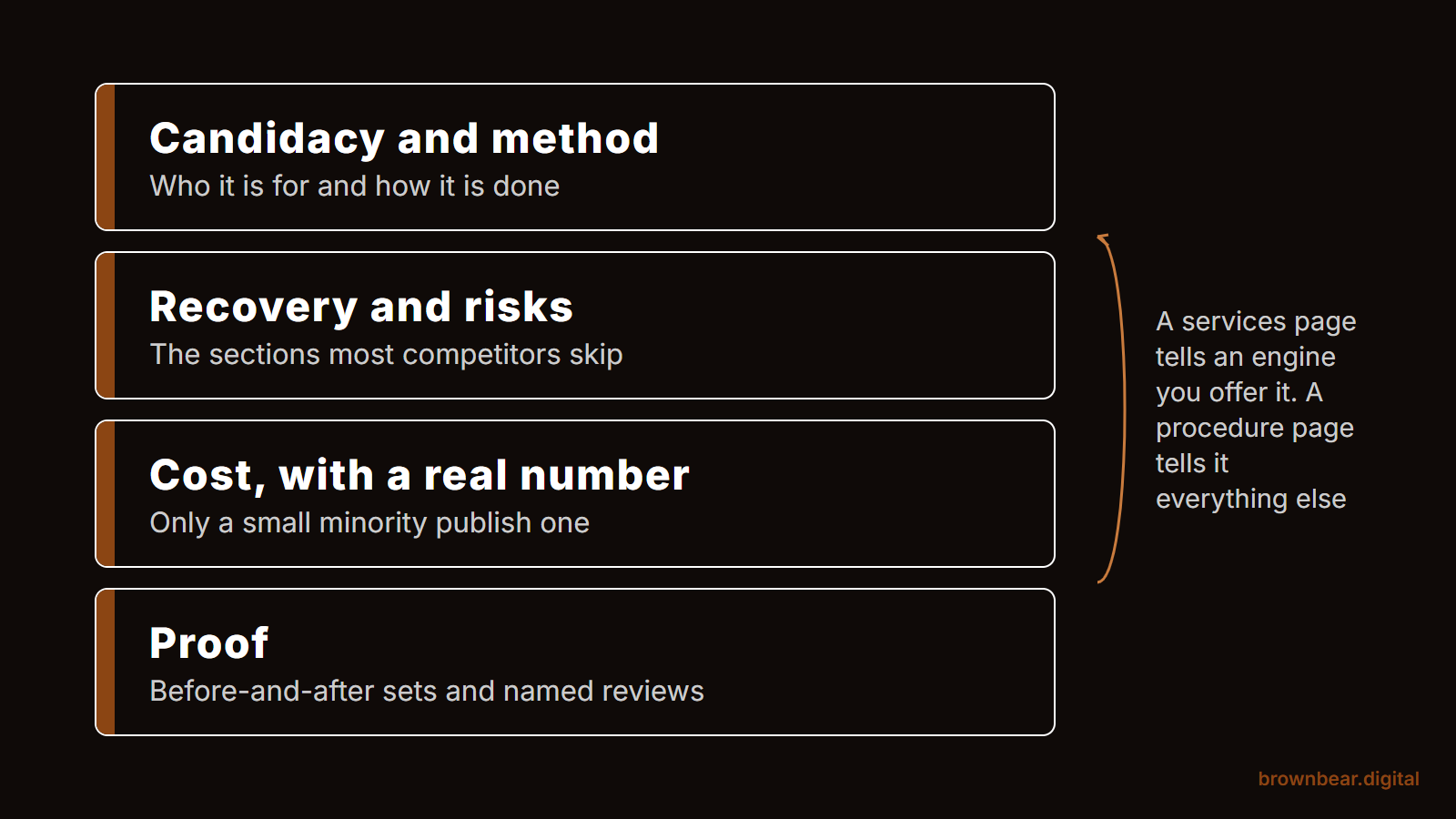
Content That Earns Trust (and the Blog Myth)
Now the contrarian part. Most guides will tell you to start a blog and publish constantly. For a new or mid-size practice, that is usually the wrong first move, and an experienced healthcare SEO said as much in a forum thread we trust: focus on your "core treatment, condition, and service pages over blog posts initially."
The reason is simple. A blog post about "five tips for faster recovery" rarely brings in a patient ready to book. A complete, trustworthy page about the specific procedure they want absolutely does. So get your procedure pages genuinely excellent before you write a single blog post. Depth on the pages that match buying intent beats volume on pages that do not.
That does not mean content never matters. Once your core pages are strong, thoughtful articles can capture patients earlier in their journey, the ones searching "is a deep plane facelift worth it" long before they are ready to call. Just sequence it correctly. Money pages first, supporting content second. Write for the human reading it, a person making a big, personal, sometimes scary decision, and the search engine tends to follow.
When Backlinks Actually Matter for Your Practice
So if links are overrated, do they matter at all? Yes, with an important caveat about your market. In a smaller or mid-size city, you can often reach the top of the map pack on the strength of a complete Google profile, strong reviews, and excellent procedure pages, with very few links. The local signals do the heavy lifting.
In a fiercely competitive metro, the math changes. As one practitioner put it, getting a plastic surgeon to the top "in a major city like LA or NY certainly won't work without links." When every competitor already has the basics nailed, quality links become a tiebreaker. The key word is quality. A handful of genuine mentions from real medical directories, local press, and reputable industry sites is worth more than hundreds of the junk links that agencies sometimes pad their reports with.
So the honest answer is: it depends on your city. Smaller market, links are a finishing touch. Major metro, links are part of the price of entry. A good partner will tell you which situation you are in instead of selling the same link package to everyone.
Technical SEO and Compliance Agencies Cut Corners On
Technical SEO matters, but for most practices it is less exotic than it sounds. The essentials are a site that loads fast on a phone, clean page structure, secure hosting, local business schema markup so search engines understand your location and services, and no broken or duplicate pages quietly competing with each other. Most practices do not need a complicated technical overhaul. They need the basics done correctly and then left alone.
What does get mishandled, often badly, is compliance. Plastic surgery sits under HIPAA, FTC advertising rules, and state medical board guidelines, and many general marketing firms simply do not account for that. One healthcare specialist warned that digital marketing firms "often mishandle medical website requirements," from how patient photos are collected and stored to how testimonials are used. Before and after images need documented patient consent. Review and testimonial practices need to follow advertising rules. Patient data and contact forms need to be handled in line with HIPAA. You can review the federal privacy requirements through the HHS HIPAA Privacy Rule.
If you operate multiple locations or several physicians, compliance gets more complicated too, because each office has its own staff, consent records, and patient data to handle correctly. The structure you choose for multiple locations affects both your rankings and your risk, so it deserves its own section.
Running Local SEO Across Multiple Locations
Once you have more than one office, local SEO stops being one campaign and becomes several at once. Each location competes in its own map pack, against its own neighbors, for its own patients. If you are a group practice owner or the manager juggling two or three offices, the instinct is usually to copy what worked at the first location and paste it everywhere. That is exactly where most multi-location practices go wrong.
The single biggest mistake is spinning up a separate website or microsite for each location. It splits your authority across weak domains, creates duplicate content, and multiplies your maintenance and compliance burden. Keep one strong website and give each location its own dedicated page under it, at a clean URL like yoursite.com/locations/austin. That structure concentrates your authority while still letting each office rank for its own city.
From there, each location needs its own complete local footprint. Here is how the core elements change when you have more than one office.
| Element | Best practice per location | Common mistake |
|---|---|---|
| Google Business Profile | A separate, fully verified profile for each office, with its own address, local phone number, and hours | One profile for all locations, or a shared phone number |
| Location page | A unique page per office with its own surgeons, staff, photos, directions, and city-specific copy | Boilerplate pages where only the city name changes |
| Reviews | Route each patient to review the exact office they visited; reviews live on that location's profile | Pooling all reviews under one profile |
| NAP consistency | Each location's name, address, and phone matched across directories independently | Mixing addresses or using a central number everywhere |
| Schema markup | LocalBusiness schema on each location page with that office's exact address | No schema, or the same address repeated sitewide |
| Authorship | Name the surgeon who actually operates at each location for E-E-A-T | A single generic "our team" across every page |
The thread tying all of this together is genuine local specificity. A location page should feel like it was written for that city, not stamped out from a template. Mention the neighborhoods you serve, the parking situation, the surgeons who actually see patients there, and the procedures that office specializes in. When two of your location pages read almost identically, Google struggles to rank either one, and patients sense the copy-paste immediately.
One practical sequencing note. If you are expanding, treat each new location as its own local launch rather than assuming your established office's authority carries over. A new office starts from scratch in its own map pack: new profile, new reviews, new citations. Plan for the same three to six month ramp you would expect for any new practice, and prioritize the location with the most growth headroom first rather than spreading effort thin across all of them at once.
Should You Do SEO or Paid Ads First?
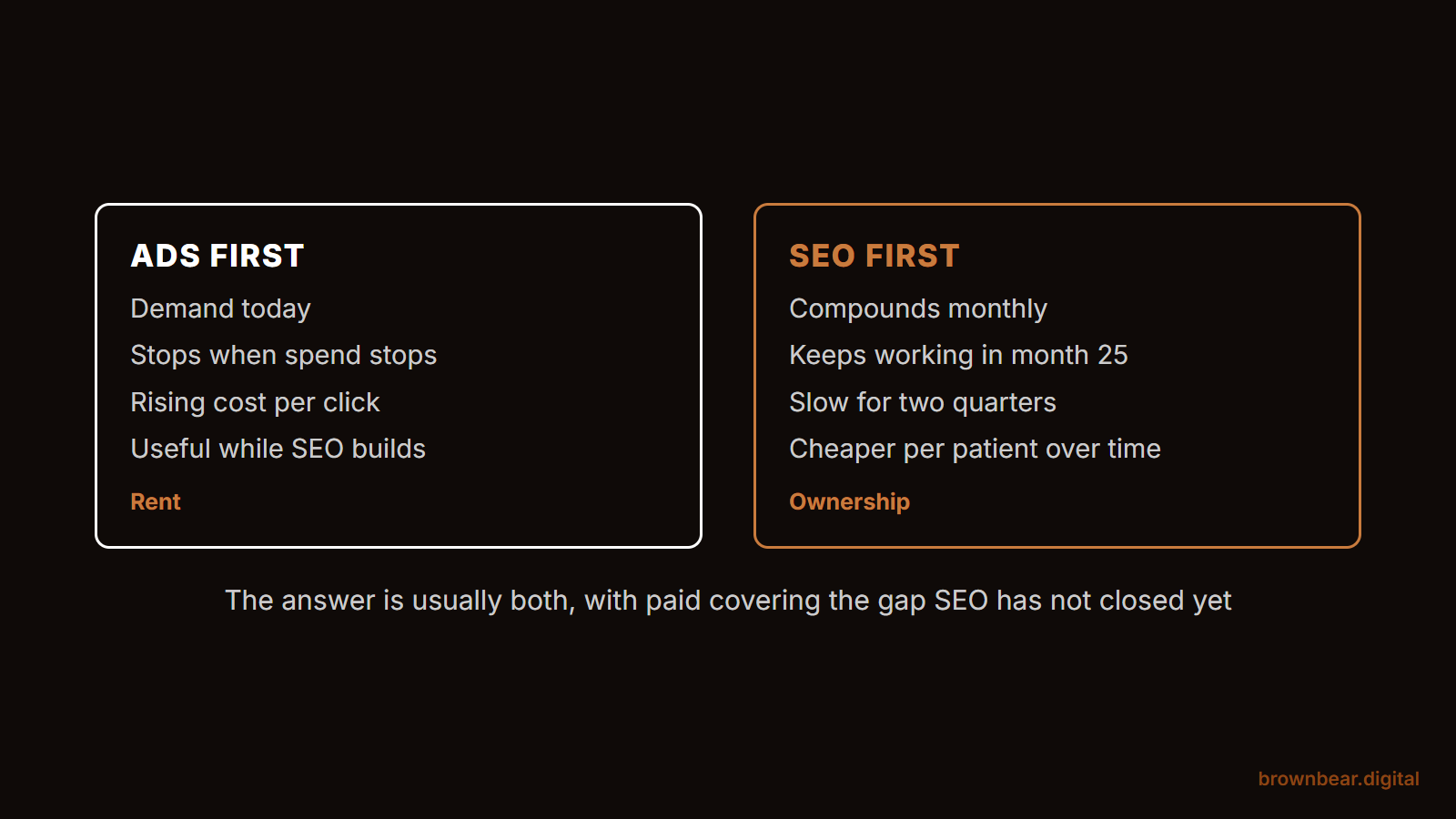
This is the question new practices ask most, and most guides dodge it because agencies would rather sell you both. Here is a straight answer. SEO is the better long-term investment because it compounds and lowers your cost per patient over time. But it is slow. In a competitive market you may wait several months to see meaningful local rankings. (The fuller argument, including why the two channels make each other smarter, is in why plastic surgeons should run SEO and SEM at the same time.)
If you are a brand-new practice that needs consults on the calendar now, paid search can bridge the gap. As one marketer noted, in competitive markets it often makes sense to lean on paid ads early "due to immediate results versus long SEO timelines," then shift the balance toward SEO as your organic presence builds. Think of it as a sequence, not a rivalry. Paid ads buy you visibility today while SEO builds the asset that lowers your costs tomorrow. An established practice with a steady patient flow can usually invest in SEO first and use paid ads selectively for specific procedures or slow seasons.
Use this as a quick gut check for where your first dollar should go.
| Your situation | Start with | Why |
|---|---|---|
| Brand-new practice, competitive metro, empty calendar | Paid ads, SEO in parallel | You need consults now; SEO is months out |
| Established practice, steady flow, growth goal | SEO first | Compounds and lowers cost per patient over time |
| One high-margin procedure to push fast | Paid ads for that procedure | Targeted, immediate, easy to measure |
| Smaller market, light competition | SEO first | Local signals alone can win the map pack |
How to Vet a Plastic Surgery SEO Company
This is the section the agencies writing competing guides will never include, because most of them would fail their own test. If you are going to hire help, and many busy practices should, here is how to tell a real partner from an expensive one. And if you have already been burned once, paying a premium for rankings that never came, treat this as the checklist you wish you had the first time. Keep our plastic surgery SEO services buyer's guide open next to it for what each line item in a proposal should include. For a longer walkthrough, see our guide to evaluating a plastic surgery marketing agency.
- Do they rank themselves? A healthcare SEO put it well: check whether the agency actually ranks in the Google map pack for their own service terms, and look at how they manage their own Google profile and reviews. If they cannot do it for themselves, be skeptical that they will do it for you.
- Do they look at your Google profile and reviews first, or pitch links and blogs? A partner who understands this niche starts with local signals. One who opens with a backlink package or a content calendar is selling the expensive thing, not the effective thing.
- Are they honest about timelines? Anyone promising page-one results in 30 days is either misleading you or planning to chase junk keywords. Real local results typically take a few months.
- Do they understand medical compliance? Ask how they handle before-and-after consent, HIPAA, and FTC review rules. If they look blank, they will create liability for you.
- Are their reports about patients or vanity metrics? Rising "domain authority" is not a business outcome. Calls, consult requests, and booked procedures are. A good partner reports on the things that pay your rent.
One more quiet signal. Be wary of anyone leading with a cut-rate "pay per conversion" pitch or pressure tactics. As one agency owner observed about the lowball pitch, "if you were really successful with plastic surgeons, you'd just work with more of them or get referrals from them." Strong partners are usually busy with clients who already trust them.
What Realistic Results, Timelines, and Costs Look Like
Let us set honest expectations, because unrealistic ones are how practices get burned. For most practices doing the work properly, local map-pack movement starts to show within three to six months. A steady, reliable flow of consult requests from organic search usually builds over six to twelve months as your profile, reviews, and procedure pages mature. Anyone promising faster is selling a story. (We unpack what actually controls that clock in how long YMYL SEO takes.)
On cost, plastic surgery SEO generally runs somewhere in the range of one to five thousand dollars a month, depending heavily on how competitive your city is. A practice in a smaller market may do well at the lower end. A practice fighting for visibility in a major metro should expect to invest more, because the link and content work required to compete there is genuinely harder. What you want to avoid is paying the high end for low-end work, which is exactly what the surgeon in our opening story did for eighteen months.
Here is a realistic picture of what to expect by market type.
| Market type | Typical monthly investment | First map-pack movement | Steady consult flow |
|---|---|---|---|
| Smaller city, light competition | $1,000 to $2,500 | 3 to 4 months | 6 to 9 months |
| Mid-size metro | $2,500 to $4,000 | 4 to 6 months | 9 to 12 months |
| Major metro (LA, NYC, Miami) | $4,000 to $5,000 and up | 6 months or more | 12 months and ongoing |
The goal of all of it is not a prettier dashboard. It is a fuller consult calendar with the procedures you actually want to perform, from patients in the area you actually serve, at a lower cost per patient every year you keep at it. That is the outcome every plastic surgery marketing engagement should be built around, and what good local SEO compounds into.
Grow Your Practice With Brown Bear
Plastic surgery SEO is not complicated, but it is easy to get wrong, and the cost of getting it wrong is months of empty consult slots and wasted retainer fees. The practices that win are the ones that get the local fundamentals right, in the right order, and refuse to be distracted by vanity metrics.
That is exactly the work we do. At Brown Bear, we build local-first SEO campaigns for practices that are tired of paying for activity instead of patients, starting with the signals that actually move the map pack and the procedures that actually fill your calendar. If you want a clear, honest look at where your practice stands and what it would take to own your local market, talk with our team and we will show you what a real plan looks like.
Written By
Founder, Brown Bear Digital
Bryan has 15 years of experience across SEO, paid search, and AI search strategy. He founded Brown Bear to give businesses direct access to senior-level search expertise without the agency overhead.
Learn More About BryanGet Found on Google.
Get Cited by AI.
Tell us about your site. We'll send back a proposal for SEO and AI search.