How Plastic Surgery Patients Actually Find Their Surgeon: The Full Search Journey, Platform by Platform
By the time a prospective patient fills out your contact form, she has already spent months deciding. She has watched procedure walkthroughs on YouTube, asked questions in Reddit threads, compared your RealSelf reviews against two competitors, searched your name in ChatGPT, and visited your website more than once. The inquiry is not the beginning of her decision process. It is close to the end.
Bryan Passanisi is the founder of Brown Bear, an SEO and AI search agency that works exclusively with plastic surgery practices.
Whether you manage marketing for a single-surgeon boutique practice or oversee patient acquisition across a multi-location group, this piece covers both the earliest stages of patient awareness formation and the final moments that determine which surgeon gets the consultation booking, including the platforms most practices have no visibility on at all.
If you're a practice manager who watches your Google rankings hold steady while consultation volume doesn't follow, this is the piece that explains the gap. Maybe you've sensed that something has shifted in how patients are finding surgeons, whether AI search, TikTok, or Reddit threads surfacing in your analytics, but haven't been able to map what that shift actually looks like in practice. Or you're a surgeon who handles your own digital presence and suspects you're investing in the wrong places without being able to prove it.
By the end of this piece you'll have a clear, stage-by-stage map of where patients research, what they're looking for at each step, and what your practice needs to look like when they arrive. The longer-term payoff: a strategy built around the full research arc rather than only the bottom of the funnel, which compounds over time rather than evaporating when ad spend stops.
We'll cover the social platforms that ignite initial curiosity, the Google search sequences that define the research arc, the AI tools and peer communities patients use to validate what they've learned, the deep-dive platforms where final preferences form, and the convergence moment when a patient narrows from a list of surgeons to the one she calls.
So, let's start with the platform that does more work than any other in the patient journey and gets the least credit in most practice marketing plans.
Key Takeaways
Your contact form is the end of her research
By the time a patient inquires, she has spent months across social platforms, Google, AI tools, Reddit, YouTube, and RealSelf. Marketing built only for the bottom of the funnel competes for a shortlist that is already decided.
The research arc runs 6 to 18 months
For major procedures like rhinoplasty and breast augmentation, the gap between the first curiosity search and a booked consultation can be 6 to 18 months, and that timeline is the map your content strategy should be built around.
Convergence wins the selection moment
Patients choose the surgeon who appeared credibly at three or four stages of their research, not the one with the best single ranking. Visibility at one stage is worth something; visibility across platforms is worth the consultation.
Peak intent has a short window
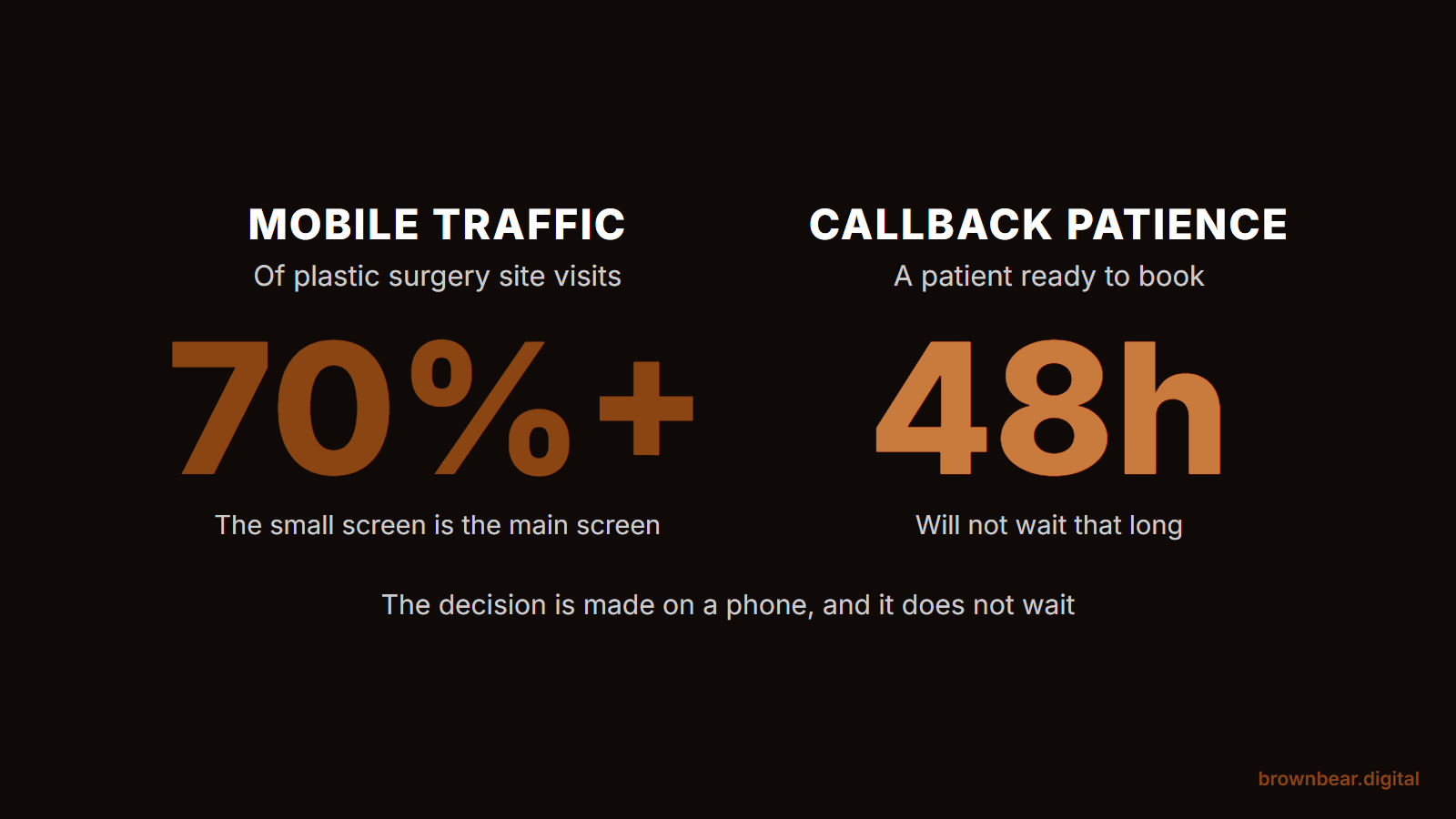
A patient ready to book will not wait 48 hours for a callback, and more than 70% of plastic surgery website traffic arrives on mobile. Same-day response and a flawless mobile experience convert the research you never saw happening.
The Journey Starts Before the Search Bar
The impulse to research a cosmetic procedure rarely begins with a Google search. It begins with a moment of social comparison: a friend whose rhinoplasty looks natural two years post-op, a before-and-after on Instagram that stops a thumb mid-scroll, a TikTok creator walking through her breast augmentation recovery week by week, or a filtered selfie that shows a version of a face the viewer wants to recognize in the mirror.
The American Academy of Facial Plastic and Reconstructive Surgeons has documented the rise of what researchers have termed "Snapchat dysmorphia": patients arriving at consultations with digitally altered images of themselves, requesting procedures that recreate a filter effect. The trigger is social, not clinical. A prospective patient does not decide to research rhinoplasty because she found a procedure page in organic search. She decides because she saw something on a screen that made her curious about what was possible.
Between 40% and 60% of patients considering cosmetic procedures report being influenced by social media before making a decision, according to a systematic review published in the Aesthetic Surgery Journal Open Forum. That influence does not primarily come from surgeon accounts, though a surgeon's social presence matters. It comes from other patients sharing their experiences, their recoveries, and their results. Social proof from peers carries more weight at this stage than any amount of professionally produced content from a practice.
For practice managers, this stage is uncomfortable to plan around because you cannot manufacture the social impulse that triggers it. What you can do is create the conditions for it: delivering outcomes patients feel compelled to share, building a practice culture where that sharing feels safe and natural, and maintaining a consistent visual identity on the platforms where it happens. The practice that benefits most from this stage is rarely the one trying to orchestrate it. It is the one whose patients cannot help talking about it.
1. The First Google Search
Once curiosity is formed, most patients move to Google. But what they type first is almost never a surgeon search. It is a procedure search.
"Rhinoplasty before and after." "Breast augmentation recovery timeline." "What is a mommy makeover." "Tummy tuck vs liposuction cost." These are awareness queries. The patient is not thinking about surgeons yet. She is thinking about whether the procedure is right for her, whether the recovery is something she can manage, and whether the cost is in a range she can consider. This stage is about the procedure, not the provider.
The query sequence evolves over weeks and months in a pattern that holds across most major cosmetic procedures:
- Curiosity phase: procedure name + "before and after," procedure name + "cost," "is [procedure] worth it"
- Education phase: procedure name + "recovery," procedure name + "risks," "how long does [procedure] last," "what happens during [procedure] surgery"
- Evaluation phase: "best plastic surgeon [city]," "board certified rhinoplasty surgeon near me," "plastic surgeon reviews [city]," "[surgeon name] reviews"
- Commitment phase: "[surgeon name] before and after," "consultation [practice name]," "[practice name] pricing," "[practice name] financing"
The gap between the curiosity phase and the commitment phase can be 6 to 18 months for major procedures like rhinoplasty and breast augmentation. A patient who first searched "rhinoplasty cost" in January may not book a consultation until the following year. That timeline is not an obstacle for your content strategy. It is the map your content strategy should be built around, with content designed to meet patients at each phase and move them toward the next one.
The "before and after" half of that sequence behaves differently from everything around it, and most practices have never been told. We ran that query across 50 procedures for our national before-and-after gallery study and found no meaningful local version of it. Localized photo searches like "breast augmentation before and after Miami" have no measurable volume. Patients search procedure pages by city and photos nationally, which means the gallery your curiosity-phase patient lands on may belong to a practice two time zones away, or to the American Society of Plastic Surgeons, whose gallery takes #1 on twelve of the surgical terms we studied.
There is a problem developing at this stage that most practices have not yet absorbed into their strategy: zero-click search. Google's AI Overviews now answer a meaningful share of common informational queries directly within the search results page, without the patient visiting any website. "How long is rhinoplasty recovery?" is answered in paragraph form above the first organic result. "What is the difference between a tummy tuck and liposuction?" gets a featured answer before a single link appears.
Practices that relied on informational keyword rankings to drive top-of-funnel traffic are seeing the impact in their analytics: rankings have held, but organic visits from informational queries have declined. The solution is not to stop producing educational content. Informational content still earns the featured answer position, and being the named source of that answer builds recognition even when there is no click. The goal is to structure educational content so that it positions your practice as the authoritative source and includes enough practice-specific perspective that a patient who wants more than a summary has a reason to click through.
If you've been running SEO for a plastic surgery practice that inherited a content strategy built around general medical keywords, this is where you'll feel the gap most acutely. The queries your patients are actually typing do not look like standard healthcare searches, and the informational content that performs well in other medical niches is now competing against AI Overviews that absorb the click before your page gets one. Ranking is not the same as getting the visit, and getting the visit is not the same as reaching the patient at the right moment in her research.
2. AI Search Is Now Part of the Research Path
Alongside traditional Google use, a growing segment of patients, concentrated in the 25 to 40 age range that is also the core demographic for most elective cosmetic procedures, are turning to AI tools as part of their research process. ChatGPT, Perplexity, Google's AI Overviews, and Bing Copilot are not replacing Google entirely. They are being layered into the research stack at specific points where conversational questions are more useful than keyword searches.
The behavior shift is worth understanding precisely. A patient researching rhinoplasty on Google types "rhinoplasty before and after natural results." The same patient using ChatGPT might type: "I'm 31, I've been thinking about rhinoplasty for two years. I want a natural result that fits my face, not a dramatic change. What should I actually look for in a surgeon, and what questions should I ask at a consultation?" That is a question no search bar was designed to handle. AI handles it fluently, synthesizing an answer that draws from across the web and delivers it as a single, confident response.
What AI surfaces in those answers depends on several factors: the depth and breadth of your website content, the consistency of your practice's entity data across directories and review platforms, the volume and recency of patient reviews, and whether your site carries the E-E-A-T signals that AI systems use to assess credibility. Practices with thin procedure pages, inconsistent business data across directories, and sparse review profiles are not being penalized by AI search. They simply do not appear in the data pool AI draws from when constructing an answer.
A study published in the Annals of Plastic Surgery found that ChatGPT answered rhinoplasty consultation questions at a level competitive with actual plastic surgeon consultations, leading the journal to ask directly whether surgeons should be concerned. Whether the clinical concern is warranted or not, the marketing implication is clear: patients are entering consultations with pre-formed opinions about procedures, surgeon selection criteria, and what good outcomes look like, shaped by AI tools they used weeks or months before picking up the phone.
Practices that are visible in AI search answers are building a trust position with patients at a stage of the research journey where their competitors have no presence at all. This is an early-mover landscape. The practices establishing AI search authority now, while most competitors have not yet begun, are creating a compounding visibility advantage that becomes harder to displace as the field catches up.
3. Reddit and the Peer Layer
Reddit occupies a specific and irreplaceable position in the plastic surgery patient journey. It is where patients go to verify what they have already learned.
Prospective patients do not typically begin their research on Reddit. They arrive there after initial research on Google or YouTube, carrying questions they believe only other patients can answer honestly. "Did your recovery from rhinoplasty actually take three weeks, or was it longer in practice?" "Did you feel pressure from your surgeon to go a different direction than you wanted?" "What do you wish someone had told you before your consultation?" These are not questions a surgeon's website is designed to answer. They are questions only someone who has been through the experience can address credibly.
A PMC study analyzing Reddit discourse on cosmetic surgery procedures described typical participants as "clinically literate but diagnostically uncertain," meaning these are patients who have done substantial research but are not yet confident in their decision. They are not looking for basic procedural information. They are looking for honest, unfiltered validation from people who have already made the decision they are still considering.
The most active communities include r/PlasticSurgery, r/Rhinoplasty, r/Blepharoplasty, r/BreastImplants, and a range of procedure-specific subreddits that have formed around shared interests. These communities have strong informal norms against promotional content. They do not respond well to surgeon self-promotion or obvious marketing language. What earns credibility in these spaces is the kind of honest, detailed patient experience that does not exist on a practice website.
One of the most common concerns practice managers raise about Reddit is not about the content of what gets posted. It is the feeling of having no control over it. That discomfort is real and worth sitting with for a moment, because the response to it shapes everything that follows. Trying to suppress or manage Reddit discussions is both ineffective and counterproductive. These communities are designed to resist exactly that kind of interference, and they do it well. The only lever a practice actually has is the quality of the experience it delivers, and that turns out to be the right lever to be pulling regardless of Reddit.
The practical implication is uncomfortable but clear: the only way to build positive Reddit presence is to deliver patient experiences worth documenting. That means consultation processes that feel personalized, communication that is transparent and responsive, and outcomes patients are proud of. Practices that cut corners on communication or post-operative follow-up build Reddit profiles that reflect it, whether they are monitoring the platform or not.
4. YouTube and the Deep-Dive Phase
YouTube is where research gets serious. If TikTok and Instagram ignite initial curiosity and Google answers baseline questions, YouTube is where prospective patients spend hours going deep on procedures they have moved past considering and are beginning to commit to.
The content patients consume on YouTube falls into two categories. The first is surgeon-produced educational content: procedure overviews, surgical technique explainers, Q&A sessions, recovery timelines, FAQ videos. The second is patient vlogs: real people documenting their surgical journeys in detail, from the moment of the consultation decision through the full recovery arc. The second category consistently outperforms the first in engagement because authenticity carries more weight than production value at this stage of the research.
A patient who has watched three rhinoplasty recovery vlogs from real patients arrives at her consultation with a significantly different level of preparation than one who has only read procedure pages. She knows what week two recovery realistically looks like, not just the clinical description. She knows the emotional arc of the process, not just the physical timeline. She knows what questions to ask because she has watched someone else ask them on camera. That preparation changes the quality of the consultation itself, and practices that are prepared to meet a well-informed patient typically convert at higher rates than those set up to educate from scratch.
For practices, YouTube creates a compound credibility opportunity. A surgeon who builds a consistent library of educational content serves two functions simultaneously: building direct trust with the prospective patients who find that content during their research phase, and creating indexable content that surfaces in both Google search results and YouTube's own recommendation engine. A patient who watches a surgeon's rhinoplasty explainer video is materially more likely to contact that surgeon for a consultation than one who has only encountered a procedure page.
The challenge is sustained commitment. YouTube does not produce meaningful results from a single video or a short production sprint. A library of 20 to 40 videos built consistently over 12 to 18 months, covering the procedures a practice performs and the questions patients actually ask, generates the kind of sustained visibility that translates into consultation bookings over time. The practices I see with the strongest YouTube-driven consultation pipelines are not the ones with the most polished production. They are the ones who show up consistently enough that prospective patients feel they already know the surgeon before walking through the door.
For surgeons managing their own content alongside a full clinical schedule, the commitment question is the practical blocker. If you're a single-surgeon practice doing rhinoplasty and revision cases five days a week, setting aside time to produce video content regularly can feel like an impossible ask. The practices that sustain YouTube output use a simple model: record informal Q&A answers to the questions they are asked at every single consultation, with a minimal production setup. A twelve-minute video answering "what should I actually expect in the first week after rhinoplasty?" does not require a studio. It requires a surgeon willing to be honest on camera about what their patients experience. That honesty, more than production quality, is what earns the trust of a prospective patient who has spent months in the research phase.
5. RealSelf and Niche Review Communities
RealSelf occupies territory that no other platform fully replicates. Unlike Google reviews, which are brief, unverified, and difficult to contextualize, or surgeon social media accounts curated by the practice, RealSelf provides something structurally different: detailed patient reviews with before-and-after photos uploaded by the patient, not the practice, alongside disclosed cost, full recovery timelines, and a binary "Worth It" or "Not Worth It" verdict on the experience.
That combination of transparency is what gives RealSelf its distinct weight in the research process. The before-and-after photos are attached to real patient experiences, not selected by a marketing team. The cost disclosure answers a question most procedure pages deliberately avoid. The "Worth It" rating provides a shorthand trust signal that patients use as a first filter when comparing surgeons by name.
An April 2024 study found that patients who used RealSelf for cosmetic procedure research showed higher awareness of treatment options and higher decision-making empowerment than patients who relied on other research channels. RealSelf reviews are also discoverable through Google, meaning a strong RealSelf profile contributes to organic visibility at exactly the stage when patients are evaluating surgeons directly by name rather than by procedure.
A practice with a 95% or higher "Worth It" rating visible in Google search results alongside the practice name carries a trust signal that is difficult to manufacture and impossible to fake. It is earned through outcomes and through the willingness of patients to document their experience publicly. Practices that do not actively encourage patients to share their experience on RealSelf are leaving a significant research-stage trust signal unbuilt. The barrier to a RealSelf review is higher than a Google review, since it requires photos and a detailed write-up, but the influence in the research phase is proportionally higher because of how much more information it provides to a prospective patient making a considered, irreversible decision.
6. The Surgeon Website
By the time a prospective patient lands on your website with serious intent, she is not in the awareness phase. She is in the evaluation phase. She already knows what procedure she wants. She is now deciding whether you are the surgeon she trusts to perform it. That distinction changes what your website needs to do.
Most plastic surgery websites are built to introduce prospective patients to procedures. That is the wrong problem to solve at this stage. A patient who has been researching rhinoplasty for four months does not need your website to explain what rhinoplasty is. She needs your website to confirm that she is in the right place.
If you're a practice manager who inherited a website you did not build, you probably already recognize this problem. The site looks credible, the gallery exists, the contact form works. But it was built to demonstrate clinical standing to other surgeons or referral sources, not to guide a patient who has been researching rhinoplasty for seven months and needs to confirm, in the first thirty seconds, that this practice operates at the level her research has led her to expect.
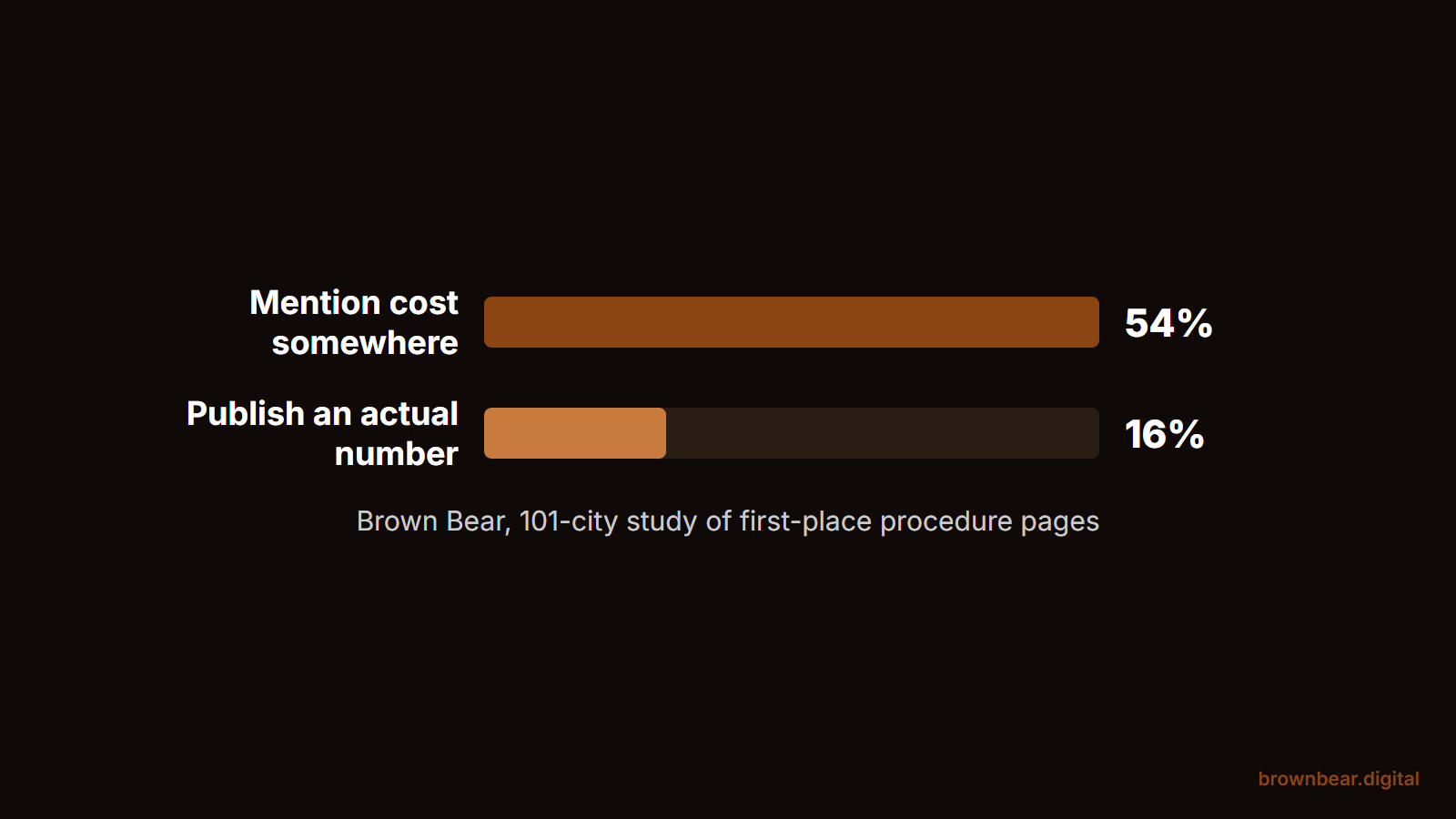
The sequence in which patients evaluate a surgical website follows a consistent pattern. The before-and-after gallery comes first. At this stage, the patient is not reading procedure text. She is looking at results and asking whether the aesthetic sensibility matches what she is looking for. If the gallery does not show cases that feel relevant to her goals, the rest of the website does not matter. If the gallery resonates, she moves to credentials: board certification, training background, the specific procedures the surgeon specializes in. After credentials comes personality: does this surgeon communicate in a way that feels trustworthy? Does the website feel clinical and cold, or does it feel like a practice that will actually talk to her? Finally, she checks for price signals: not necessarily explicit pricing, but whether the practice is transparent about what the consultation process looks like and what to expect from the conversation about cost. That last check is where the market is most exposed. Across the pages holding #1 in our 101-city procedure page study, 54% mentioned cost somewhere on the page and only 16% published an actual number. Cost is the most under-supplied thing patients want at the decision moment, and the practice willing to answer it walks into a nearly empty room.
The most common reason strong practices lose prospective patients at the website stage is not the gallery and not the credentials. It is the contact process. A patient who has spent three months researching and has arrived at a website ready to schedule a consultation is not going to wait 48 hours for a callback. Practices with immediate response mechanisms, whether same-day text response, live chat, or direct online scheduling, convert at significantly higher rates than those relying solely on a contact form and a business-hours callback window. The research phase is over. The moment of contact is a moment of peak intent, and it has a short window.
The second most consistent failure point is mobile experience. More than 70% of plastic surgery website traffic arrives on mobile devices. A website that requires desktop navigation to browse a before-and-after gallery or complete a contact form is creating friction at exactly the moment that matters most.
7. Google Maps and the Local Decision
For the majority of cosmetic surgery patients, geography matters. Even patients willing to travel for the right surgeon typically begin their search locally and expand only if they cannot find someone they trust within a comfortable distance.
Google Maps and the Local Pack, the three-listing map cluster that appears above organic results for searches like "rhinoplasty surgeon near me" or "plastic surgeon [city]," captures a disproportionate share of the highest-intent clicks in the search funnel. These are patients who are past the research phase and are actively comparing specific surgeons in a specific market. Intent at this stage is as high as it gets in organic search.
Three factors determine Local Pack visibility: proximity to the searcher, the volume and recency of Google reviews, and the completeness of the Google Business Profile. Of these, review recency is the most consistently underinvested. A practice with 200 reviews but the most recent posted fourteen months ago is at a structural disadvantage against a practice with 80 reviews where the most recent was posted last week. Google's local ranking algorithm weights recency as a signal that the practice is actively operating and generating current patient outcomes.
What patients read in plastic surgery reviews differs from what drives the aggregate star rating. The star rating earns the click on the map. What converts that click into a consultation call is what patients actually read in the review text. Comments about front-desk responsiveness, clarity of pricing communication, how the surgeon handles patient questions, and what the consultation experience felt like carry more decision weight than outcome descriptions. A prospective patient who has not yet had the procedure cannot fully evaluate clinical outcome claims. She can evaluate whether previous patients were treated the way she wants to be treated, and that evaluation drives the call.
The Selection Moment: How a Patient Narrows to One Surgeon
Somewhere in this multi-platform, multi-month journey, a patient moves from evaluating several surgeons to committing to one. Understanding what drives that transition is, from a practice management standpoint, the most operationally useful insight in this entire piece.
It is rarely the best Instagram feed or the highest Google ranking. The selection moment is driven by convergence: the patient selects the surgeon who appeared credibly and consistently across multiple platforms during her research journey, whose patient outcomes align with her aesthetic goals, and who feels accessible rather than unreachable.
The word "accessible" is doing significant work in that sentence. Patients researching plastic surgery are making a decision about a permanent change to their appearance. That weight creates a specific kind of anxiety: not necessarily about the procedure itself, but about whether the surgeon will understand what they want and whether the communication will be honest. Surgeons whose content, reviews, and website consistently signal openness to that kind of conversation win the selection moment against surgeons with stronger credentials but colder digital presence.
A surgeon who appears at three or four stages of the patient's research journey, in consistent and credible form, builds a familiarity that functions as trust before the first conversation. Visibility at one stage of the funnel is worth something. Visibility at three or four stages, across platforms, is worth the consultation. Patients who feel they already know the surgeon before booking the call book at higher rates, convert to surgery at higher rates, and are more likely to return for additional procedures over time.
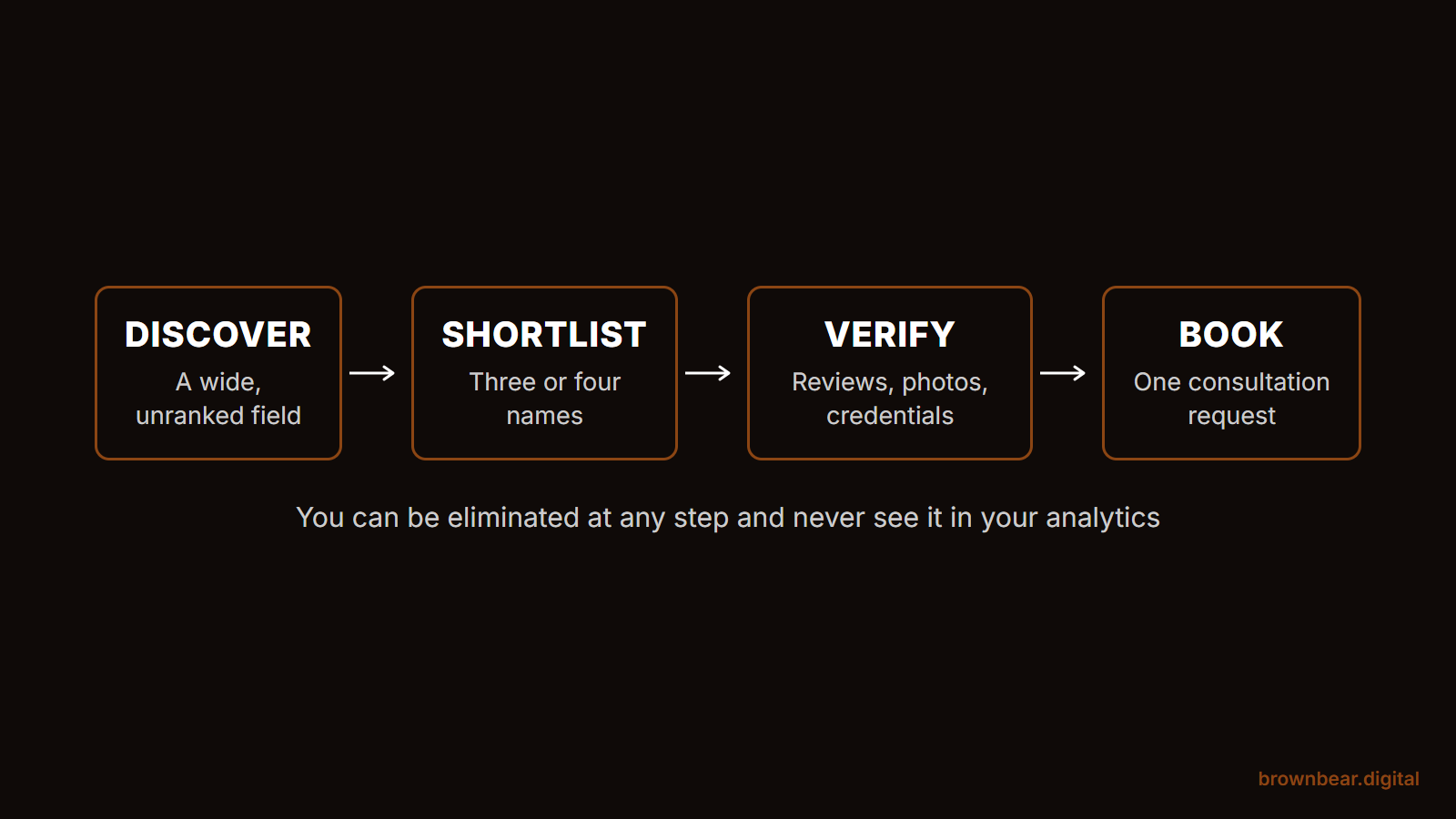
You can watch this convergence play out for your own practice. Walk one composite patient's eight-month journey and see whether she ends up booking with you:
Interactive simulation
Would She Find You? An Eight-Month Patient Journey
Maya is a composite of the research journey this article maps: 31, considering rhinoplasty, eight months from first curiosity to booked consultation. At each stage of her research, answer one question about your practice — and find out whether she books with you or with the competitor who kept showing up. Your answers stay in your browser; nothing is sent anywhere.
| Stage | You | Competitor |
|---|
For informational purposes only; Maya is a fictional composite based on the research patterns described in this article, the competitor is a hypothetical, and the outcome reflects your answers, not a prediction or guarantee. Not professional advice. Your answers stay in this browser and are never transmitted.
What This Means for Your Practice in 2026
The patient journey described above has two implications that most plastic surgery marketing strategies are not built around.
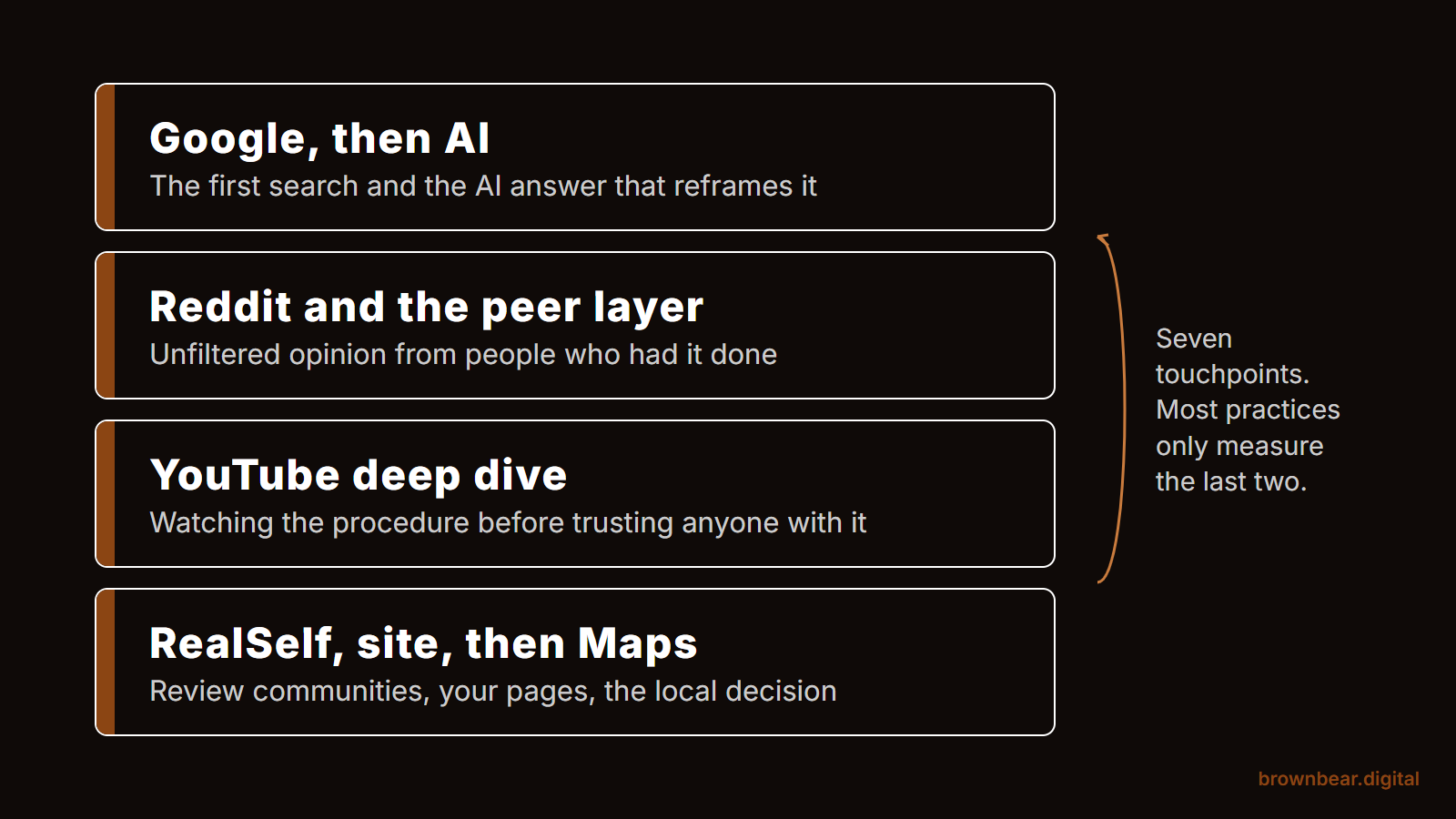
The first: single-channel optimization is not a viable strategy for sustained consultation growth. A practice that ranks on Google but has no YouTube presence, a thin RealSelf profile, and no AI search visibility is winning one stage of a seven-stage journey. The consultations it is losing to competitors are not lost because of better Google rankings. They are lost because a competitor was present at two or three additional stages of the same patient's research, and the patient arrived at the decision point with a stronger established affinity for that practice before either one ever made contact.
The second: the channels that operate at the earlier stages of the journey have long compounding timelines. A YouTube library built over the next 12 months will be earning consultation bookings in three years. An AI search presence established now, before most competitors have begun optimizing for it, creates a visibility advantage that becomes increasingly difficult to displace. The social proof built through consistent patient experience on RealSelf and Google compounds in a way that paid advertising does not.
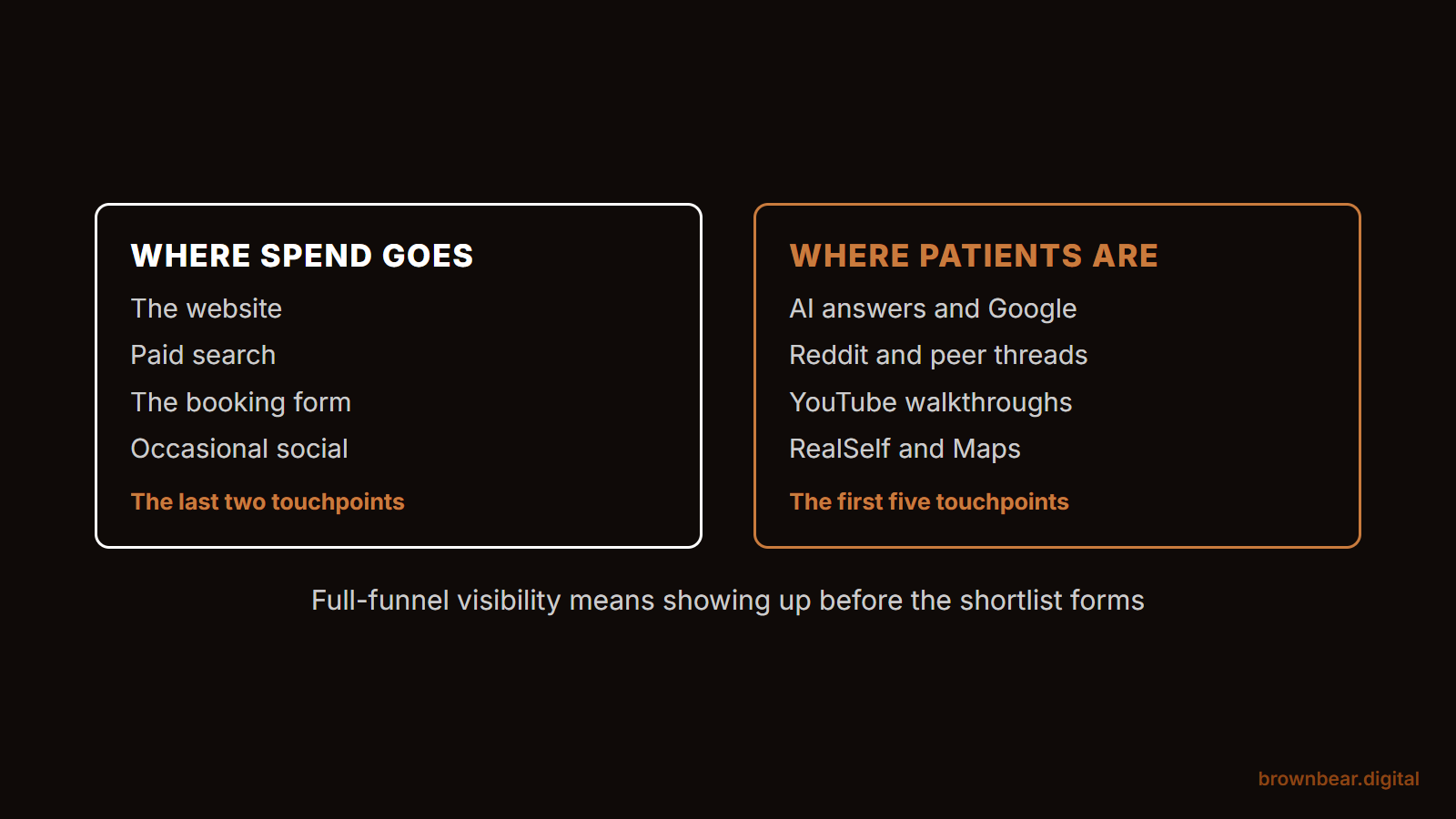
The most common diagnostic pattern I see in plastic surgery practice marketing is bottom-funnel overinvestment. Practices spend heavily on Google Ads, Local Pack optimization, and website conversion testing while investing almost nothing in the stages where patient preferences are actually formed. By the time a prospective patient reaches the bottom of the funnel, her shortlist is already decided. If your practice is not on it, the cost-per-click you are paying to reach her is money spent competing for a position you are unlikely to win.
If you want to use this map to identify where to focus first, here is the sequence that produces the clearest picture of your current gaps with the least effort to get started:
- Audit your Google Business Profile and review recency first: this is the highest-intent touchpoint in the funnel and the fastest to diagnose and improve.
- Assess your RealSelf presence: if your "Worth It" rating is below 90% or your most recent review is more than six months old, this is your second priority.
- Evaluate your website against the patient evaluation sequence: gallery quality, credentials clarity, contact response speed, and mobile experience.
- Map the earlier-stage channels, meaning AI search visibility, YouTube library, and social proof, as a 12-month build, not a quick fix.
That sequence assumes every layer is equally broken. Yours probably isn't, so answer eight questions and get the order re-ranked for your practice:
Interactive diagnostic
Your Personal Priority Order
The four-step sequence above assumes you start from zero. Answer eight quick questions about where your practice actually stands, and this re-ranks the four steps into your order — worst gap first. Your answers stay in your browser; nothing is sent anywhere.
1. When was your most recent Google review posted?
2. Is your Google Business Profile fully built out — categories, photos, services, hours, Q&A?
3. What is your RealSelf “Worth It” rating?
4. When was your most recent RealSelf review?
5. Can a ready-to-book patient reach you same-day — text response, live chat, or online scheduling?
6. Do your gallery and contact form work smoothly on a phone?
7. Do you have a surgeon-led YouTube library (10+ educational videos)?
8. Does your practice appear when AI tools (ChatGPT, Perplexity, AI Overviews) answer procedure questions for your market?
Work the list in this order:
For informational purposes only; the ranking reflects your answers against the framework in this article, not a guarantee of results, and is not professional advice. Your answers stay in this browser and are never transmitted.
The immediate result of working through this sequence is not a consultation spike. It is a clear picture of exactly where your current presence breaks down before a patient decides to contact you, and that clarity is the most actionable thing you can take from this piece.
The practices building consultation pipelines that are resistant to rising ad costs, algorithm changes, and competitive pressure are the ones treating the patient search journey as a map and building presence deliberately at each stage. Not every stage requires equal investment. Not every practice needs to activate every channel at once. But understanding where your patients are in their research, and what they need to find when they get there, is the prerequisite for every other marketing decision you make.
The longer trajectory is worth naming directly. A practice that builds full-funnel presence, showing up for patients at the curiosity stage, the research stage, the trust-verification stage, and the evaluation stage, is not just winning more consultations. It is building the kind of market position where consultation quality improves because patients arrive better prepared, more confident in their choice, and more aligned with the outcomes the surgeon is best at delivering. That patient is easier to serve well, more likely to return for additional procedures, and more likely to refer someone who matches the same profile. The funnel investment compounds in both directions: more volume and better fit.
How Brown Bear Builds Full-Funnel Visibility for Plastic Surgery Practices
Brown Bear works with plastic surgery practices to build search presence across the full patient journey, from AI search and organic rankings through to website conversion and consultation pipeline. If your current strategy is concentrated at the bottom of the funnel while patients are forming preferences at the top, we can help you map the gaps and build the presence that fills them.
Written By
Founder, Brown Bear Digital
Bryan has 15 years of experience across SEO, paid search, and AI search strategy. He founded Brown Bear to give businesses direct access to senior-level search expertise without the agency overhead.
Learn More About BryanReady to Turn Search
Into Revenue?
No pitch decks. Just a real conversation.