Plastic Surgery PPC: Why Most Campaigns Waste Budget on the Wrong Keywords
Most plastic surgery PPC campaigns do not fail for lack of budget. They fail because the keyword list was built for a patient who books today, and a plastic surgery patient almost never does.
We've audited many plastic surgery Google Ads accounts in the past three years. The pattern is consistent: practices spend $3,000 to $8,000 per month targeting keywords that generate clicks but never convert to consultations. The problem isn't click volume. It's that most agencies approach plastic surgery PPC the way they'd approach urgent care or dermatology, as if patients need immediate medical intervention.
They don't. Plastic surgery operates in luxury purchase psychology, and that changes everything about keyword strategy.
When an owner tells us Google Ads didn't work, the account teardown almost always shows the same two problems: a campaign structure that was never tuned for lead quality, and clicks landing on pages that were never built to convert them. Keyword strategy sits underneath both. By keyword strategy we mean both halves of the list: the searches you choose to pay for, and the searches you deliberately block, including the ones Google's AI Max now adds on its own.
If you own the practice and watch the monthly spend climb while the consultation calendar stays flat, this is the diagnosis. If you inherited the account from an agency and are not sure what it is buying, it is the audit checklist. And if you run the campaigns yourself between clinic days, it is the short list of settings worth checking this week.
You will leave knowing which searches deserve the budget, which belong on a negative list, what the September 2026 AI Max upgrade changes, and how to judge every keyword by consultations booked rather than clicks. We start with how patients search, then cover the keywords that waste money and the ones that book, the policy and automation settings that reshape the list, and finally measurement and landing pages. So start where the money leaks first: the gap between how patients search and how most campaigns are built.
Key Takeaways
Plastic surgery PPC fails when it's built like urgent care
Patients research for 8 to 18 months before booking, so campaigns targeting broad procedure keywords pay for research clicks that never convert. Budget belongs on the consultation-intent searches at the end of that journey.
One word lifts conversion from 1.2% to 12.8%
The keyword rhinoplasty converts at 1.2% while rhinoplasty consultation converts at 12.8%. Fewer clicks at a higher cost per click still means significantly more consultations per dollar spent.
Flip the standard budget allocation
Instead of 60% on high-volume procedure terms, put 50% into branded and consultation keywords, 30% into location plus surgeon combinations, and 20% into high-intent procedure variations.
Judge keywords on consultations booked, not clicks
Pause anything with 50+ clicks and zero consultation bookings over 60 days, and give more budget to what books. Most practices never track that final step, so they optimize for activity instead of patients.
AI Max can quietly undo a consultation keyword list
Campaign-level broad match began auto-upgrading to AI Max in September 2026. Check which ad groups have search term matching switched on, keep exact-match copies of your best terms, and keep the negative list current.
How Plastic Surgery Patients Actually Search, and Why Your Keywords Are Wrong
A rhinoplasty patient researches for 8 to 18 months before booking a consultation. They don't search like someone with a broken arm. Our rhinoplasty marketing guide maps that entire research window channel by channel.
Medical emergency search behavior: "urgent care near me" → click → book appointment today.
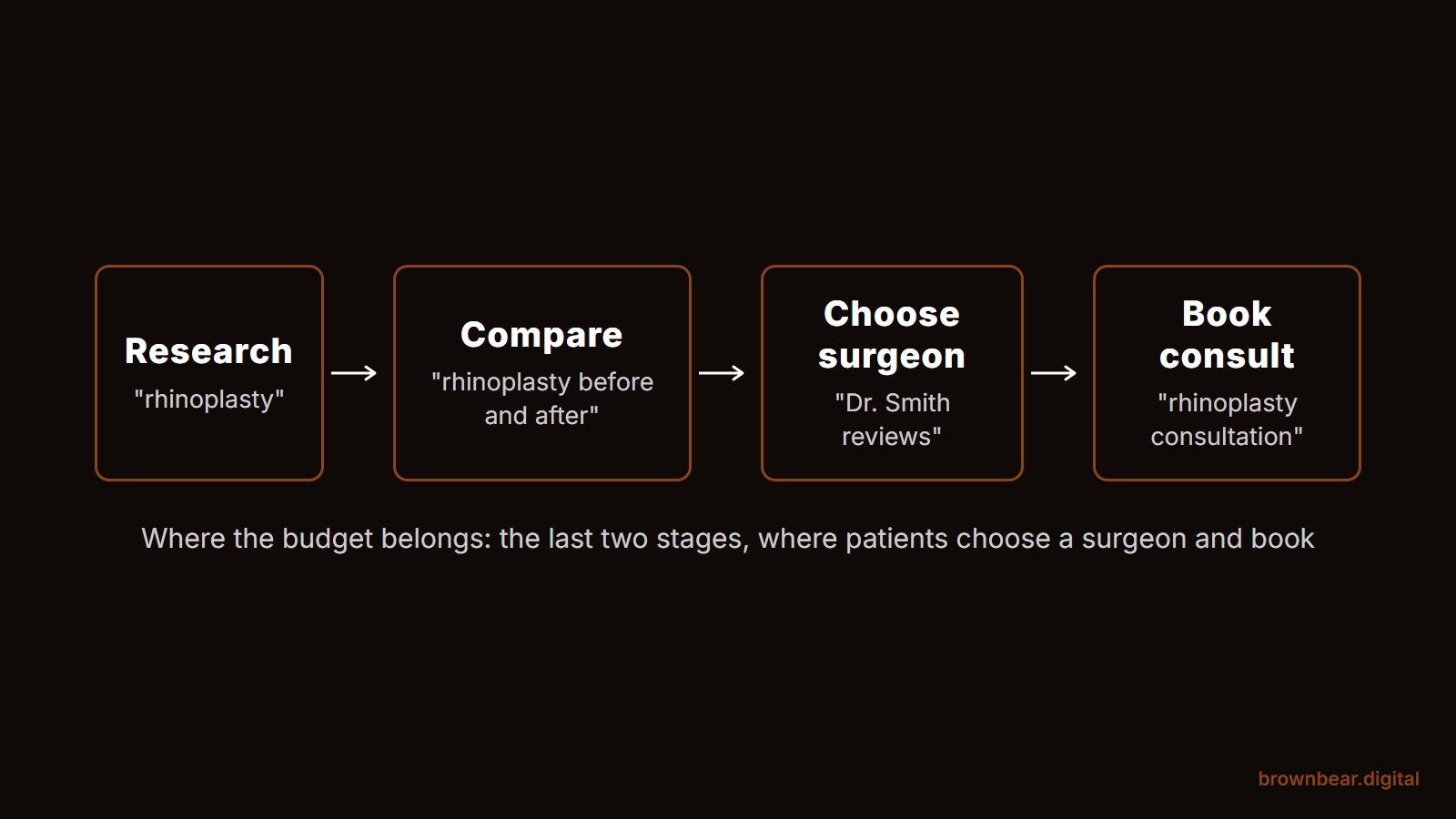
Plastic surgery search behavior: "best rhinoplasty surgeon" → research for weeks → "rhinoplasty before and after" → more research → "Dr. Smith rhinoplasty reviews" → still more research → "rhinoplasty consultation Dr. Smith."
Most agencies target broad, high-volume keywords in the first stage and wonder why their cost per consultation is $800 to $1,200. They're paying for research clicks, not conversion-ready searches.
The consultation request doesn't happen until stage four or five of the research process. That's where your budget should be focused.
There is a second reason those early clicks cost more than they look. Google treats cosmetic surgery as a sensitive health category and does not let practices build remarketing audiences from the people who visit their procedure pages, a rule covered in the policy section below. In most industries a research click is a cheap first touch you follow up later with retargeting. In plastic surgery you mostly cannot follow up, so a research click has to earn its cost on its own, and it rarely does. The full plastic surgery patient search journey shows how many platforms that research spreads across before a patient comes back to Google ready to book.
The Three Keyword Categories That Waste Your Budget
1. Generic procedure keywords.
Keywords like "breast augmentation" or "liposuction" generate impressive click volume and terrible conversion rates. These searchers are in month one of an 8-month process. They'll click your ad, browse your before-and-after gallery, and disappear into 47 other surgeon websites.
We tracked 2,400 clicks from "breast augmentation" keywords across 12 practices last year. Total consultation bookings: 31. Cost per consultation: $1,847. Capturing that early-stage demand is a content job, not a PPC job, and it is exactly what our breast augmentation marketing guide covers.
2. Informational keywords.
"How much does rhinoplasty cost?" "Tummy tuck recovery time?" "Facelift risks": these get clicks because the content is genuinely useful. But searchers want information, not a surgeon. They're not ready to book anything.
These keywords work beautifully for content marketing and SEO. They're budget killers in PPC. That split, organic capturing the research queries while paid captures the decision queries, is the core of our SEM and SEO playbook for plastic surgeons.
3. Competitor + generic combinations.
"Dr. Johnson breast augmentation," when you're not Dr. Johnson. We see this constantly: practices bidding on competitor names paired with procedure terms, hoping to intercept patients.
It doesn't work. Patients searching for a specific surgeon are past the comparison phase. They've chosen. You're paying for clicks from people who've already decided on someone else.
The Keyword Sweet Spot: Consultation-Intent Language
High-converting plastic surgery keywords signal consultation readiness, not information-gathering.
Instead of "rhinoplasty":
Target "rhinoplasty consultation [city]" or "schedule rhinoplasty consultation."
Instead of "breast augmentation surgeon":
Target "breast augmentation consultation near me" or "book breast augmentation consultation."
Instead of "facelift":
Target "facelift surgeon [city]" or "[Dr. Name] facelift consultation."
The difference in conversion rate is dramatic. "Rhinoplasty" converts at 1.2%. "Rhinoplasty consultation" converts at 12.8%.
You'll get fewer clicks. You'll pay more per click. You'll book significantly more consultations per dollar spent.
Load these as phrase and exact match keywords, not broad. Google now lets exact match show on searches with the same meaning as the keyword, and phrase match on searches that include its meaning, so even the tight match types flex a little. Broad match flexes much further, which is why the negative list below and the AI Max section later carry as much weight as the keywords themselves.
Negative Keywords: The Half of the Keyword List Nobody Audits
A consultation-intent keyword list only works if a negative keyword list stands behind it. Every match type Google offers now matches on meaning rather than exact wording, so the searches you block shape your traffic as much as the searches you bid on. A negative list built once at launch and never reopened is how research traffic creeps back into a campaign that was built to avoid it.
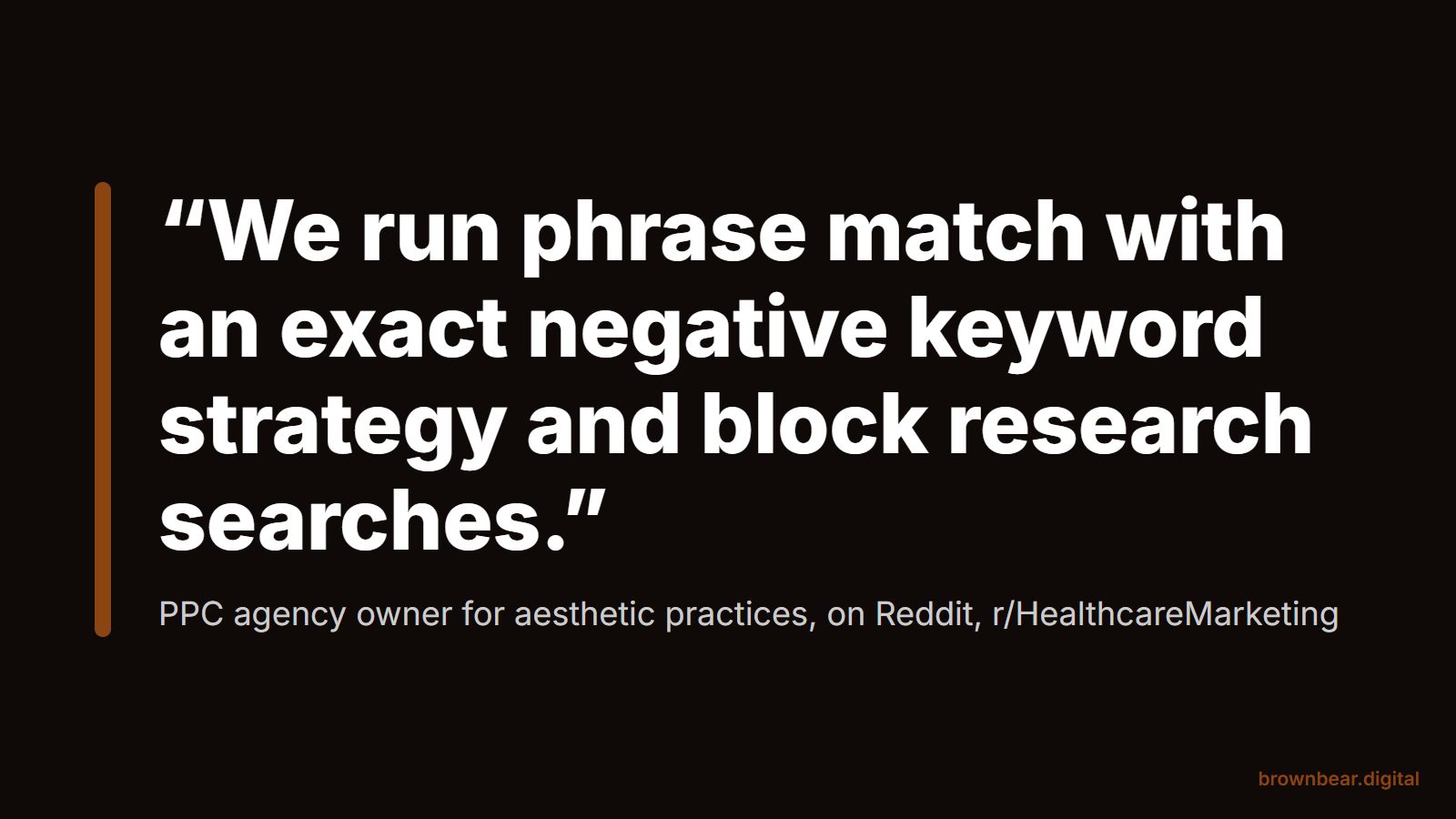
The single most useful move is one that PPC managers who specialize in aesthetic practices describe openly: add the bare procedure name as an exact-match negative. Block [mommy makeover] and [rhinoplasty] as exact negatives while you bid on phrase-match keywords such as "mommy makeover surgeon" and "rhinoplasty consultation." Google can then only match you to the longer, more specific searches, which is where booking intent lives, and the one-word research query that eats budget in month one stops triggering your ad.
Then sort every search term in the report into one of four buckets. We call it the Search Term Triage:
- Book. Consultation, schedule, appointment, near me, or a surgeon's name. Keep these and protect their budget.
- Evaluate. Best, reviews, before and after, results. Keep them at a lower bid and send them to a gallery or surgeon page, not a generic procedure page.
- Research. Cost, recovery, risks, how long, what is. Add them as exact negatives in search campaigns and answer them with content instead.
- Block. Free, cheap, jobs, salary, school, gone wrong, botched. Add the trigger word as a phrase negative across the account.
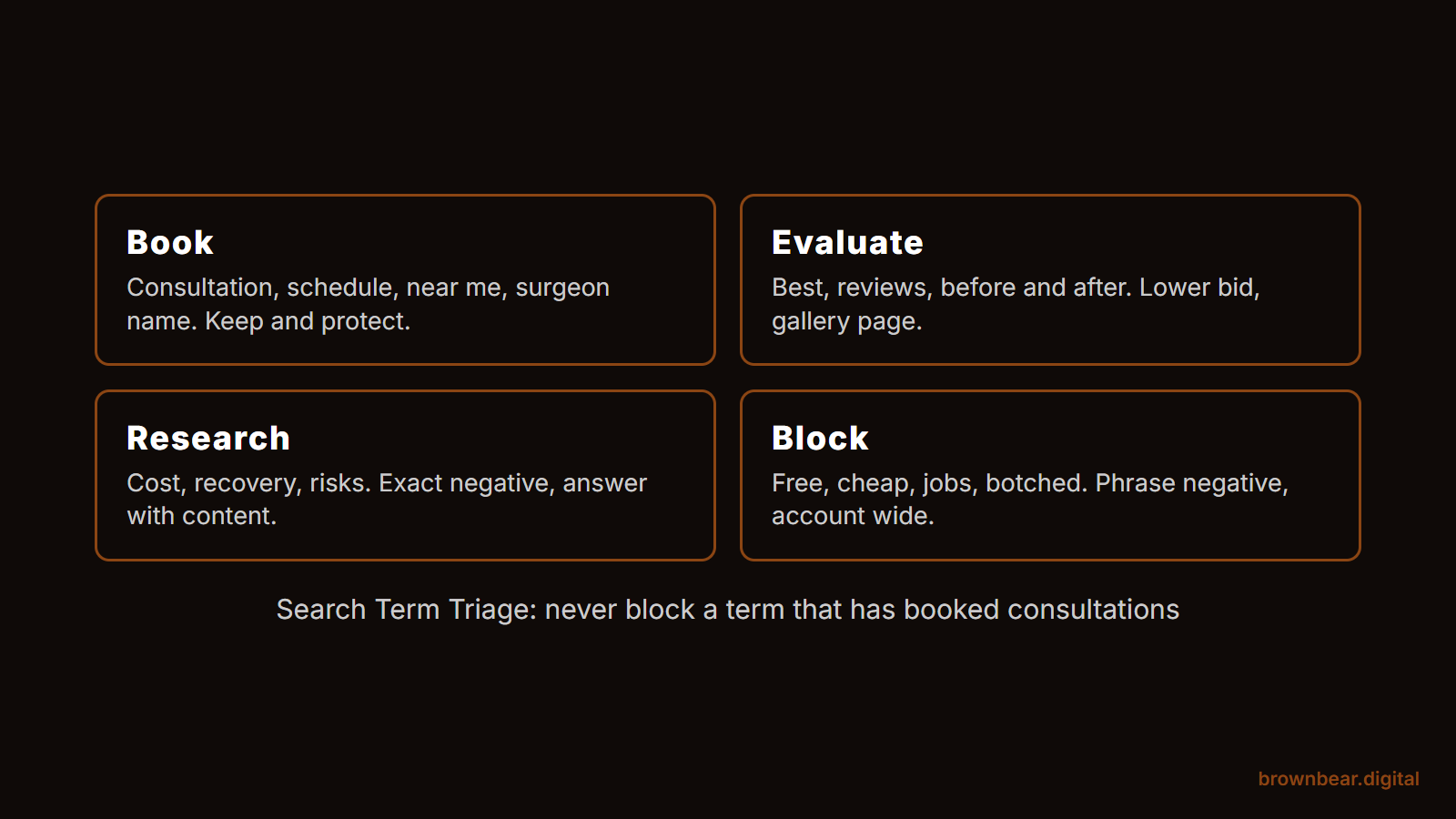
One rule overrides the buckets: never block a search term that has booked consultations, whatever its words suggest. A cost query that keeps producing consults in your market has earned its place on the list.
Picture a practice manager in Tampa reading a month of search terms for a tummy tuck campaign. Most of the spend went to the bare phrase "tummy tuck" and to cost and recovery questions, and none of those clicks booked. She adds [tummy tuck] as an exact negative, blocks the cost and recovery queries, and keeps the phrase keywords that carry a city or the word "surgeon." The next month the campaign buys fewer clicks, and the consultations it books come from the searches she kept. The negative list did the targeting the keyword list could not do alone.
The board below runs the triage for you. Paste your search terms and it sorts them into the four buckets and drafts a starter negative list for you to review before you apply it.
Geographic Modifiers That Actually Work
Most practices target "[procedure] + [city]" and call it local targeting. That's not how plastic surgery patients search.
Plastic surgery draws from wide geographic areas. Patients drive 2 to 3 hours for the right surgeon. A Manhattan plastic surgeon's patients come from Connecticut, New Jersey, and Long Island, the entire tri-state region.
Better geographic targeting: "[procedure] + [region]" rather than specific cities. "Rhinoplasty New York area," "breast augmentation Bay Area," "facelift Dallas Fort Worth."
Even better: affluent suburb combinations. "Rhinoplasty Westchester County," "breast augmentation Marin County," "facelift Plano Frisco." These areas have higher household incomes and patients willing to invest in premium surgical experiences.
The Surgeon Name Strategy Most Practices Get Wrong
Bidding on your own surgeon's name is essential, but most practices target "[Dr. Name] + [procedure]" and miss the real opportunity.
The highest-converting keywords are "[Dr. Name] + consultation" and "[Dr. Name] + reviews." Patients searching these terms are in the final decision phase. They've researched, they've compared, they're ready to book.
We tested this with a Beverly Hills practice. "[Dr. Martinez] rhinoplasty" had a 3.1% conversion rate. "[Dr. Martinez] consultation" converted at 18.7%.
The consultation-focused keywords cost more per click, but at six times the conversion rate they still book far more consultations per dollar spent.
Budget Allocation That Reflects Patient Psychology
Most plastic surgery PPC budgets are allocated like medical emergency campaigns: 60% to high-volume procedure keywords, 30% to local variations, 10% to branded terms.
Flip that allocation:
50% Branded + Consultation Keywords:
Your surgeon name variations, consultation-specific terms, review-seeking searches.
30% Location + Surgeon Combinations:
"Best rhinoplasty surgeon [region]," "[procedure] specialist [affluent area]."
20% High-Intent Procedure Keywords:
Only the specific, consultation-ready variations.
This allocation reflects how patients actually move through the decision process: extensive research leading to surgeon-specific searches and consultation booking.
AI Max and the September 2026 Broad Match Upgrade
In September 2026 Google began automatically upgrading Search campaigns that use the campaign-level broad match setting, along with campaigns using automatically created assets, to AI Max for Search. Dynamic Search Ads follow from February 2027. AI Max matches ads to searches using your keywords, your landing pages and your ad assets, so it can find traffic that no keyword on your list describes. For a consultation-intent strategy that is the risk: the engine deciding which searches you pay for is now built to widen the list you worked to narrow.
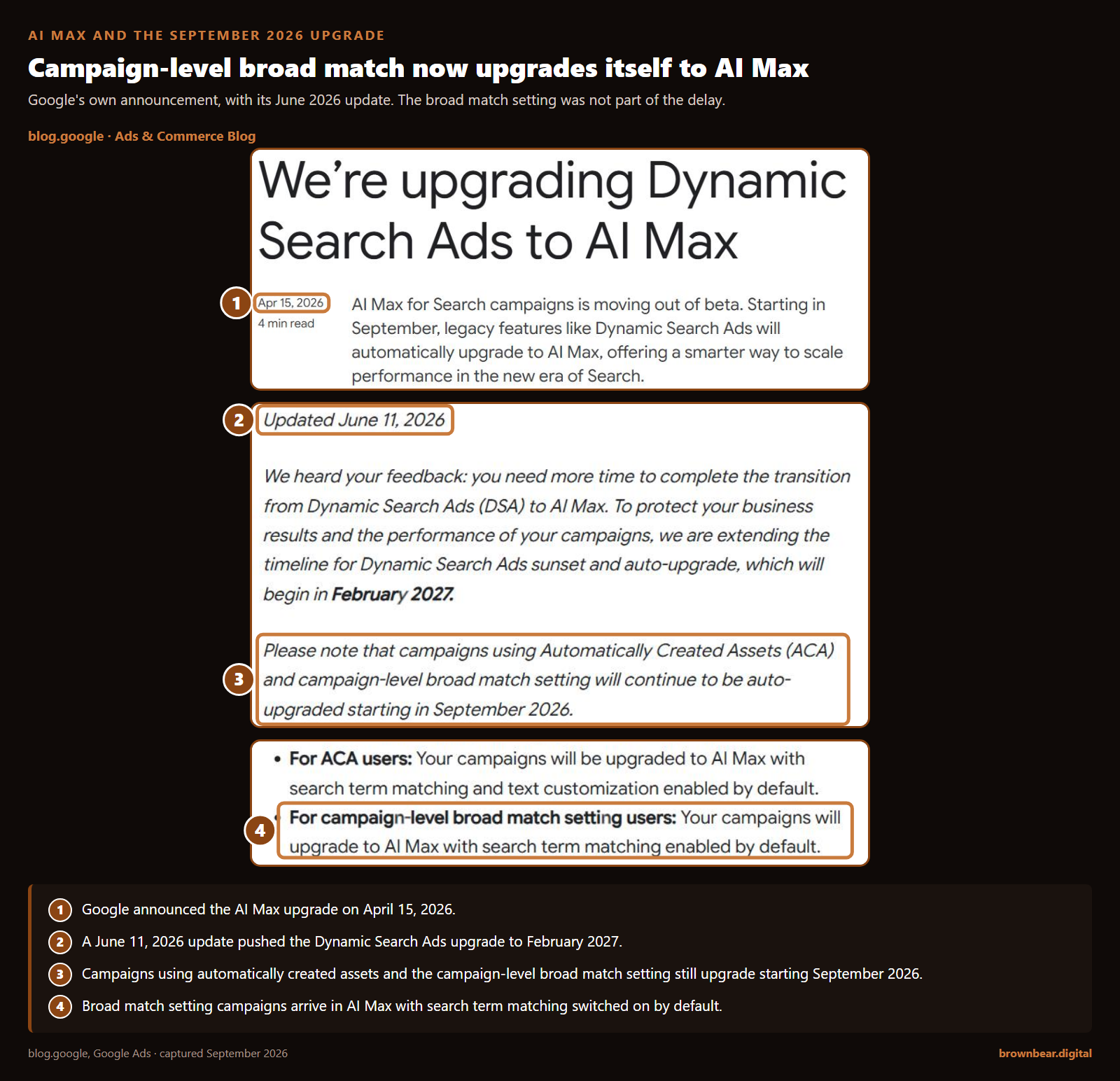
That does not make AI Max wrong for every practice. It makes it a setting to choose on purpose rather than inherit, and the right move depends on how your account was built.
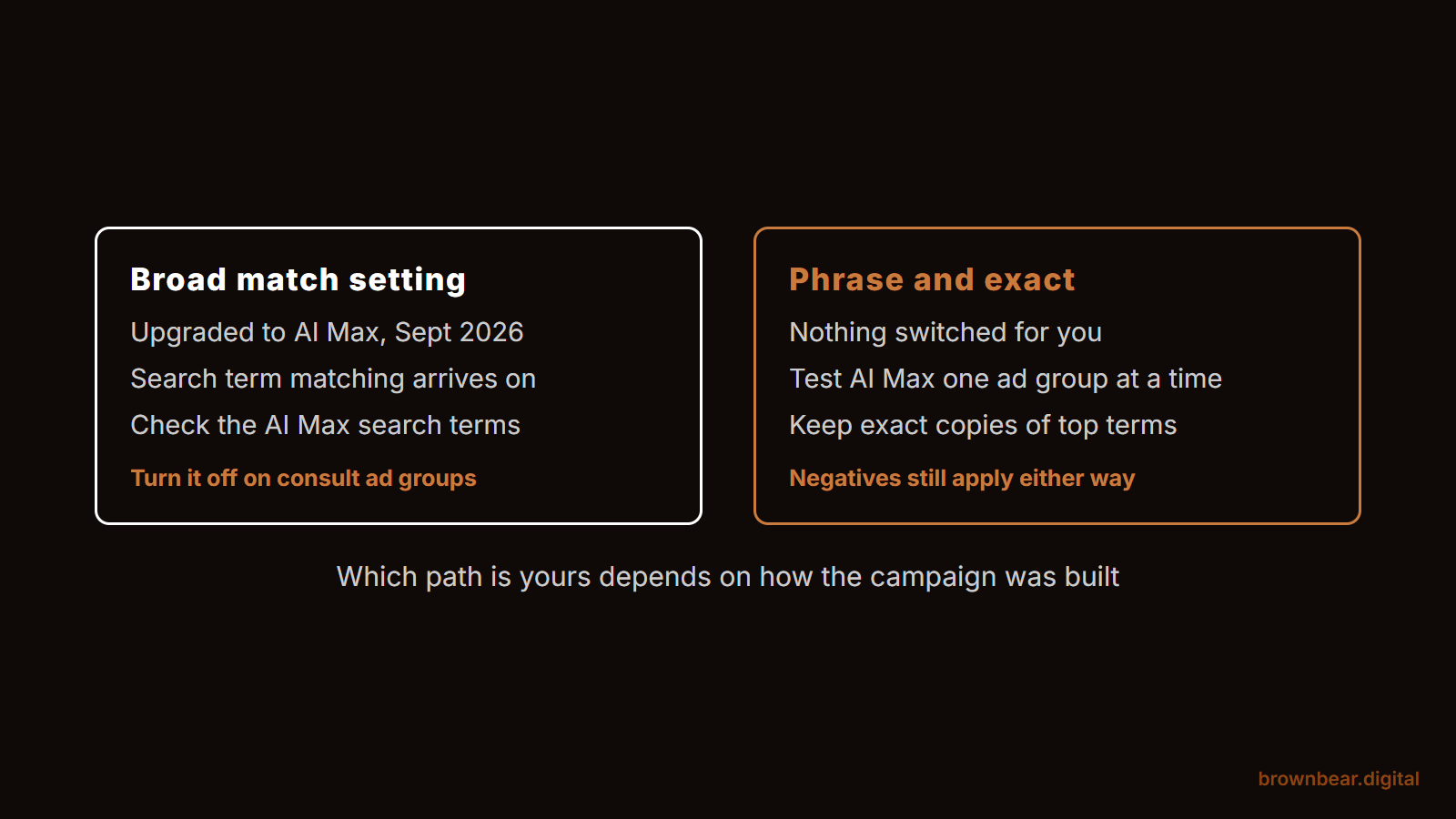
If your campaigns used the campaign-level broad match setting,
they are being upgraded, and search term matching arrives switched on. Open the search terms report, look at the searches carrying the AI Max match type, and check whether they book consultations or look like the research traffic this article warns about. If they look like research traffic, turn search term matching off in the ad groups that carry your consultation keywords, and leave it on only where you are deliberately testing reach.
If your account is already built on phrase and exact match,
nothing was switched for you, and you can keep it that way until you have enough booked-consultation data to test AI Max one ad group at a time. When you do test it, keep exact-match copies of your most important terms: Google notes that broad keywords moved into AI Max are not treated as exact match when it decides which keyword serves.
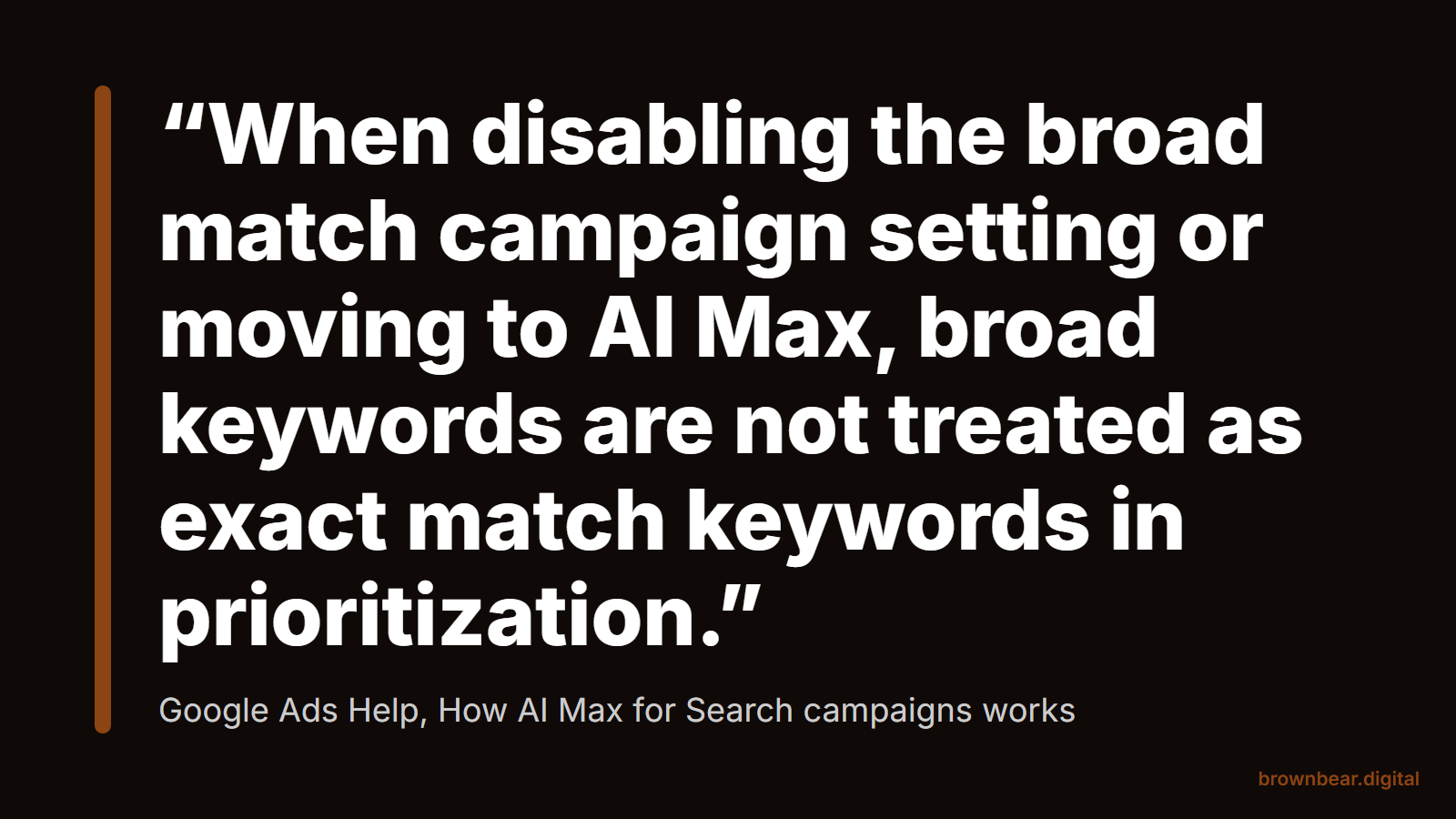
Whichever path you are on, four controls keep AI Max inside the strategy. Negative keywords, which Google says are respected with AI Max on. Brand exclusions at the campaign level, which stop your ads chasing searches for other surgeons and practices. URL exclusions, which keep AI Max from sending a consultation-ready click to a blog post. And the search terms report, which now labels the matches that came from AI Max rather than from your own keywords.
Say you run a two-surgeon practice in Scottsdale and your rhinoplasty campaign used the broad match setting. After the upgrade, final URL expansion picks up your rhinoplasty recovery blog post as a landing page, and the search terms report starts filling with recovery questions matched to it. Those clicks cost what your consultation searches cost and book at the rate of research traffic. Excluding the blog URLs and adding the recovery queries as exact negatives puts the campaign back on the searches it was built for.
The Google Ads Policy Lines That Shape Your Keyword List
Two Google Ads policies change which keywords a plastic surgery practice can and should build, and both are easy to miss until an ad is disapproved.
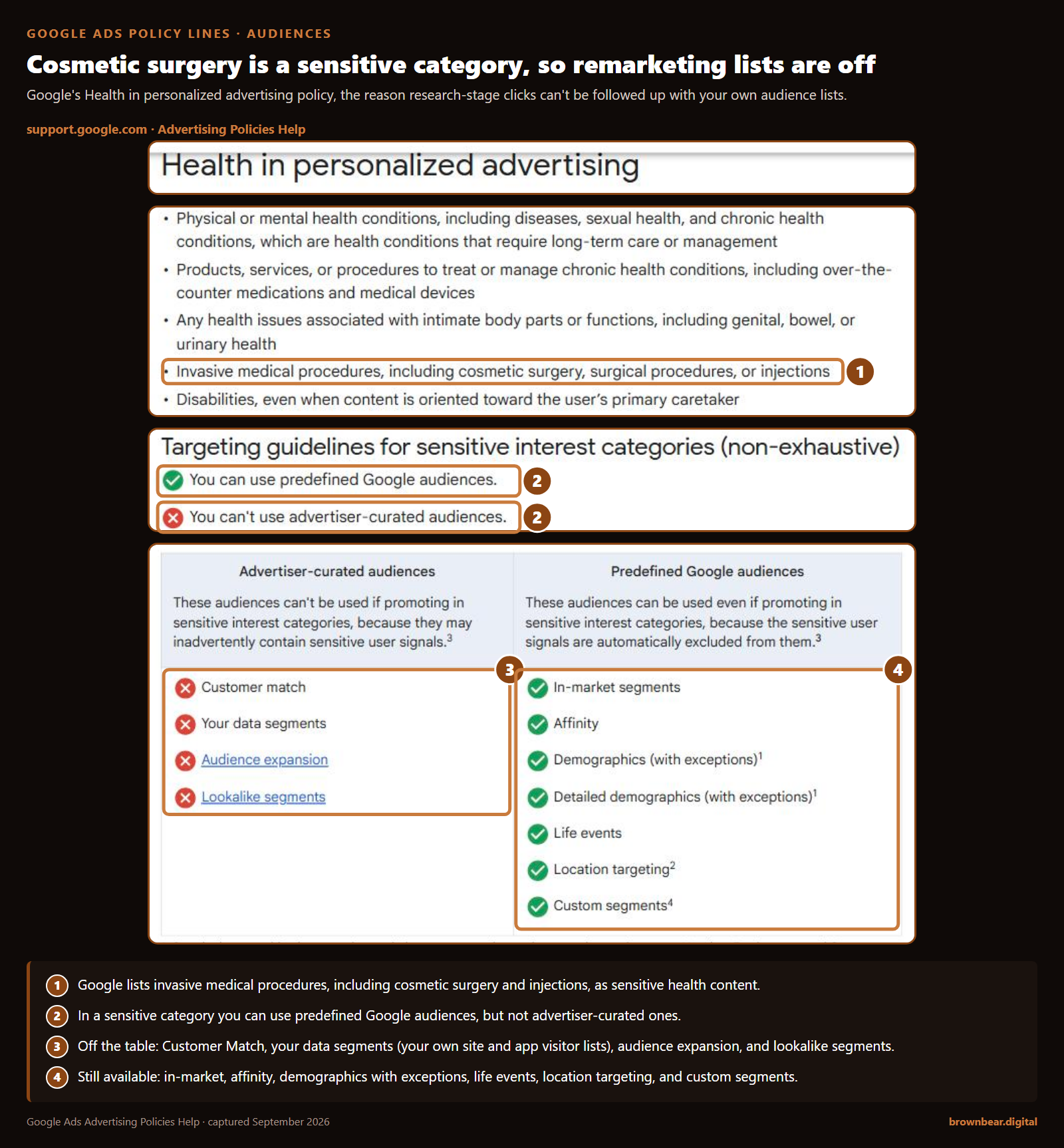
The first is audiences. Google's Health in personalized advertising policy treats invasive medical procedures, including cosmetic surgery and injections, as sensitive. Ads for them cannot use advertiser-curated audiences such as your data segments, Customer Match or lookalikes, while predefined Google audiences, demographics and location targeting remain available. The effect on keywords is the point made earlier: you cannot count on following a research-phase visitor around the web later, so the search itself has to carry the intent you are paying for.
The second is prescription drug terms. In the United States you need Google's healthcare certification to target keywords containing prescription drug terms, and Botox and other botulinum toxin brands are on Google's list. If your practice also offers injectables, keep those keywords in their own campaign, get certified before launch, and keep a disapproval there from stalling the surgical campaigns beside it.
Ad copy and landing pages carry restrictions of their own, which our guide to plastic surgery marketing covers alongside Meta's rules. For keyword strategy, these two are the ones that change what goes on the list.
The Before-and-After Keyword Opportunity
"[Procedure] before after" keywords convert better than broad procedure terms but worse than consultation-specific searches. They sit in the middle of the decision-making journey, where patients are evaluating whether the procedure yields the results they want.
These keywords work well for targeted campaigns that drive traffic to dedicated before-and-after galleries rather than to general procedure pages. The conversion rate from the gallery page to consultation request is 3 to 5x higher than from general procedure pages.
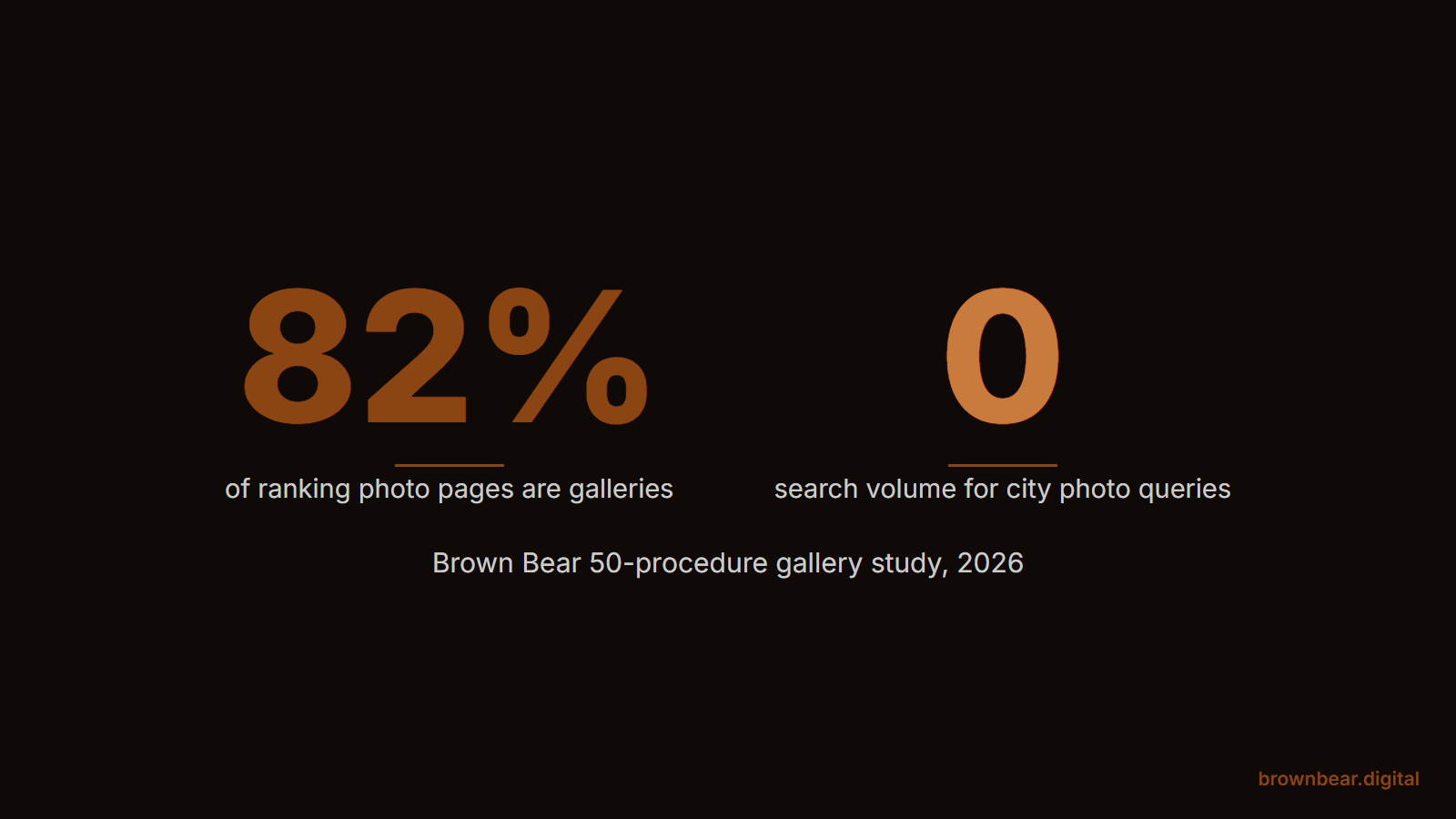
Our 50-procedure before-and-after search study adds a twist for paid search. Organic results for "[procedure] before and after" are a national contest: localized photo searches such as "breast augmentation before and after Miami" have no measurable search volume, and 82% of the practice pages ranking for photo intent are dedicated gallery pages rather than procedure pages. Two things follow for PPC. Do not build city-modified before-and-after keywords, because almost nobody types them; bid on the plain phrase and let location targeting do the local work. And because those organic results are crowded with national galleries and the American Society of Plastic Surgeons, a paid ad is often the most direct way a local practice appears on the search at all. Send that click to a dedicated before-and-after gallery page, never the homepage.
Target "[Dr. Name] [procedure] before and after" for patients specifically researching your surgeon's work.
Mobile vs. Desktop: Different Keyword Intent
Device can still hint at intent. A search for "rhinoplasty consultation near me" on a phone may come from a patient ready to call the office. What has changed is how much you can do about it, and that depends on your bid strategy.
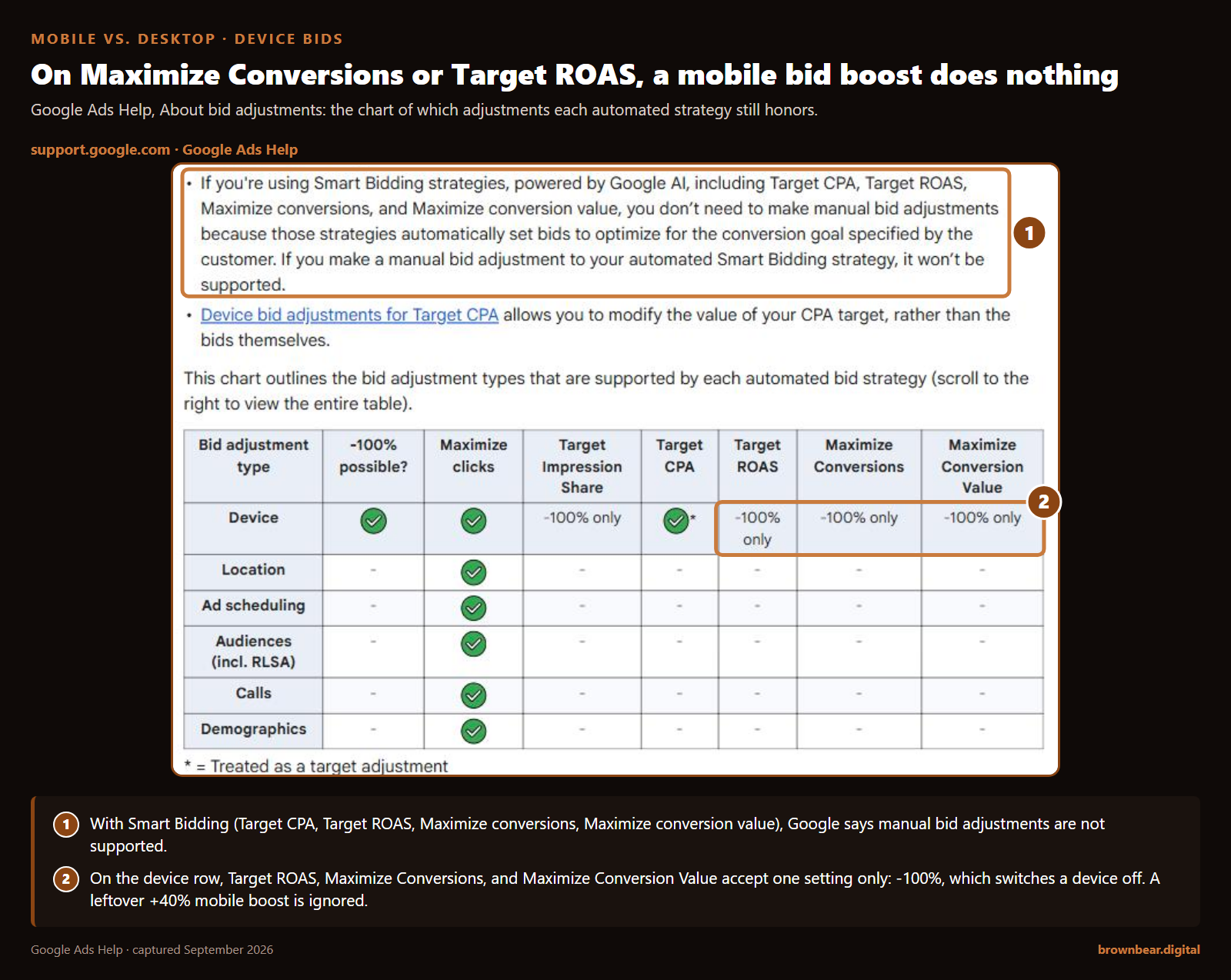
If you use Smart Bidding with Maximize Conversions, Maximize Conversion Value or Target ROAS,
Google applies only one device adjustment: minus 100%, which switches a device off. Fine-tuned mobile boosts are ignored, because the bidding algorithm already weighs device in every auction. Under Target CPA, a device adjustment changes the CPA target for that device rather than the bid. Either way, the lever that matters is conversion data: import booked consultations, and the algorithm learns which device books.
If you still bid manually,
device adjustments work as they always have, so check your consultation rate by device before you move a dollar. Raise bids where consultations actually come from, not where you assume they do.
Imagine a solo surgeon whose previous agency left a plus 40% mobile adjustment on a campaign that has since moved to Maximize Conversions. The setting still shows in the account, so everyone assumes mobile is being favored. It is not; under that strategy the adjustment does nothing. The consultation rate by device, not the leftover setting, tells her where the budget is working.
Whichever applies to you, a device setting will not rescue a broad keyword. A one-word procedure search is research traffic on a phone and on a laptop alike.
How to Audit Your Current Keyword Performance
Pull your search terms report and segment by conversion type: clicks to website visits, website visits to consultation form completions, form completions to actual consultations booked.
Most practices track clicks and maybe form submissions. They don't track the final step: consultation bookings. Without that data, you're optimizing for activity that doesn't generate patients.
Closing that gap is a setup job, not a reporting one. Google Ads can take outcomes back from your CRM through offline conversion import or enhanced conversions for leads: capture the click ID with each form fill or call, mark the lead as a booked consultation when the front desk books it, and send that event back to Google Ads as a conversion. Once booked consultations are what Google optimizes toward, every automated bidding decision starts pointing at consultations instead of form fills.
Do that work with compliance in the room. The HHS guidance on online tracking technologies explains when tracking on a healthcare site can involve protected health information. A federal court vacated one part of that guidance in 2024, the part about unauthenticated public web pages, but the rest still stands, and a booked-consultation record tied to a person is exactly the kind of data to route through a HIPAA-compliant setup. Our guide to HIPAA limits on medical marketing analytics walks through the options.
If your CRM already captures the click ID,
importing consultations is a configuration job measured in hours. If it does not, start with the manual version: export the search terms report monthly, match booked consultations to their source keyword by hand, and apply the rules below until the import is built.
Keywords generating 50+ clicks with zero consultation bookings over 60 days should be paused or moved to much lower bids. Keywords generating 10+ clicks with 2+ consultation bookings should get increased budget allocation.
Since the September 2026 upgrade, add one more column to the audit: the AI Max match type in the search terms report, so you can see whether expanded matches book at the rate of your own keywords. The checker below applies the pause and scale rules to your numbers.
The goal isn't more clicks or a lower cost per click. It's more consultations per dollar spent.
Beyond Keywords: The Landing Page Problem
Even perfect keywords fail if they drive to generic procedure pages. Consultation-ready searchers need consultation-focused landing pages.
Instead of landing on a "rhinoplasty information" page, they should land on a "schedule your rhinoplasty consultation with Dr. Smith" page. The page should make booking the next step, not learning more about the procedure.
We A/B tested this with a Dallas practice. The information-focused landing page converted consultation-ready searches at 6.2%. The consultation-focused landing page converted the same searches at 19.4%.
The consultation-ready searcher doesn't need procedure education. They need a surgeon's confidence and easy booking. If the landing page is where your campaigns leak, the most common plastic surgery website conversion failures are the place to start.
When to Expand vs. When to Focus
Once your consultation-ready keywords are performing, at a 10%+ conversion rate and cost per consultation under $600, consider expanding to broader research-phase keywords.
But fund the expansion with additional budget, not budget reallocation. Don't sacrifice high-converting keywords to chase higher click volume from low-converting searches.
The research-phase keywords support long-term brand building and capture patients at the early decision stage. They just don't belong in the same campaigns or budget allocations as consultation-ready terms.
Most practices try to do both simultaneously with insufficient budget for either approach to work effectively. Choose consultation-ready optimization first, then expand into research-phase support.
The Return on Keyword Strategy
A consultation-focused keyword strategy typically reduces total clicks by 40 to 60% while increasing consultation bookings by 100 to 200%.
For a practice spending $4,000/month generating 18 consultations, shifting to consultation-ready keywords often produces 32 to 40 consultations for the same budget.
The cost per consultation drops. Patient quality improves, because consultation-ready searchers have higher surgery conversion rates than research-phase clicks that eventually book consultations.
Your PPC budget becomes predictable patient generation rather than expensive website traffic.
Most plastic surgery practices have the budget to acquire patients through PPC. They're just targeting keywords for a different purchase psychology than plastic surgery represents. Once the keyword strategy aligns with the patient journey, PPC becomes the most reliable patient acquisition channel for the practice.
References
-
Brown Bear Digital. (2025). Plastic surgery PPC keyword performance data across client accounts, 2022 to 2025. Internal research.
-
Google. (2026). Health in personalized advertising. Advertising Policies Help. https://support.google.com/adspolicy/answer/16701855
-
Google. (2026). Google's Dynamic Search Ads are upgrading to AI Max. The Keyword. https://blog.google/products/ads-commerce/dsa-upgrade-to-ai-max-2026/
-
Google. (2026). How AI Max for Search campaigns works. Google Ads Help. https://support.google.com/google-ads/answer/15910187
-
Google. (2026). About bid adjustments. Google Ads Help. https://support.google.com/google-ads/answer/2732132
-
Google. (2026). Restricted drug terms. Advertising Policies Help. https://support.google.com/adspolicy/answer/15595717
-
Google. (2026). About offline conversion imports. Google Ads Help. https://support.google.com/google-ads/answer/2998031
-
U.S. Department of Health and Human Services. (2024). Use of Online Tracking Technologies by HIPAA Covered Entities and Business Associates. https://www.hhs.gov/hipaa/for-professionals/privacy/guidance/hipaa-online-tracking/index.html
-
Brown Bear Digital. (2026). What Ranks for Before-and-After Searches? A 50-Procedure Gallery Study. https://brownbear.digital/data/before-after-gallery-ranking-factors-2026
Related reading: Plastic Surgery KPIs: What to Actually Measure · Plastic Surgery Marketing Strategies in 2026 · How Plastic Surgery Practices Fill Their Consultation Calendar
Ready for Brown Bear to Fix Your PPC?
If your current campaigns are optimized for research-phase clicks instead of consultation-ready searches, you're leaving the most valuable patients on the table. Brown Bear Digital restructures plastic surgery paid search around the patient journey that actually exists, building keyword strategy, landing pages, and budget allocation around the signals that book consultations, not just generate traffic. Our paid search services are built around this keyword framework, and conversion rate optimization handles the landing page side. See how it all fits into the broader picture at our plastic surgery marketing page. Book a consultation and we'll audit your current keyword mix and show you exactly where the budget is going to waste.
Written By
Founder, Brown Bear Digital
Bryan has 15 years of experience across SEO, paid search, and AI search strategy. He founded Brown Bear to give businesses direct access to senior-level search expertise without the agency overhead.
Learn More About BryanGet Found on Google.
Get Cited by AI.
Tell us about your site. We'll send back a proposal for SEO and AI search.