7 Reasons Your Plastic Surgery Website Isn't Converting Visitors Into Consultations
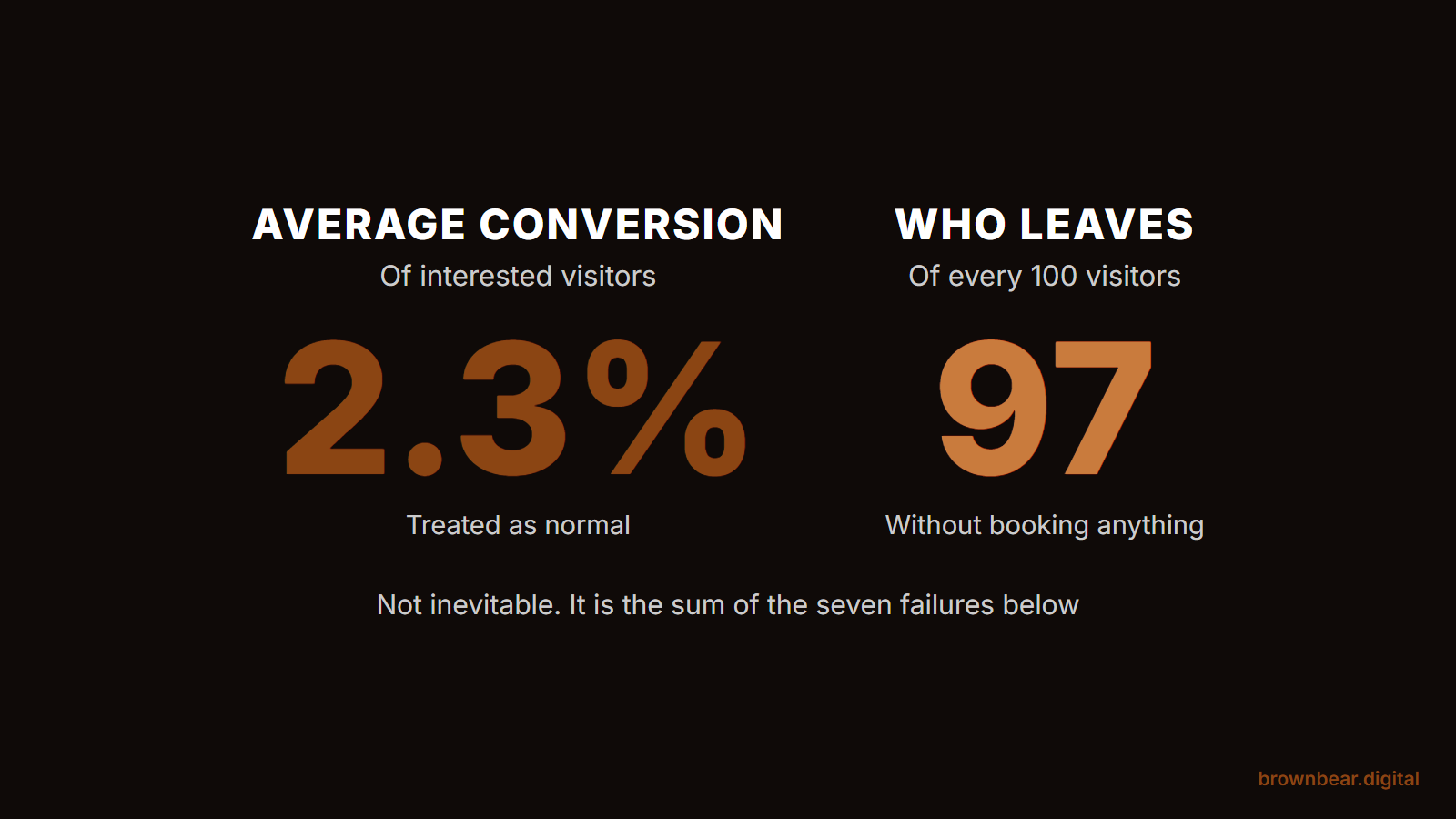
A 2.3% average conversion rate means that 97 out of every 100 people who find a plastic surgery website and show genuine interest leave without booking a consultation. That number is not inevitable. It is the result of specific, identifiable failures, and most of them have nothing to do with your surgical results.
After reviewing plastic surgery websites across different markets, specialties, and price points, the patterns are consistent enough to name. The same conversion failures appear in practices that are doing everything else right: spending on paid search, producing real results, and still watching potential patients leave without reaching out.
Robert Cialdini, psychologist and author of Influence, spent decades mapping the mechanisms that determine whether people take action or walk away in high-stakes decisions. His research on authority, social proof, and the fear of commitment explains what is happening on the other side of your screen. The patient who visited your site and did not reach out was not indifferent. They were looking for reasons to trust, and your website gave them reasons to hesitate instead.
This piece covers both the design-level signals that lose a patient in the first 50 milliseconds and the deeper content and conversion failures that lose patients who have already spent real time on your site.
If you are a surgeon who has been running ads and watching the traffic numbers climb while the consultation calendar stays flat, this is the diagnosis. Maybe you are the practice manager who knows the site needs work but cannot articulate exactly why to the surgeon. Or you built your website a few years ago and it still looks fine to you, which is exactly the problem.
By the end of this article, you will know precisely where your consultations are going and what to do about each leak. Fix these seven issues and your website stops being a digital placeholder and starts working the way it should: as the first touch of a consultation that has not been booked yet.
We will cover outdated design and first impressions, before-and-after gallery quality and the video gap most practices are missing, credentials placement, testimonial authenticity, form friction, procedure page psychology, and mobile performance.
So let's start with the issue that does the most damage fastest, and the one that is most often invisible to the person running the practice.
Key Takeaways
Patients use your website to predict your surgical work
A prospective patient can't evaluate your technique directly, so they evaluate proxies, and your website is the most visible one. The patient who didn't reach out wasn't indifferent. They were looking for reasons to trust and found reasons to hesitate.
97 of every 100 interested visitors leave without booking
A 2.3% average conversion rate is not inevitable. It is the result of seven specific, identifiable failures, and most of them have nothing to do with your surgical results.
Cut your consultation form to three fields
Name, email, and procedure of interest is all the highest-converting forms ask for. Every extra field drains decision-making energy, and no-obligation language next to the submit button directly addresses the fear that prevents submission.
Before-and-after video is the upgrade almost no competitor has made
A 360-degree video gives patients a more honest, dimensional view of their potential outcome than any flat image. The first practice in a market to do it well earns a conversion advantage that compounds.
1. Your Website Looks Like It Was Built When You Graduated Medical School
Humans form visual judgments in approximately 50 milliseconds. That's less than the time it takes to consciously register what you're looking at. In that fraction of a second, a plastic surgery prospect has already processed a signal about your competence, your attention to detail, and whether they can trust you with their face or body.
This is a cognitive phenomenon called processing fluency. When a website is visually clean, well-organized, and clearly modern, the brain processes it easily. That ease gets attributed, unconsciously, to the source: the practice feels credible, professional, and capable. When a site is cluttered, uses outdated fonts, shows pixelated stock photography from a decade ago, or has a color palette that belongs on a 2008 page, the brain works harder to extract information. That friction gets attributed to the source too. The surgeon feels less trustworthy. The practice feels like it doesn't pay attention to detail.
For someone considering an irreversible, high-cost procedure, this matters more than it does in almost any other purchase category. The brain, under that level of stakes, amplifies every negative signal. According to the American Society of Plastic Surgeons, the majority of patients spend weeks researching before they reach out to a single practice. Every visit to a competitor with a modern, well-designed site compounds the negative impression your outdated one leaves behind.
The design-as-skill-proxy effect is particularly acute in plastic surgery. A patient who has never seen the inside of an OR cannot evaluate your surgical technique directly. They evaluate proxies. Your website is the most visible one available. If you're a practice manager who has been trying to make the redesign case internally, this is the data point that tends to land: the patient never gets to see the work. They see the website first, and they are using it to predict the work.
Bryan Passanisi, founder of Brown Bear Digital, has seen this pattern across enough practices to know it is not a coincidence. "Sites built in 2015 or even as recently as 2020 just don't match what patients expect today," he says. "The dated design signals lower quality, and that perception bleeds directly into conversion. If the website feels like an afterthought, patients quietly assume the practice might be too. A plastic surgery website is not a digital brochure. It is a selling vehicle."
For a granular look at the specific homepage elements that move patients from browsing to booking, our guide to plastic surgeon homepage best practices covers all 11 in order of conversion impact.
What to do:
- Conduct an honest visual audit. Open your website on mobile and on desktop and ask one question: does this look like it was designed in the last two years? If the answer is no, it needs a rebuild, not a refresh.
- Benchmark against the top three practices in your market. Screenshot their homepages side by side with yours. The gap is almost always obvious immediately.
- Eliminate any stock photography that shows generic faces or generic clinical settings. Nothing on your site should look like it was pulled from a subscription image library.
- Work with a designer who specializes in medical aesthetics, not a generalist who also does restaurant menus and law firm sites.
2. Your Before-and-After Gallery Is Doing More Harm Than Good
Before-and-after photos are the single most powerful conversion tool on a plastic surgery website. They are also one of the most common reasons practices lose consultations they should be winning.
Here's the psychology. When a prospective patient looks at a before-and-after gallery, they are not passively admiring results. They are running a complex cognitive process. They're scanning for a patient who looks like them: similar body type, similar age, similar starting point. When they find that match, they mentally superimpose themselves onto the "before" image and project forward to imagine their own potential result. This mental simulation is social proof operating at its most powerful. The reader is literally simulating their own future in real time. Poor quality photos break this process entirely.
Inconsistent lighting between the before and after, darker in the before and brighter in the after, reads as manipulation even when the results are completely authentic. Low resolution makes fine details impossible to evaluate. Mismatched angles between shots force the brain to work to reconcile them, and that cognitive effort registers as skepticism. Patients have become acutely aware that before-and-after photos can be manipulated. According to the American Society of Plastic Surgeons, patients increasingly scrutinize gallery photography for red flags including lighting inconsistencies, blurred skin in after photos, and single-source lighting that flatters the result while obscuring the starting point.
There's a second problem that almost no practices address: diversity of representation. If your gallery shows twelve patients who all fit a narrow demographic, every patient who doesn't see themselves reflected in your work subconsciously concludes that this surgeon doesn't operate on people who look like them. That's a lost consultation you'll never know about, from someone who spent fifteen minutes on your site and left because they couldn't find their own reflection in your results.
"The before-and-after gallery is one of the most consistently overlooked assets on a plastic surgery website," says Passanisi. "Prospective patients don't browse it passively. They study it. They're comparing results, looking for someone who looks like them, and deciding whether they trust this surgeon with their face or body. It is one of the biggest deciding factors in the entire consumer journey, yet the photos are too often low-resolution, poorly lit, or inconsistent across cases."
The bigger missed opportunity, Passanisi argues, is video. "Most surgeons aren't doing it," he says. "A 360-degree video of a before-and-after gives patients a far more honest, dimensional view of what their own outcome could look like. It builds confidence in a way a flat image simply can't." It is also a gap that the vast majority of competing practices have yet to address, which means the first practice in a market to do it well earns a conversion advantage that compounds over time.
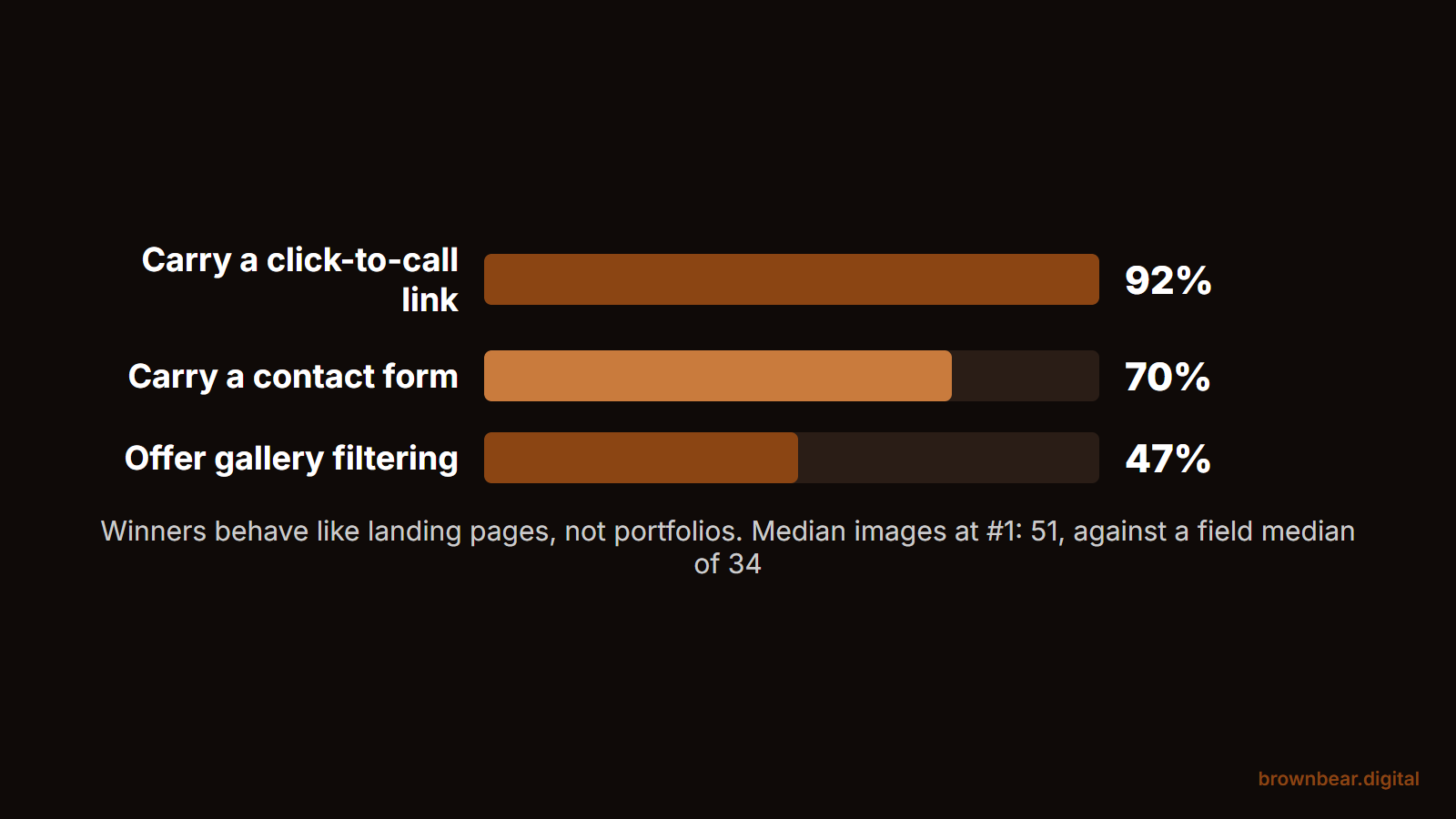
We cover the full gallery strategy, including how to structure, photograph, and organize cases for maximum conversion impact, in our guide to before-and-after gallery best practices for plastic surgeons. For the competitive picture, our 50-procedure study of what ranks for before-and-after searches dissected 418 ranking pages and found the winners behaving like landing pages rather than portfolios: #1 galleries run a median of 51 images against the field's 34, 47% offer filtering, 92% carry a click-to-call link, and 70% carry a contact form.
What to do:
- Hire a medical photographer with medical aesthetics experience. Standardize to two-source illumination, consistent patient positioning, and identical backgrounds across every case. Remove any existing photo where you cannot confirm lighting consistency and angle match.
- Photograph every procedure you want to be known for. A gallery heavy in rhinoplasties but light in breast augmentations signals that augmentation is not a priority, regardless of whether that's true.
- Diversify your gallery deliberately across age range, body type, skin tone, and gender. The more patients who see someone who resembles them, the more mental simulations you're enabling.
- Add video. A 360-degree before-and-after video walkthrough is the single highest-impact upgrade most practices aren't making. Start with your most-requested procedure and film it properly. Most of your competitors haven't done this yet.
3. Your Board Certification Is Buried Three Clicks Deep
Plastic surgery carries more risk, more cost, and more irreversibility than almost any other elective healthcare decision. When people face decisions with those characteristics, they become hypervigilant to authority signals. This is a documented psychological response to high-stakes uncertainty: humans defer to perceived expertise because it reduces the cognitive burden of a frightening decision.
Board certification from the American Board of Plastic Surgery is the clearest credential signal in your field. It means you completed a residency in plastic surgery, passed written and oral examinations, and are held to standards of ongoing education and ethics. It is objectively meaningful. But most plastic surgery websites display that credential in an "About" section that 60 to 70 percent of first-time visitors never reach before leaving.
There's a second problem that fewer practices address and almost none turn into an advantage. Most prospective patients genuinely do not know the difference between a plastic surgeon and a cosmetic surgeon. Cosmetic surgery is not a recognized medical specialty. Any licensed physician can legally call themselves a cosmetic surgeon regardless of their training background. The distinction matters enormously for patient safety, and patients who learn about it on your website, written clearly and without condescension, are dramatically more likely to book with you. You've simultaneously demonstrated expertise and answered a question they were afraid to ask. That combination converts.
If you're a growing practice trying to compete against larger, more established groups, this is one of the most accessible differentiation moves available. You don't need a bigger ad budget to educate patients on something your competitors assume they already know.
Your About page is where credentials get their full context, and most practices dramatically underinvest in it. Our breakdown of what a plastic surgeon About page actually needs covers the trust architecture that turns a résumé into a reason to book.
What to do:
- Place your ABPS certification and relevant society memberships (ASPS, The Aesthetic Society) in your site header or above the fold on your homepage, not in an "About" tab a visitor might never reach.
- Add a brief "Why Board Certification Matters" section to your homepage or a dedicated credentials page, written in plain language for patients who don't know the difference between board-certified plastic surgeons and other practitioners.
- Write a surgeon biography that reads like a story, not a curriculum vitae. Where did you train, why did you choose plastic surgery, what do you find most meaningful about this work? Specificity builds trust faster than a list of hospital affiliations.
- If you specialize in specific procedures, name those procedures in your credential display. "Board-certified plastic surgeon specializing in rhinoplasty and facial rejuvenation" converts faster than the generic credential alone.
4. Your Testimonials Fail the Authenticity Test Every Visitor Is Running
Your prospective patients are running a background fraud check on your testimonials. They may not consciously know that's what they're doing, but they are. This is what psychologists call diagnostic signaling: people in high-uncertainty situations look for specific, unusual details as evidence of authenticity, because they know that fake or exaggerated praise tends to be generic.
Consider two testimonials side by side.
"Dr. Smith is incredible. Best surgeon ever. I'm so happy with my results. Highly recommend."
"I had already consulted with two other surgeons and walked away from both of them. What changed for me was that Dr. Smith spent the first 40 minutes of our consultation just listening to what I didn't want before she ever talked about what she could do. The recovery was harder than I expected. Weeks two and three were rough. But eight months out, I've stopped thinking about my nose. I just go about my life. That's what I wanted."
The first testimonial moves no one. The second one converts. It contains specific, idiosyncratic details that no marketing team would write: the two prior consultations, the listening before the recommending, the harder-than-expected recovery, the outcome described not as "amazing results" but as "I stopped thinking about it." Those details are signals of truth. The reader's brain, trained by years of evaluating content for authenticity, responds to them with trust.
Format matters as much as content. Static five-star quotes from unnamed sources with stock-photo headshots don't do the same work as verified Google reviews with real names, video testimonials, and documented case histories on platforms like RealSelf. Eighty-four percent of patients check online reviews before choosing a healthcare provider. If someone has written a genuine two-paragraph Google review, that single entry is worth more for your conversion rate than twenty manufactured quotes on your homepage.
Video testimonials are in a category of their own. Reading a positive statement activates the reasoning mind. Watching someone describe their emotional journey through surgery, including the fear, the recovery, and the moment they knew it was worth it, activates the part of the brain that simulates other people's experiences. A prospective patient watching that video is not processing information. They are living through someone else's story. If that story ends where they want to be, the impulse to book a consultation follows naturally.
For the complete approach to generating reviews without FTC or HIPAA risk and turning them into a ranking asset, our guide to plastic surgery review generation and response covers the full strategy.
What to do:
- Send post-op patients a follow-up email at the three-month mark, when results are typically visible and satisfaction is highest, with a direct link to your Google review page and a one-sentence ask.
- Record video testimonials. Ask patients to describe their fear before the procedure, what the decision process was like, and how they feel now. Do not script it. The imperfections in unscripted video are the authenticity signals.
- Remove generic testimonials from your website. If a quote could have been written about any surgeon anywhere, it is actively hurting your credibility by suggesting that's the best your patients have to say.
- Respond to every review, positive and critical. A practice that engages thoughtfully with negative feedback signals far more confidence and competence than one that only displays five-star praise.
5. Getting to Your Contact Form Feels Like Filling Out a Loan Application
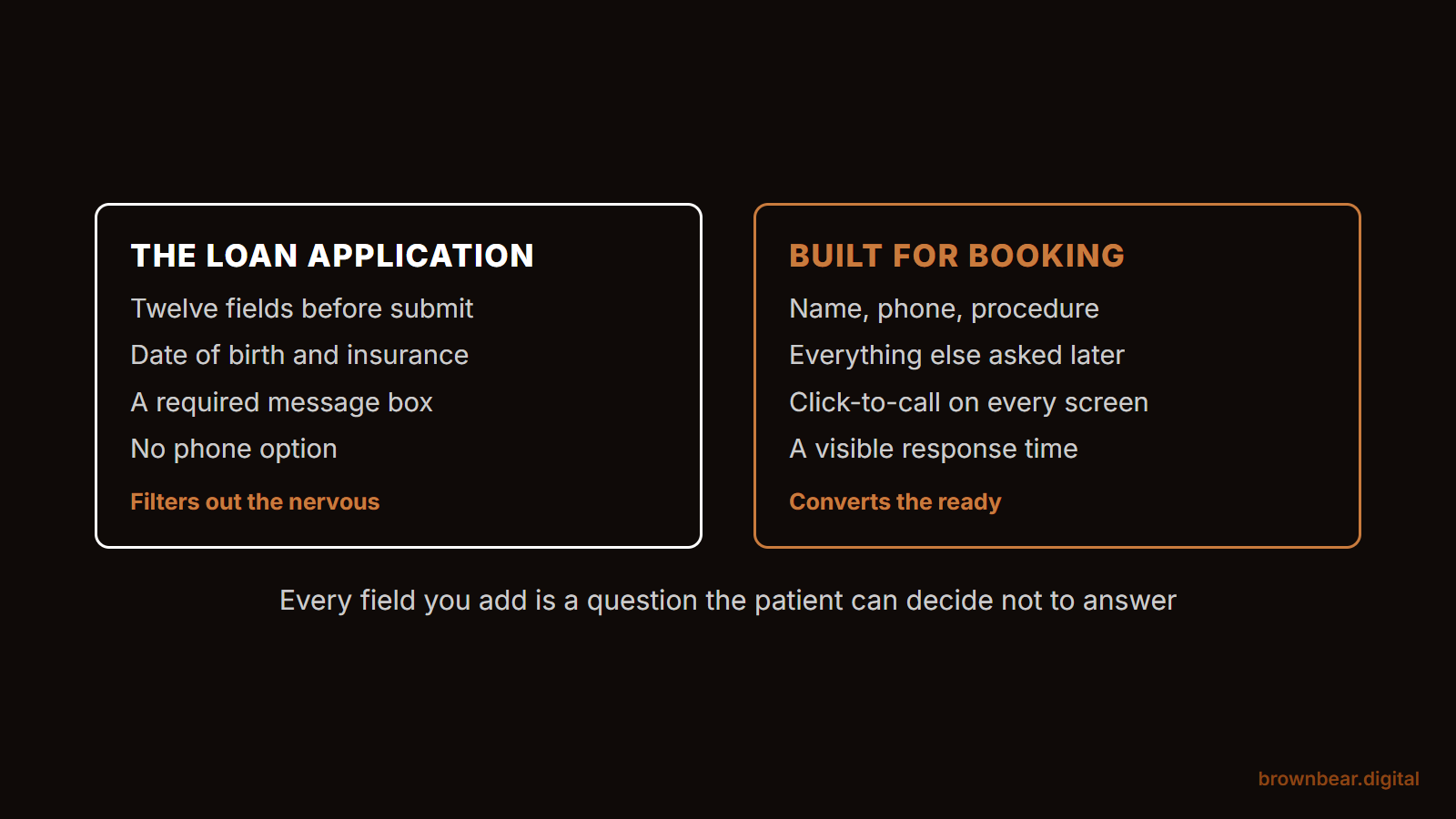
A plastic surgery prospect who reaches your contact page has made a meaningful psychological commitment. They've researched the procedure. They've evaluated your credentials. They've looked through your gallery. At this moment, every additional field in your form and every extra click between intent and submission is a micro-barrier that drains decision-making energy and gives doubt a place to grow.
Psychologists call this decision fatigue: the more micro-decisions a person is asked to make in sequence, the lower the quality and commitment of their final decision. A form asking for name, email, phone number, preferred contact method, procedure of interest, timeframe, and a message field is asking someone who just completed a complicated research process to make seven more decisions before they can reach you. Many won't. They'll close the tab intending to come back, which is almost always the last time you'll hear from them.
There's a second mechanism layered underneath: fear of commitment. Plastic surgery patients, particularly first-time patients, are often afraid of a hard sell. They've heard stories of high-pressure consultations. They don't want to give a phone number to someone who will call them three times before they're ready. A form that asks for extensive personal information before they've ever spoken to anyone at your practice can feel invasive. That feeling directly undermines the trust you've spent the rest of the website building.
The most effective consultation forms in aesthetic medicine have three fields: name, email address, and a dropdown for the procedure of interest. The "no obligation" language next to the submit button is not a throwaway phrase. It directly addresses the fear that prevents submission. For patients who are not yet ready to come into the office, offering a virtual consultation as the first step lowers the perceived stakes enough to convert people who would otherwise never reach out. Finding and removing these micro-barriers systematically is what conversion rate optimization does: more booked consults from the traffic you already have.
What to do:
- Simplify your consultation request form to three fields: name, email, and procedure of interest. Add phone as optional, not required.
- Place a consultation CTA that is always visible as visitors scroll. A sticky header with a clear booking button increases conversion meaningfully across every page type.
- Add "No obligation" or "Private and confidential" language near your form submit button. These phrases directly address the fear that prevents submission.
- Offer a virtual consultation option for patients who are not yet ready to come in person. Lowering the stakes of the first step increases the total number of people who enter your funnel.
6. Your Procedure Pages Describe the Surgery Instead of Dissolving the Fear
If you're a practice manager who has watched patients clearly research a procedure and still not book after visiting your procedure pages, the answer is almost always the same: the page answered the wrong questions.
Most plastic surgery procedure pages are written from the surgeon's perspective: what the surgery involves, what technique is used, what the general recovery timeline looks like. This is technically accurate and conversationally useless to someone in the middle of an emotionally charged research process. The questions a prospective rhinoplasty patient is actually asking are not "what is an open rhinoplasty technique?" They're asking: "Will I look natural, or will people know I had something done?" "How bad is the bruising really?" "What if I hate it?" "Can I trust this surgeon with my face?"
This is the psychology of information asymmetry. When patients don't understand something about a procedure, their brains don't remain neutral. They fill the void with the worst-case scenario available. The patient who can't find a clear answer to "how long will I be swollen" imagines permanent swelling. The one who can't find real recovery photos imagines the worst bruising they've ever seen. Comprehensive, honest procedure content doesn't just inform people. It prevents fear from filling the spaces you left blank.
There's a counterintuitive dynamic that practice owners consistently underestimate: surgeons who are willing to discuss risks, complications, and realistic expectations convert better than those who present an unambiguously positive picture. Transparency signals honesty. In a field where a meaningful percentage of patients have had a previous bad experience or know someone who has, honesty is one of the most powerful conversion tools available. A surgeon who tells patients "rhinoplasty cannot change how others perceive your personality, but it can absolutely change how you feel when you walk into a room" converts more consultations than one who promises transformation without nuance.
Almost nobody at the top of the search results is doing this. Across the #1-ranking pages in our 101-city procedure page study, just 6% covered risks and safety at the heading level, and while 65% carried a real FAQ block, only 31% marked it up so search engines and AI systems could read it. The pages beating you in your market are not winning on candor. That leaves the honest page an opening on the two things patients say they want most.
What to do:
- Rewrite each procedure page to lead with the patient's emotional reality, not the medical description. Acknowledge what they're worried about before you explain what the surgery does.
- Include a genuine FAQ section on every procedure page that answers the questions patients are actually asking. Use Google's "People Also Ask" results for each procedure to find what patients can't get answered elsewhere.
- Add recovery timelines with realistic staged photos from week one through month six. These answer the questions patients are most afraid to ask and build trust in a way that no credential badge can replicate.
- Be specific about what results are realistic and what they're not. Nuance and honesty on a procedure page signal competence more powerfully than any marketing language.
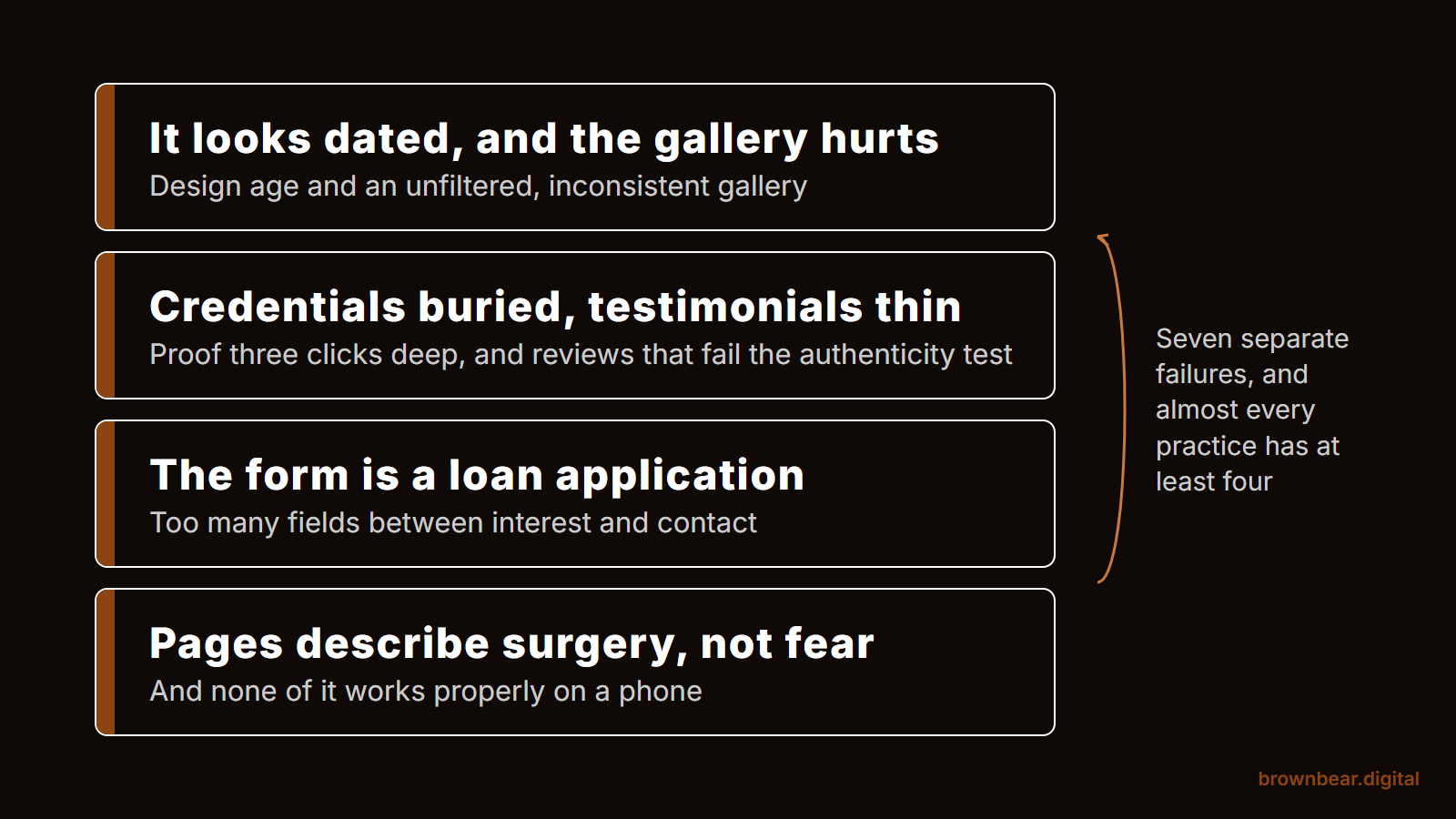
7. Your Website Is Not Actually Built for Mobile
Most plastic surgery practice owners check their website on a desktop in their office. Most prospective patients encounter it on a phone at 10:30 at night, doing research they haven't told anyone about yet.
This matters for a reason that goes beyond responsive design. Mobile browsing in a high-stakes, emotionally private category like plastic surgery is qualitatively different from desktop browsing. The patient is in a reflective state. They may be in the early stages of a decision they feel self-conscious about. They're giving your site approximately 90 seconds before they decide whether to stay or move on. A site that loads slowly, requires pinching to zoom, has tap targets too small to hit accurately, or displays a desktop layout scaled down to a phone communicates one thing clearly: this practice does not pay attention to detail.
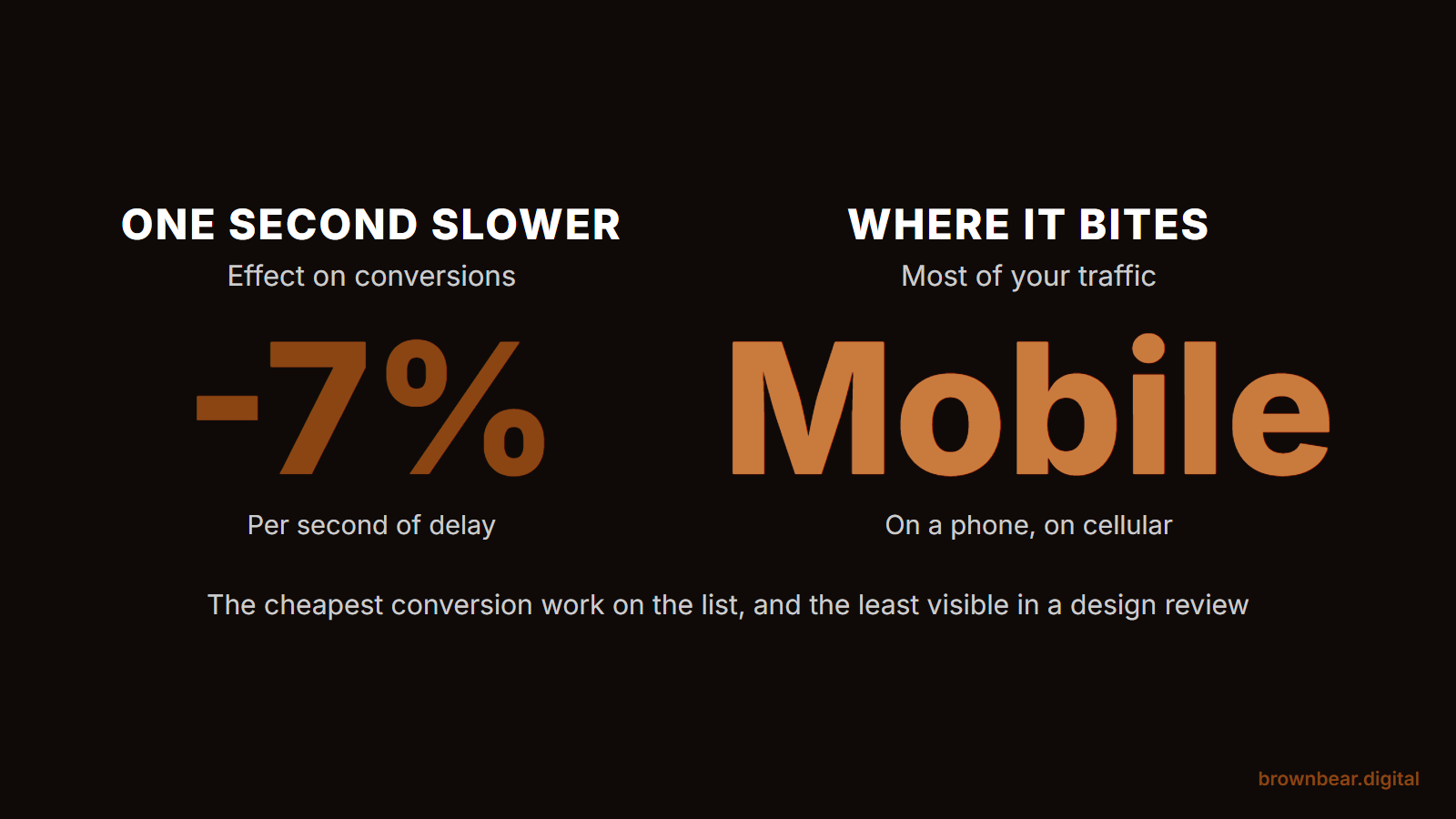
In a field where a millimeter of imprecision in a rhinoplasty matters, a sloppy mobile experience carries outsized psychological weight. The connection is subconscious, but it is real and consistent. More than 80% of plastic surgery searches now begin on mobile, and a one-second delay in page load time reduces conversions by 7%. If your site takes five seconds to load on a typical mobile connection, you have already lost a measurable percentage of every patient who found you through search, before they've read a single word.
Speed is not only a technical issue. It's a trust issue. Every second a patient waits for your site to load is a second in which their confidence in your practice is being quietly eroded. The practices winning consultations in competitive markets invest in site performance the same way they invest in equipment and staff, because the economic return is direct and traceable.
What to do:
- Run your site through Google PageSpeed Insights on the mobile setting. A score below 70 represents a measurable conversion problem and requires immediate attention.
- Compress every image in your before-and-after gallery. Most unoptimized galleries load individual images at 3 to 8 MB each. Optimized web images should be 200 to 400 KB maximum without visible quality loss.
- Add a click-to-call button that is always visible on mobile. Many high-intent patients prefer calling over filling out a form, and removing that friction captures consultations that form submissions miss.
- Audit your mobile navigation. A prospective patient on mobile should be able to reach any procedure page, the consultation form, and your surgeon's credentials page in two taps or fewer.
Brown Bear Digital Builds Plastic Surgery Websites That Convert
Every one of these issues costs you consultations. The patient who landed on your homepage and left in 50 milliseconds. The one who couldn't find proof you were board-certified. The one who saw three generic star-rating testimonials and moved on to a competitor. The one who got two fields into your contact form and closed the tab. These losses are invisible, which makes them easy to rationalize. But they add up to real revenue from real patients who were genuinely ready to book with someone.
Brown Bear Digital works with practices that are ready to turn their website into a consultation engine rather than a digital brochure. If your site is getting traffic but not calls, learn more about our plastic surgery website design services and what a conversion-focused build actually looks like. Our guide to the trust signals plastic surgery websites need breaks down that architecture element by element.
Written By
Founder, Brown Bear Digital
Bryan has 15 years of experience across SEO, paid search, and AI search strategy. He founded Brown Bear to give businesses direct access to senior-level search expertise without the agency overhead.
Learn More About BryanReady to Turn Search
Into Revenue?
No pitch decks. Just a real conversation.