Ophthalmology Marketing: What 18 Google Results Pages Show About Who Wins Eye Care Searches
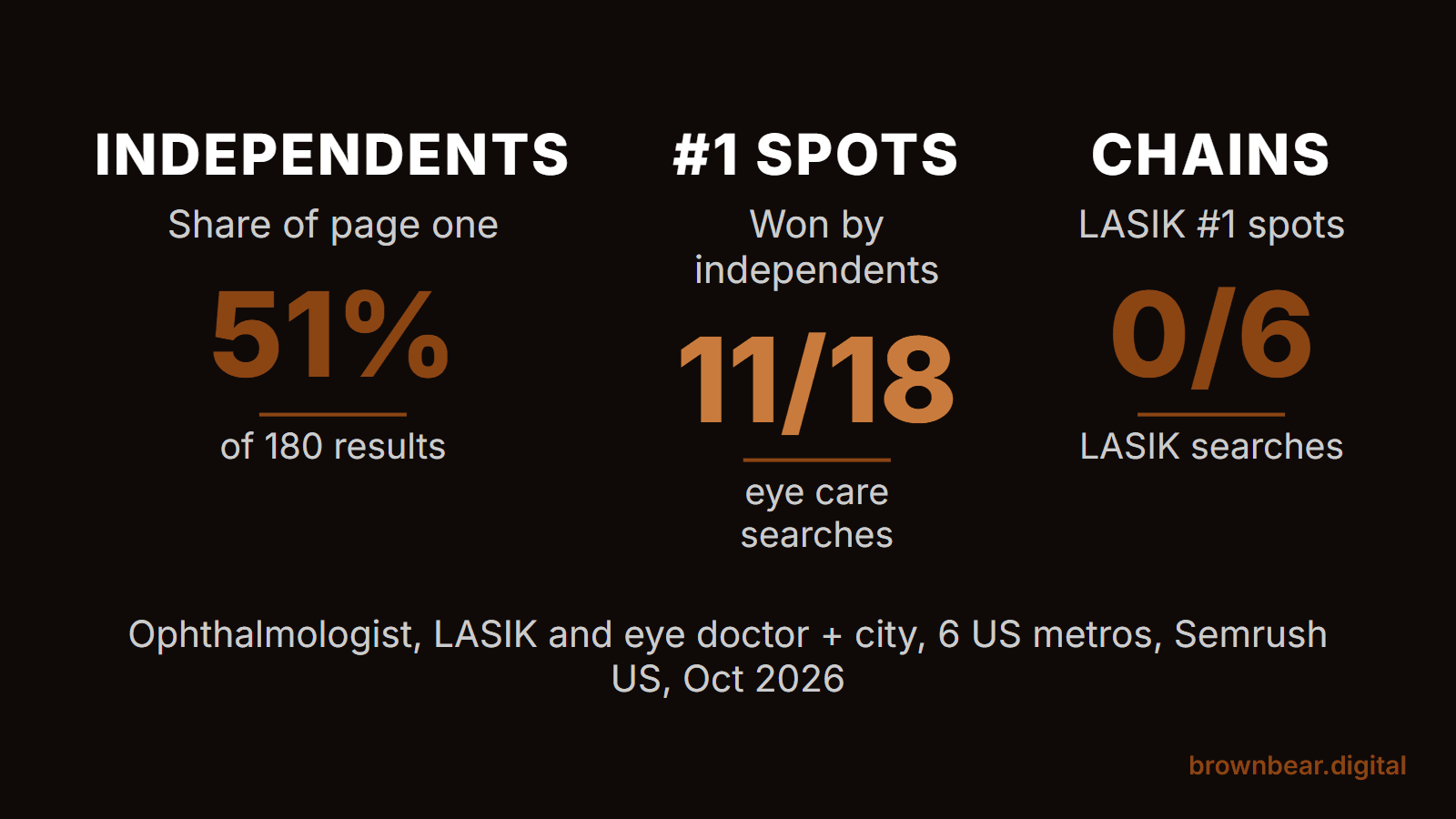
Most ophthalmology marketing advice reads the same: build a good website, claim your Google listing, ask for reviews, run some ads and send recall texts. It skips the question practice owners actually ask: who am I really up against when a patient types "LASIK" or "eye doctor" and my city? We pulled the top 10 Google results for 18 eye care searches across 6 US metros and checked who owns every result. Independent practices held 51% of them and #1 in 11 of 18 searches. Hospitals took 4 of the other 7 #1 spots. And the LASIK chains everyone worries about showed up on almost every LASIK search, but never took #1.
This guide is built on that October 2026 pull. It also draws on what Bryan Passanisi, founder of Brown Bear Digital, has seen running local SEO and AI search programs for medical practices. In those fields, as in eye care, patients pick a doctor on trust, reviews and a referral from someone they already see.
Ophthalmology marketing here means both the classic work and the newer layer above it. The classic work is your website, your Google Business Profiles, reviews, paid search, recall and the referral relationships with optometrists that feed your surgical schedule. The newer layer is the AI answers that now sit between a patient and your front desk. It covers both elective care, where patients shop on price, and medical care, where insurance and referrals do most of the steering.
If you own an ophthalmology practice with two or three surgeons, you want to know whether you can still out-rank the health system across town. If you run a refractive practice, you need to know how to win LASIK patients without matching a chain's banner price. And if you own an optometry practice, you want to know how to get chosen when a vision plan's directory and a retail chain sit above you on page one.
By the end, you'll know which searches to chase and which to leave alone. You'll know the pages and profiles each one needs, and the ad rules for LASIK, cataract lenses and glasses. You'll also know what this work should cost against the value of a surgical case. The longer payoff is a schedule that fills from your own name, your own reviews and the doctors who refer to you, not from discounts you have to keep running.
We've grouped it into four parts. First, who holds page one. Then the local work on profiles, reviews, referrals and ads. Then the rules and the AI layer, and last, cost and hiring. Start with what ophthalmology marketing is supposed to produce.
What Ophthalmology Marketing Is, and What It Should Produce
Ophthalmology marketing is the work of getting an eye practice found, chosen and booked by the patients and referring doctors in the area it serves. It covers Google, Google Maps, AI tools, paid ads, reviews, recall and your relationships with optometrists and primary care doctors. The goal is booked consultations and exams: cataract evaluations, LASIK consults, glaucoma and retina visits, and routine exams that turn into lifelong patients. Traffic and followers are not the goal.
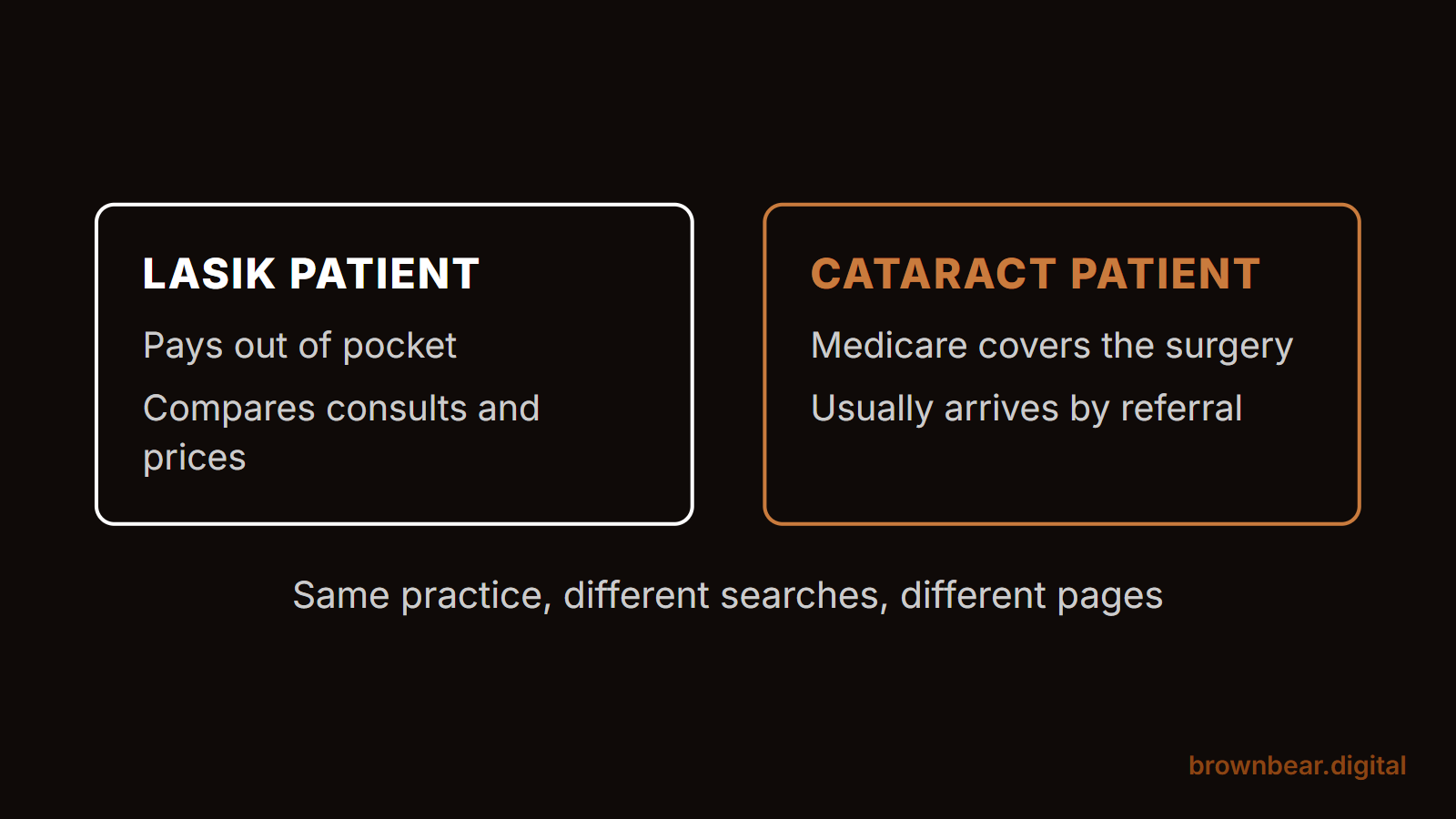
The mix matters because ophthalmology runs two businesses under one roof. Cataract surgery is mostly a Medicare-covered procedure that arrives by referral. LASIK is a self-pay purchase that patients shop like a car. Semrush puts "lasik denver" at 1,300 searches a month and "eye doctor houston" at 4,400. The people behind those two searches want different things, find you in different places and need different pages. Good ophthalmology marketing starts by knowing which search you're in, and the map below shows who owns each one.
The Eye Care Page-One Map: Who Owns the Results for Ophthalmologist, LASIK and Eye Doctor Searches
Across 18 local eye care searches in 6 metros, independent practices held 51% of the top 10 results. Hospitals and academic medical centers held 16%. LASIK chains held 9%, practices owned by private equity platforms held 8%, and directories held 9%. Independents took 30 of the 54 top-three spots and #1 in 11 of the 18 searches. Hospitals took #1 in 4. A private equity practice took #1 once, and a LASIK chain never did.
Here is how we got those numbers. On October 28, 2026, we read the top 10 organic results from Semrush for 18 searches: "ophthalmologist," "lasik" and "eye doctor" plus the city, in Houston, Phoenix, Atlanta, Denver, Chicago and Charlotte. We added four national patient questions, such as "lasik cost" and "eye exam near me," and kept those out of the totals.
Then we checked who owns every result. We read each ranking page for signs of a group. We looked for a footer line like "An EyeSouth Partners Affiliate," a parent company's logo or copyright, a group's booking system, or links to the group's site. A practice with none of those signs counts as independent. That means we found no group signal, not that we proved the practice is independent. We used the same method in our study of veterinary clinics, where corporate groups held 41% of page one. Eye care looks very different.
We call the result the Eye Care Page-One Map:
| Search type | Example | Who holds page one | What it means for you |
|---|---|---|---|
| Ophthalmologist plus city | ophthalmologist atlanta | Independent practices 52%, hospitals and academic centers 28%, private equity practices 8%. Hospitals took 6 of 18 top-three spots. | Open to independents, but the health systems sit on top in big medical cities. Win with surgeon pages and subspecialty pages. |
| LASIK plus city | lasik chicago | Independent practices 40%, LASIK chains 27%, Reddit and social posts 10%, directories 8%. Chains ranked in 5 of 6 cities. | Chains are everywhere but rarely on top. Independents took 10 of 18 top-three spots and #1 in 4 of 6. |
| Eye doctor plus city | eye doctor denver | Independent practices 62%, hospitals 13%, directories 12%. VSP's doctor finder ranked in all 6 cities. | The broadest lane. A vision plan's directory is your real neighbor here, not another practice. |
| National patient questions | eye exam near me | Retail optical and VSP held #1, #2, #3 and #7 for "eye exam near me." Practice cost pages ranked for "lasik cost" and "cataract surgery cost." | Don't chase the national exam terms. Do publish real cost pages for LASIK and cataract lenses. |
Two findings surprised us. First, the eye care giants barely show up as giants. Private equity practices appeared in 11 of 18 searches, from 5 different platforms, and all 15 of their results ran under a local practice name and website. Second, retail optical was nearly invisible on these searches. Warby Parker, Costco and Walmart didn't appear once in 180 local results. The only retail tie was an optometry practice in Atlanta that says it is "Located Inside LensCrafters," which ranked twice.
Independent Practices Still Win Most Local Eye Care Searches
Independent practices are the biggest group on page one, and they usually win with a homepage. Of the 92 independent results in our pull, 62 were homepages. Houston Eye Associates held #1 for both "ophthalmologist houston" and "eye doctor houston" with a providers page. Arizona Eye Specialists held #1 for "ophthalmologist phoenix." Kraff Eye Institute held #1 for "lasik chicago," one spot above a national chain's Chicago center.
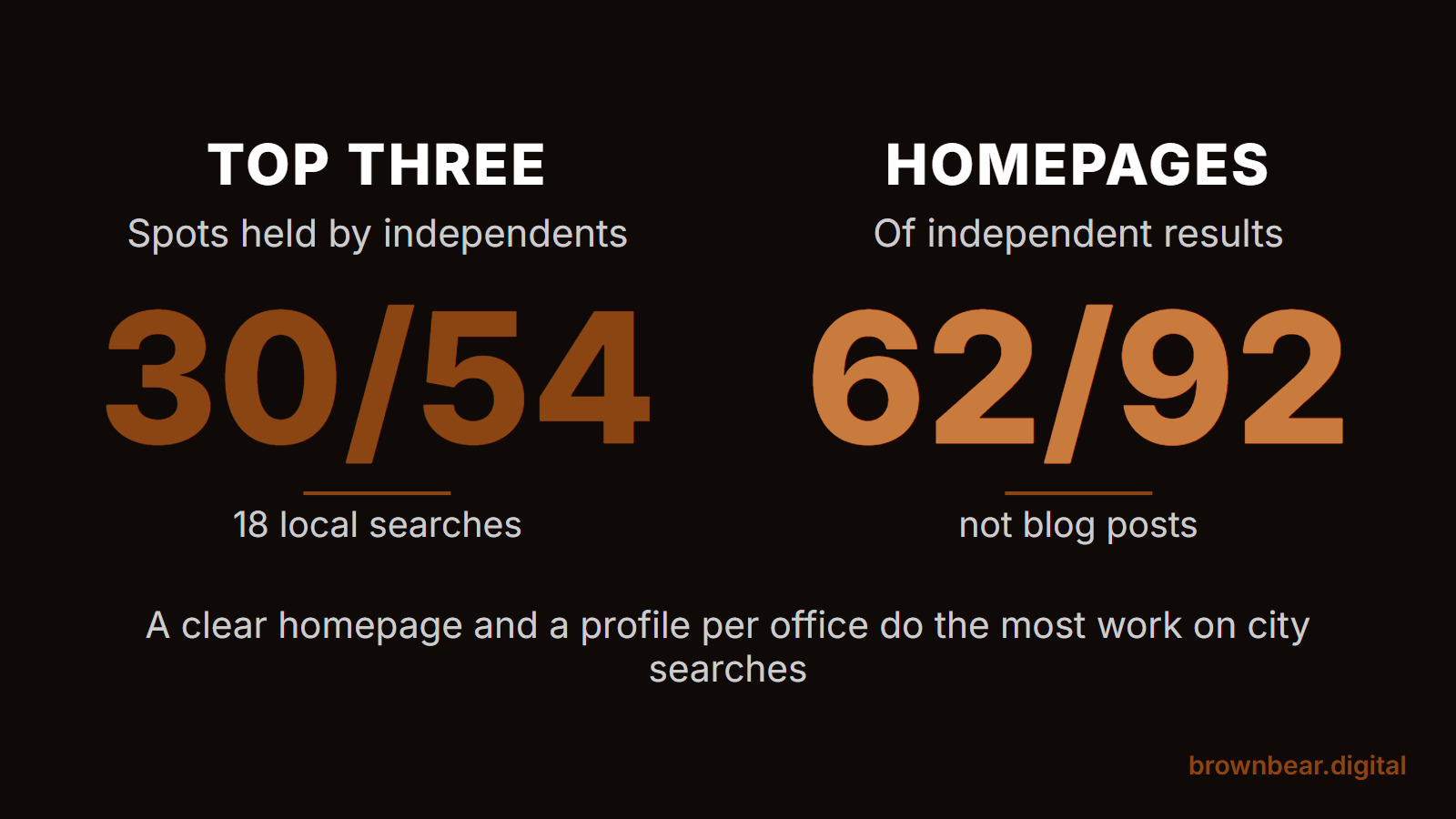
That tells you where to put your first dollars. A homepage that says what you treat, where you are and who your doctors are does more on these searches than a blog post. So does a Google Business Profile for each office, with the right category, hours and photos, and a steady stream of reviews. Searches for "ophthalmologist" or "eye doctor" and a city are about finding someone. The patient wants a doctor nearby, and Google shows the practices it trusts most in that city.
Size helps, but it isn't the whole story. Houston Eye says it has more than 21 locations, and Mann Eye Institute says it has 16. Both are big practices with no group signal on their pages. But size isn't what the #1 results share. Each one puts the doctors, the care they offer and the city in plain view.
Picture a three-surgeon practice in a suburb of Atlanta. It has one homepage that lists "comprehensive eye care" and a contact form. It rebuilds the homepage around its two main services, cataract surgery and glaucoma care, with each surgeon's photo, training and a booking link above the fold. It adds a page for each office with the address, hours, parking and the insurance plans it takes. Those pages now match what patients type, and each office has a page Google can show for its part of town.
Hospitals Own the Ophthalmologist Search in Big Medical Cities
Hospitals and academic medical centers held 28% of the results for "ophthalmologist" plus a city, and #1 in 2 of 6 cities. Northwestern Medicine held #1 for both "ophthalmologist chicago" and "eye doctor chicago." UCHealth held #1 for "ophthalmologist denver," with the University of Colorado's ophthalmology department at #9. In Chicago, five of the top 10 for "ophthalmologist chicago" were health systems or medical schools.
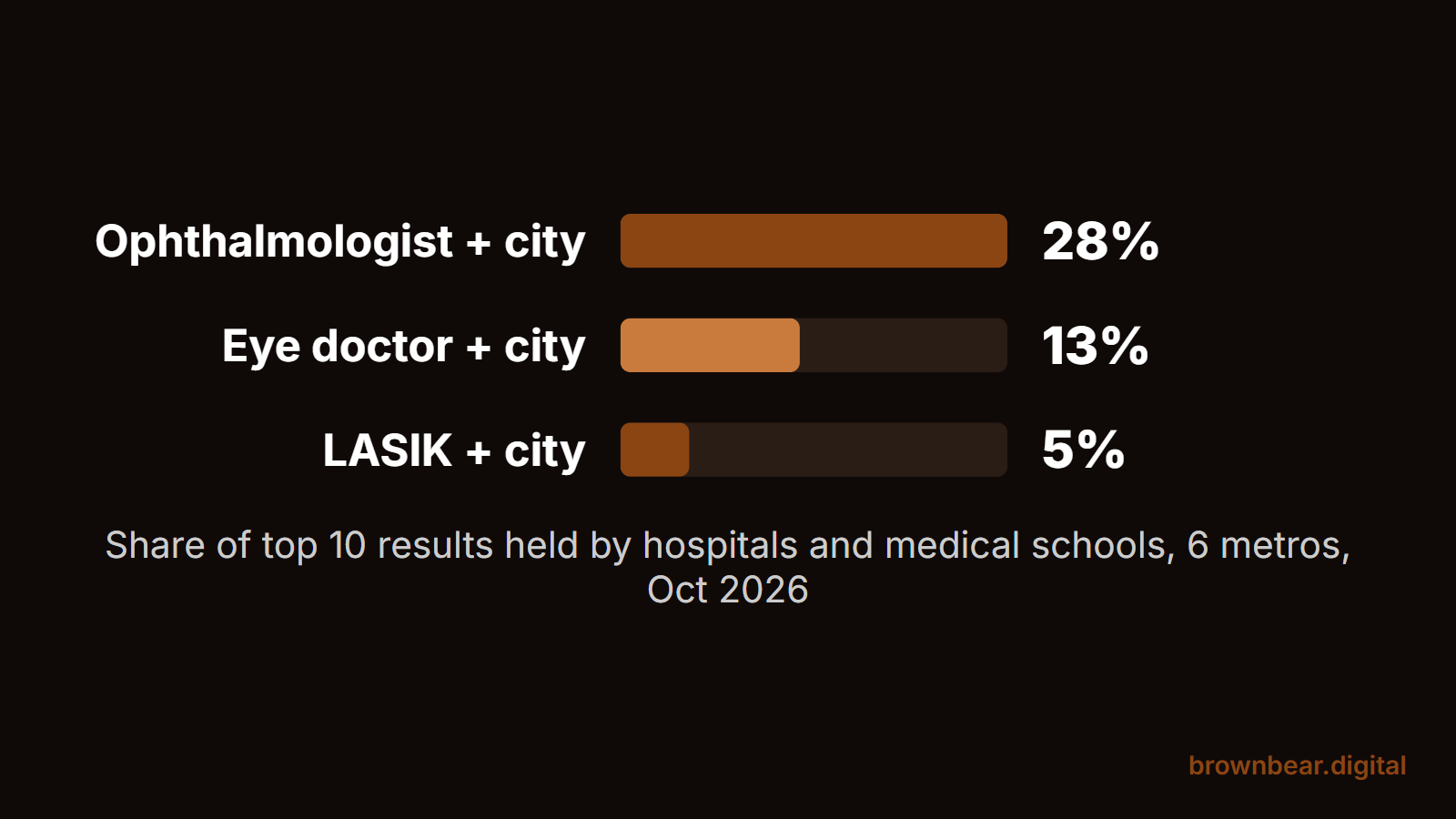
You won't out-rank Northwestern on its own city name with a homepage. You can beat it on the pages where a hospital is weakest: a single surgeon, a single procedure, a single neighborhood. Health system pages tend to be department overviews or provider search pages. In our data, 22 of the 28 hospital results were inner pages like that, built to list doctors, not to sell a procedure.
So build what they don't. Give every surgeon a full page with training, procedures, languages and reviews. Build a page for each procedure you want more of, such as cataract surgery with lens options, glaucoma surgery or dry eye treatment. And put your neighborhood on the office page. A patient choosing between a health system and a private practice is often choosing between a phone tree and a named surgeon who answers questions. Your pages should make that difference obvious.
Private Equity Practices Rank Under Local Names, So "Independent" Has to Mean Something
Private equity has bought a large share of eye care, but you wouldn't know it from page one. A study in the journal Ophthalmology counted 228 private equity acquisitions of ophthalmology and optometry practices from 2012 through 2019, by 29 platform companies. Of those, 186 came in the last three years. In our pull, those platforms ranked under the practice names patients already knew.
EyeSouth Partners had the most results, 8, under five different local brands. In Atlanta alone, three EyeSouth practices ranked for "ophthalmologist atlanta": Georgia Eye Partners at #3, East Atlanta Eye Surgery Center at #6 and Georgia Eye Associates at #7. EyeCare Partners ranked through Desert Vista Eye in Phoenix, which held #1 for "lasik phoenix." American Vision Partners ranked through Barnet Dulaney Perkins Eye Center. The only place the parent showed up was a line in the footer.
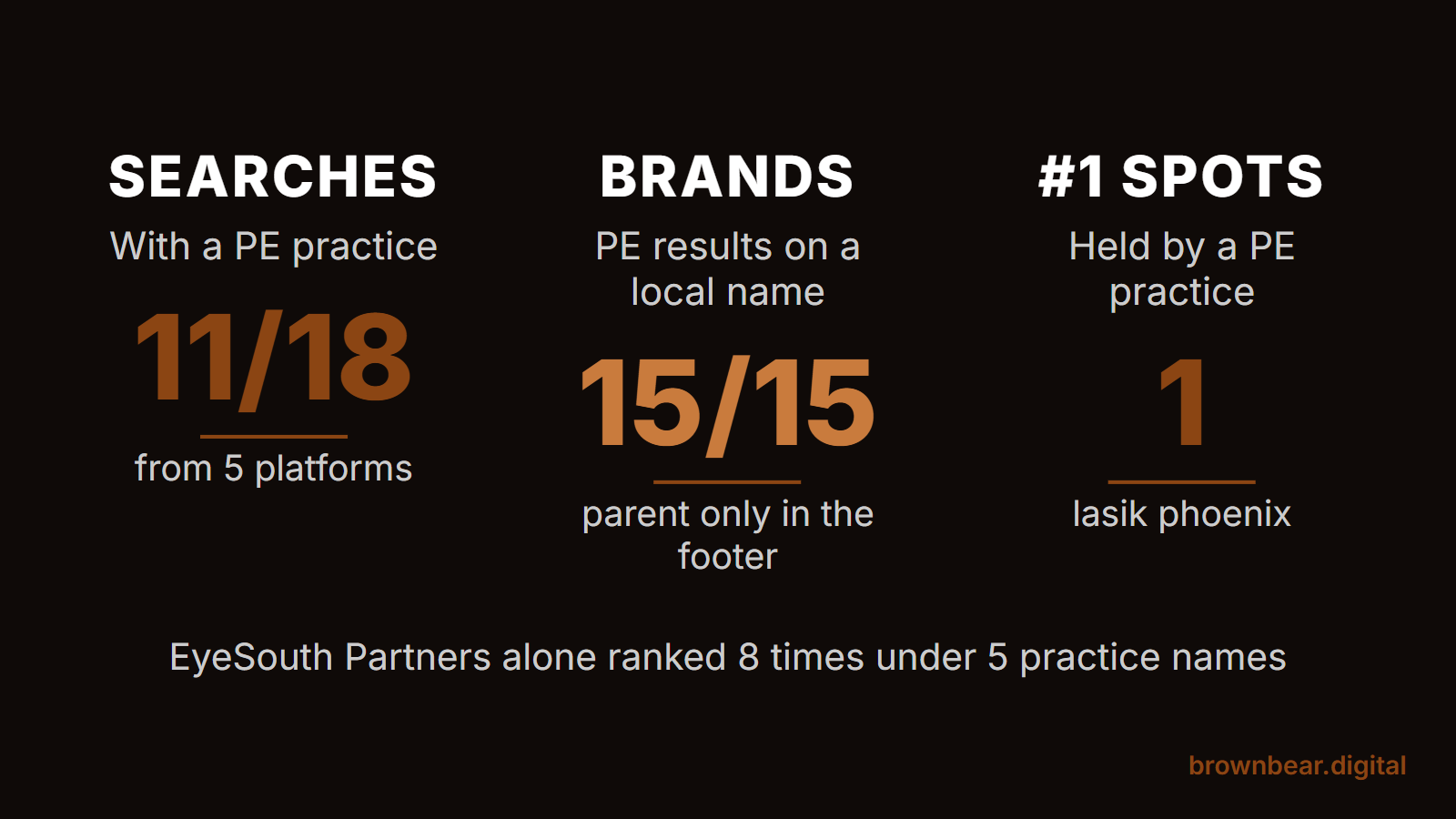
That has two consequences for an independent practice. The competitor down the road may be part of a group with a regional marketing team, even though its site looks local. And "locally owned" means nothing to a patient unless you show what it changes. If you're physician-owned, say what that means in practice. The surgeon who does the consult does the surgery. You see the same doctor at follow-up. You can call the office and reach someone who knows your chart. Claim only what's true, and claim it on the pages patients read before they book.
If you're part of a platform yourself, the data says keep the local name. None of the 15 private equity results in our pull ran on a group's own domain. Patients search for a doctor and a city, and a practice name with a long history in that city is what Google showed.
LASIK Searches: The Chains Show Up Everywhere but Rarely Win
LASIK chains ranked in 5 of the 6 LASIK searches and held 16 of the 60 results. But they took only 3 of 18 top-three spots and never #1. LasikPlus had 6 results, The LASIK Vision Institute 4 and TLC Laser Eye Centers 3, and all three brands link to the same lasik.com network. Fifteen of the 16 chain results were inner pages, mostly a templated center page for that city.
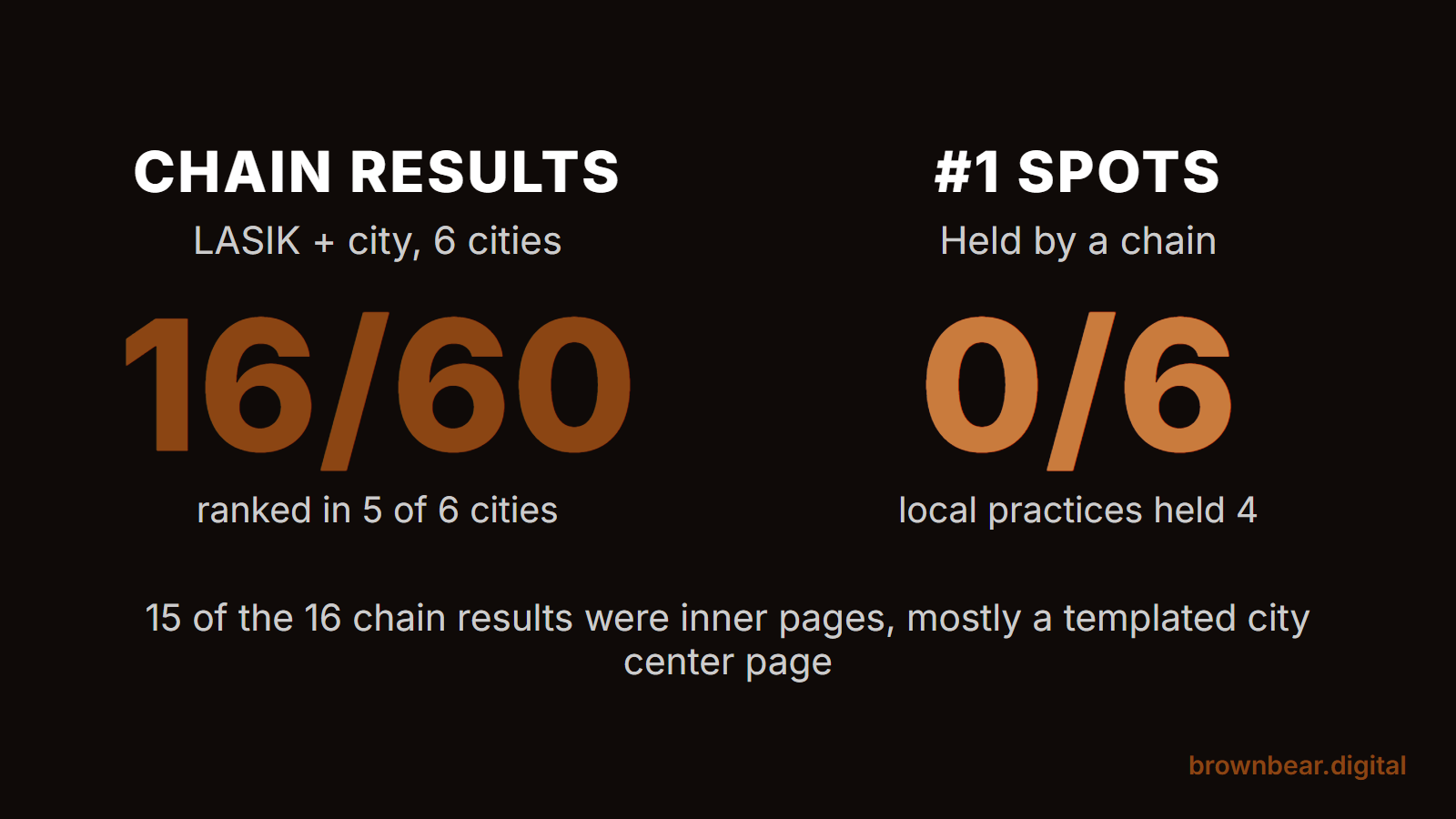
The #1 spots went to local refractive practices. Dishler Laser Institute won Denver, Kraff Eye Institute won Chicago, Woolfson Eye Institute won Atlanta and Houston LASIK won Houston. Each ranked under its own practice name, not a national brand, and the advice below is what a patient comparing those sites is looking for.
Patients say what they want on Reddit, which ranked for LASIK in 4 of our 6 cities. A September 2022 r/Denver post titled "I went to consults with 3 Denver-based LASIK surgeons and here's what I found out" drew 1,579 upvotes and 279 comments, and ranks #7 for "lasik denver." One of the top replies, with 314 upvotes, said "This is a medical procedure, not a used car." Another praised a surgeon who advised against surgery because of the risk of overcorrection. In a 2024 Chicago thread, a patient compared quotes of $3,740, $3,800 and $4,600 for both eyes. Their own eye doctor had referred them to one of the surgeons.
That points to what a LASIK practice should publish. Post a real price, or a real range, with what it includes. Explain who isn't a good candidate, and what you offer instead, such as PRK, SMILE or ICL. Show the surgeon, the technology and the follow-up schedule. A patient comparing three consults wants to feel they won't be pushed, and a page that says "not everyone qualifies" earns more trust than a banner price.
Here's the scenario that plays out in most cities. Say you run a refractive practice that charges $2,200 an eye, and a chain down the road advertises a price far below that. You could match the banner and lose money, or publish your full price with what it covers: the exam, the surgery, the follow-up visits and any enhancement. Then add a candidacy page and a short video of your surgeon explaining when they say no. The patients you lose to the banner were never going to pay your price. The ones who read your pages arrive at the consult already trusting you.
Eye Doctor Searches Run Through Vision Plans, Optometrists and Retail
"Eye doctor" plus a city is the broadest search in our pull and the one most open to independents: they held 62% of the results. But it has a neighbor no practice can out-rank on its own. VSP's doctor finder, a vision insurance directory, ranked in all 6 cities: #1 in Denver, #2 in Atlanta and Chicago, #3 in Charlotte and #8 in Houston and Phoenix.
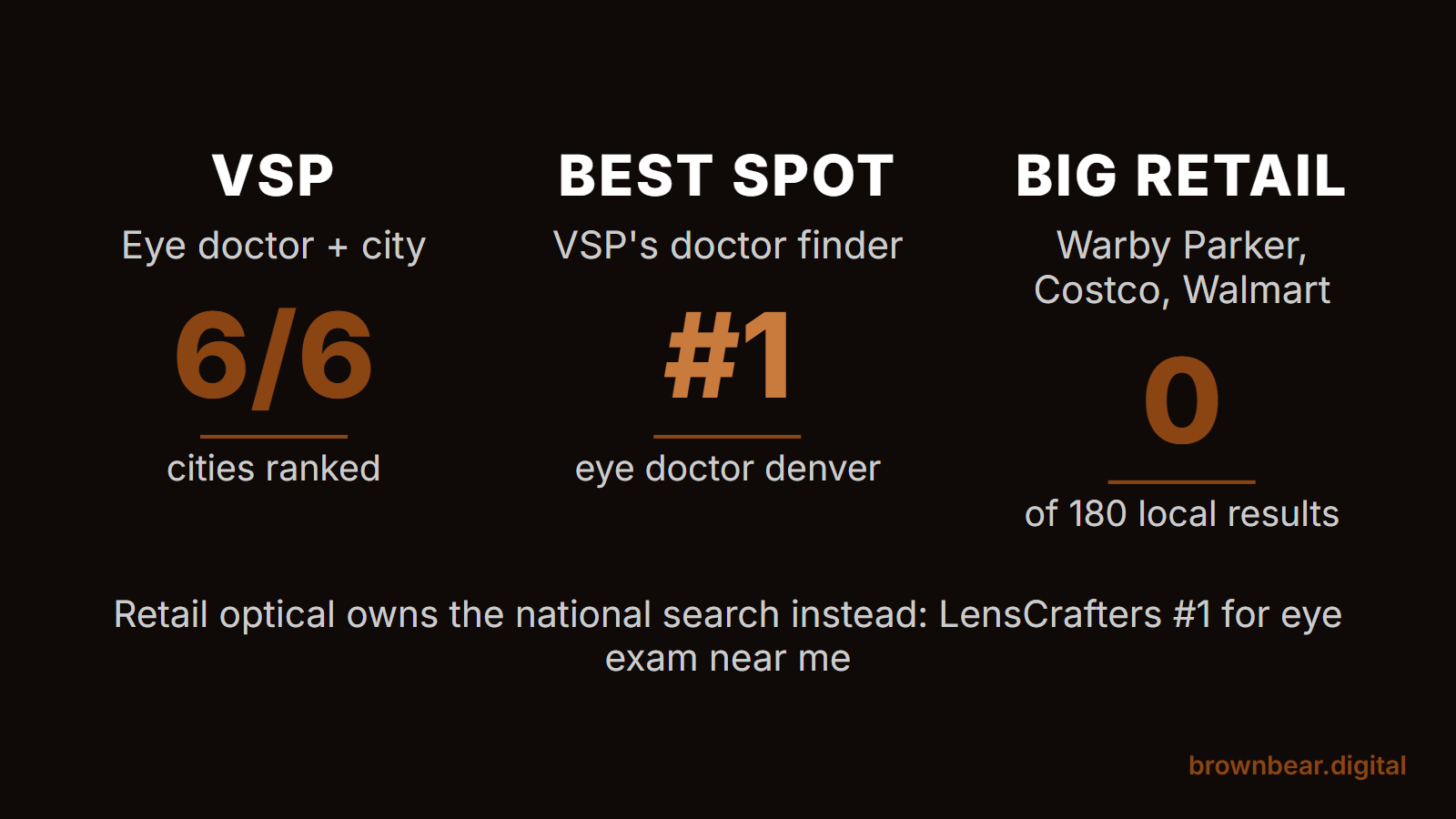
A patient who lands on that directory is choosing from the doctors in their plan. So the work there is to be listed, in network and complete: your address, hours and the services you offer. If you take VSP, EyeMed or other plans, say so on your site, with a page that lists each plan by name. That page answers the question many eye exam patients ask first.
Retail optical owns the national exam search instead. For "eye exam near me," which Semrush puts at 110,000 searches a month, LensCrafters held #1, VSP #2, Target Optical #3 and Visionworks #7. Those are national brands bidding for a national term. A local practice gets that patient through Google Maps and its Business Profile, not by out-ranking LensCrafters on the national page.
For an ophthalmology practice, these searches matter for a different reason. The patient who books a routine exam today is the cataract patient of the next decade, and the optometrists who rank here are your referral sources. Which brings us to the channel most eye care marketing advice skips.
Optometrist Referrals and Co-Management: The Channel No Agency Page Measures
For many ophthalmology practices, the most important source of surgical patients isn't Google. It's the optometrists and primary care doctors who send patients to you. In the r/Ophthalmology thread that ranks #8 for "ophthalmology marketing," the top reply said "most referrals come from your 'network' of PCPs and ODs." It added that Google reviews matter "for those looking to find out about their doctor once they have gotten a name." Google's own AI Overview for "ophthalmology marketing" lists referral networks with local optometrists as a core part of the plan.
That makes your website a referral tool as well as a patient tool. A referring optometrist wants to know how fast you'll see their patient and how they'll hear back. They also want the patient back for routine care. Houston Eye, which held #1 in two Houston searches, has a "Join Our Referral Network - Refer Online" link on its pages. Most practices have nothing of the kind.
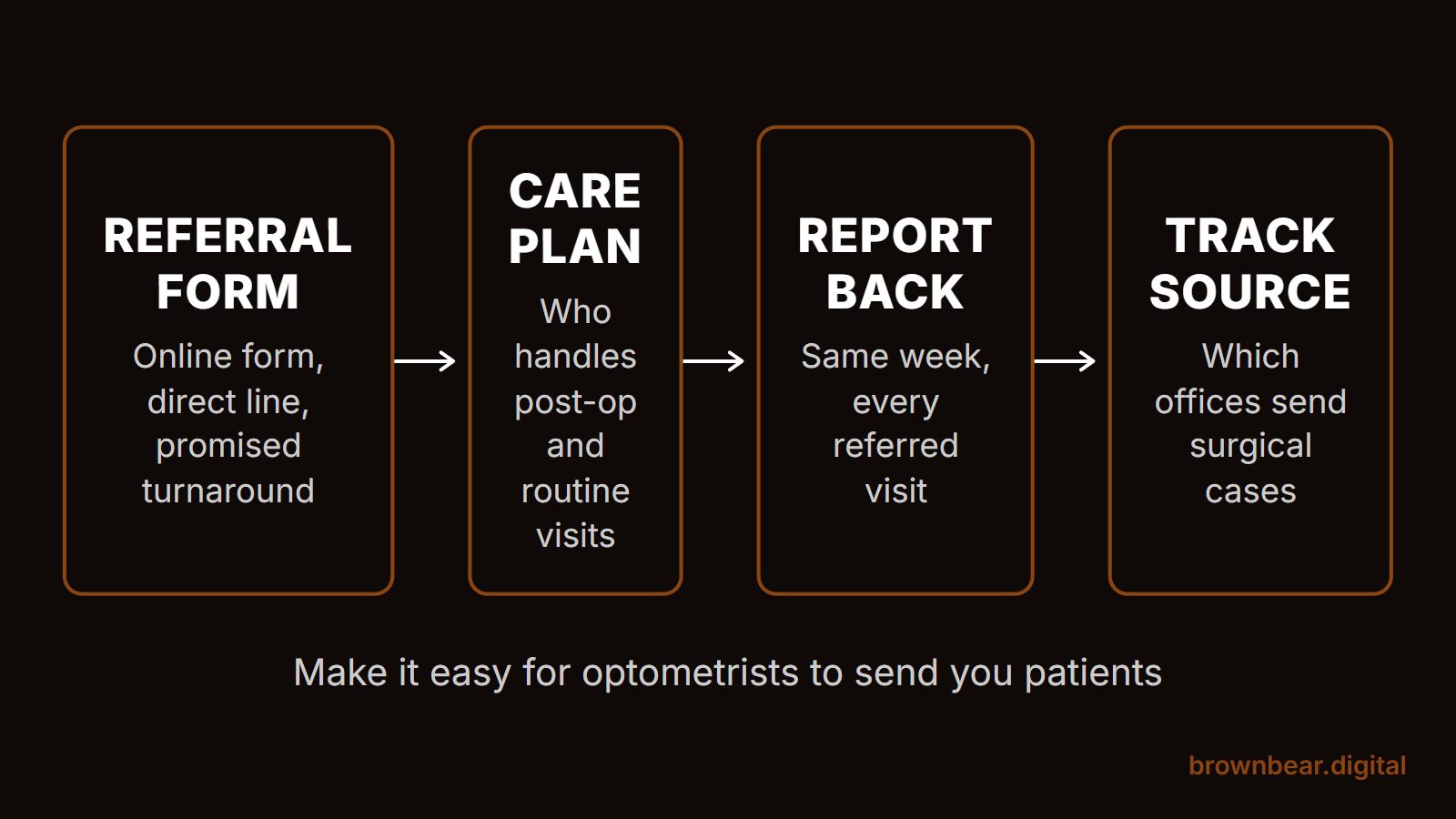
Here's what a referral program needs:
- A referring doctors page with an online referral form, a direct phone line and the turnaround you promise.
- A clear co-management policy, so optometrists know which patients come back to them for post-op and routine care.
- A report back after every referred visit, sent the same week.
- A way to track referrals by source in your practice software, so you know which offices send the most surgical cases.
The tension here is old. The American Academy of Ophthalmology's 2008 practice tips put it bluntly: optometrists "prefer to refer patients to ophthalmologists who do not employ optometrists," yet practices "typically net around $50,000 profit per year for each employed optometrist." If you employ optometrists, say clearly on your referral page that referred patients go back to their own doctor. That single line can decide whether an outside optometrist sends you patients.
Google Business Profile and Reviews for Eye Care Practices
Every office needs its own Google Business Profile with its own address, phone, hours and photos. Pick the primary category that matches what that office does most, such as "Ophthalmologist," "Eye care center" or "Optometrist," and add services that match your procedure pages. If a surgeon sees patients at two offices, make sure both profiles show it. The same structure we recommend for medical practices that run several locations applies here: one page and one profile per office, each able to stand on its own.
Reviews carry extra weight in eye care because many patients arrive with a name already in hand. They got it from their optometrist, their primary care doctor or a friend, and then they check you. Ask every patient, by text after the visit, with a direct link to the right office's profile. A review that helps the next patient starts with specifics: the procedure, the doctor and the recovery. Ask for those.
Ask everyone, not just the happy patients. The FTC's rule on consumer reviews and testimonials, in effect since October 21, 2024, bans fake reviews. It also bans using unfounded legal threats, intimidation or false accusations to suppress negative ones. The FTC's guide for marketers is plain about the rest: "Don't ask for reviews only from customers you think will leave positive ones." The FTC's Endorsement Guides also say a review from a patient you paid or rewarded has to disclose that connection. Google's own policy bars offering payment, discounts or free services in exchange for a review, and bars asking only for positive ones. So no gift cards for five stars, and no review stations that only ask patients who smiled at checkout.
Google Ads for Ophthalmology: Where Paid Search Earns Its Cost
Paid search is the fastest way into the searches you can't yet win organically, and LASIK is where it earns its cost most clearly. Semrush puts the average cost per click for "lasik denver" at $20.11. For "eye doctor" in our cities it ran $4.99 to $7.67. For 9 of our 12 "ophthalmologist" and "lasik" city searches, Semrush reported no cost data at all. Treat those as unknown, not free, and test them with a small budget before you commit.
When Bryan opens a medical practice's Google Ads account after the owner says "Google Ads didn't work," he usually finds the same two problems. Campaigns and keywords were never set up or tuned for lead quality, so money leaks to searches that never book. And the clicks land on pages not built to convert, often the homepage. For eye care, the fix is a separate campaign for each service: LASIK, cataract, dry eye and routine exams. Send each one to the matching procedure page with a booking option on it. We cover campaign structure, costs and the rules for medical advertisers in our guide to Google Ads for doctors.
Two cautions apply to eye care ads in particular. A LASIK ad that leads with a price triggers the federal rules in the next section. And the tracking on your landing pages matters. A pixel that sends what a patient typed in a booking form to an ad platform can raise a HIPAA problem. Keep forms that ask about eye conditions off third-party tracking, and count conversions in a way that doesn't expose patient information.
Advertising Rules That Apply to Eye Care Marketing
Eye care has more federal advertising rules than most specialties, because it sells devices, self-pay surgery and eyewear. This isn't legal advice, and your state licensing board has its own rules. But every eye care marketer should know these five.
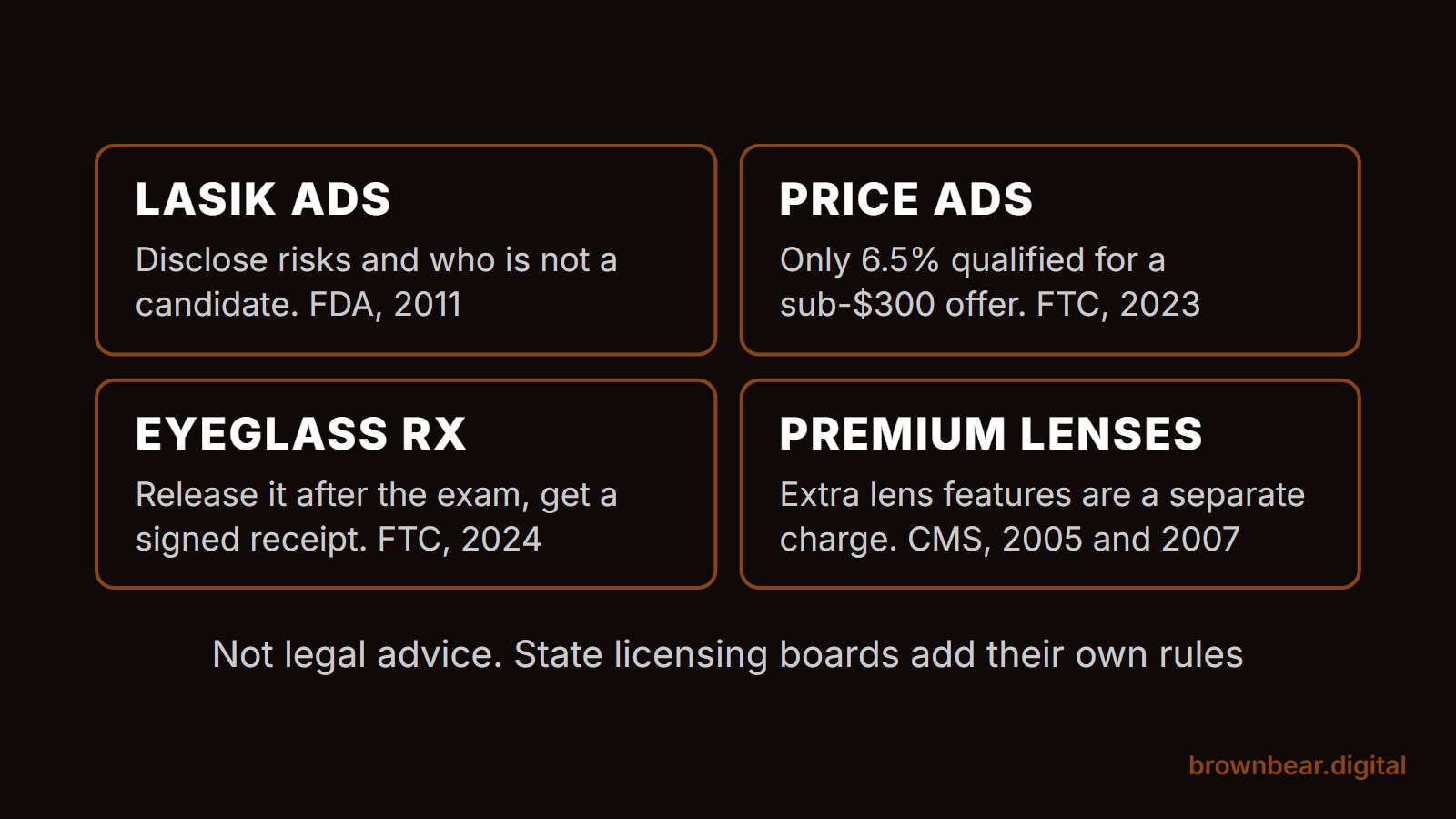
LASIK ads must disclose risks.
Lasers used for LASIK are restricted medical devices. In its 2011 letter to eye care professionals, the FDA said risk information belongs in all LASIK advertising and that ads without it "may be misleading." It also reminded providers that a restricted device is misbranded if its advertising is false or misleading. In practice, that means a LASIK ad or landing page should say who isn't a candidate and name the main risks, not just the benefits.
Price ads have to match what most patients pay.
In 2023, the FTC finalized an order against LCA-Vision, which runs LasikPlus, over ads that suggested vision correction for less than $300. The FTC said only 6.5% of the consumers who came in for a consultation qualified for the advertised price for both eyes. The order required $1.25 million in consumer redress and clear disclosures whenever LASIK is advertised at a price or discount most patients won't get. That was the company's second FTC order. A 2003 order barred it from claiming LASIK eliminates the need for glasses and contacts for life without competent and reliable scientific evidence.
Eyeglass prescriptions must be released, and now confirmed.
The FTC's updated Eyeglass Rule took effect September 24, 2024. A prescriber who also sells eyewear must give the patient their prescription right after a refractive exam. The prescriber must ask the patient to sign a confirmation that they got it, and keep that record for at least three years. You can't require a purchase, a fee or a waiver before handing it over. Don't write an ad or exam offer that bundles the exam with buying glasses in a way that implies otherwise.
Premium cataract lenses are a separate charge, and you have to say so.
Medicare covers cataract surgery with a standard lens. Two CMS rulings, from 2005 for presbyopia-correcting lenses and 2007 for astigmatism-correcting lenses, let a patient pay the extra cost of those lens features on top of the covered surgery. That's why cataract marketing is really lens marketing. Your pages should explain the options and what each costs out of pocket, so no patient learns about the upgrade for the first time on surgery day.
Reviews and testimonials follow the FTC's rules.
The consumer review rule and the Endorsement Guides covered above apply to every testimonial video, before and after quote and review request you run. A patient testimonial in an ad is read as a typical result, so if it isn't typical, the ad should say clearly what patients can generally expect.
Because eye care is health information, Google holds it to its higher standard for "your money or your life" topics. Have a doctor on your team review every medical page before it goes live, and put their name on it.
Ophthalmology Marketing for Optometry Practices, LASIK Practices and Cataract Surgeons
Ophthalmology marketing is for any eye care practice that wants patients to choose it by name. The right plan depends on what you sell and how patients pay for it. Before you pick a path, consider whether your patients come mostly by vision plan, by self-pay comparison shopping or by referral.
For Optometry Practices Competing With Vision Plan Directories and Retail Optical
Optometry practices face the most crowded page one in our pull. VSP's directory ranked for "eye doctor" in all 6 cities, and LensCrafters, Target Optical and Visionworks held three of the top seven results for "eye exam near me." The one Atlanta optometry practice with a retail tie ranked twice from inside a LensCrafters. If you own an optometry practice, compete on what a chain counter can't offer. That means the same doctor every year, specialty care such as dry eye or myopia control, and frames you pick yourself. Put your plans, your specialty services and your doctors on the homepage, and keep each office's Business Profile complete.
Search treats optometry marketing as its own topic: the top 10 for "optometry marketing," at 720 searches a month, shares no pages with the top 10 for "ophthalmology marketing." If you're an optometrist reading this, the referral and co-management sections above apply to you from the other side.
For LASIK Practices Competing With National Chains
Refractive practices face chains on almost every LASIK search, but the chains rarely win. In our pull they never took #1. The practices that did, like Kraff Eye Institute over LasikPlus in Chicago, ranked under their own names. The FTC's 2023 order against LasikPlus shows the risk of competing on banner prices. If you run a refractive practice, publish your real price and what it includes, a candidacy page that says when you'd recommend something else, and your surgeon's experience. Then answer the questions patients ask on Reddit, where some of these threads rank on page one.
For Cataract Surgeons Marketing Premium Lenses
Cataract surgeons have the most referral-driven patients and the clearest content opening. For "cataract surgery cost," which Semrush puts at 8,100 searches a month, four of the top 10 results were eye practices' own cost pages. The rest included AllAboutVision, GoodRx, the American Academy of Ophthalmology and Medicare. Because the CMS rulings let patients pay for premium lens features on top of covered surgery, the cost page is where the lens decision starts. If you do cataract surgery, publish a cost page that separates what Medicare covers from each lens option's out-of-pocket price. Then send it to referring optometrists to share with patients.
Ophthalmology Marketing in AI Search
AI tools now answer many of the questions patients used to search: what a cataract is, whether LASIK hurts, who's the best surgeon nearby. Google showed an AI Overview for "ophthalmology marketing" when we checked, and it cited marketing agencies, software vendors, a trade journal and the American Academy of Ophthalmology. Not one eye practice. For patient searches the picture shifts. In the medical practices Bryan works with, big health authorities tend to own the AI answers for broad questions like "what is cataract surgery." Practices still show up for local and cost questions. AI tools read those as local intent.
When Bryan runs an AI visibility audit for a medical practice, the AI rarely gets facts badly wrong. More often, the services the practice most wants to be known for are buried, so the AI describes a generalist. The most common outright error is a mismatched name, address or phone number across listings, which is easy to fix. And owners are most surprised by how much third-party sites, such as review sites, directories and press, shape what the AI says about them. For an eye practice, that means making your cataract, LASIK or glaucoma pages specific, keeping every listing consistent and earning mentions on sites the AI reads. Our research on AI citation sources found ophthalmology among the specialties where detailed procedure pages change what the engine says.
One more point from Bryan's work: structured data markup is worth keeping tidy, but it isn't the lever many vendors claim for AI search. Pages that load their content without heavy JavaScript, and that answer questions in plain, well-organized text, matter more. Sites that load their text with heavy JavaScript can hide it from AI crawlers.
What Ophthalmology Marketing Costs, and the Case Value That Pays for It
The old rule of thumb comes from the Academy itself. The American Academy of Ophthalmology's 2008 practice tips called a marketing budget of 3% to 8% of revenue typical, and 10% or more when entering a market or promoting elective services. That article is old, but the logic holds: LASIK and premium lenses need more marketing than medical care, because self-pay patients shop.
A better test than a percentage is the cases you need to break even. In plastic surgery, Bryan's math is that a $1,500 to $2,000 a month SEO retainer over a year costs about the same as two solid procedures sourced through search. Eye care has its own version. Say your LASIK fee is $4,000 for both eyes and your margin is half that. Then a $2,000 a month program needs about one LASIK case a month to pay for itself. A premium lens upgrade works the same way at a smaller fee. Cutting SEO to fund ads tends to lock a practice into rising click costs, while organic rankings keep paying after the work is done.
Two things make this math more favorable than it looks. Many cataract patients need the second eye done too. And every patient you see for a routine exam, dry eye or glaucoma care is a likely future cataract patient who already trusts you. Measure your program on booked consults and surgical cases by source, not on traffic.
How to Choose an Ophthalmology Marketing Agency
Look at who wrote the page-one results for "ophthalmology marketing": agencies and software vendors, each selling its own service, plus a jobs board and a Reddit thread. That's normal, but it means most advice you read is a pitch. Our guide to hiring an SEO agency for a medical practice covers the contract terms. For eye care, ask any agency for four things before you sign:
- A page-one review of your target searches, showing which results are independent practices, hospitals, chains, private equity practices and directories.
- A plan for LASIK and cataract lens pages that follows the FDA's risk disclosure guidance and the FTC's pricing and review rules.
- Reporting on booked consults and surgical cases by source, including referrals, not just rankings and traffic.
- Who writes your medical pages, and how a doctor on your team reviews them before they go live.
If a proposal treats a refractive practice the same way it treats a medical retina practice, that's your answer.
Talk to Brown Bear About Marketing Your Eye Care Practice
Ophthalmology marketing pays off when you pick the right fights: your surgeons, your procedures, your referral network and the city you serve. The national exam terms and the health system's city name can wait. Brown Bear builds that page-one map for your market first, then does the profile, page, ads and AI search work that follows from it. If you want to see where your practice stands, talk to Brown Bear about your eye care marketing.
Written By
Founder, Brown Bear Digital
Bryan has 15 years of experience across SEO, paid search, and AI search strategy. He founded Brown Bear to give businesses direct access to senior-level search expertise without the agency overhead.
Learn More About BryanGet Found on Google.
Get Cited by AI.
Tell us about your site. We'll send back a proposal for SEO and AI search.