What AI Actually Reads Before It Recommends Your Practice
Ask ChatGPT to recommend a dermatologist in Phoenix. It will name a few practices, describe each one in two confident sentences, and move on. Those sentences decide whether a patient calls you. Almost none of them were written by you.
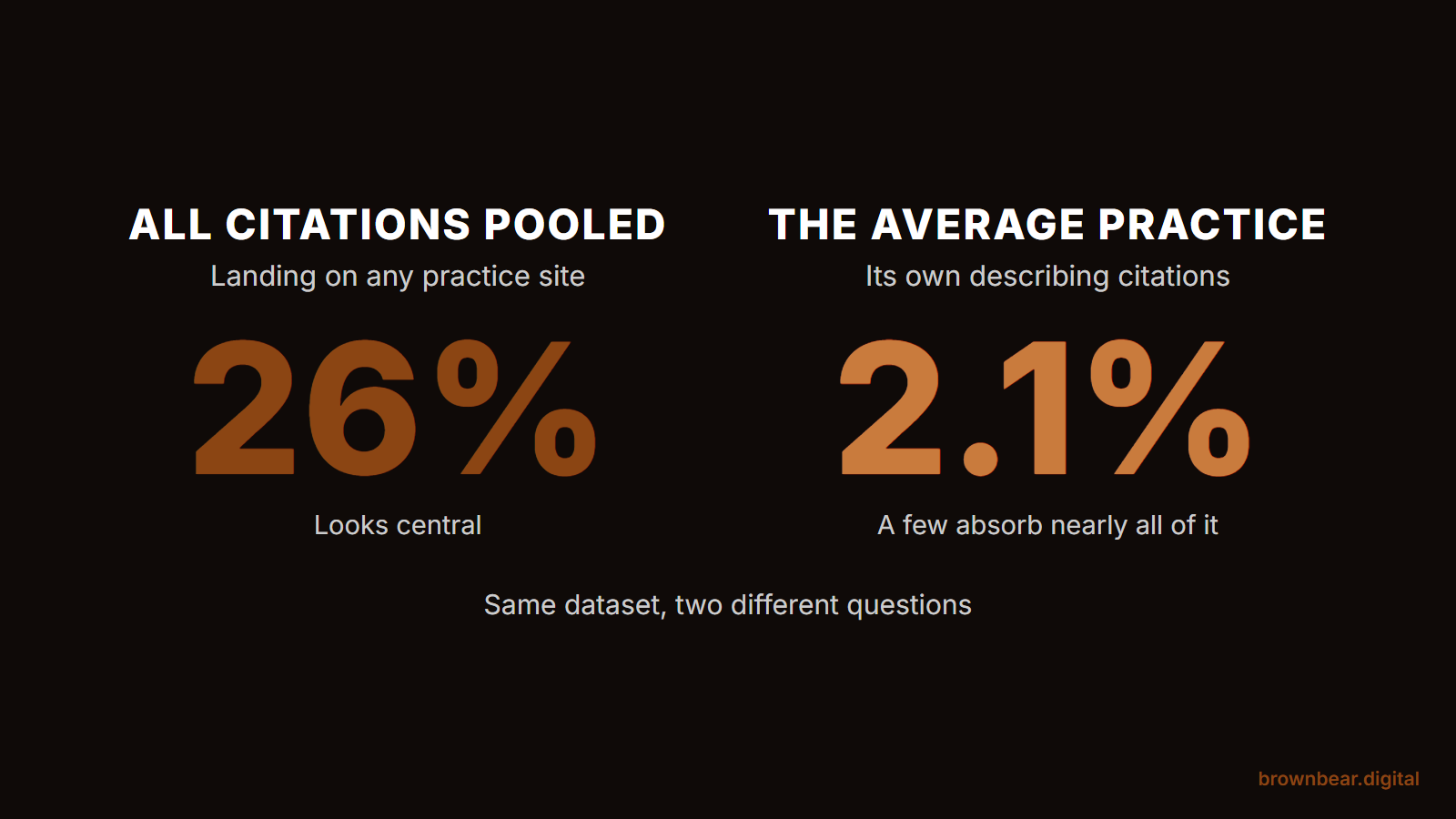
That is not a figure of speech. In a study of roughly 33,000 ChatGPT citation events, practice websites accounted for about 26 percent of all citations. But when the researchers measured the own-site share separately for each practice ChatGPT actually named, the average fell to 2.1 percent. One Phoenix dermatology practice was named 21 times across the query set. Not one of the citations behind those descriptions pointed at its own website.
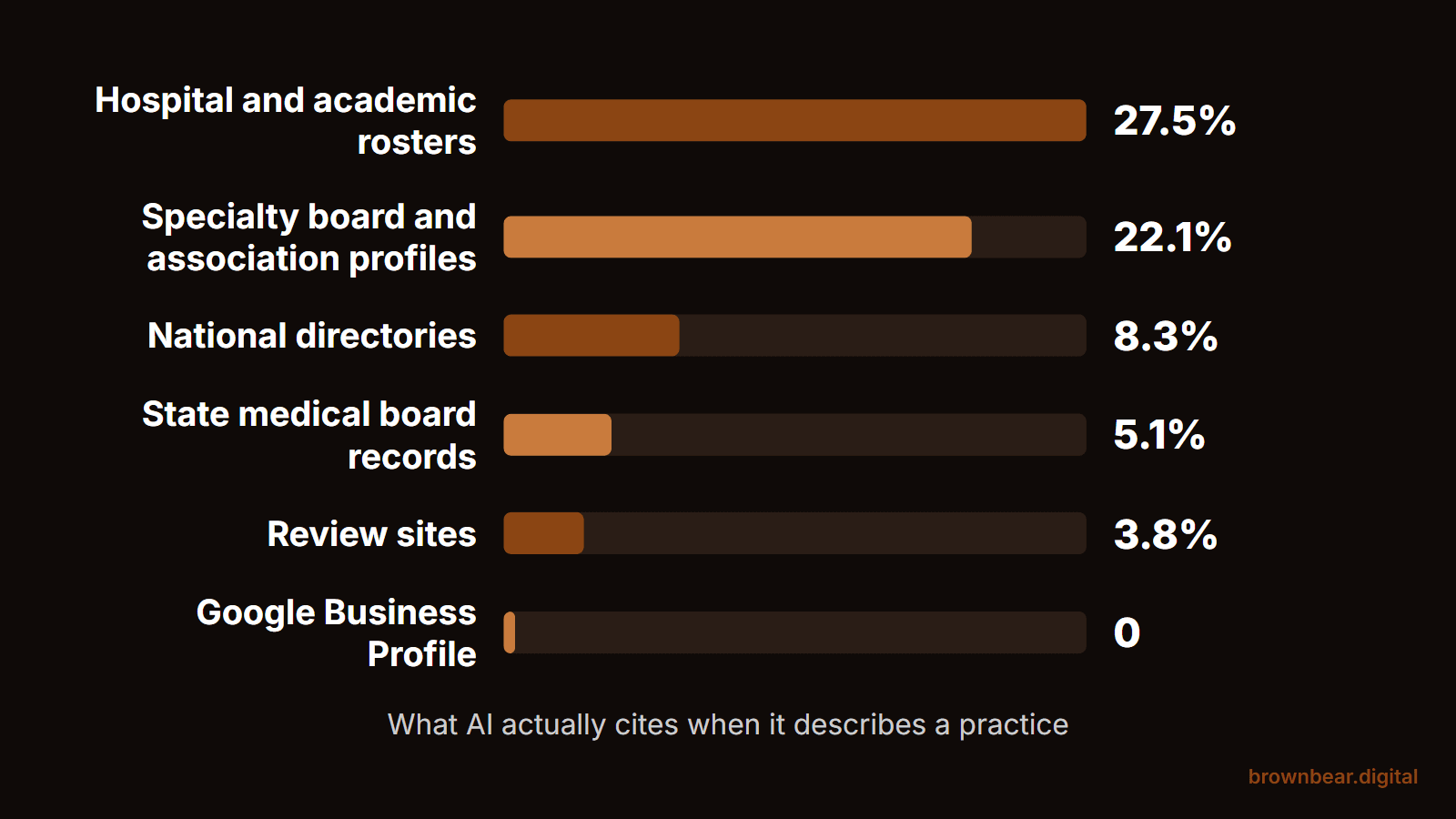
Meanwhile the standard advice tells you something else entirely. So does Google. The AI Overview that Google serves for this exact question says that patient reviews and a consistent Google Business Profile are how AI verifies and recommends a practice. In the same 33,000-citation corpus, review sites accounted for 3.8 percent. Google Business Profile accounted for none. Not a small share: no citation URL in the entire corpus pointed to one.
We run AI visibility programs for medical and plastic surgery practices, and the pattern in that data is one we have been describing to clients for over a year. What surprises owners most is not that they are invisible. It is how much of their visibility and sentiment is being driven by third-party sites they have never logged into. A large dataset has now arrived at the same place from the other direction.
This piece is for three people. If you run an independent practice and cannot work out why the hospital down the road keeps getting named instead of you, the ceiling section explains what you are actually up against. If you are the marketing lead for a multi-location group, the ledger tells you which of your dozens of profiles is doing the describing. If you hold hospital privileges or an academic appointment, you are sitting on the single largest citation source in the study and are probably not treating it as a marketing asset.
What you will have by the end: a ranked list of the sources AI actually reads about your practice, a specialty-adjusted view of how much of that you can influence, the order to fix them in, and a straight account of what none of this can change. We will also correct two numbers the industry repeats that do not survive checking.
The Description Is Not Yours
When an AI engine names your practice, two separate things happen. It decides to mention you, and then it decides what to say about you. Almost all published advice is about the first. The data says the second is where practices are quietly losing.
The 26 percent pooled figure and the 2.1 percent per-practice average are not in conflict. They describe a heavy concentration: a small number of practices absorb most of the practice-website citations, and everyone else supplies close to nothing about themselves. Read the pooled number alone and your website looks like a major input. Read the per-practice number and it becomes clear that for the typical named practice, the describing sentences are assembled almost entirely from pages someone else controls.
The researchers call this ventriloquism, and the word fits. When the third party is a current hospital roster, the description comes out polished and correct. When it is a directory still carrying an address from a job you left in 2019, the engine repeats that with exactly the same confidence.
Picture a plastic surgeon who spent eleven thousand dollars on a website rebuild last spring: new procedure pages, new photography, schema on everything. Six months later ChatGPT still describes the practice using two sentences pulled from a hospital roster written by someone in a communications office who has never met her, and a regional magazine list from 2023. Nothing about the rebuild was wrong. It simply was not the page the engine was reading.
If you have not yet established whether AI names you at all, start there instead: we published a fifteen minute test that shows whether AI names you at all, and there is no point auditing your description until you know you have one.
What AI Actually Cites When It Describes a Practice
Five sources carried roughly four in five of the 33,000 classified citations. Here they are in measured order, with the thing no competitor guide includes: whether you can actually do anything about each one.
| Source | Share of citations | Who can change it | Realistic latency |
|---|---|---|---|
| Hospital and academic rosters | 27.5% | Not you. The physician or an administrator flags errors to the medical staff office or web team | Weeks to months |
| Specialty board and association profiles | 22.1% | You, mostly. Some flow from ABMS member boards rather than from you directly | Weeks |
| National directories | 8.3% | You, via claim and correct | Days to weeks |
| State medical board records | 5.1% | You, through the board's own correction process | Varies by state |
| Review sites | 3.8% | Influence only | Ongoing |
| Your own website | 26% pooled, 2.1% for the average named practice | Entirely you | Immediate |
| Google Business Profile | 0 citations in the corpus | You, but not for this purpose | n/a |
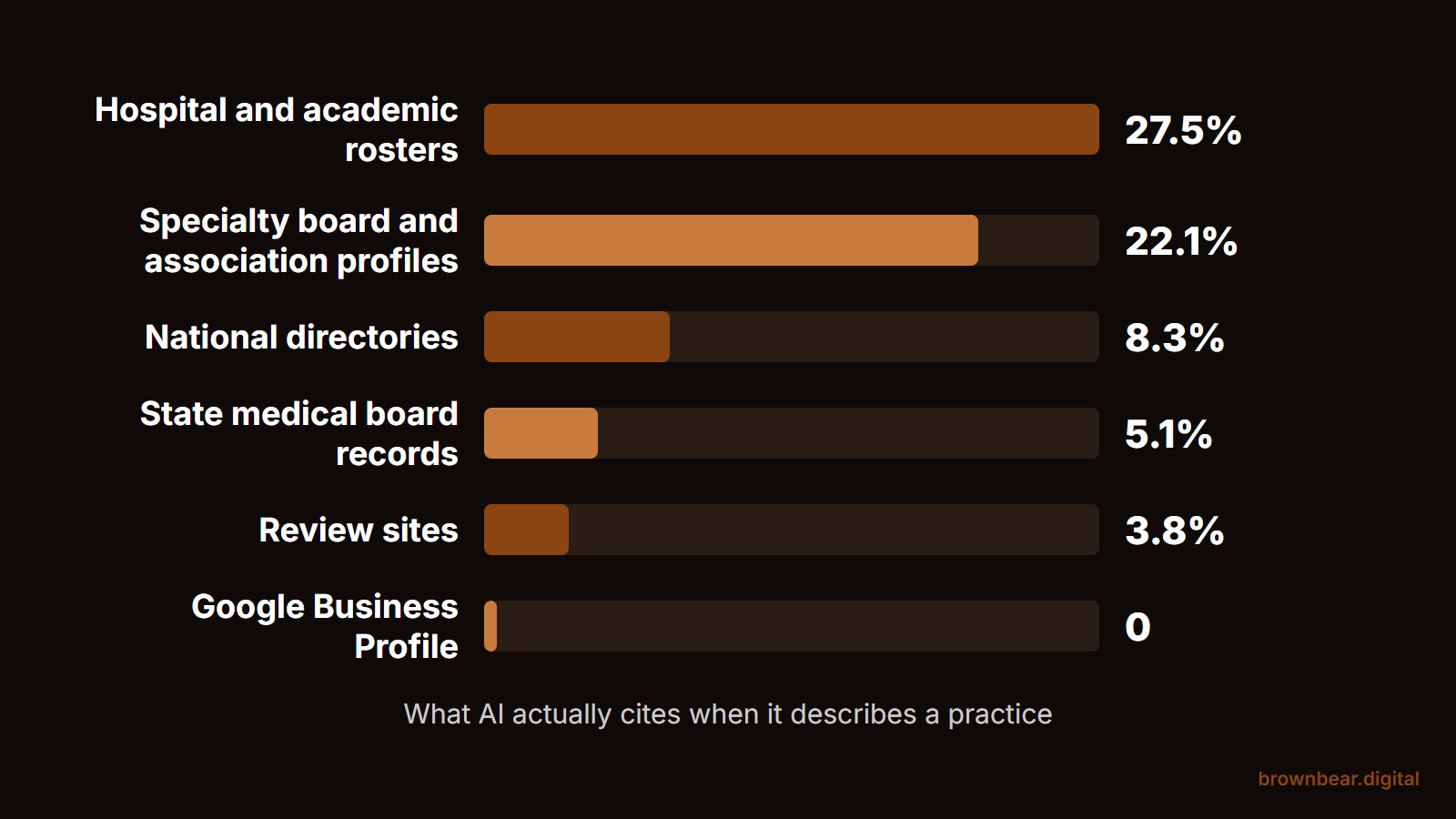
Two things fall out of that table immediately. The largest single source is the one you cannot edit. And the source most practices treat as their AI search project, the website, is the one with the widest gap between its pooled importance and its typical real contribution.
This is a retrieval problem before it is a ranking problem. The engine assembles a pool of things it can find about you, then writes from that pool. Query fan-out widens that pool further, and if you want the mechanism itself, we took one apart in how an AI Overview is assembled.
Where the Standard Advice Points in the Wrong Direction
Reviews and Google Business Profile are not worthless. They are misfiled. Both are discovery and evaluation assets: they help a patient choose you once they have found you, and a complete profile still does real work in the local pack. What the citation data says is narrower and more useful. Neither is where an engine goes to learn what to say about you.
The same applies to schema. Schema is a best practice worth keeping tidy, but it is not the lever the GEO advice claims, and a definition of GEO that holds up makes clear why. It labels information that is already on the page. It cannot put your name on a hospital roster. The bigger on-site levers remain crawlability and cleanly structured content, and we routinely strip heavy JavaScript off client sites for exactly that reason.
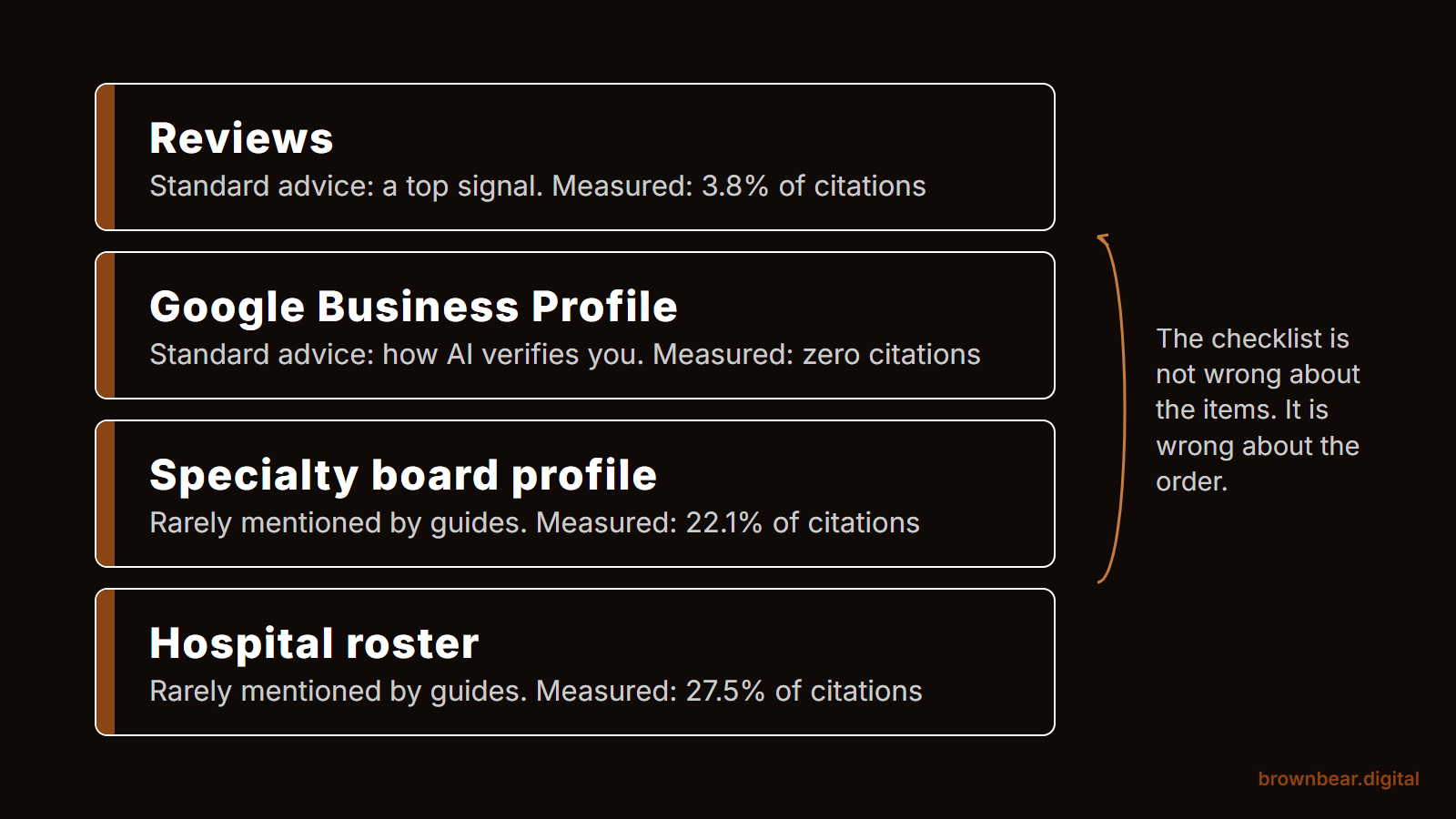
Notice what the misfiling costs. A practice that spends two quarters on review generation and profile completeness has worked hard on roughly 3.8 percent of the citation surface while the 22.1 percent that it could edit in an afternoon sits stale. That is not a small misallocation. It is close to an inversion.
Your Specialty Decides How Much of This You Control
Here the answer genuinely forks, and the deciding factor is your specialty.
In dermatology and plastic surgery, practice websites supply roughly three in ten of the describing citations. In cardiology and family medicine, that share drops to single digits. Same engine, same country, same month. A dermatologist who writes detailed procedure pages has real influence over her own description. A cardiologist doing identical work is mostly being described by institutions.
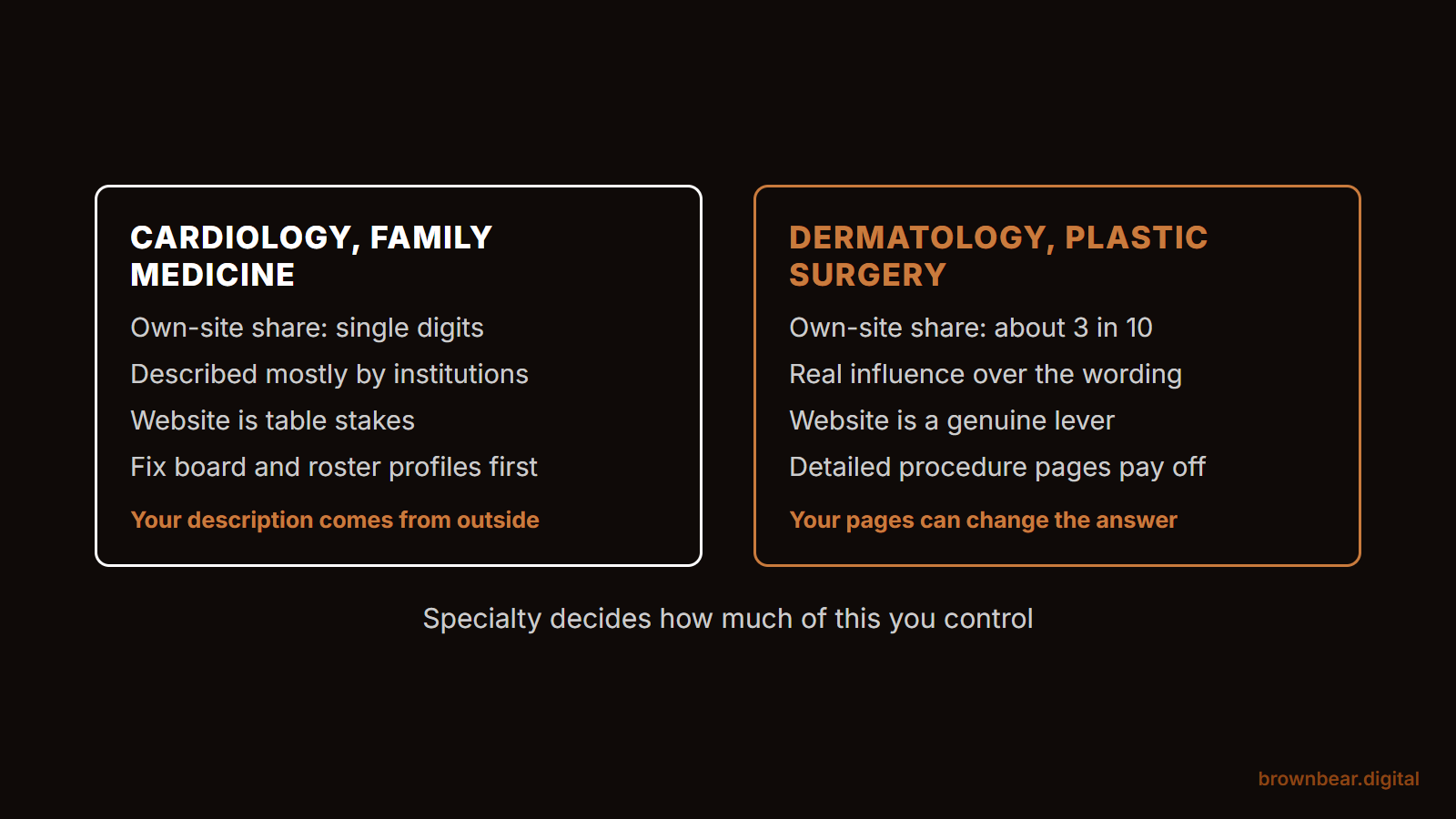
If you are in dermatology, plastic surgery, ENT or ophthalmology:
your website is a genuine lever. Detailed, specific procedure pages change what the engine can say. Write them.
If you are in cardiology, family medicine or a similarly institution-heavy specialty:
your website is table stakes, not a lever. Your afternoon is better spent on the specialty board profile, the hospital roster entry and the state licence record, because that is where your description is actually coming from.
There is a second, stranger split worth knowing. The same research programme found that plastic surgery, cardiology and family medicine sat at the bottom for how often an independent practice got named at all, around 8 percent, while dermatology, ENT and ophthalmology led at 16 to 17 percent. So a plastic surgery practice is comparatively unlikely to be named, but comparatively well positioned to control the description when it is. Those are two different problems and they need two different budgets.
Your Metro Sets a Ceiling You Did Not Choose
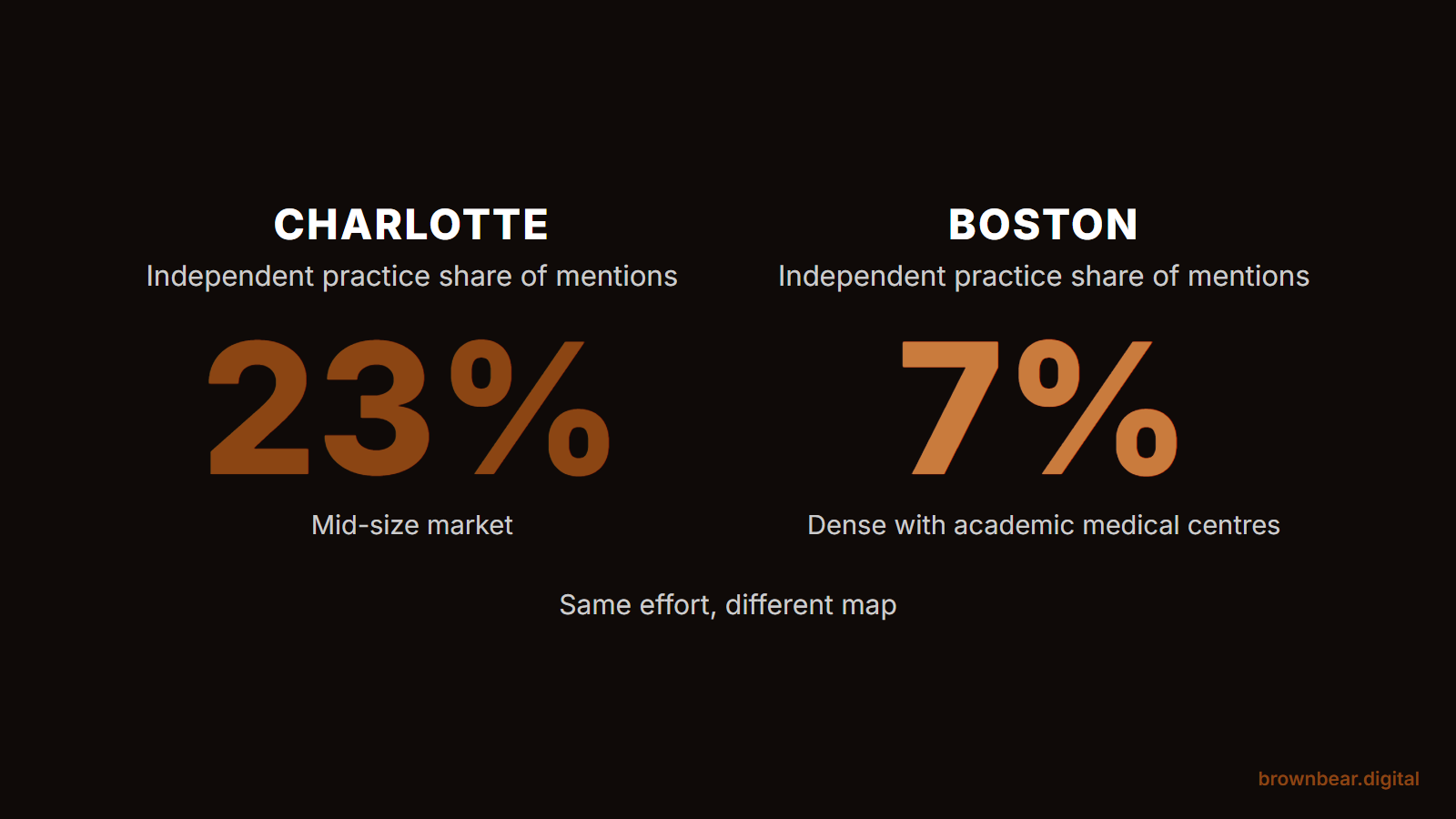
The second fork is geographic, and it is the one practice owners find hardest to hear. Independent practice organisations took 23 percent of mentions in Charlotte and 7 percent in Boston. The thinnest shares appear in metros dense with academic medical centres. A solo practice in Boston is not underperforming a solo practice in Charlotte. It is playing a harder map.
Regional lists behave the same way. Regional magazine Top Doctors pages produced substantially more citations than the better-known national ranking brands, including lists published several years earlier, and they are strongly metro-specific: San Diego, Seattle, Washington and Boston produced repeated citations while New York and Los Angeles produced almost none.
Picture two orthopaedic practices of identical quality, one in Seattle and one in Los Angeles. The Seattle practice gets nominated for a regional magazine list, and that page keeps generating citations for three years. The Los Angeles practice does everything the same and the equivalent list never surfaces. The difference is not effort. It is which publication happens to carry weight in that market.
If you are in a mid-size market:
find the publication that runs your metro's list, learn who administers it, confirm eligibility, and put the nomination deadline on the annual calendar. It is one of the cheapest citation sources available to you.
If you are in New York or Los Angeles:
do not spend the quarter chasing a list that generates almost nothing. Put the same hours into board profiles and roster accuracy.
The Stale Address Problem
The single most common defect the researchers found was not missing content. It was a stale address left behind by a former employer.
Say a cardiologist leaves a hospital, opens an independent practice across town, and updates her website the same week. Her specialty board profile still lists the hospital's address. Two years later a patient asks ChatGPT where to find her, and the engine confidently supplies an address she has not worked at since 2024, because the page it read was never hers to begin with. Updating the website does not touch it. The page being cited lives somewhere else.
This is the finding that matches our own audit pattern most closely. The most common genuine error we turn up in an AI visibility audit is not wrong clinical information. It is odd variations of practice name, address and phone number scattered across profiles, and it is usually straightforward to fix once someone actually goes looking.
When an engine has already got you wrong, correcting the record is its own process, and we walked through correcting the record when an engine describes you wrongly separately.
Fix Them in This Order
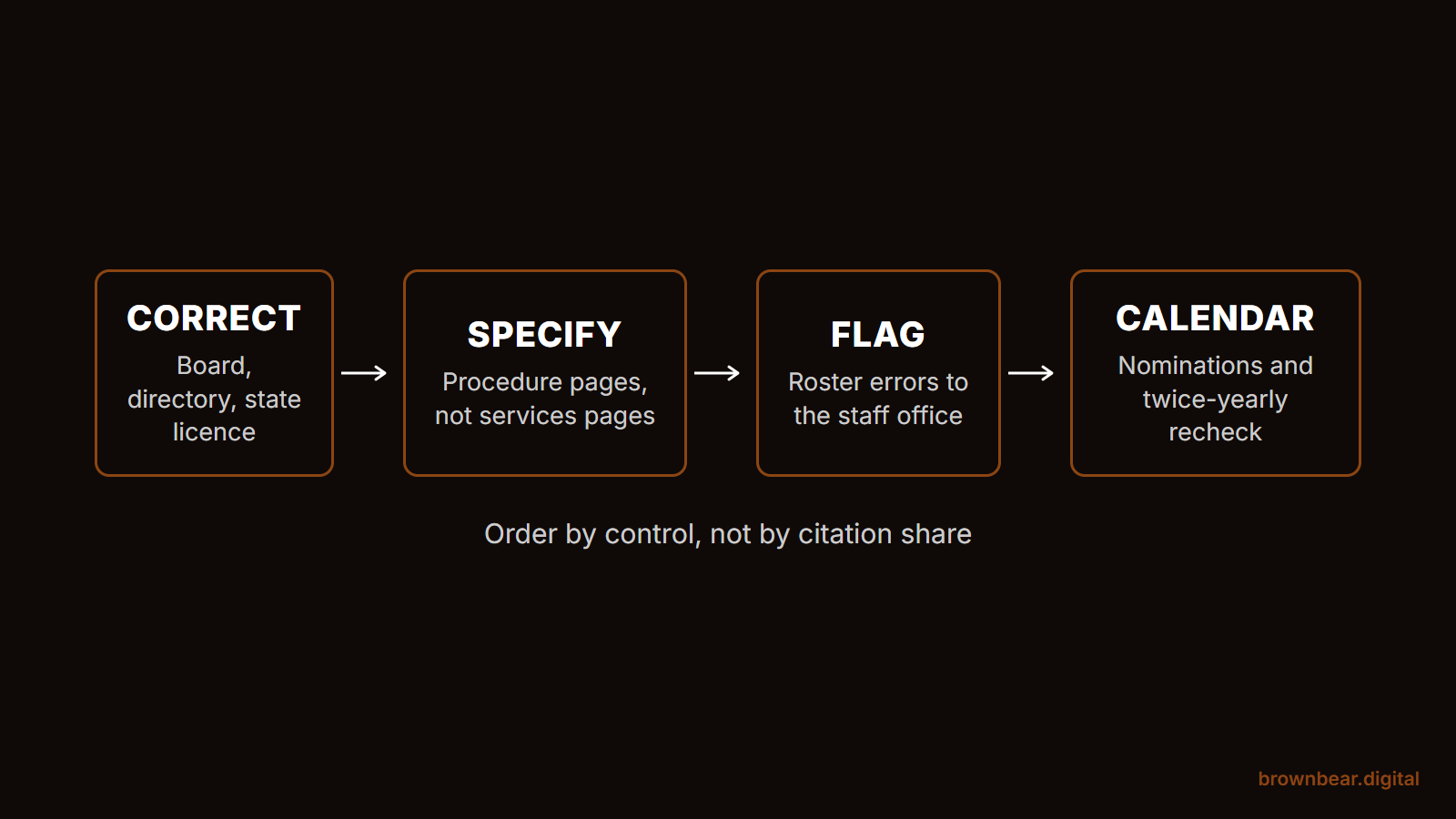
Order by control, not by citation share. The largest source is the one you cannot edit, so leading with it wastes the first month.
-
Correct factual errors on the profiles you can reach today: specialty board, association directory, national directories, state licence record. Errors first, expansion later. Auditing the outside profiles for one physician is roughly an afternoon.
-
Make your own pages specific. A services page tells an engine you offer knee surgery. A procedure page tells it which conditions you treat, how the procedure works, who is a candidate, and what training you bring. If you are in a high own-site specialty this is your highest-value hour. If you are not, do it anyway, but do it second.
-
Flag what you cannot edit. Send the hospital or academic roster corrections to the medical staff office in writing, and expect it to take weeks.
-
Calendar the recurring items: the annual Top Doctors nomination deadline, and a twice-yearly re-check of every profile in step one.
If you want the wider strategic frame around this work, it sits inside the full GEO and AEO playbook, and what the investment case looks like at three budgets covers how to fund it.
The Conversion Stat Everyone Quotes Is Not a Healthcare Stat
You will see a specific pair of numbers in almost every medical AI search pitch: AI referrals convert at 27 percent, organic search at 2.1 percent. It is quoted as though it were a healthcare finding. It is not.
The real published comparisons come from other industries entirely. One benchmark of 312 business technology firms found AI-referred visitors converting at 14.2 percent against 2.8 percent for Google organic. An analysis of more than 1,200 publisher and news sites found 1.66 percent against 0.15 percent. Ahrefs reported AI referrals at 0.5 percent of sessions producing 12.1 percent of signups. Different verticals, different conversion events, different measurement windows, and not one of them a medical practice.
The directional claim survives: AI-referred visitors do appear to convert at a multiple of organic across every dataset that has looked. That matches what we see, and it is why LLM referral quality is the KPI we report to clients rather than raw AI traffic. But a specific decimal borrowed from business software and presented to a practice owner as their expected conversion rate is not evidence. If a vendor quotes you 27 percent, ask which study, which industry, and which conversion event. The answer will tell you a great deal about the vendor.
The Reddit Advice Nobody Prices Out
A common recommendation is to build a Reddit and forum presence because AI engines cite community content. The first half is true and the second half needs numbers.
Across 824,997 citations from generic health questions, Reddit accounted for 1.35 percent. The engines also differ sharply: ChatGPT drew 1.9 percent of its health citations from social and user-generated content, while Google's AI Overviews drew 8.5 percent. So the tactic is close to irrelevant for ChatGPT and materially more relevant for Google's surfaces.
Then there is the part the advice never mentions. Reddit upvotes are openly sold from roughly one to five cents each, comments from about ten cents, and aged high-karma accounts start around five dollars. A visible position in a community thread is purchasable at trivial cost, which cuts both ways: it is a channel where a competitor can manufacture standing cheaply, and one where a practice that participates inauthentically risks a platform ban and a screenshot. Given the YMYL bar medical content is held to, that is an unusually poor risk-to-reward trade for a clinical brand.
Participate if a physician genuinely wants to answer questions in public under their own name. Do not buy your way into a thread, and do not treat community presence as a substitute for the 22.1 percent sitting in your board profile.
What This Cannot Fix
Being cited is not the same as being mentioned, and being mentioned is not the same as being chosen. Correcting every profile you can reach will not overcome a structural disadvantage in specialty, market or affiliation. Across nine patient-question patterns, independent practice organisations sat between 7 and 17 percent of mentions and were never the largest group in any cohort. Hospital-affiliated physicians were the largest in four of nine, at 41 to 55 percent.
If you hold privileges or an academic appointment, the third fork applies to you and it is good news: the largest citation category in the study is a page with your name already on it. Most practices never think to check it. Read your roster entry this week.
The evidence has limits worth stating plainly, because nobody else on this topic states any. The citation research covers ChatGPT only, in the United States, in May 2026, on one model version. Gemini, Perplexity and Google's AI Overviews may weight sources differently, and the 8.5 percent social figure above suggests they do. The findings are correlational. The source map covers practices the engine already surfaced, which biases it toward practices it was more likely to name. And it was produced by a vendor selling into this market, which is a reason to read the methodology rather than to dismiss the numbers, but it is a reason to read the methodology.
None of that makes the direction wrong. It makes confident promises about it dishonest. The wider cluster of work sits in the wider AI search strategy cluster if you want the surrounding tactics.
How to Tell If Any of It Worked
Track three things separately, because collapsing them is how practices end up unable to say whether a year of spend did anything.
First, citations: which pages an engine draws on when it describes you. Ask the engine to describe your practice and then ask it for its sources, and count how many of those you control. Against a 2.1 percent average, anything above roughly ten percent means your own pages are genuinely in the mix.
Second, mentions: whether you are named at all for the questions patients actually ask. Third, referrals and consultations, which is the only one that pays for anything.
For the tooling side of this, tracking brand mentions across engines covers the setup. Give any of it two quarters before judging it. Correcting a profile is fast; getting an outside organisation to publish the correction is not.
Frequently Asked Questions
Does Google Business Profile help my practice show up in AI search?
Not for the description. In the 33,000-citation study, no citation URL pointed to a Google Business Profile. It remains valuable for the local pack and for patients evaluating you, so keep it accurate, but it is not what an engine reads to learn what to say about you.
Do patient reviews affect whether AI recommends my practice?
Less than the advice suggests. Review sites were 3.8 percent of citations. Reviews do their work after a patient has found you.
Why does ChatGPT keep naming the hospital instead of my practice?
Because hospital and academic rosters were the largest citation category at 27.5 percent, and hospital-affiliated physicians were the largest mention group in four of nine question patterns at 41 to 55 percent. It is a structural bias in the source pool, not a judgement about your care.
Should I hire a vendor for AI visibility?
Audit the five sources first. Most of the work in the first month is factual correction on profiles you can reach yourself, and knowing what is already wrong makes you much harder to oversell.
How long before a correction shows up in an AI answer?
Longer than you want. Your own pages are immediate. Board and directory corrections take weeks and depend on the organisation. Roster changes depend on someone else's web team. Two quarters is a fair evaluation window.
Work With Brown Bear on Your Practice's AI Visibility
Most practices we audit are not badly described by AI. They are described by strangers, from pages they have never opened, using details that were accurate two employers ago. The fix usually starts as unglamorous data hygiene across five specific sources, and only then becomes a content problem.
If you want to know which pages are currently writing your practice's description, and which of them you can actually change, talk to us about an AI visibility audit. We will tell you what is worth your quarter and what is not, including when the answer is that your specialty and market make the ceiling lower than a vendor promised you.
Sources: the citation-share and description findings come from Halcy's ChatGPT citation research, published in Medical Economics as the description-source findings and the five-source audit, and in MGMA. Provider registry data referenced throughout is public via the NPPES NPI registry, and board certification status via Certification Matters.
Written By
Founder, Brown Bear Digital
Bryan has 15 years of experience across SEO, paid search, and AI search strategy. He founded Brown Bear to give businesses direct access to senior-level search expertise without the agency overhead.
Learn More About BryanGet Found on Google.
Get Cited by AI.
Tell us about your site. We'll send back a proposal for SEO and AI search.