How to Improve Visibility in Google AI Overviews
This is a plain-language guide to getting your pages cited inside Google's AI Overviews, built on what the 2026 evidence actually shows rather than the checklist that keeps circulating.
We pulled from Google's own optimization guidance, updated in July 2026, and from three large-scale studies published this year. One of them tested whether schema markup does anything for AI citations at all. Where the evidence and the popular advice disagree, we say so and show the numbers.
When we say visibility in AI Overviews, we mean two separate jobs: being retrieved as a candidate source, and being quoted in the answer that gets shown. Most guides treat these as one thing. They are not, and the gap between them explains most of the confusion around this topic.
If your rankings held steady this year while your traffic slid, you already know something changed and the reports are not telling you what. If you are in-house and someone keeps asking why a competitor shows up in the box and you do not, that question has a real answer. And if you already did the answer-first paragraphs and the FAQ schema and watched nothing move, there is a reason for that too.
By the end you will know which of three citation lanes your site is actually in, which parts of the standard advice the data supports, which parts it does not, and how to tell whether a given citation is even worth chasing. We have grouped it into four parts: what decides the citation, the retrieval mechanic almost nobody optimizes for, the tactics worth keeping and the ones worth dropping, and the economics of the win itself.
Start with the question underneath all of it: what is Google actually choosing between when it builds that box?
What Actually Decides Whether Google Cites You
Google builds an AI Overview by running your query through its normal ranking systems, retrieving a set of candidate pages, then generating an answer grounded in what those pages say. That process is called retrieval-augmented generation, and Google describes it in its own documentation. Two things follow from it, and they matter more than any single tactic.
First, you cannot be cited if you are not retrieved, and you are not retrieved unless you are indexed and eligible for snippets. Second, being retrieved is not the same as being quoted. The model still has to find a passage on your page it can lift cleanly, and it still has to prefer yours over the other candidates it pulled.
That is the whole mechanism. Everything else in this guide is about improving your odds at one of those two steps. If you want the structural breakdown of the box itself, we covered what the box is actually made of separately.
The Ranking Assumption Just Broke
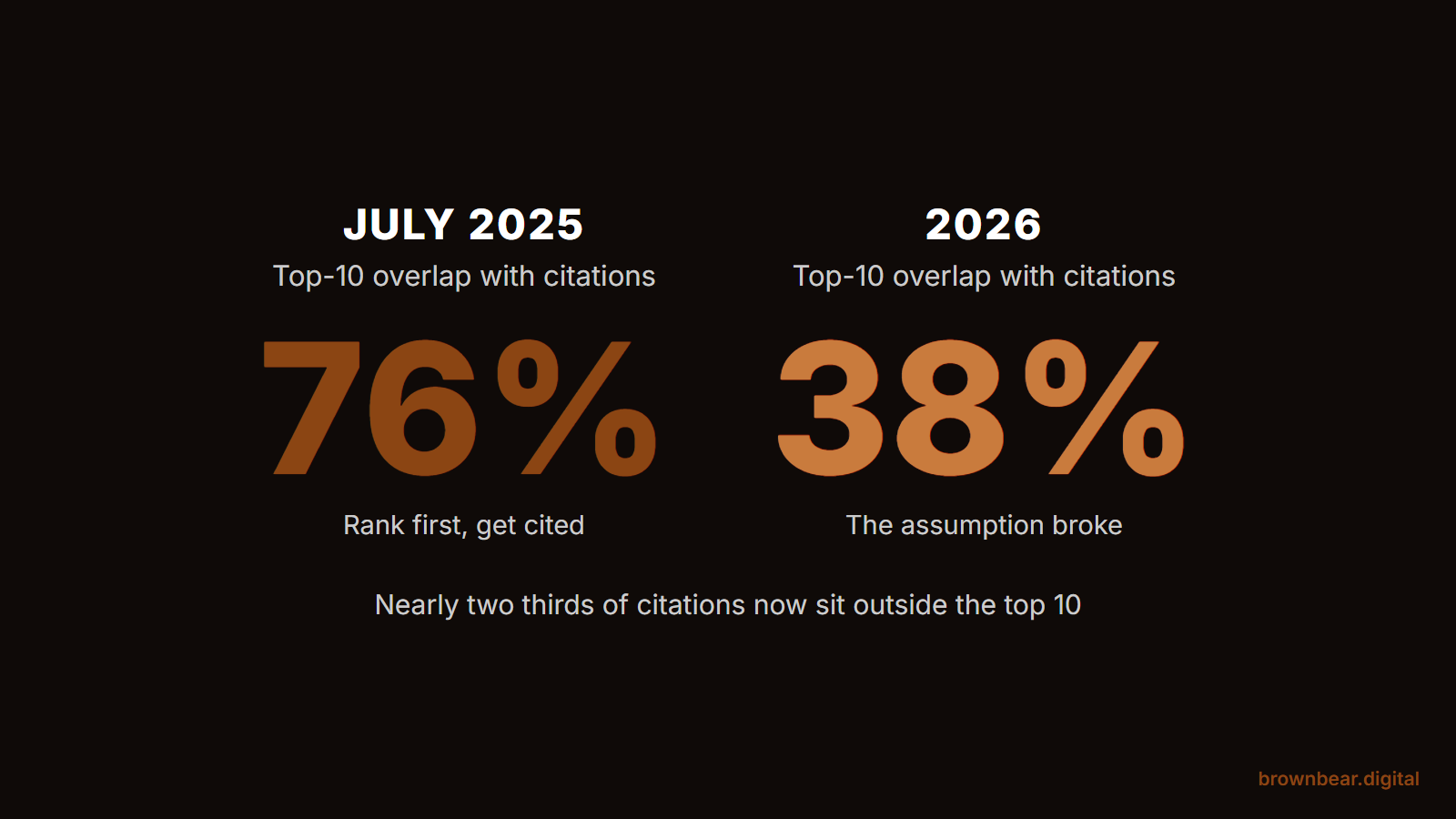
The single most common piece of advice on this topic is: rank in the top 10 and the citation follows. In mid-2025 that was close to true. In 2026 it is a minority case.
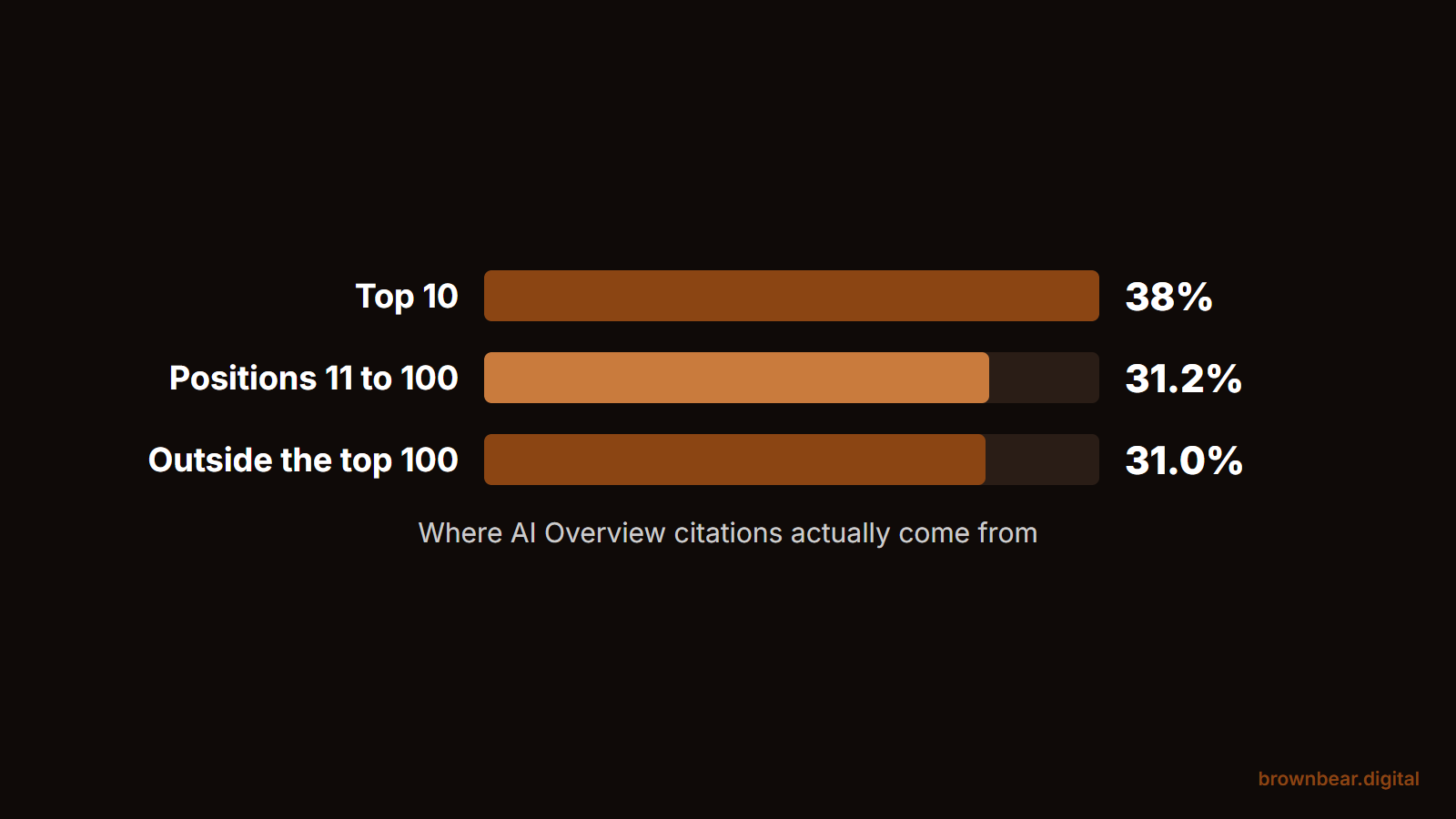
Ahrefs analyzed 863,000 keywords and 4 million AI Overview URLs in a study published in March 2026. Of the pages cited in AI Overviews:
- 38% also ranked in the top 10 for that query
- 31.2% ranked somewhere in positions 11 to 100
- 31.0% did not rank in the top 100 at all
Ahrefs' own earlier study, published July 2025 across 1.9 million citations, put the top-10 overlap at 76%. The company notes that improved citation parsing accounts for part of the difference, so the two numbers are not a clean before-and-after. Even taking the caveat seriously, the current snapshot is the part that matters for planning: roughly six in ten AI Overview citations go to pages that are not in the top 10 for the query being asked.
That reframes the whole problem. Ranking is one lane into the box. It is the lane every guide points at, and it is the smallest of the three.
Query Fan-Out Is the Part Nobody Optimizes For
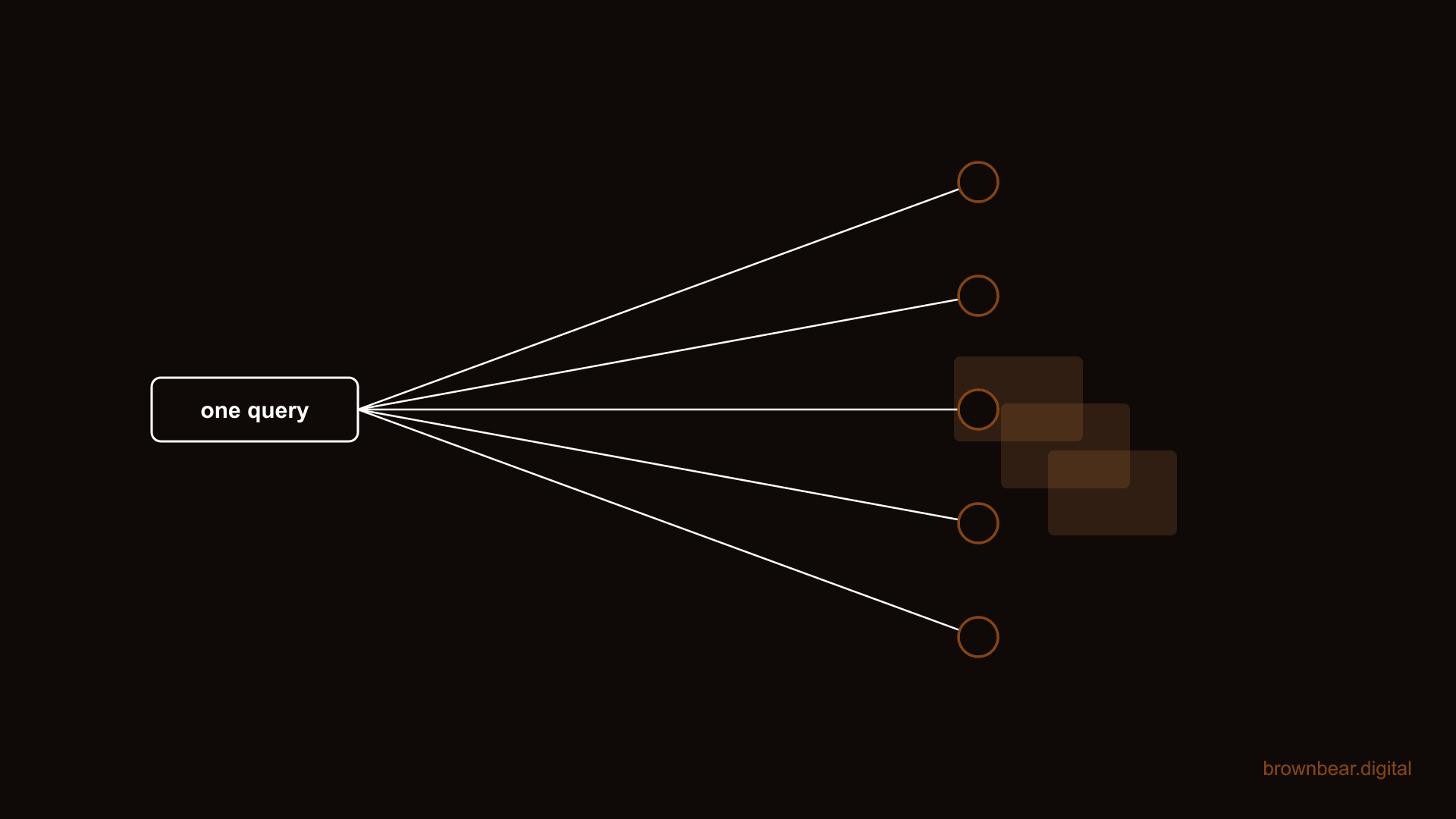
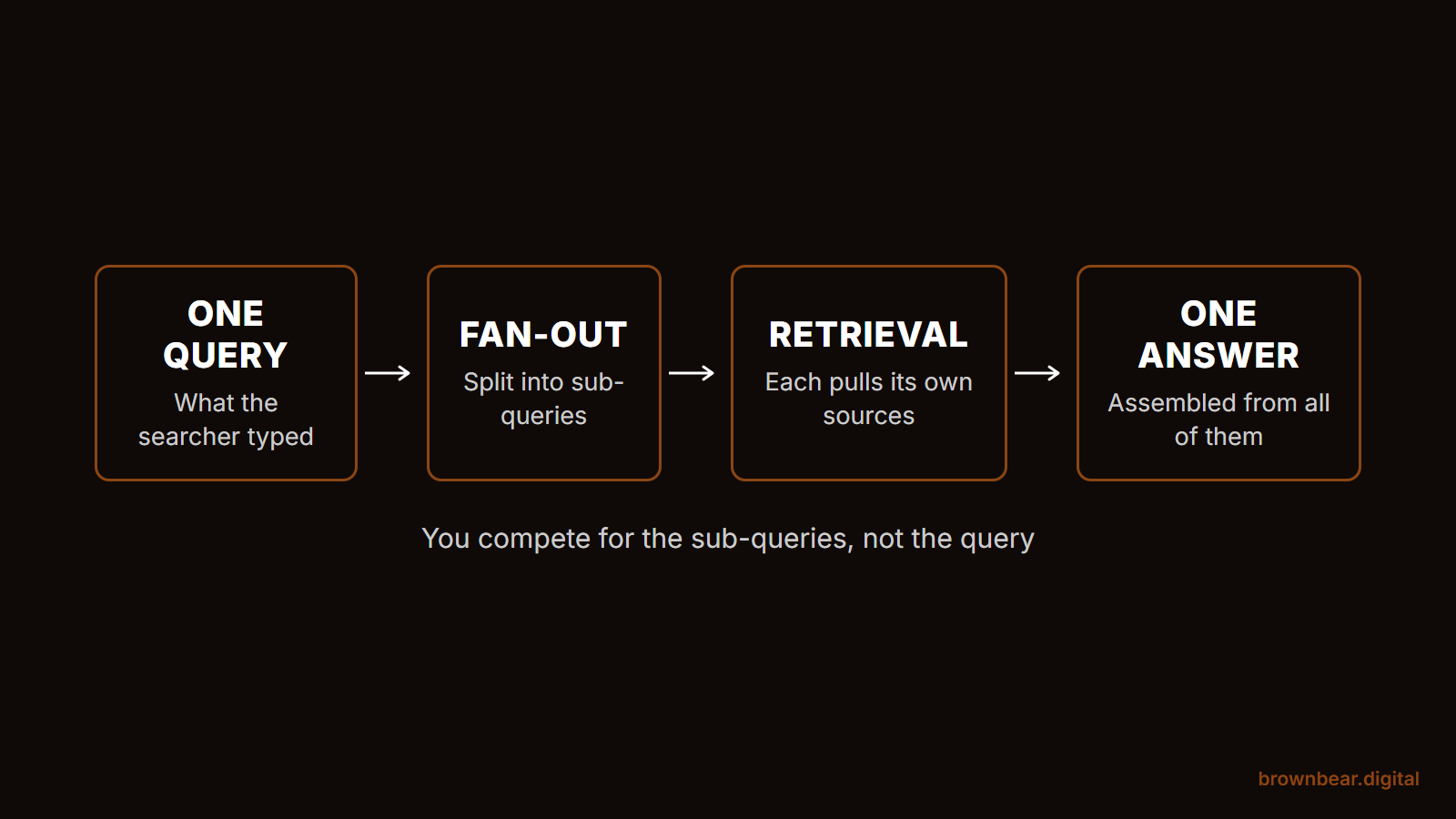
Google does not retrieve sources for the question the user typed. It splits that question into several related sub-queries, runs those concurrently, and retrieves against all of them. Google calls this query fan-out and describes it plainly: searching how to fix weeds also triggers queries for best herbicides and prevent weeds.
This is the mechanic that explains the numbers above. A page that does not rank for the head term can still be the best available answer to one of the sub-queries behind it, and that is enough to earn the citation. You are not competing for the query. You are competing for the set of queries Google generates behind it.
Picture a rhinoplasty practice that ranks fourth for "rhinoplasty recovery time" and never appears in the AI Overview. Behind that query Google is also asking what rhinoplasty recovery looks like week by week, when swelling goes down, when patients can return to work, and what makes recovery longer for some people. The practice has one page, and it answers the first of those five. A hospital system with a page on post-operative swelling timelines answers the second, ranks nowhere near the top 10 for the head term, and gets quoted. Nothing about the practice's ranking was the problem. Recovery content built for those sub-questions is a core piece of rhinoplasty marketing.
Two consequences worth acting on. Broad topical coverage stops being a vague goal and becomes a countable one: how many of the sub-queries behind your target term do you have a direct answer for? And brand salience starts to matter in a specific way, because the more sub-queries you are a plausible source for, the more often you land in a retrieval set at all.
Build Your Fan-Out Map
The practical version of the above is a map: reconstruct the likely sub-query set behind a term you want, then mark which of those you already answer. The gaps are your work list, in priority order, and they are usually cheaper to close than a ranking improvement.
One caution on how to read it. Google does not publish the actual sub-queries it runs, so any fan-out map is a model of the system rather than a readout of it. What it gets right is the shape: definitional, procedural, evaluative, comparative, and cost passes show up across almost every fan-out set, and most content libraries cover two of them and skip the rest.
What Google Tells You to Do, In Its Own Words
Google published a dedicated guide to optimizing for its generative AI features, last updated 10 July 2026. Its recommendations are shorter and blunter than most of what is written about them. The core of it:
- Be indexed and snippet-eligible. Pages excluded from snippets are excluded from AI features. This is a hard gate, not a ranking factor.
- Create non-commodity content. Google's phrasing: do not recycle what others have already said, or what a generative model could easily produce itself.
- Keep a clean technical structure. Crawlable, JavaScript-safe, minimal duplication, good page experience.
- Use images and video where they genuinely help. Multimodal content is retrieved alongside text, not instead of it.
- Handle local and commerce details properly. Business Profile and Merchant Center feeds carry product and location visibility.
Google's own summary line is worth quoting because it undercuts most of the industry's framing: creating content people find unique, compelling and useful will likely influence your presence in generative AI search more than any other suggestion. You can read the full guidance in Google Search Central's optimization guide.
What Google Tells You to Skip
The more useful half of that guide is its mythbusting section, and almost nobody quotes it. Google explicitly says you do not need to:
- Create an llms.txt file or any other AI-specific markup file
- Chop your content into small chunks for easier machine parsing
- Rewrite existing content specifically for AI systems
- Pursue inauthentic mentions across the web
- Treat structured data as a requirement for AI features
Google also states that no third-party tool has access to its internal ranking or AI systems, which is worth remembering the next time a vendor shows you an AI visibility score with a methodology it will not explain. Reading through the proposals practices bring us, the distance between what gets sold as an AI-search deliverable and what the evidence behind it actually supports is routinely wide. We sorted the full tactic list by what the evidence actually supports if you want the tier-by-tier version.
The Schema Question, Settled by the Only Controlled Study
Structured data is the most-recommended tactic in this SERP and the least supported by evidence. The only controlled test of it found no benefit.
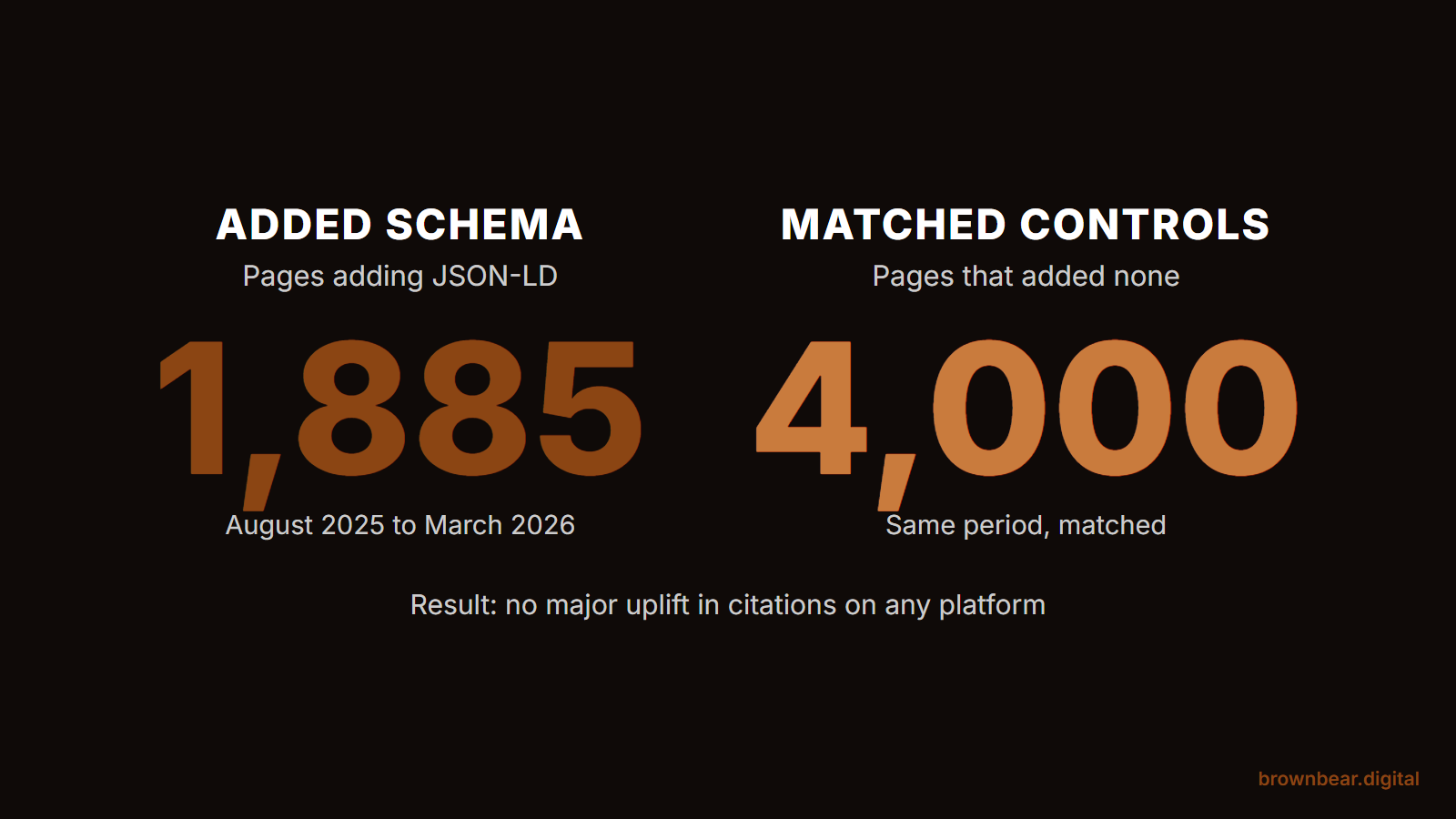
Ahrefs published a difference-in-differences study on 11 May 2026. It tracked 1,885 pages that added JSON-LD schema between August 2025 and March 2026, matched them against 4,000 control pages that did not, and measured citation changes. The results:
| Platform | Effect on citations | Reading |
|---|---|---|
| Google AI Overviews | −4.6% | Small but statistically significant decline against matched controls |
| Google AI Mode | +2.4% | Statistically indistinguishable from zero |
| ChatGPT | +2.2% | Statistically indistinguishable from zero |
The authors' conclusion: adding schema produced no major uplift in citations on any platform.
One caveat matters and the study states it plainly: it looked only at pages already receiving 100 or more AI Overview citations per month. It cannot tell you whether schema helps a page that is not being cited yet. So the finding is narrower than the headline suggests. What it does rule out is the idea that adding schema lifts a page that is already visible.
Google's position lines up with this. Structured data earns rich results in classic search, which is a real and separate benefit. It is not a requirement for AI features. Our position on schema has not changed since we first put it in the oversold tier: mark up what earns you a rich result, and stop billing schema work as AI visibility work.
Say you are reviewing a proposal that puts 20 hours into FAQ and HowTo markup across a content library as the centerpiece of an AI visibility engagement. On this evidence, that is 20 hours buying a rich-result benefit you may or may not want, sold as something it has not been shown to do. The same 20 hours spent closing four fan-out gaps buys you eligibility you did not have.
Structure a Page So the Model Can Lift an Answer
Retrieval gets you into the candidate set. Format decides whether you get quoted. The rule is narrow: state the answer in plain declarative language in the first 30 words under a heading that matches how the question is asked.
What that looks like in practice:
- Headings that match the sub-query. "How long rhinoplasty swelling lasts" beats "Recovery Considerations." The heading is a retrieval signal, not decoration.
- Answer first, context after. If the reader has to get through a paragraph of setup, so does the model, and it usually gives up and takes someone else's sentence.
- Specific numbers over ranges you hedged. "Most swelling resolves in three to four weeks" is liftable. "Recovery varies by patient" is not.
- Tables where you are comparing things. Comparison tables get pulled intact more often than the prose around them.
None of this requires rewriting your site for machines, which Google explicitly says not to do. It is the same clarity that helps a reader who is skimming. We went deeper on how models lift a clean answer off the page in a companion piece.
Why You Can Rank Second and Never Get Cited
This is the most common unanswered question in the community record on this topic, and it has three realistic causes. Work through them in order.
1. You cover the head term and almost none of the fan-out.
Ranking second for the query only makes you eligible for the sub-set of retrievals that use the query verbatim. If your library answers one of eight sub-queries, you will appear occasionally and vanish without explanation, because a slightly reworded search shifts the fan-out set away from your coverage.
2. Your answer is there but not extractable.
The information is on the page, buried in the fourth paragraph of a section whose heading does not match the question. The model retrieved you and took someone else's sentence.
3. Google is not confident about what you are.
Entity clarity is unglamorous and it matters: consistent business naming, a clear about page, third-party mentions that corroborate what you claim. A source Google cannot resolve confidently is a source it can skip without cost.
Consider an agency that ranks first or second for its category term and never gets cited, while competitors with thinner content do. Every competitor has published the same listicle with themselves at number one. From a retrieval standpoint they are interchangeable, so Google reaches past all of them for sources answering the sub-queries none of them touched: what the service costs, how to evaluate providers, what questions to ask. The winner is not the best-ranked page. It is the only page answering a different question.
Before any of this, confirm the basics: if AI crawlers cannot render your pages, none of it applies. We covered giving them a clean way in for AI crawlers in detail.
The Citation Lanes You Are Not Playing In
The three-way split in the Ahrefs data is not three degrees of the same thing. It is three different routes into the box, and most sites are competing in one of them.
The top-10 lane carries 38% of citations and rewards ranking. The deep-index lane carries 31.2% and rewards coverage: pages sitting at position 40 for the head term get pulled in constantly because they answer a sub-query cleanly. The third lane carries 31.0% and is the one almost nobody works, because it goes to sources that do not rank in the top 100 for the query at all.
Video is the most reliable route into that third lane. In the same Ahrefs data, 18.2% of citations coming from outside the top 100 were YouTube URLs, and YouTube accounted for 5.6% of all AI Overview citations. A video does not have to outrank anyone's page to be retrieved. It competes on its own terms.
Picture a dentist who has written the same implant cost article as every competitor in the metro, sitting at position 12. One six-minute video walking through what the consultation covers, published to YouTube with a transcript, enters a retrieval pool the article was never in. It is not a better article. It is a different lane, and it is one of the first moves we make for the offices we serve as a dental SEO agency.
If you are on the fence about production, we mapped out where to put video on a practice site. One qualifier: if you are in health, medicine, finance or law, expect a stricter citation bar across every lane. Named authors, credentials and citable sources carry more weight in those categories than anywhere else.
Measure It in Search Console Without Fooling Yourself
Google launched dedicated generative AI performance reports in Search Console in June 2026, rolling out to a subset of sites rather than all at once. They give you impressions and clicks from AI Overviews and AI Mode as a separate view. That is genuinely new, and it comes with a trap.
Impressions in that report will look excellent, because appearing in an AI Overview counts as an impression regardless of whether anyone reads past the summary. Treating that number as a win is the single most common measurement mistake we see right now.
Three things to watch instead:
- Citation share on the queries you care about. Not impressions across everything, but presence on the ten to twenty queries that actually generate enquiries.
- Referral traffic from AI sources. We track LLM referrals as a standing KPI for clients, and it is the only number in this space that maps cleanly to pipeline.
- Whether the summary describes you correctly. A citation attached to a wrong or outdated description of your practice is a liability, not a win.
None of that requires paid tooling to start. We published a repeatable tracking system you can run manually.
Decide Whether the Citation Is Worth Winning
Every other guide on this topic assumes the answer is yes. Sometimes it is not, and knowing which is which is worth more than another round of optimization.
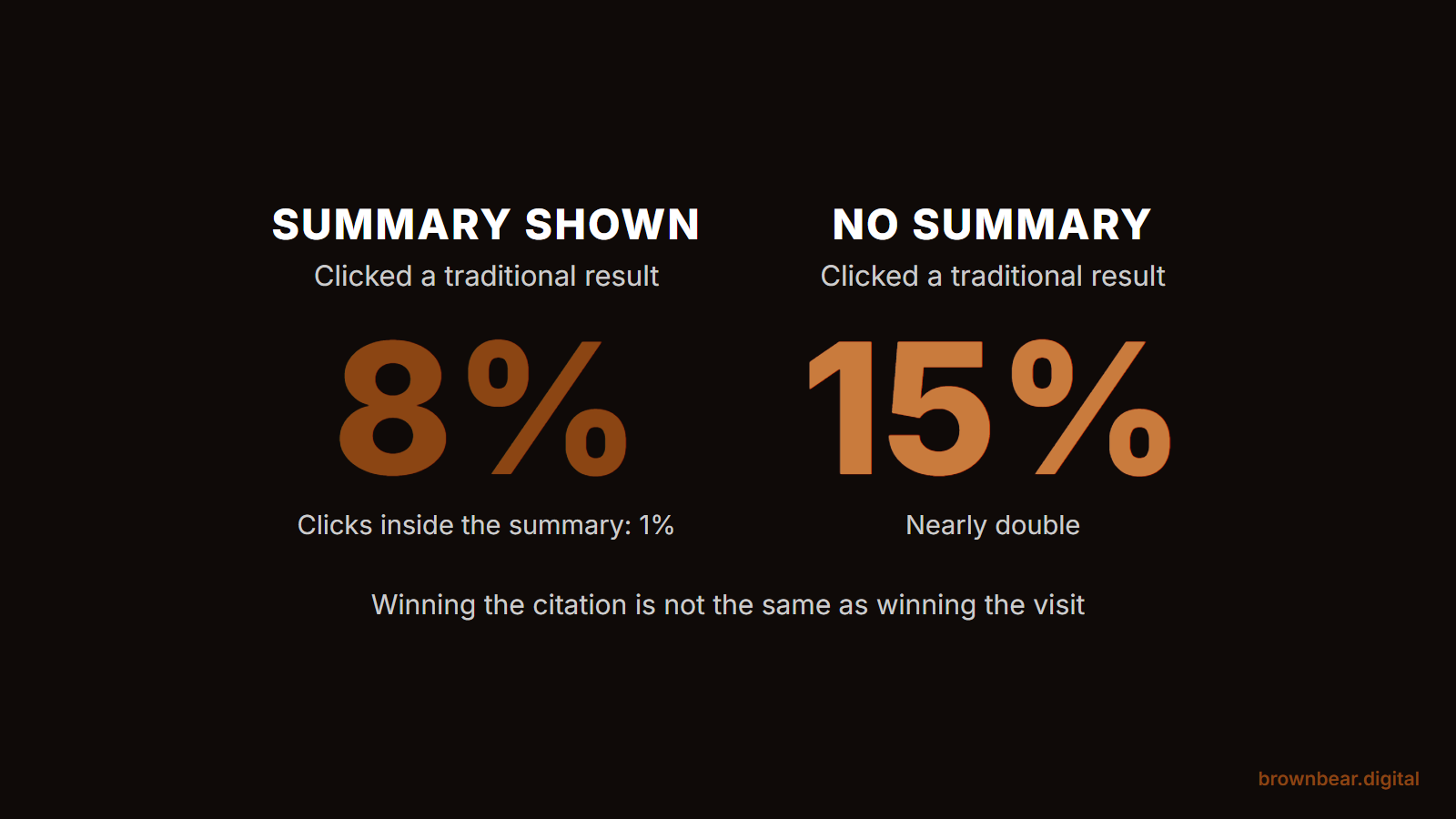
The Pew Research Center tracked the browsing behavior of 900 US adults across 68,879 Google searches in March 2025. When an AI summary appeared, users clicked a traditional result in 8% of searches, against 15% when no summary appeared. Clicks on links inside the summary itself happened in 1% of visits. Users were also more likely to end their browsing session entirely after a page with a summary. You can read Pew's full write-up for the methodology.
One operator on r/SEO reported 797,444 AI Overview impressions producing 7 clicks. That is a single unverified account rather than a benchmark, but it is directionally consistent with Pew, and it is the shape of outcome a purely informational query can produce.
So the win is real and the traffic often is not. Here is how the fork actually runs:
If the query is informational and the answer is short,
assume you are competing for brand presence, not clicks. Being named as the source in front of thousands of people who never visit still has value, but budget it as awareness spend and measure it that way. Do not promise a traffic lift you cannot deliver.
If the query is commercial or high-consideration,
chase it hard. The pattern we tend to see is that informational queries get summarized and absorbed, while queries where someone is choosing a provider still send the click, because the summary cannot make the decision for them. A citation on "how much does rhinoplasty cost in San Francisco" behaves nothing like a citation on "what is rhinoplasty."
If the query is local or transactional,
the AI Overview is often not the main event at all. Map results and Business Profile data carry more weight, and your effort is better spent there.
Consider a content publisher whose traffic fell by nearly 40% while being cited constantly by the very summaries replacing their clicks. Winning harder was not the fix, because the win was the problem. The answer for a site in that position is to move up the query ladder toward terms where a summary cannot substitute for the visit, not to optimize further into the terms where it can.
Where to Start Based on What You Are Working With
The right first move depends on where you are, so pick your row rather than working the whole list.
If you rank top 10 and are not cited,
the constraint is format or coverage, not ranking. Audit your top three pages for extractable answers under matching headings, then build the fan-out map and close two gaps. Do not buy links.
If you rank 11 to 100,
you are in the second-largest lane already and probably underusing it. Coverage is your cheapest lever: every sub-query you answer directly is a new retrieval opportunity that does not require a ranking gain.
If you rank nowhere and have no video,
start with the basics before any of this. Crawlability, indexation and internal linking come first, and why your practice is invisible to AI covers the diagnostic sequence.
Four steps, in order:
- Build the fan-out map for your single most valuable query and count your coverage.
- Close the two highest-intent gaps with direct, sourced answers under matching headings.
- Publish one video on that topic to enter the third citation lane.
- Check the generative AI report in Search Console after 60 days, tracking citation share on your priority queries rather than total impressions.
Improve Your AI Overview Visibility with Brown Bear
Most of the AI visibility work being sold right now concentrates on the smallest of the three citation lanes and bills the rest as strategy. We would rather show you which lane you are actually in, close the coverage gaps that make retrieval possible, and be straight about which queries are worth the effort.
If you want a read on where your practice or business currently stands, our AI search work starts with exactly that: a fan-out audit on your priority queries and a clear assessment of which citations will actually move your pipeline.
Written By
Founder, Brown Bear Digital
Bryan has 15 years of experience across SEO, paid search, and AI search strategy. He founded Brown Bear to give businesses direct access to senior-level search expertise without the agency overhead.
Learn More About BryanGet Found on Google.
Get Cited by AI.
Tell us about your site. We'll send back a proposal for SEO and AI search.