AI Search Ranking Factors: What the Evidence Actually Supports
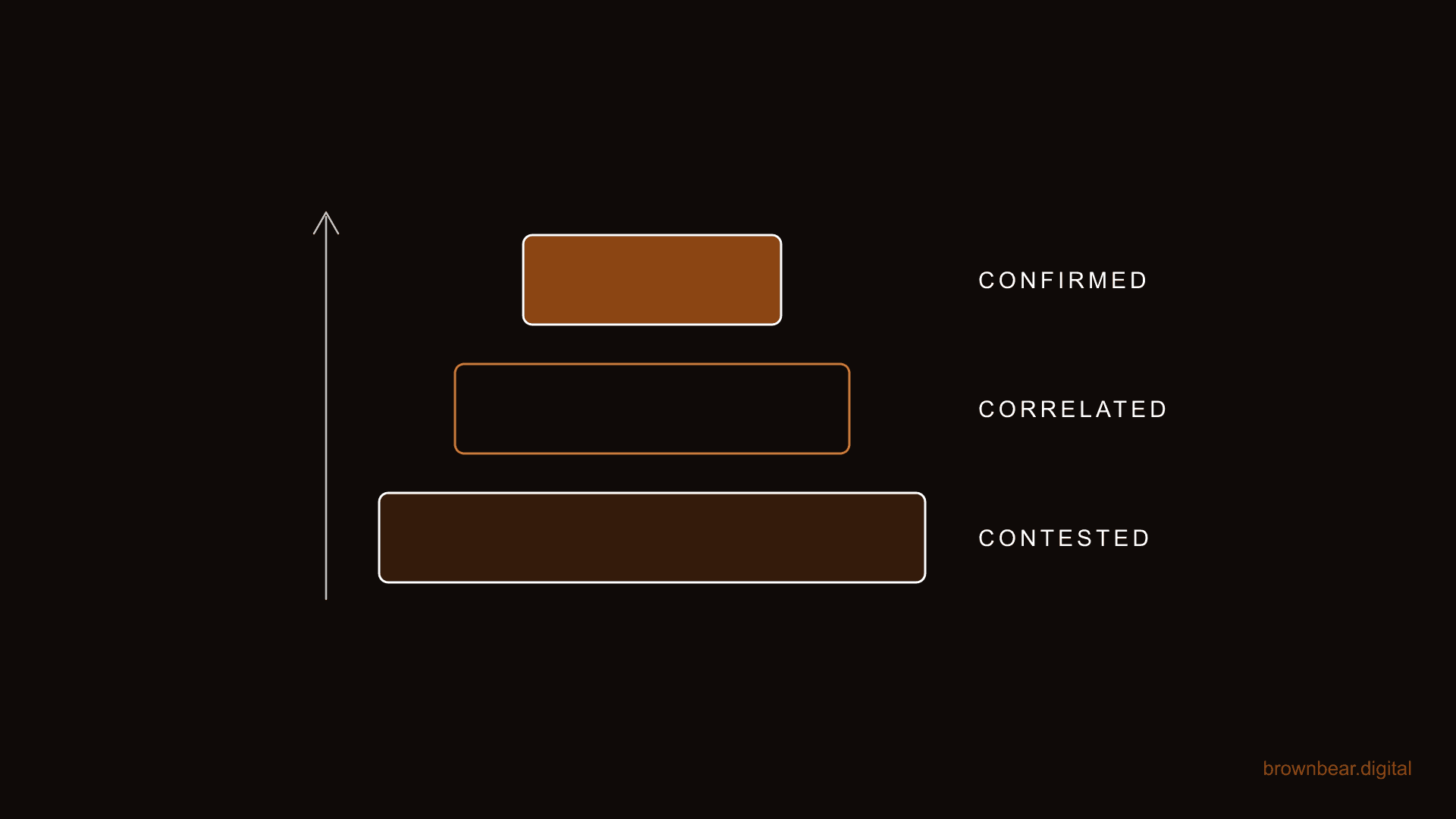
This is a plain-language guide to what actually moves visibility in AI search, sorted by how strong the evidence behind each factor really is.
That sorting matters more than usual here, because the advice in this space has gotten far ahead of the proof. Some of what gets sold as an AI search ranking factor is confirmed by Google in writing. Some of it rests on correlation studies across millions of citations, which is real evidence but not proof of cause. And some of it is a tactic invented for a requirement that does not exist. We drew the first group from Google's own published guidance, updated in July 2026, and the second from the largest public datasets available, including Ahrefs' analysis of 146 million search results and a meta-analysis of 54 separate experiments. Where our own study of 101 first-place procedure pages had something to add, we used that too.
When we say AI search, we mean both Google's AI Overviews and AI Mode, and the assistants people now ask directly, like ChatGPT and Perplexity. The factors overlap heavily but not perfectly, so where a platform behaves differently, we say so.
If you rank in the top three for your main procedure and your practice still never appears in the AI answer, there is usually a specific reason, and it is usually fixable. If someone is pitching you a GEO retainer right now and you cannot tell which half of the proposal is real, this is the reference to read it against. And if you are the person who has to report on AI visibility to a partner or a practice owner and you have no numbers to report, the measurement section is new as of this summer.
By the end, you will know which factors are confirmed, which are merely correlated, which are being oversold, and what any of it means for a practice rather than for a software company. The near-term payoff is being able to read a proposal and know what you are looking at. The longer-term one is a practice that stays findable as more of the patient journey moves into the answer itself.
We have grouped roughly a dozen factors into three tiers: what Google confirms, what the data supports, and what is contested or oversold. After that comes what changes if you are a medical practice, and how to tell whether any of it is working.
So let's start with the question underneath all of it: what does ranking even mean when a machine writes the answer?
What Ranking Actually Means When a Machine Writes the Answer
There is no position 1 through 10 in an AI answer. There is a generated response and a set of cited sources, and the question is whether you are one of them.
This is where the industry conversation splits, and it is worth naming the split because both sides are partly right. In several of the highest-engagement community threads on this question, the top answer deflates the whole idea, landing on some version of "almost all of these points lead back to solid SEO." In others, the top answer argues the opposite: it is not just SEO anymore, it is about getting mentioned in places that are not your own website. Nobody reconciles the two, and the disagreement is not really a disagreement about facts. It is two groups describing two different lanes.
The retrieval lane is the SEO lane. Google's generative features are built on top of its regular ranking systems, so crawling, indexing, and relevance still decide what is even available to be pulled. The selection lane is the newer one. Once a set of candidate pages exists, what gets quoted depends on whether your page has a clean, liftable answer and whether the model has reason to treat your brand as a known entity in that topic. You can be strong in the first lane and invisible in the second. That is precisely the situation most frustrated practices are in, and it is why how an AI Overview gets assembled is worth understanding before you spend money on any of the factors below.
How to Read This List
Every factor below carries a tier, and the tier is about evidence quality, not importance.
Confirmed by Google
means Google has stated it in its own documentation. This is the most reliable category and also the smallest, because Google says surprisingly little.
Strong correlation
means large datasets consistently find the factor associated with citation, but nobody has proven it causes citation. Correlation at this scale is worth acting on. It is not worth betting the whole budget on.
Contested or oversold
means either Google has explicitly said it is unnecessary, or the best available evidence scores it near the bottom, or both. Some things in this tier are still worth doing for other reasons. None of them is worth leading a strategy with.
Confirmed by Google
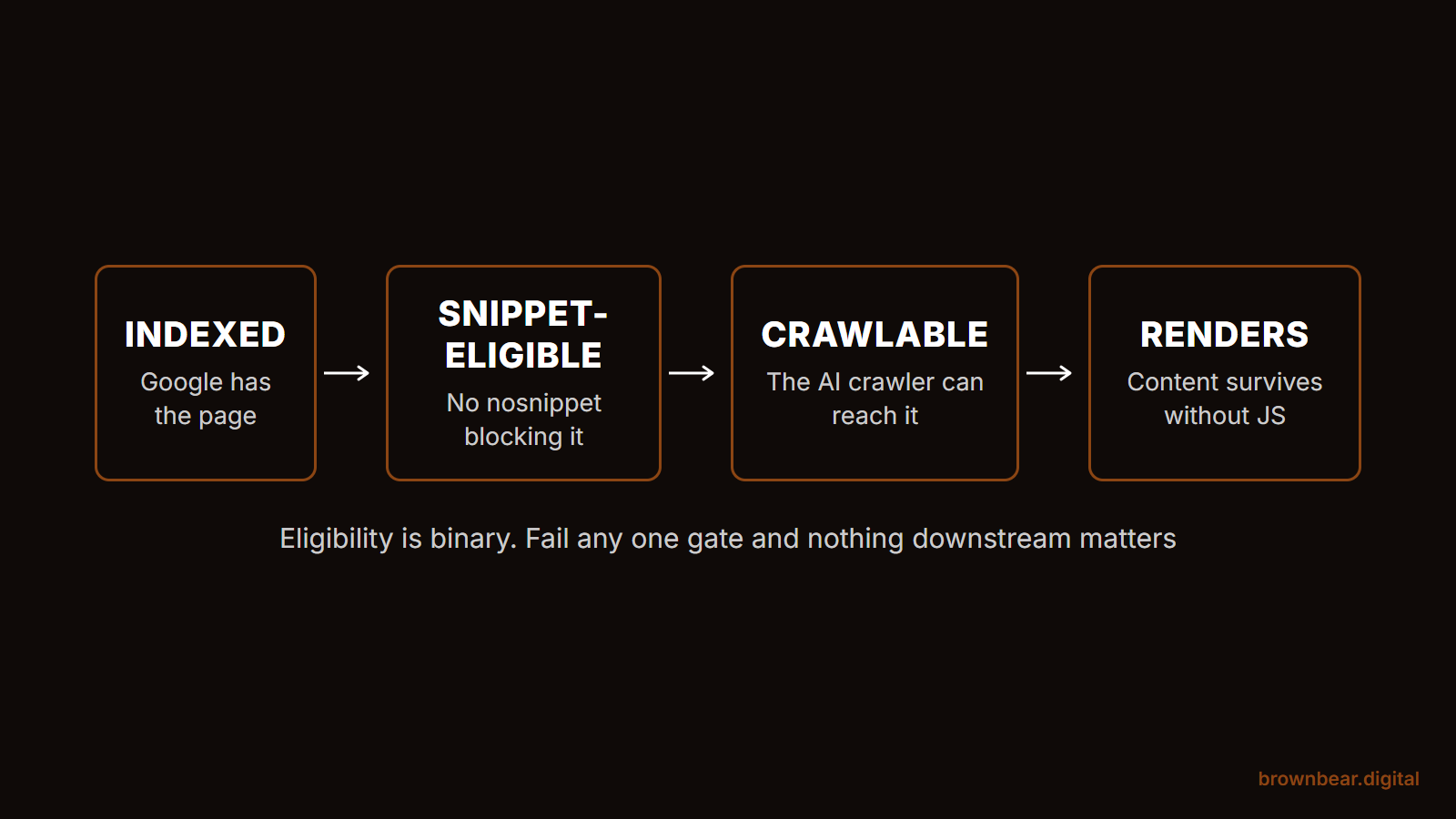
1. Your page has to be indexed and snippet-eligible
This is the only hard requirement Google states, and it disqualifies more pages than anything else on this list.
Google's documentation is unusually direct about it: a page "must be indexed and eligible to be shown in Google Search with a snippet, fulfilling the Search technical requirements. There are no additional technical requirements." Read that second sentence twice, because it quietly rules out most of what gets sold as AI search optimization.
The part that catches people is eligible to be shown with a snippet. Google names nosnippet, data-nosnippet, max-snippet, and noindex as the controls that limit whether content appears in AI features. Those are the same directives some sites deployed years ago to fight snippet scraping and zero-click search. If they are still in place, they are now switching off AI eligibility.
Picture a practice that added a short max-snippet limit across the site in 2023, on the advice of a previous agency worried about Google answering procedure questions without sending clicks. Three years later the same practice is paying to be more visible in AI search, and the setting nobody remembers adding is quietly disqualifying every page. It takes about ten minutes to check and one deploy to fix.
One related misconception is worth clearing up. Google-Extended is a separate control that covers training and grounding in other Google AI systems. It does not govern AI Overviews or AI Mode. Blocking it does not remove you from AI Overviews, and allowing it does not get you in.
Google's AI features documentation is the primary source for all of this, and it is short enough to read in full.
2. A machine has to read the page without running it
If your content only exists after JavaScript executes, retrieval frequently gets an empty shell.
Google asks that content be crawlable because its generative features work from publicly accessible, crawlable content. That sounds like a formality until you view-source a modern practice site and find that the procedure copy is not in the HTML at all.
This is the single most common technical problem we find on custom-built practice sites, and it is where we spend a lot of our early effort on a new engagement. We strip large amounts of JavaScript off client sites specifically so that the substance of a page exists in the source. It is unglamorous work and it consistently matters more than anything on a schema checklist. The site-level work that makes a page readable covers the full sequence.
3. The answer has to match the question being asked
Put a direct, self-contained answer close to the heading that asks the question, then elaborate underneath.
Google's guidance here is plain: write for people, keep it well organized, use paragraphs, sections, and headings that give the content a clear structure. The correlation data agrees strongly. In the meta-analysis, query-to-answer match scores 9.2 out of 10 and having the answer near the top of the section scores 8.8, putting both in the top tier of 23 factors.
What this does not mean is writing in a stilted, machine-facing voice. It means that if a section is titled with a question, the first two sentences under it should answer that question completely enough to be lifted out and still make sense. Structuring a page so an answer can be lifted cleanly goes deeper on the mechanics.
4. Rich media is first-party advice, not a GEO theory
Adding relevant images and video is one of the few positive things Google recommends by name.
The exact wording is to look for ways to support your textual content with high-quality, relevant images and videos. It is easy to read that as generic polish. In a medical vertical it is not, and the reason why is in the practice section below.
Strong Correlation, Not Confirmed Causation
5. Where you rank still matters, just less than it did
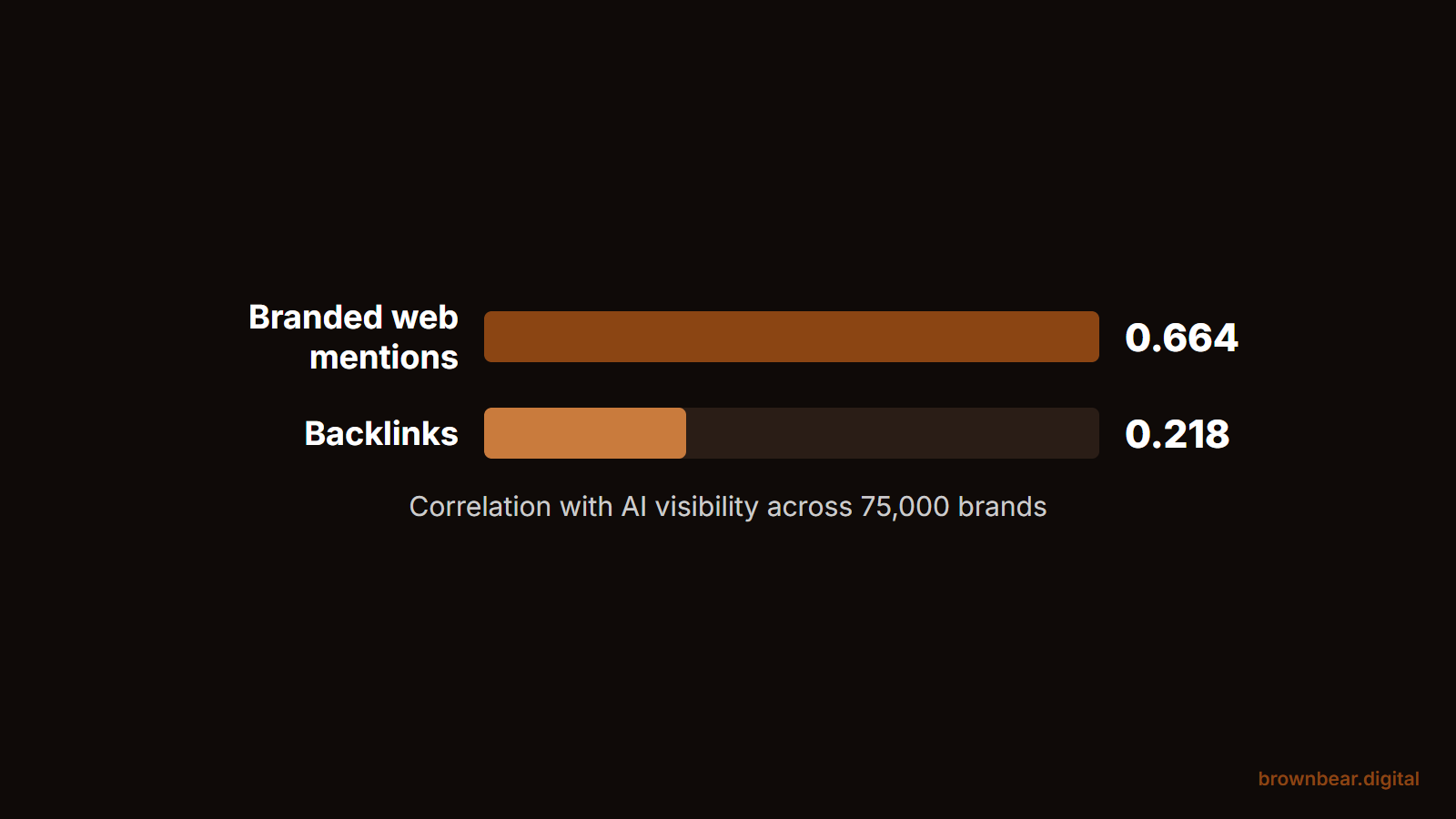
Classic organic ranking remains one of the strongest correlates of citation, but its grip has loosened sharply, and that shift is the single most useful number in this article.
In mid-2025, roughly 76% of AI Overview citations came from pages already ranking in the organic top 10. In the 2026 data, across 863,000 keywords and four million AI Overview URLs, that share is about 38%, with roughly 31% now coming from pages ranked beyond 100. Ranking is an on-ramp. It is no longer a gate.
This is the answer to the most common complaint in this whole topic: a practice ranks in the top positions on Google, and its brand is almost never the one getting cited. Both halves of that sentence can be true at once, and now you know why: the lanes have partly separated.
Picture a practice sitting at position two for a procedure page in its city. The page is fast, the copy is good, the rankings are stable. It is still not being quoted, because the page opens with a warm paragraph about the practice's philosophy and never states, in one liftable sentence, what the procedure is and who it suits. The ranking got it into the candidate pool. Nothing about the page made it the easiest thing to quote. We wrote about the diagnostic sequence for a practice that ranks well and still does not appear separately.
6. Being mentioned off your own site
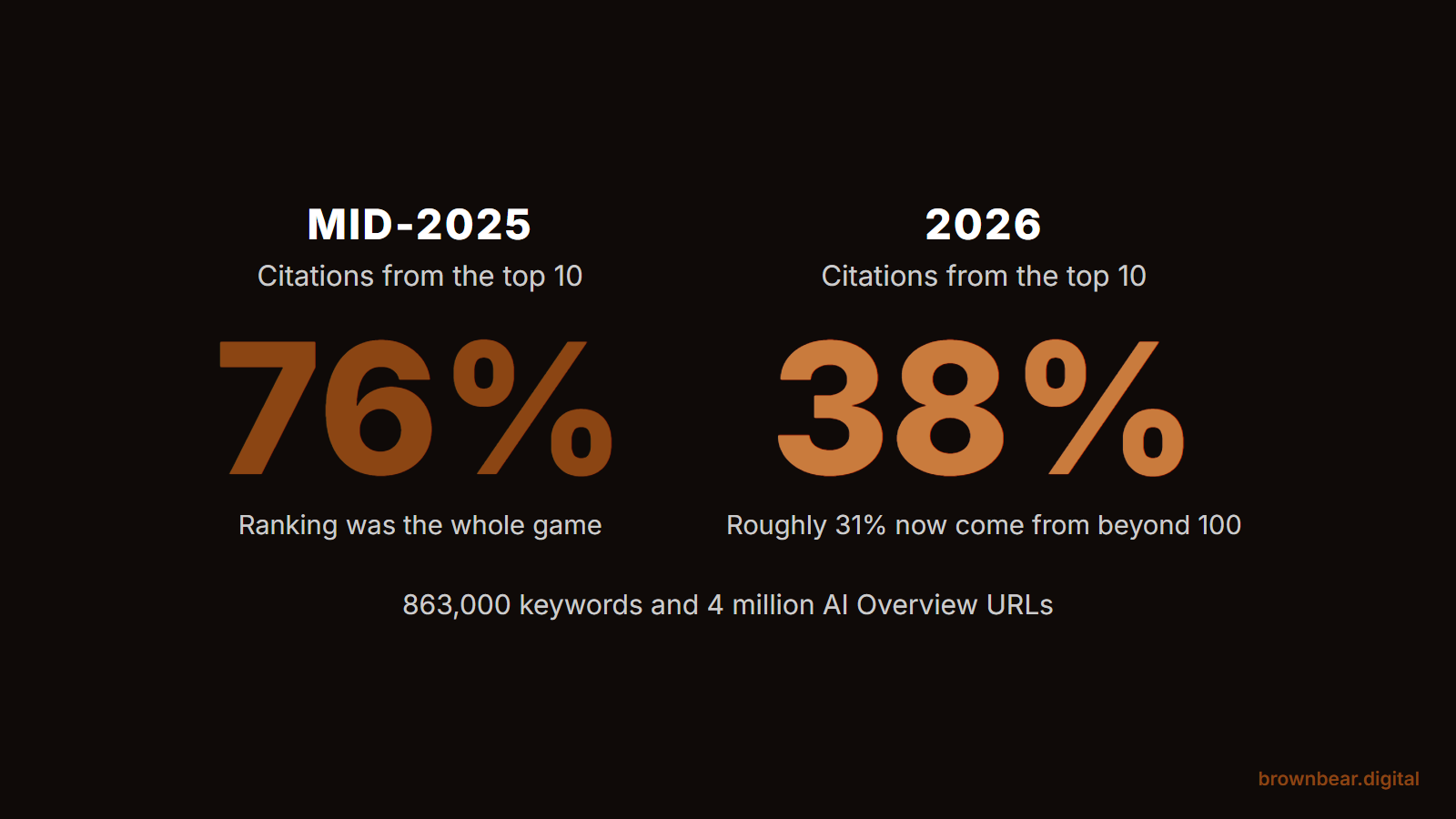
Unlinked brand mentions across the web are the strongest single correlate anyone has measured, and they beat backlinks by roughly three to one.
Across 75,000 brands, branded web mentions correlate at 0.664 with AI visibility, against 0.218 for backlinks. That is a large gap, and it points budget toward digital PR, podcasts, directories, press, and review platforms rather than toward link acquisition for its own sake.
There is a real tension here that most articles skip. Google's own 2026 guidance says that seeking inauthentic mentions across the web is not as helpful as it might seem. That is not a contradiction of the correlation data, but it is a boundary on it. Earned mentions and manufactured ones are not the same input, and only one of them is what the studies measured. In our own client audits, the thing practice owners are most surprised by is how much of their AI visibility is being decided by third-party sites they do not control: reviews, directories, press. That is why we build on-site and off-site work together rather than sequencing one after the other. More on building visibility off your own site.
7. Covering the fan-out, not just the keyword
AI systems expand one question into many related queries behind the scenes, then assemble an answer from what they find. Covering that expansion is strongly associated with getting cited.
Pages that rank across the fan-out set are 161% more likely to be cited, at a 0.77 correlation. In the meta-analysis, fan-out rank scores 9.3 and topic-cluster ranking 8.9. This is also the honest answer to how AI Mode works, since query fan-out is the mechanism Google itself describes for it.
Say a prospective patient asks an assistant whether a facelift is worth it at 45. Behind that one question, the system is likely also asking what the recovery looks like, how long results last, what the alternatives are at that age, and what it costs in their metro. A practice with one strong facelift page competes for one of those. A practice with a genuine cluster competes for all five, and the cluster is what gets it quoted.
8. Freshness, at its real size
Freshness is real and modest. Content cited by AI systems averages about 1,064 days old against 1,432 days for the organic top 10, which is a 25.7% advantage.
A widely repeated claim put this at 4.3 times, and that number traces back to no primary study. The difference between a 26% edge and a 4.3x edge is the difference between a sensible update schedule and a panic rewrite of everything you have published. Update on a rhythm. Do not tear up pages that are working.
Contested or Oversold
9. Schema markup
Schema is worth having as general SEO hygiene. It is not an AI search lever, and Google has now said so directly.
The wording leaves little room: "Structured data isn't required for generative AI search, and there's no special schema.org markup you need to add." That is from Google's generative AI optimization guide, updated in July 2026, which also dismisses several other tactics by name.
This has been our position for a while, before the guidance caught up with it. Schema is a best practice worth keeping tidy, and it is not the silver bullet it gets sold as. The bigger levers are crawlability and content that is genuinely well structured. Our own data supports the same reading from a different angle. In our study of 101 first-place procedure pages, 94% carry JSON-LD structured data, and six of them rank first with none at all. Near-universal adoption with visible exceptions is the signature of table stakes, not of a differentiator. If a proposal leads with schema, it is a proposal that is behind on the guidance.
10. llms.txt and content chunking
Neither does anything for Google Search, and both are explicitly addressed in the guidance.
On the first: "You don't need to create new machine readable files, AI text files, markup, or Markdown to appear in Google Search." In the meta-analysis of 23 factors, llms.txt scores 2.0 out of 10, dead last. On the second: "There's no requirement to break your content into tiny pieces for AI to better understand it." Google adds that you do not need to write in a specific way just for generative AI search.
Break content into sections because readers navigate better that way. That is a good reason. Doing it because a model supposedly demands it is not.
11. Manufactured mentions
This is where the mention research gets misread, and the misreading is expensive.
The correlation data measured mentions that brands earned. Buying placements or seeding mentions is a different activity, and it is the one Google named when it said that seeking inauthentic mentions across the web is not as helpful as it might seem. In a medical vertical the risk is sharper than the wasted spend, because trust signals in a health context are held to a stricter standard than in most industries.
What Changes If You Are a Medical Practice
The factor list is the same. The weights are not, and two of the differences are large enough to change where a practice spends first.
Start with exposure. In the largest published health study of this kind, more than 82% of health queries triggered an AI Overview, which is well above the cross-industry rate. Health is where this shift is furthest along, so the cost of being invisible in the answer layer is higher here than almost anywhere else. That is the same reasoning behind the YMYL standard, which applies to practice content whether or not anyone at the practice has heard of it.
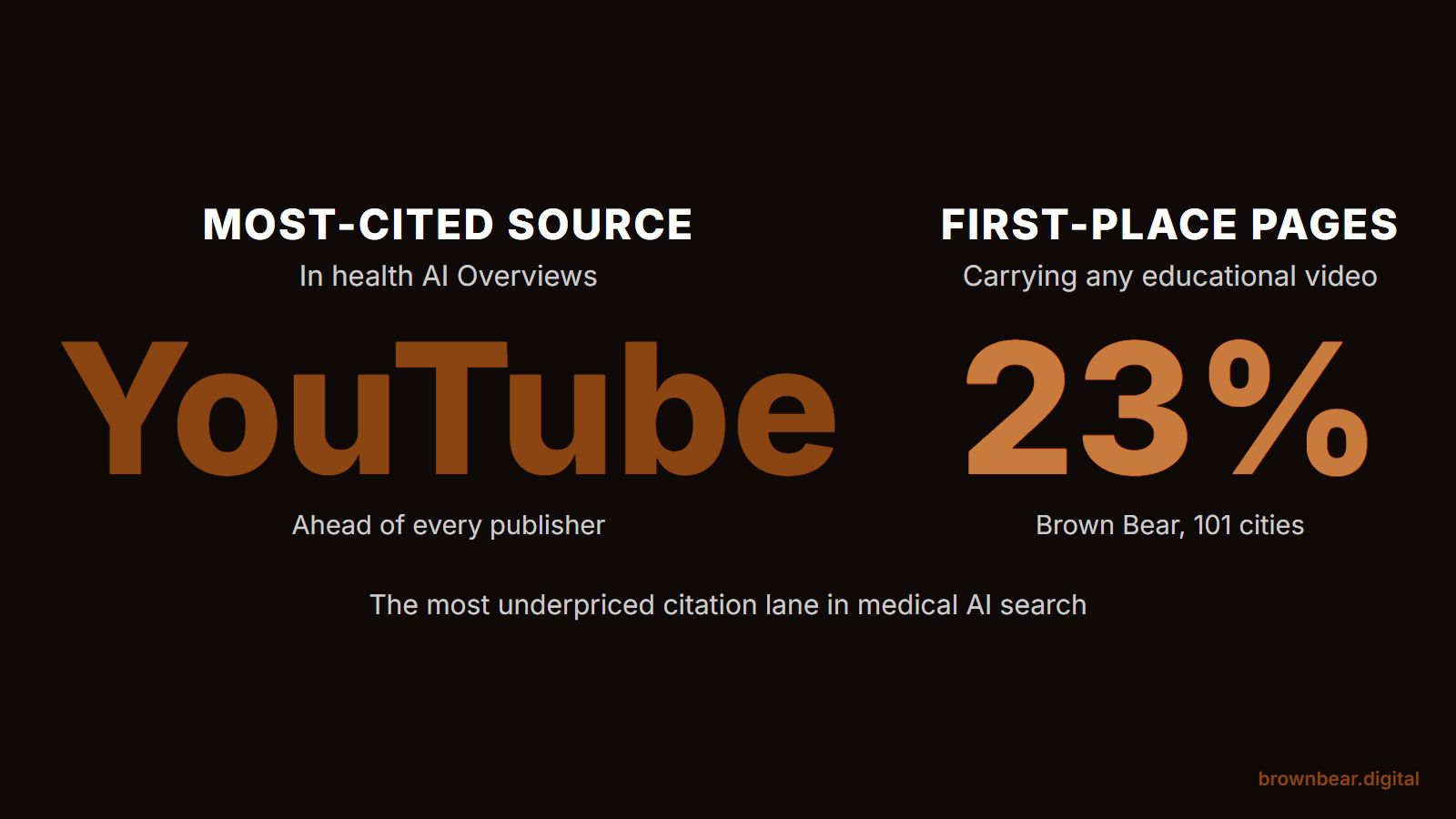
Then the surprise. In that dataset, the single most-cited source in health AI Overviews was YouTube, at 4.43% of all citations, while YouTube ranked only 11th in traditional organic results for the same queries. Only about 36% of the AI-cited pages appeared in the organic top 10 at all, and academic journals and government health institutions together accounted for roughly 1% of citations.
A limitation worth stating:
that study analyzed 50,807 health searches in Germany, not the United States. The direction of the findings is consistent with the cross-industry data, and the YouTube pattern has been reported elsewhere, but treat the exact percentages as indicative rather than as US benchmarks.
Put those two findings next to each other and the practical conclusion is uncomfortable for most practices: video is the most underpriced citation lane in medical AI search, and almost nobody in the field is using it. In our own study of first-place procedure pages, only 23% carried any educational video at all. That is a gap where the cost of entry is a surgeon, a phone, and ten minutes per procedure, and it sits directly on top of the format that gets cited most in this vertical.
Picture a practice that has spent two years building out written procedure pages and ranks well for most of them. A competitor across town publishes eight short videos, one per procedure, each answering the question the page title asks. Within a couple of quarters the competitor starts turning up in answers where the first practice does not, and nothing about the first practice's pages got worse. Where those videos belong on the site is its own question, and we covered it in where video belongs on a practice site.
One more pattern from our own audits. Big authority sites are taking over the head terms, so a practice competing on a bare procedure name against a major medical institution is usually competing for a slot that is already gone. Local and cost-shaped queries are a different story, and that is where practices still win citations. It is also worth checking something mundane before anything else: the most common real error we find is not bad content, it is odd variations of the practice name, address, and phone number scattered across the web.
How to Tell Whether Any of This Is Working
As of this summer there is finally a first-party answer, and it is partial.
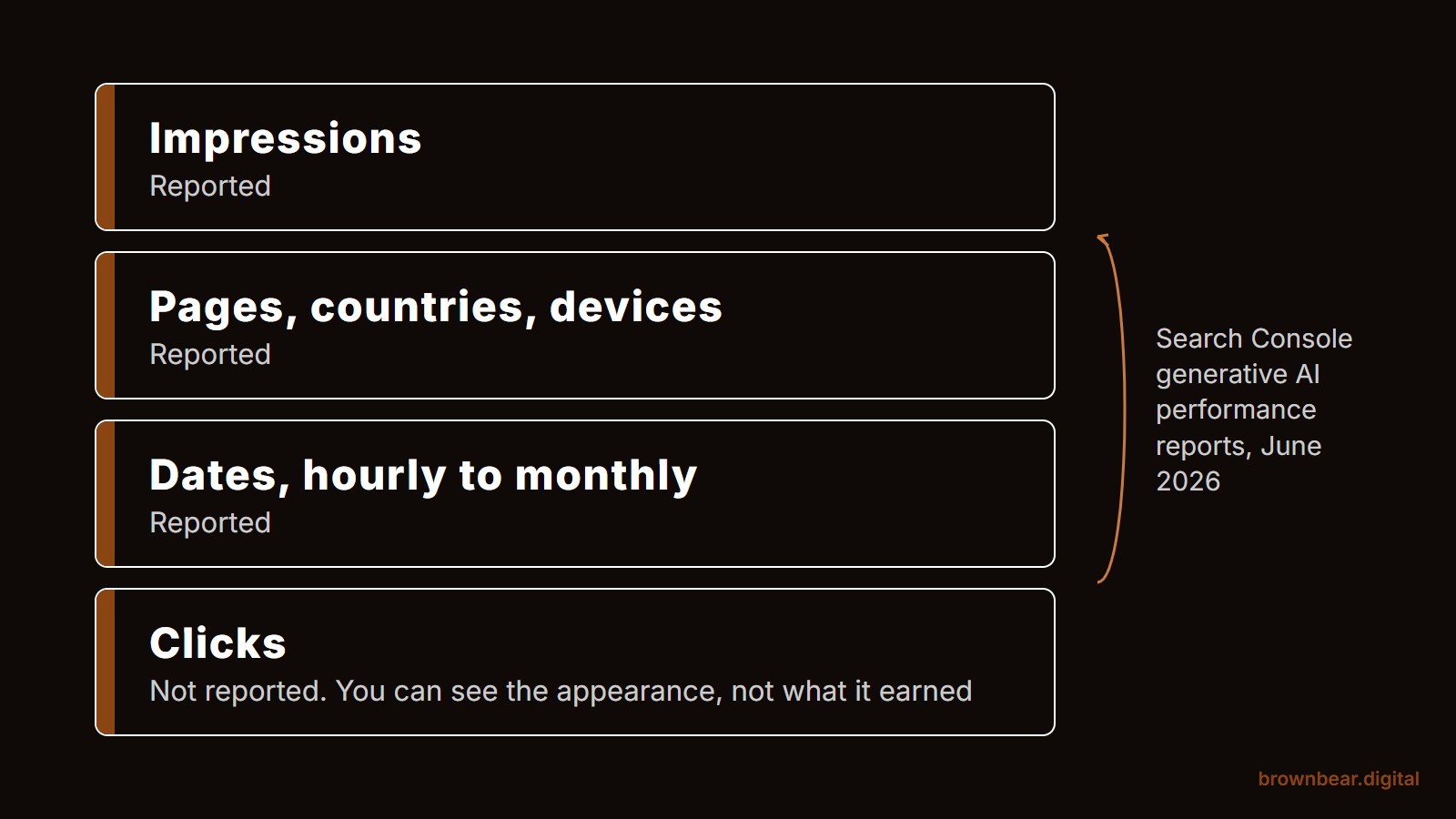
On 3 June 2026, Google launched Search Generative AI performance reports in Search Console, giving site owners a dedicated view of visibility in generative AI features across Search and Discover. The reports show impressions, pages, countries, devices, and dates, with hourly through monthly granularity, and they rolled out to a subset of websites first.
Note what is not in that list. The launch reports impressions, not clicks, so you can see that a page appeared in an AI feature without knowing what it earned you. Google has said additional metrics may come. Until they do, the picture is incomplete, and it is worth checking whether your properties have the report yet before you promise anyone a dashboard.
Two things fill the gap in the meantime. Track your own referral traffic from assistants as a distinct channel in analytics, because that is where the conversion story lives. And monitor how often you are named in answers to the prompts your patients actually use, which is a different measurement problem covered in tracking mentions across assistants.
The pattern we see in client reporting is that referral traffic from assistants converts at a higher rate and arrives more engaged than most other channels, because the research journey compresses into a single conversation before anyone clicks. Volume is still small. It is growing, and it is the number we point owners at when they ask whether any of this is worth doing yet.
Where to Start, Depending on What You Are Working With
The order matters more than the list, because eligibility problems make everything downstream pointless.
If your site is JavaScript-heavy or custom-built,
start at the top of the confirmed tier. Check snippet directives and view-source a procedure page to confirm your copy is actually in the HTML. Nothing else on this list can help while the page is unreadable or ineligible.
If your site is server-rendered and already indexed cleanly,
skip to structure and coverage. Rewrite the opening two sentences of each procedure section so they answer the section's question on their own, then look at whether you have a real cluster or a single page per procedure.
If you already rank in the top 10 for your main terms,
your problem is almost certainly selection rather than retrieval. Spend on extractability, video, and earned mentions, not on more ranking work.
If you do not rank yet,
the two lanes still overlap enough that ranking work remains the efficient path, and the 38% figure is a reason to keep going rather than a reason to stop.
In order, for most practices:
- Audit snippet directives, robots rules, and indexation on your top 10 pages, and fix anything blocking eligibility.
- View-source those same pages and confirm the body copy is present without JavaScript.
- Rewrite the first two sentences under each major heading so they stand alone as an answer.
- Record one short video per core procedure, then pursue earned mentions on the review and directory platforms your patients already read.
If you want the same territory organized by leverage rather than by evidence, our companion piece covers twelve AI search moves ranked by how much leverage each one carries. This article is about what is true. That one is about what to do first.
Work With Brown Bear on AI Search Visibility
Most of what separates a practice that gets cited from one that does not is unglamorous: a snippet directive nobody remembers adding, copy that only exists after scripts run, and procedure pages that never state the answer in a form anything can quote.
We do that work for medical and plastic surgery practices, starting with an audit of what is actually blocking eligibility before anyone spends a dollar on content. If you want to know where your practice stands, take a look at our AI search visibility work and tell us which procedures you want to be known for.
Written By
Founder, Brown Bear Digital
Bryan has 15 years of experience across SEO, paid search, and AI search strategy. He founded Brown Bear to give businesses direct access to senior-level search expertise without the agency overhead.
Learn More About BryanGet Found on Google.
Get Cited by AI.
Tell us about your site. We'll send back a proposal for SEO and AI search.