GEO vs AEO: Why Nobody Agrees on the Difference, and Why SEO Decides Both
This is Brown Bear's plain-language guide to GEO, AEO, and SEO: what each term means, where each one came from, and which of them actually changes what you do on Monday.
We run AI search visibility programs for medical practices and local service businesses, and some version of this question comes up on nearly every call. Usually it arrives as a proposal someone has been handed, with a line item on it that nobody can define. Our founder, Bryan Passanisi, has spent the last two years auditing what AI systems actually say about our clients and where those descriptions come from, which turns out to be the fastest way to find out which of these acronyms describes real work.
When we say AI search here, we mean both the AI Overview sitting above Google's blue links and the answer ChatGPT or Perplexity writes when there are no blue links at all. Those are different systems with different retrieval behavior, and most of the confusion in this topic comes from guides that quietly treat them as one thing.
If you are holding a proposal with GEO on it and no way to evaluate the number next to it, this is written for you. If you inherited a search program and your CMO forwarded you an article saying SEO is dead, you are in the right place. And if you rank well on Google and still cannot find your own brand anywhere in ChatGPT, the answer to that specific problem is in here, though it is probably not the one you expect.
By the end you will be able to date each term, quote what Google has published about both, tell whether a GEO service is a new discipline or your existing SEO with a markup, and name the tactics you have been told to do that Google says are unnecessary.
We have grouped it into four parts: where the words came from, what Google says about them, what genuinely changes in the work, and how to tell whether you are being sold something real.
Start with the part almost every guide on this topic skips. The two terms are not the same age.
1. The Short Answer
SEO gets a page into a ranked list. AEO gets a passage lifted as the answer. GEO gets a brand named inside a generated response. All three run on the same retrieval systems, which is why SEO is the foundation for both of the others rather than a separate, older discipline they replace.
| SEO | AEO | GEO | |
|---|---|---|---|
| Stands for | Search engine optimization | Answer engine optimization | Generative engine optimization |
| Coined | 1997, widely attributed to the early web marketing trade | 2018 | November 2023 |
| Original problem | Ranking in a list of links | Winning featured snippets and voice answers | Being cited inside a generated answer |
| The win condition | A position | A lifted passage | A mention |
| Where you can lose | You can rank fifth and still get traffic | There is one snippet | There is no fifth place in an answer |
| What it runs on | Crawling, indexing, ranking | The same, plus extractability | The same, plus off-site entity presence |
That is the useful version. The unusable version is the one you get if you read five guides in a row, because they will give you five different sets of definitions, and at least one will have GEO and AEO the wrong way round.
If you want the tactical layer rather than the terminology, we have the individual moves ranked by how much they actually move visibility. This piece is about why the words are a mess and what to do about it.
2. Where Each Term Actually Came From
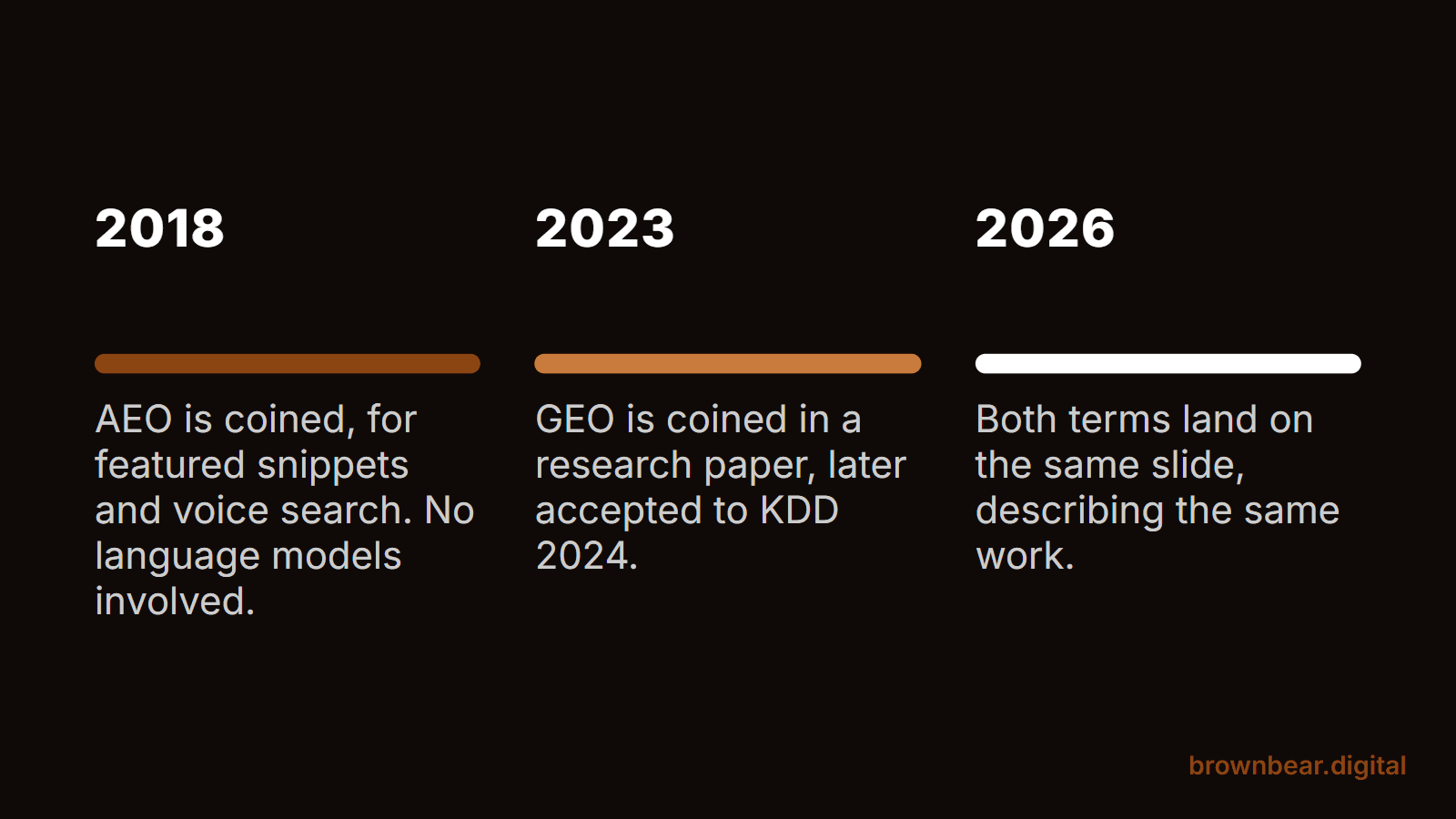
AEO and GEO were coined roughly five years apart, to solve two different problems, in two different eras of search. That is the single most useful fact about them, and it is why the definitions conflict.
AEO came first, and it predates the AI wave entirely.
Answer engine optimization is widely credited to Jason Barnard, who began using it around 2018 and presented on it at BrightonSEO that spring. That attribution is the trade's own account rather than a primary record, so treat the exact date as approximate. The problem it named was concrete and had nothing to do with language models: Google had introduced featured snippets, voice assistants were answering questions out loud, and there was suddenly a slot above position one that paid nothing in clicks but everything in visibility. Optimizing to be the answer rather than a link was a real and separate craft, and it needed a name.
GEO arrived in a research paper.
On 16 November 2023, six researchers published GEO: Generative Engine Optimization, later accepted to KDD 2024. Pranjal Aggarwal, Vishvak Murahari, Tanmay Rajpurohit, Ashwin Kalyan, Karthik Narasimhan and Ameet Deshpande introduced a benchmark called GEO-bench and reported that their methods could, in their words, "boost visibility by up to 40% in generative engine responses." Whatever you think of the number, this is a real academic origin with a real definition attached, and it is the reason GEO has a firmer claim to being a defined term than AEO does.
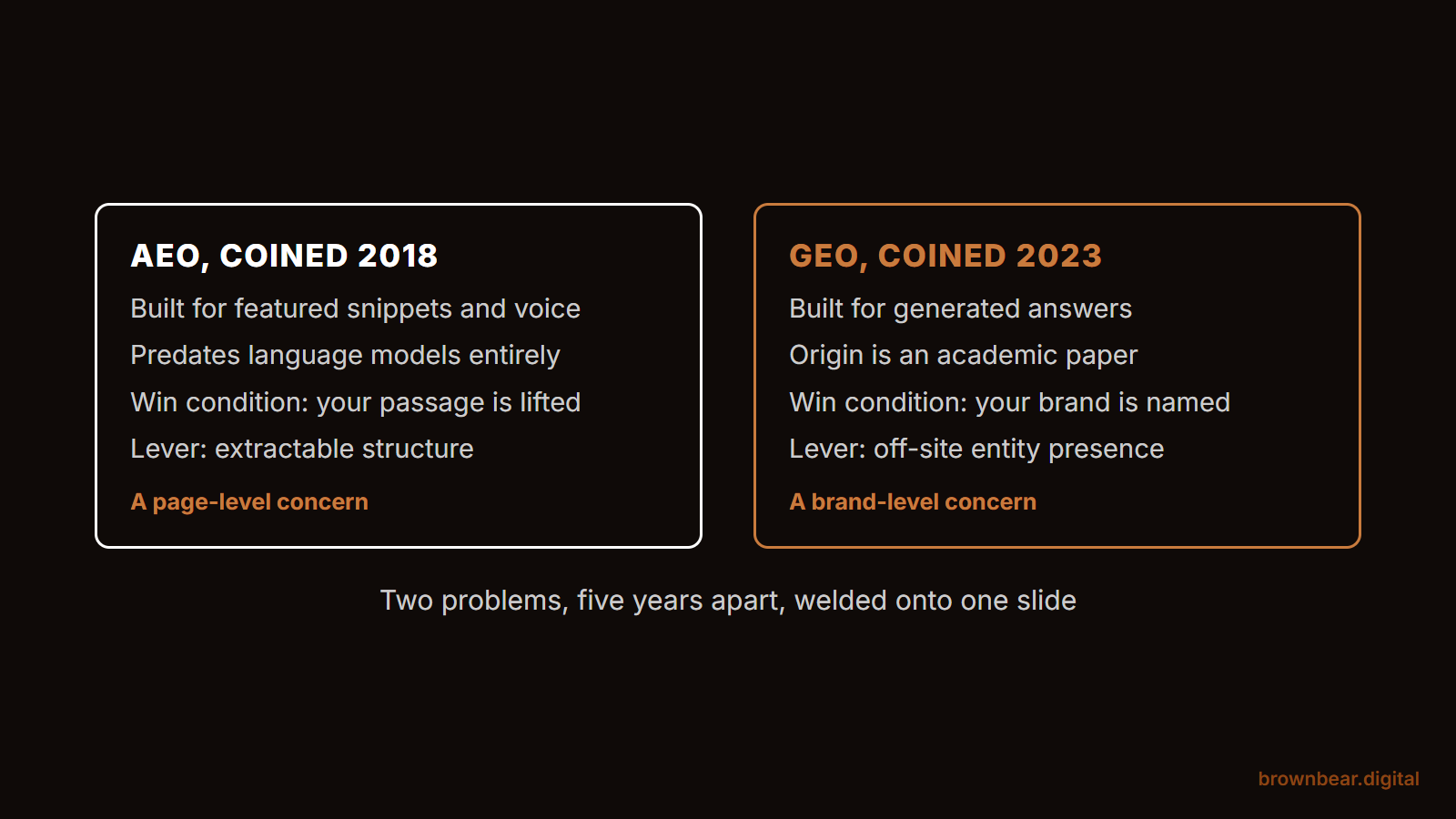
So one term was coined by a practitioner for the snippet era and one was coined by researchers for the generative era. Then ChatGPT went mainstream, every agency needed a word for the new work, and both terms got pulled onto the same slide. Neither was designed to sit next to the other, and it shows.
Picture a marketing lead who joined in 2019, learned AEO as "win the featured snippet," and left search for three years to run demand gen. She comes back in 2026, sees AEO on a proposal, and reasonably assumes it means what it meant when she learned it. Meanwhile the agency writing the proposal means "get cited by Perplexity." They are both using the word correctly, for different definitions, five years apart. Nobody in that meeting is wrong and nobody will notice.
3. Six Definitions of GEO, All From the Same Thread
The clearest evidence that these terms have no agreed meaning is not that guides disagree with each other. It is that experienced practitioners answering the same question, in the same thread, define GEO in mutually incompatible ways.
Google ranks a Reddit Discussions block at position one for these queries. We read the two largest threads, 96 and 69 answers, in September 2026, and counted the distinct definitions of GEO offered by the top-engaged responses.
- Getting your brand cited or mentioned inside a generated AI answer. The most common reading.
- Being the detailed source a model draws on for long explanatory answers, as opposed to the short direct answer.
- Brand authority building for AI, achieved off-site through reviews, forums, and niche publications.
- Optimizing specifically for deeper research inside chat interfaces, as distinct from AI Overviews.
- Optimizing for Google, with AEO covering the AI platforms. This is the inverse of every other definition on the list.
- Making sure AI shows you to the right person in the right place, which is the geographic reading of the letters, not the generative one.
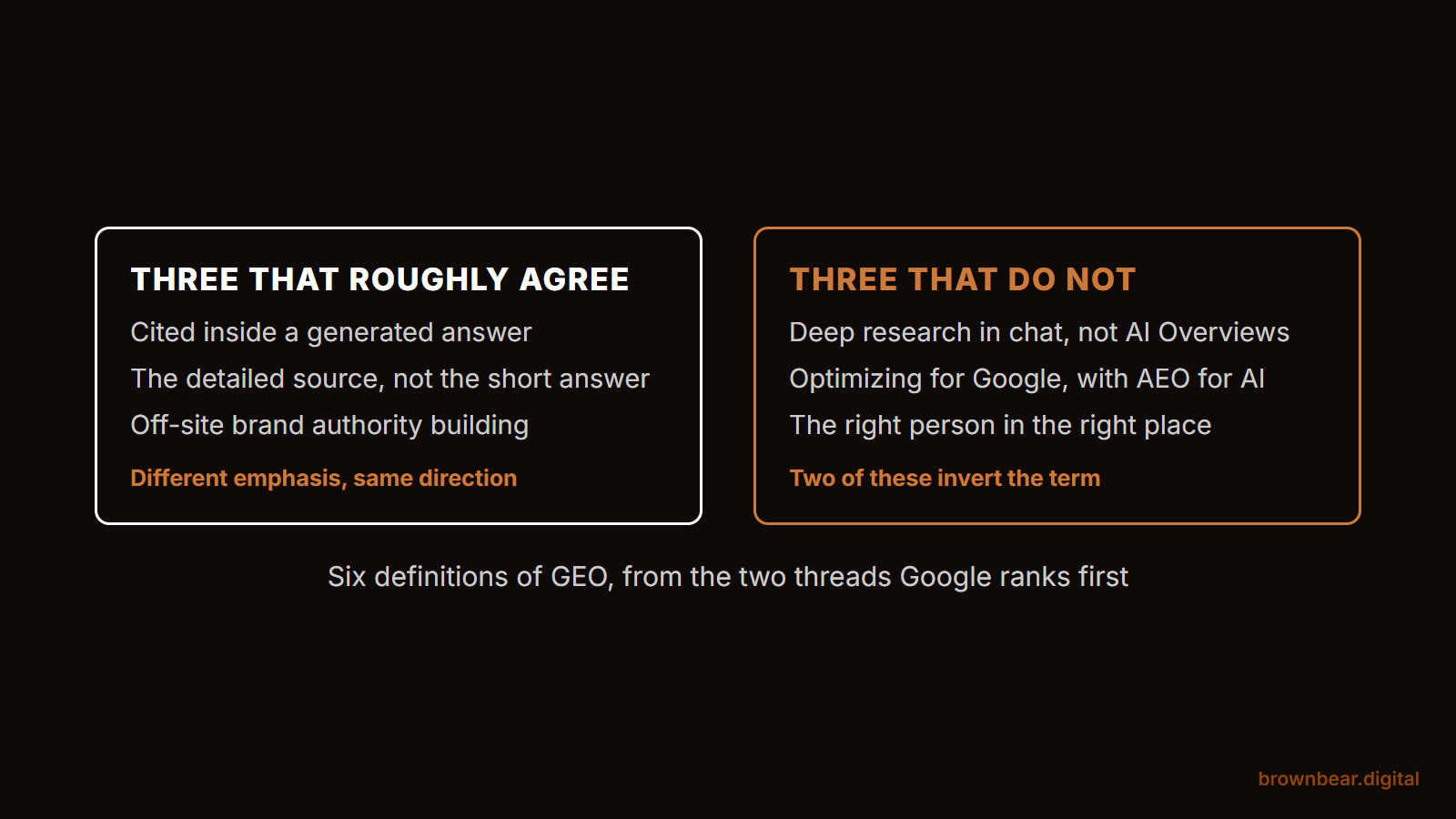
That count is ours, made on 4 September 2026 from the two threads ranking that day. Anyone can reproduce it by reading the same threads, though thread contents change over time.
Two of those six invert the term. Both were posted by people giving genuine, well-intentioned help, and both drew thanks. The confusion is not coming from bad actors. It is coming from a word that was never given a stable definition in the trade before it started appearing on invoices.
Wikipedia's own entry on generative engine optimization puts the same point in one sentence: as of early 2026, no consensus definition distinguishing these terms had been established in the academic literature, and the terms are frequently used interchangeably in practice. When the encyclopedia's position is "there is no agreed definition," any guide confidently drawing a clean line is drawing it themselves.
4. What Google Actually Says About GEO and AEO
Google has published a direct position on both acronyms. Its guide to optimizing for generative AI features, last updated 10 July 2026, states: "From Google Search's perspective, optimizing for generative AI search is optimizing for the search experience, and thus still SEO."
That is not a paraphrase and it is not an inference from a Search Liaison tweet. It is in Google's own developer documentation, in a section headed with the question of whether SEO is still relevant for generative AI search. The same page defines both acronyms plainly, notes that they are terms you may encounter for work focused on AI search visibility, and then spends a section on what Google says you do not need to do.
Two caveats that matter, because guides quoting this page tend to drop them. First, Google is speaking only for Google Search. Its generative features are built on its core ranking and quality systems, so of course the same work feeds both. That reasoning does not automatically transfer to ChatGPT or Perplexity, which retrieve differently and were not built on Google's index. Second, "still SEO" is a statement about the inputs, not about the outcome. It does not mean the results behave the same way, and section 6 is about the way they do not.
Notably, Google will not generate an AI Overview for the head-to-head question itself. We checked aeo vs geo on 4 and 5 September 2026 and got the same response both times: an AI Overview is not available for this search. The neighbouring queries behave differently, and the contrast is the interesting part. Ask geo vs seo or seo vs aeo vs geo and Google does generate one, in both cases explaining the three terms as a tidy division of labour. Ask it to adjudicate between the two newer acronyms on their own, and it declines. AI Overview presence is volatile and personalized, so treat any single check as a snapshot rather than a settled state.
5. GEO vs SEO, the Comparison People Actually Search For
GEO is not a replacement for SEO and it is not a separate channel. It is a set of concerns that sit on top of retrieval, and retrieval is what SEO has always been for.
Here is the mechanic that makes this concrete. When you ask ChatGPT or Perplexity a question about a product, a service, or a local business, the system usually does not answer from memory. It rewrites your question into search queries, fetches a set of pages, reads them, and writes an answer from what it found. That is retrieval-augmented generation, and it means the model's answer is downstream of a search result set.
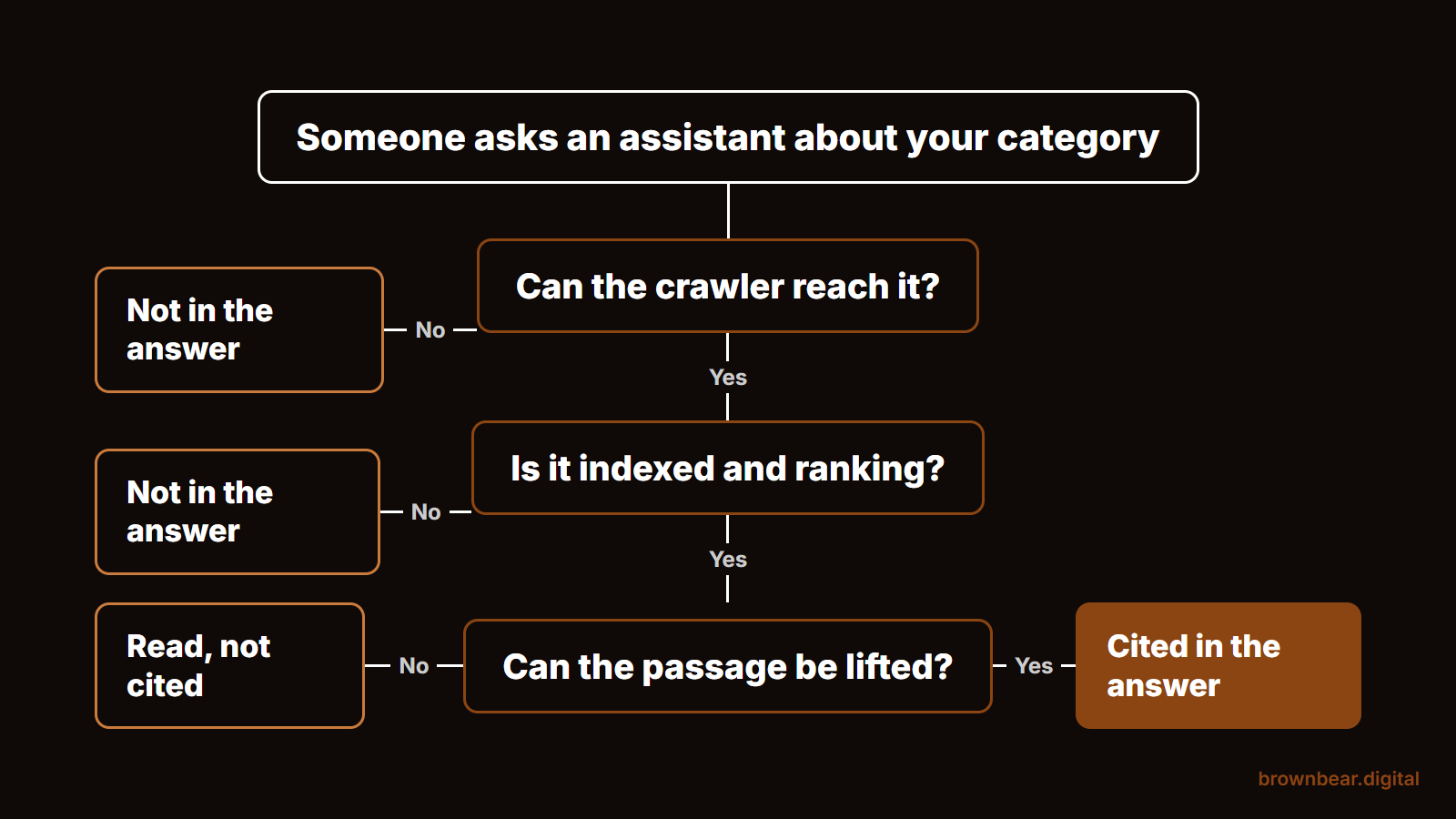
Which means the old questions still decide the outcome. Can the crawler reach the page. Is the page indexed. Does it rank for the queries the model generates, which are usually not the queries you targeted. If the answer to any of those is no, the page is not in the candidate set, and nothing you write on it can be cited. How an AI Overview is actually assembled walks through the same pipeline in more detail.
The part that is genuinely new sits after retrieval. Once your page is in the candidate set, whether it gets used depends on whether the relevant passage can be lifted cleanly, and whether the system already associates your brand with the category. Those two concerns are roughly what AEO and GEO were each coined to describe. Neither of them can rescue a page the retrieval layer never returned.
This is why "SEO is the foundation" is a mechanical statement rather than a defensive one. It is not agencies protecting a legacy service line. It is that the answer is written from a set of retrieved documents, and getting into that set is the thing SEO does.
6. The One Difference That Holds Up
The genuine structural difference is not in the tactics. It is that a ranked list has room and a generated answer does not. In search you can place fifth and still get traffic. In an AI answer there is no fifth place, so the outcome is closer to binary.
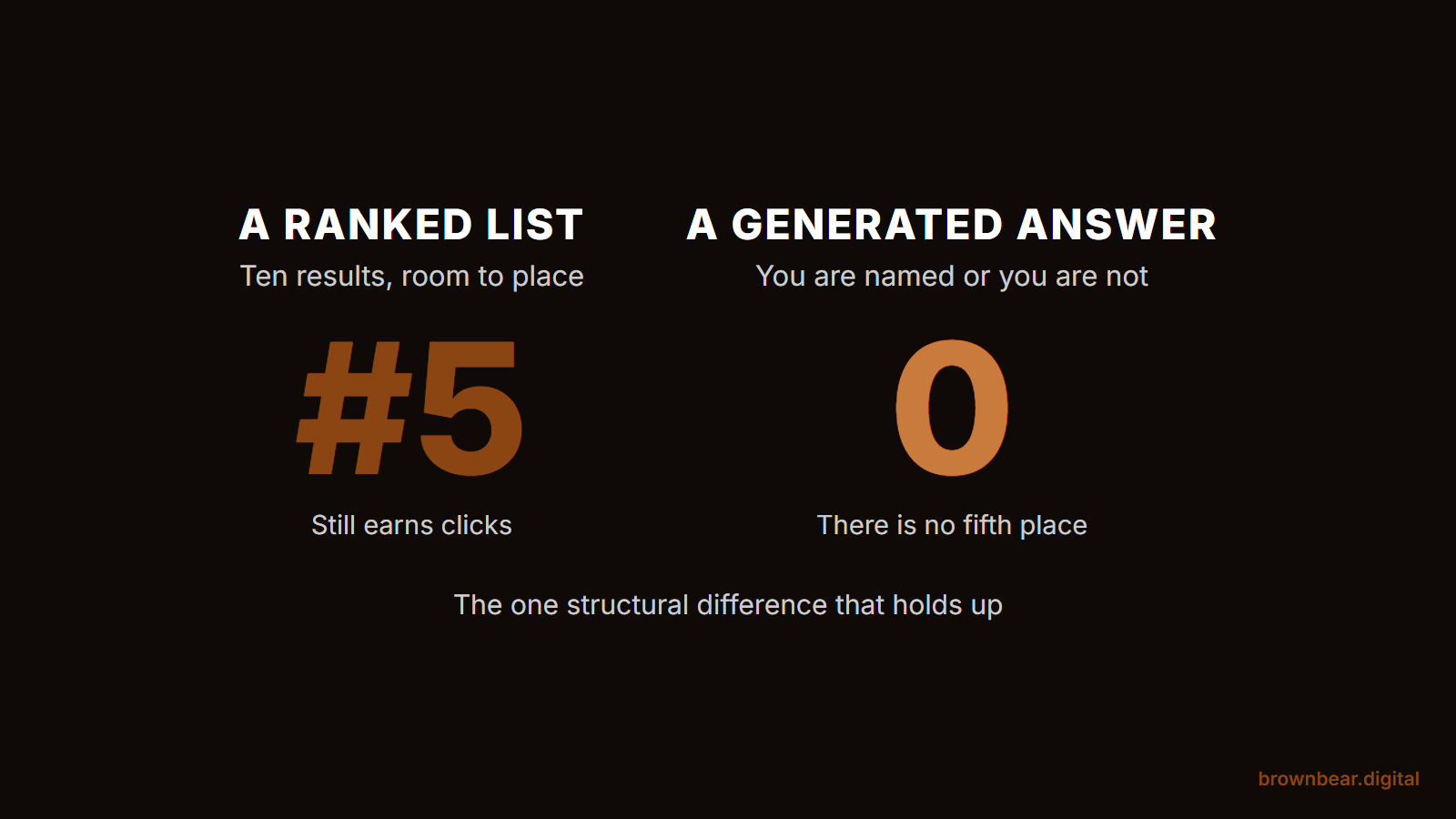
Practitioners keep arriving at this independently, and it is the one point in those Reddit threads that nobody argued with. It also explains the frustration that sends most people to this topic in the first place: a site that ranks page one and appears nowhere in ChatGPT, next to a competitor with a weaker site who shows up constantly.
Brown Bear's own data says that gap is usually an off-site problem, not an on-page one. When we classified 33,000 AI citations for medical practices, hospital and academic rosters accounted for 27.5 percent of citations, specialty board and association profiles for 22.1 percent, and national directories for 8.3 percent. The practice's own website was a small minority of what the models cited. If more than half of what an AI reads about you lives on pages you do not control, then whether you get named is decided largely off your site, no matter how well your site is written.
That is the ceiling on the whole category, and it is worth saying plainly: a meaningful share of AI visibility is not a page-level optimization problem at all. It is an entity presence problem, and it moves on the timescale of directories and third-party profiles rather than the timescale of a content sprint.
7. What Changes in the Work, and What Does Not
Roughly 80 percent of the work is the SEO you were already doing. What changes is the emphasis: extractability moves up, off-site entity consistency moves up sharply, and rank tracking stops being a sufficient measure.
| Concern | Under classic SEO | What AI search changes |
|---|---|---|
| Crawlability | Necessary | Necessary, and less forgiving. Heavy client-side rendering hurts more |
| Content quality | Necessary | Unchanged. Google's guidance is the same guidance |
| Answer placement | Nice to have | Materially more important. The direct answer belongs near the heading, not after four paragraphs of throat-clearing |
| Off-site mentions | Mostly a link-equity story | A primary input. Third-party profiles, directories, and reviews feed what the model believes about you |
| Name, address, phone consistency | Local SEO hygiene | The same hygiene, higher stakes. Inconsistent entity data is the most common thing our audits actually find |
| Measurement | Rank tracking | Insufficient. There is no position to track |
The practical version of the extractability point: lead every section with its answer. If a reader has to get through three paragraphs of context before the section says anything, a retrieval system has the same problem, and it will usually pick a page that does not make it work. Our guide to optimizing content for AI search covers the structural side in depth.
What does not change is more interesting than what does, and section 9 is entirely about it.
8. The Rebrand Test
If you are being sold GEO, four questions will tell you whether it is a new discipline or your existing SEO with a markup: what the deliverables are, what is measured, what happens off your site, and what the baseline was.
This is the question the community actually asks, phrased by one poster as whether GEO is just what agencies are calling SEO now to justify charging more for it. It deserves a real answer rather than a defensive one, so here is the test we would want a prospect to run on us.
1. What are the actual deliverables?
If the list is blog posts and backlinks, that is SEO. Those are good things to buy, and they will help AI visibility, but they are not a new service and should not carry a new price. A GEO engagement that is genuinely different includes work on entity data across third-party properties, content restructuring for extraction, and monitoring across systems you do not own.
2. What is being measured, and against what baseline?
If the reporting is rankings and organic sessions, you are buying SEO. AI visibility reporting means prompt-level testing across multiple assistants, tracked over time, with a documented baseline taken before the work started. Ask to see the baseline. A provider who cannot show you what the assistants said about you in month zero cannot show you a change in month six.
3. How much of the work happens off your website?
Given how much of what AI reads about a business lives on third-party pages, an engagement that only touches your site is working on a minority of the inputs. If nothing in the scope addresses directories, professional profiles, review platforms, or wherever your category's authority actually lives, the plan is incomplete regardless of what it is called.
4. Can they tell you what will not work?
This is the fastest one. A provider who has actually read Google's documentation can tell you which popular tactics are unnecessary, and will not be selling them. A provider who cannot name a single ineffective tactic is selling the category, not the outcome.
Say a marketing director gets a proposal with a GEO line item at an extra 2,000 dollars a month. She runs the four questions. The deliverables are eight blog posts and a link-building retainer. The reporting is rank tracking. Nothing in scope touches a page she does not own. And when she asks what will not work, the answer is that everything helps. That is four for four, and it is SEO with a markup, sold by people who have not read the documentation.
9. The Tactics You Can Stop Doing
Google's documentation explicitly names several popular AI-optimization tactics as unnecessary for Google Search: llms.txt and similar AI text files, breaking content into small chunks, writing in a special style for AI, pursuing inauthentic mentions, and structured data as a requirement.
This is where the gap between what the industry recommends and what the search engine publishes gets uncomfortable. In the largest of the two Reddit threads, the single most endorsed answer is a seven-step list, praised by other commenters as covering the bases close to 100 percent of the time. Two of its seven steps are things Google's page names as unnecessary: splitting one large guide into many short focused pieces, and adding schema markup. The advice is not malicious and it is not stupid. It is just not what the documentation says.
| Tactic | Google's published position | Does it help anyway? |
|---|---|---|
| llms.txt or other AI text files | "You don't need to create new machine readable files, AI text files, markup, or Markdown to appear in Google Search" | No evidence for Google. Low cost, so harmless, but do not pay for it as a deliverable |
| Chunking content into small pieces | "There's no requirement to break your content into tiny pieces for AI to better understand it" | Actively risky. Splitting one strong page into twelve thin ones can weaken the page that was ranking |
| Writing in a special style for AI | "You don't need to write in a specific way just for generative AI search" | Clear writing helps humans and extraction alike. Writing for machines does not |
| Buying or seeding mentions | "Seeking inauthentic 'mentions' across the web isn't as helpful as it might seem" | No. Genuine third-party presence matters a great deal, which is a different thing |
| Structured data | "Structured data isn't required for generative AI search" | Worth having for rich results and clarity. Not the lever it is sold as |
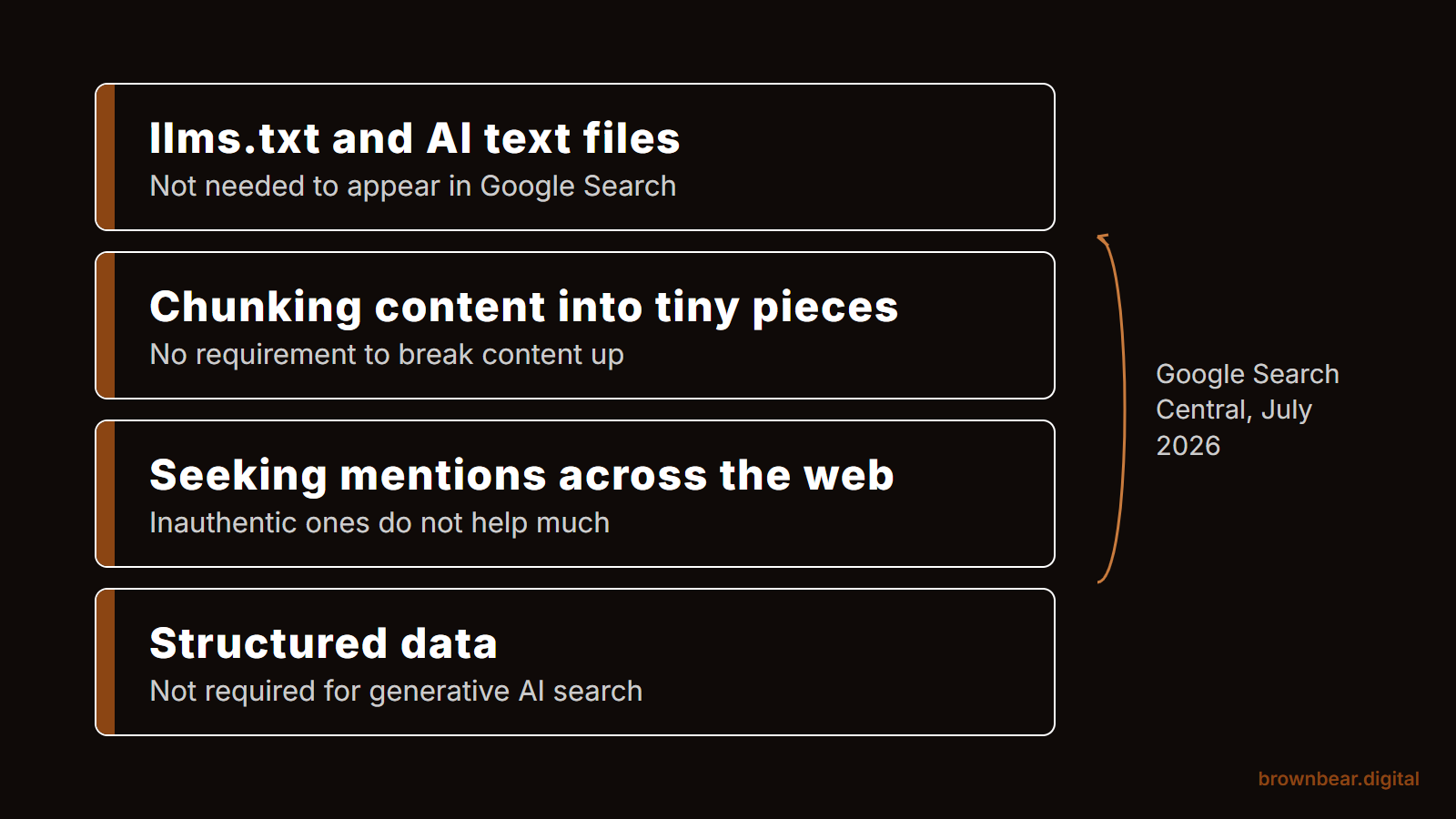
The schema line is worth dwelling on. Bryan's position for the last two years has been that schema is overhyped for AI visibility: still a best practice worth keeping tidy, but not the silver bullet it gets sold as, and a distant second to crawlability and clearly structured content. That was a contrarian call when he started making it, and Google's documentation now says the same thing in fewer words. The bigger lever, in our client work, has consistently been stripping heavy JavaScript off sites so the content is actually reachable. Our breakdown of what the evidence actually supports tiers these claims by how much support each one has.
Picture a team that spent a sprint shipping an llms.txt file, then waited a quarter for AI visibility to move. It did not, because for Google Search the file does nothing, and the assistants that might read one were not the ones the team was measuring. The sprint was not expensive. The quarter was.
10. Which One to Prioritize Depends on Your Business
The right priority forks on two things: whether you already rank, and what kind of business you run. Those two questions change the recommendation more than the choice of acronym does.
Start with whether you already rank
If you rank well and are still invisible in AI answers,
the bottleneck is almost certainly off-site. Your pages are in the candidate set and are not being chosen, or your brand is not associated with the category strongly enough to be named. Work the entity layer: third-party profiles, directory accuracy, review presence, and consistency of your name and details everywhere they appear. Content restructuring is a second-order fix here, and more content is usually the wrong answer.
If you rank poorly and are invisible in AI answers,
you do not have a GEO problem yet. You have a retrieval problem, and it is the ordinary kind. Crawlability, indexation, and topical coverage come first, because nothing downstream of retrieval can help a page that is never retrieved. Buying an AI visibility program in this state is buying the second floor before the foundation.
A plastic surgery practice we looked at ranked first for its main procedure plus city and could not be found in ChatGPT for any version of the same question. Nothing on the site was wrong. The surgeon's name appeared three different ways across a hospital roster, two board profiles, and four directories, and the address on one of them was two offices out of date. That is not a content problem and no amount of blog posts would have touched it.
Then branch on business type
Local and clinical service businesses
should weight entity accuracy and third-party profile presence highest. This is where the citation data is most lopsided and where the fixes are most concrete. What this looks like inside one vertical works the same logic through a full practice playbook.
B2B and SaaS companies
should weight review platforms and comparison surfaces highest. When a buyer asks an assistant for the best tool in a category, the answer tends to be assembled from the places categories get compared, not from vendor sites. Being absent from those is being absent from the answer.
Publishers and content businesses
face a different calculation entirely, because being cited in an answer that replaces the click is a visibility win and a traffic loss at the same time. That trade is real and it is not resolved by any of these acronyms. If AI Overviews specifically are your concern, improving visibility in Google's AI Overviews covers that surface directly.
11. How to Tell Whether Any of It Worked
Measurement is the one place where the work is genuinely different, because there is no rank to track. You need prompt-level testing across assistants, repeated on a schedule, against a baseline captured before the work started.
This is also the part most commonly missing from a GEO proposal, which is why it is question two of the Rebrand Test. Here is the minimum viable version:
- Write 20 to 30 real customer questions, phrased the way a customer would type them into an assistant, not the way you would type a keyword.
- Run all of them across the assistants your buyers use, and record four things per prompt: whether you were mentioned, whether you were cited with a link, how you were positioned against competitors, and which sources the answer drew on.
- Repeat on a fixed schedule, monthly is enough, because answers vary between runs and a single test is noise rather than a reading.
- Track the source list over time, not just your own appearances. When a new third-party site starts showing up in answers for your category, that is the next place to be present.
Our walkthrough of tracking brand mentions in AI search includes a free version of this system. The point of the baseline is not rigor for its own sake. It is that without one, nobody can tell the difference between a program that worked and a model update that happened to be kind to you.
12. Frequently Asked Questions
Is AEO part of GEO?
Depends whose definition you use, which is the whole problem. The most common framing treats AEO as the narrower craft of making a passage extractable and GEO as the broader goal of being named and recommended, which makes AEO a component of GEO. But the terms were coined five years apart for different problems, so neither was designed to nest inside the other. At the implementation level the distinction rarely changes what you do.
Is GEO just SEO with a new name?
Partly. The inputs are largely the same and Google states plainly that optimizing for its generative features is still SEO. What is genuinely different is the weighting, with off-site entity presence mattering far more, and the measurement, since there is no position to track. If a GEO service offers neither of those, it is a rebrand. Section 8 is the test.
Which is better, SEO or GEO?
The comparison does not hold, because one runs on the other. Generated answers are written from retrieved documents, and getting into that retrieval set is what SEO does. A business with no search visibility cannot buy its way into AI answers by skipping to GEO.
Do I need schema markup for AI search?
Not as a requirement. Google's documentation states that structured data is not required for generative AI search. It remains worth having for rich results and for describing your entities clearly, but it is not the lever it is commonly sold as.
Should I create an llms.txt file?
Not for Google. Its documentation says you do not need to create AI text files to appear in Google Search. The file costs almost nothing to publish, so it is not harmful, but it should not appear on an invoice as a deliverable.
Why do I rank on Google but not appear in ChatGPT?
Usually because a large share of what AI systems read about a business lives on pages the business does not own. If your entity data is inconsistent across third-party profiles, or you are simply absent from the sources your category gets summarized from, ranking will not rescue you. Start there, not with more content.
13. Work With Brown Bear on AI Search Visibility
Most of what we do when a client asks for GEO is unglamorous. We find the four places their name is spelled differently, get the JavaScript out of the way of the crawler, put the answer at the top of the section instead of the bottom, and build a baseline so that in six months there is something to compare against. It works because the boring parts are the parts the retrieval layer actually reads.
If you are evaluating a proposal, run the four questions in section 8 on it first, including on ours. If you would rather have someone run the audit and show you where you currently stand across the assistants your buyers use, that is the AI search visibility work we do.
Written By
Founder, Brown Bear Digital
Bryan has 15 years of experience across SEO, paid search, and AI search strategy. He founded Brown Bear to give businesses direct access to senior-level search expertise without the agency overhead.
Learn More About BryanGet Found on Google.
Get Cited by AI.
Tell us about your site. We'll send back a proposal for SEO and AI search.