The Anatomy of an AI Overview
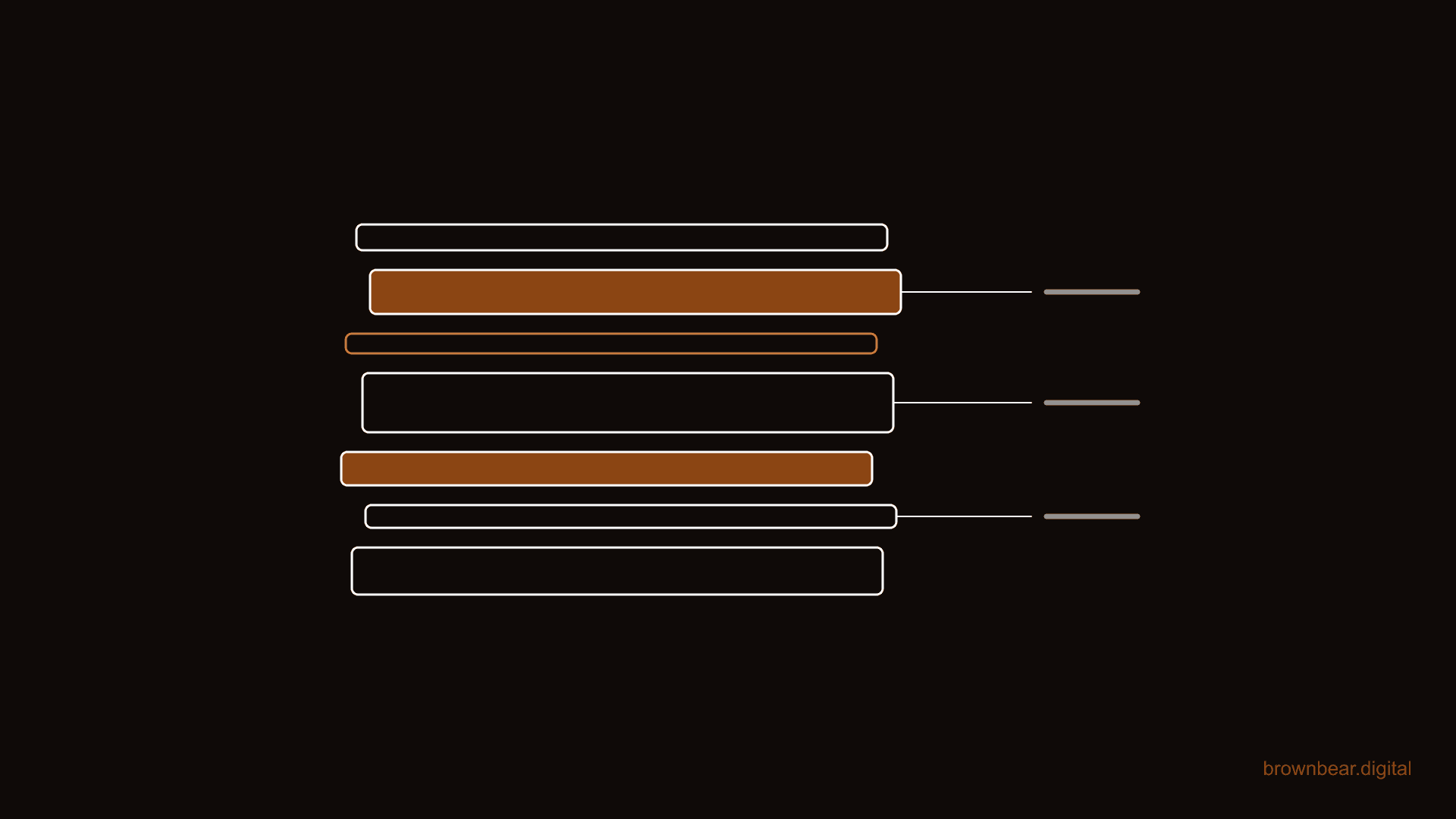
This is Brown Bear's field guide to the box at the top of Google: what an AI Overview is made of, where it came from, and why it behaves so differently depending on what someone types.
We build AI search visibility programs for medical and plastic surgery practices, which means we spend most weeks looking at AI Overviews on procedure searches and tracking which sources they pull. A good share of what follows comes from that work and from our own SERP datasets rather than from Google's documentation.
When we say AI Overview, we mean both the specific Google Search feature that launched in May 2024 and the wider family of AI answers it belongs to, including AI Mode and the assistant answers happening off Google entirely. The differences matter more than most coverage admits, so we draw the lines clearly near the end.
If your traffic has slipped and you are not sure whether that box is the reason, you are in the right place. If you are the marketing lead who has to explain this to a surgeon in ten minutes, there is a labeled diagram below you can borrow outright. If you have read a dozen posts about optimizing for AI Overviews and still could not describe how one actually gets built, closing that gap is the point of this piece. And if you simply do not trust the thing, hold that thought, because the search data says a great many people agree with you.
By the end you will be able to name every part of an AI Overview, describe the six steps Google takes to build one, say whether your own queries are likely to trigger one at all, and know exactly which controls you have and what each one costs you.
We have grouped it into four parts: what the thing is and how it is assembled, how it got here, where it does and does not appear, and what you can actually do about it.
Start with the strangest fact on this topic. Search Google for "what is an AI Overview" and Google does not give you one.
What an AI Overview Actually Is
An AI Overview is a block of AI-written text that Google places above its normal search results. A Gemini model writes it fresh for each search, using passages Google retrieves from pages already in its search index, and attaches links to some of those pages.
Three things inside that definition do most of the work.
It is generated, not stored.
There is no library of AI Overviews sitting on a shelf. The text is composed at the moment of the search, which is why two people searching the same words minutes apart can see different wording, and why you cannot "check your AI Overview" the way you check a ranking.
It is grounded, not invented.
The model is pointed at retrieved passages rather than left to write from memory. That is the difference between an AI Overview and a chatbot answer, and it is why your indexed pages are still the raw material.
It is Google's own statement, not a quotation.
A featured snippet lifts a sentence from your page and shows it with quotation marks around it, figuratively speaking. An AI Overview reads several pages and then writes something new. That distinction sounds academic until you reach the litigation section, where a German court built an entire liability ruling on it.
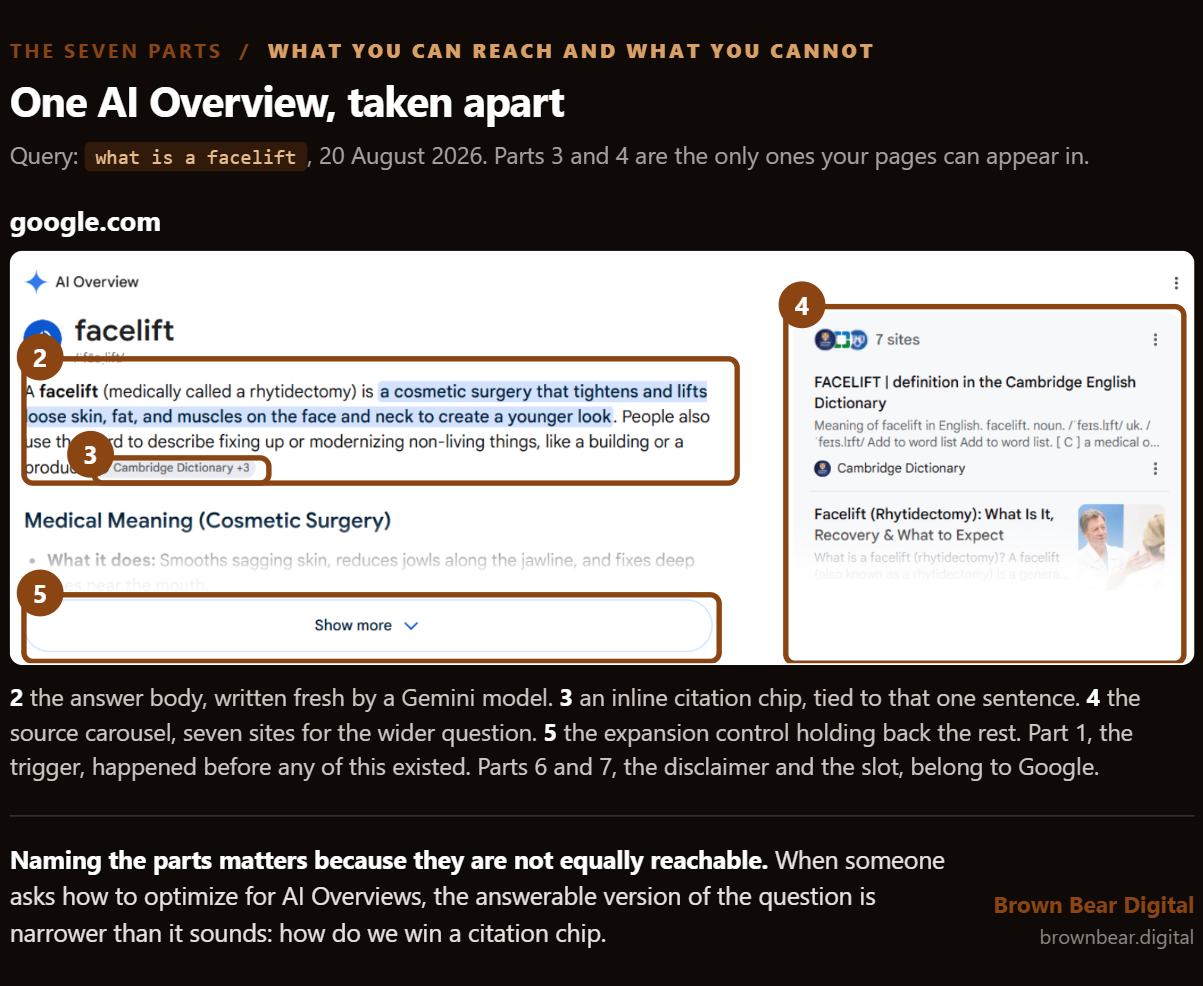
The Seven Parts of an AI Overview
Six of the pages currently ranking for this topic describe AI Overviews at length. Not one of them draws a picture of it. So here is the dissection, part by part.
| Part | What it is | Where its content comes from |
|---|---|---|
| 1. The trigger | The classification decision made before any text exists | Nothing yet. Google is deciding whether this query gets an overview at all |
| 2. The answer body | The generated summary itself | A Gemini model writing from retrieved passages |
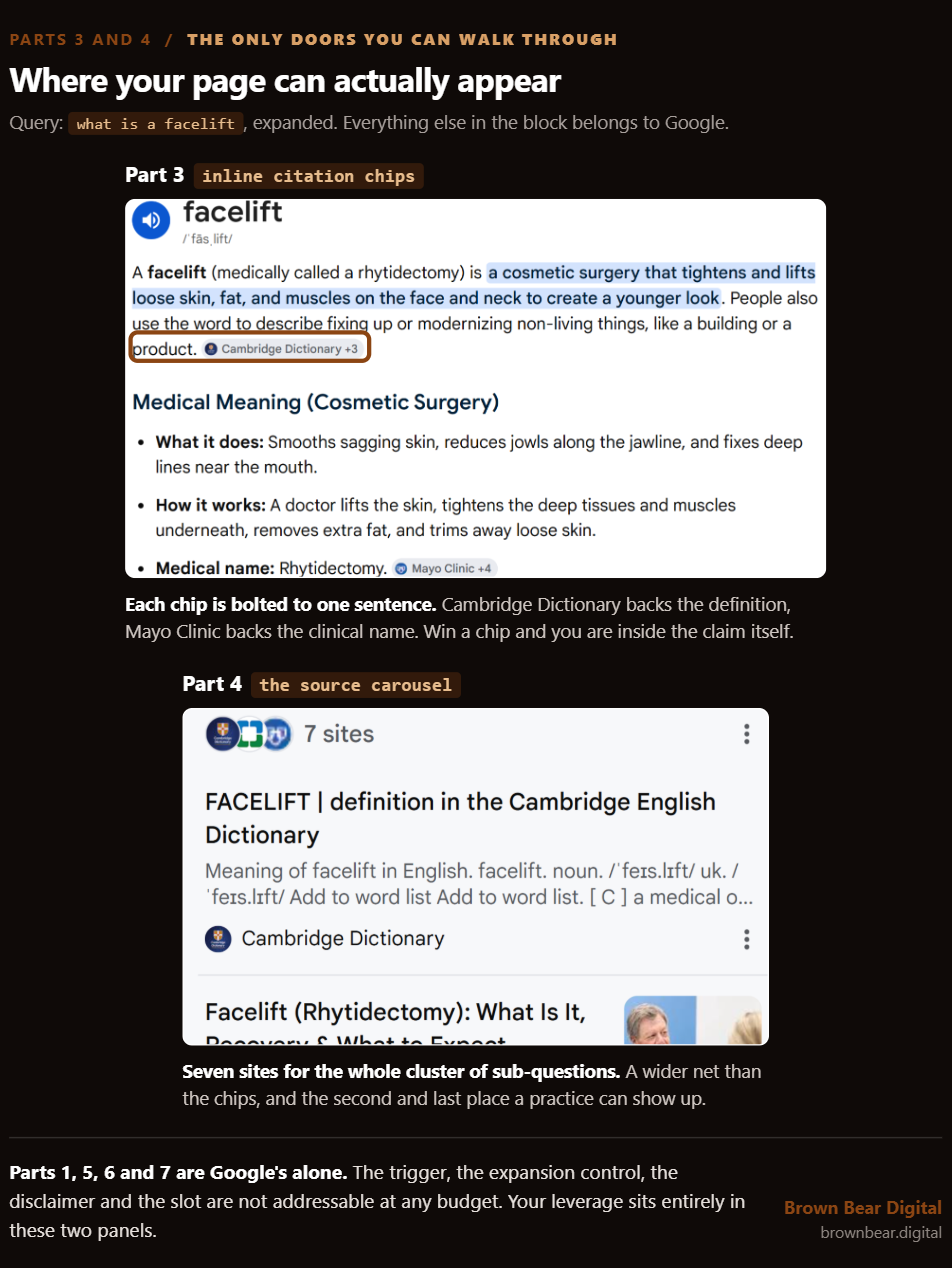
| 3. The inline citation chips | Small link boxes attached to individual sentences | The specific pages that backed that specific sentence |
| 4. The source carousel | The wider panel of supporting links | Pages judged relevant across the whole cluster of sub-questions |
| 5. The expansion control | The "Show more" affordance holding back the rest | The same generated response, hidden by default |
| 6. The disclaimer | The line warning that responses may contain mistakes | Google's interface, added after the feature's worst week |
| 7. The slot | The position above organic results, and the ads around it | Google's layout decisions, not your content |
The reason to name the parts rather than the feature is that they are not equally reachable. Parts 1, 5, 6 and 7 are entirely Google's. Part 2 is shaped by whether your pages contain clean, self-contained answers. Parts 3 and 4 are the only places your practice can actually appear. When someone asks how to optimize for AI Overviews, the answerable version of that question is: how do we win a citation chip.
Interactive
The AI Overview Dissector
A specimen AI Overview, taken apart. Tap any numbered pin to see what that part is, where its words come from, and what you can actually influence.
Recovery after a deep plane facelift
Most patients take about two weeks before returning to routine activity, with swelling and bruising easing over the first three to four weeks. Full settling of the deeper tissue can take several months, and surgeons often advise against strenuous exercise for four to six weeks.
Sources
Deep Plane Facelift Recovery Timeline
What To Expect After Facelift Surgery
Facelift Aftercare Guidance
Show more
AI responses may include mistakes.
Ads and the first blue link begin below this block.
Pick a part
Seven parts, seven different answers to the question every practice owner asks: can I do anything about this?
What it is
Where the words come from
What you can influence
Illustrative specimen for explanation only. The wording, sources and layout shown are invented to label the parts, not a capture of any live result, and Google changes this layout often. Nothing here is medical advice. Everything runs in your browser; no input is collected or transmitted.
How Google Builds One, From Query to Answer
Six steps run between someone hitting enter and the block appearing.
1. Classification
Google decides whether this query deserves an AI Overview. Most do not get one. This gate is invisible, it happens first, and it explains more variation in what practices see than any other factor.
2. Query fan-out
Rather than searching the typed words once, Google issues several related searches covering the sub-questions the query implies. Google describes this openly as a way to surface a wider and more diverse set of links.
3. Retrieval
Candidate passages come back from the existing search index. Not whole pages. Passages.
4. Grounding
The model is constrained to those retrieved passages. This is the step that separates an AI Overview from a chatbot guessing.
5. Generation
Gemini writes the summary, blending across sources.
6. Link selection
Google picks which pages get a citation chip and which fill out the source carousel.
The part most guides skip is what Google says you have to do to be eligible for any of this. The answer, from Google's own documentation on AI features and your website, is nothing special. There are no additional requirements to appear in AI Overviews or AI Mode, and no new files, AI text files, or schema.org structured data to add. A page has to be indexed and eligible to be shown with a snippet. That is the bar.
Bryan Passanisi, who founded Brown Bear, puts it more bluntly after two years of AI visibility audits: schema is overhyped as a lever for AI search. It remains a best practice worth keeping tidy, but the bigger wins in client work come from crawlability and cleanly structured content, and one of the most common fixes is stripping heavy JavaScript off a site so the content can actually be read.
Picture a practice whose recovery page is one long 1,400 word narrative about the surgeon's philosophy, with the actual timeline buried in paragraph nine. A patient searches for how long swelling lasts after a deep plane facelift. The fan-out generates a sub-question about swelling duration specifically. Retrieval looks for a passage that answers it. Paragraph nine never surfaces, because nothing around it signals that it contains the answer. The practice ranks on page one and still never appears in the box. The pages that get retrieved are the ones where each answer stands on its own.
A Short History of AI Overviews
Most of what looks arbitrary about AI Overviews today is a scar from a specific week. The timeline is worth reading as cause and effect rather than as trivia.
| When | What happened |
|---|---|
| May 2023 | Google introduces the Search Generative Experience at I/O, an opt-in Labs experiment |
| May 14, 2024 | Rebranded as AI Overviews and launched to US searchers at I/O 2024 |
| Late May 2024 | Viral failures, including advice to eat a rock a day and to put glue on pizza. Google scales back and adds triggering restrictions for queries where AI Overviews were not proving helpful |
| August 2024 | Expansion to the UK, India, Japan, Brazil, Mexico and Indonesia |
| October 28, 2024 | Expansion past 100 countries |
| March 2025 | Google begins testing AI Mode, a separate conversational search surface |
| May 2025 | Available in more than 200 countries and territories and over 40 languages, reaching about 1.5 billion monthly users |
| July 2025 | Pew Research Center publishes the first large independent study of what AI Overviews do to clicks |
| September 2025 | Penske Media, owner of Rolling Stone and Variety, files the first major US media antitrust suit over the feature |
| December 2025 | The European Commission opens a formal antitrust investigation into Google's use of publisher content for AI |
| January 2026 | Google pulls AI Overviews from a set of health queries after a Guardian investigation finds inaccurate medical summaries |
| May 2026 | A Munich court rules that AI Overviews are Google's own statements and holds Google directly liable for false ones |
Read the table again and the present-day feature makes more sense. The disclaimer under every overview exists because of May 2024. The uneven, hard to predict triggering exists because Google's own head of search said they were adding triggering restrictions after that same month. The prominence of citation chips grew as publisher pressure and litigation grew. Nothing about the current design is a neutral engineering choice. It is a settlement with the last two years.
Where AI Overviews Show Up and Where They Don't
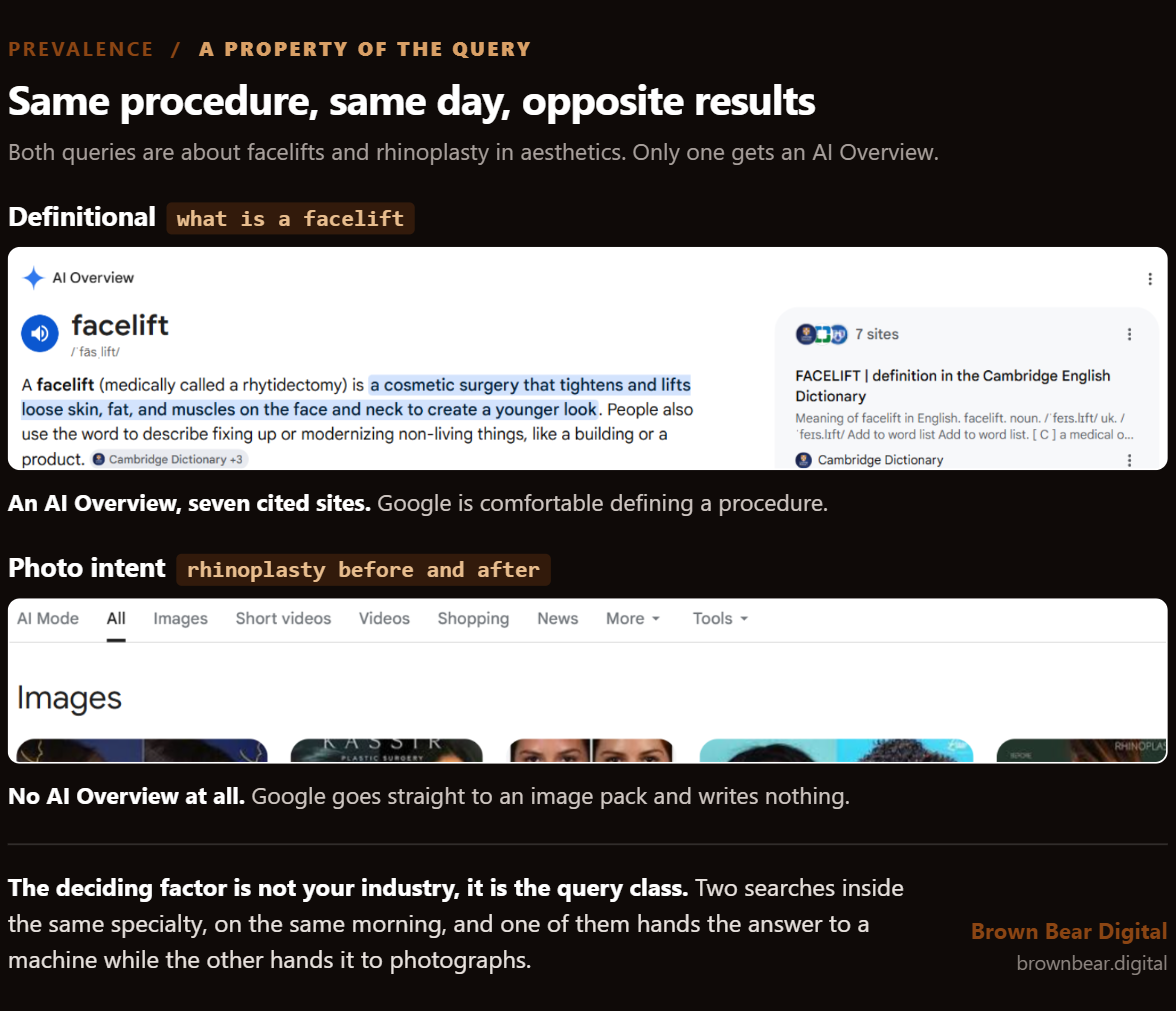
Prevalence is a property of the query, not a property of Google. This is the single most useful thing to understand about the feature, and almost nobody writing about it says so plainly.
The widely quoted industry numbers are low. Semrush has measured AI Overviews on roughly 13% of US queries. Ahrefs has measured them on about 9% of keywords and around 16% on US desktop. Those figures are real, and for most practices they are also useless, because they average across every kind of search on the internet.
Look at one vertical instead. In our own study of ranking factors across 50 before and after gallery keywords, an AI Overview appeared on 48 of the 50, or 96%. Photo intent, in aesthetics, triggers the feature at near saturation. That is roughly seven times the industry average, on exactly the searches a plastic surgery practice cares about most.
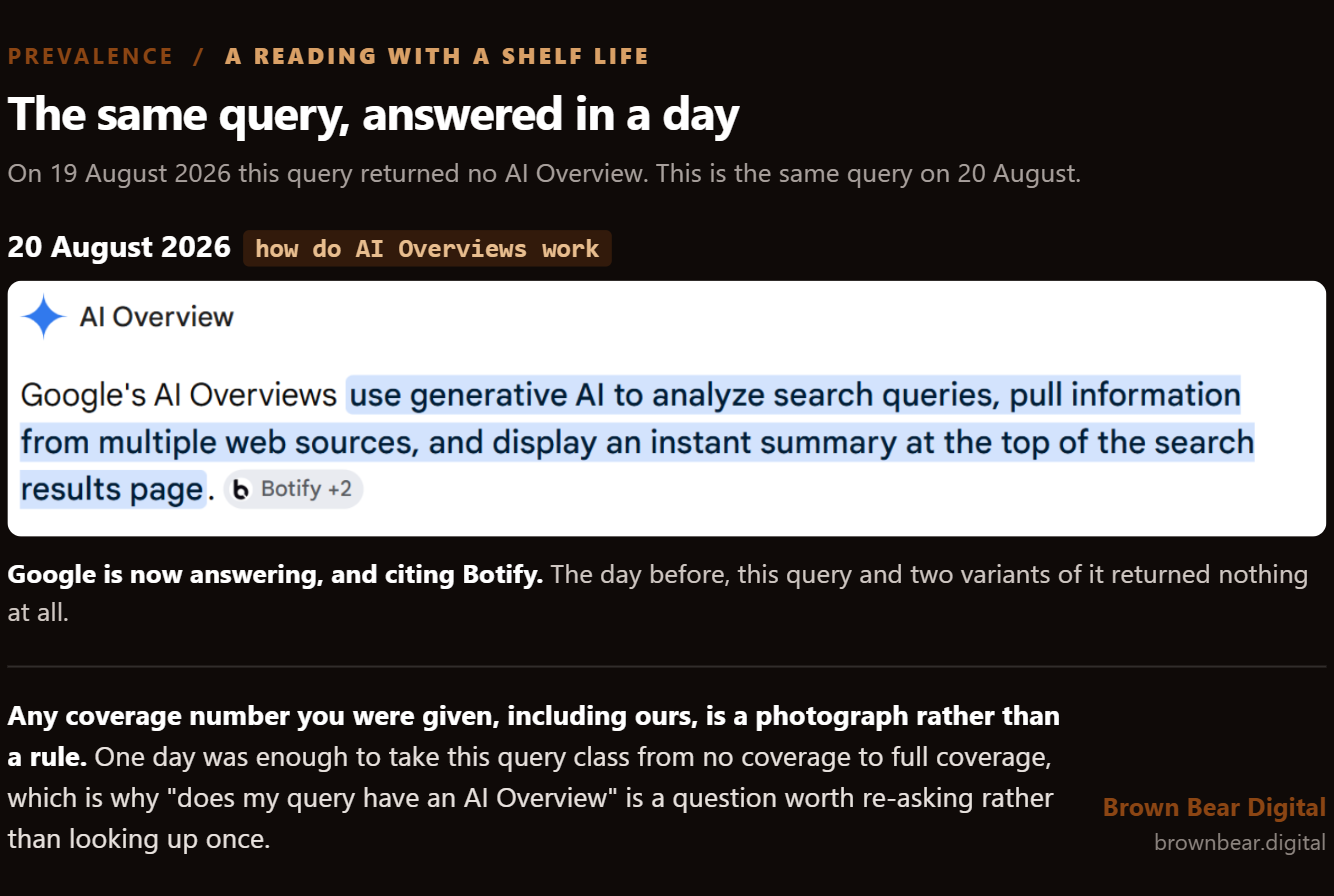
Now run it the other way, and watch how fast the ground moves. On 19 August 2026 we checked three variants of this article's own topic while logged out of Google: "what is an AI Overview", "how do AI Overviews work", and "when did AI Overviews launch". Google returned no AI Overview on any of them. We checked the same three queries the next morning and it was answering all three, citing Wikipedia on the first and Botify on the second. One day, and a query class went from no coverage to full coverage.
That is a more useful lesson than either percentage. Prevalence is not a fact you look up once and file. It is a reading with a shelf life, and on a feature Google is still actively expanding, that shelf life can be measured in days. Any number you were given about AI Overview coverage, including ours, is a photograph rather than a rule.
Which means the practical instruction forks. If your head terms are visual or commercial procedure queries, assume the overview is the first thing your patient sees and plan the page around being cited inside it. If your head terms are industry vocabulary or technical jargon, check before you spend, because you may be optimizing for a feature that never appears on your searches at all. The deciding factor is not your industry. It is the query class.
Say a practice manager reads that AI Overviews show on 13% of searches and decides the whole thing is overblown. She pulls her top twenty keywords a week later, checks them one at a time, and finds overviews on sixteen of them, because seventeen of her twenty are procedure and photo searches. The average was never about her.
Interactive
Will your patients even see an AI Overview?
Prevalence is a property of the query, not a property of Google. Pick the kind of search your patients actually run and see what the measured evidence says.
Six query classes, six very different answers. The industry average tells you almost nothing about your own search results.
What the evidence shows
What to do about it
Bands are drawn from published measurements, noted per class, and from our own SERP capture. AI Overview behaviour changes constantly and varies by location and account, so treat every band as a starting hypothesis and check your own keywords. This is informational only and is not medical, legal or financial advice. Everything runs in your browser; no input is collected or transmitted.
Why Health and Medical Queries Get Different Treatment
Google applies extra caution to queries where a wrong answer can hurt someone, and in January 2026 it acted on that caution publicly. After a Guardian investigation found inaccurate health summaries, including a Pap test presented as a test for vaginal cancer and liver blood test ranges given without accounting for patient differences, Google removed AI Overviews from a set of medical queries.
This is the AI search expression of a much older idea. Search quality standards have long treated topics that affect health, safety and finances as a separate category with a higher bar, which is the framework behind Your Money or Your Life standards in search. AI Overviews inherit that logic, and the rollback shows Google is willing to switch the feature off rather than get a medical answer wrong at scale.
For a practice this creates a split that is worth planning around explicitly. If your content is clinical, covering symptoms, complications, risk and recovery, your AI Overview exposure is lower than average, but that is not the relief it sounds like. It means you are competing for organic positions against hospital systems and specialty societies, and depth plus named clinical authorship matter more than extractability. If your content is procedure marketing, covering cost, results, photos and candidacy, your exposure is near total, and being the source that gets cited is the whole game.
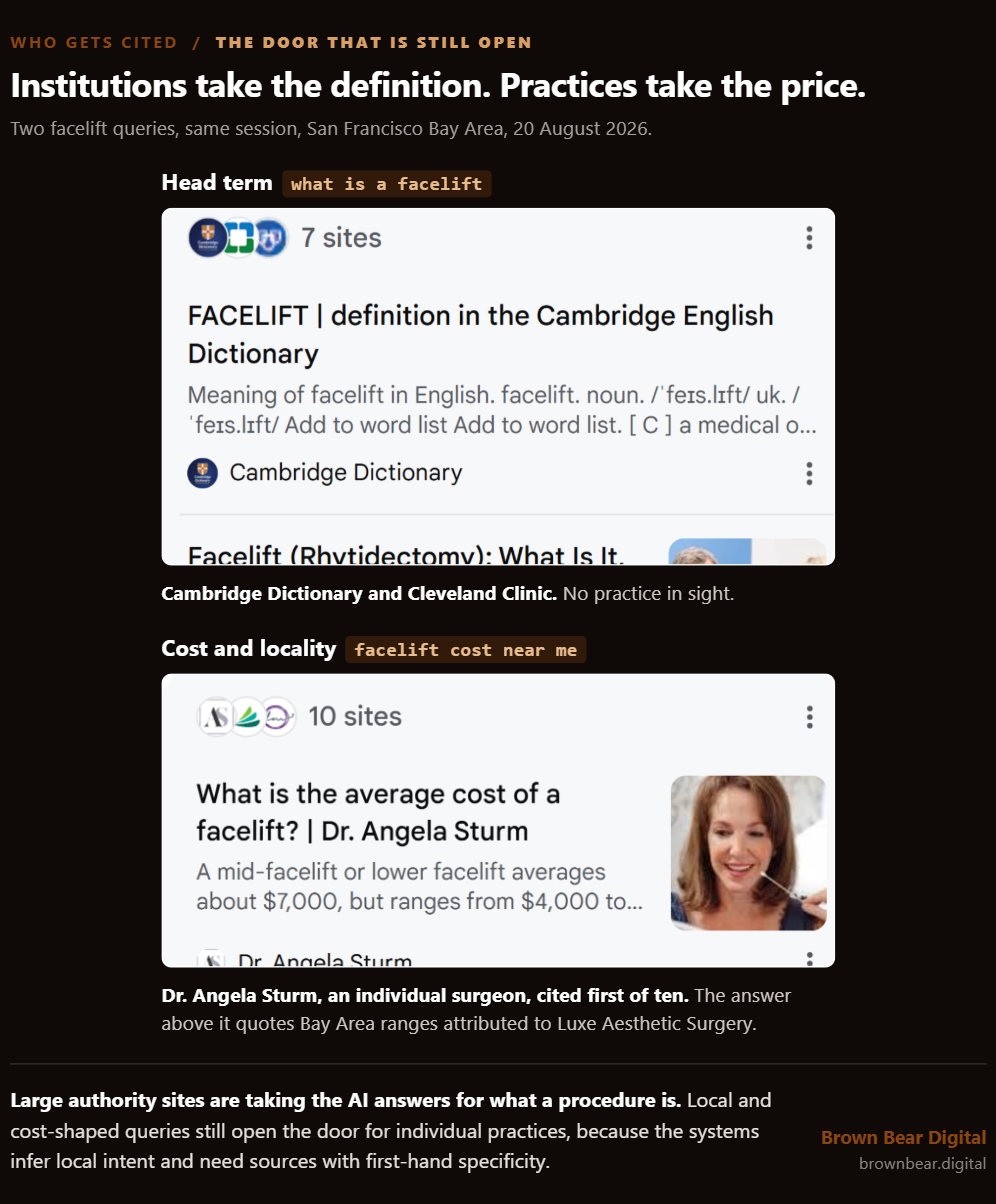
Bryan's read after running these audits across a client base of plastic surgery practices is that the territory has split cleanly. Large authority sites like Mayo Clinic and the American Society of Plastic Surgeons are taking the AI answers for head terms such as what a given procedure is. Local and cost-shaped queries still open the door for individual practices, and surgeons rank well inside AI answers on procedure plus location searches because the systems infer local intent.
What an AI Overview Does to Your Traffic
The most important number on this topic is not the one usually quoted. It is 1%.
The Pew Research Center tracked the browsing of about 900 US adults across 68,879 Google searches in March 2025, of which 12,593 produced an AI summary. Users who saw a summary clicked a traditional search result on 8% of visits, against 15% when no summary appeared. They clicked a link inside the summary itself on 1% of visits. And they ended the browsing session entirely on 26% of pages carrying a summary, against 16% of pages without one.
Ahrefs, measuring separately, found clicks to the top organic result falling by about 34.5% when an AI Overview is present.
Put the 1% next to the 8%, though, and the strategic conclusion changes. Being cited inside an AI Overview is not really a traffic channel. Almost nobody clicks those chips. What the citation buys is being named as a credible source at the moment a patient forms an impression, and the click, when it comes, usually arrives lower down the page or later in the journey.
Bryan's position on this runs against the gloom, and it comes from what he sees in client reporting rather than from the studies: the traffic that does arrive from AI surfaces converts to consultations at a higher rate and is more engaged than most other channels, because the research journey compresses into a handful of prompts in one session instead of ten tabs across a week. Fewer visits, further along.
Imagine a rhinoplasty page that used to bring in 900 sessions a month and now brings in 500. The consultation requests have not moved. What actually happened is that the 400 people who left were the ones reading a definition, and they now get the definition for free above the results. The visitors who remain are further down the path. Reading that page's report as a 44% traffic loss misses the story completely. Whether those visitors book depends on the page itself, and when a plastic surgery website isn't converting, the cause is usually one of a few fixable things.
What Decides Which Sources Get Cited
Eligibility is mechanical: the page must be indexed and allowed to show a snippet. Selection is where it gets interesting.
Pew found the most frequently cited sources in AI Overviews were Wikipedia, YouTube and Reddit. Ahrefs, analysing 55.8 million AI Overviews, found the top 50 domains accounted for 28.90% of all mentions. Both facts point the same way: the system leans heavily on a small set of consensus sources.
The practical opening comes from the fan-out. Because Google searches the sub-questions rather than the typed phrase, you are not competing for one head term. You are competing for a dozen narrow questions, most of which the big authority sites answer generically because they are writing for everyone. A practice that answers one of those narrow questions specifically and completely has a genuine shot at a citation chip on it, and that is the mechanic underneath most of the AI search strategies we recommend to clients.
Why So Many People Are Trying to Turn It Off
Here is a number that never appears in guides about AI Overviews. In the US alone, searches asking how to turn off, disable, remove or get rid of AI Overviews add up to more than 26,000 a month. "How to turn off AI Overview" by itself runs at 8,100 a month, which is higher than the search volume for "AI overviews" as a plural term.
The short practical answer is that Google offers no clean global off switch inside Search. You can move to the Web filter for a links-only view, and some Labs settings change what you see, but there is no setting that reliably removes the feature everywhere.
The more useful answer is what that volume tells you about your patients. The most upvoted comment on a Reddit thread titled "I really like Google AI Overview", posted in a subreddit dedicated to unpopular opinions, is a rejection with over 450 upvotes: the commenter notices mistakes in the topics they already know, and reasons there must also be mistakes in the topics they cannot check. That is a sophisticated form of doubt, and it is the majority position in the room.
So the strategic conclusion is not the obvious one. Getting cited in an AI Overview matters less than being the page the doubtful reader clicks to verify what the summary just told them. Design for the verification click. That means the page a patient lands on should immediately confirm, extend or correct what they just read, in the same vocabulary they just read it in.
Say a patient reads a summary claiming facelift recovery takes two weeks. She half believes it. She clicks through to a practice page that opens with a paragraph about the surgeon's training and never mentions a timeline in the first screen. She leaves and tries the next result. The page that wins her is the one that says, in its first lines, here is what two weeks actually looks like and here is what it leaves out. Writing for that moment, answer first and context second, is most of what generative engine optimization for facelift surgeons comes down to.
What You Can Control and What You Cannot
Google gives you snippet controls. It does not give you AI Overview controls. Everything available to you is a blunter instrument than it first appears.
| Control | What it does | What it costs you |
|---|---|---|
nosnippet | Blocks any text snippet from the page | Also removes your normal search snippets and featured snippets |
data-nosnippet | Blocks a specific section of a page | Surgical, and the only control here that does not damage the whole page |
max-snippet | Caps snippet length in characters | Applies everywhere snippets appear, not just AI features |
noindex | Removes the page from search entirely | Removes the page from search entirely |
| Google-Extended | Limits AI training and grounding in some other Google systems | Does not remove you from AI Overviews in Search |
The tradeoff Google documents but rarely gets explained is this: to be eligible as a supporting link in an AI Overview, a page must be indexed and eligible to appear with a snippet. The same eligibility governs both. There is no setting that keeps your regular snippets and removes you from AI answers. Opting out of one means opting out of both.
Which makes the decision simpler than it looks. For nearly every practice, the answer is to stay in and compete, and to put the effort into the parts of the page that make a site legible to AI search rather than into blocking directives. Here is where to start:
- Pull your top twenty patient-facing keywords and check each one manually for an AI Overview. Do it logged out. This takes an hour and replaces every industry average with your own reality.
- For the keywords that do trigger one, write down the sub-questions the summary answers. Those are your real targets.
- Restructure the two or three pages tied to those keywords so each sub-question has its own heading and a complete answer directly beneath it.
- Set a monthly reminder to recheck the same twenty. Triggering changes without notice, and last quarter's picture is not this quarter's.
Who Is Responsible for What an AI Overview Says
Legally, this is unsettled and moving fast, and the direction of travel matters to any practice whose reputation can be summarized by a machine.
In May 2026 the Regional Court of Munich ruled that AI Overviews are not neutral aggregations of third-party content but Google's own statements. Two publishers had been falsely linked by AI Overviews to scams and questionable business practices. The court found that by evaluating and combining content from various sites the feature generates independent, new and substantive statements, and rejected the argument that users could simply check the sources. That reasoning makes Google directly liable for accuracy.
It sits alongside a widening set of actions: Chegg's antitrust suit in February 2025, Penske Media's suit in September 2025 claiming its affiliate revenue fell by more than a third, and the European Commission's formal investigation opened in December 2025 into whether Google uses publisher content for AI without compensation and without a way to refuse that does not also cost publishers their place in Search.
For a practice the practical takeaway is narrow but real. If an AI Overview says something wrong about your practice or about a procedure you perform, your recourse is slow and unclear. The only control that works on a useful timescale is knowing it happened, which is why tracking how your brand is described in AI search belongs in the monthly routine rather than in the annual audit.
What an AI Overview Is Not
Four different things get called AI search, and conflating them causes most of the confusion in practice meetings.
| Feature | Who writes the words | Where the words come from | Where it appears |
|---|---|---|---|
| Featured snippet | Nobody. It is an extract | Verbatim from a single page | Top of the organic results |
| AI Overview | A Gemini model | Generated from passages across many indexed pages | Above the organic results |
| AI Mode | A Gemini model | Generated, conversational, across multiple turns | A separate search mode |
| Assistant answers | That vendor's model | Model knowledge plus its own retrieval | Off Google entirely, in ChatGPT, Perplexity, Claude or Gemini |
The cleanest way to hold the difference: a featured snippet is a quotation, and an AI Overview is a paraphrase Google wrote. Everything downstream, the citation behaviour, the traffic pattern, the liability question, follows from that one distinction.
Understanding the anatomy does something immediate for you. The next time a report shows organic sessions falling on a procedure page, you will be able to tell within ten minutes whether an AI Overview is involved, which of its seven parts you could realistically influence, and whether the fix is a content change or a measurement change. Over a longer horizon it does something better. It moves your practice from reacting to each new AI feature to understanding the machinery underneath all of them, which is the only position that stays useful as the features keep changing.
Brown Bear and AI Search Visibility
Knowing what an AI Overview is made of is the first half. Finding out how your practice actually appears inside one, across the specific searches your patients run, is the half that changes decisions. That is the work we do every day for medical and plastic surgery practices, starting with a real audit of your own query set rather than an industry average. When you want to see where you currently stand, take a look at our AI search visibility services.
Written By
Founder, Brown Bear Digital
Bryan has 15 years of experience across SEO, paid search, and AI search strategy. He founded Brown Bear to give businesses direct access to senior-level search expertise without the agency overhead.
Learn More About BryanGet Found on Google.
Get Cited by AI.
Tell us about your site. We'll send back a proposal for SEO and AI search.