12 AI Search Strategies, Ranked by How Much They Actually Move Visibility

Your traffic charts started looking wrong sometime last year, and every guide you have read since offers the same eleven things to fix. None of them tells you which one to do on Monday.
This is Brown Bear's ranking of the strategies that actually move visibility inside AI answers, ordered by how much work each one does for the time it costs. It draws on the AI-visibility audits we run for clients, where the findings are rarely the ones the guides predict, and on two of our own ranking studies covering 151 pages across aesthetic and medical search.
When we say AI search we mean both the AI Overview sitting above Google's blue links and the assistant conversations happening entirely off Google, in ChatGPT, Perplexity, Claude, and Gemini. The two behave differently and reward different work, so this covers both.
If you run a small business and every article you open hands you another checklist, the problem is not that you lack tactics, and we have a version of this ordered by cost in GEO for small business. If you are the only marketer in-house and you have maybe six hours a week for this, you need a sequence, not an inventory. And if an agency has just quoted you for something called GEO and you cannot tell whether it is real, you are asking exactly the right question, and there is a four-question test for whether a GEO quote is real work or a rebrand.
By the end you will know which four strategies do most of the work, which five compound slowly and are worth starting anyway, and which three are real but badly oversold. You will also have a rough hour cost for each, so you can decide what fits the time you actually have.
The twelve break into three tiers by leverage, followed by the ledger that prices them and the order to run them in. Before any of that, one thing needs clearing up, because it changes what the whole list is for.
What Changes When a Machine Answers Instead of Ranking
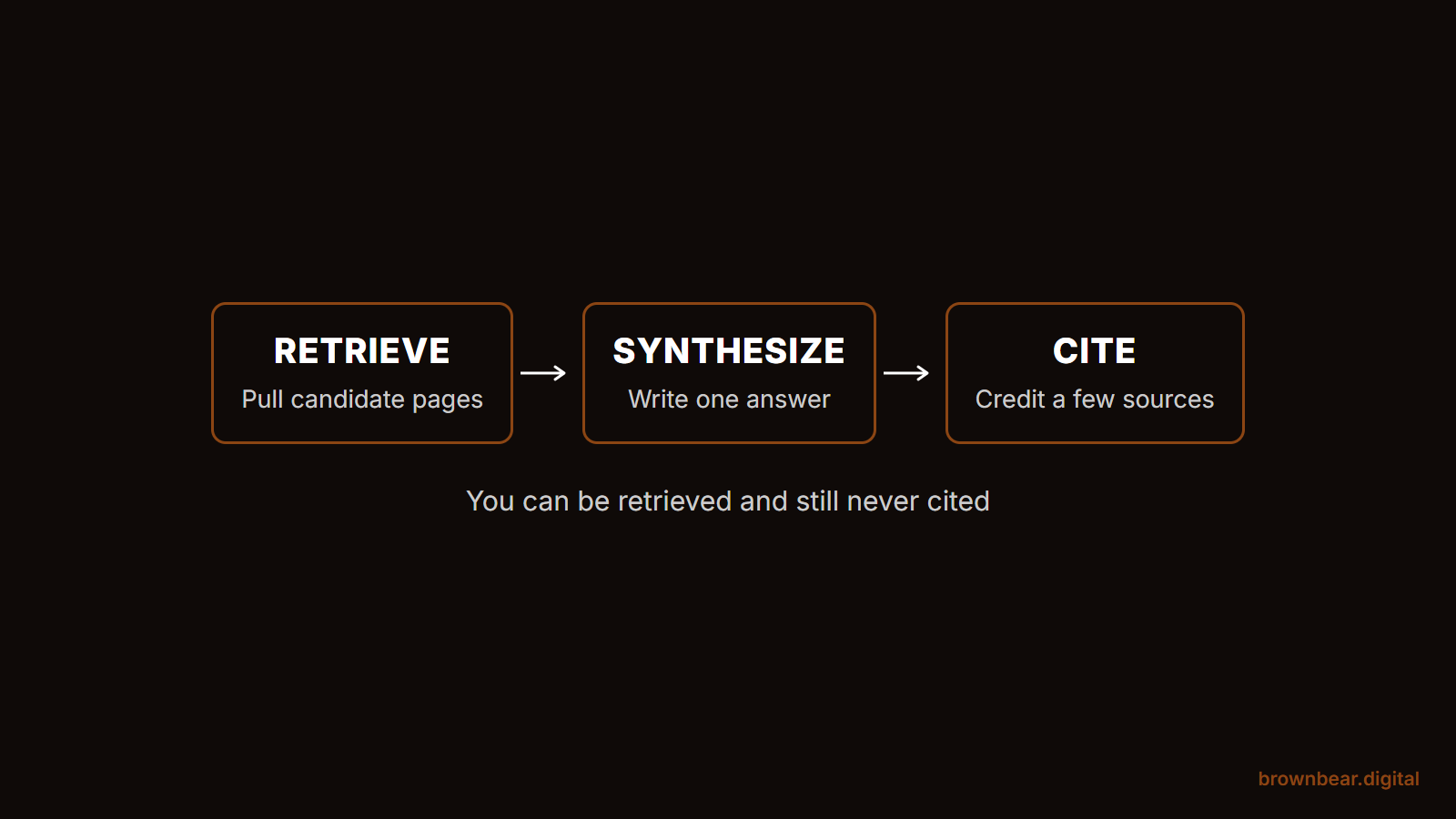
Traditional search retrieves and ranks pages. AI search retrieves passages, synthesizes them into one answer, and cites some of the sources it used. That single shift explains everything else on this list. You are no longer competing for a position. You are competing to be one of the handful of sources a model pulls from when it composes an answer.
Three consequences follow, and they are the only three that matter:
- Being reachable beats being optimized. A model that cannot retrieve your page cannot cite it, no matter how good the page is.
- What other sites say about you counts as much as what you say. Models synthesize across sources, so your own site is one input among many.
- Visibility is not stable. A citation you earn this month can vanish next month without anything on your site changing.
How much this matters depends heavily on your category. In our 50-procedure gallery study, Google served an AI Overview on 48 of the 50 keywords we tracked, or 96%. In other categories it is far rarer. The keyword this article targets is one of them: search "ai search strategy" today and Google returns no AI Overview at all. The industry writing about AI search has not yet earned an AI answer about AI search. Check your own head terms before assuming the AI Overview is your battleground. For plenty of businesses, the assistant conversations off Google matter more.
How to Read This Ranking
Every other list of AI search strategies is flat. Twelve items, equal weight, no guidance on what to do first. That is comfortable to publish and useless to act on, because these tactics are nowhere near equal.
So each strategy here carries a tier:
- Tier one does the most work per hour spent, and everything else depends on it. If you do nothing else, do these four.
- Tier two compounds. Slower to show results, durable once they land.
- Tier three is real but oversold. Worth doing eventually. Not worth doing first, and not worth paying a premium for.
Those tiers rank by leverage, which is a question about sequencing. There is a second way to sort the same territory: by how strong the evidence behind each factor actually is, which is a question about what has been proven. We did that separately in AI search ranking factors, where the same ground gets split into what Google confirms in writing, what only correlation supports, and what is being oversold. Read this one to decide what to do first. Read that one to decide what to believe.
The Four That Do the Most Work
1. Let AI Crawlers Reach Your Content
Check whether your robots.txt is blocking the AI crawlers, and unblock the ones you want citing you. GPTBot, ClaudeBot, PerplexityBot, and Google-Extended are the main ones. This takes about twenty minutes and it is the single highest-leverage thing on this list, because every other strategy is worthless if the crawler never arrives.
Google's own guidance on this is deflationary: it says the foundational work is standard technical SEO and access, not a separate AI discipline. That is worth holding onto as you read the rest of this. Most of what wins in AI search is competent fundamentals applied to a new retrieval layer.
The trap is the accidental block. Plenty of sites added a blanket disallow during the 2024 scraping panic and never revisited it, or inherited one from a security plugin. Let AI crawlers reach it before you spend a single hour on content structure.
2. Get Your JavaScript Out of the Way
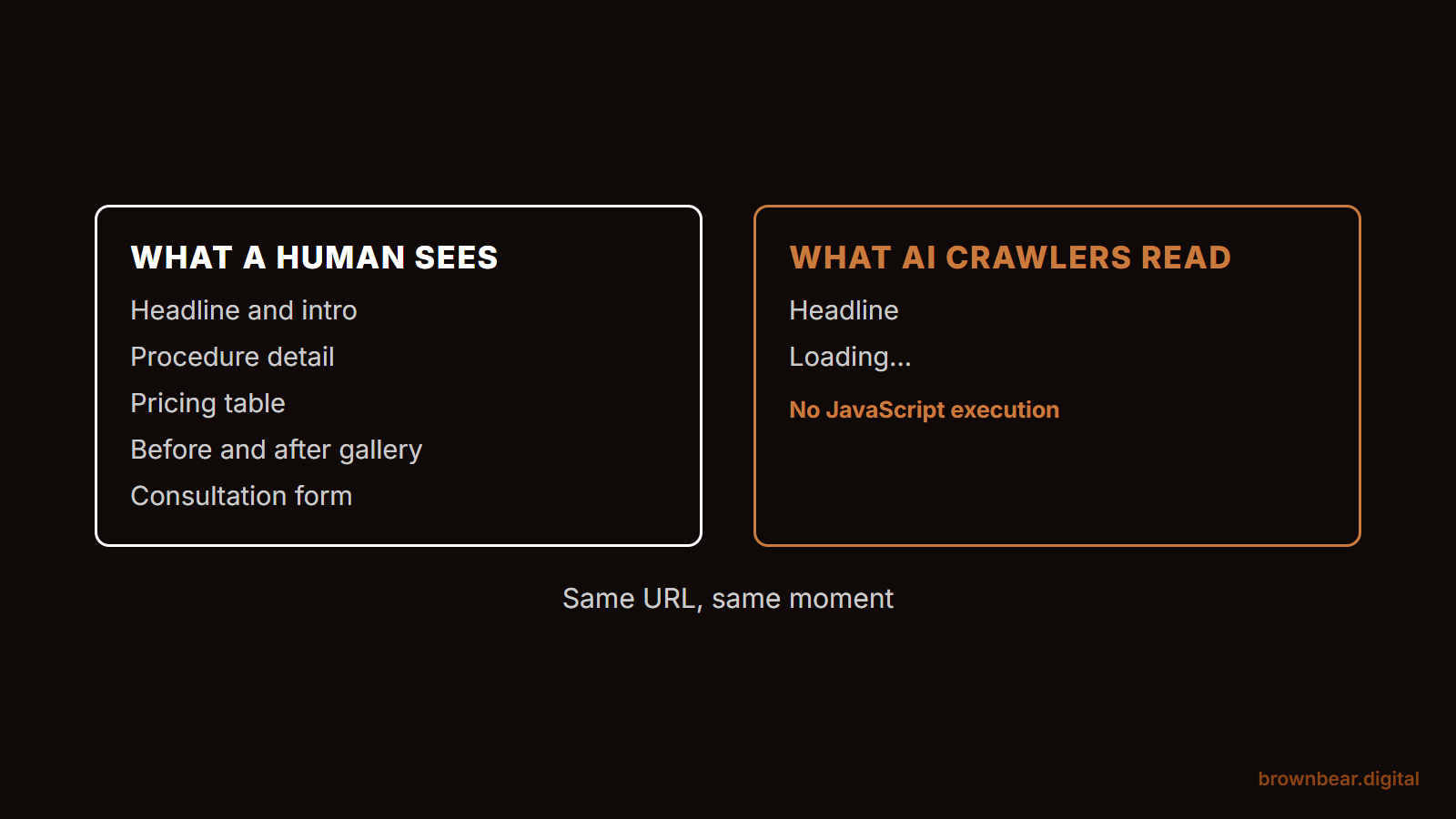
Serve your important content in the initial HTML rather than rendering it client-side. AI crawlers handle JavaScript far worse than Googlebot does, and content that only appears after hydration frequently does not exist as far as they are concerned. We strip large amounts of JavaScript off client sites, and it is consistently a bigger lever than schema.
Picture a two-location HVAC company whose site was built on a page builder that loads every service description through a client-side widget. In a browser it looks complete. Fetch the raw HTML and the page is a nav bar, a hero image, and an empty div. The company had been publishing service-area content for eight months and could not understand why no assistant would name them. Nothing was wrong with the content. There simply was not any, from the crawler's point of view.
This is the one most likely to be quietly broken on your site right now. View source on your most important page and search for a sentence you know is on it. If it is not there, strip the JavaScript before anything else.
3. Fix How You Are Described Off Your Own Site
Audit what models currently say about you, then correct the third-party sources feeding those descriptions. Ask four assistants what your company does and who it serves, and compare the answers to how you actually position yourself. The gaps point straight at the sources that need fixing.
Most guides file this under brand monitoring and treat it as a reporting task. It belongs in the top tier, because models weight what others say about you heavily, and because the fix is usually fast once you know what is wrong.
In the audits we run, the information is rarely wrong outright. The problem is that the services a business wants to be known for are buried, so models describe a generalist where the client wants specialist positioning. Owners are also consistently surprised by how much third-party sites drive their AI visibility and sentiment.
Start by finding out how AI describes your brand today, before you decide what to change.
4. Make Your Entity Impossible to Misread
Make your business name, address, phone number, and core description byte-identical everywhere they appear. Your site, your Google Business Profile, every directory, every professional association listing. Models resolve entities by matching across sources, and inconsistency reads as ambiguity.
The most common actual error our audits surface is odd variations of name, address, and phone number. It is easy to fix at the local level and it is not what the guides tell you to look for.
This is unglamorous and it outperforms most of tier two. If assistants are not showing up in AI answers at all for your brand name, entity confusion is the first thing to rule out.
The Five That Compound
5. Structure Pages So Answers Can Be Lifted Cleanly
Put a direct, self-contained answer in the first two sentences under each heading, then elaborate. Models extract passages, not pages, so a passage that only makes sense with three paragraphs of preceding context will not get pulled.
This is the one thing the entire SERP agrees on, and they are right about it. The difference is scope: it matters most on the page types that actually get cited, which is the next item.
The practical test is to read any single paragraph out of context and ask whether it still answers something. Here is how to structure the page so an answer can be lifted without losing the reading experience.
6. Build the Page Types AI Actually Cites
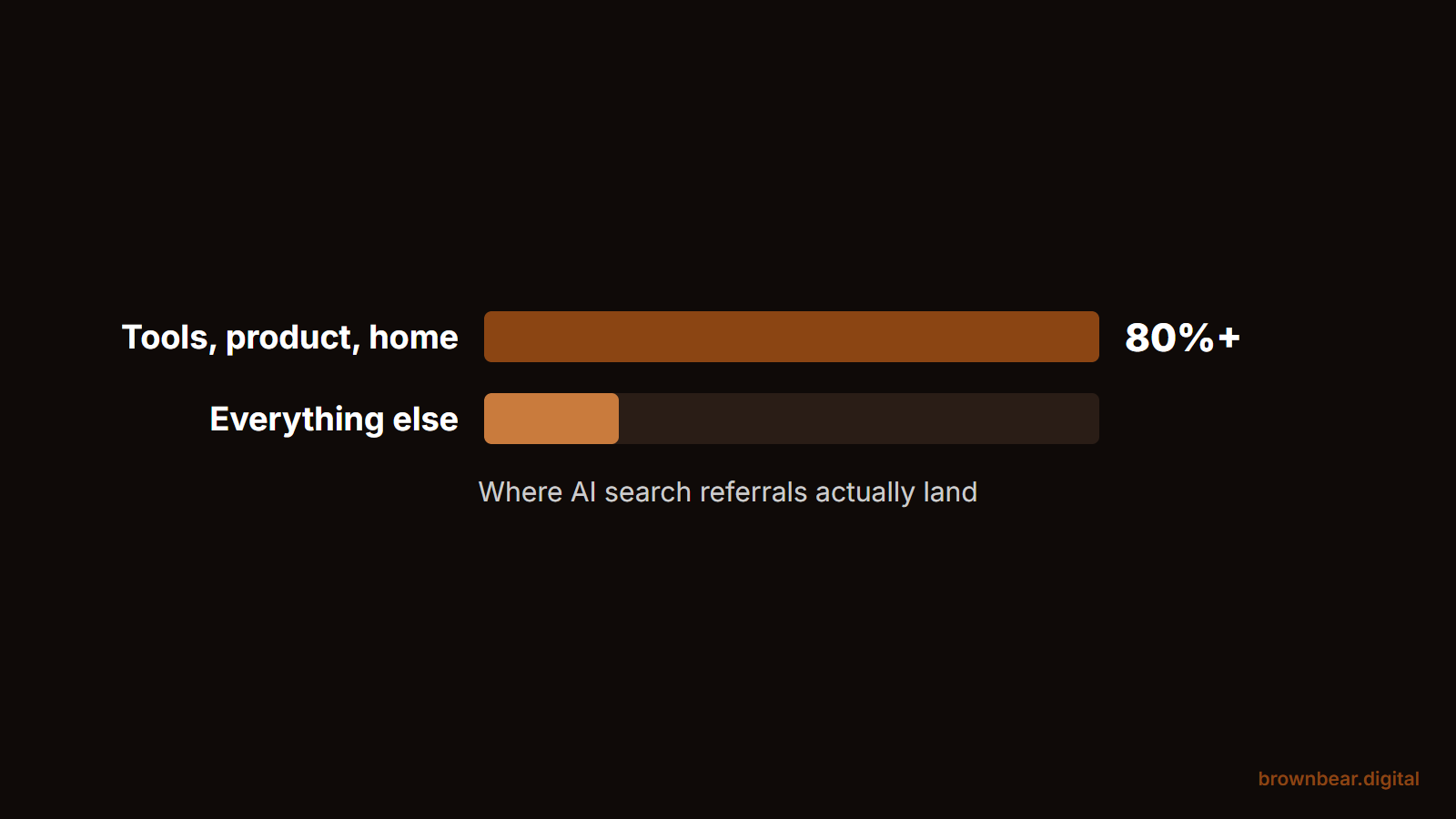
Free tools, product pages, and homepages capture the overwhelming majority of AI referral traffic. Informational blog content captures a small fraction of it. Ahrefs found more than 80% of AI referral traffic landing on just those three page types.
This quietly contradicts most of the advice on this topic, including advice sitting three items above it. Every guide tells you to restructure your blog for extraction. Almost none mentions that the blog is not where the clicks land.
Both things are true, and the resolution is that they do different jobs. Your blog content earns the citation, which is a visibility and trust event. Your tools and product pages earn the click, which is a traffic and revenue event. Optimizing only the first gets you mentioned. Building the second gets you visited.
Say you run a small payroll software company. You have forty blog posts about payroll compliance and no calculator. Assistants cite three of your posts when people ask how overtime is computed, which is pleasant and produces almost nothing. A competitor ships one overtime calculator, and assistants start linking it directly as the place to go do the thing. Same topical authority, completely different outcome.
7. Earn Mentions on the Sites AI Already Trusts
Get your business named on the third-party sites that models already lean on for your category: industry directories, review platforms, professional association listings, and genuine press. This is slow, it is the least controllable item on the list, and it compounds harder than anything else in tier two.
Which sites those are depends entirely on your category, and you can find out by asking assistants a category question and noting which sources they cite. Those are your targets. Directory and review profiles often do more work here than a year of blogging.
8. Manage Sentiment, Not Just Presence
Being mentioned is not the same as being recommended. A model can name your company accurately and in the same breath describe it in terms that lose you the customer. Track how you are characterized, not only whether you appear.
Most measurement advice stops at presence because presence is easy to count. The characterization is what determines whether a mention converts. Sentiment and salience are separate problems from visibility and need separate work.
9. Clear the Higher Trust Bar in a YMYL Category
If your topic touches health, money, safety, or legal outcomes, models apply a visibly higher sourcing standard before they will name you. Credentials, citations to primary sources, named authors, and clear editorial provenance stop being nice-to-haves.
This is where the answer forks. If you are in an unregulated category, selling software, running a restaurant, doing landscaping, you can skip most of this and spend the hours on the two items above instead. If you are in a YMYL category, medical, legal, financial, or insurance, invert that: this item outranks both of them, because without it the other work does not convert into citations. The deciding factor is simply whether a wrong answer in your category could hurt someone.
The Three That Are Necessary but Oversold
Everything below is real. None of it is a priority, and all three are routinely sold as though they were. These are the eight mistakes we see most often in compressed form: not wrong things, but right things done in the wrong order at the wrong price.
10. Schema Markup
Add structured data where it describes something real on the page. It helps machines parse entities and relationships. It is not the lever it is sold as. Schema is overhyped for AI search generally: still a best practice worth tidying, but not a silver bullet, and crawlability and cleanly structured content are the bigger levers.
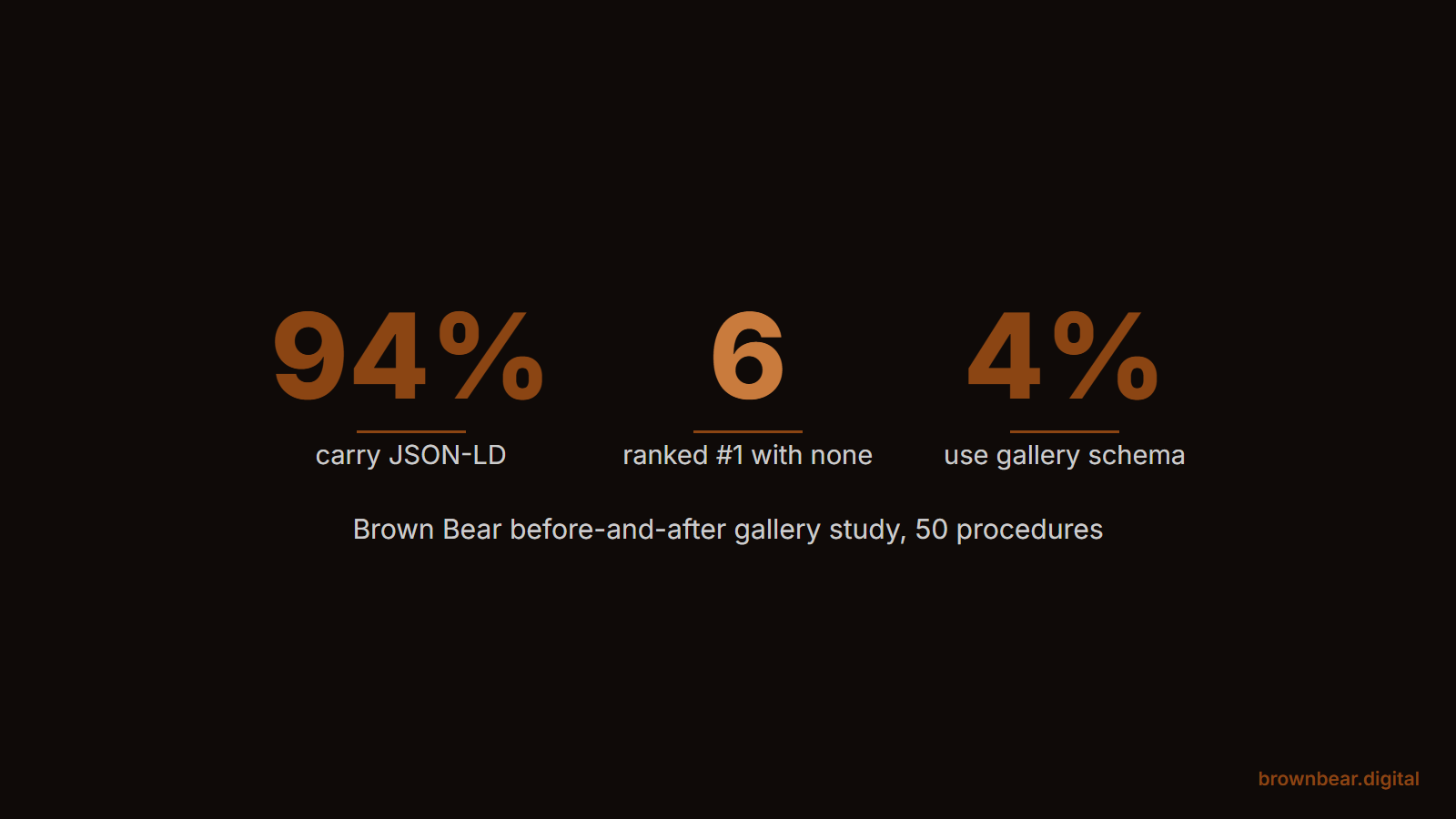
Our own data says the same thing. In our study of 101 city-level winners, 94% of #1-ranking pages carried JSON-LD, but six ranked first with no structured data whatsoever. And in the gallery study, only 4% of ranking pages used ImageGallery or MediaGallery schema, and just 5% marked up FAQ blocks despite 44% publishing FAQ content. Pages are winning without the markup the guides treat as mandatory.
Use the schema.org vocabulary for the types that genuinely describe your content, confirm it matches what is visible on the page, and move on. An afternoon, not a project.
11. Freshness and Republishing Dates
Keep genuinely time-sensitive content current. Models do show a mild preference for recent material on topics where recency matters.
What does not work is changing the date on an unchanged page. That is a cosmetic edit that fools nothing and costs the trust you are trying to build. Update content when the content has changed.
12. Prompt-Level Rank Tracking
Tools that report your visibility across a set of tracked prompts are useful for spotting direction over months. They are not a rank tracker, and treating them like one will mislead you.
Google's own guidance cautions that third-party tools have no access to its data and are therefore working from speculation. That is the search engine warning you about the tools sold to help you appear in it, and it is worth weighing before you sign an annual contract. If an agency's AI search offer is mostly a dashboard, look hard at what else is in it before you sign anything.
The Leverage Ledger
Here is the whole list in one place, priced. Effort is a rough first-pass estimate for a single site, not an ongoing program.
| # | Strategy | Tier | First-pass effort | Verdict |
|---|---|---|---|---|
| 1 | Let AI crawlers reach your content | One | ~20 min | Do it today. Everything depends on it. |
| 2 | Get your JavaScript out of the way | One | 4 to 40 hrs | Highest hidden failure rate. Check before you budget. |
| 3 | Fix how you are described off-site | One | 4 to 8 hrs to audit | Fast diagnosis, high payoff. Underrated everywhere. |
| 4 | Make your entity impossible to misread | One | 3 to 10 hrs | Unglamorous, beats most of tier two. |
| 5 | Structure pages for clean extraction | Two | 1 to 2 hrs per page | Real, and the whole SERP is right about it. |
| 6 | Build the page types AI actually cites | Two | 20 to 80 hrs | Where the clicks are. Almost nobody says so. |
| 7 | Earn mentions on trusted third-party sites | Two | Ongoing | Slowest, compounds hardest, least controllable. |
| 8 | Manage sentiment, not just presence | Two | 2 to 4 hrs per quarter | Determines whether a mention converts. |
| 9 | Clear the YMYL trust bar | Two, or One if regulated | Varies widely | Skip if unregulated. Top priority if not. |
| 10 | Schema markup | Three | 3 to 6 hrs | Real, oversold. Our own data shows pages winning without it. |
| 11 | Freshness and republishing dates | Three | Ongoing | Only when content genuinely changed. |
| 12 | Prompt-level rank tracking | Three | Tool cost | Directional only. Not a rank tracker. |
The Leverage Ledger
| # | Strategy | Priority | First pass |
|---|
Why Your Citations Keep Disappearing
Because the citation set is genuinely unstable. Industry tracking has found between 40% and 60% of cited sources changing month to month across Google's AI Mode and ChatGPT. Your page did not get penalized. The model composed a different answer.
This is the piece most measurement advice leaves out, and leaving it out sets people up to panic at noise. If you treat AI visibility like rank tracking, you will spend every month reacting to movement that means nothing.
Imagine checking a tracked prompt every Monday. Week one you are cited. Week three you are gone and a competitor is there. Week five you are back and the competitor is not. If you rebuild your content strategy on week three, you have optimized against a coin flip. The signal is the trend across a quarter, not the reading on any given Monday.

How to Measure Any of This
Measure three things, in this order of reliability:
- Referral traffic from assistant domains. Filter your analytics for chatgpt.com, perplexity.ai, claude.ai, and gemini.google.com. This is the only hard number you get, and it is real.
- Citation presence across a fixed prompt set. Write twenty prompts a real buyer would type, run them monthly, record whether you appear and how you are described. Directional, not precise.
- Conversion rate of assistant referrals against your other channels. Small volume, disproportionate quality.
LLM referral traffic converts at a higher rate and is more engaged than our other channels. It is the core KPI we show clients, and the reason to track conversion rather than volume is that assistant referrals arrive late in the decision. The research already happened inside the conversation. Here is the full method to track brand mentions across assistants without buying a platform.
The Order to Run These In
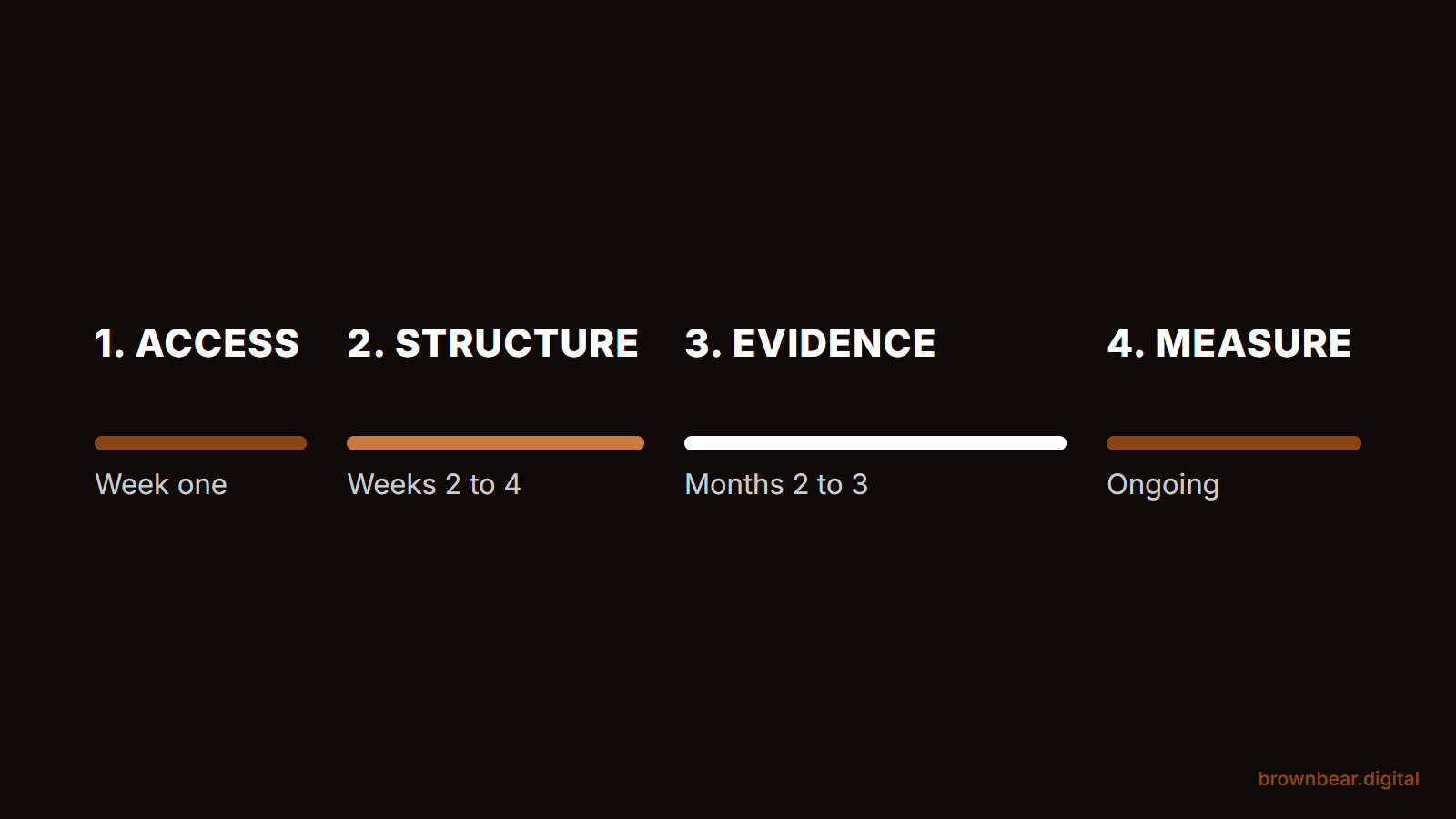
For most businesses, run it in this order:
- Week one. Unblock the crawlers, confirm your content exists in raw HTML. Nothing else matters until both are true.
- Weeks two to four. Audit how you are described, fix your entity data everywhere it appears.
- Months two and three. Build the cited page types first, then restructure your content for extraction.
- Ongoing from month two. Third-party mentions, and the trust bar work if you are regulated. Start early because it is the slowest to pay.
Two situations change that order.
If you sell a product or run an ecommerce catalog, move the cited-page-types work into week one, because your product pages already are the cited page type and they need the structural work more than your blog does. If you are a local service business, move the entity cleanup to the front instead, because entity consistency across directories carries more weight for you than for anyone else on this list, and it is often the entire reason a business is invisible.
The near-term payoff is knowing which eight things you are allowed to ignore this quarter. The longer one is a business that assistants describe correctly and recommend on purpose, which is a durable position and much harder for a competitor to take from you than a ranking is. If you are working from a fixed budget, reallocating an existing SEO budget is usually more realistic than asking for a new one.
The Theater Detector
Work With Brown Bear on AI Search
Most of the twelve are things a capable team can run in-house, and this article is written so you can. The parts worth handing off are the diagnosis, finding out what assistants currently say about you and which of the twelve is actually broken, and the JavaScript and entity work, which tends to be more tangled than it looks from the outside. Brown Bear does both, starting with the audit rather than a retainer. If you want to know where you stand before committing to anything, that is where our AI search work begins.
Written By
Founder, Brown Bear Digital
Bryan has 15 years of experience across SEO, paid search, and AI search strategy. He founded Brown Bear to give businesses direct access to senior-level search expertise without the agency overhead.
Learn More About BryanGet Found on Google.
Get Cited by AI.
Tell us about your site. We'll send back a proposal for SEO and AI search.