GEO for Small Businesses: Fix the Entity Before You Write the Content
This is Brown Bear's guide to getting a small business named when someone asks an AI assistant for a recommendation, ordered by what each step actually costs you.
We run AI search visibility programs for medical practices, local service businesses and dental offices through our SEO for dentists work, and our founder, Bryan Passanisi, has spent two years auditing what assistants say about clients and where those descriptions come from. The single most common finding in those audits is not a content problem. It is that the business name, address or phone number appears in three or four slightly different forms across the web, and the machine cannot tell whether it is looking at one business or several.
When we say GEO here we mean generative engine optimization: getting cited and recommended inside AI-generated answers. If you want the full definition first, we have what GEO actually means, and if the acronyms are what is bothering you, that is the acronyms and why they disagree. This page assumes you already know roughly what it is and want to know what to do about it on a small budget.
If you have watched a competitor get named by ChatGPT while you were not, the reason is probably in section 4. If you run your business out of a suite, a chair, a unit or a shared building, section 4 is the whole article for you. And if you are the marketer or agency being asked about this by a client and you are not sure of the answer, you are in good company, which is where section 9 starts.
By the end you will know the three things worth doing this week for nothing, the one expensive thing worth deferring, and how to tell whether any of it worked without buying a tool.
We have grouped it into four parts: why the usual advice is in the wrong order, the must-dos by cost, the failure mode nobody writes about, and when this stops being a do-it-yourself job.
Start with the ordering problem, because it is the reason most small businesses spend their first dollar in the wrong place.
1. The Short Answer
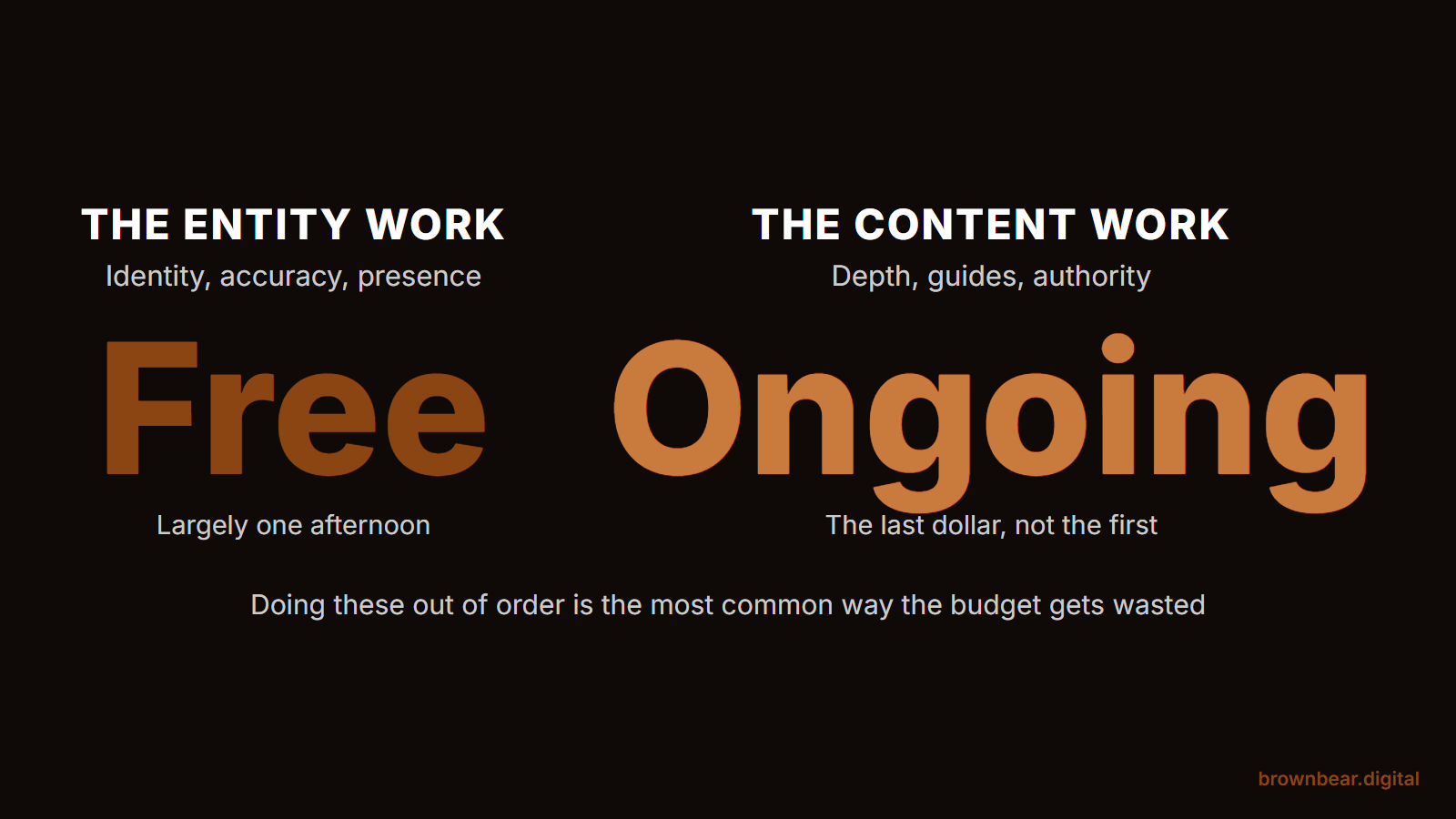
For a small business, GEO is mostly entity work rather than content work. Being named in an AI answer depends less on what your website says than on whether machines can identify you as one distinct, consistently described business across the web. The entity work is cheap, largely one-time, and mostly free. The content work is the expensive half, and it comes second.
That ordering is the opposite of what most guides tell you, including the AI Overview Google shows above this very search.
2. Why the Standard Advice Starts in the Wrong Place
The most-repeated first step in small-business GEO advice is to add schema markup. Google's own documentation says structured data is not required for generative AI search.
This is worth pausing on because you can check it yourself in about a minute. Search for GEO advice for small businesses and Google will generate an AI Overview whose first actionable step is to add structured data so AI crawlers understand your pricing, location and services. Then open Google's guide to optimizing for generative AI features, last updated 10 July 2026, and you will find the plain statement that structured data is not required for generative AI search.
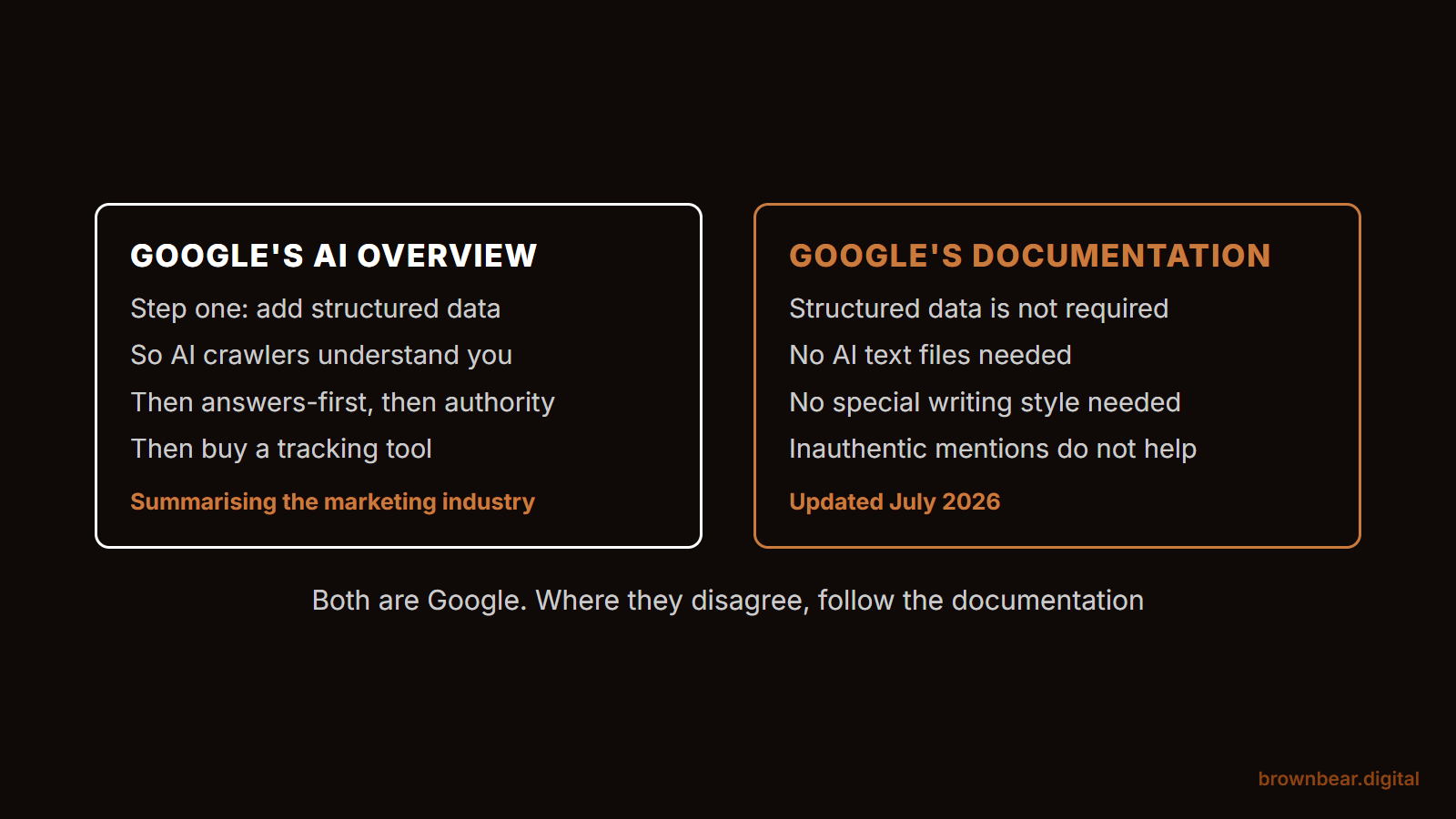
Both of those are Google. One is Google's AI summarizing the marketing industry. The other is Google's search team telling you what its systems actually need. Where they disagree, we go with the documentation.
None of this makes schema useless. It is worth having for rich results and it helps describe your business clearly. It is simply not the first thing to buy, and for a small business the difference between first and fourth on the list is the difference between spending your only budget well or badly.
Picture an owner who reads that AI Overview, pays a developer six hundred dollars to implement LocalBusiness schema, and waits. Nothing changes, because her business is still listed under two different phone numbers and her suite number is missing from half her profiles. The schema described a business the machine was never confident existed.
3. The Must-Dos, Ordered by What They Cost You
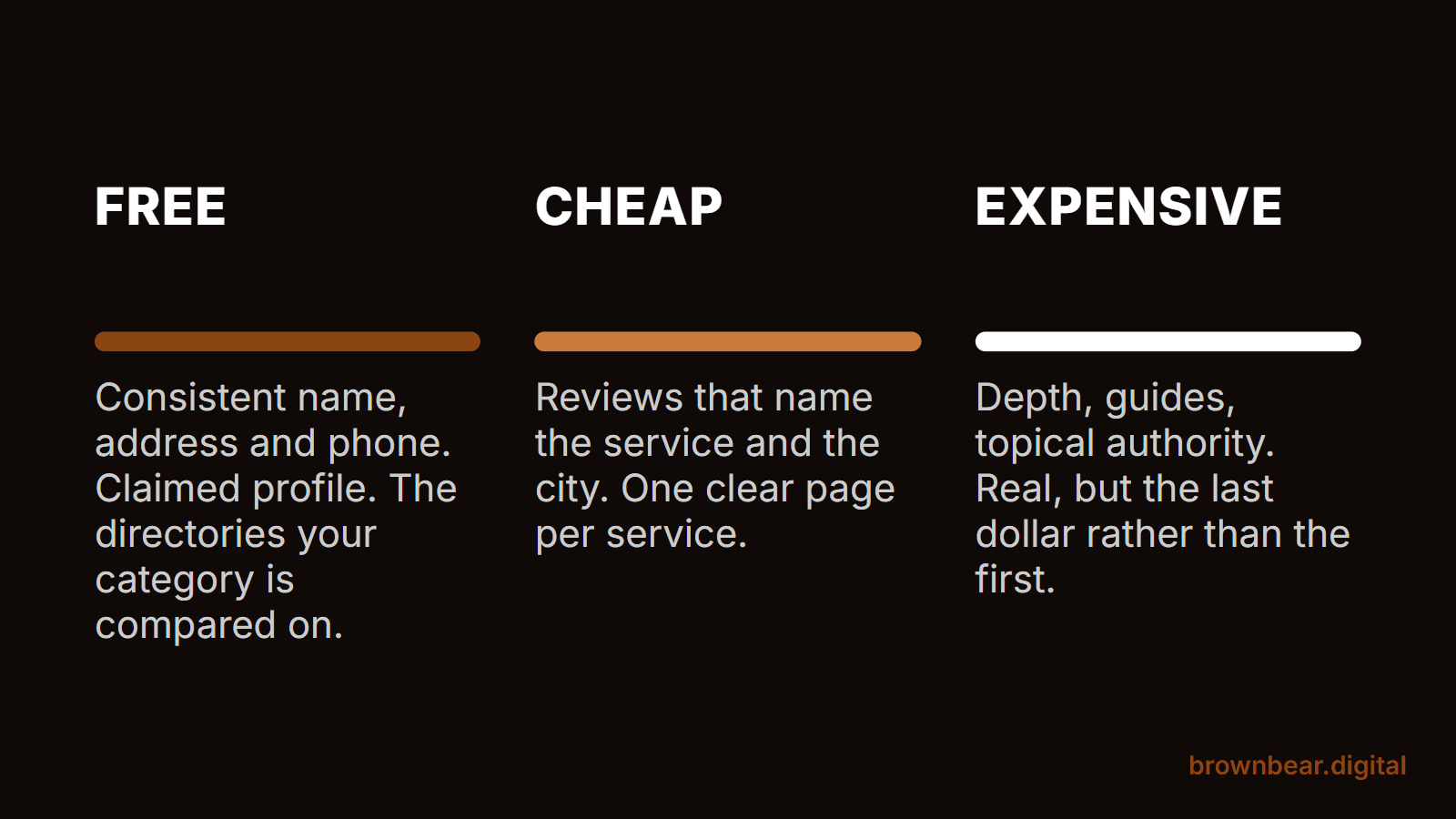
Three things are free and largely one-time. Two are cheap and recurring. One is expensive and can wait. Doing them out of order is the most common way small businesses waste money on this.
| What | Cost | How often | Why it comes where it does |
|---|---|---|---|
| Make your name, address and phone identical everywhere | Free | Once, then check twice a year | Nothing downstream works if the machine cannot tell you are one business |
| Claim and complete your Google Business Profile | Free | Once, then maintain | The most widely mirrored description of you that you actually control |
| Claim the three or four directories your category is compared on | Free | Once | These are the pages assistants read when they compare local options |
| Ask for reviews that name the service and the city | Cheap | Monthly | Specific language gives a model something to attribute to you |
| Keep one clear page per service you want to be known for | Cheap | Quarterly | Gives the answer somewhere to point once you are already a candidate |
| Publish depth: guides, original research, topical authority | Expensive | Ongoing | Real, but it is the last dollar, not the first |
The free block at the top is genuinely finishable in an afternoon or two. That is unusual in marketing and it is the best news in this article. Claiming the profile itself is done through Google's own Business Profile process, which takes minutes and costs nothing. Our walkthrough of what a complete profile looks like is written for medical practices but the completeness checklist applies to any local business.
4. The Invisible Tenant Problem
If your business operates inside another business's address, a salon suite, a chair, a unit in a shared building, a room in a clinic, a desk in a coworking space, assistants frequently cannot tell you apart from your host. You get skipped in favour of the building, even with excellent reviews.
This is the most fixable cause of small-business invisibility and it appears on none of the guides currently ranking for this topic. It surfaced instead from practitioners comparing notes: solo operators inside shared premises being passed over despite strong reviews, because they have no entity presence separate from the address they sit in.
The mechanism is straightforward once you see it. If your address string is identical to your landlord's, your suite number is missing or inconsistent, and every third-party mention of you routes through the host business's name, then from the machine's point of view there is one business at that address and it is not you.
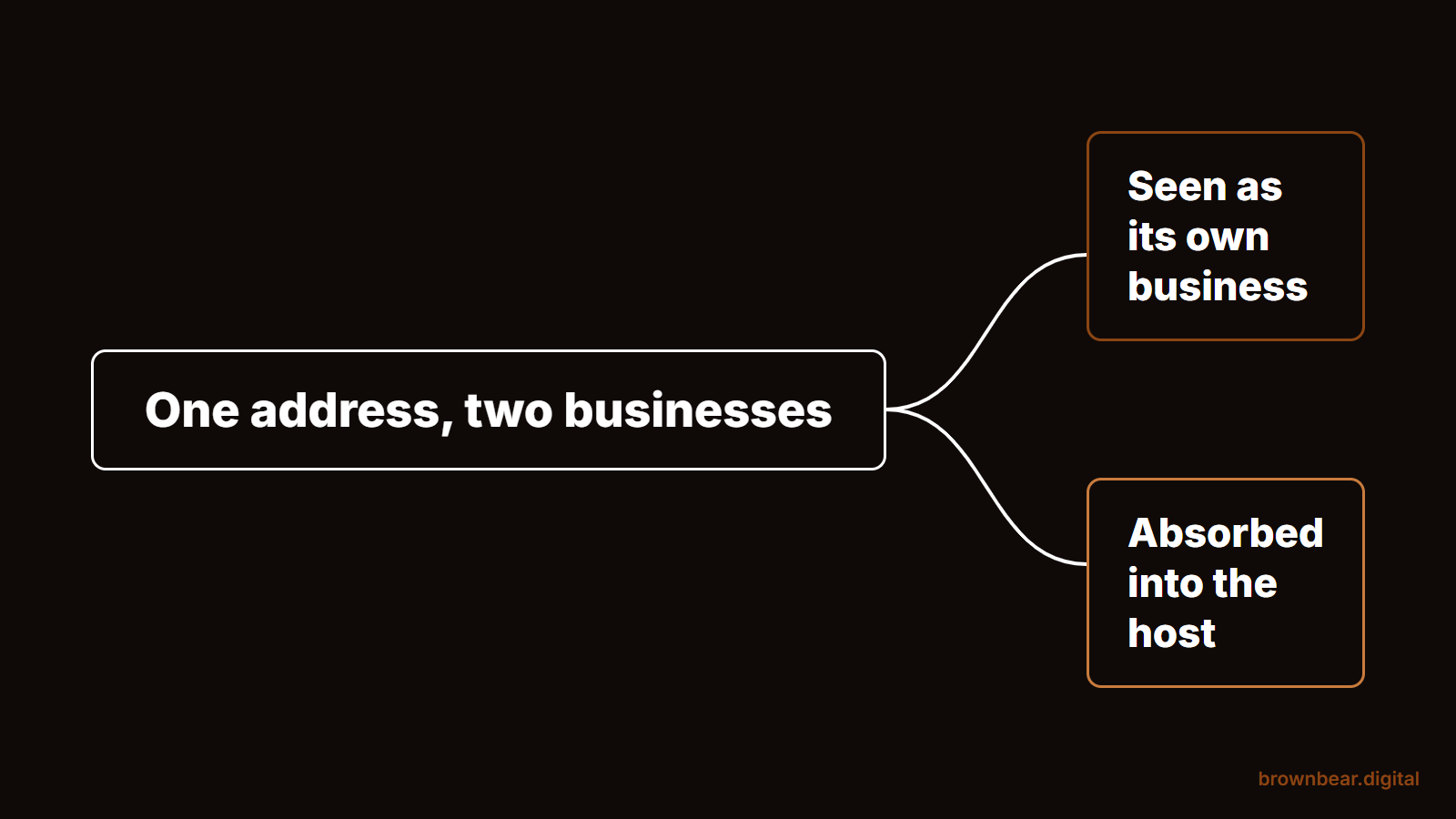
Say an esthetician rents a room inside a hair salon. Her Google profile lists the salon's street address without her suite, her booking platform lists a different phone, and her reviews live on the salon's page. She has done nothing wrong. She is simply not a separate entity yet, and no amount of content on her website changes that.
The fix forks on whether you share an address
If you share an address with a host or parent business,
your first three jobs are to add and use a unit or suite designator consistently everywhere, get at least a handful of reviews that name you rather than the host, and make sure any directory listing for you carries your own phone number rather than the front desk. This is free and it is the highest-leverage work available to you.
If you have your own address and are still invisible,
the tenant problem is not yours. Move to the consistency audit in the previous section, then to section 5, because your issue is more likely to be that too little of what the web says about you is specific enough to attribute.
5. What Actually Gets a Small Business Named
Most of what an assistant knows about a business comes from pages the business does not own. That is why entity accuracy across third-party sites outranks anything you can publish on your own site.
Brown Bear has measured this in one vertical. When we classified 33,000 AI citations for medical practices, hospital and academic rosters accounted for 27.5 percent, specialty board and association profiles for 22.1 percent, and national directories for 8.3 percent. The practice's own website was a small minority of what the models cited.
That dataset is medical practices, not small businesses generally, and it would be sloppy to present it as if it were. What transfers is the shape rather than the percentages: in a category where independent third-party profiles exist, those profiles do a large share of the describing. For a plumber or a bakery the specific sources differ, directories and review platforms rather than hospital rosters, but the position of your own website in that mix is similar. Treat the numbers as evidence for the pattern, not as your own numbers.
There is also a mechanical reason the third-party layer matters more than it used to. When someone asks an assistant for the best dentist in Austin, the system does not search that phrase. It expands it into several narrower searches, then reads what comes back. Practitioners describe watching it fan out into things like top dentists in the surrounding county, or the city plus the year. You are not competing for the question that was asked, you are competing for the handful of searches the machine invents on its way to answering it. Our piece on query fan-out covers that mechanism properly.
6. The Best Practices That Survive a Small Budget
Four practices are worth the effort at small scale: entity consistency, review specificity, one clear page per service, and presence on the two or three third-party sites your category is actually compared on. Everything else is optional until those are done.
The reason to be this restrictive is that most published best-practice lists are written for companies with a marketing team. Applied at small scale they produce a half-finished version of eight things instead of a finished version of four.
This forks on whether you have any content resource at all
If nobody at your business writes,
do not start a blog to win AI visibility. Put the same hours into review volume and specificity, and into being present and accurate on the comparison sites. Both are entity work, both compound, and neither requires you to become a publisher.
If you do have someone who writes, even a few hours a month,
spend it on one clear page per service you want to be known for, written so the answer to the obvious question sits in the first sentence rather than the fourth paragraph. That single habit does more than volume. Our list of the individual moves ranked by how much they actually move visibility goes deeper if you want the full ordering.
7. What You Can Safely Ignore For Now
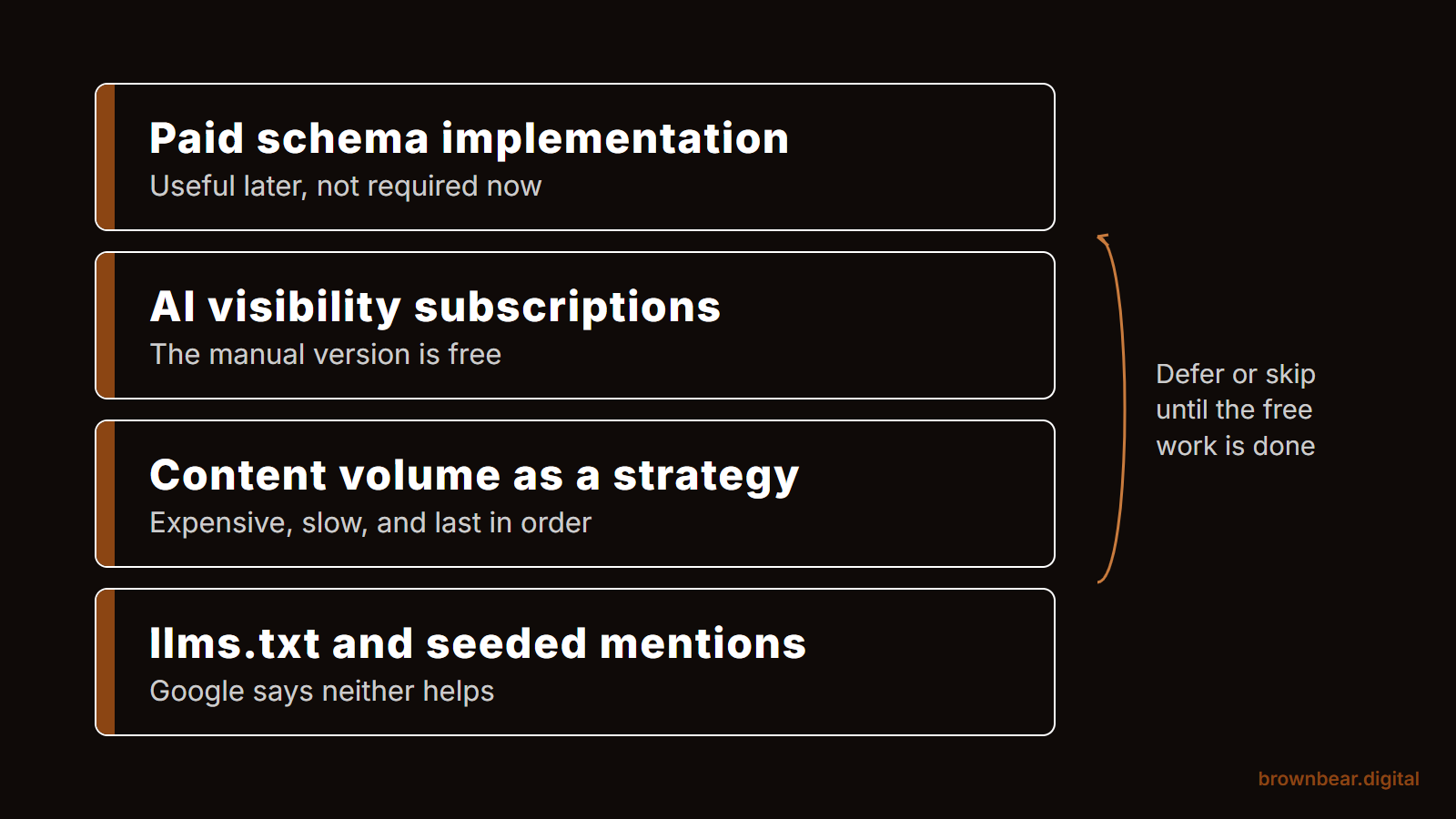
At small-business scale you can defer schema as a paid project, AI-visibility monitoring tools, publishing volume, and anything sold as an AI-specific hack. None of them are harmful. All of them are later.
| Commonly sold | Verdict | Reason |
|---|---|---|
| Paid schema implementation | Defer | Google's documentation says it is not required for generative AI search. Useful, not urgent |
| AI visibility monitoring subscriptions | Defer | Section 8 gives you the free version. Buy a tool when you have enough locations to make manual checking impractical |
| Content volume as a strategy | Defer | Expensive, slow, and it is the last item on the cost ordering rather than the first |
| llms.txt and similar AI files | Skip | Google states you do not need to create AI text files to appear in Google Search |
| Buying mentions or seeded placements | Skip | Google names inauthentic mentions as unhelpful, and it is the easiest way to waste a small budget |
It is worth knowing that this topic attracts sellers. In the community threads where small-business owners ask this exact question, several of the most confident replies are tool pitches wearing an answer's clothing. That is not a reason to distrust the advice, but it is a reason to ask what the person answering sells before you act on the ordering they give you.
8. How to Tell If It Is Working Without a Reporting Layer
There is no rank to track and no clean reporting layer for AI visibility yet. The workable substitute is a fixed set of real customer questions, run across assistants on a schedule, recorded by hand.
Practitioners are blunt that this is the weakest part of the discipline, and the answer to "how will I know if it worked" is that you build the baseline yourself. It takes about twenty minutes to set up:
- Write ten questions a real customer would ask before buying from you, phrased the way they would type them, including your city where it matters.
- Run all ten in the assistants your customers actually use, and record three things per question: whether you were named, which businesses were named instead, and which sources the answer drew on.
- Repeat monthly. Answers vary between runs, so a single pass is a snapshot rather than a measurement.
- Watch the source list as closely as your own appearances. A third-party site that keeps showing up for your category is the next place you need to be accurate.
Our walkthrough of a free system for tracking mentions has the fuller version. The baseline matters more than the tooling: without one you cannot tell a program that worked from a model update that happened to favour you.
9. When to Do This Yourself and When to Bring In an Agency
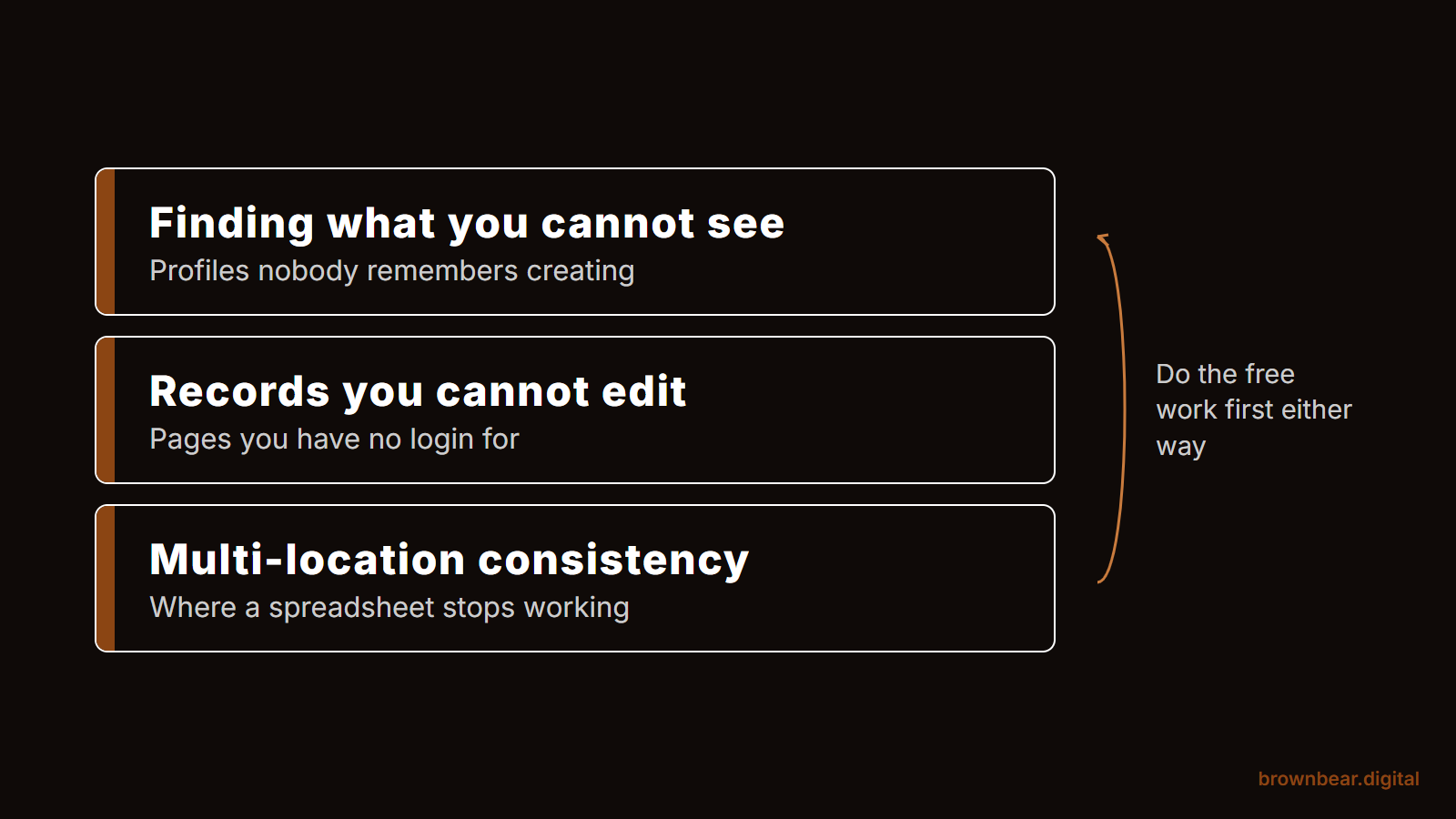
Everything in the free block of section 3 is genuinely do-it-yourself work. An agency earns its fee on three things: the audit across sources you do not know exist, the sources you cannot edit yourself, and multi-location consistency at a scale that stops being tractable by hand.
Worth saying plainly first: if you have not done the free entity work, hiring anyone is premature. A good agency will start there anyway and you will have paid agency rates for an afternoon of listing cleanup.
Here is where outside help genuinely changes the outcome.
Finding what you cannot see.
The reason entity problems persist is that nobody can list the places their business appears from memory. Most of the damage in the audits we run lives in profiles the owner had forgotten about or never created: an aggregator that scraped an old address, a directory listing a previous employee set up, a professional association profile with a phone number from two offices ago. Finding them is systematic work, not clever work, and it is the bulk of the value.
Sources you cannot edit.
Some of what describes you sits on pages you have no login for. Getting those corrected is a process of knowing who owns the record and how to ask, and it is the single most common thing clients cannot do for themselves.
Scale.
One location is a spreadsheet. Six locations across three states, each with its own set of profiles and its own drift, is a program. The point where manual checking stops working is roughly the point where an agency starts paying for itself.
Consider a marketer getting asked by a client whether they can show up when someone asks ChatGPT for the best dentist in their city. It is a fair question and most people fielding it do not have a confident answer. The useful response is not a tool recommendation. It is to run the ten-question baseline in section 8, then audit the client's entity data, and let the gap between those two things decide what the work is. When the baseline comes back empty, the next move is diagnostic rather than tactical: the twelve-check GEO audit works through access, extraction, entity and corroboration in that order, so you find out which one is actually costing you.
10. Frequently Asked Questions
Can a small business really influence AI answers?
Yes, but mostly indirectly and mostly off your own website. You influence what assistants say by being a clearly identified, consistently described, well-reviewed entity across the sources they read. You cannot edit the answer directly.
Do I need schema markup for AI search?
Not as a requirement. Google's documentation states structured data is not required for generative AI search. It is worth having eventually. It should not be your first spend.
Does my Google Business Profile matter for AI?
It matters as one of the most widely mirrored descriptions of your business that you actually control. Complete it and keep it accurate. Treat it as one input among several rather than the whole job.
How long does this take to show results?
The entity work can be done in days, but third-party sources refresh on their own schedule, so expect weeks to months before the change is reflected in what assistants say. Nothing here is a fast lever.
Do I need to hire someone for GEO?
Not to start. The free block in section 3 is do-it-yourself work. Outside help earns its keep on discovery, on records you cannot edit, and at multi-location scale.
Is this different from local SEO?
Less than the marketing suggests. The local SEO fundamentals are the mechanism rather than a separate prerequisite: consistent details, a complete profile, real reviews, presence on the sites your category is compared on. The emphasis shifts toward third-party accuracy and away from ranking position.
11. Work With Brown Bear on AI Search Visibility
Most of what we do when a business asks about GEO is unglamorous, and the first pass usually finds the same thing: a handful of places where the name, address or phone does not match, and two or three profiles nobody remembered existed. We fix what you control, flag what you do not, and build a baseline so there is something to compare against in six months.
If you want to know where you actually stand before spending anything, that is the first thing we look at in the AI search visibility work we do.
Written By
Founder, Brown Bear Digital
Bryan has 15 years of experience across SEO, paid search, and AI search strategy. He founded Brown Bear to give businesses direct access to senior-level search expertise without the agency overhead.
Learn More About BryanGet Found on Google.
Get Cited by AI.
Tell us about your site. We'll send back a proposal for SEO and AI search.