What Is GEO? The Definition, and Why Half the Industry Says It Is Not Real
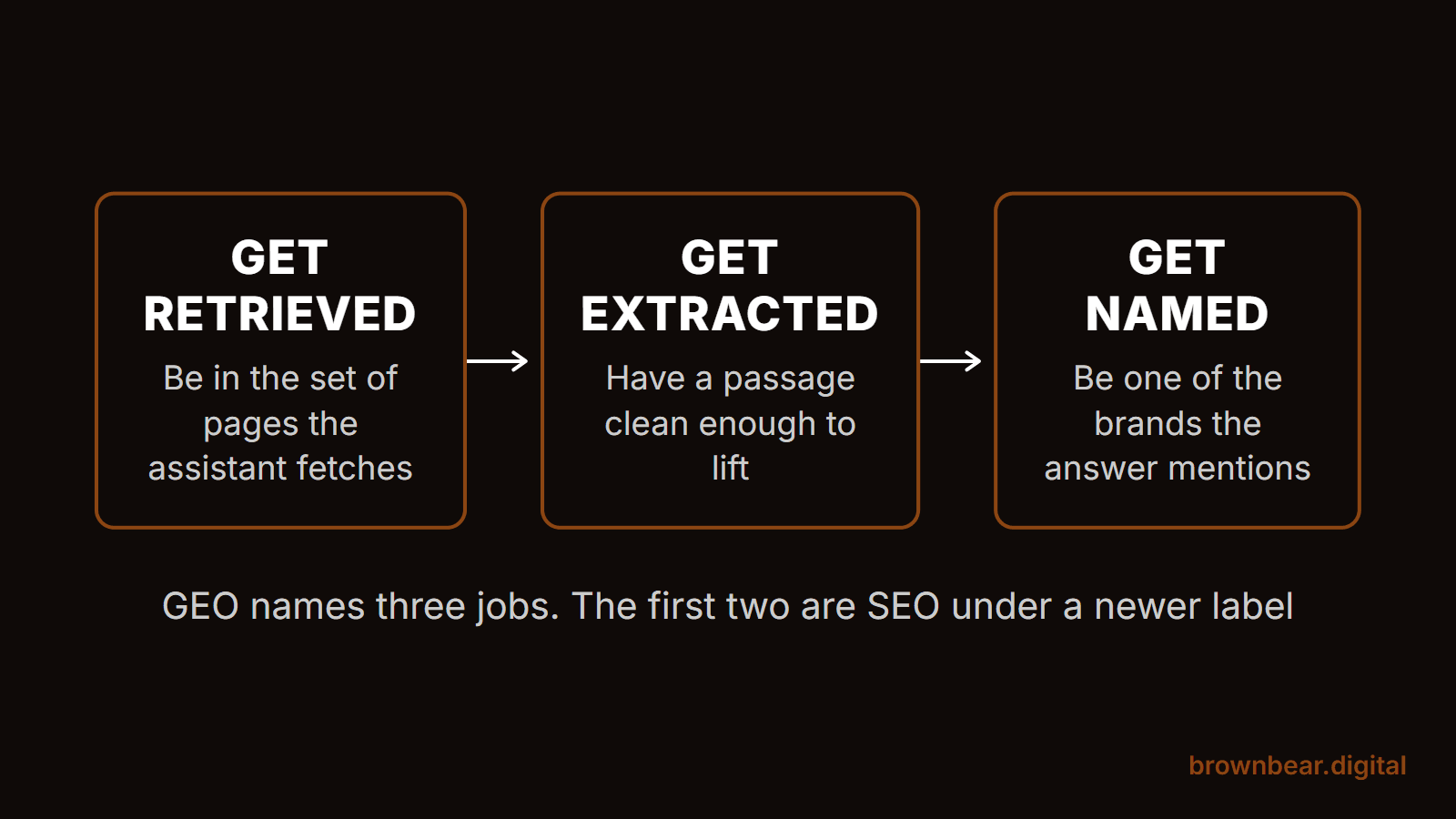
This is Brown Bear's plain-language definition of GEO, built to survive both the marketing around it and the backlash against it.
We run AI search visibility programs for medical practices and local service businesses. We do not sell a product called GEO, which turns out to matter for this particular question, because most of the pages defining the term are published by companies that do. Our founder, Bryan Passanisi, has spent the last two years auditing what AI systems say about our clients and where those descriptions come from, and that work is the source of most of what follows.
When we say GEO here, we mean generative engine optimization: the marketing term. It also stands for other things, and if you arrived looking for geography or geostationary orbit, section 7 will get you out of here quickly.
If someone handed you a strategy deck with GEO on it and no definition, you are the reason this page exists. If you saw a competitor named in a ChatGPT answer and yours was not, the mechanism is in here. And if you have been doing SEO for a decade and think the whole thing is a rebrand invented to raise rates, you are going to find a fair amount of agreement below, though not total.
By the end you will have a definition you can defend in a meeting, a way to tell which parts of GEO are genuinely new and which are SEO wearing a different badge, and a read on whether any of it applies to you yet.
We have grouped it into four parts: why the definitions conflict, what GEO actually consists of, how much of it is new, and whether you need to care right now.
Start with the thing that makes this question harder than it should be.
1. The Short Answer
GEO, or generative engine optimization, is the practice of getting your content and your brand into the answers that AI systems generate. In practice it names three separate jobs: getting your pages retrieved, getting a passage extracted cleanly, and getting your brand named. The first two are search engine optimization under a newer label. The third is the genuinely new emphasis.
That definition is longer than the one you will find on most pages, and the length is the point. The short version, "optimizing to appear in AI answers," describes an outcome rather than a practice, which is why the tactic lists attached to it are so inconsistent.
2. Why You Are Getting Two Completely Different Answers
Search for a definition and you will find confident one-liners from software vendors and flat denial from working SEOs. Both are responding to something real: the work exists, and the discipline boundary around it is mostly marketing.
The vendor side is easy to find because it is what ranks. Five of the pages currently at the top of this search define GEO in almost identical terms, and four of the five are published by companies selling AI-visibility software or services. None of them raises the question of whether the category is real, which is not a conspiracy so much as an incentive.
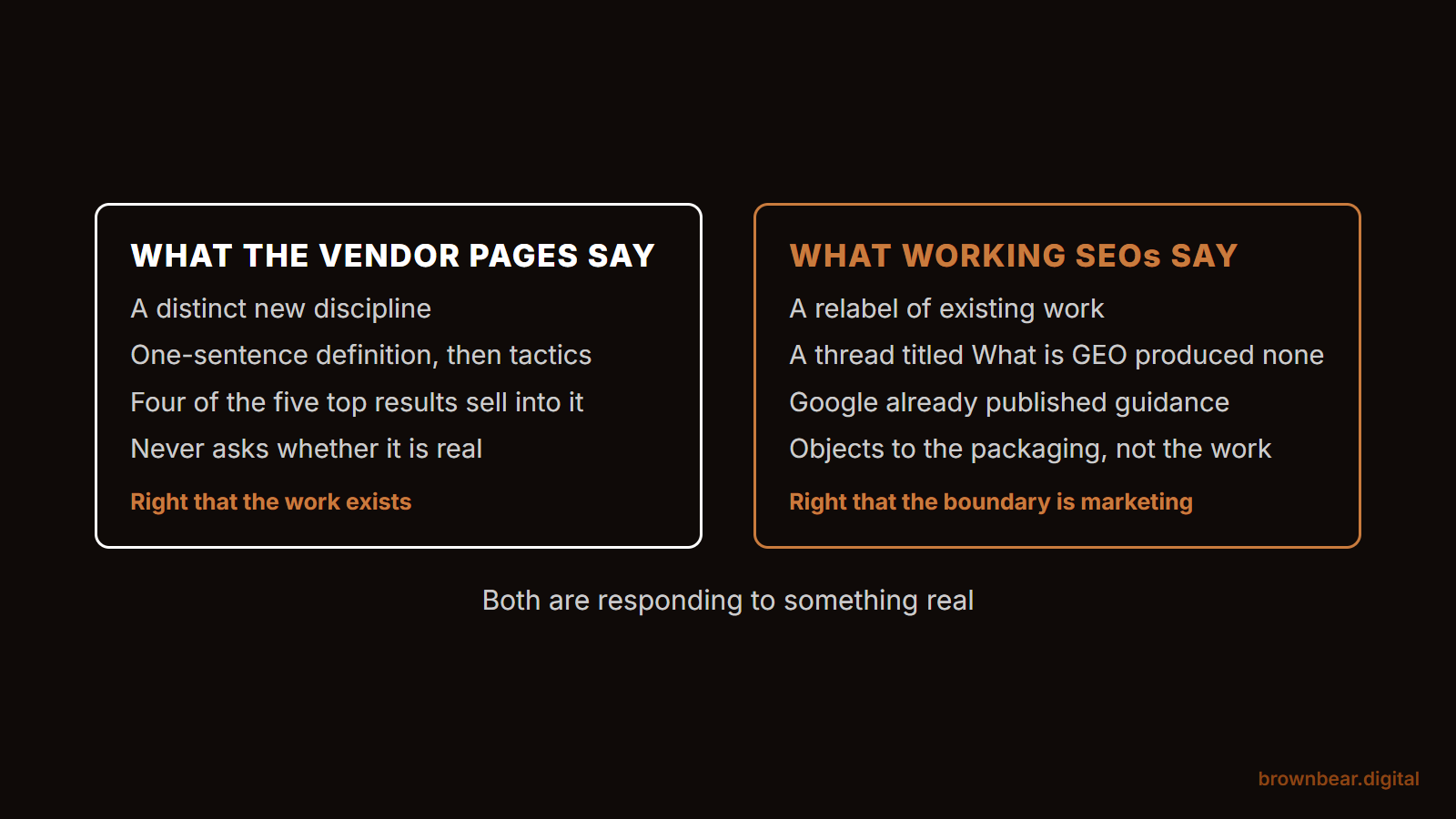
The practitioner side is louder than you would expect. In May 2026 a moderator of r/SEO, the largest SEO community on Reddit, posted a thread titled simply "What is GEO?" and flaired it Debate. The thread did not produce a definition. The top responses argued that you cannot define something that does not exist, that the whole thing reduces to a formula the moderator kept repeating, GEO minus SEO equals zero, and that inventing an acronym does not create a discipline. One commenter answered the definitional question by linking Google's own guidance on the topic, and nobody in the thread engaged with it. The moderator's stated reason for starting the thread was that the subreddit did not rank for the term and he wanted the community's view in the index for language models to draw from.
So the searcher asking what GEO means walks into a fight, and neither side is arguing in bad faith. The vendors are describing real work. The skeptics are objecting to the packaging.
Picture a marketing lead who gets a one-line brief: start doing GEO this quarter. She reads three vendor guides and gets three tactic lists. She asks the SEO contractor, who tells her it is a made-up word. Both inputs are accurate and neither tells her what to do on Monday. That gap is what the rest of this page is for.
If you want the longer version of how the terminology got this tangled, including where GEO and AEO each came from, that is where the acronyms came from and why they disagree.
3. The Three Jobs GEO Actually Names
Defining GEO by its outcome makes it unmeasurable. Defining it by its jobs makes it usable. There are three: get retrieved, get extracted, get named.
Get retrieved
When someone asks an assistant about your category, the system usually does not answer from memory. It rewrites the question into search queries, fetches a set of pages, and writes an answer from what it found. Your page has to be in that fetched set. That means it has to be crawlable, indexed, and ranking for queries the model generates, which are often not the queries you targeted.
Nothing about this job is new. It is the same crawlability, indexation and ranking work search engines have always required.
Get extracted
Being in the candidate set is not the same as being used. The system reads the retrieved pages and lifts the passages that answer the question cleanly. A section that spends three paragraphs on context before it says anything is a section that gets skipped in favour of one that does not.
This job is older than it looks too. It is what people optimized for when featured snippets mattered, and our guide to structuring content so it can be lifted covers it in depth.
Get named
The third job is different in kind. Whether an assistant names your brand as an option depends heavily on what the wider web says about you, not on what your own site says. This is where most of the actual difficulty lives, and it is the least like traditional on-page work.
Brown Bear's own data puts numbers on it. When we classified 33,000 AI citations for medical practices, hospital and academic rosters accounted for 27.5 percent of citations, specialty board and association profiles for 22.1 percent, and national directories for 8.3 percent. The practice's own website was a small minority of what the models cited. What surprises owners most, in Bryan's experience running these audits, is not that they are invisible: it is how much of their visibility is being driven by third-party pages they have never logged into.
4. Which of the Three Is Actually New
One of the three. Getting retrieved and getting extracted are SEO under a newer label. Getting named is a real shift in emphasis, and it is the part that behaves least like the work SEO teams are set up to do.
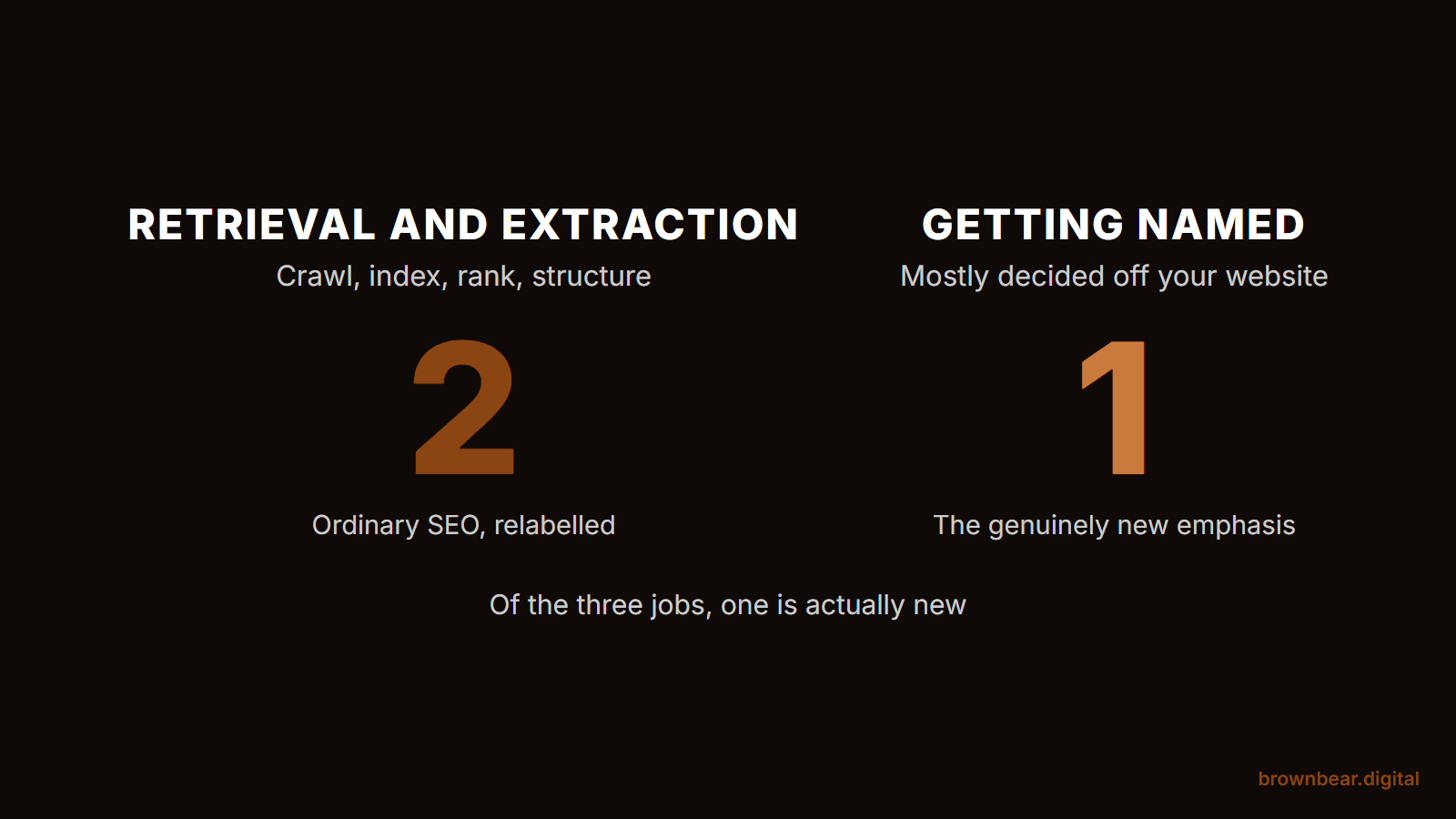
This is the concession the vendor pages will not make and the point the skeptics are half right about. The r/SEO position that GEO minus SEO equals zero is wrong, but only by one job out of three. The more measured version in that same thread, that GEO is still SEO with more focus on making content easy for AI to pull from, is closer, and still misses the off-site half.
Google's position is worth reading directly here, because it is the most authoritative statement available and it went unread in the very thread that was arguing about it. Its guide to optimizing for generative AI features, last updated 10 July 2026, states that from Google Search's perspective, optimizing for generative AI search is optimizing for the search experience, and thus still SEO. That is a statement about Google's own surfaces, where the generative features run on the core ranking systems. It does not automatically describe ChatGPT or Perplexity, which retrieve differently.
The term does have a real technical origin, which is more than the skeptics usually allow. It was introduced in a research paper, GEO: Generative Engine Optimization, published in November 2023 and later accepted to KDD 2024, which defined the problem and built a benchmark for it. So the word was not invented by an agency to raise rates. It was adopted by agencies after researchers coined it, which is a different accusation.
For which specific tactics hold up and which do not, including several that Google names as unnecessary, see the tactics Google's documentation says you can skip. For the individual moves sorted by leverage, we have them ranked by how much they actually move visibility.
5. How GEO Works, Step by Step
An assistant answering a question about your category runs roughly four steps: it rewrites your question into queries, retrieves a set of pages, reads them, and synthesizes an answer with citations. Every GEO job maps to one of those steps.
| What the system does | What decides whether you survive it | Which job |
|---|---|---|
| Rewrites the question into several search queries | Whether you rank for phrasings you did not target | Get retrieved |
| Fetches a set of candidate pages | Crawlability and indexation | Get retrieved |
| Reads them and pulls usable passages | Whether your answer sits near its heading | Get extracted |
| Writes an answer and decides who to name | What third-party sources say you are | Get named |
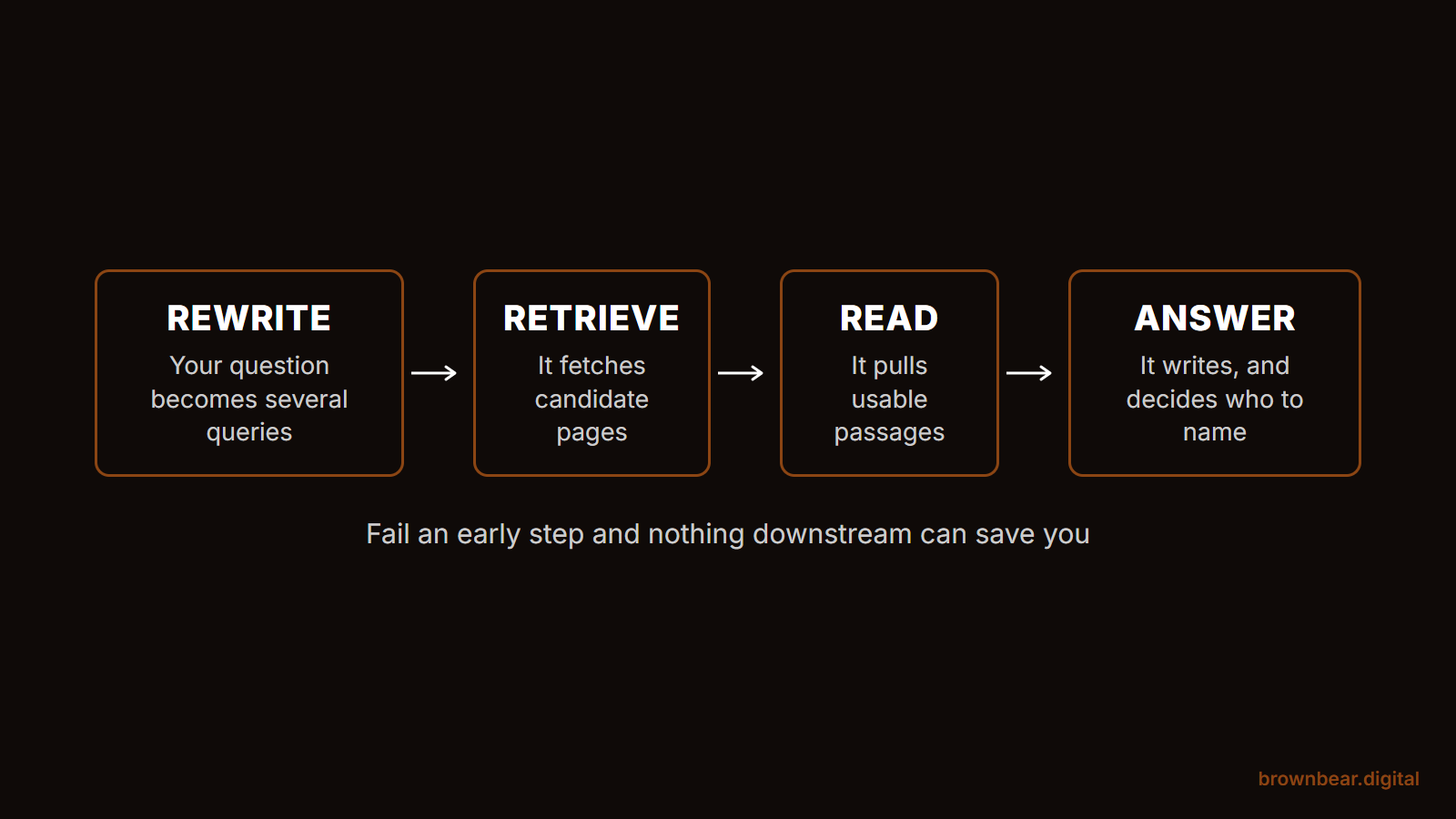
The order matters more than any individual tactic. Work on the fourth step while failing the first is wasted, because a page that is never retrieved cannot be cited no matter how it is written. How an AI Overview is assembled walks the same pipeline in more detail.
6. GEO and SEO Are Not Two Programs
Run as one program, the structural work that helps AI citation also helps ordinary search. Run as two, you get duplicated content, duplicated effort, and often two invoices for one job.
This is the point the more experienced voices in those Reddit threads keep making, and it matches what we see. Answer-first sections, clear headings, and consistent entity data improve featured snippets and AI citations at the same time. Splitting them into a separate GEO workstream tends to produce near-duplicate pages that compete with each other.
Say a B2B team buys a GEO retainer alongside its existing SEO retainer. Six months later it has two content calendars, two sets of pages targeting the same questions, and a cannibalization problem that neither vendor is measuring. Nothing in that outcome required either vendor to act in bad faith. It required only that nobody drew the boundary. If you are a plastic surgery practice weighing the same decision, our guide to hiring a plastic surgery SEO agency shows which services belong in one retainer.
The full comparison of GEO against SEO, and against AEO, is its own piece.
7. GEO Also Stands for Something Else
Outside marketing, GEO most often means geographic or geostationary. Inside marketing, a minority of writers still use it for geographic engine optimization, meaning local search work. If you arrived here looking for either, this is not the page you want.
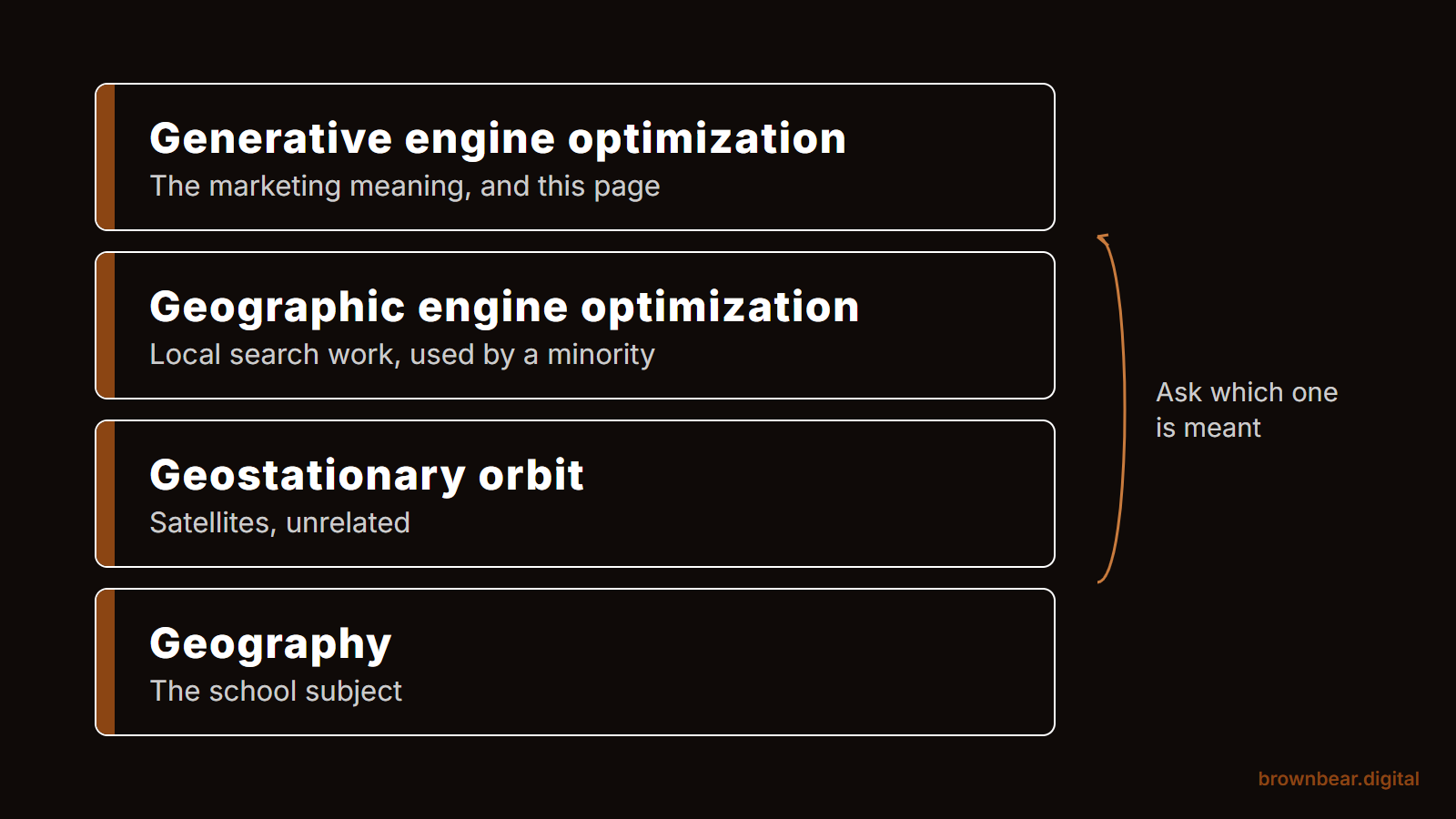
This is worth stating plainly because the collision is real and it is not only a civilian problem. One page currently ranking in the top ten for this exact search defines GEO as geographic engine optimisation, a local search tactic. The related searches Google shows alongside this query include the geography meaning and the school-subject meaning.
So if someone in a meeting says GEO and you are not certain which they mean, asking is reasonable rather than naive. In a marketing context in 2026 it almost always means generative engine optimization. Almost.
8. Does GEO Apply to You Yet
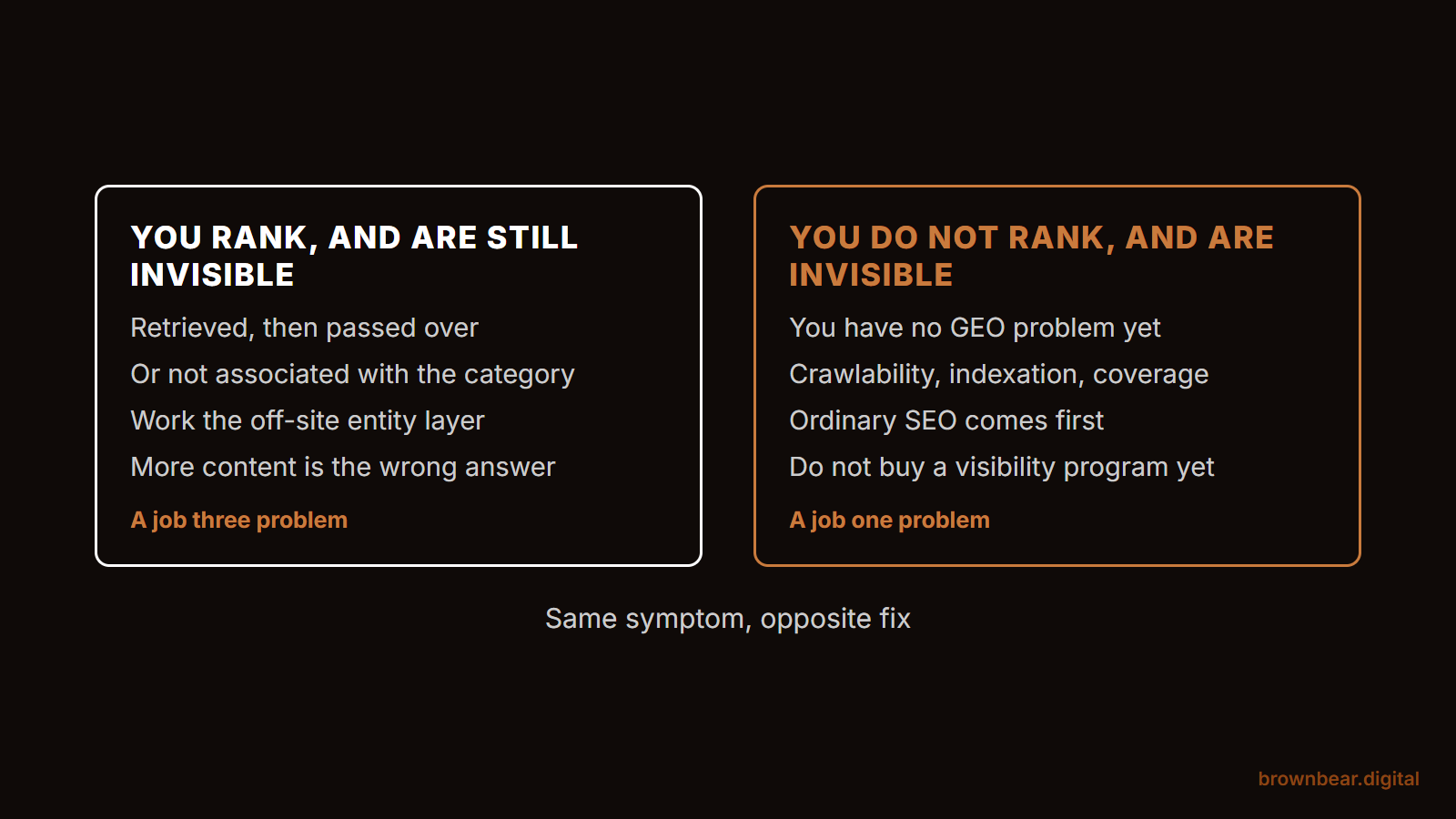
It depends on two things: whether your buyers actually ask assistants about your category, and whether you are already visible in ordinary search. For some businesses the correct answer right now is to do nothing.
Start with whether you already rank
If you rank well and are invisible in AI answers,
the third job is your bottleneck. Your pages are being retrieved and passed over, or your brand is not associated with the category strongly enough to be named. Work the off-site layer: third-party profiles, directory accuracy, review presence, and consistency of your details everywhere they appear. More content is usually the wrong answer here.
If you rank poorly and are invisible in AI answers,
you do not have a GEO problem yet. You have a retrieval problem, and it is the ordinary kind. Fix crawlability, indexation and topical coverage first, because nothing downstream can rescue a page that is never fetched. Buying an AI-visibility program in this state is buying the second floor before the foundation.
Then ask whether your buyers are even asking
Some categories get researched through assistants constantly. Others barely at all. The test is free and takes twenty minutes: write down the ten questions a real customer would ask before buying from you, run them through the assistants your buyers actually use, and see whether any brand gets named. If the answers are vague and nobody is named, there is no visibility to win yet, and the honest recommendation is to keep doing the SEO that feeds the retrieval layer and check again in six months.
A full playbook for one vertical works this same logic through a medical practice end to end.
The diagnostic names which of the three jobs is failing. Turning that into work means testing it, and the GEO audit checklist gives every check a tool, a threshold and a failure condition.
9. How to Tell Whether It Is Working
There is no position to track, so measurement means prompt-level testing across assistants, repeated on a schedule, against a baseline captured before the work starts.
This is the one area where every side of the argument agrees the work is genuinely different, and it is also the thinnest section on most competing pages. The minimum viable version:
- Write 20 to 30 questions phrased the way a customer would type them into an assistant, not the way you would write a keyword.
- Run them across the assistants your buyers use, recording four things per prompt: whether you were mentioned, whether you were cited with a link, how you were positioned against competitors, and which sources the answer drew on.
- Repeat monthly, because answers vary between runs and a single test is noise.
- Watch the source list, not just your own appearances. A new third-party site showing up for your category is the next place to be present.
Our walkthrough of tracking brand mentions in AI search includes a free version of this. Without a baseline you cannot distinguish a program that worked from a model update that happened to favour you.
10. Frequently Asked Questions
What does GEO stand for?
Generative engine optimization, in a marketing context. Outside marketing it usually means geographic or geostationary, and a minority of marketers still use it for geographic engine optimization.
Is GEO a real thing or a made-up term?
Both, in a sense. The work is real and some of it is genuinely new. The term was coined in a 2023 research paper rather than by an agency, so it is not marketing invention. But the boundary drawn around it as a separate purchasable discipline is largely marketing, and two of its three jobs are search engine optimization under a newer name.
Is GEO just SEO?
Two of its three jobs are. Getting retrieved and getting extracted are ordinary search work. Getting named depends mostly on third-party sources rather than your own site, and that emphasis is a real shift.
Do I need to hire someone for GEO?
Not as a separate engagement. Run as a second program alongside SEO it tends to duplicate work and produce competing pages. If your existing search provider cannot describe the off-site half of the work, that is the gap to close, not a reason to buy a parallel retainer.
How long does GEO take to work?
The off-site half moves on the timescale of directories and third-party profiles, which means weeks to months and often outside your direct control. The on-site half moves at the speed of ordinary SEO. Neither is a fast lever.
Why do I rank on Google but not appear in ChatGPT?
Usually because a large share of what AI systems read about a business lives on pages the business does not own. If your details are inconsistent across third-party profiles, or you are simply absent from the sources your category gets summarized from, ranking will not rescue you.
11. Work With Brown Bear on AI Search Visibility
We do not sell a product called GEO, which is partly why we are willing to write that most of it is SEO. What we do sell is the outcome: your practice or business named, described correctly, and cited when someone asks an assistant about your category. In practice that means finding the four places your name is spelled differently, getting the JavaScript out of the crawler's way, moving your answers to the top of your sections, and building a baseline so there is something to compare against later.
If you want to know which of the three jobs is failing for you before you spend anything, that is the first thing we look at in the AI search visibility work we do.
Written By
Founder, Brown Bear Digital
Bryan has 15 years of experience across SEO, paid search, and AI search strategy. He founded Brown Bear to give businesses direct access to senior-level search expertise without the agency overhead.
Learn More About BryanGet Found on Google.
Get Cited by AI.
Tell us about your site. We'll send back a proposal for SEO and AI search.