Why Medical Practices Need to Invest in SEO and AI Search in 2026

This is our plain-language case for treating search visibility as a core investment in 2026: what actually changed in how patients find care, what it is worth in dollars, and what to do first at three different budgets.
At Brown Bear Digital, we run SEO and AI search visibility programs for medical and plastic surgery practices. Bryan Passanisi, our founder, has spent the past two years auditing how AI engines describe practices to patients, and most of what follows comes straight from that work: the audits, the fixes, and the results we can publish.
When we say search, we mean both kinds: the traditional Google results your practice has always competed in, and the new layer on top of them, where AI Overviews, ChatGPT, and Perplexity answer the patient before a single website gets clicked. The investment case only makes sense when you look at both together.
If you own an elective practice and consult volume has felt softer this year, this is for you. If you manage marketing for a multi-location group and can't tell which locations AI tools even know about, same. Maybe you run a small clinic and handle marketing yourself on stolen evenings. Or maybe you've been burned by an agency that promised page one and delivered invoices, and your guard is up. Good. Keep it up. This piece is built for skeptics.
By the end, you'll know which patient searches your practice can still win, what AI engines check before they recommend anyone, what the investment actually returns when it works, and a 90-day starting sequence at three budget levels. We've grouped it into four parts: the shift, the trust signals, the math, and the plan. Let's start with the shift itself, because it is bigger than most practices realize.
Key Takeaways
The patient journey compressed
One in three U.S. adults used AI chatbots for health information in the past year, and the road from 'what is this procedure' to 'who near me should do it' now runs inside a single AI conversation. The shortlist forms before your website loads.
SEO became the supply chain for AI answers
AI engines assemble recommendations from websites, directories, reviews, and press. The practices those sources describe clearly and consistently are the ones that get named. Cut the budget and you lose your seat in the answers, not just a ranking.
The local layer pays twice
Google Business Profile, review velocity, and real procedure pages still hand out most appointments, and the same signals now feed AI visibility. Every dollar on local foundations works both shifts.
How Patients Actually Find a Practice in 2026
Patients no longer start in one place. They start in Google, in AI Overviews at the top of Google, and inside chatbots, and the same person often uses all three before booking. One in three U.S. adults now say they have turned to AI chatbots for health information in the past year, about the same share that uses social media for health questions, according to the KFF Tracking Poll on Health Information and Trust from March 2026. Among adults under 30, it is more than a third. And Google's own AI layer is not a niche feature: AI Overviews reach more than 2 billion users a month, per Alphabet's Q2 2025 earnings remarks.
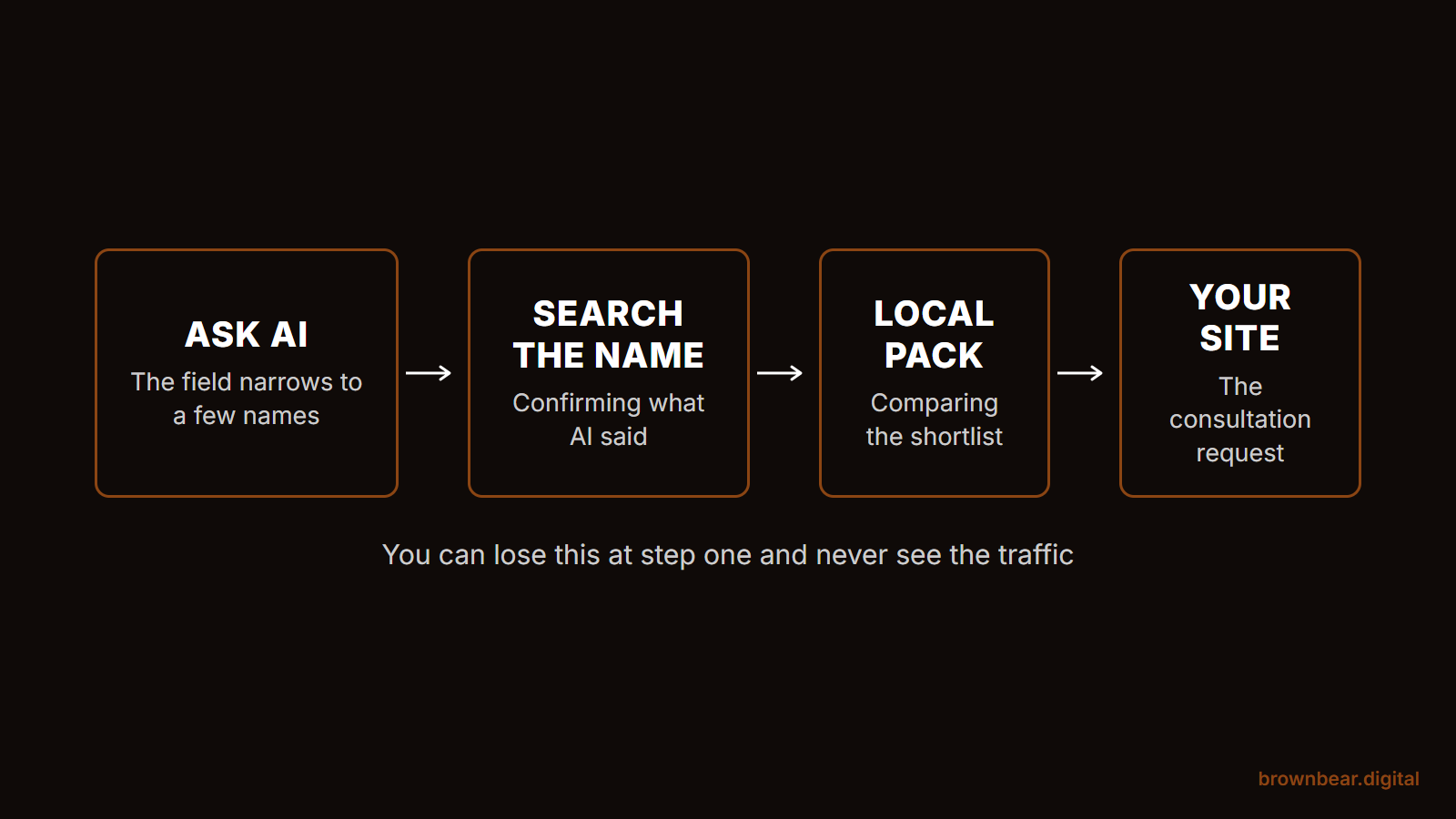
What matters for your practice is not the raw adoption number. It is how the journey compresses. A patient who once bounced between ten sites over two weeks now moves from "what is this procedure" to "who near me should do it" inside a single AI conversation. One session, one source, and the shortlist is formed before your website ever loads. We broke down that behavioral shift in detail in our guide to how patients research providers in AI search.
Picture a 34-year-old mom researching a mommy makeover after her second child. She asks ChatGPT what the procedure involves, whether it's safe to combine with a breast lift, and what recovery looks like with toddlers at home. Eleven minutes in, she types: "Who are the best surgeons for this near Walnut Creek?" The model names three practices. She books consults with two of them. If your practice isn't one of the three names, you were never in the running, and no one told you the running had happened.
Is SEO Dead Now That AI Answers First
No. The plain answer is that SEO's job changed: it stopped being only about ranking a blue link and became the supply chain for what AI engines say. Every AI answer about practices in your market is assembled from sources: websites, directories, reviews, press. The practices those sources describe clearly and consistently are the ones the engines recommend. That sourcing layer is what SEO builds now. Kill the budget and you don't just lose rankings, you lose your seat in the answers.
You may also have heard the adjacent claim that blog content is dead because chatbots answer everything. We disagree, with a caveat. Long-form content still earns the links and citations that make an engine trust a domain, and it still catches patients at the moments AI hands them back to the open web, cost curiosity being the big one. The caveat: demand a reason for every piece. Content produced to fill a calendar was always waste; AI search just made the waste visible faster.
Fair warning while we're at it, because the top-voted community answer on this exact topic is a warning about agencies overpromising: none of this is fast. Medical is a category Google and the AI engines treat with maximum caution, and visibility timelines run in quarters, not weeks. Any vendor who promises AI citations in 30 days is selling you the 2026 version of "page one guaranteed."
The Searches AI Already Owns and the Ones You Can Still Win
Not every patient search is winnable, and knowing the difference is where smart budgets start. What we see across client SERPs is a territory split. The big head terms, like "what is breast augmentation" or "how does Mohs surgery work," now belong to Mayo Clinic, the American Society of Plastic Surgeons, and the other institutional giants. AI Overviews cite them, chatbots summarize them, and no private practice is going to out-authority them there. That territory is gone, and spending to chase it is waste.
But the queries that actually fill consult slots sit in different territory. Procedure plus place, cost questions, "best near me," recovery logistics in a specific market: those still resolve to local providers, because the engines infer local intent and have to name someone. We routinely see individual surgeons cited in AI Overviews for procedure-and-city searches. That territory is open, and it is exactly where a practice's content and profiles decide who gets named. The bar is high on purpose: Google's quality systems treat health as a "Your Money or Your Life" topic and give extra weight to expertise and trust signals, per Google's own search documentation. High bars are good news for real practices; they keep the content farms out.
Where you fund the fight depends on your model. If you run an elective, cash-pay practice, the winnable territory is cost content, comparison content, and procedure-plus-city pages, because your patient is researching a considered purchase. If you run an insurance-driven practice, the play is narrower and more local: conditions you treat, referral pathways, and dominance of the map results in your service area. Same investment logic, different shelves.
What AI Engines Check Before They Recommend a Practice
Before an AI engine names your practice, it has to find you, understand you, and trust you. In practice that means a consistent identity across your website, Google Business Profile, Healthgrades, Zocdoc, and the review platforms; clear pages for the procedures you want to be known for; visible physician credentials; and a steady, recent review record. Miss those and the engine either skips you or, worse, describes you wrong.
Here's what surprises owners most in our audits: it's rarely dramatic. The information is seldom flat-out wrong. The two patterns we find over and over are small identity mismatches, with name, address, and phone variations across profiles being the most common error we log, and buried specialties, where the model reads a practice as a generalist because the thing the surgeon most wants to be known for gets one paragraph on a crowded services page. Owners are also consistently surprised by how much of their AI visibility lives off their own website, in reviews, directories, and press they stopped paying attention to years ago. If a tool has ever answered a patient's question about your market without mentioning you, our breakdown of why a practice doesn't show up in AI search walks through the usual causes.
Say you run a three-location dermatology group. Location two moved suites in 2023 and one directory still lists the old address. Your Mohs surgeon, the reason half your revenue exists, shares a bio page with four other providers. Ask a chatbot about Mohs surgery in your city and it names the group across town, not because they're better, but because their identity is coherent and yours makes the model hedge. That's the whole failure, and it's fixable in a quarter.
Run the check yourself before anyone sells you anything:
Self-Check
AI Visibility Readiness Check
Check every statement that is true for your practice today. Eight signals, thirty seconds, scored the way we score a new client audit.
0/8
For informational purposes only; results reflect the signals you check, not a full audit, and are not a guarantee of search performance. Not professional advice. Your answers stay in your browser; nothing is stored or transmitted.
The Local Layer Still Decides Who Gets the Appointment
For all the AI drama, the map pack and local results still hand out most of the appointments, and the fundamentals there haven't changed: a complete Google Business Profile, review volume with recent velocity, and real pages for the procedures patients search. What has changed is that the same local signals now feed the AI layer too, so every dollar spent on local foundations pays twice.
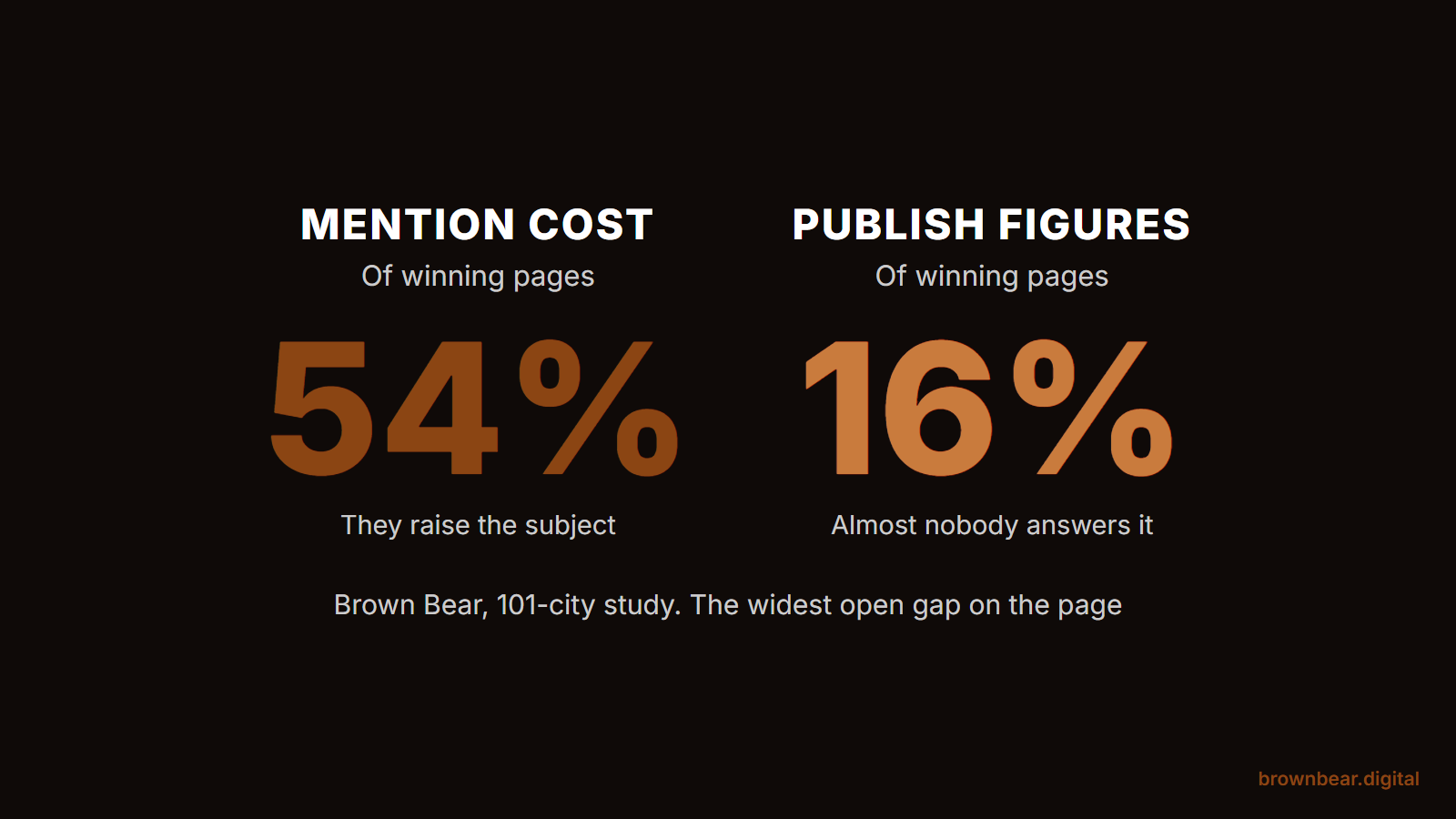
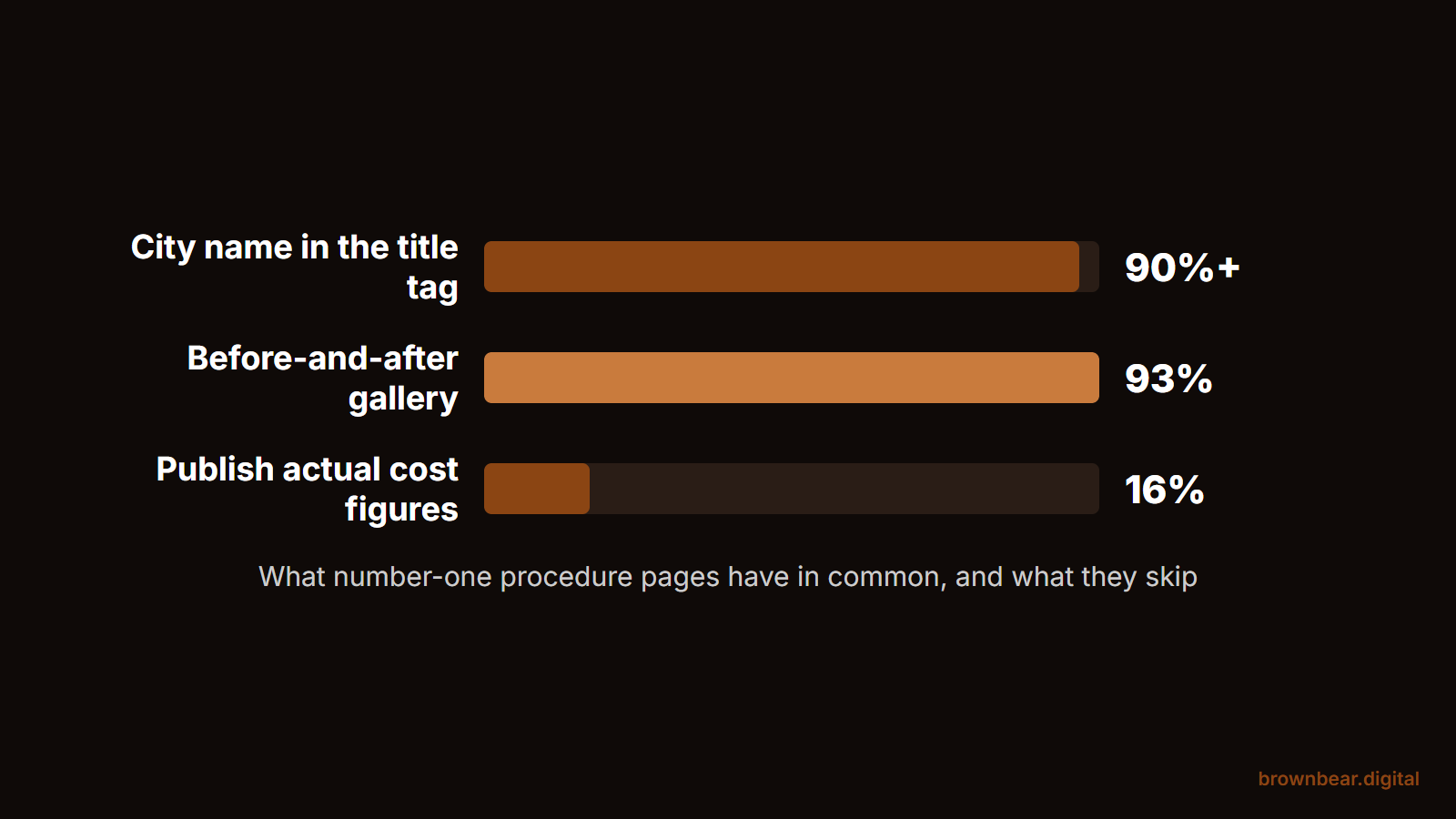
Our 101-city study of procedure-page ranking factors puts numbers on what wins locally. Across the number-one results for a high-value procedure search in 101 U.S. cities, more than 90% carry the city name in the title tag, and 93% carry a before-and-after gallery. And here is the opportunity hiding in it: 54% of winners mention cost, but only 16% publish actual figures. Cost transparency is the most under-supplied thing patients want. The practice willing to publish real numbers walks into an almost empty room.
Structure depends on your footprint. If you operate a single location, one strong GBP and deep procedure pages carry you. If you operate several, each location needs its own profile, its own page, and its own review stream, or the engines collapse your locations into a blur; the mechanics are in our multi-location SEO playbook.
The Investment Math Your Practice Can Actually Run
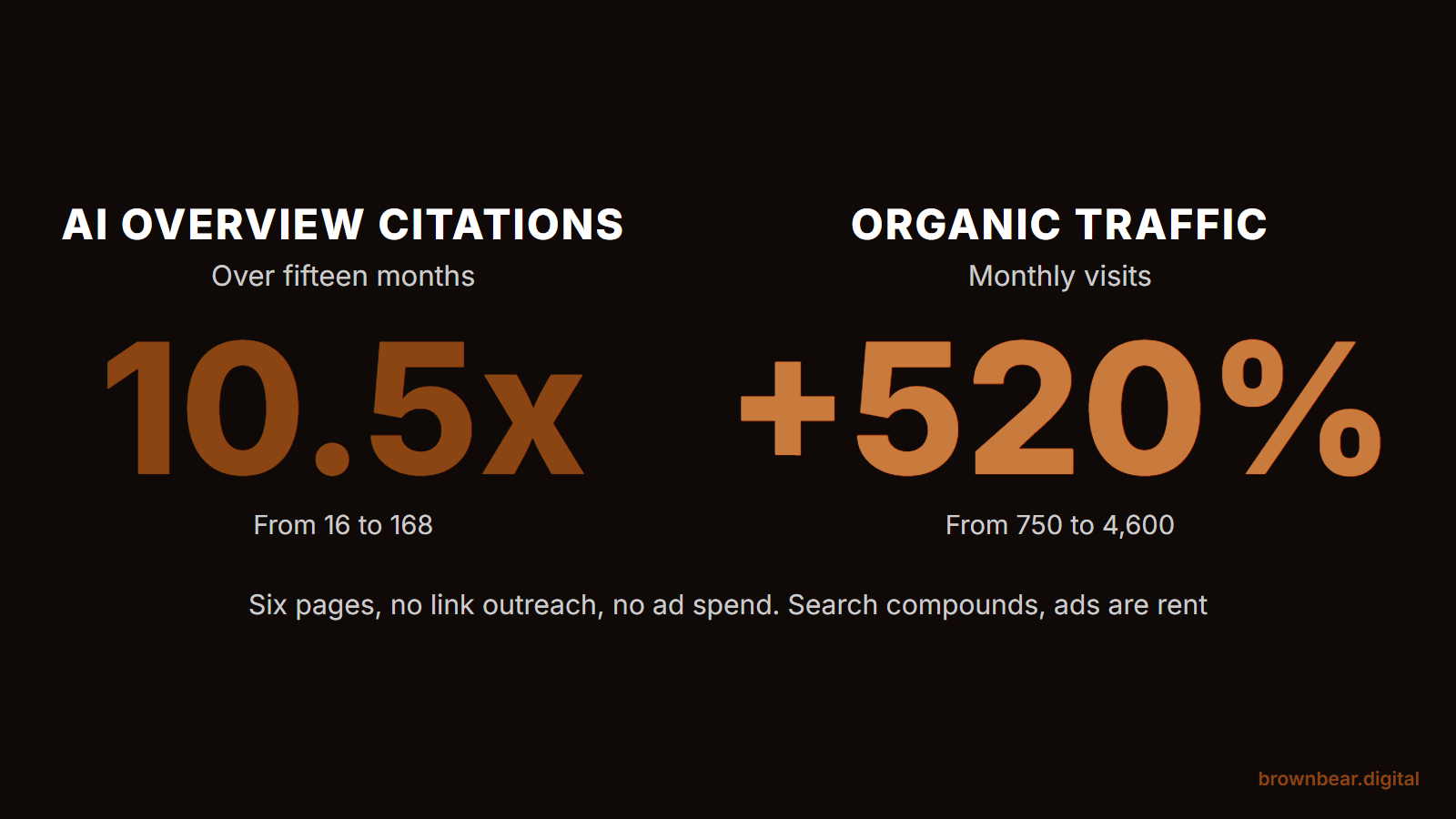
Here is the core of the case: search visibility is a compounding asset, and paid ads are rent. Both have a place, but only one of them is still working for you in month 25. The clearest evidence we can publish is our own facelift content hub case study: six pages answering pre-consultation questions, launched together and linked to the procedure page. Over fifteen months, the practice's Google AI Overview citations grew from 16 to 168, a 10.5x increase, and organic traffic rose 520%, from roughly 750 to 4,600 monthly visits. No link outreach, no ad spend on those pages. That is what compounding looks like when the content answers real questions.
Bryan's back-of-napkin version for elective practices: a $1,500 to $2,000 monthly SEO retainer costs about as much over a year as two solid organically-sourced procedures bring in. Two procedures a year is a very low bar for a program that's working, which is exactly why cutting SEO to feed the ads budget erodes the only channel that compounds while locking you into rising click costs. The blend we run instead: paid search captures demand where organic isn't visible yet, then hands territory back as visibility builds.
One more number worth watching in your own analytics: the patients who arrive from ChatGPT and other AI tools. Across our clients, LLM-referred visitors convert to consultations at a higher rate than other channels and arrive noticeably more engaged. It makes sense once you see the journey compression: they did their research inside the model and clicked out ready to act. It's still a small channel, which is the point. Early is when positioning is cheap.
Say your practice books 20 new patients a month, 40% of them find you through search of some kind, and an average new patient is worth $2,500. That's $20,000 a month riding on being findable. If a third of patient search behavior shifts to AI-first channels over the next two years and you're invisible there, roughly $72,000 of annual revenue is exposed. Run it with your own numbers:
Run Your Numbers
Patient Pipeline Risk Calculator
Your numbers, three planning scenarios. See how much of your new-patient revenue rides on being findable as search shifts toward AI answers.
$20,000
Monthly revenue from search-found patients
$6,000
Monthly revenue exposed if AI engines don't surface you
$72,000
Exposed revenue over 12 months
Planning tool for informational purposes only; the scenario percentages are assumptions you choose, not forecasts, and results are not a guarantee or projection of actual revenue. Not financial advice. Your inputs stay in your browser; nothing is stored or transmitted.
Where Practices Waste Money First
Since this is an investment case, it owes you the other side: the spending that doesn't work. The first place we look when a budget isn't producing is over-investment in schema markup. Structured data is a real best practice and worth keeping tidy, but it gets sold as the magic key to AI visibility, and in our experience it isn't. The bigger technical levers are duller: can crawlers actually reach your content, and is it written in a structure a machine can lift answers from. LLM crawlers in particular handle JavaScript poorly, which is why one of the first things we do on client sites is strip out heavy scripts standing between the content and the crawler. A $900-a-month "AI schema package" on a site whose pages barely render without JavaScript is jewelry on a locked door.
The second sinkhole is paid search run without a conversion path. When an owner tells us Google Ads didn't work, the account teardown almost always shows the same two problems: campaign structure that was never tuned for lead quality, and clicks landing on pages never built to convert them. The ads weren't the waste; the setup was. We catalogued the rest of the pattern, including the fluff-content trap, in the eight AI SEO mistakes medical clinics keep making.
Say you signed that schema package last spring. Three invoices in, rankings flat, no AI citations, and the vendor's report is a screenshot of validated markup. Nothing in that report measures whether an engine can read your recovery-timeline page or whether your Mohs surgeon exists as an entity anywhere outside your own site. Cancel it, spend one month of that fee on a crawl audit, and you'll know where the money should have gone.
Your First 90 Days at Three Budgets
We call this the First-90-Days Budget Ladder: three rungs, each a complete plan, each sequenced so the compounding starts wherever your budget is. The deciding factor for which rung is yours is simple: how much of the work can be done by someone inside the practice who actually has the hours.
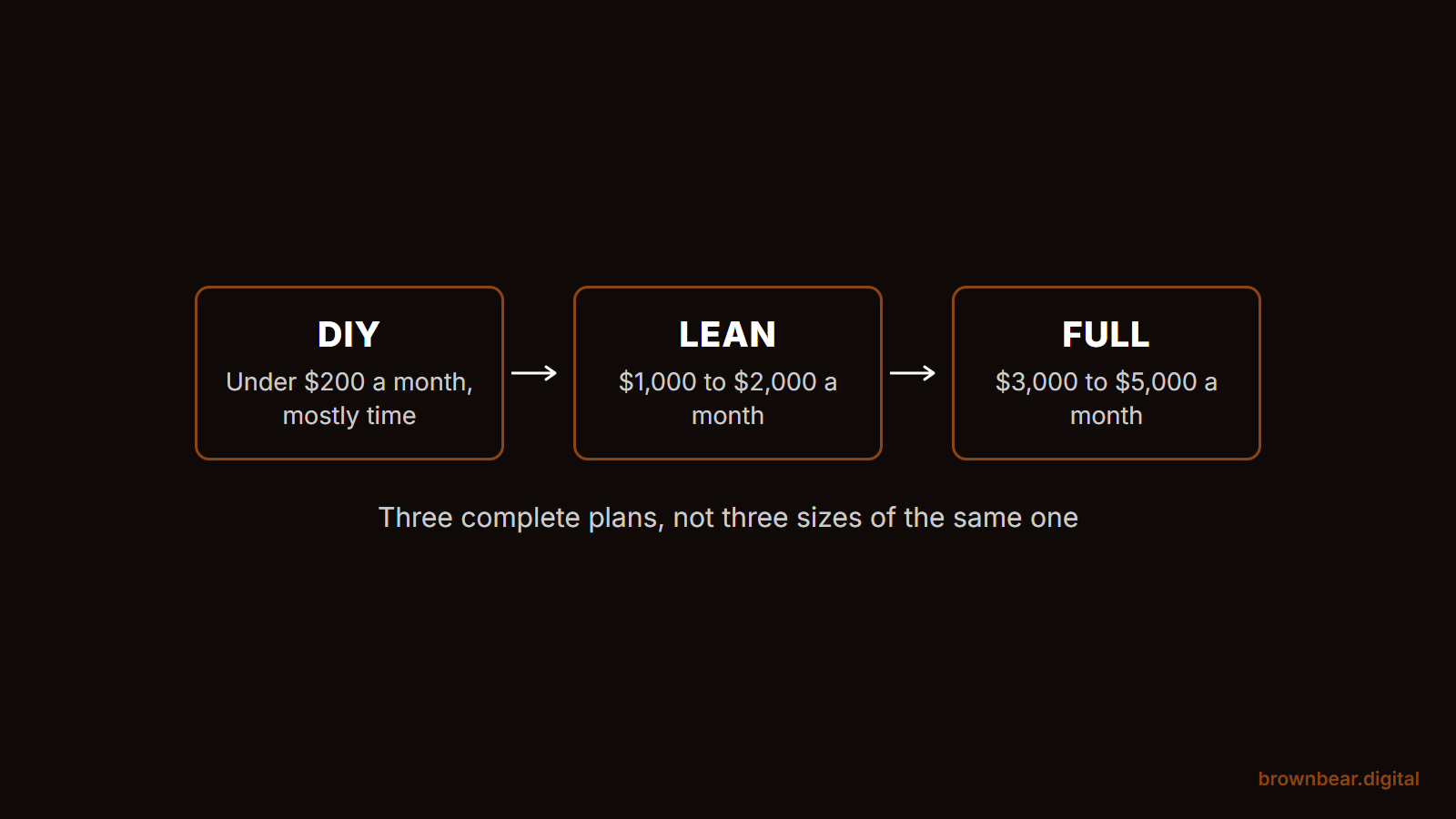
The DIY rung, mostly time and under $200 a month
For the solo owner doing marketing on stolen evenings. Days 1 to 30: complete your Google Business Profile and run the name, address, and phone sweep across every directory. Days 31 to 60: build the review workflow, a request within hours of each visit and a response to every review. Days 61 to 90: rewrite your single most important procedure page around the questions patients actually ask, direct answers first. That alone moves you past most competitors, because most practices never finish step one.
The lean rung, $1,000 to $2,000 a month
Everything above, done for you in the first month instead of three. Month two adds a technical cleanup, getting content readable without JavaScript and fixing crawl blockers. Month three starts a content cadence aimed only at winnable territory: procedure-plus-city and cost questions, one well-reasoned piece at a time, plus AI-referral tracking in your analytics so the LLM channel is measured from day one.
The full rung, $3,000 to $5,000 a month
For practices treating this as the growth channel. Adds a content hub around your flagship procedure modeled on the facelift engagement, off-site work on the third-party layer that drives AI visibility (directories, review platforms, press), and conversion work on the pages where consult requests land. This is the rung where the case-study numbers live.
Whichever rung fits, the next steps are the same four:
- Score yourself on the readiness check above and keep the two fixes it hands you.
- Run the name, address, and phone sweep this week; it's the highest-value hour on this page.
- Pick the one procedure you most want to own and give it a real page, or a hub if you have the budget.
- Put your own numbers through the pipeline calculator, then decide the budget conversation with that figure on the table. If you're bringing in help, our guide on how to hire a medical SEO agency covers the questions that expose overpromisers in the first meeting.
Do the 90 days and you get the immediate wins: a clean identity the engines can trust, a review engine that runs itself, and a number you can defend in a partner meeting. Keep it running and you get the real prize, a patient pipeline that compounds instead of resetting to zero every time you pause the ad spend.
See Where Your Practice Stands with Brown Bear
We built our practice around exactly this work: SEO and AI search visibility for medical and plastic surgery practices, measured in consultations, not impressions. The case studies and the 101-city data on this site are the receipts. If 2026 is the year you stop renting your patient pipeline, start with a conversation about our AI search optimization program and we'll show you what the engines currently say about your practice.
Written By
Founder, Brown Bear Digital
Bryan has 15 years of experience across SEO, paid search, and AI search strategy. He founded Brown Bear to give businesses direct access to senior-level search expertise without the agency overhead.
Learn More About BryanGet Found on Google.
Get Cited by AI.
Tell us about your site. We'll send back a proposal for SEO and AI search.