Plastic Surgery SEO Cost: The Line-by-Line Math Behind Every Quote
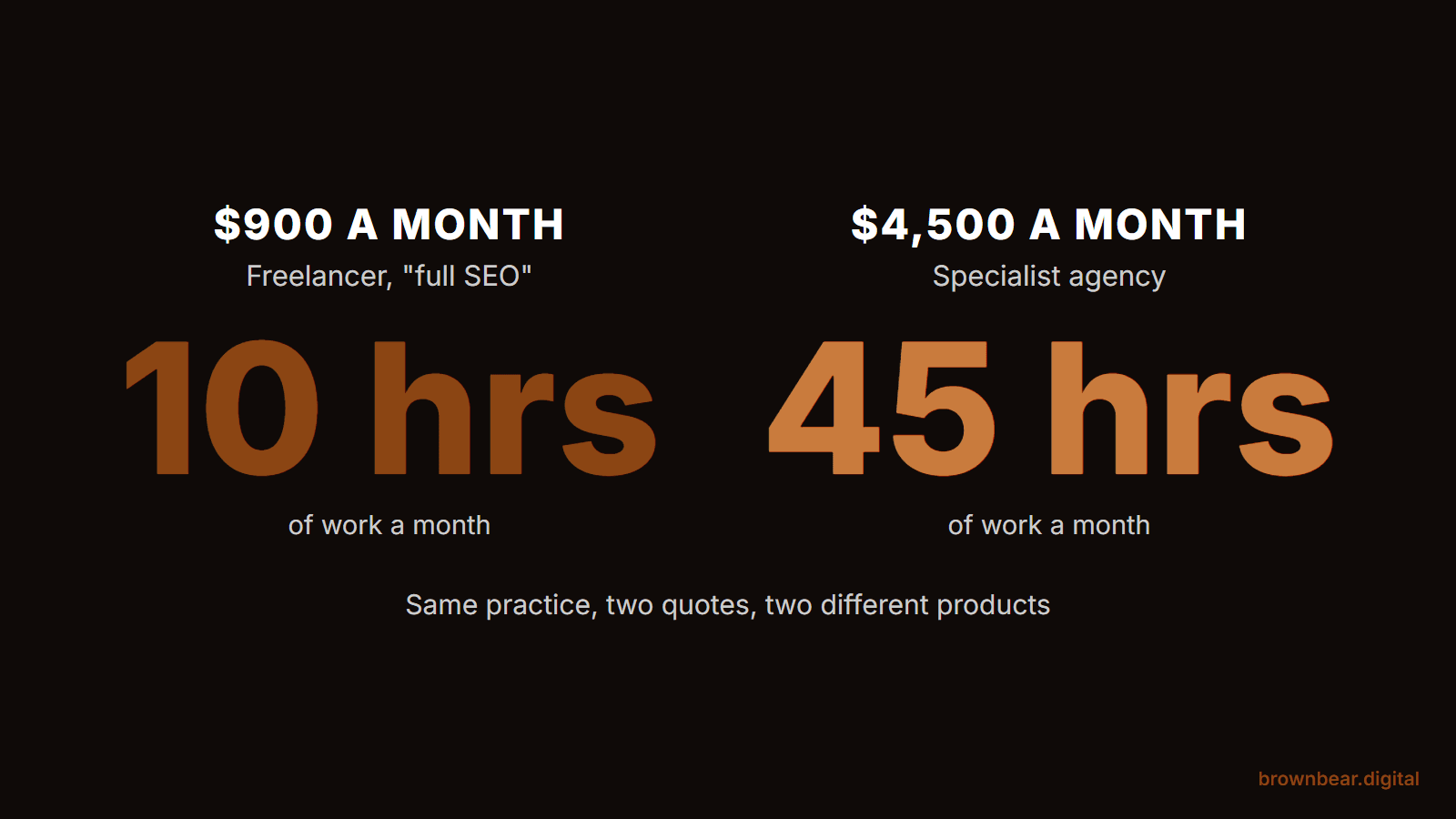
Ask three agencies what SEO costs for a plastic surgery practice and you can get three quotes that differ by a factor of five, each with a confident explanation. Every price guide on the first page of Google answers with a range. Very few of them tell you what the money actually buys, why the same practice gets a $900 quote and a $6,000 quote in the same week, or how to tell whether either one can pay for itself.
This is Brown Bear's cost guide for plastic surgery SEO, built around the line items instead of the totals. It draws on the published pricing of agencies that sell this work, an industry survey of what SEO providers charge, the surgeon fees reported by the American Society of Plastic Surgeons, and the budget math Brown Bear founder Bryan Passanisi walks practice owners through before they sign anything.
When we say SEO cost, we mean both the monthly retainer and the things that quietly ride along with it: setup fees, content, link building, the AI search work that is now part of the job, and the contract terms that can cost more than the fee itself.
If you are a solo surgeon holding two quotes that look nothing alike, you need a way to compare them that does not come down to trust. If you run a multi-surgeon practice in a crowded metro, you need to know what a serious budget looks like before a competitor sets the bar for you. And if you manage marketing for a practice and have to defend the SEO line to the surgeon who signs the checks, you need the break-even math in consults, not rankings.
By the end you will be able to turn any monthly fee into hours and deliverables, size a budget to your market and procedure mix, and calculate how many organic consults a quote needs to produce before it earns its keep. We cover it in four parts: what practices actually pay, what each budget tier buys line by line, how your market and procedures move the number, and how to judge the return and the contract.
Start with the number everyone asks for first.
What Plastic Surgery SEO Costs in 2026
Most plastic surgery practices pay between $1,500 and $10,000 a month for SEO, and a full program for a single-surgeon practice typically runs $3,000 to $6,500 a month. Multi-surgeon practices at one location typically land between $5,000 and $10,000, and multi-location groups run $8,000 to $20,000 or more. Below about $1,000 a month you are buying a handful of hours, not a program.
| Practice type | Typical monthly SEO budget | What the budget has to cover |
|---|---|---|
| Solo surgeon, smaller market | $1,500 to $3,000 | Local SEO, Google Business Profile, a small number of medically reviewed pages a month |
| Solo surgeon, full program | $3,000 to $6,500 | Technical, content, local and off-site work every month |
| Multi-surgeon, one location | $5,000 to $10,000 | More procedures, more pages, more surgeons to build authority for |
| Multi-location group | $8,000 to $20,000+ | Everything above, per location, plus coordination |
| Under $1,000 | Hours, not a program | Usually one scope area, often maintenance only |
Those bands match what we published in our plastic surgery SEO buyer's guide, and they sit inside what agencies selling this work publish. The price guides we reviewed in October 2026 ranged from $1,000 to $3,000 a month at the low end, through $3,000 to $5,500 for a small single-location practice and $5,500 to $10,000 for a competitive metro, up to $8,000 to $20,000 or more for programs that add AI search, digital PR and conversion work. One agency prices local SEO alone at $1,500 to $2,300 a month per physical location.
Generic SEO quotes run lower, and that is where a lot of the confusion starts. In Ahrefs' survey of 439 SEO providers, the most common monthly retainer was $501 to $1,000, charged by 20.4% of respondents, and 68.8% charged $2,000 a month or less. Those providers serve every kind of business. A plastic surgery practice competes in a crowded, high-value local category, under the stricter quality bar Google applies to health topics, so a price that works for a landscaper is not evidence of what your market needs.
Why Two Quotes for the Same Practice Can Differ Fivefold
An SEO quote is hours multiplied by a rate, and the two quotes on your desk are almost always buying different amounts of work, done by people at different levels. The fastest way to compare them is to convert each one back into hours.
Ahrefs' survey found the most common hourly rate was $75 to $100, charged by 24% of providers, and that rates rose with years in business. At that rate, here is what a monthly fee turns into:
- $900 a month buys roughly 9 to 12 hours.
- $1,500 a month buys roughly 15 to 20 hours.
- $3,000 a month buys roughly 30 to 40 hours.
- $6,000 a month buys roughly 60 to 80 hours.
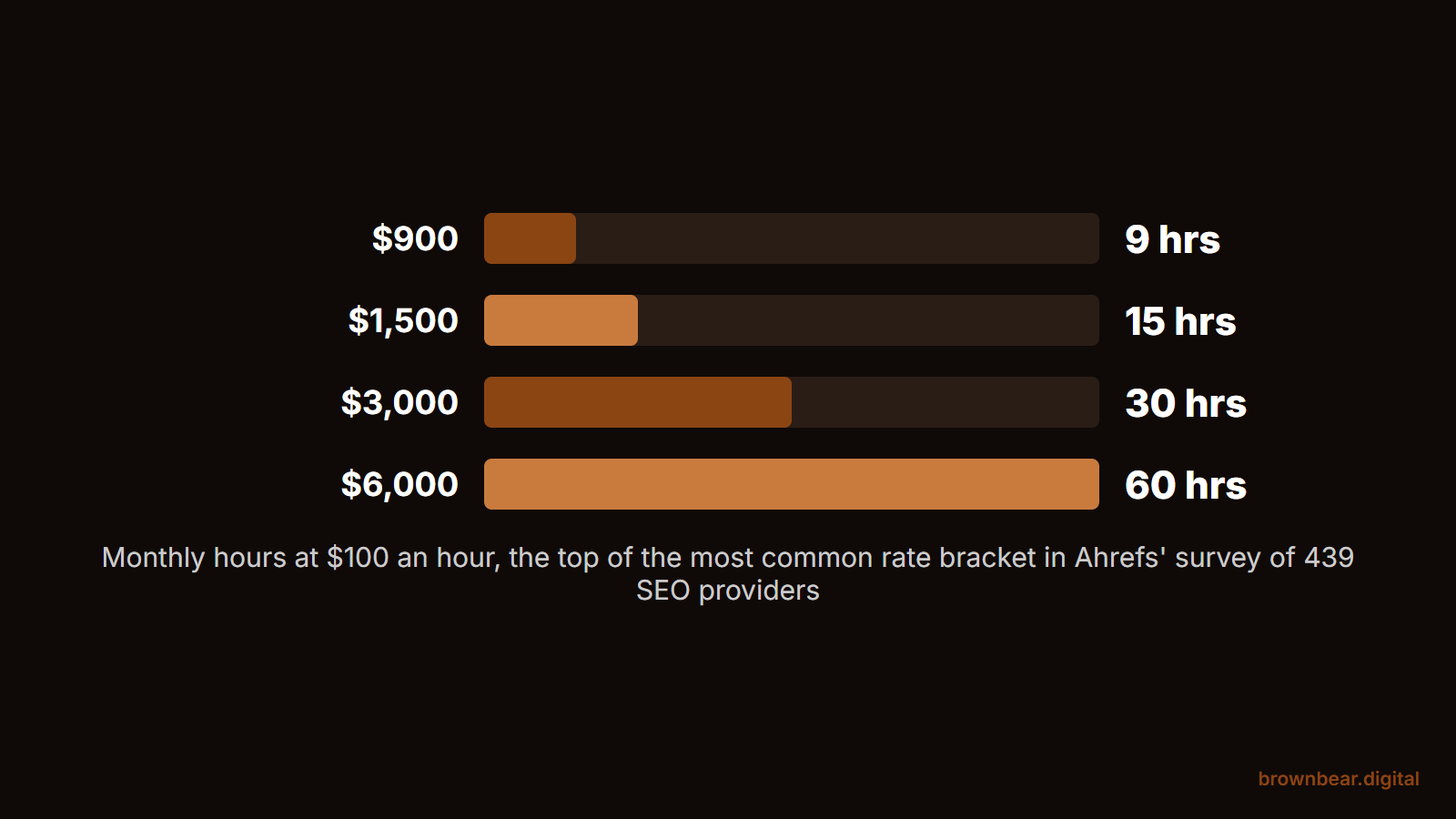
Agencies with senior strategists and medical reviewers on staff typically charge more per hour than the survey's most common bracket, so the same fee buys fewer but more senior hours. That trade can be worth it. What it cannot do is make 10 hours behave like 60.
Picture a breast and body surgeon in a mid-size market comparing two proposals. One is $900 a month from a freelancer promising "full SEO." The other is $4,500 a month from a specialist agency. At survey rates the first buys about 10 hours, which is enough to maintain a Google Business Profile and fix a few technical issues, and nothing else. The second buys enough time to publish two or more reviewed procedure pages a month and work on links. They are not two prices for the same thing. They are two different products.
That is the question to put to any proposal: how many hours does this fee buy, and where do they go?
What Each SEO Budget Tier Buys, Line by Line
Every plastic surgery SEO budget gets split across the same six line items: strategy and reporting, technical work, Google Business Profile and local, medically reviewed content, links and digital PR, and AI search work. What changes from tier to tier is how many of those lines get real hours. The table below is how Brown Bear expects a well-run budget to be allocated at each level, based on the hours each fee buys.
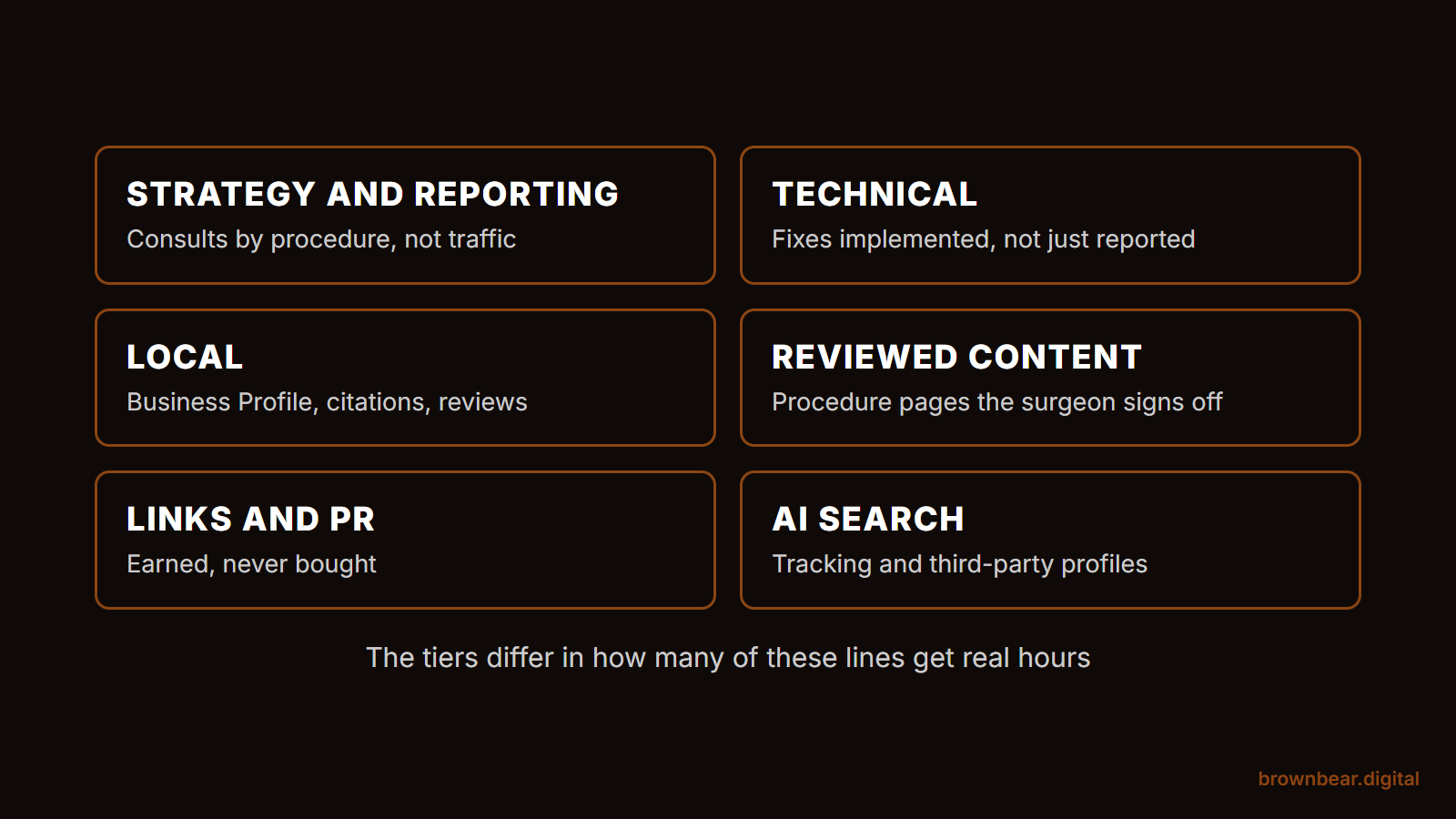
| Line item | Under $1,000 | $1,500 to $3,000 | $3,000 to $6,500 | $6,500 to $10,000+ |
|---|---|---|---|---|
| Hours a month at $75 to $100 | Under 14 | 15 to 40 | 30 to 87 | 65 to 130+ |
| Strategy and reporting | A template report | Monthly report with consults tracked | Named senior strategist, results by procedure | Plus quarterly planning with the practice |
| Technical | An audit, rarely fixes | A short list of fixes | Ongoing fixes, implemented | Site architecture, speed and JavaScript cleanup |
| Google Business Profile and local | Listing upkeep | Profile management and citations | Plus a review program and location pages | Per location |
| Medically reviewed pages | Under 1 a month | About 1 to 2 a month | About 2 to 4 a month | About 4 to 6+ a month |
| Links and digital PR | None, or a purchased package | Local citations and a few earned links | Editorial outreach | Digital PR campaigns |
| AI search work | None | A baseline check | Tracking and third-party profile work | Plus research and placements |
Content is where the tiers separate most, because a real procedure page is expensive to make. In our study of the #1 result in 101 cities for breast augmentation searches, the winning procedure pages in competitive metros clustered at 2,000 to 2,500 words, with a before-and-after gallery on 93% of winners. A page at that standard, researched, written, reviewed by the surgeon and published, takes Brown Bear roughly 6 to 10 hours. That is why a $1,500 budget carries about one a month and a $900 budget effectively carries none.
Links are the other line that quietly decides outcomes. The same study found that 52% of the #1 results were practice homepages, most of which never mention the procedure in their title tag. Google was ranking the practice's overall authority, not the page. That authority comes from links, press, reviews and mentions on other sites, which is why a budget with no money in the links line can publish good pages for a year and still watch an established competitor's homepage outrank them.
Use the decoder below to run any quote you have through the same math.
If the decoder shows a line item at zero, ask the agency directly whether that work is in scope. Sometimes it is handled elsewhere, by a web developer or an in-house coordinator. More often it simply is not happening.
How Your Market Changes What SEO Should Cost
Your market sets the floor, because the budget has to outwork the practices already ranking where you want to rank. A surgeon in a metro where a dozen established practices have spent a decade building content and links needs more hours to catch up than a surgeon in a city with three competitors and thin websites.
Published figures follow that logic. One agency that reports its clients' budgets puts plastic surgery SEO in major markets like New York, Los Angeles and Miami at $2,000 to $5,000 a month and says smaller markets typically run about half that. Another prices a competitive metro at $5,500 to $10,000 against $3,000 to $5,500 for a small single-location practice. The ratio is consistent even where the numbers are not: a crowded metro costs roughly twice what a small market does.
You can size your own market in about ten minutes. Search your three most important procedures with your city, the way a patient would, and count the distinct practices in the map results and the first page of organic results. Then note how many of them have a dedicated, substantial page for that procedure.
- If you find 5 or fewer serious competitors, and most have thin procedure pages, a focused program in the $1,500 to $3,000 range can work, as long as the proposal names exactly what it covers.
- If you find 10 or more, with deep procedure pages and strong review counts, you are in a major-metro market. A single-surgeon practice should plan on the full-program band, and a quote under $3,000 is usually a junior account or template work.
- If you sit in between, the procedures you target decide which side you fall on, which is the next section.
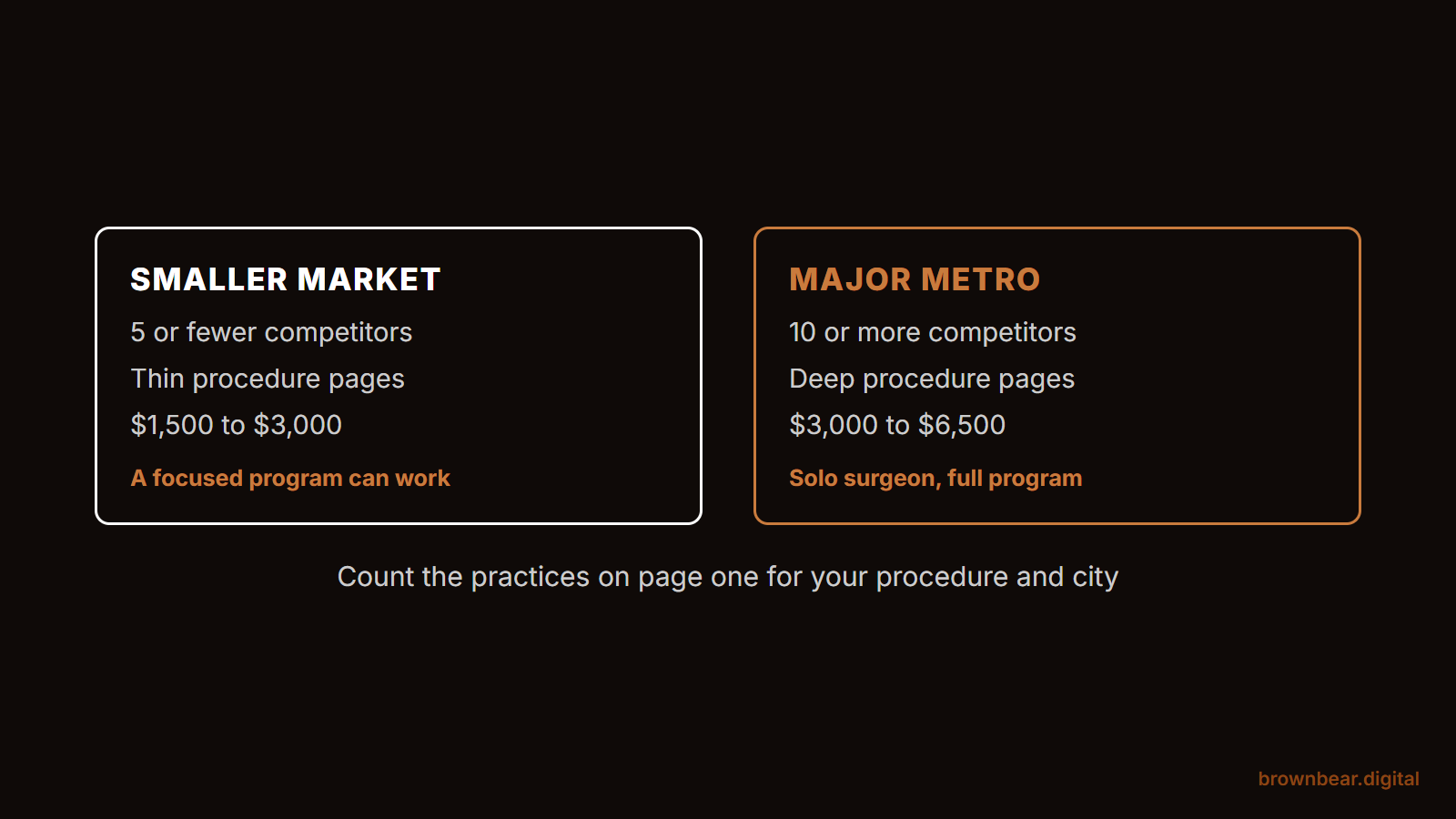
Imagine two rhinoplasty surgeons with the same skill and the same website. One practices in a metro of 400,000 people where three practices compete for "rhinoplasty" plus the city. The other practices in Los Angeles, where the first page is crowded with established practices. The first surgeon can hold the top three with a few strong pages and a steady review program. The second needs a year of content, links and press just to reach the first page. Same procedure, same surgeon, very different bill.
How Your Procedure Mix Changes the Budget
Every procedure you want to rank for is its own small SEO campaign. It needs a substantial procedure page, supporting pages that answer cost, recovery and candidacy questions, gallery cases and links. A practice targeting three procedures needs a fraction of the content a practice targeting twelve does, and the budget should reflect that.
The way to keep the number sane is to rank procedures by what a case is worth and how winnable the search is, then fund the top of the list properly instead of spreading thin across everything. The American Society of Plastic Surgeons' 2024 procedural statistics put the surgeon's fee for breast augmentation at $4,575 to $8,000, rhinoplasty at $7,500 to $12,500, a tummy tuck at $8,000 to $13,500 and a facelift at $12,000 to $19,000. Those are surgeon fees alone, not the full price a patient pays. A procedure with a higher fee needs fewer organic cases to repay its share of the budget, so it can justify more of the content and link work.
- If your revenue is concentrated in two or three surgical procedures, put most of the content budget there and accept slower progress on everything else. A focused budget that wins two procedures beats a spread budget that ranks on page two for ten.
- If you run a large non-surgical menu alongside surgery, be careful with injectables and lasers. Those searches are crowded with med spas, each case is worth less, and they can soak up a budget without moving surgical consults. Treat them as a separate line with its own target.
The Break-Even Math in Consults, Not Rankings
The right way to judge any SEO price is to work out how many organic patients it needs to produce, then ask whether that is plausible in your market. The formula is short: multiply the monthly fee by the length of the engagement, divide by the revenue from one procedure, and you have the number of organic cases needed to break even. Divide that by your consult-to-surgery rate and you have the number of organic consults.
Bryan uses the same frame with practice owners, as he put it in our playbook on balancing SEO and paid search:
"Run the math on a $1,500 to $2,000 monthly SEO retainer over twelve months: that's roughly the cost of two solid procedures coming in organically."
Bryan Passanisi, Founder, Brown Bear Digital
Here is the same math at a full-program budget. Say a practice pays $4,000 a month and judges the program over two years, a total of $96,000. Its main procedure is breast augmentation, with a surgeon's fee of about $6,000, inside the ASPS range. It needs 16 organic cases to break even. If one in three of its consults books surgery, it needs about 48 organic consults over the two years, or 2 a month.
Two adjustments make the math realistic. First, rankings lag the invoice. In medical niches, SEO typically takes 9 to 12 months to start producing patients, as our YMYL SEO timeline lays out. If the first nine months produce little, the remaining 15 have to produce those 48 consults, a little over 3 a month. Second, revenue per procedure is not profit. If you want to break even on margin rather than revenue, divide by what you keep from each case, and the required number rises.
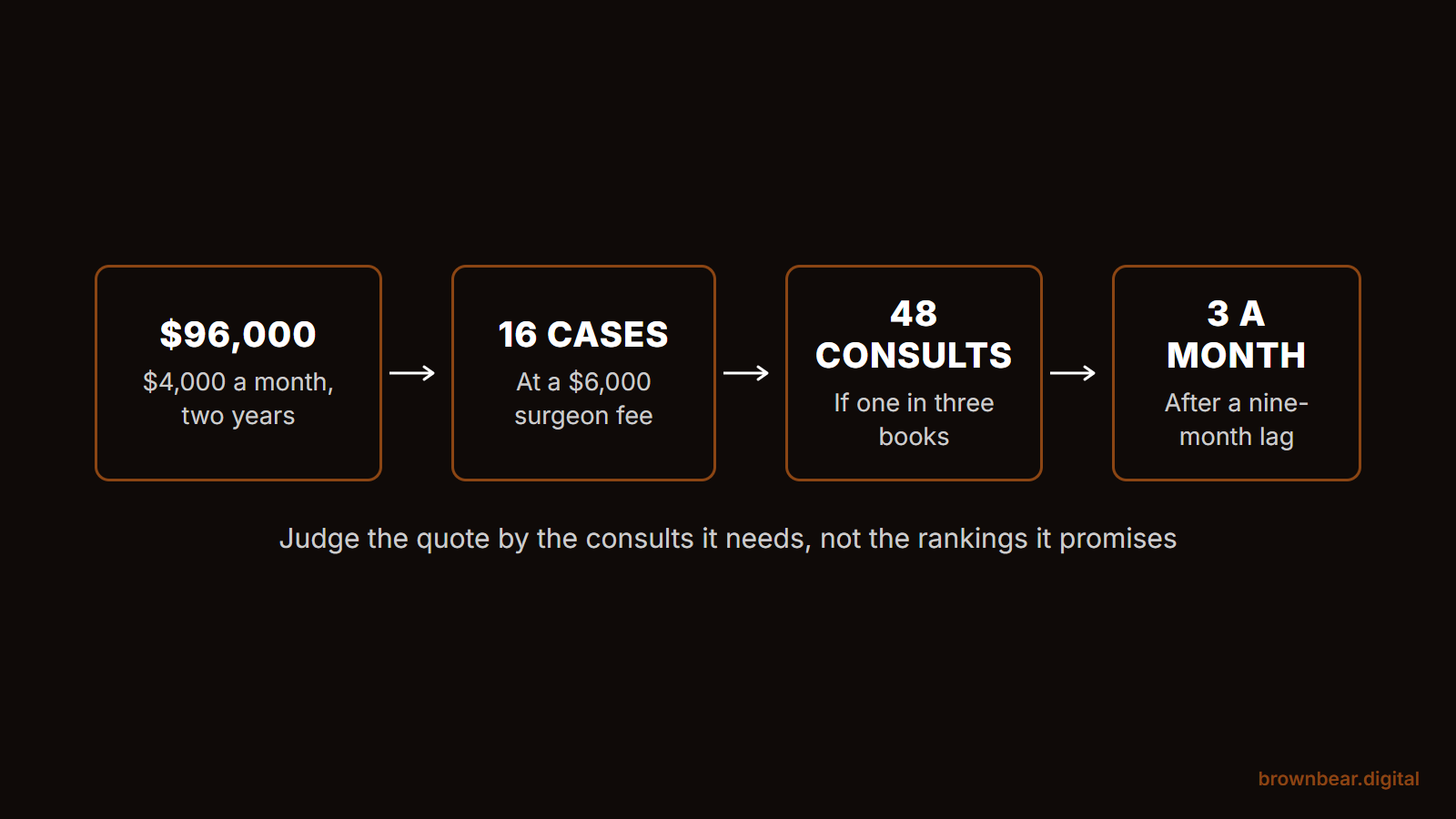
Picture a practice manager taking these numbers to the surgeon. A $4,000 retainer sounds expensive in the abstract. Three organic breast augmentation consults a month, in a market where the practice already books ten a month from referrals and ads, sounds like a modest target. The second framing is the one that gets a budget approved, and it is also the one that lets you fire an agency that cannot hit it. The buyer's guide linked above includes a retainer payback check that runs this calculation for any fee, term and procedure value.
The math also shows why cutting SEO to fund ads is usually a false saving. Bryan's view is that a retainer cut erodes the compounding that makes organic consults cheaper each year, and leaves the practice paying rising click costs with nothing building underneath. His blend logic runs the other way: paid search captures demand where SEO is not visible yet, then SEO takes over and the paid budget gets redeployed.
How AI Search Changes the SEO Budget
AI search changes where the budget goes more than how big it is. Patients now meet practices inside AI answers, so part of the money that used to go to rankings alone now has to go to the sources those answers are built from.
The pressure on clicks is real. When Pew Research Center tracked real browsing in March 2025, users who saw a Google AI summary clicked a traditional result on 8% of visits, against 15% on searches without one. A budget built only to earn rankings is now earning fewer clicks per ranking.
Cost searches are a partial exception, and that matters for practices. Bryan's observation from Brown Bear's client work is that big authority sites now take the AI answers for broad questions like what a procedure is, while local and cost searches still open the door to practices. When we checked "plastic surgery SEO cost" on October 9, 2026, Google showed no AI Overview at all. The same pattern holds for the searches your patients make about procedure prices in your city, which is why cost and local pages belong near the top of any content plan.
What AI search adds to the budget is mostly off-site. In the AI visibility audits Brown Bear runs, owners are most surprised by how much third-party sites, reviews, directories and press, drive what AI assistants say about them. That shifts money toward review programs, directory profiles and earned press, and toward tracking what assistants say about the practice. On the technical side, Bryan's view is that schema is worth keeping tidy but is overhyped for AI search; crawlable pages with clearly structured text matter more, and major AI crawlers read JavaScript poorly.
None of this needs a second budget. Our guide to rebalancing an SEO budget for AI search recommends keeping the total roughly flat and moving 15 to 30 percent of it into those new line items, funded by cutting commodity content and over-scoped technical projects. Be wary of anything sold as a separate "AI SEO" package at a very low monthly price. Most of what earns AI visibility is the same crawlable site, credible content and third-party reputation a real SEO program already builds.
Contract Terms That Cost More Than the Fee
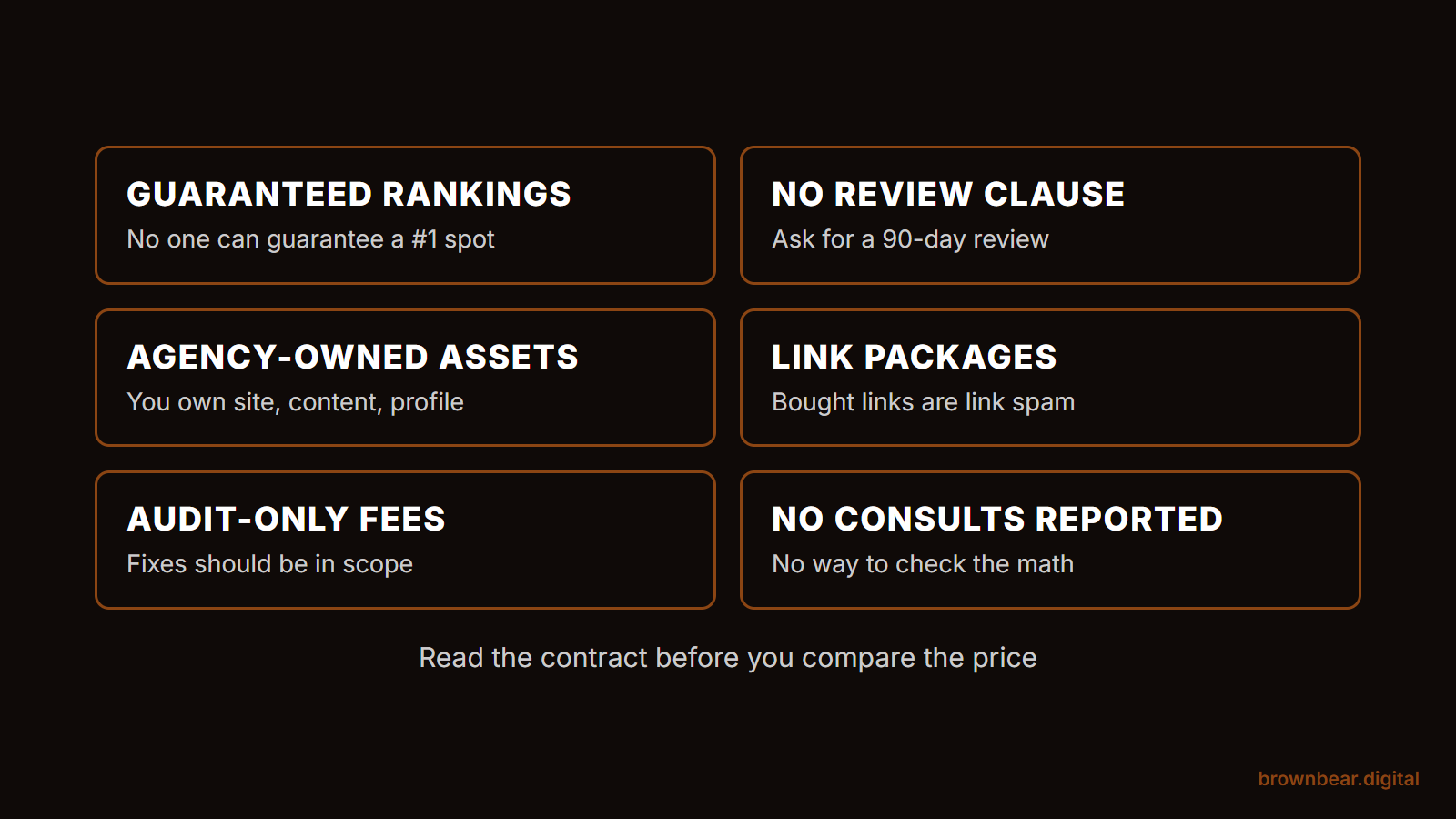
The most expensive part of an SEO engagement is often not the monthly number. It is a contract that locks you into work that is not producing, or leaves the agency owning assets you paid for. Read every proposal for these six terms before you compare prices:
- Guaranteed rankings. Google's own guidance on hiring an SEO says plainly that no one can guarantee a #1 ranking on Google, and warns against anyone who claims a special relationship with Google. A guarantee is a sales tactic, not a plan.
- A long term with no review. A 12-month agreement is reasonable for organic search, which takes months to move. A 12-month agreement with no performance review and no exit for clear underperformance is not. Negotiate a 90-day review against named milestones, as our guide to vetting a medical SEO agency recommends.
- Agency-owned assets. The practice should own the domain, the website, the content, the Google Business Profile, and admin access to Search Console and analytics. If the agency holds any of these, leaving costs you the work you paid for.
- Link packages. A line item promising a fixed number of links a month for a fixed price is usually purchased links. Google's spam policies name exchanging money for links, or posts that contain links, as link spam, and the penalty lands on your site, not the vendor's.
- Setup fees for audits nobody implements. A one-time audit fee is fair when the fixes are in scope. A fee for a PDF of recommendations your web developer then has to bill you again to implement is paying twice.
- Reports with no consults in them. If the monthly report shows traffic and rankings but never consults from organic search, there is no way to run the break-even math, which is often the point.
The link problem is not hypothetical. One Reddit user who posted asking for plastic surgery backlinks described being flooded with offers from link farms and private blog networks, plus phishing attempts, long after declining them. Any of those offers would have looked cheap on an invoice.
Questions Practice Owners Ask About SEO Pricing
How much should I pay for SEO services as a plastic surgeon?
Plan on $1,500 to $3,000 a month for a focused program in a smaller market, and $3,000 to $6,500 a month for a full program as a solo surgeon in a competitive one. Multi-surgeon and multi-location practices pay more because they have more procedures and locations to build. The right number is the one whose break-even consult count your market can plausibly produce.
Is SEO worth it for a small plastic surgery clinic?
It usually is when one organic case covers a month or more of the fee, which is true for most surgical procedures at the ASPS fee levels. It is weaker when the clinic's revenue is mostly lower-value non-surgical treatments in a market crowded with med spas. Run the break-even math with your own procedure value and close rate before deciding.
Should SEO be a monthly retainer or a one-time project?
Both have a place. A one-time project suits a defined job, such as a technical cleanup or a site migration. Ranking for competitive procedures takes ongoing content, links and local work, and that is what a monthly retainer pays for. Be skeptical of a one-time fee sold as a permanent ranking fix.
How long before SEO pays for itself?
Plan on two years to judge it properly. The first 9 to 12 months typically go mostly to fixes, content and authority that have not paid off yet, so build that lag into the break-even math and let the months that do produce consults carry the whole cost. How long the lag runs depends on how competitive your market is and how strong your site is at the start.
Can we do SEO in-house instead?
Parts of it, yes. A staff member can run the review program, keep the Google Business Profile current and supply the surgeon's input for content. Technical work, link building and the editorial process behind reviewed procedure pages are harder to do well part-time, and a coordinator's hours are not free either. Count the in-house hours at their real cost before comparing them to an agency fee.
Get a Plastic Surgery SEO Budget Built Around Your Market
The right SEO budget is not the cheapest quote or the biggest one. It is the one whose hours go to the line items your market demands, and whose break-even number your practice can actually hit. Brown Bear builds every plan from that math, by procedure and by market, and reports consults rather than traffic. If you want to see what that looks like for your practice, start with our SEO for plastic surgeons.
Written By
Founder, Brown Bear Digital
Bryan has 15 years of experience across SEO, paid search, and AI search strategy. He founded Brown Bear to give businesses direct access to senior-level search expertise without the agency overhead.
Learn More About BryanGet Found on Google.
Get Cited by AI.
Tell us about your site. We'll send back a proposal for SEO and AI search.