Healthcare Marketing: What 1,830 Google Results Show About Where Practices Should Spend
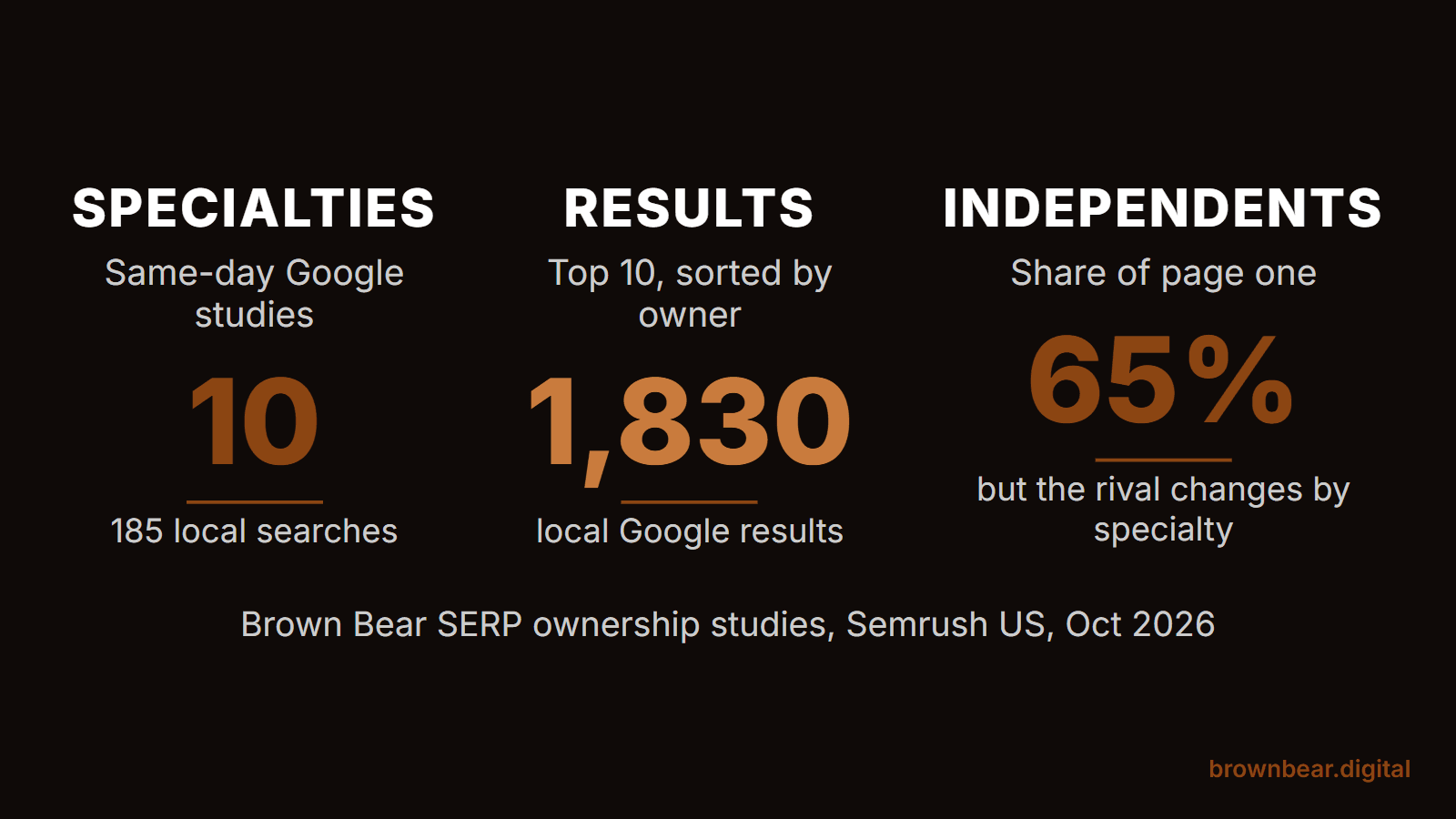
Most healthcare marketing guides hand you the same list. Build a brand, fix your website, ask for reviews, try SEO, post on social media. The list is not wrong, but it skips the question that decides where your money goes: who are you actually up against on Google? Brown Bear ran same-day Google studies for 10 healthcare specialties in October 2026 and sorted every local result by who runs it. Across 1,830 results, independent practices held 65% of page one. But the rival changed by specialty: health systems held #1 for "orthopedic surgeon" searches in 12 of 22 cities, corporate groups held #1 for vet searches in 9 of 14, and a directory held #1 for "therapist" in 7 of 13. This is Brown Bear's guide to healthcare marketing, built around the competitor you really face.
It draws on those studies, which pulled the top 10 Google results for 185 local searches, and on what Bryan Passanisi, founder of Brown Bear Digital, has seen running SEO, paid search and AI search programs for plastic surgery and medical practices.
Healthcare marketing here means both the basics and the newer layer on top. The basics are your website, your Google Business Profile, reviews, paid search, referrals and content. The newer layer is the AI answers that now sit above the results, and the directories and groups that compete for the same patients. It covers both a one-doctor clinic and a multi-office specialty group.
If you own a private practice, you want to know whether a hospital, a chain or a directory is taking the patients who search for what you do. If you run a specialty group, you need to know which searches you can win and which ones belong to the health system across town. And if you are the office manager who just inherited the marketing budget, you want a plan you can defend line by line.
By the end, you'll know who holds page one in your specialty, and which of four kinds of competitor you face. You'll know which channel to fund first, what the rules on tracking and reviews allow, and how AI search changes the picture. You'll also have a link to the deeper guide for your specialty. The longer payoff is a marketing budget that goes where patients can actually find you, instead of into a fight you cannot win.
We've grouped it into four parts: who owns page one, where to spend, the channels and rules, and the specialty playbooks with cost and hiring. Start with what healthcare marketing is supposed to produce.
What Healthcare Marketing Is, and What It Should Produce
Healthcare marketing is the work of getting a practice, clinic or health system found, chosen and booked by the patients it can serve. It covers Google search, Google Maps, AI tools, paid ads, reviews, directories, your website, content, email and referrals. The goal is new patients who book and show up. Traffic and followers are only steps toward that.
Patients choose care differently than they choose most products. The stakes are personal, so they read reviews, check credentials and compare two or three providers before they call. Many also need a provider who takes their insurance, sits close to home and can see them soon. That is why healthcare marketing leans so hard on trust and local search.
Marketing courses often teach a 5 P's model. One common version is product, price, place, promotion and people. It is a fine checklist. But it does not tell you where to spend next month, because it ignores the one thing that changes most by specialty: who already holds the results you need. The map below does.
Who Owns Page One in Healthcare: 10 Specialties, 185 Searches
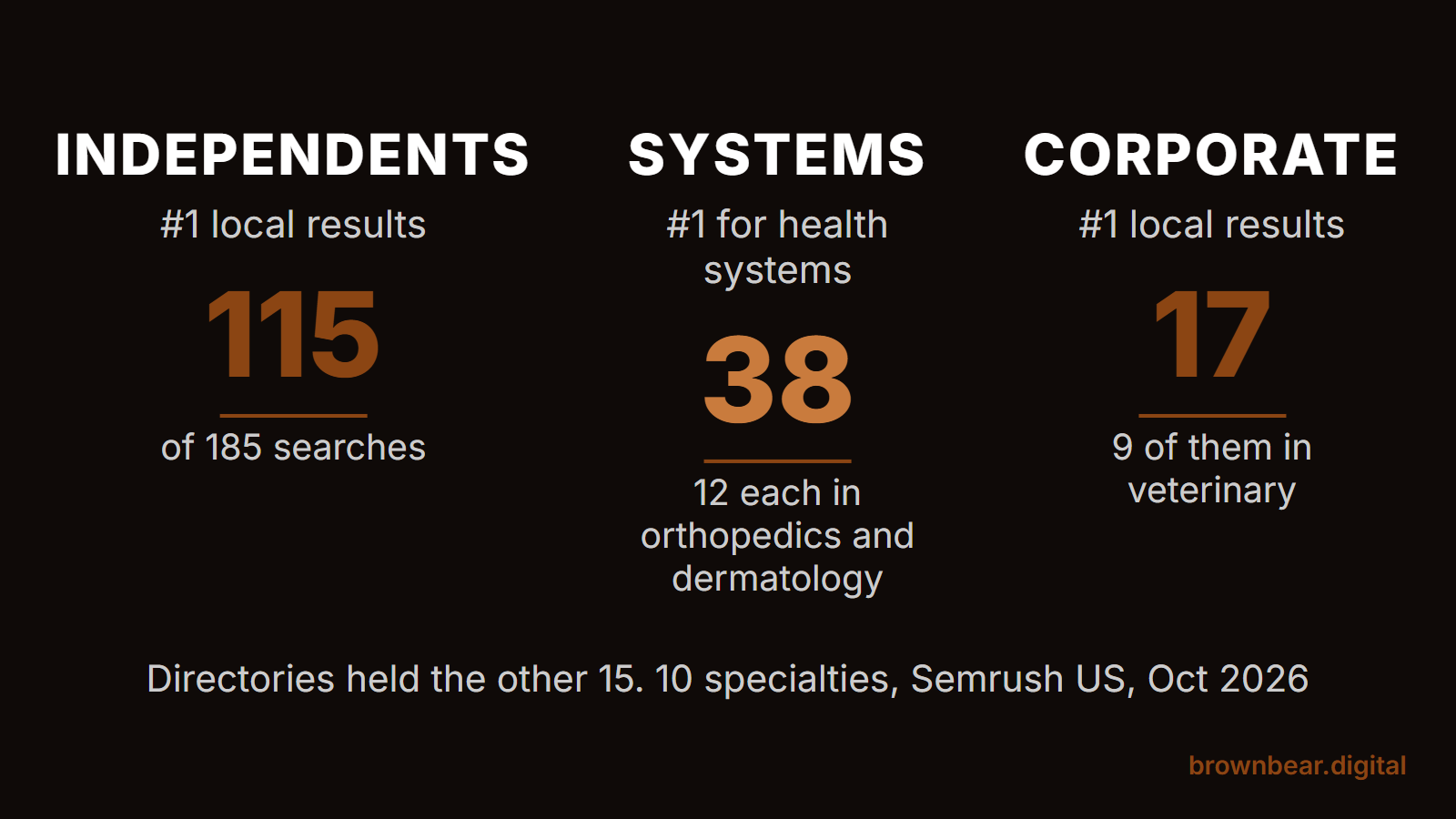
Independent practices own most of page one in healthcare, but not in every specialty. In our October 2026 studies, independents held 65% of all 1,830 local results and 115 of 185 #1 spots. Health systems held 38 #1 spots, corporate groups 17 and directories 15. The mix swings hard by specialty, and that swing should shape your budget more than any channel list.
Each study pulled the Semrush top 10 Google results for "[specialty] + city" searches in 6 to 20 US metros, on a single day per study between October 17 and October 28, 2026. We sorted each result into one of four owner types. The map pack, ads and AI Overview citations are not counted.
| Specialty | Searches | Independent practices | Corporate, PE or chain | Health systems | Directories and platforms | Who held #1 |
|---|---|---|---|---|---|---|
| Orthodontics | 14 | 78% | 3% | 4% | 13% | Independents 12 of 14 |
| Chiropractic | 20 | 73% | 7% | 2% | 16% | Independents 20 of 20 |
| Dental | 28 | 69% | 3% | 6% | 20% | Independents 20 of 28 |
| Dermatology | 27 | 69% | 7% | 19% | 5% | Independents 14, health systems 12 |
| Orthopedics | 22 | 67% | 0% | 29% | 4% | Health systems 12, independents 10 |
| Med spa | 17 | 66% | 4% | 5% | 24% | Independents 14 of 17 |
| Therapy and counseling | 13 | 66% | 5% | 2% | 27% | Directories 7, independents 6 |
| Ophthalmology | 18 | 51% | 18% | 16% | 12% | Independents 11, health systems 4 |
| Physical therapy | 12 | 50% | 15% | 25% | 8% | Independents 5, health systems 4, chains 3 |
| Veterinary | 14 | 49% | 41% | 7% | 3% | Corporate groups 9 of 14 |
| All 10 | 185 | 65% | 9% | 12% | 13% | Independents 115, health systems 38 |
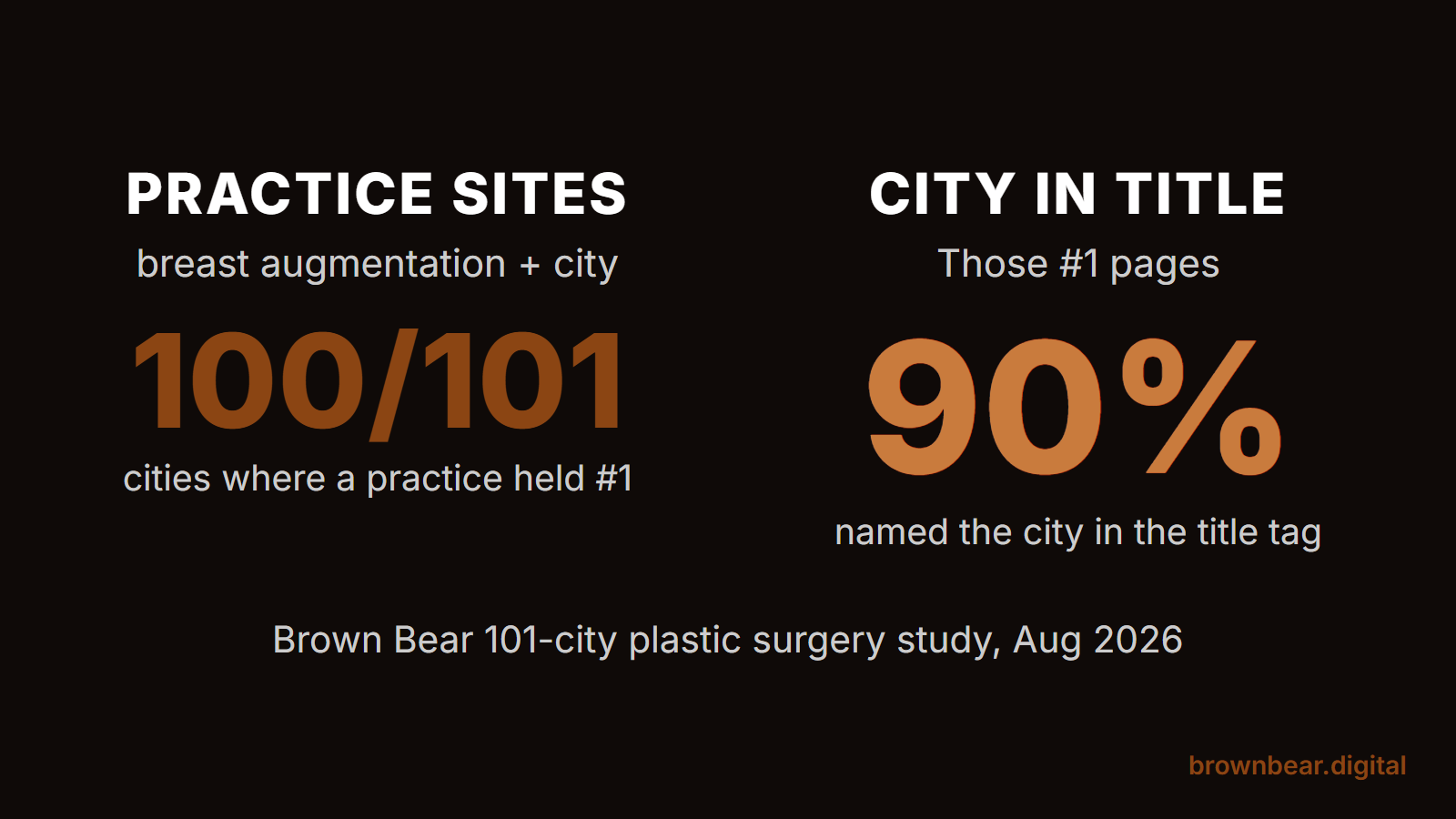
Plastic surgery sits at the far end. In our 101-city plastic surgery study, practice or surgeon websites held the #1 result for "breast augmentation" plus the city in 100 of 101 cities.
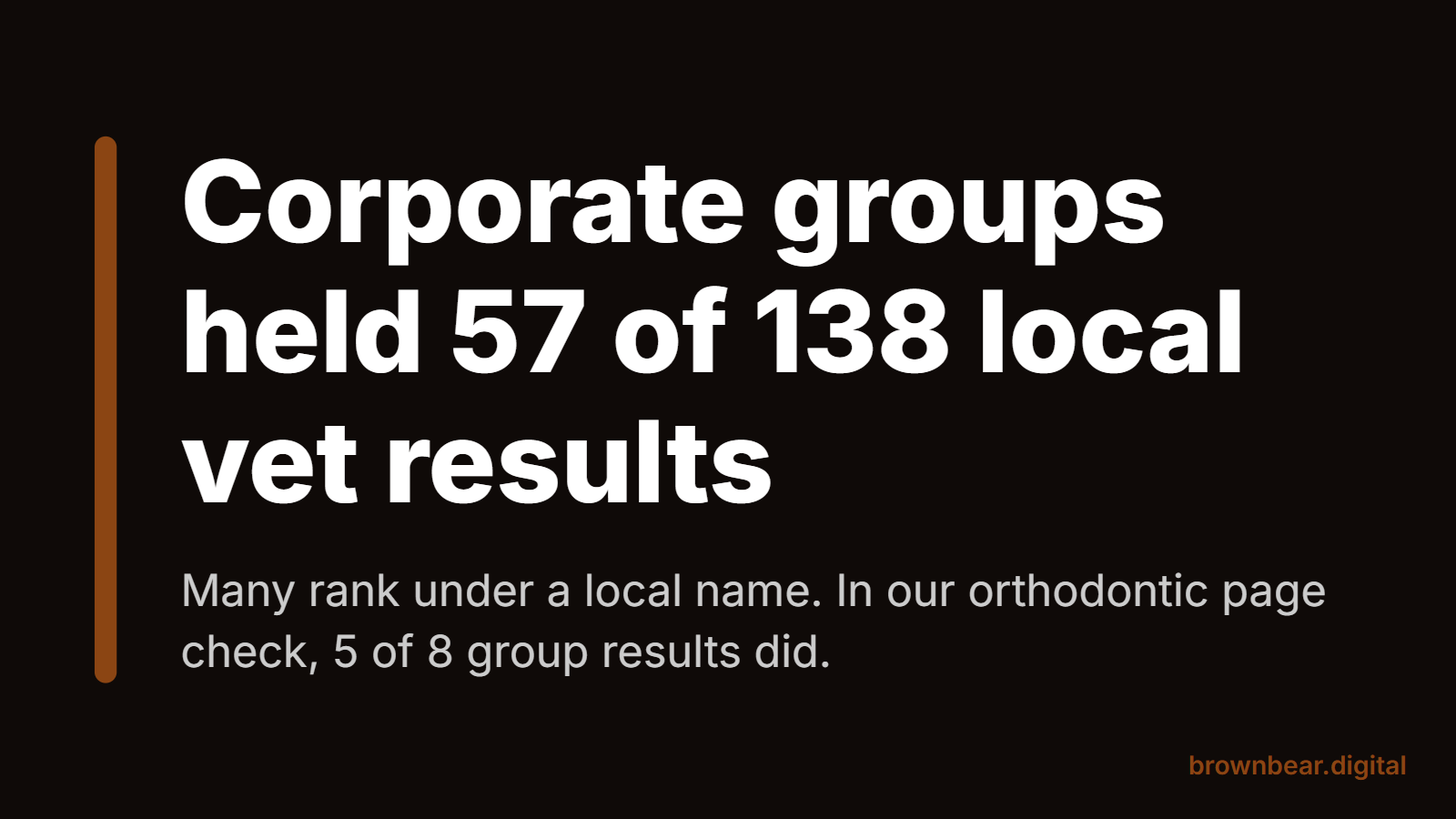
Two caveats matter. "Independent" means the study found no sign of a group owner, not proof that none exists. Most of these studies sorted results by domain, and groups often rank under a local practice name. When we checked each ranking page by hand for orthodontists, 5 of 8 corporate results used a local name. So the corporate share here is a floor, not a ceiling.
The Four Competitors Every Practice Faces, and What Each One Changes
Every practice competes with some mix of four owner types: other independent practices, health systems, corporate or private equity groups, and directories. Which one leads in your specialty decides your first move.
Other independent practices.
This is the normal case. In chiropractic, an independent practice held #1 in all 20 cities we checked. In orthodontics, corporate groups held just 4 of 139 local results. When your rivals look like you, the practice with the stronger website, Google Business Profile and reviews wins. Local SEO is the main lever.
Health systems.
Hospitals and academic centers are strongest in orthopedics, physical therapy and dermatology, with 29%, 25% and 19% of local results. They win on domain strength and on hundreds of doctor and location pages. You rarely beat them on the broad term. You beat them on the narrower procedure, condition and neighborhood searches they cover thinly.
Corporate and private equity groups.
Veterinary was the outlier, with groups holding 41% of local results and #1 in 9 of 14 searches. Ophthalmology came next at 18%, counting PE platforms, LASIK chains and retail optical, followed by physical therapy chains at 15%. Groups bring budget and many location pages. An independent wins against them on the things a group struggles to fake: one named doctor, local reviews and a site that sounds like a person.
Directories and platforms.
Psychology Today, Yelp, Zocdoc, insurer finders and social platforms took 27% of therapy results, 24% of med spa results and 20% of dental results. You cannot outrank Psychology Today for "therapist" plus your city in most markets, so your profile on it becomes part of your marketing, not an afterthought.
Picture an independent animal hospital in Austin. The #1 result for "vet austin" is a clinic with a local name and a neighborhood feel, and it belongs to a corporate group. Corporate groups held 57 of the 138 local vet results we checked. That clinic owner is not up against a faceless chain. She is up against a group that kept the local name because the local name is what ranks, so her edge has to be the things a group cannot copy: her own name, her own reviews and her own cases.
Health Systems Own Condition Searches. Practices Win the Search for a Provider
Health systems own informational healthcare searches, and practices win the searches for a provider. Across 16 condition and treatment searches in four of our studies, such as "acl tear," "eczema treatment" and "sciatica treatment," health systems held #1 in 13. Cleveland Clinic alone held 9 of them. Healthline, the American Chiropractic Association and the National Cancer Institute held the other 3, and practices held none. Health systems also held 30 of the 48 top-three spots.
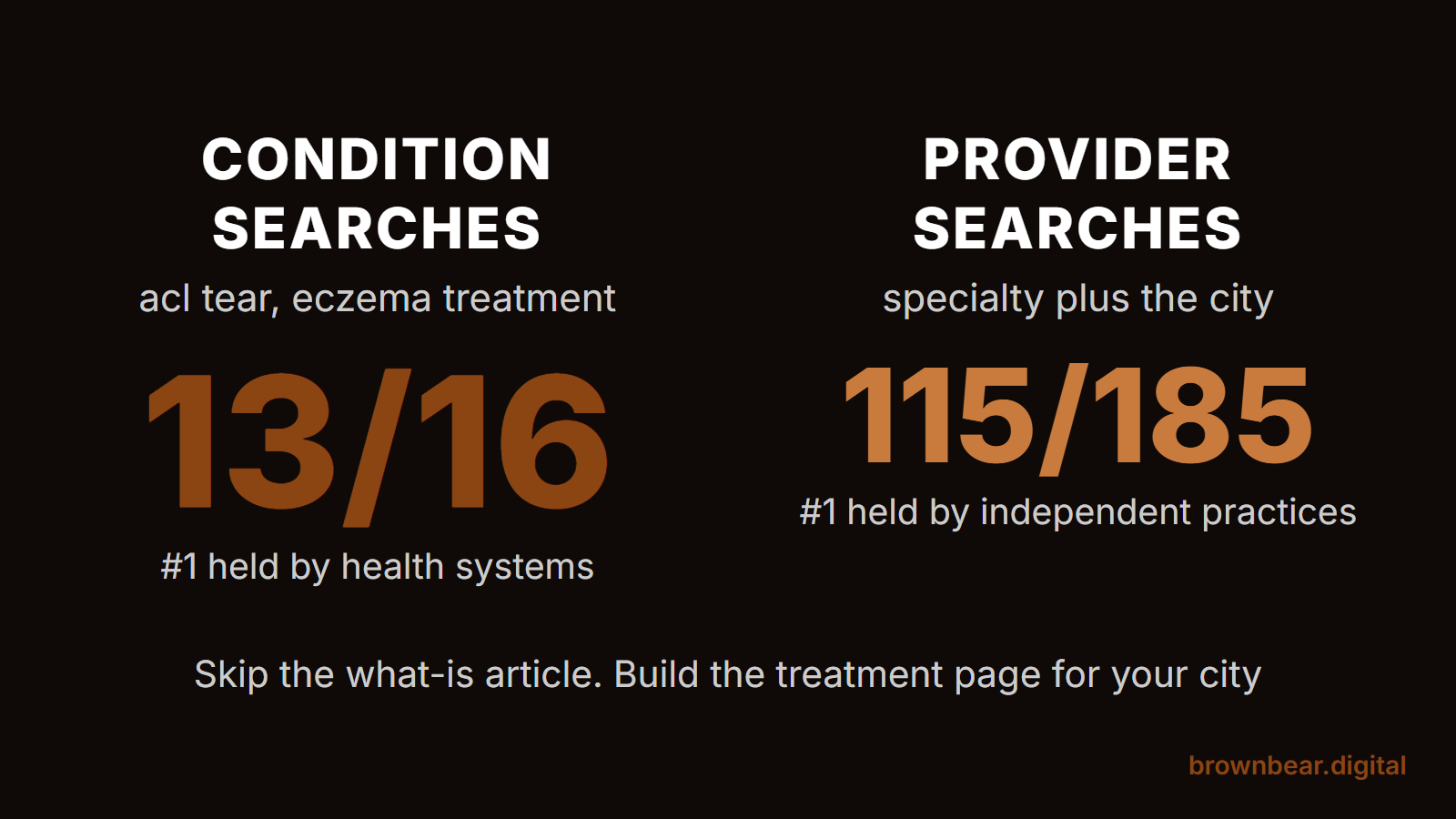
That split is the most useful fact in this guide for a small budget. A practice that writes a general "what is eczema" article is competing with Mayo Clinic, Cleveland Clinic and the local university hospital. A practice that builds a strong page for "eczema treatment" plus its city is competing with other practices.
Bryan sees the same split in AI answers. Big authority sites like Mayo Clinic and the American Society of Plastic Surgeons are taking over AI answers for head terms such as "what is breast augmentation." Local and focused searches, especially cost questions, still open the door for practices, because Google and the AI tools read local intent into them.
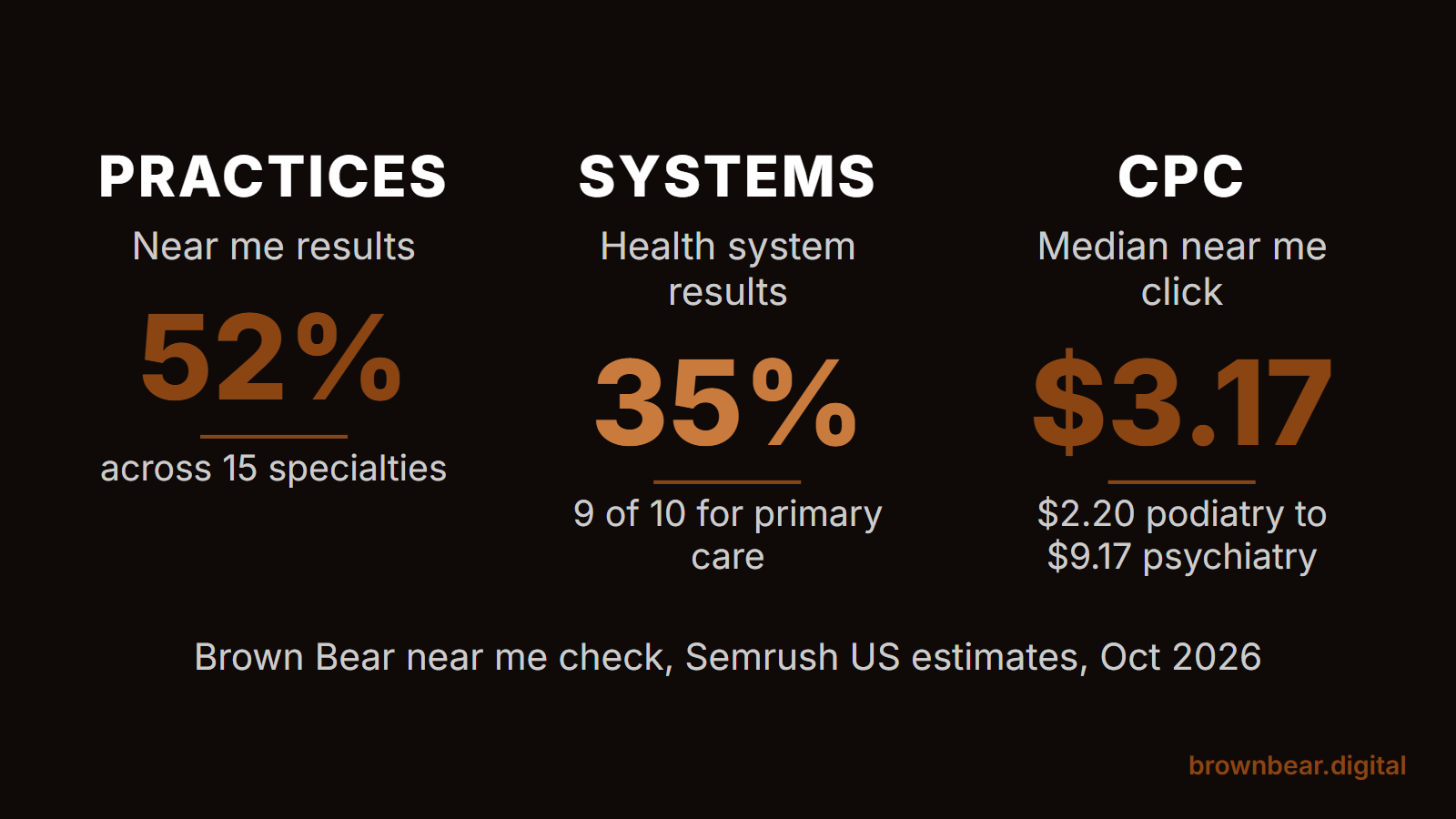
The "near me" searches behave like local searches with more health system pressure. In a separate Brown Bear check of 15 "near me" specialty searches, practices held 52% of organic results and health systems held 35%. Health systems held #1 in 8 of the 17 searches, and 9 of the 10 results for "primary care doctor near me." So primary care and other system-heavy specialties lean more on the map pack, reviews and paid search, while specialists can still win organic results.
Where to Spend First: Match Your Channels to Who Holds Your Page One
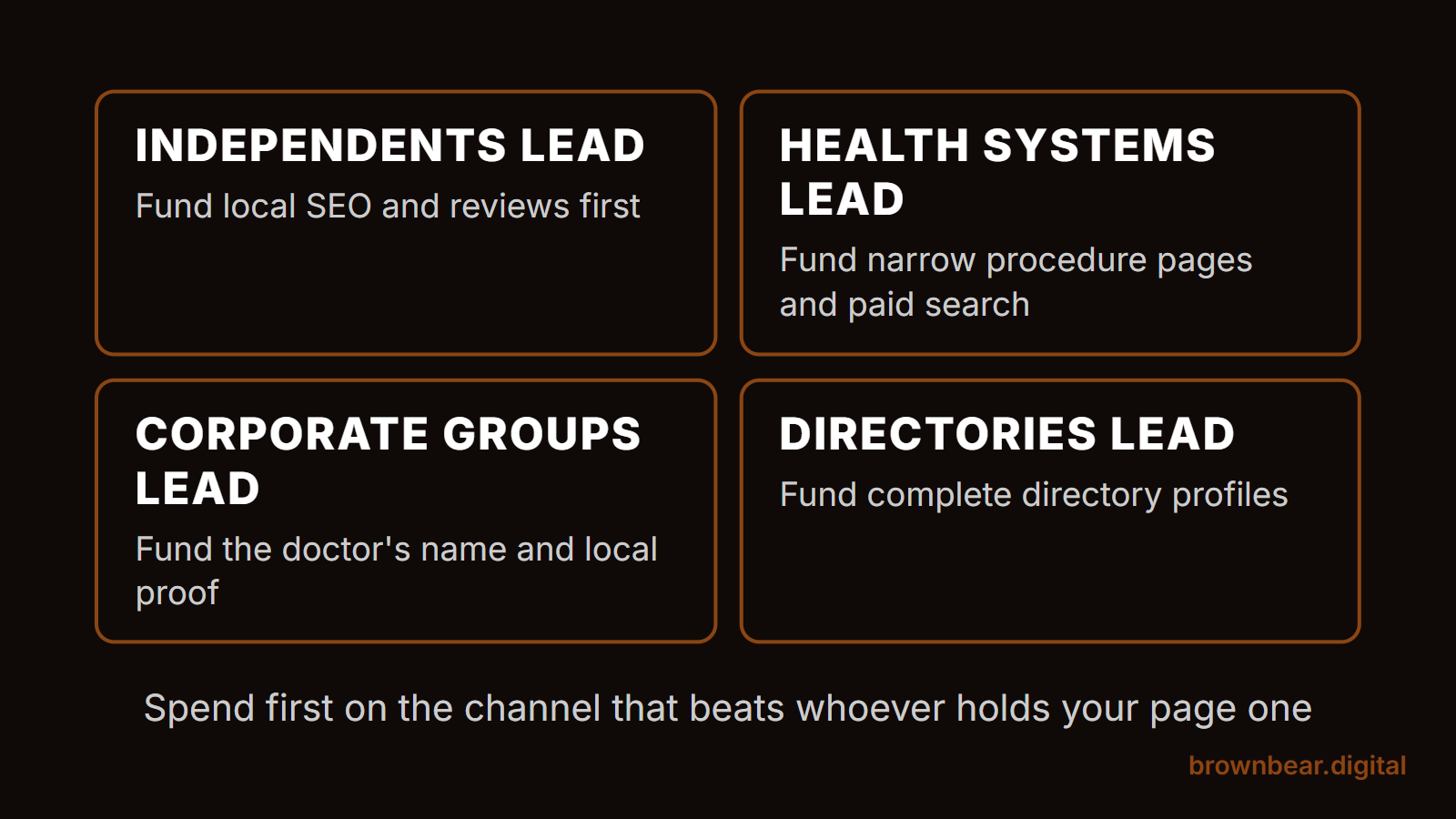
Spend first on the channel that beats the competitor holding your page one. If other independents lead, fund local SEO and reviews. If a health system leads, fund narrow procedure pages and paid search on the terms it covers thinly. If corporate groups lead, fund the doctor's name, reviews and local proof. If a directory leads, fund your directory profiles alongside your own site.
| Who holds your page one | Specialties where we saw it | Fund first | Fund second | Skip for now |
|---|---|---|---|---|
| Other independent practices | Chiropractic, orthodontics, dental, med spa, plastic surgery | Local SEO: homepage, service pages, Google Business Profile | Reviews and before-and-after proof | Broad awareness ads |
| Health systems | Orthopedics, physical therapy, dermatology, primary care | Procedure and condition pages plus your city | Paid search on the narrow terms | General condition articles that compete with hospitals |
| Corporate or PE groups | Veterinary, ophthalmology, physical therapy | The doctor's name, bio and local reviews | Neighborhood pages and community referrals | Price wars |
| Directories and platforms | Therapy and counseling, med spa, dental | A complete, current directory profile | Your own pages for the narrower searches | Trying to outrank the directory on the head term |
Say you run a three-physician physical therapy clinic in Phoenix. On "physical therapy phoenix," chains held 6 of the 10 results, including #1. Your $4,000 a month will not buy the head term. It will buy a strong page for each condition you treat most, a Google Business Profile that fills with reviews from your own patients, and paid search on narrower terms such as pelvic floor therapy, which the head-term rankings do not decide.
Use the planner below to see where your next dollar should go, based on who holds your results and how your practice runs.
The Healthcare Marketing Channels That Do the Heavy Lifting
Six channels do most of the work for most practices: your website, local SEO, reviews, paid search, content and directories. Here is what each one should do, with a link to the deeper guide.
Your Website Is the Base Every Channel Lands On
Every ad, review and AI answer sends the patient to your website, so it has to load fast, read clearly on a phone and make booking easy. Put your city in the title tag. In the plastic surgery study, 90% of #1 pages did. Build one page for each core service. Our guide to website design for medical practices covers the layout, speed and trust details that turn a visit into a booked visit.
Local SEO and Your Google Business Profile Win the Search for a Provider
Local SEO is how a practice shows up when a patient searches for a provider nearby. It runs on three things: a website with clear service and location pages, a complete Google Business Profile, and steady reviews. Practice domains carrying the city name held #1 in 8 of 20 chiropractic cities we checked. The name of the place matters because patients search by place.
Reviews Decide Who Gets the Call
Reviews do two jobs. They help your Google Business Profile rank, and they help the patient choose you once they see you. Ask every patient, make it easy, and reply without confirming that the reviewer is a patient. Our guide to what a useful review says shows which details help the next patient most.
Paid Search Fills the Gaps SEO Has Not Reached Yet
Paid search buys a spot today on searches your organic pages do not win yet. "Near me" clicks are cheaper than many owners expect. In our 15-specialty check, the median Semrush cost-per-click estimate was $3.17, from $2.20 for podiatry to $9.17 for psychiatry. When practices tell Bryan Google Ads didn't work, the account almost always shows two problems: campaigns and keywords never tuned for lead quality, and clicks sent to pages that were not built to convert. Our guide to paid search for doctors covers the setup and the health ad rules.
Content Earns Trust Before the First Visit
Good content answers the questions patients ask before they book: cost, recovery, what to expect and who is a good fit. It also earns the links and AI citations that lift the whole site. Bryan's rule for clients is to demand the reason behind every piece. Long-form still earns links and holds its place at the middle of the patient's research, such as cost questions, but fluff content does nothing. Our guide to healthcare content marketing maps each content type to the number that proves it works.
Directories and Referral Platforms Are Marketing, Not Paperwork
Healthgrades, Zocdoc, Yelp, Psychology Today, RealSelf and insurer finders all rank on page one in some specialty. Treat each profile like a landing page. Use the same name, address and phone number everywhere, add real photos and keep your insurance and hours current. A complete profile is often the cheapest page-one spot you can get.
Healthcare Marketing in AI Search
AI tools like ChatGPT, Google's AI Overviews and Gemini now answer many health questions before a patient clicks. For a practice, that means two jobs: make your site easy for AI tools to read and quote, and make sure the third-party sites they trust say the right things about you.
When Brown Bear runs AI visibility audits, the information is rarely wrong. The bigger problem is that the procedures a doctor wants to be known for are buried, so the AI tools see a generalist. The most common real error is small: odd variations of the practice's name, address or phone number across the web, which are easy to fix. What surprises owners most is how little they show up next to competitors, and how much reviews, directories and press drive what the AI says.
There is a reason to care now. Across Brown Bear's clients, visitors referred by ChatGPT and other AI tools convert to consultations at a higher rate than other channels and arrive more engaged. Bryan's read is that the search journey compresses into a few prompts in one session, from "what type of procedure" to "who is best near me," so patients click out ready to act. Our breakdown of the investment case for SEO and AI search walks through which searches AI already owns and which ones a practice can still win.
Healthcare Marketing Rules: Tracking, Reviews and Claims
Healthcare marketing carries rules most industries never face. Three come up on almost every program: what your website tracking can send, how you collect reviews, and what your ads and testimonials can claim. This is a summary, not legal advice. Talk to a healthcare attorney about your own setup.
Tracking pixels and analytics.
HIPAA limits what health information a covered practice can share with tracking tools. The HHS guidance on online tracking technologies still applies to logged-in pages such as patient portals, booking flows and intake forms. A federal court vacated one part of it on June 20, 2024: the part that treated a visitor's IP address plus a visit to a public condition page as protected information. State privacy laws and class action suits were not touched by that ruling. Our guide to what HIPAA restricts in marketing lays out the three analytics setups practices actually use.
Reviews.
The FTC's final rule banning fake reviews and testimonials, announced in August 2024, bans fake reviews, rewards tied to a positive or negative review, undisclosed reviews from staff and suppressing negative reviews with threats. Ask every patient the same way and never pay for a good review.
Claims and testimonials.
Before-and-after photos and patient stories need written consent, and results claims should be typical, not cherry-picked. Your state licensing board may add rules on titles such as "specialist" or "board certified," so check them before an ad goes live.
Healthcare Marketing Strategy by Specialty: The Playbooks
Every specialty has its own page-one map, so the right strategy changes with it. Use this table to jump to the guide built on your specialty's study.
| Specialty | What the study found | Read next |
|---|---|---|
| Dental | Independents held 69% of local results. Directories and insurer finders took a fifth | Dental marketing and the dental search study |
| Orthodontics | Groups held 4 of 139 local results. General dentists are the real rival on Invisalign searches | Orthodontic marketing |
| Dental implants | Practices and specialists held 81% of results on implant and All-on-4 searches | Implant marketing guide |
| Dermatology | Health systems held #1 in 12 of 27 searches. A PE platform showed up in 14 of 27 | Dermatology SEO |
| Med spa | Yelp appeared in all 17 searches. Ideal Image, LaserAway and Ever/Body appeared in none | Med spa marketing |
| Plastic surgery | Practices held #1 in 100 of 101 cities | Plastic surgery marketing channels |
| Orthopedics | Health systems held 29% of results. Spine surgeon searches still favor private groups | Orthopedic SEO |
| Chiropractic | Independents held #1 in 20 of 20 cities | Chiropractic SEO |
| Physical therapy | Chains and hospitals held 40% of local results | Physical therapy marketing |
| Therapy and counseling | Psychology Today held #1 for "therapist" in 6 of 6 cities | SEO for therapists |
| Ophthalmology | PE platforms, LASIK chains and retail optical held 18%. Hospitals held 16% | Ophthalmology marketing |
| Veterinary | Corporate groups held 41% of results and #1 in 9 of 14 | Veterinary marketing |
Healthcare Marketing for Private Practices, Mental Health Practices and Specialists Facing Hospital Systems
Healthcare marketing works for any practice that patients search for by service and place. What changes is who you share page one with, so check that before you pick a path.
For private practices competing on their own name and city
In chiropractic, independent practices held #1 in all 20 cities we checked, and 61 of 197 results came from practice domains with the city in the name. Those domains held #1 in 8 of the 20 cities. When your rivals are other independents, the practice with the clearest local signals wins. Put your money into your homepage, one page per core service, your Google Business Profile and reviews before you spend a dollar on awareness ads.
For mental health practices that share page one with directories
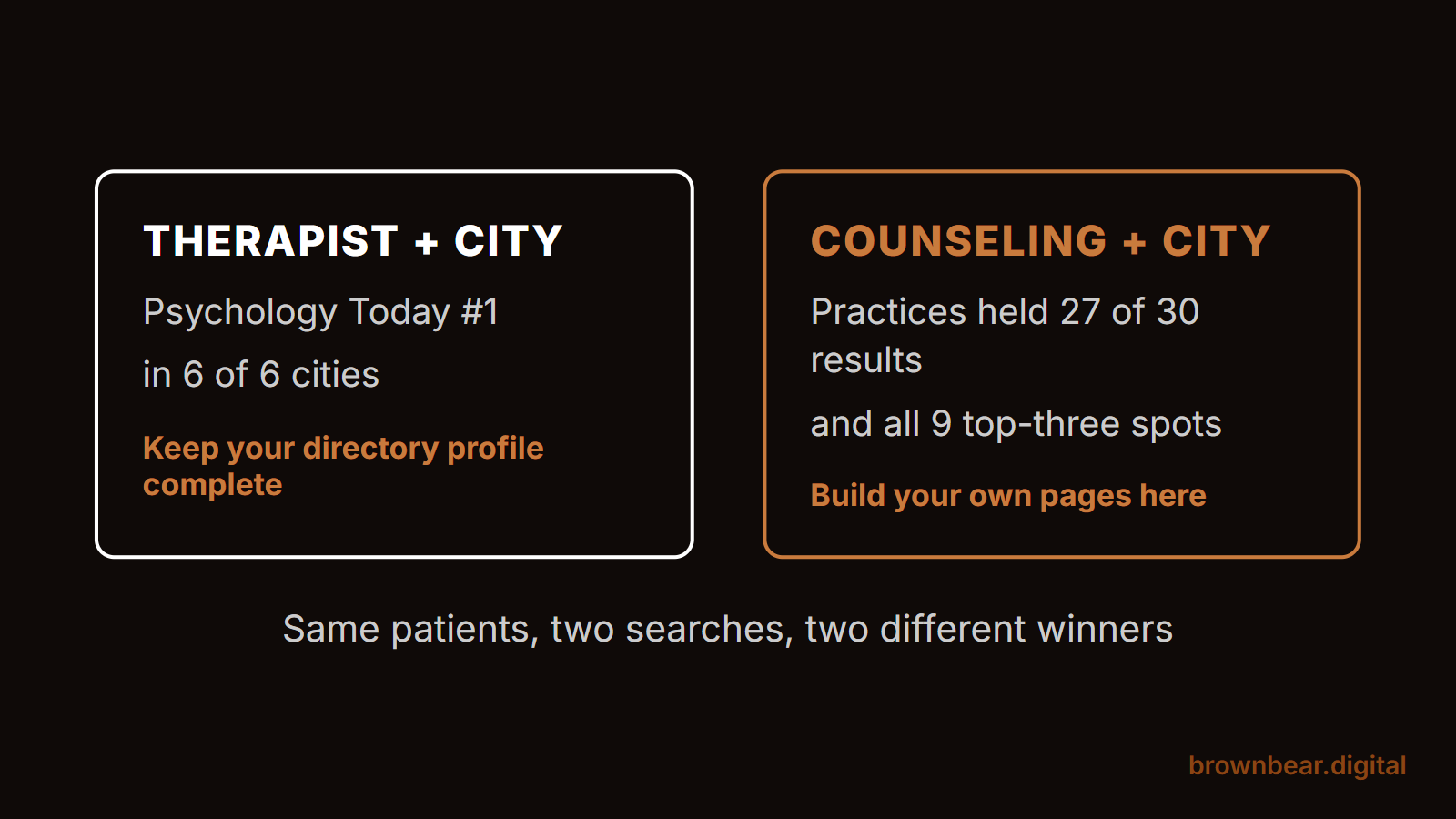
Psychology Today held #1 for "therapist" plus the city in all 6 cities we checked. But on "counseling" plus the city, practices held 27 of 30 results and all 9 top-three spots. A therapist should keep a complete, current directory profile for the head term and build their own pages around "counseling," the conditions they treat and the neighborhoods they serve, where the directory does not dominate.
For specialists who compete with hospital systems
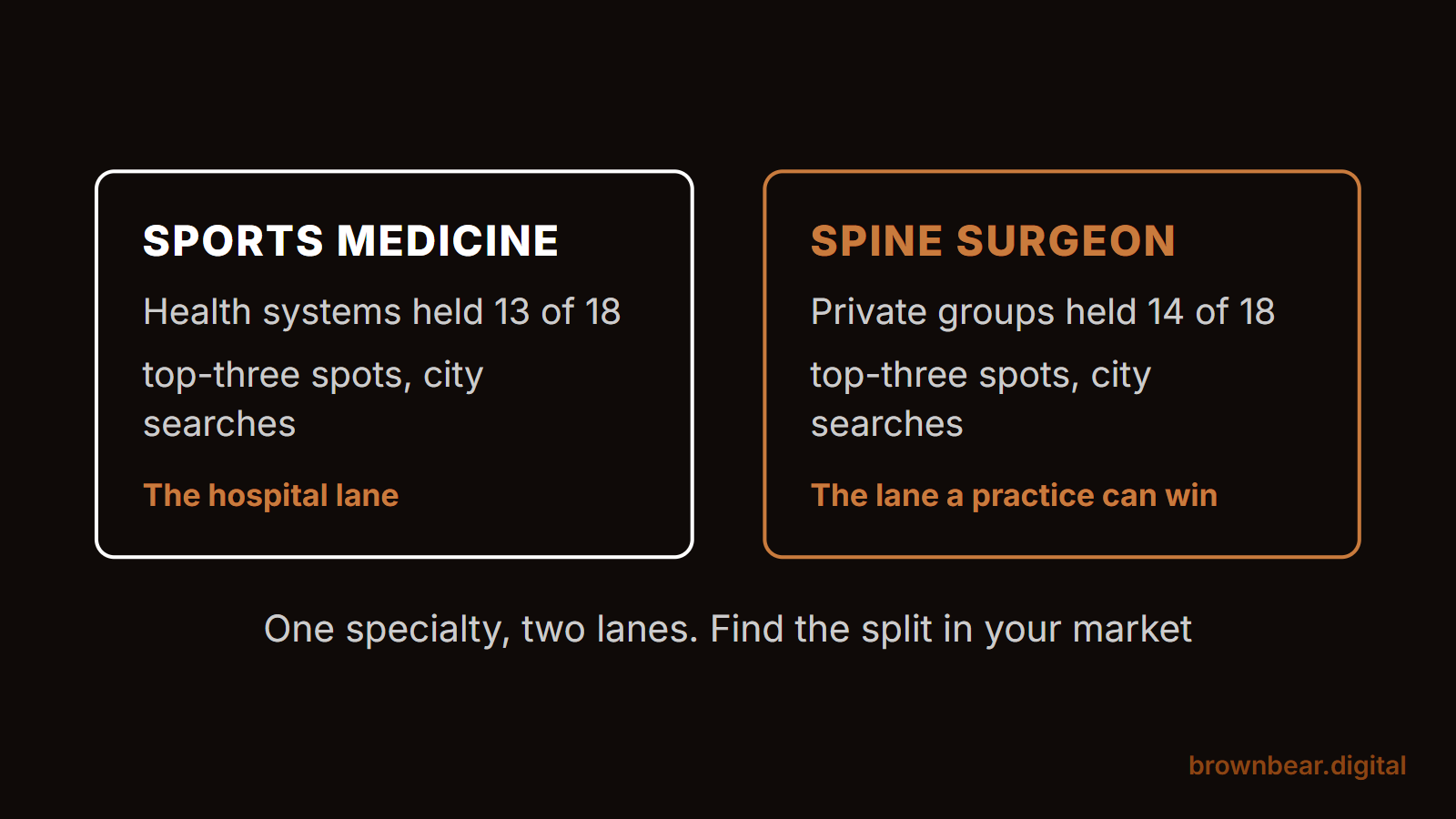
In orthopedics, health systems held 13 of 18 top-three spots on sports medicine searches, but private groups held 14 of 18 on spine surgeon searches. The same specialty split into one lane the hospitals own and one they do not. A specialist should find that split in their own market, then build deep pages for the subspecialty and procedures the health system covers thinly, and use paid search to hold the broad term while those pages grow.
What Healthcare Marketing Costs, and How to Know It Is Working
What a practice should spend depends on how many new patients it needs and what each one is worth, not on a flat percentage of revenue. Start from the patient math, then pick channels. A clinic where a new patient is worth $400 can afford far less per patient than a surgical practice where one case is worth $8,000.
For plastic surgery practices, Bryan's math is simple. A $1,500 to $2,000 a month SEO retainer over 12 months costs about what two solid organically sourced procedures bring in. Cutting SEO to fund ads breaks the compounding and locks the practice into rising paid costs. His blend: paid search captures demand where SEO is not visible yet, then SEO takes over and the paid budget moves elsewhere.
Picture a dermatology practice that brings in 30 new patients a month and wants 10 more. If each new patient is worth $600 in the first year, those 10 are worth $6,000 a month. A program that costs $3,000 a month pays for itself at five extra patients. Run that math with your own numbers before you sign anything, and judge the program on that count.
Measure what turns into revenue. Track booked appointments, cost per booked patient and calls from your Google Business Profile, not just clicks and rankings. Keep the measurement inside the tracking rules above. Count form fills and calls without sending health details to ad platforms.
How to Choose a Healthcare Marketing Partner
The right partner starts with your market, not a package. Before you sign, ask four things. Our guide to hiring an outside agency goes deeper on contracts and red flags.
- Ask them to show who holds page one for your specialty and city, and which of those results you can realistically win.
- Ask how they will report booked patients and cost per booked patient, not clicks or followers.
- Ask how they handle tracking pixels, reviews and testimonials inside the rules.
- Ask what happens to your website, profiles and ad accounts if you leave. They should stay yours.
Talk to Brown Bear About Your Healthcare Marketing
Healthcare marketing works when it starts from the competitor you actually face. That might be the practice down the street, the hospital across town, a corporate group with a local name or a directory that owns the head term. Brown Bear maps that first for your specialty and city, then builds the SEO, paid search and AI search work around it, the same way we work with plastic surgery and medical practices today. If you want to know who holds your page one, talk to Brown Bear about your page-one map.
Written By
Founder, Brown Bear Digital
Bryan has 15 years of experience across SEO, paid search, and AI search strategy. He founded Brown Bear to give businesses direct access to senior-level search expertise without the agency overhead.
Learn More About BryanGet Found on Google.
Get Cited by AI.
Tell us about your site. We'll send back a proposal for SEO and AI search.