Dental Marketing: What 17 Google Searches Show About Where New Patients Come From
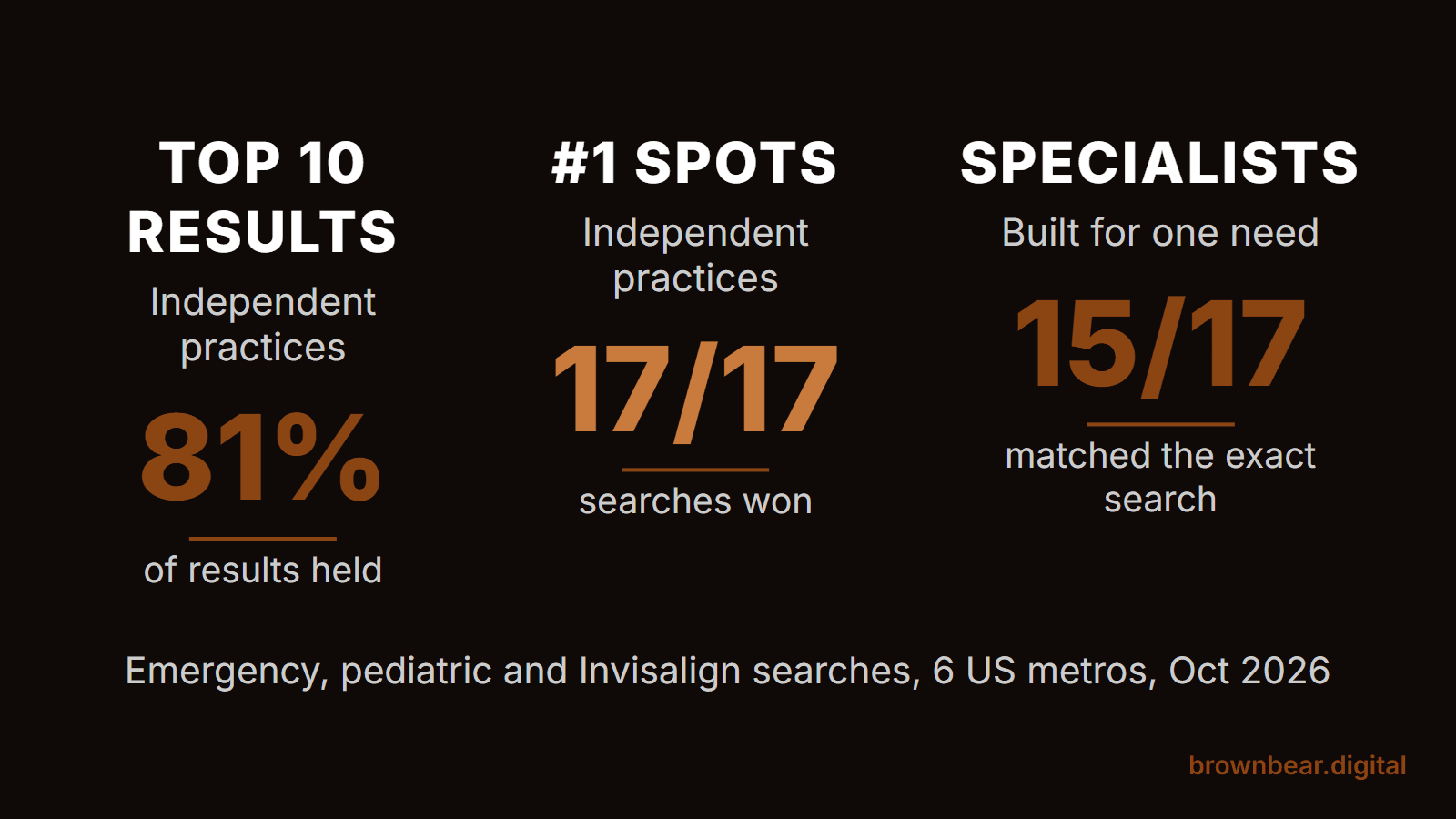
Most dental marketing advice is a list: claim your listing, post on Instagram, run some ads, ask for reviews. Lists don't tell you which channel to fund first, so we checked where patients actually land. On October 25, 2026, we pulled Google's top 10 results for 17 patient searches across six US metros: emergency dentists, pediatric dentists and Invisalign. Independent practices took 81% of the results and the #1 spot on all 17, and 15 of those 17 winners were built for the exact search, not for "dentist" in general. This is Brown Bear's guide to dental marketing, built around those results.
It also draws on two earlier Brown Bear studies: a 34-search pull of dental rankings and a 17-search pull of what Google Ads clicks cost doctors. And it draws on Bryan Passanisi, founder of Brown Bear Digital and former Principal of SEO and AI Search at QuickBooks, who audits ad accounts and AI search visibility for medical and plastic surgery practices.
Dental marketing here means every channel that brings a new patient to the chair: Google Search and Maps, Google Ads, reviews, recall and referrals, and the AI answers that now sit above all of it. It covers both general practices and specialists, and both a single office and a group with several. The deep how-to for organic rankings lives in our guide to dental SEO; this page is the map of the whole system.
If you own a general practice, you want to know which channel fills open hygiene and treatment time without burning cash. If you run a pediatric or orthodontic practice, you want to know whether the general-dentist playbook even fits you. And if you market a group with several offices, you need to know what a new patient costs in each market before you move budget.
By the end, you'll know who wins page one for three valuable patient searches and what a click costs. You'll know what Google won't let you target, which review and texting rules apply, and how to work out what a new patient is worth from your own numbers. The longer payoff is a schedule that fills with the patients and treatments you want, from channels you can measure.
We've grouped it into four parts: the demand map, the channels, the situations that change the plan, and the money. Start with what dental marketing is supposed to produce.
What Dental Marketing Is, and What It Should Produce
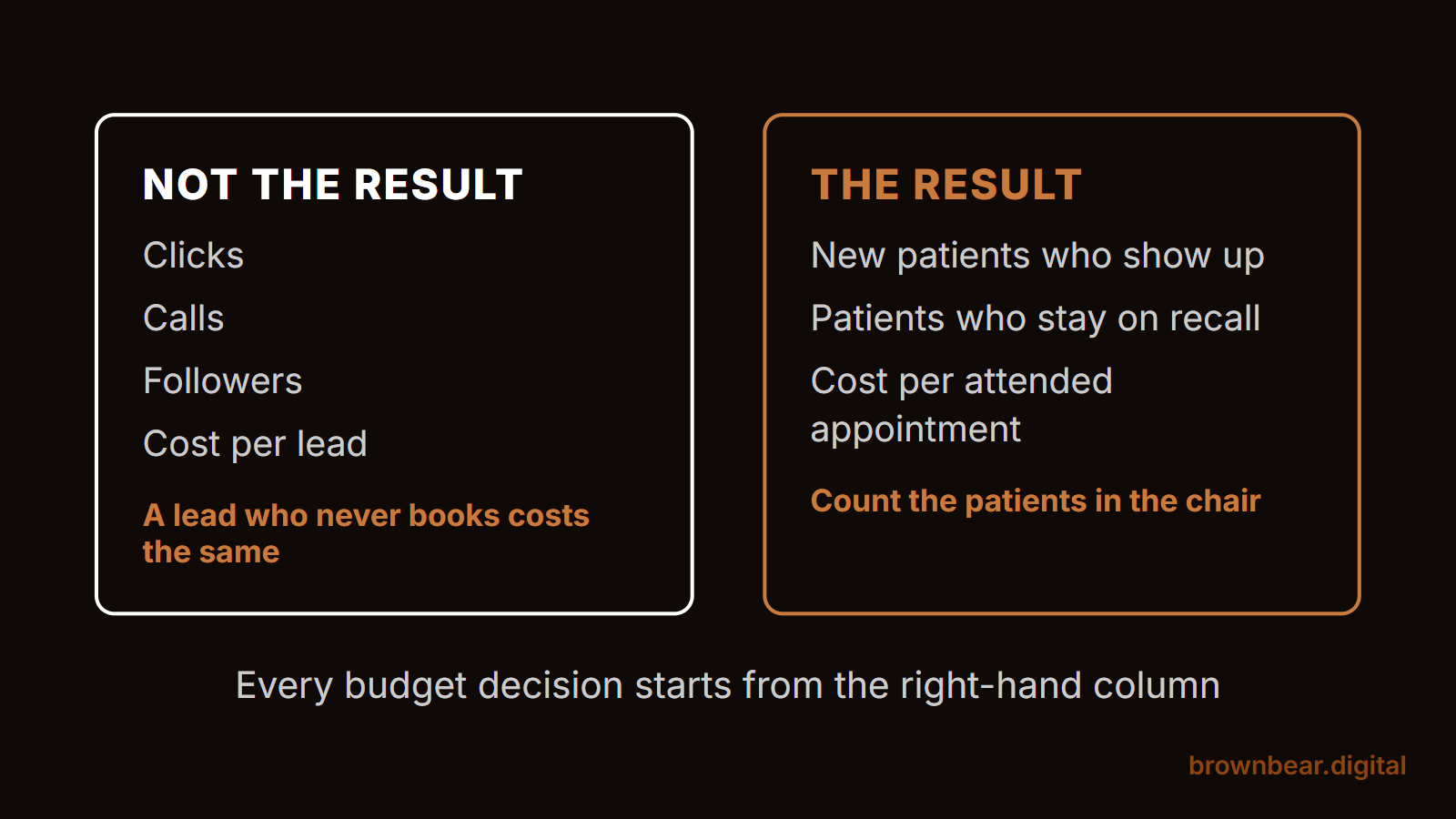
Dental marketing is the work of getting a practice found and chosen by people who need a dentist, then keeping them on the schedule. It covers search, ads, reviews, referrals, recall and AI answers. The result to measure is new patients who show up and stay on recall, not clicks, calls or followers.
That distinction drives every budget decision below. A Houston dental group with about 14 offices posted its Google Ads journey on Reddit's r/PPC. The most useful reply: track cost per attended appointment, because cost per lead is a different number. A lead who never books costs the same as one who does.
Marketing also takes staff time, even with an agency. The American Dental Association's advertising guidance notes that its Code of Ethics bars false or misleading advertising, and that state dental boards discipline misleading ads, including specialty claims some states restrict to board-certified dentists. Its practice guide for building a marketing plan expects an office manager running marketing in-house to spend about 25% of their time, roughly 10 hours a week, on it.
The Dental Demand Map: Who Holds Google's Top 10 for Emergency, Pediatric and Invisalign Searches
Across 17 dental searches in six metros, independent and local practices held 81% of Google's top 10 results and the #1 spot on every search. Multi-metro dental groups and DSOs held 5%, directories 5%, and hospitals and dental schools 4%. Insurers, Reddit, Groupon and a call-routing referral service split the rest. Practices and groups took 46 of the 51 top-three spots.
Here is how we got those numbers. On October 25, 2026, we read Semrush's top 10 organic results and keyword data, US database, for "emergency dentist," "pediatric dentist" and "Invisalign" plus a city in Houston, Miami, Phoenix, Chicago, Atlanta and Denver, with Invisalign in five of the six. Semrush's API had no units that day, so every reading came from its web interface. We sorted each result by page title and description into practice, multi-metro group, referral service, directory, insurer, hospital or school, and other. The map pack, ads and AI Overview citations are not counted. We did not check who owns each local practice, so some local brands may belong to a larger group.
We call the result the Dental Demand Map:
| Search | Who holds page one | Semrush difficulty | What a click costs | The play |
|---|---|---|---|---|
| Emergency dentist + city | Practices 79%, groups 11%. A site with "emergency" or "urgent" in its domain was #1 in 5 of 6 cities | 3 to 25 | $6.78 to $9.48 where Semrush showed a cost, median $8.03 | A dedicated emergency page, same-day hours, a phone that gets answered |
| Pediatric dentist + city | Practices 85%. Sites with kids, children or pediatric in the domain held 41 of 59 results and #1 in all 6 cities | 35 to 57 | $4.78 to $9.02, median $5.62 | Brand for parents, and give hospital dentistry and special needs care their own pages |
| Invisalign + city | Practices 80%, directories 10%. Orthodontists took 9 of 15 top-three spots, general dentists 5 | 3 to 19 | $10.74 and $14.76 in the 2 cities with data | Publish your price range; 6 of 49 results were cost pages |
Two findings changed how we'd plan a budget. First, the generalist rarely wins. 15 of the 17 #1 results were built around that exact need: emergency-named sites in 5 of 6 cities, kids-named practices in all 6, and orthodontists or Invisalign-named sites in 4 of 5. Second, national brands barely register in local organic results: Aspen Dental appeared twice in 57 emergency results and nowhere in pediatric or Invisalign. Its strength is elsewhere, as the emergency section shows.
One caution about the data: Semrush reads a national results page, not the page a parent in Denver sees. The #1 result for "pediatric dentist denver" was a practice in Denver, North Carolina. Your own rank tracker has the same blind spot unless it is set to your ZIP code.
Emergency Searches Reward Practices Built for Same-Day Care
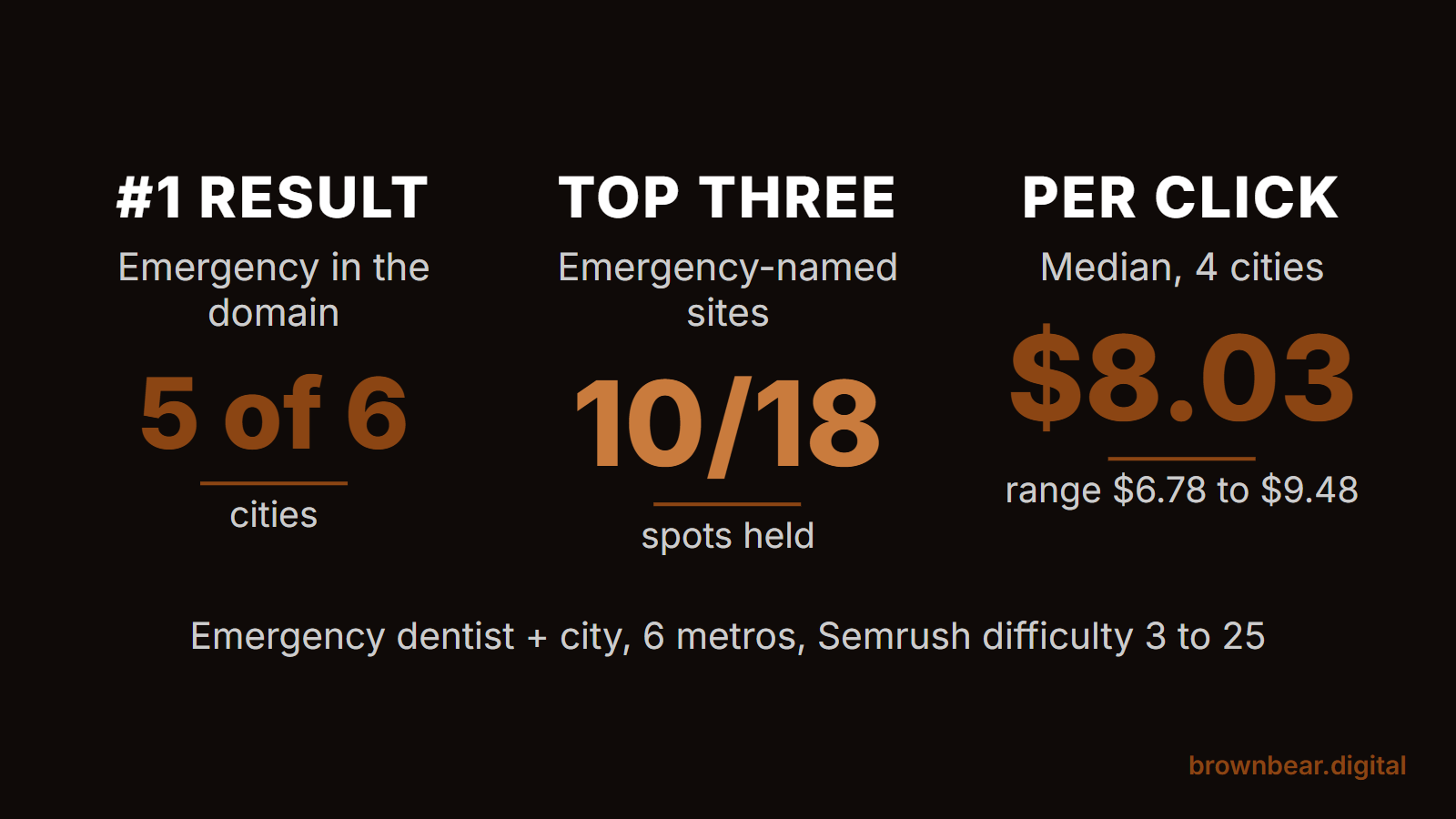
Emergency searches go to practices that look ready to see someone today. In 5 of the 6 cities, the #1 result had "emergency" or "urgent" in its domain, and those sites held 10 of the 18 top-three spots. Emergency terms are easy to rank for, with Semrush difficulty between 3 and 25. A click cost $6.78 to $9.48 in the four cities where Semrush showed a price.
Not every emergency site is a dentist. At #9 in Houston sat a call-routing service whose own footer says it is not a dentist and connects callers to dentists in its network. Patients calling it are patients you didn't get.
The national version of the search is enormous. "Emergency dentist near me" draws about 165,000 searches a month in Semrush, with a difficulty of 12 and a click cost of $6.52. Aspen Dental's walk-in emergency page holds #1 for it. The local searches are where an independent practice competes.
Picture a two-dentist general practice in Phoenix that keeps two same-day slots open every weekday. It builds one emergency page. Hours sit at the top, then the price of an emergency exam, what counts as an emergency, a tap-to-call number, and what to do after hours. It runs a small Google Ads campaign on emergency terms only while the front desk is staffed, so no paid click rings an empty office. The page and the ads both promise the one thing the searcher needs, which is being seen today.
If you can't see emergencies the same day, don't bid on them. You'll pay $7 to $9 a click for people who will call the next practice. If you can, it is often the fastest lane to a new patient, and an emergency patient who is treated well is a candidate to become a regular one.
Pediatric Searches: Parents Look for a Specialist, Not a Dentist
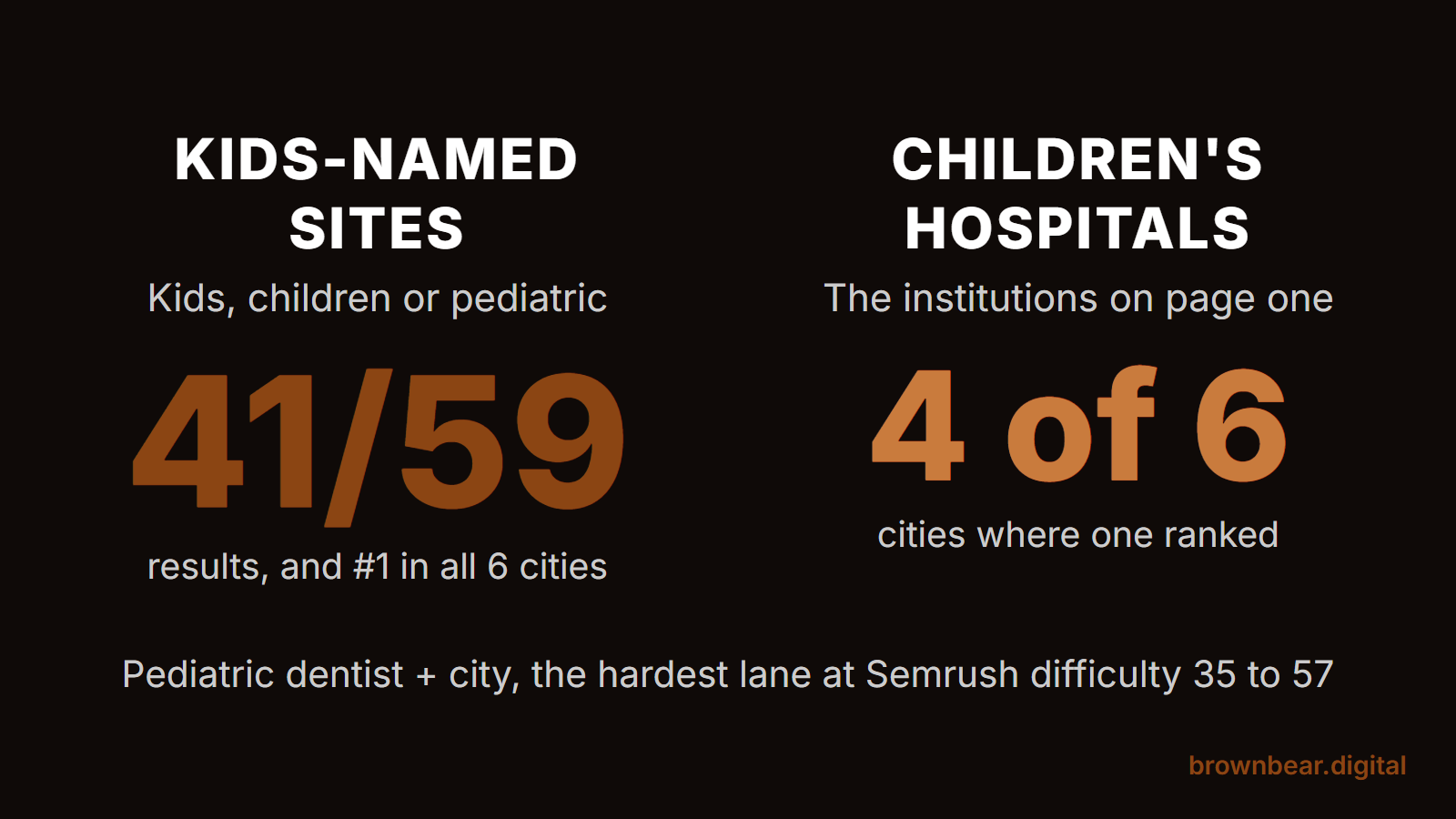
Parents searching for a pediatric dentist find practices that speak only to kids. Sites with kids, children or pediatric in their domain held 41 of the 59 results and #1 in all six cities. This is the hardest of the three lanes, with Semrush difficulty from 35 to 57, but clicks are the cheapest, with a median of $5.62.
The other names on these pages are big institutions. Children's hospitals ranked in four of the six cities: Texas Children's in Houston, Lurie Children's in Chicago, Children's Healthcare of Atlanta and Children's Hospital Colorado in Denver. Delta Dental's find-a-dentist pages ranked in Phoenix and Chicago.
A general practice that sees kids is up against specialists here. The play for a pediatric practice is to look like what parents are searching for. That means a name and site built for children and a page for each pediatric dentist. It also means pages for the needs that send parents searching, such as a first visit, sedation and special needs care. One Houston result, Hospital Pediatric Dentist, built its site around hospital dentistry and children with special needs, a niche the general results don't serve.
Invisalign Searches: Orthodontists Lead, and Price Pages Rank
Invisalign searches are the easiest lane to rank in, with Semrush difficulty from 3 to 19. They are also the most expensive to buy, at $10.74 and $14.76 a click in the two cities with data. Orthodontists took 9 of the 15 top-three spots and general dentists took 5.
Cost pages ranked even though nobody typed "cost." Six of the 49 results were pages about what Invisalign costs, from practices in Houston, Chicago and Atlanta and from Zocdoc. Reddit threads ranked in Chicago and Atlanta, and in both, patients traded the prices they were quoted. One Chicago poster was quoted $6,600 before insurance and about $2,800 after for 12 to 15 months, and another found a practice charging a flat $3,400. Yelp appeared in 4 of the 5 cities.
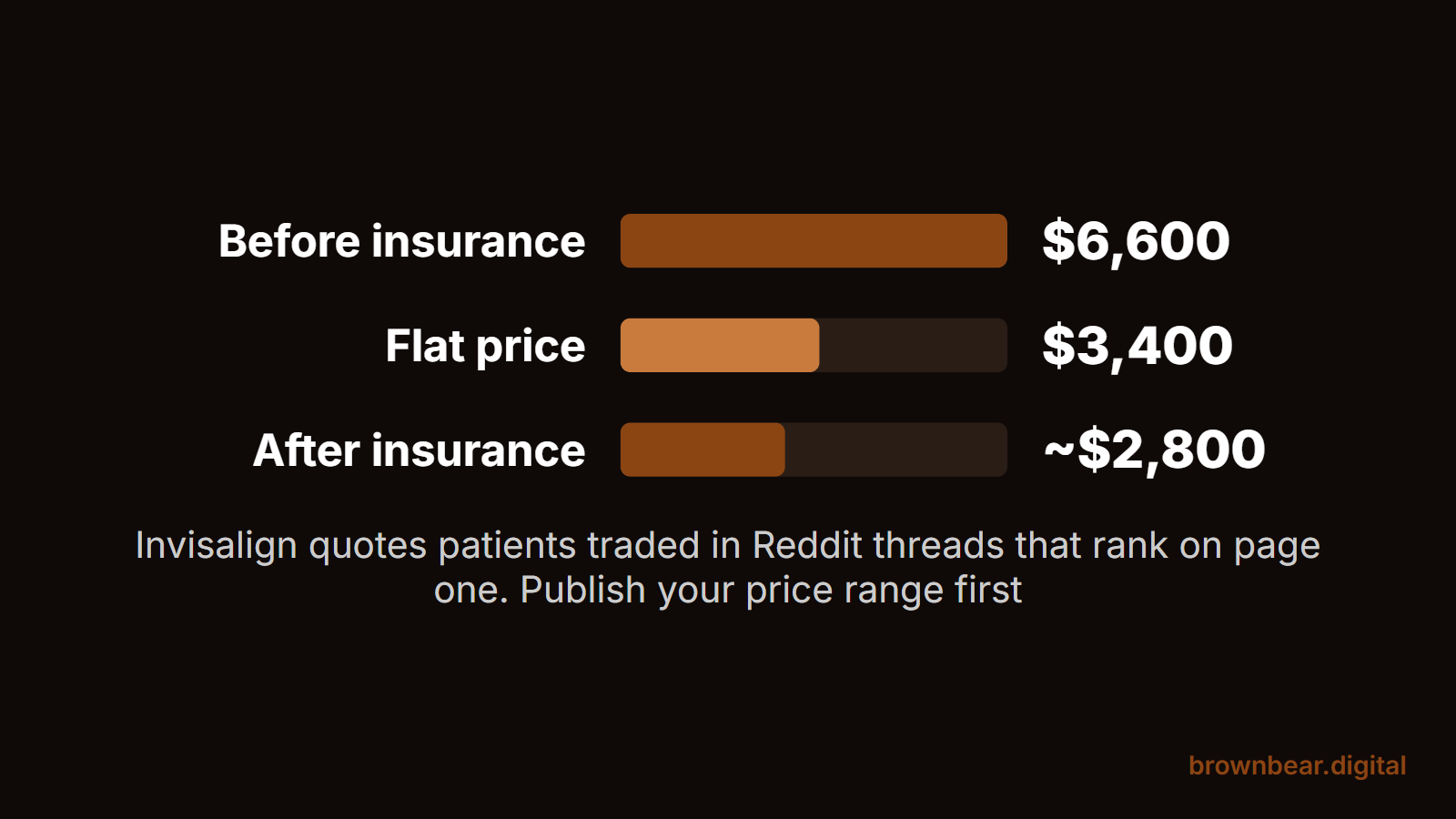
Say a general dentist in Chicago offers Invisalign and wants more cases. Competing on "orthodontist" against specialists is a long fight. A page that answers the question patients ask in those threads, a price range with what insurance usually covers and how long treatment runs, competes on the lane where general dentists still win top-three spots.
If you're an orthodontist, lead with the specialty and the doctor, because that is what holds the top spots. If you're a general dentist, lead with price, convenience and your own cases, and refer the complex ones. One Atlanta poster was told her case was too complex for aligners and went to an orthodontist for braces.
Dental SEO Is One Channel, Not the Whole Plan
Organic search is the channel that keeps paying after you stop paying for it, which is why it anchors most dental plans. But it works one search type at a time. Our earlier study of 34 dental searches, the basis of our dental SEO guide, found an insurer's dentist finder on page one for "dentist" plus a city in all 10 cities checked. Independent practices, by contrast, took #1 for "dental implants" plus a city in all six cities checked.
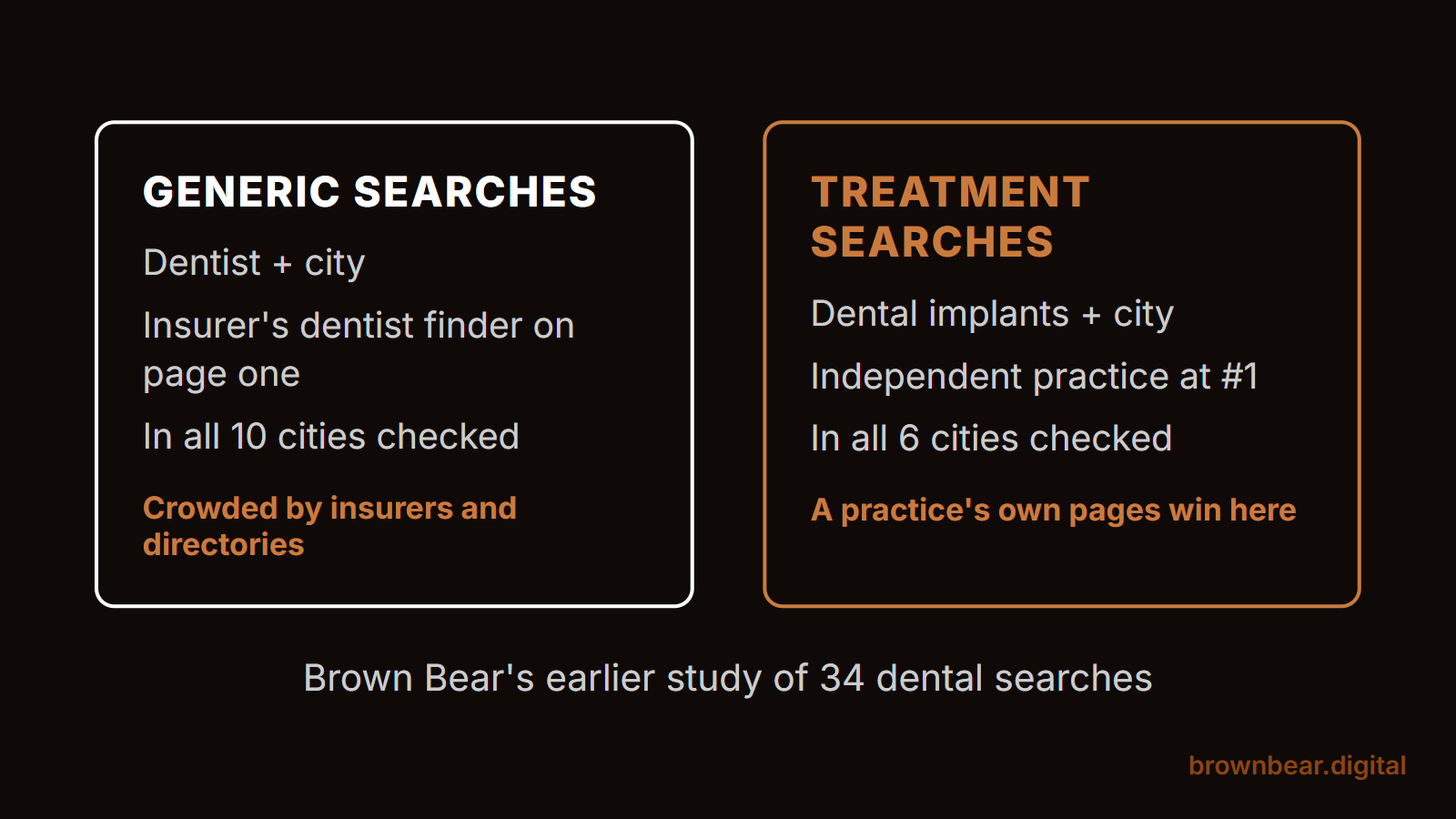
The lesson matches the demand map. Generic searches like "dentist near me" are crowded by insurers, directories and Google's own map. Treatment and situation searches are where a practice's own pages win. Implants deserve their own plan, because one case can be worth more than years of hygiene visits; we cover that in dental implant marketing.
Google Ads for Dentists: What a Click Costs and What Google Won't Let You Target
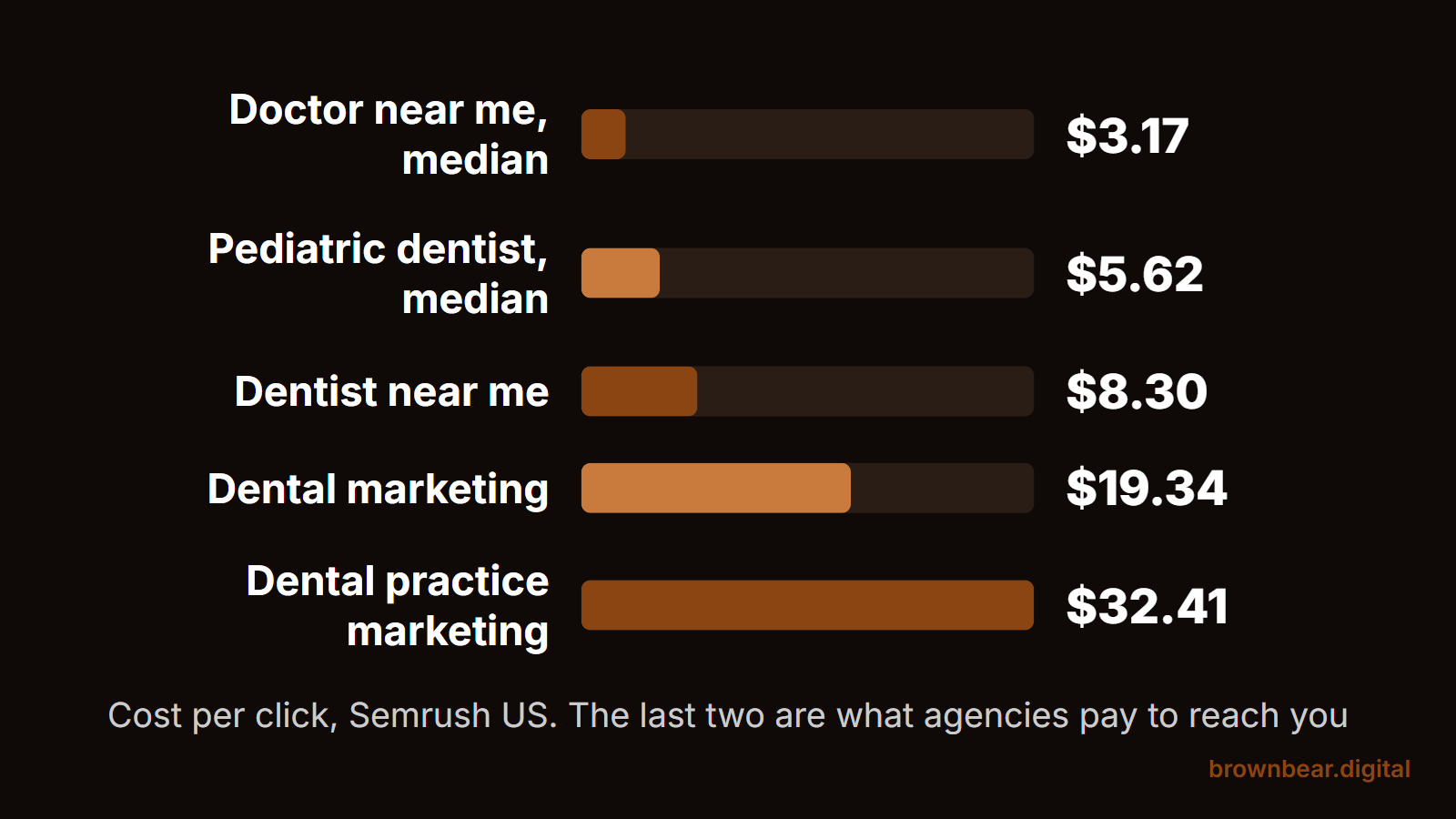
Google Ads is the fastest dental marketing channel, because it puts you above the results the day the campaign starts. Dental clicks cost more than most medical clicks. "Dentist near me" averaged $8.30 a click in Semrush, against a $3.17 median across 15 "near me" doctor searches in our study of Google Ads for doctors. Our three dental lanes ran from a $5.62 median for pediatric searches to $10.74 and above for Invisalign.
For contrast, agencies pay more to reach you than you pay to reach a patient. "Dental practice marketing" carried a $32.41 click cost in Semrush and "dental marketing" $19.34.
Two rules shape a dental account. First, Google treats personal health as a sensitive category, and its list includes invasive medical procedures such as surgical procedures. Campaigns in a sensitive category cannot use remarketing lists or Customer Match. Whether a campaign falls in that category is Google's call. Expect an implant or extraction campaign to lose those audience tools, and build it to win on the search itself. One advertiser on Reddit's r/PPC reported that every audience in a new dental client's account was void under Google's policies. Second, the American Dental Association's rule against misleading ads applies to ad copy as much as to a website. A claim of "best dentist" or a specialty title you don't hold is a risk.
Bryan Passanisi's view from opening ad accounts for medical and plastic surgery practices that say "Google Ads didn't work" is that the same two problems show up almost every time: campaigns and keywords that were never tuned for patient quality, and clicks sent to pages not built to turn a visitor into a booking. That is where Google Ads management earns its fee: tight ad groups by treatment, exact and phrase match, call tracking, and a landing page for each campaign. The landing page is a design job as much as an ads job, and our guide to medical website design covers what makes a practice page convert.
If your schedule has open chairs this month, ads are the lever, aimed at the lane you can serve fastest. If your schedule is full but the mix is wrong, put ads on the treatments you want more of and leave the general terms alone. In both cases, count new patients who show up, not calls. On r/DigitalMarketing, one reply to a dentist's plan put it plainly: most patients call rather than fill out a form, so call tracking is not optional.
Reviews: The Channel Every Other Channel Leans On
Reviews are the cheapest dental marketing channel and the one the others depend on. They shape the map pack, they are what a patient reads after clicking your ad, and they are among the sources AI tools read before naming a practice. Yelp ranked organically in 5 of our 17 searches.
A steady habit beats a campaign. On Reddit's r/DigitalMarketing, a dentist restarting marketing after a three-year break got 8 new Google reviews in one day from a simple text reminder. Reply after reply called it the strongest part of the plan. Volume matters less than substance: a review that names the treatment and the experience helps the next patient choose you.
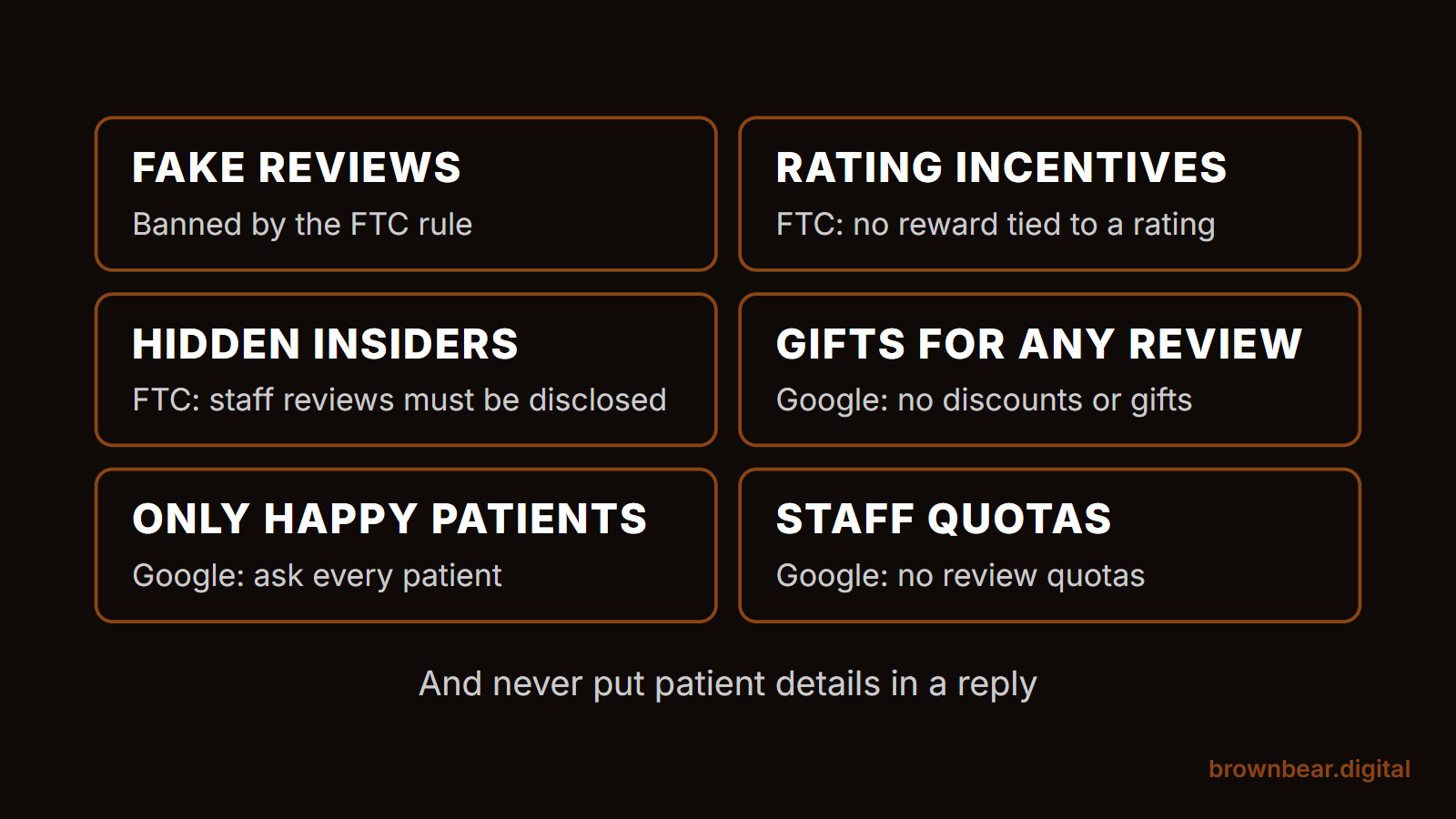
The rules are stricter than many practices assume. The FTC's final rule on fake reviews, announced August 14, 2024, bans fake reviews and incentives tied to a positive or negative review. It also bans undisclosed reviews from company insiders and baseless threats used to get negative reviews taken down, and it lets the FTC seek civil penalties against knowing violators. Google's own review policy goes further: no discounts or gifts for any review, no asking only happy patients, and no review quotas for staff.
Replies carry their own risk. In 2019, Elite Dental Associates in Dallas paid $10,000 to settle with the HHS Office for Civil Rights after answering Yelp reviews with patients' names and treatment details. Before anyone on your team answers a review, read up on how to reply without breaking HIPAA.
Picture a practice with 140 Google reviews, most of them more than two years old. The front desk starts texting every patient a review link the evening after their visit, not only the ones who seemed happy. The new reviews mention the hygienist by name, the emergency visit that got someone out of pain, the kid who wasn't scared. Those details are what a patient comparing three practices actually reads.
Recall, Reactivation and Referrals: The Patients You Already Have
The cheapest new visit is from a patient you already have. A patient who stays on a twice-yearly recall for years is worth far more than their first visit, which is why the calculator below counts recall value. Reactivating patients who fell off recall costs a text and a call.
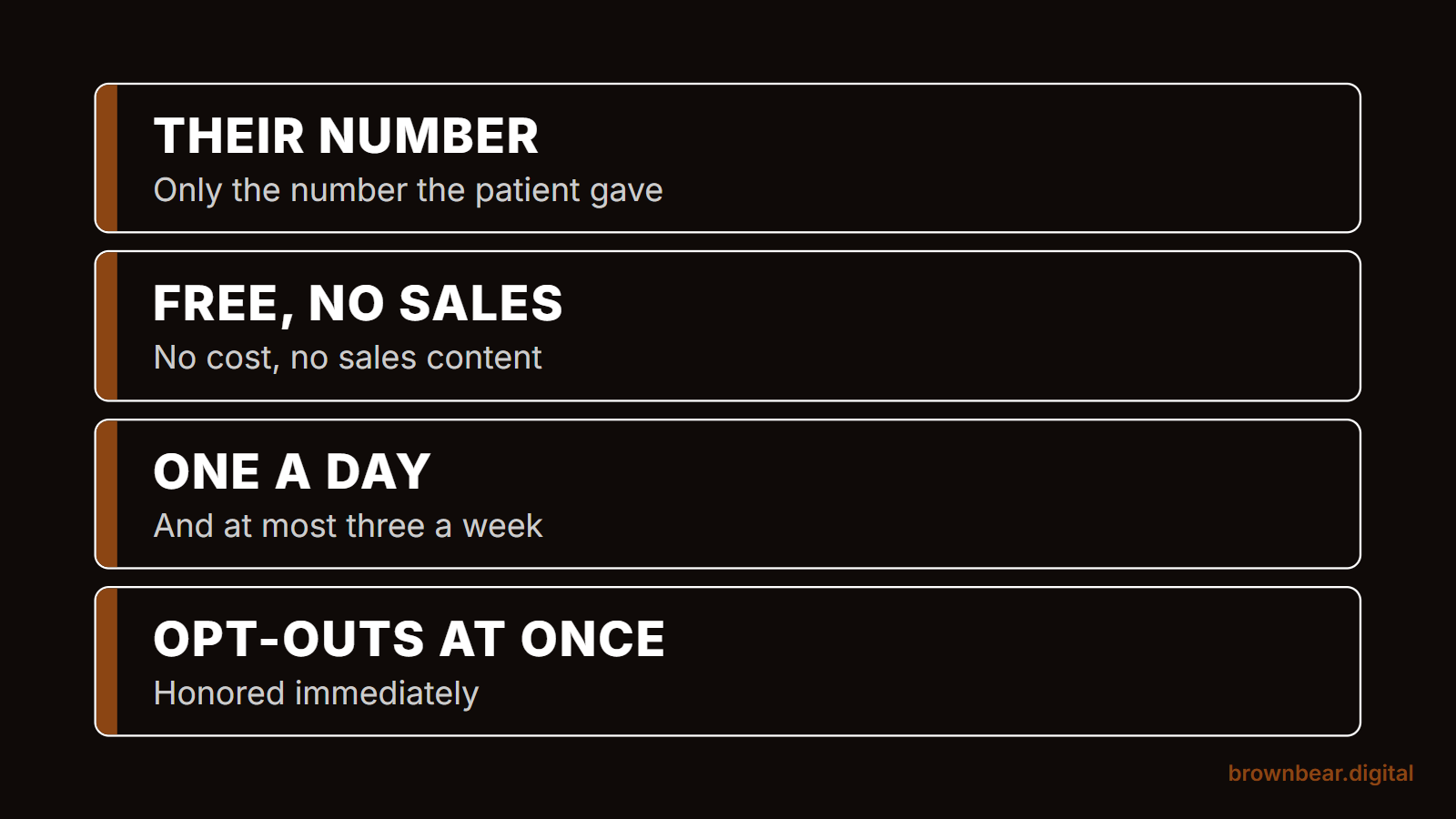
HIPAA's definition of marketing, in 45 CFR 164.501, leaves out messages about a patient's own treatment and about the practice's own services. So recall reminders are not "marketing" under HIPAA unless a third party pays you to send them. Texting is a separate law. Under the FCC's TCPA rules, a health care exemption lets a provider text a patient's mobile number about things like appointment reminders. The limits are strict: only the number the patient gave, free to the patient, no sales content, at most one message a day and three a week, and opt-outs honored immediately. A promotional text, like a whitening special, needs the patient's prior express written consent if it is sent with an autodialer. A note inviting lapsed patients to book can drift outside the exemption, so the simplest fix is a written texting consent on the new-patient form.
Say a practice with 2,000 active patients finds that 300 of them have no appointment booked. A text to patients who signed the texting consent, followed by a call from the front desk, brings some of them back without a single ad dollar. Run the calculator below with your own recall numbers and see what each 10 points of patients kept on recall is worth.
Referrals follow the same logic. Ask, make it easy, and thank people, but don't pay for reviews or tie a reward to a rating. A referral thank-you for a new patient is a different thing from a reward for a five-star review, and only the second is banned outright by Google's policy.
Dental Marketing in AI Search
AI search is now part of how patients pick a dentist. Google showed an AI Overview for "dental marketing" itself when we loaded it on October 25, 2026, and Semrush flagged AI Overviews on 2 of our 17 local searches, "emergency dentist chicago" and "invisalign phoenix." ChatGPT, Gemini and Perplexity answer "who's a good dentist near me" with a few names and a sentence about each.
Those sentences mostly come from sites other than yours. Our study of which sources AI tools cite for doctors found hospital and academic rosters, specialty board profiles and directories behind most citations, and the average named practice's own website behind about 2%. That study covered physicians, not dentists, so treat it as direction, not a dental number.
Bryan's experience auditing AI visibility for plastic surgery practices points the same way: owners are most surprised by how little they show up against competitors and by how much reviews, directories and press shape what the AI says. The most common gap he finds is not wrong facts but buried ones: the procedures a practice wants to be known for are hard to find, so the AI describes a generalist. For a dental practice, that's the implant, Invisalign or pediatric focus missing from the description.
He also points to the referrals that do arrive from AI tools. Across plastic surgery clients, they convert to consultations at a higher rate than other channels, because the patient did the research in one conversation before clicking. Measure it in your own analytics before you budget for it. The practical work behind AI search optimization for dentists is mostly the same as the rest of this guide: consistent name, address and phone everywhere, a page per treatment, and a steady flow of detailed reviews.
Dental Marketing for Pediatric Practices, Multi-Office Groups and Orthodontists
Dental marketing is for any practice that needs new patients, but the plan changes with what kind of practice you are. Before picking a path, check which searches your patients actually type and who already holds page one for them in your city.
For Pediatric Dental Practices Competing With Children's Hospitals
In our pull, a kids-named practice was #1 in all six cities, and children's hospitals ranked in four. The #1 results in Houston and Atlanta, houstonspediatricdentist.com and atlantakidsmiles.com, carry the specialty in the name, which is what a parent scans for. A pediatric practice should spend on what a hospital can't offer: one named dentist per page, first-visit and sedation pages written for parents, and reviews that mention how the child felt. Leave "dentist near me" to the general practices.
For Multi-Office Dental Groups Splitting One Budget
The Houston group on r/PPC, about 14 offices under one brand, moved its budget from Facebook ads to Google Ads after paying a high cost per conversion for few leads. In our emergency results, Lovett Dental, a Texas group, ranked in Houston with a page built for emergency care. A group's job is to give each office its own page, profile and phone number. Then compare cost per new patient by office, because a click in one market can cost twice what it costs in another. We cover the page and profile setup in our guide to location pages and profiles for practices with more than one office.
For Orthodontists and Invisalign Providers Fighting for the Same Patients
Orthodontists held 9 of the 15 Invisalign top-three spots in our pull, and Smile Straight Orthodontics in Phoenix held two of the ten results on its own. In Miami, Sun Orthodontist ranked third with a title that leads with a monthly price. An orthodontist should lead with the specialty, the doctor and a free consultation, and publish a price range before patients go looking on Reddit. A general dentist offering aligners should compete on price and convenience, and refer the complex cases.
What Dental Marketing Costs, and How to Tell If It Pays
What dental marketing costs depends on the channel. Whether it pays comes down to one comparison: what you spend to bring in a new patient against what that patient is worth over the years they stay. A channel that loses money on the first visit can still be your best one if patients stay on recall.
Timing differs by channel, which changes how you judge it. Google Ads produces calls in days. Review and recall habits pay back within months. SEO builds over months and compounds, so judge it on new patients per quarter, not per week.
Use it in this order:
- Pull last quarter's new patients by source from your practice management system, and count only patients who showed up.
- Run each paid channel through the calculator with its real cost, including fees.
- Move budget toward the channel with the lowest cost per new patient that brings the treatments you want.
- Put the first dollar of any increase into recall and reviews, then into the search lane you can serve best.
How to Choose a Dental Marketing Agency
Pick an agency that reports new patients and cost per new patient, and that gives you ownership of your ad account, Business Profile and website. It should also tell you which searches it will target in your city and who holds them now.
Be skeptical of where you hear recommendations. In the Reddit r/Dentists thread that ranks first on Google for "dental marketing," 11 of 33 comments had been removed or deleted, and about 9 of the 22 left recommended a firm or came from someone in the marketing business. One commenter who works in dental marketing gave the most useful answer there: treat marketing as one patient journey, starting with the Business Profile, not as a set of separate channels.
Ask any agency three questions. Which searches will you target, and who holds them in my city today? What will you report each month, and does it include patients who showed up? Who owns the accounts if we part ways? The same checks apply to vetting any medical marketing agency.
Fill Your Chairs With Brown Bear's Dental Marketing
Dental marketing works when each dollar goes to a search you can win and a patient you can serve, and when you count the patients who show up. Brown Bear is a search-first agency: SEO, Google Ads, AI search and websites built to turn visits into booked appointments, with Bryan working directly on strategy. If you want to know which lanes your practice can win and what they should cost, talk to our dental marketing agency team about a plan built on your city's results.
Written By
Founder, Brown Bear Digital
Bryan has 15 years of experience across SEO, paid search, and AI search strategy. He founded Brown Bear to give businesses direct access to senior-level search expertise without the agency overhead.
Learn More About BryanGet Found on Google.
Get Cited by AI.
Tell us about your site. We'll send back a proposal for SEO and AI search.