Dental Implant Marketing: What 15 Implant Searches Show About Winning Full-Arch Cases
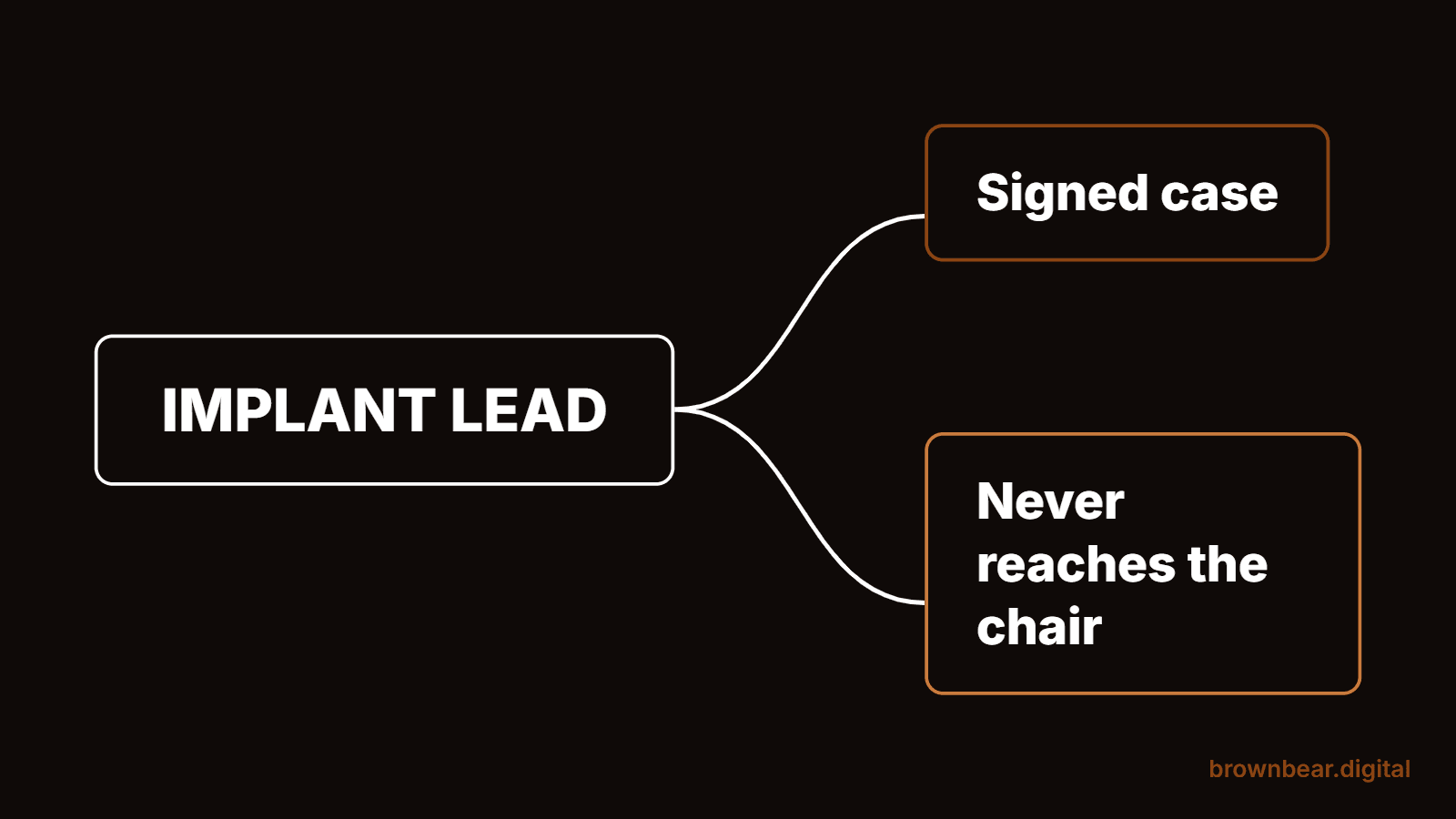
Most dental implant marketing advice is a channel checklist: run Google Ads, post on Facebook, offer financing, ask for reviews. None of it tells you who you are up against when a patient types "dental implants" and a city into Google, or what a month of ads has to produce to pay for itself. So we checked. On October 25, 2026, Brown Bear pulled the top 10 Google results for 15 implant and All-on-4 searches across 8 metros and sorted every result by who owns it.
The advice built on that data comes from Bryan Passanisi, Brown Bear's founder, who led SEO and AI search for QuickBooks at Intuit and now runs search programs for medical practices. Where we lean on what his team sees inside practice ad accounts and AI search audits, we say so.
When we say dental implant marketing, we mean both single-tooth implant cases and full-arch work like All-on-4, and both the ads that bring a patient in and the consult that turns that patient into a signed case. This guide is the implant-level companion to our dental marketing playbook, and it leaves the page-building details to our dental SEO guide.
If you're a general dentist who started placing implants and wants more of them on the schedule, you need to know which searches you can win without a new building. If you're an oral surgeon or periodontist who has lived on referrals, you need a patient-facing plan that doesn't anger the dentists who send you cases. And if you run a full-arch center that buys leads every month, you need to know which of those leads turn into money.
By the end, you'll know who holds page one for implant searches in your kind of market, what implant clicks cost, which ad and financing rules can get a campaign pulled or a practice fined, and the math that tells you whether a month of marketing paid for itself. We've grouped it into four parts: the search data, paid channels and financing, turning leads into cases, and cost and payback.
Implant marketing covers a lot of ground, so let's start with what makes it different from the rest of dental marketing.
What Dental Implant Marketing Is, and Why One Case Changes the Math
Dental implant marketing is the work of attracting patients who need missing teeth replaced, then guiding them from a first search to a signed treatment plan. It differs from general dental marketing in three ways: the case value is high, the patient researches for weeks, and most patients need financing to say yes.
That changes how you judge every channel. A hygiene patient is worth a cleaning and maybe years of visits. One full-arch case can be worth more than a year of hygiene appointments, so a campaign can look expensive per lead and still be the best money the practice spends. The reverse is also true. Cheap leads that never sit in the consult chair are the most expensive thing you can buy.
The search demand is large and fairly cheap to reach. Semrush puts "dental implants near me" at about 135,000 searches a month in the US and "all on 4 dental implants" at about 90,500. The term this guide targets, "dental implant marketing," draws about 1,300 searches a month from practices and agencies, with a cost per click of $20.93 (Semrush, via the web UI, October 25, 2026).
The Dental Implant Page-One Map: Who Ranks for Implant and All-on-4 Searches
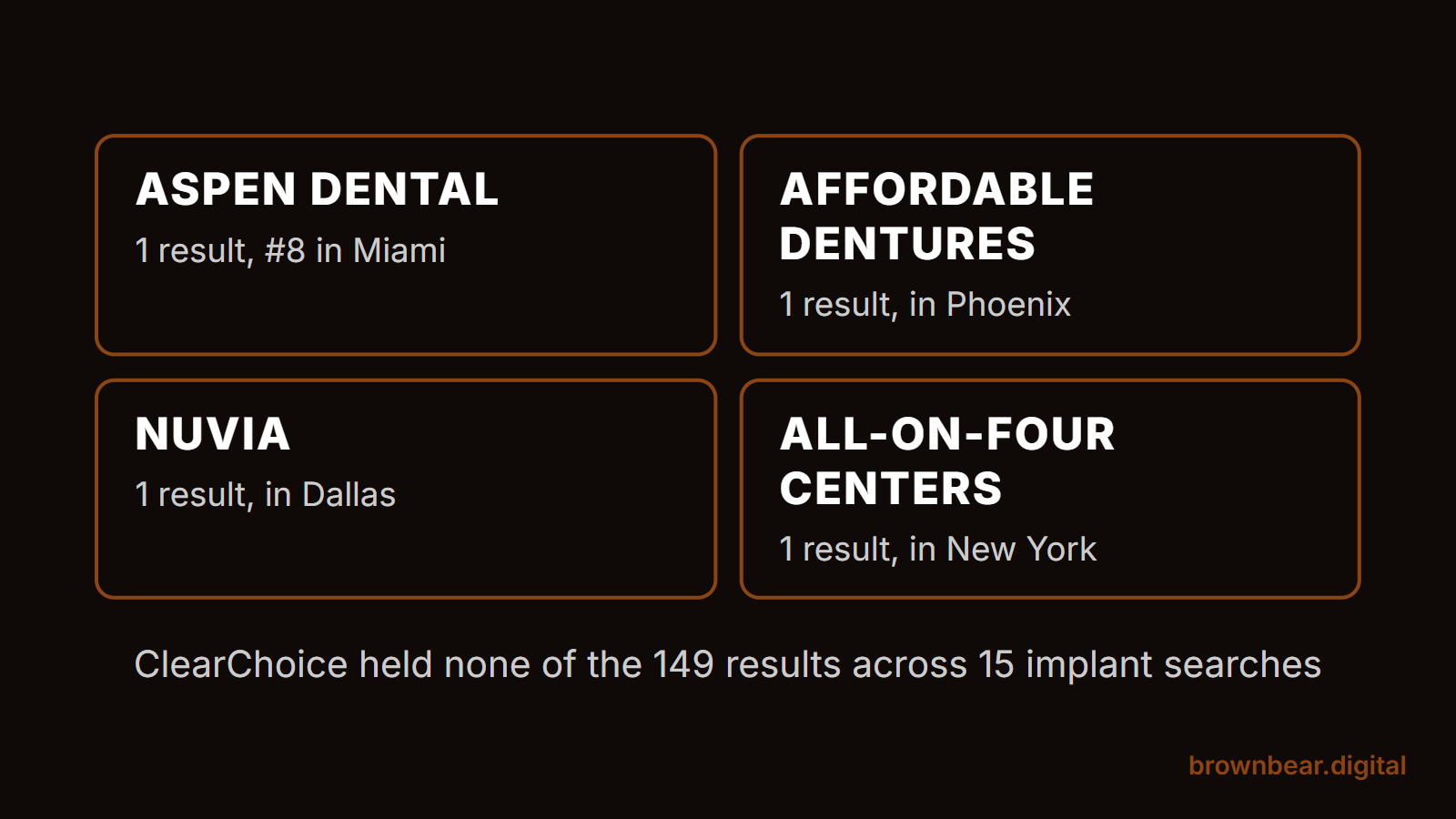
Independent practices own implant searches. Across 15 local searches in 8 metros, independent practices and specialists held 121 of the 149 results, or 81%, and 41 of the 45 top-three spots. National chains held 4 results. ClearChoice held none.
Here is how we got those numbers. On October 25, 2026, we read the top 10 organic results from Semrush for "dental implants" plus New York, Los Angeles, Chicago, Houston, Phoenix, Dallas, Miami and Atlanta, and for "all on 4" plus seven of those cities. Semrush had no results data for "all on 4" in Dallas or Atlanta, so we used "all on 4 dental implants dallas" and dropped Atlanta from that lane. We sorted each result as an independent general or implant practice, a specialist practice (oral surgeon, periodontist or prosthodontist), a regional group, a national chain, a nonprofit clinic, a hospital or dental school, or a directory. The map pack and ads are not counted. We did not check who owns each practice, so a few independent-looking brands may belong to a group.
| Search type | Example | Who ranks | Top-three spots |
|---|---|---|---|
| Dental implants plus city, 8 metros | dental implants phoenix | Independent practices 54%, specialists 18%, directories 9%, hospitals and schools 6%, regional groups 5%, chains 4% | Independents 21 of 24. Mount Sinai #1 in New York, University of Miami Health #2 in Miami |
| All on 4 plus city, 7 metros | all on 4 houston | Independent practices 61%, specialists 32%, directories 4%, one chain result | Independents 20 of 21. Specialists hold 8 of them |
Three things stand out. First, the brand names patients see on TV barely register in organic results. Aspen Dental appeared once, at #8 in Miami. Affordable Dentures and Implants appeared once in Phoenix, Nuvia once in Dallas, and the All-on-Four Dental Implant Centers network once in New York. Second, the domain name matters less than you'd think but more than zero: 3 of the 8 "dental implants" #1 results sit on a domain with "implant" in the name, and 8 of the 24 top-three spots do. Third, price transparency ranks. Dental Hearts, a nonprofit implant center that publishes a $1,950 single-implant fee in its site description, held #3 for "dental implants phoenix."
Picture a three-dentist practice in Dallas that has run "dental implants" ads for a year and never thought about organic results. The map shows a page one held by an implant center, an oral surgery group and a handful of practices, with Yelp at #5 and one chain at #8. Nothing on that page has a budget the practice can't match. A strong implant page and a full-arch page, each built for Dallas, give it two shots at clicks it currently pays for one at a time.
"All on 4" Searches Reward a Full-Arch Page, Not Your Homepage
The full-arch searches are a different race from the single-implant ones, and they need their own page. In the "all on 4" lane, 66 of the 69 results were pages built for full-arch treatment, with "all-on-4," "full arch," "full mouth" or "teeth in a day" in the URL. Only 3 were homepages. In the "dental implants" lane, by contrast, 27 of 80 results were homepages.
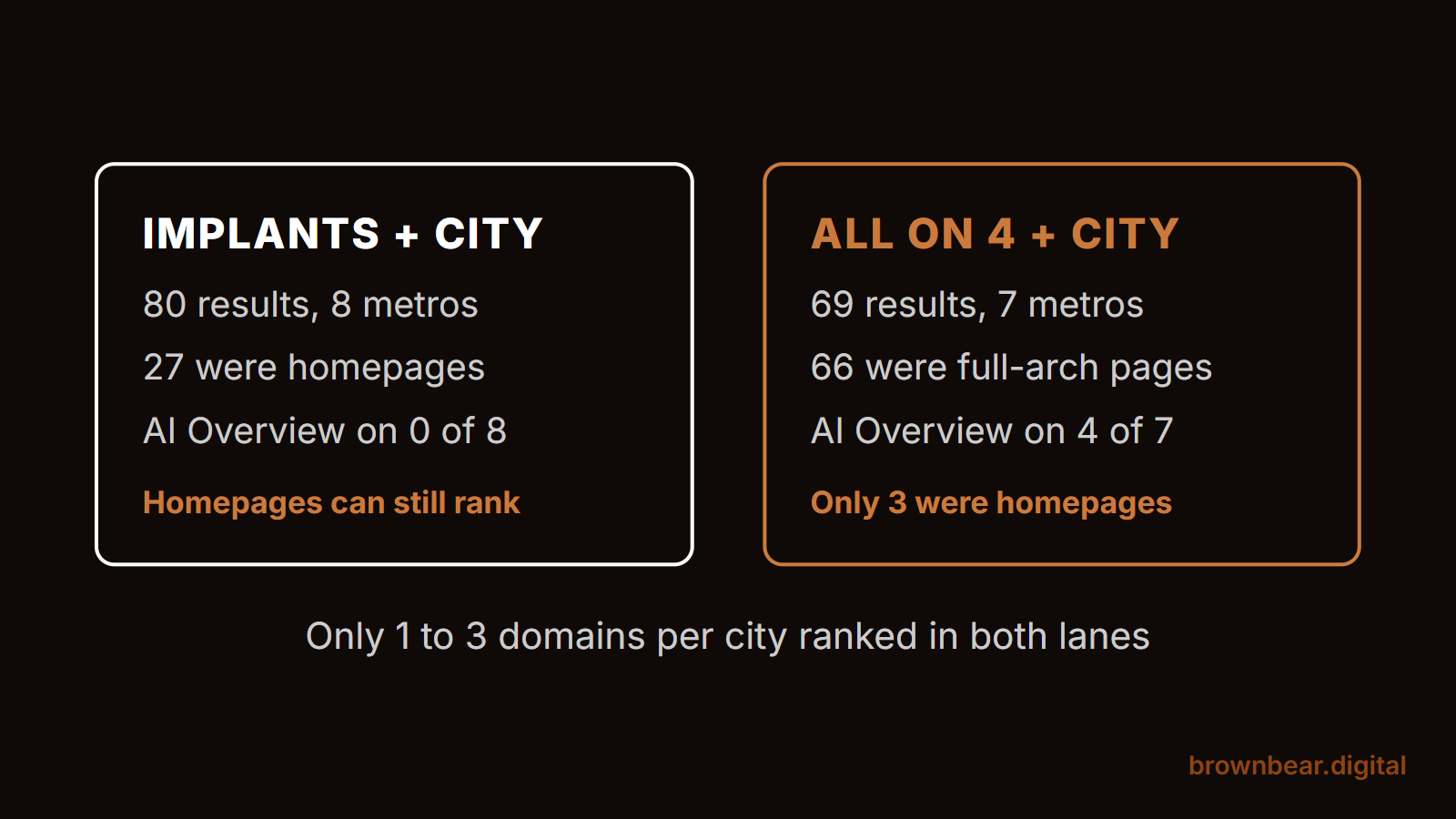
The two lanes rarely share winners. In each city, only 1 to 3 domains ranked for both "dental implants" and "all on 4." Phoenix is the exception that proves the rule: Aria Dental Implant Center held #1 for both, with its homepage on one and a dedicated All-on-4 page on the other.
Specialists punch above their numbers here. Periodontists and oral surgeons held all three top spots for "all on 4 los angeles" and #1 in New York. If you're a specialist, a full-arch page with your surgical credentials and your own case photos is the most direct way to reach patients who never get a referral slip.
The volumes look small, about 110 to 260 searches a month per city, and Semrush showed no cost-per-click data for six of the seven. Don't read that as low value. A patient who types "all on 4" plus a city already knows the treatment they want, and one of those cases can pay for months of marketing. Semrush also flagged an AI Overview on 4 of the 7 "all on 4" searches and on none of the 8 "dental implants" searches, so the full-arch page also needs plain answers an AI tool can quote: who is a candidate, what the day of surgery looks like, and what the fee includes.
Google Ads for Implants: CPCs, Targeting Limits and the Lead You Actually Want
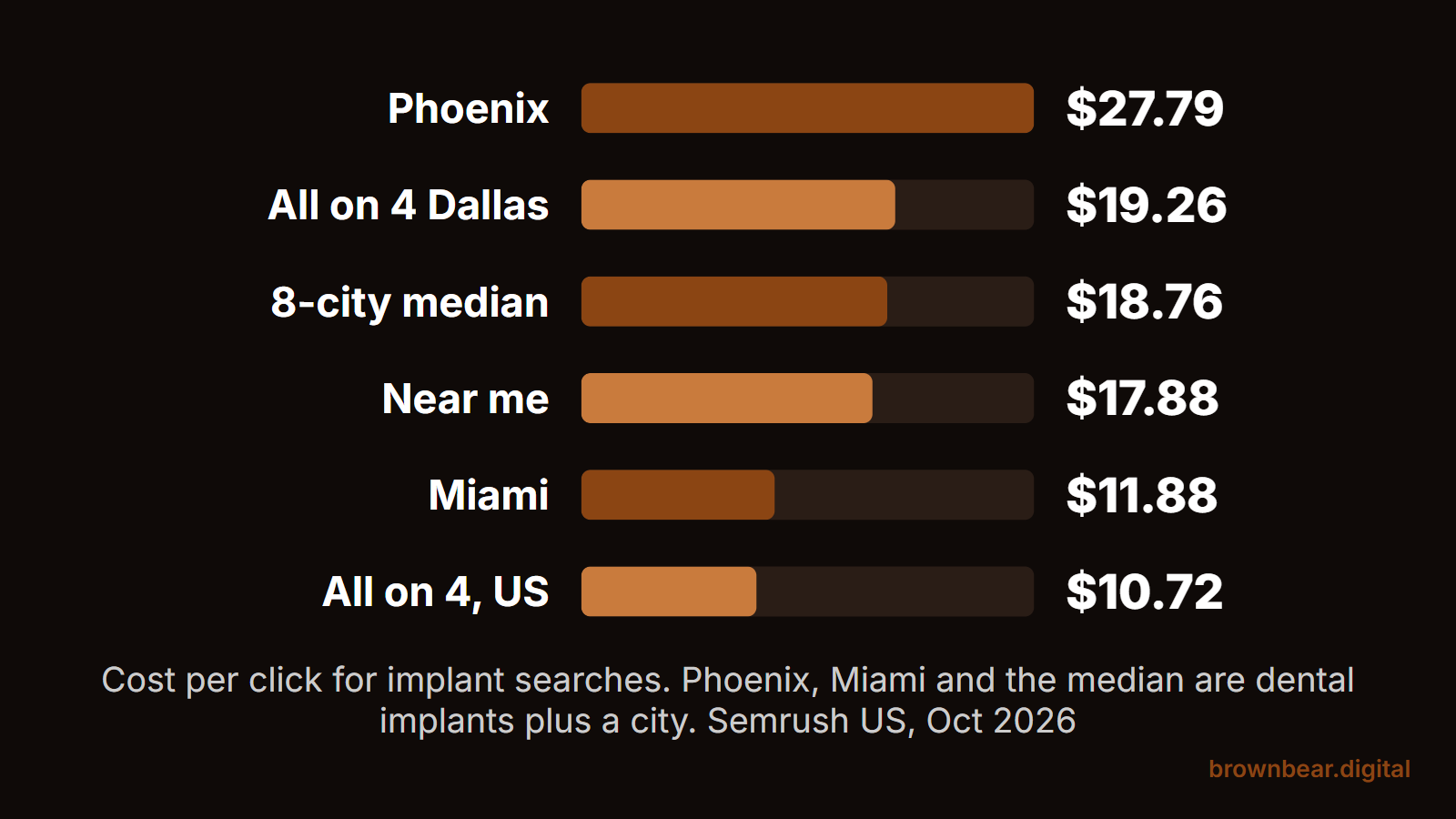
Google Ads is the fastest way to reach a patient who is ready to book, and implant clicks are not as expensive as agency pitches suggest. In our pull, "dental implants" plus a city had a median cost per click of $18.76, from $11.88 in Miami to $27.79 in Phoenix. "Dental implants near me" averaged $17.88 and "all on 4 dental implants" $10.72. "All on 4 dental implants dallas" cost $19.26 with a competition score of 0.80, the most crowded auction we saw.
The click is not where implant campaigns fail. Bryan's view from auditing medical practice ad accounts is that "Google Ads didn't work" usually comes down to two problems: campaigns that were never tuned for lead quality, and clicks sent to pages that weren't built to convert. For implants, that means price shoppers mixed with full-arch candidates, and a full-arch searcher dropped on a general services page.
There is also a targeting limit many practices don't know about. Google's Health in personalized advertising policy lists invasive medical procedures, including surgical procedures, as sensitive, and advertisers in sensitive categories can't use Customer Match, your data segments, lookalike segments or audience expansion. The policy doesn't name dental procedures, but implant placement is surgery, so plan your campaigns as if those lists are off the table. Our guide to Google Ads rules for doctors covers the wider health policy.
Here is how to set up an implant campaign that buys cases instead of clicks:
- Split single-implant and full-arch searches into separate campaigns, with separate budgets and separate landing pages.
- Add "free," "cheap," "cost in Mexico," "school" and job terms as negative keywords on the full-arch campaign, then review the search terms report every week for the first month.
- Send full-arch clicks to a full-arch page that shows real cases, the surgeon, what the fee includes and how financing works.
- Import consults that showed and cases that signed back into Google Ads, so bidding learns from cases, not form fills.
If paid search is a channel you'd rather hand off, paid search management for implant practices should be judged on cost per accepted case, the number this whole guide builds toward.
Meta Ads for Implant Patients: Long Research Windows and the Personal Attributes Rule
Facebook and Instagram ads reach people who are not searching yet: the 60-year-old with a failing partial who has not looked up "all on 4" but would stop scrolling for a patient story. That makes Meta a research-stage channel. It works best with video of real patients and the surgeon, and it needs follow-up, because an implant patient may take weeks or months to decide.
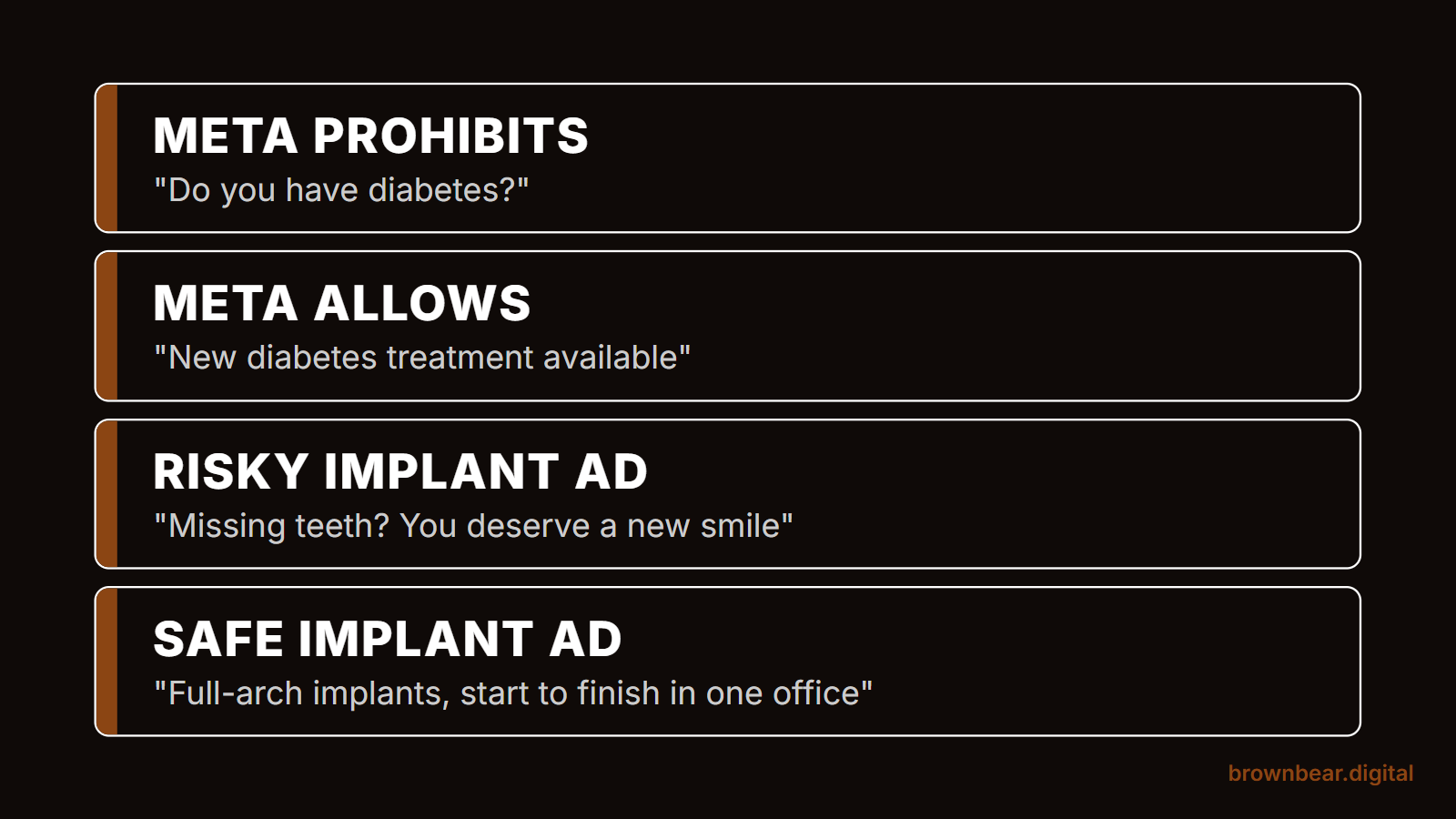
Meta's ad standards set one rule that trips up implant ads. Meta's Privacy Violations and Personal Attributes policy says ads must not assert or imply personal attributes, including physical health and medical conditions. Its own examples put "New diabetes treatment available" on the allowed side and "Do you have diabetes?" on the prohibited side. By the same logic, "Missing teeth? You deserve a new smile" is the risky version, and "Full-arch implants, start to finish in one office" is the safe one.
A dentist on Reddit asked in May 2026 whether practices were "actually getting full arches" from Meta. An agency had quoted $2,500 a month base, $1,500 for lead verification and a call center, and a $5,000 Meta ad budget. The top reply called it a waste of money. Another said a practice they'd interviewed with spent about $4,000 in marketing for every full-arch case it accepted. Both reactions can be right. The answer depends on what happens after the lead comes in, which the payback calculator below lets you test with your own numbers.
Financing Ads: The Monthly Payment Line That Triggers Federal Disclosure Rules
Financing is often what turns a yes in principle into a signed case, so implant ads lean on it hard. Be careful with the most common line: a monthly payment. Under the federal Truth in Lending rules, stating the amount of a payment or the number of payments in a credit ad triggers more disclosures. The ad must also state the down payment, the full repayment terms and the annual percentage rate, and say so if that rate can go up.
The rule is not only for lenders. The CFPB's official interpretation says all persons must follow the advertising rules, including merchants who are not creditors themselves. A practice ad that says "All-on-4 from $299 a month" is a credit ad, even when a third-party lender makes the loan. That is a question for your lender's compliance team and your attorney before the ad runs, not after.
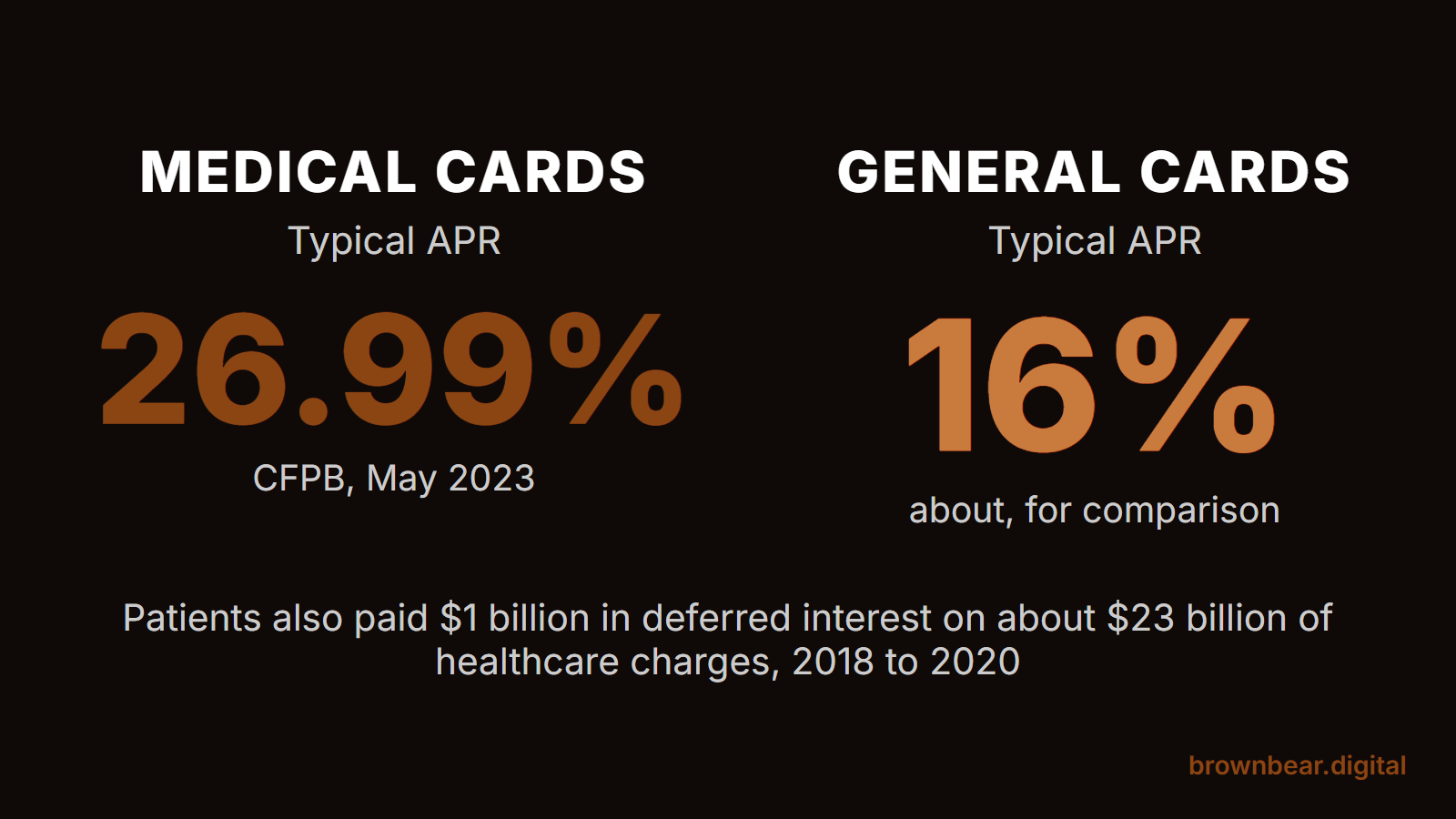
Deferred-interest offers deserve extra care. The CFPB found that patients paid $1 billion in deferred interest on about $23 billion of healthcare charges from 2018 to 2020, and that the typical medical credit card carried a 26.99% APR, compared with about 16% for general credit cards (CFPB report on medical credit cards, May 2023). In 2013 the CFPB ordered CareCredit, then part of GE Capital, to refund up to $34.1 million to consumers who were signed up for deferred-interest cards at doctors' and dentists' offices.
So the safe financing message names the options and the process, not a payment. "Most patients finance. We'll walk you through every option at your consult" invites the call without making the ad a credit ad. If you do want a payment in the ad, get the full disclosure line from the lender and run it in the ad itself.
From Lead to Accepted Case: Speed, Show Rate and the Treatment Coordinator
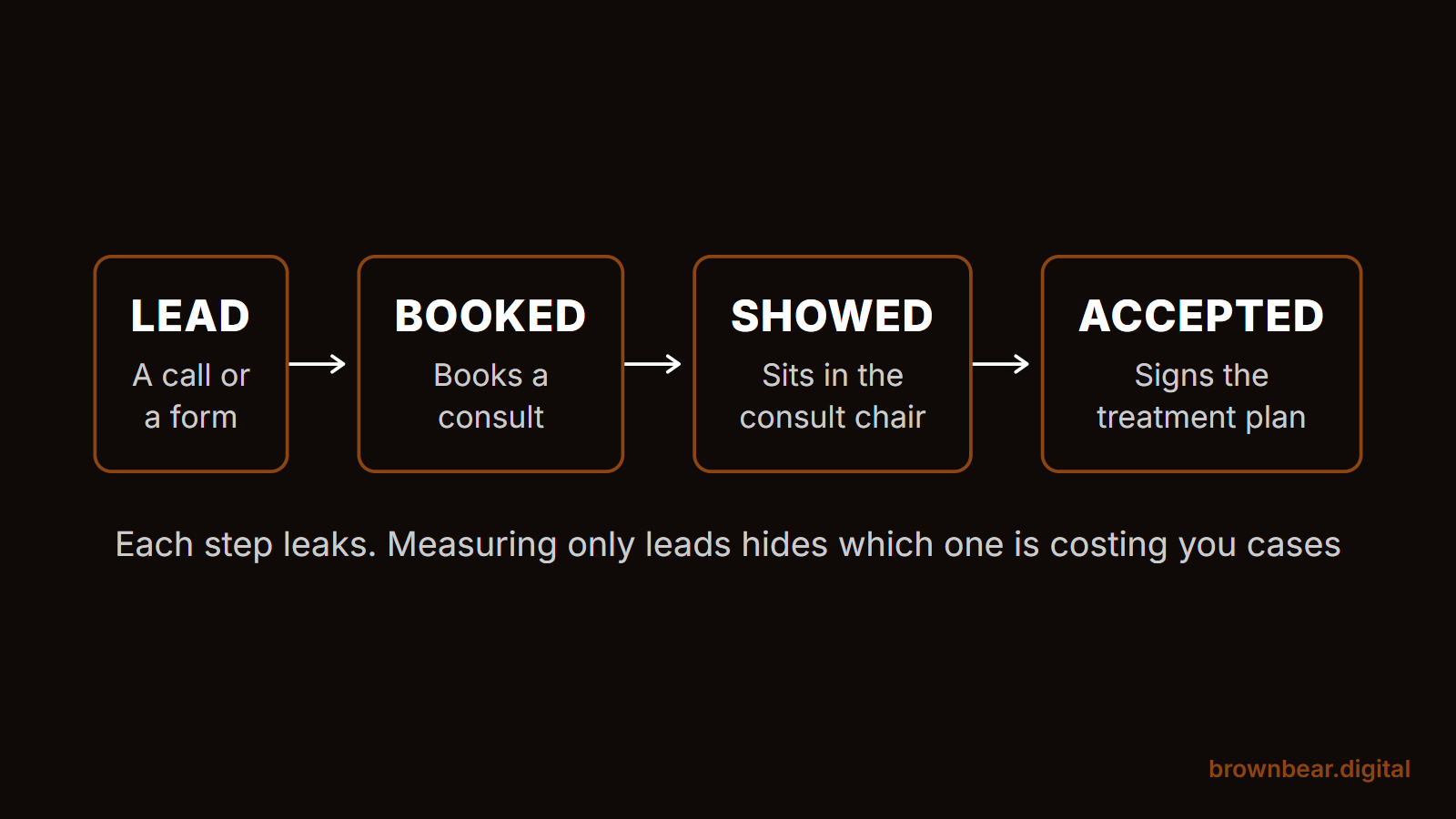
Most implant marketing money is lost between the lead and the consult chair, not in the ad account. The funnel has four steps, and each one leaks: a lead calls or fills a form, books a consult, shows up, and accepts treatment. A practice that measures only leads cannot see which step is costing it cases.
No-shows alone can swallow a campaign. A 2018 systematic review of 105 studies found an average no-show rate of about 23% across medical specialties (Dantas and colleagues, Health Policy). It is not an implant-specific figure, but it is a fair warning: if one in four booked consults doesn't show, you are paying for leads that never reach the person who closes them.
Here is what fixes the leaks:
- Call web leads back within minutes during office hours, and have a named person own every lead until it books or goes cold.
- Send a confirmation, a reminder the day before, and a short video from the doctor so the patient knows who they'll meet.
- Give full-arch consults to a trained treatment coordinator who can walk through financing in the same visit.
- Track show rate and acceptance rate by lead source, so you cut the source that books but never shows.
Many leads never convert because of the page they land on. If clicks arrive and calls don't, the problem is often the landing page, and our breakdown of pages that fail to turn clicks into consults applies to implant pages almost line for line.
Say a Houston practice gets 50 implant leads a month and books 30 consults, but only 20 show. Moving the show rate from two thirds to four in five adds 4 consults a month with no new ad spend. At even a modest acceptance rate, that is a case or more every month the ads already paid for.
Reviews and Video Testimonials Under the FTC's Review Rule
An implant patient is about to spend a lot of money on surgery, so reviews and patient videos carry more weight than they do for a cleaning. Ask for reviews that name the treatment and the doctor. "Dr. Patel did my upper arch and I ate a steak two weeks later" helps the next patient. "Great staff" doesn't. Our guide to what a strong patient review says shows the details worth asking for.
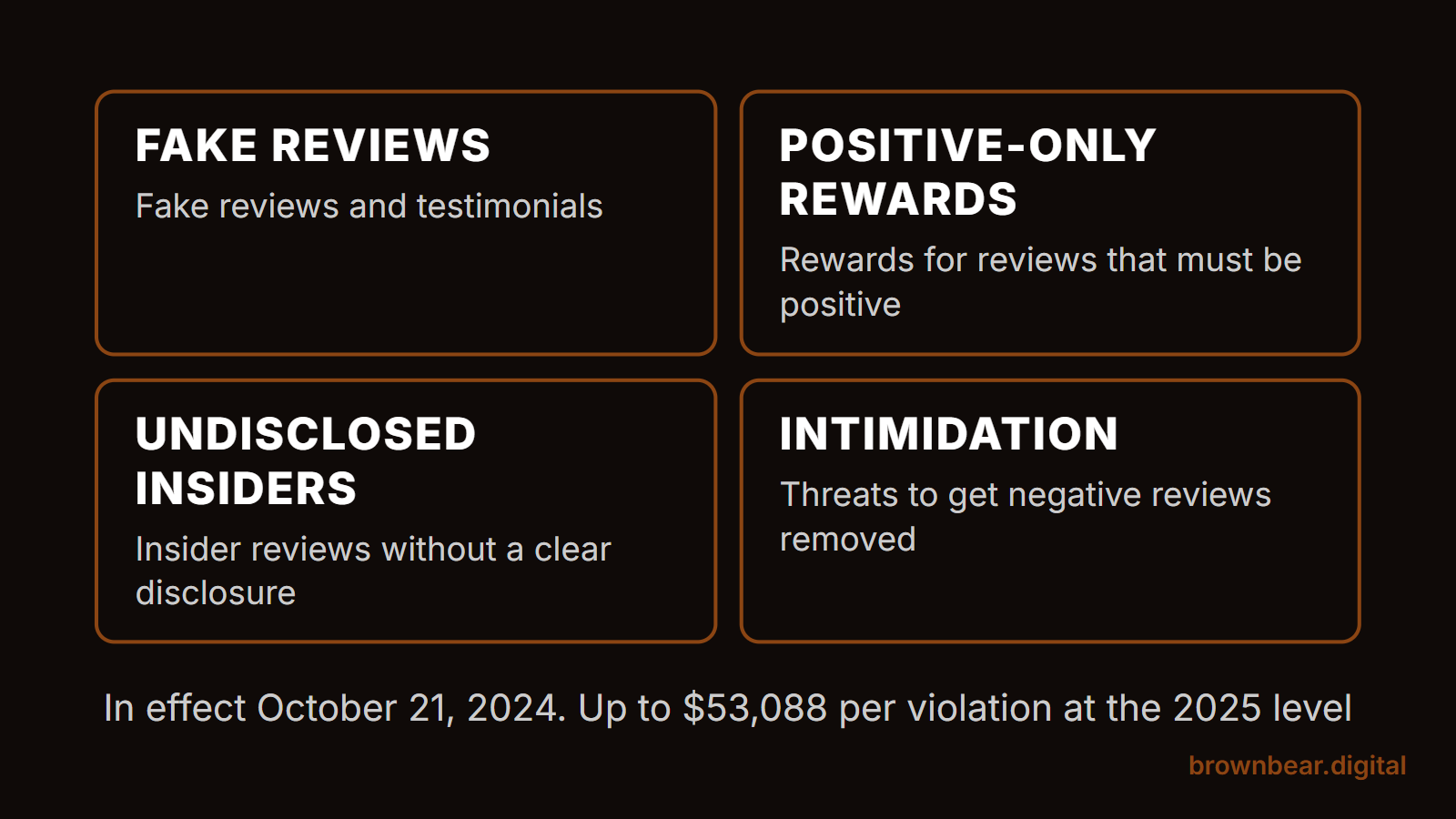
The rules tightened in 2024. The FTC's rule banning fake reviews and testimonials took effect October 21, 2024. It bans fake reviews and testimonials, offering rewards for reviews that must be positive, insider reviews without a clear disclosure, and threats or intimidation to get negative reviews removed. The FTC can seek civil penalties against knowing violators, up to $53,088 per violation at the 2025 inflation-adjusted level.
For implant practices that means three things. Ask every patient, not just the happy ones. Never tie a discount or gift to a five-star review. And treat a video testimonial as real only if the patient really had that treatment at your practice and signed a release for the video.
Dental Implant Marketing for General Dentists, Specialists and Full-Arch Centers
Dental implant marketing works for any practice that places or restores implants, but the right plan depends on how you get cases today. Before you pick a path, look at where your implant patients come from now: your own patient base, referrals from other dentists, or paid leads.
For general dentists adding implants to the schedule
General and implant-focused practices held most of the "dental implants" results in our pull, and plenty of them won with a single strong page. Camp Creek Dental took #1 in Atlanta with an affordable-implants page, and Monarch Dental Studio took #1 in Chicago with a blog post on what to expect, cost and recovery. Your edge is your existing patient base: the patients with failing bridges and partials are already in your chairs. Start with one implant page per city you serve and a recall list of patients with missing teeth, before you buy a single lead.
For oral surgeons, periodontists and prosthodontists who rely on referrals
Specialists held 36 of the 149 results, and the share rose to 32% in the "all on 4" lane, where periodontists held all three top spots in Los Angeles and an oral surgery practice held #1 in New York. Patients clearly search for specialists directly. The risk is your referral base, since general dentists may not love seeing you advertise implants to their patients. Market the full-arch and complex cases referring dentists don't do, and keep sending single-tooth restorations back to the referring office.
For dedicated full-arch centers buying leads every month
Practices built around implants did very well: Aria Dental Implant Center held #1 for both searches in Phoenix, and Dallas All-on-4 Dental Implant Center held #1 for "all on 4 dental implants dallas." These centers usually spend the most on ads and agencies, which is exactly the setup in the Reddit thread above. If that's you, organic full-arch pages are the hedge against rising ad costs, and your treatment coordinator's acceptance rate is the number every vendor should be paid against.
Groups with offices in several cities need one implant page and one Business Profile per office, which our guide on groups with offices in several cities walks through.
Dental Implants in AI Search
AI tools now answer the questions implant patients used to type into Google: who is a candidate for All-on-4, how long recovery takes, and who does full-arch work nearby. Google showed an AI Overview for "dental implant marketing" itself, and Semrush flagged one on 4 of the 7 "all on 4" city searches in our pull.
The most common finding when Bryan's team reviews a practice's AI visibility is not wrong information. It is that the treatments a practice wants to be known for are buried, so AI tools describe a general practice. A practice that places implants every week, but whose site leads with "family dentistry," will be described exactly that way. His team also sees third-party sites, such as review platforms and directories, shape how AI tools describe a practice as much as its own site does.
The fix is plain: lead each doctor page and implant page with the specialty, answer candidacy, cost and recovery questions in short direct paragraphs, and keep your name, address and phone the same everywhere. Our work on AI search visibility for dental practices starts with exactly that check.
What Implant Marketing Costs, and How to Tell If It Pays
Implant marketing pays when the accepted cases it produces are worth more than everything it costs: ad spend, agency and call-center fees, and the hard costs of each case. The cost per lead is the least useful number in that sentence. The cost per accepted case is the one that matters, and you can only get it if your phones, scheduler and treatment coordinator track each lead to the end.
Here is a worked example using the agency quote from the Reddit thread. Say the practice spends $9,000 a month, gets 60 leads, books 40% of them, sees 77% of those booked and signs 30% of the consults that show. That is 24 consults booked, about 18 shown and 5.5 cases signed, or about $1,623 in marketing per accepted case. At a blended case fee of $20,000, the month brings in about $110,880 before hard costs. At a 10% acceptance rate, the same month signs fewer than 2 cases, and each one costs almost $4,900 to win. The difference sits in the consult room, not the ad account.
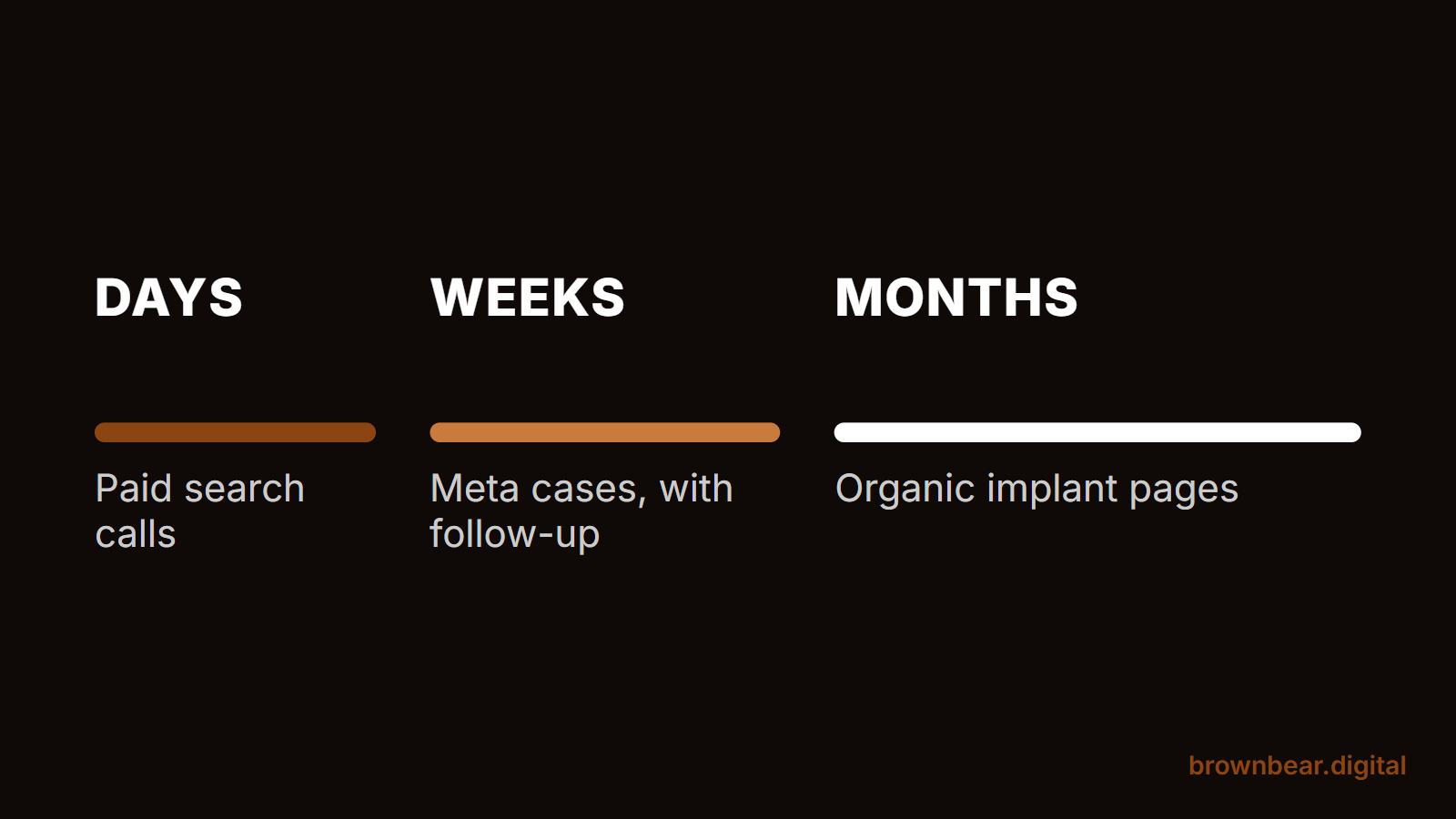
Timelines depend on the channel. Paid search can produce calls within days, Meta campaigns usually need a few weeks of follow-up to show cases, and organic implant pages take months. If your calendar needs cases this quarter, start with paid search on full-arch terms while the organic pages build. If you already get steady referrals, start with the organic pages and the recall list, and add paid search once the pages convert.
How to Judge an Implant Marketing Agency
The Reddit thread that ranks for "dental implant marketing" is a dentist asking whether agencies deliver. Seven of its twelve comments had been removed by the time we read it, a reminder that recommendations in public threads may not come from patients or neutral dentists. Ask any agency four things before you sign:
- What will you report each month: leads, or consults shown and cases accepted?
- Who owns the ad accounts, the landing pages and the call recordings if we part ways?
- How do you keep our financing ads, reviews and patient videos inside the FTC and Truth in Lending rules?
- Can we talk to two current implant clients and see their cost per accepted case?
Grow Your Implant Practice With Brown Bear
The practices winning implant patients in our data aren't the biggest brands. They have a page built for each search, ads aimed at cases instead of clicks, and a team that turns consults into signed treatment plans. Brown Bear builds that system for dental practices, from search and paid campaigns to the pages and tracking behind them. If you want a clear read on where your implant cases are coming from and where they're leaking, start with our implant marketing for dental practices.
Written By
Founder, Brown Bear Digital
Bryan has 15 years of experience across SEO, paid search, and AI search strategy. He founded Brown Bear to give businesses direct access to senior-level search expertise without the agency overhead.
Learn More About BryanGet Found on Google.
Get Cited by AI.
Tell us about your site. We'll send back a proposal for SEO and AI search.