The Anatomy of a Great Patient Review

This is Brown Bear's guide to what a patient review actually has to contain before it does anything for your visibility in search.
You probably do not have a review volume problem. Most of the practices that come to us have plenty of reviews and a rating somewhere north of 4.7. What they have is a pile of reviews that all say some version of "great experience, highly recommend," and a set of procedure-term rankings that has not moved in two years. We run search for plastic surgery and medical practices, which means we spend most of our time downstream of the review, watching what happens in the results page after the reviews land.
Here is the shape of the problem. When we looked at the pages ranking first for breast augmentation searches across 101 cities, 37 of them were still running review markup that Google stopped displaying years ago. The industry is not short on effort. It is spending that effort on the parts of reviews that no longer do anything.
When we say patient review, we mean both the two-line Google review a patient taps out in a parking lot and the eight-paragraph RealSelf write-up with a photo timeline attached. Both count. They just do very different amounts of work, and the difference between them is not length. It is what they name.
If you are a solo surgeon watching your review count climb while your procedure pages sit on page two, this is written for the gap between those two facts. If you run marketing for a practice and someone is measuring you on reviews collected per month, this is the argument for changing the metric. If you are part of a multi-provider group where the practice name ranks and the individual surgeons are invisible, the fix is in here, and it is not more reviews. And if you are newer, with fifteen reviews and a decision to make about where to point the next fifty, start here before you point them anywhere.
By the end you will have a seven-part test you can run on any review in about twenty seconds, a clear sense of which of your existing reviews are working and which are decoration, and a way to ask for reviews that produces the useful kind without putting words in a patient's mouth.
We have grouped it into four parts: what a review has to contain, what patients actually write when you leave them alone, how time and platform change the value of what you already have, and what to do about all of it starting Monday.
Let's begin with the uncomfortable part, which is why most of your five-star reviews are not doing what you think they are doing.
Why Most Five-Star Reviews Do Almost Nothing for Your Visibility
A five-star review with no specifics moves exactly one number: your average. It contributes nothing a search engine can match to a query, because it contains no query. "Dr. Smith and his staff were amazing, 10/10" is a vote. It is not a document.
This matters because of how reviews get used on the retrieval side. Your star average is a ranking input among many. The text of your reviews is something else entirely: it is a body of unpaid, third-party writing about your practice that both Google and every language model can read, quote, and match against what a patient typed. A patient searching "deep plane facelift Walnut Creek" is not asking for an average. They are asking a question that only review text containing the words "deep plane facelift" can answer.
So the practical distinction is between a review that raises your rating and a review that gives search something to work with. The first kind is a rounding error. You already have hundreds, and the two hundredth changes your average by roughly nothing. The second kind is rare, and almost nobody is asking for it.
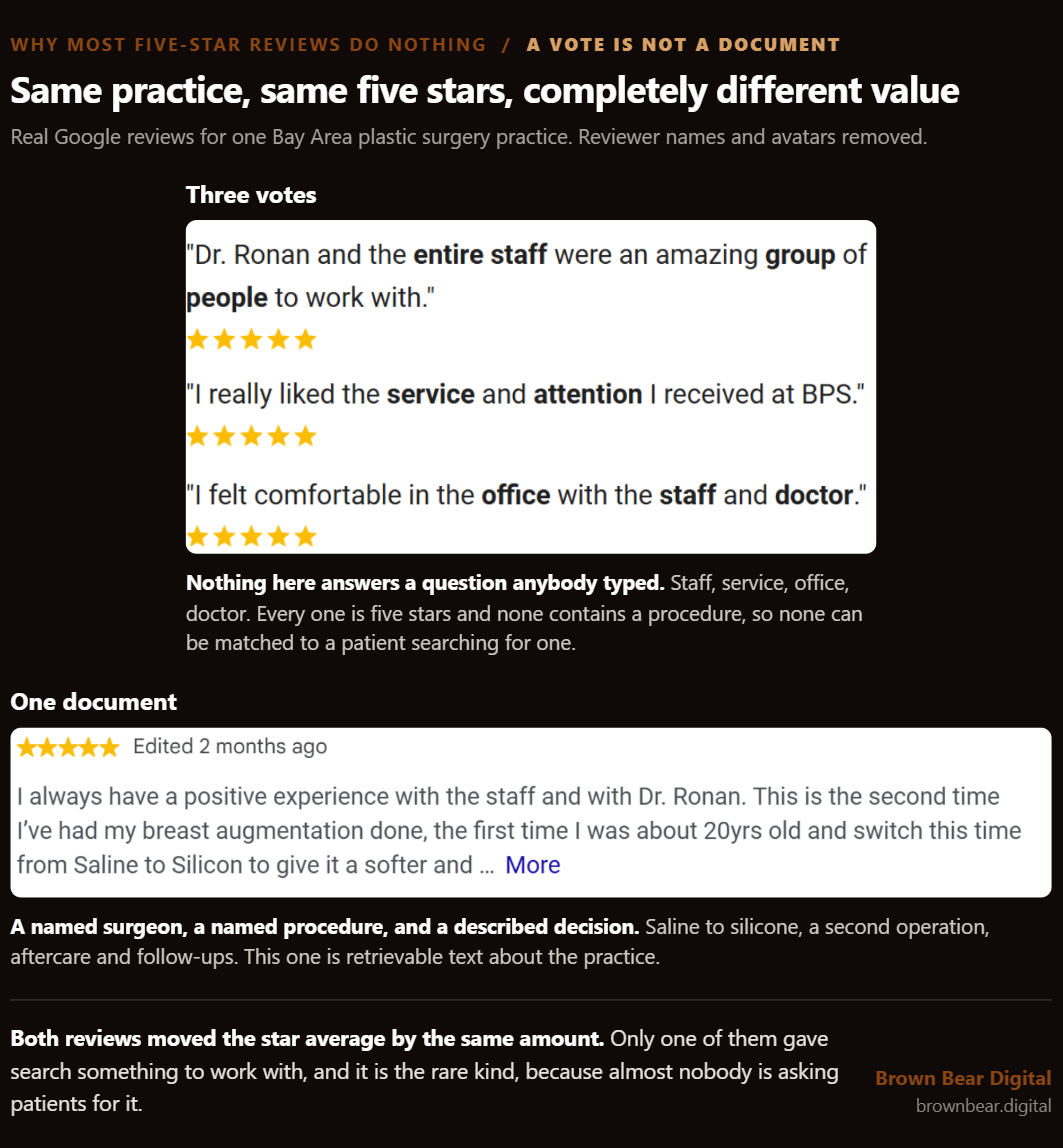
This is also why review count stops paying off. The first fifty reviews establish that you are a real practice with real patients. Somewhere past that, additional undifferentiated reviews are just maintenance. The returns move from quantity to composition, and most practices never notice the handoff because their dashboard only counts one of those things. How patients actually find a surgeon is a longer path than most practices assume, and reviews touch nearly every step of it.
The Seven Parts of a Review That Earns Search Visibility
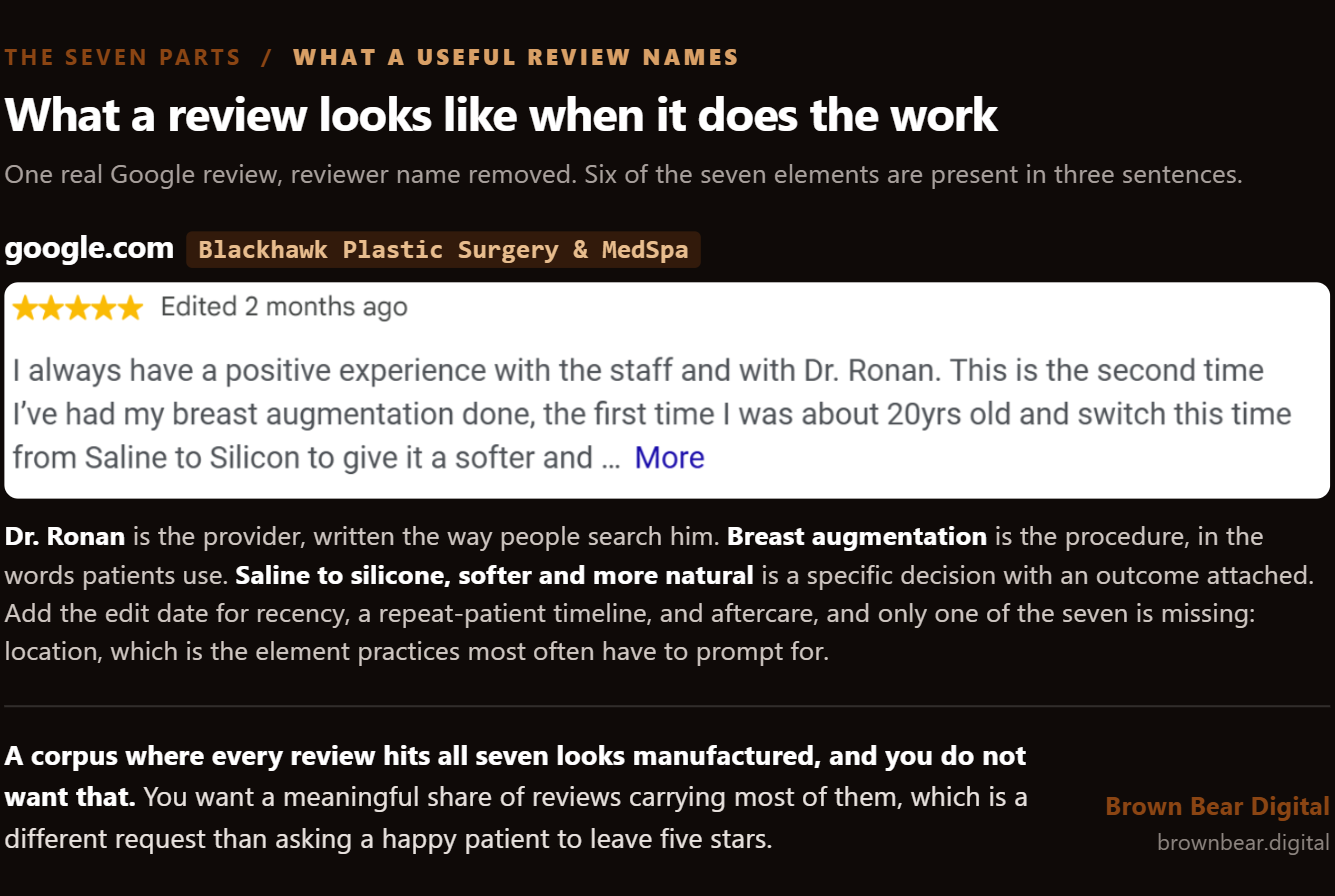
A review does useful work when it names seven things. Not every review will hit all seven, and it should not, because a corpus where every review hits all seven looks manufactured. But you want a meaningful share of your reviews carrying most of them.
1. The provider's name, written the way people search it
A review that says "the doctor" attaches to nothing. A review that says "Dr. Elena Marsh" attaches to a person. This is the single most skipped element, and in group practices it is the most expensive one to skip, because the practice accumulates all the signal and the individual surgeons accumulate none. If a patient searches your surgeon by name and finds a thin profile, the reviews that could have filled it are sitting on the practice listing saying "the doctor." Whether your individual surgeons show up as entities at all depends heavily on whether anything outside your own website says their names.
2. The procedure, named plainly
"My surgery" is invisible. "My tummy tuck" is a keyword. Patients often use the common name rather than the clinical one, and that is fine, in fact it is better: "tummy tuck" gets searched far more than "abdominoplasty." When a review happens to contain both, that is a small windfall, because it links the two terms together in text a machine can read.
3. What the procedure actually changed
This is the outcome, described in the patient's own terms. Not "great results," but "I can wear a fitted shirt without thinking about it." Outcome language is what makes a review persuasive to the next patient, and in our work it is what an assistant reaches for when someone asks what results from this surgeon look like.
4. What working with the doctor and the team was like
The process, not just the outcome. Consultation, honesty about what was and was not achievable, how the office handled the two-week follow-up, whether anybody picked up the phone at 9pm. This is the part patients write most naturally and it is genuinely valuable, provided it sits alongside the other elements rather than instead of them.
5. Where the patient came from and what they compared
"I drove down from Sacramento after consulting with three surgeons in the Bay Area" does two jobs in one sentence. It signals geographic reach beyond your immediate city, and it signals that you won a comparison, which is a trust cue no amount of self-description provides. Practices almost never ask for this and patients volunteer it more often than you would expect.
6. A photo or a video
Where the platform supports it, patient-uploaded media does something no text can: it makes the review unfakeable in the reader's mind. More on the mechanics and the consent boundary further down.
7. A date recent enough to still count
A review is a perishable asset. The seventh element is not something the patient writes, it is something you control by asking continuously rather than in bursts. Recency is covered in its own section because it is the element practices misjudge most.
Here is what the difference looks like in practice. Picture two reviews for the same surgeon, posted the same week. The first reads: "Amazing experience from start to finish. The whole team is wonderful. Highly recommend!" The second reads: "I drove up from Monterey to see Dr. Marsh after two consults closer to home. I had a deep plane facelift in March. She was direct about what she could and couldn't fix, which I appreciated, and her office called me twice in the first week. Six months out I look like myself, rested." The first review moves an average. The second one contains a city, a surgeon's name, a named procedure, a timeframe, an outcome, a comparison, and a process detail. It is the only one of the two that can be retrieved, quoted, or matched to a search.
Where this branches.
If you are a solo practitioner, your practice name and your surgeon name are effectively the same entity, so a review naming either one does most of the work, and you should prioritize the procedure name and the outcome. If you are a multi-provider group, the provider name is your binding constraint, not the procedure. Reviews naming only the practice build practice-level authority while your individual surgeons stay invisible, and that is the pattern we see most often in group practices where the practice ranks and the surgeons do not. It is not a problem you can solve by collecting more of the same reviews.
What Patients Actually Write About When You Leave It to Them
Left alone, patients write about how you made them feel, not about what you did. There is good evidence for this. A content analysis of 200 online physician reviews published in JAMA Facial Plastic Surgery found that among the comments in five-star reviews, bedside manner accounted for 26.3% and knowledge for 21.7%, while results accounted for only 17.0%. In one-star reviews the pattern held: bedside manner 23.0% and honesty or perceived pressure 22%, with results at 13.4%. You can read the full comparison of one-star and five-star physician reviews, and it is worth sitting with the implication: the thing you are actually being reviewed on, most of the time, is your manner.
That is not a criticism of patients. It is a description of what they are qualified to assess. One physician put it plainly in a public thread: lay people cannot judge a physician's competence, so what they are reporting on is their experience. That is exactly right, and it explains why so much review-generation advice fails. Practices ask patients to validate their skill, and patients cannot, so they default to the thing they can speak to.
Which reframes the whole ask. Stop requesting validation. Request description. A patient cannot tell you whether your closure technique was sound, but they can absolutely tell you they came from Monterey, had a deep plane facelift in March, and can now wear their hair up. Description is within their competence and it is what search needs. Validation is outside their competence and produces "10/10, highly recommend."
This is also the answer to the objection you will hear from your own physicians, and you will hear it, because it is loud. Plenty of doctors find review solicitation distasteful. One internist with strong upvotes on a public thread said flatly that she hates being asked to write reviews and considers online reviews meaningless. She is not wrong about the version she is objecting to, which is the star-rating popularity contest. She is objecting to a system that reduces her to an average. A review that describes a specific patient's specific procedure and specific outcome is a different object, and the case for asking is easier to make when that is what you are asking for.
Why Review Recency Decays Faster Than Your Star Rating
Your star average is a stock. Your review recency is a flow, and patients read the flow. A practice with 214 reviews at 4.8 looks excellent in the summary line and can still look alarming to somebody who scrolls, because what a scrolling patient sees is not an average, it is a sequence. Three complaints in the last four months read as a trend even when they are three out of two hundred and fourteen.
This is how patients describe it themselves. In a public thread about choosing a hospital for a delivery, one poster's concern was not the rating at all: it was that the recent reviews were negative and the older ones were not, which they read as a practice that had gotten worse. Another poster in the same thread pushed back with the standard counterargument, that people are more motivated to complain than to praise. Both are right, and that is the point. The star average cannot resolve that argument. Only a steady flow of recent, specific reviews can.
The operational takeaway is that review collection should be a continuous process at a low rate rather than a campaign at a high one. Twenty reviews collected over ten months protects you in a way that twenty reviews collected in three weeks does not, and the burst pattern is also the one most likely to look inorganic. Continuous collection also keeps your Google Business Profile looking active, which matters for local visibility independently of what the reviews say.
Picture a practice in Walnut Creek with 214 reviews and a 4.8 average that ran a big review push two years ago and nothing since. The average still reads 4.8. But the six most recent reviews are three routine five-stars from last spring and three complaints about scheduling from this summer, because unhappy patients still write reviews when nobody is asking the happy ones to. A patient scrolling that listing in August is not reading a 4.8. They are reading a practice that has gone downhill. Nothing about the underlying care changed. The flow stopped.
Where this branches.
If you have fewer than about forty reviews, volume is still your constraint and you should keep doing what the rest of the internet tells you to do: make it easy, ask consistently, remove friction. Composition matters but it is the second problem. If you are past a hundred and fifty, volume has stopped paying and composition is your only remaining lever. Collecting your next hundred generic reviews will change your average by a decimal and change your visibility by nothing.
How Reviews Feed AI Search Differently Than They Feed Google
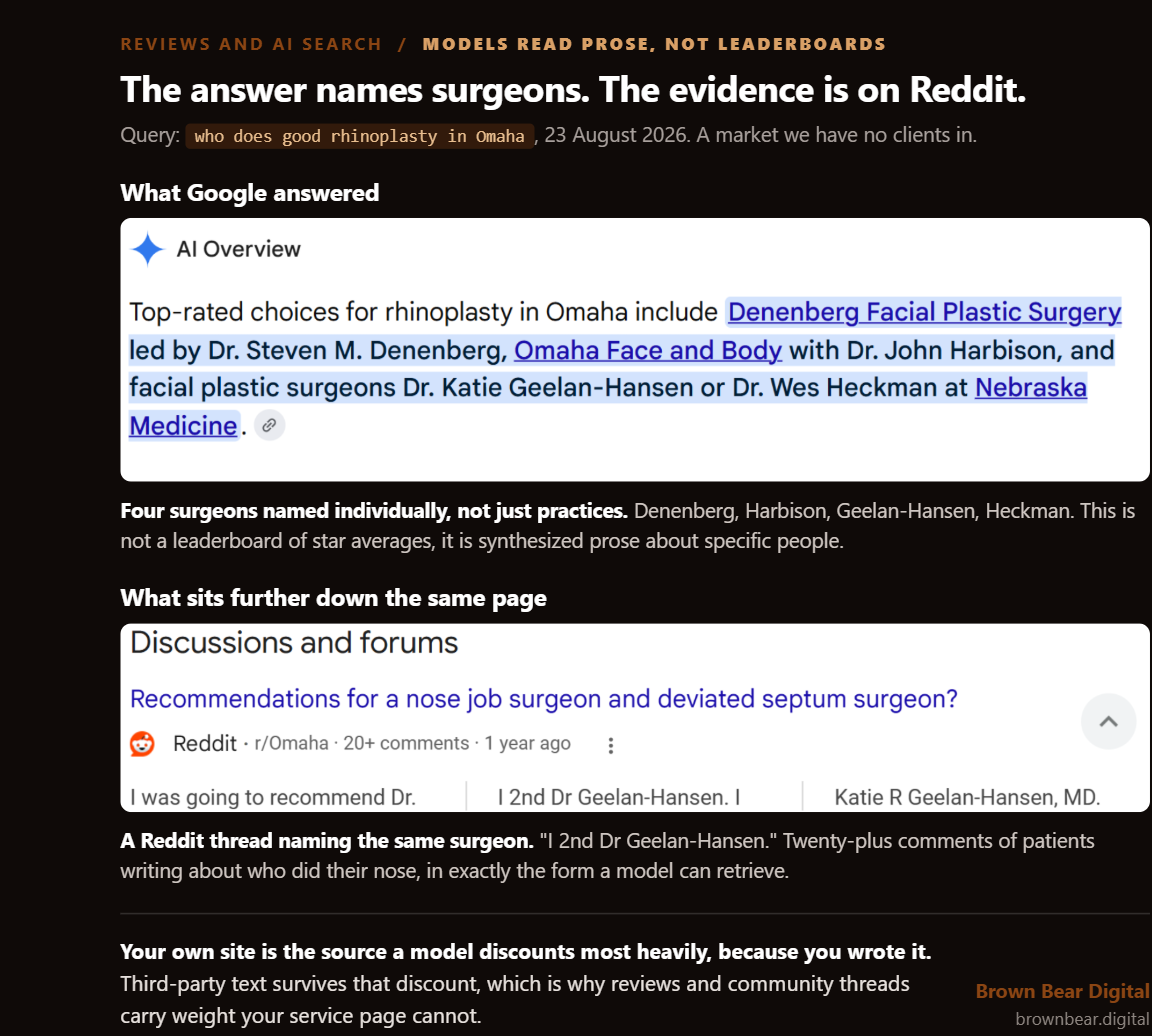
Google reads your reviews as a ranking signal with a numeric component. A language model reads them as prose. That difference changes which reviews matter.
When an assistant answers "who does good rhinoplasty in San Jose," it is not consulting a leaderboard of star averages. It is retrieving text about practices and synthesizing an answer from it. In the answers we track for client practices, the reviews that get pulled in are the ones that read like evidence: a named surgeon, a named procedure, a described outcome. A review that says "great experience" contributes nothing retrievable, because there is nothing in it to retrieve.
The second difference is that models read tone, not just topic. A review can be five stars and still read as lukewarm, and a four-star review can read as a rave with one caveat. Star ratings flatten that; language does not. This is the ground covered in sentiment and salience in AI search, and reviews are the single largest body of sentiment-carrying text most practices have.
The third difference is where the text lives. Your website is one source among many, and it is the one a model discounts most heavily, because you wrote it. Reviews are third-party text about you, which is exactly the kind of source that survives that discount. Understanding the way an AI Overview assembles its answer makes the asymmetry obvious: your own pages establish what you claim, and everything else establishes whether it is true.
None of this requires new technology on your end. It requires the reviews you are already collecting to contain nouns.
Photos and Video Inside Reviews
A patient-uploaded photo attached to a review is worth more than the same photo in your gallery, because you did not put it there. That is the whole mechanism. Your gallery is curated by definition and every reader knows it. A photo a patient chose to attach to their own review carries a credibility your own before-and-after images structurally cannot.
Platform support varies and that should shape where you point people. Google reviews accept photos. RealSelf is built around patient-documented journeys and supports the richest media of any platform in aesthetics, which is why your RealSelf profile behaves less like a listing and more like a second gallery you do not control. Yelp accepts photos. Healthgrades and most physician directories effectively do not.
The consent boundary is simple and you should not get creative with it. You do not ask a patient to post photos of their results. A patient may choose to, and that choice has to be entirely theirs and entirely unprompted, because the moment you request it you have turned a review into a marketing asset you solicited, with all the privacy and compliance exposure that implies. What you can do is make sure the patients who want to have somewhere good to do it, which mostly means having a claimed, complete profile on the platforms that support media at all.
Meanwhile the media you do control should stay controlled. A before and after gallery on your own site and patient-uploaded review photos do different jobs, and the second is not a substitute for the first. Yours proves range. Theirs proves independence.
The Timing Problem Nobody Warns Surgical Practices About
Every guide on this topic says to ask when satisfaction is highest. For surgical practices, that advice is actively harmful, because peak satisfaction and a finished result do not happen at the same time.
A patient two weeks post-op is thrilled, grateful, and still swollen. The review they write is warm, sincere, and describes a result that does not exist yet. Patients notice this about each other. In a public rhinoplasty thread, one poster's warning to future patients was specifically that the glowing reviews get written shortly after surgery, before healing finishes, which makes them unreliable as evidence of the outcome. If patients have figured that out, treat it as read that the reviews written in that window are worth less than they look.
The fix is a two-request cadence, and the second request is the valuable one. Ask once in the early window, when the patient is warm and will actually respond, and accept that you are collecting a review about the experience: the consultation, the honesty, the follow-up calls. Then ask again at the point where the result is genuinely settled, six months for most facial work and closer to a year for anything involving significant swelling or scar maturation. The second review is where you get outcome language, and outcome language is the element your corpus is almost certainly shortest on.
Say you run a rhinoplasty-heavy practice and you currently ask at the two-week post-op visit because that is when the patient is in the building and happy. Your review corpus is full of "Dr. Reyes and her team took such good care of me." All of it is true and none of it says anything about a nose. Add a second touchpoint at the one-year mark, and the reviews that come back say "a year out, I finally look like the photos we talked about in consultation, and it still looks like my face." That is the review a prospective rhinoplasty patient is actually searching for.
Where this branches.
If your practice is primarily surgical, use the two-request cadence and treat the late request as the priority. If your practice is primarily non-surgical, injectables, lasers, skin, the result is visible within days and the single early ask is correct, because there is no later state to wait for. Practices that do both should run both cadences rather than picking one, and route patients by procedure rather than by convenience.
How to Prompt for These Elements Without Scripting the Patient
You can ask a patient what to write about. You cannot tell them what to say. The line between those two is narrower than most practices think and it matters legally as well as reputationally.
The legal floor is the Federal Trade Commission's Rule on the Use of Consumer Reviews and Testimonials, 16 CFR Part 465, which took effect on October 21, 2024. It bars fake and AI-generated reviews, undisclosed reviews from company insiders, and review suppression, including using unfounded legal threats to remove a negative review or displaying a filtered subset of reviews while implying it is all of them. Incentives are handled with more nuance than the summaries usually suggest: an incentivized review counts as a testimonial and the material connection has to be disclosed, and you cannot condition an incentive on the review being positive. The FTC's own guidance on the consumer reviews rule is short and worth reading once in full.
Reputationally, the line is even more sensitive, because patients can tell. In a public thread reviewing a rhinoplasty outcome, part of the poster's complaint was that the office had handed out instructions on how to leave reviews. The instructions themselves were probably innocuous. What the patient took from them was that the reviews were manufactured, which is the opposite of what reviews are for.
The technique that stays on the right side of both lines is to ask open questions rather than supply content. Instead of a template, send three prompts and let the patient answer whichever they want:
- What procedure did you have, and roughly when?
- What is different for you now compared to before?
- What was working with our team actually like?
Those three questions produce the procedure name, the timeframe, the outcome, and the process, which is four of the seven elements, without dictating a single word. The patient's answers are entirely their own. Notice what is absent: no request for a star rating, no request for photos, no suggestion of what the answer should be, and nothing offered in exchange.
Picture a coordinator handing this over as a card at checkout rather than an automated text three days later. The card has the three questions and a QR code. The conversion rate is lower than a text blast, and the reviews that come back are three times longer and carry actual nouns. That trade is worth making once you are past your first fifty reviews.
The Ask Builder
Build a review request that prompts for the seven elements without scripting the patient.
Open questions only. No star prompt, no suggested wording, no incentive.
- No star rating requested. Asking for five stars is the fastest way to get a review with no content in it.
- No suggested wording. The FTC's consumer reviews rule, in force since October 21, 2024, treats misrepresenting a reviewer's actual experience as a violation, and patients notice supplied scripts even when they are harmless.
- No incentive of any kind. An incentivized review is a testimonial requiring disclosure, and an incentive conditioned on the review being positive is prohibited outright.
- No request for photos. A patient may choose to attach media. You do not ask them to.
For informational purposes only, and not legal, compliance, or medical advice. Review any patient-facing communication with your own counsel and against your state's rules before sending, and confirm current FTC and platform policy at the time you use it. Results are not a guarantee. Your entries stay in your browser: nothing is stored, sent, or transmitted anywhere.
Two things this section deliberately does not cover, because they are handled in depth elsewhere: the mechanics of the request system itself, and responding without crossing a HIPAA line, which is its own minefield and deserves more room than a subsection.
The Review Schema Trap on Your Own Website
If you are pasting your Google reviews onto your own website with AggregateRating markup and expecting stars in the search results, stop. It has not worked for years and it will not start.
Google's structured data documentation is explicit: "If the entity that's being reviewed controls the reviews about itself, their pages that use LocalBusiness or any other type of Organization structured data are ineligible for star review feature." That covers reviews you place in your own markup and reviews pulled in through an embedded third-party widget. Both are self-serving by Google's definition, and both are ineligible.
This is not an obscure edge case, it is one of the most common wasted implementations in medical marketing. In our 101-city study of breast augmentation ranking pages, 37 of the pages ranking first for their city were still carrying AggregateRating markup, with claimed review counts running from 1 to 2,359. Better than a third of the winners in that niche are running markup that produces nothing.
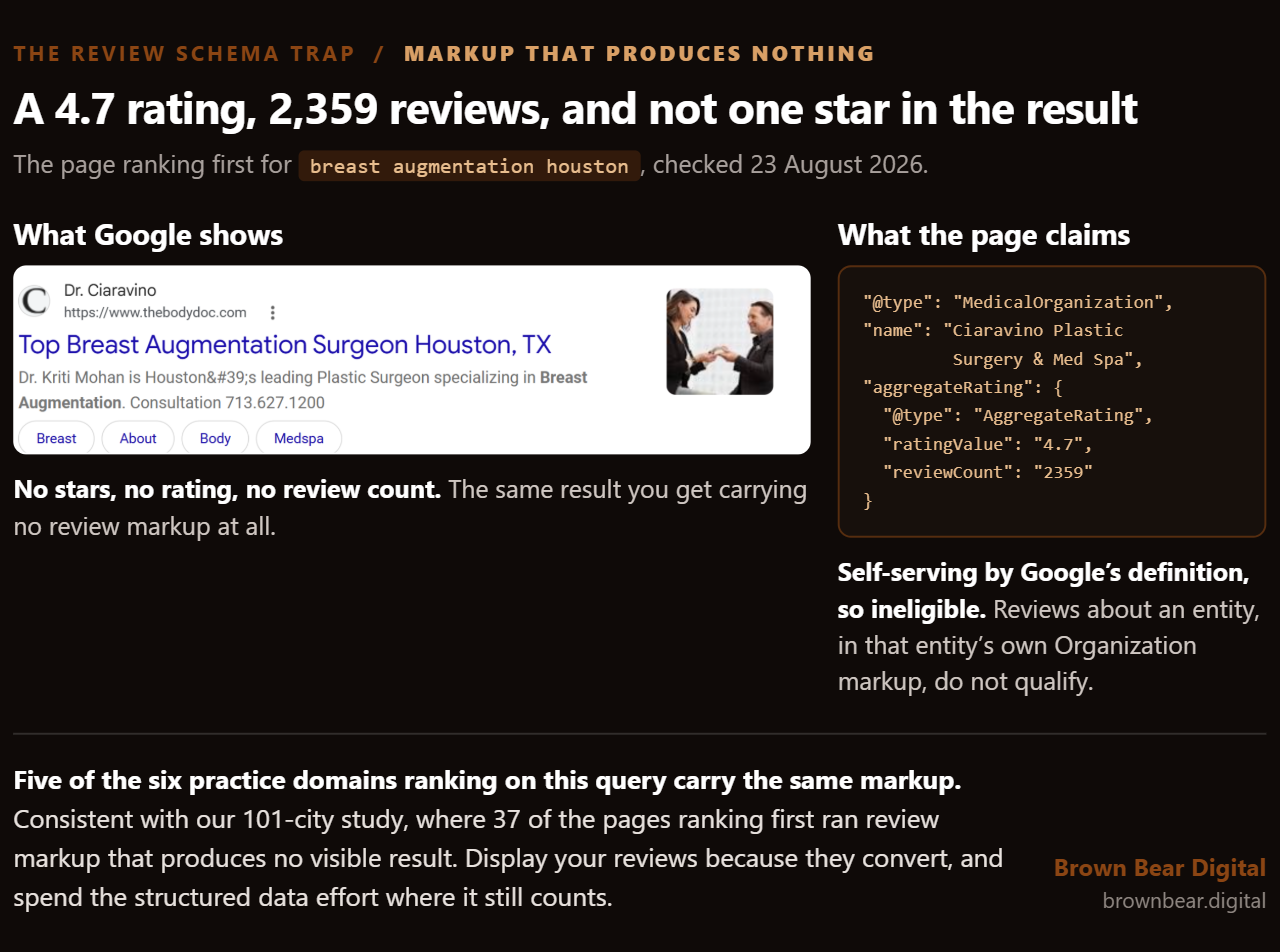
What to do instead is unglamorous and effective. Display your reviews on your site because they convert, which they do, and drop the markup, which does not. Put your structured data effort into the types that are still eligible and still relevant to a practice, and put your review effort into the third-party platforms where the reviews are not self-serving and therefore still count. The reviews on your Google Business Profile do work that reviews on your own domain structurally cannot, no matter how you mark them up.
Grade the Reviews You Already Have
Before you change how you ask, find out what you have. The Review Anatomy Scorecard is a seven-point rubric you run against your own reviews, and it takes about fifteen minutes for a sample of twenty.
Pull your twenty most recent reviews. Score each one out of seven, one point per element present:
- Names a specific provider
- Names a specific procedure or service
- Describes what changed for the patient
- Describes the experience of working with the doctor or team
- Mentions location, travel, or a comparison
- Includes a photo or video
- Was posted in the last six months
Add the twenty scores and divide by twenty. That is your corpus average, and here is what it means:
| Corpus average | What it means | The move |
|---|---|---|
| 0.0 to 1.5 | Decorative. Your reviews move your rating and nothing else | Change the ask before collecting another review |
| 1.6 to 2.9 | Typical. This is where most practices land | Add the three prompt questions; expect 1 to 2 points of lift within a quarter |
| 3.0 to 4.4 | Working. Your reviews carry retrievable content | Push on your weakest single element rather than the average |
| 4.5 and up | Rare. Your review corpus is a genuine search asset | Protect the flow; this is a recency problem now, not a composition one |
Review Anatomy X-Ray
Paste one of your patient reviews. See what search can actually read.
Nothing leaves your browser. Scored against the seven elements in this article.
For informational purposes only. Detection is keyword-based and approximate, so treat a miss as a prompt to read the review yourself rather than a verdict. This is not medical, legal, or compliance advice, and results are not a guarantee of search performance. Everything you type stays in your browser: nothing is stored, sent, or transmitted anywhere.
Score the elements separately as well as the total, because the total hides the useful information. Most practices we score come out low on the same two elements: the provider's name and the procedure name. Those two are also the easiest to lift, because they are the two the three prompt questions produce directly, and in our client work they are the two that track most closely with movement on procedure terms.
Then take four steps, in this order:
- Score your last twenty reviews and write down which of the seven elements is weakest.
- Replace your current review request with the three open questions, and remove any star-rating prompt from it.
- If you do surgical work, add a second request at six to twelve months post-op and treat it as the important one.
- Rescore twenty reviews ninety days later and compare. If the weakest element has not moved, the request is still doing the talking, not the patient.
The near-term payoff is that you stop guessing. Within an afternoon you will know whether your reviews are an asset or a number, and you will know which single element to fix first. The longer-term payoff is a review corpus that works while you sleep: text that answers the exact question a patient types, in their words, from a source that is not you. That is the version of reputation that compounds, and it is available to any practice willing to change what it asks for rather than how often. If you want the collection and response machinery around this, our full review generation and response system covers the operational side in depth.
Work With Brown Bear on Your Practice's Review Content
Most practices arrive at this problem the same way: the review count is fine, the rating is fine, and the rankings have not moved. Brown Bear works with plastic surgery and medical practices on exactly that gap, where the raw materials are already there and nothing is being built out of them. If your reviews are scoring in the decorative band and you would rather fix the input than collect another two hundred, talk to Brown Bear about your practice's search and we will score your corpus with you.
Written By
Founder, Brown Bear Digital
Bryan has 15 years of experience across SEO, paid search, and AI search strategy. He founded Brown Bear to give businesses direct access to senior-level search expertise without the agency overhead.
Learn More About BryanGet Found on Google.
Get Cited by AI.
Tell us about your site. We'll send back a proposal for SEO and AI search.