Multi-Location SEO for Medical Practices: Growing Every Office Without Diluting Trust

Opening a second office should double your reach. For a lot of medical practices, it quietly does the opposite. The new location struggles to show up in search, the flagship keeps winning every query, and patients in the new market book with whoever Google puts in front of them. This is Brown Bear's plain-language guide to multi-location SEO for medical practices: how to make every office visible in its own market without weakening the trust your brand has already earned.
At Brown Bear, we run SEO and AI-visibility programs for healthcare brands, including plastic surgery practices with more than one office. The guidance here comes from that client work: the audits we run, the listings we untangle, and the patterns we see when a practice grows from one address to several.
When we say multi-location SEO, we mean both the dental group adding a second office across town and the surgical practice operating in three different metros. The playbook is the same; the weight you put on each piece changes. And because Google classifies health topics as Your Money or Your Life content, the quality bar sits higher for you than it does for a restaurant chain running the same play.
If you're about to open a second office, you want the new location earning patients from day one instead of coasting on the flagship's reputation. If you already run several offices, you may be watching one location dominate while the others barely register. And if you're the administrator or marketing lead who inherited SEO for all of them, you need a system you can run every month, not another list of tips.
Key Takeaways
One website, many offices
Subfolders on a single domain beat separate sites; every link, review, and citation feeds one brand's authority.
Location pages must pass the Doorway Test
Five signals separate a real location page from a template with a city name. The interactive scorer below grades yours.
You have two listing layers, not one
One Google Business Profile per office, plus practitioner listings for the providers patients search by name.
Reviews are per-location currency with a compliance edge
A new office starts at zero reviews, and HHS has fined practices for how they replied to reviews. Respond without ever confirming a care relationship.
AI search multiplies with locations
Head terms belong to the big authority sites, but procedure-plus-local AI answers are winnable in every market you have an address in.
By the end of this guide, you'll know how to structure the website, what each location page has to prove, which Google listings your practice is actually entitled to, and how to measure each office like its own business. We've grouped it into four parts: the foundation, your Google surfaces, the growth calls, and the proof it's working. Let's start with what makes this a different game for a medical practice than for a retail chain.
Why Multi-Location SEO Is Different for Medical Practices
Multi-location SEO is the work of earning each physical office its own visibility in its own local market: its own map pack presence, its own location page, its own reviews, and its own listings. It is not one campaign copied across addresses. It is several local campaigns sharing one brand.
Two things make it different for medical practices. The first is proximity. Google's local results lean heavily on the distance between the searcher and your office. A strong office across town does not rank you in the suburb where your new office just opened. Each location has to earn its own market, which is exactly why each location is also an opportunity: every new office is a chance to be the closest credible option for thousands of patients your flagship could never reach.
The second is trust. Google's search quality guidelines classify medical content as Your Money or Your Life, which means the pages and profiles representing your practice are held to a higher evidence standard than most local businesses face. We've broken down what that standard rewards in our guide to E-E-A-T for plastic surgeons. In practice, that standard multiplies with every office. Ten locations means ten sets of reviews a prospective patient might read, ten listings that need accurate provider information, and ten pages Google evaluates for expertise. Done well, that multiplication compounds in your favor: a patient in any of your markets finds a nearby office wrapped in the credibility of the whole group. Done carelessly, one neglected location drags on the trust of all of them.
The benefit stack is real: more map-pack surfaces, review volume that compounds per listing, rankings for procedure-plus-city searches in every market you enter, and a bigger footprint in the third-party sources AI assistants now read. The rest of this guide is how to collect those benefits without tripping over the traps.
One Website or Several: The Structure Decision
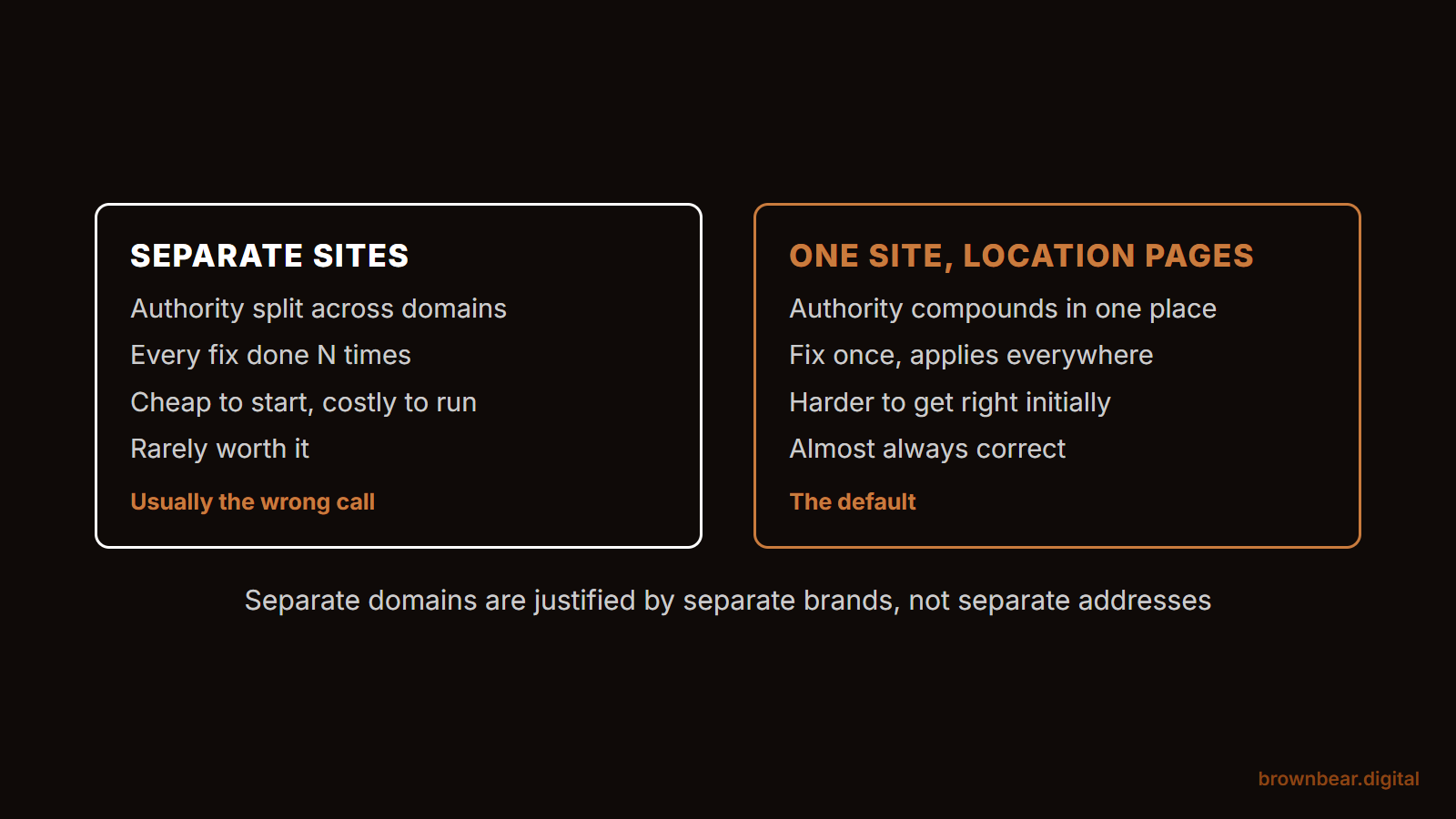
Keep one website. Give each office its own section of it. For nearly every medical group, subfolders on a single domain, like yourpractice.com/locations/austin, beat separate websites per office, because every link, citation, review, and press mention feeds one domain's authority instead of splitting it three ways. Separate domains mean each office starts from zero. A shared domain means office number four launches with the accumulated trust of the first three.
The deciding factor for how you build inside that domain is geography. If all of your offices share one metro, structure around neighborhoods and services: one strong homepage for the brand, one page per office, and service pages that mention the neighborhoods each office serves. If your offices sit in different cities or states, give each market its own subfolder with its own location page and, where offerings genuinely differ, its own service pages. A patient in Austin should be able to browse your Austin presence without wading through Dallas content.
Name locations consistently everywhere they appear: on the site, in listings, in directories. A predictable pattern like "Practice Name, Northlake" or "Practice Name, Concord Mills" helps patients pick the right office and helps Google connect each listing to its page. It does the same job for AI assistants, which is one of the three jobs GEO names. Inconsistent naming is one of the quietest ways multi-location practices confuse the map.
Location Pages That Pass the Doorway Test
Every office needs its own page, and the page has to prove the office is real, distinct, and worth choosing. The fear we hear most often is some version of: if I write eight location pages, won't Google flag them as duplicate content? The fear is pointed in the right direction but aimed at the wrong thing. The problem is not having many pages. The problem is having many copies of one page.
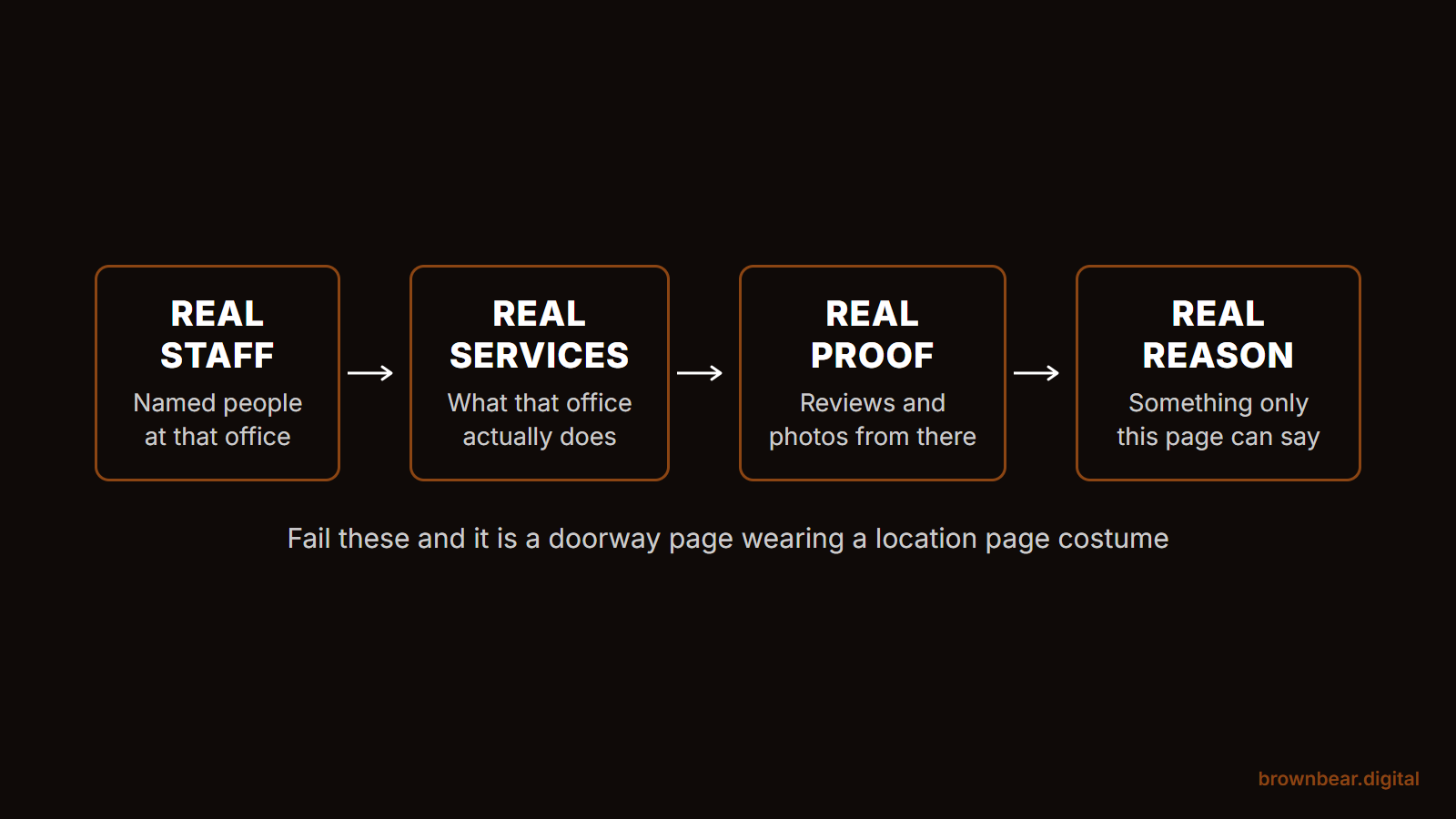
We use a standard for this called the Doorway Test: five signals that separate a real location page from the swap-the-city-name pages Google's spam policies treat as doorway abuse.
- Details only this office has. Photos of the actual space, the office's own hours, parking directions, the insurance plans this location accepts.
- The providers who practice here, by name. Patients choose people, not addresses, and provider names are what Google connects across listings, directories, and your site.
- The services actually offered here. Not the full group menu pasted everywhere. If implants happen at one office and orthodontics at another, the pages should say so.
- Proof of local presence. Reviews from this office's patients, community involvement, the neighborhoods and landmarks patients actually use to describe where you are.
- Standalone usefulness. If Google didn't exist, would a patient still use this page to choose the office and show up prepared? If not, it's a doorway with better manners.
Picture a dental group with offices in Concord and Davis Lake. Both location pages list the same twelve services in the same order, with the city name swapped in the intro. Both fail signals one through three. The rewrite gives Concord its two hygienists by name, its Saturday hours, its Sedation Friday program, and the note that it sits behind the Harris Teeter off Highway 73. Nothing about that page can be mistaken for Davis Lake's, which is exactly the point: the page now reads like the office, not like the template.
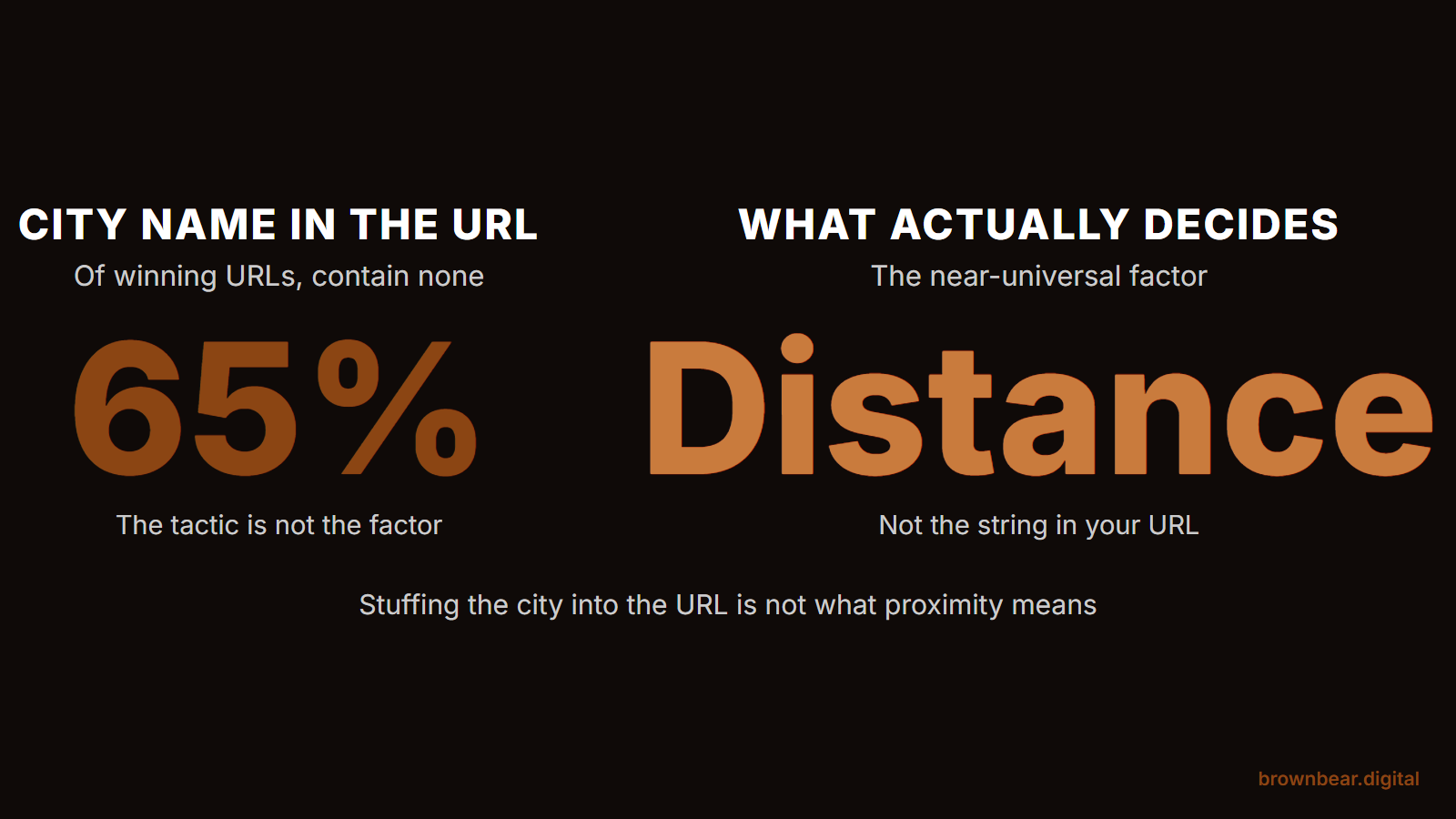
Two structural details from our 101-city study of #1-ranking procedure pages are worth borrowing when you build these. The city belongs in the title tag, which appears on 90% or more of the winners and is the closest thing to a universal ranking factor in the data, but 65% of those winning URLs contain no city name at all. Resist stamping every slug with a metro. And a multi-geo title is a proven pattern rather than a compromise: one winner titled "Breast Augmentation Scottsdale AZ, Plastic Surgeon Phoenix" holds #1 in both markets from a single page. Where two offices sit in adjacent metros and a page each would come out thin, that is the safer build.
Interactive check
The Doorway Page Test
Answer for ONE of your location pages. Ten questions, two per signal. Your answers stay in your browser; nothing is sent anywhere.
Signal 1 - Details only this office has
Signal 2 - The providers who practice here
Signal 3 - The services actually offered here
Signal 4 - Proof of local presence
Signal 5 - Standalone usefulness
For informational purposes only; results reflect your answers, not a guarantee of search performance, and are not professional advice. Your answers stay in this browser and are never transmitted.
Google Business Profiles: Location Listings and Practitioner Listings
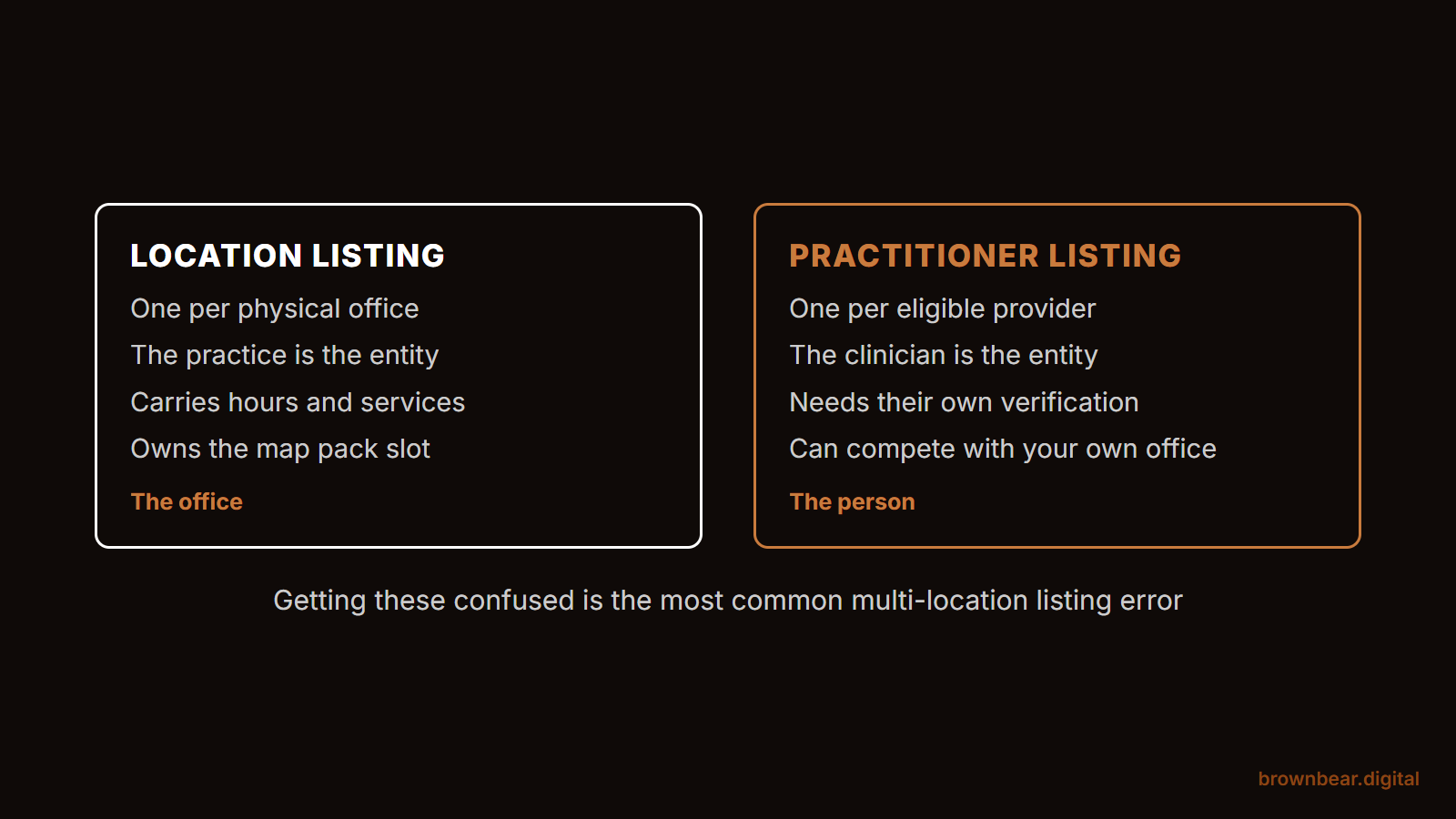
Your practice is entitled to one Google Business Profile per physical office, and each patient-facing provider can hold their own practitioner listing on top of that. This is spelled out in Google's guidelines for representing your business, and it is the single most under-used fact in medical local SEO. Most multi-location guides never mention practitioner listings because they're written for retailers. A retailer has storefronts. You have storefronts and named clinicians patients search for directly. Our Google Business Profile guide for plastic surgeons covers profile-level optimization; here we focus on the architecture.
That second layer is half the opportunity and, unmanaged, half the mess. In the AI-visibility audits we run for plastic surgery practices, the most common error is not wrong information. It's odd variations of the practice's name, address, and phone number scattered across location and practitioner listings: an old suite number here, a legacy practice name there. Individually harmless, collectively they blur the map Google is trying to draw of your group. The fix is unglamorous and local, and it's usually the first thing worth doing.
Whether to invest in practitioner listings depends on how patients find you. If the providers are the brand, meaning patients search "Dr. Chen facelift" more than they search your group's name, build each surgeon's listing and bio page as seriously as any location: consistent name, the office where they actually practice, a linked bio with credentials and procedures. If the group is the brand and providers rotate between offices, keep practitioner listings claimed, accurate, and minimal so they reinforce your locations instead of competing with them. The deciding factor is the search behavior, not the org chart.
Say a three-surgeon plastic surgery group runs offices on both sides of town, and one surgeon operates at both. Her unclaimed practitioner listing still shows the office she left two years ago. A prospective patient books a consultation, drives twenty minutes to the wrong side of town, and starts the relationship annoyed. Claiming the listing, pointing it at the office where she actually consults, and linking it to her bio page costs an afternoon. It's the highest-leverage afternoon in this guide.
Interactive guide
GBP Listing Architecture Picker
Five questions about your practice. Get the exact set of Google Business Profile listings you should hold, per Google's rules for healthcare businesses. Nothing you enter leaves this page.
1. How many physical offices does the practice have?
2. Are your offices in one metro area or spread across markets?
3. Do patients search for your providers by name, like "Dr. Chen facelift"?
4. Does any provider see patients at more than one office?
5. Does each office have its own local phone number, or does one central line answer for all?
Recommendations follow Google's guidelines for representing businesses and individual practitioners; they are informational only, not professional or legal advice, and outcomes are not guaranteed. Your answers stay in this browser and are never transmitted.
Reviews at Scale Without a HIPAA Problem
Reviews are per-location currency. Each office's listing ranks partly on its own review volume, rating, and recency, and prospective patients read the reviews for the office they would actually visit. Reviews belong to the individual listing, and a brand-new listing starts with none, even when the flagship has six hundred five-star reviews. Budget for that: the new office needs its own steady ask, its own review link, and its own response routine from the week it opens. We've covered how review generation and response shape SEO in depth; what follows is the multi-location and compliance layer.
For medical practices, the response routine is where HIPAA walks in. Even confirming that a reviewer was your patient is protected health information. The Department of Health and Human Services has settled with practices over exactly this, including a $30,000 settlement with a New Jersey mental health practice that replied to negative Google reviews with patient details. The safe pattern is simple and repeatable. Respond to every review without acknowledging a care relationship, keep the reply generic and courteous, and move anything substantive offline: "We take feedback seriously and would welcome the chance to talk. Please call our office manager at this number." Train whoever answers reviews at each location on that pattern before they ever type a reply. Our full guide to HIPAA compliance in medical SEO includes a copy-paste compliant reply system.
Run the ask at the same cadence in every office: a per-location review link at checkout, a monthly look at volume and rating per listing, and a flag when any office falls behind the group. Uneven review growth is one of the earliest signals that a location's patient experience, or just its front desk process, needs attention.
Citations: The Core Stack Plus the Medical Directories
Citations are the listings of your name, address, and phone number across the web, and the rule for multi-location groups is: each office gets its own complete, consistent set. Start with the core four every business needs: Google, Apple Maps, Bing Places, and Yelp. Then add the layer most guides skip, because it belongs to you and not to retailers: the medical directories. Healthgrades, Zocdoc, Vitals, and WebMD for physicians and clinics. RealSelf for plastic surgery, where our full RealSelf strategy guide applies per provider. The American Dental Association's Find-a-Dentist and your state dental board listings for dental groups. Each provider's directory profiles should point at the office where that provider actually sees patients.
The reason to care goes beyond consistency for its own sake. What surprises the practice owners we work with most is how much third-party sites, meaning reviews, directories, and press, drive their visibility and sentiment inside AI search tools. When a patient asks an assistant who the best dentist near them is, the answer is assembled largely from what those third-party sources say. Your directory footprint stopped being a checkbox exercise; it became source material.
The City Where You Don't Have an Office
Whether you can rank in a city without an office there depends on which kind of result you're trying to win, and most advice fails by not splitting the two. The map pack is proximity-bound. Without a real address in that city, you will not sustainably crack a competitive medical map pack there, and renting a virtual office to fake one violates Google's guidelines and risks suspension of the listings you already have. The organic results below the map are different. A genuinely useful "serving north Phoenix" page can rank organically and bring real calls, and practices do this successfully.
So the question becomes whether the chase is worth it, and that forks on how far your patients travel. If you're the kind of practice patients choose partly on convenience, a med spa, a dental office, a primary care clinic, your realistic radius is the drive patients will actually make, usually somewhere in the thirty to forty-five minute range. One strong service-area page targeting the adjacent city can earn organic visibility with the patients willing to make that drive, and it's worth building. If you're a destination practice, surgical and specialty groups where patients already travel and research for months, thin city pages are the wrong investment entirely. Put that effort into procedure content and brand strength, because your patients are searching by procedure and reputation, not by suburb.
Imagine a med spa owner in Scottsdale who builds one thorough page about serving north Phoenix: real drive times, which treatments patients typically travel for, reviews from Phoenix patients who made the trip. Six months later that page sits fourth in organic results and books a handful of Phoenix patients every month, while her map presence still ends at the city line. Nothing is broken. She's winning the result that was available and skipping the one that wasn't.
Measuring Each Office Like Its Own Business
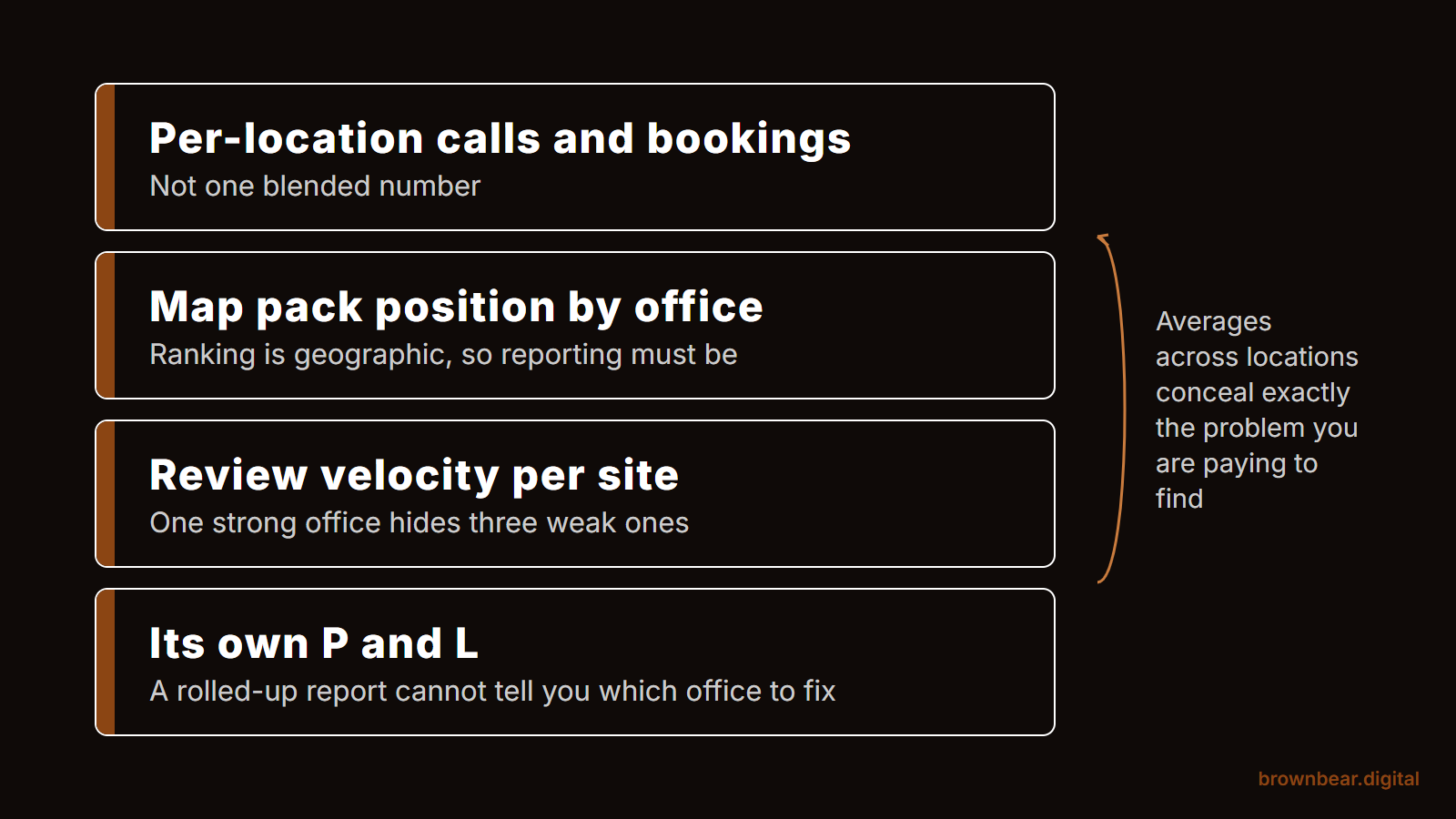
Group-level analytics hide exactly what multi-location SEO needs you to see. The flagship's numbers paper over the second office's stall. The fix is a per-location scorecard, reviewed monthly, that treats every office like its own small business. It pairs with the KPIs your practice should actually measure at the group level.
- Set up per-location tracking: a unique tracking phone number and UTM-tagged website link on each Google Business Profile, and location page conversions tracked separately in your analytics.
- Build the scorecard: map-pack position in that office's own radius, profile actions like calls, direction requests, and bookings, location page sessions and conversions, and review count and rating.
- Compare offices against each other monthly. Your own best location is the most realistic benchmark you'll ever get.
- Move effort to the laggard. Uneven results are normal; permanent unevenness means the trailing office isn't getting the ask, the content, or the attention the leader gets.
One number worth adding to the scorecard now: referrals from AI assistants. In our client programs, traffic referred by tools like ChatGPT converts to consultations and form fills at a higher rate than most channels, and it's more engaged on-site. The volume is still small, which is exactly why it's worth watching. Adoption only moves one direction.
Where AI Search Fits for Multi-Location Practices
AI search splits the territory in a way that favors multi-location practices more than most owners expect. For head terms like "what is rhinoplasty," the answers are dominated by large authority sites: the Mayo Clinics and professional societies of the world. Competing there is not a realistic goal. But for local and cost-flavored queries, the door is open. In our work with plastic surgery practices, surgeons show up in AI answers for procedure-plus-local searches because the engines infer local intent, and every additional office multiplies the local queries your practice can be the answer for.
The patient journey is also compressing. Inside one chat session, a prospective patient moves from "what type of breast augmentation is right for me" to "who's the best surgeon near me" without ever bouncing across websites. Being the answer to the second question depends on the same fundamentals this guide has covered: consistent listings, real location pages, per-office reviews, and a strong third-party footprint, because those are the sources the assistant reads.
Two practical notes from our audits. First, crawlability beats cleverness. Large language models crawl JavaScript poorly, and we routinely strip heavy scripts off client sites so the content is actually readable by the tools assembling answers. Second, schema markup is worth maintaining but overhyped as an AI lever; treat it as hygiene, not strategy. The bigger levers are structured, easily parsed content and the off-site footprint from the citations section above. That is the work our AI search visibility service is built around.
Grow Every Location with Brown Bear
Multi-location SEO rewards the practices that treat it as a system: one trusted brand, and a full local campaign underneath every address. Brown Bear builds and runs that system for healthcare brands, from the website structure down to the practitioner listings, with AI visibility built in rather than bolted on. If your next office deserves better than coasting on the flagship's reputation, talk to us about a healthcare SEO program built for every market you're in.
Written By
Founder, Brown Bear Digital
Bryan has 15 years of experience across SEO, paid search, and AI search strategy. He founded Brown Bear to give businesses direct access to senior-level search expertise without the agency overhead.
Learn More About BryanGet Found on Google.
Get Cited by AI.
Tell us about your site. We'll send back a proposal for SEO and AI search.