Mental Health Marketing: What 22 Google Results Pages Show About Who Wins Psychiatry, Rehab and IOP Searches
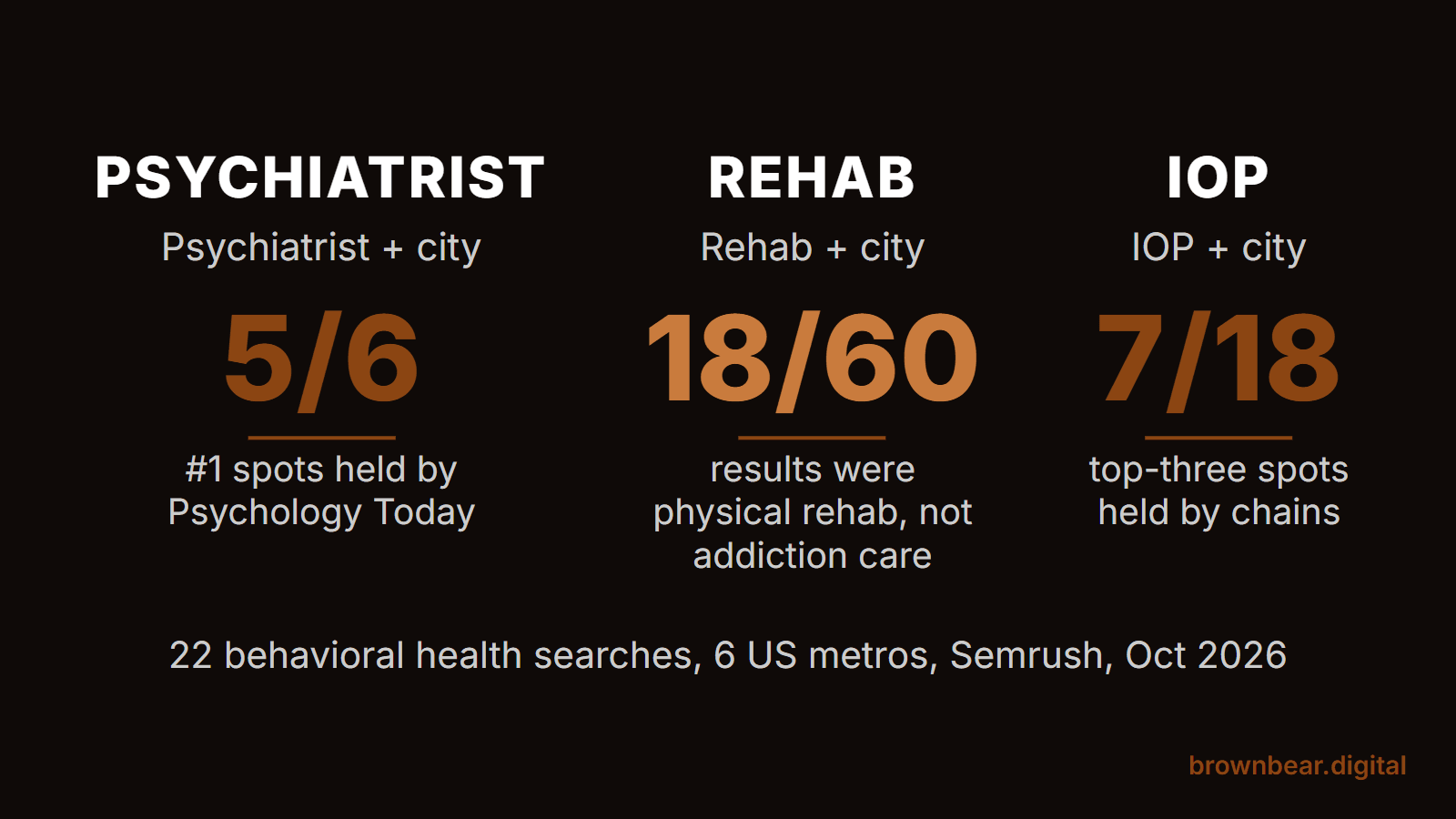
Most mental health marketing advice is written for a solo therapist with a Psychology Today profile. It tells you to claim your Business Profile, post on Instagram and ask for reviews. That advice skips the questions a psychiatry group, an intensive outpatient program or an addiction treatment center faces. Who holds page one in your city? Which ads are you allowed to run? What is your tracking code allowed to see? We pulled the top 10 Google results for 22 behavioral health searches across 6 US metros and sorted every result by who runs it. Psychology Today held #1 for "psychiatrist" plus a city in 5 of 6 cities. Almost a third of the results for "rehab" plus a city were physical rehabilitation hospitals and nursing centers, not addiction care. And on "intensive outpatient program" plus a city, hospital and program chains held 7 of the 18 top-three spots. This is Brown Bear's guide to mental health marketing for the organizations that treat people at more than one level of care.
It draws on that October 2026 Semrush pull and on the published rules from Google, HHS and federal law, each checked the same week. It also draws on what Bryan Passanisi, founder of Brown Bear Digital, has seen running local SEO, paid search and AI search programs for medical practices. That is another field where trust, privacy and licensing shape every page.
Mental health marketing here covers both the classic work and the rules around it. The classic work is your website, your program pages, your Business Profiles, directories, reviews and paid search. The rules are what make this field different from dentistry or dermatology. They include LegitScript certification for addiction ads, limits on health audiences, HIPAA guidance on tracking pixels and federal law on paying for referrals. It covers psychiatry and medication management, IOP and PHP programs and residential and outpatient addiction treatment.
If you market an addiction treatment center, you want to know why your Google Ads account keeps getting limited. You also want to know if lead vendors are worth the risk. If you own a psychiatry or medication-management group, you want to know if your own site can win. Your rivals are Psychology Today, LifeStance and the hospital down the street. And if you direct an IOP or PHP program, you want to know how a single-site program gets seen next to Acadia and Universal Health Services.
By the end, you'll know which searches each kind of organization can win and which ones belong to directories, hospitals and government locators. You'll know what Google, HHS and federal law say about ads, tracking and referrals, and how to keep crisis searches out of your marketing. You'll also know what this work costs in admissions or new patients, and how to judge an agency's pitch. The longer payoff is a census or a schedule that fills from your own name and your own programs, not from a lead vendor you can't vet.
We've grouped it into four parts: who holds page one, the rules that shape every campaign, the playbook for each type of organization and the business side of cost and hiring. Start with what mental health marketing is supposed to produce.
What Mental Health Marketing Is for Clinics, Programs and Treatment Centers
Mental health marketing is the work of getting a behavioral health organization found and contacted by people who need its level of care. It happens inside the rules that govern health advertising and patient privacy. For a psychiatry group, the contact is a new-patient appointment. For an IOP or PHP, it is an assessment. For an addiction treatment center, it is an admission. The goal is the right person reaching the right level of care. Traffic is not the goal.
That goal is harder here than in most of healthcare. Three kinds of gatekeepers sit between you and the person searching. Directories own the broadest searches. Hospital systems and multi-state chains own many program searches. And the words people use are ambiguous: "rehab" means a knee replacement to one searcher and a detox bed to another. Mental health marketing means three jobs: choose the searches you can win, build the page that wins each one and keep every campaign inside the rules.
If you run a solo or small therapy practice, your playbook is different, and we cover it in our guide to SEO for therapists. This guide starts where that one stops: organizations with prescribers, programs or beds.
The Behavioral Health Page-One Map: Who Holds Google's Top 10 for Psychiatrist, Rehab and IOP Searches
We pulled the top 10 organic results from Semrush for "psychiatrist," "rehab" and "intensive outpatient program" plus 6 cities: Houston, Phoenix, Atlanta, Denver, Philadelphia and San Diego. We added 4 national searches: online psychiatrist, intensive outpatient program, addiction treatment centers and psychiatric medication management. That is 218 results. We then opened each ranking page and checked who runs it, using parent-company links, careers links, legal names in the page code and footer lines.
Independent practices and centers held the most results of any group, 66 of 218. But who holds the top of the page changes completely by search type. The map below lets you check each one.
Three patterns decide where a behavioral health budget should go. On psychiatrist searches, the directory is the gatekeeper. On rehab searches, the word itself is the problem. On IOP searches, the hospital chains are the competition, and they win with program pages, not homepages. Each pattern calls for a different plan, so we take them one at a time.
Psychiatrist Searches: Psychology Today and Health Systems Hold the Top, Practices Hold the Middle
On "psychiatrist" plus a city, Psychology Today held #1 in 5 of 6 cities. In the sixth, Houston, UT Physicians held #1 and Memorial Hermann held #2, with Psychology Today at #3. Directories and hospital systems together took 13 of the 18 top-three spots. Zocdoc ranked in 3 cities and U.S. News in 2.
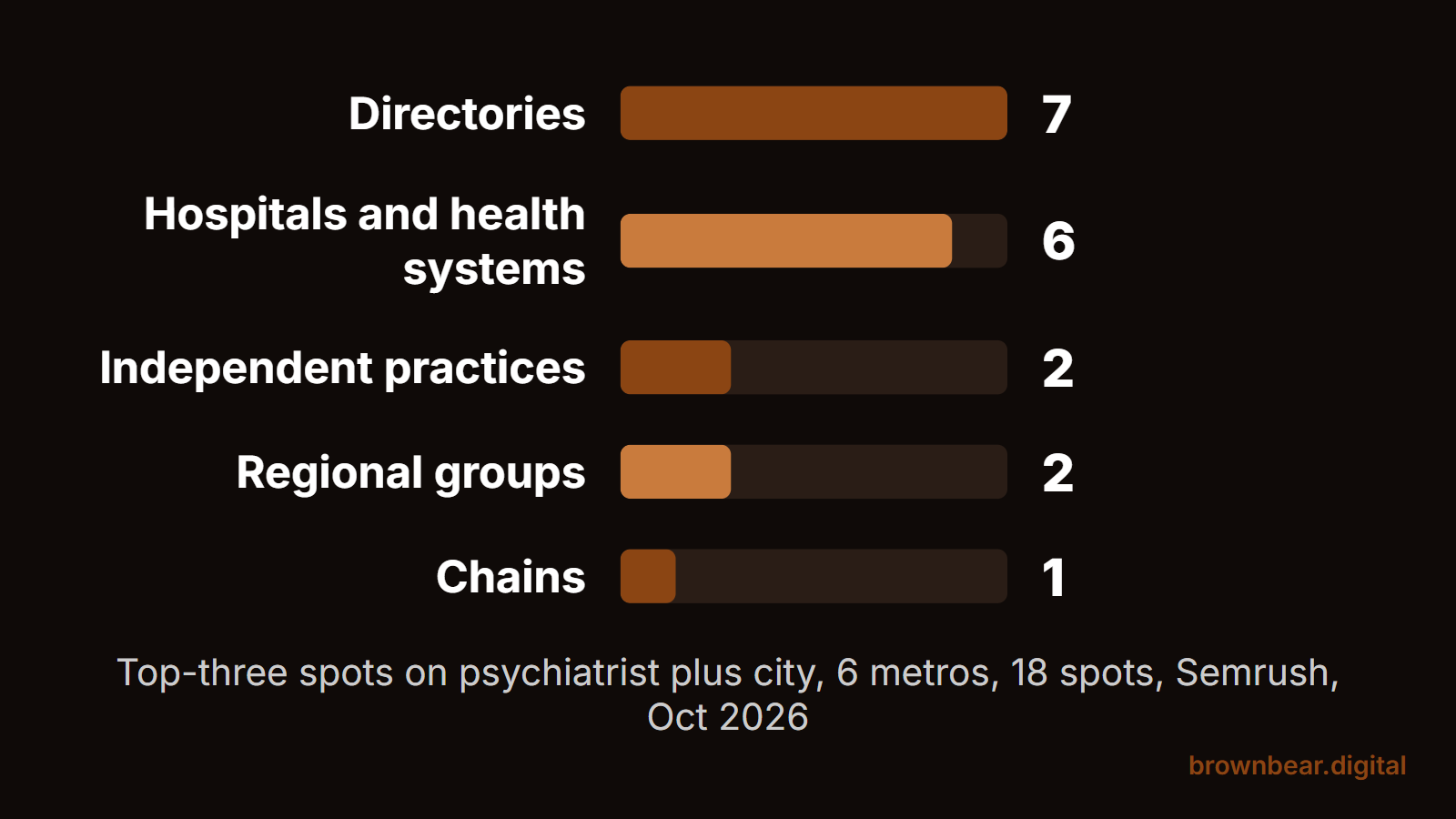
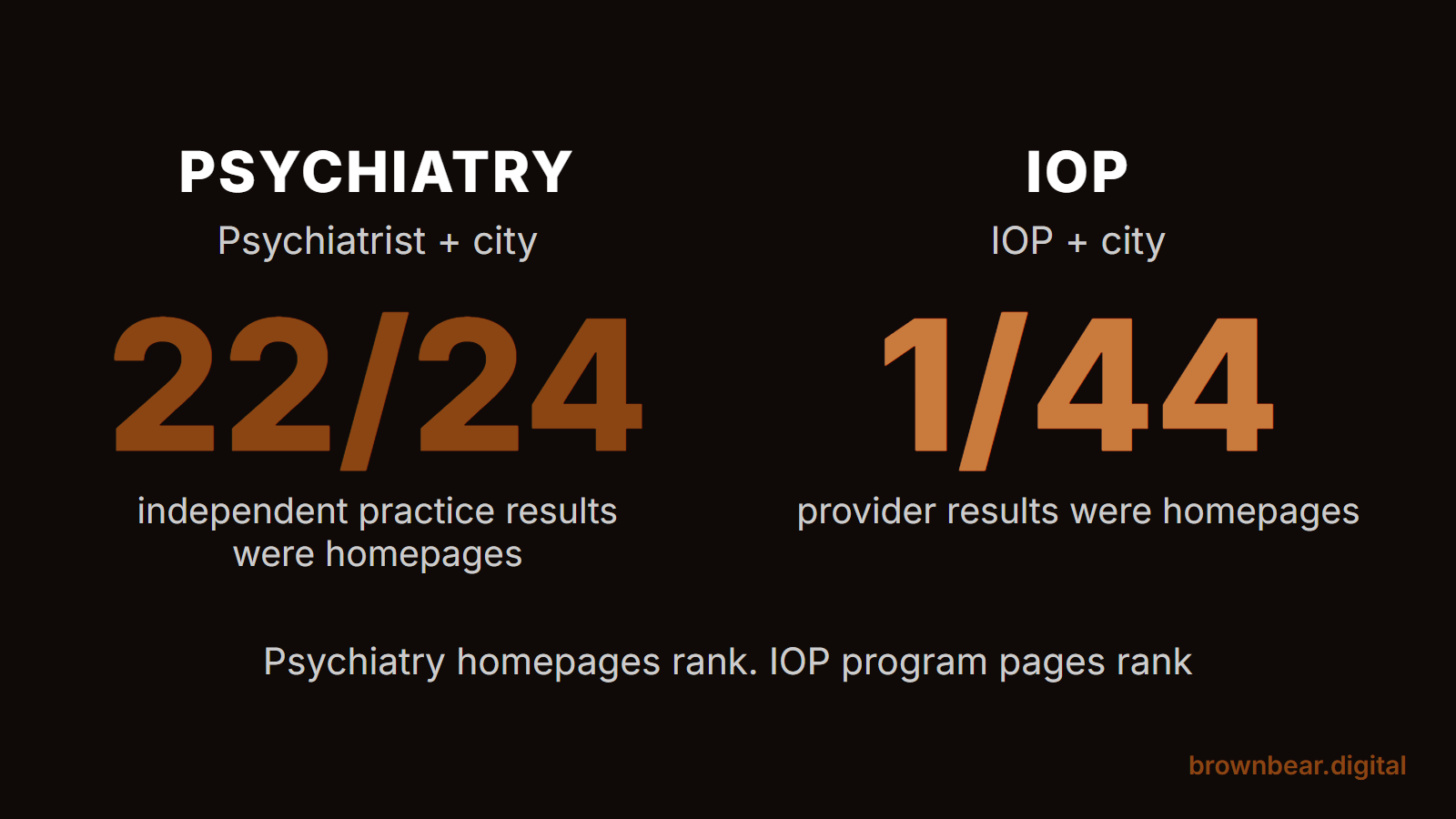
Below the top three, the page belongs to practices. Independent psychiatry practices were the largest group, 24 of 59 results, and 22 of those 24 ranked with their homepage. Psychiatric Consultants of Atlanta held #2 in Atlanta, and KMG Psychiatry held #3 in San Diego. The chains were thinner than their ad budgets suggest: LifeStance ranked in 3 cities, with #2 in Denver, and Mindpath Health in 2. Telehealth brands did not rank in any of the 6 city searches.
That shape tells a psychiatry group to work two lanes at once. Your directory profiles are your storefront on the head term. Treat your Psychology Today and Zocdoc listings as pages you maintain, with current insurance, current availability and a clear note on whether you prescribe. Your homepage is what ranks in the middle of the page. Near the top, in plain words, it has to say what you treat, who prescribes, which plans you accept and whether you are taking new patients.
That last point matters more than most practices think. In an r/Atlanta thread that ranked #10 for "psychiatrist atlanta," someone asked for psychiatrists outside one large group, and the replies turned on insurance. One person stayed with the group because it takes their plan. Another recommended a private psychiatrist who does not take insurance and costs more. A homepage that answers the insurance question in the first screen meets the searcher where the decision is actually made.
Picture a four-psychiatrist medication-management group in Denver. Its homepage opens with a mission statement, and its insurance list sits three clicks deep. Its Psychology Today profile still says it has a waitlist from last spring. Fix the profile, move "In network with Aetna, Cigna and Anthem. New patients seen within two weeks" to the top of the homepage, and the group now answers the two questions every searcher on that page is asking.
"Rehab" Plus a City Is Split Between Addiction Care and Physical Rehabilitation
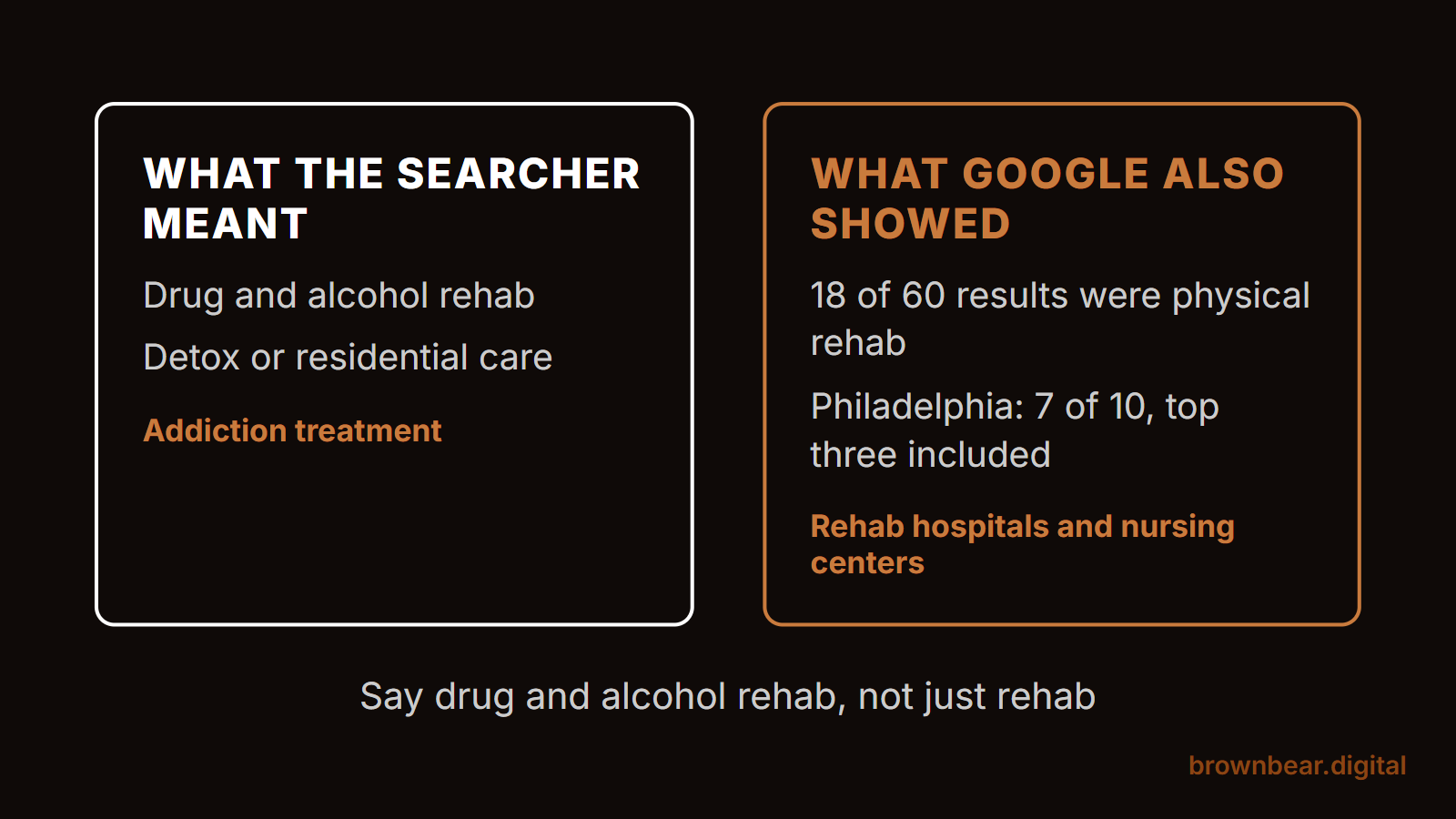
On "rehab" plus a city, 18 of 60 results were physical rehabilitation hospitals or nursing and rehabilitation centers, not addiction treatment. In Philadelphia, 7 of the 10 results were physical rehab, including the top three. In Phoenix, #1 was a rehabilitation and nursing center. Encompass Health and Reunion rehabilitation hospitals ranked in 2 cities each.
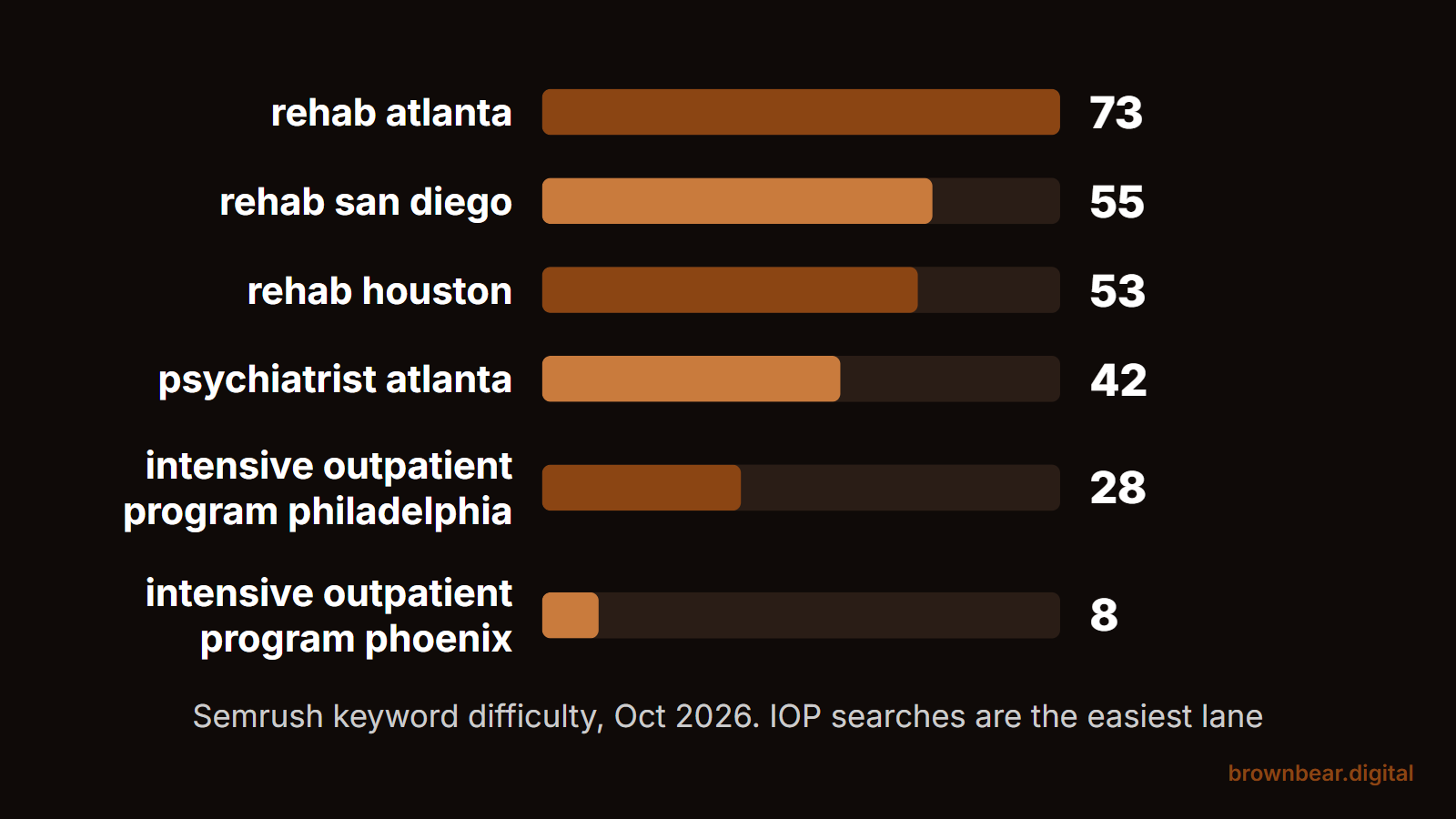
The rehab searches were also the hardest in the study. Semrush scored them 45 to 73 for difficulty, against 20 to 42 for psychiatrist searches and 8 to 28 for IOP searches. Among the addiction providers that did rank, independent centers outnumbered chain centers 16 to 7. Mile High Recovery Center held #1 in Denver, and Shoreline Recovery Center and AKUA Mind and Body held #2 and #3 in San Diego. Two directories showed up again and again: StartYourRecovery.org ranked in 5 of 6 cities, and Recovery.com held a top-three spot in Houston, Phoenix and Denver.
For an addiction treatment center, the lesson is to stop relying on the word "rehab" alone. Use the words that only your searcher uses: drug and alcohol rehab, addiction treatment, detox, residential treatment, outpatient addiction treatment. Put them in your titles, your headings and your Business Profile description, so Google never has to guess whether you treat knees or alcohol use disorder.
Say you run a 30-bed residential program in Philadelphia, and your homepage title is "Rehab in Philadelphia." On that search, you compete with Jefferson Moss-Magee and Penn Medicine. Google has mostly handed that page to physical rehab. Retitle it "Drug and Alcohol Rehab in Philadelphia" and build separate detox and residential pages. Now the center competes in searches where every rival treats what it treats.
IOP Searches Are Where Hospital Chains Compete, and Program Pages Win
On "intensive outpatient program" plus a city, multi-state chains held 17 of 59 results and 7 of the 18 top-three spots. Universal Health Services, Acadia Healthcare and Meadows Behavioral Healthcare had 4 results each, and Lifepoint Health had 2. Health systems held #1 in Denver and Philadelphia. Psychology Today's treatment directory ranked in 5 of 6 cities.
The most useful number in this lane is about page type. Only 1 of 44 provider results was a homepage. Everything else was a program page: an IOP page, an adult outpatient page, a teen IOP page, a virtual PHP and IOP page. And the IOP searches were the easiest in the study, with Semrush difficulty of 8 to 28.
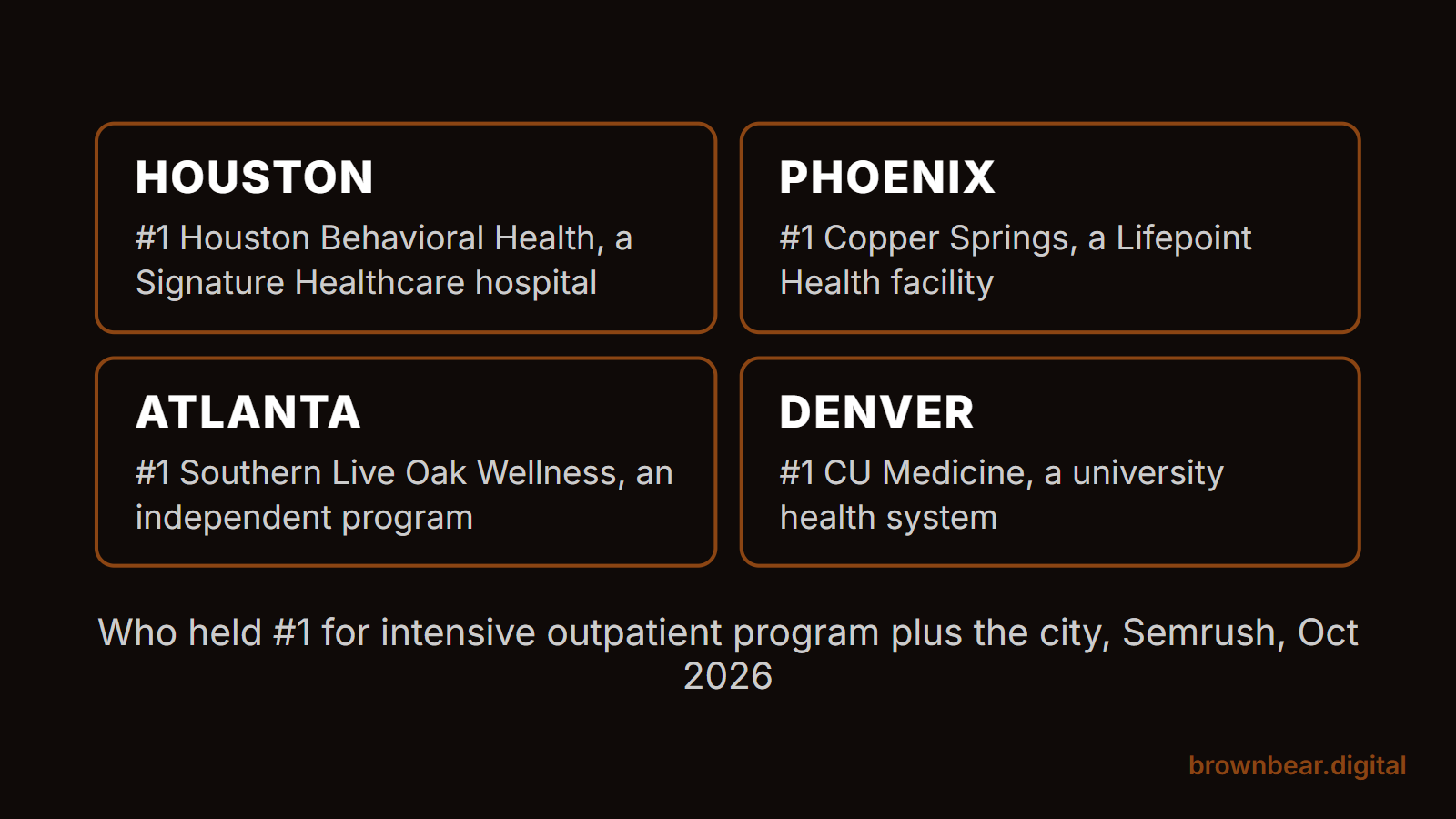
An independent program can win here. Southern Live Oak Wellness held #1 for "intensive outpatient program atlanta" with a dedicated IOP page. It ranked ahead of Meadows Behavioral Healthcare, Skyland Trail, Acadia's Riverwoods and Lakeview, and Universal Health Services' Anchor Hospital. Its page title names the program, the condition focus and the city. That is the whole playbook in one result.
Picture an IOP director at a single-site adult program in Atlanta. The program's only web presence is a paragraph on the homepage of its parent practice. Build one page per program and level of care: adult mental health IOP, PHP, and IOP for substance use if you offer it. Give each its schedule, its hours per week, who it's for, the insurance it takes and how to start an assessment. That program now has a page that matches what Google ranks on this search.
National Searches Belong to Government Locators and Telehealth Brands
The national searches are a different market. Government sites held 4 of the 12 top-three spots across the 4 national searches. Semrush puts "addiction treatment centers" at 6,600 searches a month, with a difficulty of 85. SAMHSA's National Helpline page held #1, New York's addiction services office held #2 and FindTreatment.gov, the federal treatment locator, ranked #8. On "online psychiatrist," at 12,100 searches a month, BetterHelp held #1 with an advice article, followed by Talkiatry, Zocdoc and Talkspace.
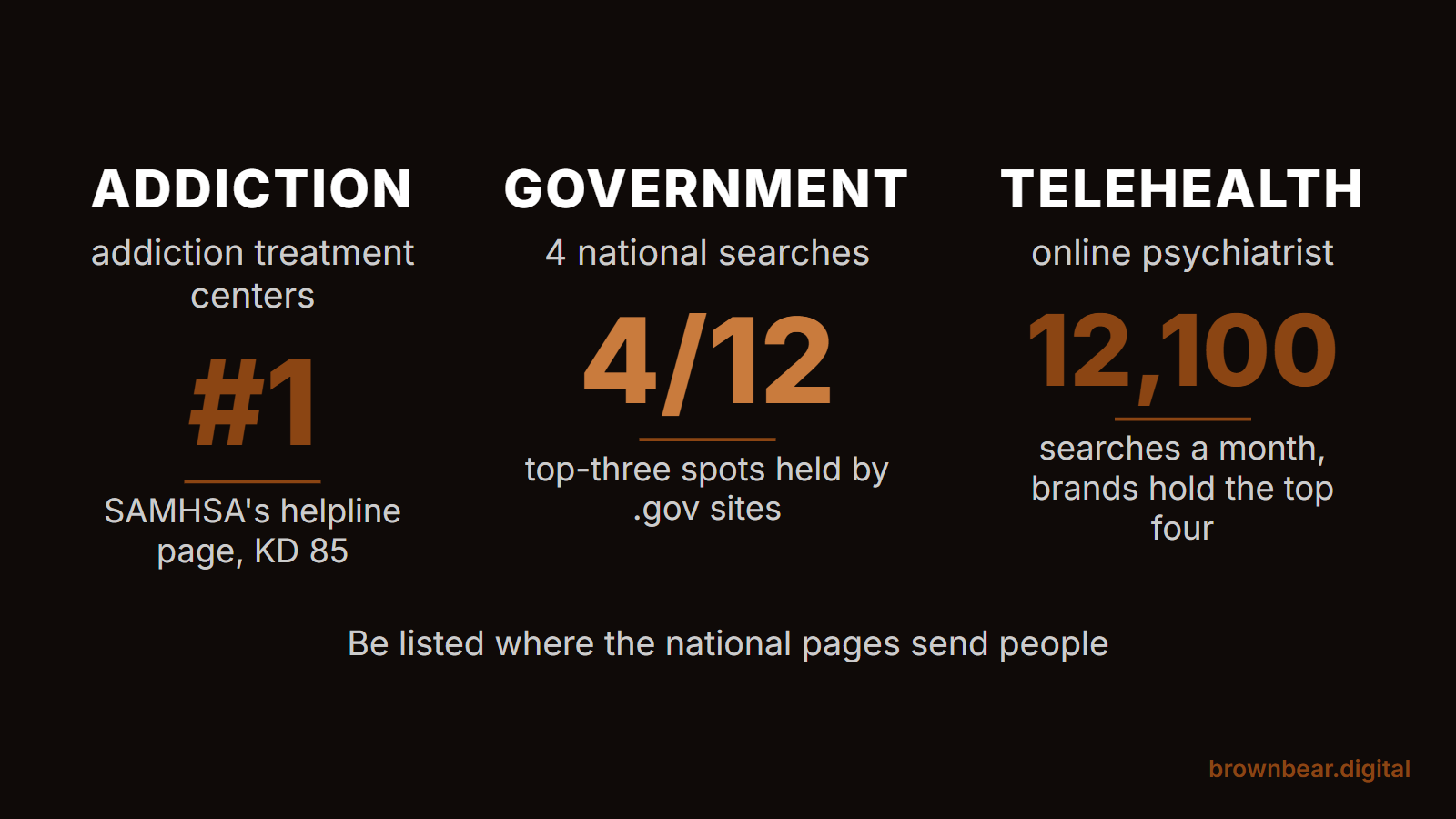
Most organizations should not build a plan around those terms. A single-state center will not outrank SAMHSA, and it should not try to outspend a national telehealth brand. The better move is to be present where those national pages send people. Keep your listing accurate in FindTreatment.gov and your state's own locator. Make sure your name, address and phone match everywhere they appear.
Google Ads for Addiction Treatment: LegitScript Certification and the Health Audience Limits
Google restricts the promotion of recovery-oriented drug and alcohol addiction services. In the United States, Google's healthcare and medicines policy requires two things. Advertisers must be certified as an addiction services provider by LegitScript, and they must be certified with Google. Services that can't get LegitScript certification can't advertise drug and alcohol addiction services on Google, and LegitScript charges a fee to process and monitor applicants. The same policy places services for behavioral addictions, impulse control disorders and nicotine outside the addiction services rule.
The certification shows up in organic results too. Of the 37 addiction treatment provider pages in our study that we could load, 21 mentioned LegitScript somewhere in their code. So did 14 of the 25 IOP program pages.
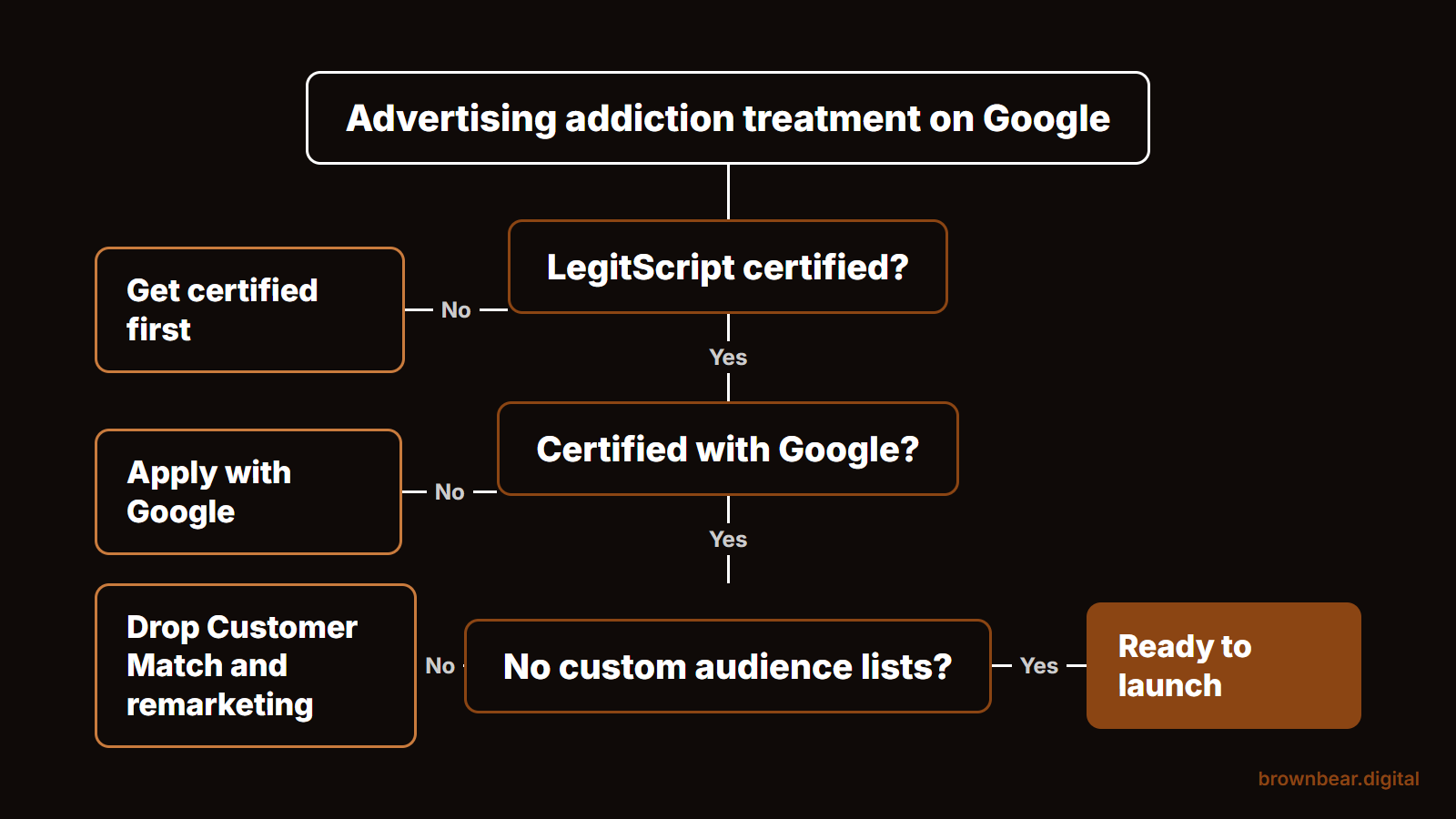
The second rule catches psychiatry groups and IOPs as well as addiction centers. Google's policy on health in personalized advertising lists counseling for depression, anxiety and addiction as examples of a sensitive health category. When you promote in that category, you can't use audiences you build yourself, including Customer Match lists, to target ads. Google's own predefined audiences remain available. In practice, that means no remarketing to past visitors and no uploading inquiry lists for ads about mental health or addiction services.
Bryan has opened many "Google Ads didn't work" accounts in medical practices, and the problems are almost always the same two. The campaigns were never set up or tuned for lead quality, and the clicks went to pages that weren't built to convert. In behavioral health, a third problem sits on top of those: an account that runs into policy limits nobody planned for. Before you scale spend, confirm your certification, build campaigns around the levels of care you actually offer and send each one to its own program page.
Tracking Pixels, HIPAA and the FTC: What a Behavioral Health Site Can Measure
The HHS Office for Civil Rights has published a bulletin on online tracking technologies used by covered entities and their business associates. One of its examples fits a behavioral health site exactly. Say a clinic's website lets someone request an appointment, and the site's third-party tracking code sends the appointment details and the person's IP address to the vendor. That vendor is a business associate. A business associate agreement is required.
Part of the bulletin no longer stands. On June 20, 2024, a federal court in Texas vacated one piece of it. That piece said HIPAA applies when tracking code connects a person's IP address with a visit to a public webpage, one with no login, about specific health conditions or providers. HHS says it is evaluating its next steps. The rest of the bulletin, including its guidance on pages behind a login and on business associate agreements, was not vacated. This is a summary of what the bulletin and the court note say, not legal advice; your counsel should map it to your site.
The Federal Trade Commission has enforced health privacy against behavioral health brands directly, including companies that are not HIPAA covered entities. In April 2024, the FTC announced a proposed order against Monument, an online alcohol addiction treatment service. It said Monument's tracking pixels sent custom events such as "Paid: Weekly Therapy," along with email and IP addresses, to Meta and Google from 2020 to 2022. The proposed order would ban Monument from sharing health data for advertising and includes a $2.5 million civil penalty, suspended because the company could not pay. In 2023, the FTC announced an order requiring BetterHelp to pay $7.8 million. The charges were that it shared email addresses, IP addresses and health questionnaire answers with Facebook, Snapchat, Criteo and Pinterest for advertising.
So measure what you need without handing ad platforms a diagnosis. These four steps cover most sites:
- List every script that runs on your appointment request, intake, insurance check and patient portal pages, and what each one sends.
- Get a business associate agreement from every vendor whose code touches patient information, or remove that code from those pages.
- Rename conversion events so they describe an action, like "form submitted," never a treatment or program.
- Track admissions and new patients in your EHR or CRM, and report those back to your marketing in aggregate.
For the wider picture on privacy and search, see our guide to how HIPAA applies to medical SEO.
Referral Payments, Lead Vendors and Patient Brokering Laws
Addiction treatment has a federal law most marketing guides never mention. The Eliminating Kickbacks in Recovery Act became law in 2018 and sits at 18 U.S.C. 220. It makes it a crime to knowingly and willfully pay or receive anything of value for referring a patient to a recovery home, clinical treatment facility or lab, when the services are covered by a health care benefit program. The penalty is a fine of up to $200,000, up to 10 years in prison, or both, for each occurrence. States have their own laws too. Florida's patient brokering statute, section 817.505, makes paying or receiving a commission, bonus, rebate, kickback or bribe for patient referrals a felony.
That is why we would never build an addiction center's growth plan on vendors paid per call or per admission. In 2018, leaders of the House Energy and Commerce Committee wrote to treatment call aggregators. Their letters noted that some hide the fact that they refer callers to the facilities that pay them. A family that calls a number from a search ad deserves to know who answers. Ask every vendor how it gets paid. Have healthcare counsel review any arrangement tied to referrals. And make sure the person who picks up your phone names your facility.
Crisis Searches Are Not a Lead Source
Some searches should never enter a marketing plan. A person searching about suicide or self-harm needs immediate help, not an intake form or a sales call. Keep those terms off your keyword lists, and add them as negative keywords if your campaigns could match them.
What your site should do is make help easy to find. The 988 Suicide and Crisis Lifeline is free and open around the clock: people can call or text 988 or chat at 988lifeline.org. A short line such as "In crisis? Call or text 988" in your header or footer serves the person who needs it right now. It also tells everyone else that your organization takes their safety seriously.
Mental Health Marketing for Addiction Treatment Centers, IOP and PHP Programs and Psychiatry Practices
Mental health marketing works differently for each level of care, because each one is chosen by a different person in a different state of mind. Before you pick a plan, decide who makes the call to you, what they search first and which rules apply to your services.
For Addiction Treatment Centers Competing With "Rehab" Ambiguity and Lead Vendors
In our pull, 18 of the 60 "rehab" results were physical rehab, and 3 of the 6 cities had Recovery.com in the top three. Your plan starts with words that leave no doubt: drug and alcohol rehab, detox, residential and outpatient addiction treatment, each with its own page. Then come LegitScript certification and Google certification before any paid search. Keep your FindTreatment.gov listing current, and never pay a vendor per admission.
For IOP and PHP Programs Competing With Hospital Chains
On the IOP searches, 43 of 44 provider results were program pages. Southern Live Oak Wellness reached #1 in Atlanta with one, ahead of four chain-owned programs. Build a page for each program and level of care, with the schedule, hours per week, who it fits, insurance and how the assessment works. Ask referring therapists and psychiatrists to send patients to that page, not your homepage. Your search competition is the chain's program page, so match it on detail and beat it on clarity.
For Psychiatry and Medication-Management Practices Competing With Directories
Psychology Today held #1 in 5 of 6 psychiatrist searches, and independent practices filled the middle of the page, 22 of them with their homepage. Treat your directory profiles as pages you maintain. Make your homepage answer what you treat, who prescribes, which insurance you take and whether you have openings. If you offer telepsychiatry, list the states you are licensed in. National telehealth brands own "online psychiatrist," so your edge is the city and the state.
Mental Health Marketing in AI Search
Semrush flagged an AI Overview on 3 of the 4 national searches in our study. It flagged one on only 1 of the 18 city searches, "intensive outpatient program phoenix," and on "mental health marketing" itself. Bryan's read from plastic surgery fits that split. Big authority sites take over AI answers for broad questions. Local searches still open the door for practices, because Google and the chatbots infer local intent.
In behavioral health, the authority sites are SAMHSA, NIMH, NAMI and the hospital systems. You will not out-cite them on "what is an intensive outpatient program." You can be the answer when someone asks which IOP near them takes their insurance. In Bryan's AI visibility audits, owners are most surprised by how little they show up next to competitors. They are also surprised by how much directories, reviews and press shape what AI tools say. The most common error he finds is not wrong information. It is odd variations of the practice's name, address and phone across those sites, and that is easy to fix.
Three things move AI visibility for a behavioral health organization:
- Program pages that state the level of care, the conditions treated, the ages served and the insurance accepted in plain sentences an AI tool can lift.
- Matching name, address and phone on your Business Profiles, directories, FindTreatment.gov and your state locator.
- Pages that load as plain HTML, so crawlers can read them without running heavy scripts.
Google holds health content to a stricter bar than most topics, which we cover in our explainer on the YMYL standard.
What Mental Health Marketing Costs, and the Admissions Math That Pays for It
What you spend depends on how many locations and levels of care you market, and whether paid search is in the mix. The more useful question is how many admissions or new patients it takes to pay the program back. The math is simple: divide a year of marketing cost by what one admission or new patient is worth to you after your costs.
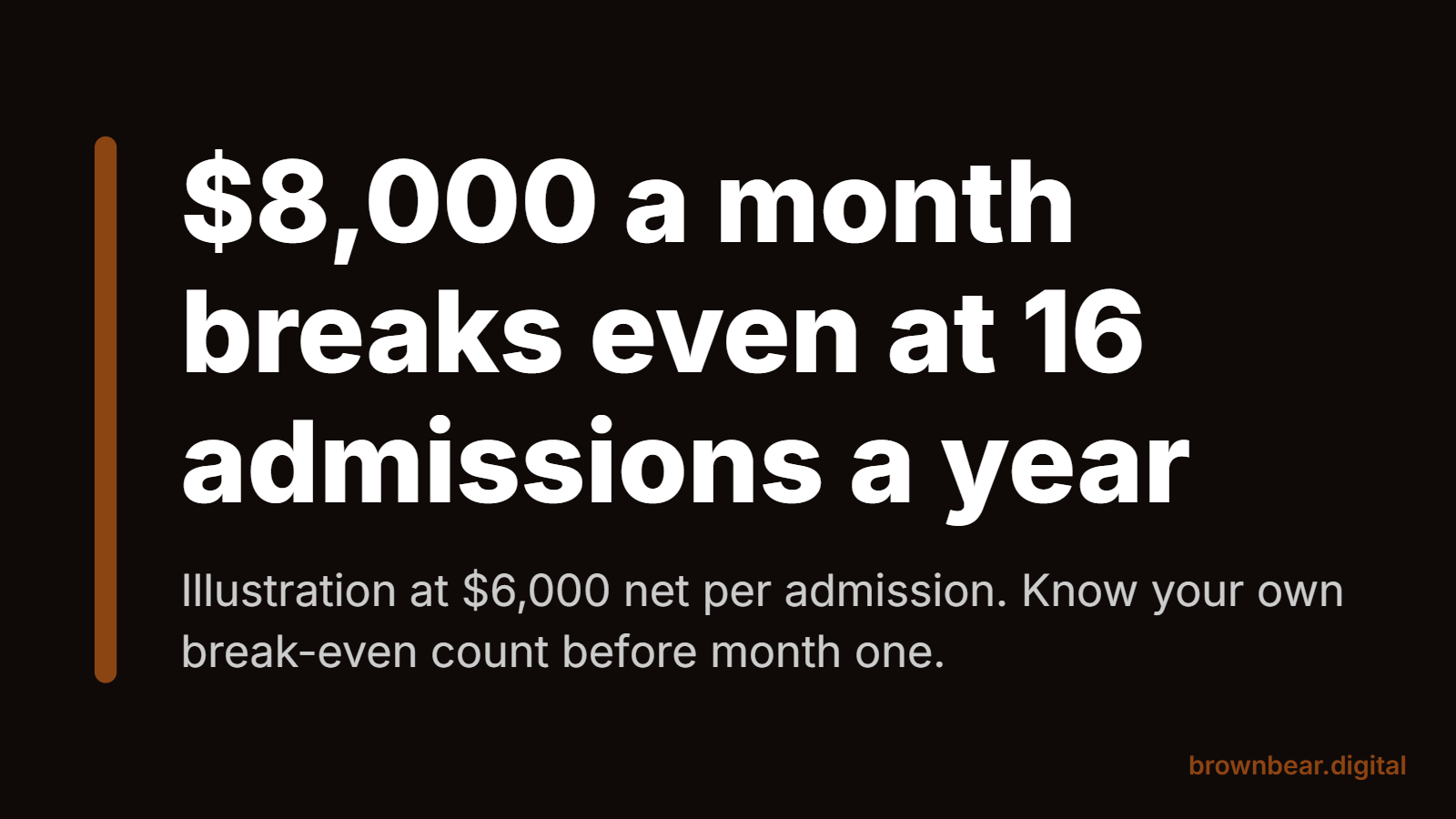
Say a single-site outpatient program spends $8,000 a month on search and ads, or $96,000 a year. Say each admission is worth $6,000 to the program after the cost of care. It breaks even at 16 admissions a year, about 1 or 2 a month. Your own numbers will differ, and these are illustrations, not benchmarks. The point is to know the break-even count before the first month starts. Then you judge results in admissions and new patients, not clicks.
Bryan's rule of thumb from plastic surgery is that a $1,500 to $2,000 monthly SEO retainer over 12 months costs about what two organically sourced procedures bring in. His warning carries over too: cutting SEO to fund ads stops the compounding and locks you into rising paid costs. Behavioral health paid search covers the searches where you aren't visible yet. Organic search takes over as your pages rank, and the paid budget moves to the next program or location.
How fast results come depends on the lane. An IOP program page in a city where difficulty sits under 30 can move within a few months. A psychiatry homepage competing below Psychology Today takes longer. A residential center chasing "rehab" plus a city faces the hardest searches in the study. Its early wins come from the specific terms: detox, alcohol rehab and the level of care plus the city.
How to Choose a Behavioral Health Marketing Partner
The results for "mental health marketing" are mostly agencies and software vendors selling their own service, and most are written for therapists. Before you hire anyone for a psychiatry group, a program or a treatment center, ask for evidence.
- Ask who holds page one for your levels of care in your city, and which of those searches they think you can win.
- Ask how they handle LegitScript, health audience limits and tracking on intake pages, and whether they will sign a business associate agreement.
- Ask how they get paid. A fee tied to admissions or referrals is a question for your counsel, not a perk.
- Ask what happens to your website, profiles and ad accounts if you leave. They should stay yours.
Talk to Brown Bear About Marketing Your Behavioral Health Organization
Mental health marketing works when it starts from the searches you can actually win and the rules you have to follow. For a psychiatry group, that means the directory and the homepage. For a program, it means the program page. For a treatment center, it means words that leave no doubt and ads that pass certification. Brown Bear builds that page-one map for your market first. Then we build the pages, profiles, paid search and AI search work around it, with tracking set up to protect the people you serve. If you want to see where your organization stands, talk to us about your behavioral health marketing.
Written By
Founder, Brown Bear Digital
Bryan has 15 years of experience across SEO, paid search, and AI search strategy. He founded Brown Bear to give businesses direct access to senior-level search expertise without the agency overhead.
Learn More About BryanGet Found on Google.
Get Cited by AI.
Tell us about your site. We'll send back a proposal for SEO and AI search.