Orthodontic Marketing: What 20 Google Results Pages Show About Who You Really Compete With
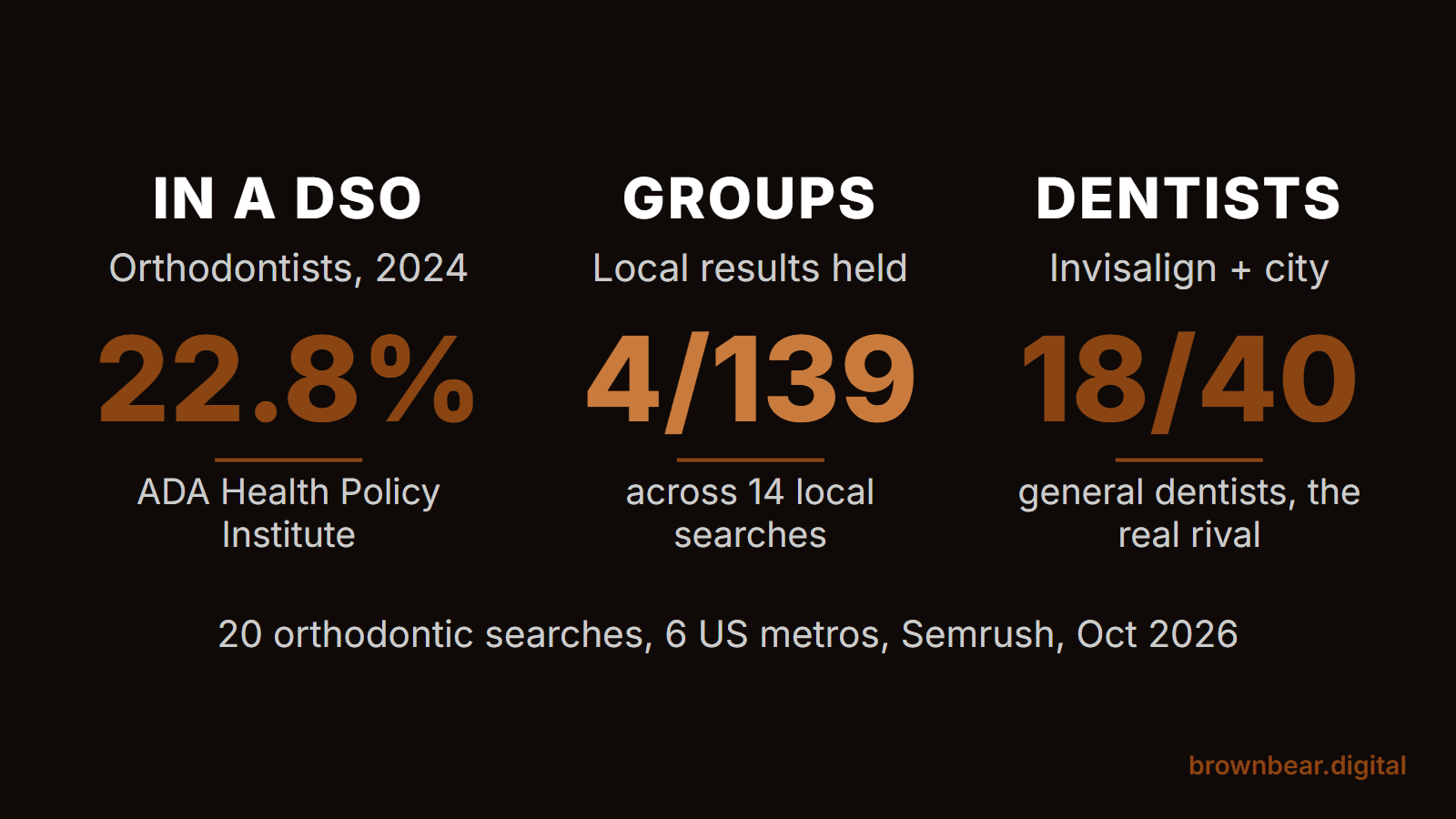
Most orthodontic marketing advice is a list of ideas. Optimize your Google Business Profile, post smile reveals on Instagram, run Facebook ads to parents, start a referral program. Lists like that skip the question that decides where your budget should go: who is actually beating you on Google? We pulled the top 10 Google results for 20 orthodontic searches across 6 US metros and sorted every result by who runs it. Corporate groups held 4 of the 139 local results. Independent orthodontists held 69% of the local top-three spots. But on "Invisalign" plus a city, general dentists held 45% of page one and #1 in 2 of 4 cities. This is Brown Bear's guide to orthodontic marketing, built around the patients and parents you can realistically win.
It draws on that October 2026 Semrush pull. It also draws on what Bryan Passanisi, founder of Brown Bear Digital, has seen running local SEO, paid search and AI search programs for medical and aesthetic practices. Patients there also compare a few providers, read reviews and book a consultation before they commit.
Orthodontic marketing here means both the classic work and the newer layer above it. The classic work is your website, your Google Business Profile, reviews, paid search, dentist referrals and the price question every family asks. The newer layer is the AI answers that now sit above the results and the aligner brands selling straight to patients. It covers both braces for a 9-year-old and clear aligners for a 40-year-old.
If you own a one-office orthodontic practice, you want to know whether the dentist down the street who offers Invisalign is taking cases you should have. If you run three or four offices, you need to know which pages and profiles each office needs to rank on its own. And if you are an orthodontist who has watched a group buy the practice across town, you want to know whether that group is now winning Google.
By the end, you'll know which searches belong to orthodontists and which ones general dentists are winning. You'll see why price pages hold the largest search demand in your field. You'll know how to set up your profile and reviews inside the rules and where paid search pays. You'll know how to speak to parents differently from adults, and how many starts a program must produce to pay for itself. The longer payoff is a schedule that fills from your own name, your own cases and your own neighborhood, not from the next discount.
We've grouped it into four parts: who holds page one, the pages and profiles that win, the audiences and rules, and the business side of cost and hiring. Start with what orthodontic marketing is supposed to produce.
What Orthodontic Marketing Is, and What It Should Produce
Orthodontic marketing is the work of getting an orthodontic practice found, chosen and booked by the families and adults in the area it serves. It covers Google, Google Maps, AI tools, paid ads, reviews, your website and the general dentists who refer to you. The goal is new-patient consultations that turn into treatment starts. Traffic, likes and followers are not the goal.
Starts are the number that matters because orthodontic cases are large, long and few. A practice signs a limited number of new cases each month, each worth thousands of dollars. Each one is decided over weeks by a parent or an adult comparing two or three offices. That makes orthodontic marketing closer to a considered purchase than to a walk-in clinic. It also means the searches you need to win are not all the same kind, and the map below shows which is which.
The Orthodontic Page-One Map: Who Ranks for Orthodontist, Invisalign and Braces Searches
Across 14 local searches in 6 metros, independent orthodontists held 58% of the top 10 results and 29 of the 42 top-three spots. Independent general dentists held 16% of results, directories such as Yelp 9%, and multi-specialty dental offices 4%. Practices owned by a dental or orthodontic group held 4 results, 3% of the page. Aligner brands held none of the local results. The mail-order aligner company SmileDirectClub stopped operating in December 2023, a few months after filing for bankruptcy.
Here is how we got those numbers. On October 28, 2026, we read the top 10 organic results from Semrush for 20 searches:
- "orthodontist" plus the city in Houston, Dallas, Atlanta, Phoenix, Charlotte and San Diego
- "invisalign" in Houston, Atlanta, San Diego and Phoenix
- "braces" in Dallas, Charlotte, Atlanta and Houston
- six national patient questions: "invisalign cost," "how much are braces," "braces for adults," "braces for kids," "invisalign for teens" and "clear aligners"
Then we sorted every result. For practices, we noted whether each one was an orthodontic practice or a general or family dentist. We also read each ranking page for signs of a group owner. Those signs were payment or careers links to a group's site, a footer line naming a parent company, or group-wide assets. A practice with none of those signs counts as independent, which means we found no group signal, not that we proved it is independent. That is the step our dental SEO study skipped. The map pack, ads and AI Overview citations are not counted.
We call the result the Orthodontic Page-One Map:
| Search type | Example | Who holds page one | What it means for you |
|---|---|---|---|
| Orthodontist plus city | orthodontist houston | Independent orthodontists 73%, directories 17%. Orthodontists took 15 of 18 top-three spots and #1 in 5 of 6 cities. Semrush difficulty 42 to 58. | Your home lane. Win it with your homepage, your Business Profile and your reviews. |
| Invisalign plus city | invisalign phoenix | General dentists 45%, orthodontists 33%. Orthodontists took 6 of 12 top-three spots, general dentists 5. Difficulty 3 to 8. | The contested lane, and the easiest to rank in. Build a real Invisalign page that says what a specialist adds. |
| Braces plus city | braces dallas | Orthodontists 63%, general dentists 10%, corporate practices 8%. Orthodontists took 8 of 12 top-three spots. Difficulty 10 to 51. | Mostly yours, but price-led pages win #1. Put a price range on your braces page. |
| National patient questions | invisalign cost | No practice homepage ranked. 22 of 59 results were cost or price pages. The AAO, Invisalign.com, Delta Dental, dental schools and hospitals held 15 of the 59. | The biggest demand in the field. Publish one clear cost page for your city, then let it earn links. |
Two findings changed how we would plan an orthodontic budget. First, the corporate groups are barely on page one. Across all 20 searches, practices owned by a group held 8 of 198 results, and smiledoctors.com itself did not rank for any of them. Second, the specialist's real rival on Google is the general dentist. On the four Invisalign searches, general dentists held 18 of 40 results. On "invisalign cost," which Semrush puts at 74,000 searches a month, they held 8 of the top 10.
Corporate Orthodontic Groups Are a Smaller Threat on Page One Than They Look
Groups own a growing share of orthodontic practices. The ADA’s Health Policy Institute found that 22.8% of US orthodontists were affiliated with a dental support organization in 2024, the highest share of any specialty. Smile Doctors alone describes itself as the largest orthodontic support organization in the country, with more than 550 locations in 36 states. But in our pull, groups rarely owned the results. On the six "orthodontist" plus city searches, one group-owned practice ranked, and it ranked #1. Lineberger Orthodontics in Charlotte runs under its own local name and site. The only sign of its owner is the "Make a Payment" button, which goes to smiledoctors.com. It also ranked #2 for "braces charlotte." On "braces dallas," Monarch Dental, a practice brand supported by Smile Brands, held #1 with a page titled "Affordable Braces in Dallas, TX."
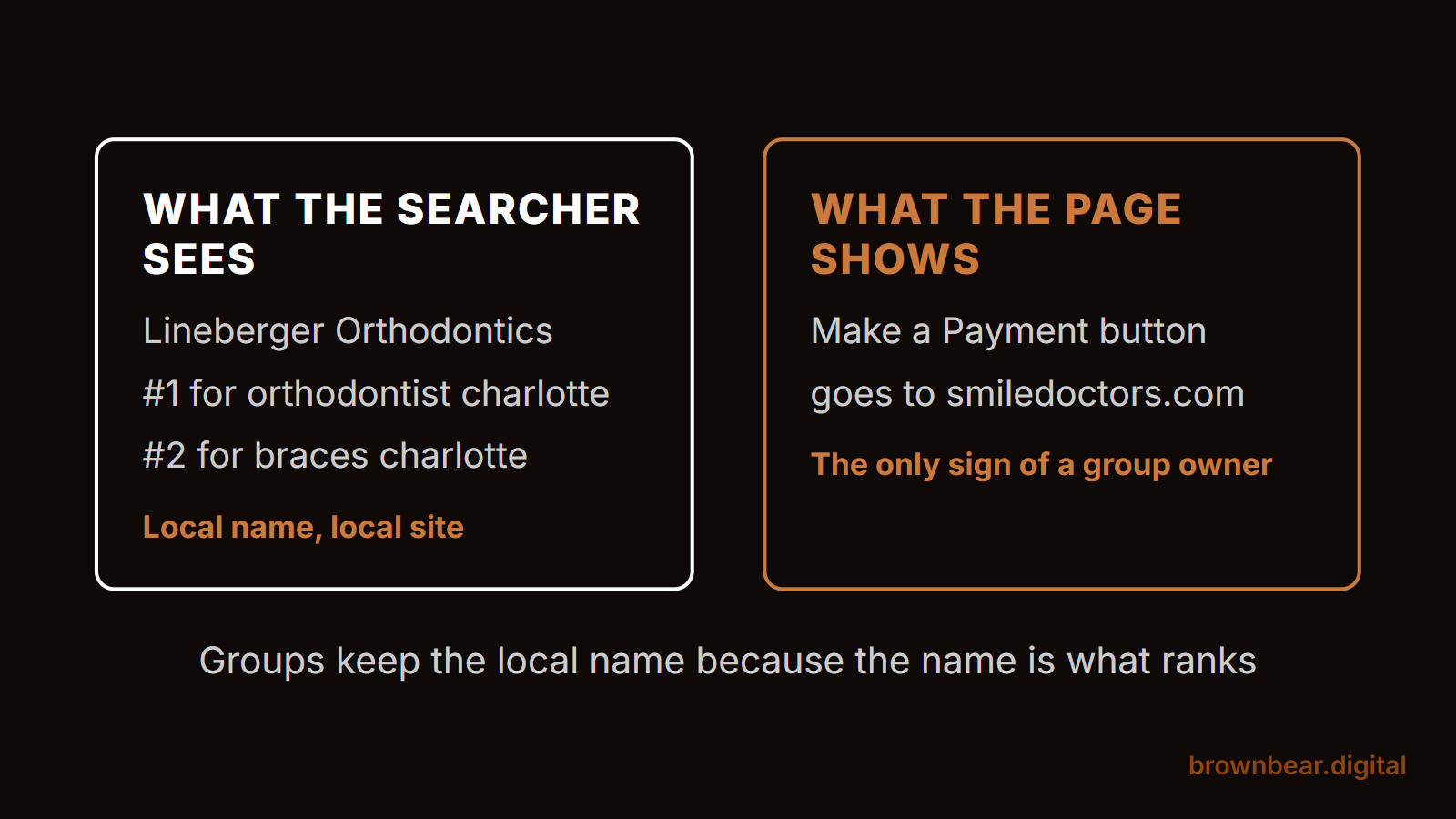
That is the pattern to watch. When a group buys an orthodontic practice, it often keeps the name, the doctor and the website, because the name is what ranks. So the competitor that worries you may still look like an independent office on Google. The count above is a floor, not a ceiling. Several of the multi-office practices we marked as independent may have a private equity partner we could not see from the page.
What the groups bring is not ranking power. It is scale behind the scenes, which can include call centers, shared ad budgets, financing offers and staff who answer leads quickly. An independent practice does not beat that with a bigger ad budget. It beats it with the things a group cannot fake: one doctor's name, real local cases, and a front desk that knows the family.
Picture an orthodontist in Charlotte who sees a Smile Doctors partner office open two exits away. The temptation is to match its offers line by line. A better first month is to check what Google shows for "orthodontist" and "braces" plus the town. Then make sure the homepage, the Business Profile and recent reviews all name the doctor, the neighborhoods served and the treatments offered. The group's office ranked on its old local name. Yours can rank on yours.
Your Real Search Rival Is the General Dentist Who Offers Invisalign
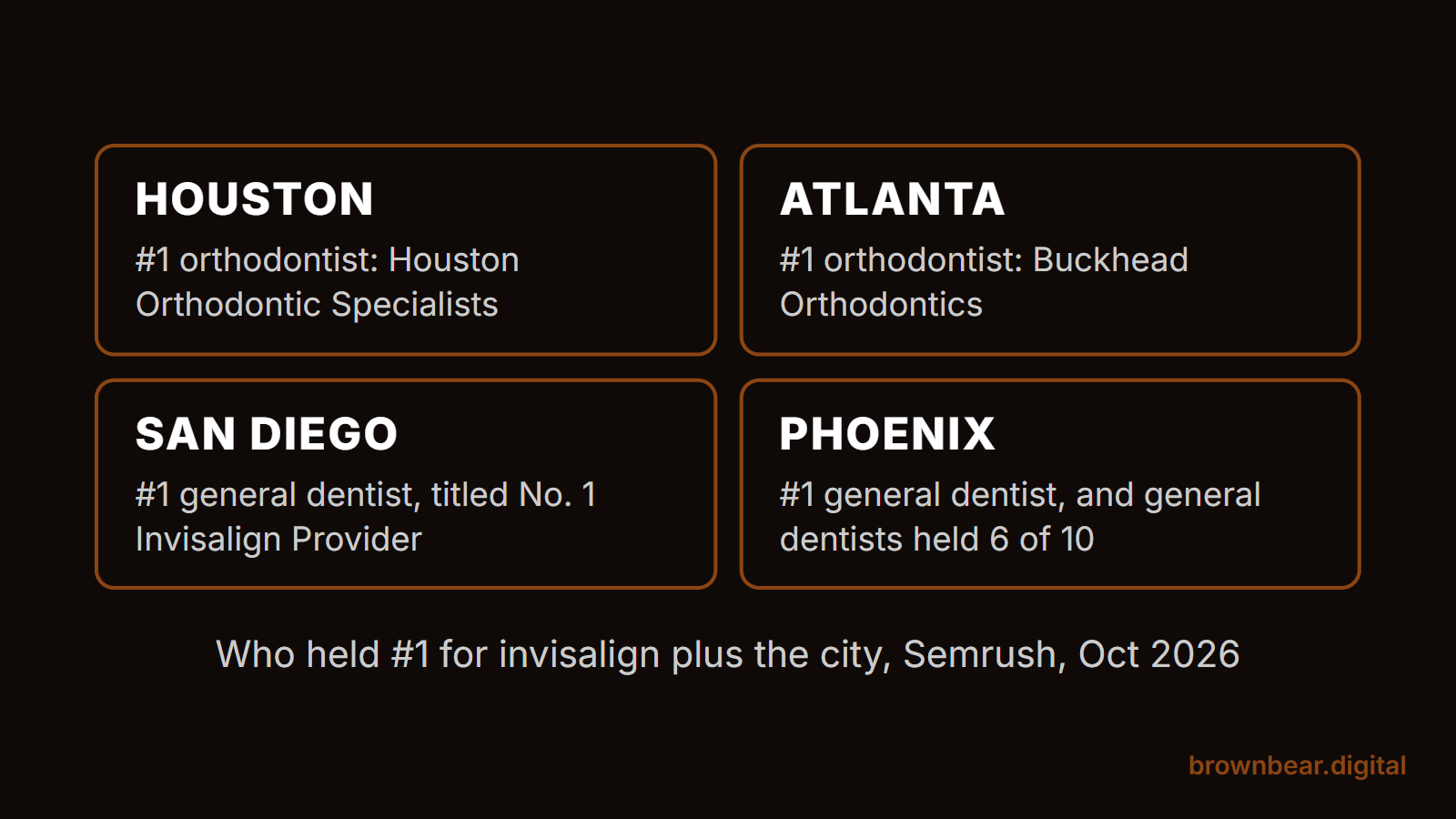
On "Invisalign" plus a city, orthodontists are not the default winner. General dentists held 18 of the 40 results across Houston, Atlanta, San Diego and Phoenix and held #1 in two cities. In San Diego, #1 went to a general practice whose title calls it the "No. 1 Invisalign Provider." In Phoenix, a general dentist held #1 and general dentists held 6 of the 10 results. Orthodontists still took 6 of the 12 top-three spots, with Houston Orthodontic Specialists and Buckhead Orthodontics at #1 in their cities. That matches what we saw from the general dentist's side when we wrote about dental marketing for general practices.
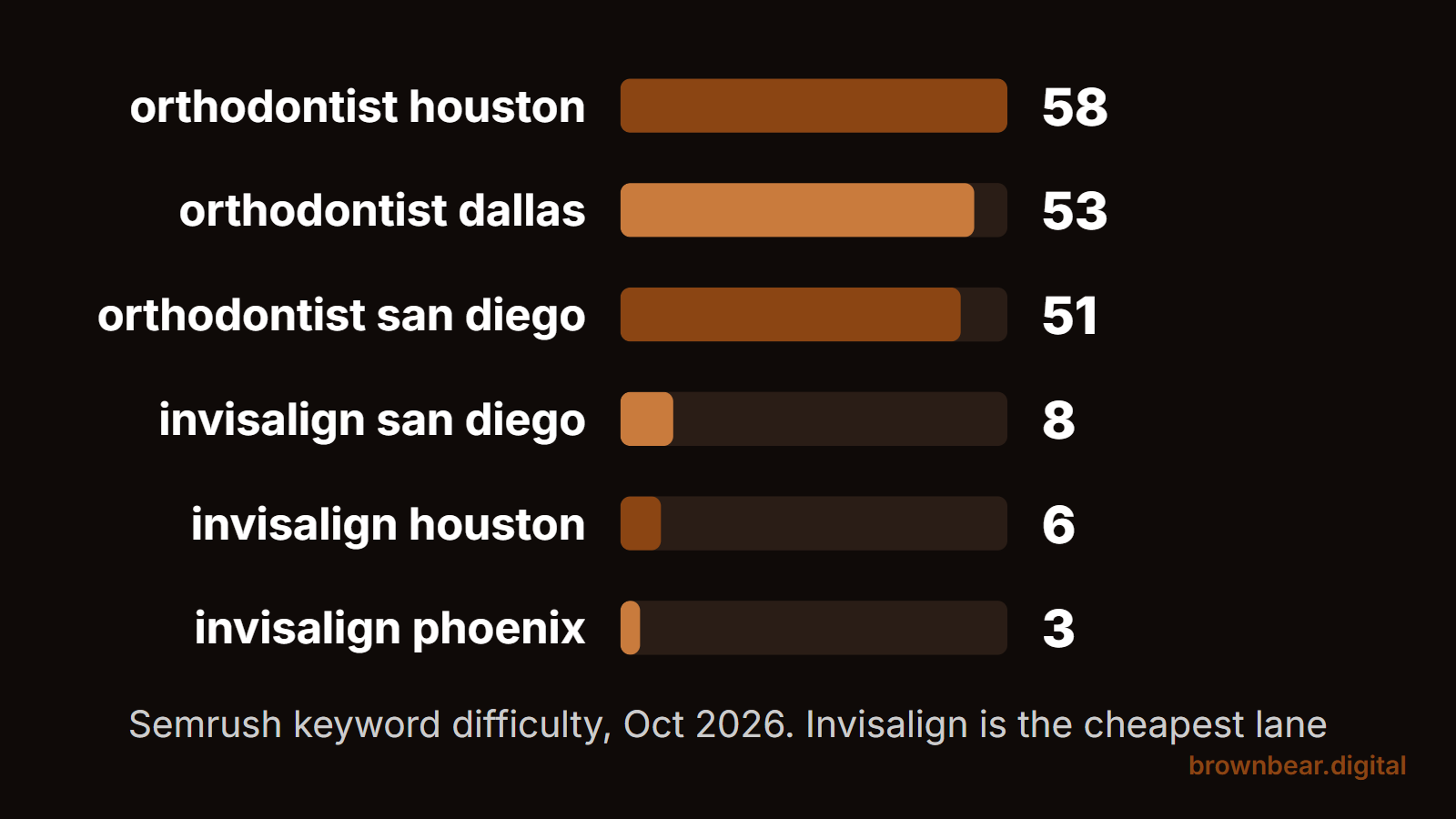
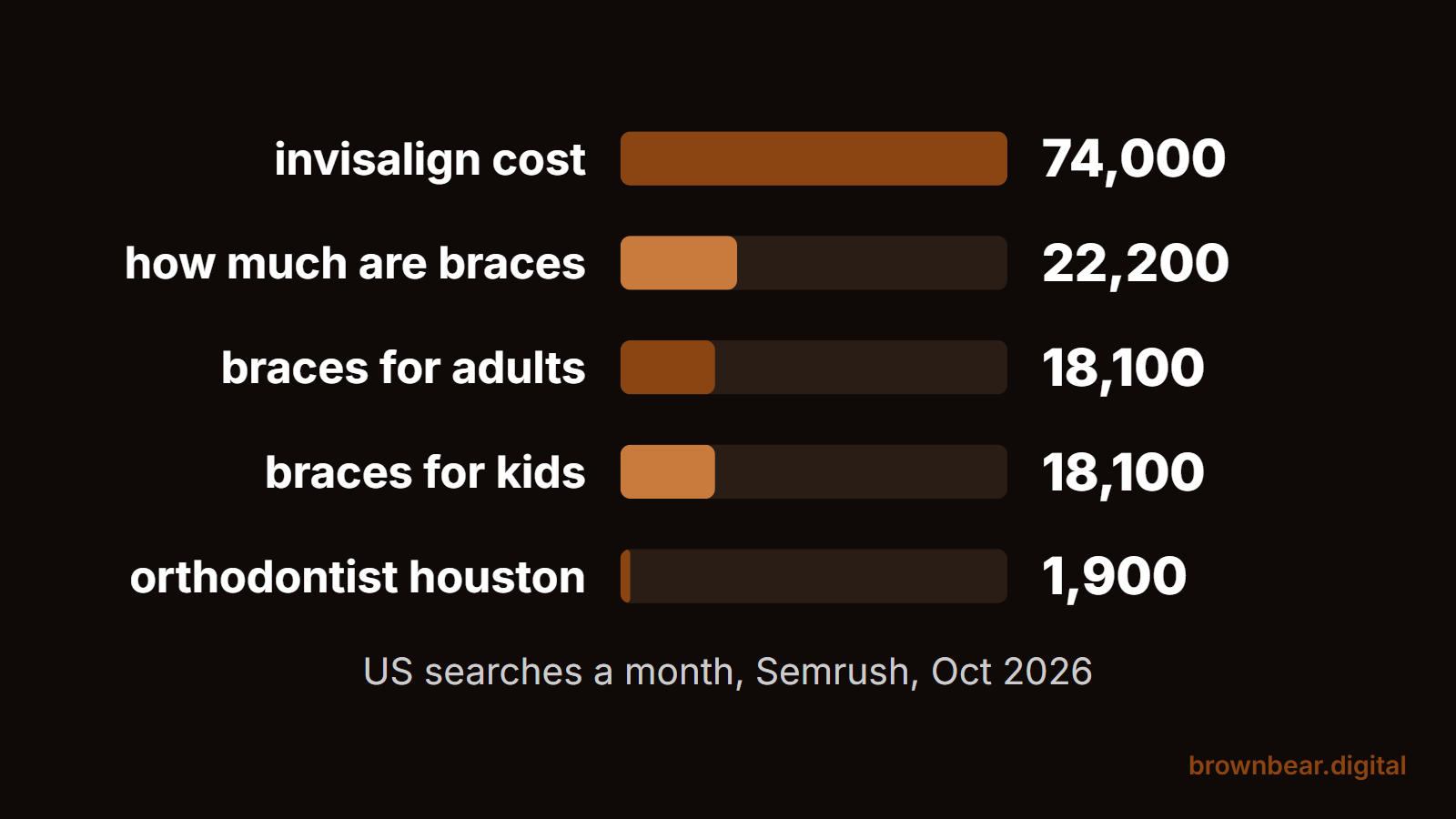
The lane is also the cheapest to enter. Semrush rates the four Invisalign searches at difficulty 3 to 8, against 42 to 58 for "orthodontist" plus the same cities. "Invisalign houston" draws 1,900 searches a month, the same as "orthodontist houston," and "invisalign san diego" draws 1,300, more than "orthodontist san diego" at 1,000.
Patients in these searches do not always know there is a difference between providers. In the r/Atlanta thread that ranks #9 for "invisalign atlanta," the most upvoted reply came from a patient told her case was too complex for Invisalign. She went to an orthodontist for braces instead. Another reply claimed that if one dentist turns you down for Invisalign, every dentist will. That is the gap an orthodontist can fill. Explain which cases aligners handle well, which ones they don't, and what a specialist sees that others may miss.
Here is how to compete in the Invisalign lane without attacking anyone:
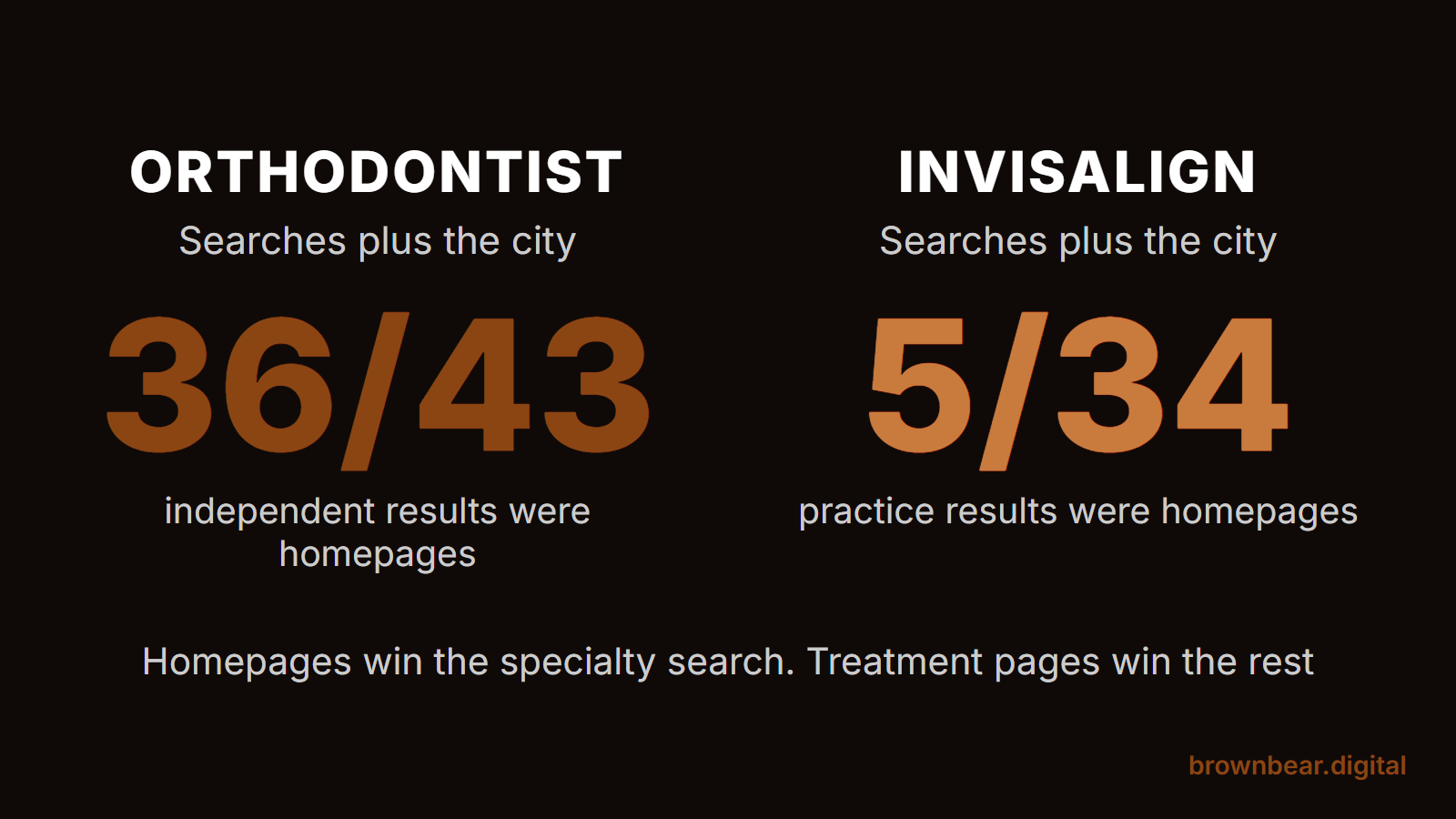
- Build one Invisalign page per office, not a paragraph on the homepage. Only 5 of the 34 practice results in this lane were homepages.
- Say plainly that you are a specialist and what that training covers. Under the ADA’s code of ethics, a general dentist who offers orthodontic services should not imply a specialty, so the word is yours to use.
- Show cases by type: crowding, spacing, overbite, and adult cases that started with a dentist's referral.
- Give a price range and what changes it, because 6 of the 40 results in this lane put price in the title.
The same dentists who compete with you on aligners also send you their complex cases. Give them a referral page that explains how to send a case, what you send back and how fast. It keeps that relationship working even while you compete for simple aligner cases on Google.
Orthodontist Searches Reward the Homepage, and Treatment Searches Reward the Treatment Page
The page Google ranks depends on the search. On "orthodontist" plus a city, 36 of the 43 independent orthodontist results were the practice's homepage. On Invisalign searches, the winners were Invisalign pages, and on braces searches about half were service pages. So your homepage has to win the specialty search, and each treatment needs its own page to win the treatment search.
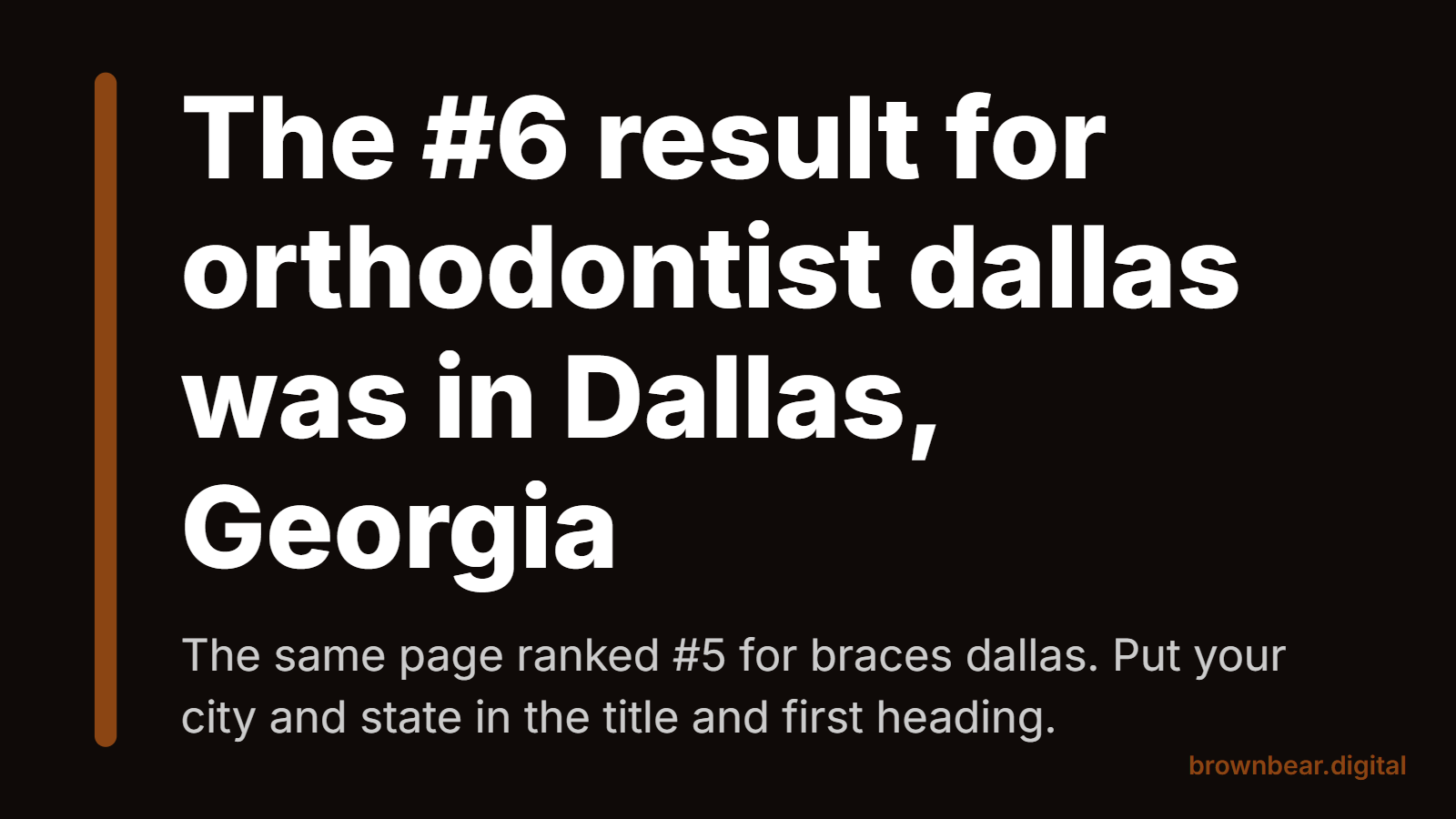
The city name has to be unmistakable too. On "orthodontist dallas," the #6 result was an OrthoZone office in Dallas, Georgia, whose page title reads "Best Orthodontist In Dallas, GA." The same page ranked #5 for "braces dallas," which also had the Dallas Arboretum at #10. Semrush reads these results without a searcher's location, so a parent in Dallas, Texas will usually see a more local page. Still, Google is matching the city name, and a homepage that says the city and state plainly removes the doubt.
A practice with several offices needs a location page and a Business Profile for each one. Each office competes for its own neighborhood. Cooper Orthodontics ranked #7 for "orthodontist houston" with a page for its Houston office, not its homepage. The same structure works for multi-office practices in any specialty.
Here is what the homepage of a one-office practice should do, in order:
- Say "orthodontist" with the city and state in the title and the first heading.
- Name the doctor, the specialty training and the treatments in the first screen.
- Link to one page each for braces, Invisalign, early treatment and adult treatment.
- Put the consultation booking, the price range and the insurance and financing answer one click away.
Price Pages Are the Largest Search Demand in Orthodontics
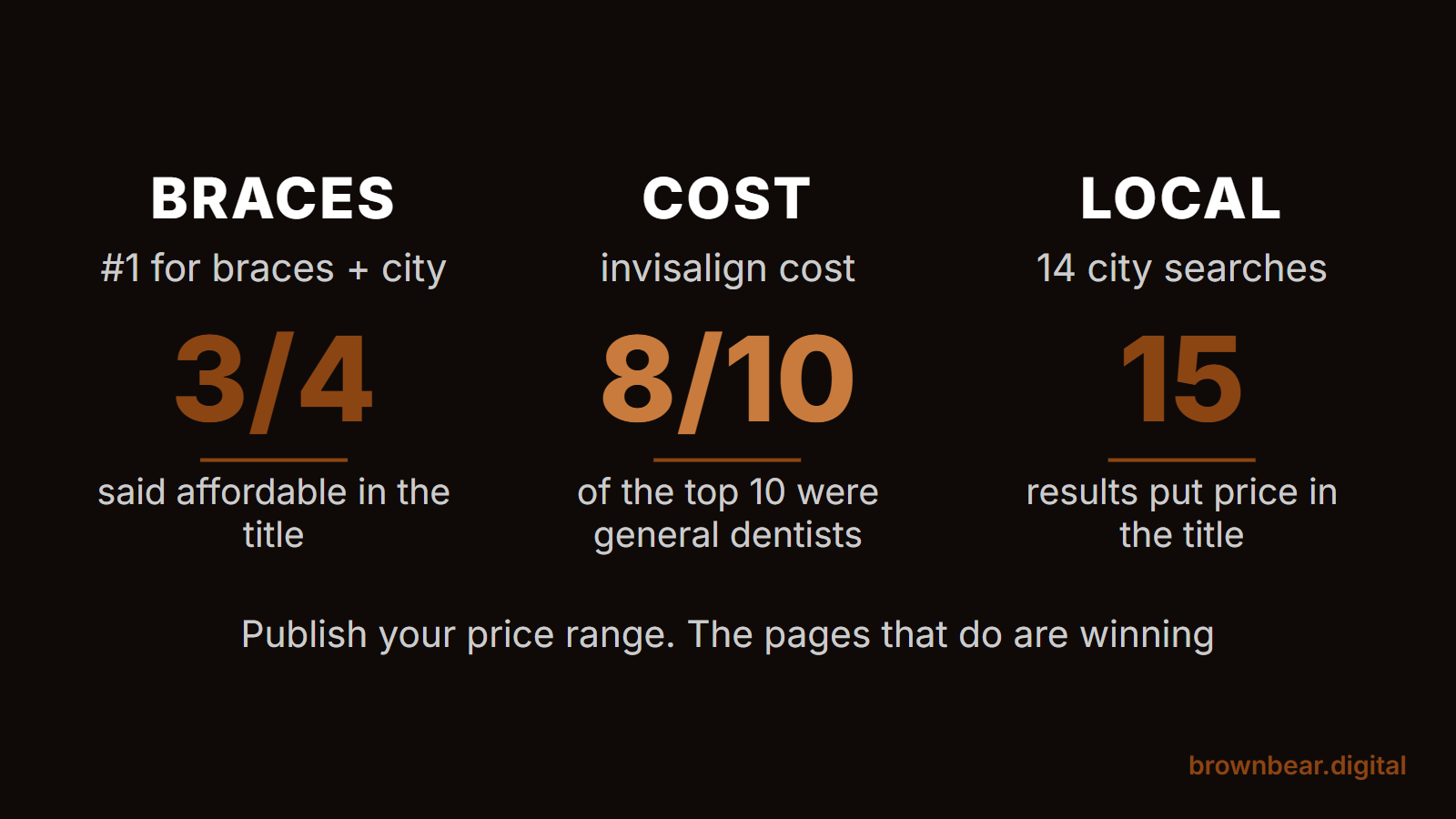
The biggest searches in this field are about money, and orthodontists are mostly missing from them. Semrush puts "invisalign cost" at 74,000 searches a month at difficulty 6, and "how much are braces" at 22,200 at difficulty 13. On "invisalign cost," every top-10 result was a practice cost page. 8 of the 10 belonged to general dentists, led by a practice in Tarzana, California. On "how much are braces," an orthodontic practice in New Jersey held #1, and orthodontists held 4 of the 10 results.
Price also wins locally. In 3 of the 4 braces searches, the #1 result had the word "affordable" in its page title: Monarch Dental in Dallas, Crown Point Orthodontics in Charlotte and SmileRight Braces in Houston. Across the 14 local searches, 15 results put price, cost or a free consultation in the title. In Houston, a general dentist's Invisalign page ranked with a flat price in its title.
Some orthodontists avoid publishing prices because every case is different. That is a reason to explain the range, not to hide it. Give your typical range for braces and for aligners, what moves a case up or down, what insurance usually covers and what a monthly payment looks like. That page answers the question parents are already typing. It also gives you a page other sites can link to.
Say a two-office practice outside Atlanta publishes one page on what braces and Invisalign cost in its area. It lists its typical range and the factors that change it. It shows the down payment and monthly terms, and it says the first consultation is free. On cost searches with the city name, that page competes with a handful of general dentists, not with the AAO.
Google Business Profile and Reviews for Orthodontic Practices
Your Google Business Profile carries the map results, which Semrush flagged on 13 of the 14 local searches. Set the primary category to Orthodontist and list braces, Invisalign and early treatment as services. Keep hours and phone numbers identical everywhere, and add photos of your office and team. Yelp ranked in the organic top 10 for 10 of the 14 local searches, including all 6 "orthodontist" plus city searches. Keep that listing current too.
Reviews do more for an orthodontist than for most practices because treatment usually runs for many months, so the patient's family sees the office again and again. Ask at the moments when they are happiest, such as the day the braces come off or the final aligner tray. Make it easy with a short link. The reviews that help the next family describe the treatment, the team and the result, the same parts of a useful patient review that matter in every specialty.
The rules are firmer than they used to be. The FTC’s rule on consumer reviews took effect on October 21, 2024. It bans fake reviews, paying for reviews that must be positive or negative, undisclosed reviews by owners or managers, and using threats to get a review taken down. Google's own policy also bars offering anything in return for a review and bars asking only happy patients. So ask every patient, or ask at a set point in treatment, and never offer a discount or a gift card for a review.
Bryan has found that the most common real error in a practice's online information is not a bad review. It is small variations in the name, address or phone number across directories and profiles. Orthodontic practices are prone to it after a move, a second office or a sale. It is also one of the easiest problems to fix.
Google Ads for Orthodontists: Where Paid Search Earns Its Cost
Paid search puts you above the organic results while your pages and reviews catch up. In our pull, Semrush put the cost per click for "orthodontist dallas" at $12.60, "orthodontist phoenix" at $10.45 and "orthodontist san diego" at $6.07. Braces searches ran $5.75 to $7.54 a click. Semrush showed no cost-per-click data for the four Invisalign city searches.
When a practice owner tells us Google Ads didn't work, Bryan's teardowns usually find the same two problems. The campaigns were set up without tuning for lead quality, so budget leaks to searches that never become consultations. And the clicks land on pages that were not built to book one. Both are fixable, and both matter more than the bid.
Paid search earns its cost in three places for an orthodontist:
- Your own practice name and doctor's name, so a group or a dentist cannot buy your brand search.
- "Invisalign" and "braces" plus your city, sent to the matching treatment page with the price range on it.
- A new office's neighborhood, until its organic pages and Business Profile start ranking.
Picture a Phoenix practice paying $10.45 a click on "orthodontist phoenix" and sending every click to its homepage. A parent who wanted to know about braces lands on a page about the doctor's philosophy, finds no price or booking button, and leaves. The same click sent to a braces page with a price range and a booking form costs the same and gives that parent a reason to book.
A paid search account built around consultations should report starts and cost per start, not clicks. Once an organic page ranks for a search, move that budget to the next search you are not yet winning.
Orthodontic Marketing for Parents of Kids, Parents of Teens and Adult Patients
Orthodontic marketing serves two buyers: parents deciding for a child or teen, and adults deciding for themselves. Before you choose where to spend, look at which group already fills your chairs and which one your market searches for most.
For Parents of Kids Weighing Braces
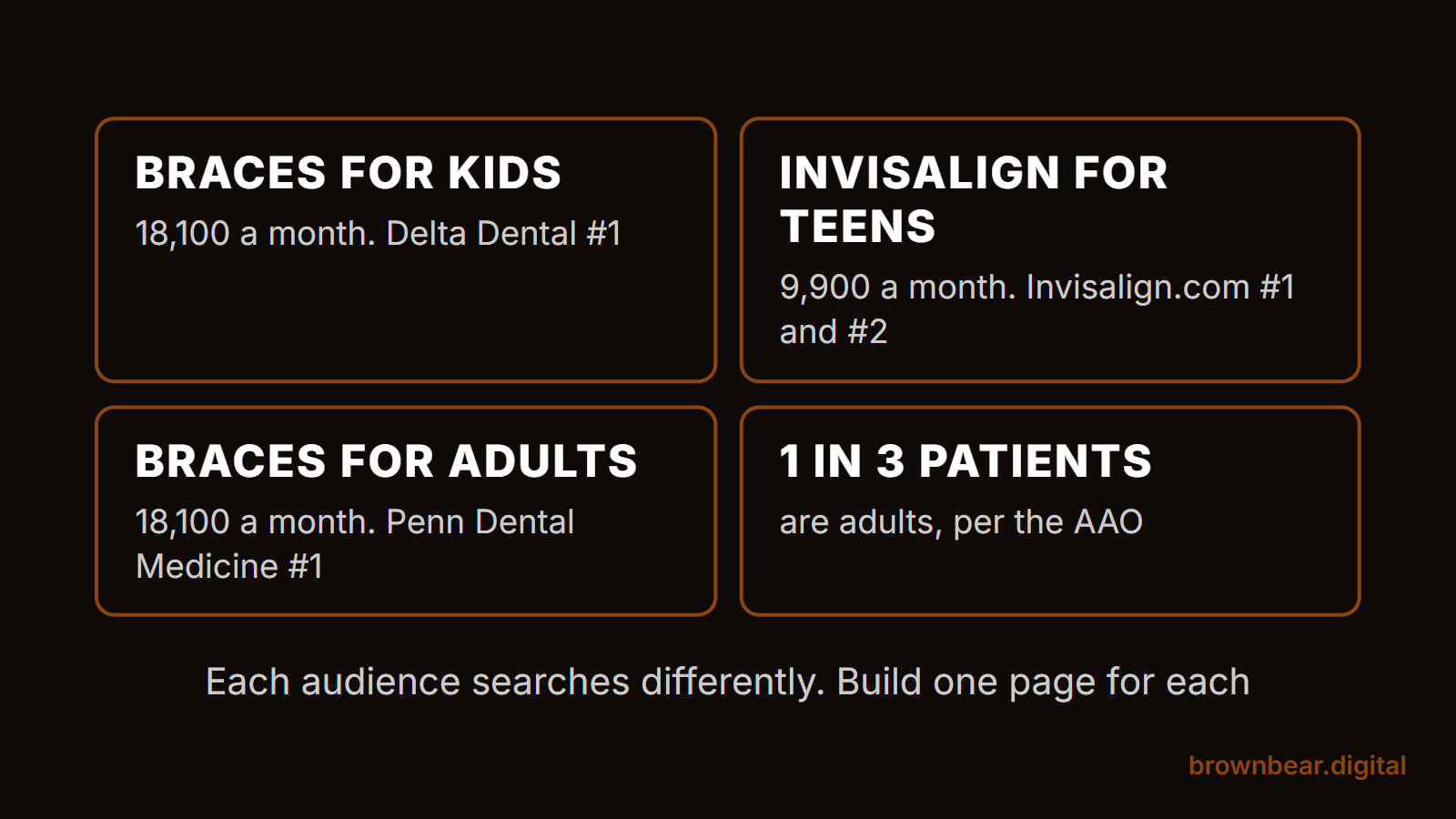
Semrush puts "braces for kids" at 18,100 searches a month, and in our pull the top 10 was mostly institutions. Delta Dental held #1, the American Association of Orthodontists #3, KidsHealth #4 and Nationwide Children's Hospital #8, with two group-owned dental practices at #2 and #5. Parents at this stage want to know whether their child needs treatment and when. The American Association of Orthodontists encourages parents to bring children to an orthodontist by age seven. Your page for this parent should explain the early check, what you look for, and why you may say "not yet."
For Parents of Teens Choosing Between Braces and Invisalign
"Invisalign for teens" draws 9,900 searches a month, and Invisalign.com held #1 and #2. Align Technology reported a record 935,800 teens and kids starting Invisalign treatment in 2025. At #4 sat a Reddit thread titled "Do not get Invisalign for your teen," where a high school student described a friend who rarely wore her trays. The replies split: some parents said their teen wore them faithfully, others said "my 14 year old, no chance." One reply put it as "it depends on the overall attitude of the teen." Your teen page should have that conversation with parents. Give them a clear view of who succeeds with aligners and who does better with braces.
For Adults Considering Braces or Clear Aligners
"Braces for adults" also draws 18,100 searches a month, and the #1 result was Penn Dental Medicine's page on adult braces options in Philadelphia. In Atlanta, Green Orthodontics ranked #7 for "braces atlanta" with a page built only for adults. The Georgia School of Orthodontics ranked #4 with its adult braces page. The AAO says 1 in 3 orthodontic patients today are adults. An adult patient pays for their own treatment and cares about discretion, time off work and cost. The adult page should lead with those, show adult cases, and be clear about when aligners are not enough.
Advertising Rules That Apply to Orthodontic Marketing
Orthodontic advertising sits under two sets of rules: the federal rules on endorsements and reviews, and your state dental board's advertising rules. This section summarizes them for marketing planning. It is not legal advice, so check your own state's rules with your board or counsel.
Before-and-after photos and patient stories are endorsements under the FTC Endorsement Guides, which were revised in 2023. When an ad shows one patient’s result, the FTC expects you to back up that the result is typical. If you can't, say clearly what patients can generally expect. So label smile galleries as individual results, show a range of cases, and get written consent before you post any patient’s photos.
The word "specialist" is the rule most likely to catch a practice. The ADA’s code treats orthodontics and dentofacial orthopedics as a recognized specialty, and only dentists who meet the specialty's education standards may announce it. The AAO describes that residency as two to three years after dental school. A general dentist who offers Invisalign may advertise it, but the ADA code also asks that dentist to state the services come from a general dentist.
States write their own versions. In Texas, a general dentist who advertises a specific service such as orthodontics must put "General Dentist" or "General Dentistry" right after the dentist’s name, under 22 TAC 108.55. That notation can be no smaller than the largest font used for the service. Texas also limits "specialist" to dentists in recognized specialty areas under 108.54. California’s Business and Professions Code 651 bars false or misleading health care advertising in general. If you advertise across state lines, each office follows its own state’s rules.
Orthodontic treatment is health care, so Google holds these pages to its higher standard for health and money topics. Name the doctor who reviewed the page and keep the claims to what your cases show.
Orthodontic Marketing in AI Search
AI Overviews showed up on the national questions far more than on local ones. Semrush flagged an AI Overview on 5 of the 6 national searches, including "invisalign cost" and "braces for adults." It flagged one on only 1 of the 6 "orthodontist" plus city searches and 1 of the 4 Invisalign searches. For "orthodontic marketing" itself, Google's AI Overview recommended local SEO, online scheduling, virtual smile assessments, transparent financing, short videos, and ads aimed at the parents who decide on a child's care.
So the AI layer reaches your patients mostly at the research stage. That is when a parent asks what braces cost or whether a teen can use aligners. The cost page, the teen page and the adult page above are the pages an AI answer can quote. Bryan's view is that structured data is worth having but rarely the deciding lever. Clear, crawlable pages that answer the question in the first lines matter more.
Bryan finds that what surprises most owners is how much third-party sites drive what AI tools say about them: reviews, directories and local press. Start by asking ChatGPT, Gemini and Google's AI Mode for the best orthodontist in your town. Note who gets named and which sources they cite. Then repeat that monthly AI mention check with the same prompts, so you can see whether your practice gains ground.
What Orthodontic Marketing Costs, and the Starts That Pay for It
The cleanest way to judge an orthodontic marketing program is in starts. Invisalign’s own cost guide puts braces at $3,000 to $7,500 without insurance and calls Invisalign’s cost comparable. Take a fee in the middle of that range, $5,250. A program costing $3,000 a month needs about 7 starts over 12 months to cover its cost in revenue, or about 0.6 a month. That is a small share of a practice's new cases. So the question is less "can we afford marketing" and more "is it producing starts we would not have had."
Bryan's way of looking at any retainer is to translate it into the business it has to produce. For an orthodontist, that is starts per month and cost per start, tracked from the first call to the signed contract.
How fast you see results depends on the lane. If your homepage, profile and reviews are already strong, the orthodontist searches can move within a few months. If you are building Invisalign and cost pages from nothing, expect longer, though the low difficulty of those searches works in your favor. If you are opening a new office, paid search covers its neighborhood while the location page and profile build.
How to Choose an Orthodontic Marketing Partner
The search results for "orthodontic marketing" are mostly agencies and software vendors selling their own service. None of the ranking pages shows who wins orthodontic searches. When you talk to an agency, ask for evidence, not a pitch:
- Ask them to show who holds page one for "orthodontist," "braces" and "Invisalign" in your city, and which of those you can win.
- Ask how they will report starts and cost per start, not clicks or followers.
- Ask what they will publish on price, and how they handle before-and-after photos and reviews inside the rules.
- Ask what happens to your website, profiles and ad accounts if you leave. They should stay yours.
Talk to Brown Bear About Marketing Your Orthodontic Practice
Orthodontic marketing works when it starts from the searches you can actually win. That means your specialty and city, the Invisalign and cost pages most practices skip, and the parents and adults who decide differently. Brown Bear builds that page-one map for your market first, then the pages, profiles, paid search and AI search work around it. If you want to see where your practice stands, look at how we approach marketing for dental and orthodontic practices.
Written By
Founder, Brown Bear Digital
Bryan has 15 years of experience across SEO, paid search, and AI search strategy. He founded Brown Bear to give businesses direct access to senior-level search expertise without the agency overhead.
Learn More About BryanGet Found on Google.
Get Cited by AI.
Tell us about your site. We'll send back a proposal for SEO and AI search.