Physical Therapy SEO: What the Top 3 Pages for 12 PT Searches Are Built From
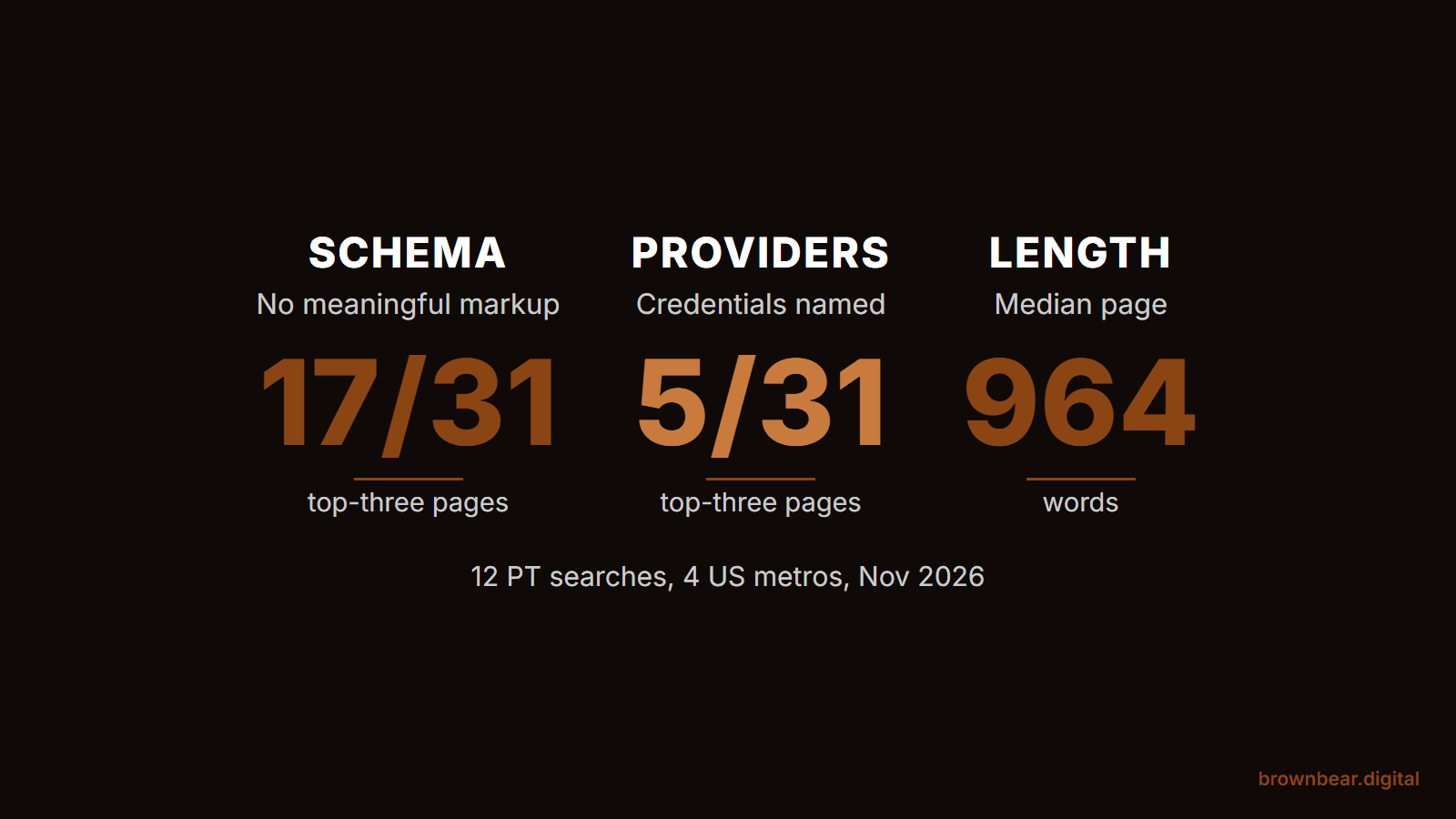
Most physical therapy SEO advice is the same checklist: claim your listing, find keywords, write blog posts. The pages that actually rank top three for PT searches tell a different story. They are shorter than most guides suggest, 17 of the 31 we analyzed had no meaningful schema, and only 5 named a credentialed provider.
This guide is built on a November 2026 pull of the top three Google results for 12 physical therapy searches in Dallas, Boston, San Diego and Minneapolis, plus what Bryan Passanisi, former SEO lead at QuickBooks and Shutterfly, has seen running SEO for medical practices, physical therapy clinics among them. It is written for PT clinic owners, multi-location groups and specialty practices.
It covers what ranking pages are made of, the build from keywords to page templates, the on-page, schema and technical layer, and the work around the site from content to measurement. Start with what physical therapy SEO covers, and where it stops.
What Physical Therapy SEO Covers, and Where Marketing Takes Over
Physical therapy SEO is the work of making a clinic's website rank in Google's organic results and map listings for the searches patients make: a service plus a city, a condition, a specialty, a therapist's name. It covers keyword research, site architecture, page content, schema, technical health, links and measurement. The goal is booked evaluations from pages you own, not traffic for its own sake.
It is one part of the bigger job. Business Profile setup, review requests, physician referrals, Google Ads and the cost math of a marketing program all sit next to it. We covered those in our study of physical therapy marketing, which mapped who holds page one across 15 PT searches in six other metros. This guide picks up where that one stops: once you know which searches you can win, what do you build?
The PT Ranking Page Anatomy: What 31 Top-Three Pages Have in Common
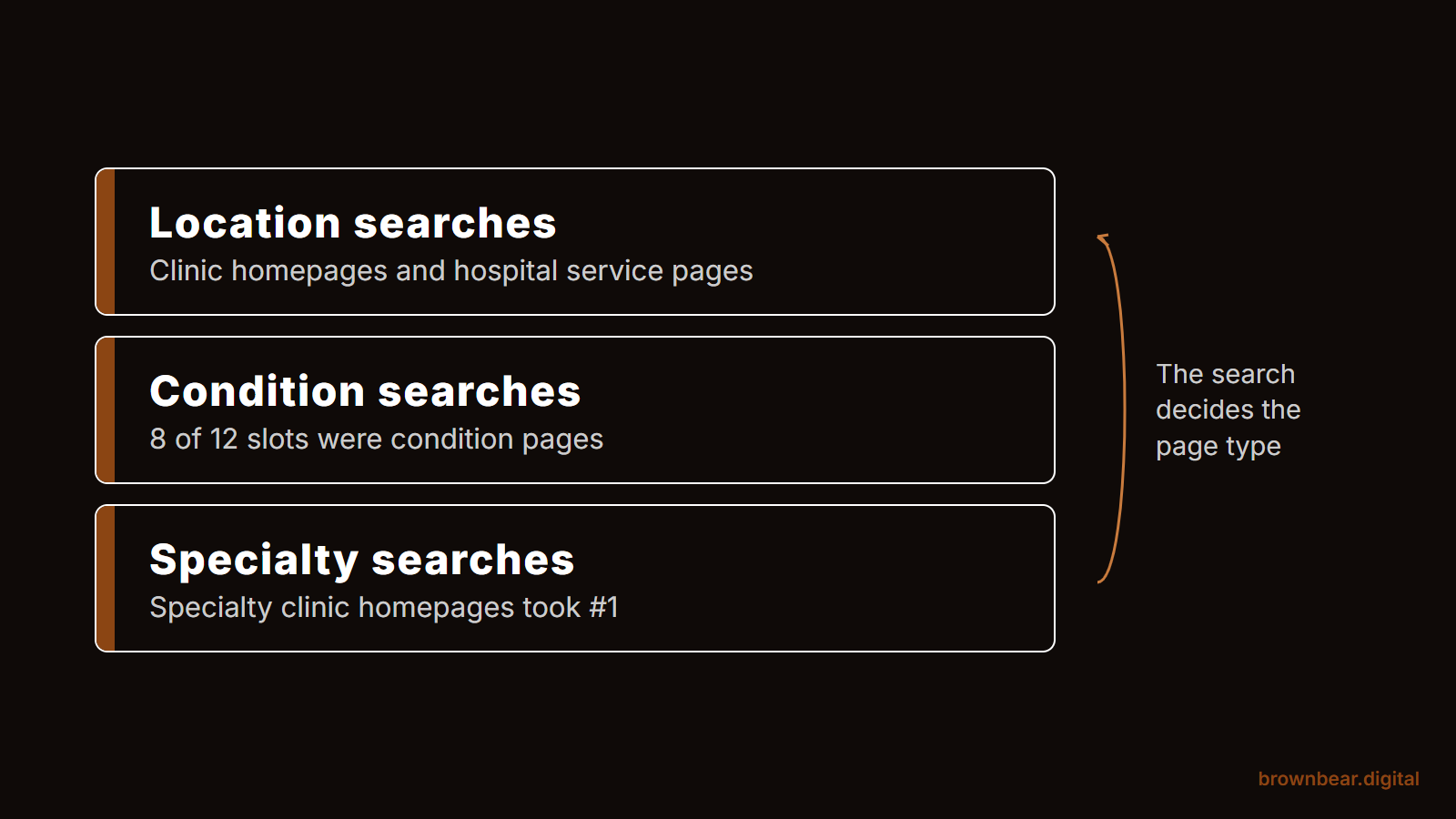
The pages that rank top three for physical therapy searches are mostly plain, mid-length pages that say who the clinic is, where it is and what it treats. Across 31 pages we could analyze, the median was 964 words. The page type changed with the search: clinic homepages and hospital service pages won city searches, dedicated condition pages won condition searches, and specialty clinic homepages won specialty searches.
Here is how we built the study. On November 1, 2026, we searched Google in a US desktop browser for 12 terms in three lanes:
- Location: "physical therapy dallas," "physical therapy boston," "physical therapist san diego" and "physical therapy minneapolis"
- Condition: "physical therapy for sciatica boston," "knee replacement physical therapy san diego," "vestibular therapy minneapolis" and "rotator cuff physical therapy dallas"
- Specialty: "pelvic floor physical therapy boston," "dry needling san diego," "sports physical therapy dallas" and "concussion physical therapy minneapolis"
We took the top three organic results for each, 36 slots in all, and left out the map pack, ads and AI answers. Four slots were Yelp search pages, and one ranked URL returned a "page not found" error when we opened it, which left 31 pages. For each page we recorded who owns it, the page type, the title, the word count with navigation included, the schema in its code, and whether it shows a credentialed provider, insurance, direct access, booking, an FAQ and a price. We call it the PT Ranking Page Anatomy:
| What we checked | Location pages | Condition pages | Specialty pages | All 31 |
|---|---|---|---|---|
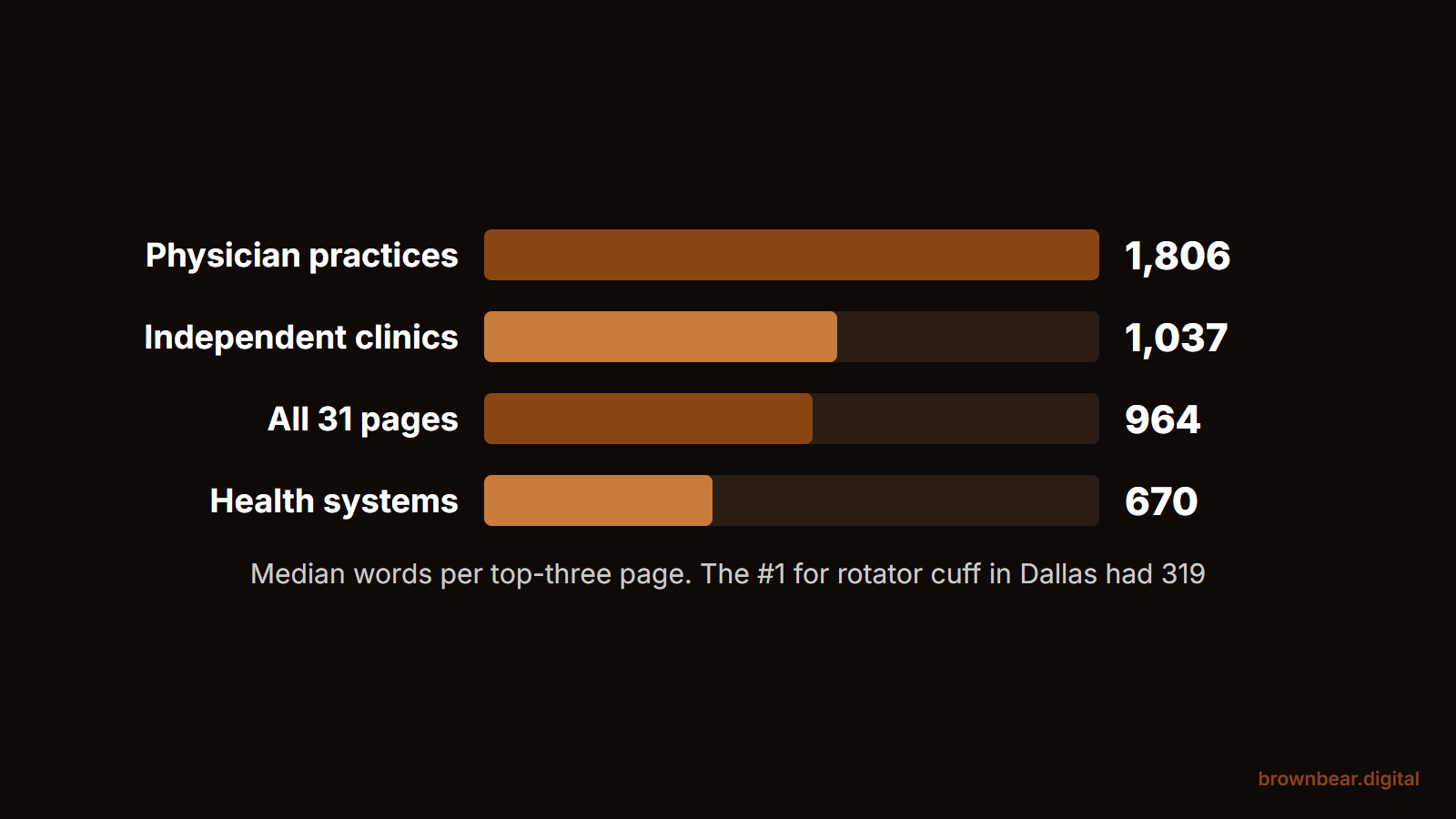
| Median words | 1,037 | 843 | 1,269 | 964 |
| City in the title | 7 of 9 | 5 of 11 | 6 of 11 | 18 of 31 |
| Business schema such as LocalBusiness or MedicalClinic | 3 of 9 | 3 of 11 | 6 of 11 | 12 of 31 |
| No meaningful schema | 6 of 9 | 7 of 11 | 4 of 11 | 17 of 31 |
| Names a credentialed provider | 1 of 9 | 2 of 11 | 2 of 11 | 5 of 31 |
| Mentions insurance | 8 of 9 | 4 of 11 | 6 of 11 | 18 of 31 |
| Mentions booking without a referral | 2 of 9 | 0 of 11 | 0 of 11 | 2 of 31 |
| Has an FAQ section | 0 of 9 | 8 of 11 | 6 of 11 | 14 of 31 |
| Shows a price | 0 of 9 | 0 of 11 | 1 of 11 | 1 of 31 |
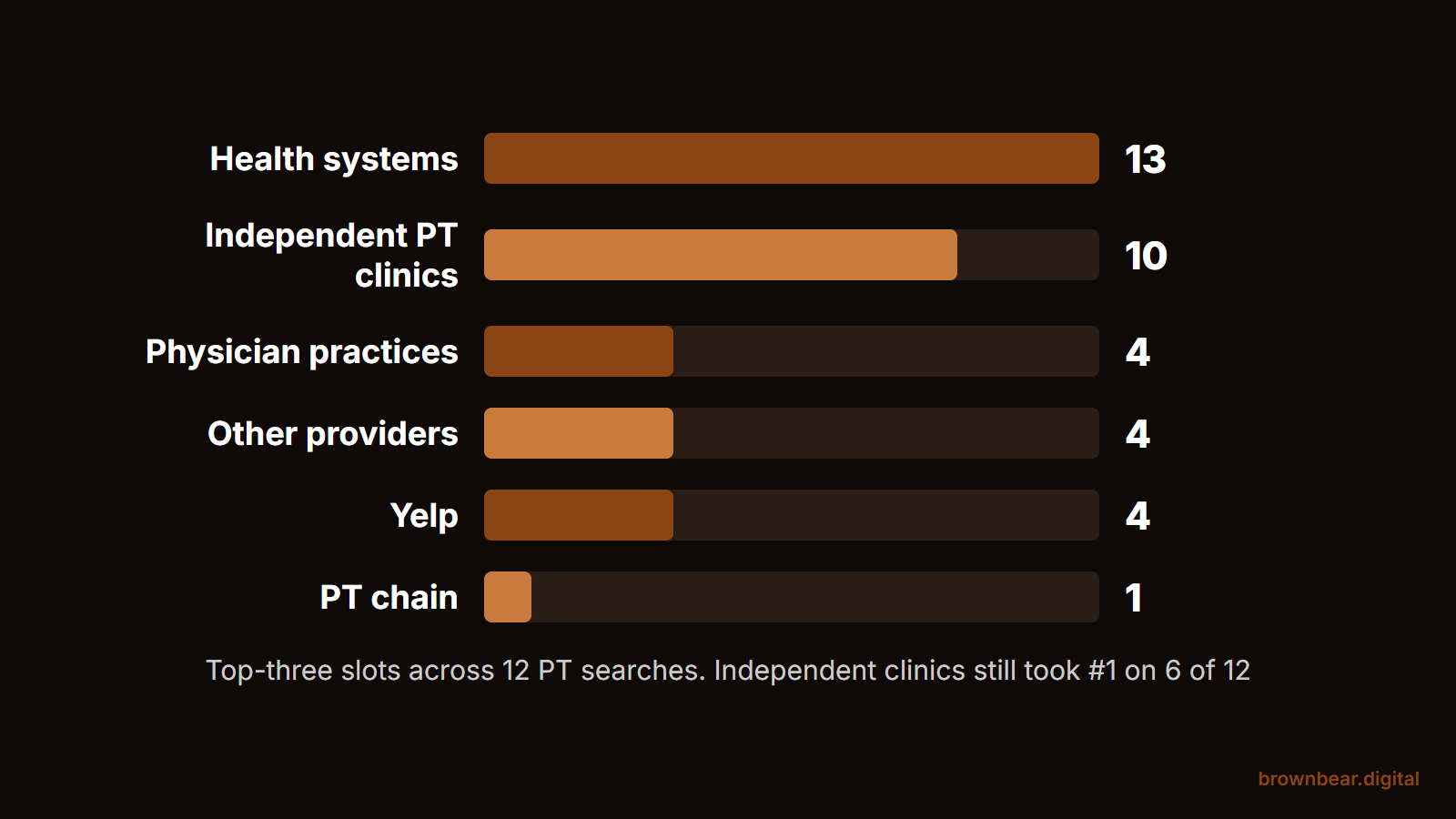
Ownership looked like this. Hospital and health systems held 13 of the 36 slots and independent PT clinics held 10. Physician practices held 4, other providers such as acupuncture, chiropractic and rehab centers held 4, Yelp held 4 and a PT chain held 1. Independent clinics still took #1 on 6 of the 12 searches, more than any other group, counting the one whose ranked page no longer loads. Systems took #1 on 3.
Three findings matter most for what you build.
Length did not decide the top spot.
The #1 result for "rotator cuff physical therapy dallas" was an independent clinic's shoulder page with 319 words and no subheadings. The #1 result for "sports physical therapy dallas" was a clinic homepage with under 400 words. Health system pages had a median of 670 words, yet they took 13 slots. What those short pages share is a clear match between the search and the page: the condition or specialty and the city sit in the title, and the page is about exactly that.
Independent clinics did the technical basics better than hospitals.
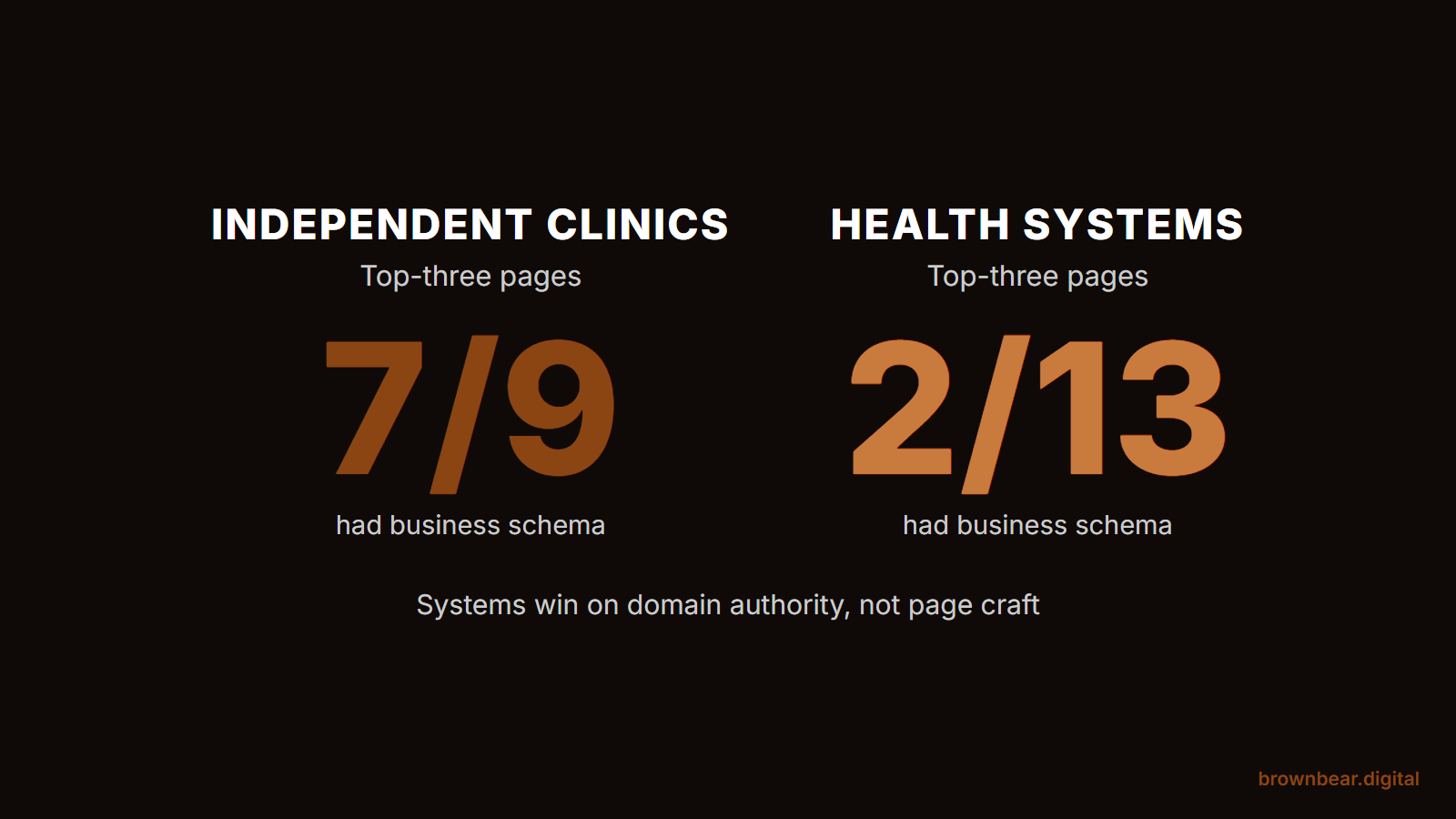
7 of the 9 independent clinic pages carried business schema, against 2 of 13 health system pages. 8 of the 9 independent pages put the city in the title. Systems win on domain authority, not on page craft, which is why a well-built clinic page can sit next to them.
The facts patients screen for are mostly missing.
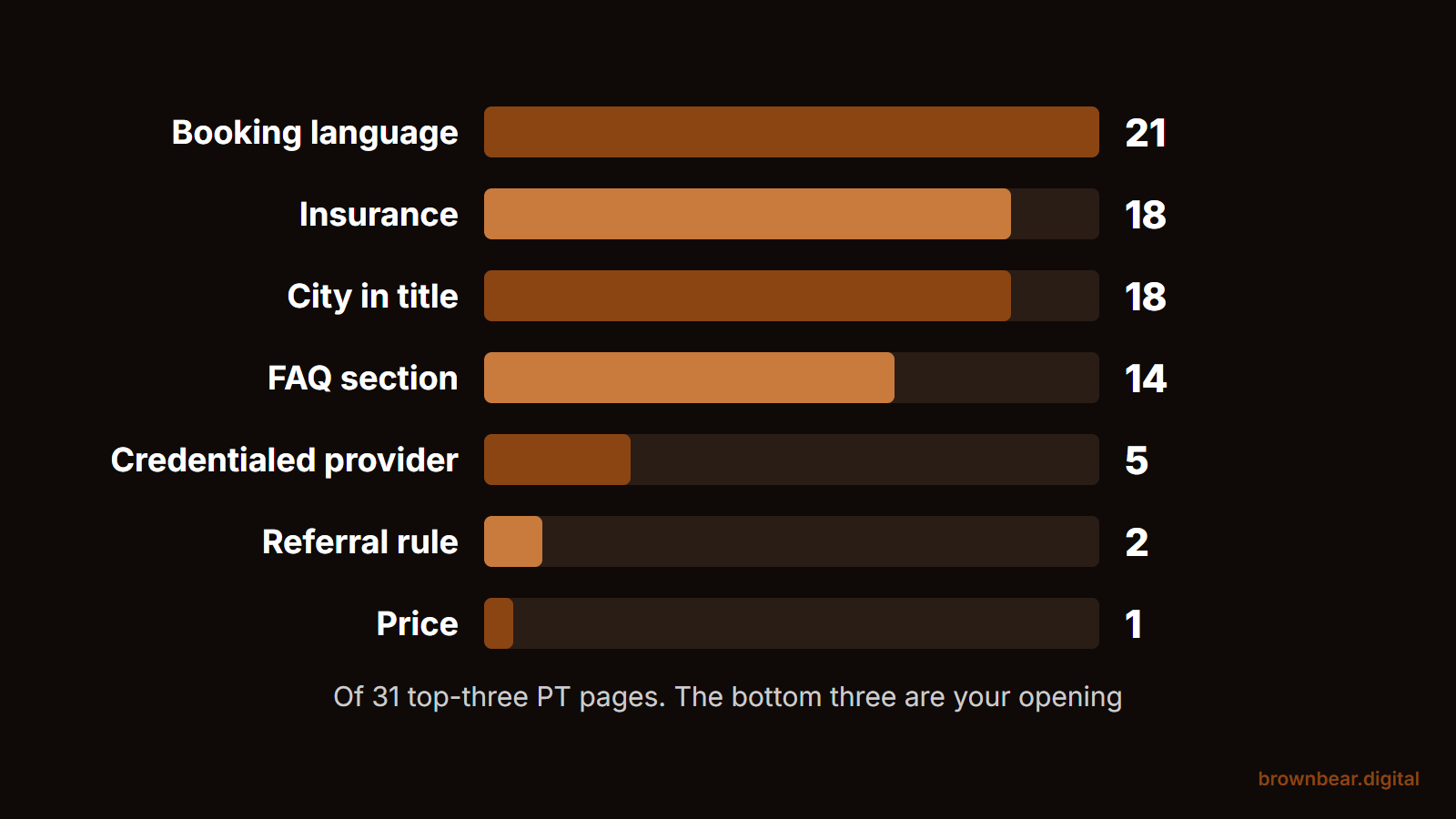
Only 5 pages named a provider with a credential such as DPT or OCS, and none of the 13 health system pages did. Only 2 mentioned that patients can book without a referral. Only 1 showed a price, and that was an acupuncture clinic's new-patient offer, not a PT clinic. Those gaps are your opening.
Build Your Keyword Universe by Lane, Not by Volume
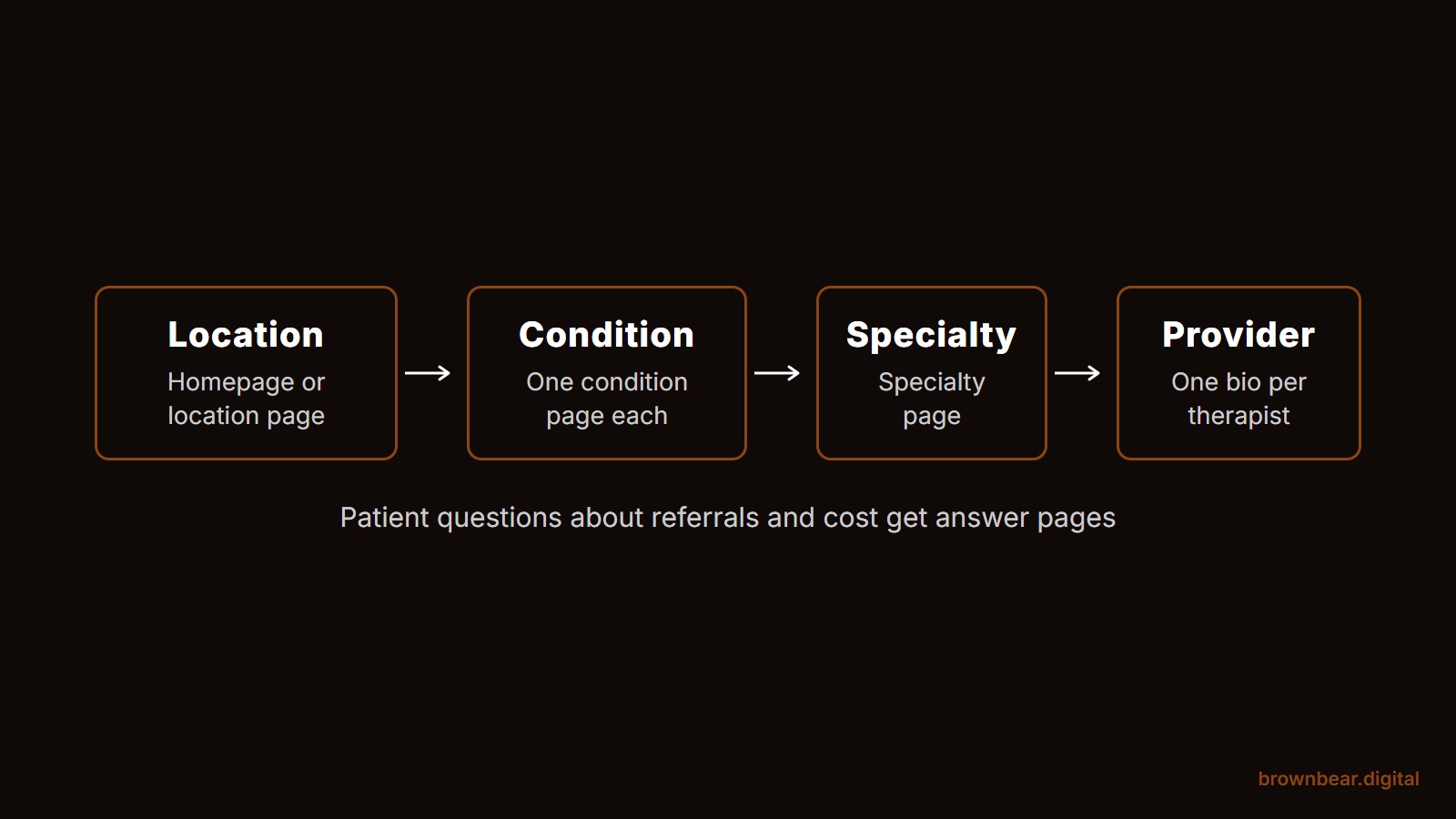
A physical therapy keyword plan should be sorted by lane, because each lane needs a different kind of page. Search volume tells you which pages to build first inside a lane. It does not tell you what to build. The five lanes are location, condition, specialty or treatment, provider, and the patient questions about referrals, insurance and cost.
Owners search for this list often. "Physical therapy keywords" draws about 1,300 searches a month in Semrush, more than "physical therapy seo" itself at 720. Here is how the lanes map to pages:
| Lane | How the search looks | Page that ranks | Who you compete with |
|---|---|---|---|
| Location | physical therapy + city, physical therapist + neighborhood | Homepage for one clinic, location page for each clinic in a group | Health systems, Yelp, chains |
| Condition | sciatica physical therapy + city, knee replacement rehab | One condition page per condition you want more of | Health systems, orthopedic surgeons |
| Specialty or treatment | pelvic floor, vestibular, sports, dry needling + city | Specialty page, or the homepage for a specialty clinic | Specialty clinics, acupuncturists, systems |
| Provider | therapist's name, "DPT" + city | One bio page per treating therapist | Directories and insurer listings |
| Patient questions | do I need a referral, does insurance cover PT, cost | Answer pages written for your state and city | Clinic blogs, APTA, health sites |
Build the list from what your clinic actually treats. Start with your top 10 diagnoses by new evaluations over the past year, then add the specialties you want more of and every city or neighborhood you can reach in a reasonable drive. Pair each one with "physical therapy" and "physical therapist." Then check each pairing in a keyword tool. Local terms often show low or zero volume in tools and still bring calls, so a low number is a reason to build the page cheaply, not a reason to skip it.
Picture a three-therapist clinic in a Dallas suburb that treats mostly shoulders, knees after surgery and running injuries. Its keyword list should not start at "physical therapy dallas," where a health system and Yelp already hold two of the top three spots. It starts at "rotator cuff physical therapy" plus its suburb, "knee replacement physical therapy" plus its suburb, and "physical therapist" plus its neighborhood. That is three pages it can win in months, before it ever takes on the city term.
Site Architecture: One Page for Every Search You Want to Win
The rule for PT site architecture is simple: every search you want to rank for needs one page that is clearly about it, and no two pages should target the same search. A single "Services" page that lists 14 conditions in bullets gives Google nothing to rank for any of them. In our study, 8 of the 12 condition-lane slots went to a page about that one condition.
A clean structure for most clinics looks like this:
- The homepage targets your main service and city: "Physical Therapy in [City], [State]."
- One page per condition you want more of, under a short path like /conditions/sciatica/.
- One page per specialty or treatment, under /services/pelvic-floor-therapy/ or similar.
- One bio page per treating therapist, under /team/[name]/.
- One page per clinic location if you have more than one, under /locations/[city-or-neighborhood]/.
Link it as a hub and spokes. The homepage links to every condition and specialty page. Each condition page links back to the homepage, to the therapists who treat it, and to the location pages where it is offered. Keep the paths short, and do not change them once they rank. If you move platforms or rename pages, send every old URL to its new home with a single permanent redirect.
Specialty clinics can flip the structure. In Boston, two pelvic health clinics ranked #1 and #3 for "pelvic floor physical therapy boston" with their homepages, each with pelvic floor and Boston in the title. If one specialty is your whole practice, the homepage is the specialty page. If your current site cannot hold this structure without hacks, a website rebuild is often cheaper than patching it page by page.
Use the planner below to turn your clinic's services and locations into a page list.
The Four Page Templates That Rank for PT Searches
Four templates cover nearly every page a physical therapy site needs: the clinic homepage or location page, the condition page, the specialty or treatment page, and the provider page. Each one has a job, a title pattern and a short list of facts that belong on it. We call the full set the PT Page Blueprint:
| Template | Title pattern | Must include | What the study showed |
|---|---|---|---|
| Homepage or location page | Physical Therapy in [City], [State] | [Clinic] | Address and neighborhoods served, hours, phone, who treats patients and their credentials, insurance taken, whether patients can book without a referral, booking button | Independent clinics won #1 in Dallas and Boston with homepages. Both mentioned booking without a referral |
| Condition page | [Condition] Physical Therapy in [City] | What the condition feels like, what an evaluation looks at, how your therapists approach it, who treats it, a short FAQ, booking | 8 of 11 condition pages had an FAQ section. The #1 for rotator cuff in Dallas was 319 words |
| Specialty or treatment page | [Specialty] Physical Therapy in [City] | Who it is for, what a visit involves, the therapist's specialty training, insurance and cash options | Specialty clinic homepages took #1 for pelvic floor in Boston and sports PT in Dallas |
| Provider page | [Name], PT, DPT | [Specialty] in [City] | Credentials and board certifications, conditions treated, location, photo, booking with that therapist | Only 5 of 31 ranking pages named a credentialed provider on the page |
The Homepage or Location Page
For a single clinic, the homepage is the location page, so it carries the city, the neighborhood, the address and the people. The Dallas #1 was a clinic homepage that mentioned direct access and displayed a review count. For groups, each clinic gets its own location page written for its own neighborhood. The pattern is the same one we recommend for PT groups with several clinics in other specialties: one page and one Business Profile per real office.
The Condition Page
A condition page earns its place by answering what a patient with that problem wants to know before booking: will PT help, what happens at the first visit, who will see me, and can I book now. It does not need 3,000 words. It needs to be about one condition in one place, and it should never give treatment advice to a reader nobody has evaluated. Say plainly that the evaluation decides the plan.
The Specialty or Treatment Page
Specialty pages face different competitors than general PT pages. For "dry needling san diego," the top two results were an integrative health center and an acupuncture clinic, and the first PT clinic showed up at #4. If you offer a treatment that other licensed professions also offer, your page has to explain what a physical therapist's version involves and who performs it.
The Provider Page
Provider pages are the cheapest win on this list. The knee replacement page that ranked #2 in San Diego named its therapist with "PT, DPT" after his name and marked him up as a Person in its schema. The sports clinic at #3 in Dallas named its therapist with PT, DPT and OCS. Most competitors named nobody. A bio page for each treating therapist gives Google and patients a real person to connect to each condition you treat.
On-Page SEO: Titles, Headings and the Facts Patients Screen For
On-page SEO for a PT clinic comes down to two jobs: make each page's title and first heading match the search it targets, and put the facts a patient uses to choose a clinic where they can see them. Most ranking pages did the first job. Most skipped the second.
Titles first. 18 of the 31 pages put the city in the title, and independent clinics did it on 8 of 9 pages. Lead with the service or condition, then the city, then the clinic name: "Sciatica Physical Therapy in Dorchester, Boston | [Clinic]." Your first heading should say the same thing in plain words. A homepage headline that reads "Move Better, Live Better" tells Google nothing about what or where you treat.
Then the facts. Patients choosing a PT clinic want to know who will treat them, whether their insurance is taken, whether they need a referral and how soon they can be seen. In our study, 18 pages mentioned insurance, but only 5 named a credentialed provider and only 2 mentioned booking without a referral. Every state now allows some form of direct access, but the rules differ, so state your own state's rule accurately rather than a blanket "no referral needed."
Say you run a two-therapist clinic in Minneapolis, where a health system's provider directory held #1 for "physical therapy minneapolis." Your homepage title reads "Home | Lakeside PT." Change it to "Physical Therapy in Minneapolis, MN | Lakeside PT," name both therapists with their credentials in the first screen, list the insurers you take, and add a line explaining what Minnesota's direct access rule means for a new patient. None of that takes a developer, and it puts named, credentialed therapists on the page, which neither health system result in that top three did.
Check any page on your site against what the top-ranking PT pages carry:
Schema for PT Sites: What to Mark Up and What Not to Expect
Schema markup helps Google read your clinic's facts, but it did not separate winners from losers in our study. 17 of the 31 top-three pages had no meaningful schema at all, including most health system pages. Add it because it is cheap and accurate, not because it moves rankings by itself.
What to add:
- LocalBusiness markup on the homepage and each location page, using the most specific type that fits, such as MedicalClinic with Physiotherapy as its medical specialty, with your name, address, phone, hours and geo coordinates. Google's local business documentation asks for the most specific subtype available and lists the required and recommended fields.
- Person markup on each provider page, with the therapist's credentials.
- Breadcrumb markup sitewide, which most site platforms add for you.
What not to expect: FAQ rich results. Google limited them to well-known government and health sites in August 2023, then stopped showing them in Search in May 2026. Keep FAQ sections on your condition pages because patients read them, and 8 of the 11 ranking condition pages had one, but do not expect the markup to win extra space on the results page.
Bryan's view, from the medical practice sites Brown Bear audits, is that schema is worth having and rarely the lever. Crawlable pages with clear, well-structured answers move rankings and AI visibility more than markup does.
Technical SEO for Clinic Websites, Including the Ranked Page That No Longer Exists
Technical SEO for a PT site is mostly about making sure Google can reach, read and trust every page you built: fast load on a phone, pages that render without waiting on scripts, clean redirects, and no ranked URLs that return errors. Most clinic sites run on a template platform, so the problems are usually few and fixable.
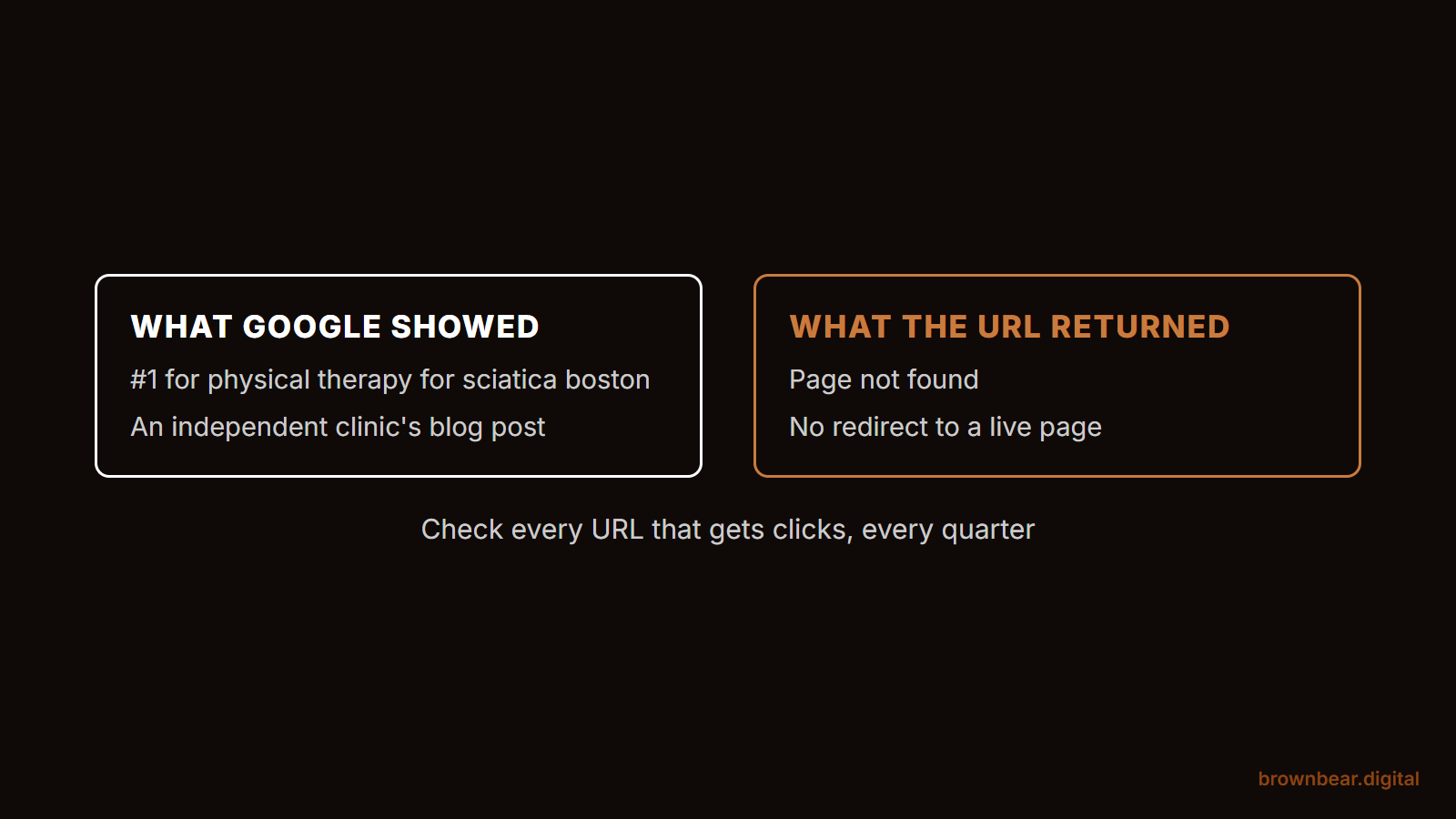
The study turned up a clear example. The #1 result for "physical therapy for sciatica boston" was an independent clinic's blog post. When we opened that exact URL, it returned the clinic's "page not found" screen. Google was still sending searchers to a page that no longer exists. The likely cause is a rebuild or cleanup that removed or renamed the post without a redirect, and unless it is fixed, that clinic is likely to lose a #1 ranking it already earned.
Here is the short technical list to run every quarter:
- Export every URL that gets clicks from Google Search Console and check that each returns a live page. Anything that errors gets a single permanent redirect to its closest live match.
- Test your homepage and one condition page in Google's PageSpeed Insights on mobile. Booking widgets, chat popups and video headers are the usual drag.
- Turn off JavaScript in your browser and load your condition pages. If the text disappears, Google and AI crawlers may see less than your patients do. We cover the fixes in our guide to JavaScript rendering on clinic sites.
- Check that each location and condition page is in your XML sitemap and not blocked by a "noindex" tag left over from a staging site.
In Bryan's experience, heavy scripts are one of the most common reasons a medical practice site says less to Google than its owner thinks, and stripping them out is often the first fix.
Content Plan: Condition Pages Before Blog Posts
A PT clinic's content plan should start with condition and specialty pages, not blog posts. Those pages target the searches that book evaluations, and they are what won the condition and specialty lanes in our study. Only 2 of the 36 top-three slots went to blog posts, and one of those was the page that no longer loads.
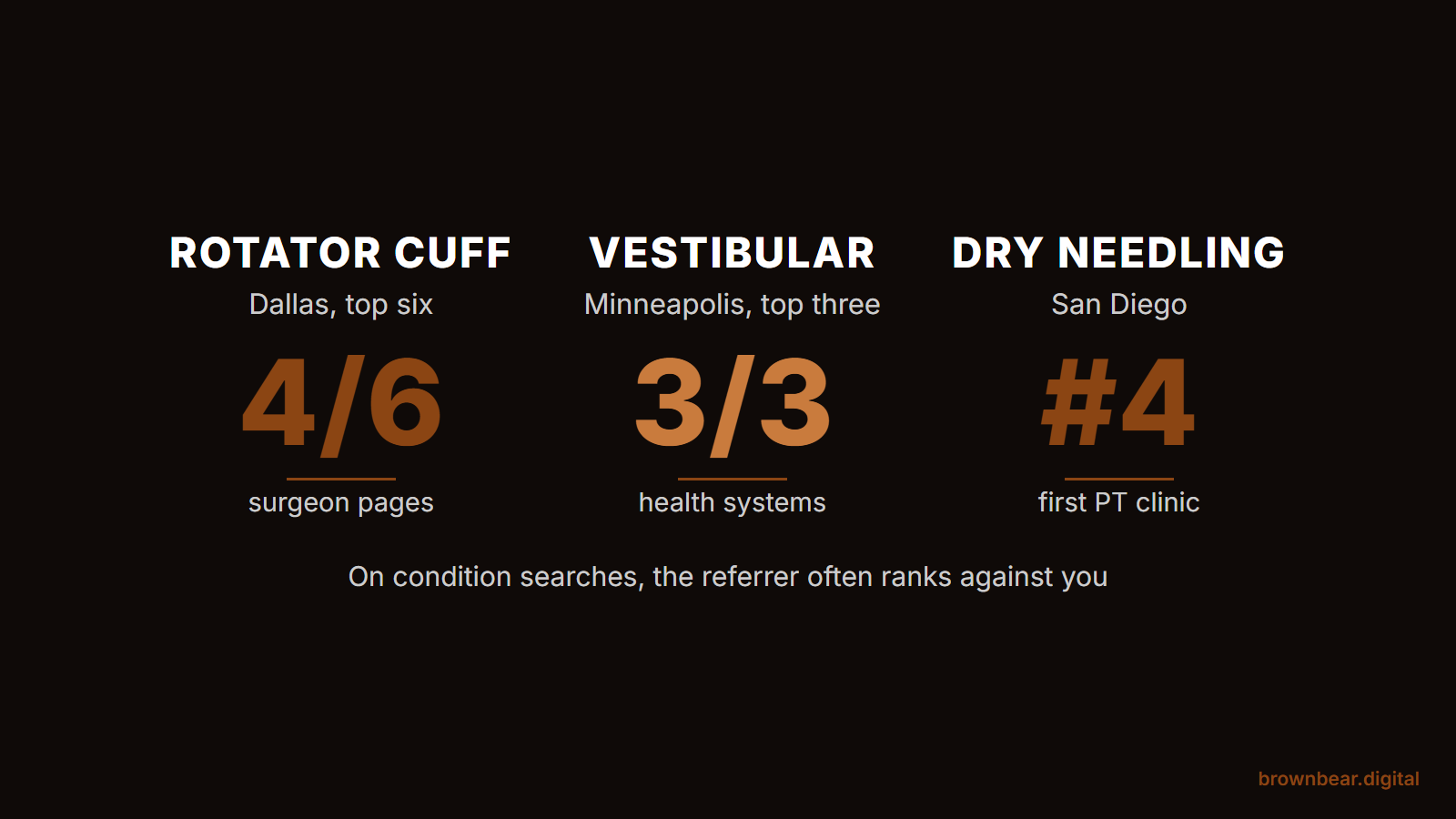
Condition searches also bring the toughest competitors. For "rotator cuff physical therapy dallas," an independent clinic held #1, but 4 of the top 6 results were orthopedic surgeons' pages. For "vestibular therapy minneapolis," health systems held all three top spots. On condition searches, the doctor who could refer to you is often ranking against you, the same pattern we saw from the other side when we studied orthopedic groups competing for the same searches. Your page wins on what theirs leaves out: who treats the patient, what therapy involves, and how soon they can start.
Order the work this way:
- Build condition pages for your top 5 diagnoses by new evaluations.
- Build one page for each specialty you want to grow.
- Write answer pages for the patient questions in your state: referrals, insurance coverage, what a first visit costs without insurance.
- Only then add blog posts, and only ones that answer a question patients actually ask your front desk.
Bryan's rule for clients is to ask for the reason behind every piece before it is written. Long-form content still earns links and still answers the cost and "should I" questions patients research, but a post written only to keep a blog active does neither.
Picture a pelvic health clinic that has published 40 blog posts on general wellness and has one "Services" page listing pelvic floor therapy as a bullet. Its blog draws readers from across the country who never book. Moving that effort into a pelvic floor page for its city, a postpartum page and a page for men's pelvic health gives it three pages that match what local patients type, which is how the Boston pelvic clinics in our study ranked.
Links, Citations and the Local Signals Around Your Site
Links and listings tell Google your clinic is real and local. For a PT clinic, the useful links come from places patients and partners already trust: the gyms, running clubs, schools and teams you work with, the physicians who refer to you, local news and community sponsors. You do not need hundreds. You need a steady few from your own area.
Start with consistency. Your clinic's name, address and phone should read the same on your site, your Business Profile, Yelp, insurer directories and every listing site. Yelp search pages took 4 of the 36 top-three slots in our study, including #2 in Boston and San Diego, so those listings get seen. In Bryan's AI visibility audits, small variations in name, address or phone across listings are the most common error he finds, and PT clinics drift after moves, mergers and rebrands.
Then earn local links on purpose:
- List every gym, school, club and team you treat athletes from, and ask each to link to your relevant specialty page.
- Offer a free injury screen at a local race or school event, and ask the organizer to list you as a partner on their site.
- Send each referring physician a page they can share with patients, such as your post-surgery rehab page for a surgeon's knee patients.
Physical Therapy SEO for Single Clinics, Multi-Location Groups and Specialty Practices
Physical therapy SEO is for any outpatient clinic that wants evaluations from search, but the first build depends on how many clinics and specialties you run. Count your locations and the services you want more of before you pick a path.
For Single-Clinic Private Practices Starting With the Homepage
In Dallas and Boston, an independent clinic took #1 for "physical therapy" plus the city with its homepage, and both pages mentioned that patients can book without a referral. Your homepage is your most important page, so put your city, your therapists and their credentials, your insurers and your direct access rule on it first. Then build condition pages for your top diagnoses before anything else.
For Multi-Location PT Groups Building a Page per Clinic
In Minneapolis, a local PT group ranked #5 with a page for its Minneapolis location, not its homepage, and the chain result in our study, Bay State Physical Therapy, ranked #3 for sciatica in Boston with a condition page. Groups need both layers: a location page per clinic and condition pages that link to the clinics offering that care. Write each location page for its own neighborhood and team so the pages do not read as copies.
For Specialty Clinics Making the Specialty the Homepage
Two pelvic health clinics held #1 and #3 for "pelvic floor physical therapy boston," and a sports clinic held #1 for "sports physical therapy dallas," each with its homepage. When one specialty is most of your caseload, put it in the homepage title and first heading, name the therapist's specialty training, and build supporting pages for the conditions inside that specialty.
How to Measure Physical Therapy SEO Without Breaking HIPAA
Measure physical therapy SEO by evaluations booked from organic search, broken out by the page that brought the visitor in. Rankings and traffic are early signals. Booked evaluations and completed plans of care are the result.
A simple setup works:
- In Google Search Console, group your pages by lane: homepage and locations, conditions, specialties, providers. Track clicks and average position per group monthly.
- Track phone calls and booking requests by landing page, using a call tracking number on the website while your main clinic number stays the primary phone on your Business Profile and listings.
- Have the front desk ask "how did you find us?" and record it in your practice software for every new evaluation.
Be careful with tracking pixels on pages about conditions and appointments. The HHS guidance on online tracking technologies says tracking on pages like booking and patient portals can expose protected health information; a federal court vacated part of that guidance in June 2024, the part covering tracking that links a visitor's IP address to a public page about health conditions or providers, and the rest still stands. Our guide covers the HIPAA rules for tracking pixels in more detail.
A Realistic Timeline for Physical Therapy SEO
Physical therapy SEO pays off in stages, and the smaller, more specific lanes move first. Provider pages, condition pages for a suburb or neighborhood, and fixes to titles and listings can show movement within a few months. A "physical therapy" plus big-city search where health systems hold the top spots is a year or more of work, and sometimes a stretch goal rather than the plan.
The order Brown Bear plans PT programs in follows the lanes:
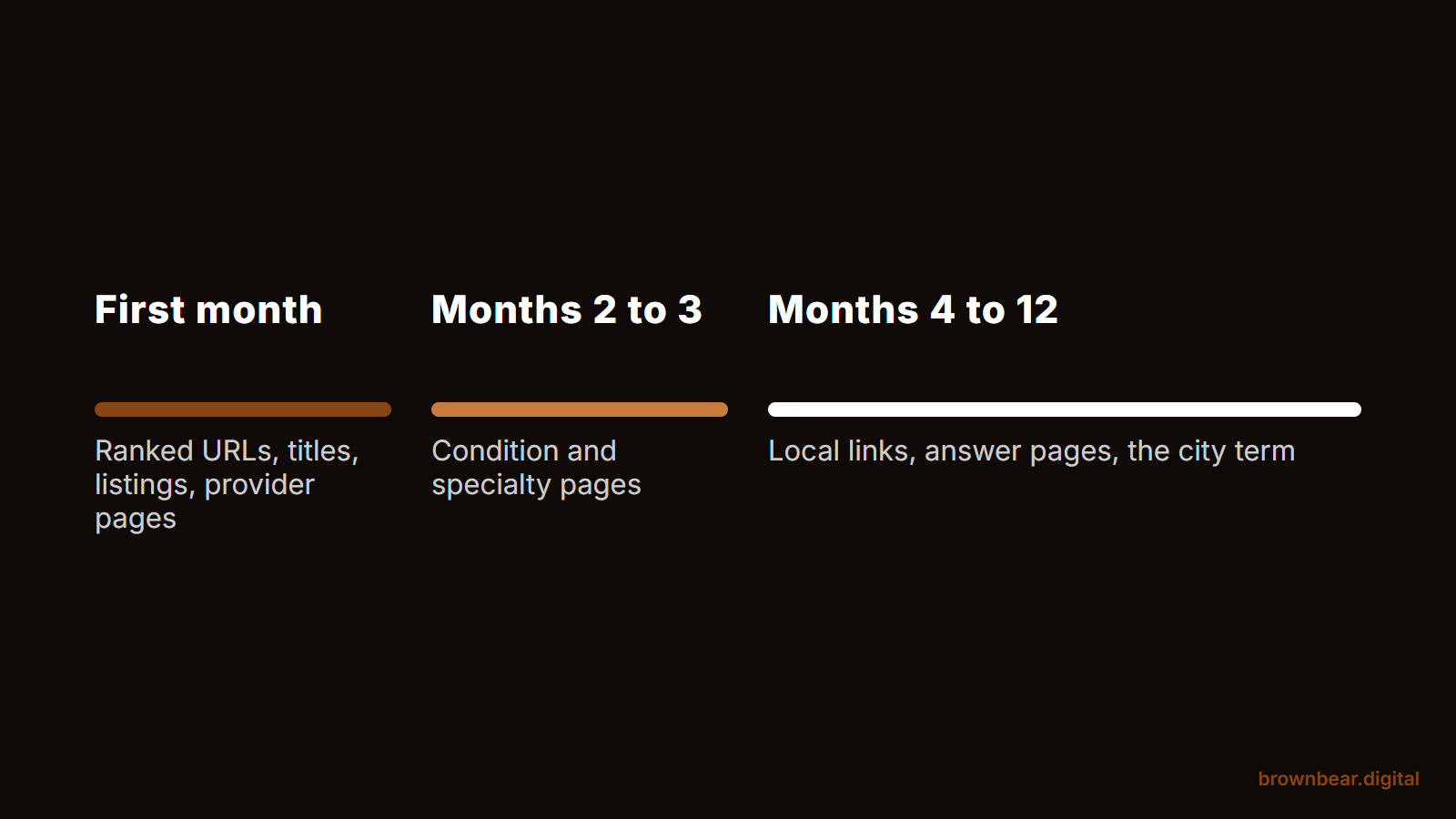
- First month: fix broken ranked URLs, titles, listings and schema, and publish provider pages.
- Months two and three: build condition and specialty pages for your top diagnoses and services.
- Months four to 12: earn local links, add answer pages for patient questions, and widen into nearby neighborhoods and the city term.
Judge the first year on evaluations booked by landing page, not on whether you rank for the city term yet. A clinic that books steadily from 15 condition and provider pages is in a better place than one that ranks #8 for "physical therapy" plus its city.
Build Your Physical Therapy SEO With Brown Bear
The clinics that win PT searches are not the ones with the most content. They are the ones whose pages say plainly what they treat, where, and who does the treating. Brown Bear works with physical therapy clinics on that build, from the keyword map to the templates to the technical cleanup. If you want a plan built from your own caseload and your own city's results, start with our SEO for physical therapy clinics.
Written By
Founder, Brown Bear Digital
Bryan has 15 years of experience across SEO, paid search, and AI search strategy. He founded Brown Bear to give businesses direct access to senior-level search expertise without the agency overhead.
Learn More About BryanGet Found on Google.
Get Cited by AI.
Tell us about your site. We'll send back a proposal for SEO and AI search.