Plastic Surgery Email Marketing: The Rules Behind the Send
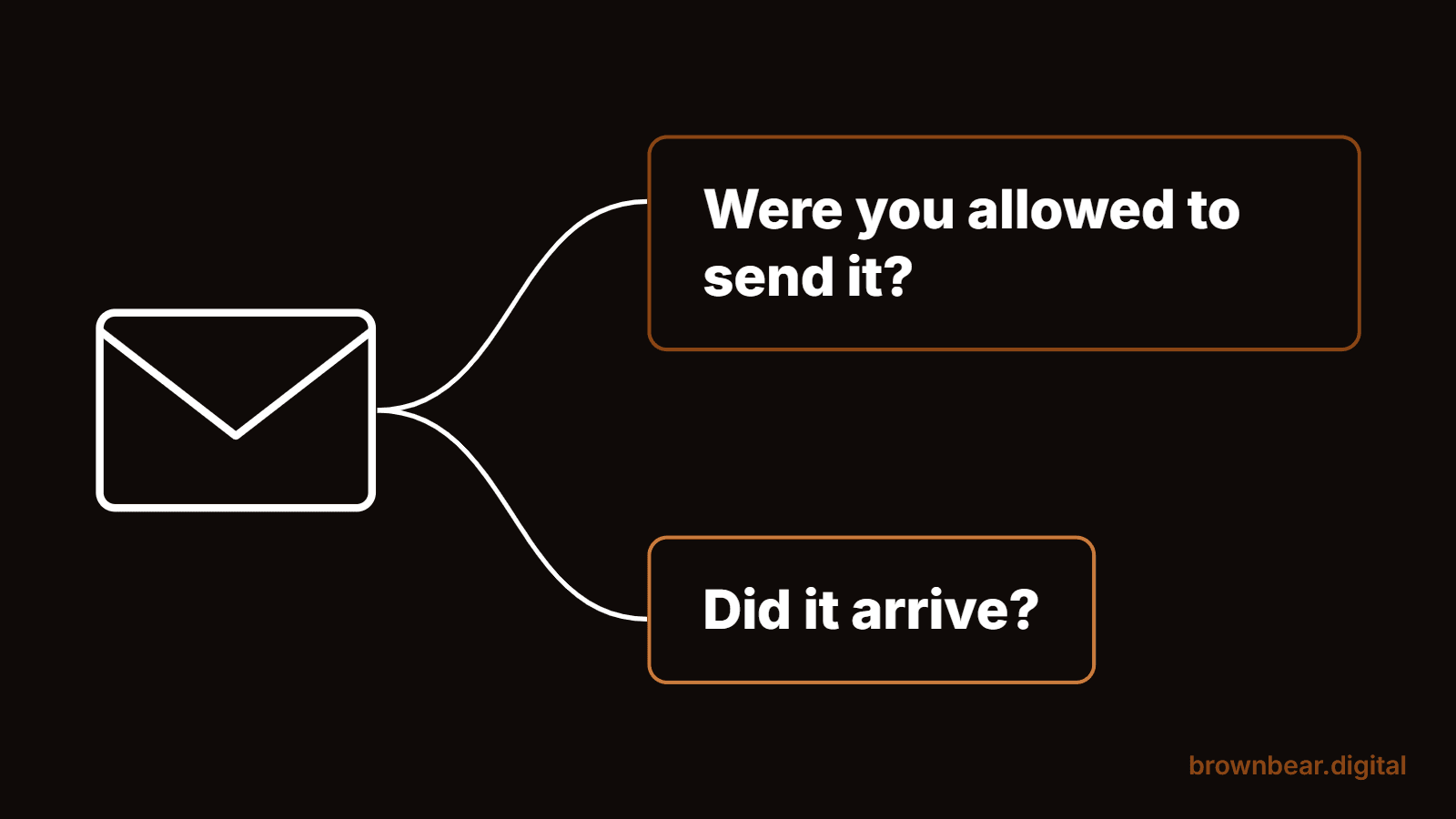
This is Brown Bear's guide to plastic surgery email marketing, built around the two questions that decide whether any of it works: were you permitted to send this, and did it arrive?
Almost every guide on this topic answers the compliance question the same way, in one sentence, and gets it wrong in a way that matters. The rules themselves are two short paragraphs of federal regulation. They take about a minute to read, and we quote them here because nothing currently ranking for this search does.
When we say email marketing, we mean both the automated sequence that runs after a consultation whether or not anyone is watching it, and the one-off promotional send somebody builds on a Tuesday afternoon because the surgical calendar looks thin in three weeks. Those two things carry very different risk, and most practices treat them identically.
If you are a surgeon who has been told for three years that you should be doing more with email and has never had a straight answer about what you are allowed to say, this is written for you. If you are the practice manager who inherited a CRM with four thousand addresses in it and no record of where any of them came from, the section on lists is the one to read first. And if you run marketing for a multi-location group where each office has been building its own audience, the failure you are heading toward is a deliverability failure, not a creative one.
By the end you will know which of your emails HIPAA actually regulates and which it does not touch at all, why that answer has almost nothing to do with your email platform, how thin your deliverability margin really is compared to a retailer's, and what to measure instead of the return-on-investment figure every agency quotes at you.
We have grouped it into four parts: what email is genuinely for inside a surgical practice, what the rules actually say, how to build the list and the sequence, and how to tell whether it is working. Start with the part that gets skipped, which is the question of what this channel is for in the first place.
What Email Actually Does for a Plastic Surgery Practice
Email is the only audience a practice owns outright. Every other channel is rented. Your position in Google can move on a Tuesday for reasons nobody explains. Your reach on Instagram is set by a ranking system you do not control and cannot appeal. Your paid search account can be suspended over an ad policy interpretation. The email list is the one asset that survives all of that, because it is a file of addresses that belongs to the practice.
That is a different argument from the one the rest of this topic makes. Most guides open by telling you email returns thirty-six dollars for every dollar spent. We come back to that number later, because where it comes from is worth knowing. The stronger case for email in a surgical practice has nothing to do with a ratio. It is that cosmetic surgery has an unusually long and unusually private decision window, and email is the only channel that can stay present through it without being intrusive.
Somebody who requests a rhinoplasty consultation is not usually deciding between you and another surgeon that week. They are deciding whether to do this at all, on a timeline measured in months, and they are mostly doing it alone. They are not going to post about it. They may not tell their family. Search brought them in, and how practices generate plastic surgery leads is a separate problem with its own answers, but search cannot follow them through the six months that come next. Email can, and it can do it in a channel they already treat as private.
So the honest framing of what email does is this: it is not a lead source. It is what keeps a lead alive long enough to become a surgery.
The Compliance Question Almost Every Guide Answers Wrong
The standard answer is "use a HIPAA-compliant email platform and sign a Business Associate Agreement." That is not wrong, but it answers a different question than the one you are asking. A BAA governs how your vendor handles protected health information once you have given it to them. It says nothing whatsoever about whether you were permitted to send the message in the first place.
Two paragraphs of the Privacy Rule decide that, and they work in sequence.
First: is this communication "marketing" at all?
Under the definition of marketing in 45 CFR 164.501, marketing means making a communication about a product or service that encourages the recipient to purchase or use it. But the same definition carves out communications made for treatment of the individual, and communications that describe a health-related product or service provided by the covered entity itself, as long as no third party is paying for the message.
Read that carefully, because it inverts the advice everyone gives. A practice emailing its own patients about its own procedures, its own surgeons, its own financing, or its own open house is generally not doing marketing as HIPAA defines it. No authorization is triggered. The thing the whole industry treats as the dangerous act is, in the ordinary case, excluded by name.
Second: if it is marketing, what does that require?
This is where practices get caught. 45 CFR 164.508(a)(3) requires a covered entity to obtain an authorization for any use or disclosure of protected health information for marketing, and it lists exactly two exceptions: a face-to-face communication made to the individual, and a promotional gift of nominal value. Email is neither of those. Once a communication is marketing and it touches PHI, there is no platform, no BAA, and no intake checkbox that substitutes for a valid written authorization.
The trap: who is paying for the email
The exclusion above holds only while nobody outside the practice is funding the message. The same regulation defines financial remuneration as direct or indirect payment from, or on behalf of, a third party whose product or service is being described. The word doing the work is indirect.
Co-op marketing dollars from an injectable manufacturer are indirect payment. A rebate that scales with the volume you use is indirect payment. Creative assets supplied free by an implant company for you to send under your own name are indirect payment. In every one of those cases, an email describing that company's product to your patient list stops being an excluded communication about your own services and becomes marketing that requires prior written authorization.
Picture a practice manager building a Botox Day email in early October. The subject line names the brand. The images came from the manufacturer's partner portal. The manufacturer is reimbursing part of the send as a co-op credit, an arrangement the practice owner set up eighteen months ago and nobody mentioned to the person writing the email. The list is everyone in the CRM who has ever had an injectable, which is a segment built directly from patient records. That email is marketing, it uses PHI, and it needs an authorization that nobody has collected. The platform is fully HIPAA-compliant. It makes no difference at all.
This is also the source of a real disagreement worth knowing about. HIPAA Journal's guidance on digital marketing for plastic surgeons goes so far as to say it "does not advocate email marketing for plastic surgeons" on the grounds that many of the marketing exemptions do not apply to what plastic surgeons actually do. We think that overcorrects. The exclusion for describing your own services is squarely available to a practice that funds its own email, and abandoning the channel entirely gives up the one audience you own. But the caution behind it is well placed, and it is aimed at exactly the manufacturer-funded campaign described above.
Compliance here is also not separable from the rest of your marketing. The same reasoning about what counts as PHI shapes where HIPAA touches the rest of your marketing, from tracking pixels on procedure pages to what your intake forms transmit.
The branch that matters most:
if the practice is paying for the email out of its own budget and the email describes services the practice provides, you are inside the exclusion and no authorization is needed. If any part of the funding comes from a manufacturer, a device company, or a product line whose brand appears in the email, treat it as marketing requiring authorization until someone with the vendor contracts in front of them tells you otherwise in writing. The deciding factor is the money, not the wording.
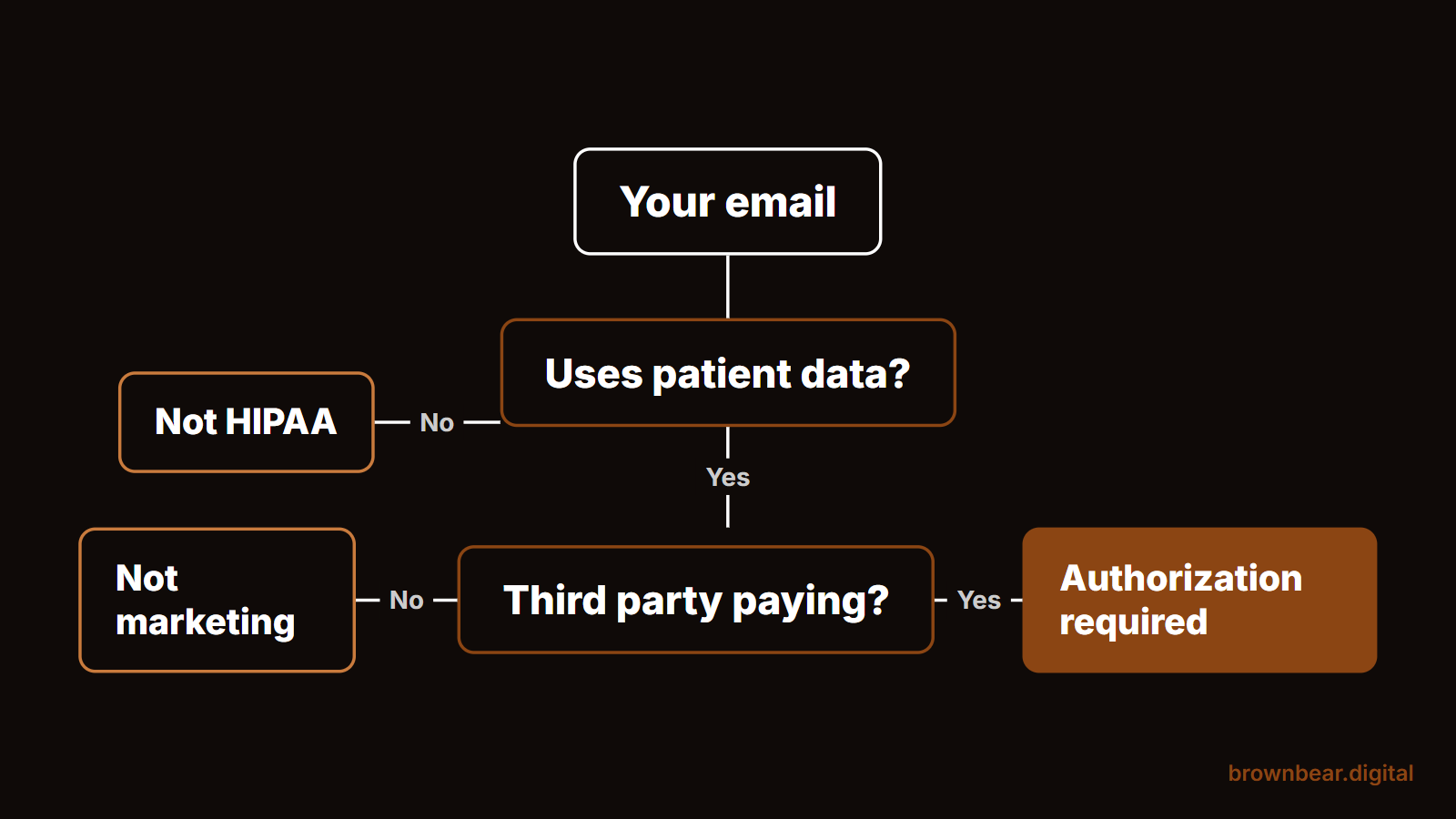
Answer for one specific email you want to send. The router walks the same two questions the regulation asks: is this communication "marketing" under 45 CFR 164.501, and if it is, does 164.508(a)(3) require written authorization first?
For informational purposes only. This router is a reading aid for two paragraphs of the HIPAA Privacy Rule, not legal advice, and it does not account for state privacy law, the FTC Health Breach Notification Rule, CAN-SPAM, or your Business Associate Agreements. Have counsel review any campaign before it sends. Your answers stay in your browser. Nothing is transmitted, stored, or sent to Brown Bear.
The Three Lists Every Practice Should Be Running
Everything above collapses into one operational decision, and it is not a decision about copy. It is a decision about which list a message belongs on. Most practices run one list, which is why every send raises every question at once. Run three, and the questions answer themselves.
| List | Who is on it | What it may carry | Governing constraint |
|---|---|---|---|
| Care | Patients with a scheduled or completed procedure | Pre-op instructions, recovery check-ins, appointment logistics, follow-up questions | Pure treatment communication. Excluded from marketing entirely. Must run on a platform with a signed BAA because the content is PHI. |
| Practice | Consults and patients who have opted in to hear from you | Your procedures, your surgeons, your financing, your events, your own educational content | Excluded from marketing under the own-services carve-out, but only while the practice funds it alone. One manufacturer dollar moves a message off this list. |
| Public | Anyone who subscribed through the website, an event, or a download, with no patient record attached | General education, brand content, anything a manufacturer helps fund | No PHI, so no HIPAA marketing analysis. CAN-SPAM and sender reputation still apply in full. |
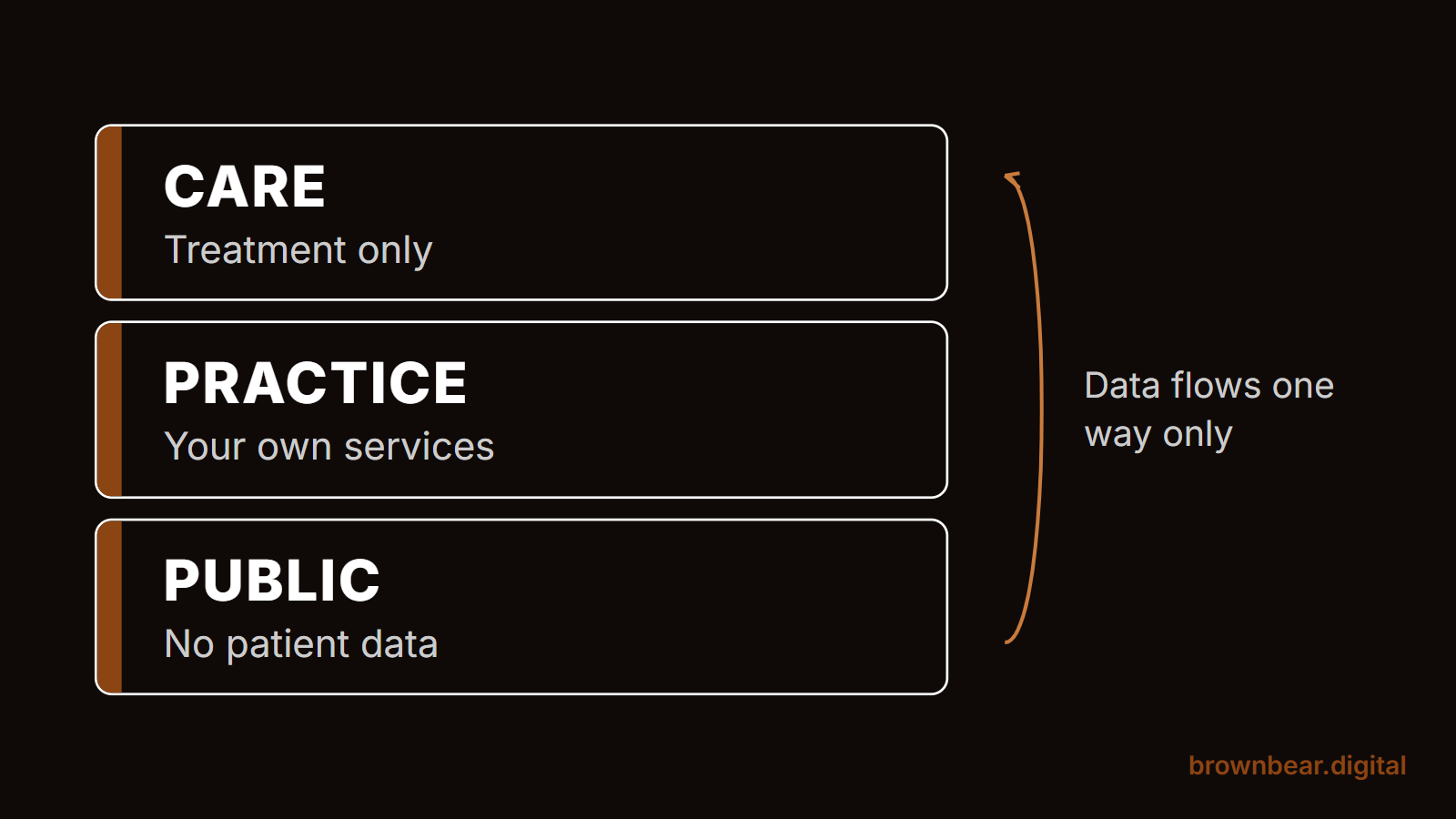
Call it the three-list rule. Its whole value is that it turns a legal question into a routing question, and routing questions can be answered by a practice manager at four in the afternoon without calling a lawyer. Where does this message belong? If it does not belong cleanly on one of the three, it is not ready to send.
The rule also has a hard edge, which is what makes it useful rather than decorative: the lists never merge, and data only ever flows in one direction. Somebody on the Public list who becomes a patient joins Care and Practice. Nobody on Care is ever exported into Public to make a promotional send bigger. That single discipline is what keeps a clean list clean, and it is the step that gets skipped when a campaign is underperforming and somebody decides to broaden the audience.
The second branch, for practices with a medspa arm:
if your surgical practice and your aesthetics business share a roof, a brand, and a database, run the three lists per entity, not once across both. Medspa promotions are the most likely to be manufacturer-funded, and surgical patients are the most likely to be PHI-heavy. Mixing them is how a compliant practice list becomes a non-compliant one without anyone making a decision. If the two businesses are genuinely separate legal entities, keep the databases separate too; if they are one entity, keep the segments separate and enforce it in the platform rather than in someone's memory.
None of this is theoretical scaffolding. It is the same principle behind a facelift marketing program built on owned channels, where the durable results came from assets the practice controlled rather than from platforms that could change the rules underneath them.
The Post-Consult Sequence and Why It Runs Longer Than 30 Days
The consultation is where most practices stop following up and where the decision actually starts. A working post-consult sequence has three phases, and the third one is where the surgeries come from.
Days 0 to 30, the information phase.
Thank-you and clear next steps on the day of the consult. The procedure's specific questions a few days later, written as answers rather than as a brochure. Financing options in the first week, because cost is the objection people are least likely to raise out loud. Results and recovery expectations in the second and third weeks. A direct invitation to come back with questions at the end of the month.
Days 31 to 90, the consideration phase.
This is the phase almost nobody builds, and it is where the standard advice fails. The emails here are not sales messages. They are the things somebody quietly needs before they can commit: what recovery genuinely looks like week by week, how other patients described the decision, what the surgeon's own approach and philosophy actually are.
Days 91 and beyond, the return phase.
A low-friction way back in. Not a discount. A question, a new piece of information, an easy path to a second conversation with no obligation attached.
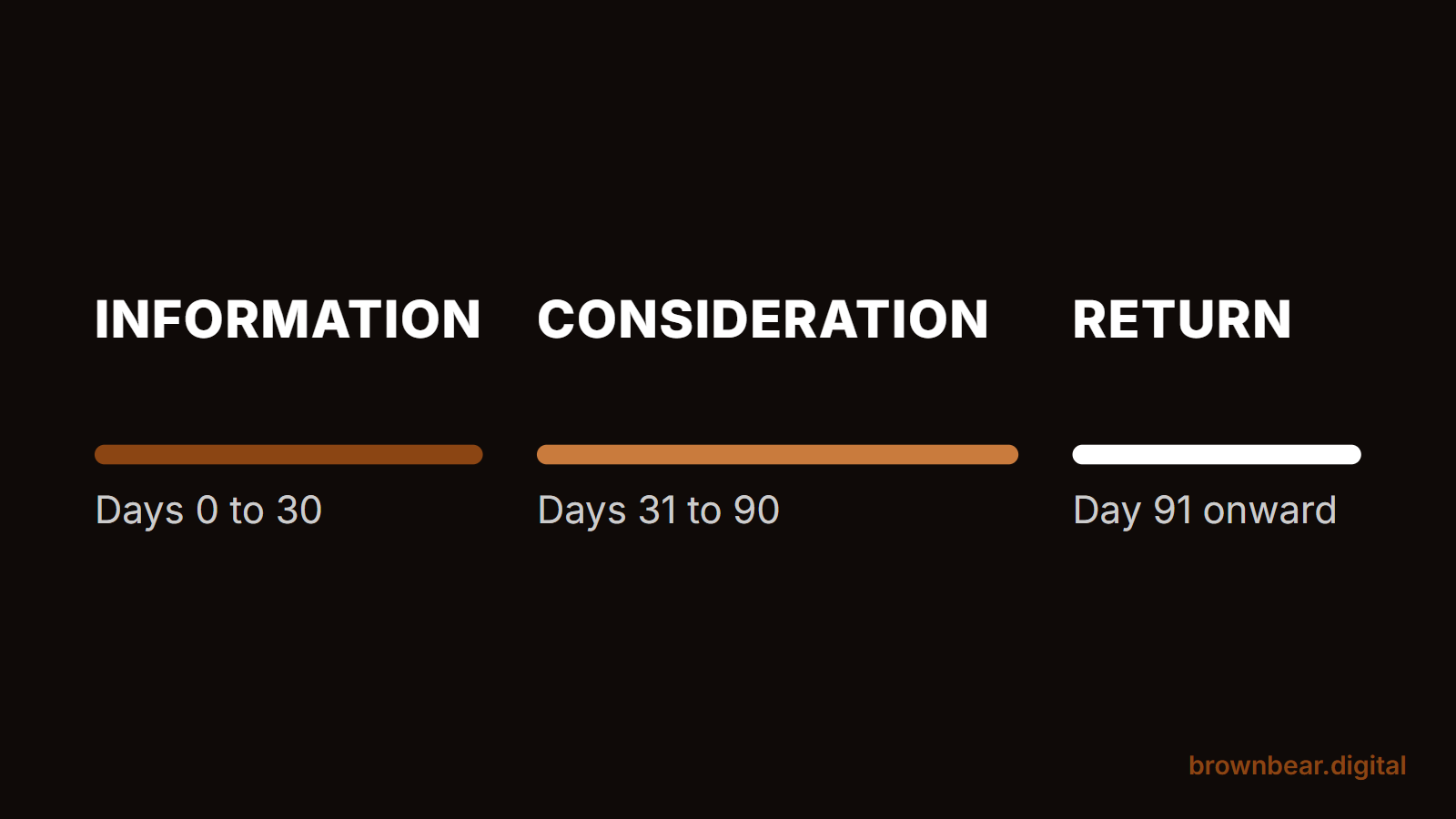
The reason the sequence has to run this long is that the decision window for elective surgery is measured in seasons, not weeks. Say a woman consults for a breast augmentation in March. She is genuinely serious. She also has a daughter graduating in June, a family trip in July, and no interest in explaining a six-week recovery to anyone at either event. She is not going to book until the fall, and she was never going to. A sequence that runs out at day thirty concludes she was not interested, when what actually happened is that the practice stopped talking to her five months before she was ready. A sequence that is still gently present in August gets the call.
If you are the practice manager who inherited the CRM, this is the highest-value thing you can build, and you can build it without touching a single compliance question, because every message in it sits on the Care or Practice list and is funded by the practice.
One placement worth getting right: the review request belongs late in the post-surgery arm of this sequence, after the result has settled, not in the first week when the patient is still swollen and anxious. Timing changes what people write, and what makes a patient review worth having is mostly a function of when you asked.
Why Your Emails Land in Promotions and What It Costs You
A practice can get every word of the compliance question right and still have nobody read the email, because a second set of rules governs whether it arrives. These are not legal rules. They are the mailbox providers', and they are enforced automatically.
Google and Yahoo's sender requirements, in force since February 2024, oblige bulk senders to authenticate with SPF, DKIM, and DMARC, to support one-click unsubscribe on marketing mail, and to keep their spam complaint rate below 0.30%. The formal bulk-sender line is 5,000 messages per day, which almost no single practice crosses.
That threshold is where the branch is, and it runs the opposite way to what people assume.
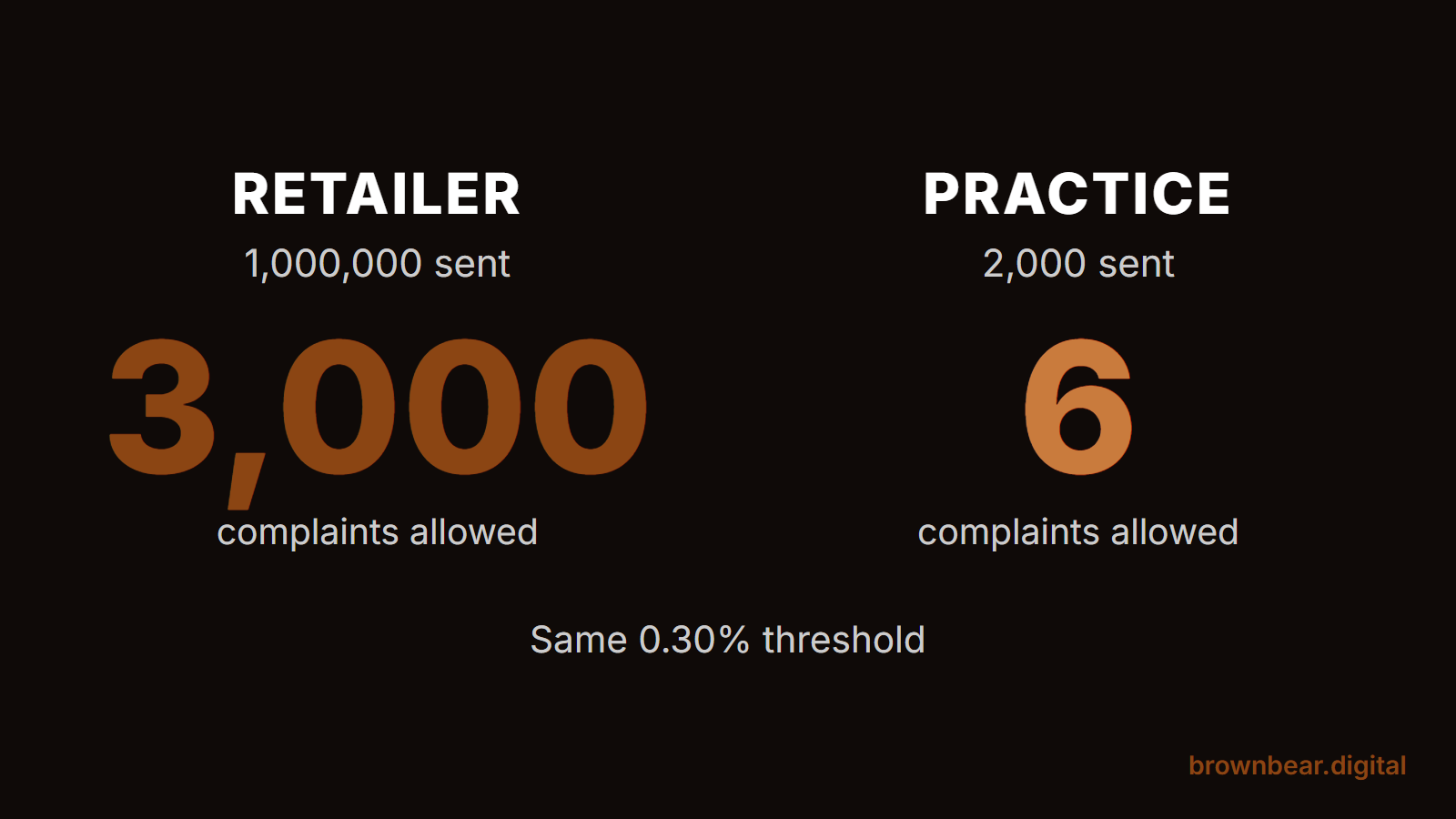
If you send more than 5,000 a day, you are formally in scope and you need the full authentication stack in place, full stop. If you send fewer, the letter of the bulk rules does not bind you, and this is exactly where practices relax. They should not. The complaint rate still governs how your mail is treated, and a small list gives you far less room, not more. A retailer mailing a million people can absorb three thousand complaints before crossing 0.30%. A practice mailing two thousand crosses it at six.
Six people. That is the entire margin, and nothing on your dashboard tells you where you are inside it.
Consider a practice that sends one Mother's Day promotion to its whole database, five thousand addresses accumulated over eleven years. Most of those people were patients once, in 2016, and have not heard from the practice since. A few hundred do not remember signing up for anything. Fifteen of them hit report spam rather than hunt for an unsubscribe link. That is 0.30% exactly, from a single well-intentioned send, and the practice now has a sender reputation problem that will quietly degrade the post-op instructions it sends next week. Nobody connects the two events, because the promotional campaign appeared to do fine.
The fix is not a better subject line. It is sending less mail to people who have not engaged and more to people who just had a consultation, keeping care communication on a separate sending identity from promotional mail, and making the unsubscribe link easier to find than the spam button.
Gmail and Yahoo hold senders to a spam-complaint rate under 0.30%. On a retailer's million-address list that is a wide margin. On a practice list it is a handful of people. Set your list size and watch how small the margin actually is.
For informational purposes only, and not a guarantee of inbox placement. Complaint rate is one input among many that mailbox providers weigh, alongside authentication, engagement history, sending domain age, and list hygiene. This is not legal or compliance advice. Everything you enter stays in your browser. Nothing is transmitted, stored, or sent to Brown Bear.
Before and After Photos in Email
Practices want to send before-and-after images because they are the most persuasive asset the practice owns. The short answer is that you can, and that there are three separate ways it goes wrong, only one of which is about HIPAA.
The consent problem.
A patient's photograph is protected health information, and a consent to use images in the practice's gallery is not automatically a consent to use them in email campaigns. What governs is the scope of the authorization, not its existence, because 45 CFR 164.508 sets out the specific elements a valid authorization must contain, including a description of the uses it actually covers. Practices routinely have a signed photo release from 2019 and assume it covers a send in 2026 to a list that did not exist then. Read the document before you assume, and if the scope is narrow, get a fresh one. This is worth doing properly once rather than case by case forever.
The rendering problem.
Many email clients block images by default until the reader chooses to load them. An email built entirely around a before-and-after grid arrives as a wall of empty boxes and a call to action with no context. If the images are the message, the message did not arrive.
The complaint problem.
This is the one nobody warns about. Surgical before-and-after imagery is exactly the kind of content that produces a spam complaint from someone who was not expecting it in their inbox that morning, particularly for body procedures and particularly on a shared or work device. Given the margin described above, an image-led promotional send to a broad list is one of the higher-risk things a practice can do, and the risk is concentrated in precisely the recipients who are least engaged.
Picture a practice that has a genuinely excellent tummy tuck gallery and builds its January campaign around it. The images are consented, the copy is careful, the platform is compliant. It goes to the full database because January is the month people are motivated. What comes back is a modest number of consult requests and an unusually high complaint rate from the oldest third of the list, people who last visited years ago for something unrelated and were surprised to open surgical photography at their desk. The campaign looks like a success in the platform's report and cost the practice sender reputation it will spend two months rebuilding.
The practical answer is to keep the images one click away rather than in the email. Write the email around the story and the result, and link to the gallery on your own site. You keep the persuasion, you get the visit on a page you control and can measure, and the message renders for everyone regardless of what their client blocks.
Building the List Without Buying One
Do not buy a list. The vendors selling plastic surgeon email lists are selling addresses of surgeons, not of patients, and anything sold as a patient list is either fabricated or was obtained in a way you do not want attached to your practice's sending domain.
Build the Public list from three places instead: the website, where a genuinely useful download beats a newsletter signup box every time; the front desk, where an explicit ask at checkout converts far better than a form; and events, where the person already chose to be in the room. Build the Practice list from consults who opt in during intake, with the opt-in worded as a real choice rather than buried in a consent block. The Care list builds itself, because it is simply your patients.
The step almost everyone skips is separating them at the point of capture rather than afterwards. Once four thousand addresses are in one table with no record of origin, you cannot untangle them, and every future send inherits that uncertainty. If you are the practice manager staring at exactly that CRM right now, the honest starting position is that you cannot fix it retroactively. What you can do is stop adding to it, start the three lists cleanly from today, and run a re-permission campaign to the old database once, then let the non-responders go. Losing two thirds of a list that was never going to open anything is a gain, not a loss.
The platform question follows from the lists, not the other way around. You need a vendor that will sign a BAA for anything touching Care and Practice. Several will; several of the best-known consumer email tools will not, and that is the real constraint on tool choice, not features. It is one decision inside the rest of the cosmetic surgery marketing stack, and it is worth making in that context rather than in isolation.
What to Measure Instead of the $36 Return
Nearly every guide on this topic opens with a return figure. Thirty-six dollars for every dollar spent is the common one; forty-two is the version quoted for aesthetics specifically. We checked every page currently ranking for this search, and not one of them attaches a source to either number.
Both trace back to general-market email benchmark surveys, not to plastic surgery data, and they are averages across industries where the product costs forty dollars and the purchase decision takes four minutes. Applying that ratio to a channel whose job is to keep a twelve-thousand-dollar decision alive across seven months is not conservative or aggressive. It is simply measuring a different thing. The number is not a lie; it is evidence of the wrong type, quoted with a confidence its source does not support.
Open rate has its own problem. Privacy features that pre-load images on the recipient's behalf inflate the metric in ways that vary by mail client, which means your open rate is partly a measure of what devices your patients use. It is still useful as a trend line against itself. It is not useful as a benchmark against anyone else's.
Four numbers are worth building your reporting around instead:
- Consult-to-surgery conversion rate, measured separately for consults who received the full sequence and consults who did not. This is the only number that isolates what email actually did.
- Time from consultation to booking. If the sequence is working, this gets longer before it gets better, because you are converting people who would previously have been written off.
- Spam complaint rate per send. Track it as a first-class metric, not a footnote. It is the leading indicator for every other number on this list.
- Revenue attributable to reactivated patients. Prior patients returning for a second procedure is the highest-margin revenue a practice has, and email is close to the only channel that reaches them.
Getting from here to there is four steps: pull your consult-to-surgery rate for the last twelve months so you have a baseline that predates any sequence. Split future consults so a control group is visible. Add complaint rate to whatever report the practice already reviews monthly. Then leave it alone for two quarters, because a channel that operates on a six-month decision cycle cannot be evaluated on a thirty-day one.
Email does not sit apart from the rest of the numbers, either. It belongs alongside the practice metrics that track real revenue, and reported in the same review, so it is judged on surgical volume rather than on opens.
Where Email Fits Now That AI Search Takes the Click
Something has changed underneath this topic in the last two years that none of the email guides account for. A growing share of the questions a prospective patient asks now get answered without a click. The AI summary at the top of the results page, or the assistant they asked instead of searching, resolves the question and the visit never happens.
That does not make search less important. It makes the moment of contact rarer and more valuable. When a patient does land on your site and gives you an email address, that address is worth more than it was three years ago, because there will be fewer chances to get one.
The pattern to watch for in your own analytics is informational search visits flattening while consultation requests hold steady. That is the signature of a channel where the browsing has moved elsewhere and only the decided still arrive, and it looks like decline in a traffic report while the pipeline is unchanged.
That is also why email list growth belongs in the same report as traffic rather than a tier below it. If the number of people who can reach your site is falling while the value of each one rises, the metric that matters is how many of them you kept.
The strategic consequence is straightforward. Every channel where an intermediary stands between you and the patient is getting narrower and less predictable. The list is the only one where nothing stands in between. Practices that spent the last decade optimizing for traffic and treated email as an afterthought are discovering that they built on the rented side.
Both halves of that matter, which is why the AI search visibility work we do for practices and the email programs we build for them are the same strategy viewed from two ends: be the source the AI cites so you still get found, and own the audience so that being found leads somewhere durable.
The long-term outcome worth aiming at is not a higher open rate. It is a practice whose surgical calendar is filled substantially by people it already knows, on a channel nobody can take away, in a decade when everything else about how patients find surgeons is being rewritten.
Talk to Brown Bear About Your Practice's Email
Email programs in surgical practices rarely fail on the copy. They fail because one list is doing three jobs, nobody has read the paragraph that decides what they are allowed to send, and the sequence stops a month into a six-month decision. Those are structural problems, and they are fixable in weeks rather than quarters. If you would like a straight read on where your practice sits, talk to us about your practice's email and we will tell you what we would change first.
Written By
Founder, Brown Bear Digital
Bryan has 15 years of experience across SEO, paid search, and AI search strategy. He founded Brown Bear to give businesses direct access to senior-level search expertise without the agency overhead.
Learn More About BryanGet Found on Google.
Get Cited by AI.
Tell us about your site. We'll send back a proposal for SEO and AI search.