Is SEO for Lawyers Different? Two Answers That Actually Change the Work
Ask whether SEO for lawyers is different and you get the same answer from almost everyone: yes, because legal is YMYL, because the competition is brutal, and because bar rules apply. Then the article hands you keyword research, on-page, local, links, technical, measurement. The identical playbook every other industry gets, with the word "attorney" swapped in.
That answer is not wrong. It is just not load-bearing. Knowing that legal is YMYL tells you nothing you would do differently on Monday morning.
This piece sorts the commonly named differences by how much each one actually changes the work. Three of them change it very little. Two change it structurally, and those two are the ones the guides treat as a subsection near the bottom.
Brown Bear runs SEO and AI search programs for medical practices, which is a neighbouring regulated vertical rather than the same one. Where that experience transfers, section 4 says so explicitly. Where it does not, this piece reasons from published rules and public evidence, and cites them, rather than claiming a track record it does not have.
By the end you will know which of the differences apply to your firm specifically, which marketing copy your state's rules put out of reach, and why the correct playbook for a personal injury firm is close to the opposite of the correct playbook for an estate planning practice.
Key Takeaways
Three of the five named differences barely change the work
Local intent, high competition, and long sales cycles are real, but they are shared with dozens of other service verticals. None of them makes a legal strategy structurally different from a plumber's or a dentist's.
The advertising rules constrain deliverables, not just tone
Rule 7.1 in most states forbids unsubstantiated comparisons with other lawyers. That puts the single most reliable content format in commercial SEO, the superlative comparison page, out of reach in a way it is not for any unregulated business.
Lawyers is not one vertical, and Google agrees
The AI Overview for this exact query ends by asking which practice area you are in before it will go further. Personal injury and estate planning are further apart in search behaviour than plastic surgery and plumbing.
The transferable part is the compliance discipline, not the tactics
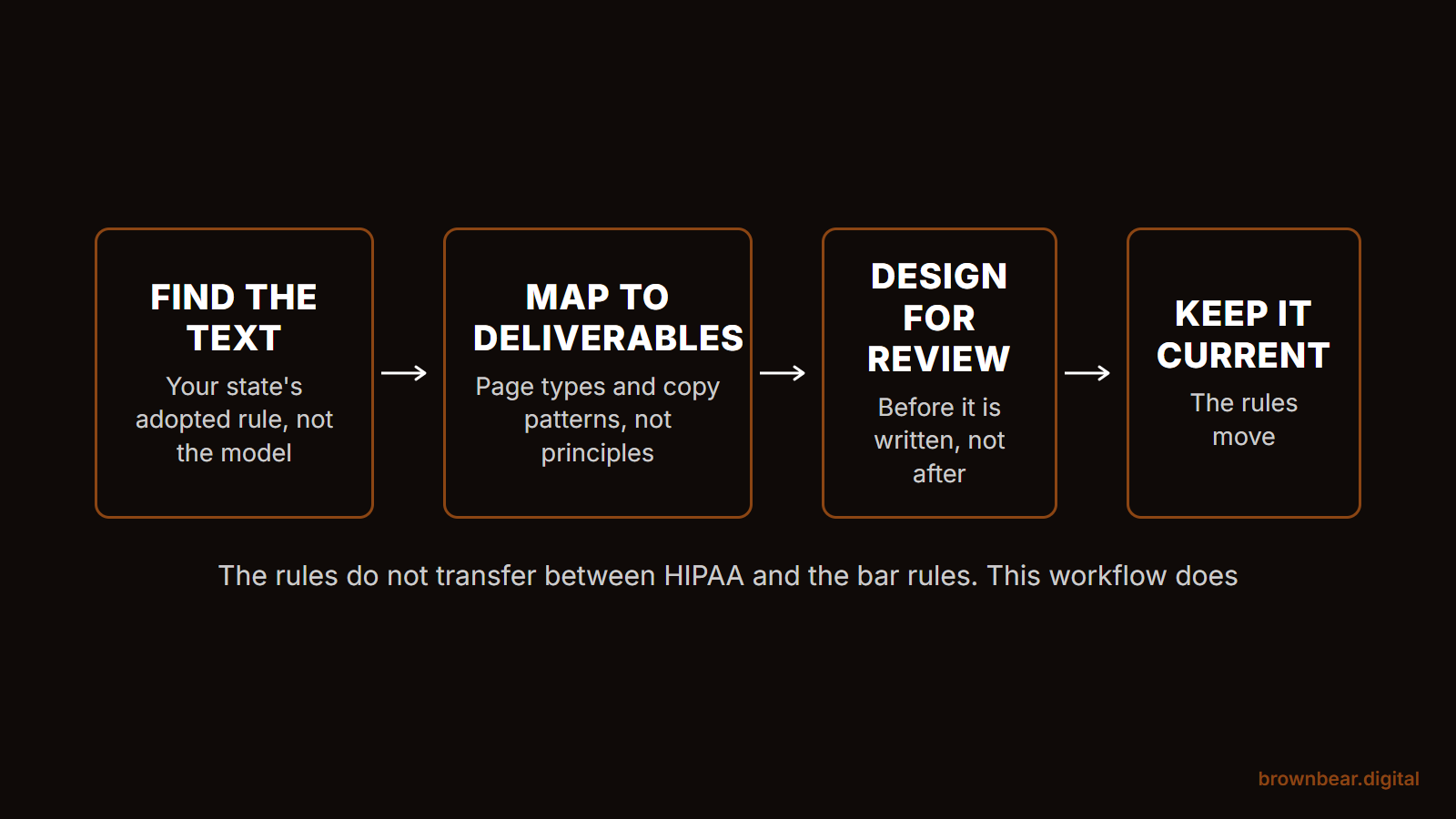
Regulated verticals share a workflow: find the binding rule text, map it to specific deliverables, then design content that survives review. The rules themselves do not transfer between HIPAA and the bar rules at all.
1. The Short Answer
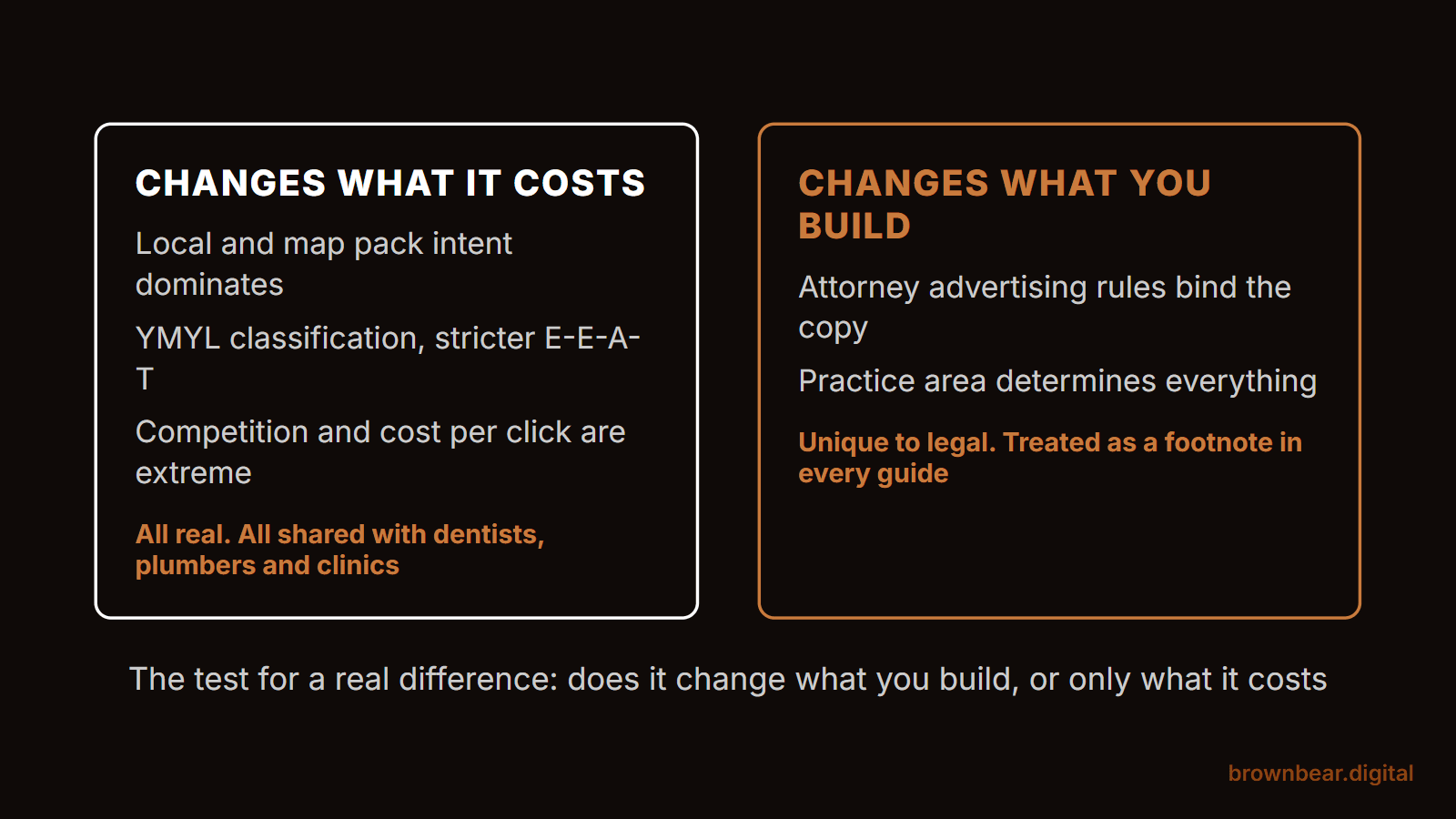
SEO for lawyers is different in two ways that change what you build, and three ways that only change how hard it is.
The two structural differences are that attorney advertising rules place specific, checkable limits on marketing copy that do not exist in unregulated industries, and that legal is not a single vertical, so the correct strategy inverts between practice areas.
The three differences that get named most often, local intent, YMYL classification, and high competition, are all real and all shared. Every local service business has local intent. Medical and financial sites carry the same YMYL burden. High competition raises the price of the work without changing its shape.
If you take one thing from this page: the question is not whether legal SEO is different, it is which of your firm's differences are the binding ones. For most firms, the binding constraint is the practice area, and the rules are second.
2. The Five Differences, Sorted by How Much Each One Changes
Here is every difference the ranking guides name, with an assessment of how much each actually alters the work.
| Difference | Real? | Unique to legal? | What it changes |
|---|---|---|---|
| Local and map pack intent dominates | Yes | No | Nothing structural. Shared with every local service business, from dentists to HVAC |
| YMYL classification and stricter E-E-A-T | Yes | No | Raises the evidence bar. Shared with medical and financial, and the response is the same in all three |
| Competition and cost per click are extreme | Yes | Partly | Changes the budget, not the strategy. A term you cannot afford is a targeting decision, not a different discipline |
| Attorney advertising rules bind the copy | Yes | Yes | Removes specific content formats from the menu. No parallel in unregulated verticals |
| Practice area determines everything | Yes | Yes | The playbook inverts between practice areas within the same profession |
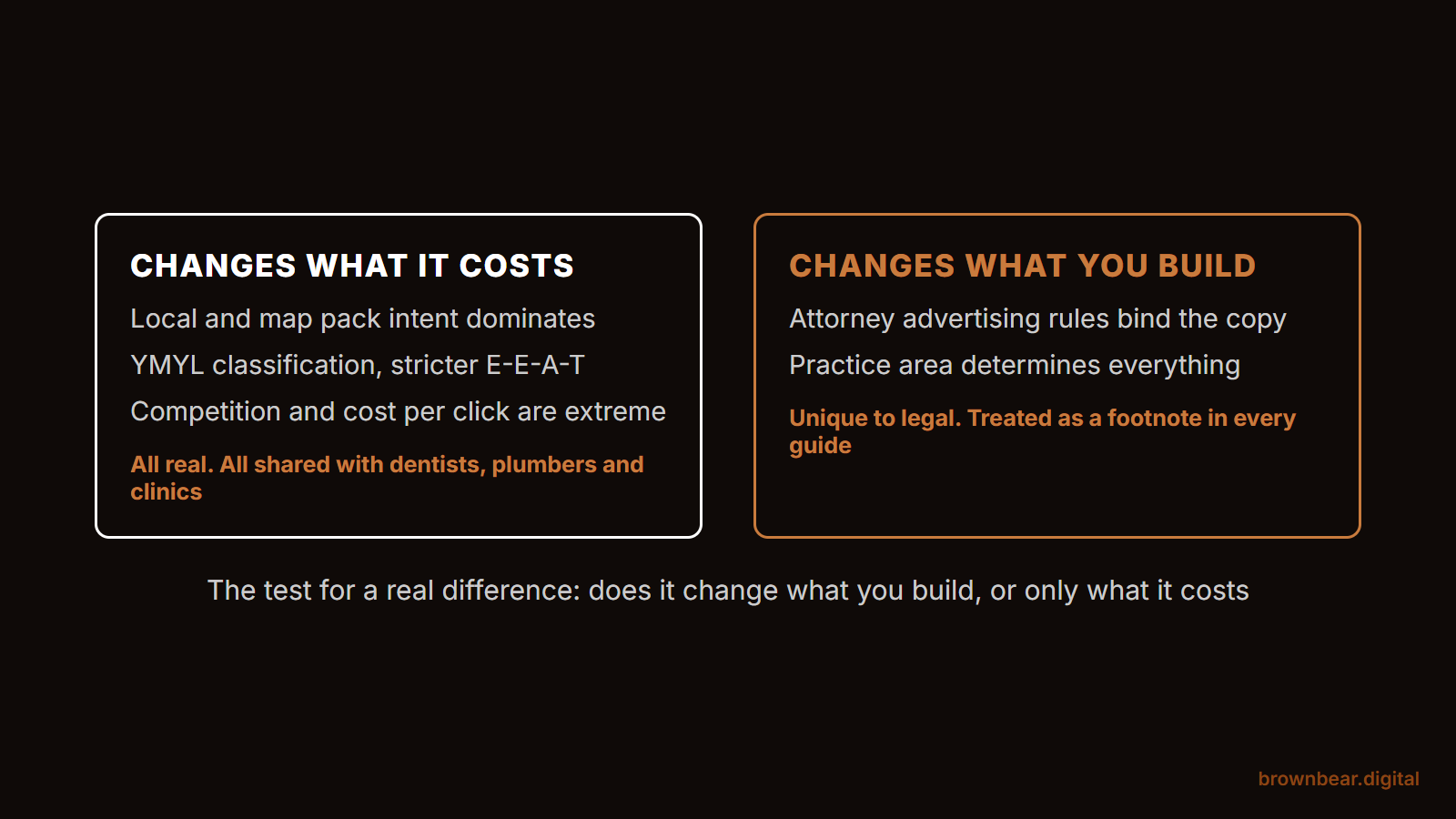
The first three explain why legal SEO is expensive and slow. They do not explain why it is different. A dentist in a competitive metro faces local intent, a YMYL classification and punishing costs per click, and nobody writes articles asking whether dental SEO is a different discipline.
The test for a real difference is simple: does it change what you build, or only what it costs? We applied the same test to cosmetic medicine in why plastic surgery SEO is different, and it survived, because a patient who self-refers and pays out of pocket genuinely needs a different page than one arriving on a referral. Two of the five rows above survive it here.
The bottom two rows are where the actual answer lives.
3. The Advertising Rules Constrain Deliverables, Not Just Tone
Most guides mention bar rules in a paragraph about "staying compliant" and move on. That framing treats the rules as a tone problem, something you solve by writing carefully. They are not a tone problem. They remove specific, high-performing content formats from your options.
Start with the rule text itself. Here is Rule 7.1 as adopted by the North Carolina State Bar, quoted in full:
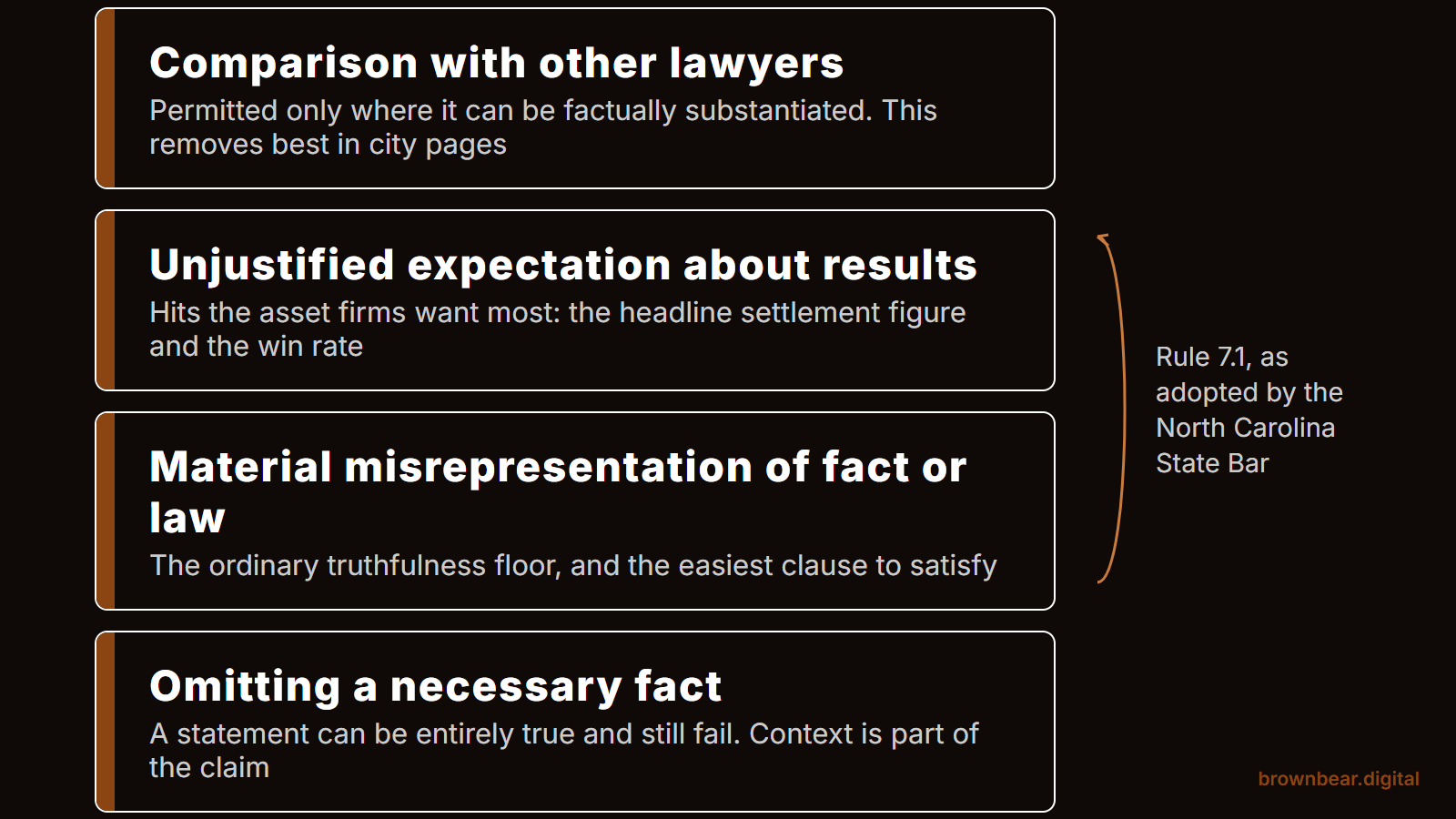
A lawyer shall not make a false or misleading communication about the lawyer or the lawyer's services. A communication is false or misleading if it contains a material misrepresentation of fact or law, or omits a fact necessary to make the statement considered as a whole not materially misleading. Such communications include but are not limited to a statement that is likely to create an unjustified expectation about results the lawyer can achieve; a statement that states or implies that the lawyer can achieve results by means that violate the Rules of Professional Conduct or other law; or a statement that compares the lawyer's services with other lawyers' services, unless the comparison can be factually substantiated.
Read that last clause again, because it is the one with teeth for SEO.
What the rule takes off the menu
Superlative and comparison pages.
In every unregulated vertical, "best [service] in [city]" is among the most reliable commercial formats there is. It matches high-intent commercial queries, it is easy to structure, and it converts. For a law firm publishing about itself, a claim comparing its services to other lawyers' services is permitted only where the comparison can be factually substantiated. "The best personal injury lawyer in Charlotte" is not a substantiated comparison. It is exactly the statement the rule names.
Case results presented as expectation.
Results pages are the asset most firms want most, and the rule specifically names statements "likely to create an unjustified expectation about results the lawyer can achieve." A results page is not automatically forbidden, but the format that performs best, a large number displayed prominently with no context, is the format closest to the line.
Testimonials that do the comparing for you.
A review that says a firm is the best in town raises the same question as saying it yourself. States vary considerably in how they treat this, and several require specific disclaimers.
Note what is happening here. In an unregulated vertical, the constraint on your marketing copy is whether it is true and whether it converts. Here there is a third filter, and it removes formats that would otherwise be correct.
The rewrite is usually available, and it is usually better
The useful move is not to abandon these pages. It is to replace the unsubstantiated claim with a substantiated fact, which is both compliant and, as it happens, more persuasive. The pattern in every row below is the same: swap a comparative adjective for a verifiable noun.
| Common copy | The problem under Rule 7.1 | A version built on facts |
|---|---|---|
| Best personal injury lawyer in Charlotte | Compares to other lawyers with nothing to substantiate it | Charlotte personal injury attorney, trying cases in Mecklenburg County since 2009 |
| Aggressive representation that gets results | Invites an unjustified expectation about results | Board certified in state criminal law, 140 jury trials |
| We win 98 percent of our cases | A bare figure with no denominator sets an expectation | State what the number counts, over what period, and that outcomes turn on the facts of each matter |
| Voted the top firm in the state | A comparison, and usually to an unverifiable poll | Name the publication, the year, and the methodology, or drop it |
| Free consultation, no fee unless we win | Often permitted, but many states require a disclosure about costs | Keep the offer, add your state's required language about client responsibility for costs |
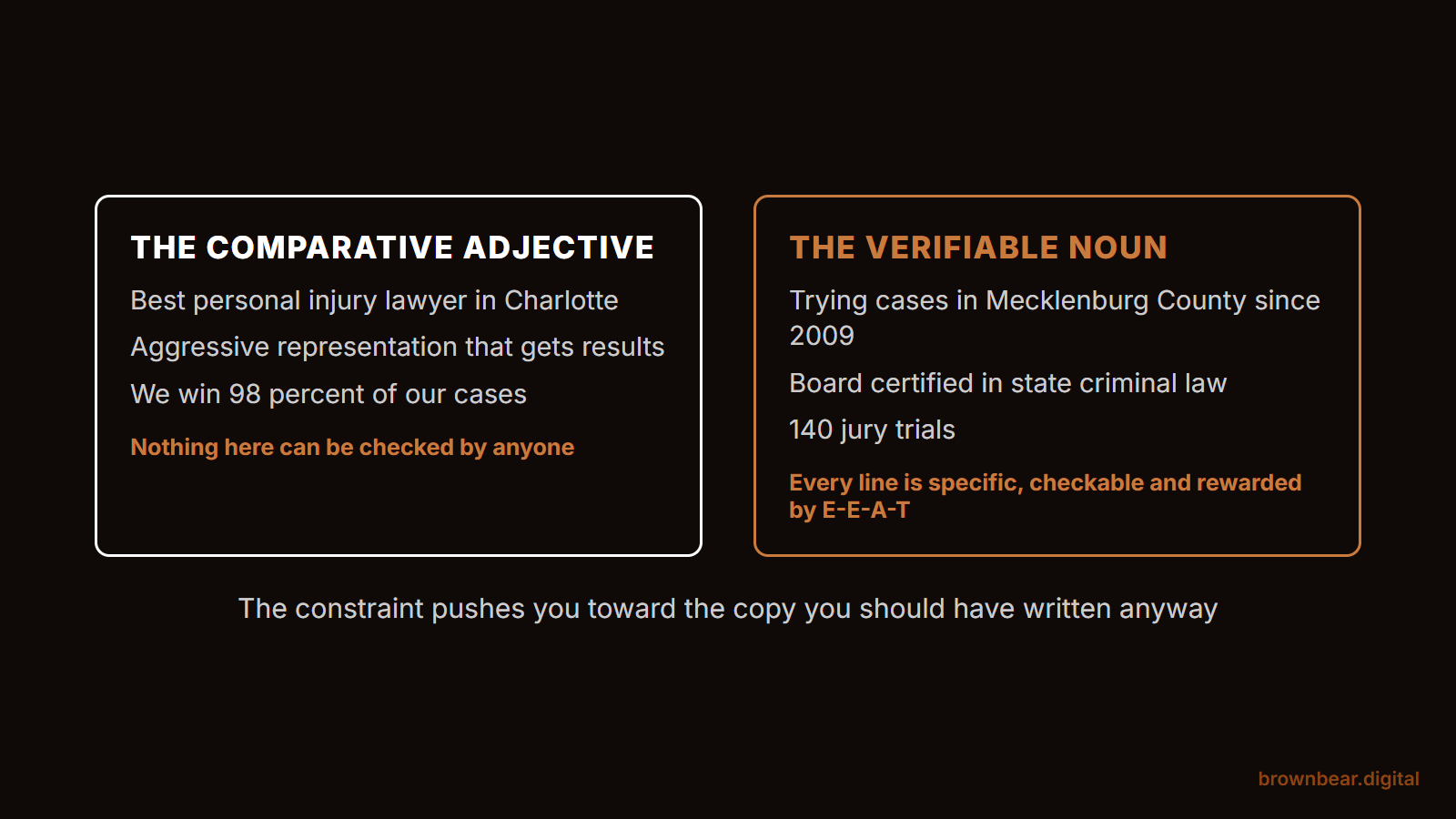
Every right-hand cell is a specific, checkable statement. Specificity is what E-E-A-T rewards and what a superlative cannot supply, which is why the compliant version of a legal page frequently outperforms the version that got sent back for review. The constraint pushes you toward the copy you should have written anyway.
The state variation point almost every guide gets wrong
Guides routinely cite "ABA Model Rule 7.1" as though it governs. It does not. The ABA Model Rules are a model. They bind no lawyer anywhere until a state supreme court adopts them, and states amend them when they do. That is why the text quoted above is North Carolina's version rather than the ABA's.
The practical consequence for anyone doing this work: the compliance review for a national firm is not one review. It is one per jurisdiction the firm advertises into, against that state's adopted text. Any agency that hands you a single blanket compliance answer has not done the work.
4. What Transfers From Other Regulated Verticals, and What Does Not
We have written before about how HIPAA compliance changes medical SEO, and it is worth being precise about what carries across, because the temptation is to assume regulated is regulated.
The rules themselves transfer not at all. HIPAA governs protected health information, which is a privacy regime about data. The attorney advertising rules govern communications about a lawyer's services, which is a truthfulness regime about claims. A HIPAA specialist knows nothing useful about Rule 7.1 by virtue of knowing HIPAA.
What does transfer is the workflow, and it is genuinely the harder half:
- Find the binding rule text for the specific jurisdiction, not the model or the summary.
- Map each rule to the specific deliverables it touches, at the level of page types and copy patterns rather than general principles.
- Design the content so it survives review before it is written, rather than getting written and then softened.
- Keep the mapping current, because the rules move.
Both verticals also sit inside Google's YMYL classification, and the response to that is genuinely the same in both: demonstrable credentials, named authorship, accurate citations, and trust signals that a reviewer could verify. If you want the realistic time horizon for that work, we have covered how long YMYL SEO takes separately.
5. Lawyers Is Not One Vertical
This is the difference that changes the most and gets discussed the least.
Here is a finding worth sitting with. We captured the live AI Overview for the query "seo for lawyers" on 2026-09-08. After summarising the core pillars, Google's own AI ends with this:
If you'd like to dive deeper, tell me: What is your firm's primary practice area (e.g., family law, criminal defense, personal injury)? Are you handling the SEO in-house or looking to hire an agency?
Google's AI will not go further without knowing the practice area. It has correctly identified that "lawyers" is too broad a category to answer for. Every guide ranking beneath that AI Overview answers it anyway.

How far apart the practice areas actually are
| Practice area | Trigger | Research window | Geography | What wins |
|---|---|---|---|---|
| Personal injury | Sudden, involuntary | Hours to days | Tight, then statewide for large cases | Speed of response, map pack presence, review volume |
| Criminal defense | Sudden, urgent, private | Hours | Courthouse jurisdiction | Availability, discretion, immediate contact |
| Family law | Building, then decisive | Weeks to months | County | Reassurance, process explanation, named attorney trust |
| Estate planning | Elective, deferrable | Months to years | Regional, referral-heavy | Education, seminars, professional referral networks |
| Immigration | Deadline driven | Days to weeks | National, language specific | Language match, process clarity, remote service |
Personal injury and estate planning are on the same list only because both are practised by lawyers. A personal injury client is in distress, decides fast, will never buy again, and is being competed for by firms spending enormous sums per click. An estate planning client is calm, defers for years, arrives through an accountant or financial adviser as often as through search, and may be worth more over a lifetime than the acquisition cost suggests.
The playbook does not adjust between those two. It inverts.
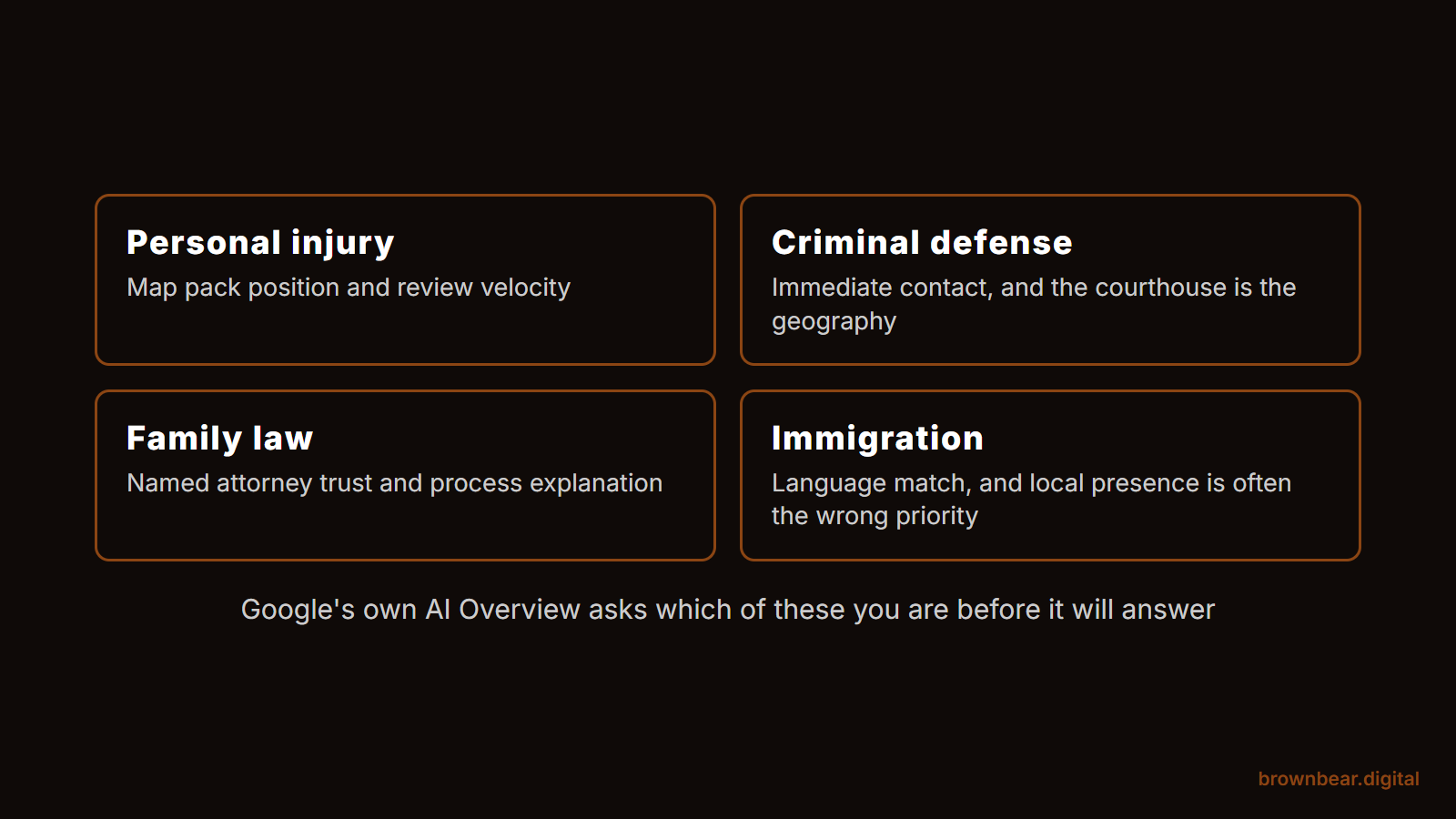
For personal injury, speed and local presence dominate and long-form education is a weak second. For estate planning, long-form education and referral relationships dominate and map pack position is a weak second. Advice that says "law firms should invest in local SEO and educational content" is technically true for both and useful for neither.
This is also why the budget advice in circulation is so inconsistent. The figures that surface most often run from roughly 500 to 1,500 dollars a month for a smaller practice in a moderate market up to several thousand for competitive metro personal injury work. Those numbers are not contradicting each other. They are describing different practice areas, and the sources rarely say which.
6. What Carries Over Unchanged
It is worth being equally clear about the parts that are just SEO, because a vendor telling you that legal SEO is entirely its own discipline is selling you something.
Technical foundations are identical. Crawlability, rendering, site speed, and mobile behaviour work the same way on a law firm site as on any other. Keyword research methodology is identical, though the terms and their prices are not. Google Business Profile optimisation follows the same rules as it does for any local business, and the map pack does not have a legal variant. Internal linking, information architecture, and measurement are unchanged.
The E-E-A-T response is shared with the other YMYL verticals rather than unique to legal: name your authors, show credentials, cite primary sources, and make the firm's real people visible. That is the same answer a medical practice gets.
If a proposal in front of you prices ordinary technical and on-page SEO at a premium because the client is a law firm, the premium is for the vertical, not the work.
7. What This Changes About Hiring
Two questions separate an agency that has done this work from one that has read about it.
Ask which state's rule text they work from.
The correct answer names your state and, if you advertise across state lines, names each of them. An answer that says "we follow the ABA Model Rules" describes a document that binds nobody.
Ask them to describe your practice area's buying process back to you.
Someone who has run personal injury campaigns will talk about response time and review velocity. Someone who has run estate planning will talk about seminars and referral sources. Someone who has run neither will talk about local SEO and quality content.
We have written a fuller version of this for medical practices in what your SEO agency will not tell you before you sign, and most of it applies here with the vertical swapped.
8. What This Page Deliberately Does Not Do
This is not a law firm SEO playbook, and the omission is on purpose. Comprehensive playbooks for this query already exist and several are genuinely good, running to five and six thousand words across keyword research, on-page, local, links, technical and measurement. Rewriting one would add a seventh.
What none of them does is tell you which of their sections apply to you. That is the gap this page fills. Take the practice area answer from section 5, then read a playbook with it in hand.
Two limits worth stating. Nothing here is legal advice, and a compliance question about your own marketing belongs with your state bar or your ethics counsel rather than with an SEO agency. And the rule quoted in section 3 is one state's text, chosen because it is representative and publicly accessible. Yours will differ, which is section 3's entire point.
References
- North Carolina State Bar, Rule 7.1, Communications Concerning a Lawyer's Services
- American Bar Association, Model Rules of Professional Conduct, Rule 7.1
- Live Google AI Overview for the query "seo for lawyers", captured 2026-09-08. Cited sources in that AI Overview: Hennessey Digital, DC Bar, LawPay, Attorney at Work.
- Keyword volume and difficulty via the Semrush web interface, 2026-09-08.
Work with Brown Bear
We build SEO and AI search programs for firms in regulated verticals, where the constraint is rarely the tactics and usually the review. If you want to know which of the differences on this page bind your firm specifically, and what that means for the next two quarters, talk to us about legal SEO and we will start with your practice area and your state's rule text rather than a generic audit.
Written By
Founder, Brown Bear Digital
Bryan has 15 years of experience across SEO, paid search, and AI search strategy. He founded Brown Bear to give businesses direct access to senior-level search expertise without the agency overhead.
Learn More About BryanGet Found on Google.
Get Cited by AI.
Tell us about your site. We'll send back a proposal for SEO and AI search.