Veterinary SEO: What the Top 3 Pages for 16 Pet Owner Searches Show Your Clinic Site Needs
Most veterinary SEO advice stops at a checklist: claim your listing, add keywords, start a blog. It rarely says which pages a clinic site needs, or what those pages look like when they rank. This guide covers the keyword lanes, the six page templates, the on-page and technical work, and a 12-month build order.
It is built on a November 2026 teardown of the 48 pages ranking in the top three for 16 pet owner searches, from "spay and neuter phoenix" to "dog ear infection," and on what Bryan Passanisi sees running SEO and AI search programs for medical practices. It is written for practice owners, group marketing leads and specialty clinics.
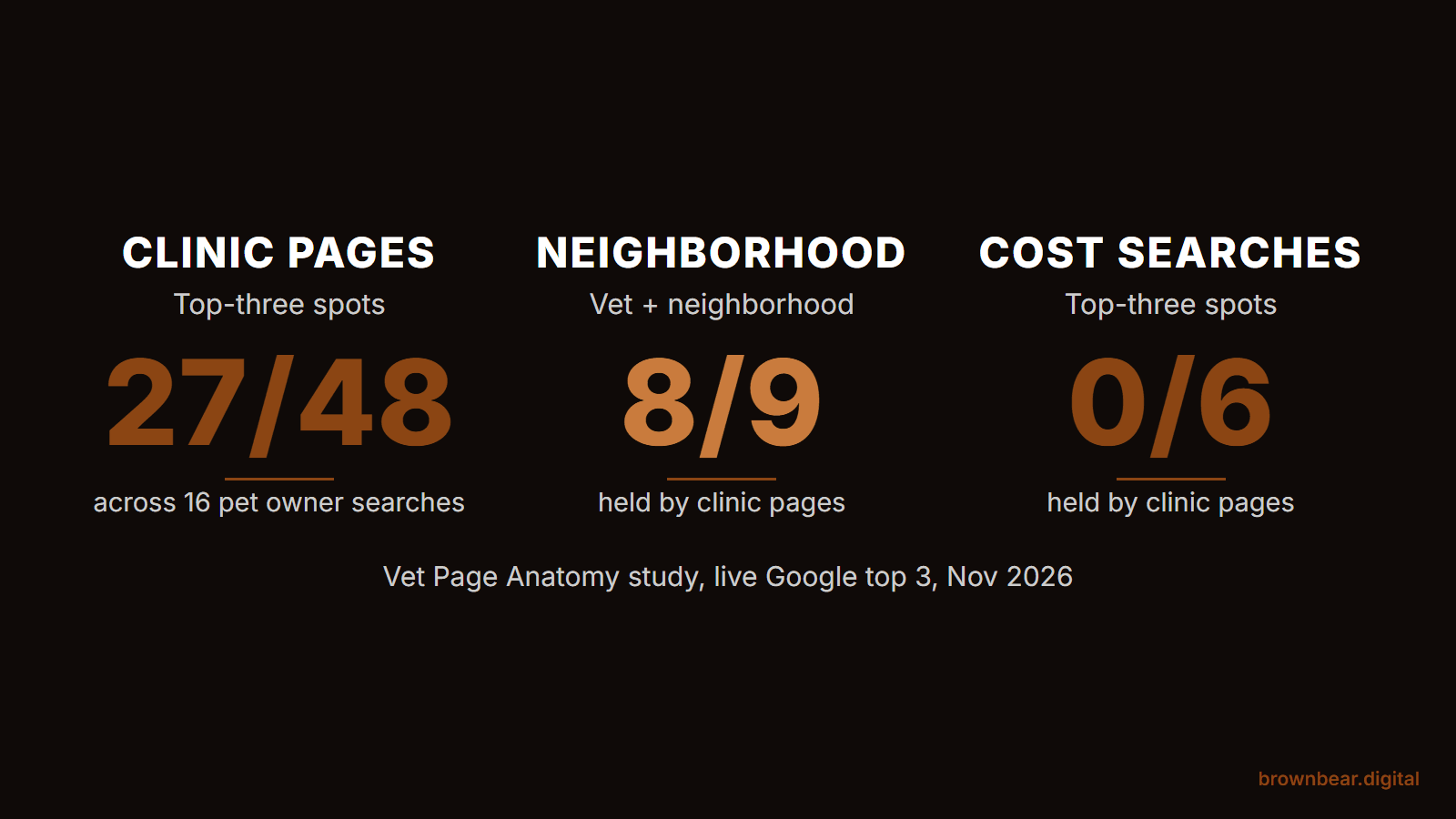
Clinic pages took 27 of those 48 spots. They won neighborhood searches with plain homepages and lost every cost search to pages that printed a price. Start with what veterinary SEO is supposed to build.
What Veterinary SEO Is, and Where It Ends and Marketing Begins
Veterinary SEO is the work of getting a clinic's own web pages to rank in Google's organic results, map pack and AI answers for the searches pet owners in its area run. In practice that means building the right pages, writing titles and copy that match each search, marking the pages up so machines can read them, keeping the site fast and crawlable, and earning listings and links that confirm where you are. The result to measure is booked new-client visits from search, page by page.
It is narrower than veterinary marketing. Reviews, Google Ads, reminders, telehealth and competing with corporate groups are marketing jobs, and we covered them in our guide to competing with corporate clinics, along with a map of who owns the clinics on page one. This guide is the build manual underneath it: which pages, what goes on them, and in what order.
The Vet Page Anatomy Study: What the Top 3 Results Have in Common for 16 Pet Owner Searches
Across 16 searches, clinic and hospital pages held 27 of the 48 top-three spots. They held 8 of 9 on neighborhood searches, 7 of 9 on specialty and species searches, 5 of 9 on pet health questions, 7 of 15 on service searches and 0 of 6 on cost searches. The pages that won were rarely elaborate. The median local clinic page carried about 670 words of main text in its HTML, 7 of 22 had no usable H1 heading, and 18 of the 27 clinic pages carried no veterinary or local business schema.
Here is how we got those numbers. On November 1, 2026, we searched Google in a US English session for 16 searches in five lanes:
- Service plus city: dog teeth cleaning austin, spay and neuter phoenix, puppy vaccines denver, cat dental cleaning charlotte, pet microchip nashville
- Pet health questions: dog limping, cat not eating, dog ear infection
- Neighborhood: vet south austin, vet cherry creek denver, vet east nashville
- Specialty and species: exotic vet phoenix, cat only vet denver, veterinary dermatologist austin
- Cost: dog dental cleaning cost, cost to spay a dog
For each search we took the top three organic results, skipping ads and the map pack, and read every page's HTML for page type, title, H1, word count, schema types, prices, reviews, a named veterinarian, a reviewed-by line and an online booking link. Pages that blocked our script were read in a browser instead. One session is one sample, Google tailors results to location, and word counts come from each page's main HTML text, so treat them as close, not exact.
We call the result the Vet Page Anatomy:
| Lane | Clinic pages in the top 3 | What won | What to build |
|---|---|---|---|
| Neighborhood, like vet south austin | 8 of 9 | 5 homepages and 3 group location pages. 6 of the 8 named the neighborhood in the title. | A homepage, or one location page per hospital, that names the neighborhood |
| Specialty and species, like exotic vet phoenix | 7 of 9 | Homepages and service pages of specialty, cat-only and exotic clinics. Two association listings took the rest. | A page or homepage that names the species or specialty in the title |
| Pet health question, like dog ear infection | 5 of 9 | Clinic and hospital blog posts, median about 1,400 words. PetMD and Reddit took the rest. | Pet health pages written from the questions your front desk hears |
| Service plus city, like spay and neuter phoenix | 7 of 15 | Clinic service pages, but shelters, nonprofit clinics, a city page and Petco's Vetco took 7 spots, and 6 of those 7 showed prices. | One page per service, with a price or a price range |
| Cost, like cost to spay a dog | 0 of 6 | CareCredit, GoodRx, a county fee page, an SF SPCA price sheet and a Reddit thread | A cost page with your real ranges |
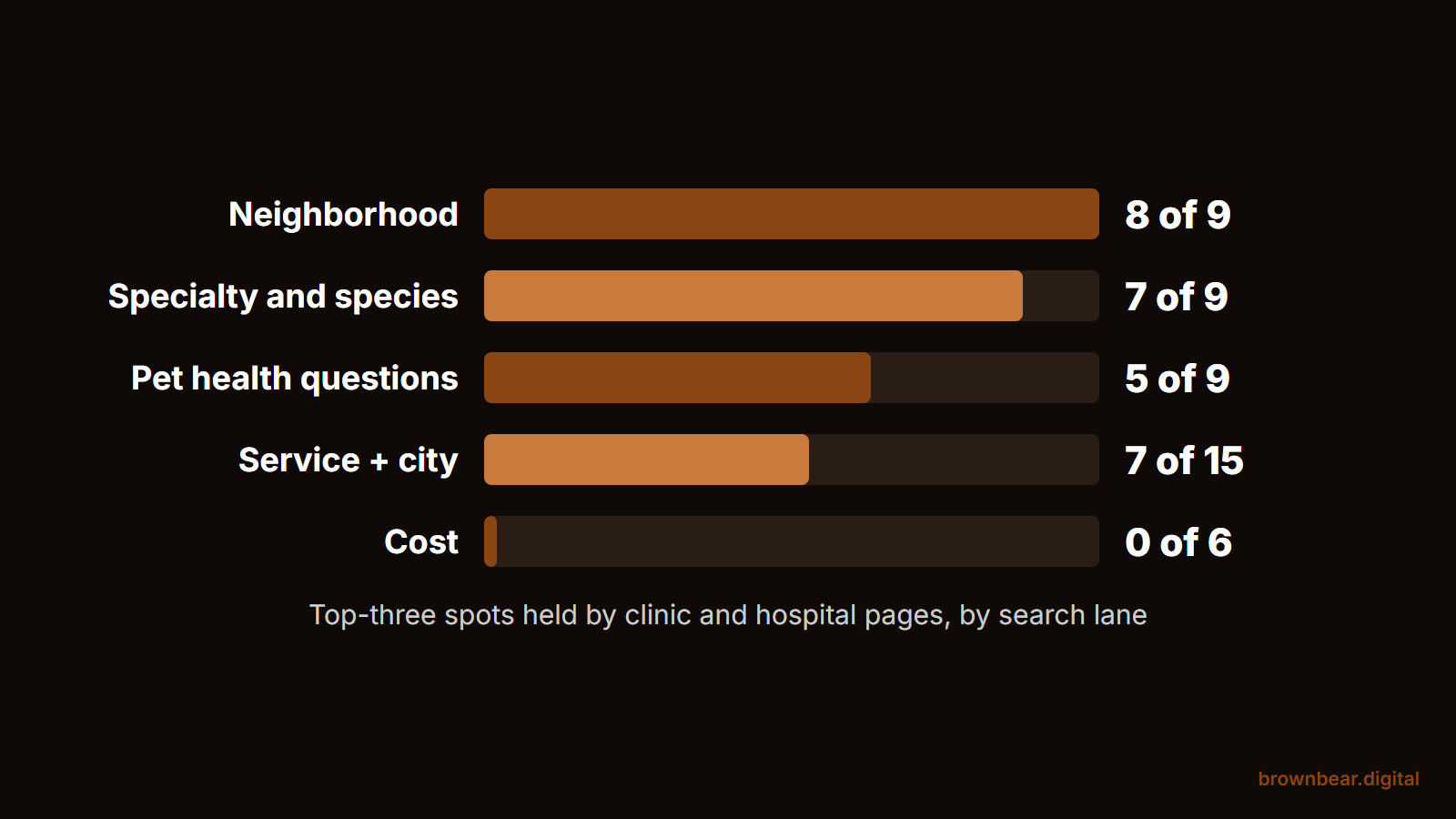
Three findings surprised us. First, price decides the service lane. The nonprofit clinics that outranked private practices for spay, neuter, dental and vaccine searches all put dollar figures on the page, and the clinics mostly didn't. Second, pet health questions are more open than in human medicine. When we ran the same kind of pull for dental practices, Cleveland Clinic held #1 for all three condition searches. Here, five clinic and hospital blogs took top-three spots, and none of them carried a reviewed-by line. Third, the winning clinic pages were thin. Five of the 22 local clinic pages had fewer than 300 words in their HTML, which says the bar to clear is lower than most clinics assume.
Build Your Veterinary Keyword List by Lane, Not by Volume
A clinic's keyword list should be sorted into the five lanes above, because each lane needs a different kind of page and faces different competition. Search volume tells you how many people look. The lane tells you whether a clinic page can win, and which page has to do it.
Here is what goes in each lane, and which page answers it:
- Neighborhood and city: vet plus your neighborhood, animal hospital plus your city, vet near a landmark your clients use. Your homepage answers these, or a location page per hospital.
- Service: each service plus your city, like dog dental cleaning, spay and neuter, puppy vaccines, microchipping, surgery and senior care. One service page each.
- Species and specialty: cat vet, exotic vet, bird vet, veterinary dermatologist, veterinary dentist. A species page, a specialty page, or the homepage of a niche clinic.
- Pet health questions: the symptoms and conditions clients call about, like limping, vomiting, ear infections and not eating. One pet health page each.
- Cost: what a service costs, like cost to spay a dog or dog dental cleaning cost. One cost page, or a price section on each service page.
Build the list from your own records first. Pull your 20 most-billed services from your practice management system, list the species you see, and write down the neighborhoods most of your clients come from. Then check each term in Search Console and a keyword tool. Don't drop a neighborhood term just because the tool shows little volume: keyword tools report national figures, and hyperlocal searches often read very low there even when they bring in real calls.
Picture a two-doctor clinic in south Austin whose keyword list is one line long: "vet austin." Sorted by lane, the same clinic finds about 30 terms: three neighborhoods, eight services, cats and dogs, a dozen symptoms its front desk hears every week, and the cost of a dental cleaning. Only one of those, "vet austin," is a fight with every clinic in the city. The other 29 each need a page the clinic can build this year.
The Six Page Templates a Veterinary Website Needs
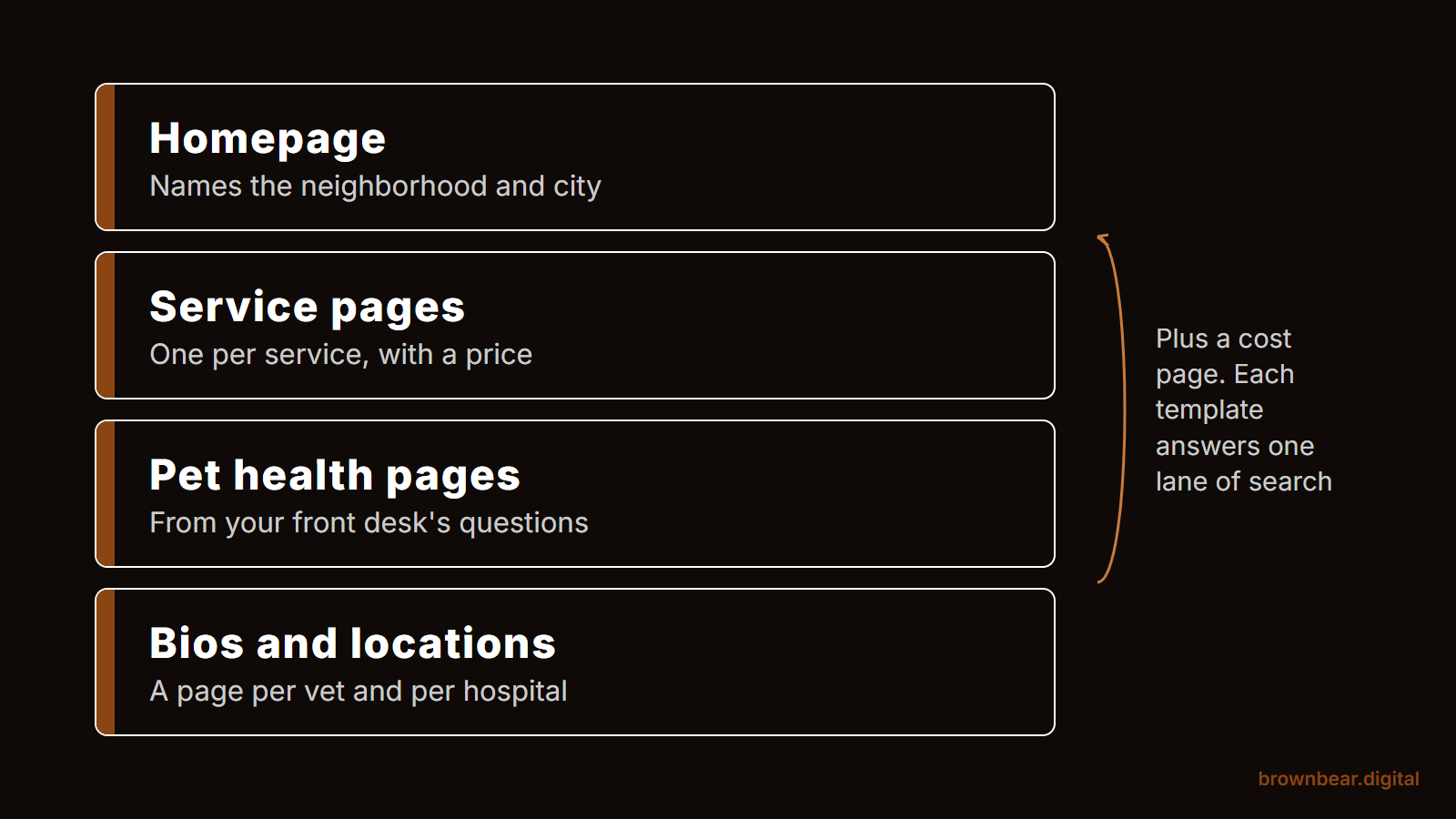
A veterinary site needs six page types: a homepage that works as the neighborhood page, one page per service, one page per hospital if you have more than one, a bio page per veterinarian, pet health pages, and a cost page. Each one targets a lane, and the study shows what the ranking version of each carries.
| Template | Targets | What the top 3 carried | URL pattern |
|---|---|---|---|
| Homepage | Vet plus neighborhood or city | Neighborhood or city in the title, a named vet, a booking link | / |
| Service page | Service plus city | Service and city in the title, what happens, a price or range | /services/dog-dental-cleaning |
| Location page | Neighborhood, for groups | Neighborhood in the title, that hospital's address, hours and vets | /locations/south-austin |
| Vet bio page | Vet name, specialty searches | Degree, board certification where it exists, species and services | /team/dr-name |
| Pet health page | Symptom and condition questions | A direct answer, when to come in, about 1,400 words | /pet-health/dog-limping |
| Cost page | Service cost questions | Real dollar ranges and what changes them | /pricing |
Groups should read the location row first. Each hospital needs a page that stands on its own, with its own address, phone, hours, vets and reviews, which is the same structure we lay out for medical practices with several hospitals or offices. It is also the template work we do inside on-page and technical SEO programs for practices. Plan your own pages below.
Service Pages: Why the Shelter Outranks You for Spay and Neuter
Because it printed the price. In the service lane, 6 of the 7 shelter, nonprofit, city and retail pages in the top three showed prices. Emancipet's dog dental cleaning page, #1 in Austin, lists $225 for a routine cleaning and $425 for an advanced one. Spay Neuter Clinic, #3 in Phoenix, lists $76 for a cat neuter, $105 for a cat spay and dog surgery from $127. Humane Colorado lists rabies and distemper vaccines at $25 each. Only 1 of the 7 clinic service pages in the top three showed any dollar figure at all.
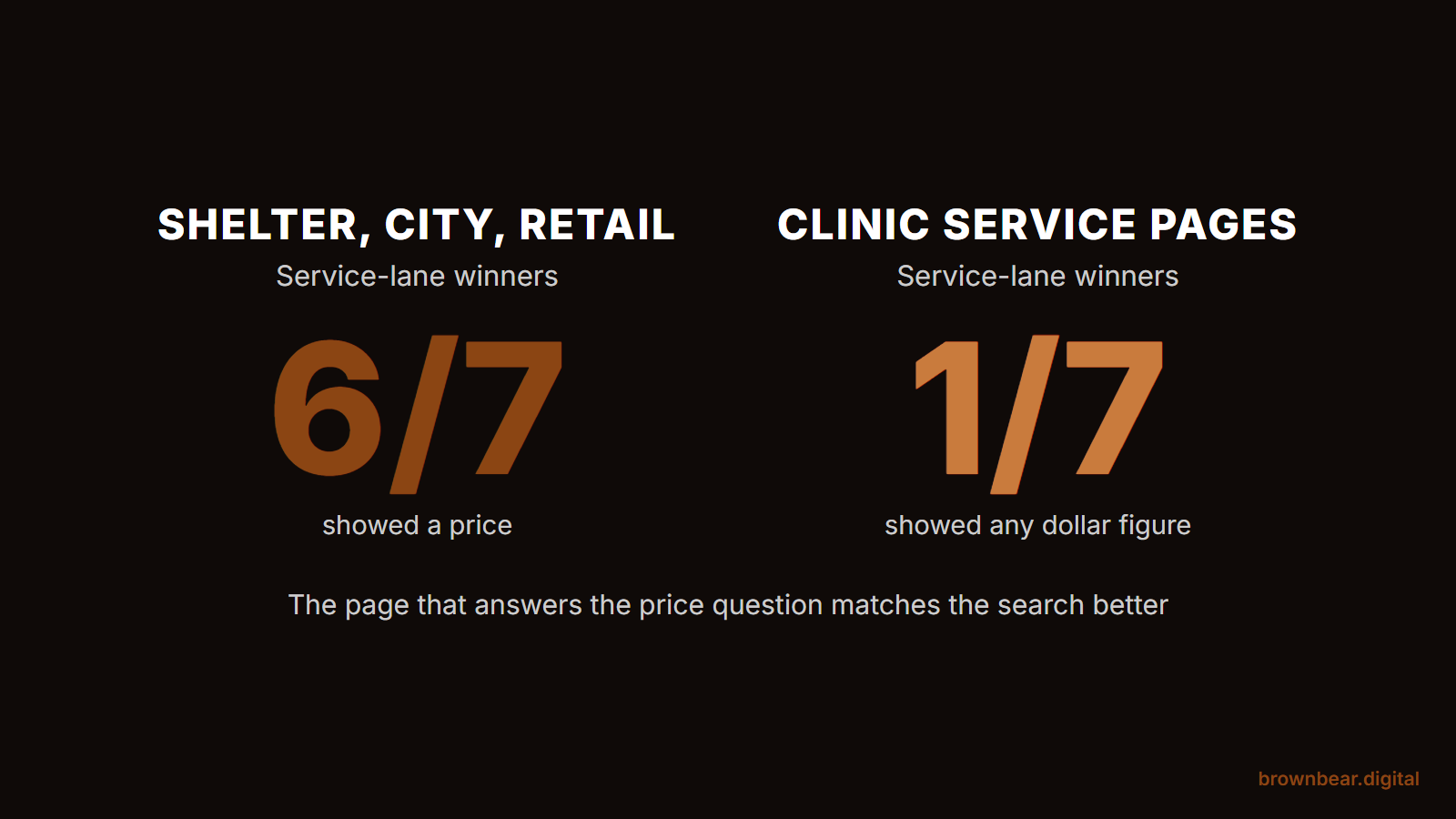
Price is what the person typing "spay and neuter phoenix" wants to know before they call, and a page that answers it matches the search better than one that says "call for pricing." Nonprofit clinics publish prices because low cost is their pitch. A private clinic doesn't have to match those prices to rank. It has to show its own and explain what's included.
Each service page should carry, near the top:
- The service and your city in the title and H1, like "Dog Dental Cleaning in South Austin"
- Who it's for, and when a pet needs it
- What happens on the day, including anesthesia, bloodwork and recovery
- A price, a starting price or a range, and what moves it up or down
- Which of your vets does it, linked to their bio page
- A booking link or phone number above the fold
If your prices are fixed, publish them. If they depend on the pet, as dental cleanings often do once extractions come in, publish the range and the three or four things that change it. If you won't publish any number, expect the shelter to keep the top spot for that search, and put your effort into services where you are the only provider nearby.
Picture a clinic in Phoenix whose spay page reads "We offer safe, compassionate spay and neuter services. Call us to learn more." A pet owner comparing three tabs sees $105 at the nonprofit clinic and nothing on this page. The clinic adds a starting price, what that price includes, what the pre-surgery bloodwork adds, and why its patients stay overnight. It still costs more than the shelter. Now the page explains why, which is the question the pet owner was asking.
Neighborhood Searches: Homepages Win for Independents, Location Pages for Groups
Clinic pages held 8 of the 9 top-three spots for vet plus a neighborhood, more than in any other lane. Five were homepages, including small groups that give each hospital its own website. Three were location pages on a larger group's site: CityVet in south Austin, Modern Animal in Cherry Creek and Livewell Animal Urgent Care in east Nashville. Six of the 8 named the neighborhood in the title tag, like "South Austin Veterinarian" for Paz Veterinary and "Veterinarian In South Austin" for Manchaca Road Animal Hospital.
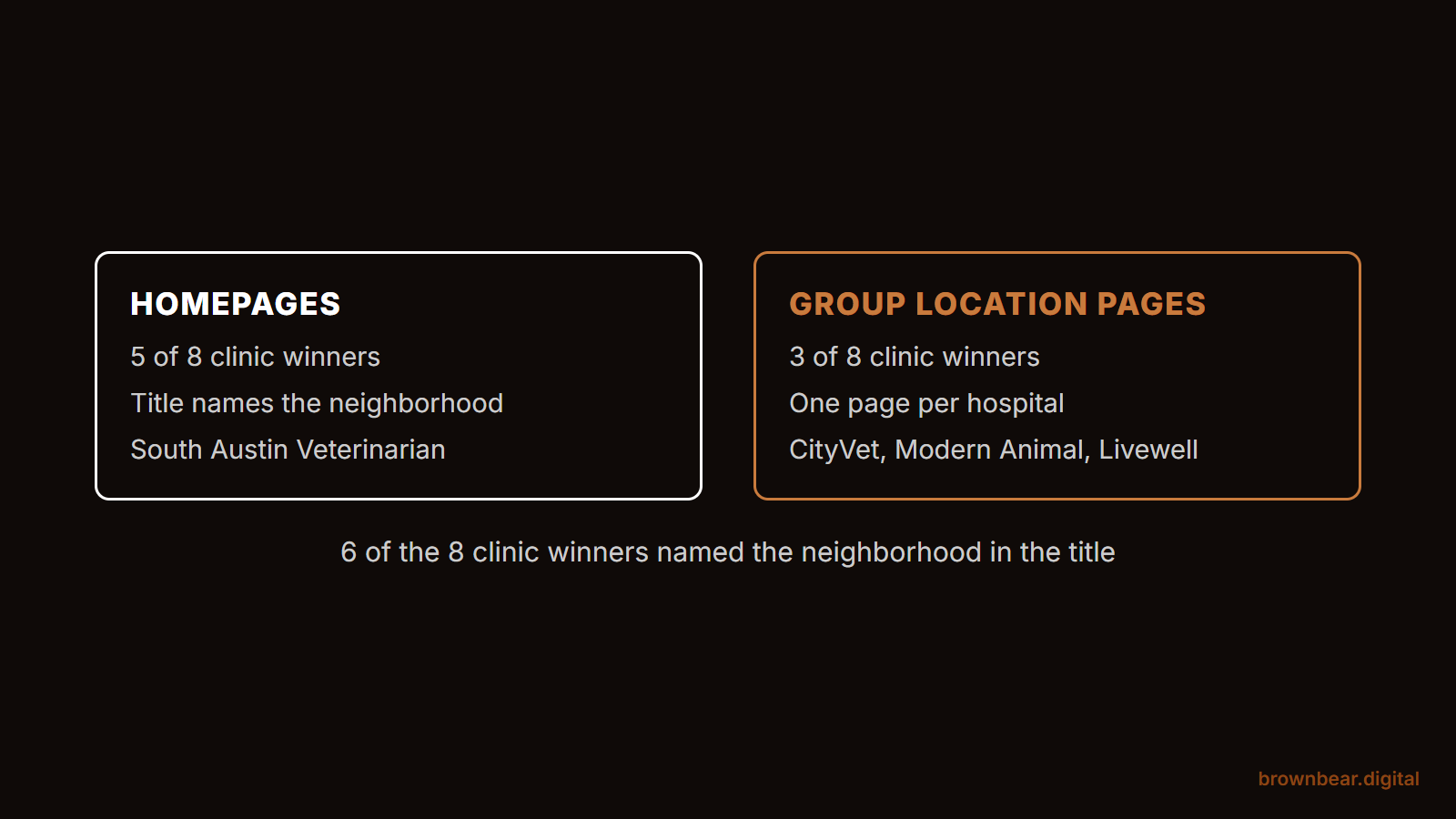
The two clinics that ranked without the neighborhood in the title, Mobley Veterinary Clinic and 5 Points Animal Hospital in east Nashville, used "Veterinarian in Nashville, TN." They still ranked, but they left the most specific match on the table.
Here's how to set this up. If you run one hospital, make your homepage the neighborhood page: put the neighborhood and city in the title and the H1, and name the two or three areas most clients drive from in the first paragraph. If you run two or more, build one location page per hospital and give each the treatment a homepage would get. A single "Locations" list that names every neighborhood makes no page the best answer for any of them. Your Google Business Profile does the work in the map pack above these results, and we covered profiles and reviews in the marketing guide linked above.
Pet Health Questions Are the Lane Clinics Actually Win
Clinic and hospital blog posts held 5 of the 9 top-three spots for "dog limping," "cat not eating" and "dog ear infection." The winners were Montclair Pet Hospital, BluePearl's Irvine hospital, Garden State Veterinary Specialists, Advanced Veterinary Medical Center and Banfield. PetMD held two spots and Reddit two. The clinic posts ran a median of about 1,400 words, and Google showed an AI Overview on all three searches.
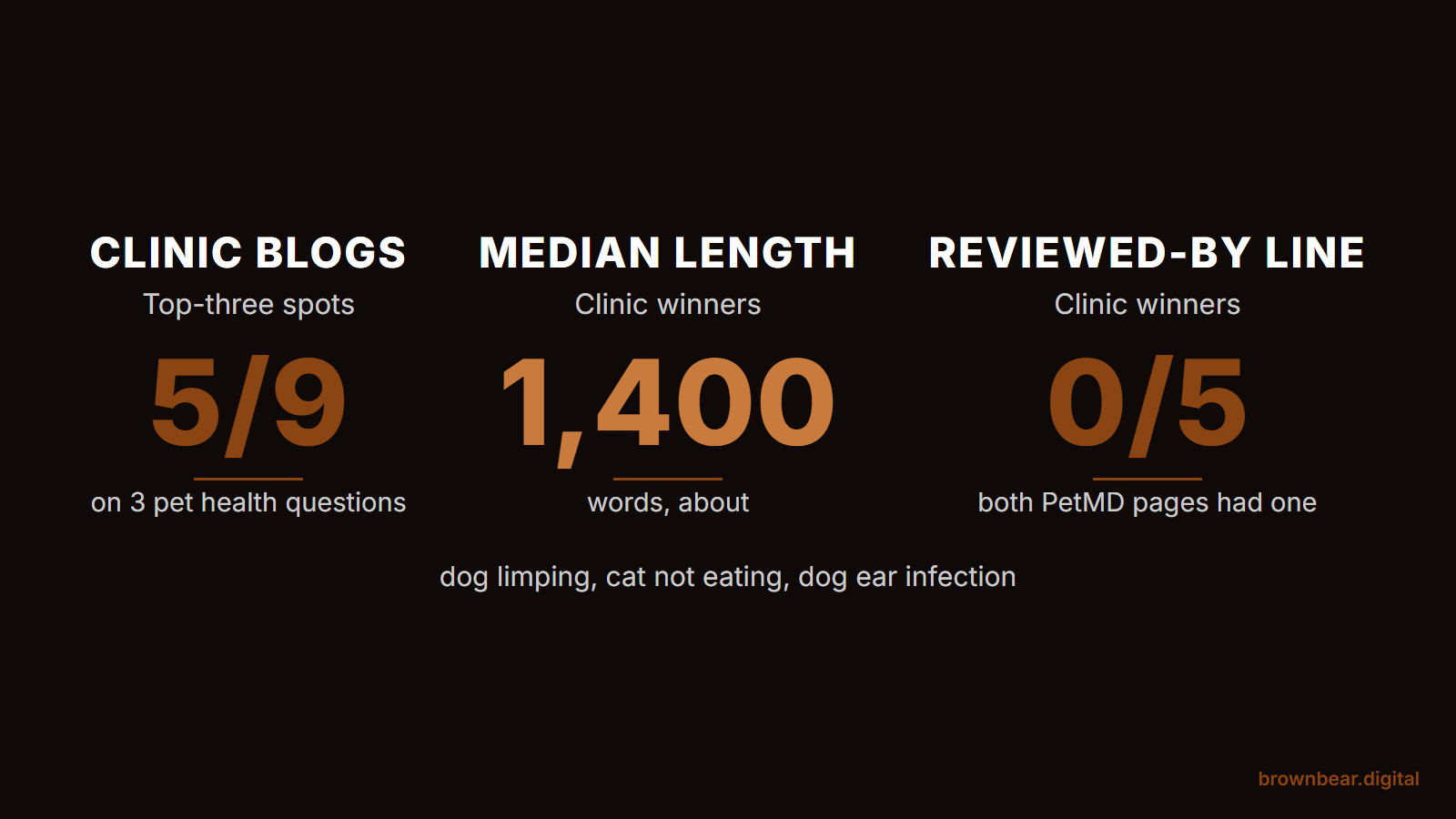
The gap is trust markup on the page. Neither PetMD page left it out: both carried a line naming the veterinarian who reviewed it. None of the five clinic posts did. Google says its systems give even more weight to strong E-E-A-T on health topics, and pet health falls under the stricter standard for health pages. A clinic post that names its author, their degree and the date a vet reviewed it gives that signal for free.
Write pet health pages from the questions your front desk hears, in this order:
- Answer the question in the first two sentences, including when it's an emergency.
- List the signs that mean "come in today" and the ones that can wait for a regular visit.
- Explain what the visit involves and what it might cost, then link to the matching service page.
- Put the vet's name, degree and a reviewed date at the top, and a booking link at the end.
Two of the nine spots went to Reddit threads where pet owners ask each other the same thing, which tells you the question behind the search is usually "is this serious?" Lead with that answer.
Say your receptionists field five calls a week from owners whose dog is limping after a park visit. A vet on your team spends 30 minutes outlining what she tells those callers: rest for 24 hours, the signs of a fracture, when swelling means come in today. That outline becomes a page called "My Dog Is Limping: When to Worry," with her name and a reviewed date at the top. It answers the search, and it books the dogs that do need to be seen.
Vet Bio Pages and Credentials Google Can Read
Sixteen of the 27 clinic pages in the top three named a veterinarian or a credential in their text. On specialty searches, the credential pages ranked on their own: the American College of Veterinary Dermatology's listing for an Austin dermatology clinic held #3 for "veterinary dermatologist austin," and a Feline Veterinary Medical Association job post for CatsOnly held #3 for "cat only vet denver."
Give every veterinarian a bio page with their degree, school, years in practice, the species and services they focus on, and board certification where they hold it. Only use "specialist" for a vet who is board-certified, because veterinary ethics rules and state boards reserve the word. Link each service page and pet health page to the vet who does or reviews that work. If your vets belong to a specialty college or a feline or exotic association, make sure their directory listing exists and links back to you, since those listings ranked in our pull.
Titles and H1s: Name the Service and the Place
Seventeen of the 22 local clinic pages in the top three put the city or neighborhood in the title tag, usually next to the service or the word "veterinarian." Seven of the 22 had no usable H1 at all, just an empty heading or the words "Welcome to." The title tag carried those pages.
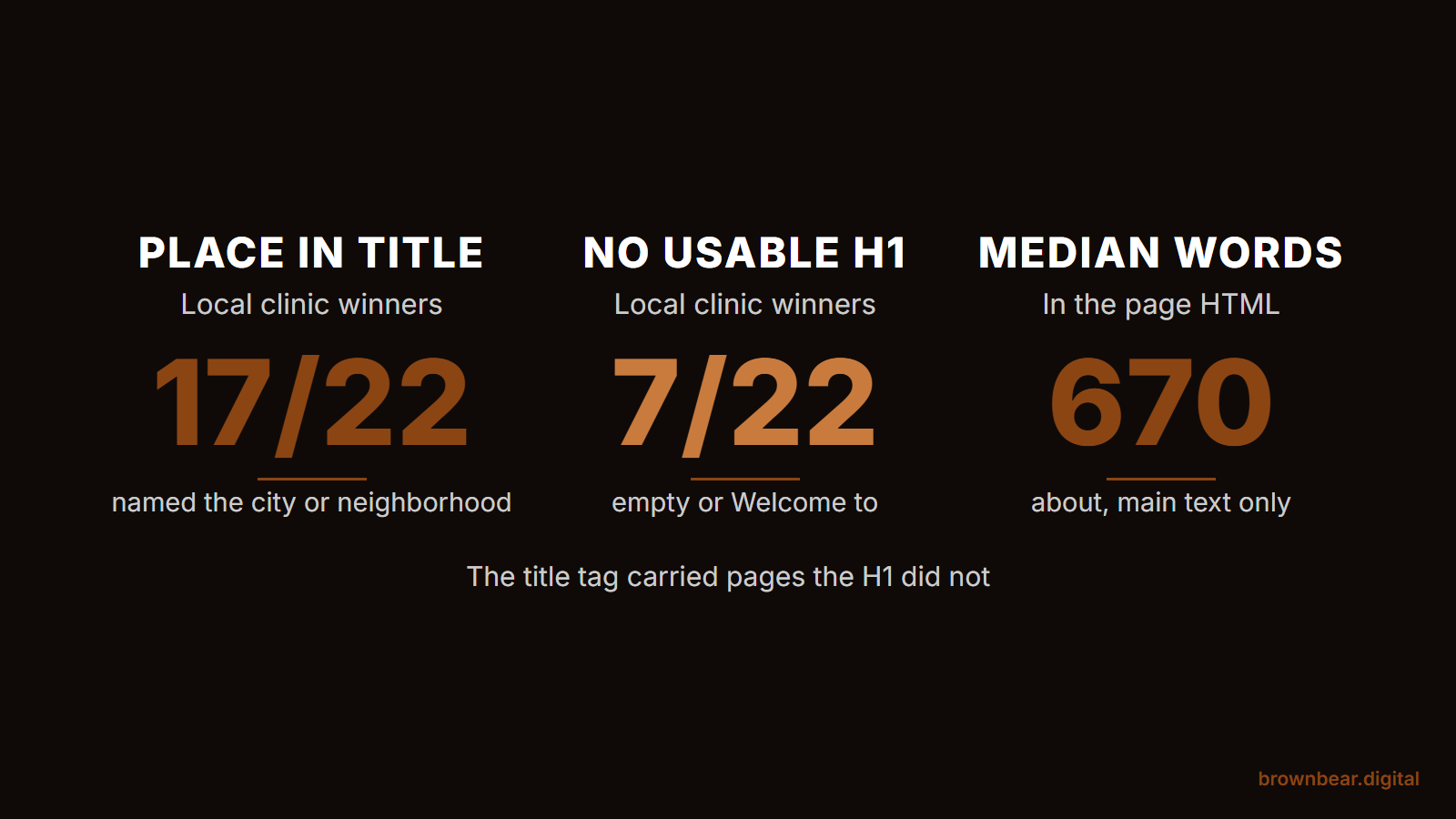
That doesn't make the H1 optional. It means a clinic competing with these pages can out-build them with an hour of work. The on-page rules from the study:
- Title: service or "Veterinarian," then neighborhood and city, then clinic name, under about 60 characters.
- H1: the same idea in plain words, like "Cat Dental Cleaning in Charlotte."
- First paragraph: who you treat, where, and what makes the visit different, in two or three sentences.
- One page per search intent, so the spay page and the dental page don't compete with each other.
Check any page you have against what the top three carried:
Schema for Veterinary Websites: Worth Adding, Not Why Pages Rank
Only 9 of the 27 clinic pages in the top three carried VeterinaryCare or LocalBusiness schema, and only 6 used VeterinaryCare. One, Modern Animal's Cherry Creek page, marked up a review rating. The other 18 ranked without any veterinary or local business markup.
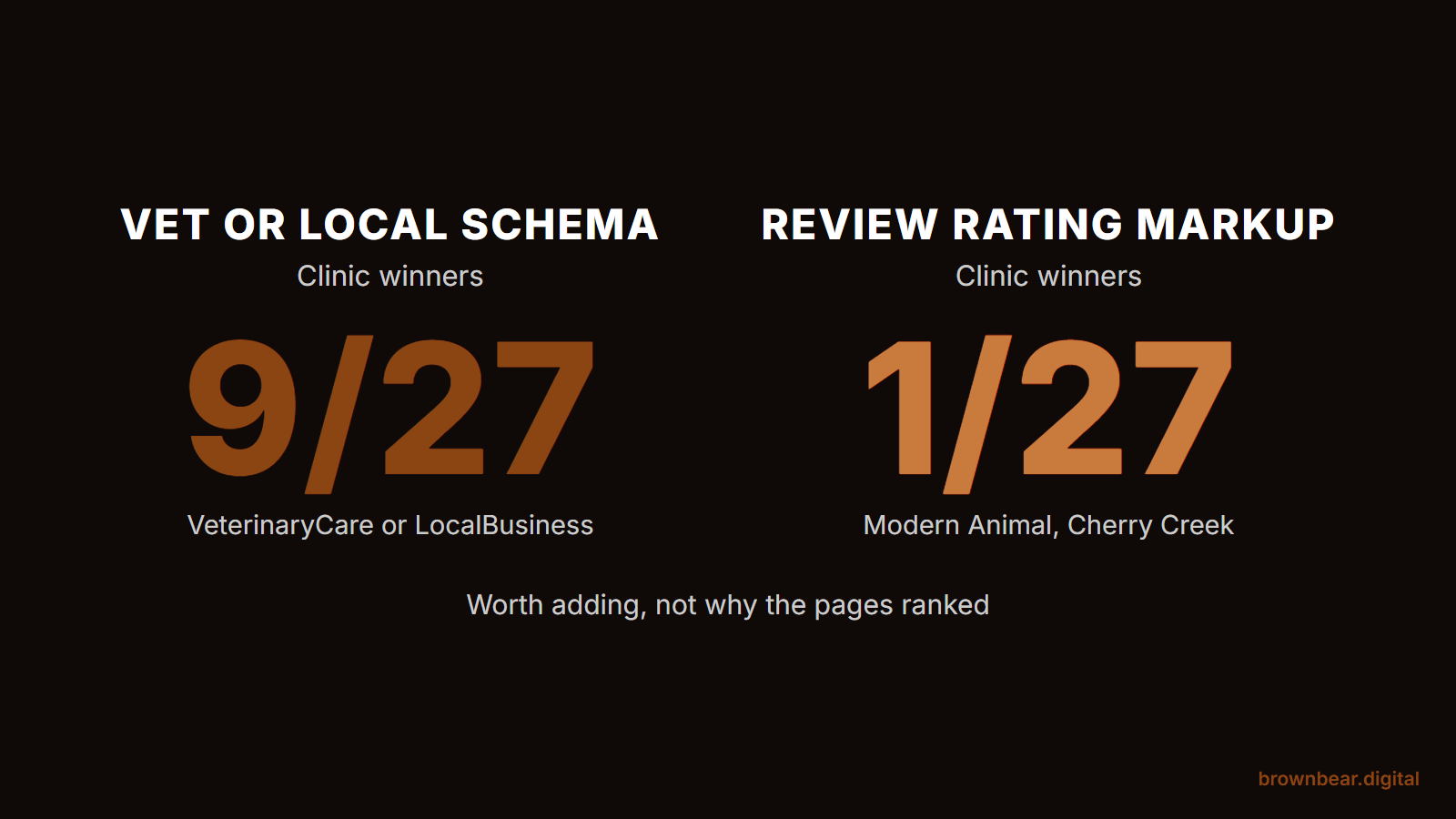
That matches Bryan's view from medical practices: schema is worth having, but it is rarely the lever that moves rankings or AI visibility. Crawlable pages with clear answers matter more. Add it anyway, because it costs little and removes guesswork. Use schema.org's VeterinaryCare type, which defines itself simply as "a vet's office," on your homepage and each location page, with the address, phone, hours, coordinates and links to your listings. Mark up vets as people on their bio pages, and articles with an author on pet health pages.
Technical SEO: Make Sure the Words Are in the HTML
Five of the 22 local clinic pages in the top three had fewer than 300 words of main text in the HTML a crawler first receives. Some were thin pages. Others loaded their copy with scripts after the page arrived. Google renders scripts, so these pages still ranked. Many AI crawlers don't.
Vercel's analysis of AI crawler traffic found that none of the major AI crawlers it tested, including OpenAI's and Anthropic's, rendered JavaScript. In Bryan's work on medical practice sites, Brown Bear strips large amounts of JavaScript off client sites for this reason. Our guide to what AI crawlers miss on a practice site shows how to check yours: view the page source, search it for your main heading and first paragraph, and if they aren't there, the copy is arriving by script.
The rest of the technical list is short for most clinic sites:
- One clean URL per page, with old URLs sending a 301 redirect to the new ones
- A sitemap that lists every service, location, bio and pet health page
- Fast loading on a phone, because many owners search with a worried pet next to them
- Booking widgets and chat tools that load after the main content, not before it
If the site can't pass those checks, rebuilding the clinic site on a lighter template is often cheaper than patching it page by page.
Listings, Links and the AI Answers Above the Results
Your name, address and phone number should match everywhere a pet owner or a crawler might look: Google, Apple Maps, Bing, Yelp, Facebook and the vet directories you belong to. In Bryan's AI visibility audits, odd variations in a business's name, address or phone number across listings are the most common actual error he finds. Clinics are prone to it after a move, a sale or a new phone system.
Links that help a clinic are local and earned: the shelters and rescues you work with, local news when your team does something worth covering, the specialty and feline associations whose directories already rank, and the referral hospitals you send cases to. Skip paid link packages. A handful of real local links does more than a few hundred from sites no pet owner reads.
AI answers sit above much of this. Google showed an AI Overview on 6 of our 16 searches, including all three pet health questions, but on none of the three neighborhood searches. The biggest surprise for most practice owners in Bryan's experience is how much third-party sites, like review sites, directories and associations, shape what AI tools say about them. Consistent listings, bio pages with credentials and pet health pages with a named reviewer are the same work that earns AI search visibility for vet clinics.
A 12-Month Veterinary SEO Build Order
Build in the order the study ranks the lanes: fix the pages that already compete, then add the pages that win most often, then the long game.
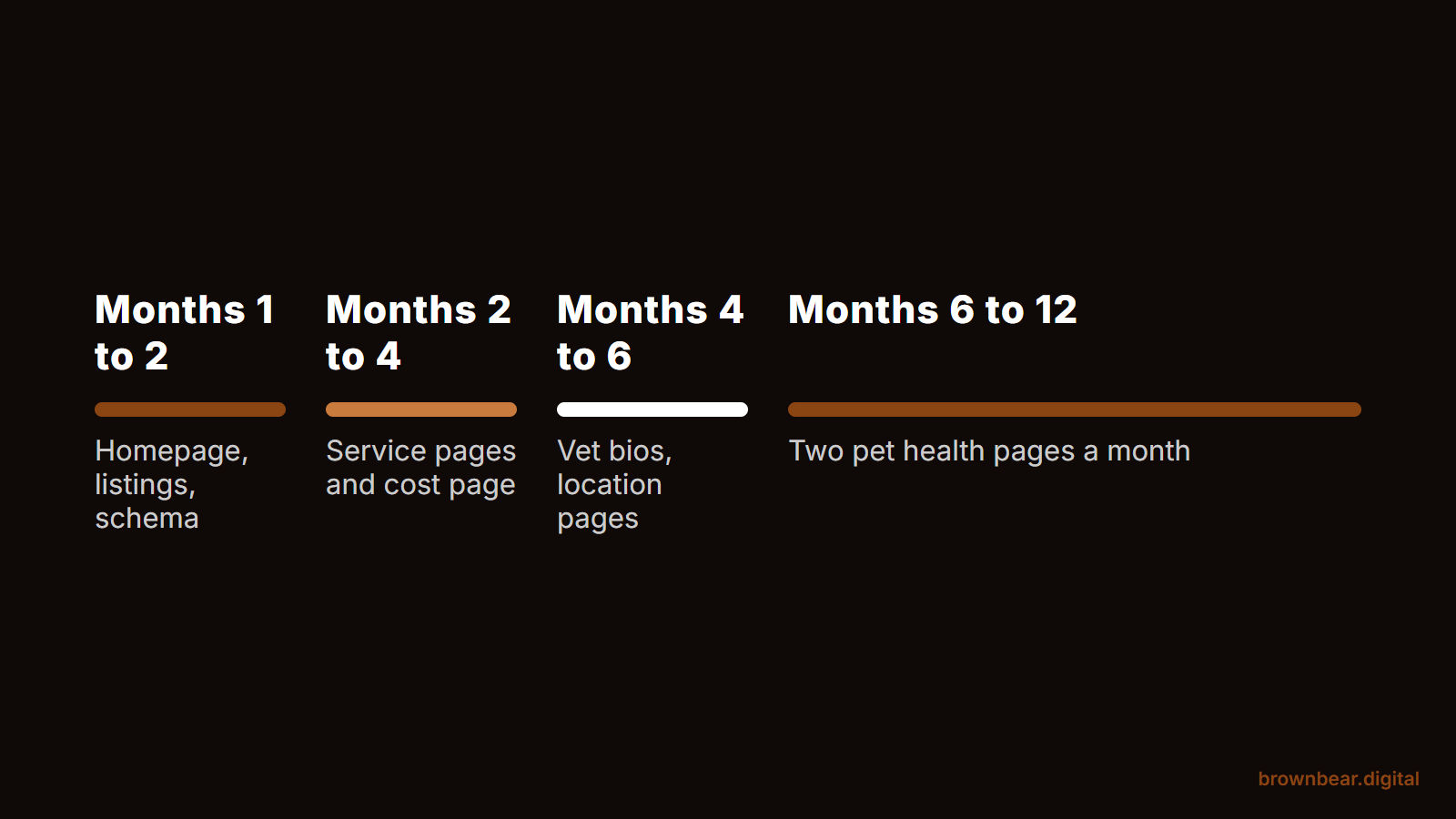
- Months 1 and 2: rewrite the homepage title, H1 and first paragraph around your neighborhood, clean up your listings, add VeterinaryCare schema, and check that your copy is in the HTML.
- Months 2 to 4: build your five most-billed services as service pages with prices or ranges, and a cost page.
- Months 4 to 6: add a bio page for every vet, and a location page for every hospital if you have more than one.
- Months 6 to 12: publish two pet health pages a month from your front desk's call log, each reviewed by a named vet.
If you run a group, move location pages to month one, because every hospital without its own page is a neighborhood you aren't competing for. If you're a specialty or exotic practice, move vet bio pages forward too, since credentials are what your searches turn on.
How to Measure Veterinary SEO, and How Long It Takes
Measure veterinary SEO by page type and by booked visits, not by a single ranking. In Search Console, group clicks by template: homepage and location pages, service pages, pet health pages, cost page. In your Business Profile, track calls and direction requests. In your practice management system, record how each new client found you, and count booked new-client exams from organic search and the map pack each month.
Timing depends on the page. A title or homepage fix is read as soon as Google recrawls the page. New service and pet health pages need months to settle, and a neighborhood you've never targeted takes longer still. Judge the program at six and twelve months against booked new-client exams, and use the payback calculator in our marketing guide to turn that into revenue.
Veterinary SEO for Independent Practices, Multi-Hospital Groups and Specialty Clinics
Veterinary SEO is for any clinic that wants pet owners to find its own pages before a directory, a shelter or an app. Before you pick a path, check how many hospitals you run and whether your clients search for a service, a place or a species.
For independent practices with one hospital
Paz Veterinary's south Austin hospital held #1 for "vet south austin" with a homepage titled "South Austin Veterinarian," and Manchaca Road Animal Hospital held #2 with "Veterinarian In South Austin." Neither needed a location page, because the homepage was the location page. An independent clinic should make its homepage name the neighborhood, then build service pages with prices, since that's the lane where shelters now beat private practices.
For groups with two or more hospitals
Three of the 8 clinic pages on neighborhood searches were group location pages: CityVet's south Austin page, Modern Animal's Cherry Creek page and Livewell's east Nashville page. Each named its neighborhood in the title and carried that hospital's own details. A group should give every hospital a page like that, and its own Business Profile, before it writes a single blog post.
For specialty, cat-only and exotic practices
CatsOnly held #1 and #2 for "cat only vet denver," Exotic Pet Vets held #1 and #3 for "exotic vet phoenix," and Central Texas Veterinary Specialty and Emergency Hospital's allergy and dermatology page held #1 for "veterinary dermatologist austin" with fewer than 200 words in its HTML. Specialty searches turn on the species or specialty word and the credential behind it. A niche practice should put that word in every title and back it with bio pages and association listings, since two of the nine specialty spots went to association pages.
How to Choose a Veterinary SEO Agency
A good veterinary SEO agency starts with your pages, not a keyword report. It can show you, lane by lane, which of your searches a clinic page can win, which page should win each one, and what the pages ranking above you carry that yours don't.
Before you sign, ask for four things:
- A page plan sorted by lane: neighborhood, service, species, pet health and cost.
- A look at your current pages' HTML, showing whether your copy, headings and schema are there for crawlers.
- Who writes your pet health pages, and how a vet on your team reviews them.
- Reporting on booked new-client exams by page type, not just rankings and traffic.
If a proposal treats a cats-only clinic the same way it treats a three-hospital general practice group, it hasn't looked at your searches.
Get a Veterinary SEO Plan From Brown Bear
Veterinary SEO pays off when each search near your door has a page built to answer it: your neighborhood, your services and prices, your vets and the questions your clients ask. Bryan worked with veterinary clinics earlier in his career, and Brown Bear starts with that page plan for your market, then builds the pages, the schema and the listings behind them. If you want to see where your clinic stands, start with our veterinary SEO and marketing for independent clinics.
Written By
Founder, Brown Bear Digital
Bryan has 15 years of experience across SEO, paid search, and AI search strategy. He founded Brown Bear to give businesses direct access to senior-level search expertise without the agency overhead.
Learn More About BryanGet Found on Google.
Get Cited by AI.
Tell us about your site. We'll send back a proposal for SEO and AI search.